Article

Effects of Bike Trails on Roe Deer and Wild Boar Habitat Use in Forested Landscapes

1
Department of Forest Protection and Wildlife Management, Mendel University in Brno, Zemědělská 3, 613 00 Brno, Czech Republic
2
Department of Biology and Ecology, University of Ostrava, 30. Dubna 22, 701 03 Ostrava, Czech Republic
3
Institute of Vertebrate Biology, Czech Academy of Sciences, Květná 8, 603 65 Brno, Czech Republic
*
Author to whom correspondence should be addressed.
Sustainability 2026, 18(2), 1030; https://doi.org/10.3390/su18021030
Submission received: 13 November 2025 / Revised: 12 January 2026 / Accepted: 16 January 2026 / Published: 19 January 2026

Abstract

Outdoor recreational activities, particularly cycling and mountain biking, are rapidly expanding in forested landscapes, raising concerns about their effects on wildlife. Although bike trails are increasingly common, their ecological impacts on large mammals remain insufficiently studied. We investigated how bike trail use influences the abundance and spatial behaviour of roe deer (Capreolus capreolus) and wild boar (Sus scrofa) in three contrasting forest environments in the Czech Republic. We surveyed roe deer raking and bedding sites and wild boar rooting along 734 transects positioned perpendicular to bike trails, monitored cyclist activity using automated counters, and recorded habitat characteristics. Generalized linear mixed models were used to evaluate the effects of trail proximity, cycling intensity, and vegetation structure. Cycling intensity did not influence overall species abundance; however, roe deer consistently avoided resting close to trails, leading to a measurable loss of potential resting habitat. Roe deer raking decreased with higher cycling intensity at the most remote site, while wild boar rooting was driven primarily by vegetation structure. These findings demonstrate that even low-intensity recreation can alter wildlife behaviour. We recommend maintaining unmanaged buffer zones along trails to provide refuge and reduce disturbance. Our results offer guidance for sustainable trail planning in forest ecosystems. Our conclusions are based on sign surveys collected during one growing season and quantify spatial responses up to 100 m from trails; diel activity, detectability, and seasonal variation were not directly assessed.

1. Introduction

Outdoor recreational activities constitute a fundamental aspect of life in economically developed countries, significantly contributing to physical and mental well-being [1]. Beyond their health benefits, these activities hold substantial economic importance, helping to sustain employment and supporting the economic vitality of regions beyond industrial and administrative centres [2]. Moreover, in numerous countries, outdoor recreation plays a crucial role in the economically sustainable management of protected areas [3,4]. Given these multifaceted advantages, governments actively promote such seemingly beneficial and non-conflicting activities by investing in infrastructure tailored for tourists, cyclists, mountain bikers, skiers, and other outdoor enthusiasts. The demand for outdoor recreation has increased markedly over recent decades, with the growing prevalence of urban lifestyles, accompanied by higher disposable income and leisure time [5]. Concurrently, technological advancements have expanded recreational opportunities, with innovations in equipment such as mountain bikes, e-bikes, and functional outdoor apparel enhancing accessibility and experience [6].
Outdoor recreational activities in forested landscapes, including mountain biking, have increased markedly in recent decades [7,8,9], raising concerns about their potential impacts on wildlife and forest ecosystems [10,11,12,13].
The ecological impact of specific tourist activities is receiving increasing attention, with research aiming to establish sustainable tourist-carrying capacities that minimize threats to landscape diversity. Although tourism does not induce landscape transformations as profound as those caused by agriculture or commercial forestry, the sustained pressure it exerts can, in certain remote areas, pose a more substantial threat to sensitive species than conventional land use practices [14]. Tourism activities can have both direct and indirect effects on soil properties, vegetation composition, and wildlife populations [15,16,17]. The extent of tourism-induced ecological disturbances depends on multiple factors, including the type, intensity, and seasonality of recreational activities, as well as the resilience and sensitivity of local plant and animal species [18,19]. The overall stability and regenerative capacity of the ecosystem also play a crucial role, with mountain ecosystems being particularly vulnerable [20]. Additionally, tourism has been identified as a driver of invasive species introduction and spread [21,22], further exacerbating ecological pressures. It can also pose a direct threat to endangered species through habitat degradation, disturbance, and altered interspecific interactions [23,24]. The effects of tourism on wildlife are well-documented, with observed shifts in species behaviour, spatial distribution, daily activity patterns, migration routes, feeding strategies, and reproductive success [16]. Beyond direct disturbances, tourism can also impact wildlife indirectly, by altering foraging opportunities, reducing habitat cover, or modifying predator–prey dynamics [25].
Mountain biking has experienced substantial growth across Europe in recent years and is currently undergoing a significant expansion in central Europe. This trend is largely driven by the increasing recognition of cycling as both a health-promoting activity and an environmentally sustainable mode of transport and recreation. A key factor contributing to the rise in recreational cycling intensity is the widespread adoption of electric bicycles, which enable individuals with lower physical fitness levels to travel greater distances with ease [26]. In response to this growing demand, cycling infrastructure has evolved to include off-road cycle paths that integrate with existing networks of villages, marked forest-road hiking trails, and dedicated ‘single-trail’ mountain bike trails traversing forested landscapes. From an ecological perspective, the most significant potential impacts of mountain biking arise from bike trails that extend beyond established forest paths, encroaching on natural habitats and increasing the likelihood of disturbance to wildlife [27]. In particular, large animals may experience habitat displacement due to a reduction in available undisturbed shelter sites. Additionally, the construction and use of bike trails have been linked to vegetation degradation [28,29,30], soil erosion [31], and increased disturbance of large ungulates and avian species [32,33]. Wildlife responses to such disturbances vary; some species exhibit heightened vigilance and increased locomotion, leading to elevated energy expenditure [34]. Prolonged exposure to these disturbances may compel animals to relocate to suboptimal habitats, where reduced foraging opportunities and increased predation risk can negatively affect population viability [35,36]. In some cases, species may exhibit habituation to human presence over time, potentially altering their natural anti-predator behaviours and increasing their susceptibility to predation [25].
Most existing studies assessing the impact of cyclists and mountain bikers on natural ecosystems have primarily focused on established and intensively used cycle paths along forest roads [26,37,38,39]. While such routes accommodate high volumes of cyclists, they are typically sparse in distribution and rarely extend into inaccessible terrain, leaving a substantial proportion of forest landscapes largely unaffected. Consequently, although a considerable number of cyclists may traverse these designated bike trails, wildlife generally has sufficient opportunity to avoid human disturbance. In contrast, the ecological impact of single-track mountain bike trails remains poorly understood. These bike trails, while often used only seasonally, tend to form dense networks, with riders seeking a wide range of difficulty levels, including highly technical descents from remote and otherwise undisturbed locations [40]. Furthermore, such bike trails are typically narrow, one-way paths, which, despite their limited per-hour throughput, sustain near-continuous traffic due to the high frequency of cyclists. Additionally, mountain bikers are often motivated by adrenaline and novelty, frequently venturing onto unauthorized or self-created bike trails, further expanding the extent of human disturbance [41]. As a result, even if the absolute number of cyclists remains constant, their cumulative impact on wildlife may be substantially greater, as the increasing spatial reach of these bike trails progressively reduces the availability of undisturbed refuges for animals [41].
Despite the ongoing expansion of bike trail networks, there remains a lack of systematically verified data on their impacts on larger wildlife species. This highlights the urgent need to assess the ecological consequences of existing bike trails. Given that roe deer (Capreolus capreolus L.) and wild boar (Sus scrofa L.) are widely distributed and present across nearly all trail sites in Central Europe, these species are particularly susceptible to potential disturbances caused by cycling activities [42].
In this study, we examined whether bike trails influence the spatial behaviour of large ungulates in forested landscapes. Specifically, we tested (i) whether the occurrence of roe deer resting sites and raking activity varies with distance from bike trails and cy-cling intensity, (ii) whether these responses differ among sites with contrasting levels of recreational use, and (iii) whether wild boar rooting activity is associated with bike trail proximity and cycling intensity or is primarily related to habitat structure. By addressing these questions, we aimed to disentangle behavioural responses to recreational disturbance from habitat-driven patterns.

2. Materials and Methods

2.1. Study Sites

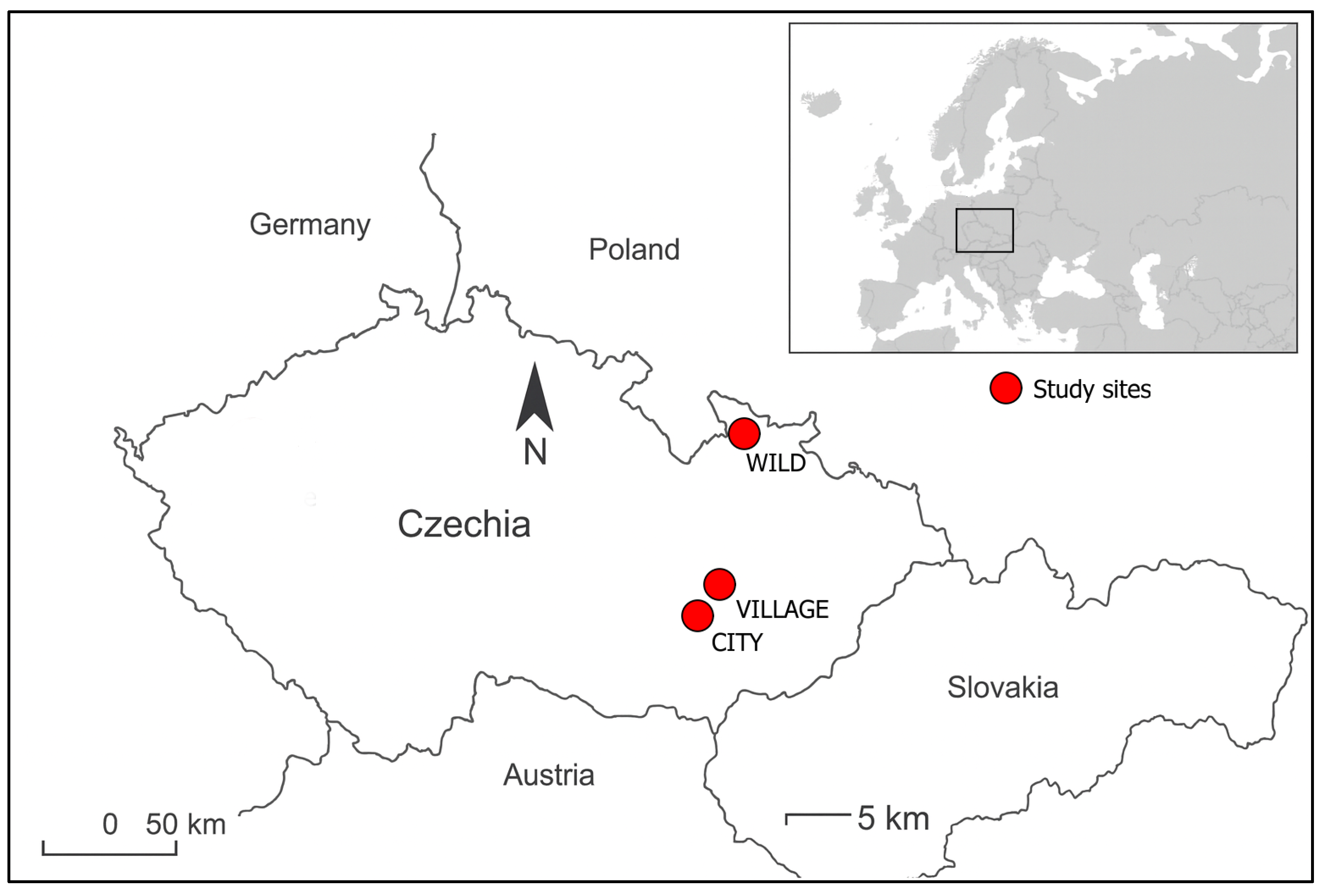
Data were collected between June and October 2020 at three locations in the Czech Republic, each featuring established bike trails: Brno, Jedovnice, and the Rychlebské Mountains region. These sites, hereafter referred to as CITY, VILLAGE, and WILD (Figure 1), respectively, differ in the overall intensity of tourist activity and key environmental parameters (Table 1). The CITY site was situated within a forested landscape characterized by hilly terrain and a dense network of hiking and biking trails, as well as forest roads, directly adjacent to the urban area of a large city, Brno. This site experiences high-intensity, year-round recreational use, predominantly by city residents. The VILLAGE site, near Jedovnice, was situated in a semi-rural landscape close to several villages. While the site is easily accessible to residents of larger cities, recreational activity is primarily concentrated on weekends, with a lower level of tourism observed on weekdays. The WILD site, located in the Rychlebské Mountains region, is relatively remote, with a low population density and limited proximity to major towns or villages. Recreational use here is less intensive compared to the CITY and VILLAGE sites, with the majority of tourist activity occurring during the summer months and minimal winter recreation.
Data on hunting bag (i.e., numbers of harvested individuals) and estimated population abundance of roe deer and wild boar were obtained from official hunting statistics provided by the regional authority. This authority compiles annual records reported by individual hunting grounds, including both the total number of harvested animals and administratively derived estimates of population size.
Approximate density values were calculated from these official population estimates by relating estimated abundance to the total area of the corresponding hunting grounds. Both hunting bag data and population/density estimates represent secondary data sources reflecting broader, landscape-scale population levels. They were used exclusively to provide contextual background for the study sites and were not included as response or explanatory variables in the statistical analyses.

2.2. Data Collection

The number of cyclists using each bike trail was monitored using seventeen Zelt Evo automated Eco-Counters (Eco-Counter, San Diego, CA, USA), deployed across the study sites from June to October 2020. Specifically, seven counters were installed at the CITY site, six at the VILLAGE site, and four at the WILD site. Each counter was strategically placed to capture the total number of passages on a single designated bike trail, with one Eco-Counter positioned per trail.
Raw counter data were recorded at an hourly resolution and subsequently aggregated to obtain the mean number of cyclists per kilometre per day for each trail over the monitoring period. These aggregated values were used as a continuous covariate representing cycling intensity in the statistical analyses.
The presence of roe deer and wild boar was assessed through systematic surveys of residence signs along 5 × 100 m transects at each site during the growing season (i.e., June–October 2020). Transects were oriented perpendicular to the bike trail, with the starting point located at the bike trail’s edge. The approximate positions of transects were predefined using topographic maps but were adjusted in the field to avoid areas where local conditions (e.g., fences, buildings, recently harvested stands, or unmarked roads) might interfere with the detection of animal signs. On each trail, transects were spaced at approximately 100 m intervals, and each transect’s starting location was georeferenced using GPS. Each transect was subdivided into five 5 × 20 m sampling plots, where the following indicators of animal presence were recorded: Roe deer: number of raking signs and number of bed sites; Wild boar: total area of rooting activity. In total, data were collected from 734 transects, distributed as follows: 271 in CITY, 240 in VILLAGE, and 223 in WILD.
Roe deer bed sites were identified as clearly visible resting depressions on the ground surface or in the herb layer, characterized by flattened vegetation or disturbed litter consistent with recent use. Roe deer raking signs were recorded as ground-based disturbance associated with territorial marking behaviour, including scraped or disturbed soil and vegetation. Only distinct and clearly recognizable signs were recorded in the field to ensure consistent identification. Wild boar rooting was identified by characteristic soil disturbance and overturned vegetation and was quantified as the total affected area within each sampling plot.
At each sampling plot, we recorded vegetation and stand structure parameters to assess habitat conditions. Specifically, we measured E1 (herbaceous layer): coverage and average height of the herbaceous vegetation; E2 (shrub layer): coverage of shrubs up to 2 m in height; E3 (tree layer): dominant tree species and average stand age, derived from available forest management records and stand maps.

2.3. Data Analysis

All analyses were conducted in R v.4.2.3 [43]. Because our data are hierarchical (segments nested within transects and trails) and the response variables are non-Gaussian, we used generalized linear mixed models (GLMMs), which allow us to model nested random effects and appropriate error distributions. Generalized linear mixed models (GLMMs) from the “lme4” package [44] were employed to determine significant differences in wildlife residence signs across study sites. Roe deer raking and bed signs were recorded as counts per plot and were analysed using negative binomial GLMMs to accommodate overdispersion in the count data (variance exceeding the mean) [45]. Wild boar rooting was recorded as a semi-quantitative rooting intensity index bounded between 0 and 1, reflecting the estimated proportion of rooting within a plot; this bounded response was therefore analysed using a binomial GLMM with a logit link (fractional logit approach), which constrains fitted values to the 0–1 interval.
The primary covariate used in the models was locality (CITY, VILLAGE, and WILD), with potential main explanatory variables including the number of cyclists per km per day, distance from the bike trail (categorized as 0–20 m, 20–40 m, 40–60 m, 60–80 m, and 80–100 m), and E1 (herbaceous layer) and E2 (shrub layer) coverage. Additional explanatory variables included the dominant tree species and tree age. To account for random effects, a hierarchical structure was implemented. Individual bike trails within each locality were treated as a random term, while individual transects (positioned perpendicular to the bike trails and spanning distances of 0–100 m) were nested within their respective bike trails. The distance of the sampling plot was included as a random slope term, allowing for potential variations in its effect across different bike trails and localities.
Final models were selected using a stepwise selection approach based on the Akaike information criterion (AIC), implemented via the “buildmer” package [46]. This selection process included all explanatory variables, second-degree polynomial terms for continuous variables, and their interactions. If any focal explanatory variables were removed during selection, these were reintroduced in the final model to evaluate their significance. To enhance model accuracy and computational efficiency, the default “bobyqa” optimizer was replaced with “nloptwrap”, and likelihood estimation was performed using the adaptive Gauss–Hermite quadrature approximation. Convergence was ensured by setting the tolerance for the penalized weighted residual sum of squares to 1 × 10⁻³ and increasing the maximum function evaluations to 1 × 10⁵. All quantitative explanatory variables were scaled to improve numerical stability. To improve convergence and computational efficiency, all final GLMMs were fitted using the “nloptwrap” optimizer with Laplace approximation. Convergence criteria were tightened by setting the tolerance for the penalized weighted residual sum of squares to tolPwrss = 1 × 10⁻³ and increasing the maximum number of function evaluations to maxfun = 1 × 10⁵. For count-type responses (roe deer raking, roe deer bed sites, and the combined residence-sign index), we used a negative binomial error distribution with fixed theta values (θ = 0.555, 0.4789, and 0.4796, respectively), whereas wild boar rooting was modelled with a binomial distribution and logit link. The statistical significance of fixed effects and their interactions was assessed using ANOVA from the “car” package [47]. In addition, to detect multicollinearity, the variance inflation factor (VIF) was computed, with explanatory variables potentially exceeding VIF > 2 excluded from the final model. Data visualization was conducted using the “jtools” version 2.3.0 [48], “interactions” [49], and “ggplot2 v3.5.1” [50] packages to illustrate significant fixed effects estimates.

3. Results

3.1. Number of Cyclists

The total number of cyclists varied significantly across study sites (Table 2). Trail use was lowest at the WILD site, with an average of 15.35 (±14.18) cyclists/km/day, primarily due to its limited seasonal use, with peak activity occurring in July and August. Cycling intensity was slightly higher at the CITY site, where the average reached 28.24 (±18.47) cyclists/km/day. However, both sites were greatly surpassed by the VILLAGE site, which recorded an average of 79.43 (±63.12) cyclists/km/day, i.e., approximately three times the cycling intensity observed at the other two sites.
Across all study sites, a total of 1037 roe deer beds, 1890 roe deer raking signs, and 2899 m2 of wild boar rooting area were recorded across 3670 sampling plots. The lowest sign densities for both species were observed at the WILD site, whereas the highest densities were recorded at the CITY site (Table 2).

3.2. Roe Deer Raking

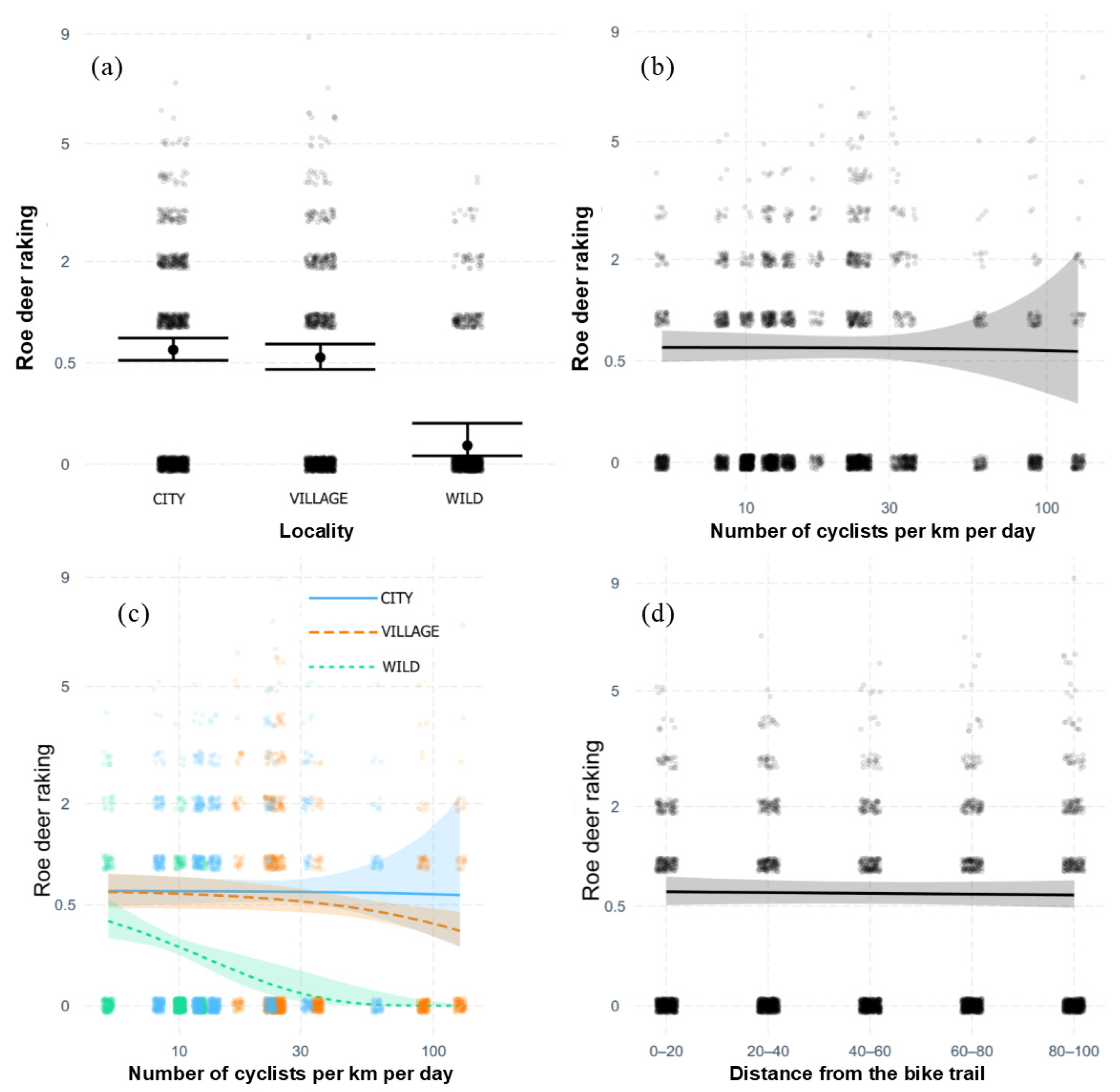
The prevalence of roe deer raking differed significantly among localities (χ2 = 53.24, df = 2, p < 0.001; Figure 2a), and was influenced by the number of cyclists per km per day (χ2 = 6.50, df = 1, p = 0.011; Figure 2b), with a significant interaction between these factors (χ2= 9.96, df = 2, p = 0.007; Figure 2c). In contrast, no significant effect was found for distance from the bike trail (χ2 = 0.12, df = 1, p = 0.726; Figure 2d) or E1 (herbaceous layer) and E2 (shrub layer) coverage (χ2 = 0.09, df = 1, p = 0.764; χ2 = 1.60, df = 1, p = 0.206, respectively). Specifically, there was no significant difference in roe deer raking between the VILLAGE and CITY sites (z = −0.89, p = 0.375), whereas a significant difference was observed between the WILD and CITY sites (z = −4.49, p < 0.001), indicating a lower density of roe deer raking at the WILD site. The number of cyclists per km per day had no significant effect on roe deer raking at the CITY site (z = −0.10, p = 0.924) or the VILLAGE site (z = −0.95, p = 0.343). However, at the WILD site, increasing cycling intensity was associated with a significant decline in roe deer raking density (z = −3.09, p = 0.002).

3.3. Roe Deer Beds

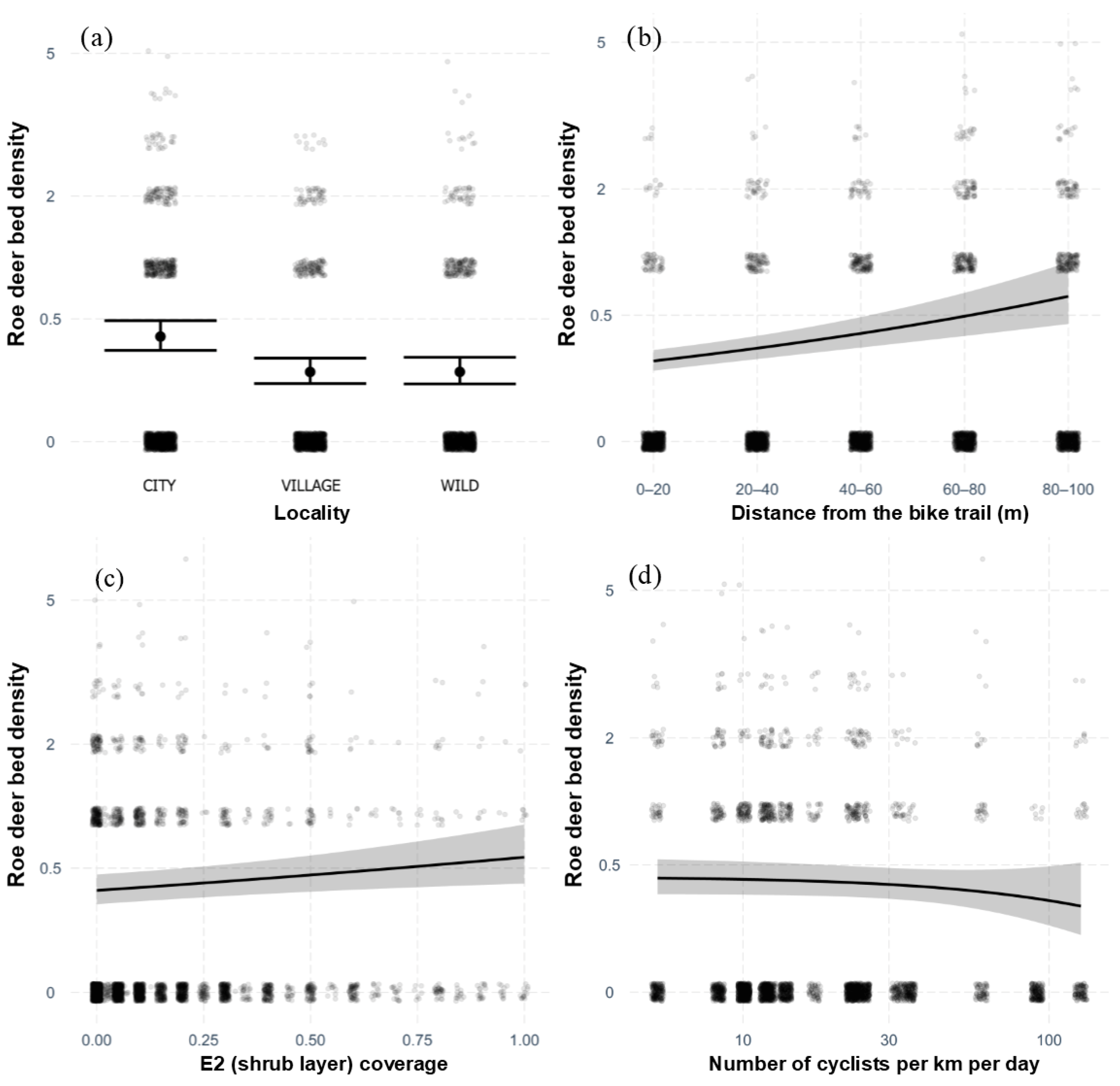
The density of roe deer beds differed significantly among localities (χ2 = 22.73, df = 2, p < 0.001; Figure 3a) and was affected by the distance from the bike trail, with bed density increasing significantly as distance from the bike trail increased (χ2 = 31.16, df = 1, p < 0.001; Figure 3b). Additionally, E2 (shrub layer) coverage had a significant effect, with higher coverage being associated with a greater density of beds (χ2 = 7.33, df = 1, p = 0.007; Figure 3c). In contrast, neither cycling intensity (number of cyclists per km per day) (χ2 = 1.54, df = 1, p = 0.214; Figure 3d) nor E1 (herbaceous layer) coverage (χ2 = 0.99, df = 1, p = 0.319) had a significant effect on bed density. More specifically, the CITY site had a significantly higher density of beds compared to both the VILLAGE (z = −3.67, p < 0.001) and WILD (z = −3.82, p < 0.001) sites, whereas no significant difference was found between the VILLAGE and WILD sites (z = −0.12, p = 0.725).

3.4. Beds and Raking

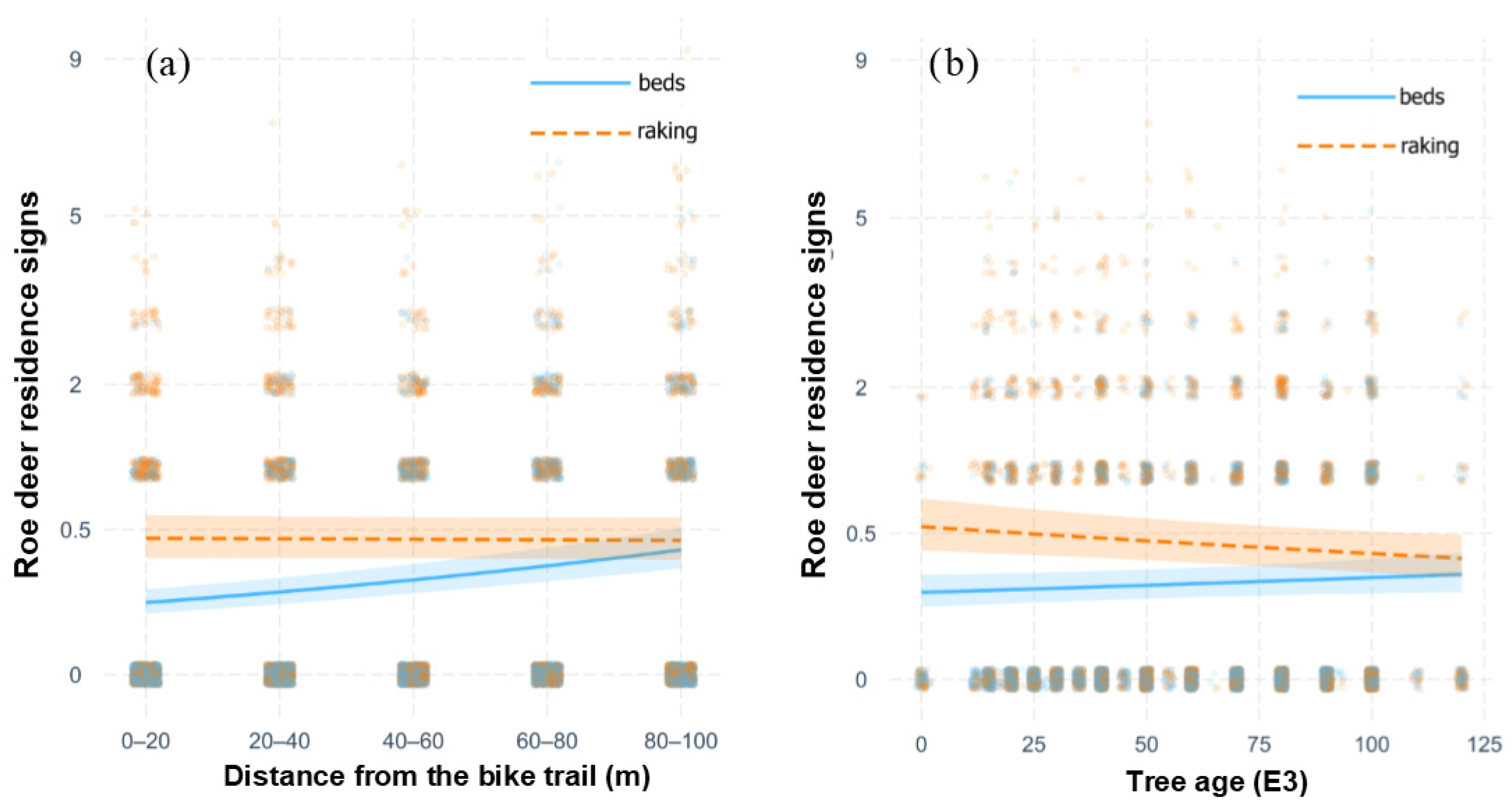
The density of roe deer raking was significantly higher than that of beds (χ2 = 21.77, df = 1, p < 0.001). Distance from the bike trail had a significant effect (χ2 = 50.98, df = 1, p < 0.001), with a significant interaction between sign type and distance from the bike trail (χ2 = 50.98, df = 1, p < 0.001, Figure 4a). Specifically, bed density increased with greater distance from the bike trail, whereas raking density remained unaffected. While neither raking nor beds were individually affected by the tree age (χ2 = 0.83, df = 1, p = 0.362), a significant interaction between sign type and tree age was observed (χ2 = 11.49, df = 1, p = 0.001; Figure 4b), indicating that raking density decreased while bed density increased with increasing tree age.

3.5. Wild Boar Rooting

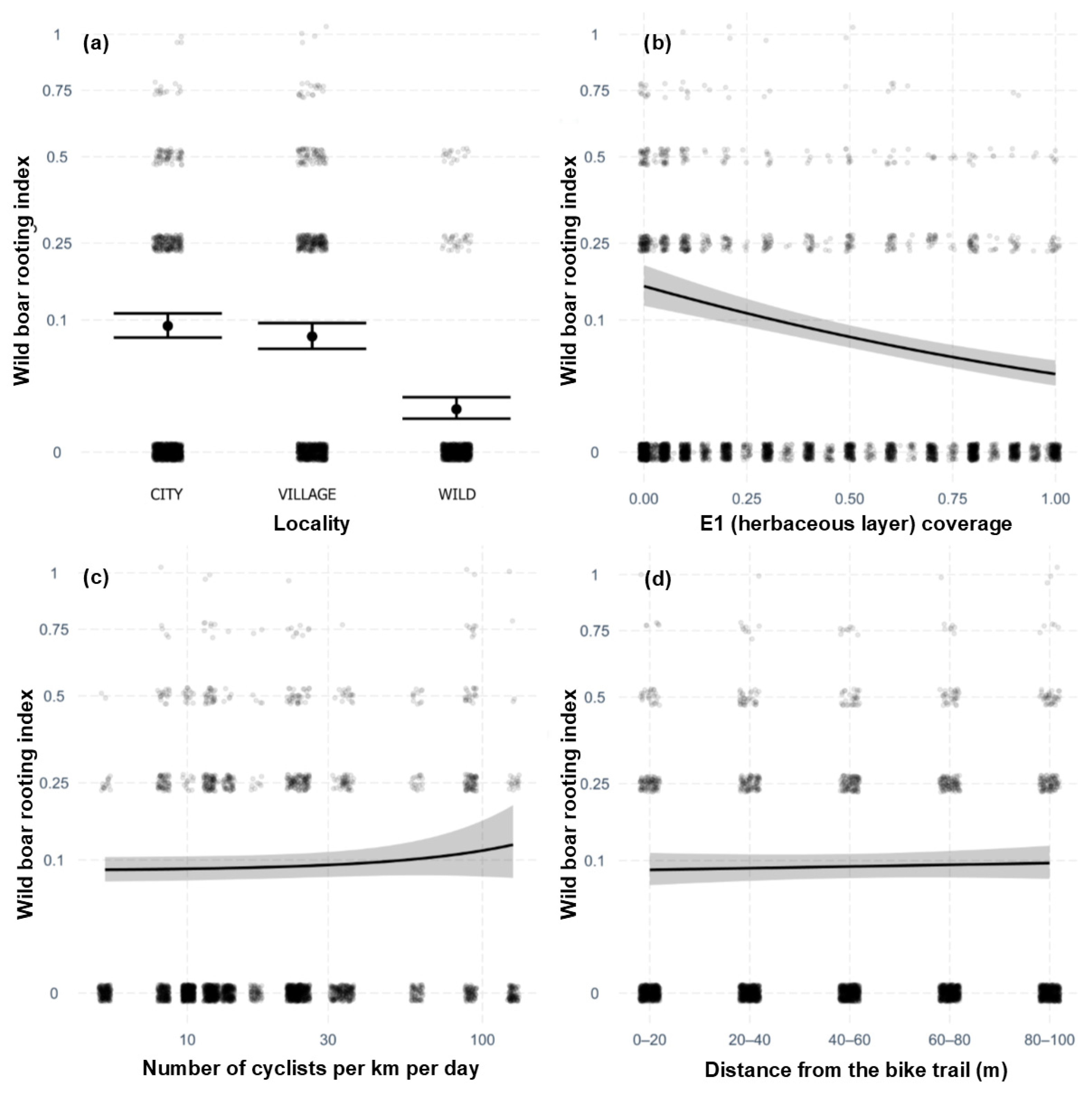
The intensity of wild boar rooting differed significantly among localities (χ2 = 66.55, df = 2, p < 0.001; Figure 5a), and was negatively influenced by E1 (herbaceous layer) coverage (χ2 = 47.82, df = 1, p < 0.001; Figure 5b). In contrast, cycling intensity (number of cyclists per km per day) (χ2 = 1.90, df = 1, p = 0.169; Figure 5c), distance from the bike trail (χ2 = 0.37, df = 1, p = 0.546; Figure 5d), and E2 (shrub layer) coverage (χ2 = 1.62, df = 1, p = 0.203) had no significant effect on rooting behaviour. A significantly lower rooting intensity was recorded at the WILD site (z = −8.06, p < 0.001), with no significant difference was found between the VILLAGE and CITY sites (z = −1.11, p = 0.268).

4. Discussion

In this study, we quantified how cycling disturbance and trail proximity relate to roe deer and wild boar habitat use across three sites differing in disturbance context. Roe deer raking varied among localities and showed a locality-specific response to cycling intensity, with a detectable decline only at the WILD site. In contrast, roe deer beds increased with distance from the trail and were positively associated with shrub-layer cover, indicating spatial avoidance near trails primarily in resting signs. Wild boar rooting differed strongly among localities and declined with increasing herb-layer cover, while cycling intensity and trail distance showed no detectable effects within the sampled 0–100 m range.
Large ungulates (including roe deer and wild boar) have, in many cases, successfully adapted to human-dominated landscapes, establishing stable populations even in areas of intensive anthropogenic use [51]. However, managing these populations at levels that balance both wildlife conservation and human economic interests remains a challenge [52,53]. Both roe deer and wild boar exhibit high spatial activity and are capable of responding to disturbances over considerable distances. Indiscriminate tourist activity can lead to site abandonment in areas experiencing excessive disturbance [54] or shifts towards increased nocturnal activity as an avoidance strategy [55]. Such behavioural adaptations may result in the concentration of animals in areas with lower tourist pressure and/or denser cover, potentially increasing local grazing pressure and influencing nutritional status [16]. Conversely, human-modified landscapes can also attract wildlife, particularly when anthropogenic food resources are available [56]. In some cases, certain species—such as wild boar—may become fully habituated to human disturbance, showing little or no avoidance behaviour [57].
In this study, we focused on the effects of tourist cycling activity in forest stands on roe deer and wild boar abundance and behaviour, as assessed through the presence of residence signs such as raking and beds for roe deer and rooting areas for wild boar. At our study sites, cyclist movement was largely confined to designated bike trails, with negligible off-trail activity, as confirmed by field observations and consistent with previous findings [58]. Cycling was also predominantly diurnal and seasonal, peaking during the forest growing season (June–October), as recorded by automated counters. This temporal pattern of use may reduce overlap with other recreational activities, particularly those dependent on undisturbed access, such as hunting, and thus indirectly affect wildlife behaviour.
Cycling intensity differed markedly among the three study sites. The CITY site showed relatively low levels of cycling activity, whereas the VILLAGE site experienced the highest visitation rates, and the WILD site showed intermediate levels of use. These differences provided a useful gradient of recreational pressure, allowing us to evaluate whether ungulate responses were consistent across sites or depended on local disturbance intensity.
Our analysis revealed that the total number of cyclists had no consistent effect on the overall abundance of roe deer and wild boar signs across the three study sites. However, a notable exception was observed in the WILD site, where increasing cycling intensity significantly reduced the number of roe deer raking signs, suggesting that raking signs (which can reflect territorial and rut-related behaviour) may be sensitive to even moderate recreational pressure in less disturbed landscapes. This highlights the importance of considering site-specific responses when evaluating the impacts of human activity on wildlife. Both species were present at all localities, and although the highest densities of signs were recorded at the CITY site, this pattern should not be interpreted as a biologically meaningful difference. Rather, these between-site differences may reflect a combination of unmeasured local factors—such as habitat quality, historical land use, predator presence, or hunting intensity—rather than the direct effects of recreational use. Most importantly, our results demonstrate a clear and consistent avoidance of bike trails by roe deer when selecting resting sites, with bed density increasing significantly with distance from the trail at all sites. This spatial shift in resting behaviour represents the most robust pattern identified in our study and suggests that bike trail proximity limits the availability of undisturbed refuge areas for roe deer, regardless of total visitor intensity. To some extent, this apparent lack of impact may be attributed to the nature of bike trail use (e.g., cyclists move faster than walkers, reducing the duration of potential disturbance). Additionally, the presence of cyclists may indirectly limit the activities of other users, such as hunters (see below). However, high ungulate densities in these areas contribute to economic, ecological, and veterinary risks. For example, roe deer are highly selective browsers, which can influence species diversity in both forest trees and herbaceous undergrowth [59]. Similarly, wild boar can severely limit natural tree regeneration by consuming seeds and fruits [60] and may negatively affect small animal populations through predation [61]. Furthermore, wild boar rooting behaviour can threaten ecologically valuable habitats by altering soil structure and vegetation [62,63]. Additionally, wild boar have been vectors of zoonotic diseases, with potential transmission risks to humans and domestic animals such as cats and dogs [64].
Despite intensive recreational use, both roe deer and wild boar continued to use areas close to bike trails, suggesting a behavioural adaptation to this form of disturbance. Although shifts towards increased nocturnality in ungulates in response to human recreational activity have been documented elsewhere [65], diel activity was not quantified in this study; thus, such temporal shifts are discussed as a plausible but untested mechanism rather than as direct evidence. This is consistent with predictions of the “fear landscape framework” [66], which posits that an animal’s risk perception is shaped by the availability of cover that can serve as a temporary refuge during periods of intense disturbance [67]. Recent studies [57] further suggest that such behavioural shifts are more pronounced in species exposed to repeated human disturbance. In this context, recreational activities may indirectly shape ungulate space use by altering the perceived risk landscape and the distribution of effective refuge areas within forest stands. However, our data indicate that both roe deer and wild boar continue to use areas close to bike trails, suggesting a behavioural adaptation to this form of disturbance. In such contexts, frequent recreational use may effectively create refuges from hunting, allowing ungulates to persist with reduced risk of harvest. Although this shift may offer short-term benefits to wildlife, it also raises concerns about long-term consequences: animals concentrating in tourist-heavy zones to avoid hunting pressure could lead to uneven population distribution and complicate future management [68]. Distinguishing the respective impacts of hunting activity and non-lethal tourist disturbance in such landscapes remains an important area for future research. Additionally, further studies should examine how large ungulates would respond in similar environments with reduced shelter availability.
Our data revealed no statistically significant effect of distance from the bike trail on the occurrence of roe deer raking or wild boar rooting signs. This suggests that these behaviours, which are typically associated with foraging and territorial marking, were not strongly influenced by trail proximity. However, as our study did not directly assess diel activity patterns, we cannot determine whether these behaviours occurred predominantly during the day or at night. The lack of a spatial pattern in sign distribution may indicate a certain level of tolerance to static infrastructure, particularly in the absence of direct human presence. This stands in contrast to the clear spatial avoidance observed in roe deer resting sites, which appears more sensitive to trail proximity regardless of cyclist intensity. These findings align with those of Meisingset et al. [65], who similarly observed that red deer approached such bike trails more frequently at night than during the day. For wild boar, vegetation disturbance or removal during bike trail construction may have positively influenced their presence, as the species prefer bare ground with minimal herbaceous vegetation for rooting and wallowing. Interestingly, bike trail construction and use may also indirectly influence the behaviour of other species, particularly carnivores and omnivores, through changes in trail-associated food resources [69]. However, further research is needed to confirm this potential interaction.
The most consistent and statistically robust pattern observed in our study was the avoidance of bike trails by roe deer when selecting resting sites. Across all three study sites, bed density increased significantly with distance from the trail, regardless of cyclist intensity. This effect was evident within 60 m of the bike trail at all study sites, regardless of the site usage intensity. Our data suggest that roe deer avoided approximately 22% (125 ha) of potential resting habitat at the CITY site, 16% (130 ha) at the VILLAGE site, and 14% (185 ha) at the WILD site. The environmental characteristics of a site also played a crucial role, particularly young E2 shrub layer coverage, which provides optimal shelter for resting roe deer. We found significantly fewer roe deer beds near bike trails in areas with little or no shrub layer cover. These findings align with those of Scholten et al. [70], who investigated the effects of mountain biking trails on the spatial behaviour of red deer in Norway and found that red deer reduced their activity within 40 m of the track. Similarly, Licoppe and De Crombrugghe [71] reported that this “zone of avoidance” expanded to approximately 100 m when roads, bike trails, and hiking tracks were constructed in open landscapes. Comparable effects of bike trails/hiking tracks have been documented for numerous other species, including American bison, red deer, and pronghorn antelope in the USA [72] and capercaillie in Central Europe [73]. We also observed that the vegetation structure significantly affects the abundance of roe deer and wild boar signs along bike trails, with height, density, and species composition influencing both food availability and shelter quality. Additionally, vegetation type and soil moisture played a key role in determining wild boar rooting and/or wallowing activity, which, in turn, had significant effects on ground cover density.
Taken together, our findings suggest that the spatial arrangement of bike trails and the availability of suitable vegetative cover may influence ungulate behaviour more strongly than the total number of cyclists using the trails. In particular, the consistent avoidance of bike trails for resting indicates that proximity to recreational infrastructure can reduce the availability of functional refuge areas. If bike trail density becomes too high, or if animals lack access to sufficient cover, such conditions could potentially elevate stress levels and force individuals to shift their spatial use or abandon certain areas.
To help mitigate these impacts, we recommend a precautionary buffer of up to approximately 150 m on either side of bike trails, managed to support a dense shrub layer that provides essential shelter for wildlife. Additionally, animals in disturbed areas may exhibit increased movement, which could heighten the risk of wildlife–cyclist collisions—especially in areas with limited visibility due to dense vegetation, on straight segments where speeds are higher, or at sharp turns where animals have little time to react. We therefore encourage trail managers and mountain bikers to adopt speed-reduction measures and heightened caution in trail sections with poor visibility, to reduce risks for both wildlife and recreationists.
Several limitations should be considered when interpreting our results. First, wildlife presence was inferred from sign surveys, which represent indirect proxies of space use rather than direct measures of abundance or activity. Second, data were collected during a single growing season, and potential seasonal variation in habitat use and responses to disturbance was not assessed. Because the study period overlapped with the roe deer rutting season (July–August), we cannot disentangle seasonal reproductive motivation from responses to recreational disturbance; effects on raking signs are therefore interpreted as patterns in sign density rather than as evidence for a single underlying behavioural mechanism. Third, although observer bias and detectability are generally considered low for conspicuous signs such as beds, raking, and rooting, some variation in detectability cannot be entirely excluded. In addition, our study was conducted at only three sites, which may limit the generalizability of the results to other landscapes and management contexts. Finally, spatial responses were quantified only up to 100 m from bike trails; management recommendations beyond this distance, therefore, involve a degree of extrapolation.
Future research should combine sign-based approaches with complementary methods such as camera trapping or GPS telemetry to better capture diel activity patterns and fine-scale movement responses. Long-term studies covering multiple years and seasons, a larger number of sites, and wider distance gradients from recreational infrastructure would further improve our understanding of how large ungulates respond to increasing recreational pressure.

5. Conclusions

Our findings provide new insights into the effects of bike trails on wildlife behaviour and habitat use, underscoring the importance of integrating these considerations into wildlife management and conservation strategies. While our study demonstrated that regulated cycling in forested environments had little to no impact on the overall presence of large ungulates, such as roe deer or wild boar, it significantly influenced animal behaviour, particularly by reducing the availability of resting sites, while having no significant impact on foraging or territorial marking activities. To minimize potential disturbances, we recommend that all bike trails and mountain biking trails, particularly those in the planning stage, incorporate wildlife-friendly design principles, including (i) ensuring sufficient spacing between bike trails to minimize noise and disturbance while preserving adequate areas for shelter and resting sites and (ii) establishing a buffer zone of at least 150 m on either side of the bike trail, planted with a mix of deciduous and coniferous trees and managed to maintain year-round cover for wildlife. By implementing these measures, recreational cycling infrastructure can be developed in a way that balances outdoor recreation with the conservation of wildlife habitats.

Author Contributions

Conceptualization, O.M. and J.K.; methodology, O.M. and J.D.; software, J.D.; validation, O.M., P.P. and M.H.; formal analysis, P.P.; investigation, O.M. and J.D.; data curation, J.D. and R.P.; writing—original draft preparation, O.M.; writing—review and editing, O.M., J.K., P.P. and M.H.; visualization, P.P.; supervision, J.K.; project administration, O.M.; funding acquisition, J.D. All authors have read and agreed to the published version of the manuscript.

Funding

This research received no external funding.

Institutional Review Board Statement

Not applicable.

Informed Consent Statement

Not applicable.

Data Availability Statement

The data supporting the findings of this study are available from the corresponding author upon reasonable request.

Acknowledgments

We thank Kevin Roche for revising the English language and for valuable comments on an earlier version of the manuscript. We also acknowledge the support of SocioFaktor s.r.o. for providing technical assistance and cyclist count data. We are grateful to SINGLETRAIL Moravský kras, Základna Jedovnice, for cooperation and access to the trail infrastructure during fieldwork.

Conflicts of Interest

The authors declare no conflicts of interest. The funders had no role in the design of the study; in the collection, analyses, or interpretation of data; in the writing of the manuscript; or in the decision to publish the results.

References

  1. Coventry, P.A.; Brown, J.V.E.; Pervin, J.; Brabyn, S.; Pateman, R.; Breedvelt, J.; Gilbody, S.; Stancliffe, R.; McEachan, R.; White, P.C.L. Nature-based outdoor activities for mental and physical health: Systematic review and meta-analysis. SSM—Popul. Health 2021, 16, 100934. [Google Scholar] [CrossRef]
  2. Bielska, A.; Borkowski, A.S.; Czarnecka, A.; Delnicki, M.; Kwiatkowska-Malina, J.; Piotrkowska, M. Evaluating the Potential of Suburban and Rural Areas for Tourism and Recreation. Sci. Rep. 2022, 12, 20369. [Google Scholar] [CrossRef] [PubMed]
  3. Weaver, D.B. Magnitude of Ecotourism in Costa Rica and Kenya. Ann. Tour. Res. 1999, 26, 792–816. [Google Scholar] [CrossRef]
  4. Weddell, M. The Green Rush—How Montana’s Outdoor Economy Fuels Sustainable Tourism. In Montana Economic Report; University of Montana: Missoula, Montana, 2024. [Google Scholar]
  5. Bell, S.; Tyrväinen, L.; Sievänen, T.; Pröbstl, U.; Simpson, M. Outdoor Recreation and Nature Tourism: A European Perspective. Living Rev. Landsc. Res. 2007, 1, 1–46. [Google Scholar] [CrossRef]
  6. Taylor, S.; Burrow, C.; Button, S. Challenging Hegemonic Velocipedic Modality in the Great Outdoors: The Seemingly Inexorable Rise of the Electric Mountain Bike. J. Outdoor Recreat. Tour. 2023, 43, 100684. [Google Scholar] [CrossRef]
  7. Calvén, A.; Beery, T.; Kristofers, H.; Johansson, M.; Carlbäck, M.; Wendin, K. Outdoor Recreation, Nature-Based Tourism and Food: COVID-19 Adaptations in Hospitality. Front. Sustain. Tour. 2025, 4, 1529233. [Google Scholar] [CrossRef]
  8. Urry, J. The Tourist Gaze and the Environment. Theory Cult. Soc. 1992, 9, 1–26. [Google Scholar] [CrossRef]
  9. Rota, N.; Canedoli, C.; Azzimonti, O.L.; Nagendra, H.; Padoa-Schioppa, E. Ecosystem Services in the Alps: Visitors’ Perceptions. Ecosyst. People 2025, 21, 2451274. [Google Scholar] [CrossRef]
  10. Hardiman, N.; Burgin, S. Mountain Biking: Downhill for the Environment or Chance to Up a Gear? Int. J. Environ. Stud. 2013, 70, 976–986. [Google Scholar] [CrossRef]
  11. Heer, C.; Rusterholz, H.P.; Baur, B. Forest Perception and Knowledge of Hikers and Mountain Bikers in Two Different Areas in Northwestern Switzerland. Environ. Manag. 2003, 31, 709–723. [Google Scholar] [CrossRef][Green Version]
  12. Schirpke, U. Ecosystem Services and Benefits of Nature to People: Pressures and Conflicts in Mountainscapes. In Montology Palimpsest; Springer: Cham, Switzerland, 2023; pp. 429–442. [Google Scholar] [CrossRef]
  13. UNEP. Report of the Fifth Meeting of the Conference of the Parties to the Convention on Biological Diversity; UNEP: Paris, France, 2000. [Google Scholar]
  14. Bezák, P.; Petrovič, F. Agriculture, Landscape, Biodiversity: Scenarios in Poloniny National Park. Ekológia 2006, 25, 82–93. [Google Scholar]
  15. Liddle, M. Recreation Ecology: The Ecological Impact of Outdoor Recreation and Ecotourism; Chapman & Hall: London, UK, 1997. [Google Scholar]
  16. Buckley, R. Environmental Impacts of Ecotourism; CABI Publishing: Wallingford, UK, 2004. [Google Scholar]
  17. Hammitt, W.E.; Cole, D.N.; Monz, C.A. Wildland Recreation: Ecology and Management, 3rd ed.; John Wiley & Sons: Hoboken, NJ, USA, 2015. [Google Scholar]
  18. Pickering, C.M. Ten Factors Affecting Severity of Visitor Impacts in Protected Areas. Ambio 2010, 39, 70–77. [Google Scholar] [CrossRef] [PubMed]
  19. Monz, C.A.; Gutzwiller, K.J.; Hausner, V.H.; Brunson, M.W.; Buckley, R.; Pickering, C.M. Managing Interactions of Recreation and Climate Change. Ambio 2021, 50, 631–643. [Google Scholar] [CrossRef] [PubMed]
  20. Forbes, B.C.; Ebersole, J.J.; Strandberg, B. Anthropogenic Disturbance and Patch Dynamics in Circumpolar Arctic Ecosystems. Conserv. Biol. 2001, 15, 954–969. [Google Scholar] [CrossRef]
  21. Williams, F.; Eschen, R.; Harris, A.; Djeddour, D.; Pratt, C.; Shaw, R.S.; Varia, S.; Lamontagne-Godwin, J.; Thomas, S.E.; Murphy, S.T. The Economic Cost of Invasive Non-Native Species on Great Britain; CABI: Wallingford, UK, 2010; p. 199. [Google Scholar]
  22. Cadotte, M.W.; Alabbasi, M.; Akib, S.; Chandradhas, P.; Gui, J.; Huang, K.; Li, A.; Richardson, D.M.; Shackleton, R.T. Gauging the threat of invasive species to UNESCO world heritage sites relative to other anthropogenic threats. Biol. Invasions 2024, 26, 3959–3973. [Google Scholar] [CrossRef]
  23. Ballantyne, M.; Pickering, C.M. Tourism and Recreation: A Common Threat to IUCN Red-Listed Vascular Plants in Europe. Biodivers. Conserv. 2013, 22, 3027–3044. [Google Scholar] [CrossRef]
  24. Rankin, B.L.; Ballantyne, M.; Pickering, C.M. Tourism and Recreation Listed as a Threat for a Wide Diversity of Vascular Plants: A Continental Scale Review. J. Environ. Manag. 2015, 154, 293–298. [Google Scholar] [CrossRef]
  25. Marzano, M.; Dandy, N. Recreationist Behaviour in Forests and the Disturbance of Wildlife. Biodivers. Conserv. 2012, 21, 2967–2986. [Google Scholar] [CrossRef]
  26. Kuwaczka, L.F.; Mitterwallner, V.; Audorff, V.; Steinbauer, M.J. Ecological Impacts of (Electrically Assisted) Mountain Biking. Glob. Ecol. Conserv. 2023, 44, e02475. [Google Scholar] [CrossRef]
  27. Lathrop, J. Ecological Impacts of Mountain Biking: A Critical Literature Review. Bachelor’s Thesis, University of Montana, Missoula, MT, USA, 2003. [Google Scholar]
  28. Cole, D.N. Impacts of Hiking and Camping on Soils and Vegetation: A Review. In Environmental Impacts of Ecotourism; Buckley, R., Ed.; CABI Publishing: Wallingford, UK, 2004; pp. 41–60. [Google Scholar]
  29. Newsome, D.; Cole, D.N.; Marion, J.L. Environmental Impacts Associated with Recreational Horse-Riding. In Environmental Impacts of Ecotourism; Buckley, R., Ed.; CABI Publishing: Wallingford, UK, 2004; pp. 61–82. [Google Scholar]
  30. Pickering, C.M.; Hill, W. Impacts of Recreation and Tourism on Plant Biodiversity and Vegetation in Protected Areas in Australia. J. Environ. Manag. 2007, 85, 791–800. [Google Scholar] [CrossRef]
  31. Marion, J.; Wimpey, J. Environmental Impacts of Mountain Biking: Science Review and Best Practices. In Managing Mountain Biking: IMBA’s Guide to Providing Great Riding; Webber, P., Ed.; International Mountain Bicycling Association: Boulder, CO, USA, 2007; pp. 94–111. [Google Scholar]
  32. George, S.L.; Crooks, K.R. Recreation and Large Mammal Activity in an Urban Nature Reserve. Biol. Conserv. 2006, 133, 107–117. [Google Scholar] [CrossRef]
  33. Lamorski, T.; Dabrowski, P. Tourism and Its Impacts on Biodiversity: The Case of Babia Góra National Park/Biosphere Reserve, Poland. In Case Study on Guidelines for the Preparation of Case Studies: International Workshop “Tourism in Mountain Areas”; Ecological Tourism in Europe: Bonn, Germany, 1997. [Google Scholar]
  34. Naylor, L.M.; Wisdom, M.J.; Anthony, R.G. Behavioral Responses of North American Elk to Recreational Activity. J. Wildl. Manag. 2009, 73, 328–338. [Google Scholar] [CrossRef]
  35. Blanc, R.; Guillemain, M.; Mouronval, J.B.; Desmonts, D.; Fritz, H. Effects of non-consumptive leisure disturbance to wildlife. Revue d’Écologie 2006, 61, 117–133. [Google Scholar] [CrossRef]
  36. Lemelin, R.H.; Wiersma, E.C. Perceptions of Polar Bear Tourists: A Qualitative Analysis. Hum. Dimens. Wildl. 2007, 12, 45–52. [Google Scholar] [CrossRef]
  37. Cole, D.W.; Rapp, M. Elemental Cycling in Forest Ecosystems. In Dynamic Properties of Forest Ecosystems; Reichle, D.E., Ed.; Cambridge University Press: Cambridge, UK, 1981; pp. 341–409. [Google Scholar]
  38. Davies, C.; Newsome, D. Mountain Bike Activity in Natural Areas: Impacts, Assessment and Implications for Management—A Case Study from John Forrest National Park, Western Australia. Cooperative Research Centre for Sustainable Tourism: Gold Coast, Australia, 2009; pp. 237–253. [Google Scholar]
  39. Ballantyne, M.; Pickering, C.; Gudes, O. Impact of Formal and Informal MTB Trails on Urban Forest Remnants. In Proceedings of the 7th International Conference on Monitoring & Management of Visitors, Tallinn, Estonia, 20–23 August 2014; Tallinn University: Tallinn, Estonia; pp. 155–157.
  40. Stevenson, L.C.; Pabel, A.; MacGregor, C.; Law, L.; Judd, J.A. Trail Design and Its Influence on Trail User Impacts. J. Responsible Tour. Manag. 2022, 2, 31–54. [Google Scholar]
  41. Lucas, E. Recreation-Related Disturbance to Wildlife in California. Calif. Fish. Wildl. J. 2020, 29, 29–51. [Google Scholar]
  42. van Beeck Calkoen, S.T.S.; Mühlbauer, L.; Andrén, H.; Apollonio, M.; Balčiauskas, L.; Belotti, E.; Carranza, J.; Cottam, J.; Filli, F.; Gatiso, T.T.; et al. Ungulate management in European national parks: Why a more integrated European policy is needed. J. Environ. Manag. 2020, 260, 110068. [Google Scholar] [CrossRef]
  43. R Core Team. R: A Language and Environment for Statistical Computing; R Foundation for Statistical Computing: Vienna, Austria, 2022. [Google Scholar]
  44. Bates, D.; Maechler, M.; Bolker, B.; Walker, S. Fitting Linear Mixed-Effects Models Using lme4. J. Stat. Softw. 2015, 67, 1–48. [Google Scholar] [CrossRef]
  45. Venables, W.N.; Ripley, B.D. Modern Applied Statistics with S, 4th ed.; Springer: New York, NY, USA, 2002. [Google Scholar]
  46. Voeten, C.C. Buildmer: Stepwise Elimination and Term Reordering for Mixed-Effects Regression, R package version 2.11; CRAN: Vienna, Australia, 2023. Available online: https://CRAN.R-project.org/package=buildmer (accessed on 15 January 2026).
  47. Fox, J.; Weisberg, S. An R Companion to Applied Regression, 3rd ed.; SAGE Publications: Thousand Oaks, CA, USA, 2019. [Google Scholar]
  48. Long, J.A. Jtools: Analysis and Presentation of Social Scientific Data, R Package Version 2.3.0; CRAN: Vienna, Australia, 2022. Available online: https://CRAN.R-project.org/package=jtools (accessed on 15 January 2026).
  49. Long, J.A. Interactions: Comprehensive, User-Friendly Toolkit for Probing Interactions, R Package Version 1.2.0; CRAN: Vienna, Australia, 2019. [CrossRef]
  50. Wickham, H. ggplot2: Elegant Graphics for Data Analysis; Springer: New York, NY, USA, 2016. [Google Scholar]
  51. Mols, B. Space Use and Behavioral Responses of Large Herbivores to Predation Risk and Human Disturbance. Ph.D. Thesis, Wageningen University & Research, Wageningen, The Netherlands, 2024. Available online: https://research.wur.nl/en/publications/ (accessed on 11 November 2025).
  52. Massei, G.; Kindberg, J.; Licoppe, A.; Gačić, D.; Šprem, N.; Kamler, J.; Baubet, E.; Hohmann, U.; Monaco, A.; Ozoliņš, J.; et al. Wild boar populations up, numbers of hunters down? A review of trends and implications for Europe. Pest. Manag. Sci. 2015, 71, 492–500. [Google Scholar] [CrossRef]
  53. Carpio, A.J.; Álvarez, Y.; Oteros, J.; León, F.; Tortosa, F.S. Intentional introduction pathways of alien birds and mammals in Latin America. Glob. Ecol. Conserv. 2020, 22, e00949. [Google Scholar] [CrossRef]
  54. Apollonio, M.; Ciuti, S.; Luccarini, S. Long-Term Influence of Human Presence on Spatial Sexual Segregation in Fallow Deer (Dama dama). J. Mammal. 2005, 86, 937–946. [Google Scholar] [CrossRef]
  55. Padié, S.; Morellet, N.; Cargnelutti, B.; Hewison, A.M.; Martin, J.L.; Chamaillé-Jammes, S. Time to leave? Immediate response of roe deer to experimental disturbances using playbacks. Eur. J. Wildl. Res. 2015, 61, 871–879. [Google Scholar] [CrossRef]
  56. Lamb, C.T.; Ford, A.T.; McLellan, B.N.; Proctor, M.F.; Mowat, G.; Ciarniello, L.; Nielsen, S.E.; Boutin, S. The Ecology of Human–Carnivore Coexistence. Proc. Natl. Acad. Sci. USA 2020, 117, 17876–17883. [Google Scholar] [CrossRef]
  57. Burton, A.C.; Beirne, C.; Gaynor, K.M.; Sun, C.; Granados, A.; Allen, M.L.; Alston, J.M.; Alvarenga, G.C.; Álvarez Calderón, F.S.; Amir, Z.; et al. Mammal Responses to Global Changes in Human Activity Vary by Trophic Group and Landscape. Nat. Ecol. Evol. 2024, 8, 924–935. [Google Scholar] [CrossRef]
  58. Marion, J.L.; Leung, Y.F. Trail Resource Impacts and Assessment Techniques. J. Park. Recreat. Admin. 2001, 19, 17–37. [Google Scholar]
  59. Prokešová, J.; Barančeková, M.; Homolka, M. Density of Red Deer and Roe Deer and Their Distribution in Relation to Different Habitat Characteristics in a Floodplain Forest. Folia Zool. 2006, 55, 1–14. [Google Scholar]
  60. Kamler, J.; Dobrovolný, L.; Drimaj, J.; Kadavý, J.; Kneifl, M.; Adamec, Z.; Knott, R.; Martiník, A.; Plhal, R.; Zeman, J.; et al. The impact of seed predation and browsing on natural sessile oak regeneration under different light conditions in an over-aged coppice stand. iForest 2016, 9, 569–576. [Google Scholar] [CrossRef]
  61. Massei, G.; Genov, P.V. The Environmental Impact of Wild Boar. Galemys 2004, 16, 135–145. [Google Scholar] [CrossRef]
  62. Cuevas, M.F.; Novillo, A.; Campos, C.; Dacar, M.A.; Ojeda, R.A. Food habits and impact of rooting behaviour of the invasive wild boar, Sus scrofa, in a protected area of the Monte Desert, Argentina. J. Arid. Environ. 2010, 74, 1582–1585. [Google Scholar] [CrossRef]
  63. Kenyeres, Z.; Szabo, S.; Bauer, N. Conservation Possibilities of the Rare Grasshopper Stenobothrus eurasius Zubovski, 1898 Are Hampered by Wild Game in Its Fragmented Western Outposts. J. Insect Conserv. 2020, 24, 115–124. [Google Scholar] [CrossRef]
  64. Abrantes, A.; Vieira-Pinto, M. 15 Years Overview of European Zoonotic Surveys in Wild Boar and Red Deer: A Systematic Review. One Health 2023, 16, 100519. [Google Scholar] [CrossRef] [PubMed]
  65. Meisingset, E.L.; Loe, L.E.; Brekkum, Ø.; Van Moorter, B.; Mysterud, A. Red deer habitat selection and movements in relation to roads. J. Wildl. Manag. 2013, 77, 181–191. [Google Scholar] [CrossRef]
  66. Gaynor, K.M.; Brown, J.S.; Middleton, A.D.; Power, M.E.; Brashares, J.S. Landscapes of fear: Spatial patterns of risk perception and response. Trends Ecol. Evol. 2019, 34, 355–368. [Google Scholar] [CrossRef]
  67. Carter, N.H.; Shrestha, B.K.; Karki, J.B.; Pradhan, N.M.B.; Liu, J. Coexistence between wildlife and humans at fine spatial scales. Proc. Natl. Acad. Sci. USA 2012, 109, 15360–15365. [Google Scholar] [CrossRef]
  68. Drimaj, J.; Kamler, J.; Plhal, R.; Janata, P.; Adamec, Z.; Homolka, M. Intensive Hunting Pressure Changes the Distribution of Wild Boar. Hum.–Wildl. Interact. 2021, 15, 22–31. [Google Scholar] [CrossRef]
  69. Leote, P.; Cajaiba, R.L.; Moreira, H.; Gabriel, R.; Santos, M. The importance of invertebrates in assessing the ecological impacts of hiking trails: A review of its role as indicators and recommendations for future research. Ecol. Indic. 2022, 137, 108741. [Google Scholar] [CrossRef]
  70. Scholten, J.; Moe, S.R.; Hegland, S.J. Red Deer (Cervus elaphus) Avoid Mountain Biking Trails. Eur. J. Wildl. Res. 2018, 64, 8. [Google Scholar] [CrossRef]
  71. Licoppe, A.M.; De Crombrugghe, S.A. Assessment of Spring Habitat Selection of Red Deer (Cervus elaphus L.) Based on Census Data. Z. Jagdwiss. 2003, 49, 1–13. [Google Scholar] [CrossRef]
  72. Taylor, A.R.; Knight, R.L. Wildlife Responses to Recreation and Associated Visitor Perceptions. Ecol. Appl. 2003, 13, 951–972. [Google Scholar] [CrossRef]
  73. Thiel, D.; Ménoni, E.; Brenot, J.F.; Jenni, L. Effects of recreation and hunting on flushing distance of capercaillie. J. Wildl. Manag. 2007, 71, 1784–1792. [Google Scholar] [CrossRef]
Figure 1. Location of the three study sites (CITY, VILLAGE, and WILD) in the Czech Republic. Red circles indicate the positions of the study sites. The inset map shows the location of the study area within Europe. The three sites represent contrasting landscape contexts and levels of recreational use.
Sustainability 18 01030 g001
Figure 2. Estimated effects of selected factors on roe deer raking density: (a) effect of locality (levels: CITY, VILLAGE, and WILD); (b) effect of cycling intensity (number of cyclists per km per day; x-axis shown on a log10 scale); (c) interaction between cycling intensity and locality (CITY, VILLAGE, and WILD); (d) effect of distance from the bike trail (distance classes: 0–20, 20–40, 40–60, 60–80, and 80–100 m). Values represent model estimates (mean ± 95% CI), accounting for other variables in the models; shaded areas indicate 95% confidence intervals around the model predictions, points show raw observations (jittered for visibility). Axis transformations are used for visualization purposes only and do not affect the statistical inference. The y-axis is displayed on a square-root scale for visualization.
Sustainability 18 01030 g002
Figure 3. Estimated effects of selected factors on roe deer bed density: (a) effect of locality (levels: CITY, VILLAGE, WILD); (b) effect of distance from the bike trail (distance classes: 0–20, 20–40, 40–60, 60–80, 80–100 m); (c) effect of E2 (shrub layer) coverage (proportion; 0–1); (d) effect of cycling intensity (number of cyclists per km per day; x-axis shown on a log10 scale). Values represent model estimates (mean ± 95% CI), accounting for other variables in the models; grey areas indicate 95% confidence intervals around the model predictions, and points show raw observations (jittered for visibility). Axis transformations are used for visualization purposes only and do not affect the statistical inference. The y-axis is displayed on a square-root scale for visualization.
Sustainability 18 01030 g003
Figure 4. Estimated effects of selected factors on roe deer residence signs (beds vs. raking): (a) interaction between distance from the bike trail (distance classes: 0–20, 20–40, 40–60, 60–80, and 80–100 m) and sign type (beds vs. raking); (b) interaction between tree age (E3; years) and sign type (beds vs. raking). Values represent model estimates (mean ± 95% CI), accounting for other variables in the models; blue shadow areas indicate 95% confidence intervals around the model predictions, points show raw observations (jittered for visibility). Axis transformations are used for visualization purposes only and do not affect the statistical inference. Overall, beds tended to increase with distance from trails, whereas raking varied less across the 0–100 m gradient.
Sustainability 18 01030 g004
Figure 5. Estimated effects of selected factors on intensity of wild boar rooting: (a) effect of locality (levels: CITY, VILLAGE, and WILD); (b) effect of E1 (herbaceous layer) coverage (proportion; 0–1); (c) effect of cycling intensity (number of cyclists per km per day; x-axis shown on a log10 scale); (d) effect of distance from the bike trail (distance classes: 0–20, 20–40, 40–60, 60–80, and 80–100 m). Values represent model estimates (mean ± 95% CI), accounting for other variables in the models; grey areas indicate 95% confidence intervals around the model predictions, and points show raw observations (jittered for visibility). Axis transformations are used for visualization purposes only and do not affect the statistical inference. The greatest predicted differences were associated with locality and E1 coverage. Predicted effects of cycling intensity and distance from the trail were near-flat relative to the variability in the observations.
Sustainability 18 01030 g005
Table 1. Characteristics of the three study sites. Comparison of key parameters at the three study sites in the Czech Republic: CITY (a highly frequented urban-adjacent forest near Brno), VILLAGE (a semi-rural site near Jedovnice with moderate recreational use), and WILD (a remote, low-population-density site in the Rychlebské Mountains region). Hunting bag data and animal densities are based on 2020 records.
CategoryCITYVILLAGEWILD
Elevation (m a.s.l.)360565690
Area (ha)5.787.9913.31
GPS coordinates49.210 N, 16.707 E49.319 N, 16.781 E50.281 N, 17.178 E
Length of bike trail (km/km2)3.62.72.3
Length of hiking patch (km/km2)3.61.50.5
Human density (Ind/km2)˃1500100–250˂25
Wild boar density (Ind/km2) *30.09.64.8
Roe deer density (Ind/km2) *7.57.13.5
Wild boar hunting bag (Ind/km2) * 2.94.63.9
Roe deer hunting bag (Ind/km2) *0.03.53.0
* in 2020.
Table 2. Cyclist activity and recorded wildlife sign metrics at the three study sites (CITY, VILLAGE, and WILD).
LocalityTotal Number of CyclistsRoe Deer Raking (Number)Roe Deer Beds (Number)Total Wild Boar Rooting Area (m2)Total Plots with the Presence of Wild Boar Rooting
CITY90,3169605301232488
VILLAGE263,7016932391464339
WILD72,34023726820353
Disclaimer/Publisher’s Note: The statements, opinions and data contained in all publications are solely those of the individual author(s) and contributor(s) and not of MDPI and/or the editor(s). MDPI and/or the editor(s) disclaim responsibility for any injury to people or property resulting from any ideas, methods, instructions or products referred to in the content.