Article

Translating the One Security Framework for Global Sustainability: From Concept to Operational Model


School of Life & Environmental Sciences, Sydney Institute of Agriculture, The University of Sydney, Sydney, NSW 2006, Australia
*
Authors to whom correspondence should be addressed.
Sustainability 2026, 18(2), 1031; https://doi.org/10.3390/su18021031
Submission received: 8 December 2025 / Revised: 7 January 2026 / Accepted: 9 January 2026 / Published: 19 January 2026

Abstract

Fragmented, sector-by-sector governance is poorly suited to cascading risks that couple climate, food, water, health, biodiversity, soils, energy, and environmental quality. This paper addresses the translation gap between integrative security–sustainability paradigms and the routine machinery of government, including planning, budgeting, procurement, and accountability. We develop the Spheres of Security (SOS) model as a conceptual–operational method organised around four overlapping spheres (biophysical, economic, social, and governance) and a repeatable cycle—diagnose → co-design → deliver → demonstrate → adapt—illustrated through two stylised vignettes (urban heat and health; watershed food–water–energy). SOS introduces an auditable overlap rule and an Overlap Score, supported by lean assurance, to make verified multi-sphere co-benefits commissionable and to surface trade-offs transparently within normal, accountable institutions (consistent with weak securitisation). We provide implementation guidance, including minimum institutional preconditions and staged entry-point options for jurisdictions where pooled budgets and full administrative integration are not immediately feasible.

1. Introduction

The contemporary risk landscape is increasingly defined by tightly coupled, cascading shocks across climate, food, water, health, biodiversity, soils, energy, and environmental quality—shocks that propagate through social and economic systems and routinely overwhelm sector-by-sector governance. These dynamics are occurring within the biophysical limits described by the planetary boundaries framing, where perturbations in one domain can amplify instability in others, underscoring the need for integrative strategies that secure human well-being and planetary stability together [1,2]. Security and sustainability agendas have similarly converged in recent multilateral and research assessments calling for networked, inclusive, and cross-mandate governance capable of managing systemic risk rather than isolated hazards [3,4,5,6].
Over the past three decades, adjacent paradigms have widened the security lens beyond narrow state-centric framings. Human Security reframed security in people-centred terms, linking “freedom from fear” and “freedom from want” to global stability [7]. Planetary Health and One Health further foregrounded the co-dependence of human and ecological systems, advancing transdisciplinary approaches that connect people, animals, and ecosystems [8,9]. While these approaches have strengthened conceptual integration, they have often operated in parallel rather than as a unified basis for delivery, leaving a persistent translation gap between integrative concepts and the routine machinery of government, including planning, budgeting, procurement, and accountability.
Climate- and environment-linked risks have increasingly been framed through “security” language, but the literature shows that climate/security vary sharply in who or what is being secured and what kinds of policy responses are legitimised [10]. This matters for operationalisation: securitisation dynamics can mobilise urgency yet can also normalise exceptionalism and narrow the space for accountable, distributive policymaking [10]. As an alternative, “ecological security” approaches argue for securing socio-ecological integrity (rather than primarily state stability), and they foreground legitimacy, distributional consequences, and long-run resilience as core design constraints for climate risk governance [11].
Adjacent integrative paradigms—including One Health and Planetary Health—have strengthened the conceptual case for cross-domain coordination, but their implementation often encounters recurring governance barriers (fragmented mandates, weak coordination routines, and limited institutionalised assurance) [12]. A prominent articulation of One Health defines it as an integrated, unifying approach that aims to sustainably balance and optimise the health of people, animals, and ecosystems, explicitly recognising interdependence across these domains [12]. However, systematic evidence indicates that the operational governance mechanisms for One Health are uneven and frequently under-specified (e.g., unclear accountability architectures, inconsistent coordination mechanisms, and variable monitoring and learning routines) [13]. This reinforces the broader “translation gap” problem: conceptual integration is comparatively mature, while day-to-day public management routines remain largely sector-bound.
A similar translation challenge is visible in water–energy–food (and water–energy–food–ecosystem) nexus scholarship. Nexus frameworks provide a compelling diagnosis of coupled interdependencies, but governance research repeatedly finds that the conditions for effective coordination across sectors and scales are insufficiently understood and inconsistently embedded in institutional practice [14]. Recent synthesis work on WEFE nexus governance further highlights recurring challenges—scale misfit, institutional fragmentation, resource constraints, goal conflicts, and actor/power asymmetries—while falling for governance approaches that can manage trade-offs transparently and operationalise coordination rather than merely advocate it [15].
Across these bodies of work, a central gap remains: how to make cross-domain co-benefits and trade-offs decision-relevant within routine government machinery, particularly budgeting, commissioning, and procurement, without collapsing into indicator overload or discretionary rhetoric. Policy coherence scholarship underscores that integration often fails when it lacks durable institutional “hooks” in planning and finance systems [16]. Likewise, evidence on performance-oriented contracting suggests that incentives and contract design can shift behaviour, but only when outcome definitions, verification, and accountability mechanisms are credible and enforceable [17]. This paper addresses that gap by specifying a governance-ready operating method—the Spheres of Security (SOS) model—that connects cross-domain problem framing to repeatable routines (diagnose → co-design → demonstrate → adapt) and to auditable “overlap” verification, which can be made consequential in appraisal, budgeting and outcomes-based procurement.
Our earlier contribution conceptualised One Security as a next-generation integrative paradigm that makes this indivisibility explicit: the security of people and planet is jointly produced across four interdependent dimensions—biophysical, economic, social, and governance [18]. In line with that foundation, we adopt a challenge-led stance that treats major existential challenges (e.g., urban heat and health, basin-scale food–water–energy risk, and nature-positive economic transition) as the organising entry points for policy design and coordination. Consistent with a position of weak securitisation, we argue for urgency without recourse to exceptional powers—favouring routine, accountable institutions that can iteratively manage risk, coordinate across mandates, and co-produce benefits across domains [5,6].
This paper advances the operational translation of One Security. We introduce the Spheres of Security (SOS) model, which treats the biophysical, economic, social, and governance domains as overlapping spheres and targets the central overlap, where co-benefits are maximised and trade-offs are explicitly managed. The contribution is a governance-ready method that is (i) challenge-led in problem framing, (ii) polycentric in delivery (multiple decision centres coordinating across scales), and (iii) iterative in learning, with a deliberately lean assurance approach, so indicators support—rather than dominate—management [4,19]. We specify a repeatable operating cycle—diagnose → co-design → deliver → demonstrate → adapt—and show how SOS can link local programmes to international enablers, including transparency regimes, cooperative finance mechanisms, and biodiversity targets [20,21,22]. By shifting policy from single-objective optimisation to the verified production of multi-sphere co-benefits, SOS offers a scalable pathway to resilient and equitable outcomes across coupled domains.

2. One Security: Framework and Dimensions

2.1. One Security Framework (Definition and Scope)

One Security is an integrative framework that treats sustainability and security as a single, jointly produced objective: safeguarding the enabling conditions for human well-being and planetary stability together. Its premise is that contemporary risks are increasingly coupled and cascading across climate, food, water, health, biodiversity, soils, energy, and environmental quality and, therefore, routinely exceed the capacity of fragmented, sector-by-sector governance to anticipate spillovers and manage trade-offs coherently [1,2,4,5,6]. Rather than locating “security” solely in state-centric or emergency framings, One Security treats security as an outcome of coordinated stewardship across interacting social–ecological systems within biophysical limits.
One Security is explicitly challenge-led. It takes existential challenges (e.g., urban heat and health, basin-scale food–water–energy risk, and nature-positive economic transition) as the organising entry points for policy design and coordination, because these challenges are precisely where cross-domain spillovers and distributional trade-offs are most acute. This stance responds to a recurring translation gap across integrative paradigms, where conceptual integration is strong, but routine budgeting, procurement, and delivery practices remain sector-bound [5,7,8,9]. One Security, therefore, aims to provide a coherent basis for designing interventions that explicitly manage cross-domain trade-offs and produce verifiable co-benefits.
The framework also builds on the logic of Soil Security, which demonstrated the value of structuring a complex sustainability domain through multiple interacting dimensions and associated indicators, making it possible to connect biophysical conditions to social, economic, and governance drivers and responses [23,24]. One Security generalises a structured, multidimensional approach from soils to whole-system sustainability governance.

2.2. Dimensions of One Security

One Security is defined through four interdependent dimensions—biophysical, economic, social, and governance—which represent distinct but overlapping domains of value production and risk management. These are not simply administrative “sectors”; they are causal and evaluative categories capturing how interventions alter underlying system states and welfare across domains.
Biophysical security concerns the integrity and resilience of natural systems that provide life-support functions and regulate hazards. It includes climate stability, biodiversity and ecosystem function, soil and water condition, and exposure to environmental risks (e.g., heat, flood, drought, and pollution). Biophysical security is foundational because degradation in Earth systems propagates into economic disruption and social instability, increasing the likelihood of compounding risk [1,2,4].
Economic security concerns livelihoods, fiscal and macroeconomic resilience, and the capacity to sustain prosperity through transitions without destabilising shocks. It includes employment and income stability, the affordability of essential services, productivity and competitiveness, and the mobilisation of transition finance aligned to long-term system viability. Economic security in One Security retains the “freedom from want” logic from human security while insisting that economic performance is constrained by natural capital and legitimacy [7,25,26].
Social security concerns health, equity, inclusion, education, and social cohesion. It captures the distributional dimensions of risk and policy response—who is exposed, who benefits, and who bears transition costs—and the capacity of communities to absorb shocks without cascading into unrest or chronic disadvantage [4,7]. Because distributional harms can destabilise programmes and trigger backlash, social security is treated as a design constraint, not a downstream add-on.
Governance security concerns institutional capability, legitimacy, and accountability: the ability of institutions to coordinate across mandates and scales, uphold the rule of law and rights, manage conflicts transparently, and learn adaptively under uncertainty. It includes participation and consent processes, transparency and integrity, dispute resolution, and policy coherence across portfolios and time horizons [5,6,25,26,27].
The One Security framework and its four interdependent dimensions are summarised in Figure 1.
These dimensions are mutually reinforcing. Economic gains achieved through biophysical degradation, or climate action pursued without social legitimacy and fair burden-sharing, can be self-defeating. They create delayed instability and political backlash that undermine durable security. One Security, therefore, evaluates interventions not only by within-dimension performance but by their ability to generate credible co-benefits across dimensions while making trade-offs explicit and governable.

2.3. Theoretical Grounding and Definitional Clarity

2.3.1. Weak Securitisation (Urgency Without Exceptional Powers)

We locate One Security’s operational stance within securitisation theory. In the Copenhagen School, securitisation is a speech act that elevates an issue to an existential threat warranting extraordinary measures; desecuritisation returns it to the domain of normal politics. One Security does not deny the security salience of climate, food, or health risks. Rather, it advances a position of weak securitisation: treating coupled risks with urgency while constraining responses to routine, accountable institutions and avoiding exceptional powers and rights derogations [5,6,28].
Weak securitisation is normatively justified when (i) cross-domain spillovers create system-level risk; (ii) emergency powers would likely impose democratic or distributional harms; and (iii) institutional design—polycentric coordination, transparent evaluation, and contestable dispute resolution—can deliver urgency without derogation. In the SOS operationalisation (Section 3), weak securitisation is expressed as organisational guardrails: publication of trade-off rationales, independent assurance, and explicit distributional safeguards.

2.3.2. What Are “Spheres”? Ontology, Sectors, and the Overlap Rule

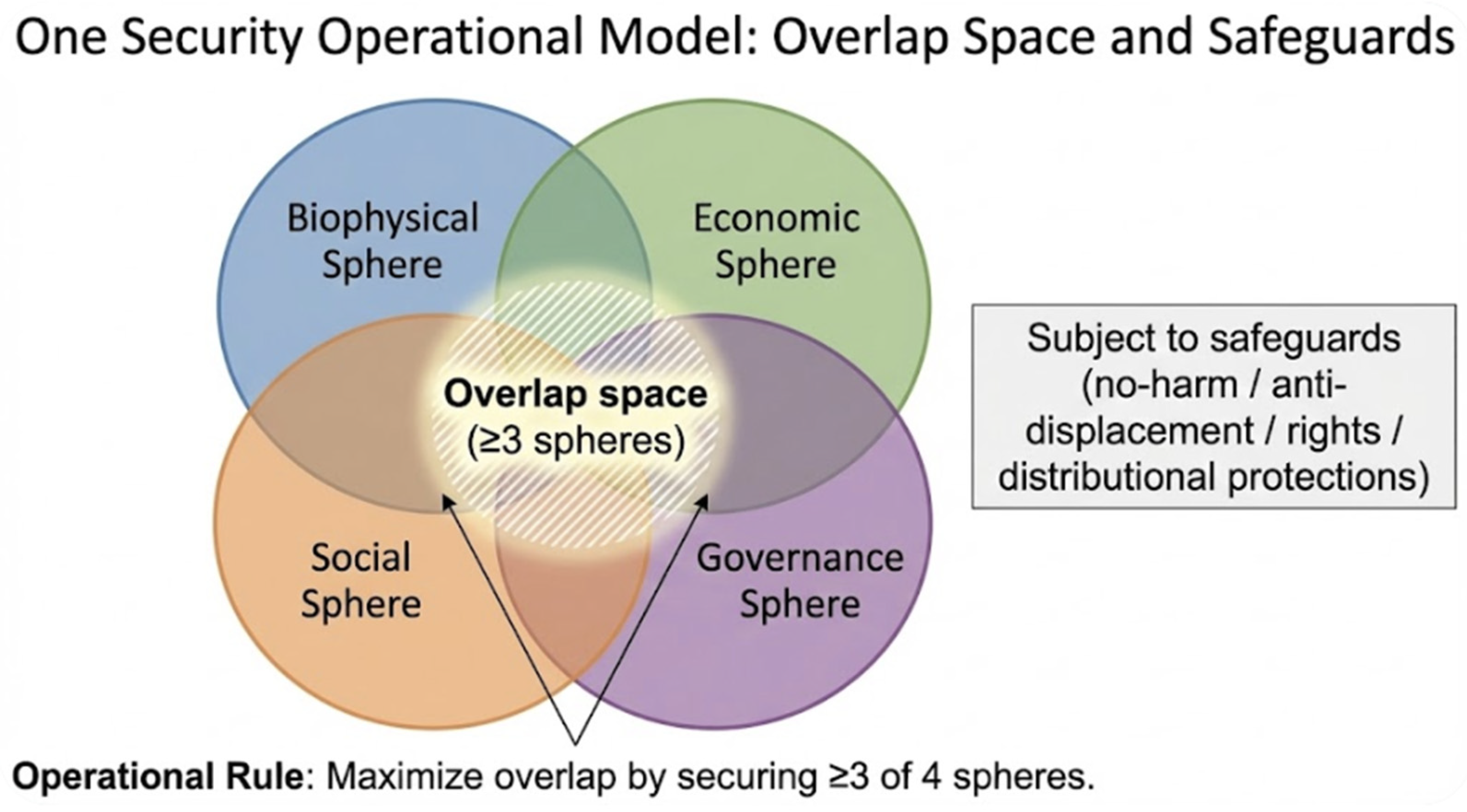
The “spheres” in SOS denote ontological domains of joint value production—biophysical, economic, social, and governance—rather than administrative silos. Administrative sectors are one institutional carving; spheres are causal and evaluative categories for identifying how interventions affect system states and welfare. A central operational concept is overlap: the region where a single intervention yields verified positive effects in multiple spheres within the same place and time window, after applying “no-harm” safeguards.
For implementation clarity, SOS uses the following overlap rule.
Let Δ B ( I ) ,   Δ E ( I ) ,   Δ S ( I ) ,   and   Δ G ( I ) denote the estimated changes attributable to intervention III in the biophysical, economic, social, and governance spheres relative to a stated counterfactual, and let Θ B ,   Θ E ,   Θ S ,   and   Θ G denote minimum thresholds for a material positive effect in each sphere (defined ex ante).
An intervention III is classified as an overlap intervention if at least three of the four conditions below are satisfied within the same geography and time window, subject to explicit safeguards:
Δ B ( I ) Θ B ,                     Δ E ( I )     Θ E ,                   Δ S ( I ) Θ S ,                     Δ G ( I ) θ G
Equivalently, define an indicator O(I)O(I)O(I) such that:
O ( I )   =   1   i f   a t   l e a s t   t h r e e   o f   Δ B ( I ) Θ B ,     Δ E ( I )     Θ E ,   Δ S ( I ) Θ S ,         Δ G ( I )   θ G   h o l d ;
O t h e r w i s e   O ( I )   =   0 . This rule frames programmes as bundles of effects (co-benefits and trade-offs) rather than single-objective projects. The SOS operating cycle introduced in Section 3 is designed to shift portfolio investment toward overlap interventions while making conflicts explicit, auditable, and contestable within routine governance.

2.3.3. Power, Asymmetry, and Political Economy

Polycentric governance can improve contextual fit and experimentation, but it does not eliminate power asymmetries. Actors who control finance, land, infrastructure, and key forms of expertise can shape agendas and the distribution of benefits, and “co-benefit” framing can obscure contested trade-offs. One Security, therefore, treats distributional politics as a core design concern. Operationally, SOS requires explicit benefit-sharing arrangements where communities bear transition costs, and it embeds just transition instruments (e.g., targeted compensation, local hiring, affordability protections, and community wealth mechanisms) to reduce regressive effects and maintain legitimacy [4,26,29]. Dispute resolution and transparency are, therefore, governance security conditions for durable multi-sphere outcomes, not optional add-ons.

2.3.4. Anchoring the Biophysical Sphere: Planetary Boundaries and Resilience

We anchor biophysical security in the planetary boundaries framework and operationalise performance using resilience thinking: resistance (maintaining function under shock), recovery (returning toward function after disturbance), and transformability (reconfiguring systems when regimes shift) [1,2,30]. In practice, interventions are appraised for their contribution to maintaining Earth-system functions within biophysical limits and for strengthening adaptive capacity under deep uncertainty, consistent with the IPCC framing of adaptation as iterative risk management [4]. This anchoring helps distinguish genuine multi-sphere co-benefits from short-term gains purchased through longer-term ecological degradation.

3. Operationalising One Security: The Spheres of Security (SOS) Model

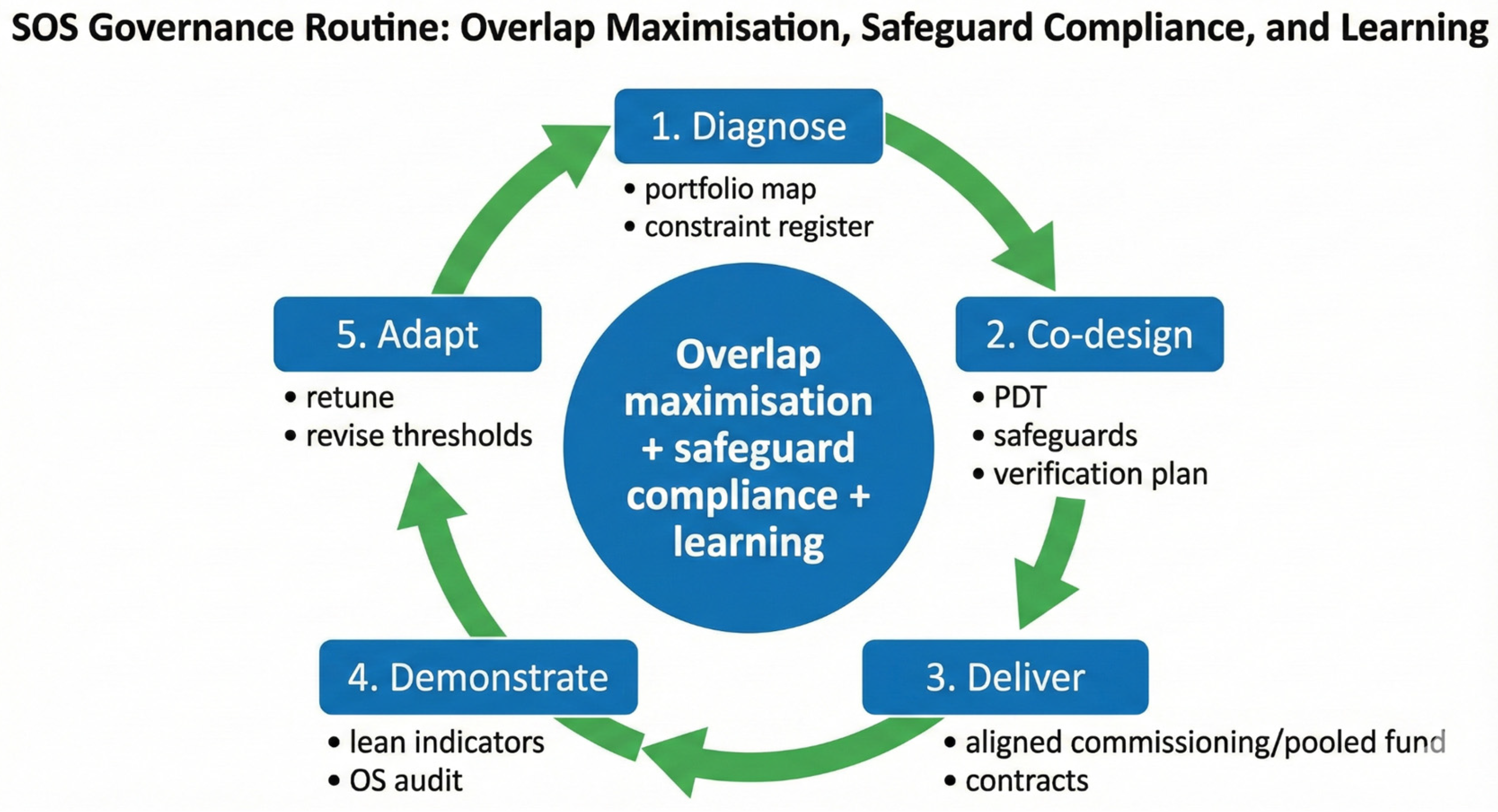
Empirical status and intent. SOS is specified as a conceptual–operational governance method (a design for implementation) rather than an empirically evaluated programme model. The stylised vignettes and numerical parameters (e.g., thresholds and procurement weightings) are included as illustrative design choices to make the decision logic explicit; they should not be interpreted as results from completed field trials unless explicitly stated. In jurisdictions that adopt SOS, parameters should be calibrated to local legal constraints, administrative capacity, baseline portfolio performance, and data maturity and then refined through staged implementation and iterative risk management cycles [4,25,26]. Figure 2 and Figure 3 summarise the SOS structure (overlap objective) and the operating cycle.

3.1. Rationale and Design Principles

SOS operationalises One Security by shifting governance from siloed optimisation toward verified co-benefit production and explicit trade-off management across four interdependent spheres. Three design principles underpin the method.
Interdependence. Socio-ecological outcomes arise from interactions rather than isolated components; interventions therefore create portfolios of co-benefits and spillovers that must be anticipated ex ante and verified ex post [31,32]. This aligns with the framing of climate adaptation and sustainability governance as iterative risk management under compounding shocks [4]. This design assumption is consistent with systems and social–ecological governance scholarship that emphasises feedbacks, spillovers, and non-linear risk propagation in coupled systems.
Polycentricity. Multiple decision centres can improve contextual fit, experimentation, and learning when coordinated around shared problems with transparent rules and mutual accountability [19,33,34]. Polycentric delivery is treated here as a practical architecture for managing cross-mandate complexity, not as a claim that power asymmetries dissolve. The choice of polycentric delivery follows established work on multi-centre governance for collective action and complex environmental problems.
Weak securitisation. SOS pursues urgency through routine, accountable institutions—planning, budgeting, procurement, and transparency—rather than exceptional powers, consistent with calls for networked, inclusive governance under systemic risk [5,6]. SOS therefore embeds guardrails (publication of trade-offs, independent assurance, and distributional safeguards), so high-priority action remains within normal politics (Section 2.3.1). The “urgency within normal politics” stance is consistent with securitisation scholarship, distinguishing exceptionalist responses from routinised, accountable governance.

3.2. Structure: Four Overlapping Spheres and the Overlap Objective

  • SOS treats the four domains—biophysical, economic, social, and governance—as overlapping spheres of value production and risk management, and it targets the overlap where co-benefits are maximised and trade-offs are explicitly managed. The operational objective is to increase the share of portfolio spend that delivers verified positive effects in at least three spheres within the same geography and time window, subject to explicit safeguards (Figure 2). This “overlap-first” objective is designed to make integration decision-relevant in routine public management systems, rather than leaving co-benefits as narrative aspirations [25,26].
  • Biophysical sphere: Ecosystem integrity and hazard/risk dynamics across climate, water, soils, biodiversity, pollution [1,2,4];
  • Economic sphere: Livelihoods, competitiveness, fiscal sustainability, and transition finance [25,26];
  • Social sphere: Health, equity, inclusion, education, and cohesion [4,7];
  • Governance sphere: Institutional capability, rule of law, participation, transparency, policy coherence, and dispute resolution [5,25,26,27].

3.3. Operating Cycle: Diagnose → Co-Design → Deliver → Demonstrate → Adapt

SOS is implemented through a short, repeatable governance routine designed to embed learning and verification into routine planning, budgeting, commissioning, and evaluation (Figure 3). The text below specifies the minimum artefacts produced at each step so jurisdictions can implement SOS without expanding indicator inventories or relying on informal coordination.

3.3.1. Diagnose (Portfolio and Institutional Diagnostics)

Begin with a place-based portfolio diagnostic that maps current programmes, regulations, and investments to their primary sphere(s), documents credible co-benefits, and flags negative spillovers. The diagnostic includes (i) a risk profile (hazards, exposure, and vulnerability); (ii) a trade-off map (who bears costs/benefits); and (iii) an institutional fit scan identifying fragmentation and opportunities for joint ownership across agencies and scales [4,25,35].
Outputs (minimum):
  • Portfolio map (programme by programme): primary sphere(s), claimed co-benefits, evidence quality, spillover risks;
  • Constraint register: legal barriers (e.g., budget pooling), administrative capacity constraints, data gaps;
  • Candidate “overlap bundles” for priority zones (e.g., heat adaptation + housing stability + local jobs + transparent reporting).
The minimum portfolio maps fields (illustrative template). For each programme/instrument in the boundary, there is the programme name; geography and time window; primary sphere; claimed co-benefits (other spheres); plausible spillover/trade-off risks; safeguard trigger(s) (yes/no, which); evidence quality (low/medium/high); and whether the programme is a candidate component of an overlap bundle. This template is intended to make fragmentation and co-benefit claims visible and comparable at the portfolio level and to identify high-risk trade-offs early [25,26].

3.3.2. Co-Design (Polycentric Delivery Teams and Safeguard Design)

Convene Polycentric Delivery Teams (PDTs), which are problem-focused, boundary-spanning groups that include relevant agencies (e.g., environment–health–finance–planning), implementers, and affected communities. Co-design specifies (i) a shared theory of change; (ii) distributional safeguards (just transition measures); (iii) a lean assurance set (Section 3.3.4); and (iv) a dispute pathway. Boundary organisations and co-production platforms improve the salience, credibility, and legitimacy of the evidence used in cross-sector decisions [36,37,38]. Where distributional stakes are high, co-design should explicitly incorporate just transition instruments [29,39].
Outputs (minimum):
  • Co-owned programme design (scope, eligibility, targeting rules, safeguard triggers);
  • Verification plan (what evidence is required, who verifies, audit cadence);
  • Dispute pathway and escalation ladder (Section 3.4).
For the illustrative safeguard trigger rule (example), where distributional risks are foreseeable, safeguards are specified as trigger rules rather than aspirational principles. For example, if a heat-mitigation investment zone exceeds a pre-specified housing vulnerability threshold (e.g., rent burden/eviction risk/tenure insecurity), then bundled delivery must include enforceable anti-displacement protections (e.g., right-to-return provisions, affordability protections, community land trust acquisition, or value-capture ring fencing) and a functioning grievance mechanism; failure to implement safeguards disqualifies affected outputs from counting toward overlap performance [25,26,29].

3.3.3. Deliver (Routine Public Management Levers: Pooled or Aligned)

Delivery uses routine public management levers—programme-based budgeting, aligned commissioning, and outcomes-based procurement—to purchase multi-sphere outcomes rather than single outputs [25,26,40]. SOS is designed to work under different legal constraints:
  • Where pooled budgets are legally feasible: establish a time-bound Joint Outcomes Fund with results-based contracting and published overlap performance;
  • Where pooled budgets are constrained: implement aligned commissioning (parallel appropriations with shared targets, joint calls, and common assurance protocols). This preserves legal accountability while still shifting incentives toward overlap outcomes (Section 3.7).
Outputs (minimum):
  • Commissioning plan (roles, procurement route, safeguards, verification);
  • Standard procurement clauses for overlap performance + safeguard compliance;
  • Public-reporting template (dashboards + decision notes).
For the illustrative procurement/contract clause set (example), SOS can be made contract-relevant through a small number of standard clauses: (i) reporting of sphere deltas against a stated counterfactual for the boundary/time window; (ii) documentary evidence requirements for governance proxies (publication artefacts, participation records, grievance logs, integrity checks); (iii) safeguard compliance requirements and enforcement actions; (iv) audit/verification access rights for the assurance function; and (v) consequences for material misreporting or safeguard failure (corrective action, payment holdback, or re-competition depending on severity). These clauses operationalise integration by aligning incentives with verified overlap outcomes rather than single-sector outputs [25,26,27].

3.3.4. Demonstrate (Lean Assurance + Overlap Verification)

SOS distinguishes within-sphere indicators from overlap indicators.
Lean assurance (within-sphere backbone). Select one primary, verifiable indicator per sphere to provide minimal backbone accountability (examples below). Indicators should be few, decision-relevant, and auditable to prevent measurement dominating delivery [4,25,26]. Examples include:
  • Biophysical: ecosystem integrity proxy (e.g., biodiversity intactness or comparable index) [41];
  • Economic: jobs/affordability or income stability in target cohorts;
  • Social: health coverage/outcomes or education access/attainment, depending on challenge framing [4];
  • Governance: transparency/accountability proxies supported by evidence rules (see below), complemented where useful by governance indicator infrastructures [27].
Overlap indicators (making co-benefits budget relevant), overlap verification answers a practical executive question: What share of spend demonstrably delivers material positive effects in ≥3 spheres in the same geography/time window, subject to safeguards? (Section 2.3.2).
Overlap Score (OS): definition and interpretation
Define an Overlap Score (OS) for an intervention or contract as an auditable value from zero to one representing the share of outputs (or spend) that is independently verified to deliver material positive effects in ≥3 spheres within the defined geography/time window, subject to safeguards. OS is designed to be interpretable, comparable, and enforceable in commissioning.
Auditing “Governance” deltas for OS
Governance outcomes are audited through pre-specified proxy indicators with explicit evidence rules and counted only when thresholds are met. Illustrative governance deltas include:
  • Transparency: publication of budgets, procurement decisions, award rationales, and performance dashboards (dated, accessible, and complete);
  • Participation: documented co-design processes; representation criteria; published responses to submissions; evidence of “you said, we did”;
  • Accountability: a functioning grievance mechanism with service standards (e.g., response times), logged cases, and resolution rates;
  • Coordination capability: formal co-ownership agreements (MoUs/charters), joint targets, and documented cross-agency decision minutes;
  • Integrity/compliance: conflict-of-interest registers, procurement integrity checks, and audit findings closed within defined periods.
Verification methods include documentary audits (contracts, minutes, dashboards), administrative logs (response times, compliance records), and independent assurance (auditor-general, internal audit, or accredited evaluator). Governance deltas are only counted toward OS when evidence requirements are met (pass/fail) to avoid false precision and reduce subjectivity [26,27].
Making OS consequential (illustrative design parameters)
The mechanisms below are illustrative starting points intended to show how SOS can be hard-wired into routine decision rules; jurisdictions should calibrate them to legal constraints, administrative capacity, baseline portfolio performance, and data maturity.
  • Appraisal rule (illustrative). Score bids on (a) within-sphere indicators + safeguard compliance, and (b) OS. Reserve a material portfolio share (an initial “set-aside”) for high-overlap interventions in priority zones;
  • Procurement rubric (illustrative). Technical quality 35%, cost 25%, overlap performance 30%, delivery risk 10%;
  • Performance adjustment (illustrative). Shift a modest proportion of annual allocations toward implementers whose audited OS and safeguard compliance exceed targets; persistent under-performance triggers corrective action or re-competition.
Calibration guidance (how to justify numbers without pretending they are empirical). Start with “shadow scoring” (non-binding OS) and then calibrate thresholds based on the diagnostic: choose cut-points that distinguish the upper tier of multi-sphere performers (e.g., top quartile of baseline OS), sensitivity-test against bidder supply and essential service continuity, and tighten thresholds as assurance capacity improves [25,26].
Worked Overlap Score example (stylised). To illustrate how OS can be audited without indicator overload, consider a bundled contract within a defined boundary where four deliverables represent 100% of spend: (a) cooling infrastructure and monitoring (40%); (b) household energy-bill rebates for vulnerable cohorts (25%); (c) tenant protection and affordability measures (20%); and (d) public transparency and grievance operations (15%). If independent verification confirms that (a) delivers material biophysical and health benefits, (b) delivers economic and social benefits, (c) delivers social and governance benefits, and (d) meets governance evidence rules, then the audited OS equals the share of spend delivering verified benefits in ≥3 spheres subject to safeguards. If safeguards fail for any deliverable (e.g., anti-displacement protections not implemented), the affected spend share is excluded from OS. This example is illustrative and intended to show how OS can be computed as an auditable decision parameter rather than a comprehensive dashboard [25,26,27].

3.3.5. Adapt (Institutionalised Learning and Retuning)

Institutionalise annual and mid-term monitor–evaluate–learn–retune cycles that (i) update risks and constraints, (ii) revise safeguards and targeting, and (iii) adjust commissioning parameters and portfolio allocations as shocks, technologies, prices, and preferences evolve [4,20].
Outputs (minimum):
  • Annual retuning decision note (what changed and why);
  • Updated safeguard triggers and enforcement actions;
  • Revised OS/assurance rules as evidence quality improves.

3.4. Governance Architecture: Coordination, Coherence, and Dispute Resolution

Delivery hinges on aligning mandates, money, and monitoring. Polycentric coordination enables experimentation while sharing standards and learning across scales [19,33]. Within governments, horizontal coordination (e.g., environment–health–finance delivery units) and vertical compacts (local–regional–national) reduce fragmentation.
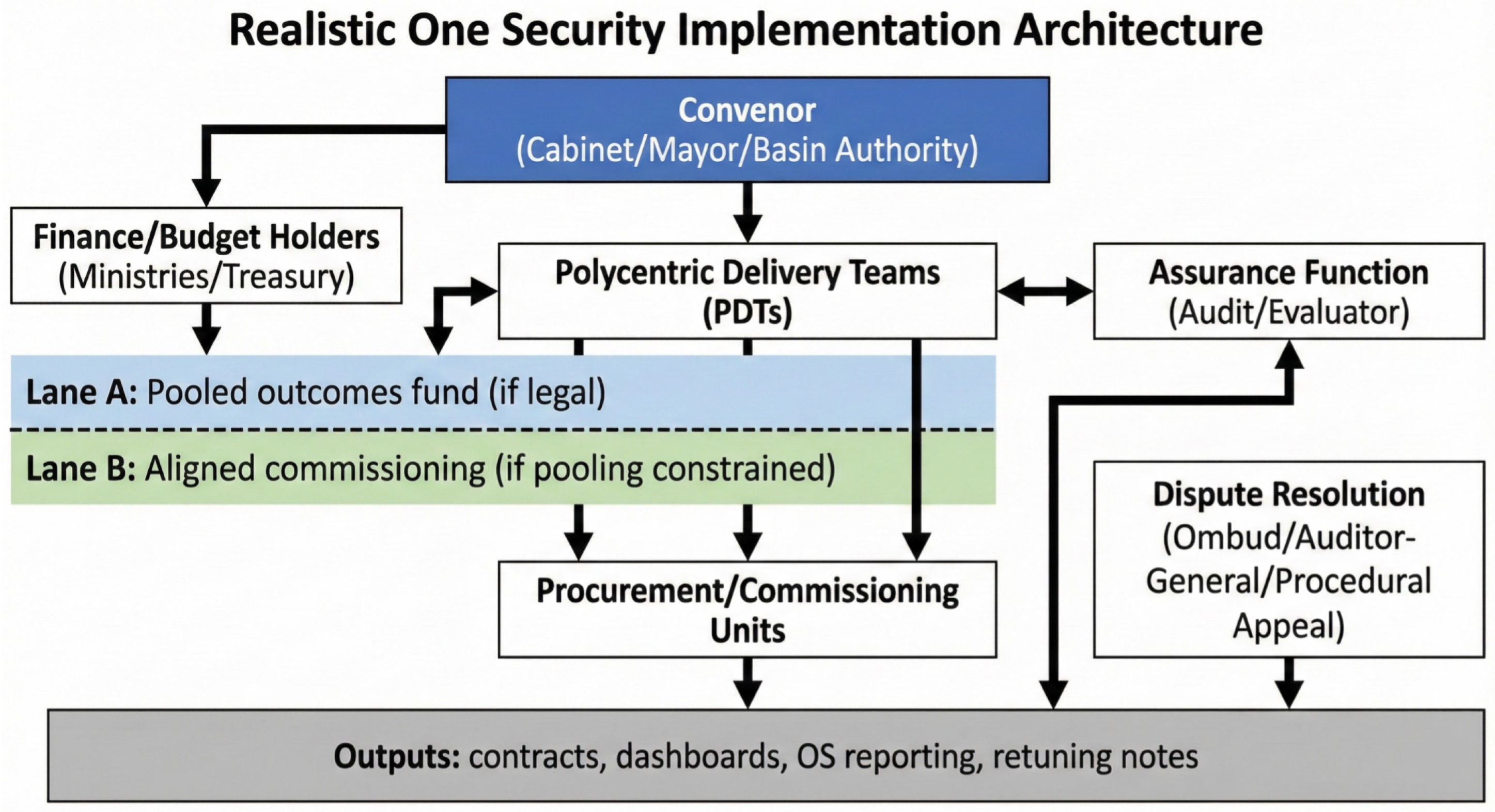
Convening authority and mandate. SOS requires a legitimate convenor (e.g., mayor/cabinet, basin authority) with an explicit mandate to assemble PDTs and require cross-agency participation for defined challenges. Where legislation allows, a statutory delivery mandate can authorise joint target-setting and publication of overlap performance. Where it does not, the mandate can still authorise aligned commissioning and shared reporting [25,26].
Budget instruments (pooled or aligned).
  • Joint Outcomes Fund (pooled appropriations) where legally feasible;
  • Aligned commissioning (parallel appropriations with shared targets, joint calls, common assurance) where pooling is constrained.
Dispute resolution (keeping trade-offs governable). Use a transparent escalation ladder:
  • PDT mediation using agreed principles (co-benefit maximisation, safeguard compliance);
  • Decision by an executive coordination committee (e.g., environment–health–finance leaders);
  • Procedural appeal to an independent arbiter (auditor-general/ombud) with published rationales.
Participation and legitimacy. Co-designed forums with affected communities are required, and distributional risks trigger benefit-sharing arrangements and just transition instruments [29,39]. This sustains weak securitisation by maintaining urgency within routine, accountable politics [5,6].
Minimum retuning decision note (illustrative headings). Retuning is institutionalised through a short, published decision note: (i) what changed in risks/constraints; (ii) what evidence triggered the change (including OS audit findings and safeguard performance); (iii) what programme design or targeting changes are required; (iv) what commissioning parameters change (e.g., thresholds, weightings, set-asides); and (v) what enforcement actions are taken for safeguard failure. Publishing this note is a governance-security condition: it keeps urgency within routine accountability and makes trade-off decisions contestable rather than informal [25,26,27,28].
Implementation note (examples of enforceable coherence). To make coordination durable, SOS relies on enforceable coherence devices rather than informal goodwill: written convenor mandates, harmonised commissioning specifications across agencies, standard evidence rules for verification (including governance proxies), and a public dispute-resolution escalation ladder with published rationales. These devices operationalise polycentric coordination while addressing power asymmetries through transparency and safeguard enforcement, consistent with the weak-securitisation stance [19,25,26,27,28,29,33,34].

3.5. External Enablers and Alignment

SOS is compatible with international regimes that institutionalise learning and integrity. The UNFCCC Enhanced Transparency Framework provides a template for iterative reporting and review [20]. Cooperative approaches under Article 6 can support results-based finance where integrity safeguards are met [21], and the Kunming–Montreal Global Biodiversity Framework offers targets and benefit-sharing principles relevant to biophysical–social–governance overlaps [22]. Re-using existing reporting infrastructures can keep assurance lean while focusing management attention on overlap performance rather than siloed metrics.

3.6. Stylised Applications (Vignettes): Urban Heat and Health; Watershed Food–Water–Energy

The following applications are stylised vignettes intended to demonstrate SOS decision logic and do not report outcomes from evaluated real-world programmes.

3.6.1. Urban Heat and Health (Managing the Green–Gentrification Trade-Off)

Challenge. Heat mitigation can raise amenity and property values, risking the displacement of low-income residents if safeguards are absent.
Diagnose (illustrative). Overlay heat exposure with housing vulnerability (rent burden, eviction risk, tenure, speculative sales) to identify tracts where cooling benefits are likely to trigger displacement risks.
Co-design (illustrative). Establish a PDT (environment–health–housing–planning–utilities + community groups) and package overlap interventions with explicit safeguards:
  • Cooling measures: street trees, cool roofs, schoolyard greening targeted to priority tracts;
  • Housing stability safeguards: right-to-return provisions linked to retrofit works; affordability protections; community land trust acquisitions; value-capture mechanisms that ring-fence uplift into permanently affordable housing;
  • Jobs and equity: local-hire and apprenticeship targets; targeted rebates for vulnerable households; culturally tailored outreach;
  • Governance: published dashboards; grievance mechanisms; transparent selection criteria and rationales.
Deliver (illustrative). Commission bundled contracts requiring cooling + housing safeguards + reporting; fast-track approvals for proposals that meet overlap and safeguard requirements.
Demonstrate (illustrative). Example indicators:
  • Biophysical: reduced heat exposure in treated blocks relative to matched comparators;
  • Economic: local job-months created; net household energy-bill reductions;
  • Social: reduced heat-related emergency presentations; maintained/improved housing stability indicators relative to controls;
  • Governance: documented co-ownership agreements; dashboard publication; verified grievance performance.
Overlap verification (illustrative). Verify that a defined share of expenditure delivers positive deltas in ≥3 spheres within the same blocks/time window, subject to anti-displacement safeguards.
Adapt (illustrative). If displacement proxies worsen, tighten safeguards (expand CLT acquisition, increase value-capture share, prioritise tenant-protected parcels) and adjust targeting.

3.6.2. Watershed Food–Water–Energy (Negotiating Flows and Farm Income)

Challenge. Environmental flow releases may improve downstream ecosystems and water quality but reduce irrigation reliability, affecting farm income and community viability.
Diagnose (illustrative). Quantify low-flow deficits, biodiversity thresholds, irrigation dependence, farm margins, and distributional exposure across sub-catchments.
Co-design (illustrative). Pair seasonal re-operation with on-farm water productivity measures; managed aquifer recharge; riparian restoration; and payment-for-ecosystem-services contracts funded by downstream beneficiaries (utilities/hydropower), supported by risk instruments that reward verified resilience measures.
Deliver (illustrative). Use results-based contracting that pays on verified sediment reduction, habitat metrics, and water reliability outcomes while protecting minimum farm margin thresholds through transition support.
Demonstrate (illustrative). Example indicators:
  • Biophysical: improved low-flow reliability; reduced sediment in targeted sub-catchments relative to baseline/climate-adjusted expectations;
  • Economic: maintained or improved farm net margins relative to baseline (accounting for transition support);
  • Social: improved household water security and distributional indicators for affected communities;
  • Governance: verified compliance with allocation rules; audited co-ownership agreements; transparent reporting of trade-offs.
Overlap verification (illustrative). Independently verify a spend share delivering positive deltas in ≥3 spheres within the same sub-catchments/time window.
Adapt (illustrative). Recalibrate release rules and incentive rates annually as climate signals, prices, and constraints evolve.

3.7. Minimum Institutional Preconditions and Entry-Point Implementation (Feasibility)

Minimum institutional preconditions. SOS does not require full administrative integration at the outset, but it does require several minimum conditions to function credibly:
  • Legitimate convenor with a mandate to coordinate across agencies for a defined challenge and geography (cabinet directive, mayoral authority, basin charter, or interagency MoU);
  • Agreed diagnostic boundary (place, time window, counterfactual logic) and a small set of verifiable indicators;
  • Assurance function with authority to validate reported co-benefits (internal audit, auditor-general function, or independent evaluator);
  • Dispute pathway so trade-offs are adjudicated transparently rather than displaced into informal vetoes.
Entry-point SOS (staged adoption). In jurisdictions where pooled budgets are legally or administratively difficult, SOS can be implemented in stages:
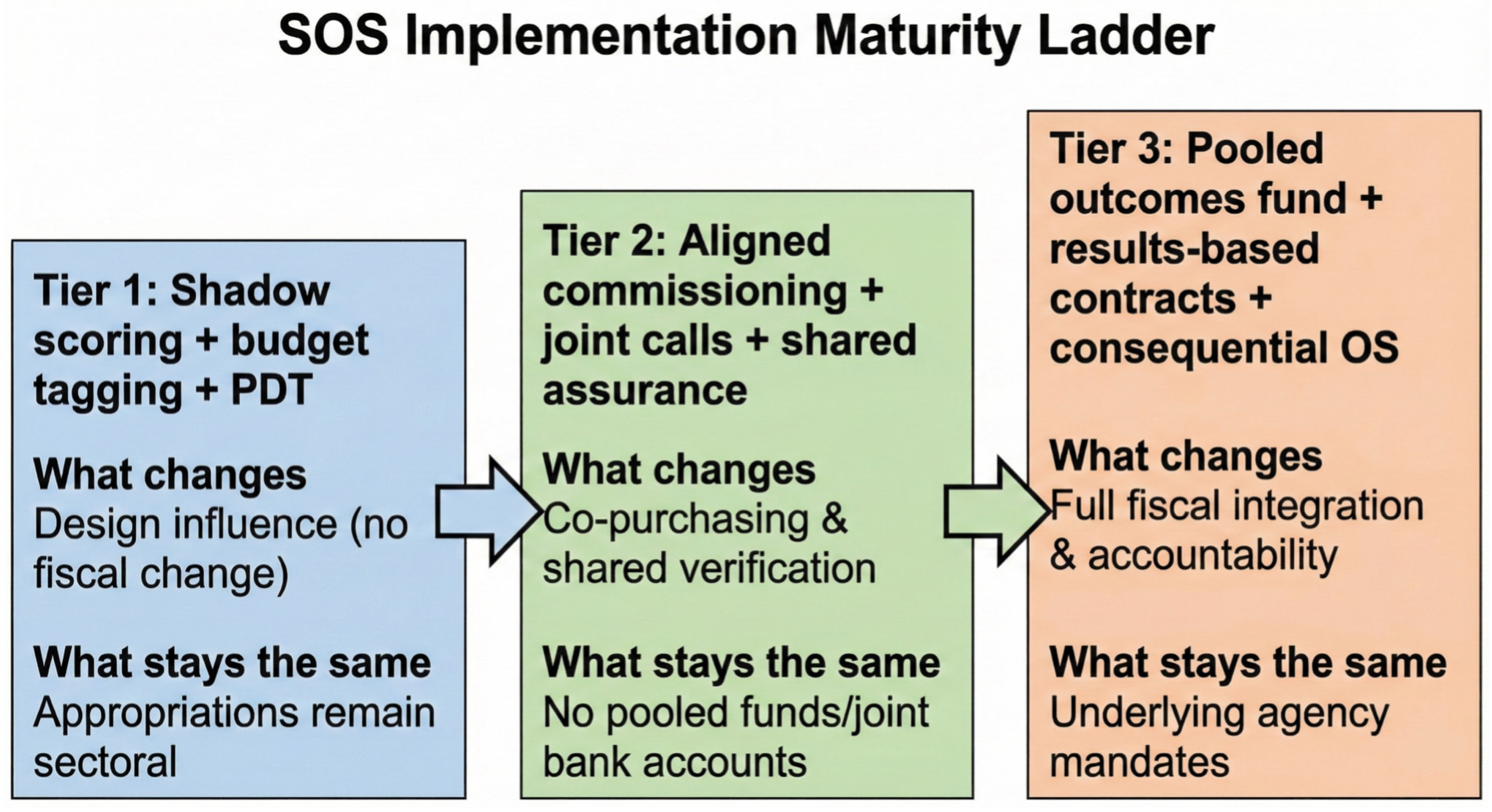
  • Tier 1—Coordination-first (no pooled budgets). Establish a PDT, complete the shared diagnostic mapping, introduce budget tagging to identify overlap-relevant spend, and apply OS as a non-binding appraisal criterion (“shadow scoring”);
  • Tier 2—Aligned commissioning (virtual pooling). Run joint calls where agencies co-commission via parallel appropriations or matched contributions, adopt shared targets and common assurance, and include overlap + safeguards as material procurement criteria;
  • Tier 3—Pooled outcomes fund (full SOS). Where legal authority exists, establish a time-bound joint outcomes fund with pooled appropriations and results-based contracting; hard-wire overlap performance into allocation shifts and re-competition decisions.
Legal and administrative workarounds. Where statutes prohibit pooled appropriations, implementation can proceed via interagency agreements, treasury-authorised joint programme lines, matched funding calls, or special-purpose vehicles that preserve legal accountability while enabling joint target-setting and verification [25,26].

4. Enabling Cross-Sectoral Integration and Policy Translation

To make the translation function of SOS operational (rather than merely conceptual), this section supplements the six enabling conditions with implementation-oriented artefacts that jurisdictions can adapt. These include minimum viable templates for coordination (PDT terms of reference), programme bundling (overlap-bundle checklist), public financial management under legal constraints (aligned commissioning workflow and procurement rubric), assurance (evidence rules and anti-gaming safeguards), learning cycles (monitor–evaluate–learn–retune calendar), and legal/administrative anchoring (illustrative duty-to-cooperate and publication clauses). These artefacts are illustrative and are intended to reduce ambiguity about what to do on Monday morning: when translating One Security into routine planning, budgeting, procurement, reporting, and dispute resolution [4,25,26].
The SOS model is designed to translate One Security from an integrative concept into routine, governance-ready practices. Translation here is not primarily about expanding indicator inventories; it is about reconfiguring institutional routines that govern mandates, money, monitoring, and dispute resolution so that multi-sphere co-benefits are systematically designed for, verified, and rewarded [25,26]. SOS, therefore, treats implementation as a public management problem: creating practical interfaces between (i) problem framing, (ii) delivery authority, (iii) financing and commissioning, and (iv) assurance and learning cycles that can operate under administrative and legal constraints [4,25,26].
This section specifies six enabling conditions—institutions, instruments, finance, metrics, learning, and legal anchoring—and provides implementation-oriented examples that are illustrative rather than evaluative, consistent with SOS’s conceptual–operational intent (Section 3).
The institutional roles and interfaces required to implement SOS—convening, polycentric delivery, financing/commissioning, assurance, and dispute resolution—are summarised in Figure 4.

4.1. Institutional Coordination: Convening, Boundary-Spanning, and Coherence

Cross-sector integration often fails when coordination is treated as an informal aspiration rather than an institutional design problem. SOS addresses this by requiring (i) an explicit convenor with authority to assemble polycentric delivery teams (PDTs), (ii) shared problem boundaries (place/time window/counterfactual), and (iii) a transparent dispute pathway (Section 3.4). This aligns with scholarship emphasising polycentric governance for complex collective-action problems, where coordination emerges through explicit rules, shared standards, and mutual accountability rather than hierarchical command [19,33,34].
Boundary organisations and co-production platforms can improve the salience, credibility, and legitimacy of evidence used in cross-sector decisions, reducing the risk that integration collapses into contested expertise or parallel silo plans [36,37]. SOS operationalises this insight through simple routines: a shared diagnostic map, joint target-setting across agencies, publication of trade-off decisions, and evidence rules for safeguards and verification.
Illustrative translation levers (institutional):
  • Designated convenor with a written mandate (cabinet directive, mayoral order, basin authority charter) requiring cross-agency participation for a defined challenge and geography;
  • Standing PDT “delivery unit” (environment–health–finance–planning + implementers + community representatives) with documented decision rules and escalation;
  • Vertical compacts (city–state; basin–national) specifying shared outcomes, reporting cadence, and dispute escalation procedures;
  • Minimum transparency routine: publish (a) selection criteria, (b) award rationales, and (c) safeguard triggers and enforcement actions [5,6].
For implementation clarity, a minimum Terms of Reference for the Polycentric Deliver Team (PDT) is provided in Box 1.
Box 1. Polycentric delivery team (PDT_terms of reference).
CategorySpecifications
PurposeCoordinate design and delivery of SOS overlap bundles for a defined challenge and boundary (geography/time window/counterfactual).
Convenor MandateWritten authority (cabinet directive/mayoral order/basin charter/MoU) to require cross-agency participation and to publish decision artefacts [25,26].
Membership (Minimum)
(i)  
Environment/land/water;
(ii) 
Health;
(iii)
Treasury/finance;
(iv) 
Planning/housing/infrastructure;
(v)  
Implementing agencies/contract managers;
(vi) 
Affected community representatives;
(vii)
Independent assurance/evaluation representative (observer).
Decision RulesQuorum: Greater than 70% of agencies + community rep present.
Mode: Consensus where feasible; recorded vote otherwise.
Ethics: Conflict-of-interest declarations required for all members.
Outputs (Each Cycle)
(i)  
Portfolio diagnostic map;
(ii) 
Co-owned theory of change;
(iii)
Safeguard triggers and benefit-sharing arrangements;
(iv) 
Verification plan (evidence rules + audit cadence);
(v)  
Commissioning/procurement route;
(vi) 
Public decision note (trade-offs and rationale).
Reporting CadenceMonthly: Implementation dashboard.
Quarterly: Decision note.
Annual: Retuning note (Section 4.5).
Dispute EscalationPDT mediation → executive coordination committee → procedural appeal to independent arbiter with published rationale (Section 3.4).

4.2. Policy Design Beyond Single Instruments: Coherent Policy Mixes for Overlap Outcomes

Integrated outcomes rarely emerge from isolated instruments; they are produced by policy mixes that combine incentives, standards, investment, and information with temporal and institutional consistency [25,42]. SOS therefore treats interventions as bundles that jointly target biophysical integrity, economic resilience, social outcomes, and governance capability, while making trade-offs explicit. This “bundle logic” is consistent with systems perspectives emphasising feedbacks, non-linearities, and cross-domain spillovers in sustainability transitions [4,31,32]. The minimum design requirements and evidence artefacts for an SOS ‘overlap bundle’ are summarised in Table 1 and the minimum assurance protocol and evidence rules for each sphere (including pass/fail governance proxies) are summarised in Table 2.
Two programme families offer practical templates for overlap-oriented bundling:
(i)
Nature-based solutions (NbS). When specified to recognised standards, NbS can jointly reduce hazard risk, strengthen biodiversity, generate livelihoods, and build social licence through participatory stewardship—subject to safeguards (land rights, distributional impacts, long-term maintenance) [4,43]. Under SOS, an NbS contract becomes an “overlap bundle” when coupled with (a) affordability or tenure protections in high-risk displacement zones, (b) local hiring and training, and (c) transparent monitoring and grievance pathways;
(ii)
Clean-energy and efficiency programmes. Energy transitions can be overlap bundles when paired with labour standards, targeted affordability protections, and transparent monitoring of distributional impacts and integrity risks [4,44]. Under SOS, energy efficiency upgrades for vulnerable households can be commissioned as packages: emissions/energy savings (biophysical) + bill reduction (economic) + health improvements via better indoor conditions (social) + published dashboards and complaint resolution (governance).
Illustrative translation levers (instrument design):
  • “Bundle-by-default” guidance: every programme design must include (a) at least one safeguard and (b) at least one co-benefit mechanism beyond the primary objective;
  • Challenge templates: heat, flood, water scarcity, food-system risk templates specifying minimum social and governance protections (e.g., anti-displacement, benefit-sharing, grievance systems);
  • Standard clauses: community benefit agreements, affordability protections, and participation requirements triggered when distributional risks exceed defined thresholds.

4.3. Public Financial Management: Aligning Budgets, Procurement, and Incentives

A central reason integrative frameworks struggle in practice is that public financial management remains sectoral: budgets are appropriated by ministry, procurement buys narrow outputs, and accountability follows silo line items. SOS translates One Security into finance and commissioning routines by encouraging programme-based budgeting and procurement that explicitly values multi-sphere outcomes [25,26]. This can be conducted with varying levels of integration depending on legal and administrative constraints (Section 3.7).
Where pooled funds are feasible, a time-bound joint outcomes fund can disburse via outcomes-based contracts and publish overlap performance. Where pooled budgets are not feasible, aligned commissioning can still achieve material coordination: agencies run joint calls with parallel appropriations, adopt shared targets, and use common verification protocols while retaining formal fiscal authority [26]. Mission-oriented approaches provide a complementary framing for mobilising finance and innovation around time-bound, cross-sector objectives that inherently require multi-sphere outcomes [40].
Illustrative translation levers (finance and procurement):
  • Budget tagging for overlap-relevant spend (Tier 1): make multi-sphere investment visible within existing appropriations;
  • Procurement rubrics that assign a material weight to overlap performance and safeguard compliance (Section 3.3.4), even before OS becomes binding;
  • Matched funding calls (Tier 2): agencies co-commission a programme line to reduce fragmentation without requiring full pooling;
  • Contractual verification clauses requiring documentary evidence and independent assurance for sphere deltas and safeguards.
This workflow operationalises SOS where pooled appropriations are not legally feasible by aligning targets, calls, and assurance while retaining separate fiscal accountability [17,18].
  • Joint problem definition: Convenor/PDT defines the boundary (place/time window) and confirms the overlap objective and safeguard triggers;
  • Parallel budget tagging: Each agency tags relevant spend as SOS-eligible (for transparency and portfolio tracking);
  • Joint call, separate appropriations: Agencies issue a joint call for proposals with a single specification, while each funds its portion under its own appropriation line;
  • Common scoring + assurance: A shared evaluation panel uses a single rubric (below) and a single assurance protocol (Table 2);
  • Contract alignment: Separate contracts (if required) contain harmonised clauses for verification, safeguards, reporting, and grievance mechanisms;
  • Single public dashboard: All funded work reports into one overlap dashboard for the defined boundary, including trade-off decisions and safeguard enforcement actions;
  • Retuning: Annual (and mid-term) recalibration shifts future calls toward high-overlap performers with verified safeguard compliance (Section 4.5).
Illustrative procurement rubric for aligned commissioning (adapt to context):
  • Technical quality and deliverability: 35%;
  • Cost/value for money: 25%;
  • Verified overlap performance plan (OS) + safeguard design: 30%;
  • Delivery risk and assurance readiness: 10%;
Implementation note: These weights are illustrative and can be introduced initially as “shadow scoring” before becoming binding as assurance capacity matures [25,26].

4.4. Metrics and Accountability: From Indicator Inventories to Verifiable Overlap Performance

Measurement can support translation, but it can also overwhelm implementation when indicator inventories become ends in themselves. SOS addresses this risk through lean assurance: a small backbone of within-sphere indicators paired with overlap verification that rewards credible co-benefits (Section 3.3.4). Within-sphere indicators provide basic accountability (biophysical integrity; jobs/affordability; health/coverage outcomes; and transparency/coordination capability), drawing where possible on existing measurement infrastructures (e.g., biodiversity intactness [41]; governance indicators [27]; and sector reporting systems [45]).
Overlap indicators then answer a practical executive question: what share of the portfolio is demonstrably delivering multi-sphere outcomes in the same place and time window, subject to safeguards? This makes co-benefits budget-relevant without requiring a comprehensive dashboard for everything.
A frequent translation barrier is that governance outcomes are treated as too “soft” to verify. SOS addresses this by defining auditable governance proxies with evidence rules—publication of decisions and dashboards, documented participation processes, functioning grievance mechanisms, co-ownership agreements, and integrity/compliance artefacts—counting governance deltas only when verification thresholds are met [26,27]. This preserves rigour without forcing governance into false precision.
Illustrative translation levers (assurance):
  • Published assurance protocol: evidence rules for each sphere (including governance);
  • Independent verification: internal audit, auditor-general functions, or accredited evaluators;
  • Anti-gaming safeguards: audit sampling, penalties for misreporting, transparent counterfactual assumptions, and documented trade-off rationales.

4.5. Learning Cycles: Institutionalising Iterative Risk Management and Portfolio Re-Tuning

Translation requires governance systems that learn. SOS is aligned with the framing of adaptation and sustainability governance as iterative risk management: diagnose risks, act, evaluate, and adjust as conditions evolve [4]. Learning cycles are also embedded in international transparency and review processes, providing templates for routine reporting and periodic reassessment that can be reused to keep assurance lean (Section 3.5) [20].
Operationally, SOS recommends scheduled monitor–evaluate–learn–retune cycles in which a small number of indicators and overlap verification inform portfolio reallocation and programme redesign (Section 3.3). This helps avoid the common failure mode, where integrated plans exist on paper, but budgets and procurement remain unchanged. Mapping interactions—synergies and conflicts—among sustainability objectives can further support prioritisation and sequencing, particularly where trade-offs are non-linear or context-dependent [46].
Illustrative translation levers (learning):
  • Annual portfolio re-tuning: shift a modest share of resources toward verified high-overlap programmes and document why;
  • Mid-term safeguard review: tighten or redesign safeguards where distributional impacts worsen;
  • Published learning notes: “what changed and why” to strengthen legitimacy and reduce policy volatility;
Month 0–1 (Diagnose refresh): update risk profile, constraints register, and trade-off map for the boundary.
Month 3 (Safeguard review): examine distributional indicators and grievance logs; tighten/extend safeguards where triggers are frequent, or harms are increasing.
Month 6 (OS audit snapshot): independent verification of a sample of contracts/outputs; publish interim assurance note.
Month 9 (Commissioning design): adjust next call specifications and evaluation rubric based on verified learning.
Month 12 (Retune): publish an annual retuning decision and note what changed, what evidence triggered the change, what budget/procurement parameters are adjusted, and how safeguard enforcement will change.
This routine aligns SOS with iterative risk management by making learning and parameter adjustment part of normal budgeting and commissioning cycles rather than ad hoc responses [4].

4.6. Legislative and Normative Anchoring: Making Integration Durable

Integrated delivery often fails when it depends on temporary coordination goodwill. Legislative or formal policy anchoring can make integration more durable by embedding duties to cooperate, publish trade-off rationales, and provide access to information and participation—features associated with stronger adaptive capacity in multi-level governance [5,35]. At the international level, transparency frameworks and biodiversity targets can reinforce domestic assurance by providing norms for reporting integrity and review cycles that can be reused rather than duplicated [20,22].
A practical translation objective is to move overlap performance from a “nice-to-have” narrative to a governance requirement. Where a jurisdiction claims multi-sphere benefits, it should specify safeguards and evidence rules and accept independent verification. This strengthens weak securitisation by keeping urgency within routine, accountable politics and reducing incentives to rely on emergency framing as a substitute for institutional design [5,6].
Illustrative translation levers (legal/anchoring):
  • Duty-to-cooperate provisions for designated challenges (statutory, cabinet-level, or treasury rules);
  • Mandatory publication of procurement and evaluation artefacts for overlap-funded programmes;
  • Formal dispute pathways and procedural appeals to prevent silent vetoes and increase accountability (Section 3.4).

4.7. A Minimum Viable SOS Package (Early Adoption Under Fragmentation)

To support feasibility in lower-capacity or highly fragmented settings, SOS can be translated into a minimum viable package that does not require pooled budgets at the outset (Section 3.7). The minimum package consists of (i) a designated convenor and a PDT for a defined challenge; (ii) a shared diagnostic map and explicit safeguards; (iii) lean assurance with one within-sphere indicator per sphere plus a simple overlap verification rule; and (iv) “shadow” overlap scoring in appraisal and procurement to influence design, while formal fiscal authorities remain unchanged. The minimum viable package and its required artefacts are summarised in Table 3.
This staged approach allows for assurance capability and political legitimacy to mature before stronger fiscal integration is attempted, while still shifting routine decision-making toward verified multi-sphere outcomes.

5. Discussion: Governance Implications, Implementation Pathways, Limitations, and Future Outlook

This section consolidates the manuscript’s implications and practical feasibility. We first situate One Security/SOS within current global governance dynamics (Section 5.1), then specify implementable sequencing under real legal and administrative constraints (Section 5.2). We then state the limitations of SOS as a conceptual–operational method rather than an evaluated programme model (Section 5.3), and outline priority directions for empirical testing, calibration, and institutional comparison (Section 5.4).
The SOS model specifies a governance-ready translation of One Security designed to shift public action from single-objective optimisation toward the production of verified multi-sphere co-benefits. The central claim is institutional rather than predictive. If mandates, finance, assurance, and dispute resolution are configured to reward overlap performance (Section 3), then integrated outcomes become more likely, and trade-offs become more governable within routine politics under weak securitisation [4,5,6,18,25,26,28]. This section situates SOS within contemporary global governance dynamics, specifies practical implementation pathways under real-world constraints, and identifies limitations and future research priorities.

5.1. Global Governance Implications for One Security

At the international level, risk governance remains divided between peace and security architectures on the one hand and environmental and development regimes on the other, producing coordination gaps precisely where risks are most coupled and cascading [5,6]. One Security supports a form of networked and inclusive multilateralism—denser links among treaty bodies, financial institutions, cities, regions, and civil society—so that mandates and finance can align around multi-sphere outcomes rather than parallel targets [5,6,18]. In practical terms, this implies routine interfaces between security fora and climate–health–biodiversity regimes; joint risk assessments and scenario exercises that explicitly consider cascading hazards and second-order impacts; and cross-regime transparency norms that reduce information asymmetries and integrity risks [4,5,6].
Three existing global processes are especially relevant as external enablers for SOS. First, the UNFCCC Enhanced Transparency Framework institutionalises iterative reporting and review, providing a practical template that jurisdictions can reuse to keep SOS assurance lean while maintaining credibility [20]. Second, Paris Agreement Article 6 cooperative approaches can support results-based finance where integrity safeguards and accounting rules are met, aligning biophysical and economic objectives while strengthening governance through transparent procedures [21]. Third, the Kunming–Montreal Global Biodiversity Framework provides targets and benefit-sharing principles that can anchor biophysical–social–governance overlaps and reinforce domestic safeguards [22]. Importantly, these regimes do not automatically produce cross-sector integration. Rather, they can act as enabling infrastructures when domestic institutions translate them into routine budgeting, procurement, and accountability structures—precisely the translation function SOS is designed to serve [5,6,25,26].

5.2. Implementation Pathways and Sequencing (Feasibility Under Real Constraints)

Feasibility concerns are well-founded. Full fiscal integration—such as pooled budgets or joint outcomes funds—is not immediately achievable in many jurisdictions due to legal constraints, administrative boundaries, and political contestation. SOS is, therefore, designed for staged adoption, allowing coordination and assurance capability to mature before stronger integration is attempted [25,26]. The stages below align with Section 3.7 but are elaborated here as an implementable pathway.The entry-point SOS pathway and staged adoption (coordination-first, aligned commissioning, and pooled outcomes funding where feasible) are summarised in Figure 5.
Stage 1—Entry (coordination first; “shadow scoring”)
The objective is to change design behaviour without changing fiscal authorities. A jurisdiction designates a legitimate convenor and polycentric delivery team for a defined challenge and geography, conducts the portfolio diagnostic, and applies the Overlap Score as a non-binding appraisal tool (“shadow scoring”) alongside explicit safeguards. Budgets remain sectoral, but overlap-oriented design becomes visible through budget tagging, shared targets, and published trade-off rationales [25,26]. This approach operationalises urgency within routine politics and is consistent with weak securitisation rather than emergency exception [5,6,28].
Stage 2—Intermediate (aligned commissioning; “virtual pooling”)
The objective is joint purchasing of overlapping outcomes while retaining separate appropriations. Agencies co-commission programmes through parallel appropriations or matched funding calls, adopt shared targets and common verification protocols, and embed overlap performance and safeguard compliance as material criteria in procurement—even if payments remain agency-specific [25,26,42]. This moves integration from coordination into contracts while minimising statutory friction.
Stage 3—Advanced (pooled outcomes fund, where legally feasible)
Where legal authority exists, the jurisdiction establishes a time-bound joint outcomes fund with pooled appropriations and results-based contracting. Overlap performance and safeguard compliance become consequential for allocation shifts, corrective action, and re-competition decisions, supported by independent assurance [25,26]. Mission-oriented governance provides a complementary rationale for mobilising innovation and finance around time-bound cross-sector objectives that inherently require multi-sphere outcomes [40].
Minimum institutional preconditions (the “must-haves”)
SOS does not require full administrative integration at the outset, but it does require minimum conditions to function credibly. First, there is a legitimate convenor with a written mandate to coordinate across agencies for a defined challenge and boundary. Second, there is an agreed diagnostic boundary (place, time window, and counterfactual logic) and a small set of outcome indicators that can be verified as part of iterative risk management [4,25,26]. Third, there is an assurance function with authority to validate reported co-benefits (internal audit, auditor-general, or independent evaluator), including governance proxies where relevant [25,26]. Fourth, there is a basic dispute-resolution pathway, so trade-offs are adjudicated transparently rather than displaced into informal vetoes—an essential condition for durable weak securitisation [5,6,28]. Fifth, there are enforceable safeguards that address distributional risks and legitimacy, including just transition instruments where communities bear transition costs [29,39].
Calibration of numeric thresholds and design parameters
The numerical thresholds used in Section 3 (e.g., portfolio set-asides, OS cut-offs, procurement weights) should be read as illustrative design parameters, not universal prescriptions. Calibration can be guided by the initial diagnostic and phased adoption. Begin with modest thresholds while assurance systems are established, then tighten thresholds and increase the overlap-relevant portfolio share as verification becomes reliable [4,25,26].

5.3. Limitations

This study specifies SOS as a conceptual–operational governance method and illustrates decision logic through stylised vignettes. It does not report outcomes from evaluated programmes. Accordingly, any numerical thresholds, procurement weightings, or portfolio rules presented in Section 3 are illustrative design parameters intended to make the governance logic explicit; they must be calibrated to local legal constraints, administrative capacity, baseline portfolio performance, and data maturity [4,25,26].
Several limitations follow. First, the Overlap Score is sensitive to counterfactual design, verification quality, and how “material” thresholds are defined within each sphere. If OS is used in appraisal, budgeting, or procurement, jurisdictions require clear evidence rules, independent assurance, and anti-gaming safeguards to avoid perverse incentives and strategic reporting [25,26,27]. Second, governance outcomes—while auditable via proxy artefacts (e.g., publication of award rationales and dashboards, participation records, grievance mechanisms, co-ownership agreements, integrity checks)—involve more interpretive discretion than many biophysical or economic indicators. This elevates the importance of pre-specified documentation requirements, pass/fail evidence rules, and third-party verification [26,27]. Third, polycentric coordination does not remove power asymmetries: actors controlling finance, land, infrastructure, or expertise can shape agendas and the distribution of benefits, and “co-benefit” framing can obscure contested trade-offs. SOS, therefore, depends on explicit distributional safeguards, benefit-sharing arrangements, and transparent dispute resolution to maintain legitimacy under weak securitisation [28,29,39]. Finally, even “lean” assurance can overload low-capacity settings if verification protocols are over-designed; staged adoption is, therefore, recommended to build capability before making OS consequential in fiscal allocation [25,26].

5.4. Future Research Directions (Future Outlook)

Future work should test SOS through staged implementation in applied settings, with attention to feasibility, administrative burden, integrity, and distributional outcomes. Five priorities follow.
First, pilot applications of overlap-oriented appraisal and commissioning in municipal, regional, or basin settings should evaluate whether “shadow scoring” and aligned commissioning measurably change programme design behaviour, bidder responses, and cross-agency coordination [25,26,42]. Second, simulations and sensitivity analyses should be used to calibrate Overlap Score thresholds and portfolio set asides under different institutional and market conditions, including stress tests for essential service continuity and fiscal constraints [4,25,26]. Third, auditing standards for governance deltas and safeguard compliance should be developed and validated, including documentation templates, sampling strategies, penalties for misreporting, and minimum requirements for grievance mechanisms and trade-off publication [26,27]. Fourth, comparative institutional analysis should examine how different legal and budgetary systems accommodate aligned commissioning versus pooled outcomes funds and identify workable administrative pathways where pooled appropriations are prohibited [25,26]. Fifth, political economy research should test SOS performance under asymmetric power, contested mandates, and distributional conflict, including the design of just transition safeguards that preserve legitimacy while maintaining urgency within routine politics [28,29,38].
Taken together, these implications, constraints, and research priorities clarify how SOS is intended to be used: as a practicable method for aligning mandates, finance, assurance, and learning around verified multi-sphere outcomes, adoptable through staged implementation. The contribution is, therefore, a governance-ready translation of One Security—designed to make co-benefits contractable and auditable while keeping urgency within normal, accountable politics under weak securitisation [4,5,6,18,25,26,28].

Author Contributions

Conceptualisation, M.P. and A.M.; methodology, M.P.; software, M.P.; validation, M.P. and A.M.; formal analysis, M.P.; investigation, M.P.; resources, A.M.; data curation, M.P.; writing—original draft preparation, M.P.; writing—review and editing, M.P. and A.M.; visualization, M.P.; supervision, A.M.; project administration, M.P.; funding acquisition, A.M. All authors have read and agreed to the published version of the manuscript.

Funding

This research was funded by the Australian Research Council (ARC) through an ARC Laureate Fellowship, grant FL210100054. The APC was funded by the Australian Research Council (ARC) under the same grant (FL210100054).

Institutional Review Board Statement

Not applicable.

Informed Consent Statement

Not applicable.

Data Availability Statement

No new data were created or analysed in this study.

Acknowledgments

The authors thank their colleagues in the Soil Security & Digital Agriculture Group and at the Sydney Institute of Agriculture at the University of Sydney for constructive discussions.

Conflicts of Interest

The authors declare no conflict of interest.

References

  1. Rockström, J.; Steffen, W.; Noone, K.; Persson, Å.; Chapin, F.S., III; Lambin, E.F.; Lenton, T.M.; Scheffer, M.; Folke, C.; Schellnhuber, H.J.; et al. A safe operating space for humanity. Nature 2009, 461, 472–475. [Google Scholar] [CrossRef] [Scilit]
  2. Steffen, W.; Richardson, K.; Rockström, J.; Cornell, S.E.; Fetzer, I.; Bennett, E.M.; Biggs, R.; Carpenter, S.R.; de Vries, W.; de Wit, C.A.; et al. Planetary boundaries: Guiding human development on a changing planet. Science 2015, 347, 1259855. [Google Scholar] [CrossRef] [Scilit]
  3. Michel, D. One Earth, One Security Space: From the 1972 Stockholm Conference to Stockholm+50 and Beyond; Stockholm Environment Institute: Stockholm, Sweden, 2022. [Google Scholar]
  4. IPCC. Climate Change 2022: Impacts, Adaptation and Vulnerability (AR6 WGII); Cambridge University Press: Cambridge, UK, 2022. [Google Scholar]
  5. United Nations. Our Common Agenda: Report of the Secretary-General; United Nations: New York, NY, USA, 2021. [Google Scholar]
  6. Stockholm International Peace Research Institute (SIPRI). Environment of Peace: Security in a New Era of Risk; SIPRI: Stockholm, Sweden, 2022. [Google Scholar]
  7. United Nations Development Programme (UNDP). Human Development Report 1994: New Dimensions of Human Security; Oxford University Press: New York, NY, USA, 1994. [Google Scholar]
  8. Whitmee, S.; Haines, A.; Beyrer, C.; Boltz, F.; Capon, A.G.; de Souza Dias, B.F.; Ezeh, A.; Frumkin, H.; Gong, P.; Head, P.; et al. Safeguarding human health in the Anthropocene epoch: Report of The Rockefeller Foundation–Lancet Commission on planetary health. Lancet 2015, 386, 1973–2028. [Google Scholar] [CrossRef] [Scilit] [PubMed]
  9. World Health Organization; Food and Agriculture Organization of the United Nations; World Organisation for Animal Health; United Nations Environment Programme. One Health Joint Plan of Action (2022–2026); WHO: Geneva, Switzerland, 2022. [Google Scholar]
  10. Trombetta, M.J. Environmental Security and Climate Change: Analysing the Discourse. Camb. Rev. Int. Aff. 2008, 21, 585–602. [Google Scholar] [CrossRef] [Scilit]
  11. McDonald, M. Climate change and security: Towards ecological security? Int. Theory 2018, 10, 153–180. [Google Scholar] [CrossRef] [Scilit]
  12. One Health High-Level Expert Panel (OHHLEP); Adisasmito, W.; Almuhairi, S.; Behravesh, C.B.; Bilivogui, P.; Bukachi, S.A.; Casas, N.; Becerra, N.C.; Charron, D.F.; Chaudhary, A.; et al. One Health: A new definition for a sustainable and healthy future. PLoS Pathog. 2022, 18, e1010537. [Google Scholar] [CrossRef] [Scilit]
  13. Faijue, D.D.; Segui, A.O.; Shringarpure, K.; Razavi, A.; Hasan, N.; Dar, O.; Manikam, L. Constructing a One Health governance architecture: A systematic review and analysis of governance mechanisms for One Health. Eur. J. Public Health 2024, 34, 1086–1094. [Google Scholar] [CrossRef] [Scilit]
  14. Srigiri, S.; Dombrowsky, I. Analysing the Water-Energy-Food Nexus From a Polycentric Governance Perspective: Conceptual and Methodological Framework. Front. Environ. Sci. 2022, 10, 725116. [Google Scholar] [CrossRef] [Scilit]
  15. Mooren, C.E.; Munaretto, S.; La Jeunesse, I.; Sievers, E.; Hegger, D.L.T.; Driessen, P.P.J.; Hüesker, F.; Cirelli, C.; Canovas, I.; Mounir, K.; et al. Water–energy–food–ecosystem nexus: How to frame and how to govern. Sustain. Sci. 2025, 20, 2313–2334. [Google Scholar] [CrossRef] [Scilit]
  16. Dzebo, A. Does Policy Coherence Make National Implementation of Global Sustainability Agendas More Successful? Annu. Rev. Environ. Resour. 2025, 50, 457–478. [Google Scholar] [CrossRef] [Scilit]
  17. Bel, G.; Esteve, M.; Straub, S. Performance-Based Contracting: A Meta-Regression Analysis of the Determinants of Impact. J. Public Adm. Res. Theory 2025, 52, muaf037. [Google Scholar] [CrossRef] [Scilit]
  18. McBratney, A.; Park, D. One Security. In International Yearbook of Soil Law and Policy; Springer: Berlin/Heidelberg, Germany, 2025. [Google Scholar]
  19. Ostrom, E. Polycentric systems for coping with collective action and global environmental change. Glob. Environ. Change 2010, 20, 550–557. [Google Scholar] [CrossRef] [Scilit]
  20. UNFCCC. Decision 18/CMA.1: Modalities, Procedures and Guidelines for the Transparency Framework; UNFCCC: Bonn, Germany, 2018. [Google Scholar]
  21. UNFCCC. Decision 2/CMA.3: Guidance on Cooperative Approaches Referred to in Article 6.2 of the Paris Agreement; UNFCCC: Bonn, Germany, 2021. [Google Scholar]
  22. Convention on Biological Diversity (CBD). Kunming–Montreal Global Biodiversity Framework; CBD: Montreal, QC, Canada, 2022. [Google Scholar]
  23. McBratney, A.; Field, D.J.; Koch, A. The dimensions of soil security. Geoderma 2014, 213, 203–213. [Google Scholar] [CrossRef] [Scilit]
  24. Evangelista, S.J.; Field, D.J.; McBratney, A.B.; Minasny, B.; Ng, W.; Padarian, J.; Román Dobarco, M.; Wadoux, A.M.J.-C. A proposal for the assessment of soil security: Soil functions, soil services and threats to soil. Soil Secur. 2023, 10, 100086. [Google Scholar] [CrossRef] [Scilit]
  25. OECD. Policy Coherence for Sustainable Development 2019: Empowering People and Ensuring Inclusiveness and Equality; OECD Publishing: Paris, France, 2019. [Google Scholar]
  26. OECD. PCSD Framework: A Framework for Policy Coherence for Sustainable Development; OECD Publishing: Paris, France, 2021. [Google Scholar]
  27. Kaufmann, D.; Kraay, A.; Mastruzzi, M. The Worldwide Governance Indicators. In World Bank Policy Research Working Paper; World Bank Group: Washington, DC, USA, 2010; p. 5430. [Google Scholar]
  28. Buzan, B.; Wæver, O.; de Wilde, J. Security: A New Framework for Analysis; Lynne Rienner Publishers: Boulder, CO, USA, 1998. [Google Scholar]
  29. Newell, P.; Mulvaney, D. The political economy of the “just transition”. Geogr. J. 2013, 179, 132–140. [Google Scholar] [CrossRef] [Scilit]
  30. Walker, B.; Holling, C.S.; Carpenter, S.R.; Kinzig, A. Resilience, adaptability and transformability in social–ecological systems. Ecol. Soc. 2004, 9, 5. [Google Scholar] [CrossRef] [Scilit]
  31. Meadows, D.H. Thinking in Systems: A Primer; Chelsea Green: White River Junction, VT, USA, 2008. [Google Scholar]
  32. Folke, C.; Carpenter, S.R.; Walker, B.; Scheffer, M.; Chapin, T.; Rockström, J. Resilience thinking: Integrating resilience, adaptability and transformability. Ecol. Soc. 2010, 15, 20. [Google Scholar] [CrossRef] [Scilit]
  33. Jordan, A.; Huitema, D.; Hildén, M.; van Asselt, H.; Rayner, T.; Schoenefeld, J.; Tosun, J.; Forster, J.; Boasson, E. Governing climate change polycentrically. Annu. Rev. Environ. Resour. 2018, 43, 417–440. [Google Scholar]
  34. Carlisle, K.; Gruby, R.L. Polycentric systems of governance: A theoretical model for the commons. Policy Stud. J. 2019, 47, 927–952. [Google Scholar] [CrossRef] [Scilit]
  35. Pahl-Wostl, C. A conceptual framework for analysing adaptive capacity and multi-level learning processes in resource governance regimes. Glob. Environ. Change 2009, 19, 354–365. [Google Scholar] [CrossRef] [Scilit]
  36. Guston, D.H. Boundary organizations in environmental policy and science: An introduction. Sci. Technol. Hum. Values 2001, 26, 399–408. [Google Scholar] [CrossRef] [Scilit]
  37. Cash, D.W.; Clark, W.C.; Alcock, F.; Dickson, N.M.; Eckley, N.; Guston, D.H.; Jäger, J.; Mitchell, R.B. Knowledge systems for sustainable development. Proc. Natl. Acad. Sci. USA 2003, 100, 8086–8091. [Google Scholar] [CrossRef] [Scilit]
  38. Armitage, D.; Plummer, R.; Berkes, F.; Arthur, R.I.; Charles, A.T.; Davidson-Hunt, I.J.; Diduck, A.P.; Doubleday, N.C.; Johnson, D.S.; Marschke, M.; et al. Adaptive co-management for social–ecological complexity. Front. Ecol. Environ. 2009, 7, 95–102. [Google Scholar] [CrossRef] [Scilit]
  39. ILO. Guidelines for a Just Transition Towards Environmentally Sustainable Economies and Societies for All; International Labour Organization: Geneva, Switzerland, 2015. [Google Scholar]
  40. Mazzucato, M. Mission-Oriented Research & Innovation in the European Union; European Commission: Brussels, Belgium, 2018. [Google Scholar]
  41. Scholes, R.J.; Biggs, R. A biodiversity intactness index. Nature 2005, 434, 45–49. [Google Scholar] [CrossRef] [Scilit]
  42. Howlett, M.; Rayner, J. Design principles for policy mixes: Cohesion and coherence in ‘new governance arrangements’. Policy Soc. 2007, 26, 1–18. [Google Scholar] [CrossRef] [Scilit]
  43. IUCN. Global Standard for Nature-Based Solutions; International Union for Conservation of Nature: Gland, Switzerland, 2020. [Google Scholar]
  44. IRENA. Renewable Energy and Jobs: Annual Review 2023; International Renewable Energy Agency: Abu Dhabi, United Arab Emirates, 2023. [Google Scholar]
  45. WHO/UNICEF. Estimates of National Immunization Coverage (WUENIC); World Health Organization and UNICEF: Geneva, Switzerland, 2023. [Google Scholar]
  46. Nilsson, M.; Griggs, D.; Visbeck, M. Policy: Map the interactions between Sustainable Development Goals. Nature 2016, 534, 320–322. [Google Scholar] [CrossRef] [Scilit]
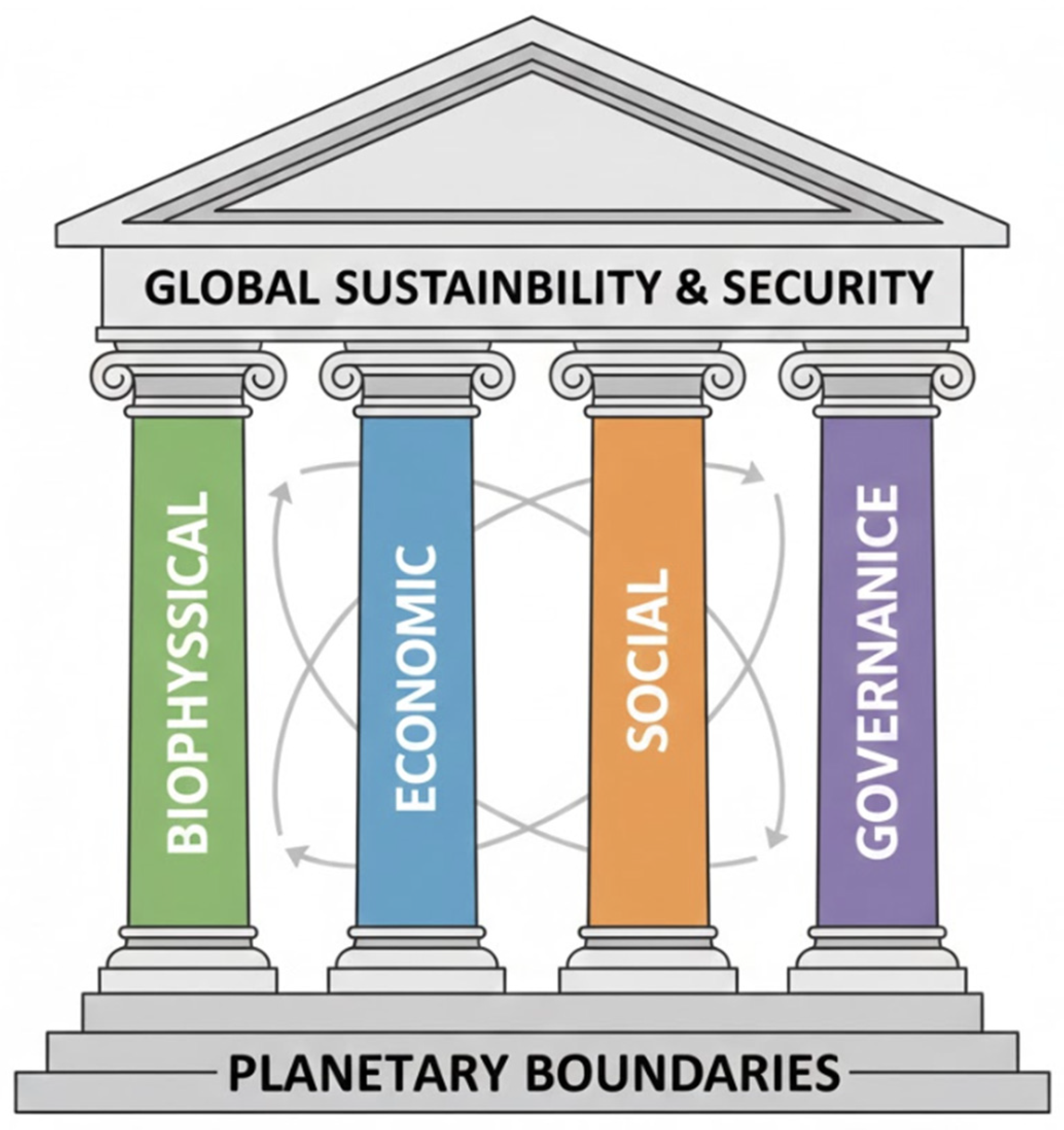
Figure 1. One Security framework: four interdependent dimensions (biophysical, economic, social, and governance) jointly producing security and sustainability outcomes.
Sustainability 18 01031 g001
Figure 2. Spheres of Security (SOS): four overlapping spheres and the overlap rule. Overlap interventions deliver verified benefits in ≥3 spheres within the same geography/time window, subject to safeguards.
Sustainability 18 01031 g002
Figure 3. SOS operating cycle (diagnose–co-design–deliver–demonstrate–adapt).
Sustainability 18 01031 g003
Figure 4. SOS institutional architecture: convening, delivery, financing, assurance, and dispute resolution roles supporting overlap-oriented commissioning under pooled or aligned budget conditions.
Sustainability 18 01031 g004
Figure 5. Entry-point SOS and staged adoption: coordination-first (‘shadow scoring’), aligned commissioning, and pooled outcomes funding as administrative and legal capacity increases.
Sustainability 18 01031 g005
Table 1. Overlap-bundle checklist (programme design requirements and evidence artefacts). 
Requirement (Minimum)What It Means in PracticeEvidence Artefact (Publish/Verify)
Primary objectiveA clear primary outcome in one sphere (B/E/S/G)Theory of change + baseline/counterfactual statement
At least one co-benefit mechanismA specific design feature expected to produce a second-sphere gain (not incidental)Design specification + targeting rules
Safeguard(s) for foreseeable harmsTriggered protections for distributional, integrity, or ecological risksSafeguard trigger rules + enforcement mechanism
Governance artefactsParticipation, transparency, and grievance pathways are built in“You said/we did” log; grievance register; dashboard fields
Verification planEvidence rules for each claimed sphere delta and safeguard complianceAssurance protocol (Table 2) + audit cadence
Ye sDelivery feasibilityCommissioning route feasible under legal constraintsCommissioning plan (pooled vs. aligned) + role assignment
Adaptation hookPre-registered retuning points (what would cause redesign)Annual retuning note template (Box 1)
Table 2. Assurance protocol (minimum evidence rules for each sphere; illustrative). 
SphereIndicator/Proxy (Illustrative)Evidence RequiredVerification MethodPass/Fail/Materiality Rule
Biophysical (B)Condition/risk proxy relevant to challenge (e.g., biodiversity intactness; heat exposure; sediment load)Monitoring data or audited environmental reportingIndependent technical audit or accredited evaluatorMaterial positive delta ≥ threshold ΘB within boundary/time window
Economic (E)Target-cohort affordability/income stability/jobsAdministrative data (payments, bills, employment) + samplingAudit sampling + counterfactual checkMaterial positive delta ≥ ΘE; distributional test applied
Social (S)Health/security outcome relevant to challengeHealth/admin data, surveys, service useIndependent evaluator + privacy-compliant auditMaterial positive delta ≥ ΘS; equity subgroup checks
Governance (G)Auditable governance proxies (transparency/participation/grievance/integrity)Documentary artefacts + administrative logsDocumentary audit (pass/fail)Counts only if evidence rule satisfied (no partial credit)
Table 3. Minimum viable SOS package (inputs -> artefacts -> outputs). 
ComponentMinimum InputRequired ArtefactMinimum Output (Impact)
MandateWritten convenor authority + PDT membership listPDT ToR (Box 1)Cross-agency participation is routinised
BoundaryDefined place/time window + counterfactual logicBoundary statement (dated)Comparable verification window
SafeguardsDistributional/integrity trigger rules + enforcementSafeguard schedule + grievance Harms are governable, not displaced
AssuranceNamed verifier + evidence rulesAssurance protocol (Table 2)Auditable sphere deltas (incl. governance)
Finance HookBudget tagging and/or aligned commissioningCommissioning plan + rubric Overlap becomes decision-relevant
LearningAnnual MELR calendarRetuning note template (Box 1)Parameters improve over time
Disclaimer/Publisher’s Note: The statements, opinions and data contained in all publications are solely those of the individual author(s) and contributor(s) and not of MDPI and/or the editor(s). MDPI and/or the editor(s) disclaim responsibility for any injury to people or property resulting from any ideas, methods, instructions or products referred to in the content.