Article

How Does Sustainability Governance Shape the Green Finance and Climate Nexus?

1
University School of Business, Chandigarh University, Mohali 140413, India
2
Institute of Social Sciences and International Studies, Budapest Metropolitan University, 1148 Budapest, Hungary
3
Department of International and Applied Economics, Széchenyi István University, 9026 Győr, Hungary
*
Authors to whom correspondence should be addressed.
Sustainability 2026, 18(2), 1022; https://doi.org/10.3390/su18021022
Submission received: 24 December 2025 / Revised: 15 January 2026 / Accepted: 16 January 2026 / Published: 19 January 2026

Abstract

The proposed research aims to analyse the effects of the relationship between Sustainability Governance (SG) and Climate Impact (CI), taking into consideration Green Finance (GF). Furthermore, it examines how Institutional Support (IS) enhances the governance systems governing these variables. The research provides a holistic approach for analysing the effects of financial dynamics on climate impacts. Partial Least Squares Structural Equation Modelling (PLS-SEM) was employed in this research study. The data were collected from various industries using a standardised questionnaire. The structural model examined the direct and indirect relationships between variables such as GF, SG, and CI. IS emerged as the moderated variable. The outcomes of the study confirmed that “GF has an important and direct as well as indirect (through SG as the mediator) impact on CI. IS significantly increases SG and thus exerts an overall enhancing effect on the impact of GF on the climate.” The study has supported the research objectives and aims. The limitations of this study comprised constraints related to both time and cost. The researchers encountered limitations in accessing senior managers and directors of various organisations for the study. IS emerged as an important intermediate factor that can significantly link various actions and activities that impact the climate. This study supports both global and local research objectives. The study offers significant insights, underscoring the critical role of SG within Green Business (GB). Additionally, IS emerges as a vital enabling tool that strengthens the overall governance framework. The study contributes significantly to the development of integrated frameworks for institutions seeking to effectively address environmental challenges. The implications for action indicate that furthering entrenched institutional structures and instilling good governance practices can add tremendous value to the transformation potential of GF and usher in accelerated efforts to achieve national and international objectives on climate change.

1. Introduction

Climate change has come to represent the crucial challenge on the twenty-first-century agenda, with 1.3 °C of warming above pre-industrial levels already having occurred and it is on track to reach 2.7–2.8 °C this century with the current level of ambition [1]. Addressing this trend will require mobilising finances on a scale that would previously have been expected in a war effort. This will mean new spending on a scale of USD 900 billion–2.1 trillion annually on mitigation, according to the United Nations Environmental Programme (UNEP), with a further USD 194–366 billion annually on adaptation [2], which is significantly greater than the current publicly disbursed finance. This gap between requirements and resources is now termed the “climate finance gap” and highlights the current importance of financial intermediation effectiveness and robust governance frameworks [3]. The development of green finance (GF) and funds dedicated to environmental projects provides a cause for slight optimism [4,5]. This is on the back of the cumulative issuance of labelled green, social, sustainability, and transition bonds exceeding USD 5.1 trillion as of mid-2024 [6], with green bonds increasing to account for 70% of all new sustainable debt [7,8]. A significant development in India, one of the most rapidly expanding emerging markets today, is that tracked GF flows had reached INR 3.7 trillion (USD 50 billion) in FY 2021-22, with a 20% increase in only two years, with the majority of this devoted to clean energy and efficiency and e-mobility, as specified in [9] in this region. However, as the current state of worldwide experience shows, financial contribution per se does not necessarily strengthen climate change achievements on the ground, with important projects in danger of sitting idle amidst resource misallocation or underperformance in the context of governance structures that lack clarity [10].
In the growing onslaught of the challenges posed by climate change, the need for targets extends no further than the call for specific financial flows, governance, and alignment of these elements with climate goals. In the mobilization of GFs to the tune of trillions of dollars, one fundamental research question remains: namely, why the sheer volume of climate finance in some countries contributes greatly to environmental outcomes while, in other countries, such volumes make little, if any, difference to outcomes that make a tangible difference in the change required in the global fight to address climate change. It is necessary to identify the missing link between the chains of GF and climate change outcomes.
The present research is located at the nexus of climate finance, sustainability governance (SG), and the implementation of public policies, domains that are acquiring an increasingly important strategic role in the process by which governments, international organizations, and other stakeholders are working to translate the terms of the Paris Climate Accords and the Sustainable Development Goals into action [11]. However, paradoxically, in spite of the spectacular growth in sustainable financial tools such as green bonds, sustainability-linked loans, and climate funds, empirical research on the meaning and functioning of this type of financial flow has been hitherto limited and not well studied.
This study makes a significant contribution by bridging the gap between climate finance and desired environmental outcomes from an SG perspective using empirical methods. Unlike previous studies, in which governance is often a marginal or non-changing variable, this paper defines governance as a dynamic mediator that plays a pivotal role in influencing GF and the relationships among GF, SG, Institutional Support (IS), and climate impact (CI). This paper presents a diversified, empirical approach that is beneficial in that it reaches new heights in theoretical developments and practical applications. IS is introduced in this study as a structural catalyst, which plays a major role in enhancing governance functions and optimising the effectiveness of financial exchanges, especially in new economies. These theoretical developments and new findings are not only original in their approaches and assumptions but also offer concrete policy implications and directions to relevant global actors in their pursuit to align their finances with climate imperatives through the Paris Agreement and SDGs.
To fill this research gap, the current research proposes an integrated empirical analysis to examine the impact of SG on the GF and CI relationship and the role played by IS in improving the sustainability of this role. Using Partial Least Squares Structural Equation Modelling (PLS-SEM), the current research aims to develop a complex structural model that incorporates the direct as well as indirect relationships between the variables to have a better grasp on the complex GF and CI relationship. It should be noted that PLS-SEM analysis is appropriate for the current research as the technique deals with complex constructs and a small to medium sample size.
The reasoning for conducting the proposed study rests on two different considerations. Firstly, existing policy discourse has traditionally focused on promoting the scaling up of GF, while ignoring the role of the quality of governance in ensuring the efficiency of GF. Secondly, there is currently a lack of empirical modelling of the role of governance and the impact of the underlying institutions on the outcomes of climate finance. This has been the focus of most theoretical models of climate finance, with governance being treated as the background variable or the state of being in a specific condition.
This study offers important insights that pave the way for SG being viewed not merely as the stage on which the performance of GF occurs, but also as the catalytic factor that shapes whether and how GF translates into climate value. In that regard, this study also offers important insights that allow structural factors within climate finance performance to be supplemented by government support.
Such financial flows can strengthen sustainability governance by providing resources for effective monitoring and oversight. For example, GF flows can directly support adaptation and mitigation activities and produce visible climate outcomes through enhanced transparency, stakeholder participation, and monitoring, thereby increasing their overall impact on climate change [12]. Well-designed governance frameworks can, in turn, efficiently channel these green financial resources, creating a positive feedback loop between finance, governance, and climate action. Moreover, institutional support for governance frameworks—such as standardisation, concessional financing, and regulatory mechanisms—can further improve their effectiveness, particularly in emerging markets where institutional capacities are still under development [13].
By empirically validating these interdependencies using PLS-SEM, this study makes a significant contribution to the literature by proposing a conceptually grounded and statistically supported framework with strong potential to inform policymakers, financial institutions (FIs), and multilateral institutions in addressing the climate finance implementation gap—an issue of critical importance for developing economies facing acute governance challenges.
The solution to the real-world problem tackled in this paper is theoretically profound, methodologically sophisticated, and of strategic relevance. Rather than simply measuring money and emissions, this study investigates the governance structure that converts finance into climate action.

2. Literature Review and Hypotheses

2.1. Green Finance

GF has obtained significant recognition as a vibrant tool in the pursuit of sustainable development objectives by redirecting funds into environmentally positive developments. Classifications of various GF tools, such as green bonds, green loans, sustainability-linked bonds, carbon credits, and equity investment, have shown significant increases in usage levels to finance climate-resilient infrastructure and energy sectors [14]. Institutional and government reinforcements from global and national organisations, such as the EU Taxonomy, the Reserve Bank of India’s (RBI) green deposit scheme, and finances from multilateral organisations such as the World Bank and Green Climate Fund, have shown pivotal contributions in making these tools mainstream and encouraging the participation of the private sectors [15]. Nonetheless, these remain unequally accessible, with the primary-focus groups being the MSMEs, rural sectors, and emerging countries, largely because of the limitations of creditworthiness, high transaction costs, and the lack of environmental data [16,17]. Solutions from FinTech and inclusive policies have shown the potential to address these inequalities. Also, the contributions of stakeholder participation, from the level of investors, community groups, and the broader civil society organisations, have shown appreciable importance in ensuring the transparency and accountability of the GF’s conduct. Shareholder activism, participatory budgeting, and community-led sustainable development have shown promising results in acting as revolutionary forms in promoting climate-resilient financial behaviour [18]. Despite the appreciable advancements in these sectors, the current literature has shown the scopes of greater inclusivity, behaviour changes, and integration of technology in making the efficacy of the GF frameworks better equitable in global contexts.

2.2. Sustainability Governance

SG has developed as a paradigm with multiple lenses encompassing the integration of the environment, society, and economy into institutional and policy frameworks [19]. The literature shows the pivotal role of regulation in creating the legal and institutional infrastructure for sustainable development [20]. The governments of nations and the international community have developed guidelines such as the Sustainable Development Goals (SDGs) [21], the Paris COP Accord, and Environmental and Social Governance (ESG) disclosure regimes (TCFD, EU Taxonomy) that inform and harmonize the approach to sustainability for all [22].
These are helpful in institutionalized commitment and in aligning the behaviour of all key stakeholders with the long-term vision of sustainable development. Transparency and accountability are equally significant, with emphasis on disclosure of key environmental and social impacts along with the requirement of accountability to key stakeholders. The approach to governance now also includes key principles of integrated reporting and GRI-based reporting to promote awareness, trust, and greater engagement with key actors, namely governments, stock market players, and the general public [23]. However, the literature shows [24] that there are also serious shortfalls regarding participation and inclusivity, with special emphasis on the marginalized communities, native people, and localities left outside the decision-making frameworks of the governance structure. Inclusive frameworks of governance, namely community-based governance for effective management and community-based budgeting, are considered essential to infuse greater legitimacy, ownership, and equity in the sustainable development domain [25]. At the end of the discussion, the seriousness of the monitoring system and the mechanism of enforcement assumes key significance in ensuring compliance and progress toward the same. This involves independent audits, third-party certification, and online monitoring systems. Given the partial absence of enforcement and institutional divisions in general, but particularly for developing nations, this also proves to be a crucial drawback for the effective implementation of SG [26]. Against this backdrop, the literature has posited the need for a governance regime for SG that has regulatory frameworks which effectively and coherently blend inclusiveness and flexibility with clearly outlined and robust monitoring systems to ensure agile and fair transitions toward sustainable development.

2.3. Climate Impact

CI is incrementally being defined by mitigation outcome, adaptation outcome, innovation, and ecosystem resilience—the four essential aspects that make up a comprehensive integrated framework of response to climate change. Mitigation outcome basically deals with greenhouse gas emission reduction using renewable energy, carbon pricing, energy efficiency, and afforestation efforts. There is evidence showing that policies relating to carbon markets and net-zero approaches of businesses have drastically cut the emission intensity in many sectors. Adaptation outcome, for its part, improves the ability of both society and ecosystems to cope with climate risks. Among the effective approaches prescribed in the literature are climate-resilient agricultural practices and early warnings, as well as nature-inspired urban planning. This is, however, especially achieved in those areas where proper governance strategies are in place. The disparities in adaptation capability in vulnerable social groups and developing areas remain significant. Innovation, for its part, works as a bridging mechanism for both adaptation and mitigation. Clean technologies, artificial intelligence, and blockchain innovations are revolutionising the approaches toward climate action [27]. On the other hand, governments work to create innovation ecosystems through the use of subsidies, public-private collaborations, and investments in R&D in mobilising climate innovations. In regard to this, ecosystem resilience has come to be important in ensuring the stability of the ecosystem during climatic challenges. Restoring natural habitats, the conservation of nature, and responsible land management help both in mitigation, which includes absorbing carbon and adaptation, and in conserving communities against floods and drought or climatic changes concerning the same [28]. The literature supports an integrated approach to addressing climate change that combines technological advancement with nature-based solutions [29].

2.4. Institutional Support

IS plays an extremely important role in ensuring sustainable development and climate action, with four pillars for IS established in the literature: Government Commitments, Regulation Clarity, Intergovernmental Cooperation, and IS capacity building. IS’s role in ensuring sustainable development is described [30] as being anchored in government commitment, whereby the commitment reflects the political will to make sustainability inherent in development agendas, climate action, and government spending. IS’s influence on development programs, climate actions, and spending structures, according [11] to the literature, has been shown to be severely impacted by government commitment to sustainable development actions, with NDCs in the Paris Climate Agreements showing higher coherence in government spending on sustainable development actions in developing countries. Government commitment to sustainable development actions needs to match coordination in regulations in order to ensure fiscal attractiveness to domestic as well as foreign investors in developing countries [31]. The presence in developing countries of proper sustainability terminologies in taxonomy, ESG reports, and green economy finances has played an important role in boosting confidence in IS in those countries. The role played by interagency cooperation in ensuring cooperation towards sustainable development actions was established in the literature to act as an important IS action in developing countries upon which other IS activities are central to ensuring IS’s influence on development actions in developing countries is successful by ensuring cooperation amongst government ministries in developing countries, including ministries in charge of economic expenditure in developing countries, to ensure complementarity in sustainable development actions in developing countries impacted by common challenges such as poverty in developing countries.
However, capacity building is perceived in the literature as a pivotal foundation of IS’s influence on sustainable development actions in developing countries requiring technical capacity-building to enhance human capacity; it is further influenced by international IS cooperation and the cooperation of local entities, which collectively ensure the success of sustainable development [32,33,34,35].

2.5. Hypotheses

GF has proven to be an important mover in bringing about SG by channelling funds into environmentally responsible and socially inclusive projects. It was revealed in the literature review that the use of green financial instruments such as green bonds, sustainability-linked loans, and ESG-based investment strategies could improve governance structures by bringing about transparency, accountability for risk, and strategic thinking [36]. The following hypothesis is the result (H1):
H1: 
GF has a positive impact on SG.
GF has a transformative role for SG, providing financial resources for environmentally responsible and inclusive development. This includes financial instruments such as green bonds, sustainability-linked loans, and ESG investments, which assure not only financial support for climate-smart development but also the tenets for transparency, accountability, and adherence to regulation for financial institutions. The implementation stages for GF normally involve strict adherence to global environmental disclosure rules, assessments, and sustainability reports, which makes financial institutions abide by governance frameworks. The type of financial discipline involved usually makes some of the key governance dimensions for sustainability more solid, such as imposing regulations, active participation of stakeholders, and the process of inclusive decision-making. Such good governance over the issue of sustainability enhances the capacity for the effective formulation of climate governance policies. These systems of governance would, therefore, serve effectively in bringing about mitigation strategies against climate change, like the reduction of greenhouse gases, increasing renewable energy, and adaptation strategies to climate change, such as disaster risk reduction, sustainable land use, and the restoration of degraded ecosystems. In terms of the relationship between GF and SG, in this case, such a relationship is synergistic. This relationship between GF and SG is interdependent in terms of realising actual climatic outcomes. Such interdependence will, therefore, call for combined strategies that involve innovation in the area of finance along with mechanisms of governance that are inclusive, open, and transparent.
H2: 
SG has a positive impact on CI.
The literature review indicates the importance of having representative, accountable, and well-regulated systems to successfully address climate matters. SG encompasses the structures, institutions, and processes related to environmental and climate issues, such as the enforcement of regulations, stakeholders’ involvement, transparency, and thinking in the long term [37]. The structures of governance that are committed to sustainability ensure that policies related to climate change are not only appropriately made but also appropriately applied. These systems enhance inter-sector coordination, environmental justice, and the coordination of adaptation and mitigation measures in light of regional and local development plans [38]. The good governance variable holds a positive association with higher success rates of climate mitigation; for instance, lower rates in greenhouse gas emissions are due to incentivised renewables, carbon pricing, and environmentally conscious urban design [39]. Good governance is also important for improved adaptational capabilities because it enables investments in resilient infrastructure, early warning systems, sustainable agricultural practices, and rehabilitating ecosystems [40]. Additionally, inclusive governance helps ensure the involvement of vulnerable groups, such as the marginalised, in environmental programs necessary for attaining environmental justice.
Empirical studies indicate that all regional and global sites that adopt properly established SG frameworks also consistently indicate higher performance rates for climate resilience, environmental indicators, or other factors. As such, SG is one of the most significant driving forces that ensure that environmental policies, environmental investments, or environmental finances are transformed into tangible climate action success factors.
H3: 
IS moderates the relationship between SG and CI.
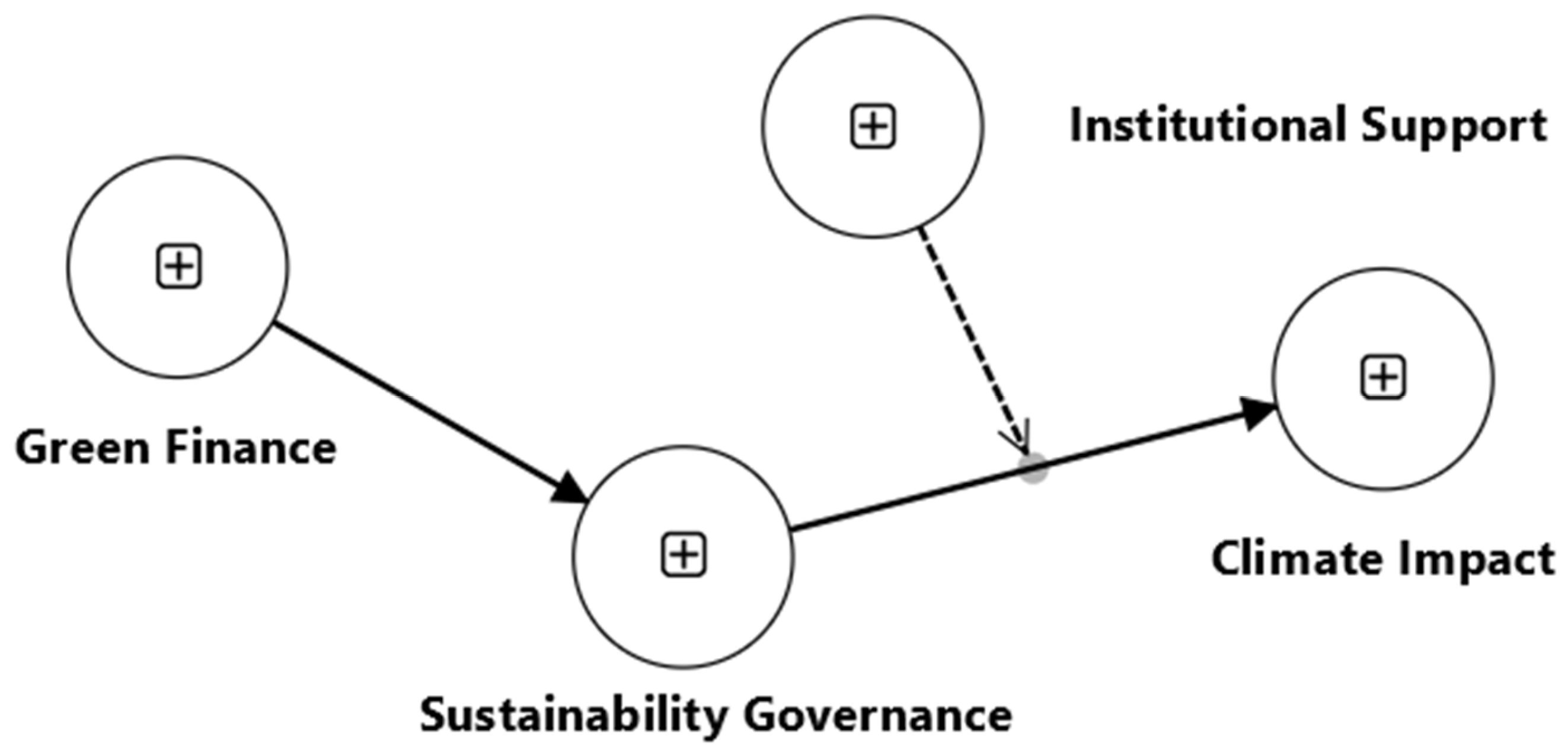
In summary, the conceptual model of this paper is shown in Figure 1.
The conceptual model (Figure 1) presents an integrated framework that combines GF, SG, and IS to explain CI. Green finance is theorised to strengthen sustainability governance through embedded disclosure, accountability, and compliance mechanisms, which subsequently influence climate outcomes. Institutional support is incorporated as a moderating variable in the SG–CI relationship, capturing how variations in institutional capacity, regulatory effectiveness, and policy execution condition the extent to which governance mechanisms translate into climate impacts [41]. While stronger governance frameworks may also attract green finance, and observed climate impacts may influence institutional and governance behaviour, such reciprocal relationships cannot be empirically disentangled within a cross-sectional PLS-SEM design. Accordingly, the assumed directionality reflects theoretical structuring. This integrated framework is particularly relevant for developing economy contexts, where the presence of institutional support does not uniformly enhance governance effectiveness, thereby offering policy-relevant insights into uneven climate outcomes.

3. Materials and Methods

The quantitative methodology in this study has proven to be excellent for systematically and objectively investigating the associations between variables [42]. This methodology enhances the accuracy and generalizability of the findings by conducting data collection, which aids in statistical analysis, and hence in hypothesis testing. Studies involving the identification of constructs, investigating the causal relationship, and scrutinising patterns in massive datasets will largely benefit from this methodology (n = 329). Furthermore, this quantitative methodology helps in diminishing the risk of the researcher’s influence on the information by presenting a systematic, repeatable approach with enhanced validity by using a reliable study procedure [43]. This methodology helps in the systematic analysis of complex patterns in LVs’ complicated associations by using statistical procedures such as SEM-PLS, making it an efficient method for assessing conceptual models. The quantitative method in this study has proven to be perfectly suited to the objective of this research due to its ability to present empirical evidence that substantiates the generalisations on conceptual models.

3.1. Design and Approach

The Descriptive Cross-Sectional Research Strategy, which is best suited to investigate relationships between variables at a point in time, is employed in this research [44]. This research design is most appropriate in investigating perceptual behaviours in actual settings since, in this design, a full understanding of the phenomenon in terms of patterns, characteristics, and relationships without intentionally modifying variables can be achieved. This design gives a full understanding of the phenomenon under observation through the careful collection of data from a sample group in order to identify trends and relationships within the data. This particular design is most appropriate in assessing behaviours and trust, aspects that influence decision-making at a point in time [45]. Also, this design is most appropriate in that it enables a thorough understanding of the topic in actual settings, since cost is not involved in this design, as it involves data collection in actual settings through surveys. The Descriptive Cross-Sectional Research Strategy is perfectly appropriate in relation to this research since, with this design, a thorough understanding is attained that does not necessarily require follow-up.

3.2. Sample and Data Collection

In order to ensure that the sample is made up of knowledgeable and experienced professionals in the government, finance, and sustainability sectors and services during the previous six months, the research criteria were established. India was deliberately selected as the research context because it signifies a major emerging economy characterised by rapid growth in green finance initiatives alongside uneven institutional maturity, fragmented regulatory frameworks, and variable enforcement capacity [46]. These structural features make India a theoretically appropriate setting to examine how GF is translated into sustainability governance practices and, ultimately, climate outcomes. Data from GF users were gathered using a snowball sampling strategy, which is frequently applied when direct access to a larger, randomised sample is restricted [47]. This approach leverages referrals from initial participants to reach additional respondents with relevant experience.
Data were collected from February to May 2025, yielding a total of 500 responses by Cochran’s formula for sample size [48]. Following a thorough review, 45 responses were received after the deadline, 93 were invalid or were unreliable entries that were excluded, and 96 did not respond, resulting in a final sample of 266 valid responses. This sample size is considered suitable for SEM analysis.

3.3. Instrument Design

The measurement scales used in the study are displayed in Table 1, with items that have been somewhat altered and tailored to meet the goals of the investigation. To guarantee that the questions appropriately represented the theoretical ideas, every item in the questionnaire was thoughtfully designed to correspond with the constructs being tested and with the demographics (Table 2). A board of ten professionals from academia and the relevant industry was consulted to establish face validity. These experts’ deep knowledge and comprehension as professionals contribute to their nomination. The following were on the panel:
  • Academic specialists: five professors and researchers with professional expertise in government, finance, and sustainability sectors, from top universities in India and beyond.
  • Industry experts: Five FinTech professionals having hands-on experience in implementing professionals, GF, and sustainability sectors, including managers, consultants, and senior executives. To make sure the questions were understandable, pertinent, and thorough, these professionals went over the questionnaire. Their suggestions were very helpful in improving the clarity and applicability to the goals of the study.
  • This expert validation served as a critical step in reducing instrument bias. By refining the questionnaire based on feedback from ten academic and industry specialists, the study ensured that the items remained objective, theoretically aligned, and clear to practitioners, thereby minimizing systematic errors in respondent interpretation.

All constructs were measured using a 7-point Likert scale from 1, which means strongly disagree, to 7, which means strongly agree [49] (Sharma et al., 2025). The construct consists of five items each. All variables and their measures are shown in Table 1.
Table 1. Constructs and measures.
Constructs & SourceMeasureDimensions
Green Finance (GF)
[50,51]
  • Our organisation has access to green financial instruments such as green bonds or loans.
Instruments, Support, Accessibility, Engagement
2.
Government or financial institutions offer incentives for green investments.
3.
GF has been effectively used to fund environmental projects.
4.
There is sufficient IS for green financial mechanisms.
5.
The volume of green financial flows has increased in recent years.
Sustainability Governance (SG)
[52,53]
  • Our organisation complies with national/international sustainability regulations.
Regulation, Transparency and Accountability, Participation and Inclusiveness, Monitoring and Enforcement
2.
There is clear accountability for environmental governance.
3.
Government policies support long-term sustainability goals.
4.
Stakeholder participation is encouraged in sustainability decision-making.
5.
Monitoring and evaluation mechanisms for sustainability are effective.
Climate Impact (CI)
[54,55]
  • Our initiatives have led to a measurable reduction in carbon emissions.
Mitigation Outcomes, Adaptation Outcomes, Innovation, Ecosystem Resilience
2.
GF has contributed to climate adaptation or mitigation outcomes.
3.
Climate risks are actively assessed and managed in our operations.
4.
There is a visible improvement in environmental indicators due to recent projects.
5.
Our organisation contributes to national or international climate goals.
Institutional Support (IS)
[56,57]
  • Government agencies provide clear guidance on GF and sustainability.
Government Commitment, Regulatory Clarity, Inter-agency Collaboration, Capacity Building
2.
Institutional capacity supports climate-related decision-making.
3.
Technical and financial assistance is available for green projects.
4.
There is strong coordination between public and private stakeholders.
Source: Authors’ own edited table, 2025.
Table 2. Respondents’ demographics.
Demographic VariableGenderRespondents (%)
GenderMale63.5%
Female36.5%
Age Group (in years)18–2526.3%
26–3537.6%
36–4522.9%
46–559.0%
56 and above4.1%
Organizational AffiliationGovernment/Policy Institutions31.6%
Financial Institutions (Banks, NBFCs, FinTech)38.3%
Sustainability Sector (NGOs, ESG, Climate)30.1%
Geographic RegionNorth India29.7%
South India19.9%
East India16.2%
West India23.3%
Central & Northeast India10.9%
Source: Authors’ own edited table, 2025, n = 266.
A pre-screening procedure was used to make sure the respondents were appropriate for the study in order to guarantee the sample’s relevance. “Do you have experience and knowledge of GF and SG related to sustainable projects?” was the first qualifying question posed to potential respondents.
The entire poll could only be completed by those who responded in the affirmative.
The size of the entire population is uncertain because there is no official estimate or centralised database for professionals working in FinTech and GF. Therefore, non-probability convenience sampling was utilised in the study, which is appropriate for exploratory research involving groups that are difficult to reach or that are not well characterized [58]. This guarantees practical relevance and access to competent people, even when it restricts the formal generalizability.
To mitigate potential sampling biases, a multi-stage validation process was implemented. First, a rigorous pre-screening procedure ensured that only respondents with verified professional knowledge of green finance and sustainability governance participated. Second, the exclusion of 93 invalid or unreliable responses further enhanced the data’s integrity. Finally, the selection of India as a research context was theoretically driven to capture dynamics in a large emerging economy with diverse regulatory maturity.
Given the emphasis on FinTech platforms for green finance (GF) entrepreneurs, this study employed structural equation modelling (SEM) to analyse complex relationships among latent constructs and observed indicators, making it suitable for testing path linkages within the sustainable governance framework (Figure 2).

4. Results

4.1. Measurement Model Assessment

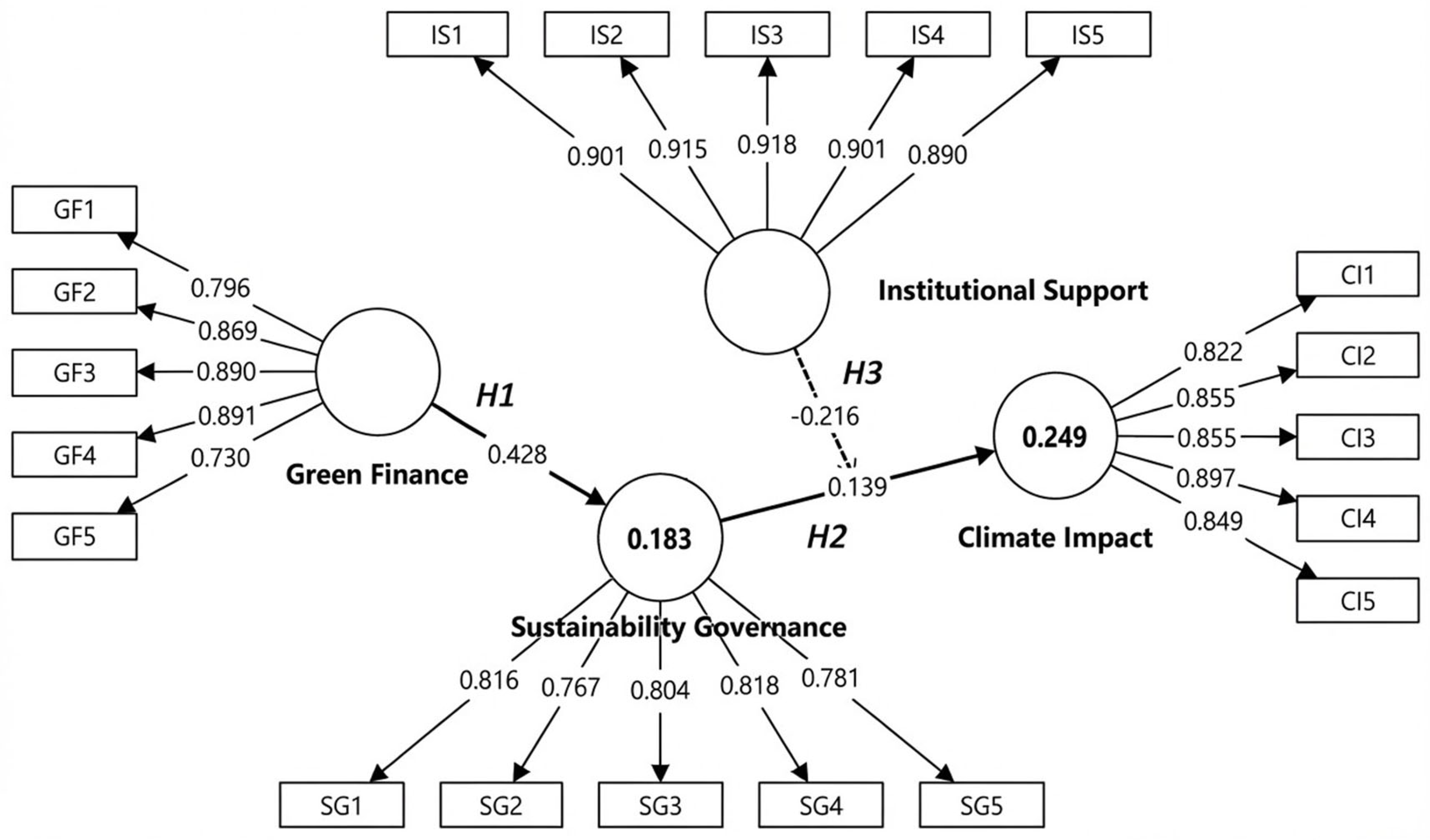
To examine the measurement model quality, indicator reliability tests, internal consistency reliability tests, convergent validity tests, and multicollinearity tests were undertaken (Table 3). The standardised factor loadings for all items were well above the threshold of 0.70, establishing robust indicator reliability. In particular, the loadings for the construct CI varied between 0.822 and 0.897, for GF between 0.730 and 0.891, for IS between 0.890 and 0.918, and for SG between 0.767 and 0.818. These high loadings confirm that the items are good measures of their respective latent constructs.
Internal consistency reliability was assessed through Cronbach’s alpha and composite reliability. All constructs proved to have very good reliability, with Cronbach’s alpha ranging from 0.857 (SG) to 0.945 (IS) and composite reliability ranging from 0.897 to 0.958, which is well over the limit of 0.70 suggested by [59]. These findings verify that the constructs are measured reliably. To check the convergent validity, the Average Variance Extracted (AVE) technique was used [60]. For all the constructs, the AVE values were above 0.50. This indicates that the indicators used in each construct explained more than half the variance. The AVE values were 0.733 for Construct CI, 0.702 for Construct GF, 0.819 for Construct IS, and 0.636 for Construct SG.
To determine the presence or absence of multicollinearity, the values of the Variance Inflation Factor (VIF) were taken into consideration. It was noted that VIF values for all the indicators were below the threshold of 5, with a highest value of 4.555 for GF3 [61], thereby confirming that there is no multicollinearity. At this stage, it is concluded that the level of reliability/validity of the measurement model is at its highest, providing a strong foundation for carrying out analysis for the structural model.

4.2. Results of Discriminant Validity

In order to find the discriminant validity, the following tools were applied: the Fornell–Larcker criterion, as well as the correlation between the different constructs. These are tests conducted to ensure that each construct has discrimination among all the other constructs in the model. The Fornell–Larcker criterion states that the square root of the Average Variance Extracted (AVE) of each construct must be higher than the correlation coefficients between that construct and all the other constructs [62]. The square root values of AVE (appearing diagonally in the matrix) were 0.856 for CI, 0.838 for GF, 0.905 for IS, and 0.797 for SG (Table 4). In every instance, these values were greater than the corresponding inter-construct correlations, representing sufficient discriminant validity.
Moreover, the inter-construct correlation matrix also reinforces discriminant validity. All correlations between constructs were below 0.85, and the maximum observed correlation was 0.453 for IS and SG (Table 5). The interaction term (IS × SG) revealed low correlations with the original constructs, validating its discriminant nature and lack of multicollinearity issues in moderation analysis. Generally, the findings from both Fornell–Larcker and the correlation matrix validate that all constructs of the model are unique and have acceptable discriminant validity.

4.3. Structural Model Valuations

A structural model analysis was conducted on the proposed relationships between various constructs through bootstrapping with 5000 resamples [63]. Results showed that GF significantly and positively impacts SG (β = 0.428, t = 9.586, p < 0.001) (Table 6), indicating that green financial tools, institutional incentives, and access to green capital have a substantial role to play in shaping governance frameworks aligned to sustainability goals. IS also significantly predicts CI (β = 0.326, t = 5.108, p < 0.001), confirming that institutional commitments, inter-agency cooperation, and smooth regulatory frameworks play a crucial role in driving tangible environmental outcomes, such as carbon reduction, adaptation, and development activities aligned with climate goals. This explains about 25% of the variance (R2 = 0.249) with a moderate effect size (F2 = 0.225), accounting for 18.3% of the variance (R2 = 0.183). The interaction term of IS and SG has a statistically significant negative influence on CI (β = −0.216, t = 3.199, p = 0.001). This indicates the presence of a moderating effect. This also means that although the individual effect of IS and SG is positively associated with CI, jointly their effect may result in diminishing returns or even restriction, possibly caused by over-regulation or improper priorities in the case of their simultaneous strength. The direct effect of SG on CI was not statistically significant but approached significance (β = 0.139, t = 1.702, p = 0.089). Non-significant indirect effect value for GF on CI via SG was obtained (β = 0.059, t = 1.629, p = 0.103). This implies that mediation was not supported for this model. The findings suggest that even if GF positively affects governance structure, it does not result in improved CI performance. Overall, the model supports the significance of IS and GF as key drivers of sustainability outcomes, while the role of SG appears to be more complex and potentially contingent on other moderating or contextual factors.
The Q2 results show that SG (0.214) has medium predictive relevance, while CI has low relevance when explained only by governance (0.019) but improves with IS (0.110), highlighting the moderator’s role in enhancing predictive power.

4.4. Moderation Analysis

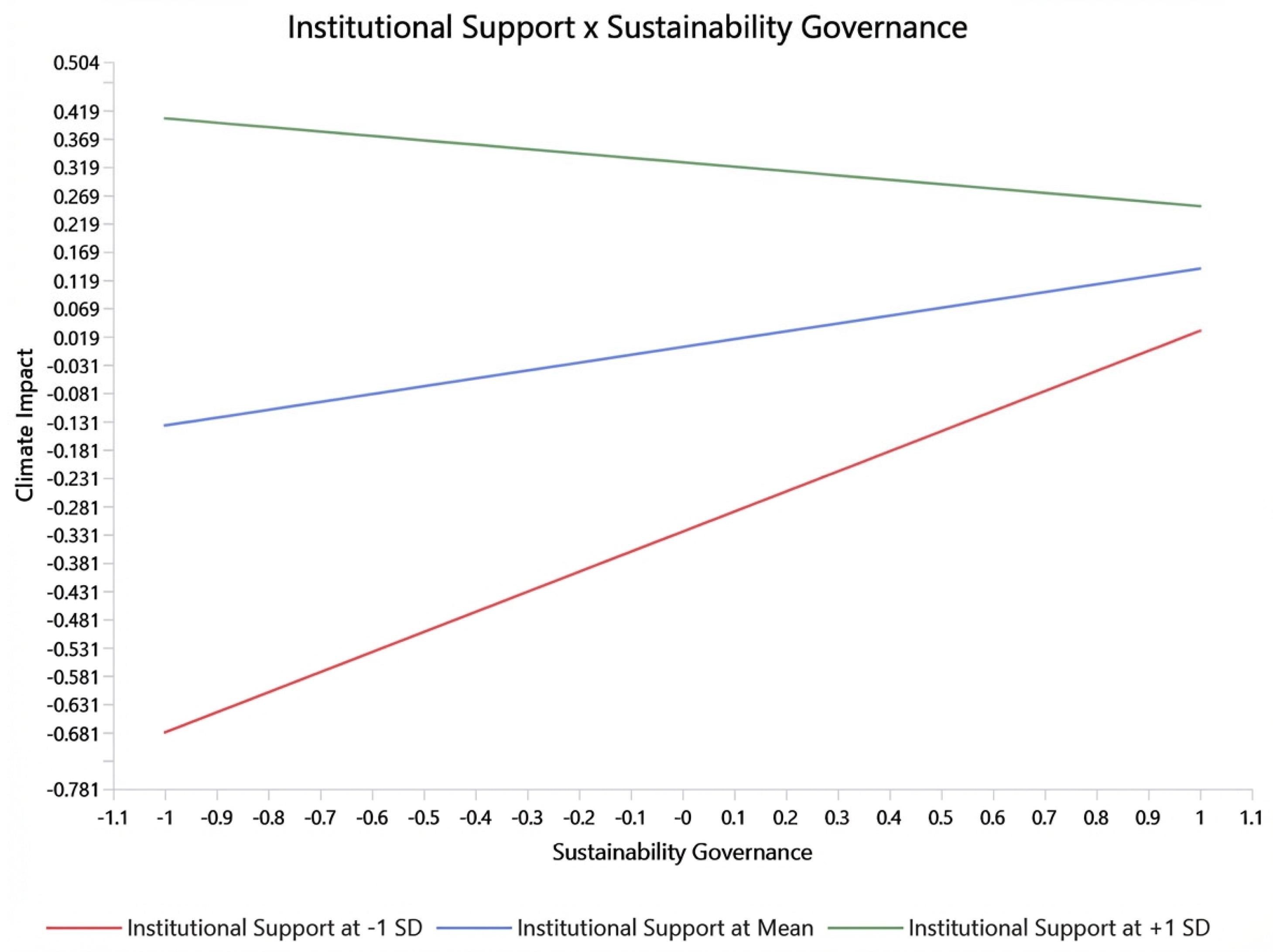
It can be seen in Figure 3 that the moderation analysis focuses on determining if the existence of SG to reduce CI will vary based on the IS level. The significance of the analysis can be attributed to the fact that it makes it possible to observe the interaction effects, which are not visible when using direct relationships, thereby providing a more in-depth understanding for policymakers on how governance structure has to be aligned with the institutional framework to exert the utmost impact on climate.
The red line (−1 SD) indicates that less IS results in a negative climate influence regardless of enhanced governance, thus showing the ineffectiveness of governance when support is lacking. The blue line (mean) represents a mildly positive influence, while the green line (+1 SD) begins with a positive influence that reduces with increased support. Overall, the graph also verifies the negative interaction effect as the presence of IS affects governance efficacy, with the absence of support significantly diminishing efficacy.

4.5. Additional Analysis

The fit statistics reported in Table 7 indicate that the estimated model demonstrates an acceptable overall fit. The SRMR value of 0.079 remains within the recommended threshold of 0.08 [64], suggesting a satisfactory model approximation. The NFI value of 0.863, which is very close to that of the saturated model (0.866), indicates reasonable model adequacy. The observed increases in d_ULS, d_G, and chi-square values compared to the saturated model reflect a modest loss of fit due to model estimation, which is expected and remains within acceptable limits for SEM-PLS analysis.
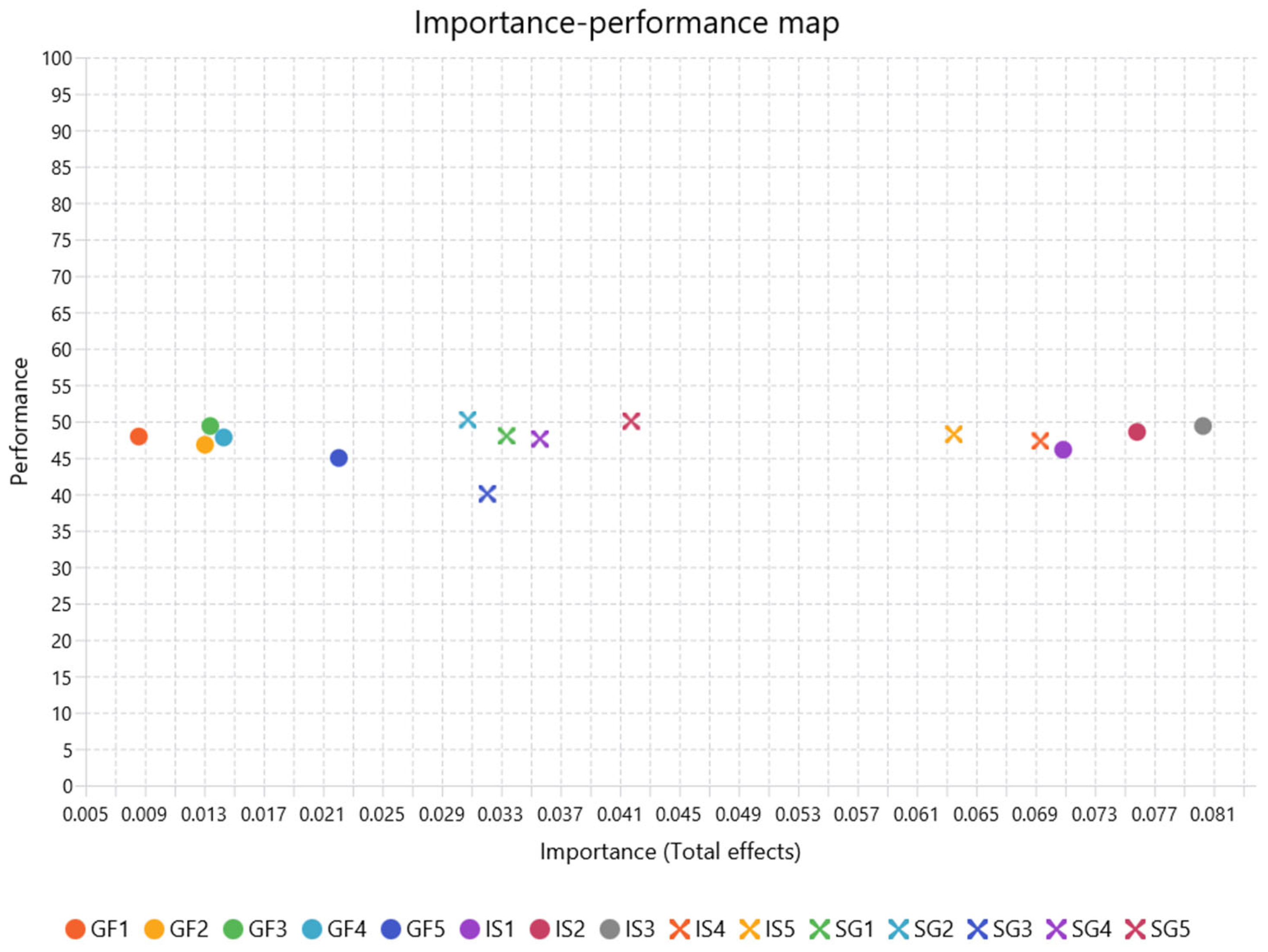
The Importance–Performance Map (Figure 4, IPMA) provides a strategic perspective on the key indicators influencing the outcome variable, namely CI, by positioning them according to their relative importance (total effects) and performance (average values). To enhance interpretability and address scale-related concerns, the performance axis has been deliberately constrained to a narrower range (35–55) that reflects the actual dispersion of the data, thereby revealing meaningful differences that would otherwise be obscured on a broader 0–100 scale [65]. This improved visual clarity allows for more precise differentiation among indicators clustered within similar performance levels. The IPMA results show that sustainability governance indicators (SG5, SG4, and SG3) score high on both importance and performance, underscoring their critical contribution to climate outcomes. These indicators, reflecting governance compliance, transparency, and stakeholder engagement, are performing effectively and should be sustained and further strengthened. In contrast, while green finance indicators (GF1–GF4) exhibit moderate to high performance, they rank lower in importance, suggesting that despite operational strength, their marginal contribution to climate impact is limited. Institutional support indicators (IS1, IS2, and IS3) appear in the lower importance–performance quadrant, indicating priority areas for managerial and policy intervention, as improvements in these items are likely to yield substantial gains in climate impact if their strategic relevance increases.

5. Discussion

Findings from the study offer significant information and help to explain the holistic role of GF, promote SG, and play a crucial role in overcoming the impact associated with climate change, as well as contribute to the existing body of work looking for the facilitators of the development of climate change-resistant sustainable development. This positive role that GF plays in the context of SG observed within this study supports previous studies that suggest that those financial systems that are well linked with environmental applications, such as green bonds, green investments, and climate credits, might serve as precipitators for the reconstruction of governance systems. This role that GF plays in being not only a funding agent but also being integral for improved governance supports previous works that consider the fact that this financial mechanism has the capacity for being both a funding agent and adopting long-term responsible functions for environmental governance. This role that it plays within this environment supports previous works that examine the role that financial mechanisms play within environmental/climate applications. This role that these mechanisms play supports previous works undertaken by [66], which demonstrated within their research that those financial mechanisms linked to environmental applications, such as those within green financial mechanisms that are well linked with disclosure regulations, play an integral role in fortifying environmental governance mechanisms. Additionally, these findings align with previous works highlighting high factor loadings and composite reliability for both environmental financial mechanisms within this study. This reinforces the justification for these financial mechanisms has in enhancing governance. These results corroborate a previous study [67] which proclaims that sustainable finance has pivotal effects in fortifying good governance related to environmental practices, promoting environmentally integrated applications within oversight functions.
Furthermore, the findings are also confirmed by the significant and positive effect that IS has on the climate. This serves to validate the literature that argues for the crucial role that institutional frameworks must take in ensuring sustainability towards the environment [68]. From the above formula, the effect that IS has on the impact of climate change when presented in the form of administrative capacity, policy guidelines, and the same implementation frameworks and strategies affects the impact directly. This means that the effectiveness of sustainability projects lies in the preparedness and responsiveness that the institutional players must have towards the different cross-sector policies that affect the environment. This shows that the results have construct validity since the indicators have a high AVE. Discriminant validity was confirmed using the Fornell–Larcker criterion, inter-construct correlations remained below threshold levels, and VIF values for all constructs and the interaction term were within acceptable limits.
One of the most important findings of the study is the presence of a significant moderating effect of IS on the SG–CI relationship. While the SG factor by itself had only a borderline significant impact on the CI (p = 0.089), it seems to represent a more complex occurrence in which the greater the IS, the greater the possibility of reversing or weakening the marginal efficiency gains of additional methods of SG. This finding can be seen to validate the warning given by those who argue that complementary or duplicative regulatory systems may contribute to the inefficiencies in the process of climate governance [69]. It can be speculated that in circumstances in which there are existing sound institutional frameworks, the additional provision of SG mechanisms may cause regulatory congestion or incongruence unless they can be properly and ideally integrated. This can be seen as indirectly supported by those who focus their efforts on the motivations of the institutional context to properly focus or minimise their systems in the quest for environmental maximisation. This inference can be drawn from the sentiments regarding the supporting role of regulatory systems in the area of sustainable finance, which explain that the provision of the sustainability factor in finance may represent an area of rational integration and proper focus of financial provisioning and the corresponding impact on the environment, preventing incongruence between the methodologies and the provision of the sustainable finance environment by the institution, and avoiding unexpected discrepancies between financial provisioning and environment impact. They propose that the potentialities in green financial flows may be jeopardized by the deficiencies in the capacity for implementation or the provision of the corresponding environment [70].
The fact that the study is constructed to measure the robustness of the Fornell–Larcker criterion through discriminant validation adds a degree of empirical integrity to the separation of GF, SG, IS, and the interaction effect. The low correlation values between the interaction variables (IS × SG) and other constructs confirm that this factor is capturing a different dimension of systemic synergy, possibly that of coordinated activity between capability and implementation, a perspective underscored by current studies emphasising integrated climate governance [71]. The results, summarised, emphasise that progress towards meeting climate goals is not very likely through focused action, such as discrete improvements, that might apply specifically or single-handedly within finance, governance, or institutional frameworks alone. Rather, in policy terms, based in the integrated framework adopted for this study, the most effective climate policies would necessarily synthesise these three elements towards an integrated system that is climate accountable, allocates resourcefully, and delivers policy. The results, taken together, echo the general thrust of the Sustainable Development Goals, particularly SDG-13 (Climate Action), SDG-16 (Peace, Justice, and Strong Institutions), and SDG-17 (Partnerships for the Goals), which call for a synergistic, inclusive, wisely-governed response to shared global challenges for sustainable development and its benefits. The consistency of the predictive results again suggests that governance is the primary factor, highlighting the urgent need for regulatory clarity, capability building, and direct action. The study theoretically contributes to this, as it integrates the role of governance, finance, and institutional moderation with policy lessons for maximal results for climate action.

6. Theoretical and Practical Impacts

This study offers a substantial theoretical contribution by advancing an integrated approach that incorporates GF, SG, IS, and climate effects. It meta-theorises the theories while considering the empirical proof of the linkage between these variables, along with the intricate involvement of the IS variable, which works both as an indirect variable for the promotion of climate effects and as a moderator to influence the degree of governance mechanism effectiveness. The consideration of the large extent of the moderating effect level recognises the importance of considering the differences in the contextual level of institutional capability when assessing the involvement of governance in the environmental performance of the firm. In this context, the research introduces a more dynamic, contextual, and refined approach to the ordinary theories of sustainable development, climate governance, or both.
In addition, this study also highlights the significance of embracing the role of GF in achieving more effective governance for the cause of sustainability by demonstrating the theoretical consideration that financial institutions possess the capability to induce structural change in areas outside the supply of capital. In this context, this study also emphasizes the necessity of a more comprehensive research study to unearth the indirect channels that have a continuous influence on climate financial and governance institutions in the context of their handling of environmental effects in the context of the level of time in the future [72].
The insightful consideration of this research study introduces a very significant starting point for formulating theories to capture the intricate influence of interconnected channels in environmentalism policymaking and the development of institutions. The contributions to practice include recommendations to policymakers, institutional actors, and financial agents on how to plan for climate resilience. The visual presentation of the GF governance highlights not only the significance of financial tools but also other factors of accountability and sustainability. This can help in planning regulatory requirements in synchronisation with financial investment in order to fulfil environmental objectives. The significance of the crucial role played by support through institutions supports the concept that initiatives in capacity development with reforms to improve the operational capacity of institutions in terms of operation/administration/strategy-building are greatly significant. This can be applied in a significant way through institutional investment in implementing changes in infrastructural development and definition of roles and responsibilities in order to improve the catalytic forces of sustainability interventions. The interaction effects illustrated provide evidence that strategies require synchronisation with the prevailing strength/maturity of institutions. This can be applied in order to derive the best results in environments with developed institutions. Through governmental adjustments, effective results would be achieved. Institutional environments under development require that the premise of institutional development takes place with governance development as the precondition. The research also clarifies that financial resources in financial governance may not necessarily accomplish climatic objectives without being practised in a supportive institutional context. This clarifies that a streamlined policy with convergent financial, institutional, and regulatory streams is essential. This contributes significantly to program design, the development of public policies, and designing/synchronising climatic interventions with effectiveness. This contributes toward enhancing the theoretical significance of approaches to definitions/facilitators in non-sustainable development and identifies the direction applied in practice.

7. Conclusions

The study examined the interconnected functions of GF and SG and their related impact on climate influence through moderated mediation analysis. The findings from the study demonstrate the complex and complementary nature of the variables. GF was an important enabler of SG and underlines the importance of financial systems and environments complementing and focusing on each other. IS has both direct and moderating functions on impact and underlines the importance of IS in sustainability. The observed interaction between IS and governance suggests that the effectiveness of governance instruments is contingent on the ability of institutional structures to cope with the situation. Although the direct contribution of SG to climate outcomes was relatively low, its impact was considerably enhanced when combined with high levels of IS. This implies that climate change action needs more than just policies and finances; in fact, it needs enabling infrastructure related to institutions, processes, and governance capacity. Although the indirect effect of GF on the climate aspect through the governance channel was not significant, the channel has a meaningful role, hinting indirectly at the behaviour of longer-term effects not necessarily included within the study timeframe. Given the India-specific sample and a non-probability sampling design, the findings should be interpreted as context-sensitive rather than universally generalisable; variations in institutional maturity, regulatory coherence, and financial market depth across countries may alter the strength and direction of the proposed relationships.
Therefore, this study concludes that for dealing with climate challenges, a holistic perspective covering the complementarities of the roles of finance innovation, institutional power, and the quality of governance is necessary. Through such complementarities, this study has established empirical evidence for holistically addressing challenges of climate change for the purpose of achieving sustainable development towards a climate-resilient outcome.

8. Future Study

Further research can be carried out on the basis of the outcomes achieved in this research which attempt to incorporate the lagged and dynamic effects of GF and governance on climate within the framework of longitudinal research designs. Investigating further contextual controls like political support, technology readiness, and stakeholders may provide better insight into the research context for the facilitation of action against climate change. The comparison analysis within studies across various institutional and geographical contexts can assist in generalising research outcomes for determining specific trends within the research outcomes. Applying qualitative research approaches like interviews and case studies can assist in dealing with challenges and opinions within research contexts related to stakeholders. Impact assessment regarding the level of climate change due to the conversion of the support structure for GF into actions within the private sector can be better understood through further research.

Author Contributions

Conceptualization, V.S., and M.K.; methodology, V.S., and M.K.; software, V.S., and A.S.; validation, V.V., and A.S.; formal analysis, V.S., and M.K.; investigation, V.S., and A.S.; resources, V.S., M.K., and A.S.; data curation, V.S.; writing—original draft preparation, V.S., and M.K.; writing—review and editing, V.V., and A.S.; visualization, V.S., M.K., and A.S.; supervision, V.V., and A.S.; project administration, V.V., and A.S.; funding acquisition, V.V., and A.S. All authors have read and agreed to the published version of the manuscript.

Funding

This research received no external funding.

Data Availability Statement

Data is contained within the article.

Conflicts of Interest

The authors declare no conflict of interest.

References

  1. Gopal, S.; Pitts, J. ESG Integration: Unveiling Risk and Driving Innovation in Sustainable Finance. In The FinTech Revolution: Bridging Geospatial Data Science, AI, and Sustainability; Springer: Cham, Switzerland, 2025; pp. 35–81. [Google Scholar] [CrossRef]
  2. Mahmud, S. Corpus-assisted ecolinguistics and media framing: Mapping climate narratives in Bangladesh. J. World Lang. 2025, 11, 517–558. [Google Scholar] [CrossRef]
  3. Kozma, D.E. Measuring Sustainable Development In The European Union Based On The 2030 Agenda Indicators. Deturope 2024, 16, 21–42. [Google Scholar] [CrossRef]
  4. Adger, W.N. Scales of governance and environmental justice for adaptation and mitigation of climate change. J. Int. Dev. 2001, 13, 921–931. [Google Scholar] [CrossRef]
  5. Tóth, G.; Szigeti, C. The historical ecological footprint: From over-population to over-consumption. Ecol. Indic. 2016, 60, 283–291. [Google Scholar] [CrossRef]
  6. Woodhill, J.; Surie, M.D.; Jones, K. Financing food systems transformation and rural revitalization: Opportunities and challenges. J. Rural Stud. 2024, 95, 241–270. [Google Scholar]
  7. Li, Z.; Li, Q. Balancing Submarine landslides and the Marine Economy for Sustainable Development: A review and future prospects. Sustainability 2024, 16, 6490. [Google Scholar] [CrossRef]
  8. Amighini, A.; Giudici, P.; Ruet, J. GF: An empirical analysis of the Green Climate Fund portfolio structure. J. Clean. Prod. 2022, 350, 131383. [Google Scholar] [CrossRef]
  9. Castillo-Calzadilla, T.; Alonso-Vicario, A.; Borges, C.E.; Martin, C. E-mobility in positive energy districts. Buildings 2022, 12, 264. [Google Scholar] [CrossRef]
  10. Bracking, S.; Leffel, B. Climate finance governance: Fit for purpose? WIREs Clim. Change 2021, 12, e709. [Google Scholar] [CrossRef]
  11. Gomez-Echeverri, L. Climate and development: Enhancing impact through stronger linkages in the implementation of the Paris Agreement and the Sustainable Development Goals (SDGs). Phil. Trans. R. Soc. A 2018, 376, 20160444. [Google Scholar] [CrossRef]
  12. Christopoulos, S.; Horvath, B.; Kull, M. Advancing the governance of cross-sectoral policies for sustainable development: A metagovernance perspective. Public Adm. Dev. 2012, 32, 305–323. [Google Scholar] [CrossRef]
  13. Stern, J.; Holder, S. Regulatory governance: Criteria for assessing the performance of regulatory systems: An application to infrastructure industries in the developing countries of Asia. Util. Policy 1999, 8, 33–50. [Google Scholar] [CrossRef]
  14. Azam, I.; Guo, Y.; Lau, C.K.M. Green Finance and ESG Readiness: Bridging the Gaps in Sustainability Transitions. Corp. Soc. Responsib. Environ. Manag. 2025, 33, 599–615. [Google Scholar] [CrossRef]
  15. Clark, R.; Reed, J.; Sunderland, T. Bridging funding gaps for climate and sustainable development: Pitfalls, progress and potential of private finance. Land Use Policy 2018, 71, 335–346. [Google Scholar] [CrossRef]
  16. Höck, A.; Klein, C.; Landau, A.; Zwergel, B. The effect of environmental sustainability on credit risk. J. Asset Manag. 2020, 21, 85–93. [Google Scholar] [CrossRef]
  17. Csiszárik-Kocsir, Á.; Varga, J.; Bagó, P. Hidden behavioural characteristics of financial awareness among the Hungarian population. Vez./Bp. Manag. Rev. 2024, 55, 72–81. [Google Scholar] [CrossRef]
  18. Matimolane, S.; Mathivha, F.I. Tackling rural water scarcity in South Africa: Climate change, governance, and sustainability pathways. Front. Environ. Sci. 2025, 13, 1550738. [Google Scholar] [CrossRef]
  19. Lafferty, W.; Hovden, E. Environmental policy integration: Towards an analytical framework. Environ. Politics 2003, 12, 1–22. [Google Scholar] [CrossRef]
  20. Haque, F.; Ntim, C.G. Environmental policy, sustainable development, governance mechanisms and environmental performance. Bus. Strategy Environ. 2018, 27, 415–435. [Google Scholar] [CrossRef]
  21. Francis, C.A.; Lieblein, G. Review and critique of the TATA-BOX model. In Agroecological Transitions: From Theory to Practice in Local Participatory Design; Springer: Cham, Switzerland, 2019. [Google Scholar] [CrossRef]
  22. Krueger, P.; Sautner, Z.; Tang, D.Y.; Zhong, R. The effects of mandatory ESG disclosure around the world. J. Account. Res. 2024, 62, 1795–1847. [Google Scholar] [CrossRef]
  23. Hamad, S.; Draz, M.U.; Lai, F.-W. The impact of corporate governance and sustainability reporting on integrated reporting: A conceptual framework. Sage Open 2020, 10, 2158244020927431. [Google Scholar] [CrossRef]
  24. Cornell, S.; Jorgensen, M. What are the limits of social inclusion? Indigenous peoples and indigenous governance in Canada and the United States. Am. Rev. Can. Stud. 2019, 49, 283–300. [Google Scholar] [CrossRef]
  25. Frost, G.; Rooney, J. Considerations of sustainability in capital budgeting decision-making. J. Clean. Prod. 2021, 312, 127650. [Google Scholar] [CrossRef]
  26. Alshbili, I.; Elamer, A.A.; Moustafa, M.W. Social and environmental reporting, sustainable development and institutional voids: Evidence from a developing country. Corp. Soc. Responsib. Environ. Manag. 2021, 28, 881–895. [Google Scholar] [CrossRef]
  27. Hao, H.; Xu, C.; Zhang, W.; Chen, X.; Yang, S.; Muntean, G.-M. Reliability-aware optimization of task offloading for uav-assisted edge computing. IEEE Trans. Comput. 2025, 74, 3832–3844. [Google Scholar] [CrossRef]
  28. Smith, P.; Calvin, K.; Nkem, J.; Campbell, D.; Cherubini, F.; Grassi, G.; Korotkov, V.; Hoang, A.L.; Lwasa, S.; McElwee, P.; et al. Which practices co-deliver food security, climate change mitigation and adaptation, and combat land degradation and desertification? Glob. Change Biol. 2020, 26, 1532–1575. [Google Scholar] [CrossRef]
  29. Papazoglou, M.P.; Van Den Heuvel, W.-J. Service-oriented architectures: Approaches, technologies and research issues. VLDB J. 2007, 16, 389–415. [Google Scholar] [CrossRef]
  30. Ranade, W.; Hudson, B. Conceptual issues in inter-agency collaboration. Local Gov. Stud. 2003, 29, 32–50. [Google Scholar] [CrossRef]
  31. Hoegh-Guldberg, O.; Jacob, D.; Taylor, M.; Guillén Bolaños, T.; Bindi, M.; Brown, S.; Camilloni, I.A.; Diedhiou, A.; Djalante, R.; Ebi, K.; et al. The human imperative of stabilizing global climate change at 1.5 °C. Science 2019, 365, eaaw6974. [Google Scholar] [CrossRef]
  32. Franco, I.B.; Tracey, J. Community capacity-building for sustainable development: Effectively striving towards achieving local community sustainability targets. Int. J. Sustain. High. Educ. 2019, 20, 691–725. [Google Scholar] [CrossRef]
  33. Berde, É.; Kuncz, I.; Németh, P.; Remsei, S.; Szabó-Bakos, E. GDP per capita and human capital investment in five countries after exhaustion of the first demographic dividend. Reg. Stat. 2025, 15, 908–929. [Google Scholar] [CrossRef]
  34. Bashir, M.F.; Bashir, M.A.; Raza, S.A.; Bilan, Y.; Vasa, L. Linking gold prices, fossil fuel costs and energy consumption to assess progress towards sustainable development goals in newly industrialized countries. Geosci. Front. 2024, 15, 101755. [Google Scholar] [CrossRef]
  35. Leal Filho, W.; Tripathi, S.K.; Andrade Guerra, J.B.S.O.D.; Giné-Garriga, R.; Orlovic Lovren, V.; Willats, J. Using the sustainable development goals towards a better understanding of sustainability challenges. Int. J. Sustain. Dev. World Ecol. 2019, 26, 179–190. [Google Scholar] [CrossRef]
  36. Kandpal, V.; Jaswal, A.; Santibanez-Gonzalez, E.D.R.; Agarwal, N. Sustainable financing for ESG practices. In Sustainable Energy Transition; Springer: Cham, Switzerland, 2024; pp. 167–200. [Google Scholar] [CrossRef]
  37. Ali, M.A.; Kamraju, M. Accountability, transparency, and adaptation strategies. In Global Climate Governance: Strategies for Effective Management; Springer: Cham, Switzerland, 2025; pp. 135–154. [Google Scholar] [CrossRef]
  38. Keskitalo, E.C.H.; Juhola, S.; Baron, N.; Fyhn, H.; Klein, J. Implementing Local Climate Change Adaptation and Mitigation Actions: The Role of Various Policy Instruments in a Multi-Level Governance Context. Climate 2016, 4, 7. [Google Scholar] [CrossRef]
  39. Khurshid, A.; Rauf, A.; Qayyum, S.; Calin, A.C.; Duan, W.Q. Green innovation and carbon emissions. Environ. Dev. Sustain. 2023, 25, 8777–8798. [Google Scholar] [CrossRef]
  40. Kosoe, E.A.; Ogwu, M.C. Sustainable Urban Planning and Environmental Management. In Evaluating Environmental Processes and Technologies; Springer: Cham, Switzerland, 2025; pp. 463–485. [Google Scholar] [CrossRef]
  41. Hyun, E.; Yu, S. The strength within: CSR governance as an environmental performance driver in weak institutional contexts. Systems 2024, 12, 515. [Google Scholar] [CrossRef]
  42. Duckett, D.G.; Lorenzo-Arribas, A.; Horgan, G.; Conniff, A. Amplification without the event: The rise of the flexitarian. J. Risk Res. 2021, 24, 1049–1071. [Google Scholar] [CrossRef]
  43. Rose, J.; Johnson, C.W. Contextualizing reliability and validity in qualitative research: Toward more rigorous and trustworthy qualitative social science in leisure research. J. Leis. Res. 2020, 51, 432–451. [Google Scholar] [CrossRef]
  44. Lillis, A.M.; Mundy, J. Cross-sectional field studies in management accounting research—Closing the gaps between surveys and case studies. J. Manag. Account. Res. 2005, 17, 119–141. [Google Scholar] [CrossRef]
  45. Pokhilenko, I.; van Esch, T.E.M.; Brabers, A.E.M.; de Jong, J.D. Relationship between trust and patient involvement in medical decision-making: A cross-sectional study. PLoS ONE 2021, 16, e0256698. [Google Scholar] [CrossRef]
  46. Seow, R.Y.C. Transforming ESG analytics with machine learning: A systematic literature review using TCCM framework. Corp. Soc. Responsib. Environ. Manag. 2025, 32, 7358–7389. [Google Scholar] [CrossRef]
  47. Rezvani, S.M.H.S.; de Almeida, N.M.; Falcão, M.J. Climate adaptation measures for enhancing urban resilience. Buildings 2023, 13, 2163. [Google Scholar] [CrossRef]
  48. Woolson, R.F.; Bean, J.A.; Rojas, P.B. Sample size for case-control studies using Cochran’s statistic. Biometrics 1986, 42, 927–932. [Google Scholar] [CrossRef] [PubMed]
  49. Sharma, V.; Rupeika-Apoga, R.; Singh, T.; Gupta, M. Sustainable Investments in the Blue Economy: Leveraging Fintech and Adoption Theories. J. Risk Financ. Manag. 2025, 18, 368. [Google Scholar] [CrossRef]
  50. Kumar, B.; Kumar, L.; Kumar, A.; Kumari, R.; Tagar, U.; Sassanelli, C. GF in circular economy: A literature review. Environ. Dev. Sustain. 2024, 26, 16419–16459. [Google Scholar] [CrossRef]
  51. Agrawal, R.; Agrawal, S.; Samadhiya, A.; Kumar, A.; Luthra, S.; Jain, V. Adoption of GF and green innovation for achieving circularity: An exploratory review and future directions. Geosci. Front. 2024, 15, 101669. [Google Scholar] [CrossRef]
  52. Tran, M.; Beddewela, E.; Ntim, C.G. Governance and sustainability in Southeast Asia. Account. Res. J. 2021, 34, 516–545. [Google Scholar] [CrossRef]
  53. Billi, M.; Mascareño, A.; Edwards, J. Governing sustainability or sustainable governance? Semantic constellations on the sustainability-governance intersection in academic literature. J. Clean. Prod. 2021, 279, 123523. [Google Scholar] [CrossRef]
  54. Roerink, G.J.; Menenti, M.; Soepboer, W.; Su, Z. Assessment of CI on vegetation dynamics by using remote sensing. Phys. Chem. Earth Parts A/B/C 2003, 28, 103–109. [Google Scholar] [CrossRef]
  55. Leal Filho, W.; Abeldaño Zuñiga, R.A.; Sierra, J.; Dinis, M.A.P.; Corazza, L.; Nagy, G.J.; Aina, Y.A. An assessment of priorities in handling climate change impacts on infrastructures. Sci. Rep. 2024, 14, 14147. [Google Scholar] [CrossRef]
  56. Falola, H.O.; Adeniji, A.A.; Adeyeye, J.O.; Igbinnoba, E.E.; Atolagbe, T.O. Measuring IS strategies and faculty job effectiveness. Heliyon 2020, 6, e03461. [Google Scholar] [CrossRef]
  57. Stephan, U.; Uhlaner, L.M.; Stride, C. Institutions and social entrepreneurship: The role of institutional voids, IS, and institutional configurations. J. Int. Bus. Stud. 2015, 46, 308–331. [Google Scholar] [CrossRef]
  58. Lehdonvirta, V.; Oksanen, A.; Räsänen, P.; Blank, G. Social media, web, and panel surveys: Using non-probability samples in social and policy research. Policy Internet 2021, 13, 134–155. [Google Scholar] [CrossRef]
  59. Hair, J.F.; Risher, J.J.; Sarstedt, M.; Ringle, C.M. When to use and how to report the results of PLS-SEM. Eur. Bus. Rev. 2019, 31, 2–24. [Google Scholar] [CrossRef]
  60. Cheung, G.W.; Cooper-Thomas, H.D.; Lau, R.S.; Wang, L.C. Reporting reliability, convergent and discriminant validity with structural equation modeling: A review and best-practice recommendations. Asia Pac. J. Manag. 2024, 41, 745–783. [Google Scholar] [CrossRef]
  61. Thompson, C.G.; Kim, R.S.; Aloe, A.M.; Becker, B.J. Extracting the variance inflation factor and other multicollinearity diagnostics from typical regression results. Basic Appl. Soc. Psychol. 2017, 39, 81–90. [Google Scholar] [CrossRef]
  62. Chan, S.H.; Lay, Y.F. Examining the reliability and validity of research instruments using partial least squares structural equation modeling (PLS-SEM). J. Balt. Sci. Educ. 2018, 17, 239–251. [Google Scholar] [CrossRef]
  63. Preacher, K.J.; Rucker, D.D.; Hayes, A.F. Addressing moderated mediation hypotheses: Theory, methods, and prescriptions. Multivar. Behav. Res. 2007, 42, 185–227. [Google Scholar] [CrossRef]
  64. Ebrahimi, P.; Khajeheian, D.; Fekete-Farkas, M. A SEM-NCA approach towards social networks marketing: Evaluating consumers’ sustainable purchase behavior with the moderating role of eco-friendly attitude. Int. J. Environ. Res. Public Health 2021, 18, 13276. [Google Scholar] [CrossRef]
  65. Streukens, S.; Leroi-Werelds, S.; Willems, K. Dealing with nonlinearity in importance-performance map analysis (IPMA): An integrative framework in a PLS-SEM context. In Partial Least Squares Path Modeling: Basic Concepts, Methodological Issues and Applications; Springer: Berlin/Heidelberg, Germany, 2017; pp. 367–403. [Google Scholar] [CrossRef]
  66. Saha, J.; Haldar, S.; Bhattacharya, S.; Paul, S. Tourism in retrospect of COVID-19 on global perspective using analytical hierarchy process. Spat. Inf. Res. 2021, 29, 981–995. [Google Scholar] [CrossRef]
  67. Kaushik, S.; Kaushik, S.; Sharma, Y.; Kumar, R.; Yadav, J.P. The Indian perspective of COVID-19 outbreak. VirusDisease 2020, 31, 146–153. [Google Scholar] [CrossRef]
  68. Jain, J.; Walia, N.; Kaur, M.; Singh, S. Behavioural biases affecting investors’ decision-making process: A scale development approach. Manag. Res. Rev. 2022, 45, 1079–1098. [Google Scholar] [CrossRef]
  69. Cole, D.H. From global to polycentric climate governance. Clim. Law 2011, 2, 395–413. [Google Scholar] [CrossRef]
  70. Nasir, N.; Ahmed, W. GF initiatives and their potential to drive sustainable development. In Climate Change and Finance: Navigating the Challenges and Opportunities in Capital Markets; Springer: Cham, Switzerland, 2024; pp. 3–29. [Google Scholar] [CrossRef]
  71. Visseren-Hamakers, I.J. Integrative environmental governance: Enhancing governance in the era of synergies. Curr. Opin. Environ. Sustain. 2015, 14, 136–143. [Google Scholar] [CrossRef]
  72. Zournatzidou, G.; Ragazou, K.; Sklavos, G.; Sariannidis, N. Examining the impact of environmental, social, and corporate governance factors on long-term financial stability of the European financial institutions: Dynamic panel data models with fixed effects. Int. J. Financ. Stud. 2025, 13, 3. [Google Scholar] [CrossRef]
Figure 1. Conceptual model.
Sustainability 18 01022 g001
Figure 2. Conceptual model evaluation and hypothesis (Source: Created using SEM-PLS).
Sustainability 18 01022 g002
Figure 3. Moderation effects.
Sustainability 18 01022 g003
Figure 4. IPMA evaluation of key variables (Source: Created by SEM-PLS).
Sustainability 18 01022 g004
Table 3. Construct reliability and validity.
CodingFactor LoadingsVIFCronbach’s Alpharho_arho_cAVE
Climate Impact CI10.8222.3970.9100.9300.9320.733
CI20.8552.701
CI30.8552.550
CI40.8973.005
CI50.8492.204
Green Finance GF10.7963.0160.8990.9400.9210.702
GF20.8693.756
GF30.8904.555
GF40.8914.224
GF50.7301.314
Institutional SupportIS10.9013.6060.9450.9490.9580.819
IS20.9154.054
IS30.9184.215
IS40.9013.863
IS50.8903.459
Sustainability GovernanceSG10.8162.2360.8570.8630.8970.636
SG20.7671.828
SG30.8042.178
SG40.8182.053
SG50.7811.588
Source: Created using SEM-PLS, Retrench-Composite reliability (rho_a), Composite reliability (rho_c), Average variance extracted (AVE).
Table 4. Fornell–Larcker criterion.
ConstructsCIGFISSG
CI0.856
GF0.3280.838
IS0.4020.3210.905
SG0.3430.4280.4120.797
Source: Created using SEM-PLS.
Table 5. Discriminant validity.
ConstructsCIGFISSG
CI
GF0.349
IS0.4180.351
SG0.3650.4350.453
IS x SG0.3110.1640.0820.324
Source: Created by SEM-PLS.
Table 6. The structural model.
EffectPath and ConstructsOMSTDEVO/STDE|Vp-ValuesSignificant
(Y/N)
R2F2Q2
Direct EffectGF -> SG0.4280.4370.0459.5860.000 ***Y0.2490.2250.214
IS -> CI0.3260.3300.0645.1080.000 ***Y0.1830.1180.110
IS × SG -> CI−0.216−0.2170.0683.1990.001 **Y 0.066
SG -> CI0.1390.1400.0821.7020.089N 0.019
Indirect
effect
GF -> CI0.0590.0610.0361.6290.103
GF -> SG -> CI0.0590.0610.0361.6290.103
Source: Retrench—Original sample (O), Sample mean (M), Standard deviation (STDEV), T statistics (|O/STDEV|) Converging Validity Pointer, Notes: *** = p < 0.01, ** = p < 0.05.
Table 7. Fit summary.
Model FitSaturated ModelEstimated Model
SRMR0.0740.079
d_ULS1.1352.410
d_G0.3690.392
Chi-square552.253562.521
NFI0.8660.863
Source: Created using SEM-PLS.
Disclaimer/Publisher’s Note: The statements, opinions and data contained in all publications are solely those of the individual author(s) and contributor(s) and not of MDPI and/or the editor(s). MDPI and/or the editor(s) disclaim responsibility for any injury to people or property resulting from any ideas, methods, instructions or products referred to in the content.