Article

How to Build an Intention to Reduce Consumption? The Mediating Role of Self-Efficacy

by
Tomasz Wanat
1,
Barbara Borusiak
2,*,
Bartłomiej Pierański
2,
Margarita Brugarolas
3 and
Laura Martínez-Carrasco
3
1
Department of Marketing Strategies, Poznan University of Economics and Business, 61-875 Poznan, Poland
2
Department of Commerce and Marketing, University of Economics and Business, 61-875 Poznan, Poland
3
Instituto de Investigación e Innovación Agroalimentaria y Agroambiental (CIAGRO), Miguel Hernández University, 03312 Orihuela, Spain
*
Author to whom correspondence should be addressed.
Sustainability 2026, 18(2), 1016; https://doi.org/10.3390/su18021016
Submission received: 27 November 2025 / Revised: 5 January 2026 / Accepted: 13 January 2026 / Published: 19 January 2026

Abstract

According to the degrowth concept, it is necessary to reduce material consumption and the use of natural resources in order to achieve a more sustainable and equitable economy. Consumers in wealthy countries should consider reducing their consumption levels, which can be hard to accept in these societies. The objective of the current study is to examine the role of environmental self-efficacy in building intention to reduce consumption voluntarily. The analysis was based on data collected from 705 respondents across Poland and Spain. To test the hypotheses, we used the PLS-SEM algorithm and IPMA. The current research results showed that both environmental concern and social norms lead to the intention to reduce consumption through environmental self-efficacy. The mediating effect of self-efficacy in the case of environmental concern’s influence on intention to reduce consumption is stronger in Poland than in Spain, whereas the same effect in the case of social norms’ impact on intention to reduce consumption is similar in both countries. We also observed that the direct effect of social norms on intention to reduce consumption was noticeable in both countries separately but not found after combining both countries’ samples.

1. Introduction

The degrowth concept has gained momentum as a response to the environmental and social challenges posed by the current economic system, with many academics, activists, and policymakers advocating for alternative models of economic development that prioritize human well-being and ecological sustainability over continuous growth [1,2,3]. Degrowth originates from the research showing that human economic activity based on the dominating business model leads to the growth of companies’ scope and their expanding impact on the natural environment [4]. So, degrowth as a concept posits the necessity to stop the trend of production and consumption growth to reduce the global economic pressure on the environment.
The issue of degrowth has been considered from various perspectives—see literature reviews [5,6,7]. One key factor in degrowth is the voluntary reduction in consumption across the acquisition, use, and disposal phases, aimed at benefiting the environment [5]. This is reflected in emerging consumer behaviors, such as flight shame leading to reduced air travel [8], decreased household water consumption [9], energy conservation [10], and anti-consumption practices [11].
The amount of research on consumption reduction motivated by environmental reasons is increasing [5,12,13,14,15]. These studies indicate limited research on emotions, cognitive processes, habits or individual differences in consumer engagement in reduction practices [5]. They also show that reducing consumption for environmental purposes is a significant challenge for consumers, often due to the perceived weak impact of their actions on global environmental issues. To address this issue, we explore self-efficacy as a possible important factor, which can be crucial in voluntarily reducing consumption
Thus, it is not unusual to find a difference between what people think and feel about being more sustainable and what they do [16], especially when it comes to reducing consumption [17]. To help people act more on their intentions to use less, one key factor is self-efficacy. In every type of action people undertake, they must believe that they are capable of doing it and may expect some outcomes [18]. Research shows that aiding people to build self-efficacy has helped in many areas, like quitting smoking [19], rehabilitation [20], and healthcare [21]. All these make us recognize self-efficacy as a significant predictor of intention to reduce consumption (IRC).
Despite the increasing research on sustainable consumption, significant gaps remain. First, while ‘green purchasing’ is widely studied, the voluntary reduction of consumption (deconsumption)—which requires consumer sacrifice—remains under-researched regarding its cognitive drivers. Second, although environmental concern (EC) and social norms (SNs) are known predictors of behavior, the mediating mechanism of environmental self-efficacy (ESE) in translating these motivations into a radical intention to reduce consumption is not yet fully understood. Finally, there is a lack of comparative evidence on how these psychological paths vary across different cultural contexts.
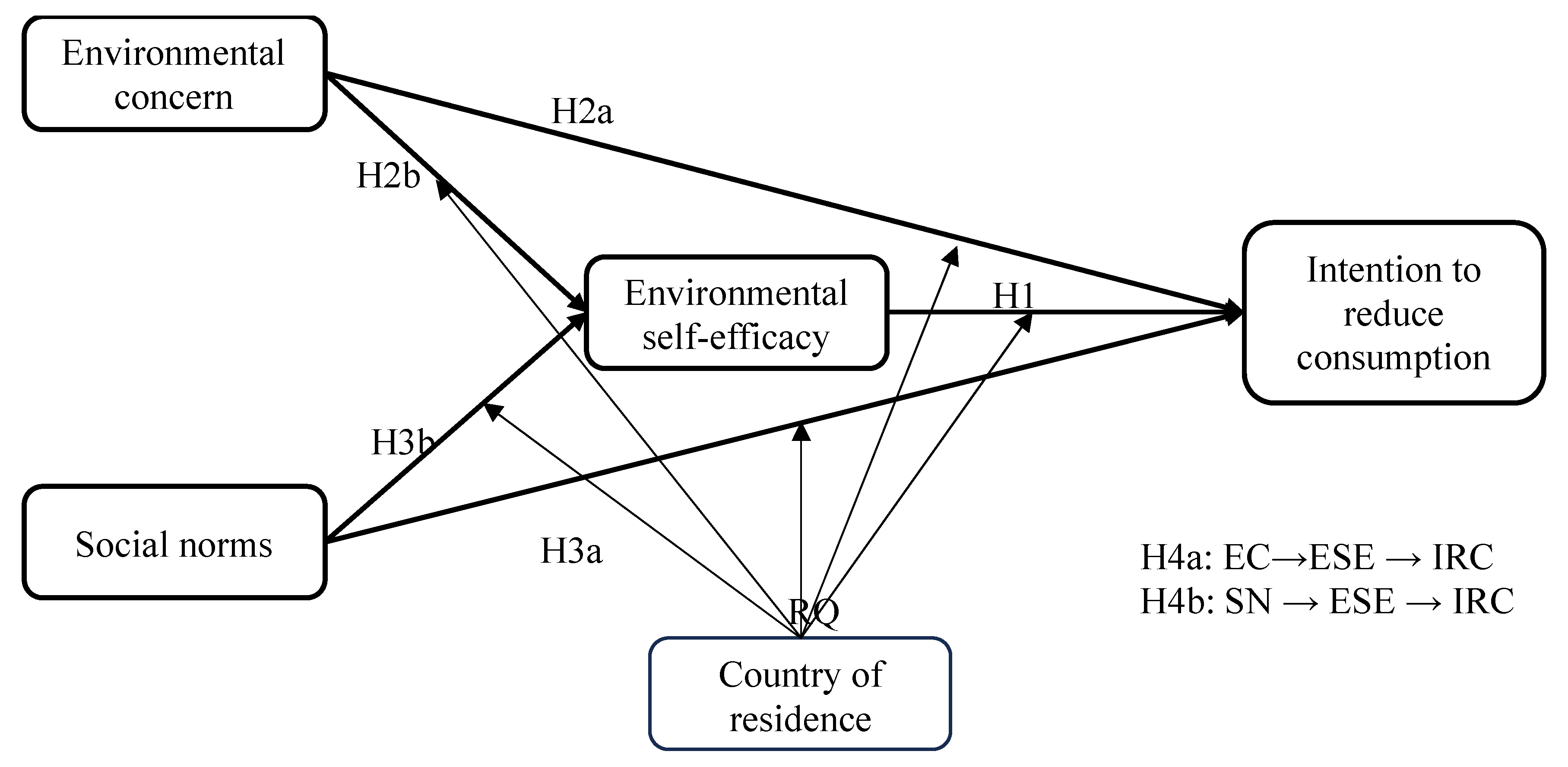
The objective of the current study is to address these gaps by examining the intention to reduce consumption voluntarily with three variables: injunctive social norms (perceived by customers as expectations regarding social approval from important others putting external pressure on them) and environmental concern (regarded here as an attitude towards environmental issues, thus as an internal motivation). The particular focus of this research is on the effect of environmental self-efficacy, a variable considered to facilitate people to act according to their environmental concerns and/or social norms, which may not be a sufficient justification (see Figure 1). Exploring the mediating role of environmental self-efficacy underscores the importance of this study. Previous research highlights the need for further research to better understand the specific mechanisms that explain the relationship between environmental concern, social norms, and pro-environmental behavior. Furthermore, although self-efficacy is a well-documented determinant of pro-environmental behavior, it has been conceptualized as a moderating rather than a mediating variable. By positioning environmental self-efficacy as a mediator, this study contributes to the literature by offering a more nuanced explanation of how environmental concern and social norms translate into actual pro-environmental behavior. We anticipate that this study may be relevant to a wide range of stakeholders, including policymakers, higher education institutions, non-governmental organizations, and businesses. Our research is based on widely accepted theories explaining behavioral intention (Theory of Reasoned Action and Theory of Planned Behavior [22]).
We also wanted to explore the differences in this regard between Poland and Spain—two European countries that differ strongly in some terms (like environmental conditions) and are similar in others (population size, dominant religion, EU membership).
The paper is structured as follows: The first part is devoted to a literature review. A special focus is placed on issues related to the role of self-efficacy in reducing consumption, as well as differences between Poland and Spain in the context of sustainable consumption. The following part is devoted to the presentation of the research procedure and methods. This is followed by the discussion, theoretical and practical implications, limitations of the study, and conclusions.

2. Literature Review and Hypotheses Development

2.1. The Role of Self-Efficacy as a Predictor of Pro-Environmental Intentions

Self-efficacy is the key concept of the current study. It is defined as a belief in an individual’s ability to execute the behaviors necessary to generate specific performance [18]. Thus, environmental self-efficacy can be interpreted as an individual’s belief in their ability to take actions that positively impact the environment or address environmental issues. According to the social cognitive theory, self-efficacy is regarded to be a key agentic mechanism [23]. Self-efficacy influences the choices individuals make regarding the environments they interact with and the challenges they undertake [18,24]. Environmental protection through consumption reduction is also such a challenge, mainly because an individual’s behavior has a limited, indirect impact on the state of the environment. Setting one’s goals in this regard and self-evaluative reactions are unsettled as there is no direct relation between an individual’s action and results concerning the whole globe.
ESE is conceptualized in this study as beliefs about the importance of self-efficacy within the specific context of consumption reduction. Referring to the importance of these beliefs, rather than directly measuring one’s self-efficacy, makes this construct conceptually consistent with the other variables included in the model.
Nevertheless, previous studies showed that efficacy beliefs, specifically environmental self-efficacy, are strongly related to pro-environmental behaviors and intentions. Numerous studies conducted all over the world showed how efficacy determines the intention to get involved in some climate adaptation actions [25] and public-sphere climate actions [26]. It was found that self-efficacy determines sustainable consumption [27], predicts climate change policy support [28], and can transform the relationship between climate change concerns and personal energy-saving behavior [29]. It was also found that the confluence of threat and efficacy beliefs seems to enhance the probability of an individual undertaking actions to tackle climate change [30]. It let us formulate the following hypothesis:
H1. 
Environmental self-efficacy is positively related to the Intention to reduce consumption.

2.2. Environmental Concern (EC)

Environmental concern (EC) refers to “an evaluation of, or an attitude towards facts, one’s own behavior, or others’ behavior with consequences for the environment” [31]. EC stems either from environmental knowledge or personal values [32]. The relationship between EC and pro-environmental attitudes and behaviors has been extensively studied over the past decades. Meta-analyses that summarize these studies reveal a positive and significant correlation between EC and adopting pro-environmental attitudes and behaviors. In a meta-analysis by [33], EC was found to be positively correlated with public pro-environmental behavior. A recent meta-analysis based on 23 studies related to the use of solar PV also showed a positive relationship between EC and pro-environmental behavioral intention variables, despite the high heterogeneity among the effect sizes [34].
Nevertheless, it should be noted that the relationship between EC and pro-environmental behavior is sometimes complex [35,36]. In many cases, such a relationship is weak and conditioned by many other factors (see below on self-efficacy as a mediator).
Studies on the relationship between EC and consumption reduction are far fewer, but their conclusions are similar. It was found that individuals with higher EC manifest stronger attitudes towards not using cars [37] or express stronger positive water conservation behavior [38]. This leads to the following hypothesis:
H2a. 
Environmental concern is positively related to the Intention to reduce consumption.
While the impact of EC on pro-environmental behavior is well established, the evidence for the impact of EC on environmental self-efficacy is much more tenuous and is not straightforward. On the one hand, it was found that individuals who are more concerned about environmental topics have higher levels of self-efficacy [39] and are more likely to believe in their ability to effect change through their actions [40]. This relationship is reinforced by the view that concern for the environment motivates people as consumers to engage in problem solving. Thus, the sense of efficacy in dealing with environmental challenges is increased [41]. On the other hand, high levels of environmental concern, especially when paired with a perception of global environmental issues as insurmountable, can lead to feelings of helplessness rather than empowerment, potentially diminishing environmental self-efficacy [42]. Despite these discrepancies, we assume that the impact of EC on ESE prevails, leading to the following hypothesis:
H2b. 
Environmental concern is positively related to environmental self-efficacy.

2.3. Social Norms (SNs)

Social norms (SNs), a type of social influence, are a set of explicit and implicit rules of behavior [43]. Cialdini et al. [44] divide social norms into descriptive norms as “the norms of what is”, a sort of perception of a group behavior, and injunctive norms as “the perception of what most people approve or disapprove.”
The influence of SNs on people’s environmental intentions and behaviors has been demonstrated in numerous studies [45,46,47], a review of which can be found in [48]. They are among the most relevant pro-environmental characteristics significantly influencing sustainable consumer behavior [27]. They have been used to guide green consumption behaviors in the stages of a green product lifespan: purchase, product use, product recycling, or product waste [49]. For example, its influence has been determined on sub-optimal food purchase intentions [50], organic foods [51], green products [52], and eco-friendly, second-hand, or organic clothes [53,54]. Regarding consumption reduction, one of the most studied trends in recent years is the reduction in meat consumption, and several studies have detected a positive influence of SNs on this reduction [55,56].
However, a positive effect of SNs on sustainable purchasing behavior has not always been found or has been very low in some cases [57,58,59,60,61,62]. In fact, in some cases, it has had the opposite effect [49,63]. As the preponderance of literature points to the positive impact of SNs on the pro-environmental, the following hypothesis is posited:
H3a. 
Social norms are positively related to the intention to reduce consumption.
Previous research suggests that positive SNs can increase an individual’s belief in the efficacy of their actions, which consequently encourages these individuals to engage in pro-environmental behavior [64]. Conversely, when SNs do not serve to support environmental action, this can hinder the development of environmental self-efficacy [65]. Referring to the distinction between descriptive and injunctive norms already mentioned, research indicates that self-efficacy can be stimulated by SNs, albeit in different ways. Descriptive norms can affect behavior, and increase self-efficacy when they are consistent with pro-environmental action. On the other hand, injunctive social norms can offer moral motivation and influence self-efficacy through the willingness to comply with socially sanctioned behavior [44]. These lead to the following hypothesis:
H3b. 
Social norms are positively related to environmental self-efficacy.

2.4. Mediating Role of Environmental Self-Efficacy

This study also proposes that Environmental self-efficacy (ESE) mediates the relationship between Environmental concern and Intention to reduce consumption, as well as between Social norms and Intention to reduce consumption. Given that in our study ESE is conceptualized as a belief in its general importance, it can act as a mediator, as this type of belief may be more strongly influenced by social factors and environmental awareness than a belief in one’s own individual self-efficacy.
Previous research demonstrated the importance of self-efficacy as a mediator in the relation between easy and more difficult pro-environmental self-reported behavior. These results show that self-efficacy may be an important motivator of challenging pro-environmental behavior [66]. This result has a special meaning for the current study, which regards reducing voluntary consumption- self-limiting behavior that may require consumer sacrifice [67].
Additional arguments for the important role of self-efficacy are provided by studies in which the impact of EC or SNs on pro-environmental behavior is not always positive [68,69]. The reason why some individuals may not engage in pro-environmental activities (despite manifesting high EC or SNs) may be due to disbelief in their impact on desired outcomes. Only when people have strong self-efficacy beliefs can their attitude about the environment be transformed into action.
Thus:
H4a. 
Environmental self-efficacy mediates the relationship between Environmental concern and Intention to reduce consumption.
H4b. 
Environmental self-efficacy mediates the relationship between Social norms and Intention to reduce consumption.

2.5. Are Spain and Poland More Similar or More Different?

As the current research is based on a sample of Spanish and Polish respondents, our objective was also to explore the meaning of country of origin in shaping pro-environmental intentions. A comparison of Spain and Poland regarding the quality of the environment can be based on the Environmental Performance Index (EPI) in both countries. The environmental situation in Spain (EPI = 56.60, 27 rank among 180 countries) is much better than in Poland (EPI = 50.60, 46 rank). Air quality contributing to EPI is exceptionally poor in Poland (air quality index equals 40.40; 74 rank) and is much better in Spain (air quality index equals 74.00; 22 rank). The Water Resources index measures the extent to which humans mitigate the threats to aquatic ecosystems. Spain ranks 14th, whereas Poland ranks 32nd. For centuries, Spanish people have been dealing with water carefully as they suffered from water shortage for agricultural purposes. So, they developed water control systems, including water tribunals [70], which proves the existence of sophisticated social norms regarding the protection of the environment.
According to Poortinga et al. [71], Poland and Spain strongly differ in terms of environmental concern; in Poland, it is rather low, whereas in Spain, it may be considered as one of the highest in Europe. It was also proven before that the environmental concern had a bigger influence on a pro-environmental attitude in Spain than in Poland [72].
Beyond environmental indicators, the cultural determinants of Spain and Poland provide a robust theoretical framework for comparing consumer behavior. According to Hofstede’s cultural dimensions [73] these countries differ significantly in their ‘Motivation towards Achievement and Success’. Spain scores 42, characterizing it as a consensus-oriented society where harmony and social norms are dominant. In contrast, Poland scores 64, reflecting a more ‘decisive’ society focused on performance and individual achievement. These cultural drivers suggest that while Spanish consumers might be more susceptible to social pressure (social norms), Polish consumers may rely more on their perceived capability to achieve individual results (self-efficacy).
In the context of the current research, which was conducted on homogenous samples (in terms of age and education), the above-mentioned differences could be diminished [74]. Considering the complex intersection of the diverse national factors discussed above and the limited empirical evidence on how these contexts influence the behavioral relationships examined in this study, this section is exploratory in nature and is related to the following research question:
RQ: To what extent do the hypothesized relationships (H1–H4) vary across the countries?

3. Materials and Methods

3.1. Data Collection, Data Screening, and Measurements

Data for the study was collected among Spanish (410) and Polish (440) students, via an online questionnaire. Respondents completed the questionnaire anonymously and were neither rewarded nor given any course credits for completing it. Informed consent was obtained from all subjects involved in the study. The gender structure from both countries showed no significant differences. The survey used a set of reflective latent variables whose indicators were taken from previous studies (see Table 1). All were measured using a 7-point Likert scale (where 1—meant Strongly Disagree to 7—Strongly Agree). Questions were translated into Spanish and Polish (the respondents’ native languages) and checked by two experts to ensure clarity and proper understanding.
Indicators were tested for standard deviation and mean values. The standard deviation ranged from 0.959 to 1.994, while the mean value ranged from 4.098 to 6.399, suggesting that there were no significant differences between the study constructs due to similar magnitudes within each construct. Indicators were also tested for skewness and kurtosis. No significant deviations were observed for either measurement tested. Skewness and kurtosis ranged from −0.015 to −0.441 and 0.932 to −0.988, respectively, and were within the acceptable range of −2/+2 for uni-dimensional normal distributions [81].
To test the quality of the collected data, analyses recommended by Ward and Meade [82] related to the level of careless responding were also performed. Four methods were used, two directed at detecting low variability of variables—IRV [83] and the longstrings index [84]—and two directed at detecting outliers—Mahalanobis distance [85] and the Person-total correlation method [86]. As a result of applying careless responding tests the sample size was refined to 705 individuals—422 from Poland, and 283 from Spain.

3.2. Data Analysis Strategy

The PLS-SEM algorithm [87] was used to analyze the collected data [88,89,90]. The use of this method was mainly due to the partly exploratory nature of the study [91]. The procedure of the data analysis was based on the guidelines of Hair and Alamer [92], updated in recent publications [88,90]. Following the standard approach [93], the analysis was conducted in two stages, the first in which the properties of the outer model were tested, using confirmatory composite analysis [94], and the second in which the model structural proprieties were tested. Calculations were performed using the default settings for confidence intervals (95%). The value of resamples was raised to 10,000 in bootstrapping.
Following Hair and Alamer’s [92] guidelines, the structural model assessment was carried out in four steps.
It started by checking the level of collinearity between the constructs using the value inflation factor (VIF). The highest VIF value was 1.499 and was below the threshold of 3.0 (Sarstedt et al., 2021) [91]. In addition, going beyond the standard approach, a common method bias (CMB) analysis was performed [95]. This was dictated by the fact that the study used reflective [96] variables measured by the same 7-point scale. Thus, they were significantly exposed to CMB [95]. For this purpose, the procedure proposed by Kock [97] was used. It assumes that if a full test for collinearity is performed, the values will remain below 3.3, which is indeed the situation.
In the next step [92], the size and significance of the path coefficients were assessed using a bootstrapping procedure (10,000 resampling, with the Bias-Corrected and Accelerated confidence interval estimation method, and two-tailed testing at the 0.05 level).
In the third step [92], the level of explained variance was assessed for IRC as the ultimate outcome variable and ESE as the mediating variable using the constructs’ coefficients of determination (R2).
As a final step of Hair and Alamer’s [92] guidelines, an assessment of the out-of-sample predictive power was carried out using the PLS predict procedure [98].
In addition, a mediation analysis was performed for two reasons. First, the statistical significance of direct pathways does not necessarily prove the significance of mediation [99]. Secondly, the ESE (mediation) variable was central to the study design.
An important part of the study was the analysis of relationships between variables at the individual country level. It is distinguished from other parts of the study by its exploratory nature. It aimed to determine the extent of similarities and differences in the relationships in question in the two countries. In order to make comparisons between groups, tests for measurement invariance at the configurational, scalar, and metric levels and the equality of composite mean values and variances were performed according to the MICOM procedure [100].
As a natural extension of the PLS-SEM analysis, we applied IPMA, which is vital for establishing the hierarchy of importance and performance of individual constructs. The resulting hierarchy can then be appropriately used to guide practical actions. Additionally, this analysis enables a comparison of construct importance and performance hierarchies across individual countries. The purpose of applying IPMA is to determine which of the preceding variables are the most important in terms of the criterion of performance and importance for the target variable [101]. The former criterium is determined on the basis of mean value of their rescaled latent variable scores ranging from 0 to 100. The latter criterion relates to the magnitude of the constructs’ effect sizes. Streukens et al. [101] proposed setting thresholds by dividing the two criteria into those of low or high importance or performance. The threshold value for the criterion on importance was set at 0.75, while for the performance criterion at 0.3, following Streukens [101] which corresponds to the medium effect size level. The use of threshold values for the criteria makes it possible to divide the IPMA figure into four boxes, which facilitates the interpretation of the results [32].

4. Results

4.1. Measurement Model

The core results of the analysis of the outer model properties are presented in Table 1. The results show that the outer loadings are statistically significant and above the threshold of 0.7 [92]. Indicator reliability was above 0.5. The values of the internal consistency reliability were between 0.905 and 0.964 (values exceeding 0.95 may indicate issues of redundancy among indicators, likely caused by their similarity and the limited number of manifest variables per construct). Cronbach’s alphas ranged from 0.843 to 0.981, pointing to excessive redundancy in the case of a single construct (IRC). Finally, convergent validity was achieved with AVE values greater than 0.50
The discriminant validity, tested using the heterotrait–monotrait ratio (HTMT) [102], was confirmed as none of the confidence intervals contained the value 1 (see Table 1). A standard HTMT test (without bootstrapping) showed that none of the values exceeded the threshold of 0.9 [103], with the highest value of 0.694 (see Table A4, Appendix A).
The results presented in Table 1 regarding convergent validity, reliability, and discriminant validity mostly support the evaluation of the outer model. However, the Composite reliability and Cronbach’s alpha values exceeding the upper threshold of 0.95 for certain constructs indicate potential redundancy among the indicators. This suggests that some items may be overly similar, which could affect the interpretability and parsimony of the measurement model. This also suggests the need to select a different set of indicators in future studies.

4.2. Structural Model

Following Hair and Alamer’s [92] guidelines described in Section 3.2, Following Hair and Alamer’s [92] guidelines described in Section 3.2, the level of collinearity among the constructs was first assessed, with the highest value being 1.815 (see Table A6 in Appendix A).
Second, the size and significance of the path coefficients were assessed (Table 2). All path coefficients, except one, were statistically significant. The relationship between EC and the ultimate outcome variable (IRC) was positive (β = 0.508, t = 15.162, p < 0.001) with a medium effect size (f2 = 0.333). A significant relationship was also observed between ESE and IRC (β = 0.277, t = 8.124, p < 0.001) with a small effect size (f2 = 0.103). The relationship between SNs and IRC led to statistically insignificant results (β = −0. 014, t = 0.514, p > 0.05).
Regarding mediating outcome variable Environmental self-efficacy, we identified two constructs that directly impacted it. The first was EC (β = 0.519, t = 18.112, p < 0.001) with a medium effect (f2 = 0.343), the second was SNs (β = 0.076, t = 2.266, p < 0.05) with a lower than small effect (f2 = 0.007).
Table 3 shows the level of explained variance for IRC and ESE. The model was able to explain 48.3% of the variance of the IRC. In contrast, the model was able to explain 30.2% of the variance for the ESE variable. It is worth mentioning that R2 values have a context-dependent interpretation [104]. Given that there are no studies in either Spain or Poland with which the results obtained in this study can be directly compared, the interpretation of the strength of the R2 effect should be cautious and considered moderate.
The analysis of the out-of-sample predictive power showed that the results obtained with PLS-SEM had higher errors for the majority of the indicators (in terms of RMSE and MAE) compared to the naïve model as a benchmark, implying that the model has low predictive power (see Table A7, Appendix A).

4.3. Mediation Effects of Environmental Self-Efficacy

The mediation test is presented in Table 4. The results indicate that ESE is a statistically significant mediator between both exogenous variables and the ultimate outcome variable (IRC), giving support for the H4a and H4b hypotheses.

4.4. Multi-Group Analysis

The analysis of configurational invariance carried out did not show any differences between the groups (both models exhibited identical indicators, data treatment, and algorithm settings). The same was true for scalar invariance; factor loadings for the constructs did not differ significantly between countries (see Table A8, Appendix A). At this stage, partial measurement invariance was obtained. This provides an opportunity to compare path coefficients in both countries. The test of invariance of composite mean values and variances indicated that there were significant differences in means and variances between groups (Table A9, Appendix A). Such test results do not give the right to compare construct means in both countries.
When focusing on the comparison of path coefficients in both countries, it can be observed that the coefficients were statistically significant (p < 0.05, see Table A10, Appendix A). This supports hypotheses for H1:H3 at the country level. In order to determine the differences in path coefficients in the two countries, a test of differences was performed. The results are presented in Table 5. Environmental self-efficacy influenced Intention to reduce consumption more strongly in Poland than in Spain (diffPL-S = 0.221, p < 0.01). In contrast, the influence of Social norms on Intention to reduce consumption was stronger in Spain than in Poland (diffPL-S = −0.249, p < 0.001). These two discrepancies revealed the dissimilarity of the countries in question. Values of other direct paths between constructs indicated no significant differences between countries.
The test results for the mediating role of Environmental self-efficacy presented in Table 6 indicate three main conclusions. First, in Poland and Spain, both mediating paths were statistically significant. These findings confirm the hypotheses H4a and H4b at each country’s level.
The second finding is that there were no variations between countries in the Social norms—Environmental self-efficacy—Intention to reduce consumption path (Welch-Satterthwaite t = 0.120, p < 0.904; Table 7). However, a difference was observed in the case of the second mediating path (Environmental concern—Environmental self-efficacy—Intention to reduce consumption). In Poland, the path coefficient was higher than in Spain (Welch-Satterthwaite t = 3.473, p < 0.01), suggesting dissimilarity between countries.
A summary of the results of the hypotheses tested is provided in Table 8. Only one of the tested hypotheses was found unsupported for the entire sample.

4.5. Importance and Performance Map Analysis (IPMA)

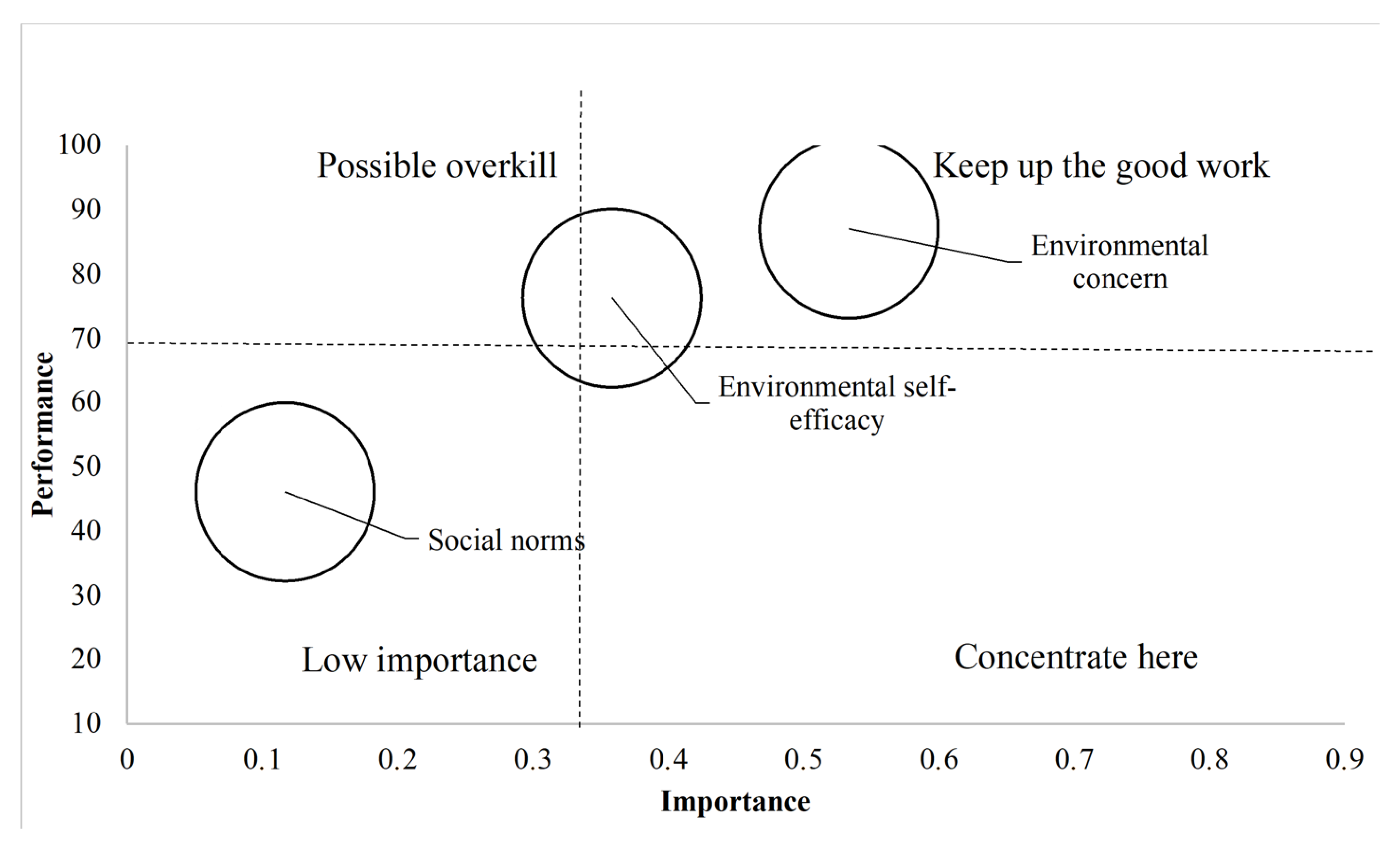
The results obtained from the PLS-SEM analysis were used for the IPMA, the aim of which was to capture the practical importance of individual constructs and, subsequently, to identify similarities and differences in the hierarchy of construct importance across the countries studied. The IPMA results for the whole sample are presented in Figure 2. To create the IPMA figure, we used the Excel template created by Hauff et al. [105].
In our research, the IPMA results reveal substantial disparities between the causes for Intention to reduce consumption (Figure 2, Table A11, Appendix A). EC exhibits the most considerable total effect (0.652) and plays a crucial role in explaining the IRC (83.578). ESE shows a smaller total effect (0.275) and demonstrates moderate performance compared to the other two constructs (73.915). Lastly, SNs display the smallest total effect (0.006) and have the weakest performance (54.256).
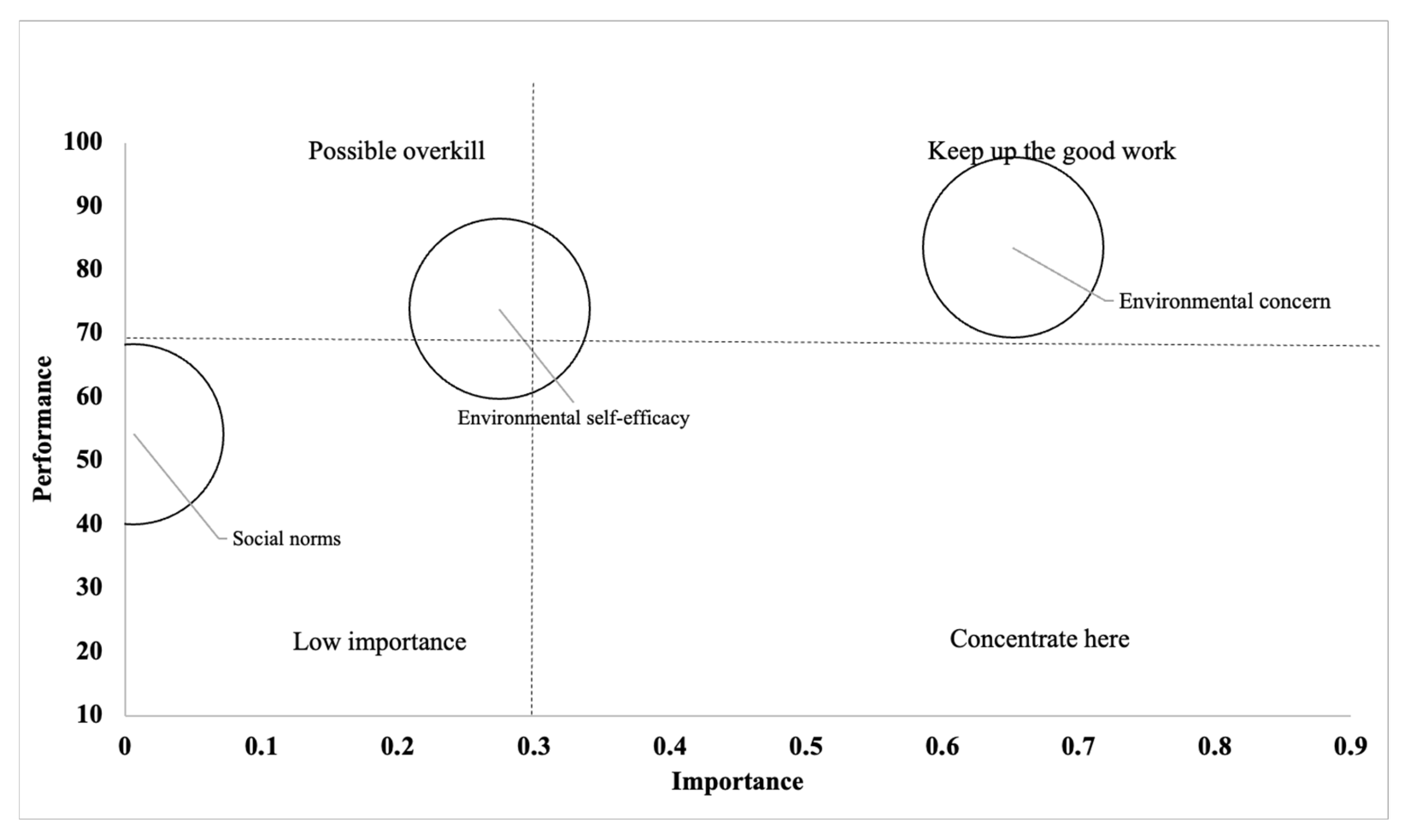
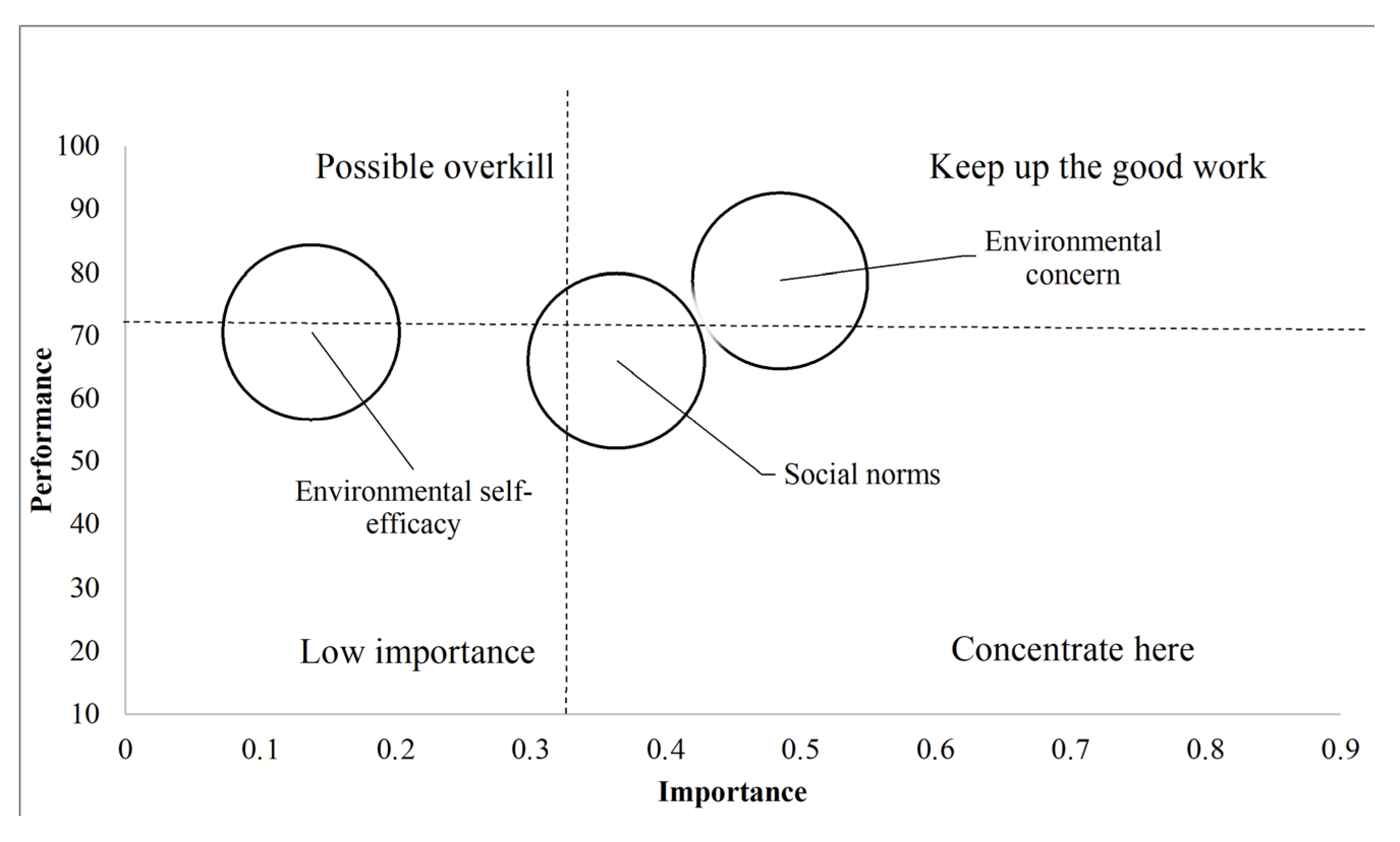
The separate maps for Poland and Spain differ from the overall picture presented above. According to IPMA, in both countries, the set cut-off levels of EC have already been exceeded, and it is enough that activities related to this area will continue. On the other hand, the other variables have different interpretations depending on the country. The IPMA results show that in Poland (see Figure 3), SNs are located in the Low importance quarter of the matrix, whereas in Spain, they are located in the Concentrate here quarter (Figure 4). Regarding ESE, in Poland, it is located in the quarter Keep up the good work, whereas in Spain it is situated in Low importance quarter.

5. Discussion

The present study examined the effects of Social norms (SNs) and Environmental concerns (ECs) on Intentions to reduce consumption (IRC), with Environmental self-efficacy (ESE) as a mediating variable. Self-efficacy is widely recognized as a crucial determinant of pro-environmental behaviors [106,107]. The findings of this study support its mediating role in the relationship between SNs, EC with IRC, and also extend these earlier findings in the sense that ESE in this study was understood as the belief in importance of environmental self-efficacy. This means that the subjects recognize the role of this factor in shaping consumption reduction in relation to EC. Notably, ESE was found to mediate these relationships consistently, regardless of respondents’ country of origin. This aligns with a strong approach to sustainable consumption [6], which treats people as citizens who accept the social setting of consumption decisions, must be supported by concrete measures. Our results provide a clear suggestion that the emphasis should not be on increasing environmental concern but on increasing confidence in one’s own ability to influence it means self-efficacy.
Our research indicates that EC is the most significant variable influencing intentions to reduce consumption, both directly and indirectly through Environmental self-efficacy. Regarding direct impact, this finding aligns with recent studies on the role of EC in green consumption practices, such as the intention to garbage reduction [108], eco-friendly purchasing [32,109], reducing meat consumption [110,111], and lowering the use of single-use bottled water [112]. However, our results contradict other studies that suggest certain pro-environmental behaviors, such as reducing the usage of gas, electricity, and automobiles, are not influenced by EC [108].
We also identified the mediating effect of ESE between EC and IRC. This brings the novelty to the body of knowledge. The reason for such a statement is twofold. Firstly, previous studies have proven the mediating effect of other variables, such as pro-social behavior [113], intentional learning [109], attitudes [110], and social norms [111]. The multiple and diverse mediating variables found in the literature point to potential problems of endogeneity [114,115]. They also point to the need for further research to clarify the specific role of mediators in the relationship between environmental concern and pro-environmental behavior.
Secondly, while the influence of self-efficacy is widely recognized in the literature, it is more often regarded as a moderator than a mediator. For example, Bertolotti et al. [107] demonstrated that self-efficacy is an important factor in meat consumption reduction, making individuals more receptive to health messages. It is also associated with energy conservation behavior [106] and with the reduction in unhealthy habits, such as alcohol consumption [116], suggesting that individuals with higher self-efficacy are more likely to persist in their consumption reduction efforts [117] or in the context of reducing sedentary behavior in which self-efficacy can lead to improved planning, which in turn can predict lower consumption behavior [118]. Our study managed to capture the role of ESE as a mediator, which results from the very nature of the construct used, which was not aimed at determining someone’s ESE but at perceiving the importance of ESE in the context of reducing consumption. This means that, in addition to ESE itself, awareness of its role or even faith in its effectiveness is also important, which may be the subject of further research.
We have not found a direct effect between SNs and IRC. Similar results can be found in another study [60]. However, more research delivers opposite results, concluding that social norms play an essential role in reducing meat consumption [110], low-carbon consumption behavior [119], or healthy behaviors like increasing vegetable consumption [120] or reducing alcohol consumption [121]. Moreover, the observed lack of SN’s direct impact on IRC may be theoretically justified in two ways. Firstly, consumption reduction constitutes a high-cost, self-regulatory behavior. Prior research [122] indicates that social norms are more effective for visible, low-cost actions than for sustained forms of self-limitation. Accordingly, in the case of demanding behaviors, norms are more likely to exert an indirect influence by shaping perceived capability (self-efficacy) rather than directly motivating intention. Unlike one-off or low-effort pro-environmental actions such as waste segregation or choosing eco-labeled products, voluntary consumption reduction requires sustained commitment; thus, social approval alone is unlikely to translate into intention unless individuals also believe they can successfully enact the behavior. This provides a theoretical rationale for why social norms in our model operate primarily through ESE rather than directly. We interpret the pooled-sample result through the lens of conditional norm activation theories, which posit that the behavioral impact of social norms is contingent on contextual alignment and perceived feasibility. The other explanation is related to the heterogeneity across national contexts due to the sample of people from different countries taken into the study, which will be explained in the following paragraph. Pooling the samples masked the country-level dynamics resulting in a non-significant average effect.
Our findings so far let us verify the hypotheses that have been formulated. In order to address the research question, we compared Polish and Spanish subsamples. While in some cases we did not observe significant differences between the two countries with regard to the relationships studied, in some other cases significant differences were observed. These results suggest that while some factors may have a universal impact on some environmental behaviors, others are shaped by country-specific variables, highlighting the importance of context in understanding consumption reduction behaviors. Firstly, Social norms influence the intention to reduce consumption more in Spain than in Poland (Table 5). On the other hand, Environmental self-efficacy has a stronger effect on the intention to reduce consumption in Poland than in Spain (Table 5). Finally, ESE mediation between Environmental concern and IRC was found to be stronger in Poland than in Spain (Table 7).
The more substantial influence of Social norms on voluntary consumption reduction in Spain than in Poland may be explained by the strength of social norms itself. In Spain, social norms have been developed to protect the population and the environment [123,124]. Caring for the environment has a much longer tradition in Spain than in Poland. As a result, in Spain, more time was given to develop social norms aimed at environmental protection through legal solutions (water courts, for instance). Moreover, Spain accessed the EU, which focused on pro-environmental regulations, 18 years earlier than Poland (Spain—in 1986, Poland—2004). Besides, Hofstede’s model offers a deeper psychological explanation. Spain’s lower score in “Motivation towards achievement and success” dimension describes a society that values harmony and social cohesion. In such a context, social norms are not just ‘legal rules,’ but a fundamental part of the individual’s social identity, making them a primary driver for voluntary consumption reduction. On the other hand, Poland has historically lacked systemic (community-wide) solutions aimed at environmental protection. Even nowadays, they are at a very early stage. It can, therefore, be concluded that social norms are not strong enough to have a significant impact on reducing consumption in Poland. It was supported by recent research showing that the influence of social norms on pro-environmental intentions is generally weak in Poland [112]. It is visible that in Spain, where pro-environmental norms are more institutionalized and socially reinforced, norms translate more readily into direct intentions. In Poland, where such norms are weaker or less routinized, their influence is indirect and operates mainly by strengthening individual agency beliefs. When these contexts are combined, the opposing strengths and mechanisms of norm influence effectively cancel out at the aggregate level, yielding a non-significant direct effect.
The other two findings of our study indicate the important role of Environmental self-efficacy in shaping pro-environmental consumption attitudes in Poland. This is the case both for the direct influence of ESE on IRC and indirect influence as a mediating variable between EC and IRC. The more important role of the ESE in Poland compared to Spain may be explained by the general optimism of young Poles, partially related to macroeconomic factors (lower unemployment rate and substantially higher GDP growth rate in Poland). Additionally, this finding can be explained according to Hofstede’s framework, as it reflects a culture with a higher ‘Motivation towards Achievement’. In decisive societies, individuals prioritize performance and personal results. Therefore, the belief in one’s own capability (Self-efficacy) becomes the essential bridge between environmental concern and actual intention. In summary, macroeconomic growth and youthful optimism in Poland provide a favorable environment for this mindset, and the cultural emphasis on individual achievement might be the underlying mechanism that empowers Polish consumers to believe their actions can lead to meaningful change.
As self-efficacy plays such an important role in voluntary consumption reduction, it seems an important issue to strengthen it. One way to increase the sense of self-efficacy is through actions that fall within the framework of what Fitzpatrick et al. [125] describe as radical ecological democracy, and involves giving rights and opportunities to participate in decision-making on ecological issues.
Another option to enhance self-efficacy so as to induce pro-environmental behavior [25], is to provide information about how to perform a specific behavior as well as both dynamic and descriptive norm information. Information on how to perform a specific behavior in our study refers to reducing consumption. Guiding consumers on what a reduction in consumption actually means is of paramount importance. In the literature, two directions of consumption reduction can be identified [126]. One, referred to as liberal, means replacing traditional products with more ecological ones, with only slightly reduced consumption. The other, more radical, means restricting consumption to only the most necessary products. Dynamic norms information refers to another way of reinforcing self-efficacy by communicating how others are successful in the process of changing certain behaviors, e.g., reducing consumption. Additionally, descriptive norm information can reinforce self-efficacy by indicating how many people have already managed to reduce consumption [25].
To conclude, the differences observed in the importance and performance of the three variables—Social norms, Environmental concern, and Environmental self-efficacy —in shaping Intentions to reduce consumption in Poland and Spain highlight the necessity of tailoring pro-environmental strategies to the specific context of each country. The results indicate that promoting certain pro-environmental behaviors requires an approach that reflects the country’s unique socio-cultural, economic, and environmental conditions. This conclusion is consistent with previous studies showing that national and regional differences in public attitudes toward the environment and resource use often require local adjustments in policy [127,128,129].

6. Implications of the Study

The findings of this study have a number of important implications for policymakers, higher education institutions, non-governmental organizations, and businesses. For policymakers, the findings suggest that public policy should focus on empowering individuals by making consumption reduction seems possible and meaningful. This could include providing clear guidance on what consumption reduction means, presenting successful examples, and making it possible for citizens to see results of their actions. Furthermore, the observed differences between countries suggest that pro-environmental policy should be tailored to national and cultural contexts. In societies where social norms play a stronger role, norm-based policy may be more effective, whereas in contexts where individualism is more important, policy should prioritize empowerment and capacity building.
The study also has important implications for higher education. Universities play a key role in shaping students’ beliefs about their potential to contribute to the transition toward sustainability. Sustainability education can strengthen students’ self-efficacy for environmental protection and better prepare them to be involved in consumption reduction activities. This aligns with the perception of consumers as active citizens rather than passive market participants.
For non-governmental organizations, the results indicate that initiatives that actively engage individuals in co-creating solutions, sharing success stories, and demonstrating cumulative impact are more likely to foster self-efficacy and lasting behavioral change. Strengthening people’s self-efficacy may be particularly important when promoting more radical, self-limiting forms of consumption.
Finally, for businesses, the findings suggest that firms can contribute to consumption reduction by, for example, designing products that are more durable and possible to repair when it is necessary.


7. Limitations and Future Research

The study has several limitations. First, our study’s samples consist of students only. It could introduce bias related to limited purchasing power, though voluntary consumption reduction does not depend on high income. Instead, it often involves non-purchase, delayed purchase, or lower-intensity alternatives, making students more influenced by psychological factors like environmental concern and self-efficacy than by economic trade-offs. So even if this group offers valuable insights as young, educated people are very likely to shape future consumption norms, it does not fully represent the wider population, especially in terms of age, socio-economic status and life experience, all of which can influence attitudes and behaviors related to pro-environmental behavior. Students, often with higher levels of environmental awareness, may exhibit different patterns of pro-environmental behavior compared to other demographic groups [122,127]. As a result, the generalizability of the findings may be limited. The other limitation is related to the convenient nature of the sample.
In future research, it would be beneficial to include a more diverse sample including people of wider range of ages, professional backgrounds, and geographic regions to better capture the variability in environmental attitudes and behaviors. A more diversified sample would allow for more robust conclusions and a better understanding of how the studied phenomena manifest across different segments of the population.
It is also important to note that we used cross-sectional data in our study. This limits the ability to infer causal relationships, particularly in the context of mediation [130,131]. Longitudinal data are more appropriate in this case, although usually much more difficult to obtain. Future research could address this challenge by additionally introducing a broader set of variables, which could demonstrate the role and limitations of ESE as a mediating variable.

8. Conclusions

Our research has shown that the most important predictor of Intention to reduce consumption is Environmental concern. It is characterized by both direct influence and indirect influence through Environmental self-efficacy. Social norms did not have a direct impact on IRC. SNs may be necessary but insufficient for motivating voluntary consumption reduction unless individuals also believe that their actions are effective. In this sense, Social Norms appear to function as a background enabling condition, strengthening environmental self-efficacy rather than directly triggering behavioral intentions. The mediating role of ESE in the relationship between both EC and IRV, as well as between SNs and IRC, also appeared to be crucial.
Additionally, our study showed differences between Poland and Spain. In Spain, SNs had a stronger impact on reducing consumption, probably due to a relatively long tradition of caring for the environment. On the other hand, ESEs played a more significant role in Poland, which may be due to the optimism of young Poles and the favorable economic conditions present over the last two decades. These results point to the need to adapt pro-environmental strategies to the cultural conditions of each country.

Author Contributions

Conceptualization, T.W., B.B., B.P., M.B. and L.M.-C.; methodology, T.W. and B.B.; software, T.W.; validation, T.W.; formal analysis, T.W.; investigation: B.B., B.P., M.B. and L.M.-C.; data curation, T.W.; writing—original draft preparation, T.W., B.B., B.P., M.B. and L.M.-C.; writing—review and editing, T.W., B.B., B.P., M.B. and L.M.-C.; supervision, B.B.; project administration, B.B.; funding acquisition, B.P. All authors have read and agreed to the published version of the manuscript.

Funding

This research received no external funding.

Institutional Review Board Statement

The study was conducted in accordance with the Declaration of Helsinki and approved by the Institutional Ethics Committee of Wroclaw University (1/II/2021, 11 February 2021) for studies involving humans.

Informed Consent Statement

Informed consent was obtained from all subjects involved in the study.

Data Availability Statement

The data presented in this study are openly available in https://osf.io/znmte, accessed on 10 November 2025.

Conflicts of Interest

The authors declare no conflicts of interest.

Abbreviations

The following abbreviations are used in this manuscript:
ECEnvironmental Concern
SNsSocial Norms
IRCIntention To Reduce Consumption
ESEEnvironmental Self-Efficacy
EPIEnvironmental Performance Index
VIFValue Inflation Factor
CMBCommon Method Bias
PLS-SEMPartial Least Squares Structural Equation Modelling
MICOMMeasurement Invariance Of Composite Models
IPMAImportance And Performance Map Analysis
HTMTHeterotrait–Monotrait Ratio Test
GDPGross Domestic Product

Appendix A

Table A1. The final sample sizes by country.
CountryFrequency%% Valid
Poland42259.959.9
Spain28340.140.1
Whole sample705100.0100.0
Table A2. Descriptive statistics.
ItemMinimumMaximumMSDSkewness (Standard Error)Kurtosis (Standard Error)
EC11.007.005.86811.22285−0.836 (0.092)−0.034 (0.184)
EC21.007.006.00991.18401−0.884 (0.092)−0.200 (0.184)
EC33.007.006.35740.97404−1.348 (0.092)0.668 (0.184)
EC43.007.006.39860.95866−1.441 (0.092)0.932 (0.184)
SNs11.007.004.09791.78705−0.016 (0.092)−0.823 (0.184)
SNs21.007.004.20141.86375−0.015 (0.092)−0.988 (0.184)
SNs31.007.004.43401.84221−0.137 (0.092)−0.967 (0.184)
IRC11.007.004.35891.93437−0.293 (0.092)−0.922 (0.184)
IRC21.007.004.44261.92911−0.342 (0.092)−0.890 (0.184)
IRC31.007.004.48091.99431−0.369 (0.092)−0.967 (0.184)
ESE11.007.005.35891.33900−0.505 (0.092)−0.006 (0.184)
ESE21.007.005.20141.32363−0.267 (0.092)−0.233 (0.184)
ESE31.007.005.72341.24148−0.737 (0.092)0.250 (0.184)
Table A3. Discriminant Validity with HTMT bootstrapping approach.
HTMTOriginal Sample (O)Sample Mean (M)Bias2.5%97.5%
Reduction <-> EC0.6950.694−0.0000.6470.737
Self-efficacy <-> EC0.6260.6260.0000.5660.681
Self-efficacy <-> Reduction0.5990.5990.0000.5390.654
Social norms <-> EC0.3540.353−0.0000.2870.418
Social norms <-> Reduction0.2210.2210.0000.1480.292
Social norms <-> Self-efficacy0.2680.2690.0000.1900.345
Table A4. Discriminant Validity with HTMT (traditional approach).
HTMT Standard PLS SEMECIRCESESNs
EC
Reduction0.695
Self-efficacy0.6260.599
Social norms0.3540.2210.268
Table A5. Discriminant Validity with Fornell–Larcker Criterion.
Constructs ECReductionSelf-EfficacySocial Norms
EC0.871
Reduction0.6540.981
Self-efficacy0.5430.5480.872
Social norms0.3230.2170.2430.948
Table A6. VIF values.
IRCESECLF (Random)
IRC 1.773
EC1.4991.1161.815
ESE1.427 1.512
SNs1.1241.1161.133
Table A7. PLS prediction results.
Q2 PredictPLS-SEM_RMSEPLS-SEM_MAELM_RMSELM_MAEIA_RMSEIA_MAE
IR10.3981.5021.2511.4461.1851.9361.614
IR20.4301.4581.2101.4101.1571.9311.616
IR30.3951.5521.306 1.4831.2271.9961.685
LCSE10.1741.2180.9761.2260.9831.3401.115
LCSE20.2261.1650.9541.1710.9521.3251.092
LCSE30.2681.0640.8561.0530.8411.2431.064
Table A8. Compositional invariance test.
Original CorrelationCorrelation Permutation Mean5.0%Permutation p Value
EC Environmental concern1.0001.0001.0000.154
IRC Intention to reduce consumption1.0001.0001.0000.196
ESE Environmental self-efficacy1.0001.0000.9990.265
SNs Social norms1.0001.0000.9990.522
Table A9. Equality of composite mean values and variances.
MeanOriginal DifferencePermutation Mean Difference2.5%97.5%Permutation p Value
EC Environmental concern0.432−0.003−0.1420.1400.000
IRC Intention to reduce consumption 0.941−0.001−0.1450.1460.000
ESE Environmental self-efficacy0.315−0.002−0.1520.1540.001
SNs Social norms−0.6850.000−0.1450.1490.000
Variance
EC Environmental concern−0.4770.002−0.2100.2220.000
IRC Intention to reduce consumption−0.3700.004−0.1510.1650.000
ESE Environmental self-efficacy0.4500.004−0.2120.2180.000
SNs Social norms−0.2120.006−0.1490.1630.007
Table A10. Path coefficient.
Original PolandOriginal SpainMean PolandMean SpainSD PolandSD Spaint Value Polandt Value Spainp Value Polandp Value Spain
EC → IRC0.3520.4290.3510.4290.0500.0557.0967.7850.0000.000
EC → PES0.5070.4090.5080.4090.0370.06213.6596.6450.0000.000
PES → IRC0.3590.1380.3600.1380.0490.0457.3953.0240.0000.003
SNs → IRC0.0810.3300.0820.3310.0370.0572.2195.8260.0260.000
SNs → PES0.1000.2410.1010.2430.0410.0702.4533.4610.0140.001
Table A11. IPMA results—general.
IPMA (on IRC)Total EffectPerformance
EC0.65283.578
Self-efficacy0.27573.915
Social norms0.00654.256

References

  1. Banerjee, S.B.; Jermier, J.M.; Peredo, A.M.; Perey, R.; Reichel, A. Theoretical Perspectives on Organizations and Organizing in a Post-Growth Era. Organization 2021, 28, 337–357. [Google Scholar] [CrossRef] [Scilit]
  2. Demaria, F.; Schneider, F.; Sekulova, F.; Martinez-Alier, J. What Is Degrowth? From an Activist Slogan to a Social Movement. Environ. Values 2013, 22, 191–215. [Google Scholar] [CrossRef] [Scilit]
  3. Kallis, G.; Kerschner, C.; Martinez-Alier, J. The Economics of Degrowth. Ecol. Econ. 2012, 84, 172–180. [Google Scholar] [CrossRef] [Scilit]
  4. Meadows, D.H.; Randers, J.; Meadows, D.L. The Limits to Growth (1972). In The Future of Nature; Robin, L., Sörlin, S., Warde, P., Eds.; Yale University Press: New Haven, CT, USA, 2017; pp. 101–116. ISBN 978-0-300-18847-9. [Google Scholar]
  5. Ghorban Nejad, S.; Skeiseid, H.V.; Våland, T.I. Individual-Level Consumption Reduction: Literature Review and Research Propositions. J. Clean. Prod. 2024, 471, 143420. [Google Scholar] [CrossRef] [Scilit]
  6. Lorek, S.; Spangenberg, J.H. Sustainable Consumption within a Sustainable Economy—Beyond Green Growth and Green Economies. J. Clean. Prod. 2014, 63, 33–44. [Google Scholar] [CrossRef] [Scilit]
  7. Vincent, O.; Brandellero, A. Transforming Work: A Critical Literature Review on Degrowth, Post-Growth, Postcapitalism and Craft Labor. J. Clean. Prod. 2023, 430, 139640. [Google Scholar] [CrossRef] [Scilit]
  8. Büchs, M. The Role of Values for Voluntary Reductions of Holiday Air Travel. J. Sustain. Tour. 2017, 25, 234–250. [Google Scholar] [CrossRef] [Scilit]
  9. Lowe, B.; Lynch, D.; Lowe, J. Reducing Household Water Consumption: A Social Marketing Approach. J. Mark. Manag. 2015, 31, 378–408. [Google Scholar] [CrossRef] [Scilit]
  10. Carrus, G.; Tiberio, L.; Mastandrea, S.; Chokrai, P.; Fritsche, I.; Klöckner, C.A.; Masson, T.; Vesely, S.; Panno, A. Psychological Predictors of Energy Saving Behavior: A Meta-Analytic Approach. Front. Psychol. 2021, 12, 648221. [Google Scholar] [CrossRef] [Scilit]
  11. Boström, M. Social Relations and Challenges to Consuming Less in a Mass Consumption Society. Sociol. Forsk. 2022, 58, 383–406. [Google Scholar] [CrossRef] [Scilit]
  12. Culiberg, B.; Cho, H.; Kos Koklic, M.; Zabkar, V. The Role of Moral Foundations, Anticipated Guilt and Personal Responsibility in Predicting Anti-Consumption for Environmental Reasons. J. Bus. Ethics 2023, 182, 465–481. [Google Scholar] [CrossRef] [Scilit] [PubMed]
  13. Egea, J.M.O.; De Frutos, N.G. Toward Consumption Reduction: An Environmentally Motivated Perspective: Factors Toward Consumption Reduction. Psychol. Mark. 2013, 30, 660–675. [Google Scholar] [CrossRef] [Scilit]
  14. Lee, M.S.W.; Ortega Egea, J.M.; García De Frutos, N. Anti-consumption beyond Boundaries: From Niche Topic to Global Phenomena. Psychol. Mark. 2020, 37, 171–176. [Google Scholar] [CrossRef] [Scilit]
  15. Weitensfelder, L.; Heesch, K.; Arnold, E.; Schwarz, M.; Lemmerer, K.; Hutter, H.-P. Areas of Individual Consumption Reduction: A Focus on Implemented Restrictions and Willingness for Further Cut-Backs. Sustainability 2023, 15, 4956. [Google Scholar] [CrossRef] [Scilit]
  16. Maseeh, H.I.; Sangroya, D.; Jebarajakirthy, C.; Adil, M.; Kaur, J.; Yadav, M.P.; Saha, R. Anti-consumption Behavior: A Meta-analytic Integration of Attitude Behavior Context Theory and Well-being Theory. Psychol. Mark. 2022, 39, 2302–2327. [Google Scholar] [CrossRef] [Scilit]
  17. Billows, G.; McNeill, L. Consumer Attitude and Behavioral Intention toward Collaborative Consumption of Shared Services. Sustainability 2018, 10, 4468. [Google Scholar] [CrossRef] [Scilit]
  18. Bandura, A. Self-Efficacy: Toward a Unifying Theory of Behavioral Change. Psychol. Rev. 1977, 84, 191–215. [Google Scholar] [CrossRef]
  19. Baishya, M.L.; Collins, B.N.; Lepore, S.J. Antecedents of Self-Efficacy to Achieve Smoking-Behavior-Change Goals among Low-Income Parents Enrolled in an Evidence-Based Tobacco Intervention. Int. J. Environ. Res. Public Health 2022, 19, 13573. [Google Scholar] [CrossRef] [Scilit]
  20. Ahern, L.; Timmons, S.; Lamb, S.E.; McCullagh, R. Can Behavioural Change Interventions Improve Self-Efficacy and Exercise Adherence among People with Parkinson’s? A Systematic Review Protocol. HRB Open Res. 2022, 5, 15. [Google Scholar] [CrossRef] [Scilit]
  21. Kashani, M.; Eliasson, A.H.; Walizer, E.M.; Fuller, C.E.; Engler, R.J.; Villines, T.C.; Vernalis, M.N. Early Empowerment Strategies Boost Self-Efficacy to Improve Cardiovascular Health Behaviors. Glob. J. Health Sci. 2016, 8, 322. [Google Scholar] [CrossRef] [Scilit]
  22. Ajzen, I. The Theory of Planned Behavior. Organ. Behav. Hum. Decis. Process. 1991, 50, 179–211. [Google Scholar] [CrossRef] [Scilit]
  23. Bandura, A. Toward a Psychology of Human Agency: Pathways and Reflections. Perspect. Psychol. Sci. 2018, 13, 130–136. [Google Scholar] [CrossRef] [Scilit] [PubMed]
  24. Bandura, A. Self-Efficacy Mechanism in Human Agency. Am. Psychol. 1982, 37, 122–147. [Google Scholar] [CrossRef]
  25. Van Valkengoed, A.M.; Steg, L. Meta-Analyses of Factors Motivating Climate Change Adaptation Behaviour. Nat. Clim. Change 2019, 9, 158–163. [Google Scholar] [CrossRef] [Scilit]
  26. Doherty, K.L.; Webler, T.N. Social Norms and Efficacy Beliefs Drive the Alarmed Segment’s Public-Sphere Climate Actions. Nat. Clim. Change 2016, 6, 879–884. [Google Scholar] [CrossRef] [Scilit]
  27. Khan, S.; Thomas, G. Examining the Impact of Pro-Environmental Factors on Sustainable Consumption Behavior and Pollution Control. Behav. Sci. 2023, 13, 163. [Google Scholar] [CrossRef] [Scilit]
  28. Bostrom, A.; Hayes, A.L.; Crosman, K.M. Efficacy, Action, and Support for Reducing Climate Change Risks. Risk Anal. 2019, 39, 805–828. [Google Scholar] [CrossRef] [Scilit]
  29. Gregersen, T.; Doran, R.; Böhm, G.; Poortinga, W. Outcome Expectancies Moderate the Association between Worry about Climate Change and Personal Energy-Saving Behaviors. PLoS ONE 2021, 16, e0252105. [Google Scholar] [CrossRef] [Scilit]
  30. McLoughlin, N. Communicating Efficacy: How the IPCC, Scientists, and Other Communicators Can Facilitate Adaptive Responses to Climate Change without Compromising on Policy Neutrality. Clim. Change 2021, 169, 5. [Google Scholar] [CrossRef] [Scilit]
  31. Fransson, N.; Gärling, T. Environmental Concern: Conceptual Definitions, Measurement Methods, and Research Findings. J. Environ. Psychol. 1999, 19, 369–382. [Google Scholar] [CrossRef] [Scilit]
  32. Saari, U.A.; Damberg, S.; Frömbling, L.; Ringle, C.M. Sustainable Consumption Behavior of Europeans: The Influence of Environmental Knowledge and Risk Perception on Environmental Concern and Behavioral Intention. Ecol. Econ. 2021, 189, 107155. [Google Scholar] [CrossRef] [Scilit]
  33. Lou, X.; Li, L.M.W. The Relationship of Environmental Concern with Public and Private Pro-environmental Behaviours: A Pre-registered Meta-analysis. Eur. J. Soc. Psychol. 2023, 53, 1–14. [Google Scholar] [CrossRef] [Scilit]
  34. Ghosh, A.; Satya Prasad, V.K. Evaluating the Influence of Environmental Factors on Household Solar PV Pro-Environmental Behavioral Intentions: A Meta-Analysis Review. Renew. Sustain. Energy Rev. 2024, 190, 114047. [Google Scholar] [CrossRef] [Scilit]
  35. Lou, X.; Li, L.M.W.; Xia, W.; Zhu, Q. A Meta-Analysis of Temporal Shifts in Environmental Concern between 1994 and 2017: An Examination of the New Environmental Paradigm. Anthropocene 2022, 38, 100335. [Google Scholar] [CrossRef] [Scilit]
  36. Pong, V.; Tam, K.-P. Relationship between Global Identity and Pro-Environmental Behavior and Environmental Concern: A Systematic Review. Front. Psychol. 2023, 14, 1033564. [Google Scholar] [CrossRef] [Scilit] [PubMed]
  37. Gardner, B.; Abraham, C. Going Green? Modeling the Impact of Environmental Concerns and Perceptions of Transportation Alternatives on Decisions to Drive. J. Appl. Soc. Pyschol. 2010, 40, 831–849. [Google Scholar] [CrossRef] [Scilit]
  38. Aprile, M.C.; Fiorillo, D. Water Conservation Behavior and Environmental Concerns: Evidence from a Representative Sample of Italian Individuals. J. Clean. Prod. 2017, 159, 119–129. [Google Scholar] [CrossRef] [Scilit]
  39. Syabania, K.; Muhdhar, M.H.I.A.; Landriany, E.; Setiawan, N.R.; Nugraha, B.A.; Mardiyanti, L. The Link between Self-Efficacy and Environmental Literacy of Students. AIP Conf. Proc. 2023, 2569, 020002. [Google Scholar] [CrossRef] [Scilit]
  40. Chen, M.-F. Impact of Fear Appeals on Pro-Environmental Behavior and Crucial Determinants. Int. J. Advert. 2016, 35, 74–92. [Google Scholar] [CrossRef] [Scilit]
  41. Meinhold, J.L.; Malkus, A.J. Adolescent Environmental Behaviors: Can Knowledge, Attitudes, and Self-Efficacy Make a Difference? Environ. Behav. 2005, 37, 511–532. [Google Scholar] [CrossRef] [Scilit]
  42. Ojala, M. How Do Children Cope with Global Climate Change? Coping Strategies, Engagement, and Well-Being. J. Environ. Psychol. 2012, 32, 225–233. [Google Scholar] [CrossRef] [Scilit]
  43. Dello Russo, G.; Lytle, A.; Hoffenson, S.; Wu, L.; Mahoney, C. An Experimental Study of Consumer Attitudes and Intentions in Electricity Markets. Clean. Responsible Consum. 2023, 9, 100116. [Google Scholar] [CrossRef] [Scilit]
  44. Cialdini, R.B.; Reno, R.R.; Kallgren, C.A. A Focus Theory of Normative Conduct: Recycling the Concept of Norms to Reduce Littering in Public Places. J. Personal. Soc. Psychol. 1990, 58, 1015. [Google Scholar] [CrossRef]
  45. Carrigan, M.; Moraes, C.; Leek, S. Fostering Responsible Communities: A Community Social Marketing Approach to Sustainable Living. J. Bus. Ethics 2011, 100, 515–534. [Google Scholar] [CrossRef] [Scilit]
  46. Cialdini, R.B.; Jacobson, R.P. Influences of Social Norms on Climate Change-Related Behaviors. Curr. Opin. Behav. Sci. 2021, 42, 1–8. [Google Scholar] [CrossRef] [Scilit]
  47. McDonald, R.I.; Crandall, C.S. Social Norms and Social Influence. Curr. Opin. Behav. Sci. 2015, 3, 147–151. [Google Scholar] [CrossRef] [Scilit]
  48. Farrow, K.; Grolleau, G.; Ibanez, L. Social Norms and Pro-Environmental Behavior: A Review of the Evidence. Ecol. Econ. 2017, 140, 1–13. [Google Scholar] [CrossRef] [Scilit]
  49. Ge, W.; Sheng, G.; Zhang, H. How to Solve the Social Norm Conflict Dilemma of Green Consumption: The Moderating Effect of Self-Affirmation. Front. Psychol. 2020, 11, 566571. [Google Scholar] [CrossRef] [Scilit]
  50. Do Carmo Stangherlin, I.; De Barcellos, M.D.; Basso, K. The Impact of Social Norms on Suboptimal Food Consumption: A Solution for Food Waste. J. Int. Food Agribus. Mark. 2020, 32, 30–53. [Google Scholar] [CrossRef] [Scilit]
  51. Ham, M.; Jeger, M.; Frajman Ivković, A. The Role of Subjective Norms in Forming the Intention to Purchase Green Food. Econ. Res.-Ekon. Istraž. 2015, 28, 738–748. [Google Scholar] [CrossRef] [Scilit]
  52. Liobikienė, G.; Grincevičienė, Š.; Bernatonienė, J. Environmentally Friendly Behaviour and Green Purchase in Austria and Lithuania. J. Clean. Prod. 2017, 142, 3789–3797. [Google Scholar] [CrossRef] [Scilit]
  53. Kim, S.H.; Seock, Y.-K. The Roles of Values and Social Norm on Personal Norms and Pro-Environmentally Friendly Apparel Product Purchasing Behavior: The Mediating Role of Personal Norms. J. Retail. Consum. Serv. 2019, 51, 83–90. [Google Scholar] [CrossRef] [Scilit]
  54. Kumar, A.; Prakash, G.; Kumar, G. Does Environmentally Responsible Purchase Intention Matter for Consumers? A Predictive Sustainable Model Developed through an Empirical Study. J. Retail. Consum. Serv. 2021, 58, 102270. [Google Scholar] [CrossRef] [Scilit]
  55. Amiot, C.E.; El Hajj Boutros, G.; Sukhanova, K.; Karelis, A.D. Testing a Novel Multicomponent Intervention to Reduce Meat Consumption in Young Men. PLoS ONE 2018, 13, e0204590. [Google Scholar] [CrossRef] [Scilit] [PubMed]
  56. Sparkman, G.; Walton, G.M. Dynamic Norms Promote Sustainable Behavior, Even If It Is Counternormative. Psychol. Sci. 2017, 28, 1663–1674. [Google Scholar] [CrossRef] [Scilit]
  57. Borusiak, B.; Szymkowiak, A.; Kucharska, B.; Gálová, J.; Mravcová, A. Predictors of Intention to Reduce Meat Consumption Due to Environmental Reasons—Results from Poland and Slovakia. Meat Sci. 2022, 184, 108674. [Google Scholar] [CrossRef] [Scilit]
  58. Jansson, J.; Nordlund, A.; Westin, K. Examining Drivers of Sustainable Consumption: The Influence of Norms and Opinion Leadership on Electric Vehicle Adoption in Sweden. J. Clean. Prod. 2017, 154, 176–187. [Google Scholar] [CrossRef] [Scilit]
  59. Kim, M.J.; Hall, C.M.; Kim, D.-K. Predicting Environmentally Friendly Eating out Behavior by Value-Attitude-Behavior Theory: Does Being Vegetarian Reduce Food Waste? J. Sustain. Tour. 2020, 28, 797–815. [Google Scholar] [CrossRef] [Scilit]
  60. Thorman, D.; Whitmarsh, L.; Demski, C. Policy Acceptance of Low-Consumption Governance Approaches: The Effect of Social Norms and Hypocrisy. Sustainability 2020, 12, 1247. [Google Scholar] [CrossRef] [Scilit]
  61. Van Der Linden, S. The Conspiracy-Effect: Exposure to Conspiracy Theories (about Global Warming) Decreases pro-Social Behavior and Science Acceptance. Personal. Individ. Differ. 2015, 87, 171–173. [Google Scholar] [CrossRef] [Scilit]
  62. Yakobovitch, N.; Grinstein, A. Materialism and the Boomerang Effect of Descriptive Norm Demarketing: Extension and Remedy in an Environmental Context. J. Public Policy Mark. 2016, 35, 91–107. [Google Scholar] [CrossRef] [Scilit]
  63. Schultz, P.W.; Nolan, J.M.; Cialdini, R.B.; Goldstein, N.J.; Griskevicius, V. The Constructive, Destructive, and Reconstructive Power of Social Norms. Psychol. Sci. 2007, 18, 429–434. [Google Scholar] [CrossRef] [Scilit] [PubMed]
  64. Fielding, K.S.; Head, B.W. Determinants of Young Australians’ Environmental Actions: The Role of Responsibility Attributions, Locus of Control, Knowledge and Attitudes. Environ. Educ. Res. 2012, 18, 171–186. [Google Scholar] [CrossRef] [Scilit]
  65. Stern, P.C. New Environmental Theories: Toward a Coherent Theory of Environmentally Significant Behavior. J. Soc. Issues 2000, 56, 407–424. [Google Scholar] [CrossRef] [Scilit]
  66. Lauren, N.; Fielding, K.S.; Smith, L.; Louis, W.R. You Did, so You Can and You Will: Self-Efficacy as a Mediator of Spillover from Easy to More Difficult pro-Environmental Behaviour. J. Environ. Psychol. 2016, 48, 191–199. [Google Scholar] [CrossRef] [Scilit]
  67. Lloyd, K.; Pennington, W. Towards a Theory of Minimalism and Wellbeing. Int. J. Appl. Posit. Psychol. 2020, 5, 121–136. [Google Scholar] [CrossRef] [Scilit]
  68. Asif, M.; Xuhui, W.; Nasiri, A.; Ayyub, S. Determinant Factors Influencing Organic Food Purchase Intention and the Moderating Role of Awareness: A Comparative Analysis. Food Qual. Prefer. 2018, 63, 144–150. [Google Scholar] [CrossRef] [Scilit]
  69. Tan, C.-S.; Ooi, H.-Y.; Goh, Y.-N. A Moral Extension of the Theory of Planned Behavior to Predict Consumers’ Purchase Intention for Energy-Efficient Household Appliances in Malaysia. Energy Policy 2017, 107, 459–471. [Google Scholar] [CrossRef] [Scilit]
  70. Ostrom, E. Governing the Commons; Cambridge University Press: Cambridge, UK, 2015. [Google Scholar]
  71. Poortinga, W.; Fisher, S.; Bohm, G.; Steg, L.; Whitmarsh, L.; Ogunbode, C. European Attitudes to Climate Change and Energy. Topline Results from Round 8 of the European Social Survey; European Social Survey: London, UK, 2018. [Google Scholar]
  72. Borusiak, B.; Szymkowiak, A.; Lopez-Lluch, D.B.; Sanchez-Bravo, P. The Role of Environmental Concern in Explaining Attitude towards Second-Hand Shopping. Entrep. Bus. Econ. Rev. 2021, 9, 71–83. [Google Scholar] [CrossRef] [Scilit]
  73. Hofstede, G. Dimensionalizing Cultures: The Hofstede Model in Context. Online Read. Psychol. Cult. 2011, 2, 8. [Google Scholar] [CrossRef] [Scilit]
  74. Kővári, E.; Formádi, K.; Banász, Z. The Green Attitude of Four European Capitals of Culture’s Youth. Sustainability 2023, 15, 7866. [Google Scholar] [CrossRef] [Scilit]
  75. Chen, M.-F.; Tung, P.-J. Developing an Extended Theory of Planned Behavior Model to Predict Consumers’ Intention to Visit Green Hotels. Int. J. Hosp. Manag. 2014, 36, 221–230. [Google Scholar] [CrossRef] [Scilit]
  76. Han, H.; Hsu, L.-T.J.; Sheu, C. Application of the Theory of Planned Behavior to Green Hotel Choice: Testing the Effect of Environmental Friendly Activities. Tour. Manag. 2010, 31, 325–334. [Google Scholar] [CrossRef] [Scilit]
  77. Chiang, Y.-T.; Fang, W.-T.; Kaplan, U.; Ng, E. Locus of Control: The Mediation Effect between Emotional Stability and Pro-Environmental Behavior. Sustainability 2019, 11, 820. [Google Scholar] [CrossRef] [Scilit]
  78. Giefer, M.M.; Peterson, M.N.; Chen, X. Interactions among Locus of Control, Environmental Attitudes and Pro-Environmental Behaviour in China. Envir. Conserv. 2019, 46, 234–240. [Google Scholar] [CrossRef] [Scilit]
  79. Joshi, Y.; Rahman, Z. Investigating the Determinants of Consumers’ Sustainable Purchase Behaviour. Sustain. Prod. Consum. 2017, 10, 110–120. [Google Scholar] [CrossRef] [Scilit]
  80. Vermeir, I.; Verbeke, W. Sustainable Food Consumption among Young Adults in Belgium: Theory of Planned Behaviour and the Role of Confidence and Values. Ecol. Econ. 2008, 64, 542–553. [Google Scholar] [CrossRef] [Scilit]
  81. Sposito, V.A.; Hand, M.L.; Skarpness, B. On the Efficiency of Using the Sample Kurtosis in Selecting Optimal lp Estimators. Commun. Stat. Simul. Comput. 1983, 12, 265–272. [Google Scholar] [CrossRef] [Scilit]
  82. Ward, M.; Meade, A.W. Dealing with Careless Responding in Survey Data: Prevention, Identification, and Recommended Best Practices. Annu. Rev. Psychol. 2023, 74, 577–596. [Google Scholar] [CrossRef] [Scilit]
  83. Dunn, A.M.; Heggestad, E.D.; Shanock, L.R.; Theilgard, N. Intra-Individual Response Variability as an Indicator of Insufficient Effort Responding: Comparison to Other Indicators and Relationships with Individual Differences. J. Bus. Psychol 2018, 33, 105–121. [Google Scholar] [CrossRef] [Scilit]
  84. Niessen, A.S.M.; Meijer, R.R.; Tendeiro, J.N. Detecting Careless Respondents in Web-Based Questionnaires: Which Method to Use? J. Res. Personal. 2016, 63, 1–11. [Google Scholar] [CrossRef] [Scilit]
  85. Meade, A.W.; Craig, S.B. Identifying Careless Responses in Survey Data. Psychol. Methods 2012, 17, 437–455. [Google Scholar] [CrossRef] [Scilit]
  86. Curran, P.G. Methods for the Detection of Carelessly Invalid Responses in Survey Data. J. Exp. Soc. Psychol. 2016, 66, 4–19. [Google Scholar] [CrossRef] [Scilit]
  87. Ringle, C.M.; Wende, S.; Becker, J.-M. SmartPLS 4; SmartPLS GmbH: Oststeinbek, Germany, 2022. [Google Scholar]
  88. Becker, J.-M.; Cheah, J.-H.; Gholamzade, R.; Ringle, C.M.; Sarstedt, M. PLS-SEM’s Most Wanted Guidance. Int. J. Contemp. Hosp. Manag. 2023, 35, 321–346. [Google Scholar] [CrossRef] [Scilit]
  89. Ringle, C.M.; Sarstedt, M.; Sinkovics, N.; Sinkovics, R.R. A Perspective on Using Partial Least Squares Structural Equation Modelling in Data Articles. Data Brief 2023, 48, 109074. [Google Scholar] [CrossRef] [Scilit] [PubMed]
  90. Sarstedt, M.; Hair, J.F.; Ringle, C.M. “PLS-SEM: Indeed a Silver Bullet”—Retrospective Observations and Recent Advances. J. Mark. Theory Pract. 2023, 31, 261–275. [Google Scholar] [CrossRef] [Scilit]
  91. Sarstedt, M.; Ringle, C.M.; Hair, J.F. Partial Least Squares Structural Equation Modeling. In Handbook of Market Research; Homburg, C., Klarmann, M., Vomberg, A.E., Eds.; Springer International Publishing: Cham, Switzerland, 2021; pp. 1–47. ISBN 978-3-319-05542-8. [Google Scholar]
  92. Hair, J.; Alamer, A. Partial Least Squares Structural Equation Modeling (PLS-SEM) in Second Language and Education Research: Guidelines Using an Applied Example. Res. Methods Appl. Linguist. 2022, 1, 100027. [Google Scholar] [CrossRef] [Scilit]
  93. Anderson, J.C.; Gerbing, D.W. Structural Equation Modeling in Practice: A Review and Recommended Two-Step Approach. Psychol. Bull. 1988, 103, 411. [Google Scholar] [CrossRef]
  94. Hair, J.F.; Howard, M.C.; Nitzl, C. Assessing Measurement Model Quality in PLS-SEM Using Confirmatory Composite Analysis. J. Bus. Res. 2020, 109, 101–110. [Google Scholar] [CrossRef] [Scilit]
  95. Podsakoff, P.M.; MacKenzie, S.B.; Lee, J.-Y.; Podsakoff, N.P. Common Method Biases in Behavioral Research: A Critical Review of the Literature and Recommended Remedies. J. Appl. Psychol. 2003, 88, 879. [Google Scholar] [CrossRef] [Scilit]
  96. Diamantopoulos, A.; Siguaw, J.A. Formative Versus Reflective Indicators in Organizational Measure Development: A Comparison and Empirical Illustration. Br. J. Manag. 2006, 17, 263–282. [Google Scholar] [CrossRef] [Scilit]
  97. Kock, N. Common Method Bias: A Full Collinearity Assessment Method for PLS-SEM. In Partial Least Squares Path Modeling; Latan, H., Noonan, R., Eds.; Springer International Publishing: Cham, Switzerland, 2017; pp. 245–257. ISBN 978-3-319-64068-6. [Google Scholar]
  98. Shmueli, G.; Sarstedt, M.; Hair, J.F.; Cheah, J.-H.; Ting, H.; Vaithilingam, S.; Ringle, C.M. Predictive Model Assessment in PLS-SEM: Guidelines for Using PLSpredict. Eur. J. Mark. 2019, 53, 2322–2347. [Google Scholar] [CrossRef] [Scilit]
  99. Zhao, X.; Lynch, J.G.; Chen, Q. Reconsidering Baron and Kenny: Myths and Truths about Mediation Analysis. J. Consum. Res. 2010, 37, 197–206. [Google Scholar] [CrossRef] [Scilit]
  100. Henseler, J.; Ringle, C.M.; Sarstedt, M. Testing Measurement Invariance of Composites Using Partial Least Squares. Int. Mark. Rev. 2016, 33, 405–431. [Google Scholar] [CrossRef] [Scilit]
  101. Streukens, S.; Leroi-Werelds, S.; Willems, K. Dealing with Nonlinearity in Importance-Performance Map Analysis (IPMA): An Integrative Framework in a PLS-SEM Context. In Partial Least Squares Path Modeling; Latan, H., Noonan, R., Eds.; Springer International Publishing: Cham, Switzerland, 2017; pp. 367–403. ISBN 978-3-319-64068-6. [Google Scholar]
  102. Henseler, J.; Ringle, C.M.; Sarstedt, M. A new criterion for assessing discriminant validity in variance-based structural equation modeling. J. Acad. Mark. Sci. 2015, 43, 115–135. [Google Scholar] [CrossRef] [Scilit]
  103. Lowry, P.B.; Gaskin, J. Partial Least Squares (PLS) Structural Equation Modeling (SEM) for Building and Testing Behavioral Causal Theory: When to Choose It and How to Use It. IEEE Trans. Profess. Commun. 2014, 57, 123–146. [Google Scholar] [CrossRef] [Scilit]
  104. Kopplin, C.S.; Rausch, T.M. Above and beyond Meat: The Role of Consumers’ Dietary Behavior for the Purchase of Plant-Based Food Substitutes. Rev. Manag. Sci. 2022, 16, 1335–1364. [Google Scholar] [CrossRef] [Scilit]
  105. Hauff, S.; Richter, N.F.; Sarstedt, M.; Ringle, C.M. Importance and Performance in PLS-SEM and NCA: Introducing the Combined Importance-Performance Map Analysis (cIPMA). J. Retail. Consum. Serv. 2024, 78, 103723. [Google Scholar] [CrossRef] [Scilit]
  106. Barry, N.A.; Harper, C.M.; Berryman, C.; Farley, C. Role of Self-Efficacy in Reducing Residential Energy Usage. J. Archit. Eng. 2016, 22, B4015006. [Google Scholar] [CrossRef] [Scilit]
  107. Bertolotti, M.; Carfora, V.; Catellani, P. Different Frames to Reduce Red Meat Intake: The Moderating Role of Self-Efficacy. Health Commun. 2020, 35, 475–482. [Google Scholar] [CrossRef] [Scilit]
  108. Fuji Johnson, G. Deliberative Democracy and Precautionary Public Reasoning: Exploratory Thoughts. Ateliers Éthique 2006, 1, 81–87. [Google Scholar] [CrossRef] [Scilit]
  109. Newton, J.D.; Tsarenko, Y.; Ferraro, C.; Sands, S. Environmental Concern and Environmental Purchase Intentions: The Mediating Role of Learning Strategy. J. Bus. Res. 2015, 68, 1974–1981. [Google Scholar] [CrossRef] [Scilit]
  110. Cheah, I.; Sadat Shimul, A.; Liang, J.; Phau, I. Drivers and Barriers toward Reducing Meat Consumption. Appetite 2020, 149, 104636. [Google Scholar] [CrossRef] [Scilit] [PubMed]
  111. Lai, A.E.; Tirotto, F.A.; Pagliaro, S.; Fornara, F. Two Sides of the Same Coin: Environmental and Health Concern Pathways Toward Meat Consumption. Front. Psychol. 2020, 11, 578582. [Google Scholar] [CrossRef] [Scilit]
  112. Borusiak, B.; Szymkowiak, A.; Pierański, B.; Szalonka, K. The Impact of Environmental Concern on Intention to Reduce Consumption of Single-Use Bottled Water. Energies 2021, 14, 1985. [Google Scholar] [CrossRef] [Scilit]
  113. Chen, J.; Zhang, G.; Hu, Q. Research on the Impact of Pro-Environment Game and Guilt on Environmentally Sustainable Behaviour. Int. J. Environ. Res. Public Health 2022, 19, 13406. [Google Scholar] [CrossRef] [Scilit]
  114. Hult, G.T.M.; Hair, J.F.; Proksch, D.; Sarstedt, M.; Pinkwart, A.; Ringle, C.M. Addressing Endogeneity in International Marketing Applications of Partial Least Squares Structural Equation Modeling. J. Int. Mark. 2018, 26, 1–21. [Google Scholar] [CrossRef] [Scilit]
  115. Sande, J.B.; Ghosh, M. Endogeneity in Survey Research. Int. J. Res. Mark. 2018, 35, 185–204. [Google Scholar] [CrossRef] [Scilit]
  116. Armitage, C.J.; Harris, P.R.; Arden, M.A. Evidence That Self-Affirmation Reduces Alcohol Consumption: Randomized Exploratory Trial with a New, Brief Means of Self-Affirming. Health Psychol. 2011, 30, 633–641. [Google Scholar] [CrossRef] [Scilit]
  117. Bernier, M.; Avard, J. Self-Efficacy, Outcome, and Attrition in a Weight-Reduction Program. Cogn. Ther. Res. 1986, 10, 319–338. [Google Scholar] [CrossRef] [Scilit]
  118. Szczuka, Z.; Kulis, E.; Boberska, M.; Banik, A.; Siwa, M.; Zaleskiewicz, H.; Knoll, N.; Revenson, T.A.; Luszczynska, A. Dyadic Reciprocal Associations between Self-efficacy and Planning Predict Sedentary Behaviour. Br. J. Health Psychol. 2023, 28, 451–466. [Google Scholar] [CrossRef] [Scilit] [PubMed]
  119. Liang, D.; Fu, Y.; Liu, M.; Sun, J.; Wang, H. Promoting Low-Carbon Purchase from Social Norms Perspective. Behav. Sci. 2023, 13, 854. [Google Scholar] [CrossRef] [Scilit] [PubMed]
  120. Robinson, E.; Higgs, S. Food Choices in the Presence of ‘Healthy’ and ‘Unhealthy’ Eating Partners. Br. J. Nutr. 2013, 109, 765–771. [Google Scholar] [CrossRef] [Scilit] [PubMed]
  121. DeJONG, W.; Schneider, S.K.; Towvim, L.G.; Murphy, M.J.; Doerr, E.E.; Simonsen, N.R.; Mason, K.E.; Scribner, R.A. A Multisite Randomized Trial of Social Norms Marketing Campaigns to Reduce College Student Drinking. J. Stud. Alcohol. 2006, 67, 868–879. [Google Scholar] [CrossRef] [Scilit]
  122. Bamberg, S.; Möser, G. Twenty years after Hines, Hungerford, and Tomera: A new meta-analysis of psycho-social determinants of pro-environmental behaviour. J. Environ. Psychol. 2007, 27, 14–25. [Google Scholar] [CrossRef] [Scilit]
  123. Ortiz, G.; Aznar-Crespo, P.; Olcina-Sala, Á. How Social Are Flood Risk Management Plans in Spain? WIT Trans. Ecol. Environ. 2021, 251, 65–75. [Google Scholar]
  124. Rodríguez-Carreras, R.; Úbeda, X.; Francos, M.; Marco, C. After the Wildfires: The Processes of Social Learning of Forest Owners’ Associations in Central Catalonia, Spain. Sustainability 2020, 12, 6042. [Google Scholar] [CrossRef] [Scilit]
  125. Fitzpatrick, N.; Parrique, T.; Cosme, I. Exploring Degrowth Policy Proposals: A Systematic Mapping with Thematic Synthesis. J. Clean. Prod. 2022, 365, 132764. [Google Scholar] [CrossRef] [Scilit]
  126. Moisander, J. Motivational Complexity of Green Consumerism. Int. J. Consum. Stud. 2007, 31, 404–409. [Google Scholar] [CrossRef] [Scilit]
  127. Gifford, R.; Nilsson, A. Personal and Social Factors That Influence Pro-Environmental Concern and Behaviour: A Review: Personal and Social Factors That Influence Pro-Environmental Behaviour. Int. J. Psychol. 2014, 49, 141–157. [Google Scholar] [CrossRef] [Scilit]
  128. Mavisakalyan, A.; Sharma, S.; Weber, C. Pro-Environmental Behavior and Subjective Well-Being: Culture Has a Role to Play. Ecol. Econ. 2024, 217, 108081. [Google Scholar] [CrossRef] [Scilit]
  129. Mostafa, M.M. Wealth, Post-Materialism and Consumers’ Pro-Environmental Intentions: A Multilevel Analysis across 25 Nations: Wealth, Post-Materialism and Consumers’ Pro-Environmental Intentions. Sust. Dev. 2013, 21, 385–399. [Google Scholar] [CrossRef] [Scilit]
  130. Fiedler, K.; Schott, M.; Meiser, T. What Mediation Analysis Can (Not) Do. J. Exp. Soc. Psychol. 2011, 47, 1231–1236. [Google Scholar] [CrossRef] [Scilit]
  131. Green, D.P.; Ha, S.E.; Bullock, J.G. Enough Already about “Black Box” Experiments: Studying Mediation Is More Difficult than Most Scholars Suppose. Ann. Am. Acad. Polit. Soc. Sci. 2010, 628, 200–208. [Google Scholar] [CrossRef] [Scilit]
Figure 1. Research model. Source: own elaboration.
Sustainability 18 01016 g001
Figure 2. Importance-performance map analysis (IPMA) results. Source: own elaboration.
Sustainability 18 01016 g002
Figure 3. IPMA results for Poland. Source: own elaboration.
Sustainability 18 01016 g003
Figure 4. IPMA results for Spain. Source: own elaboration.
Sustainability 18 01016 g004
Table 1. Results summary for measurement models.
Latent Variable (Sources)
Measurement Items
Outer
Loadings
AVEComposite Reliability (Rho C)Cronbach‘s AlphaRho AHTMT 95% Bootstrap Confidence Interval
Criterion>0.70>0.500.70–0.950.70–0.950.70–0.95+ (not include 1)
Environmental concern [72] 0.7580.9260.8920.901+
EC1. In order to survive, humans must live in harmony with nature.0.754
EC2. I think environmental problems are very important.0.901
EC3. I think environmental problems cannot be ignored.0.913
EC4. I think we should care about environmental problems.0.904
Intention to reduce consumption [75,76] 0.9630.9870.9810.982+
IR1. I plan to reduce my consumption.0.984
IR2. I am willing to reduce my consumption.0.982
IR3. I will make an effort to reduce my consumption.0.978
Environmental Self-efficacy [77,78] 0.7610.9050.8430.851+
ESE1. I believe that everyone has the ability to make a change through own actions. 0.851
ESE2. Internal locus of control is crucial in pro-environmental behaviour.0.901
ESE3. I think that people’s self-control and self-efficacy awareness should be strengthened.0.864
Social norms [79,80] 0.8990.9640.9440.968+
SNs1. My friends expect me to protect the environment.0.934
SNs2. My family expects me to protect the environment0.949
SNs3. Most people who are important to me think that I should protect the environment.0.961
Source: own elaboration.
Table 2. Results from the structural model.
HypothesisDirect EffectsβtpCI [2.5%97.5%]f2
H2aEC → IRC0.50815.1620.0000.4430.5740.333
H2bEC → ESE0.51918.1120.0000.4590.5730.343
H1ESE → IRC0.2778.1240.0000.2080.3410.103
H3aSNs → IRC−0.0140.5140.608−0.0700.0410.000
H3bSNs → ESE0.0762.2660.0230.0100.1390.007
Source: own elaboration.
Table 3. Explanatory power evaluation.
ConstructsR2 ValueStandard DeviationT Statisticsp Values
Intention to reduce consumption0.4830.02717.8470.000
Environmental self-efficacy0.3020.02810.5080.000
Source: own elaboration.
Table 4. Mediation effect of Environmental self-efficacy.
HypothesisMediation Effects β t pCI [2.5%97.5%]
H4aEC → ESE → IRC0.1447.1860.0000.1060.185
H4bSNs → ESE → IRC0.0212.1590.0310.0030.041
Source: own elaboration.
Table 5. Differences between direct paths between Poland and Spain.
PathDifference (Poland—Spain)2-Tailed (Poland—Spain) p-Value
EC → IRC−0.0770.301
EC → ESE0.0980.174
ESE → IRC0.2210.001
SNs → IRC−0.2490.000
SNs → ESE−0.1410.084
Source: own elaboration.
Table 6. Mediation in Spain and Poland.
Mediation PathOriginal (Poland)Original (Spain)Mean (Poland)Mean (Spain)t Value (Poland)t Value (Spain)p-Value (Poland)p-Value (Spain)
EC → ESE → IRC0.1820.0560.1830.0565.8812.9970.0000.003
SNs→ESE→ IRC0.0360.0330.0360.0342.3132.0110.0210.044
Source: own elaboration.
Table 7. Difference in mediation effects between Poland and Spain.
Mediation Path Bootstrap MGAWelch-Satterthwaite
Difference (Poland—Spain)1-tailed (Poland—Spain) p-value2-tailed (Poland—Spain) p-valuet value (|Poland vs. Spain|)p-value (Poland vs. Spain)
EC → ESE → IRC0.1250.0000.0003.4730.001
SNs → ESE → IRC0.0030.4380.8760.1200.904
Source: own elaboration.
Table 8. Summary of results of hypothesis testing.
HypothesesFull SamplePolandSpainPoland vs. Spain
H1: ESE → IRCsupportedsupportedsupportedPL > S
H2a EC → IRCsupportedsupportedsupportedPL~S
H2b: EC →ESEsupportedsupportedsupportedPL~S
H3a: SNs → IRCnot supportedsupportedsupportedPL < S
H3b: SNs →ESEsupportedsupportedsupportedPL~S
H4a: EC → ESE → IRCsupportedsupportedsupportedPL > S
H4b: SNs → ESE → IRCsupportedsupportedsupportedPL~S
Source: own elaboration.
Disclaimer/Publisher’s Note: The statements, opinions and data contained in all publications are solely those of the individual author(s) and contributor(s) and not of MDPI and/or the editor(s). MDPI and/or the editor(s) disclaim responsibility for any injury to people or property resulting from any ideas, methods, instructions or products referred to in the content.