
Article

Off-Farm Income Shares and Farmers’ Adoption of Arable Land Protection Practices: Evidence from the Jianghan Plain, China


1
School of Economics and Management, Hubei University of Education, Wuhan 430205, China
2
School of Economics and Trade, Hubei University of Economics, Wuhan 430205, China
3
Faculty of Business and Law, University of Portsmouth, Portsmouth PO1 3DE, UK
4
School of Natural and Environmental Sciences, Newcastle University, Newcastle upon Tyne NE1 7RU, UK
*
Author to whom correspondence should be addressed.
Sustainability 2026, 18(17), 8731; https://doi.org/10.3390/su18178731
Submission received: 29 July 2026 / Revised: 16 August 2026 / Accepted: 24 August 2026 / Published: 26 August 2026
(This article belongs to the Topic Advances in Soil Health Restoration)

Abstract

Using a Poisson regression model with a quadratic term and data from a 2022 survey of rice farmers across 10 counties in China’s Jianghan Plain, this study examines how the off-farm income shares are associated with the interplay between survival and sustainability imperatives in farmers’ adoption of arable land protection (ALP) practices. The results reveal an inverted U-shaped relationship between the off-farm income shares and ALP adoption. However, the off-farm income shares are negatively associated with ALP adoption overall. The association is consistent with several channels: disruption of farming time, increased distance from cropland, reduction in operational scale, and weakened awareness of ALP. Furthermore, significant differences in ALP adoption are observed among full-time farmers, part-time I farmers, and part-time II farmers, with the latter exhibiting the lowest level of ALP adoption. These findings provide empirical evidence on how off-farm income shares correlate with land management decisions and offer implications for tailored agricultural policy interventions.

1. Introduction

Arable land protection (ALP) is central to sustainable agriculture because it supports both food security and environmental integrity [1]. Despite its recognized importance, arable land degradation has become a pressing global issue [2,3]. Current estimates from the Food and Agriculture Organization (FAO) [4] indicate that more than 40% of the world’s agricultural land has been significantly degraded, largely owing to inadequate protective measures during cultivation. In response, the United Nations has included land restoration in Sustainable Development Goal 15, while China has launched policy initiatives such as the Arable Land Protection Subsidy Policy (2016) and the Well-facilitated Capital Farmland Construction Plan (2021–2030). A growing body of evidence indicates that farmers’ adoption of ALP practices can contribute to soil conservation and improvements in land quality [5,6,7].
Nevertheless, the dissemination and uptake of ALP technologies in China have fallen short of expectations [8,9]. Some scholars attribute this gap to deficiencies in the technology extension system, including underinvestment, insufficient professional capacity, and weak regulatory frameworks [10,11]. More fundamentally, there is often a mismatch between the technologies promoted and the actual needs of farmers. Extension services have not adequately accounted for the considerable heterogeneity among farmers in terms of labor availability, land endowments, and economic conditions. As a result, farmers show limited motivation to adopt ALP practices.
This diversity in farmers’ economic objectives poses a major challenge to ALP technology adoption [12]. Part-time employment has accelerated this diversification. As industrialization and urbanization advance, agriculture no longer provides the primary livelihood for rural households in China [13]. Many farmers now take on off-farm work while continuing to farm, and some have left agriculture altogether [14]. This shift has created a continuum of farmer types, ranging from full-time to part-time to fully off-farm, with significant consequences for how labor is allocated and how land is used.
Recent studies have begun to examine the link between part-time employment and ALP adoption, but the findings remain inconclusive. One strand of the literature argues that part-time employment weakens farmers’ attachment to land and thus undermines ALP engagement [15]. Another perspective contends that the additional income and cognitive gains from off-farm work may actually facilitate greater investment in land protection [16]. More recently, Pei et al. [17] documented an inverted U-shaped relationship between part-time farming and cultivated land use sustainability in China, suggesting that the effect of off-farm employment is contingent on the income shares from non-agricultural sources. These divergent views underscore the need for a more nuanced understanding.
Our study extends previous research in three respects: practice-specific analysis, examination of proposed pathway indicators, and differentiated policy implications. First, whereas Pei et al. [17] examined a composite measure of cultivated-land-use sustainability, we analyze three specific ALP practices: improvements to irrigation and drainage facilities (IDF), land leveling (LLP), and organic fertilizer application (ORF). Second, we examine the associations between off-farm income shares and four proposed pathway indicators: disruption of farming time, greater distance from home, reduced operational scale, and weaker awareness of ALP. Yang and Sang [16] did not examine nonlinearity or these pathway-related associations. Third, we compare practice-specific adoption patterns across full-time, part-time I, and part-time II farmers and discuss their differentiated policy implications. Our contribution therefore lies primarily in the disaggregated analysis of ALP practices and farmer-category heterogeneity rather than in the discovery of nonlinearity itself.
Accordingly, this study examines the nonlinear association between off-farm income shares and farmers’ adoption of ALP practices. It also explores associations with four proposed pathway indicators and compares practice-specific adoption patterns across farmer categories. As a typical pattern of labor reallocation from agriculture, our goal is to generate evidence that can inform more tailored and effective policy interventions. We note that our cross-sectional data do not allow us to establish causal relationships; all empirical results are interpreted as conditional associations.

2. Theoretical Analysis and Hypotheses

2.1. ALP Adoption

ALP adoption encompasses a range of agricultural practices designed to maintain or improve the condition of arable land [1]. Following China’s Well-facilitated Capital Farmland Construction Plan (2021–2030) [18], ALP technologies can be grouped into three main categories: Irrigation and Drainage Technologies (IDT), Farmland Management Technologies (FMT), and Soil Improvement Technologies (SIT). Representative practices include enhancements in Irrigation and Drainage Facilities (IDF), Land Leveling Procedures (LLP), and the application of Organic Fertilizers (ORF). This study therefore evaluates farmers’ ALP adoption through their adoption of these three technologies.

2.2. Off-Farm Income Shares and Farmers’ Adoption of ALP Practices

Conventional economic models often portray farmers as rational actors who maximize returns subject to resource constraints [19]. In practice, however, farmers face limitations in information, knowledge, and cognitive capacity, which constrain their decision-making [20]. The concept of bounded rationality, as articulated by Simon [21] and Conlisk [22], offers a more realistic lens: farmers’ choices are shaped by cognitive, motivational, and physiological constraints. Applied to ALP, this implies that farmers may favor familiar techniques, avoid perceived risks, and struggle to process complex information about novel practices.
Yet this perspective has largely focused on the economic dimension of rationality, while neglecting the ecological dimension. In reality, farmers’ ALP decisions are influenced by both economic and ecological rationality [23]. Economic rationality prioritizes profit maximization and cost minimization; ecological rationality, by contrast, emphasizes environmental sustainability and long-term ecological balance [24,25]. The relative weight of these two rationalities varies with the off-farm income shares.
When farmers rely solely on agriculture, economic rationality dominates: they seek survival security, reduce investments in ALP, and may even overapply chemical inputs to mitigate yield risks. As they begin to engage in part-time work while maintaining agriculture as their primary income source, ecological rationality gains ground. With more secure livelihoods and closer ties to the land, they become both willing and able to invest in ALP technologies. However, as off-farm income continues to rise and eventually surpasses agricultural income, economic rationality once again prevails. Farming becomes less central, opportunity costs increase, and willingness to invest in land protection declines. Moreover, part-time work often reduces the time and energy available for farming, increases spatial distance from farmland, and limits access to ALP-related information and training.
The Capability Approach, as articulated by Sen [26] and Robeyns [27], provides a complementary lens for understanding this process. It distinguishes between the resources available to an individual and their substantive capability to convert those resources into valued outcomes. Off-farm income may expand farmers’ capability to adopt ALP practices by improving access to finance, information, and technology. However, extensive dependence on off-farm employment may simultaneously erode the conversion factors—time, proximity to farmland, and institutional engagement—necessary to transform these resources into effective land protection. As Liu et al. [28] demonstrate in the Chinese rural context, formal rights and resources do not automatically translate into effective access to land-related benefits when institutional arrangements constrain individuals’ actual opportunities.
This framework points to three implications. First, the weakening of ecological rationality at high off-farm income levels is not inevitable; it reflects a shift in the relative scarcity of time and attention as off-farm work intensifies. Second, alternative effects could also be at play. Higher off-farm income might, in principle, relax credit constraints and encourage long-term investment in land protection, although our empirical results show a net negative association at high income shares. Third, the inverted-U pattern is likely context-dependent. Where land tenure is secure and agricultural cooperatives are strong, the turning point may shift upward or the subsequent decline may flatten. We interpret our findings as reflecting the institutional conditions of the Jianghan Plain, rather than a universal pattern.
Based on this reasoning, we propose:
Hypothesis 1.
The relationship between the off-farm income shares and farmers’ adoption of ALP practices exhibits an inverted U-shaped pattern, such that the adoption of ALP technology first increases and then decreases with the off-farm income shares.

2.3. Categories of Farmers

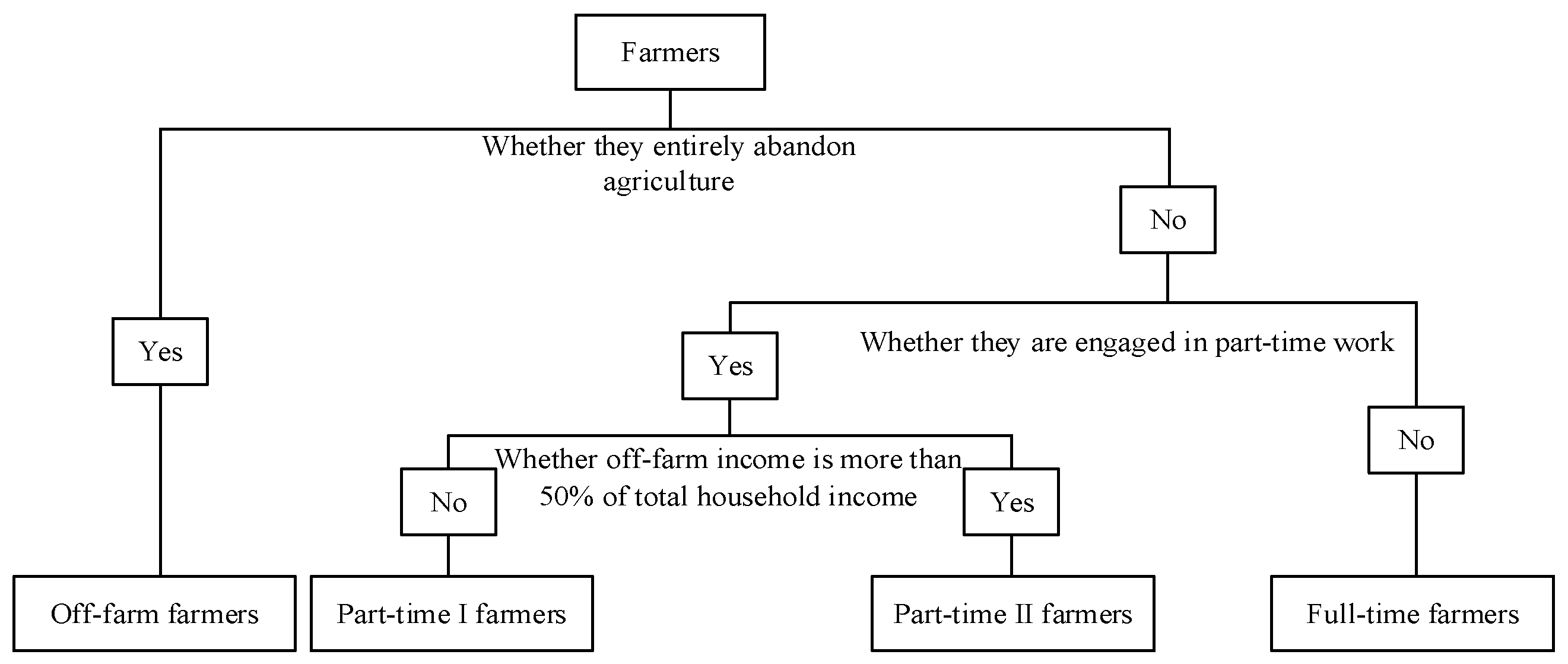
To better capture heterogeneity, we classify farmers into four categories based on their engagement in agriculture and off-farm work, following the income-based classification in Liu et al. [29]: full-time farmers (≤10% off-farm income), part-time I farmers (10–50%), part-time II farmers (50–90%), and off-farm farmers (>90%). This classification is also informed by He et al. [30] and Andersson et al. [31]. Cai et al. [32] further found that livelihood differentiation significantly alters input behavior, with informal part-time farmers reducing chemical use due to better land endowments, while formal part-time farmers tend to increase such inputs—highlighting the importance of disaggregating farmer types in ALP analysis. The classification scheme is illustrated in Figure 1. Since off-farm farmers have completely withdrawn from agricultural activities, they are excluded from the analysis.
The thresholds of 10%, 50%, and 90% follow the established classification in Liu et al. [29] and He et al. [30], which have been widely used in Chinese rural household studies. These thresholds also align with the categorization guidelines of the National Bureau of Statistics of China. The 10% threshold distinguishes de jure full-time farmers from those with any off-farm income. The 50% threshold marks the point at which agriculture ceases to be the primary income source. The 90% threshold identifies farmers that have essentially exited agricultural production. We acknowledge that these thresholds are context-specific and may require adjustment when applied to other regions or agricultural systems.

2.4. Differences in ALP Preferences Across Farmer Categories

We expect systematic differences in ALP technology preferences across farmer categories. Full-time farmers, being heavily dependent on agricultural income, have strong incentives to protect land quality. However, their limited capital and technical capacity makes them more likely to adopt labor-intensive, low-cost technologies such as LLP. Part-time I farmers, who maintain agriculture as their primary activity but benefit from off-farm income, are better positioned to invest in capital-intensive technologies like IDF and ORF. Part-time II farmers, by contrast, are primarily engaged in off-farm work and have weak ties to agriculture; they are unlikely to adopt any ALP technologies. We therefore propose:
Hypothesis 2.
Full-time farmers exhibit a propensity to adopt Land Leveling Procedures (LLP).
Hypothesis 3.
Part-time I farmers tend to prefer enhancing Irrigation and Drainage Facilities (IDF) and applying Organic Fertilizers (ORF).
Hypothesis 4.
Part-time II farmers show no significant inclination toward any of these ALP technologies.

3. Materials and Methods

3.1. Data

The data come from a survey of rice farmers in the Jianghan Plain of Hubei Province, China, conducted in 2022. Hubei is a major rice-producing province within the Yangtze River Economic Belt. In 2021, the province produced 27.6433 million tons of grain, with a sowing area of 4685.98 thousand hectares, maintaining grain production above 25 million tons for nine consecutive years (Hubei Provincial Bureau of Statistics, https://en.hubei.gov.cn/news/newslist/202206/t20220609_4169475.shtml, accessed on 9 June 2022). The Jianghan Plain, covering approximately 46,000 km2, is one of major rice-producing regions in China. The region has experienced substantial reallocation of labor from agriculture to off-farm employment. This setting provides an informative case for examining the relationship between off-farm income and land protection. We do not claim that the plain is representative of all Chinese farming systems; rather, our findings should be interpreted as reflecting the conditions of this specific region. The study contributes evidence from a context where both agricultural intensification and labor diversification are active processes.
The survey followed a stratified random sampling design: 10 counties were selected from the three main rice-producing zones in Hubei; within each county, three townships were randomly chosen; within each township, two villages were selected; and from each village, at least 25 farmers were randomly sampled. Face-to-face interviews were conducted with farmers who had actively participated in agricultural production in 2021 and were able to provide reliable information. The questionnaire covered household characteristics, rice production, livelihoods, and ALP technology adoption. The total sample comprised 1571 observations.
The sample construction proceeded in two steps. The original survey comprised 1571 rice farmers. First, we excluded 519 farmers with off-farm income shares exceeding 90%, as these farmers had effectively withdrawn from agricultural production and reported zero agricultural labor input. This left 1052 farmers (233 full-time farmers, 22%; 244 part-time I farmers, 23%; 575 part-time II farmers, 55%) engaged in active farming. Second, among these 1052 farmers, listwise deletion of missing values on key variables (household income, land area, and ALP adoption) reduced the sample to 971 observations.
Table 1 compares the 519 excluded off-farm farmers with the 1052 retained farmers across key demographic and economic characteristics. The excluded farmers are significantly older (62.19 vs. 59.65 years), less educated (6.67 vs. 8.06 years), and operate substantially smaller land areas (7.39 vs. 23.35 mu) than the retained farmers. No significant difference is found in total household income between the two groups. The excluded farmers’ near-complete reliance on off-farm income (mean share of 0.975) confirms that they had effectively exited agricultural production. These patterns suggest that farmers with limited land resources are more likely to exit agriculture, while those with larger land endowments remain engaged in farming despite off-farm income diversification. Their exclusion from the regression analysis is therefore justified, as their ALP adoption is not meaningfully defined in the absence of active agricultural activity.

3.2. Variable Selection

Dependent variable. Farmers’ adoption of ALP practices is measured by the number of ALP technologies adopted (IDF, LLP, ORF), taking integer values from 0 to 3, following Willy and Holm-Müller [33]. The three technologies are (1) enhancement of irrigation and drainage facilities (IDF); (2) land leveling procedures (LLP); and (3) application of organic fertilizers (ORF). The adoption of each practice was measured by asking farmers: ’Did you adopt the following practices in your rice production during 2021: (a) enhancing irrigation and drainage facilities; (b) land leveling; (c) applying organic fertilizers?’ Each item was coded as 1 if adopted and 0 otherwise. The reference period was the 2021 rice growing season. The household head was identified as the primary respondent, with cross-verification from other adult household members where available.
Independent variable. The key explanatory variable is the off-farm income shares, measured as the ratio of off-farm income to total household income, treated as a continuous variable. We use the income shares rather than the labor time share for three reasons. First, income shares directly reflect the farmers’ economic dependence on agriculture, which is the theoretical mechanism of interest. Second, labor time allocation is difficult to measure precisely in household surveys when multiple members engage in both farm and off-farm work. Third, the income-based classification follows established practice in the literature [26,30,34,35], facilitating comparability with previous studies. We also construct categorical variables for full-time, part-time I, and part-time II farmers based on the income thresholds described in Section 2.3 [26,30].
Control variables. Drawing on prior studies [1,36], we control for farmers’ individual characteristics (age, education, political identity, health status), household characteristics (rice growing area, agricultural laborers, annual household income), rice growing conditions (soil fertility, number of plots, topography), and external factors (market environment, transport condition, professional cooperative, agricultural training).
Table 2 presents the distribution of ALP adoption across farmer categories. The mean ALP scores for off-farm, part-time II, part-time I, and full-time farmers are 0.503, 0.541, 0.820, and 0.614, respectively, suggesting a possible inverted U-shaped pattern. After excluding off-farm farmers (519 observations, 33.04%) who had completely withdrawn from agricultural activities, the analytical sample consisted of 1052 observations (233 full-time, 244 part-time I, and 575 part-time II). Due to missing values in key variables (e.g., annual household income, area of rice-growing, and ALP technology adoption), the final regression sample comprised 971 observations. Table 3 provides summary statistics for all variables.

3.3. Empirical Strategy

Traditional approaches to analyzing count data have historically treated such data as either continuous and normally distributed or categorized them as occurrences or non-occurrences. However, these methods have been replaced by more suitable statistical techniques that leverage the Poisson probability distribution, specifically designed for analyzing count data [37]. Given that the dependent variable is in count form, this study employs the Poisson Regression Model to examine the association of off-farm income shares and farmers’ adoption of ALP practices. Model 1 is structured as follows:
l n λ i = α 0 + α 1 P i + k = 1 α 2 k C o n t r o l s i
where λ i = E ( A L P i |xi) denotes the expected number of ALP adoption of the ith farmer, defined as the count of ALP technologies adopted by the farmers, which ranges from 0 to 3. P i indicates the shares of off-farm income to total household income of the ith farmer.   C o n t r o l s i comprises a collection of control variables that could potentially influence the dependent variable. α 0 , α 1 , α 2 k are parameters to be estimated.
l n λ i = β 0 + β 1 P i + β 2 P i 2 + k = 1 β 3 k C o n t r o l s i
P i 2 represents the squared term of the off-farm income shares of the ith farmer. β 0 , β 1 , β 2 , β 3 k are parameters to be estimated in this model. The other variables are defined similarly as in Model 1. All models are estimated using maximum likelihood estimation with robust standard errors.
Alongside investigating the association between off-farm income shares and farmers’ ALP adoption, this study also delves into variations in ALP preferences across different farmer categories. The models are structured as follows:
I D F i = γ 0 + γ 1 F a r m e r i , j + k = 1 γ 2 k C o n t r o l s i + w i
L L P i = γ 0 + γ 1 F a r m e r i , j + k = 1 γ 2 k C o n t r o l s i + w i
A O F i = γ 0 + γ 1 F a r m e r i , j + k = 1 γ 2 k C o n t r o l s i + w i
I D F i , L L P i and A O F i signify the three types of ALP adoption preferences of the ith farmer, represented as dummy variables with values of 0 or 1. They indicate whether farmers have adopted enhancements in irrigation and drainage facilities (IDF), implementation of land leveling procedures (LLP), and the application of organic fertilizers (ORF), respectively. F a r m e r i , j denotes the farmer category of the ith farmer, where j can assume values 1, 2 and 3. F a r m e r i , 1 , F a r m e r i , 2 and F a r m e r i , 3 are dummy variables indicating whether the ith farmer is a full-time farmer, a part-time I farmer, and a part-time II farmer, respectively. C o n t r o l s i represents a set of variables that may impact on dependent variables. w i is the unobservable disturbance term, while γ 0 , γ 1 and γ 2 are parameters subject to estimation. All models are estimated using Stata 15. Variance Inflation Factor (VIF) tests indicate no serious multicollinearity (mean VIF = 1.22; see Table 4).

4. Results

4.1. Poisson Regression

Table 5 reports the Poisson regression estimates. Column 1, which excludes the quadratic term, shows a negative and significant coefficient for the off-farm income shares (−0.402, p < 0.05), confirming a net negative association. Column 2, which includes the quadratic term, yields a positive coefficient for the linear term (1.216, p < 0.05) and a negative coefficient for the squared term (−1.961, p < 0.01), indicative of an inverted U-shaped relationship. The “utest” procedure confirms that the inverted-U relationship is statistically significant (p = 0.001). The slope is positive at the lower bound of the observed range (0.892, p < 0.01) and negative at the upper bound (−1.496, p < 0.001), indicating a genuine non-monotonic pattern rather than a U-shape in the opposite direction. These results support the presence of an inverted-U relationship between the off-farm income shares and ALP adoption, with a turning point of 0.336 as reported in Table 6. These results support Hypothesis 1.
Among the control variables, agricultural training has a positive and strongly significant association (p < 0.01). Health status and number of plots are also positive and significant (p < 0.05). Political identity and annual household income are positive at the 10% level. Market environment and transport conditions have negative and significant associations.

4.2. Robustness Tests

To assess the robustness of our main results, we conducted four additional checks, summarized in Table 7. First, we re-estimated the main model including the 519 excluded off-farm farmers. The quadratic term remained negative and significant, with a turning point of 0.323 (Column 1). The exclusion of these farmers therefore does not drive the inverted-U pattern.
Second, we winsorized continuous variables at the 1st and 99th percentiles to reduce the influence of extreme observations. The quadratic term remained negative and significant (p < 0.01), with a turning point of 0.293 (Column 2). The relationship is not an artifact of outliers.
Third, we clustered standard errors at the village level to allow for correlated errors within villages. The quadratic term remained negative and significant (p < 0.01), with a turning point of 0.293 (Column 3). Standard errors increased modestly, as would be expected with 62 village clusters. The pattern thus holds after accounting for within-village dependence.
Fourth, we replaced the Poisson Regression Model with an Ordered Probit specification as an alternative functional form. This addresses the concern that our results might depend on the count-data distributional assumption. The quadratic term remained negative and significant (p < 0.01), with a turning point of 0.283 (Column 4).
In all four specifications, the quadratic term kept a negative sign and the turning points stayed within the range of the observed data. Taken together, these checks suggest that the inverted-U relationship is not an artifact of sample selection, distributional assumptions, outliers, or unadjusted village-level correlation. We note, however, that the clustered standard errors are less precise than the main estimates, which we attribute to the limited number of village clusters.

4.3. Associations with Proposed Behavioral Pathways

Our theoretical framework suggests four channels through which off-farm income might relate to ALP adoption: less time available for farming, greater physical distance from cropland, smaller operational scale, and weaker awareness of land protection. We constructed binary indicators for these four channels from the survey data. This section examines whether the off-farm income shares are correlated with these indicators. We do not claim that these are causal mechanisms; testing whether these variables transmit the association would require panel data or quasi-experimental variation to establish temporal order.
Table 8 reports the Probit estimates for each indicator. The off-farm income shares are positively associated with all four variables, and the associations are statistically significant. The strongest association is with IDH (increasing distance from home), followed by RLS (reduction in land scale), DFT (disruption of farming time), and WAP (weakened awareness). These patterns are consistent with the idea that as farmers rely more on off-farm income, their connection to farming weakens across multiple dimensions.
These results align with our theoretical expectations, but they do not constitute evidence of mediation. Whether these four variables actually transmit the association between off-farm income and ALP adoption remains an open question that longitudinal data could help answer.

4.4. Heterogeneity Across Farmer Categories

To examine whether the aggregate index masks differential adoption patterns across technologies, we estimate separate Probit models for each of the three ALP practices (IDF, LLP, and ORF). We re-define the independent variables as dummy indicators for full-time, part-time I, and part-time II farmers, with off-farm farmers excluded from the sample. The full results are presented in Table 9.
For full-time farmers, the coefficient in Column 4 is positive and significant at the 5% level (LLP: 0.285, p < 0.05), while the coefficient in Column 1 is negative and significant at the 10% level (IDF: −0.410, p < 0.10). This indicates that full-time farmers are significantly more likely to adopt land leveling procedures and significantly less likely to adopt irrigation and drainage enhancements. These findings support Hypothesis 2.
For part-time I farmers, the coefficients are positive and highly significant in both Column 2 (IDF: 0.443, p < 0.01) and Column 8 (ORF: 0.493, p < 0.01). This suggests a strong and consistent preference among part-time I farmers for adopting both irrigation and drainage facilities and organic fertilizers, which aligns with Hypothesis 3.
For part-time II farmers, the coefficient in Column 6 is negative and significant at the 1% level (LLP: −0.318, p < 0.01), indicating a notable reluctance to adopt land leveling procedures. No significant associations are found for IDF or ORF. This pattern supports Hypothesis 4, confirming that part-time II farmers show little engagement with ALP technologies overall.
Overall, these results confirm that ALP technology preferences vary systematically across farmer livelihood strategies. The findings point to a simple policy implication: extension programs should match technology promotion to farmers’ economic circumstances. Full-time farmers need low-cost options; part-time I farmers can absorb capital-intensive practices; part-time II farmers, who have largely disengaged from farming, may require service-based approaches rather than technology promotion.

5. Discussion

5.1. The Inverted U-Shape and Competing Explanations

Our finding of an inverted-U-shaped relationship between the off-farm income shares and farmers’ adoption of ALP practices is consistent with a narrative of shifting rationalities. At low levels of off-farm income, farmers appear to prioritize short-term survival and income security, which limits their investment in land protection. As off-farm income rises toward the turning point, the pattern suggests that ecological rationality gains ground: farmers acquire both the financial means and the incentive to invest in sustainable land management. Beyond this threshold, farming becomes a secondary activity, and the opportunity cost of time spent on land protection may outweigh its perceived benefits. The observed pattern across farmer groups is consistent with a progression from survival-driven to sustainability-driven behavior, and back again as off-farm income continues to rise.
While our cross-sectional data cannot directly verify this long-term dynamic process, we can still consider several other explanations for the observed pattern. First, liquidity constraints may bind for part-time farmers: off-farm income often goes to consumption rather than agricultural investment, limiting working capital for ALP practices. Second, rising off-farm wages increase the opportunity cost of farm labor, making time-intensive practices less attractive. Third, farmers with less secure land rights may underinvest in long-term land protection regardless of their off-farm income. Fourth, differential access to extension services and credit may confound the relationship. Fifth, selective withdrawal—less capable or less motivated farmers sorting into part-time II status—could produce the pattern without any causal effect of off-farm income on ALP adoption.
The overall negative association between off-farm income shares and ALP adoption is consistent with Sun et al. [38], who found that off-farm employment reduces agricultural green total factor productivity, particularly among households with a high share of non-agricultural income. This does not imply that off-farm work should be discouraged; rather, it points to the need for policies that help farmers balance off-farm work with sustainable land management. The estimated turning point of 0.336 should be interpreted as a sample-specific feature of the fitted relationship rather than as a universal or policy threshold.
The correlational patterns we observe across the four pathway variables (IDH, RLS, DFT, and WAP) point to possible channels through which off-farm income might relate to ALP adoption. The strongest association is with increased distance from home, followed by reduction in land scale, disruption of farming time, and weakened awareness. These patterns suggest several policy directions. Promoting local off-farm employment could reduce the spatial distance between farmers and their land. Improving land transfer systems could help mitigate the fragmentation effects of part-time farming. Investing in ALP training programs tailored to part-time farmers, especially those with high off-farm income shares, might compensate for their reduced time and awareness. We emphasize, however, that these are speculative policy inferences based on correlational evidence.

5.2. International Perspectives on Part-Time Farming and Land Protection

Our findings also speak to broader debates on agricultural transition beyond China. The trend toward part-time farming in China shares similarities with pluriactivity in Europe, where farm households also diversify income sources through off-farm work [39]. However, the motivations differ: in many European contexts, pluriactivity is partly sustained by agricultural subsidies and lifestyle choices, whereas in rural China it is more often a response to low agricultural returns and limited land availability. Despite these differences, the ecological implications appear convergent. European farmers have been found to give limited attention to soil multi-functionality beyond primary productivity [39], and evidence from India suggests that improved non-farm employment opportunities increase household welfare but reduce incentives to deploy labor for soil and water conservation [40], a pattern consistent with our results. Institutional context also matters: the inverted-U relationship we observe may be shaped by China’s collective land tenure system, in which farmers hold use rights rather than full ownership. Under private property regimes, the incentive structure for long-term land conservation could differ. Our findings thus contribute to a growing international literature that examines how agricultural transformation shapes land management, while also highlighting the role of institutional context in shaping these relationships [41].

5.3. Other Determinants of ALP Adoption

Age and education do not show significant associations with ALP adoption in our sample, which contrasts with some earlier studies. Higher household income is positively associated with ALP adoption, consistent with Boz [42]. Rice-growing area is not significant, suggesting that scale alone does not drive land protection. The number of plots, however, shows a positive association, possibly because fragmented land requires more attention and diversified management practices. Market environment and transport access show negative associations, which we interpret as suggestive evidence that convenient sales outlets reduce farmers’ attention to production quality. Agricultural training has a strong positive association, confirming the role of extension services. The significant associations of training and political identity echo Zhang and Lu [43], who emphasized the role of policy cognition and social networks in promoting conservation practices.

5.4. Heterogeneity in ALP Preferences

The differences across farmer categories provide practical guidance for policy design. Full-time farmers prefer low-cost, labor-intensive options such as LLP. Part-time I farmers, who combine agricultural and off-farm income, are more likely to adopt capital-intensive technologies such as IDF and ORF. Part-time II farmers, who have largely decoupled from agriculture, show little interest in any ALP technology. These patterns suggest that uniform extension programs are unlikely to be effective [44].
For full-time farmers, whose ALP adoption remains low due to capital constraints rather than lack of incentive, subsidies for conservation practices and promotion of low-cost technologies are the priority. Reducing the upfront cost of adoption could encourage greater uptake of practices like land leveling, which aligns with this group’s resource endowments.
For part-time I farmers, who have already reached the highest ALP adoption levels among the three groups, the policy focus should shift from subsidizing adoption to sustaining and scaling up investment. Credit support and capital-intensive technology packages, such as irrigation facilities and organic fertilization, could help this group maintain their current engagement with ALP technologies.
For part-time II farmers, the low adoption reflects limited time, spatial distance from farmland, and reduced economic dependence on agriculture rather than a lack of available technologies. For this group, land trusteeship and socialized services may be more practical than technology promotion alone. These approaches can relieve part-time II farmers of direct management burdens while maintaining land productivity, addressing the specific constraints identified in our pathways analysis.

6. Conclusions

Part-time employment is a widespread feature of agricultural development in countries with limited arable land resources. Using survey data from 1571 rice farmers in China’s Jianghan Plain, this study applies Poisson and Probit models to examine how the off-farm income shares are associated with farmers’ ALP adoption. While our empirical setting is the Jianghan Plain, the analytical framework and policy logic developed here have broader applicability to other regions experiencing similar processes of agricultural transition.
Three main conclusions emerge. First, ALP adoption is highest at intermediate levels of off-farm income shares and lower at both ends of the observed distribution, consistent with an inverted U-shaped association. The estimated turning point of 0.336 is sample-specific and should not be interpreted as a universal policy threshold. Second, off-farm income shares are positively associated with four proposed pathway indicators, but these associations do not establish mediation effects. Third, practice-specific adoption patterns differ across farmer categories: full-time farmers show higher LLP adoption, part-time I farmers show higher IDF and ORF adoption, and part-time II farmers show lower LLP adoption.
These findings point to several policy implications. At a general level, governments should enhance the economic attractiveness of agriculture to keep farming a viable livelihood, promote local employment to help farmers balance off-farm work with farm work, and design ALP policies that account for farmer heterogeneity. More specifically, for full-time farmers, reducing upfront costs through subsidies and promoting low-cost technologies are appropriate, as their relatively low adoption may partly reflect capital constraints. For part-time I farmers, who already show the highest engagement with ALP, policy should shift from promoting adoption to sustaining and scaling up investments through credit support and capital-intensive technology packages. For part-time II farmers, whose limited adoption stems from time and spatial constraints rather than technology unavailability, land trusteeship and socialized services may be more practical than technology promotion alone.
Several limitations should be considered when interpreting our findings. First, our cross-sectional design does not allow us to establish causal relationships or observe dynamic transitions between farmer categories over time. Although we interpret our findings as conditional associations consistent with our theoretical framework, we cannot rule out reverse causality or unobserved confounding. Panel data or quasi-experimental designs would be valuable for future research to strengthen causal identification.
Second, the aggregate count measure of ALP adoption assumes equal weighting of the three practices (IDF, LLP, and ORF), which may oversimplify differences in cost, frequency, environmental benefits, and decision-making responsibility across the three technologies. While we supplement the aggregate analysis with practice-specific Probit models, future research could develop weighted indices based on environmental impact assessments or cost–benefit analyses.
Third, our findings are drawn from a sample of rice farmers in the Jianghan Plain, a flat and intensively cultivated region. The results may not be directly generalizable to mountainous areas, pastoral regions, or smallholder-dominated farming systems with different land tenure arrangements and off-farm labor market conditions. Moreover, the off-farm income shares are measured at the household level and rely on self-reported income data, which may introduce measurement error. Further empirical validation in diverse agricultural settings is needed.

Author Contributions

Conceptualization, M.Y. and L.J.F.; methodology, G.Y. and M.Y.; software, G.Y.; formal analysis, G.Y. and S.J.; investigation, M.Y.; data curation, G.Y.; writing—original draft preparation, G.Y.; writing—review and editing, G.Y., M.Y., S.J., D.C. and L.J.F.; visualization, G.Y.; supervision, L.J.F.; project administration, M.Y.; funding acquisition, G.Y. All authors have read and agreed to the published version of the manuscript.

Funding

This research was funded by the Scientific Research Foundation of Hubei University of Education for Talent Introduction (grant No. ESRC20240041) and the Tsinghua University Doctoral Dissertation Fellowship Programme of the Institute of Rural Studies (grant No. 202208).

Institutional Review Board Statement

Ethical review and approval were waived for this study by the Institutional Committee, as it complies with Article 32(3) of the “Measures for the Ethical Review of Life Sciences and Medical Research Involving Humans” (China, 2023). This exemption applies because the study involved anonymous surveys and was conducted as part of standard educational practices, posing no risk to participants.

Informed Consent Statement

Informed consent was obtained from all subjects involved in the study.

Data Availability Statement

Data are contained within the article.

Conflicts of Interest

The authors declare no conflicts of interest.

Abbreviations

The following abbreviations are used in this manuscript:
ALPArable Land Protection
IDFIrrigation and Drainage Facilities
LLPLand Leveling Procedures
ORFOrganic Fertilizers
IDTIrrigation and Drainage Technologies
FMTFarmland Management Technologies
SITSoil Improvement Technologies
DFTDisturbance of Farming Time
IDHIncreasing Distance from Home
RLSReduction in Arable Land Scale
WAPWeakness of Awareness in ALP
VIFVariance Inflation Factor

References

  1. Zhang, Y.; Lu, X.; Zou, Y.; Lv, T. Nudging strategies for arable land protection behavior in China. Int. J. Environ. Res. Public Health 2022, 19, 12609. [Google Scholar] [CrossRef] [Scilit]
  2. Eswaran, H.; Lal, R.; Reich, P.F. Land degradation: An overview. In Response to Land Degradation; CRC Press: Boca Raton, FL, USA, 2019; pp. 20–35. [Google Scholar]
  3. Akbari, Z.; Imani, B.; Pourramzan, E.; Choobchian, S.; Siamian, N.; Sklenička, P.; Janečková, K.; Witlox, F.; Azadi, H. How to protect productive lands to ensure food security: The case of Northern Iran. Land Use Policy 2025, 158, 107685. [Google Scholar] [CrossRef] [Scilit]
  4. FAO. The State of the World’s Land and Water Resources for Food and Agriculture—Systems at Breaking Point. Synthesis Report 2021; FAO: Rome, Italy, 2021. [Google Scholar]
  5. Lai, Z.; Chen, M.; Liu, T. Changes in and prospects for cultivated land use since the reform and opening up in China. Land Use Policy 2020, 97, 104781. [Google Scholar] [CrossRef] [Scilit]
  6. Fantappiè, M.; Lorenzetti, R.; De Meo, I.; Costantini, E.A. How to improve the adoption of soil conservation practices? Suggestions from farmers’ perception in western Sicily. J. Rural Stud. 2020, 73, 186–202. [Google Scholar] [CrossRef] [Scilit]
  7. Zhang, Y.; Lu, X.; Zhang, M.; Ren, B.; Zou, Y.; Lv, T. Understanding farmers’ willingness in arable land protection cooperation by using fsQCA: Roles of perceived benefits and policy incentives. J. Nat. Conserv. 2022, 68, 126234. [Google Scholar] [CrossRef] [Scilit]
  8. Wang, Y.; Li, Y. Promotion of degraded land consolidation to rural poverty alleviation in the agro pastoral transition zone of northern China. Land Use Policy 2019, 88, 104114. [Google Scholar] [CrossRef] [Scilit]
  9. Wang, L.; Li, Z.; Yuan, C.; Liu, L. Exploration on the reasons for low efficiency of arable land protection policy in China: An evolutionary game theoretic model. Environ. Dev. Sustain. 2023, 26, 25173–25198. [Google Scholar] [CrossRef] [Scilit]
  10. Genius, M.; Koundouri, P.; Nauges, C.; Tzouvelekas, V. Information transmission in irrigation technology adoption and diffusion: Social learning, extension services, and spatial effects. Am. J. Agric. Econ. 2014, 96, 328–344. [Google Scholar] [CrossRef] [Scilit]
  11. Hu, R.; Cai, Y.; Chen, K.Z.; Huang, J. Effects of inclusive public agricultural extension service: Results from a policy reform experiment in western China. China Econ. Rev. 2012, 23, 962–974. [Google Scholar] [CrossRef] [Scilit]
  12. Scoones, I.; Marongwe, N.; Mavedzenge, B.; Murimbarimba, F.; Mahenehene, J.; Sukume, C. Livelihoods after land reform in Zimbabwe: Understanding processes of rural differentiation. J. Agrar. Change 2012, 12, 503–527. [Google Scholar] [CrossRef] [Scilit]
  13. Wang, S.; Bai, X.; Zhang, X.; Reis, S.; Chen, D.; Xu, J.; Gu, B. Urbanization can benefit agricultural production with large scale farming in China. Nat. Food 2021, 2, 183–191. [Google Scholar] [CrossRef] [Scilit]
  14. Brosig, S.; Glauben, T.; Herzfeld, T.; Wang, X. Persistence of full and part time farming in Southern China. China Econ. Rev. 2009, 20, 360–371. [Google Scholar] [CrossRef] [Scilit]
  15. Zheng, W.; Luo, B.; Hu, X. The determinants of farmers’ fertilizers and pesticides use behavior in China: An explanation based on label effect. J. Clean. Prod. 2020, 272, 123054. [Google Scholar] [CrossRef] [Scilit]
  16. Yang, X.; Sang, Y. How does part time farming affect farmers’ adoption of conservation agriculture in Jianghan Plain, China? Int. J. Environ. Res. Public Health 2020, 17, 5983. [Google Scholar] [CrossRef] [Scilit]
  17. Pei, X.W.; Zheng, X.E.; Wu, C. How part time farming affects cultivated land use sustainability: Survey based assessment in China. Land 2024, 13, 1242. [Google Scholar] [CrossRef] [Scilit]
  18. China’s Well-facilitated Capital Farmland Construction Plan (2021–2030). Available online: https://ntjss.moa.gov.cn/zcfb/202109/t20210915_6376511.htm (accessed on 6 September 2021).
  19. Chatzimichael, K.; Genius, M.; Tzouvelekas, V. Pesticide use, health impairments and economic losses under rational farmers behavior. Am. J. Agric. Econ. 2022, 104, 765–790. [Google Scholar] [CrossRef] [Scilit]
  20. Brown, C.; Kovács, E.; Herzon, I.; Villamayor Tomas, S.; Albizua, A.; Galanaki, A.; Grammatikopoulou, L.; McCracken, D.; Olsson, J.A.; Zinngrebe, Y. Simplistic understandings of farmer motivations could undermine the environmental potential of the common agricultural policy. Land Use Policy 2021, 101, 105136. [Google Scholar] [CrossRef] [Scilit]
  21. Simon, H.A. Bounded rationality. In Utility and Probability; Palgrave Macmillan: London, UK, 1990; pp. 15–18. [Google Scholar]
  22. Conlisk, J. Why bounded rationality? J. Econ. Lit. 1996, 34, 669–700. [Google Scholar]
  23. Wauters, E.; Bielders, C.; Poesen, J.; Govers, G.; Mathijs, E. Adoption of soil conservation practices in Belgium: An examination of the theory of planned behaviour in the agri environmental domain. Land Use Policy 2010, 27, 86–94. [Google Scholar] [CrossRef] [Scilit]
  24. Sandhu, H.S.; Wratten, S.D.; Cullen, R.; Case, B. The future of farming: The value of ecosystem services in conventional and organic arable land. An experimental approach. Ecol. Econ. 2008, 64, 835–848. [Google Scholar] [CrossRef] [Scilit]
  25. Key, N.; Roberts, M.J. Nonpecuniary benefits to farming: Implications for supply response to decoupled payments. Am. J. Agric. Econ. 2009, 91, 1–18. [Google Scholar] [CrossRef] [Scilit]
  26. Sen, A. Development as Freedom; Oxford University Press: Oxford, UK, 1999. [Google Scholar]
  27. Robeyns, I. The Capability Approach: A Theoretical Survey. J. Hum. Dev. 2005, 6, 93–117. [Google Scholar] [CrossRef] [Scilit]
  28. Liu, L.; Gou, K.; Ran, L. Beyond the Three Ambiguities: A Capability Approach to Divorced Women’s Collective Membership for Land Expropriation Compensation in Rural China. Land 2026, 15, 1002. [Google Scholar] [CrossRef] [Scilit]
  29. Liu, G.; Ma, Z.; Guo, S.; Deng, X.; Song, J.; Xu, D. How does farmers’ differentiation affect farmland abandonment from the perspective of land attachment and generational differences? Evidence from Sichuan Province, China. Environ. Dev. 2023, 48, 100924. [Google Scholar] [CrossRef] [Scilit]
  30. He, Y.; Xie, H.; Peng, C. Analyzing the behavioral mechanism of farmland abandonment in the hilly mountainous areas in China from the perspective of farming household diversity. Land Use Policy 2020, 99, 104826. [Google Scholar] [CrossRef] [Scilit]
  31. Andersson, H.; Ramamurtie, S.; Ramaswami, B. Labor income and risky investments: Can part time farmers compete? J. Econ. Behav. Organ. 2003, 50, 477–493. [Google Scholar] [CrossRef] [Scilit]
  32. Cai, L.M.; Wang, L.P.; Ning, M.X. Farmers’ livelihood differentiation and pesticide application: Empirical evidence from a causal mediation analysis. Sustainability 2022, 14, 8502. [Google Scholar] [CrossRef] [Scilit]
  33. Willy, D.K.; Holm Müller, K. Social influence and collective action effects on farm level soil conservation effort in rural Kenya. Ecol. Econ. 2013, 90, 94–103. [Google Scholar] [CrossRef] [Scilit]
  34. De Janvry, A.; Sadoulet, E. Income strategies among rural households in Mexico: The role of off farm activities. World Dev. 2001, 29, 467–480. [Google Scholar] [CrossRef] [Scilit]
  35. Pfeiffer, L.; López Feldman, A.; Taylor, J.E. Is off farm income reforming the farm? Evidence from Mexico. Agric. Econ. 2009, 40, 125–138. [Google Scholar] [CrossRef] [Scilit]
  36. Xie, H.; Huang, Y. Influencing factors of farmers’ adoption of pro environmental agricultural technologies in China: Meta analysis. Land Use Policy 2021, 109, 105622. [Google Scholar] [CrossRef] [Scilit]
  37. Hayat, M.J.; Higgins, M. Understanding Poisson regression. J. Nurs. Educ. 2014, 53, 207–215. [Google Scholar] [CrossRef] [Scilit]
  38. Sun, X.H.; Fan, X.N.; Liu, Q.; Lyu, J. Balancing livelihoods and sustainable development: How does off farm employment affect agricultural green total factor productivity in China? Sustainability 2026, 18, 155. [Google Scholar] [CrossRef] [Scilit]
  39. Schröder, J.J.; Ten Berge, H.F.M.; Bampa, F.; Creamer, R.E.; Giraldez-Cervera, J.V.; Henriksen, C.B.; Olesen, J.E.; Rutgers, M.; Sandén, T.; Spiegel, H. Multi-Functional Land Use Is Not Self-Evident for European Farmers: A Critical Review. Front. Environ. Sci. 2020, 8, 575466. [Google Scholar] [CrossRef] [Scilit]
  40. Kumar, S.; Singh, R.P. Tradeoff between Non-farm Income and On-farm Conservation Investments in the Semi-Arid Tropics of India. Agric. Econ. Res. Rev. 2020, 33, 215–226. [Google Scholar]
  41. Wang, G.; Attipoe, S.G. Does Off-farm Employment Contribute to Chemical Fertilizer Reduction? New Evidence from the Main Rice-producing Area in Jilin Province, China. PLoS ONE 2022, 17, 0279194. [Google Scholar] [CrossRef] [Scilit]
  42. Boz, I. Effects of environmentally friendly agricultural land protection programs: Evidence from the Lake Seyfe area of Turkey. J. Integr. Agric. 2016, 15, 1903–1914. [Google Scholar] [CrossRef] [Scilit]
  43. Zhang, Y.W.; Lu, X.H. Social capital, policy cognition, and farmers’ cultivated land protection behaviors: An empirical analysis based on SEM. J. Resour. Ecol. 2026, 17, 575–592. [Google Scholar] [CrossRef] [Scilit]
  44. Bouchakour, R.; Saad, M. Farm and farmer characteristics and off farm work: Evidence from Algeria. Aust. J. Agric. Resour. Econ. 2020, 64, 455–476. [Google Scholar] [CrossRef] [Scilit]
Figure 1. Classification of the Farmer Categories.
Sustainability 18 08731 g001
Table 1. Comparison of retained and excluded off-farm farmers.
VariableRetained Sample
(N = 1052)
Excluded Off-Farm Farmers
(N = 519)
Difference
Age59.65462.192−2.538 ***
Education level8.0586.6731.385 ***
Area of rice growing23.3547.39115.962 ***
Annual household income7.0986.8750.224
off-farm income shares0.4940.975−0.481 ***
Adoption of ALP practices0.6220.5030.119 **
Note: *** p < 0.01, ** p < 0.05, (two-sample t-tests). The retained sample includes farmers with off-farm income shares ≤ 90%, while the excluded sample includes farmers with off-farm income shares > 90%.
Table 2. Preliminary statistics of ALP adoption by farmer category.
Farmer CategoriesDefinitionNRatio (%)ALP Adoption
(Mean)
SD
Full-time≤10% off-farm income23314.8310.6140.686
Part-time I10–50% off-farm income24415.5320.8200.889
Part-time II50–90% off-farm income57536.6010.5410.752
Off-farm>90% off-farm income51933.0360.5030.555
Total 1571100.00
Table 3. Descriptive statistics of variables.
VariableDefinitionMeanSD
Adoption of ALP practicesCount of ALP technologies adopted (0–3)0.6600.793
off-farm income sharesShare of off-farm income in total household income0.4050.293
AgeFarmers’ age (years)59.42920.697
Education levelFarmers’ education level (years)8.1165.439
Political identityFarmers’ political identity, general public = 1, party member = 21.1340.341
Health statusFarmers’ self-assessment of health status, the range of values is 1 to 53.8330.771
Area of rice growingFarmer households’ rice growing area (mu)26.70559.635
Agricultural laborersNumber of people involved in agricultural work (person)1.9200.788
Annual household incomeTotal income of farm household (10,000 yuan)7.03812.328
Soil fertilitySoil fertility of own arable land, poor = 1, fair = 2, good = 32.1740.523
Number of plotsNumber of plots of own arable land (plot)15.28356.332
Topography of arable landTopography of own arable land, flat = 1, sloping = 2, hilly = 31.1470.477
Market environmentIs there a local person or agency that comes to your house to buy the grain? Yes = 1, no = 00.7430.437
Transport conditionDistance from main road (km)2.92034.755
Professional cooperativeIs there a local professional cooperative? Yes = 1, no = 00.5630.496
Agricultural trainingHave you attended an agricultural training course in 2021? Yes = 1, no = 00.4920.500
Note: The analytical sample excludes off-farm farmers (those with more than 90% of income from off-farm sources), resulting in 1052 observations. All variables reflect farmers’ conditions and activities during the 2021 production year. The area unit “mu” is a traditional Chinese unit of land measurement, with 1 mu equivalent to 1/15 of a hectare, or approximately 666.7 square meters.
Table 4. Variance inflation factors.
VariableVIF1/VIF
Area of rice growing2.260.44
Annual household income2.160.46
Off-farm income shares1.220.82
Professional cooperative1.100.91
Number of plots1.090.92
Agricultural training1.090.92
Soil fertility1.070.93
Health status1.060.94
Topography of arable land1.060.94
Education level1.040.96
Political identity1.040.96
Market environment1.040.96
Agricultural laborers1.040.96
Age1.040.96
Transport condition1.020.98
Mean VIF1.22
Table 5. The results of Poisson regression.
Variable(1)(2)
Coef.S.E.Coef.S.E.
off-farm income shares−0.402 **0.1291.216 **0.439
off-farm income shares2−1.961 ***0.533
Age0.0010.0010.0010.001
Education level−0.0030.007−0.0040.008
Political identity0.256 *0.1230.250 *0.121
Health status0.156 **0.0520.136 **0.053
Area of rice growing−0.0010.001−0.0020.001
Agricultural laborers0.0240.04800.0370.050
Annual household income0.0110.0070.012 *0.006
Soil fertility−0.1180.067−0.1070.068
Number of plots0.001 ***0.0000.000 **0.000
Topography of arable land−0.0950.080−0.0490.082
Market environment−0.297 **0.094−0.249 **0.091
Transport condition−0.028 *0.013−0.027 *0.013
Professional cooperative0.0420.0870.0390.086
Agricultural training0.347 ***0.0840.329 ***0.083
Constant−0.891 **0.344−1.071 **0.343
N971971971971
Pseudo R20.0320.038
Note: *, **, and *** indicate significance at 10%, 5%, and 1%, respectively. Robust standard errors are reported in the S.E. columns. Robust standard errors are reported in the S.E. columns.
Table 6. Test for an inverted U-shaped relationship.
Lower BoundUpper BoundTurning PointOverall Test
Interval00.9000.336
Slope0.892−1.496
t-statistic3.198−4.830 3.200
p-value0.0010.000 0.001
95% CI for turning point [0.287, 0.389]
Note: The turning point is calculated as −β1/(2β2) = 0.336. The 95% confidence interval is estimated via the delta method. The overall test rejects the null hypothesis of a monotonic relationship (p = 0.001).
Table 7. Robustness test results.
Variable(1) Total
Samples
(2) Winsorized
(1–99%)
(3) Village
Clustered SE
(4) Ordered
Probit
Off-farm income shares3.233 ***1.160 **1.160 *0.925 **
(0.459)(0.508)(0.621)(0.435)
Off-farm income shares2−5.001 ***−1.982 ***−1.982 ***−1.633 **
(0.493)(0.595)(0.694)(0.512)
ControlsYesYesYesYes
Constant−0.709 (0.464)−0.282 (0.604)−0.282 (0.654)
Cut 10.595
(0.321)
Cut 21.771 ***
(0.322)
Cut 32.489 ***
(0.324)
N1360967967971
Pseudo R20.1440.0440.0440.041
Turning point0.3230.2930.2930.283
Note: *** p < 0.01, ** p < 0.05 and * p < 0.1. Robust standard errors in parentheses for Columns 1–2; village-clustered standard errors in Column 3; standard errors in Column 4.
Table 8. Probit estimates for pathway indicators.
Variable(1)(2)(3)(4)
DFTIDHRLSWAP
Part_time0.118 **0.541 ***0.138 ***0.083 *
(0.041)(0.081)(0.038)(0.035)
ControlsYESYESYESYES
N971971971971
Pseudo R20.0240.1590.0330.001
Note: * p < 0.1, ** p < 0.05, *** p < 0.01. Robust standard errors are reported in parentheses.
Table 9. Differences in ALP practices across farmer categories.
IDFLLPORF
(1)(2)(3)(4)(5)(6)(7)(8)(9)
Full-time−0.410 * 0.285 ** −0.312
(0.161) (0.107) (0.164)
Part-time I 0.443 *** 0.129 0.493 ***
(0.120) (0.102) (0.132)
Part-time II −0.161 −0.318 *** −0.225
(0.119) (0.092) (0.126)
Constant−0.269−0.452−0.152−0.734−0.767−0.527−2.306 ***−2.494 ***−2.172 ***
(0.450)(0.433)(0.438)(0.479)(0.476)(0.485)(0.488)(0.493)(0.498)
ControlsYESYESYESYESYESYESYESYESYES
N971971971971971971971971971
Pseudo R20.0790.0880.0730.0440.0400.0480.1300.1430.129
Note: * p < 0.1, ** p < 0.05, *** p < 0.01. Robust standard errors are reported in parentheses.
Disclaimer/Publisher’s Note: The statements, opinions and data contained in all publications are solely those of the individual author(s) and contributor(s) and not of MDPI and/or the editor(s). MDPI and/or the editor(s) disclaim responsibility for any injury to people or property resulting from any ideas, methods, instructions or products referred to in the content.