1. Introduction
Young trees are particularly vulnerable to heat stress in urban environments, where built infrastructure modifies radiation, airflow, and hydrologic processes, which can limit establishment and longevity [
1]. The urban heat island effect exacerbates high temperature exposure by raising city temperatures above those of surrounding rural areas [
2]. Pavements, especially dark asphalt, absorb and release heat, worsening local thermal loads and contributing to canopy loss [
3]. Urban tree stress is further intensified by dense infrastructure, human activity (e.g., traffic, construction), and reduced airflow, because tree cooling potential depends on canopy traits such as leaf density and crown structure [
4]. Therefore, urban heat islands can act as ecological filters that determine which species can persist. The combination of urban conditions and the increasing frequency and intensity of heat waves can impose substantial physiological strain and inhibit growth of newly planted, young, urban trees.
Heat stress can directly induce tree mortality by limiting evaporative cooling, raising leaf temperature to critical thresholds, and disrupting photosystem II [
5]. Photosynthesis is generally optimized between 20 and 30 °C, with temperatures above 40 °C often tolerated only at increasing physiological cost due to elevated transpirational demand and hydraulic stress [
6]. Prolonged heat can destabilize cellular structures and alter metabolic pathways, reducing growth and development, with future climate projections indicating more frequent damaging episodes [
7]. Heat waves, defined as short-term episodes of temperature 5–10 °C above optimal growth conditions, can cause severe physiological stress, especially when high evaporative demand coincides with limited soil moisture, compounding heat and drought effects on woody plants [
8]. Seedlings of common urban tree species exhibit substantial drought sensitivity. Even species considered relatively stress-tolerant, such as hedge maple (
Acer campestre) and Norway maple (
Acer platanoides), show measurable growth declines under drought, whereas sycamore maple (
Acer pseudoplatanus) can experience shoot biomass reductions approaching 30% [
9].
Unlike natural ecosystems, the production and planting of trees for urban environments subject young trees to a distinct set of physical, chemical, and biological stressors that can limit establishment, growth, and longevity [
10]. These challenges begin during nursery production, where young trees with underdeveloped root systems are exposed to intensified microclimates, and often persist after planting in urban environments where soil quality, rooting volume, and site conditions shape survival [
11]. For example, nursery production systems, where young street trees are typically established, are optimized for full sunlight and mobility and have been shown to experience higher thermal stress than field soils or natural forest environments [
12,
13,
14]. Similarly, urban planting sites further intensify stress, due to air pollution, poor drainage, restricted soil volumes, and physical damage [
15]. Post-planting factors such as location, soil quality, and management further influence survival, with root loss during transplanting reducing water and nutrient uptake while depleting carbon reserves [
16,
17]. In urban settings, restricted planting spaces and inconsistent care further limit survival, with average life expectancy of street trees ranging from 19 to 28 years [
18]. Heat waves and droughts compound these challenges, reducing growth and survival of ornamental trees already only partially adapted to current climates [
19].
Selecting urban trees for aesthetic traits, such as fall foliage color, may have caused unintentional functional tradeoffs, potentially reducing stress tolerance or ecosystem service performance [
20,
21]. Furthermore, many urban trees grown in nurseries originate from regions with climatic conditions that differ substantially from those of production environments. For example, many shade-tree species used in the United States are selected from eastern and northern forests with humid summers but are propagated in nurseries in Oregon’s Willamette Valley, which experiences dry summers with low humidity [
22]. This mismatch predisposes trees like red maple (
Acer rubrum) to moisture stress, a risk expected to increase with climate change.
The convergence of heat stress, water limitation, and root disruption during establishment has prompted interest in management interventions designed to support survival and growth of young trees. These interventions include plant growth regulators, fungicides with reported physiological effects, reflective particle films, nutrient amendments, and irrigation-based cooling strategies, although their effectiveness varies by species, product, and site conditions. Previous studies have reported species-specific improvements in water balance, growth, and photosynthetic efficiency, though responses are inconsistent across trials [
23,
24]. For young trees, such interventions may reduce stress during transplanting and help sustain growth under high-temperature conditions.
The objectives of this study were to evaluate whether chemical or mist applications could mitigate heat stress and enhance growth of red maple (Acer rubrum) under full-sun conditions. We selected red sunset maple (Acer rubrum ‘FranksRed’) as a model shade tree to work with in Oregon because the species is native to eastern hardwood forests, and this cultivar is planted in northern cities throughout North America and Europe. We hypothesized that these stress-mitigation treatments would reduce canopy thermal stress, improve soil water availability, and enhance the growth of young red maple trees under full-sun conditions. This work provides a framework for assessing practical interventions to support young tree establishment under increasingly warm and dry conditions.
2. Materials and Methods
2.1. Plant Material, Experimental Design, and Treatments
The study was conducted over two growing seasons (2022–2023) at the North Willamette Research and Extension Center (Aurora, OR, USA; 45.281210° N, 122.751678° W) using 96 container-grown Acer rubrum ‘FranksRed’. Trees were randomly assigned to one of six stress-mitigation treatments in a completely randomized design, with 16 trees per treatment: Control (standard irrigation and fertilization); water-mist; Paclobutrazol (Trimtect®, Rainbow Ecoscience, Minnetonka, MN, USA); Propiconazole (Strider™, Nufarm Americas Inc., Alsip, IL, USA); Kaolin (Surround® WP, Tessenderlo Kerley Inc., Phoenix, AZ, USA); and potassium phosphite (Fortiphite® 0-0-27, Plant Food Company Inc., Cranbury, NJ, USA). Three treatments (paclobutrazol, propiconazole, and kaolin) were applied to the foliage using backpack sprayers. Separate backpack sprayers were used for each product to prevent cross-contamination. Chemical applications were synchronized to phenological and environmental milestones. Paclobutrazol was applied once annually to dormant trees prior to budbreak at 78.1 mL L−1 (10 fl oz gal−1), following the manufacturer’s labeled recommendation. Propiconazole at 31–47 mL L−1 (6 oz gal−1) was applied twice per year, first at leaf emergence and again on fully developed leaves four weeks later depending on year. The kaolin clay at 720 g L−1 was applied as a foliar spray 24 h before forecasted heat events, with reapplications every 3–4 weeks to maintain canopy coverage. The potassium phosphite product was applied as a soil drench (40 mL product per 7.5 L), also synchronized with heat events. The potassium phosphite was applied one week prior to imminent heat events, two to three times per season. The final treatment, a water mist, was provided as a single overhead nozzle (Netafim, Cool Net 4 Nozzle fogger, Netafim USA, Fresno, CA, USA) per tree controlled by an automated vapor pressure deficit (VPD) controller. When ambient VPD exceeded 2.0 kPa, misting activated for 30 s every 5 min and continued until VPD declined below the threshold.
2.2. Container Substrate and Cultural Conditions
Trees were grown in 95 L (25-gal) containers filled with a Douglas-fir-based soilless substrate composed of 40% aged coarse bark, 40% aged fine bark, 10% coconut coir, and 10% perlite. Lime amendments included dolomitic lime (Ag100 and Ag10) and gypsum applied at standard industry rates to adjust pH and supply Ca and Mg. Controlled-release fertilizer (16-6-12; Harrell’s LLC, Lakeland, FL, USA) was applied at 44 g per tree prior to budbreak each year. Irrigation was delivered via automated drip irrigation scheduled for 08:00, 12:00, and 16:00 daily. Soil volumetric water content (VWC) was monitored continuously in a randomly selected subset of eight trees per treatment (48 total trees) using permanently installed substrate moisture sensors buried within the root zone of each instrumented container. Sensor measurements were used to control irrigation shutoff, pausing irrigation events when mean VWC exceeded 0.35 m3 m−3.
2.3. Data Collection
Ambient conditions including air temperature, relative humidity, and solar radiation were recorded at 5-min intervals by an on-site weather station (ARAO station, AgriMet, US Bureau of Reclamation) (
Table 1). Canopy temperature was measured every 5 min using infrared sensors (METER Group Inc., Pullman, WA, USA) positioned at mid-canopy height on two randomly selected trees per treatment (12 instrumented trees total). Sensors remained on the same trees throughout the study to provide continuous repeated measurements. Root-zone volumetric water content (VWC) was monitored continuously in a randomly selected subset of eight trees per treatment (48 instrumented trees total) using permanently installed TEROS 12 sensors (METER Group Inc., Pullman, WA, USA) buried within the container substrate.
Tree height and trunk caliper were measured at the beginning and the end of each growing season. Caliper was measured 10 cm above the substrate surface. The growth (end of season − initial) height and caliper values were used for statistical analysis. Also, towards the end of the second growing season (15 September 2023) leaf samples (n = 6) were collected from three treatment groups—control, mist, and potassium phosphite. These three groups were selected to (a) confirm potassium phosphite uptake through the soil drench, (b) because mineral build-up was observed on the leaves in the mist-treatment, and (c) to provide a baseline (non-treated) control. Leaf samples were rinsed with water, oven-dried for 48 h at 65 °C, ground, and analyzed through inductively coupled plasma mass spectrometry for macronutrients (N, P, K, Ca, Mg, S) and micronutrients (B, Zn, Mn, Fe, Cu, Na, Al) by an accredited agricultural laboratory.
2.4. Data Analyses
All analyses were conducted in R version 4.3.2 (R Core Team, Vienna, Austria). Raw canopy temperature was analyzed using the following model:
Daily daytime and nighttime means were calculated to derive diurnal amplitude (ΔT). ΔT was analyzed using a linear mixed-effects model (LMM). For the sensor (VWC and Temp) LMM the sensors were included as a random intercept with random time slopes to account for temporal autocorrelation and sensor heterogeneity. Repeated canopy temperature and VWC observations were collected from instrumented trees. Because measurements from the same instrumented tree were not statistically independent, sensor identity was included as a random effect to account for repeated measurements through time. This approach accounts for temporal correlation among repeated observations from the same instrumented tree while allowing treatment effects to be estimated appropriately. Estimated marginal means (EMMs) were derived from the mixed-effects models that included environmental covariates, and are presented instead of raw means because EMMs enable inference on treatment effects independent of temporal variation in weather conditions. Thermal exposure was quantified as the cumulative number of hours that canopy temperature exceeded thresholds (25, 30, 35, 40, and 45 °C). For each canopy temperature sensor, daily hours above these temperature thresholds were calculated by summing 5-min observation intervals. To compare treatment differences while accounting for temporal and sensor-level variability, canopy temperatures were evaluated using LMM, with treatment as a fixed effect and sensor nested within treatment and date included as random effects to account for repeated measurements over time. EMMs were calculated for each treatment and threshold, and pairwise comparisons were performed using Tukey-adjusted contrasts.
VWC was recorded repeatedly by the soil-moisture sensors, and treatment effects were evaluated using an LMM:
Significance of fixed effects was assessed using Type III ANOVA (Satterthwaite approximation). EMMs and Tukey-adjusted pairwise contrasts were computed with emmeans.
Tree height and trunk caliper were analyzed using one-way ANOVA:
Residuals were examined for normality (Shapiro–Wilk) and homogeneity (Levene’s test). Tukey’s HSD and compact letter displays were used for mean separation. Foliar nutrients were analyzed using one-way ANOVA with Tukey HSD adjustment. Samples that lacked complete nutrient determinations were excluded. Diagnostic checks followed the same workflow as for growth traits. During the preparation of this manuscript, the authors used ChatGPT (OpenAI, GPT-5.5) to assist with language editing, and R code refinement. The authors reviewed, verified, and edited all generated content, interpreted the results, and take full responsibility for the content of this publication.
3. Results
3.1. Canopy Temperature Dynamics
During the entire study the mean daily tree canopy temperatures closely tracked ambient conditions, with the LMM of canopy temperature revealing no significant difference between treatment groups. Random effect variance indicated moderate canopy sensor-level variability within treatments (σ2 = 1.20 in 2022; σ2 = 0.08 in 2023). During the first year (2022), the mean daily canopy temperatures ranged from 10 to 35 °C. Throughout this period, average temperatures (EMM ± SE) in the mist treatment consistently exhibited lower daily maxima (17.60 ± 0.78 °C) compared to the other treatments: propiconazole (18.54 ± 0.78 °C), paclobutrazol (19.35 ± 0.78 °C), control (19.39 ± 0.78 °C), potassium phosphite (19.47 ± 0.78 °C), and kaolin (20.44 ± 0.78 °C). However, pairwise comparisons of the treatments versus the control were non-significant (all p ≥ 0.11; Type III ANOVA: F5,6 = 1.52, p = 0.31).
The second year (2023), all canopy temperatures were warmer, spanning 12–38 °C, with average daily temperatures (EMM ± SE) as follows: kaolin = 17.41 ± 0.20 °C, mist = 17.43 ± 0.20 °C, potassium phosphite = 17.75 ± 0.20 °C, propiconazole = 17.71 ± 0.20 °C, paclobutrazol = 17.89 ± 0.20 °C, and control = 18.14 ± 0.20 °C. Although the overall treatment effect was not significant (F5,6 = 1.92, p = 0.22), mist and kaolin exhibited the lowest estimated marginal mean canopy temperatures, differing from the control by approximately 0.7 °C. Pairwise comparisons indicated that both treatments were significantly cooler than the control (mist: −0.71 °C, p = 0.046; kaolin: −0.73 °C, p = 0.042). The overall test evaluated variation among all six treatments, whereas the pairwise contrasts evaluated specific treatment differences relative to the control; therefore, these results should be interpreted as evidence for specific contrasts rather than a general treatment effect. Temporal patterns demonstrated strong daily cycles, with peak temperatures between 13:00 and 15:00 and nightly minimum before 06:00. Sensor-level variability within treatments was generally low but increased during heatwave periods, reflecting localized microclimatic heterogeneity.
Diurnal canopy temperature amplitude (ΔT), calculated as the difference between daytime and nighttime canopy temperature, provided additional insight into treatment effects that were not evident from mean canopy temperature alone. In 2022, ΔT ranged from 1.2 to 20.0 °C (median = 5.8 °C), with only minor differences among treatments after accounting for environmental covariates. In contrast, treatment effects on ΔT were significant in 2023 (F5,775 = 56.37, p < 0.001). Estimated marginal means indicated that kaolin exhibited the lowest ΔT, whereas paclobutrazol and potassium phosphite exhibited the highest values. Ambient air temperature was negatively associated with ΔT, while vapor pressure deficit was positively associated with ΔT; relative humidity was not a significant predictor.
Seasonal exposure to high canopy temperatures was further quantified by calculating cumulative hours above thresholds of 25, 30, 35, 40, and 45 °C (
Table 2). Consistent directional reductions in thermal exposure were observed, with mist and kaolin exhibiting fewer cumulative hours above the highest temperature thresholds than the control in both study years (
Table 2). In 2022, the mist treatment group consistently experienced fewer hours above higher thresholds (35–45 °C), whereas differences at lower thresholds (25–35 °C) were subtle. For example, mist group trees registered 19.7 h 35–40 °C, compared to 90.6 h for control trees. In 2023, elevated ambient temperatures resulted in greater separation among treatments, with mist-treated trees accumulated 162 h above 35 °C and 30.8 h above 40 °C, while control accumulated 294.8 h and 83.7 h, respectively. Despite these consistent directional differences, treatment effects on cumulative hours above the temperature thresholds were not statistically significant based on the mixed-effects models and Tukey-adjusted pairwise comparisons.
3.2. Volumetric Water Content (VWC)
Volumetric water content varied significantly among irrigation treatments (F5,522431 = 175.1, p < 0.001) and over time (Treatment × Time: F5,518641 = 1018.2, p < 0.001), while the main effect of time alone was not significant (F1,1 = 0.16, p = 0.79). Average (EMM ± SE) VWC ranged from 0.347 ± 0.011 m3 m−3 in paclobutrazol to 0.378 ± 0.011 m3 m−3 in mist, with control at 0.355 ± 0.011 m3 m−3. Post-hoc Tukey comparisons revealed mist maintained significantly higher soil moisture than all other treatments (p < 0.001), whereas paclobutrazol, propiconazole, and potassium phosphite were significantly lower than control (p < 0.001). Differences for kaolin relative to control were minor (Δ = –0.005 m3 m−3, biologically negligible). Despite statistical significance due to large sample size, absolute effect sizes were small (<0.03 m3 m−3).
3.3. Tree Growth and Foliar Nutrient Status
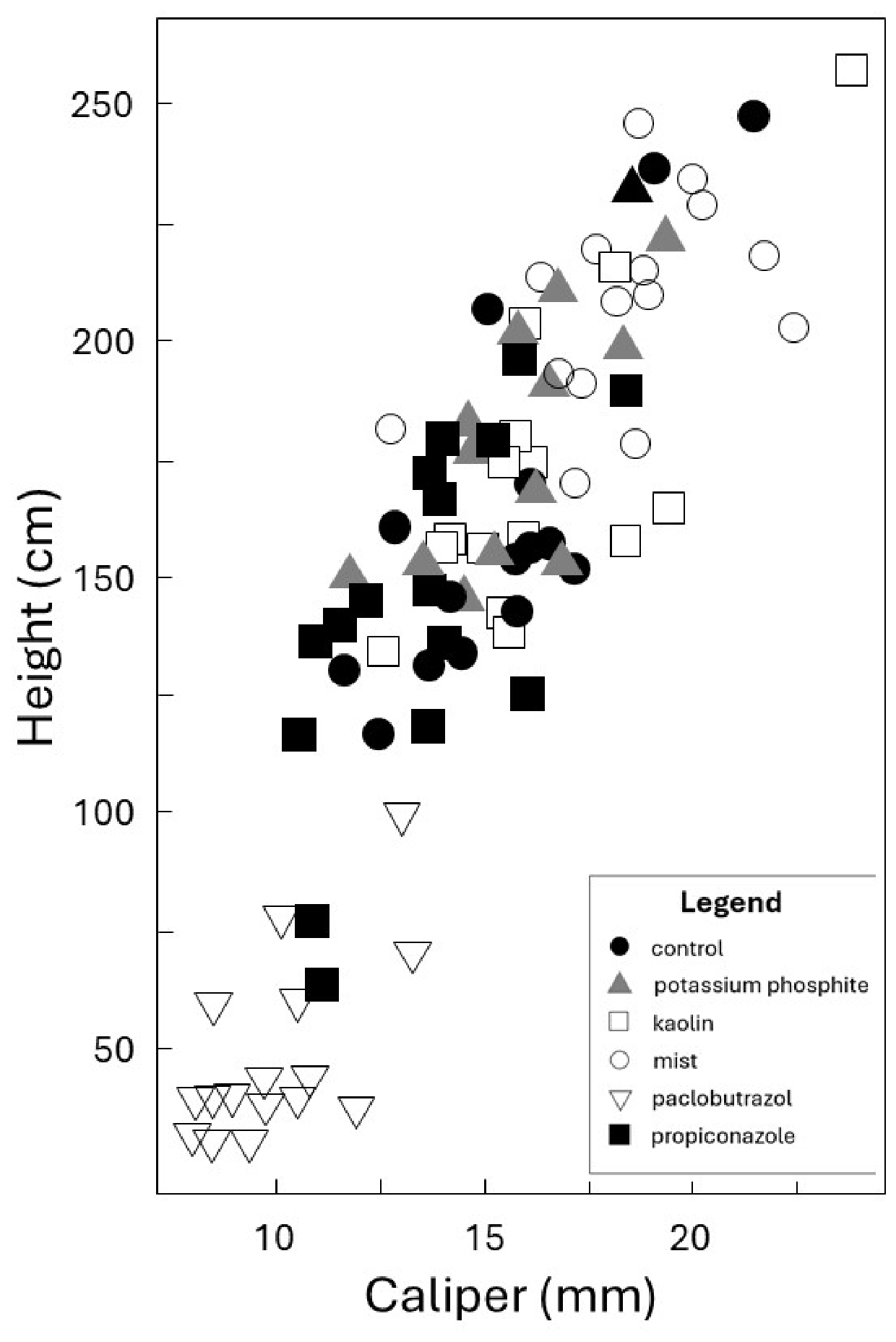
The treatments significantly affected tree height (F
5,89 = 51.28,
p < 0.001) and caliper (F
5,89 = 26.68,
p < 0.001) (
Figure 1). Mist-treated trees exhibited the greatest growth (207 ± 21.5 cm height; 18.4 ± 2.32 mm caliper), significantly exceeding all other treatments. Potassium phosphite and kaolin resulted in intermediate growth (height: 177 ± 28.5 cm and 170 ± 31.7 cm; caliper: 15.8 ± 1.99 mm and 16.4 ± 2.61 mm, respectively), while control trees were slightly smaller (162 ± 37.1 cm; 15.6 ± 2.47 mm). Paclobutrazol-treated trees exhibited the lowest growth (height: 48.7 ± 19.4 cm; caliper: 9.95 ± 1.66 mm).
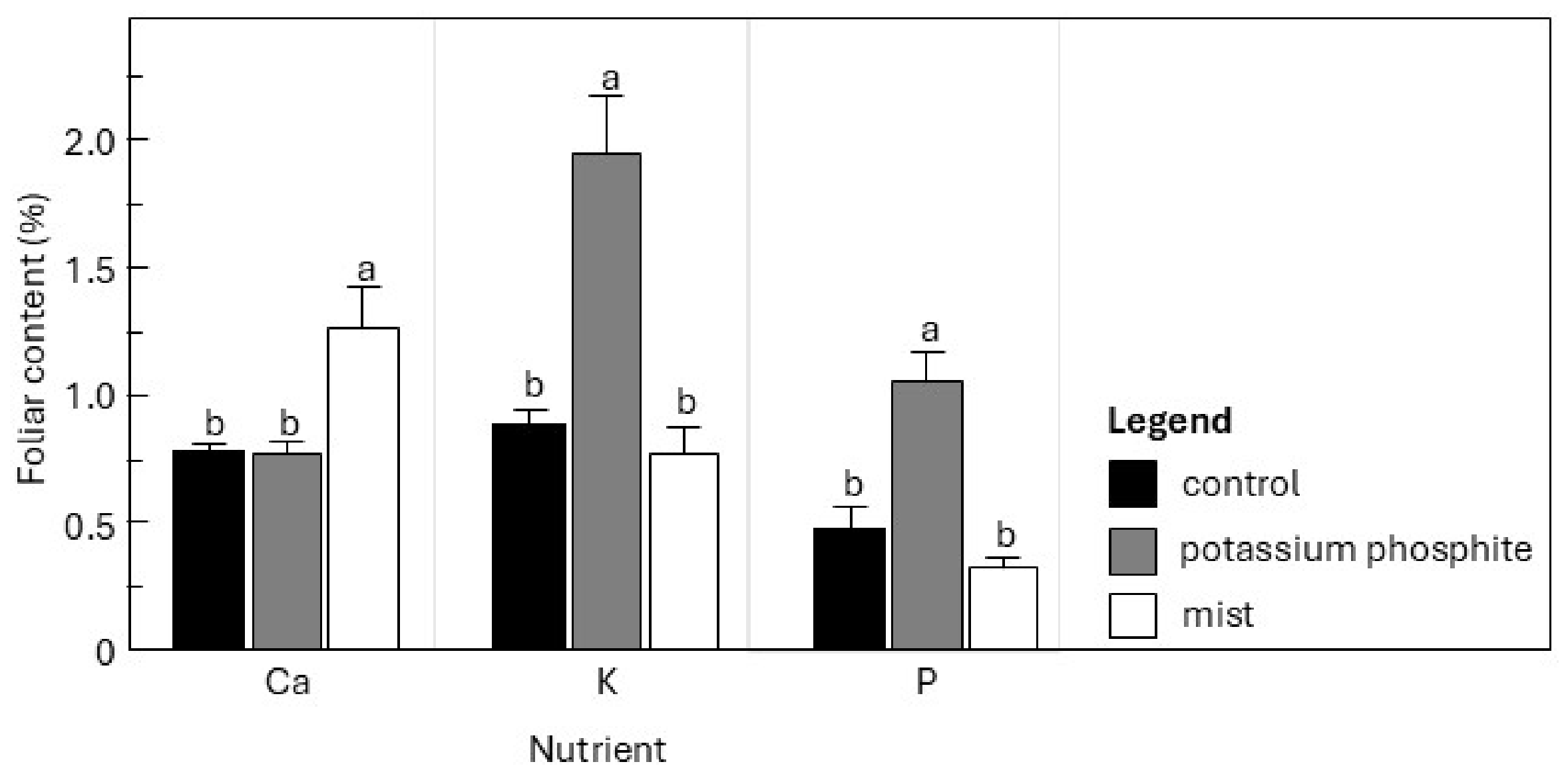
Foliar nutrient analyses showed treatment-dependent differences in macronutrients (
Figure 2). Potassium phosphite significantly increased P% (1.05 ± 0.19%) and K% (1.95 ± 0.38%) relative to control (P%: 0.48 ± 0.15%; K%: 0.88 ± 0.10%;
p < 0.01) but reduced N% (1.15 ± 0.16% vs. 1.47 ± 0.06%;
p = 0.046). Mist treatment revealed significantly higher Ca compared to the other groups (potassium phosphite: 0.78 ± 0.05%; mist: 1.28 ± 0.25%; control: 0.77 ± 0.07%). Other tested micronutrients showed non-significant variation, except for Zn, which was lower in potassium phosphite (27 ± 4 mg kg
−1) relative to the control (35 ± 3 mg kg
−1).
4. Discussion
The experimental treatments were designed to mitigate and alleviate heat stress during establishment of young trees, yet average daily temperature was not significantly different between the treatments in either year, indicating that average canopy temperature was strongly governed by atmospheric conditions rather than treatment. However, in contrast to mostly similar temperatures between treatment groups, growth responses were strong, consistent, and clearly treatment-dependent. Mist-treated trees exhibited the greatest height and caliper growth, significantly exceeding all other treatments, whereas paclobutrazol markedly suppressed growth. Potassium phosphite and kaolin treatments also produced intermediate responses, exceeding control tree growth. Although treatment effects on canopy temperature and soil volumetric water content were modest in magnitude, these relatively small differences coincided with large treatment-dependent differences in growth. These patterns suggest that moments matter, and subtle modifications to canopy microclimate and available soil-water can have disproportionate effects on early tree establishment.
The strong growth responses to mist application likely reflect a combination of reduced transpirational demand, improved plant water status, and partial thermal buffering during periods of high evaporative demand, allowing sustained photosynthesis and carbon allocation to growth even under high ambient temperatures. This interpretation is consistent with previous studies showing that heat stress constrains growth primarily through effects on photosynthesis, carbon balance, and hydraulic function [
6,
7,
25]. However, these mechanisms were inferred from canopy temperature and soil moisture responses and were not directly evaluated through physiological measurements such as gas exchange, leaf water potential, stomatal conductance, or chlorophyll fluorescence. In contrast, paclobutrazol substantially suppressed height and caliper growth, consistent with its known role as a gibberellin-inhibiting plant growth regulator. While growth suppression may be desirable for some nursery production objectives, our results indicate that paclobutrazol is not an appropriate strategy for mitigating heat stress during the establishment of young trees. Conversely, the potassium phosphite treatment may hold promise for urban forestry. While the growth benefits were not as great as the mist treatments, the periodic application of a potassium phosphite soil drench was much easier than establishing a canopy misting system and retained the natural aesthetic of the trees more than canopy coatings with kaolin. Additionally, this study was conducted on relatively small, young trees; for mature urban trees with large canopies, soil-applied treatments such as potassium phosphite drench will be more scalable than foliar applications of mist or kaolin.
There may be management considerations to the potassium phosphite product as foliar nutrient analyses revealed treatment-dependent shifts in macronutrient concentrations. Increased foliar phosphorus and potassium concentrations suggest enhanced nutrient uptake or allocation, potentially supporting stress tolerance mechanisms such as osmotic regulation and energy metabolism. However, the concurrent reduction in nitrogen concentration highlights potential nutrient imbalances or dilution effects that may limit growth response. These findings underscore the complexity of stress-mitigation treatment effects, which may enhance certain physiological pathways while constraining others. Previous studies have reported similarly mixed outcomes, with improvements in photosynthetic efficiency or nutrient status not always translating into increased growth [
23,
24]. The increased Ca observed under mist treatment was attributed to the mineral concentrations of the water source deposited on the leaf surfaces through continual evaporation. All trees received this water source for irrigation, therefore growth improvements by the mist treatment group are believed to be driven primarily by water relations and microclimate modification.
Canopy temperature is driven by atmospheric forcing for establishing and mature trees. Trees are often assumed to cool their canopies through shading and transpirational water loss; however, these mechanisms depend on adequate water availability and are frequently constrained in urban environments. For example, in a city-scale experiment spanning 18 urban tree species, diurnal canopy temperature amplitude varied with species traits such as leaf size and surrounding impervious surface cover, whereas mean canopy temperature remained closely coupled to air temperature when assessed using high-resolution thermal infrared imagery [
26]. Evidence from urban micrometeorological studies suggests that reductions in near-canopy temperature are often driven more by shading and air movement than by transpiration alone [
27]. While transpiration can contribute to cooling under favorable conditions, its effectiveness is highly context dependent [
28], and may be limited in water-constrained urban settings. Many urban planting sites are not irrigated or experience intermittent water supply, increasing the likelihood of water limitation during periods of high atmospheric demand.
More broadly, water availability mediates tree responses to urban heat islands and high-temperature environments, as heat waves impose sublethal effects on plant physiology, growth, and reproduction by altering the balance between photosynthesis and transpiration [
25]. In this study, soil moisture (i.e., VWC) differed significantly among treatments, with mist maintaining consistently higher soil moisture than all other treatments. Although absolute differences in VWC were small, they may have been sufficient to influence canopy temperature exposure and growth outcomes. Previous work similarly shows that water availability governs the capacity of trees to tolerate elevated temperatures [
29]. For example, red maple growth may increase under high temperature when water is sufficient but declines when drought coincides with additional stressors [
29]. Importantly, physiological regulation can further constrain cooling. Red maple is an isohydric species that tightly regulates stomatal conductance in response to VPD, closing stomata under high atmospheric demand even when soil moisture is adequate, and also under low soil water availability [
22]. The supplemental mist treatment reduced canopy VPD, which may have translated to the growth responses. Because canopy misting simultaneously altered canopy temperature, soil moisture, and the atmospheric environment surrounding the foliage, the relative contribution of each mechanism could not be isolated within the present experimental design.
Mean temperatures have been a standard of reporting in the literature [
30,
31]. Yet mean daily and even hourly temps may conflate biologically relevant exposure. While our research and others have shown that mean canopy temperature is constrained by ambient conditions, treatment effects are more likely to emerge through short-term exposure to extreme temperatures rather than through shifts in average conditions. Consistent with this framing, treatment-level differences became more apparent when canopy temperature exposure was evaluated at upper extremes. Mist and kaolin treatments exhibited lower daily maximum canopy temperatures and fewer cumulative hours above biologically relevant high-temperature thresholds (≥35 and ≥40 °C), particularly during the warmer 2023 season. Although these differences were not statistically significant, the magnitude and directional consistency of reduced exposure suggest that thermal buffering during periods of greatest heat stress. This distinction, that moments of stress relief are increasingly recognized as critical for understanding plant heat stress responses, is important, as even brief exposure to extreme temperatures can cause disproportionate physiological damage [
8]. Short-duration heat stress has been shown to reduce photosynthetic capacity through limitations on Rubisco activase and decreases in the proportion of Rubisco in its active state, with reductions of approximately 30% in balsam poplar (
Populus balsamifera) and Eastern cottonwood (
Populus deltoides) tree species at 40 °C relative to 27 °C. At higher temperatures, damage to thylakoid membranes further constrains photosynthesis and carbon gain [
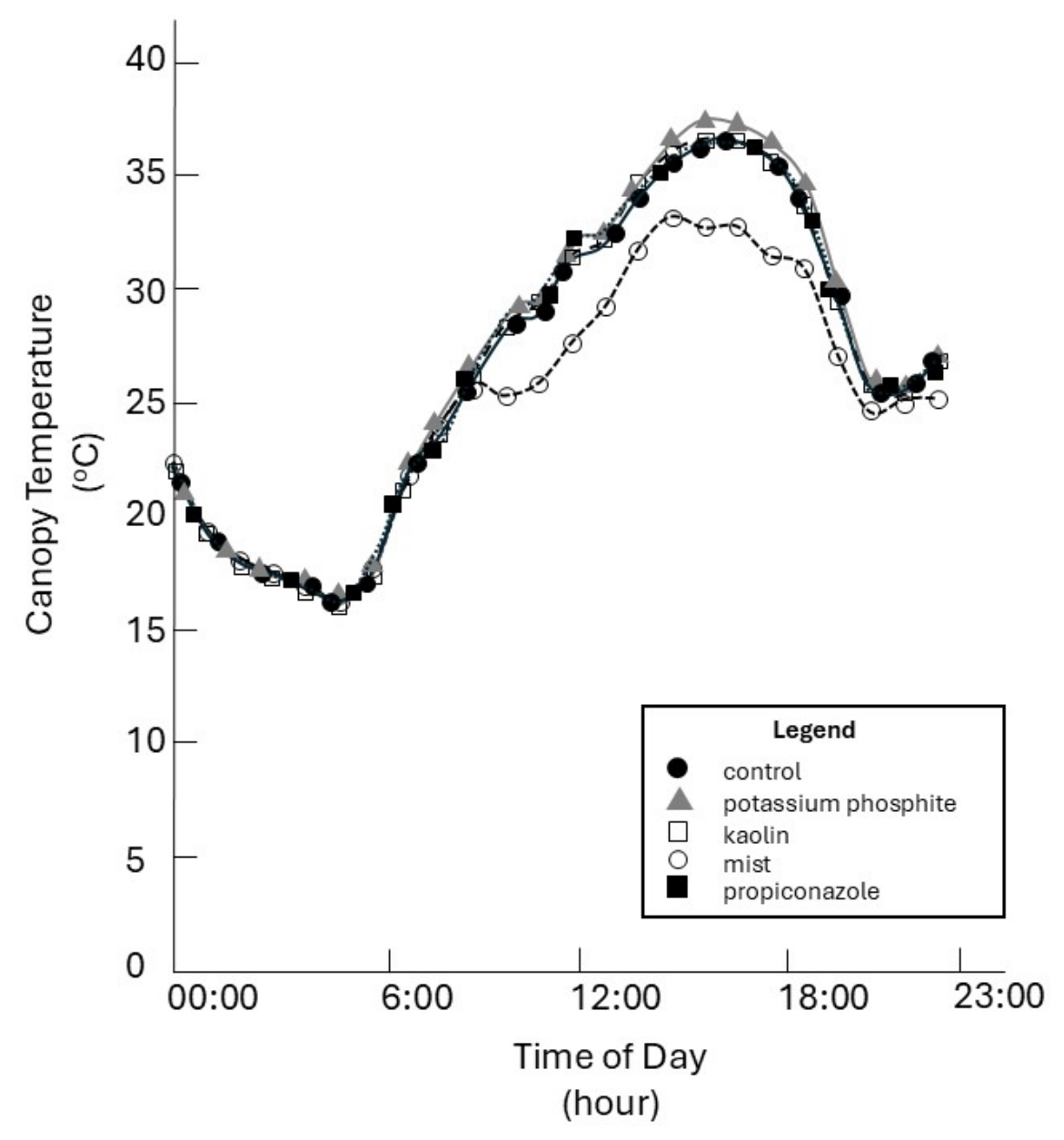
6]. Consequently, modest reductions in peak canopy temperature (
Figure 3) or cumulative hours above damaging thresholds (
Table 2) may contribute to outsized benefits for photosynthetic integrity, carbon balance, and growth, particularly in young trees with limited capacity for thermal and hydraulic buffering. Work on asymmetric warming in temperate tree species demonstrates that growth responses depend strongly on the timing and amplitude of temperature increases, with modest nighttime warming producing substantial effects on radial growth even when mean temperatures change little [
32].
5. Conclusions
From an applied perspective, these results provide several insights relevant to the establishment of young urban trees. Because this study was conducted using container-grown trees under nursery conditions, these findings should be interpreted primarily in the context of early establishment rather than mature urban street tree performance. First, they indicate that foliar applications are unlikely to override ambient thermal conditions in exposed environments, particularly during extreme heat events. However, treatments that reduce peak canopy temperatures, cumulative exposure to damaging thresholds, or diurnal thermal amplitude can still yield meaningful improvements in early growth and establishment. Second, the pronounced growth benefits associated with mist application suggest that strategies aimed at maintaining favorable plant water relations during establishment may be more effective than those targeting canopy temperature alone. In urban contexts where irrigation infrastructure is available, supplemental cooling during extreme heat events may improve early survival and growth of newly planted trees. Third, variable responses among chemical treatments highlight the need for species- and context-specific evaluation. Stress mitigation treatments may confer benefits under certain conditions, but their effectiveness depends on interactions among climate, soil moisture, and tree physiology. Together, these findings reinforce that no single intervention can fully mitigate the combined stresses imposed by urban heat islands, drought, and restricted rooting environments.
Several limitations should be considered when interpreting these results. This study focused on short-term establishment responses; longer-term effects on canopy development, root growth, and post-transplant performance remain unknown. In addition, the mist treatment simultaneously altered canopy temperature, soil moisture, and the atmospheric environment surrounding the foliage. Consequently, the relative contribution of evaporative cooling, supplemental water availability, reduced vapor pressure deficit, and foliar wetting could not be isolated within the present experimental design. Finally, responses were evaluated for red maple, and extrapolation to other species should be approached cautiously given known tradeoffs among growth, stress tolerance, and ornamental traits. Future research could prioritize integrated management strategies that combine limited irrigation, canopy cooling, and cultivar selection under simulated urban heat island conditions, as well as long-term studies linking nursery practices to post-planting performance in urban landscapes.
Overall, this study demonstrates that while chemical and mist-based interventions do not eliminate heat stress under high-temperature, they can meaningfully reduce exposure to damaging thermal extremes and substantially improve growth during establishment. The decoupling of weak responses in mean canopy temperature from strong growth outcomes underscores the importance of evaluating stress mitigation strategies using metrics that capture short-term thermal dynamics and plant water relations. As urban environments continue to warm, management approaches that enhance water availability and moderate canopy microclimate will be increasingly critical for sustaining the performance of shade trees during the vulnerable establishment phase.