1. Introduction
Although the relationship between CSR and organizational performance varies across industries and institutional contexts, the two are linked [
1,
2,
3]. This variation has turned the focus from the question of whether CSR matters to the question of how it creates value. New studies suggest stakeholder reactions, credibility, and relational assets are significant mechanisms, but evidence of agri-food enterprises continues to be limited [
4,
5,
6].
This is a problem especially in so-called “Credence Good” markets, where consumers cannot easily test the product or the process to check its important characteristics before buying. In this context, CSR can be a beacon of an organization’s legitimacy and credibility. This theory of signaling [
7] and stakeholder theory [
8] can help clarify possible pathways for responsible behavior to lead to diminished uncertainty about organizational characteristics that are difficult to observe and for stakeholders to convert credible signals into trust, cooperation, and loyalty.
The Yunnan tea industry can be used as an example to compare with other credence products in the agri-food sector. Research on fair-trade and eco-labelled coffee reveals that the coffee buyer treats the certification as a proxy for social and environmental attributes that are hard to confirm [
9]. As for wine, research suggests that the presence of the organic label is a cue to attributes of the production that are relevant to the environment [
10], and for organic food, the results of such studies indicate that the organic label is a cue to characteristics of production that cannot be observed at the point of sale [
11]. Tea has similar information issues. The CSR signals can influence general views of corporate legitimacy and specific opinions about who can be trusted, with Yunnan being a place where origin and authenticity are more of a concern, and companies can range in size.
Two conceptually similar but distinct stakeholder responses are studied. Customer trust is a general assessment of willingness to rely on the organization under uncertainty, while corporate reputation is a cumulative evaluation over time of the company. The relationships of CSR with responses have been reported in previous studies [
12,
13,
14]. Theoretically, it is useful to examine them together, as a way to distinguish an overall evaluation of organizational capability from a more relational understanding of reliance as two ways to achieve performance in a credence goods setting.
Three issues in the theory of the analysis are of importance. Firstly, while the concepts of reputation and trust are linked, treating them as synonymous will result in confusion in whether CSR is associated with a wide assessment of the firm or with the willingness to place trust in it when the situation is uncertain. Second, in credence-goods settings, there is information asymmetry, as it is hard to verify important product and process attributes, which necessitates the interpretation of stakeholders in value creation. Third, firm size can also affect the impact and legitimacy of CSR signals because the larger the firm, the more resources, certification, and disclosure it can provide; smaller firms may partly compensate for these benefits by having more embeddedness and direct contact with stakeholders. The parallel mediation and firm-size moderation tests of tea enterprises in Yunnan are driven by these tensions.
This study employs a signal–response approach based on a combination of signaling theory and stakeholder theory. Signaling theory accounts for the ability of CSR to transmit credible messages about organizational behavior that are not readily perceptible to stakeholders, while stakeholder theory accounts for how stakeholders react and understand the message. A combination of the two theories thus suggests two different but related reactions. The firm’s reputation helps to minimize uncertainty by building up its evaluative standing over time, and stakeholder trust originates in their willingness to engage in an exchange relationship that involves surrendering their vulnerability. These responses can, in a credence-goods market, be translated into CSR signals in firm’s performance via different stakeholder mechanisms. Therefore, the current study investigates the role of corporate reputation and customer trust as parallel mediating pathways, and the moderating effect of firm size on the direct impact of CSR on firm performance. The tea industry in Yunnan is a suitable empirical case study, as the characteristics of the product are hard to verify directly by the customer, and the place of origin and production methods are also hard to verify.
This paper is divided into the following sections. The literature review and research hypotheses are developed in
Section 2. The empirical results are presented in
Section 4, and the research methods are described in
Section 3. The findings are presented and discussed in
Section 5, as well as theoretically and managerially. The study is summarized in
Section 6, and limitations and directions for future research are laid out.
2. Literature Review
2.1. Theoretical Foundations
The stakeholder theory outlines why CSR can have significance when stakeholders see responsible conduct as a way to protect or promote their interests. Cooperation, loyalty, advocacy and ongoing involvement of employees, customers, communities and others are potential answers. Trust in CSR (TinCSR) has been found to be driven by both expected utility and social norms, implying that stakeholders gauge a firm’s trustworthiness in addition to assessing the appropriateness of its activities [
15]. These are not automatic effects of CSR spending but are dependent upon the interpretation and reactions of stakeholders to the firm’s actions.
In the context of information asymmetry, signaling theory can be used to explain the initial interpretation of CSR activities by stakeholders. Difficult-to-observe attributes of an organization, like integrity, reliability, and commitment to the long-term [
8], can be communicated through responsible practices. Stakeholder theory has been introduced to address what is done with these signals by the recipients. Signaling theory thus focuses on whether responsible conduct is made visible and credible, and stakeholder theory on how recipients interpret that to mean cooperation and continued exchange, advocacy or other forms of support. The two perspectives imply that CSR becomes associated with performance only when the stakeholders perceive it as a signal and take action in response that bears organizational consequences. Reputation and trust are two different response pathways: while reputation is a cumulative assessment over time of the firm’s performance, trust lowers the vulnerability of the relationship and facilitates reliance on the firm. These pathways are particularly applicable in credence-goods environments where the attributes of the product and production are hard to verify. The empirical model is designed to test the separability of the two pathways (but not the strength of the credence condition).
2.2. CSR and Firm Performance
Prior evidence generally indicates a positive CSR–performance relationship, although the strength of the association varies across sectors and institutional contexts [
1,
2,
3,
16]. One view is that CSR creates relatively direct benefits through legitimacy, stakeholder cooperation, or differentiation. Another is that its benefits depend largely on relational assets such as reputation, trust, and loyalty [
17]. This distinction shifts the question from whether CSR is beneficial to how and under what conditions it is associated with economic or organizational outcomes. In a credence-goods market, relational mechanisms may be particularly relevant because buyers often rely on indirect evidence of product quality and organizational integrity. H1 therefore tests the total association between CSR and employee-perceived firm performance before the two stakeholder pathways are considered separately.
Taken together, the literature leaves two competing explanations unresolved. One perspective suggests that CSR may be linked to performance through relatively direct organizational benefits, whereas another suggests that the association operates largely through stakeholder responses such as reputation and trust. Differences across studies may reflect variation in information asymmetry, stakeholder visibility, and the credibility with which responsible practices are communicated. Existing evidence does not establish whether reputation and trust remain distinct pathways when they are examined simultaneously in a credence-goods setting. The present study addresses this issue through a parallel-mediation model in Yunnan tea enterprises, where customers may find it difficult to verify product origin, safety, and production practices.
H1. CSR has a significant positive relationship with employee-perceived firm performance.
2.3. Dual Mediation Mechanisms: Corporate Reputation and Customer Trust
Reputation and trust of the company are linked, but they are different stakeholder perceptions. The meaning of reputation is a relatively long-term, collective assessment of the reputation of an organization, while trust is defined as the readiness to rely on the organization in uncertain and vulnerable situations [
13,
14]. Repeated messages can lead to reputation in both responses, and evidence of competence, integrity, and benevolence can lessen the perceived risk involved in relying on the firm. A parallel mediation model is thus an appropriate approach for determining whether these two responses independently mediate the relationship between CSR and performance.
CSR can positively impact corporate reputation from an integrated signaling–stakeholder standpoint if a firm’s responsible actions are not only conspicuous but also consistent and credible, such that they can influence repeat buy decisions. These signals help to minimize uncertainty regarding probable organizational behavior and stakeholder evaluations can build up over time into more general perceptions of legitimacy and standing. These reputational benefits can be undermined where responsible activity is not well communicated or is seen as being inauthentic. Food-chain studies, SME studies and transitional economy studies support this mechanism [
12,
18,
19,
20], and disclosure studies highlight the role of credibility [
17,
21].
H2. CSR has a significant positive relationship with corporate reputation.
Customer trust represents another response to the same information problem. CSR signals that convey competence, integrity, and concern for stakeholder interests may reduce the perceived risk of relying on the firm. Unlike reputation, which reflects an accumulated evaluation, trust involves willingness to accept vulnerability within an exchange relationship. This distinction is particularly relevant in tea markets, where customers cannot directly verify attributes such as origin, pesticide use, authenticity, or environmental practices. Evidence from crisis, food-chain, international, and cross-country studies supports an association between CSR and trust, while research on digital disclosure shows that vague or insufficiently credible communication may fail to build trust [
7,
13,
22,
23,
24,
25].
H3. CSR has a significant positive relationship with employee-perceived customer trust.
Corporate reputation may be associated with performance because favorable organizational standing can influence stakeholder decisions and willingness to continue investing in the relationship. Stakeholder theory suggests that reputable firms are more likely to receive cooperation and sustained support, while signaling theory suggests that an established reputation can reduce uncertainty about future conduct. Through legitimacy, differentiation, customer retention, and lower perceived organizational risk, reputation can therefore contribute to performance when stakeholders act on these favorable evaluations. Evidence from SME and CSR research supports this resource-conversion process [
17,
19,
21].
H4. Corporate reputation has a significant positive relationship with employee-perceived firm performance.
Trust should also be associated with performance because willingness to rely on a firm under conditions of vulnerability can support continued exchange. Trust facilitates cooperation, commitment, repeat purchasing, positive recommendations, and customer retention [
26,
27], all of which are central to relationship marketing. In the present model, CSR provides information about organizational conduct; employees report their perceptions of how customers respond to that conduct; and stronger perceived customer trust is expected to be associated with better employee-perceived firm performance. This logic is consistent with prior CSR research linking trust with loyalty and brand-related outcomes [
13,
14,
24].
H5. Employee-perceived customer trust has a significant positive relationship with employee-perceived firm performance.
Firm size introduces a competing theoretical tension rather than a single resource-based expectation. Larger organizations may have greater capacity to support formal CSR programs, certification, disclosure, and stakeholder communication, potentially increasing the visibility and reach of CSR activities. Prior studies report size-contingent CSR effects that are consistent with this resource and visibility argument [
28,
29]. Smaller firms, however, may build credibility through local embeddedness, direct owner–customer contact, and closer community relationships, reducing their dependence on costly formal systems. These opposing mechanisms help explain mixed evidence in earlier studies. The directional hypothesis nevertheless follows the resource argument, predicting that the greater formal capacity of larger tea enterprises will strengthen the CSR–performance relationship.
H6. Firm size positively moderates the relationship between CSR and employee-perceived firm performance, such that the relationship is stronger for larger enterprises.
Taken together, H2–H5 specify two concurrent rather than sequential mediation pathways. CSR may be associated with a broad evaluation of the firm through corporate reputation and with willingness to rely on the firm through employee-perceived customer trust; each pathway may, in turn, be associated with performance through different stakeholder responses. Previous studies have modeled reputation or trust within broader CSR outcome chains [
13,
17,
19,
23]. Estimating both mediators simultaneously allows the present study to test whether each pathway contributes uniquely to the same CSR–performance association and whether their indirect effects differ in magnitude.
H7. Corporate reputation mediates the relationship between CSR and employee-perceived firm performance.
H8. Employee-perceived customer trust mediates the relationship between CSR and employee-perceived firm performance.
2.4. Conceptual Model
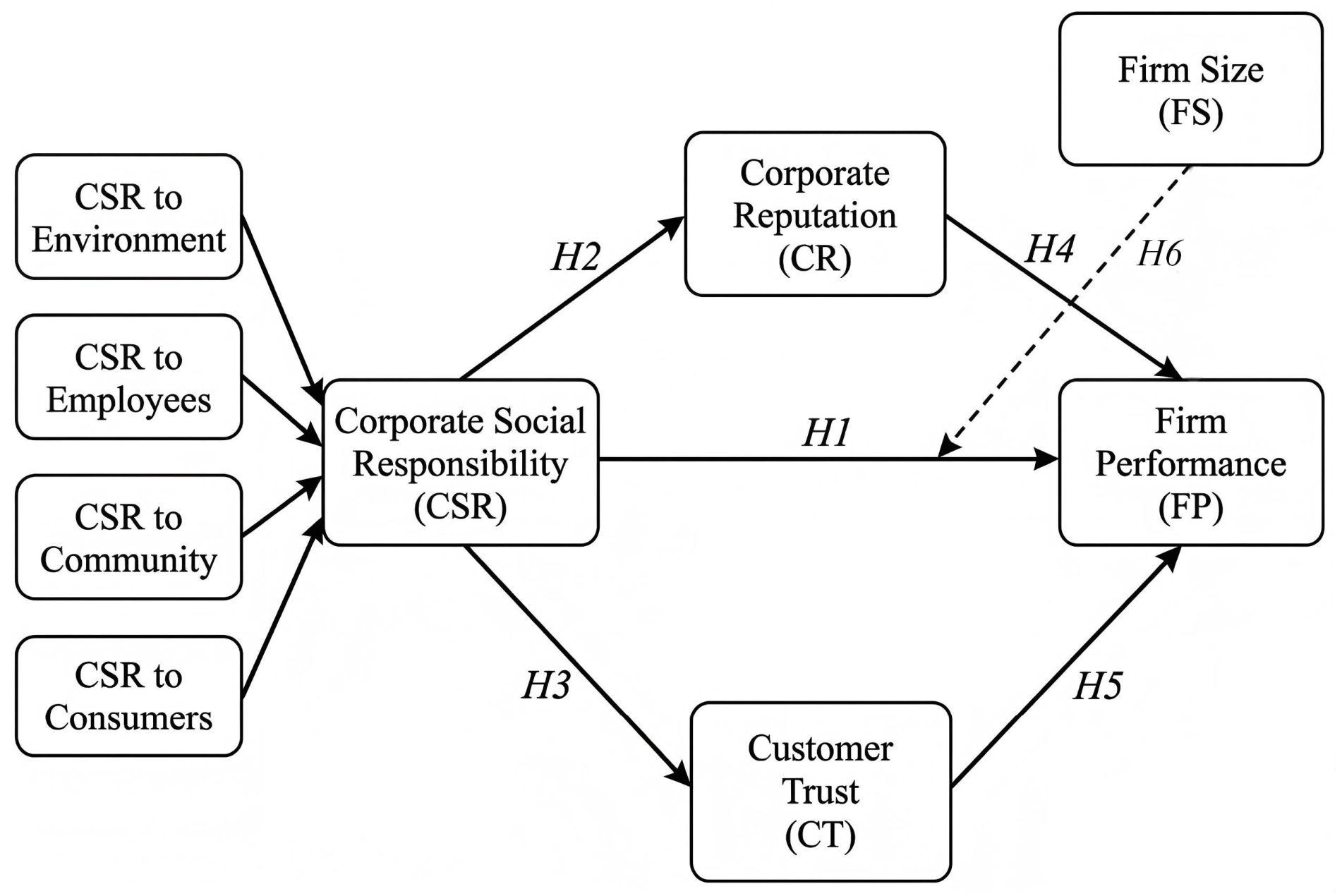
Figure 1 summarizes the eight hypotheses: the total association between CSR and firm performance; the paths from CSR to corporate reputation and employee-perceived customer trust; the paths from both mediators to firm performance; the moderating role of firm size; and the two mediation hypotheses. The model represents the proposed relationships but does not prespecify whether the direct CSR–performance effect remains significant after both mediators are included.
3. Materials and Methods
3.1. Data Source and Sample Characteristics
A total of 489 anonymous employee questionnaires were collected from the tea enterprises in Yunnan Province in the period from October to December 2024. The study was subsequently reviewed by the Network Research Ethics Committee, Naresuan University, under its exemption procedure, and Certificate of Exemption No. 006/2025 (NREC No. 0036/2568) was issued on 5 May 2025. The documented exemption determination therefore post-dated the data-collection period. Responses were not collected at the enterprise level; the unit of analysis is the individual respondent. A total of 163 respondents were selected in three categories based on the annual turnover of enterprises, namely large enterprises (more than CNY 200 million), medium enterprises (CNY 5 million–200 million), and small/micro enterprises (less than CNY 5 million). The questionnaire was sent out by Questionnaire Star on WeChat, and duplicate cases were identified by IP address. A raw dataset includes a category of enterprise size for each respondent, but lacks an enterprise identifier. Therefore, it is not possible to reconstruct the number of different enterprises participating in the survey, the number of respondents per enterprise, or whether multiple respondents were from the same enterprise; and the available recruitment record does not indicate within-enterprise employee-selection rule. The enterprise identifiers are not available, so intraclass correlation, design effects, and cluster-robust standard errors are not available. All statistical inferences are thus respondent-level. Conventional standard errors may be underestimated if several respondents were from the same enterprise, but the amount of the risk cannot be estimated from the available record. The quota design was employed to ensure that there was equal analytical coverage for each of the three sizes and is not regarded as being equivalent to the distribution of enterprises within the industry frame (699 enterprises).
The 489 respondents are described in
Table 1. The quota design led to the even distribution of the numbers among the three enterprise sizes, which were not necessarily representative of the natural distribution of tea enterprises in Yunnan Province. Sixty-one percent (61.35%) of the respondents are women, 59.10% are 26–45 years old, and 47.85% are frontline staff, 38.04% are middle-level managers, 13.29% are senior-level managers, and 4 of the respondents are in other positions. All frequencies of observations of employees are displayed in the table.
3.2. Variable Definition and Measurement
Items adapted from existing scales were used for each construct and were adapted to the context of the tea industry in Yunnan. The CSR consists of four dimensions, as suggested by Le (2023) [
19], namely employees (CSREM, 6 items); community (CSRCM, 3 items); customers (CSRCS, 4 items); and environment (CSREN, 3 items). Corporate reputation (CR, 3 items) is a construct that is defined by the customer’s perception of their experience, the company’s future and the credibility of the company [
30]. Customer trust (CT, 4 items) was not directly collected from customers. The objects measure perceived customer advocacy, intention to keep the relationship, positive word of mouth and trust in the quality of the product [
26,
27]. For this reason, CT is considered an employee-perceived measure of customer trust rather than an employee self-reported measure of customer trust. While employees can see repeat interactions, recommendations, complaints and product-quality feedback, they can simply miss or misunderstand customer feedback. The results of the reliability, AVE and HTMT confirm coherence and empirical distinctiveness of the employee-report measurement frame, but do not confirm cross-informant equivalence. Firm performance (FP, 5 items) includes one item related to perceived profit compared to industry average and four non-financial items related to customer relationships, less absenteeism, working environment and employee loyalty/morale [
31]. FP is therefore a proxy for organizational-performance, not financial performance, and is reported by employees, not audited. The mediation model was also tested using the four non-financial FP items only because this profit item may not be so easily accessible to frontline staff. The complete item wording and construct mapping are provided in
Supplementary Table S1.
3.3. Analytical Procedure
The analysis was conducted in two related phases. First, a 28-item correlated seven-factor measurement model was estimated from the item-level covariance matrix using multivariate-normal maximum-likelihood (ML) covariance fitting in Python 3.13.5 with SciPy 1.17.0. The archived project materials indicate that AMOS was used in the original analysis, but no AMOS settings file was available; therefore, its estimator was not assumed. The fit statistics in
Section 4.2 are based on the explicit ML estimation reported here, which reproduced the standardized loading range in the available measurement output (0.647–0.933). Second, observed composite scores were used to test H1–H5 and the parallel mediation model. Specific indirect effects and their formal contrast were estimated in a single 5000-resample percentile-bootstrap procedure using the same composite-score matrix as the path regressions. Overall CSR was calculated as the unweighted mean of the four CSR dimension scores (CSREM, CSRCM, CSRCS, and CSREN), consistent with the dataset. Bootstrapping was used because the sampling distribution of an indirect effect is not necessarily normal [
32,
33,
34,
35]. H6 was tested separately using hierarchical regression. Firm size was ordinally coded (small/micro = 1, medium = 2, large = 3), and CSR and firm size were standardized before forming the interaction term. Moderation was assessed using the interaction coefficient and the change in explained variance; simple slopes were not interpreted because the interaction was nonsignificant [
35].
3.4. Reliability and Validity Assessment
A pilot study using 50 respondents of the target population was conducted to test the suitability of the content. A Kaiser–Meyer–Olkin value of 0.848 and a Bartlett’s test of sphericity significant at chi-square = 10,706.544, df = 378,
p < 0.001 were obtained. Cronbach’s alpha coefficients varied between 0.868 and 0.929 for the various scales and have been reported to be 0.870 for the total scale. Standardized loadings, composite reliability, and average variance extracted were used to assess convergent validity. The Fornell–Larcker criterion [
36] and the heterotrait–monotrait ratio (HTMT) were used to assess discriminant validity. HTMT values below 0.85 were interpreted as evidence of empirical distinctiveness between constructs [
37,
38].
Supplementary Tables S2 and S3 provide the item-level reliability and exploratory-factor results and the additional convergent and discriminant validity statistics.
3.5. Common Method Bias Control
Procedural and statistical checks were used to handle the common method bias. Participation was anonymous, confidentiality was stressed, and the sequence of CSR and outcome items created psychological separation. All 28 measurement items were then subjected to Harman’s single factor test, as all constructs were measured from the same respondents in the same questionnaire. Furthermore, in order to prevent the common method variance [
39], a full-collinearity diagnostic was also calculated for the four substantive composites (CSR, corporate reputation, employee-perceived customer trust, and employee-perceived firm performance), following the procedure suggested by Kock (2015) [
39], with a cutoff point of VIF > 3.3. These are not diagnostics to establish the absence of same-source bias, but rather diagnostics to determine whether there is a dominant common method component.
4. Results
4.1. Descriptive Statistics and Correlation Analysis
Table 2 reports the descriptive statistics and Pearson correlations. Among the CSR dimensions, customer-focused CSR has the highest mean (M = 3.956), while employee-focused CSR has the lowest (M = 3.794). Overall CSR is positively correlated with corporate reputation (r = 0.334,
p < 0.001), employee-perceived customer trust (r = 0.304,
p < 0.001), and employee-perceived firm performance (r = 0.158,
p < 0.001). Employee-perceived firm performance is more strongly correlated with employee-perceived customer trust (r = 0.302,
p < 0.001) than with overall CSR. These bivariate associations are preliminary; the hypothesized direct, indirect, and interaction effects are evaluated in the subsequent models.
4.2. Measurement Model Assessment (CFA)
Prior to hypothesis testing using observed composite scores, the measurement properties of all seven constructs were evaluated using covariance-based confirmatory factor analysis. The standardized factor loadings, average variance extracted (AVE), composite reliability (CoRel), Cronbach’s alpha, and discriminant validity statistics are summarized in
Table 3, with model fit indices reported separately in
Table 4.
The independently re-estimated correlated seven-factor ML measurement model showed acceptable fit: chi-square = 930.451, df = 329, chi-square/df = 2.828, RMSEA = 0.061 (90% CI [0.057, 0.066]), CFI = 0.943, IFI = 0.943, TLI = 0.935, NFI = 0.915, SRMR = 0.049, PGFI = 0.717, and PNFI = 0.796. The factor loadings are standardized and fall within range of the range of measurement outputs provided (between 0.647 and 0.933). AVE values are between 0.667 and 0.785, and the composite reliability values range from 0.871 to 0.929. All of the square roots of the AVEs are greater than the inter-construct correlations for each in Panel B of
Table 3. The HTMT assessment is done in Panel C, and the values are between 0.026 and 0.325, which are all below the 0.85 value. Hence, the Fornell–Larcker and HTMT results give convergent evidence of the discriminant validity in the respondent level measurement model.
The common method factors analysis did not show a single dominant source factor for the statistical diagnostics. In the unrotated solution, Harman found that the first factor accounted for 23.56% of the total item variance, and the remaining seven factors, with eigenvalues greater than 1, explained a total of 80.39% of total item variance. All of the VIFs were below 3.3, with the full-collinearity VIFs being 1.191 for CSR, 1.189 for corporate reputation, 1.228 for employee-perceived customer trust, and 1.117 for employee-perceived firm performance. The results diminish, but do not obviate the concern for common method variance due to the use of a single questionnaire.
4.3. Observed-Composite Regression and Hypothesis Testing
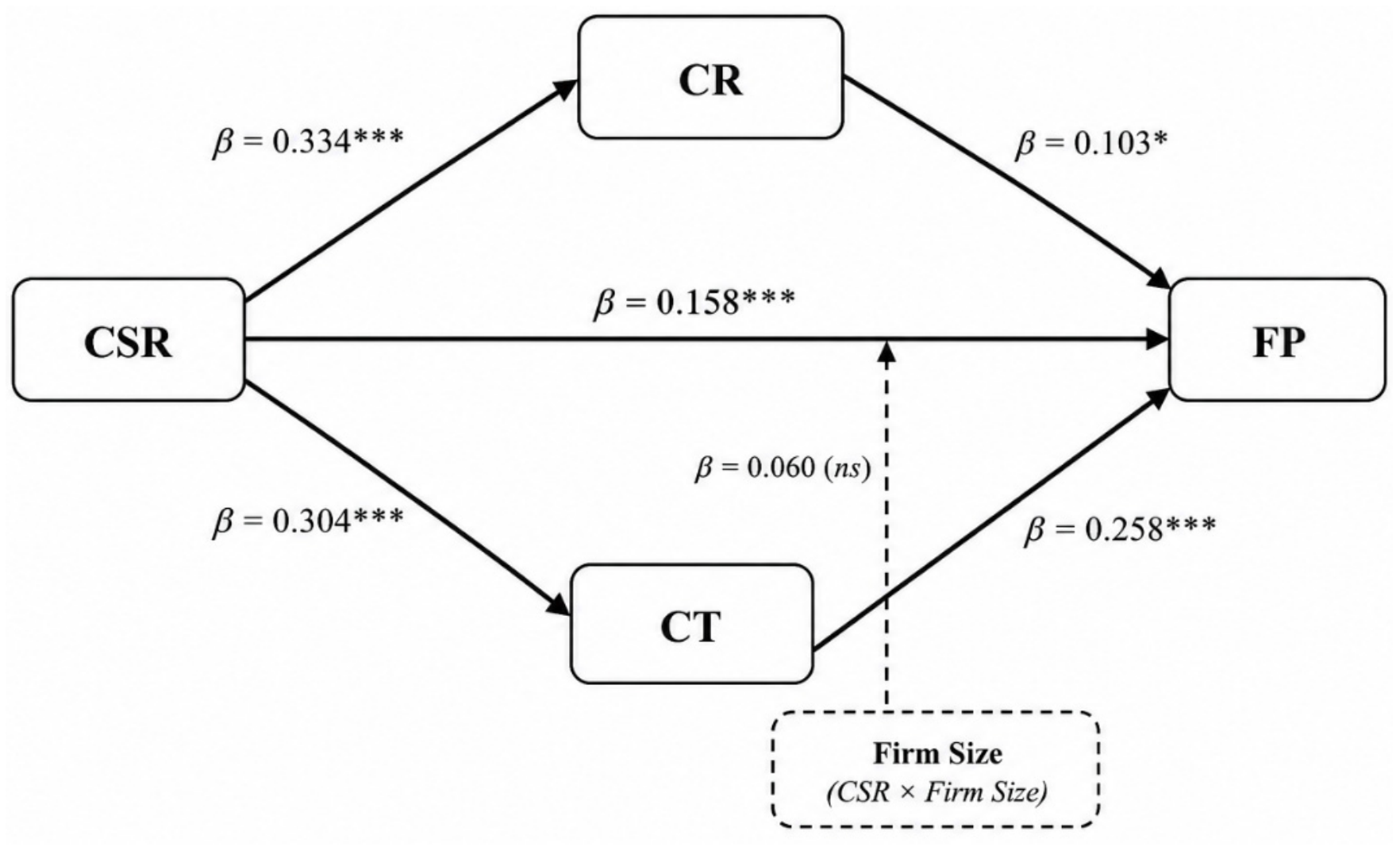
The reported hypothesis tests are carried out in three stages. The total effect estimated prior to the introduction of the two mediators is used as the CSR–firm performance coefficient for H1. H2–H5 are reported on the CSR-to-mediator and mediator-to-performance paths, respectively, and H6 is tested separately by hierarchical regression. The direct effect is then reported in the mediation model in 4.4, controlling for corporate reputation and customer trust. This is important because the total effect is different from the post-mediation direct effect. The standardized coefficients are shown in
Figure 2, and the estimated coefficients are given in
Table 5.
Figure 2.
Observed-composite path and moderation results: standardized coefficients. Note. ***
p < 0.001; *
p < 0.05; ns = not significant (
p ≥ 0.05). Coefficients for H1–H5 are derived from observed-composite regressions, whereas H6 is derived from the hierarchical moderation regression. The CSR to FP coefficient is the total-effect estimate used for H1; the direct effect after including both mediators is reported in
Table 6. Firm size denotes the CSR × firm-size interaction term. The CFA fit indices reported in
Table 4 apply only to the measurement model. Solid arrows represent the observed direct paths corresponding to H1–H5; the dashed arrow represents the CSR × firm-size interaction tested for H6. Source: author’s own work.
Figure 2.
Observed-composite path and moderation results: standardized coefficients. Note. ***
p < 0.001; *
p < 0.05; ns = not significant (
p ≥ 0.05). Coefficients for H1–H5 are derived from observed-composite regressions, whereas H6 is derived from the hierarchical moderation regression. The CSR to FP coefficient is the total-effect estimate used for H1; the direct effect after including both mediators is reported in
Table 6. Firm size denotes the CSR × firm-size interaction term. The CFA fit indices reported in
Table 4 apply only to the measurement model. Solid arrows represent the observed direct paths corresponding to H1–H5; the dashed arrow represents the CSR × firm-size interaction tested for H6. Source: author’s own work.
Table 5.
Observed-composite path estimates and hypothesis testing results.
Table 5.
Observed-composite path estimates and hypothesis testing results.
| H | Path | B | SE | t | p | β | 95% CI | Result |
|---|
| H1 | CSR → FP | 0.290 | 0.082 | 3.537 | <0.001 | 0.158 | [0.130, 0.451] | Supported |
| H2 | CSR → CR | 0.614 | 0.078 | 7.829 | <0.001 | 0.334 | [0.460, 0.768] | Supported |
| H3 | CSR → CT | 0.591 | 0.084 | 7.054 | <0.001 | 0.304 | [0.427, 0.756] | Supported |
| H4 | CR → FP | 0.102 | 0.047 | 2.200 | 0.028 | 0.103 | [0.011, 0.194] | Supported |
| H5 | CT → FP | 0.244 | 0.044 | 5.604 | <0.001 | 0.258 | [0.158, 0.330] | Supported |
| H6 | CSR × Size → FP | 0.061 | 0.045 | 1.358 | 0.175 | 0.060 | [−0.027, 0.150] | Not Supported |
Table 6.
Bootstrap parallel mediation and indirect-effect contrast.
Table 6.
Bootstrap parallel mediation and indirect-effect contrast.
| Effect | Estimate | SE | t | p | 95% CI | Inference |
|---|
| Total effect: CSR → FP | 0.290 | 0.082 | 3.537 | <0.001 | [0.130, 0.451] | Significant |
| Direct effect: CSR → FP (c’) | 0.083 | 0.086 | 0.967 | 0.334 | [−0.086, 0.252] | Not significant |
| Indirect: CSR → CR → FP | 0.063 | 0.031 | — | — | [0.002, 0.125] | Significant |
| Indirect: CSR → CT → FP | 0.144 | 0.034 | — | — | [0.081, 0.216] | Significant |
| Contrast: CT indirect − CR indirect | 0.081 | 0.047 | — | — | [−0.011, 0.177] | Not significant |
Table 5 shows support for H1–H5 and no support for H6. CSR had a positive total association with employee-perceived firm performance (B = 0.290, beta = 0.158, t = 3.537,
p < 0.001), supporting H1. CSR was also positively related to corporate reputation (B = 0.614, beta = 0.334, t = 7.829,
p < 0.001) and employee-perceived customer trust (B = 0.591, beta = 0.304, t = 7.054,
p < 0.001), supporting H2 and H3. Corporate reputation (B = 0.102, beta = 0.103, t = 2.200,
p = 0.028) and employee-perceived customer trust (B = 0.244, beta = 0.258, t = 5.604,
p < 0.001) were positively associated with employee-perceived firm performance, supporting H4 and H5. The relative size of the two mediation pathways is tested directly in
Section 4.4. The CSR × firm-size interaction was not significant (B = 0.061, beta = 0.060, t = 1.358,
p = 0.175), and the addition of the interaction increased R-squared by 0.004. H6 was therefore not supported.
4.4. Mediation Effects and Supplementary Analysis
H7 and H8 were evaluated using one 5000-resample percentile-bootstrap run on the same observed-composite score matrix used for the reported path coefficients. Bootstrapping directly evaluates indirect effects and avoids relying on a sequence of separate significance tests as the definition of mediation [
32,
33,
34,
35]. The same resamples were used to calculate both specific indirect effects and their difference.
Table 6 reports the total effect, both specific indirect effects, the residual direct effect with its inferential statistics, and the formal indirect-effect contrast.
The indirect effect through corporate reputation was significant (indirect effect = 0.063, Boot SE = 0.031, 95% percentile-bootstrap CI [0.002, 0.125]), and the indirect effect through employee-perceived customer trust was also significant (indirect effect = 0.144, Boot SE = 0.034, 95% percentile-bootstrap CI [0.081, 0.216]). The residual direct effect was not statistically significant (c’ = 0.083, SE = 0.086, t = 0.967, p = 0.334, 95% CI [−0.086, 0.252]). This pattern is described as indirect-only mediation in the fitted model rather than as complete mediation; the indirect effects are supported while no residual direct effect is detected after the mediators are included, but a nonsignificant direct effect does not establish that the true direct effect is exactly zero. H7 and H8 are therefore supported as mediation hypotheses. The employee-perceived customer-trust pathway had the larger point estimate, but the formal bootstrap contrast was not significant (difference = 0.081, Boot SE = 0.047, 95% percentile-bootstrap CI [−0.011, 0.177]). The data therefore do not establish that one indirect pathway is statistically stronger than the other.
The sensitivity analysis using only the four non-financial performance items produced the same substantive pattern. CSR retained a positive total association with the alternative performance score (B = 0.280,
p < 0.001), the post-mediation direct effect remained nonsignificant (B = 0.068,
p = 0.439), and both corporate reputation (B = 0.105,
p = 0.024) and employee-perceived customer trust (B = 0.250,
p < 0.001) remained positively associated with the outcome. The mediation conclusions therefore did not depend on the single competitor-relative profit item. Detailed results for this sensitivity analysis are reported in
Supplementary Table S4.
Table 7 provides the supplementary hierarchical regression test for H6. Model 2 shows that the CSR × firm-size interaction is not statistically significant (B = 0.061, SE = 0.045, t = 1.358,
p = 0.175), and the increase in explained variance is small (Delta R-squared = 0.004). The data therefore provide no statistical evidence that the CSR–performance relationship differs by firm size. Because the interaction is not significant, simple-slope differences are not interpreted as evidence of moderation.
5. Discussion and Implications
5.1. CSR and Firm Performance in a Credence-Goods Industry
The total association between CSR and employee-perceived firm performance was positive, consistent with prior studies linking responsible business practices with legitimacy, stakeholder cooperation, and differentiation [
1,
2,
3]. After corporate reputation and employee-perceived customer trust were included, however, the direct CSR coefficient was not statistically significant. In this sample, the observed CSR–performance association was therefore accounted for mainly by the two stakeholder-response pathways rather than by a residual direct pathway.
These associations were observed within the Yunnan tea context, where customers may find it difficult to verify attributes such as authenticity, pesticide use, environmental management, and supply-chain practices. This interpretation is consistent with evidence that Chinese consumers value information about tea origin and certification [
40]. Because credence intensity was not measured, the study does not test whether credence characteristics caused or strengthened the observed mediation pathways. The findings are also non-causal because the data are cross-sectional and based on employee self-reports. Recent evidence also indicates that CSR–performance associations can depend on disclosure pathways [
41], reputation and stakeholder valuation [
42], competitive conditions [
43], the configuration of CSR activities [
44], and additional organizational mediators [
45].
5.2. Comparing the Roles of Corporate Reputation and Employee-Perceived Customer Trust
CSR was positively associated with both corporate reputation and employee-perceived customer trust, consistent with earlier work linking CSR with reputation, trust, loyalty, and related outcomes [
12,
13,
17,
19,
23]. The parallel model shows that both pathways remain relevant when estimated simultaneously.
The indirect effect through employee-perceived customer trust (0.144) had a larger point estimate than the effect through corporate reputation (0.063), but the bootstrap contrast was not significant. The data therefore do not establish that one pathway is statistically stronger than the other.
Conceptually, the two pathways remain distinct. Reputation is a broad, accumulated evaluation of an organization’s standing, whereas trust concerns willingness to rely on the organization under conditions of uncertainty or vulnerability. In the tea context, reputation may shape general assessments of the producer, while employee-perceived customer trust reflects employees’ perceptions of customers’ willingness to rely on the firm when origin, safety, or production practices cannot be independently verified. Because trust was reported by employees rather than customers, these findings should not be interpreted as direct evidence of customer self-reported trust.
5.3. Theoretical Implications
The theoretical contribution is enabled by the refinement of previous CSR mediation research rather than the discovery of new mechanisms for the involvement of stakeholders. The study focuses on stakeholder theory and analyzes the two already known responses that may coexist in the same CSR–performance relationship with the help of signaling theory. The signaling theory focuses on the acceptability of information regarding problematic and hard-to-observe behavior, while the stakeholder theory focuses on how recipients can make inferences and act based on that information in a way that is relevant to their support. Corporate reputation is the sum of evaluative standing, and employee perceived customer trust is the perceived relational reliance. The large indirect effects are in line with both pathways coexisting, but the nonsignificant nonshared Bootstrap contrast offers no evidence on which pathway is stronger.
The context of this interpretation is the Yunnan tea industry, since it can be hard for customers to verify the origin, safety, pesticide use, and production practices of a product. Reputation and trust are two ways of addressing the information problem: reputation is a set of judgments that have been accumulated about the organization; trust is the trust placed in the organization under relative vulnerability. However, credence intensity was not measured, and no comparison industry was included. The context of the findings should thus not be interpreted as evidence that credence characteristics themselves bolstered either of the two pathways.
The third contribution Is with respect to nonsignificant firm size. The findings from previous studies indicate that there are size differences in the relationship between CSR and performance because larger companies tend to have more resources, certification capacity and visibility [
28,
29]. However, in smaller tea enterprises, the formal advantages of these mechanisms are partially compensated by the local embeddedness, direct interactions with stakeholders, or other informal credibility mechanisms [
4,
19]. Therefore, the null interaction is informative within this sample: resource advantages and relational proximity act in counter directions, and firm size may not yield a uniform change in the relationship between CSR and performance.
5.4. Managerial Implications
The results indicate that managers should consider CSR as a component of a stakeholder-relationship strategy, not as a philanthropic initiative of its own. Previous studies on CSR, reputation, and customer reactions also suggest that the creation of value through CSR activities is possible only when stakeholders are aware of these activities and consider them credible [
13,
19,
20]. The significant paths mediated by corporate reputation and employee-perceived customer trust indicate that the positive total association with employee-perceived firm performance is not only due to the expense but also to these intermediate relationships. CSR activities and communication should thus be made visible and verifiable and be closely linked with issues that are important to the stakeholders.
The two indirect pathways were not significantly different, but the larger point estimate for the pathway of employee perception of customer trust indicated practices to reduce customer purchase uncertainty may be beneficial. Ways in which tea enterprises can help these perceptions include implementing traceability, providing sourcing transparency, offering credible quality-assurance evidence, controlling the environment, and documenting employee and community responsibilities. Traceability and certification are important to Chinese tea drinkers, as highlighted by Rao et al. (2023) [
40], and credible digital CSR disclosure can help build customer confidence and engagement, as reported by Alhumud et al. (2025) [
25]. Managers should therefore be able to correlate public CSR claims with evidence that can be substantiated by stakeholders, including certification status, origin information, testing history and progress indicators. The recommendations are not direct evidence of customer-reported responses but rather based on employee perceptions, as indicated by the trust measure.
The notion of corporate reputation is typically established over a period of time, with repetition and continuity of organizational behavior. Previous studies show that multi-year CSR efforts, along with consistency between public communication and actions, have a greater impact on supporting a company’s reputation and customer loyalty than single-year efforts [
12,
20]. Managers should continuously communicate achievements and challenges, and, as appropriate, apply independent certification, and stick to sustainability reporting and stakeholder engagement. These practices can over time build up the evaluations that contribute to the corporate reputation, along with the more immediate uncertainty reduction role of trust.
The lack of significance in the interaction between firm size and CSR is no evidence that CSR works in exactly the same way in each firm. Smaller companies may find it less practicable to have formal assurance systems and to engage in public reporting but may be more likely to have other less expensive ways to achieve transparency, while larger firms may have strong capacity to implement formal systems. Managers should, therefore, choose CSR communication and assurance practices suited to their resources and stakeholder relationships and not just that of large companies.
6. Conclusions
This study examined the association between CSR and employee-perceived firm performance in the Yunnan tea industry, with corporate reputation and employee-perceived customer trust specified as parallel mediators and firm size tested as a moderator. The signal–response conversion perspective was used to distinguish the credibility of CSR signals from the evaluative and relational responses through which stakeholders may interpret those signals.
CSR had a positive total association with employee-perceived firm performance. Both specific indirect effects were statistically significant, whereas the residual direct effect was not (B = 0.083, SE = 0.086, t = 0.967, p = 0.334, 95% CI [−0.086, 0.252]). The fitted parallel-mediation model was therefore consistent with an indirect-only mediation pattern. This terminology describes the observed statistical pattern and does not imply that the true direct effect is exactly zero. The employee-perceived customer-trust pathway had the larger point estimate, but the 5000-resample bootstrap contrast was not statistically significant (difference = 0.081, 95% CI [−0.011, 0.177]). The data therefore do not establish that either indirect pathway is stronger. The CSR × firm-size interaction was also nonsignificant.
Theoretical value is the separation and synthesis of two established stakeholder-response pathways in the context of the tea in Yunnan. Corporate reputation is a function of the accumulated standing of the organization, and employee perceived customer trust is a function of perceived customer reliance. The importance of both indirect effects is in line with the multiple pathway model of the CSR–performance association, and the lack of significance for the contrast does not support the idea that one pathway is more dominant than the other. Credence intensity was not measured, thus the results do not provide evidence of the mediation effects of the credence characteristics themselves but of the mediation effects operating within a context of a credence-goods setting.
The results from a management viewpoint highlight CSR activities that are tangible, measurable, and are linked to stakeholder issues. The support for the reputation- and trust-related answers examined in this study could be facilitated by traceability, trans-parent sourcing, credible certification, environmental controls, employee wellbeing, and consistent communication with stakeholders. The implications relate to the perceptions of the employees and not to the customers’ own assessments of trust, as the measure of customer trust was based on the employees’ perception of it. This means that the implications are practice-driven in nature but do not necessarily reflect customer-trust judgements.
There are a number of limitations to be noted. The survey was carried out during October–December 2024, and thus the results are representative of the market and organizational conditions at the time of the survey. The sample was selected with equal numbers in each of the three enterprise size categories to ensure an analytical balance in the sample, which is not appropriate for the purpose of providing prevalence estimates for the population of 699 enterprises. Enterprise identification is not included in the raw data, and therefore the number of enterprises that participated, the number of respondents per enterprise, and the potential for clustering of employees within enterprises cannot be evaluated. The intraclass correlation, design effects, and cluster-robust standard errors, therefore, could not be computed. All inferences are respondent-level, but if several respondents were from the same enterprise, the reported standard errors may be underestimated, although it is not possible to quantify this risk from the available records. Measuring the confidence levels that employees believe their customers have in them rather than self-reported levels of customer confidence or the financial performance of the firm as audited, “employee-perceived customer trust” and “employee-perceived firm performance”, does not equal “customer reported” or “financial performance”. The measurement results demonstrate internal consistency, convergent and discriminant validity for these respondent-level perceptions but do not provide cross-informant equivalence. The sensitivity analysis indicated that the mediation pattern remained when the competitor-relative profit item was excluded. Although Harman’s single-factor test and the full-collinearity VIFs did not show a dominant common method component, all focal variables were assessed on the same cross-sectional questionnaire, thus presenting a risk for common-source bias and causal ambiguity. The credence-goods argument is another theoretically set scope condition and not a tested moderation condition because there was no measurement of credence intensity or any industry for comparison. Multi-source and longitudinal designs are suggested as the next steps in research; enterprise identifiers should be maintained, custom trust measures should be utilized by the enterprise, and objective measures of performance should be employed, and research should investigate whether the two pathways vary by setting functioning at different levels of product and process verifiability.
Supplementary Materials
The following supporting information can be downloaded at
https://www.mdpi.com/article/10.3390/su18168533/s1, Table S1: Questionnaire items and construct measurement details; Table S2: Reliability and exploratory factor-analysis diagnostics for the 28 measurement items; Table S3: Additional convergent and discriminant validity statistics for the seven-factor measurement model; Table S4: Sensitivity analysis using the four-item non-financial employee-perceived firm performance measure.
Author Contributions
Conceptualization, W.W. and D.P.; Formal analysis, W.W.; Investigation, D.P.; Methodology, W.W.; Supervision, D.P.; Validation, D.P.; Writing—original draft preparation, W.W.; Writing—review and editing, D.P. and W.W. All authors have read and agreed to the published version of the manuscript.
Funding
Supported by the Special Basic Cooperative Research Programs of Yunnan Provincial Undergraduate Universities’ Association (grant NO.202301BA070001-065).
Institutional Review Board Statement
The study was conducted in accordance with the Declaration of Helsinki. The Network Research Ethics Committee, Naresuan University, Thailand, reviewed the study under its exemption procedure and issued Certificate of Exemption No. 006/2025 (NREC No. 0036/2568) on 5 May 2025.
Informed Consent Statement
Informed consent was obtained from all subjects involved in the study.
Data Availability Statement
The data presented in this study are available from the corresponding author upon reasonable request. The data are not publicly available due to privacy and confidentiality considerations.
Conflicts of Interest
The authors declare no conflicts of interest.
Abbreviation
The following abbreviation is used in this manuscript:
| CSR | Corporate Social Responsibility |
References
- Al-Shammari, M.A.; Banerjee, S.N.; Rasheed, A.A. Corporate Social Responsibility and Firm Performance: A Theory of Dual Responsibility. Manag. Decis. 2022, 60, 1513–1540. [Google Scholar] [CrossRef] [Scilit]
- Khan, I.; Jia, M.; Lei, X.; Niu, R.; Khan, J.; Tong, Z. Corporate Social Responsibility and Firm Performance. Total Qual. Manag. Bus. Excell. 2023, 34, 672–691. [Google Scholar] [CrossRef] [Scilit]
- Li, W.; Yan, T.; Li, Y. Corporate Social Responsibility and Financial Performance in a Cross-Country Context: A Meta-Analysis. J. Bus. Res. 2025, 190, 115218. [Google Scholar] [CrossRef] [Scilit]
- Achi, A.; Adeola, O.; Achi, F.C. CSR and Green Process Innovation as Antecedents of Micro, Small, and Medium Enterprise Performance: Moderating Role of Perceived Environmental Volatility. J. Bus. Res. 2022, 139, 771–781. [Google Scholar] [CrossRef] [Scilit]
- Abdelqader, M.; Uyar, A.; Kuzey, C. CSR Transparency and Firm Value: Is the Connection Differential for Cost Leaders and Differentiators? J. Clean. Prod. 2024, 443, 141102. [Google Scholar] [CrossRef] [Scilit]
- Dela, E.; Ye, J.; Berhe, H.M. The Impact of Corporate Social Responsibility on Financial Performance in Indonesian Highly Polluted Industries: Mediating Role of Industry Competitiveness. SAGE Open 2024, 14, 21582440241259479. [Google Scholar] [CrossRef] [Scilit]
- Chen, C.C.; Khan, A.; Hongsuchon, T.; Ruangkanjanases, A.; Chen, Y.T.; Sivarak, O.; Chen, S.C. The Role of Corporate Social Responsibility and Corporate Image in Times of Crisis: The Mediating Role of Customer Trust. Int. J. Environ. Res. Public Health 2021, 18, 8275. [Google Scholar] [CrossRef] [Scilit] [PubMed]
- Trinh, T.; Zhao, H. The Effect of Supplier CSR on Customer–Supplier Relationship. J. Bus. Res. 2024, 185, 114909. [Google Scholar] [CrossRef] [Scilit]
- Loureiro, M.L.; Lotade, J. Do Fair Trade and Eco-Labels in Coffee Wake up the Consumer Conscience? Ecol. Econ. 2005, 53, 129–138. [Google Scholar] [CrossRef] [Scilit]
- Delmas, M.A.; Grant, L.E. Eco-Labeling Strategies and Price-Premium: The Wine Industry Puzzle. Bus. Soc. 2014, 53, 6–44. [Google Scholar] [CrossRef] [Scilit]
- Janssen, M.; Hamm, U. Product Labelling in the Market for Organic Food: Consumer Preferences and Willingness-to-Pay for Different Organic Certification Logos. Food Qual. Prefer. 2012, 25, 9–22. [Google Scholar] [CrossRef] [Scilit]
- Ali, W.; Danni, Y.; Latif, B.; Kouser, R.; Baqader, S. Corporate Social Responsibility and Customer Loyalty in Food Chains: Mediating Role of Customer Satisfaction and Corporate Reputation. Sustainability 2021, 13, 8681. [Google Scholar] [CrossRef] [Scilit]
- Islam, T.; Islam, R.; Pitafi, A.H.; Xiaobei, L.; Rehmani, M.; Irfan, M.; Mubarak, M.S. The Impact of Corporate Social Responsibility on Customer Loyalty: The Mediating Role of Corporate Reputation, Customer Satisfaction, and Trust. Sustain. Prod. Consum. 2021, 25, 123–135. [Google Scholar] [CrossRef] [Scilit]
- Zhao, Y.; Abbas, M.; Samma, M.; Ozkut, T.; Munir, M.; Rasool, S.F. Exploring the Relationship Between Corporate Social Responsibility, Trust, Corporate Reputation, and Brand Equity. Front. Psychol. 2021, 12, 766422. [Google Scholar] [CrossRef] [Scilit] [PubMed]
- Chen, S.; Chen, Y.; Jebran, K. Trust and Corporate Social Responsibility: From Expected Utility and Social Normative Perspective. J. Bus. Res. 2021, 134, 518–530. [Google Scholar] [CrossRef] [Scilit]
- Saeed, A.; Alnori, F.; Yaqoob, G. Corporate Social Responsibility, Industry Concentration, and Firm Performance: Evidence from Emerging Asian Economies. Res. Int. Bus. Financ. 2023, 64, 101864. [Google Scholar] [CrossRef] [Scilit]
- Anita, R.; Abdillah, M.R.; Sari, S.P.S.; Rizki, S.; Arlendhea, W. Corporate Social Responsibility and Firm Performance: The Role of Firm Reputation. J. Glob. Responsib. 2025, 16, 669–685. [Google Scholar] [CrossRef] [Scilit]
- Ramayah, T.; Falahat, M.; Soto-Acosta, P. Effects of Corporate Social Responsibility on Employee Commitment and Corporate Reputation: Evidence from a Transitional Economy. Corp. Soc. Responsib. Environ. Manag. 2022, 29, 2006–2015. [Google Scholar] [CrossRef] [Scilit]
- Le, T.T. Corporate Social Responsibility and SMEs’ Performance: Mediating Role of Corporate Image, Corporate Reputation and Customer Loyalty. Int. J. Emerg. Mark. 2023, 18, 4565–4590. [Google Scholar] [CrossRef] [Scilit]
- Mehnaz; Jin, J.; Hussain, A.; Warraich, M.A.; Waheed, A. Impact of Perceived CSR Practices on Customer Loyalty: The Mediating Role of Reputation and Customer Satisfaction. Corp. Soc. Responsib. Environ. Manag. 2024, 31, 3724–3734. [Google Scholar] [CrossRef] [Scilit]
- Siddiqui, F.; YuSheng, K.; Tajeddini, K. The Role of Corporate Governance and Reputation in the Disclosure of Corporate Social Responsibility and Firm Performance. Heliyon 2023, 9, e16055. [Google Scholar] [CrossRef] [Scilit] [PubMed]
- Chkir, I.; Rjiba, H.; Mrad, F.; Khalil, A. Trust and Corporate Social Responsibility: International Evidence. Financ. Res. Lett. 2023, 58, 104043. [Google Scholar] [CrossRef] [Scilit]
- Homer, S.T.; Berezina, E.B.; Gill, C.M.H.D. The Mediating Effect of Firm Familiarity Between Corporate Social Responsibility and Reputation, Trust, and Customer Satisfaction. Bus. Soc. Rev. 2024, 129, 398–423. [Google Scholar] [CrossRef] [Scilit]
- Zhu, H.; Wagner, E. Is Corporate Social Responsibility a Matter of Trust? A Cross-Country Investigation. Int. Rev. Financ. Anal. 2024, 93, 103127. [Google Scholar] [CrossRef] [Scilit]
- Alhumud, A.A.; Leonidou, L.C.; Alarfaj, W.; Ioannidis, A. The Impact of Digital CSR Disclosure on Customer Trust and Engagement: The Moderating Role of Consumer Deontology and Law Obedience. J. Bus. Res. 2025, 186, 115035. [Google Scholar] [CrossRef] [Scilit]
- Morgan, R.M.; Hunt, S.D. The Commitment-Trust Theory of Relationship Marketing. J. Mark. 1994, 58, 20–38. [Google Scholar] [CrossRef] [Scilit]
- Sirdeshmukh, D.; Singh, J.; Sabol, B. Consumer Trust, Value, and Loyalty in Relational Exchanges. J. Mark. 2002, 66, 15–37. [Google Scholar] [CrossRef] [Scilit]
- Wang, K.; Qiao, Y. The Horizontal S-Shaped Relationship Between Corporate Social Responsibility and Financial Performance: The Moderating Effects of Firm Size and Industry Dynamism. Bus. Ethics Environ. Responsib. 2022, 31, 937–968. [Google Scholar] [CrossRef] [Scilit]
- Zaiane, S.; Ellouze, D. Corporate Social Responsibility and Firm Financial Performance: The Moderating Effects of Size and Industry Sensitivity. J. Manag. Gov. 2023, 27, 1147–1187. [Google Scholar] [CrossRef] [Scilit]
- El-Garaihy, W.H.; Mobarak, A.K.M.; Albahussain, S.A. Measuring the Impact of Corporate Social Responsibility Practices on Competitive Advantage: A Mediation Role of Reputation and Customer Satisfaction. Int. J. Bus. Manag. 2014, 9, 109. [Google Scholar] [CrossRef] [Scilit]
- Martinez-Conesa, I.; Soto-Acosta, P.; Palacios-Manzano, M. Corporate Social Responsibility and Its Effect on Innovation and Firm Performance: An Empirical Research in SMEs. J. Clean. Prod. 2017, 142, 2374–2383. [Google Scholar] [CrossRef] [Scilit]
- Baron, R.M.; Kenny, D.A. The Moderator-Mediator Variable Distinction in Social Psychological Research: Conceptual, Strategic, and Statistical Considerations. J. Personal. Soc. Psychol. 1986, 51, 1173–1182. [Google Scholar] [CrossRef] [PubMed]
- Preacher, K.J.; Hayes, A.F. SPSS and SAS Procedures for Estimating Indirect Effects in Simple Mediation Models. Behav. Res. Methods Instrum. Comput. 2004, 36, 717–731. [Google Scholar] [CrossRef] [Scilit] [PubMed]
- Preacher, K.J.; Hayes, A.F. Asymptotic and Resampling Strategies for Assessing and Comparing Indirect Effects in Multiple Mediator Models. Behav. Res. Methods 2008, 40, 879–891. [Google Scholar] [CrossRef] [Scilit] [PubMed]
- Hayes, A.F. Introduction to Mediation, Moderation, and Conditional Process Analysis: A Regression-Based Approach, 3rd ed.; Guilford Press: New York, NY, USA, 2022; ISBN 978-1-4625-4903-0. [Google Scholar]
- Fornell, C.; Larcker, D.F. Evaluating Structural Equation Models with Unobservable Variables and Measurement Error. J. Mark. Res. 1981, 18, 39–50. [Google Scholar] [CrossRef] [Scilit]
- Henseler, J.; Ringle, C.M.; Sarstedt, M. A New Criterion for Assessing Discriminant Validity in Variance-Based Structural Equation Modeling. J. Acad. Mark. Sci. 2015, 43, 115–135. [Google Scholar] [CrossRef] [Scilit]
- Voorhees, C.M.; Brady, M.K.; Calantone, R.; Ramirez, E. Discriminant Validity Testing in Marketing: An Analysis, Causes for Concern, and Proposed Remedies. J. Acad. Mark. Sci. 2016, 44, 119–134. [Google Scholar] [CrossRef] [Scilit]
- Kock, N. Common Method Bias in PLS-SEM: A Full Collinearity Assessment Approach. Int. J. e-Collab. 2015, 11, 1–10. [Google Scholar] [CrossRef] [Scilit]
- Rao, S.; Chen, F.; Hu, W.; Gao, F.; Huang, J.; Yi, H. Consumers’ Valuations of Tea Traceability and Certification: Evidence from a Blockchain Knowledge Experiment in Six Megacities of China. Food Control 2023, 151, 109827. [Google Scholar] [CrossRef] [Scilit]
- Escamilla-Solano, S.; Fernández-Portillo, A.; Sánchez-Escobedo, M.C.; Orden-Cruz, C. Corporate Social Responsibility Disclosure: Mediating Effects of the Economic Dimension on Firm Performance. Corp. Soc. Responsib. Environ. Manag. 2024, 31, 709–718. [Google Scholar] [CrossRef] [Scilit]
- Gálvez-Sánchez, F.J.; Molina-Prados, A.; Molina-Moreno, V.; Moral-Cuadra, S. Exploring the Three-Dimensional Effect of Corporate Social Responsibility on Brand Equity, Corporate Reputation, and Willingness to Pay: A Study of the Fashion Industry. J. Retail. Consum. Serv. 2024, 79, 103836. [Google Scholar] [CrossRef] [Scilit]
- Jung, Y.L.; Yoo, H.S. Environmental, Social, and Governance Activities and Firm Performance: Global Evidence and the Moderating Effect of Market Competition. Corp. Soc. Responsib. Environ. Manag. 2023, 30, 2830–2839. [Google Scholar] [CrossRef] [Scilit]
- Lu, H.; Osiyevskyy, O.; Liu, X. Enhancer or Stabilizer? Investigating the Distinct Impact of Primary and Secondary CSR on the Level and Variability of Firm Value. J. Bus. Res. 2023, 168, 114210. [Google Scholar] [CrossRef] [Scilit]
- Shatila, K.; Martínez-Climent, C.; Enri-Peiró, S. The Mediating Roles of Corporate Reputation, Employee Engagement, and Innovation in the CSR–Performance Relationship: Insights from the Middle Eastern Banking Sector. J. Risk Financ. Manag. 2025, 18, 534. [Google Scholar] [CrossRef] [Scilit]
| Disclaimer/Publisher’s Note: The statements, opinions and data contained in all publications are solely those of the individual author(s) and contributor(s) and not of MDPI and/or the editor(s). MDPI and/or the editor(s) disclaim responsibility for any injury to people or property resulting from any ideas, methods, instructions or products referred to in the content. |