1. Introduction
The contemporary labor market is characterized by growing instability and structural complexity, rendering employment prospects for young people increasingly uncertain [
1]. This condition reflects a profound transformation of the modern economic system, driven primarily by intensifying global competition, a persistent mismatch between educational qualifications and labor market demands, and the proliferation of non-standard work arrangements, including freelance, platform-based, and hybrid employment. As a result, professional trajectories are becoming progressively fragmented [
2,
3].
These global dynamics are borne out by recent empirical data, which not only confirm their scale but bring into sharper focus a number of long-standing structural problems. In 2024 the International Labour Organization [
2] reported a significant increase in feelings of anxiety and insecurity among young people: close to two in three expressed worry about job stability and financial independence. This trend is directly captured by SDG indicator 8.6.1 (proportion of youth not in employment, education or training), underscoring that the sustainability of the education-to-work transition is not merely a conceptual concern but a formally monitored global development priority. For many, the move from education into work has become one of the more daunting thresholds of early adulthood. In Italy, this difficulty is made worse by a set of deeply rooted vulnerabilities, namely economic stagnation, stubbornly high youth unemployment, and a productive system that struggles to recognize the value of what recent graduates actually bring to the table [
3]. When entry into the labor market is this fraught with uncertainty, the consequences extend well beyond the professional sphere, often manifesting as anxiety, chronic stress, and a pervasive sense of disorientation during a critical phase of personal development [
3,
4,
5]. These individual experiences, however, cannot be read in isolation from the broader institutional and societal structures that affect, and sometimes constrain, the paths young people are able to take.
This is why the transition from higher education to employment is increasingly understood not just as a personal challenge, but as a question of social and educational sustainability. The concept of sustainable employability holds that people’s ability to build workable, adaptive careers over time is not simply a product of market conditions; it depends heavily on the psychological and relational resources they are able to develop and draw upon [
6]. From this perspective, universities are not merely sites of knowledge transfer; they are key actors in students’ long-term development. This role aligns closely with the United Nations Sustainable Development Goals, particularly SDG 4 [
7] and SDG 8 [
8], and implies a responsibility to design learning experiences that leave students with something durable: not just technical skills, but the kind of inner resources that hold up across a lifetime of work. Understanding which aspects of the university experience foster this sense of readiness is therefore not a narrow question about career outcomes; it speaks to the broader sustainability of the entire education-to-work transition.
It is within this complex context that employability, and particularly its perceived dimension, emerges as a fundamental resource for young people. Perceived employability refers to an individual’s subjective assessment of their own capacity to obtain and maintain employment aligned with their skills, qualifications, and aspirations [
9,
10]. This construct extends beyond the mere possession of marketable knowledge and competencies; it encompasses the individual’s sense of agency, autonomy, and adaptive flexibility in navigating the labor market [
11]. A growing body of research suggests that subjective perceptions of employability may be more strongly associated with professional trajectories than objective market conditions, insofar as they activate adaptive and proactive responses to occupational uncertainty [
12].
Consistent with Hobfoll et al.’s [
13] Conservation of Resources Theory, perceived employability constitutes a psychological resource of considerable relevance, capable of buffering against the stress generated by transitional situations and being positively associated with career orientation, psychological well-being, and individual life planning [
3,
14,
15]. As Caballero et al. [
16] have noted, one of the most pressing challenges facing universities today is ensuring that graduates are able to enter the labor market through sustainable occupational pathways that are coherent with their educational profiles. However, a growing divergence between educational attainment and actual job placement is observed, with graduates increasingly occupying roles for which they are either over- or underqualified, phenomena that risk fueling demotivation and talent migration toward labor market contexts perceived as more rewarding [
17,
18].
Accordingly, employability has progressively assumed greater institutional salience for academic institutions. The construction of sustainable and field-congruent career trajectories begins within the university context, where students first develop occupational self-representations as prospective workers. Factors such as teaching quality, the nature of faculty-student relationships, institutional reputation, and students’ sense of belonging to their university have been shown to contribute decisively to the development of occupational self-efficacy and confidence in one’s employment prospects [
9,
19,
20,
21,
22].
In recent years, scholarly interest in the construct of employability has generated a plurality of increasingly sophisticated and multidimensional theoretical frameworks. These approaches have moved beyond reductive, skills-based conceptualizations, redefining employability as an “umbrella” construct that integrates personal, psychological, social, and contextual dimensions [
19,
23,
24,
25]. Notwithstanding these theoretical advances, there remains a need for empirical evidence that clarifies the nature and implications of perceived employability, particularly within higher education contexts [
3,
26].
Against this backdrop, further investigation into the process through which the educational experience shapes employability perceptions are warranted. Understanding this relationship would facilitate more informed and deliberate professional transitions and would enable a shift away from interpretations of employability as an exclusively individual responsibility, recognizing instead the institutional role of universities in equipping graduates to navigate an ever-transforming labor market.
In light of these considerations, the present study aims to explore the role of the university experience in the construction of perceived employability. The investigation focuses on specific dimensions of the educational experience, such as teaching quality, the faculty-student relationship, university reputation, and the level of institutional commitment, variables that are associated with students’ perceptions of their own employability during the university-to-work transition.
The long-term objective is to contribute to the definition of educational practices and institutional strategies capable of accompanying the transition from university to work in a more conscious and inclusive manner, valuing and maximizing the role of universities in employability dynamics.
2. Theoretical Background
2.1. Perceived Employability
Theoretical models and conceptualizations over the last twenty years regarding the concept of employability have progressively broadened their focus, increasingly incorporating the subjective, psychological, and contextual dimensions of employability. An exemplary contribution in this direction is represented by the work of Hillage and Pollard [
27] (p. 1), who defined employability as “the capability to move self-sufficiently within the labour market to realise potential through sustainable employment”. This model already accounted for the dynamic interaction between individual resources and external factors. Furthermore, it introduced an element of particular significance: the idea that the individual is not a passive actor subjected to market conditions, but rather an active agent who, through awareness and autonomy, is capable of mobilizing resources and directing their own occupational trajectories. This aligns with contemporary sustainable career models, which conceptualize career sustainability along the interrelated dimensions of health, happiness, and productivity across the person’s working life [
28].
The subjective dimension of employability finds its clearest theoretical expression in the concept of perceived employability [
9]. What this perspective brings to the table is a recognition that simply cataloging the resources individuals possess is not enough; what matters just as much is how those resources are perceived, interpreted, and put to use in relation to the broader economic and social context. Over the past two decades, perceived employability has grown into one of the most studied variables in research on work transitions, psychological well-being, and career development, establishing itself as a central construct in the field [
10,
20].
At its core, perceived employability captures individuals’ confidence in their ability to obtain and maintain meaningful employment. It can also be understood, however, as a psychological precondition for something larger: sustainable employability, that is, the capacity to remain productively and healthily engaged in work across the course of a career [
6].
Within this framework, ref. [
29] proposed a conceptual model in which career sustainability is shaped by the dynamic interaction between individual resources and contextual conditions across three interrelated indicators: health (psychological and physical well-being sustained over time), happiness (subjective career satisfaction), and productivity (i.e., sustained performance and employability). Perceived employability, in this sense, functions as an individual resource that feeds into all three dimensions: it protects against the psychological strain of labor market uncertainty (health), supports a sense of professional fulfillment (happiness), and underpins graduates’ capacity to remain competitive and adaptable in the labor market over time (productivity). Higher education institutions, as this Special Issue underscores, play a fundamental role in cultivating this resource before students even enter the labor market, making the university experience a critical, and understudied, upstream determinant of long-term career sustainability. Seen this way, perceived employability is not simply an outcome of university education; it is an early building block of a longer-term occupational trajectory. Students who leave university feeling genuinely equipped and confident are better placed to handle labor market transitions, adapt to shifting job demands, and sustain their professional well-being over time. Understanding which features of the university experience nurture this sense of readiness therefore matters not only for immediate employment outcomes, but for the long-term sustainability of graduates’ careers.
What distinguishes perceived employability from broader conceptions of employability is precisely this emphasis on individual representation over objective conditions. As Lazarus and Folkman [
30] have argued, people tend to make professional decisions based on how they read their situation, regardless of whether that reading accurately reflects reality. A student who perceives themselves as having low employability will often act accordingly, pulling back from job searching or overlooking available opportunities, even when their actual level of human capital would suggest otherwise [
31,
32]. The reverse is equally true: those who feel highly employable tend to display greater confidence, proactivity, resilience, and overall well-being in their professional lives [
28,
33]. Perception, in other words, does not merely reflect reality; it actively shapes it.
It is important to clarify, however, that the literature has not marked a simple moving past one perspective in favor of another. On the contrary, it has progressively outlined a comparison between two distinct yet interrelated interpretive modes: on the one hand, one focused on objectively possessed resources and conditions; on the other, one centered on the subjective representations that individuals construct regarding their chances of entering and remaining in the labor market. Vanhercke et al. [
10] systematized this distinction, referring to an
input-based approach and an
output-based approach. This tension between objective conditions and subjective evaluation is further complicated by a comparative dimension: the extent to which either perspective is empirically warranted appears to vary systematically across national labor markets. Several multi-country European studies had already highlighted some years ago that university degrees are rewarded differently across countries [
34]: in some regions employers tend to prioritize specialized competences and the coherence between graduates’ studies and the tasks required, whereas in others the possession of a generic degree still carries considerable weight but coexists with higher levels of mismatch and delayed entry into stable employment, underscoring how national differences in the interpretation of credentials affect graduates’ employability. More recently, Souto-Otero and Białowolski [
35] confirmed that the relative weight of competences versus degrees and credentials continues to vary significantly across European labor markets, identifying groups of employers that are more “competence-oriented” and others that remain more “credentialist,” relying more heavily on the reputational value of degrees and institutions. Sin, Tavares, and Amaral [
36] further show that, even in systems where the degree has traditionally functioned as a positional good, young people increasingly recognize the importance of transversal competences, extra-curricular experience, and additional activities in improving their employability, while also noting that academic pathways do not always provide structured support for developing such competences. These cross-national findings reinforce the relevance of the input–output distinction proposed by Vanhercke et al. [
10]: how employability is best conceptualized and measured may itself be contingent on the institutional and labor-market context under investigation, a consideration of direct relevance to the Italian case examined in the present study.
The former conceives Perceived Employability as the outcome of individual characteristics and external conditions: human capital (qualifications, technical skills), social capital (professional networks and contacts), personal resources (e.g., dispositional traits, self-efficacy beliefs), and labor market dynamics [
37,
38]. In this perspective, “measuring” employability is equivalent to making a rational assessment of possessed resources and available opportunities. Conversely, the
output-based approach places subjective evaluations directly at the center, treating Perceived Employability as an autonomous construct measurable through individuals’ perceptions of their employment opportunities, regardless of objective indicators [
20,
21]. Both perspectives, if considered in isolation, present limitations: the first tends to confuse Perceived Employability with its antecedents, while the second risks overlooking the impact of contextual conditions. Hence arises the need to systematically investigate the predictive factors of Perceived Employability [
39,
40], since both individual characteristics and environmental variables have proven empirically relevant in shaping the perception of employability [
41,
42,
43,
44].
Therefore, if perceived employability currently represents a privileged perspective for understanding employability dynamics, it becomes essential to investigate its mechanisms, antecedents, and outcomes precisely during the university-to-work transition phase, in which the educational experience can play a decisive role in shaping expectations, motivations, and initial career trajectories.
2.2. Good Teaching
Good Teaching refers to the quality of instructional practices as perceived by students, encompassing the extent to which faculty are able to stimulate intellectual interest, provide clear and meaningful explanations, make course content engaging, offer constructive and timely feedback, and respond effectively to students’ difficulties [
45,
46]. From this perspective, effective teaching extends beyond mere content transmission, manifesting instead as a form of social support oriented toward employability, achieved through interpersonal relationships between faculty and students [
45,
47]. According to Petruzziello et al. [
47], support from teaching staff (STS) enhances students’ perceived employability by preparing them to face post-graduation challenges with greater awareness. In this context, faculty act as facilitators in developing personal and professional resources. The literature identifies four main support functions provided by faculty [
48]:
Instrumental support, aimed at fostering understanding and mastery of subjects, including translating theoretical knowledge into practical, work-relevant skills [
17,
49];
Self-assessment support, which encourages critical reflection and comparison of one’s learning against labor market standards, strengthening analytical and problem-solving abilities [
50,
51];
Informational support, through which faculty share labor market insights and career opportunities, promoting proactive career planning and management [
52];
Emotional support, involving availability to listen, expressing trust and closeness, thereby boosting students’ motivation and self-efficacy [
53].
These functions are essential in creating an active, collaborative learning environment where theory and practice integrate, enabling students to critically reflect on, self-assess, and apply their competencies in real-world contexts [
40,
54]. This approach not only strengthens perceptions of professional preparedness but also builds students’ confidence in their employability potential, fostering greater awareness during the transition to the workforce.
Theoretical employability models, such as the USEM Model [
55] and the CareerEDGE Model [
50], emphasize that graduates’ employability is rooted in their university learning experiences. Consistent with these frameworks, Petruzziello et al. [
3] demonstrated that support from teaching staff is directly and positively associated with perceived employability across time points. This relationship operated both directly and through perceived employability’s subsequent effect on psychological well-being, establishing perceived employability as a consequential outcome of teaching quality.
2.3. University Commitment
The concept of University Commitment refers to the degree of students’ involvement and identification with the academic institution, encompassing aspects such as the overall impression of the university, sense of belonging, satisfaction, perception of quality, and the willingness to continue studies at the same university [
9,
19,
56,
57,
58,
59,
60]. This construct was developed from the concept of organizational commitment [
61], replacing the reference to the organization with that to the university: the underlying idea is that, just as commitment to an organization reflects job dedication and motivation, academic attachment similarly expresses the student’s involvement and motivation in their educational path [
9].
Beyond describing the connection to academic experience, university commitment has also been studied in relation to dimensions tied to the perception of employability. Rothwell et al. [
21] proposed a model integrating university commitment, ambition, and perceived employability, highlighting how these three factors are positively associated and contribute to the construction of one’s self-perception as employable. Furthermore, Niu et al. [
19] found that the perception of future employability correlates positively both with career ambition and attachment to the university, while it is negatively associated with career distress—namely, the negative emotions linked to the process of professional choice. It follows that students’ ability to perceive themselves as employable upon completing their studies depends not only on the skills and experiences gained, but also on their sense of belonging and identification with the attended university. Within a framework oriented toward professional success and employability, authors like Rothwell define commitment as a high-performance psychological “input”: far from being a mere final outcome, it constitutes the initial energy and dedication that drive students to actively invest in their educational journey [
9,
37]. In this perspective, university commitment serves as an antecedent to college satisfaction, since students who dedicate continuous time and effort to academic activities (study dedication) tend to perceive greater personal competence, which in turn generates feelings of fulfillment and satisfaction with their chosen path [
62]. Finally, a strong institutional commitment acts as a catalyst for study persistence and perceived employability, encouraging students to participate in the extra-curricular and networking activities necessary to build a solid and competitive professional identity in the labor market [
63].
2.4. College Satisfaction
The dimension of College Satisfaction represents the degree to which students perceive their academic choice as appropriate and meaningful, both on a personal level and in relation to their professional future. It integrates two complementary components: on the one hand, intrinsic satisfaction, which is linked to the enjoyment of what one studies and the sense of coherence between the chosen path, expectations, and personal characteristics; on the other hand, an instrumental evaluation, which refers to the perceived utility of university education regarding employment prospects and career opportunities [
64].
Numerous studies have highlighted how satisfaction with one’s degree program plays a central role in university adjustment processes and psychological well-being within the academic journey. Lent et al. [
65], for instance, showed that satisfaction with the course of study predicts life satisfaction and the ability to cope with academic challenges. In parallel, the literature has emphasized the link between satisfaction and performance: as early as 1986, Bean and Bradley [
66] highlighted that academic satisfaction is associated with better results and persistence in higher education—a finding consistent with Tinto’s [
67] model on institutional departure, where satisfaction with the academic choice constitutes a protective factor against dropout. Furthermore, more recent research has brought to light the role of academic satisfaction as a psychological resource capable of sustaining well-being and preparation for the professional future [
62].
In this perspective, College Satisfaction shapes up as a relevant indicator of perceived employability, as it highlights the extent to which students recognize their academic experience not only as meaningful on an educational level, but also as a strategic investment for their professional future.
2.5. Present Study and Hypotheses Development
The literature converges on the view that perceived employability is best understood not as a simple function of objectively possessed resources, but as the outcome of a complex process in which individual, relational, and contextual dimensions interact to shape students’ representations of their future occupational opportunities. Within this framework, the university experience constitutes a privileged context for the construction of perceived employability. Teaching quality and faculty support contribute to the development of cognitive, motivational, and emotional resources; college satisfaction reflects the degree of coherence and perceived utility of the chosen academic path; and university commitment captures the student’s level of identification with and investment in their educational trajectory. Longitudinal evidence on graduates’ transition to work shows that career planning, self-efficacy beliefs, metacognitive skills, work experience and social networks developed during university studies accumulate and shape both objective career success and subjective evaluations of employability [
68]. Although these dimensions have frequently been examined in isolation, they appear closely interconnected and potentially capable of acting synergistically in shaping employability perceptions.
While prior research has examined the role of teaching quality in shaping perceived employability—most notably Petruzziello et al. [
47], who demonstrated a longitudinal association between teaching staff support and perceived employability among Italian university students—the specific psychological mechanism through which instructional quality translates into occupational self-perception remains underexplored. The present study addresses this gap by proposing college satisfaction as a theoretically grounded mediating variable, capable of accounting for how the subjective experience of high-quality teaching gradually consolidates into a sense of professional readiness. This represents a conceptual advance over models that treat the teaching–employability relationship as direct and unmediated.
Similarly, while university commitment has been examined in relation to perceived employability primarily at the correlational level [
19,
21], its role as a simultaneous antecedent of both college satisfaction and perceived employability within an integrated structural model has not been empirically tested. The present study therefore offers, in the Italian higher education context, a unified model in which three core dimensions of the academic experience-instructional quality, institutional identification, and domain-specific satisfaction-are examined as interacting predictors of perceived employability, responding to calls for greater empirical integration of university-related antecedents of this construct [
3,
26].
While the present study focuses on Good Teaching and University Commitment as key predictors of College Satisfaction and Perceived Employability, other variables identified in the literature as potentially relevant to employability perceptions, such as work placements, career guidance services, and individual characteristics, were not included in the present design. This narrowing of scope reflects a deliberate methodological choice: including a broader battery of measures would have substantially increased respondent burden, with a likely cost in terms of response rate and data quality. Good Teaching and University Commitment were therefore prioritized as the focal predictors, as they represent dimensions of the academic experience that, despite their theoretical relevance, remain comparatively underexamined in relation to Perceived Employability compared to more extensively studied variables such as work placements and career guidance.
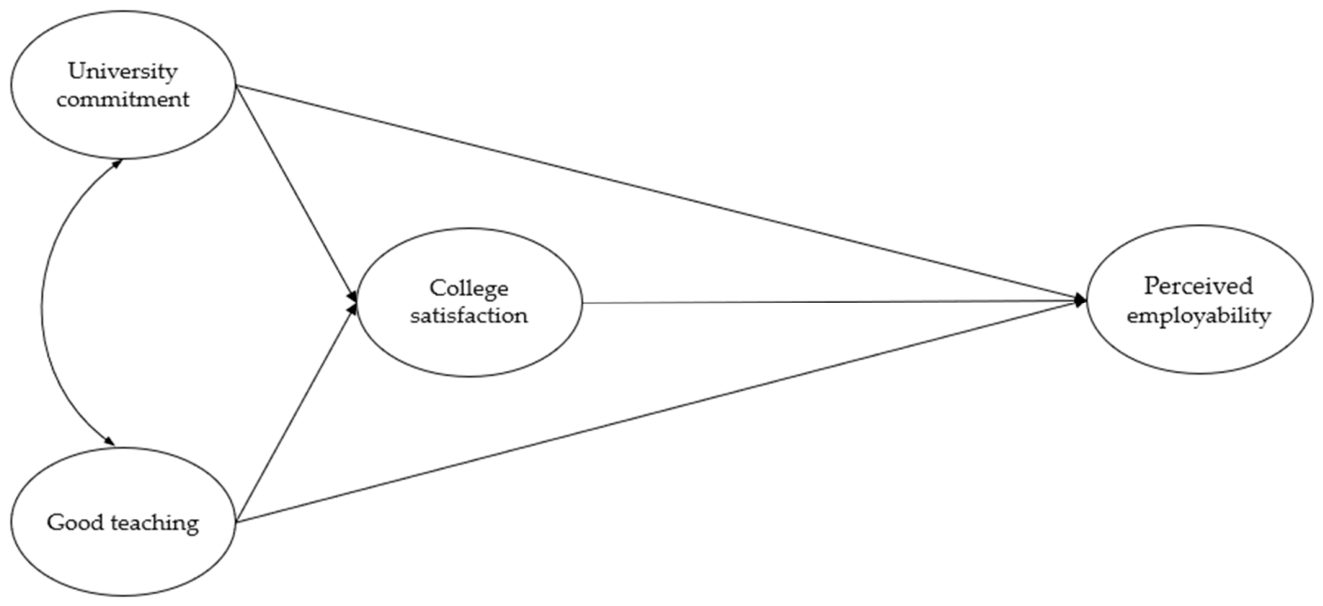
Building on these theoretical and empirical considerations, the present study aims to examine the relationships among good teaching, university commitment, college satisfaction, and perceived employability within a unified structural model, as presented on
Figure 1. Specifically, the following hypotheses are proposed:
H1. Good Teaching is positively associated with College Satisfaction.
H2. University Commitment is positively associated with College Satisfaction.
H3. College Satisfaction mediates the relationship between Good Teaching and Perceived Employability.
H4. College Satisfaction mediates the relationship between University Commitment and Perceived Employability.
3. Materials and Methods
3.1. Sample
The sample comprised 179 participants recruited between July 2025 and January 2026 from the University of Palermo, through institutional email lists and in-person recruitment by the research team in university classrooms. Data were collected via the LimeSurvey platform, which recorded 253 accessed questionnaires, of which 179 were fully completed and included in the analyses (completion rate = 70.75%). Participation was voluntary, and anonymity was ensured. The sample included 106 females (59.22%), 70 males (39.11%), and 3 individuals identifying as non-binary (1.68%). Participants’ mean age was 24.40 years (SD = 5.95). With regard to educational level, 54.75% were enrolled in master’s degree programs, 4.47% in single-cycle master’s degree programs, and 40.22% in bachelor’s degree programs. Participants were drawn from 36 different degree programs, reflecting a broad disciplinary composition; when grouped into macro-areas, participants belonged to STEM (N= 43, 24.02%) or non-STEM (N = 133, 74.30%) fields of study, while for 3 participants (1.68%) the disciplinary area could not be classified.
3.2. Measures
Self-perceived employability was assessed using the Employability Scale developed by Rothwell et al. [
9], in its Italian version validated by Di Fabio and Palazzeschi [
69]. The scale consists of 16 items (e.g., “My degree is seen as a gateway to a specific career that is generally perceived as highly desirable”) rated on a 5-point Likert scale ranging from 1 (strongly disagree) to 5 (strongly agree). The scale showed good internal consistency in the present study (α = 0.81).
University commitment was assessed using the University Commitment subscale developed by Rothwell et al. [
9]. As no validated Italian version of the scale was available at the time of data collection, the subscale was translated and adapted following a forward-backward translation design [
70]. First, the original items were translated into Italian by a bilingual member of the research team with expertise in the construct under investigation. The Italian version was then back-translated into English by an independent bilingual translator, external to the research team and blind to the original items, to check for semantic and conceptual equivalence. Discrepancies between the original and back-translated versions were discussed and reconciled by the research team, resulting in the final Italian version used in the present study. The adapted scale includes 7 items (e.g., “I am proud to tell others that I attend this university”) rated on a 5-point Likert scale ranging from 1 (strongly disagree) to 5 (strongly agree). Reliability and preliminary construct validity of the Italian version were evaluated within the measurement model of the present study (see Results section), and the scale demonstrated excellent internal consistency (α = 0.88).
Perceived teaching quality was assessed through the Good Teaching subscale of the Italian version of the Student Course Experience Questionnaire (SCEQ; [
46]; Italian adaptation by Barattucci & Zuffo [
45]). The subscale consists of 6 items (e.g., “The teaching staff are good at explaining things”) rated on a 5-point Likert scale ranging from 1 (strongly disagree) to 5 (strongly agree), with good internal consistency (α = 0.87).
College Satisfaction was measured using the College Satisfaction Scale (CSS) [
64]. While the original instrument comprises 20 items across five dimensions (choice congruence, quality of services, relationships with peers, study habits, and utility for future career), only the subscales assessing choice congruence and perceived utility for future career were selected for the present study, for a total of 8 items (e.g., “I am satisfied with my choice of degree program”). These two dimensions were chosen a priori because they are the only ones theoretically coherent with the construct of perceived employability investigated here; the remaining subscales (quality of university services, relationships with peers, and study habits) although relevant to overall university satisfaction, do not directly pertain to students’ perceptions of their employment prospects and were therefore excluded on theoretical grounds. Items were rated on a 5-point Likert scale ranging from 1 (not at all) to 5 (completely). The scale showed excellent reliability in the present sample (α = 0.92). To our knowledge, this selective use of the CSS subscales—restricted to choice congruence and perceived utility for future career—has not been previously applied in the literature, and represents an original methodological choice.
3.3. Data Analysis
Descriptive statistics, Pearson’s correlations, means, standard deviations, and reliability indices were computed using jamovi version 2.6 [
71] and R version 4.4 [
72]. Reliability analyses were performed using the psych package [
73]. Common method bias was preliminarily assessed through Harman’s single-factor test: an exploratory factor analysis including all study items loaded onto a single unrotated factor showed that the first factor accounted for 26.7% of the total variance, below the recommended 50% threshold. However, given that Harman’s single-factor test is regarded as an insensitive and non-diagnostic method for ruling out common method bias [
74,
75], this result should be interpreted with caution and does not, on its own, establish the absence of common method variance.
Mediation analyses were conducted using the jAMM module for jamovi 2.6 [
76]. Given that item responses were mandatory in the online survey, the final sample (N = 179) did not present item-level missing data.
Indirect associations were tested using bias-corrected bootstrap confidence intervals based on 5000 resamples. Collinearity diagnostics (Variance Inflation Factors) were examined for both the model with Satisfaction as the dependent (Good Teaching and University Commitment as independent variables) and the model with Perceived Employability as the dependent (Satisfaction, Good Teaching, and University Commitment as independent variables), given the moderate correlation observed between Good Teaching and University Commitment (r = 0.523).
4. Results
Since all study variables were collected through self-report questionnaires administered at a single time point, the data may be affected by common method bias. To evaluate this possibility, Harman’s single-factor test was performed using jamovi 2.6. All items from the study scales were entered into an exploratory factor analysis (EFA) and constrained to load onto one unrotated factor. The analysis revealed that the single factor explained 26.70% of the total variance, a value below the recommended 50% threshold [
77]. While this result does not indicate the presence of a single dominant factor, Harman’s single-factor test is regarded as an insensitive and non-diagnostic method for ruling out common method bias [
74,
75], and this limitation is acknowledged in the Discussion section.
Table 1 presents the descriptive statistics and correlations among the study variables. Overall, participants reported moderate-to-high levels of Perceived Employability (M = 3.37, SD = 0.48), University Commitment (M = 3.36, SD = 0.72), Good Teaching (M = 3.42, SD = 0.75), and Satisfaction (M = 3.78, SD = 0.73).
All variables were positively and significantly correlated with one another (p < 0.001). Perceived Employability showed moderate positive associations with University Commitment (r = 0.454), Good Teaching (r = 0.306), and Satisfaction (r = 0.508). In addition, Satisfaction was positively associated with both University Commitment (r = 0.425) and Good Teaching (r = 0.468). The strongest correlation emerged between University Commitment and Good Teaching (r = 0.523), suggesting that students who perceived higher teaching quality also tended to report stronger commitment toward their university.
To test the hypothesized mediation model, a parallel multiple mediation analysis was conducted on the composite scores of the four variables (Good Teaching, University Commitment, College Satisfaction, and Perceived Employability), rather than on their underlying items. Good Teaching and University Commitment were entered as independent variables, College Satisfaction as the mediator, and Perceived Employability as the outcome; the covariance between Good Teaching and University Commitment was also estimated.
Collinearity diagnostics indicated no multicollinearity concerns for either model tested. In the model with College Satisfaction as the outcome, Good Teaching (VIF = 1.377, Tolerance = 0.726) and University Commitment (VIF = 1.377, Tolerance = 0.726) showed no evidence of problematic redundancy. In the model with Perceived Employability as the outcome, Good Teaching (VIF = 1.532, Tolerance = 0.653), University Commitment (VIF = 1.460, Tolerance = 0.685), and College Satisfaction (VIF = 1.357, Tolerance = 0.737) likewise fell well within acceptable limits (VIF < 5).
Unstandardized coefficients, bias-corrected bootstrap 95% confidence intervals (5000 resamples), and standardized effect sizes (β) are reported together in
Table 2 to ensure consistency in the metric used for coefficients and confidence intervals.
Both Good Teaching (b = 0.332, SE = 0.074, 95% CI [0.172, 0.503], β = 0.338, p < 0.001) and University Commitment (b = 0.250, SE = 0.076, 95% CI [0.077, 0.413], β = 0.247, p = 0.001) were positively associated with College Satisfaction, together accounting for 26.3% of its variance (R2 = 0.263).
College Satisfaction, in turn, was positively associated with Perceived Employability (b = 0.258, SE = 0.047, 95% CI [0.163, 0.368], β = 0.396, p < 0.001). University Commitment retained a significant direct association with Perceived Employability (b = 0.201, SE = 0.049, 95% CI [0.109, 0.290], β = 0.307, p < 0.001), whereas the direct association between Good Teaching and Perceived Employability was not significant (b = −0.025, SE = 0.049, 95% CI [−0.127, 0.078], β = −0.040, p = 0.603). The full model accounted for 32.8% of the variance in Perceived Employability (R2 = 0.328).
The indirect association between Good Teaching and Perceived Employability through College Satisfaction was significant (b = 0.085, SE = 0.024, 95% CI [0.042, 0.158], β = 0.134,
p < 0.001). Notably, the total association between Good Teaching and Perceived Employability was not significant (b = 0.060, SE = 0.050, 95% CI [−0.051, 0.169], β = 0.094,
p = 0.228), while both the indirect association and the path from Good Teaching to College Satisfaction were. This pattern, a significant indirect association in the absence of a significant total or direct association, is consistent with what Zhao, Lynch, and Chen [
78] term “indirect-only mediation,” a more precise characterization than the traditional [
79] notion of full mediation, which additionally required a significant total association prior to the inclusion of the mediator.
The indirect association between University Commitment and Perceived Employability through College Satisfaction was also significant (b = 0.064, SE = 0.023, 95% CI [0.021, 0.133], β = 0.098, p = 0.005). Given that University Commitment retained a significant direct association with Perceived Employability, this pattern is consistent with partial (complementary) mediation, whereby College Satisfaction accounts for part, but not all, of the association between University Commitment and Perceived Employability.
5. Discussion
The present study aimed to investigate the role of the university learning experience in relation to students’ perceived employability (Perceived Employability), with a particular focus on the mediating function of college satisfaction in the relationship between teaching quality, university commitment, and Perceived Employability. Four hypotheses were formulated, proposing that Good Teaching and University Commitment would be positively associated with College Satisfaction (H1 and H2), and that College Satisfaction would mediate their respective relationships with Perceived Employability fully in the case of Good Teaching (H3) and partially in the case of University Commitment (H4). The results provided support for all four hypotheses, yielding a coherent and theoretically meaningful picture of how the academic experience relates to occupational self-perception.
H1 proposed that Good Teaching would be positively associated with College Satisfaction. This hypothesis was supported (b = 0.332, β = 0.338,
p < 0.001), indicating that students who perceived their instructors as effective, engaging, and supportive tended to report greater satisfaction with their academic choice and a stronger sense of its utility for their professional future. This finding is consistent with the theoretical framework proposed by Petruzziello et al. [
47], who argued that the support functions enacted by teaching staff, as instrumental, self-assessment, informational, and emotional [
48], contribute to students’ motivational and self-evaluative resources. When faculty effectively fulfill these functions, students appear to develop a more positive and coherent evaluation of their academic path, perceiving it as both personally meaningful and professionally relevant. This result also aligns with the USEM [
55] and CareerEDGE [
50] models, which conceptualize graduates’ employability as rooted in the overall quality of the learning experience rather than in isolated instructional inputs.
H2 proposed that University Commitment would be positively associated with College Satisfaction. This hypothesis was also supported (b = 0.250, β = 0.247,
p = 0.001), suggesting that students who felt more strongly identified with and invested in their institution reported greater satisfaction with their academic experience. This is consistent with the notion that commitment to the university enhances a sense of coherence and personal investment in the educational path, which in turn generates feelings of fulfillment and perceived utility [
62]. Students who actively identify with their institution may be more inclined to interpret their academic experience as congruent with their personal and professional aspirations, thereby perceiving their degree as a meaningful and strategically valuable resource for their future. This finding lends empirical support to the theoretical positioning of University Commitment as an antecedent of College Satisfaction within integrated models of the academic experience [
21].
H3 proposed that the association between Good Teaching and Perceived Employability would be fully mediated by College Satisfaction, with no significant direct path expected. This hypothesis was supported: the direct association between Good Teaching and Perceived Employability was non-significant (b = −0.025, β = −0.040,
p = 0.598), while the indirect association through College Satisfaction was significant (b = 0.085, β = 0.134, 95% CI [0.042, 0.158],
p < 0.001). Because the total association between Good Teaching and Perceived Employability was also non-significant (b = 0.060, β = 0.094, 95% CI [−0.051, 0.169],
p = 0.228), this pattern is more precisely described as
indirect-only mediation [
78] rather than full mediation in the traditional Baron and Kenny [
79] sense, which additionally required a significant total association prior to the inclusion of the mediator. This pattern suggests that the contribution of instructional quality to students’ occupational self-perception is not immediate or mechanical but operates through a more gradual psychological process. When students experience effective and supportive teaching, they tend to develop a more positive and coherent evaluation of their academic path, which in turn reinforces their sense of occupational preparedness.
This finding carries important theoretical implications. It suggests that good teaching does not directly “transfer” employability-relevant skills into students’ self-perceptions; rather, its association is accumulated and consolidated through the subjective meaning that students attribute to their academic experience. In other words, the pathway from instruction to occupational confidence runs through satisfaction through the sense that the studies are worthwhile, coherent, and relevant to the professional future. This interpretation is consistent with identity-based accounts of employability [
23], in which professional self-concept is not simply a function of competencies acquired, but of how those competencies are experienced and situated within a broader narrative of personal development. It also resonates with the Conservation of Resources framework [
13], according to which resources in this case, the experience of quality teaching contribute to well-being and adaptive functioning not directly, but by building other resources, such as satisfaction, that then sustain proactive orientations toward the future.
Notably, this result stands in partial contrast with Petruzziello et al. [
47], who found a direct longitudinal effect of teaching staff support on Perceived Employability. The absence of a direct association in the present study may reflect the cross-sectional nature of the design, which captures a snapshot rather than a developmental process, or it may suggest that the direct influence of teaching on Perceived Employability requires time to consolidate, becoming visible only when measured across multiple time points. Alternatively, the use of College Satisfaction as an explicit mediator in the present model may have absorbed variance that in previous studies was captured by the direct path. Future longitudinal research including College Satisfaction as a mediating variable would help clarify this discrepancy.
H4 proposed that University Commitment would show both an indirect association on Perceived Employability through College Satisfaction and a significant direct association, reflecting a pattern of partial mediation. This hypothesis was fully supported: the indirect association was significant (b = 0.064, β = 0.098, 95% CI [0.021, 0.133], p = 0.005), and the direct association remained significant after accounting for the mediated pathway (b = 0.201, β = 0.307, p < 0.001). This dual pattern is the most theoretically rich finding of the present study and warrants careful interpretation.
The indirect pathway, from University Commitment through College Satisfaction to Perceived Employability, mirrors the dynamic described for Good Teaching, suggesting a representational process: students who feel strongly committed to their institution are more likely to perceive their academic experience as coherent and professionally meaningful, developing higher satisfaction, which in turn strengthens their sense of occupational readiness. This is consistent with the theoretical positioning of University Commitment as an antecedent of satisfaction-based self-appraisal within models of student development [
21,
62].
The direct pathway, however, points to a distinct and additional process—one that is motivational and behavioral rather than evaluative. A strong sense of belonging and identification with one’s institution appears to directly sustain students’ conviction of being employable, independently of how satisfied they feel with their academic choice. This suggests that University Commitment functions not merely as a cognitive appraisal of the institution, but as a form of psychological anchoring: a resource that stabilizes students’ professional self-concept even when satisfaction-based pathways are not the primary channel. In this sense, institutional identification may directly reinforce the student’s sense of being a credible and competitive future worker partly through the symbolic value attributed to the university’s reputation, and partly through the motivational energy that commitment generates toward academic and extracurricular investment [
9,
37,
63].
This interpretation is consistent with identity-based accounts of employability [
23], in which belonging to a valued community contributes directly to the construction of a professional self-concept. It also extends Rothwell et al.’s [
21] model by demonstrating empirically that the commitment-Perceived Employability relationship is not exhausted by satisfaction, but retains an autonomous motivational component. Future research might investigate whether this direct effect is moderated by individual variables such as career identity clarity, self-efficacy, or institutional prestige perceptions, which could help clarify the boundary conditions of this relationship.
More broadly, the present findings reinforce the view that universities are not merely credentialing institutions, but active contexts for the construction of professional identity and self-efficacy. The transition from higher education to the labor market is not only associated with what students learn, but by how they experience their learning environment and the extent to which they feel that their academic path is coherent, supported, and relevant to their professional future [
17,
52]. Taken together, the four hypotheses tested in this study converge on a coherent picture: perceived employability, rather than being a fixed trait or a direct product of skills acquisition, is a dynamically constructed resource that emerges from the interplay between instructional quality, institutional belonging, and the subjective meaning attributed to one’s academic experience.
6. Limitations and Future Directions
Several limitations of the present study should be acknowledged.
First, the cross-sectional design does not allow for causal inferences, and the temporal dynamics among the variables remain unexplored. Longitudinal studies would be needed to clarify the directionality of these relationships and to assess whether the associations between teaching quality, university commitment, and Perceived Employability persist or evolve across different stages of the academic career.
Second, the sample was drawn exclusively from a single Italian university, which may limit the generalizability of findings to other institutional and cultural contexts. This limitation is particularly salient in light of the cross-national evidence discussed earlier [
34,
35,
36], which suggests that the relative weight of competences versus formal credentials and, by extension, the mechanisms linking the university experience to perceived employability, may vary systematically across national labor market contexts. Future research should therefore include more diverse samples, spanning different types of institutions, disciplinary fields, and national settings, to examine the extent to which these patterns hold across contexts.
Third, all variables were collected via self-report at a single time point, raising the possibility of common method variance. Although Harman’s single-factor test indicated that a single factor did not account for the majority of the variance, this method is regarded as insensitive and non-diagnostic [
74,
75], and therefore cannot be considered sufficient evidence to rule out common method bias. Future studies should adopt stronger procedural or statistical remedies, such as the inclusion of a marker variable or the modeling of an unmeasured latent method factor, to more rigorously address this concern. Relatedly, because participation was voluntary and recruitment relied on institutional email lists and in-person contact rather than a formal probabilistic sampling procedure, and no formal analysis of the sample’s representativeness relative to the full University of Palermo student population was conducted, some degree of self-selection bias cannot be ruled out.
Moreover, the Italian adaptation of the University Commitment subscale, obtained through a forward-backward translation procedure, has not yet undergone formal psychometric validation (e.g., confirmatory factor analysis on an independent sample or measurement invariance testing); although it demonstrated excellent internal consistency in the present sample (α = 0.88), future research should establish its structural validity more rigorously before wider use.
Fourth, the present study did not test measurement invariance across relevant subgroups, such as gender or level of study (undergraduate vs. postgraduate), which could reveal potential differences in the structure of the model across these groups. Additionally, degree level and disciplinary field were not included as covariates in the main model, as they were not part of our theoretical framework. A robustness check including these variables did not alter the substantive results, although bachelor’s and STEM students reported somewhat higher perceived employability; given the absence of a theoretical rationale for this study, we leave this finding for future investigation.
Finally, while the present study focused on three core dimensions of the academic experience, future research might explore additional predictors of Perceived Employability, such as internship experiences, peer relationships, career counseling services, and individual difference variables including self-efficacy and career adaptability, in order to develop a more comprehensive model of the antecedents of perceived employability in university contexts.
7. Conclusions and Practical Implications
The present study examined the role of the university learning experience in relation to students’ perceived employability, focusing on the interplay between teaching quality, university commitment, college satisfaction, and occupational self-perception. The findings converge on a coherent picture: the academic experience is not straightforwardly or directly associated with perceived employability, but rather relates to it through a more nuanced process in which students’ subjective evaluation of their university path functions as a mediating process. Perceived employability, in this light, is not merely an individual trait or a fixed reflection of objectively held competencies; it is a dynamically constructed resource, built through the relational and institutional experiences that students accumulate throughout their academic journey.
From a theoretical standpoint, the study contributes to the literature by offering an integrated empirical model that brings together multiple dimensions of the university experience within a single explanatory framework, addressing a gap that has been noted particularly in the Italian higher education context [
3,
26]. The mediated pathway from good teaching to perceived employability through college satisfaction adds nuance to existing accounts of the teaching-employability relationship, suggesting that instructional quality does not translate into occupational self-perception through direct skill transmission, but through the gradual consolidation of a meaningful academic self-narrative. The partial mediation pattern observed for university commitment, by contrast, points to its dual nature: it operates both as a direct motivational resource and as an antecedent of satisfaction-based employability perceptions.
Taken together, these findings suggest that college satisfaction functions as a critical mechanism through which teaching quality and students’ sense of institutional belonging translate into stronger perceptions of employability. From a sustainable careers perspective [
29], these findings indicate that the university experience contributes not only to graduates’
immediate labor market readiness, but to the foundational psychological resources—a sense of competence, belonging, and occupational confidence—that sustain career health, happiness, and productivity (i.e., performance and employability within the labor market) well beyond the transition to work. This means that investments in instructional quality and institutional belonging therefore function as upstream levers for sustainable career development, directly responding to calls for a stronger integration of higher education’s role within sustainable career research [
29], in line with SDG Target 4.4 (skills for employment) and SDG Target 8.6 (reducing youth disengagement from the labor market). Universities are, in this sense, active contributors to a more resilient education-to-work pipeline, helping students build a base of psychological resources they will need to navigate a labor market that is increasingly uncertain and rapidly changing, being more “productive” in a sustainable way and increasing their perceived employability.
The practical implications of these findings extend across multiple stakeholders. This is particularly relevant in Southern Italian contexts such as Sicily where the study takes place, where persistent regional disparities in labor market absorption capacity may make institutional support for perceived employability—a psychological resource under the university’s control—especially consequential, given that objective local labor market conditions are largely outside of it. For university administrators, the results make a clear case for investing in initiatives that help students perceive their degree as professionally relevant and coherent with their aspirations. This might take the form of structured career orientation programs, curricula that explicitly integrate professional competencies, and opportunities for students to actively reflect on the connections between their studies and the world of work. These efforts should be woven into the entire academic path rather than reserved for the final stages before graduation.
For faculty, the finding that good teaching is associated with perceived employability through satisfaction carries a specific and perhaps underappreciated message: effective instruction is not only about knowledge transfer; it contributes to a broader process of professional identity formation. Faculty development programs should therefore help teachers recognize not only the pedagogical dimensions of their role, but also its career-relevant functions, including the informational, self-assessment, and emotional support that have been shown to strengthen students’ occupational self-perception [
48].
Moreover, the direct positive association between university commitment and perceived employability suggests that enhancing students’ sense of belonging is far more than a retention strategy; it has tangible implications for how students come to see their future in the labor market. Structured peer-tutoring schemes, already common in the Italian university system, together with mentoring relationships between senior and incoming students and extracurricular opportunities that strengthen institutional identification, may therefore represent valuable and readily implementable levers for supporting employability, particularly in the earlier stages of the academic path. In a labor market defined by growing uncertainty, especially in the Italian (and Sicilian) context, helping students develop a sustainable perception of their occupational potential remains a meaningful contribution a university can make to a successful transition from education to work. There is, more broadly, a growing need for structured career support programs within higher education, particularly in countries such as Italy, where this need has been recognized only relatively recently—arguably because, until a few years ago, the national labor market relied more heavily on formal qualifications as a proxy for competence than on the direct assessment of skills [
34,
35]. From a practical standpoint, the authors think that it may be worth introducing, within our universities, structured workshops aimed at enhancing soft skills such as negotiation, problem-solving, and assertive communication, practiced collaboratively in small peer groups to also strengthen teamwork abilities. Such initiatives can be understood as a concrete extension of the instrumental and self-assessment support functions associated with good teaching in the present model, while also enhancing the sense of belonging and peer connection central to university commitment. By strengthening both pathways identified in our findings, these workshops may enhance students’ satisfaction with their academic experience and, ultimately, their perceived employability. Consistent with the sustainable careers framework outlined earlier [
29], these transferable competencies support not only immediate employability but also long-term career sustainability, as they build durable personal resources rather than job-specific skills that students can adapt and redeploy across changing roles and labor market conditions.