Article

Valorization of Aromatic Coconut Wastes into Biochars for Carbon Dioxide Uptake and Dye Adsorption: Adsorption Behavior and Economic Feasibility


by
Pisitpong Intarapong
1,*,
Soydoa Vinitnantharat
2,3,
Nareerat Sukkhee
2 and
Naris Pratinthong
4
1
Ratchaburi Campus, King Mongkut’s University of Technology Thonburi, Ratchaburi 70150, Thailand
2
Environmental and Energy Management for Community and Circular Economy Research Group, King Mongkut’s University of Technology Thonburi, Bangkok 10140, Thailand
3
Environmental Technology Program, School of Energy Environment and Materials, King Mongkut’s University of Technology Thonburi, Bangkok 10140, Thailand
4
Energy Technology Program, School of Energy, Environment and Materials, King Mongkut’s University of Technology Thonburi, Bangkok 10140, Thailand
*
Author to whom correspondence should be addressed.
Sustainability 2026, 18(16), 8403; https://doi.org/10.3390/su18168403
Submission received: 25 June 2026 / Revised: 25 July 2026 / Accepted: 6 August 2026 / Published: 17 August 2026

Abstract

The purpose of this research is to investigate the potential of aromatic coconut waste-derived biochars, namely coconut husk biochar (CHB) and coconut empty fruit bunch biochar (CBB), as low-cost, sustainable, and locally available adsorbents. Biochars were characterized using SEM, XRD, XPS, and XRF to evaluate their physical and chemical properties, followed by CO2 uptake, moisture uptake, and methylene blue (MB) adsorption experiments. The results demonstrated that CBB exhibited the highest CO2 uptake of 4.44 mmol g−1, outperforming CHB (2.39 mmol g−1) under temperature-programmed desorption. Notably, the water-washed biochar (CBB-w) exhibited a marked decrease in CO2 uptake, providing strong supporting evidence that naturally occurring mineral species play an important role in the CO2 adsorption mechanism. The quantity and type of naturally occurring potassium-containing oxides and salts strongly influenced CO2 and moisture uptake. In contrast, isotherm analyses using the Langmuir, Freundlich, Temkin, and Dubinin–Radushkevich models indicated that CHB exhibited a superior MB adsorption capacity (30 mg g−1), reflecting the different adsorption mechanisms governing gas- and liquid-phase adsorption. The estimated production cost of aromatic coconut waste-derived biochar ranged from approximately US$0.83–1.11 kg−1, depending on production scale. These results demonstrate that aromatic coconut waste-derived biochar represents a promising low-cost and sustainable adsorbent for environmental applications, particularly CO2 capture and dye removal.

1. Introduction

Coconut production in South East Asian countries, such as Indonesia, the Philippines, Vietnam, Malaysia, and Thailand, is recorded at 58.27% of the global amount, which was a yield of 5.43 tons/ha and production of 37.68 million tons in 2023. Thailand’s coconut production increased at an average rate of 8.10% from 2017 to 2023 [1]. The Ministry of Commerce has reported that Thailand’s agricultural product exports to Free Trade Area (FTA) partners in 2024 totaled US$12.7 billion (approximately 13.3 billion USD), making Thailand the largest exporter of agricultural products in the ASEAN region [2]. Aromatic coconut is a high-value agricultural product due to its distinctive aroma, taste, and bioactive components, such as sugars, proteins, amino acids, vitamins, and minerals [3,4], which are beneficial for human health. However, the rapid expansion of the aromatic coconut industry has generated large amounts of residues, including husks, shells, and empty fruit bunches, estimated at approximately 459,000 metric tons/year or 1836.14 tons/day [5]. These wastes are commonly discarded in processing facilities and remain underutilized because of their high moisture content, approximately 70 wt%, which limits direct energy recovery [6,7]. Alternative waste management routes, such as composting [8], bio-extraction [9], and conversion to biochar [10], have therefore attracted increasing attention. Biochar is considered a promising method since it uses less energy for production and can be used in several practical ways, such as for soil amendment [11], as a compost additive, for carbon sequestration, and as an adsorbent [11]. Since aromatic coconut waste is produced all year round with negligible feedstock cost, its conversion into biochar offers a sustainable approach for waste valorization and landfill reduction.
Biochar derived from coconut residues has been reported to exhibit favorable textural properties and surface chemistry for adsorption applications. The pyrolysis of coconut husk to biochar at 325–700 °C revealed that 325 °C gave the highest yield of 42.79 wt% [12]. In general, high pyrolysis temperatures reduce the biochar’s surface functional groups while increasing its aromaticity and specific surface area. Biochar produced at temperatures around 300–500 °C is optimal for retaining essential nutrients and forming more functional groups, such as iron oxide magnetite in biochar from wood [13], carboxyl and keto groups in biochar from rice straw [14,15], and hydroxyl and phenolic groups in biochar from coconut husk [16]. These functional groups, together with high surface areas and charged surfaces, enhance the adsorption and immobilization of organic and inorganic pollutants. Increasing the pyrolysis temperature generally promotes devolatilization and pore development, resulting in a higher specific surface area and pore volume. However, a higher pyrolysis temperature or prolonged residence time may lead to pore widening, partial collapse of the carbon framework, excessive burn-off, and reduced biochar yield. In addition, excessively severe pyrolysis conditions may alter or remove naturally occurring inorganic mineral species that play an important role in CO2 adsorption [17].
Methylene blue (MB), a cationic dye, is a poisonous and carcinogenic substance used in a variety of sectors, including textiles, printing, medicines, and food. Its high chemical stability and resistance to biodegradation contribute to its environmental persistence, making effective removal strategies essential [18]. As a result, MB was commonly employed as an organic compound model for adsorption by natural and purified clays [19], activated carbon [20], and biochar [21]. Its adsorption on biochar is mainly governed by pore structure and surface functional groups. Open mesopores promote MB diffusion and accommodation, while oxygen-containing functional groups enhance electrostatic interactions [22].
Biochar has attracted attention as a low-cost and sustainable adsorbent for CO2 capture. Compared with conventional adsorbents such as clay and zeolite, biochar offers advantages including abundant feedstock availability, a lower environmental impact, and compatibility with circular economy approaches [23,24,25]. Although advanced adsorbents such as amine-functionalized porous carbons, MOFs, and composite sorbents show high CO2 selectivity and uptake under flue-gas conditions [26,27], their complex synthesis and surface modification often increase production cost and limit large-scale application.
Biochar-based adsorbents provide a scalable alternative, with CO2 uptake mainly controlled by microporosity, surface area, pore structure, and naturally occurring mineral species [28]. Agricultural residues such as rice straw, bamboo, wood pellets, and coconut shells have been widely studied as biochar precursors for CO2 adsorption [29,30]. Mineral-rich and basic functionalized biochars can improve CO2 affinity and stability under post-combustion conditions [31,32]. Temperature-programmed desorption (TPD) has emerged as a suitable tool for elucidating the strength, heterogeneity, and reversibility of CO2 uptake on carbonaceous materials at relatively higher temperatures. TPD studies consistently demonstrate that CO2 uptake at different adsorption temperatures on biochar and carbon materials is dominated by physisorption and chemisorption, corresponding to weak van der Waals interactions on aromatic carbon surfaces and basic mineral sites, respectively [33,34]. A recent review on coconut-based biochar emphasized its use for the removal of metals and organic pollutants from wastewater. For liquid-phase dye adsorption, coconut-shell-derived activated carbon has been reported as an effective low-cost adsorbent for methylene blue removal, with adsorption behavior depending on pH, contact time, particle size, adsorbent dosage, temperature, and initial dye concentration [35]. In contrast, gas-phase CO2 adsorption is mainly controlled by micropores and surface areas. Recent reviews on biomass-derived carbon materials for CO2 capture highlight the importance of pore development and surface modification in enhancing CO2 uptake [36]. Coconut material is also recognized as a suitable precursor for carbon sources for various applications. However, quantitative studies directly comparing the inherent mineral composition of different aromatic coconut waste fractions and its contribution to CO2 adsorption remain limited. Moreover, the synergistic role of mineral species and precursor-dependent pore geometry in regulating adsorption selectivity between small gaseous molecules and relatively large organic contaminants has not been clearly established. In particular, the contrasting adsorption behaviors of coconut empty fruit bunch biochar (CBB) and coconut husk biochar (CHB) produced under identical pyrolysis conditions remains insufficiently understood.
From an economic point of view, biochar production from agricultural waste has received increasing attention due to its ability to change low-value residues into functional adsorbents for environmental applications [37]. Nevertheless, the majority of recent research on biochar adsorbents has concentrated on adsorption behavior, surface properties, and removal efficiency, while the production cost and economic feasibility have rarely been considered. This limitation is especially significant, as practical application is significantly influenced by material cost.
Regarding aromatic coconut waste, few studies have directly compared the inherent mineral compositions of different coconut residues produced under identical pyrolysis conditions. They evaluated how these naturally occurring mineral species influenced adsorption behavior. The combined role of inherent mineral species and pore structure in governing adsorption selectivity toward gas-phase CO2 and moisture uptake and dye adsorption has received limited attention. In addition, the economic feasibility was not evaluated. Thus, this research aims to analyze the properties of biochar obtained from coconut waste, including coconut husk (CH) and coconut empty fruit bunch (CB) of the aromatic coconut industry, on their ability to uptake moisture and CO2 as well as in MB adsorption. Moreover, the physicochemical characteristics and adsorption isotherms of each biochar were also investigated. An economic perspective of biochar was proposed in terms of scalability.

2. Materials and Methods

2.1. Biochar Preparation and Characterization

Aromatic coconut wastes (CH and CB) were collected from a coconut factory in Ratchaburi, Thailand. The wastes were sun-dried for 1 week to reduce the moisture content from 80 wt% to ~18 wt% before carbonization. A total of 25 kg of dried waste was loaded into a 20 L drum kiln (Figure S1), sealed, and carbonized at 500.0 ± 20 °C for 24 h. The overall average heating rate was 2 °C/min, and the average airflow rate in the small kiln was maintained in the range of 8–10 cm2/min. After cooling overnight to below 50 °C, coconut husk biochar (CHB) and coconut empty fruit bunch biochar (CBB) were obtained (Figure S2). Biochar yield was calculated from the mass ratio of produced biochar to feedstock. The biochars were then crushed and sieved to 125–149 µm. To prepare washed CBB (CBB-w), CBB was rinsed with deionized water at ambient temperature until the wash water showed no further change in electrical conductivity (WTW, Cond3210, Weilheim, Germany), indicating that no metals or ions had been leached from the biochar’s surface. The conductivity threshold for the water-washing endpoint was 3 ± 2 µS/cm, which was equal to DI water.
The CHB, CBB, CH, and CB were characterized for the ultimate analysis of carbon (C), hydrogen (H), and nitrogen (N) by an elemental analyzer (LECO CHN628, LECO Corporation, St Joseph, MI, USA) and for sulfur (S) by another elemental analyzer (Micro Corder JM10, J-SCIENCE LAB Co., Ltd., Kyoto, Japan), and oxygen (O) was calculated by subtracting the percentages of C, H, N, S from 100. All biochar samples (CHB, CBB, CBB-w) were analyzed for elemental composition using an X-ray fluorescence (XRF) spectrometer (XGT-2000W, Horiba Ltd., Kyoto, Japan), surface morphology by scanning electron microscope (SEM) (Phenom ProX G6, Thermo Fisher Scientific, Waltham, MA, USA), surface area using the Brunauer–Emmett–Teller (BET) method, and pore size distribution by surface characterization analyzer (Micromeritics 3Flex, Micromeritics Instrument Corporation, Norcross, GA, USA). X-ray diffraction (XRD) patterns of the biochars were acquired using a Bruker X-ray diffractometer, employing Cu-Kα radiation (1.54 Å) at 20 kV and 20 mA, to determine the crystal patterns of salts. X-ray photoelectron spectroscopy (XPS) was performed using a Kratos Axis Ultra DLD with a monochromatic Al K-α source (15 mA, 14 kV) to ascertain the oxidation states of the salt embedded in the biochars. In addition, the iodine adsorption capacity (iodine number) was analyzed according to ASTM D4607-94 [38]. The ash content was analyzed in accordance with ASTM D3174 [39]. Initially, the sample was weighed prior to combustion, then placed in a muffle furnace and heated to 650 °C for 24 h. Upon completion of the heating process, the sample was removed, allowed to cool to room temperature in a desiccator, and subsequently reweighed to determine the residual mass. The ash content was then calculated based on the difference between the pre- and post-combustion weights. The thermal stability of aromatic coconut husk and bunch was determined by thermal gravimetric analysis (TGA/DSC 3+, Mettler Toledo, OH, USA) with a simultaneous thermal analyzer (STA) at a heating rate of 10 °C/min with temperatures in the range of 30 and 900 °C in a nitrogen atmosphere (20 mL/min).

2.2. Batch Experiment

The capabilities of CHB, CBB, and CBB-w on carbon dioxide and moisture uptake as well as MB adsorption were investigated. All experiments were performed in duplicate. For carbon dioxide uptake, temperature-programmed desorption (TPD) was used to evaluate the amount of gas uptake on the surface of biochars. The key principle is to heat a biochar in an inert atmosphere and record the spectra of CO2, using Thermo Finnigan TRACE 1110 gas chromatography (Thermo Fisher Scientific, Santa Clara, CA, USA) and BEL (BELCAT-M Analyzer, BEL Japan Inc., Osaka, Japan). Each biochar sample (0.15 g) was degassed by heating in a flow of helium at a rate of 10 °C/min from room temperature to 300 °C and was held at 300 °C for 1 h to remove moisture. Uptake of the CO2 gas was done at 30 °C for 1 h. Then, helium gas was flowed at 30 °C for 1 h to eliminate the physically sorbed CO2 gas. Finally, the chemically sorbed CO2 was desorbed by a heating rate of 5 °C/min up to 800 °C.
For moisture uptake, the procedure was adapted simply from previous studies [40,41]. A total of 2 g of biochar was first dried in a hot-air oven at 110 °C for 24 h to remove residual moisture. The dried sample was then transferred into a humidity-controlled chamber, where the relative humidity was maintained at 75% at 25 °C using a saturated NaCl solution that closely simulated the typical ambient humidity conditions. The biochar was periodically weighed every 24 h until a constant mass was achieved, indicating equilibrium moisture uptake. The moisture uptake capacity was then determined based on the percentage increase in sample weight, as calculated using Equation (1).
%   increase   weight = ( W i W o W o ) × 100
where Wi is the weight on the day of measurement, and Wo is the initial weight.
MB (Merck Group, Darmstadt, Germany) was used as a model organic pollutant to investigate the adsorption capacities. The stock solution (1000 mg/L) was prepared by dissolving 1.000 g of MB in 1.0 L of deionized water. Then, it was diluted to a desired concentration of 4 mg/L by deionized water. The equilibrium time for methylene blue adsorption was determined by placing 0.1 g of each biochar in a 250 mL Erlenmeyer flask containing 250 mL of MB solution at a concentration of 4 mg/L. The mixture was subsequently agitated in the incubator shaker (Innova 42R Inc/Ref Shaker, Eppendorf, Pennsauken, NJ, USA) at 25 °C and 120 rpm for periods of 30, 45, 60, 120, 180, 240, 300, 360, 420, 480, 540, and 600 min. Then, the mixture was filtered, and the filtrate was measured for the remaining MB concentration using a UV spectrophotometer (Orion AquaMate 8100, Thermo Fisher Scientific, MA, USA) at the maximum wavelength of 665 nm. The MB adsorption capacity at time t (qt) was calculated from the remaining MB concentration using Equation (2).
q t = V s C o C t W
where Vs is the volume of the solution (L), W is the weight of each biochar used (g), C0 is the initial concentration (mg/L), and Ct is the concentration at time t.
MB adsorption isotherm was done by shaking the flask containing 0.1 g of each biochar in 250 mL of MB solution at concentrations of 1, 2, 3, 4, 5, and 6 mg/L in the incubator shaker (Innova 42R Inc/Ref Shaker, Eppendorf, NJ, USA) at 25 °C, at 120 rpm for 600 min (the adsorption equilibrium time). Control experiments without biochar were also performed. The equilibrium adsorption data of MB were determined using the four most dominant adsorption isotherm models. They are the Langmuir, Freundlich, Temkin, and Dubinin–Radushkevich models as described in the Supplementary Materials [42,43].

2.3. Statistical Approach and Economic Model

All experiments (CO2 and moisture uptake and MB adsorption by biochar) were evaluated through duplicate experiments, with mean values and standard deviations reported. Any experimental set exhibiting a variation greater than 10% was repeated to ensure reproducibility. The adsorption parameters and model constants were calculated using Microsoft Excel.
The production cost of biochar is primarily governed by energy, equipment (capital), labor, and any consumables/reagents, which collectively determine the delivered unit cost of biochar. A simple batch-costing model was used to estimate the biochar production cost per batch and the resulting unit cost (USD/kg of biochar) [11,44]. The process accounts for (i) variable operating costs (fuel and electricity), (ii) labor costs, and (iii) capital depreciation of the kiln. The feedstock was supplied directly from a nearby coconut-processing facility at no purchase cost, and pyrolysis was performed on-site; therefore, feedstock procurement and transportation costs were assumed to be negligible. The syngas produced during pyrolysis was recovered and reused as burner fuel, reducing external energy demand. Nevertheless, the estimate excludes costs related to collection, pretreatment, product handling, and revenues from co-products such as condensate liquid and syngas.

3. Results

3.1. Physicochemical of the Biochars

TG/DTG analyses of CH and CB were added (Figure S3) to clarify the pyrolytic behavior of the raw feedstocks. The thermograms show an initial mass loss below 120 °C from moisture, followed by the characteristic lignocellulosic decomposition stages: hemicellulose (200–320 °C), cellulose (320–400 °C; sharp DTG peak), and a broad, slow lignin degradation extending to ~600 °C [45,46], consistent with the thermal behavior observed in this study. These profiles are consistent with our conversion conditions (500 ± 20 °C) and help rationalize the observed aromatic coconut biochar yields (26–30%). The results of the yield, moisture content, and fixed carbon of CH, CB, CHB, and CBB are shown in Table 1. The yields of CHB and CBB are 26.7% and 21.9%, respectively. When compared to other agricultural residues subjected to pyrolysis at temperatures of 500 ± 20 °C, these yields were within a similar range. For instance, other research reported that the biochar yields of 500–600 °C were 29.1% for rice straw, 28.4% for sawdust, 38.9% for sugar cane, and 21.3% for tree leaves [47]. A pyrolysis temperature of 500 ± 20 °C was therefore selected because it was high enough to complete most of the hemicellulose and cellulose decomposition and promote carbonization, while still retaining naturally occurring inorganic mineral species such as K-, Na-, Ca-, and Cl-containing salts.
The moisture content of aromatic coconut residue and biochar is reported in Table 1. The moisture contents of all samples are within acceptable limits for biomass and biochar (<8–10%) to ensure minimal energy loss during pyrolysis and prevent clogging of the adsorption sites [48]. The moisture content of waste products has a direct impact on their calorific value. The excessive moisture in waste material leads to heat loss during burning from moisture evaporation, resulting in decreased calorific value. Furthermore, the ash content (1.64% to 10.18%) in aromatic coconut trash is minimal. The ash level of waste materials must not surpass 20%. High ash content can negatively affect the thermal conversion processes by reducing energy efficiency and increasing slagging and fouling issues [49]. According to these results, CBB is unsuitable as a charcoal for fuel.
The raw materials (CH and CB) have lower carbon contents (~45%) and higher oxygen contents (>41%, stability: O/C < 0.4, aromaticity: H/C < 0.7), typical of lignocellulosic biomass. After pyrolysis, both biochars (CHB and CBB) showed significantly increased carbon contents (65.60% and 69.25%, respectively) and decreased oxygen contents, indicating enhanced carbonization. CBB has the highest carbon and lowest hydrogen and oxygen contents, reflecting the least aromatic but the most stable structure.
The XRF analysis revealed significant differences in elemental content among the CBB, CHB, and CBB-w samples (Table 2). CBB, especially, had the highest concentrations of potassium (7.85 wt%) and chlorine (5.26 wt%), followed by CHB, suggesting the presence of mineral salts retained during pyrolysis. High chlorine (Cl) levels in biochar can adversely affect the combustion apparatus, resulting in complications such as burner fouling [50]. The CBB-w sample, which was washed with deionized water, showed no detectable levels of these elements, indicating effective removal of soluble inorganic components. The reduction in metal and salt content after washing can enhance the adsorptive properties of biochar by minimizing site blockage. It implies that CBB and CHB are not compatible with the role of charcoal. However, P, K, and some micronutrients (Fe, Zn, etc.) are essential for the structural growth of plants.
Adsorption isotherms are commonly used to characterize the surface area, pore volume, pore size, and pore structure, as shown in Table 3. CBB exhibited a much higher surface area compared to CHB. The surface analysis revealed that CBB developed a more microporous structure than CHB. The total pore volume also increased from 0.0764 to 0.0949 cm3/g, while the micropore volume increased from 0.0437 to 0.0709 cm3/g. As a result, the micropore fraction increased from 57.20% for CHB to 74.71% for CBB. In contrast, CHB showed a relatively higher macropore volume of 0.0181 cm3/g compared with 0.0081 cm3/g for CBB. After water washing, CBB-w retained a high surface area of 177.17 m2/g, similar to that of CBB. However, the pore volume distribution changed noticeably. The total pore volume and micropore volume slightly increased from 0.0949 to 0.0957 cm3/g and 0.0709 to 0.0799 cm3/g, respectively. Consequently, the micropore fraction increased from 74.71% in CBB to 83.49% in CBB-w, while the macropore volume decreased from 0.0081 to 0.0004 cm3/g. The average pore size of CHB and CBB (~21 Å) is nearly the same; however, the treatment (CBB-w) results in a decrease in the average pore size (14.4 Å). Consequently, water washing could remove soluble inorganic species and opened or exposed additional microporous structures.
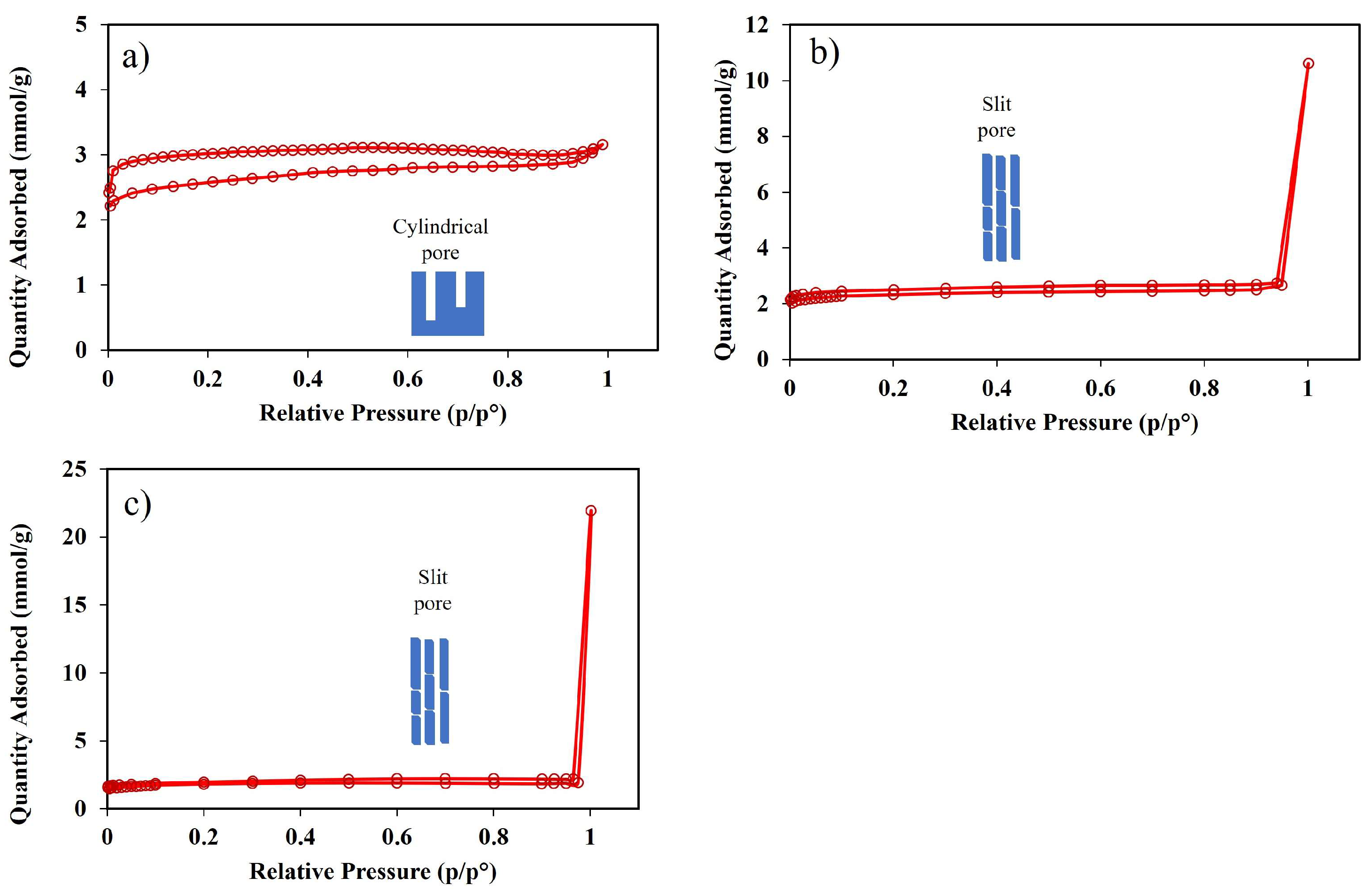
The differences in the BET surface area and iodine number are closely associated with pore geometry and adsorbate accessibility. CHB, which predominantly contains cylindrical pores, exhibited a lower BET surface area and iodine number but provided relatively open channels that may facilitate the diffusion of larger adsorbate molecules. In contrast, CBB and CBB-w were dominated by slit-shaped pores and showed higher micropore fractions and BET surface areas. These narrow spaces enhance the confinement and adsorption of small molecules. The particularly high iodine number of CBB-w is consistent with its greater micropore fraction and smaller average pore size, indicating improved accessibility of iodine to narrow slit pores. Therefore, adsorption capacity cannot be interpreted solely from BET surface area; pore shape and molecular accessibility must also be considered.
N2 adsorption isotherms were categorized by the International Union of Pure and Applied Chemistry (IUPAC) into six types. From Figure 1a,b, CHB belongs to the H1 type, which is ascribed to cylindrical pore shapes. While the hysteresis loop from CBB and CBB-w reveals an H4 type with slit-shaped mesopores or layered structures [51,52]. Moreover, the steep uptake near a relative pressure of 1.0 indicates that all aromatic coals comprise larger mesopores or macropores with diameters of 2 < d < 50 nm over the relative pressure range of 0.45–0.9 P/P0. These geometric differences significantly influence the BET surface area and total pore volume. Cylindrical pores with closed pores provide a higher internal surface area accessible for multilayer adsorption, leading to smoother isotherms and moderate hysteresis. Conversely, slit-shaped pores tend to exhibit higher apparent pore volumes but less uniform adsorption–desorption transitions due to irregular capillary effects between plate-like structures [53,54]. Consequently, the BET surface area and pore parameters derived from the isotherms reflect not only the pore size distribution but also the morphological geometry of the adsorbent.
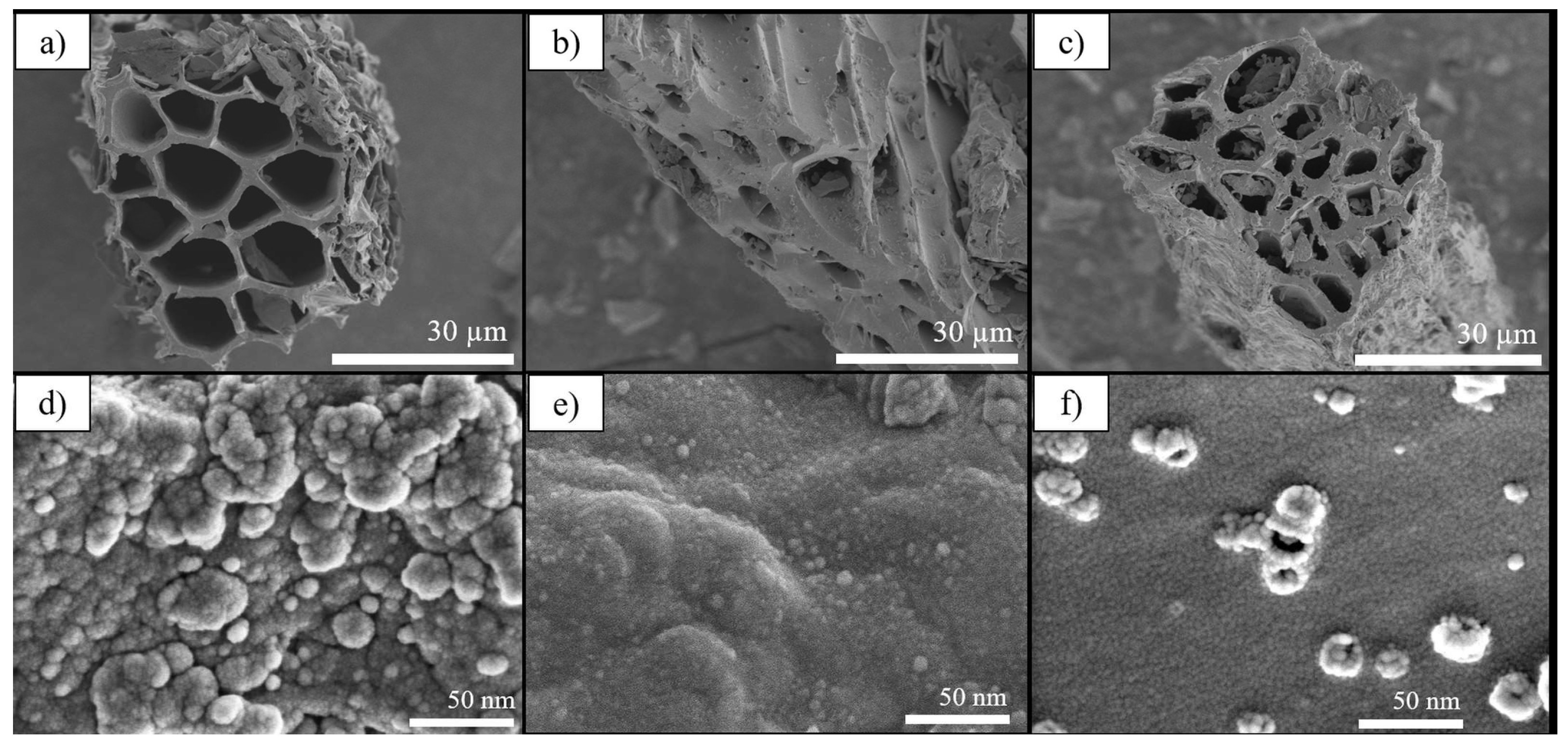
The iodine number is a key indicator of carbon-based materials’ porosity and surface area, particularly reflecting the amount of micropores (<2 nm) available for adsorption, as shown in Table 3. CBB (343.16 mg/g) has a higher iodine number than CHB (255.07 mg/g), indicating a more developed microporous structure and greater surface area. The largest surface area is CBB-w (583.47 mg/g), which has the highest iodine number. Iodine number results correlate with the BET results. After washing, the adsorptive characteristics of biochar can be improved by reducing the obstacle sites and increasing porosity. SEM images of CHB, CBB, and CBB-w under X 1.5k of magnification are shown in Figure 2a–c. The pore sizes in those biochars are around 22–25 µm, attributed to be the pores of phloem in aromatic coconut. Further increasing the magnification to X 100k (Figure 2d–f), particle surfaces of CHB and CBB are observed to be multi-scale objects, suggesting the aggregation of various metal elements at the surface. After treatment, a smaller particle was found homogeneously on the surface. From XRF results, metal compounds were not detected on the surface of CBB-w. The BET and SEM results show that pore volume and surface area increase after removing metals.
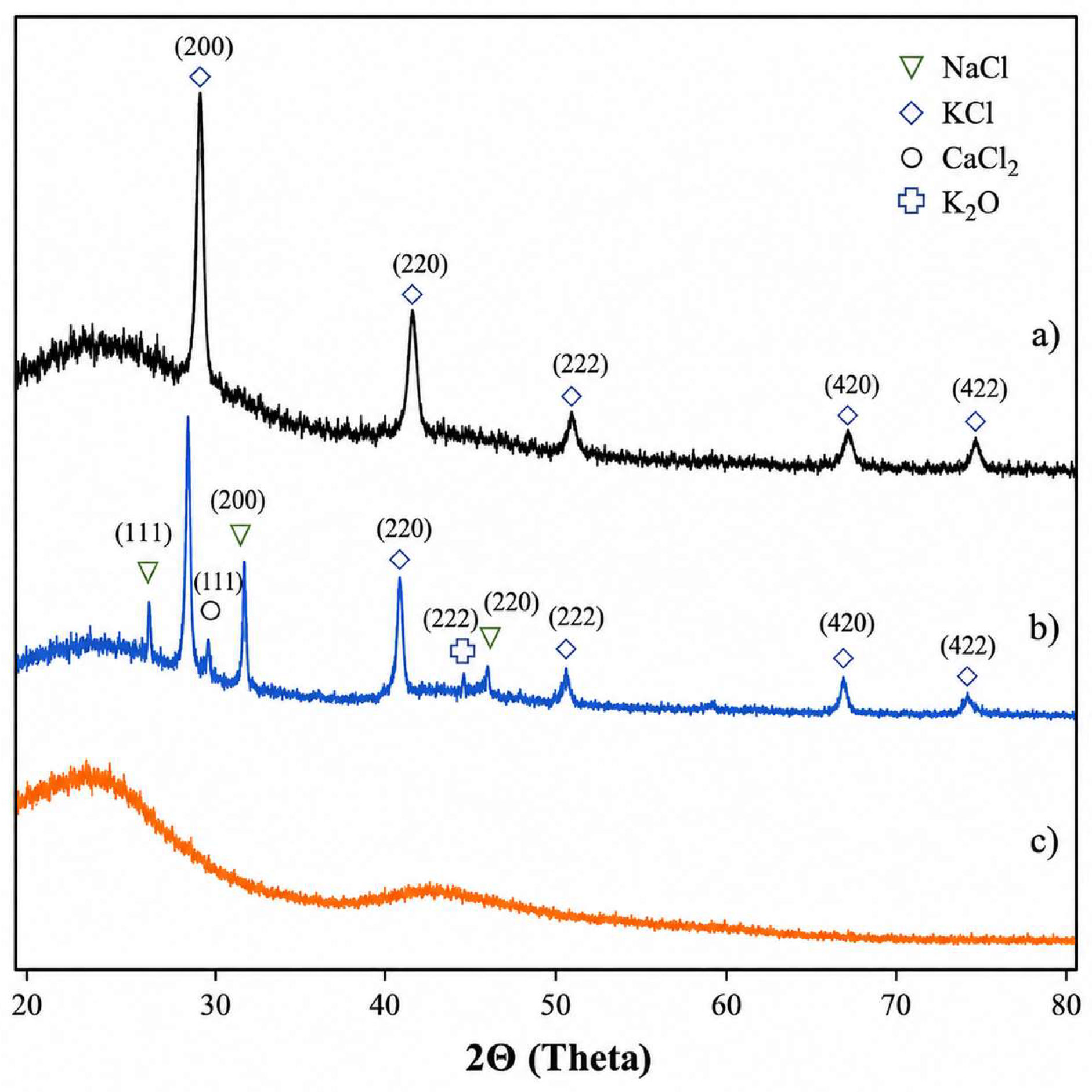
X-ray diffractograms of biochar from aromatic coconut waste are shown in Figure 3. Peaks originating from CHB (Figure 3a) were detected at 2Θ = 29.32°, 41.71°, 50.73°, 67.19°, and 74.64° (JCPDS#, no. 41-1476), which were ascribed to the KCl phase in CHB because coconut waste contained a large amount of the element potassium over 5.61 wt% (Table 2). XRD peaks from CBB, as shown in Figure 3b, were detected in addition to phases of NaCl (JCPDS#, no. 01-070-2506), CaCl2 (JCPDS#, no. 01-072-1937), and K2O (JCPDS#, no. 47-1701; 77-2176). After washing with deionized water, all peaks (Figure 3c) disappeared due to the leaching out of potassium, sodium, etc., on the carbon surface. It can be concluded that ionic compounds or salt species are normally found in aromatic coconut wastes.
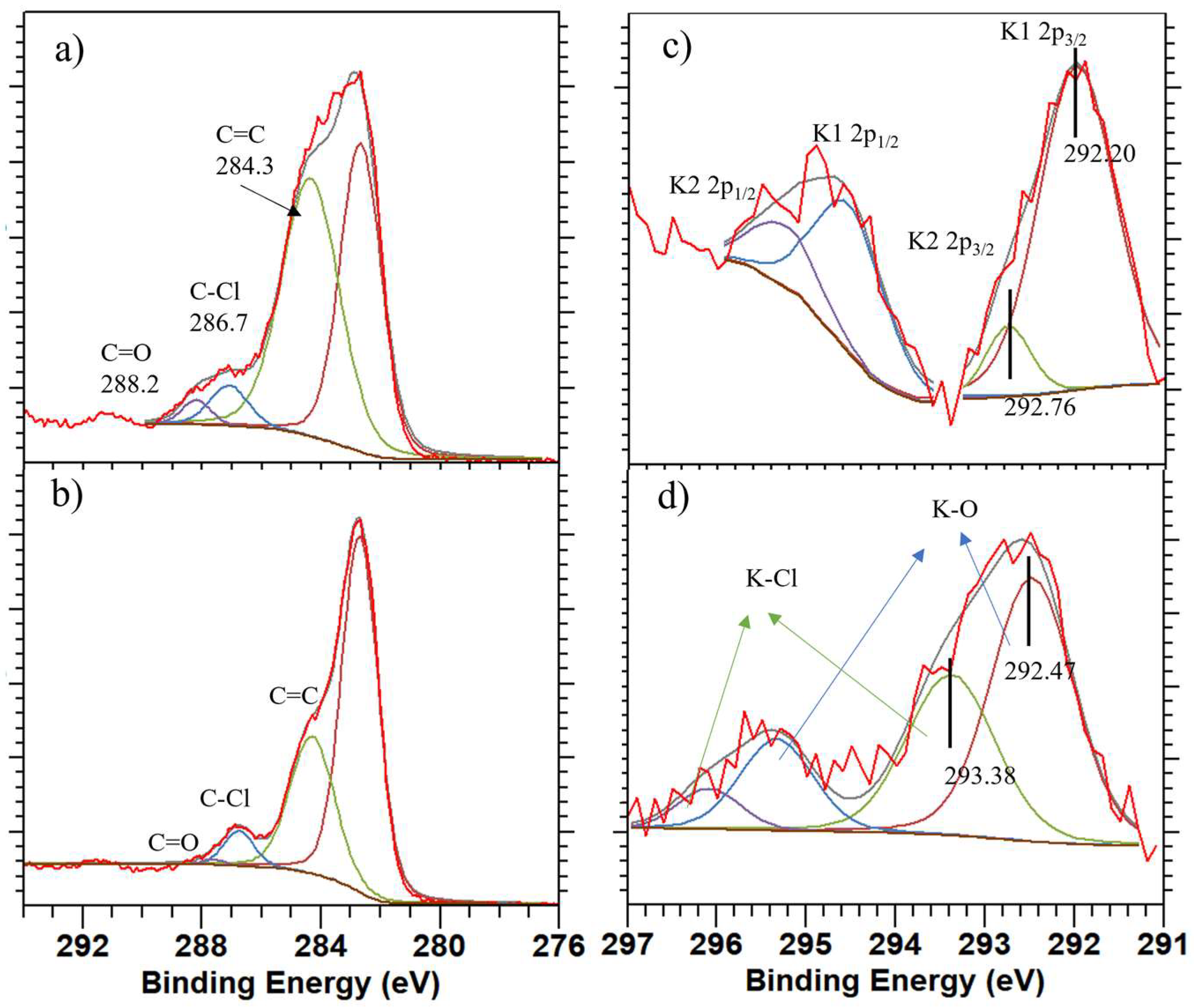
The X-ray photoelectron spectroscopy (XPS) data for the C and the K levels of the sample: CHB (a and c) and CBB (b and d) are shown in Figure 4 and Table S1, respectively. The C1s core level for CHB and CBB (Figure 4a,b) represent C-C (282.0 eV) and C=C bonds (284.3 eV), which are typically found in well-carbonized biochar [55]. C-Cl bonds appeared at a binding energy of 286.75 eV, as observed in other reports [56]. A weak peak at ≈288.20 eV was attributed to C-O bonds [57]. It reveals clear evidence of chlorine in the biochar samples or chlorinated biochar.
The spectra show the binding states of potassium (K) in Figure 4c,d, crucial for understanding basicity and the CO2 uptake site. The K1 2p3/2 and 2p1/2 XPS spectra at 292.20 and 294.53 eV are attributed to compounds combining potassium or the K-O group (KClO4) [58]. The K1 2p3/2 and 2p1/2 XPS spectra at 292.47 eV and 295.33 eV correspond to potassium chloride (KCl) [59]. CHB exhibits cleaner carbon surfaces with a reduced presence of heteroatoms, indicating more stable or graphitized (C=C) structures, whereas CBB demonstrates more surface functionalization (C-Cl and C=O), potentially influencing basicity. Higher K signals of CBB may also have stronger basicity than those of CHB, as demonstrated by XRF data. No K-related XPS spectra were observed for CBB-w, indicating the removal of K species after water washing.
Semi-quantitative Rietveld refinement was performed to compare the crystalline mineral phases in CHB, CBB, and CBB-w. The results indicated that CBB contained relatively greater contributions from K-, Na-, and Ca-containing crystalline phases, including KCl, NaCl, CaCl2, K2O, and CaO, than CHB (Figure S6). The relationship between mineral composition and ash content was further examined using XRF, XRD, XPS, and Rietveld refinement analysis (Figure S7). A strong positive linear relationship was observed between ash content and XRF-derived K content, indicating that potassium-containing inorganic species were a major contributor to the ash fraction, with CBB showing the highest ash and K contents. This interpretation is further supported by the semi-quantitative Rietveld refinement of the XRD patterns, which revealed a higher contribution of crystalline KCl in CBB than in CHB, while these crystalline mineral phases were markedly reduced or became undetectable after water washing. Consistently, XPS analysis confirmed the presence of surface K-containing species, assigned mainly to KCl, in both CHB and CBB, whereas their signals were significantly diminished after washing. Taken together, the Rietveld refinement, XRF, XPS, and ash-content results consistently demonstrate that K-containing inorganic species contribute substantially to the mineral fraction of the biochars and that water washing effectively removes surface-accessible and water-soluble mineral species.

3.2. CO2 Uptake

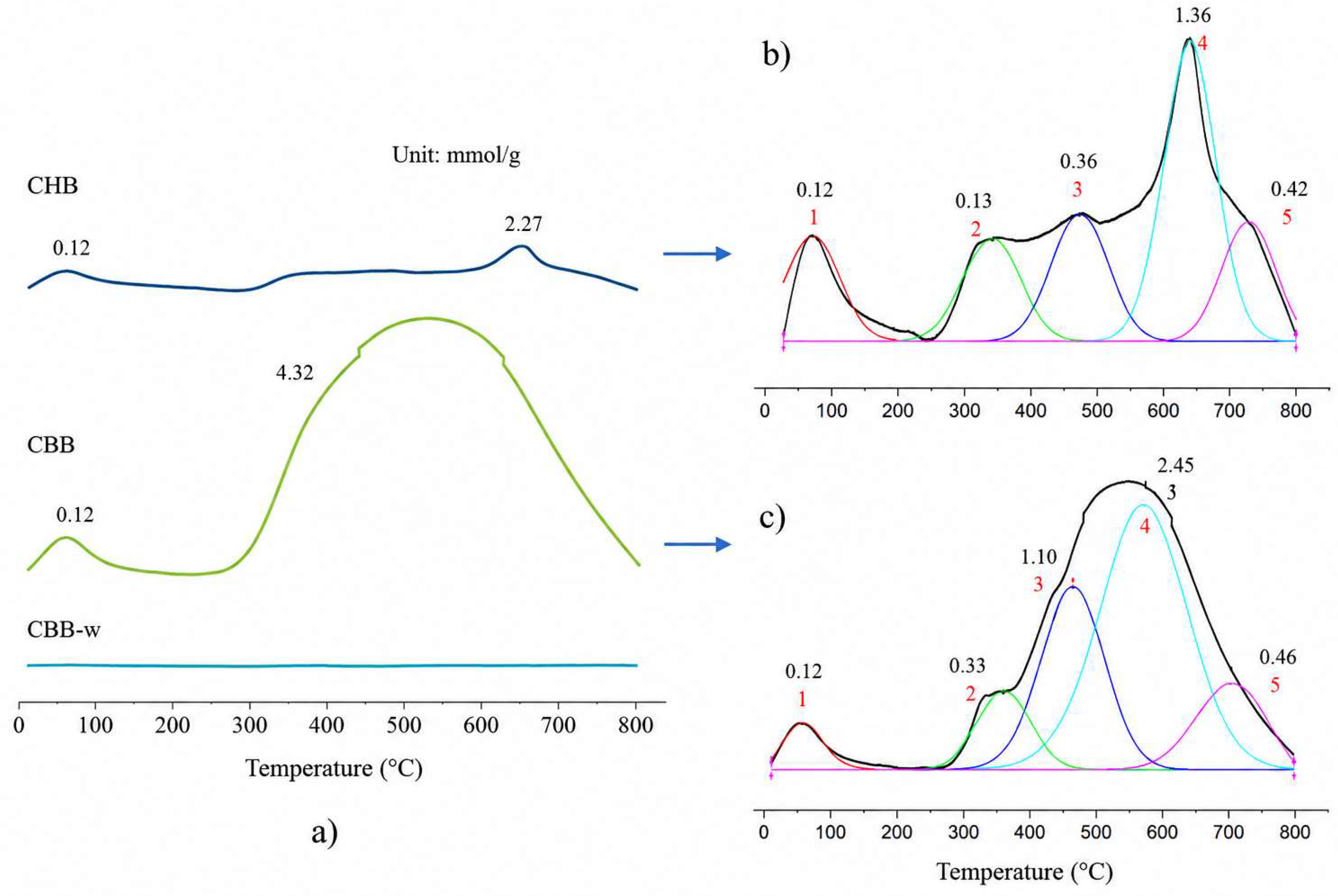
The strength and amount of CO2 uptake were implemented to measure how the efficiency of aromatic coconut biochar could sorb odor or unwanted gases in the atmosphere. The desorption temperature of CO2 gas represents the attractive force between the solid surface and the gas. The higher the desorption temperature, the stronger the absorption force of gases on the surface. The CO2 desorption on aromatic coconut wastes is shown in Figure 5. The desorption temperature from CHB and CBB reveals five-point desorption temperatures (700–750, 600–650, 400–450, 300–350, and 90–120 °C). The low-temperature desorption region at 90–120 °C was assigned to physically adsorbed CO2 associated with weak van der Waals interactions and pore confinement. The intermediate desorption regions at 300–500 °C were attributed to weak-to-moderate chemisorption on oxygen-containing functional groups and weak basic surface sites. The high-temperature regions over 600 °C were assigned to strong chemisorption associated with mineral-derived basic sites, particularly alkali and alkaline-earth metal species. The peak area of each deconvoluted component was calculated and normalized to the total desorption peak area to estimate the relative contribution of each adsorption mechanism. Higher temperature desorption results in higher strength between CO2 and biochar. There was no desorption peak of CBB-w after CBB was washed under vigorous deionized water. Water could remove metals/salts from the aromatic coconut biochar.
To elucidate the amount of CO2 uptake on the CHB and CBB surfaces, the TPD analysis of biochar derived from coconut waste was conducted, revealing notable differences in both the strength and amount of adsorption sites. CBB exhibited significantly higher total CO2 desorption (4.44 mmol/g) compared to CHB (2.39 mmol/g). Deconvolution of the TPD profiles showed that CBB contained a proportion of medium sorption strength (1.10 mmol/g, peak 3) and strong sorption strength (2.45 mmol/g, peak 4), while CHB was dominated by strong adsorption strength (1.36 mmol/g, peak 4). The number of strongest (peak 5) and weakest (peak 1) adsorption sites shows no significant difference. The washed CBB (CBB-w) displays no CO2 desorption, confirming that washing removes key basic components, particularly mineral-based sites for CO2 uptake. This suggests that CBB possesses not only a higher quantity but also a greater strength of uptake sites, likely due to its higher fixed carbon and structural properties, making it more effective for applications such as CO2 uptake and catalytic reactions. CBB can uptake more gas than CHB because it contains the highest amount of potassium, calcium, and sodium, as reported from XRF. According to XRD and XPS results, the KCl, KClO4, NaCl, and CaCl2 species that are produced during carbonization at temperatures higher than 500 °C have a significant impact on CO2 uptake. Other research proposed that theoretically metal ions, such as K+ ions, with high levels of N-doping, and significant microporosity play a key role in promoting CO2 uptake [60]. Catherine et al. proposed that the KCl-incorporated graphitic carbon influenced enhanced CO2 uptake [61]. Thus, the uptake values represent chemisorbed CO2 associated with alkali salts (KCl, K2O, CaCl2) formed during pyrolysis. Aromatic coconuts are typically cultivated in coastal or canal-adjacent areas influenced by slightly brackish water and mineral-rich soils (N, P, K, Ca, and Mg) [62], conditions that contribute to their characteristic fragrance and growth performance [63]. This cultivation environment promotes the accumulation of alkali and alkali-earth elements within the biomass, which are partially retained after pyrolysis. Consequently, coconut-derived biochar exhibits a naturally occurring mineral species (e.g., K+ and Ca2+) and makes it a unique adsorbent.
Table 4 compares the CO2 uptake capacities of different adsorbents at low pyrolysis temperatures of 298–303 K. The CBB prepared in this study showed a CO2 uptake capacity of 4.44 mmol/g, which was higher than those of CHB (2.39 mmol/g), mixed metal oxide (2.27 mmol/g), MgO/FS (3.43 mmol/g), and CaO/FS (3.11 mmol/g). The superior performance of CBB compared with CHB was attributed to its higher content of alkali and alkali-earth mineral species, which could react with CO2 to carbonate forms. The absence of detectable CO2 uptake in CBB-w after washing further confirms the key role of these mineral species in enhancing CO2 capture. Although CaO-loaded charcoal exhibited a higher CO2 uptake capacity of 8.00 mmol/g, CBB still demonstrated promising performance as a low-cost and sustainable biochar-based adsorbent derived from aromatic coconut waste.

3.3. Moisture Uptake

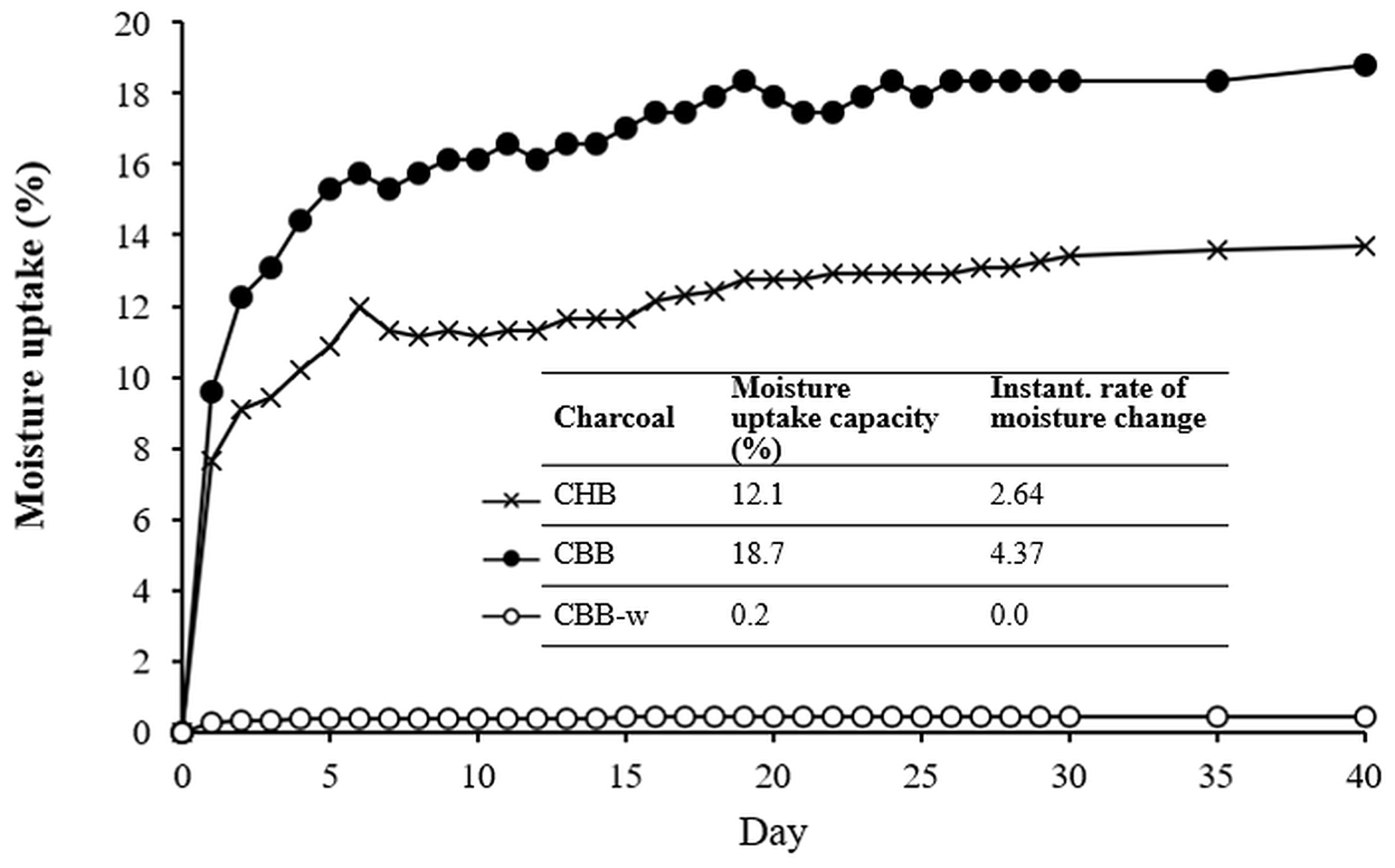
Moisture uptake in porous materials is important for many applications, such as dehumidification, thermal batteries, and the delivery of drinking water in remote areas. Moisture uptake of biochar from aromatic coconut waste is evaluated as shown in Figure 6. The amount of moisture capacity in CHB, CBB, and CBB-w was 12.1%, 18.7%, and 0.2%, respectively. The instantaneous rate of weight change in CBB (4.37) is more than double that of CHB (2.64). CBB has the highest moisture uptake capacity and the highest rate of weight change compared to CHB and CBB-w. The hydroxyl functional group in the water molecule is attached by K+, Na+, or Ca2+ ions, which initiate the formation of ion–dipole interactions with water molecules. Hence, the amount of water vapor adsorbed on biochar is relative to the amount of minerals in the biochar. From XRF, the amount of alkali (Na, K, and Ca) in CBB (12.5 wt%) is higher than that of CHB (7.1 wt%). Moreover, the BET isotherms are used to understand the adsorption capacity of CBB compared with CHB. As such, surface area is not the only promising factor for water uptake, but functional groups on the surface can also enhance the efficiency of moisture uptake.

3.4. MB Adsorption Isotherm

The adsorption of methylene blue onto CHB, CBB, and CBB-w biochars over time with the concentration of methylene blue set at 4 mg/L is shown in Figure S4. CHB has the highest equilibrium adsorption capacity of approximately 8 mg/g and reached equilibrium within 100 min. CBB and CBB-w biochar reach equilibrium around 100 min, and the adsorption capacity was almost the same, around 6.5 mg/g, suggesting that metals left on the surface of CBB had no significant effect on enhancing adsorption capacity. To elucidate the adsorption behavior and underlying mechanisms, the experimental equilibrium data were analyzed using the Langmuir, Freundlich, Temkin, and Dubinin–Radushkevich isotherm models. The goodness of fit was assessed using the coefficient of determination (R2), root-mean-square error (RMSE), and chi-square (χ2). The best-fitting model was identified based on the highest R2 and the lowest RMSE and χ2 values, representing the smallest deviation between the experimental and model-calculated adsorption capacities.
The Langmuir model is used to fit the adsorption isotherms of methylene blue on biochars in Figure S5a, and the fitting parameters are listed in Table 5 to study an approximation of organic compound adsorption on the biochars’ surface area. The R2 values of the adsorption isotherm models ranged from 0.837 to 0.987. Among the evaluated models, the Langmuir model provided the best fit for CBB, with R2 = 0.980, RMSE = 0.175 mg/g, and χ2 = 0.026, indicating good agreement between the experimental and calculated adsorption capacities. The Langmuir constant KL is highest for CBB-w, indicating a stronger affinity between the adsorbate and the adsorbent. The lower KL values for CBB and CHB indicated weaker affinities. The Langmuir adsorption isotherm model can excellently describe the adsorption isotherm process, suggesting that methylene blue is seemingly a monolayer on the biochars’ surface. The maximum adsorption capacity (qmax) of CHB (30.3 mg/g) > CBB (8.81 mg/g)> CHB-w (7.36 mg/g).
The Freundlich adsorption equations: yCHB = 33.393x0.6253, yCBB = 7.8658x0.225, yCBB-w = 7.2831x0.1576 are analyzed as shown in Figure S5b. The adsorption capacity (KF) indicates how much methylene blue can be adsorbed onto the surface of biochar. Higher values of KF and n indicate a greater adsorption capacity and stronger binding on a heterogeneous surface. CHB has the highest adsorption capacity (KF = 33.39 mg/g), followed by CBB (KF = 7.86 mg/g), and CBB-w (KF = 7.28 mg/g), as shown in Table 5. The adsorption intensity (1/n) reflects the favorability and intensity of adsorption. A smaller value of 1/n (closer to 0) indicates that the adsorption is less favorable and less intense. MB adsorption is most advantageous in CHB and least advantageous in CBB-w, indicating the maximum adsorption intensity for CHB and the lowest for CBB-w. CBB was better described by the Langmuir model than by the Freundlich model ( R 2 = 0.9867 versus 0.9324), indicating predominantly monolayer MB adsorption on relatively uniform and accessible sites. In contrast, the Freundlich model fitted CBB-w and CHB better than the Langmuir model, suggesting more heterogeneous adsorption sites associated with differences in surface functional groups, pore accessibility, and adsorption energies. However, because the Dubinin–Radushkevich model gave slightly higher R2 values for CBB-w and CHB, pore filling also contributed significantly to their adsorption behavior.
The Temkin model accounts for indirect adsorbate–adsorbate interactions (Figure S5c and Table 5). CBB-w shows the best adsorption performance according to the highest adsorption energy (B) and equilibrium binding constant (KT). Without any metal ions, MB adsorbs strongly on the surface of biochar. However, CHB displays very low B and extremely small KT, indicating weak adsorption capacity and interaction energy.
The Dubinin–Radushkevich (D–R) isotherm (Figure S5d and Table 5) is used to describe the adsorption mechanism on a heterogeneous surface and to distinguish between physical and chemical adsorption based on the adsorption energy. The adsorption process is physical, as confirmed by the calculated mean free energy (E < 8.0 kJ/mol). Thus, all samples follow a physical adsorption mechanism. Across all four isotherm models, the CHB sample consistently demonstrates a high MB adsorption capacity, indicating its superior performance in MB adsorption. Thus, the cylindrical pores exhibit a much higher MB adsorption than slit-shaped pores.
The maximum methylene blue adsorption capacities (qm) of the aromatic coconut-derived biochars were further compared with previously reported biomass-based adsorbents, as summarized in Table S2. The qm value of CHB (15.98 mg/g) is comparable to those reported for several untreated biochars derived from plant residues, such as Citrullus colocynthis seed (18.90 mg/g), apricot seed (19.01 mg/g), and Uvaia seed (37.15 mg/g). In contrast, CBB and CBB-w exhibit lower adsorption capacities (8.81 and 7.36 mg/g, respectively), reflecting the influence of pore geometry and accessibility rather than that of surface functional groups alone. Activated biochars, including bamboo-derived and fallen coconut leaf carbons, show substantially higher qm values (>60 mg/g); however, these materials require additional activation steps and higher energy input. Overall, the results demonstrate that CHB offers a competitive adsorption performance among non-activated biochars while maintaining advantages in terms of low preparation temperature, minimal processing, and potential scalability.

3.5. Proposed Mechanism of CO2 Uptake and MB Adsorption on Biochars

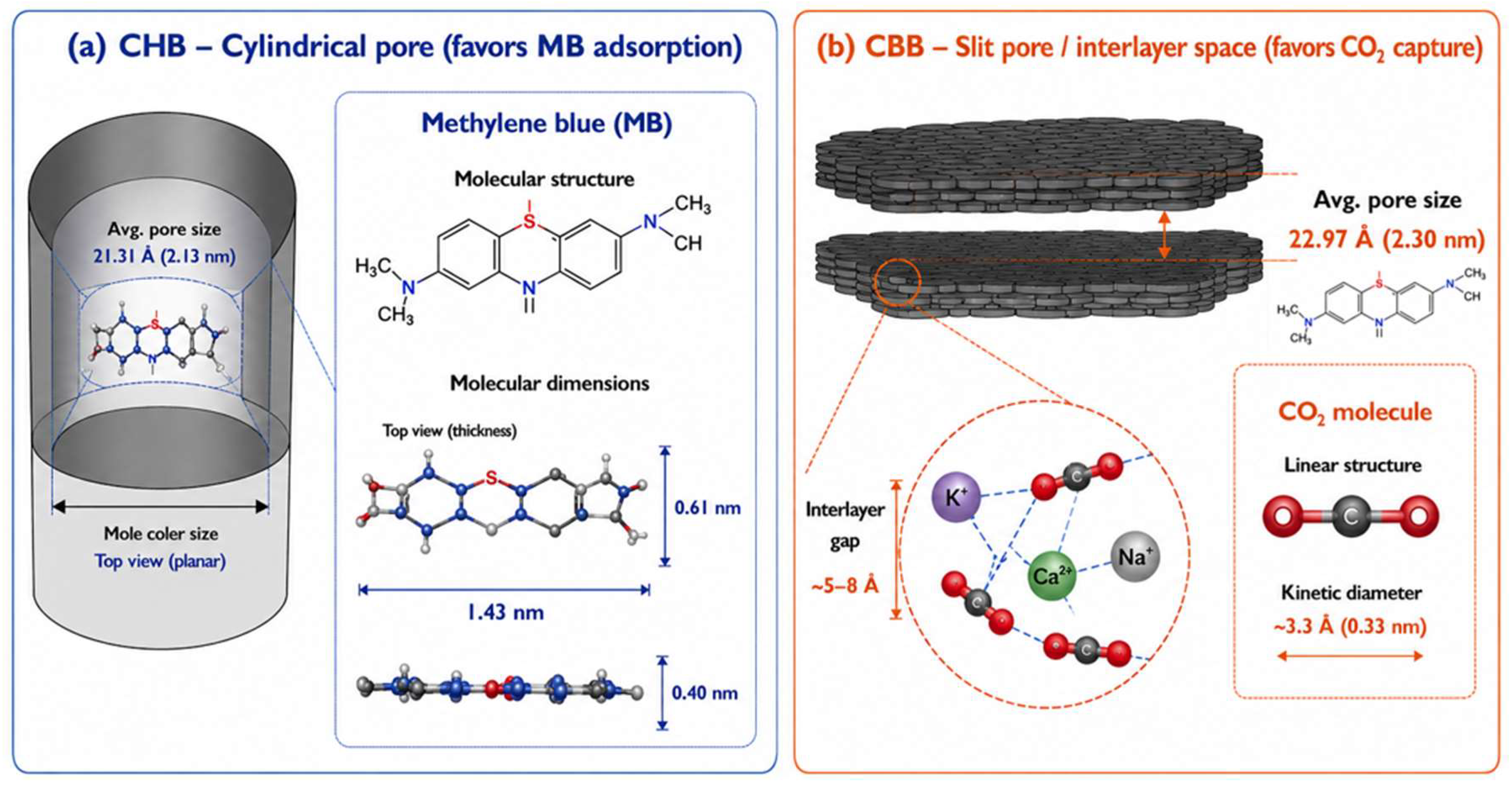
Figure 7 illustrates the adsorption mechanisms of methylene blue (MB) and CO2 on aromatic coconut-derived biochars. MB adsorption (Figure 7a) is mainly governed by physical adsorption, including pore diffusion, π–π stacking with graphitic carbon domains, and electrostatic interactions with chlorine- and oxygen-containing functional groups, such as C–Cl and C=O, identified by XPS analysis [67]. CHB shows superior MB adsorption because its pore structure is more favorable for the diffusion and accommodation of relatively large MB molecules. Although the average pore sizes of CHB and CBB were comparable (21.31 and 22.97 Å, respectively), CHB had a lower micropore fraction (57.20%) and a relatively higher macropore volume (0.0181 cm3/g) than CBB (0.0081 cm3/g). This more open cylindrical pore network likely facilitates the transport of MB molecules, which have molecular dimensions of approximately 1.43 × 0.61 × 0.40 nm [68], thereby enhancing liquid-phase adsorption. In contrast, the higher micropore fraction of CBB (74.71%) and its slit-shaped pore geometry may restrict the diffusion and accessibility of these larger dye molecules despite its greater surface area.
However, CO2 uptake is primarily facilitated by alkali and alkaline-earth metal species (K+, Na+, and Ca2+) inherently present in the biochar matrix (Figure 7b). XPS analysis reveals surface-associated K–O and K–Cl environments, indicating the presence of basic mineral sites. These cations interact with CO2 molecules through ion–quadrupole and ion–dipole interactions, which may be further enhanced in the presence of moisture, promoting the formation of surface carbonate species such as potassium carbonate [69]. In addition, the small kinetic diameter of CO2 (~3.3 Å or 0.33 nm) allows it to diffuse readily into narrow micropores and slit-shaped interlayer spaces, making microporosity especially beneficial for CO2 adsorption. Accordingly, CBB, which had a higher micropore fraction (74.71%) than CHB (57.20%), exhibited superior CO2 uptake. Notably, CBB-w showed an even higher micropore fraction (83.49%) and micropore volume (0.0799 cm3/g) than CBB, yet its CO2 uptake was lower than that of CBB. This indicates that pore structure alone does not fully determine CO2 adsorption performance and confirms that mineral species in CBB also play a crucial role in enhancing CO2 uptake.
Although CBB contains chlorine- and oxygen-containing functional groups, its MB adsorption capacity was lower than that of CHB. The higher O/C ratio of CHB suggests a greater proportion of oxygen-containing functional groups on its surface, which can enhance the adsorption of cationic MB molecules via electrostatic attraction or hydrogen bonding. Water washing did not significantly improve MB adsorption, indicating that inorganic salts were not the main limiting factor. Instead, the lower MB adsorption of CBB and CBB-w is mainly attributed to their slit-shaped pore networks and high micropore fractions, which are favorable for small gas molecules such as CO2 but less accessible to bulky MB molecules. The differing performance of CBB—exhibiting a significant CO2 uptake as well as restricted MB adsorption—illustrates a trade-off affected by pore geometry and mineral composition: micropore-dominant slit pores and specific mineral species enhance CO2 capture, while larger cylindrical/macroporous pathways favor MB adsorption.

3.6. Production Cost Analysis and Possible Application

In this study, biochar production was evaluated using both a small laboratory-scale system (30 kg tank reactor) and a larger batch reactor (1500 kg), allowing the estimation of production cost under different operational scales as shown in Table S3. Because the coconut residues used in this work are abundant agricultural wastes all year round in Thailand and are commonly available at no acquisition cost, the feedstock cost was negligible across both systems. The major expenses were associated with biomass fuel, electricity, labor, and equipment depreciation. For the small tank reactor, the total production cost was approximately $8.92 per batch, corresponding to $1.11 per kg of biochar. In contrast, the large batch reactor exhibited a lower cost of $0.83 per kg due to economies of scale.
Comparison with reported biochar production costs in the literature (Table 6), ranging from $0.4–1.1 per kg for wood- or sludge-derived biochars, $0.67–1.44 per kg for oil tea camellia shell biochars, and up to $2–5.6 per kg for modified biochars and activated carbons, showed the coconut-based biochar fell within the lower end of the global cost range. This suggests that coconut waste, when combined with low-temperature pyrolysis (500 °C), provides a highly cost-effective route for producing biochar with the potential for further cost reduction under mass-production scenarios. Compared with conventional amine scrubbing [70], adsorption systems exhibit reduced energy penalties, operational simplicity, and scalability potential, supporting biochar (particularly CBB) as a viable low-cost platform for decentralized and post-combustion CO2 uptake applications. In addition, CHB and CBB can be used for soil amendment because of their capacities in moisture uptake, which benefits soil microorganisms and organic pollutant adsorption, as well as provides nutrients for plants.
While the present study provides useful preliminary insights into the adsorption performance of aromatic coconut-derived biochars, further investigation is needed to fully evaluate the effects of pyrolysis conditions and continuous-flow adsorption behavior. In this work, the biochars were prepared at a pyrolysis temperature of 500 °C, which was selected to represent practical coconut biochar production conditions while retaining mineral-related active sites. However, pyrolysis temperature can significantly affect biochar yield, pore structure, surface functional groups, ash composition, and adsorption performance. Therefore, further studies should evaluate a wider temperature range to optimize the balance between porosity, mineral retention, and adsorption capacity. In addition, the adsorption experiments were conducted under static batch conditions; thus, breakthrough behavior, mass-transfer limitations, adsorption capacity under continuous-flow operation, and long-term stability were not assessed in this work. Future work should therefore include dynamic column experiments, regeneration tests, capacity retention, and structural stability evaluation to confirm the practical applicability of aromatic coconut-derived biochars for CO2 capture and wastewater treatment.

4. Conclusions

Both CHB and CBB exhibited comparable yields at pyrolysis conditions. The significantly high alkali mineral content in CBB (K, Na, Ca) strongly enhanced CO2 uptake, as evidenced by its superior desorption strength and higher adsorption capacity (4.44 mmol/g) relative to CHB (2.39 mmol/g). The presence of crystalline chloride/oxide species confirmed by XRD, XRF, and XPS was responsible for generating stronger basic adsorption sites. Conversely, MB adsorption followed the opposite trend. CHB exhibited the highest methylene blue adsorption capacity (~30 mg/g) and the most favorable adsorption intensity across all isotherm models. This superior performance is attributed to its cylindrical pore structure, which offers greater accessibility and more suitable pore–molecule interactions compared to the slit-shaped pores observed in CBB. Therefore, CHB is more appropriate for liquid-phase dye adsorption, whereas CBB is more effective for CO2 uptake applications. In addition, production cost analysis indicated that aromatic coconut-derived biochar could be produced at approximately $0.83–1.11 kg−1, depending on the production scale, placing it at the lower end of reported global biochar production costs. These findings demonstrate that aromatic coconut waste can serve as a low-cost and sustainable feedstock for producing biochar, supporting waste management and circular bioeconomy development.

Supplementary Materials

The following supporting information can be downloaded at https://www.mdpi.com/article/10.3390/su18168403/s1, Figure S1: A drum kiln for biochar production; Figure S2: Coconut husk biochar (CHB) and coconut empty fruit bunch biochar (CBB); Figure S3: TGA and DTG curves of aromatic coconut wastes (a) CH, and (b) CB with a heating rate of 10 °C/min under a nitrogen atmosphere flow of 50 mL/min; Figure S4: Equilibration time of MB adsorption of CHB, CBB, and CBB-w; Figure S5: MB adsorption isotherms of (a) Langmuir, (b) Freundlich, (c) Temkin, and (d) Dubinin–Radushkevich; Figure S6: Rietveld refinement and estimated relative crystalline phase fractions of CHB and CBB; Figure S7: Relationship between ash content and potassium-containing species determined by XRF, XRD, and XPS; Table S1: Binding energy of CHB and CBB; Table S2: Comparison of biochar and treated biochar for MB adsorption; Table S3: Production costs for biochar from aromatic coconut wastes; Table S4: Surface and pore characteristics from t-plot and adsorption/desorption isotherm of biochars.

Author Contributions

Conceptualization, P.I. and S.V.; methodology, P.I. and S.V.; software, P.I. and S.V.; validation, P.I. and S.V.; formal analysis, P.I. and N.S.; investigation, P.I. and S.V.; resources, P.I. and S.V.; data curation, P.I. and S.V.; writing—original draft preparation, P.I., S.V. and N.S.; writing—review and editing, P.I., S.V. and N.P.; visualization, P.I.; supervision, S.V.; project administration, P.I.; funding acquisition, S.V. All authors have read and agreed to the published version of the manuscript.

Funding

This research was funded by Thailand Science Research and Innovation, and the National Science, Research and Innovation Fund, Fiscal year 2023, with grant number (FRB660073/0164).

Institutional Review Board Statement

Not applicable.

Informed Consent Statement

Not applicable.

Data Availability Statement

The data supporting the reported results are contained within the article and the Supplementary Materials; further inquiries can be directed to the corresponding author.

Acknowledgments

The authors highly appreciate and acknowledge King Mongkut’s University of Technology Thonburi (KMUTT), Thailand Science Research and Innovation, and the National Science, Research and Innovation Fund, Fiscal year 2023, with grant number (FRB660073/0164). The authors also sincerely thank Nuanlao Dherdkiattikul, Chief Executive Officer of Aromatic Farm Company, for providing valuable support and assistance for this study.

Conflicts of Interest

The authors declare no conflicts of interest.

References

  1. FAO. FAOSTAT Crops and Livestock Products. 2025. Available online: https://www.fao.org/faostat/en/#data/QCL (accessed on 10 October 2025).
  2. Royal Thai Embassy, Copenhagen, Denmark. Thailand Now Largest Agricultural Products Exporter in ASEAN and Eighth Globally. 2024. Available online: https://copenhagen.thaiembassy.org/en/content/thailand-now-largest-agricultural-products-exporte?cate=5d81e20015e39c1614002150 (accessed on 16 October 2025).
  3. Tuyekar, S.N.; Tawade, B.S.; Singh, K.S.; Wagh, V.S.; Vidhate, P.K.; Yevale, R.P.; Gaikwad, S.; Kale, M. An overview on coconut water: As a multipurpose nutrition. Int. J. Pharm. Sci. Rev. Res. 2021, 68, 63–70. [Google Scholar] [CrossRef] [Scilit]
  4. Ngampeerapong, C.; Chavasit, V. Nutritional and bioactive compounds in coconut meat of different sources: Thailand, Indonesia and Vietnam. Chiang Mai Univ. J. Nat. Sci. 2019, 18, 562–573. [Google Scholar] [CrossRef] [Scilit]
  5. Sodsai, K.; Nuengchaknin, C.; Wuttisakulwong, S.; Piyaphanuwat, R. A study on the management of waste from the thailand aromatic coconut industry: A case study of ratchaburi and samut songkhram provinces. J. Environ. Sustain. Manag. 2025, 21, 60–77. [Google Scholar] [CrossRef]
  6. Idris, N.; Saadon, I.M.; Azize, A.M.; Zakaria, M.Z. Electrical production cost of young coconut waste pellet by using mini pellet mill-a feasibility study. Indones. J. Electr. Eng. Comput. Sci. 2020, 18, 599–606. [Google Scholar] [CrossRef] [Scilit]
  7. Gebreegziabher, T.; Oyedun, A.O.; Luk, H.T.; Lam, T.Y.G.; Zhang, Y.; Hui, C.W. Design and optimization of biomass power plant. Chem. Eng. Res. Des. 2014, 92, 1412–1427. [Google Scholar] [CrossRef] [Scilit]
  8. Tran, T.; Thi, Q.V.C.; Duong, D.V.; Trung, L.D.; Trang, N.T.Q.; Hong, L.T.A. Optimizing the C/N ratio in composting fresh coconut husk and shell waste for organic fertilizer production. IOP Conf. Ser. Earth Environ. Sci. 2024, 1419, 012019. [Google Scholar] [CrossRef] [Scilit]
  9. Thongsamer, T.; Sukkhee, N.; Vinitnantharat, B.; Tirachulee, P.; Patanachan, P.; Limkuansuwan, V. Bacteria and Nutrients in Fermented Bio-extracts from Aromatic Coconut Husk. RMUTI J. 2025, 18, 91–102. Available online: https://ph01.tci-thaijo.org/index.php/rmutijo/article/view/261176/174921 (accessed on 5 August 2026).
  10. Sopandi, T.P.; Sulianto, A.A.; Anugroho, F.; Yusoff, M.Z.M.; Mohamed, M.S.; Farid, M.A.A.; Setyawan, H.Y. RSM-optimized biochar production from young coconut waste (Cocos nucifera): Multivariate analysis of non-linear interactions between temperature, time, and activator concentration. Ind. Crops Prod. 2025, 223, 120157. [Google Scholar] [CrossRef] [Scilit]
  11. Awogbemi, O.; Kallon, D.V.V. Progress in agricultural waste derived biochar as adsorbents for wastewater treatment. Appl. Surf. Sci. Adv. 2023, 18, 100518. [Google Scholar] [CrossRef] [Scilit]
  12. Dissanayaka, D.M.N.S.; Udumann, S.S.; Nuwarapaksha, T.D.; Atapattu, A.J. Effects of pyrolysis temperature on chemical composition of coconut-husk biochar for agricultural applications: A characterization study. Technol. Agron. 2023, 3, 13. [Google Scholar] [CrossRef] [Scilit]
  13. Chen, B.; Chen, Z.; Lv, S. A novel magnetic biochar efficiently sorbs organic pollutants and phosphate. Bioresour. Technol. 2011, 102, 716–723. [Google Scholar] [CrossRef] [Scilit] [PubMed]
  14. Borgohain, A.; Konwar, K.; Buragohain, D.; Varghese, S.; Kumar Dutta, A.; Paul, R.K.; Khare, P.; Karak, T. Temperature effect on biochar produced from tea (Camellia sinensis L.) pruning litters: A comprehensive treatise on physico-chemical and statistical approaches. Bioresour. Technol. 2020, 318, 124023. [Google Scholar] [CrossRef] [Scilit] [PubMed]
  15. Vendra Singh, S.; Chaturvedi, S.; Dhyani, V.C.; Kasivelu, G. Pyrolysis temperature influences the characteristics of rice straw and husk biochar and sorption/desorption behaviour of their biourea composite. Bioresour. Technol. 2020, 314, 123674. [Google Scholar] [CrossRef] [Scilit] [PubMed]
  16. Ighalo, J.O.; Conradie, J.; Ohoro, C.R.; Amaku, J.F.; Oyedotun, K.O.; Maxakato, N.W.; Akpomie, K.G.; Okeke, E.S.; Olisah, C.; Malloum, A.; et al. Biochar from coconut residues: An overview of production, properties, and applications. Ind. Crops Prod. 2023, 204, 117300. [Google Scholar] [CrossRef] [Scilit]
  17. Cárdenas-Aguiar, E.; Méndez, A.; Gascó, G.; Lado, M.; Paz-González, A. The Effects of Feedstock, Pyrolysis Temperature, and Residence Time on the Properties and Uses of Biochar from Broom and Gorse Wastes. Appl. Sci. 2024, 14, 4283. [Google Scholar] [CrossRef] [Scilit]
  18. Khan, I.; Saeed, K.; Zekker, I.; Zhang, B.; Hendi, A.H.; Ahmad, A.; Ahmad, S.; Zada, N.; Ahmad, H.; Shah, L.A.; et al. Review on methylene blue: Its properties, uses, toxicity and photodegradation. Water 2022, 14, 242. [Google Scholar] [CrossRef] [Scilit]
  19. Ouaddari, H.; Abbou, B.; Lebkiri, I.; Habsaoui, A.; Ouzzine, M.; Fath Allah, R. Removal of Methylene Blue by adsorption onto natural and purified clays: Kinetic and thermodynamic study. Chem. Phys. Impact 2024, 8, 100405. [Google Scholar] [CrossRef] [Scilit]
  20. Fito, J.; Abewaa, M.; Mengistu, A.; Angassa, K.; Ambaye, A.D.; Moyo, W.; Nkambule, T. Adsorption of methylene blue from textile industrial wastewater using activated carbon developed from Rumex abyssinicus plant. Sci. Rep. 2023, 13, 5427. [Google Scholar] [CrossRef] [Scilit] [PubMed]
  21. Güleç, F.; Williams, O.; Kostas, E.T.; Samson, A.; Stevens, L.A.; Lester, E. A comprehensive comparative study on methylene blue removal from aqueous solution using biochars produced from rapeseed, whitewood, and seaweed via different thermal conversion technologies. Fuel 2022, 330, 125428. [Google Scholar] [CrossRef] [Scilit]
  22. Ge, Q.; Li, P.; Liu, M.; Xiao, G.-M.; Xiao, Z.-Q.; Mao, J.-W.; Gai, X.-K. Removal of methylene blue by porous biochar obtained by KOH activation from bamboo biochar. Bioresour. Bioprocess. 2023, 10, 51. [Google Scholar] [CrossRef] [Scilit] [PubMed]
  23. Chouikhi, N.; Cecilia, J.A.; Vilarrasa-García, E.; Besghaier, S.; Chlendi, M.; Franco Duro, F.I.; Rodriguez Castellon, E.; Bagane, M. CO2 adsorption of materials synthesized from clay minerals: A review. Minerals 2019, 9, 514. [Google Scholar] [CrossRef] [Scilit]
  24. Kim, K.H.; Kim, M.H. Adsorption of CO2, CO, H2, and N2 on zeolites, activated carbons, and metal-organic frameworks with different surface nonuniformities. Sustainability 2023, 15, 11574. [Google Scholar] [CrossRef] [Scilit]
  25. Nguyen, M.-V.; Lee, B.-K. Removal of dimethyl sulfide from aqueous solution using cost-effective modified chicken manure biochar produced from slow pyrolysis. Sustainability 2015, 7, 15057–15072. [Google Scholar] [CrossRef] [Scilit]
  26. Du, J.; Li, Z.; Yang, B. Selective gas adsorption and separation of carbon dioxide in metal-organic frameworks and composites. J. Phys. Conf. Ser. 2021, 2021, 012004. [Google Scholar] [CrossRef] [Scilit]
  27. Zentou, H.; Hoque, B.; Abdalla, M.A.; Saber, A.F.; Abdelaziz, O.Y.; Aliyu, M.; Alkhedhair, A.M.; Alabduly, A.J.; Abdelnaby, M.M. Recent advances and challenges in solid sorbents for CO2 capture. Carbon Capture Sci. Technol. 2025, 15, 100386. [Google Scholar] [CrossRef] [Scilit]
  28. Ghanbarpour Mamaghani, Z.; Hawboldt, K.A.; MacQuarrie, S. Adsorption of CO2 using biochar—Review of the impact of gas mixtures and water on adsorption. J. Environ. Chem. Eng. 2023, 11, 109643. [Google Scholar] [CrossRef] [Scilit]
  29. Huang, Y.-F.; Chiueh, P.-T.; Shih, C.-H.; Lo, S.-L.; Sun, L.; Zhong, Y.; Qiu, C. Microwave pyrolysis of rice straw to produce biochar as an adsorbent for CO2 capture. Energy 2015, 84, 75–82. [Google Scholar] [CrossRef] [Scilit]
  30. Zhang, C.; Ji, Y.; Li, C.; Zhang, Y.; Sun, S.; Xu, Y.; Jiang, L.; Wu, C. The application of biochar for CO2 capture: Influence of biochar preparation and CO2 capture reactors. Ind. Eng. Chem. Res. 2023, 62, 17168–17181. [Google Scholar] [CrossRef] [Scilit] [PubMed]
  31. Dissanayake, P.D.; You, S.; Igalavithana, A.D.; Xia, Y.; Bhatnagar, A.; Gupta, S.; Kua, H.W.; Kim, S.; Kwon, J.-H.; Tsang, D.C.W.; et al. Biochar-based adsorbents for carbon dioxide capture: A critical review. Renew. Sustain. Energy Rev. 2020, 119, 109582. [Google Scholar] [CrossRef] [Scilit]
  32. Guo, S.; Li, Y.; Wang, Y.; Wang, L.; Sun, Y.; Liu, L. Recent advances in biochar-based adsorbents for CO2 capture. Carbon Capture Sci. Technol. 2022, 4, 100059. [Google Scholar] [CrossRef] [Scilit]
  33. Suba, M.; Verdeș, O.; Borcănescu, S.; Popa, A. Effect of temperature on CO2 adsorption onto amine-Functionalized KIT-6 adsorbents. Molecules 2024, 29, 3172. [Google Scholar] [CrossRef] [Scilit] [PubMed]
  34. Takeuchi, K.; Yamamoto, S.; Hamamoto, Y.; Shiozawa, Y.; Tashima, K.; Fukidome, H.; Koitaya, T.; Mukai, K.; Yoshimoto, S.; Suemitsu, M.; et al. Adsorption of CO2 on graphene: A combined TPD, XPS, and vdW-DF study. J. Phys. Chem. C 2017, 121, 2807–2814. [Google Scholar] [CrossRef] [Scilit]
  35. Abbas, M.; Trari, M. Adsorption Behavior of Methylene Blue Onto Activated Coconut Shells: Kinetic, Thermodynamic, Mechanism and Regeneration of the Adsorbent. Dose-Response 2024, 22, 1–18. [Google Scholar] [CrossRef] [Scilit] [PubMed]
  36. Kundu, S.; Khandaker, T.; Anik, M.A.-A.M.; Hasan, M.K.; Dhar, P.K.; Dutta, S.K.; Latif, M.A.; Hossain, M.S. A comprehensive review of enhanced CO2 capture using activated carbon derived from biomass feedstock. RSC Adv. 2024, 14, 29693–29736. [Google Scholar] [CrossRef] [Scilit] [PubMed]
  37. Nematian, M.; Keske, C.; Ng’ombe, J.N. A techno-economic analysis of biochar production and the bioeconomy for orchard biomass. Waste Manag. 2021, 135, 467–477. [Google Scholar] [CrossRef] [Scilit] [PubMed]
  38. ASTM D4607-94; Standard Test Method for Determination of Iodine Number of Activated Carbon. ASTM: West Conshohocken, PA, USA, 2006. Available online: http://osmindustrial.com/wp-content/uploads/2017/10/ASTM-D4607-Standard-Test-Method-for-Determination-of-Iodine-Number-of-Activated-Carbon.pdf (accessed on 20 April 2026).
  39. ASTM D3174-12; Standard Test Method for Ash in the Analysis Sample of Coal and Coke from Coal. ASTM: West Conshohocken, PA, USA, 2018. Available online: https://www.scribd.com/document/1028989377/Standard-Test-Method-for-Ash-in-the-Analysis-Sample-of-Coal-and-Coke-From-Coal (accessed on 20 April 2026).
  40. Gray, M.; Johnson, M.G.; Dragila, M.I.; Kleber, M. Water uptake in biochars: The roles of porosity and hydrophobicity. Biomass Bioenergy 2014, 61, 196–205. [Google Scholar] [CrossRef] [Scilit]
  41. Furukawa, H.; Gándara, F.; Zhang, Y.-B.; Jiang, J.; Queen, W.L.; Hudson, M.R.; Yaghi, O.M. Water Adsorption in Porous Metal–Organic Frameworks and Related Materials. J. Am. Chem. Soc. 2014, 136, 4369–4381. [Google Scholar] [CrossRef] [Scilit] [PubMed]
  42. Acharya, A.; Jeppu, G.; Raju Girish, C.; Prabhu, B. Development of a multicomponent adsorption isotherm equation and its validation by modeling. Langmuir 2023, 39, 17862–17878. [Google Scholar] [CrossRef] [Scilit] [PubMed]
  43. Ayawei, N.; Ebelegi, A.N.; Wankasi, D. Modelling and interpretation of adsorption isotherms. J. Chem. 2017, 2017, 3039817. [Google Scholar] [CrossRef] [Scilit]
  44. Rubel, R.I.; Wei, L. Economic assessment of biochar-based controlled-release nitrogen fertilizer production at different industrial scales. Waste Biomass Valorization 2025, 16, 6833–6849. [Google Scholar] [CrossRef] [Scilit]
  45. Díez, D.; Urueña, A.; Piñero, R.; Barrio, A.; Tamminen, T. Determination of hemicellulose, cellulose, and lignin content in different types of biomasses by thermogravimetric analysis and pseudocomponent kinetic model (TGA-PKM Method). Processes 2020, 8, 1048. [Google Scholar] [CrossRef] [Scilit]
  46. Yang, H.; Yan, R.; Chen, H.; Lee, D.H.; Zheng, C. Characteristics of hemicellulose, cellulose and lignin pyrolysis. Fuel 2007, 86, 1781–1788. [Google Scholar] [CrossRef] [Scilit]
  47. Ajien, A.; Idris, J.; Sofwan, N.M.; Husen, R.; Seli, H. Coconut shell and husk biochar: A review of production and activation technology, economic, financial aspect and application. Waste Manag. Res. 2023, 41, 37–51. [Google Scholar] [CrossRef] [Scilit] [PubMed]
  48. Hu, D.; Zhang, M.; Xu, H.; Wang, Y.; Yan, K. Recent advance on the catalytic system for efficient production of biomass-derived 5-hydroxymethylfurfural. Renew. Sustain. Energy Rev. 2021, 147, 111253. [Google Scholar] [CrossRef] [Scilit]
  49. Abioye, K.J.; Harun, N.Y.; Sufian, S.; Yusuf, M.; Jagaba, A.H.; Ekeoma, B.C.; Kamyab, H.; Sikiru, S.; Waqas, S.; Ibrahim, H. A review of biomass ash related problems: Mechanism, solution, and outlook. J. Energy Inst. 2024, 112, 101490. [Google Scholar] [CrossRef] [Scilit]
  50. Ahn, K.-H.; Shin, D.-C.; Lee, Y.-E.; Jeong, Y.; Jung, J.; Kim, I.T. Biochar production and demineralization characteristics of food waste for fuel conversion. Molecules 2023, 28, 6114. [Google Scholar] [CrossRef] [Scilit] [PubMed]
  51. Xu, L.; Zhang, J.; Ding, J.; Liu, T.; Shi, G.; Li, X.; Dang, W.; Cheng, Y.; Guo, R. Pore structure and fractal characteristics of different shale lithofacies in the dalong formation in the western area of the lower Yangtze platform. Minerals 2020, 10, 72. [Google Scholar] [CrossRef] [Scilit]
  52. Thommes, M.; Kaneko, K.; Neimark, A.V.; Olivier, J.P.; Rodriguez-Reinoso, F.; Rouquerol, J.; Sing, K.S.W. Physisorption of gases, with special reference to the evaluation of surface area and pore size distribution (IUPAC Technical Report). Pure Appl. Chem. 2015, 87, 1051–1069. [Google Scholar] [CrossRef] [Scilit]
  53. Feinberg, B.J.; Hsiao, J.C.; Park, J.; Zydney, A.L.; Fissell, W.H.; Roy, S. Slit pores preferred over cylindrical pores for high selectivity in biomolecular filtration. J. Colloid Interface Sci. 2018, 517, 176–181. [Google Scholar] [CrossRef] [Scilit] [PubMed]
  54. Kanani, D.M.; Fissell, W.H.; Roy, S.; Dubnisheva, A.; Fleischman, A.; Zydney, A.L. Permeability–selectivity analysis for ultrafiltration: Effect of pore geometry. J. Membr. Sci. 2010, 349, 405–410. [Google Scholar] [CrossRef] [Scilit] [PubMed]
  55. Simões dos Reis, G.; Mayandi Subramaniyam, C.; Cárdenas, A.D.; Larsson, S.H.; Thyrel, M.; Lassi, U.; García-Alvarado, F. Facile synthesis of sustainable activated biochars with different pore structures as efficient additive-carbon-free anodes for lithium- and sodium-ion batteries. ACS Omega 2022, 7, 42570–42581. [Google Scholar] [CrossRef] [Scilit] [PubMed]
  56. Xie, L.; Wang, H.; Jin, C.; Wang, X.; Jiao, L.; Suenaga, K.; Dai, H. Graphene nanoribbons from unzipped carbon nanotubes: Atomic structures, raman spectroscopy, and electrical properties. J. Am. Chem. Soc. 2011, 133, 10394–10397. [Google Scholar] [CrossRef] [Scilit] [PubMed]
  57. Zhang, X.; Schiros, T.; Nordlund, D.; Shin, Y.C.; Kong, J.; Dresselhaus, M.; Palacios, T. X-ray spectroscopic investigation of chlorinated graphene: Surface structure and electronic effects. Adv. Funct. Mater. 2015, 25, 4163–4169. [Google Scholar] [CrossRef] [Scilit]
  58. Yu, C.; Chen, X.; Li, N.; Chen, J.; Yao, L.; Zhou, Y.; Lu, K.; Lai, Y.; Lai, X. Biomass ash pyrolyzed from municipal sludge and its adsorption performance toward tetracycline: Effect of pyrolysis temperature and KOH activation. Environ. Sci. Pollut. Res. 2022, 29, 81383–81395. [Google Scholar] [CrossRef] [Scilit] [PubMed]
  59. Stoch, J.; Ladecka, M. An XPS study of the KCl surface oxidation in oxygen glow discharge. Appl. Surf. Sci. 1988, 31, 426–436. [Google Scholar] [CrossRef] [Scilit]
  60. Wang, S.; Zhan, J.; Chen, K.; Ali, A.; Zeng, L.; Zhao, H.; Hu, W.; Zhu, L.; Xu, X. Potassium-doped g-C3N4 achieving efficient visible-light-driven CO2 reduction. ACS Sustain. Chem. Eng. 2020, 8, 8214–8222. [Google Scholar] [CrossRef] [Scilit]
  61. Catherine, H.N.; Liu, Z.-T.; Lin, C.-Y.; Chung, P.-W.; Tsunekawa, S.; Lin, S.D.; Yoshida, M.; Hu, C. Understanding the intermediates and carbon dioxide adsorption of potassium chloride-incorporated graphitic carbon nitride with tailoring melamine and urea as precursors. J. Colloid Interface Sci. 2023, 633, 598–607. [Google Scholar] [CrossRef] [Scilit] [PubMed]
  62. Lins, P.M.P.; Ferreira, E.V.d.O. Nutrition and production of coconut palm cultivated with mineral fertilization in the state of Pará. Rev. Bras. Frutic. 2021, 43, e-113. [Google Scholar] [CrossRef] [Scilit]
  63. Balasoooriya, L. Sustainable Potassium Sources for Organic Coconut Cultivation: Enhancing Growth and Productivity. 2023. Available online: https://www.researchgate.net/publication/371851876_Sustainable_Potassium_Sources_for_Organic_Coconut_Cultivation_Enhancing_Growth_and_Productivity (accessed on 10 March 2026).
  64. Zhu, X.; Ge, T.; Yang, F.; Lyu, M.; Chen, C.; O’Hare, D.; Wang, R. Efficient CO2 capture from ambient air with amine-functionalized Mg–Al mixed metal oxides. J. Mater. Chem. A 2020, 8, 16421–16428. [Google Scholar] [CrossRef] [Scilit]
  65. Yusof, S.M.; Othaman, R.; Setiabudi, H.D.; Teh, L.P. Modified fibrous silica for enhanced carbon dioxide adsorption: Role of metal oxides on physicochemical properties and adsorption performance. J. Solid State Chem. 2021, 294, 121845. [Google Scholar] [CrossRef] [Scilit]
  66. Gao, N.; Chen, K.; Quan, C. Development of CaO-based adsorbents loaded on charcoal for CO2 capture at high temperature. Fuel 2020, 260, 116411. [Google Scholar] [CrossRef] [Scilit]
  67. Jiang, D.; Li, H.; Cheng, X.; Ling, Q.; Chen, H.; Barati, B.; Yao, Q.; Abomohra, A.; Hu, X.; Bartocci, P.; et al. A mechanism study of methylene blue adsorption on seaweed biomass derived carbon: From macroscopic to microscopic scale. Process Saf. Environ. Prot. 2023, 172, 1132–1143. [Google Scholar] [CrossRef] [Scilit]
  68. Raposo, F.; De La Rubia, M.A.; Borja, R. Methylene blue number as useful indicator to evaluate the adsorptive capacity of granular activated carbon in batch mode: Influence of adsorbate/adsorbent mass ratio and particle size. J. Hazard. Mater. 2009, 165, 291–299. [Google Scholar] [CrossRef] [Scilit] [PubMed]
  69. Lee, J.; Kim, K.-H.; Kwon, E.E. Biochar as a Catalyst. Renew. Sustain. Energy Rev. 2017, 77, 70–79. [Google Scholar] [CrossRef] [Scilit]
  70. Darmayanti, M.G.; Tuck, K.L.; Thang, S.H. Carbon dioxide capture by emerging innovative polymers: Status and perspectives. Adv. Mater. 2024, 36, 2403324. [Google Scholar] [CrossRef] [Scilit] [PubMed]
  71. Li, S.; Chen, G. Thermogravimetric, thermochemical, and infrared spectral characterization of feedstocks and biochar derived at different pyrolysis temperatures. Waste Manag. 2018, 78, 198–207. [Google Scholar] [CrossRef] [Scilit] [PubMed]
  72. Nguyen, M.-V.; Lee, B.-K. A novel removal of CO2 using nitrogen doped biochar beads as a green adsorbent. Process Saf. Environ. Prot. 2016, 104, 490–498. [Google Scholar] [CrossRef] [Scilit]
  73. Cai, T.; Liu, X.; Zhang, J.; Tie, B.; Lei, M.; Wei, X.; Peng, O.; Du, H. Silicate-modified oiltea camellia shell-derived biochar: A novel and cost-effective sorbent for cadmium removal. J. Clean. Prod. 2021, 281, 125390. [Google Scholar] [CrossRef] [Scilit]
  74. León, M.; Silva, J.; Carrasco, S.; Barrientos, N. Design, cost estimation and sensitivity analysis for a production process of activated carbon from waste nutshells by physical activation. Processes 2020, 8, 945. [Google Scholar] [CrossRef] [Scilit]
  75. Alhashimi, H.A.; Aktas, C.B. Life cycle environmental and economic performance of biochar compared with activated carbon: A meta-analysis. Resour. Conserv. Recycl. 2017, 118, 13–26. [Google Scholar] [CrossRef] [Scilit]
Figure 1. The hysteresis loop of biochar from aromatic coconut waste: (a) CHB, (b) CBB, and (c) CBB-w.
Sustainability 18 08403 g001
Figure 2. SEM images of CHB, CBB, and CBB-w at ×1.5k magnification: (a) CHB, (b) CBB, and (c) CBB-w; and at ×100k magnification: (d) CHB, (e) CBB, and (f) CBB-w.
Sustainability 18 08403 g002
Figure 3. XRD patterns of (a) CHB, (b) CBB, and (c) CBB-w.
Sustainability 18 08403 g003
Figure 4. XPS results of C1s of (a) CHB, and (b) CBB, and XPS of K1s (c) CHB, and (d) CBB. The red lines represent the experimental XPS spectra, the gray lines represent the fitted envelopes, and the colored component peaks represent the deconvoluted chemical species. Specifically, the brown, green, blue, and purple peaks correspond to the fitted components assigned to the C 1s background and carbon-related species, including C=C, C–Cl, and C=O, as well as K-containing species in the K 1p and K 2p regions, including K–Cl and K–O.
Sustainability 18 08403 g004
Figure 5. CO2 desorption on (a) aromatic coconut wastes (CHB, CBB, and CBB-w) and peak deconvolution of CO2 from (b) CHB, and (c) CBB. The blue, green, and cyan lines in panel (a) represent the overall CO2-TPD profiles of CHB and CBB, and CBB-w. In the deconvoluted CO2-TPD profiles in panel (b) and (c), the black line represents the fitted envelopes. The red, green, blue, cyan, and magenta curves correspond to peaks 1–5, respectively, which are assigned to strength adsorption sites from weak to strong.
Sustainability 18 08403 g005
Figure 6. Percentage of moisture uptake by CHB, CBB, and CBB-w at 25 °C and 75% RH.
Sustainability 18 08403 g006
Figure 7. Proposed mechanisms of MB adsorption and CO2 uptake on the surface of the biochar (a) CHB, and (b) CBB.
Sustainability 18 08403 g007
Table 1. CHNOS elements analysis of aromatic coconut waste and biochar.
MaterialsMoisture
(%)
Elements (%)Yield (%)H/C
Ratio
O/C RatioAsh
(%)
CHNOS
CH18.845.586.130.3447.880.07N/A0.131.053.51
CB16.443.466.050.5255.940.08N/A0.141.286.76
CHB1.5665.604.710.1429.460.0926.70.070.4510.18
CBB2.3569.253.450.1827.020.1021.90.050.3920.24
Table 2. Element composition of biochars from XRF.
ElementBy Weight
CHBCBBCBB-w
K 5.617.85Nil
Cl 2.445.26Nil
Ca 0.833.08Nil
Na 0.621.60Nil
P 0.130.35Nil
S 0.040.07Nil
Si 0.200.71Nil
Mg 0.141.05Nil
Fe 0.040.09Nil
Zn 0.050.07Nil
Cu 0.010.01Nil
Mn 0.010.01Nil
Br 0.020.02Nil
Al Nil0.02Nil
Sr Nil0.01Nil
Cr 0.01NilNil
Table 3. Characteristics of surface area, porosity, and iodine number of biochar.
CharcoalSurface Area (m2/g)Total
Pore Volume
(cm3/g)
Micropore
Volume
(cm3/g)
Mesopore
Volume
(cm3/g)
Macropore
Volume
(cm3/g)
Micropore Fraction
(%)
Average Pore Size (Å)Iodine Number
(mg/g)
CHB25.600.07640.04370.01460.018157.2021.31255.07
CBB175.020.09490.07090.01590.008174.7122.97343.16
CBB-w177.170.09570.07990.01540.000483.4914.37583.47
Table 4. Comparison of CO2 uptake from this study and other studies.
MaterialsPyrolysis
Temperature
(K)
CO2 Uptake (mmol/g)Ref.
Mixed metal oxide2982.27[64]
MgO/FS2983.43[65]
CaO/FS2983.11
CaO-loaded charcoal2988.00[66]
CHB3032.39This work
CBB3034.44
CBB-w NilNil
Table 5. Langmuir, Freundlich, Temkin, and Dubinin–Radushkevich isotherm constants for MB adsorption.
BiocharLangmuir FreundlichTemkinDubinin–Radushkevich
qmKLR2RMSEχ2KF1/nR2RMSEχ2BKTR2RMSEχ2βER2RMSEχ2
(mg/g)(L/mg) (mg/g) (mg/g)(L/mg)1/n (mg/g) (J/mol)(L/g) (mol2/J2)(kJ/mol)
CBB8.818.280.98670.175
0.401
1.477
0.0267.860.2250.93240.2990.2990.6650.0003760.96620.22550.0512.00 × 10−84.810.97660.0260.026
CBB-w7.3622.140.87270.1247.280.1570.83220.4400.4410.8550.0005880.8110 0.4130.1491.00 × 10−86.710.85910.1240.124
CHB30.033.620.83701.16033.930.6250.82731.5241.3230.1412.33 × 10−110.8248 1.1641.4583.00 × 10−84.320.85021.161.453
Table 6. Comparison of production costs for biochar, modified biochar, and activated carbon.
ProductsMaterialsLocationCost ($/kg)Biochar Production Rate (kg/Day)Production Temperature
(°C)
Ref.
BiocharsWater oak woodUSA0.4–0.6N/A400–800[71]
Chicken manureKorea1.3N/A450[25]
SludgeUSA0.7–1.01000400–700[72]
Orchard biomassUSA0.57–1.45500–3500N/A[37]
Aromatic coconut residueThailand0.86–1.18–200500This work
Oil tea camellia shellChina0.67–1.44N/A500[73]
Modified
Biochars
Silicate-modified oil tea camellia shellChina0.67–5.49N/A500[73]
Amine-modified chicken manureKorea2.6N/A450[25]
NutshellsChile2.1510,000N/A[74]
Activated
Carbon
Coconut shellUSA5.6N/AN/A[75]
Disclaimer/Publisher’s Note: The statements, opinions and data contained in all publications are solely those of the individual author(s) and contributor(s) and not of MDPI and/or the editor(s). MDPI and/or the editor(s) disclaim responsibility for any injury to people or property resulting from any ideas, methods, instructions or products referred to in the content.