Valorization of Aromatic Coconut Wastes into Biochars for Carbon Dioxide Uptake and Dye Adsorption: Adsorption Behavior and Economic Feasibility


Abstract
1. Introduction
2. Materials and Methods
2.1. Biochar Preparation and Characterization
2.2. Batch Experiment
2.3. Statistical Approach and Economic Model
3. Results
3.1. Physicochemical of the Biochars
3.2. CO2 Uptake
3.3. Moisture Uptake
3.4. MB Adsorption Isotherm
3.5. Proposed Mechanism of CO2 Uptake and MB Adsorption on Biochars
3.6. Production Cost Analysis and Possible Application
4. Conclusions
Supplementary Materials
Author Contributions
Funding
Institutional Review Board Statement
Informed Consent Statement
Data Availability Statement
Acknowledgments
Conflicts of Interest
References
- FAO. FAOSTAT Crops and Livestock Products. 2025. Available online: https://www.fao.org/faostat/en/#data/QCL (accessed on 10 October 2025).
- Royal Thai Embassy, Copenhagen, Denmark. Thailand Now Largest Agricultural Products Exporter in ASEAN and Eighth Globally. 2024. Available online: https://copenhagen.thaiembassy.org/en/content/thailand-now-largest-agricultural-products-exporte?cate=5d81e20015e39c1614002150 (accessed on 16 October 2025).
- Tuyekar, S.N.; Tawade, B.S.; Singh, K.S.; Wagh, V.S.; Vidhate, P.K.; Yevale, R.P.; Gaikwad, S.; Kale, M. An overview on coconut water: As a multipurpose nutrition. Int. J. Pharm. Sci. Rev. Res. 2021, 68, 63–70. [Google Scholar] [CrossRef] [Scilit]
- Ngampeerapong, C.; Chavasit, V. Nutritional and bioactive compounds in coconut meat of different sources: Thailand, Indonesia and Vietnam. Chiang Mai Univ. J. Nat. Sci. 2019, 18, 562–573. [Google Scholar] [CrossRef] [Scilit]
- Sodsai, K.; Nuengchaknin, C.; Wuttisakulwong, S.; Piyaphanuwat, R. A study on the management of waste from the thailand aromatic coconut industry: A case study of ratchaburi and samut songkhram provinces. J. Environ. Sustain. Manag. 2025, 21, 60–77. [Google Scholar] [CrossRef]
- Idris, N.; Saadon, I.M.; Azize, A.M.; Zakaria, M.Z. Electrical production cost of young coconut waste pellet by using mini pellet mill-a feasibility study. Indones. J. Electr. Eng. Comput. Sci. 2020, 18, 599–606. [Google Scholar] [CrossRef] [Scilit]
- Gebreegziabher, T.; Oyedun, A.O.; Luk, H.T.; Lam, T.Y.G.; Zhang, Y.; Hui, C.W. Design and optimization of biomass power plant. Chem. Eng. Res. Des. 2014, 92, 1412–1427. [Google Scholar] [CrossRef] [Scilit]
- Tran, T.; Thi, Q.V.C.; Duong, D.V.; Trung, L.D.; Trang, N.T.Q.; Hong, L.T.A. Optimizing the C/N ratio in composting fresh coconut husk and shell waste for organic fertilizer production. IOP Conf. Ser. Earth Environ. Sci. 2024, 1419, 012019. [Google Scholar] [CrossRef] [Scilit]
- Thongsamer, T.; Sukkhee, N.; Vinitnantharat, B.; Tirachulee, P.; Patanachan, P.; Limkuansuwan, V. Bacteria and Nutrients in Fermented Bio-extracts from Aromatic Coconut Husk. RMUTI J. 2025, 18, 91–102. Available online: https://ph01.tci-thaijo.org/index.php/rmutijo/article/view/261176/174921 (accessed on 5 August 2026).
- Sopandi, T.P.; Sulianto, A.A.; Anugroho, F.; Yusoff, M.Z.M.; Mohamed, M.S.; Farid, M.A.A.; Setyawan, H.Y. RSM-optimized biochar production from young coconut waste (Cocos nucifera): Multivariate analysis of non-linear interactions between temperature, time, and activator concentration. Ind. Crops Prod. 2025, 223, 120157. [Google Scholar] [CrossRef] [Scilit]
- Awogbemi, O.; Kallon, D.V.V. Progress in agricultural waste derived biochar as adsorbents for wastewater treatment. Appl. Surf. Sci. Adv. 2023, 18, 100518. [Google Scholar] [CrossRef] [Scilit]
- Dissanayaka, D.M.N.S.; Udumann, S.S.; Nuwarapaksha, T.D.; Atapattu, A.J. Effects of pyrolysis temperature on chemical composition of coconut-husk biochar for agricultural applications: A characterization study. Technol. Agron. 2023, 3, 13. [Google Scholar] [CrossRef] [Scilit]
- Chen, B.; Chen, Z.; Lv, S. A novel magnetic biochar efficiently sorbs organic pollutants and phosphate. Bioresour. Technol. 2011, 102, 716–723. [Google Scholar] [CrossRef] [Scilit] [PubMed]
- Borgohain, A.; Konwar, K.; Buragohain, D.; Varghese, S.; Kumar Dutta, A.; Paul, R.K.; Khare, P.; Karak, T. Temperature effect on biochar produced from tea (Camellia sinensis L.) pruning litters: A comprehensive treatise on physico-chemical and statistical approaches. Bioresour. Technol. 2020, 318, 124023. [Google Scholar] [CrossRef] [Scilit] [PubMed]
- Vendra Singh, S.; Chaturvedi, S.; Dhyani, V.C.; Kasivelu, G. Pyrolysis temperature influences the characteristics of rice straw and husk biochar and sorption/desorption behaviour of their biourea composite. Bioresour. Technol. 2020, 314, 123674. [Google Scholar] [CrossRef] [Scilit] [PubMed]
- Ighalo, J.O.; Conradie, J.; Ohoro, C.R.; Amaku, J.F.; Oyedotun, K.O.; Maxakato, N.W.; Akpomie, K.G.; Okeke, E.S.; Olisah, C.; Malloum, A.; et al. Biochar from coconut residues: An overview of production, properties, and applications. Ind. Crops Prod. 2023, 204, 117300. [Google Scholar] [CrossRef] [Scilit]
- Cárdenas-Aguiar, E.; Méndez, A.; Gascó, G.; Lado, M.; Paz-González, A. The Effects of Feedstock, Pyrolysis Temperature, and Residence Time on the Properties and Uses of Biochar from Broom and Gorse Wastes. Appl. Sci. 2024, 14, 4283. [Google Scholar] [CrossRef] [Scilit]
- Khan, I.; Saeed, K.; Zekker, I.; Zhang, B.; Hendi, A.H.; Ahmad, A.; Ahmad, S.; Zada, N.; Ahmad, H.; Shah, L.A.; et al. Review on methylene blue: Its properties, uses, toxicity and photodegradation. Water 2022, 14, 242. [Google Scholar] [CrossRef] [Scilit]
- Ouaddari, H.; Abbou, B.; Lebkiri, I.; Habsaoui, A.; Ouzzine, M.; Fath Allah, R. Removal of Methylene Blue by adsorption onto natural and purified clays: Kinetic and thermodynamic study. Chem. Phys. Impact 2024, 8, 100405. [Google Scholar] [CrossRef] [Scilit]
- Fito, J.; Abewaa, M.; Mengistu, A.; Angassa, K.; Ambaye, A.D.; Moyo, W.; Nkambule, T. Adsorption of methylene blue from textile industrial wastewater using activated carbon developed from Rumex abyssinicus plant. Sci. Rep. 2023, 13, 5427. [Google Scholar] [CrossRef] [Scilit] [PubMed]
- Güleç, F.; Williams, O.; Kostas, E.T.; Samson, A.; Stevens, L.A.; Lester, E. A comprehensive comparative study on methylene blue removal from aqueous solution using biochars produced from rapeseed, whitewood, and seaweed via different thermal conversion technologies. Fuel 2022, 330, 125428. [Google Scholar] [CrossRef] [Scilit]
- Ge, Q.; Li, P.; Liu, M.; Xiao, G.-M.; Xiao, Z.-Q.; Mao, J.-W.; Gai, X.-K. Removal of methylene blue by porous biochar obtained by KOH activation from bamboo biochar. Bioresour. Bioprocess. 2023, 10, 51. [Google Scholar] [CrossRef] [Scilit] [PubMed]
- Chouikhi, N.; Cecilia, J.A.; Vilarrasa-García, E.; Besghaier, S.; Chlendi, M.; Franco Duro, F.I.; Rodriguez Castellon, E.; Bagane, M. CO2 adsorption of materials synthesized from clay minerals: A review. Minerals 2019, 9, 514. [Google Scholar] [CrossRef] [Scilit]
- Kim, K.H.; Kim, M.H. Adsorption of CO2, CO, H2, and N2 on zeolites, activated carbons, and metal-organic frameworks with different surface nonuniformities. Sustainability 2023, 15, 11574. [Google Scholar] [CrossRef] [Scilit]
- Nguyen, M.-V.; Lee, B.-K. Removal of dimethyl sulfide from aqueous solution using cost-effective modified chicken manure biochar produced from slow pyrolysis. Sustainability 2015, 7, 15057–15072. [Google Scholar] [CrossRef] [Scilit]
- Du, J.; Li, Z.; Yang, B. Selective gas adsorption and separation of carbon dioxide in metal-organic frameworks and composites. J. Phys. Conf. Ser. 2021, 2021, 012004. [Google Scholar] [CrossRef] [Scilit]
- Zentou, H.; Hoque, B.; Abdalla, M.A.; Saber, A.F.; Abdelaziz, O.Y.; Aliyu, M.; Alkhedhair, A.M.; Alabduly, A.J.; Abdelnaby, M.M. Recent advances and challenges in solid sorbents for CO2 capture. Carbon Capture Sci. Technol. 2025, 15, 100386. [Google Scholar] [CrossRef] [Scilit]
- Ghanbarpour Mamaghani, Z.; Hawboldt, K.A.; MacQuarrie, S. Adsorption of CO2 using biochar—Review of the impact of gas mixtures and water on adsorption. J. Environ. Chem. Eng. 2023, 11, 109643. [Google Scholar] [CrossRef] [Scilit]
- Huang, Y.-F.; Chiueh, P.-T.; Shih, C.-H.; Lo, S.-L.; Sun, L.; Zhong, Y.; Qiu, C. Microwave pyrolysis of rice straw to produce biochar as an adsorbent for CO2 capture. Energy 2015, 84, 75–82. [Google Scholar] [CrossRef] [Scilit]
- Zhang, C.; Ji, Y.; Li, C.; Zhang, Y.; Sun, S.; Xu, Y.; Jiang, L.; Wu, C. The application of biochar for CO2 capture: Influence of biochar preparation and CO2 capture reactors. Ind. Eng. Chem. Res. 2023, 62, 17168–17181. [Google Scholar] [CrossRef] [Scilit] [PubMed]
- Dissanayake, P.D.; You, S.; Igalavithana, A.D.; Xia, Y.; Bhatnagar, A.; Gupta, S.; Kua, H.W.; Kim, S.; Kwon, J.-H.; Tsang, D.C.W.; et al. Biochar-based adsorbents for carbon dioxide capture: A critical review. Renew. Sustain. Energy Rev. 2020, 119, 109582. [Google Scholar] [CrossRef] [Scilit]
- Guo, S.; Li, Y.; Wang, Y.; Wang, L.; Sun, Y.; Liu, L. Recent advances in biochar-based adsorbents for CO2 capture. Carbon Capture Sci. Technol. 2022, 4, 100059. [Google Scholar] [CrossRef] [Scilit]
- Suba, M.; Verdeș, O.; Borcănescu, S.; Popa, A. Effect of temperature on CO2 adsorption onto amine-Functionalized KIT-6 adsorbents. Molecules 2024, 29, 3172. [Google Scholar] [CrossRef] [Scilit] [PubMed]
- Takeuchi, K.; Yamamoto, S.; Hamamoto, Y.; Shiozawa, Y.; Tashima, K.; Fukidome, H.; Koitaya, T.; Mukai, K.; Yoshimoto, S.; Suemitsu, M.; et al. Adsorption of CO2 on graphene: A combined TPD, XPS, and vdW-DF study. J. Phys. Chem. C 2017, 121, 2807–2814. [Google Scholar] [CrossRef] [Scilit]
- Abbas, M.; Trari, M. Adsorption Behavior of Methylene Blue Onto Activated Coconut Shells: Kinetic, Thermodynamic, Mechanism and Regeneration of the Adsorbent. Dose-Response 2024, 22, 1–18. [Google Scholar] [CrossRef] [Scilit] [PubMed]
- Kundu, S.; Khandaker, T.; Anik, M.A.-A.M.; Hasan, M.K.; Dhar, P.K.; Dutta, S.K.; Latif, M.A.; Hossain, M.S. A comprehensive review of enhanced CO2 capture using activated carbon derived from biomass feedstock. RSC Adv. 2024, 14, 29693–29736. [Google Scholar] [CrossRef] [Scilit] [PubMed]
- Nematian, M.; Keske, C.; Ng’ombe, J.N. A techno-economic analysis of biochar production and the bioeconomy for orchard biomass. Waste Manag. 2021, 135, 467–477. [Google Scholar] [CrossRef] [Scilit] [PubMed]
- ASTM D4607-94; Standard Test Method for Determination of Iodine Number of Activated Carbon. ASTM: West Conshohocken, PA, USA, 2006. Available online: http://osmindustrial.com/wp-content/uploads/2017/10/ASTM-D4607-Standard-Test-Method-for-Determination-of-Iodine-Number-of-Activated-Carbon.pdf (accessed on 20 April 2026).
- ASTM D3174-12; Standard Test Method for Ash in the Analysis Sample of Coal and Coke from Coal. ASTM: West Conshohocken, PA, USA, 2018. Available online: https://www.scribd.com/document/1028989377/Standard-Test-Method-for-Ash-in-the-Analysis-Sample-of-Coal-and-Coke-From-Coal (accessed on 20 April 2026).
- Gray, M.; Johnson, M.G.; Dragila, M.I.; Kleber, M. Water uptake in biochars: The roles of porosity and hydrophobicity. Biomass Bioenergy 2014, 61, 196–205. [Google Scholar] [CrossRef] [Scilit]
- Furukawa, H.; Gándara, F.; Zhang, Y.-B.; Jiang, J.; Queen, W.L.; Hudson, M.R.; Yaghi, O.M. Water Adsorption in Porous Metal–Organic Frameworks and Related Materials. J. Am. Chem. Soc. 2014, 136, 4369–4381. [Google Scholar] [CrossRef] [Scilit] [PubMed]
- Acharya, A.; Jeppu, G.; Raju Girish, C.; Prabhu, B. Development of a multicomponent adsorption isotherm equation and its validation by modeling. Langmuir 2023, 39, 17862–17878. [Google Scholar] [CrossRef] [Scilit] [PubMed]
- Ayawei, N.; Ebelegi, A.N.; Wankasi, D. Modelling and interpretation of adsorption isotherms. J. Chem. 2017, 2017, 3039817. [Google Scholar] [CrossRef] [Scilit]
- Rubel, R.I.; Wei, L. Economic assessment of biochar-based controlled-release nitrogen fertilizer production at different industrial scales. Waste Biomass Valorization 2025, 16, 6833–6849. [Google Scholar] [CrossRef] [Scilit]
- Díez, D.; Urueña, A.; Piñero, R.; Barrio, A.; Tamminen, T. Determination of hemicellulose, cellulose, and lignin content in different types of biomasses by thermogravimetric analysis and pseudocomponent kinetic model (TGA-PKM Method). Processes 2020, 8, 1048. [Google Scholar] [CrossRef] [Scilit]
- Yang, H.; Yan, R.; Chen, H.; Lee, D.H.; Zheng, C. Characteristics of hemicellulose, cellulose and lignin pyrolysis. Fuel 2007, 86, 1781–1788. [Google Scholar] [CrossRef] [Scilit]
- Ajien, A.; Idris, J.; Sofwan, N.M.; Husen, R.; Seli, H. Coconut shell and husk biochar: A review of production and activation technology, economic, financial aspect and application. Waste Manag. Res. 2023, 41, 37–51. [Google Scholar] [CrossRef] [Scilit] [PubMed]
- Hu, D.; Zhang, M.; Xu, H.; Wang, Y.; Yan, K. Recent advance on the catalytic system for efficient production of biomass-derived 5-hydroxymethylfurfural. Renew. Sustain. Energy Rev. 2021, 147, 111253. [Google Scholar] [CrossRef] [Scilit]
- Abioye, K.J.; Harun, N.Y.; Sufian, S.; Yusuf, M.; Jagaba, A.H.; Ekeoma, B.C.; Kamyab, H.; Sikiru, S.; Waqas, S.; Ibrahim, H. A review of biomass ash related problems: Mechanism, solution, and outlook. J. Energy Inst. 2024, 112, 101490. [Google Scholar] [CrossRef] [Scilit]
- Ahn, K.-H.; Shin, D.-C.; Lee, Y.-E.; Jeong, Y.; Jung, J.; Kim, I.T. Biochar production and demineralization characteristics of food waste for fuel conversion. Molecules 2023, 28, 6114. [Google Scholar] [CrossRef] [Scilit] [PubMed]
- Xu, L.; Zhang, J.; Ding, J.; Liu, T.; Shi, G.; Li, X.; Dang, W.; Cheng, Y.; Guo, R. Pore structure and fractal characteristics of different shale lithofacies in the dalong formation in the western area of the lower Yangtze platform. Minerals 2020, 10, 72. [Google Scholar] [CrossRef] [Scilit]
- Thommes, M.; Kaneko, K.; Neimark, A.V.; Olivier, J.P.; Rodriguez-Reinoso, F.; Rouquerol, J.; Sing, K.S.W. Physisorption of gases, with special reference to the evaluation of surface area and pore size distribution (IUPAC Technical Report). Pure Appl. Chem. 2015, 87, 1051–1069. [Google Scholar] [CrossRef] [Scilit]
- Feinberg, B.J.; Hsiao, J.C.; Park, J.; Zydney, A.L.; Fissell, W.H.; Roy, S. Slit pores preferred over cylindrical pores for high selectivity in biomolecular filtration. J. Colloid Interface Sci. 2018, 517, 176–181. [Google Scholar] [CrossRef] [Scilit] [PubMed]
- Kanani, D.M.; Fissell, W.H.; Roy, S.; Dubnisheva, A.; Fleischman, A.; Zydney, A.L. Permeability–selectivity analysis for ultrafiltration: Effect of pore geometry. J. Membr. Sci. 2010, 349, 405–410. [Google Scholar] [CrossRef] [Scilit] [PubMed]
- Simões dos Reis, G.; Mayandi Subramaniyam, C.; Cárdenas, A.D.; Larsson, S.H.; Thyrel, M.; Lassi, U.; García-Alvarado, F. Facile synthesis of sustainable activated biochars with different pore structures as efficient additive-carbon-free anodes for lithium- and sodium-ion batteries. ACS Omega 2022, 7, 42570–42581. [Google Scholar] [CrossRef] [Scilit] [PubMed]
- Xie, L.; Wang, H.; Jin, C.; Wang, X.; Jiao, L.; Suenaga, K.; Dai, H. Graphene nanoribbons from unzipped carbon nanotubes: Atomic structures, raman spectroscopy, and electrical properties. J. Am. Chem. Soc. 2011, 133, 10394–10397. [Google Scholar] [CrossRef] [Scilit] [PubMed]
- Zhang, X.; Schiros, T.; Nordlund, D.; Shin, Y.C.; Kong, J.; Dresselhaus, M.; Palacios, T. X-ray spectroscopic investigation of chlorinated graphene: Surface structure and electronic effects. Adv. Funct. Mater. 2015, 25, 4163–4169. [Google Scholar] [CrossRef] [Scilit]
- Yu, C.; Chen, X.; Li, N.; Chen, J.; Yao, L.; Zhou, Y.; Lu, K.; Lai, Y.; Lai, X. Biomass ash pyrolyzed from municipal sludge and its adsorption performance toward tetracycline: Effect of pyrolysis temperature and KOH activation. Environ. Sci. Pollut. Res. 2022, 29, 81383–81395. [Google Scholar] [CrossRef] [Scilit] [PubMed]
- Stoch, J.; Ladecka, M. An XPS study of the KCl surface oxidation in oxygen glow discharge. Appl. Surf. Sci. 1988, 31, 426–436. [Google Scholar] [CrossRef] [Scilit]
- Wang, S.; Zhan, J.; Chen, K.; Ali, A.; Zeng, L.; Zhao, H.; Hu, W.; Zhu, L.; Xu, X. Potassium-doped g-C3N4 achieving efficient visible-light-driven CO2 reduction. ACS Sustain. Chem. Eng. 2020, 8, 8214–8222. [Google Scholar] [CrossRef] [Scilit]
- Catherine, H.N.; Liu, Z.-T.; Lin, C.-Y.; Chung, P.-W.; Tsunekawa, S.; Lin, S.D.; Yoshida, M.; Hu, C. Understanding the intermediates and carbon dioxide adsorption of potassium chloride-incorporated graphitic carbon nitride with tailoring melamine and urea as precursors. J. Colloid Interface Sci. 2023, 633, 598–607. [Google Scholar] [CrossRef] [Scilit] [PubMed]
- Lins, P.M.P.; Ferreira, E.V.d.O. Nutrition and production of coconut palm cultivated with mineral fertilization in the state of Pará. Rev. Bras. Frutic. 2021, 43, e-113. [Google Scholar] [CrossRef] [Scilit]
- Balasoooriya, L. Sustainable Potassium Sources for Organic Coconut Cultivation: Enhancing Growth and Productivity. 2023. Available online: https://www.researchgate.net/publication/371851876_Sustainable_Potassium_Sources_for_Organic_Coconut_Cultivation_Enhancing_Growth_and_Productivity (accessed on 10 March 2026).
- Zhu, X.; Ge, T.; Yang, F.; Lyu, M.; Chen, C.; O’Hare, D.; Wang, R. Efficient CO2 capture from ambient air with amine-functionalized Mg–Al mixed metal oxides. J. Mater. Chem. A 2020, 8, 16421–16428. [Google Scholar] [CrossRef] [Scilit]
- Yusof, S.M.; Othaman, R.; Setiabudi, H.D.; Teh, L.P. Modified fibrous silica for enhanced carbon dioxide adsorption: Role of metal oxides on physicochemical properties and adsorption performance. J. Solid State Chem. 2021, 294, 121845. [Google Scholar] [CrossRef] [Scilit]
- Gao, N.; Chen, K.; Quan, C. Development of CaO-based adsorbents loaded on charcoal for CO2 capture at high temperature. Fuel 2020, 260, 116411. [Google Scholar] [CrossRef] [Scilit]
- Jiang, D.; Li, H.; Cheng, X.; Ling, Q.; Chen, H.; Barati, B.; Yao, Q.; Abomohra, A.; Hu, X.; Bartocci, P.; et al. A mechanism study of methylene blue adsorption on seaweed biomass derived carbon: From macroscopic to microscopic scale. Process Saf. Environ. Prot. 2023, 172, 1132–1143. [Google Scholar] [CrossRef] [Scilit]
- Raposo, F.; De La Rubia, M.A.; Borja, R. Methylene blue number as useful indicator to evaluate the adsorptive capacity of granular activated carbon in batch mode: Influence of adsorbate/adsorbent mass ratio and particle size. J. Hazard. Mater. 2009, 165, 291–299. [Google Scholar] [CrossRef] [Scilit] [PubMed]
- Lee, J.; Kim, K.-H.; Kwon, E.E. Biochar as a Catalyst. Renew. Sustain. Energy Rev. 2017, 77, 70–79. [Google Scholar] [CrossRef] [Scilit]
- Darmayanti, M.G.; Tuck, K.L.; Thang, S.H. Carbon dioxide capture by emerging innovative polymers: Status and perspectives. Adv. Mater. 2024, 36, 2403324. [Google Scholar] [CrossRef] [Scilit] [PubMed]
- Li, S.; Chen, G. Thermogravimetric, thermochemical, and infrared spectral characterization of feedstocks and biochar derived at different pyrolysis temperatures. Waste Manag. 2018, 78, 198–207. [Google Scholar] [CrossRef] [Scilit] [PubMed]
- Nguyen, M.-V.; Lee, B.-K. A novel removal of CO2 using nitrogen doped biochar beads as a green adsorbent. Process Saf. Environ. Prot. 2016, 104, 490–498. [Google Scholar] [CrossRef] [Scilit]
- Cai, T.; Liu, X.; Zhang, J.; Tie, B.; Lei, M.; Wei, X.; Peng, O.; Du, H. Silicate-modified oiltea camellia shell-derived biochar: A novel and cost-effective sorbent for cadmium removal. J. Clean. Prod. 2021, 281, 125390. [Google Scholar] [CrossRef] [Scilit]
- León, M.; Silva, J.; Carrasco, S.; Barrientos, N. Design, cost estimation and sensitivity analysis for a production process of activated carbon from waste nutshells by physical activation. Processes 2020, 8, 945. [Google Scholar] [CrossRef] [Scilit]
- Alhashimi, H.A.; Aktas, C.B. Life cycle environmental and economic performance of biochar compared with activated carbon: A meta-analysis. Resour. Conserv. Recycl. 2017, 118, 13–26. [Google Scholar] [CrossRef] [Scilit]

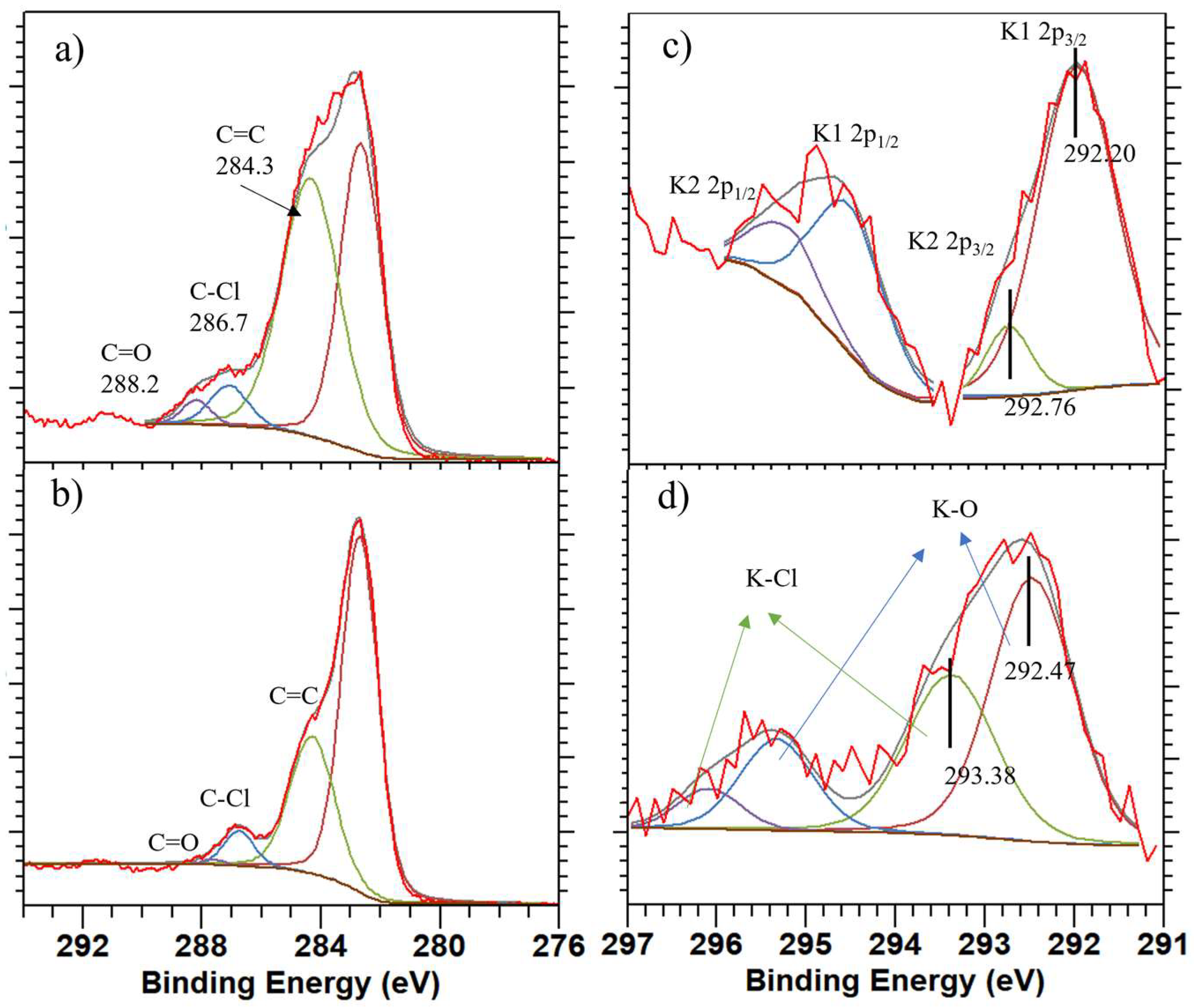
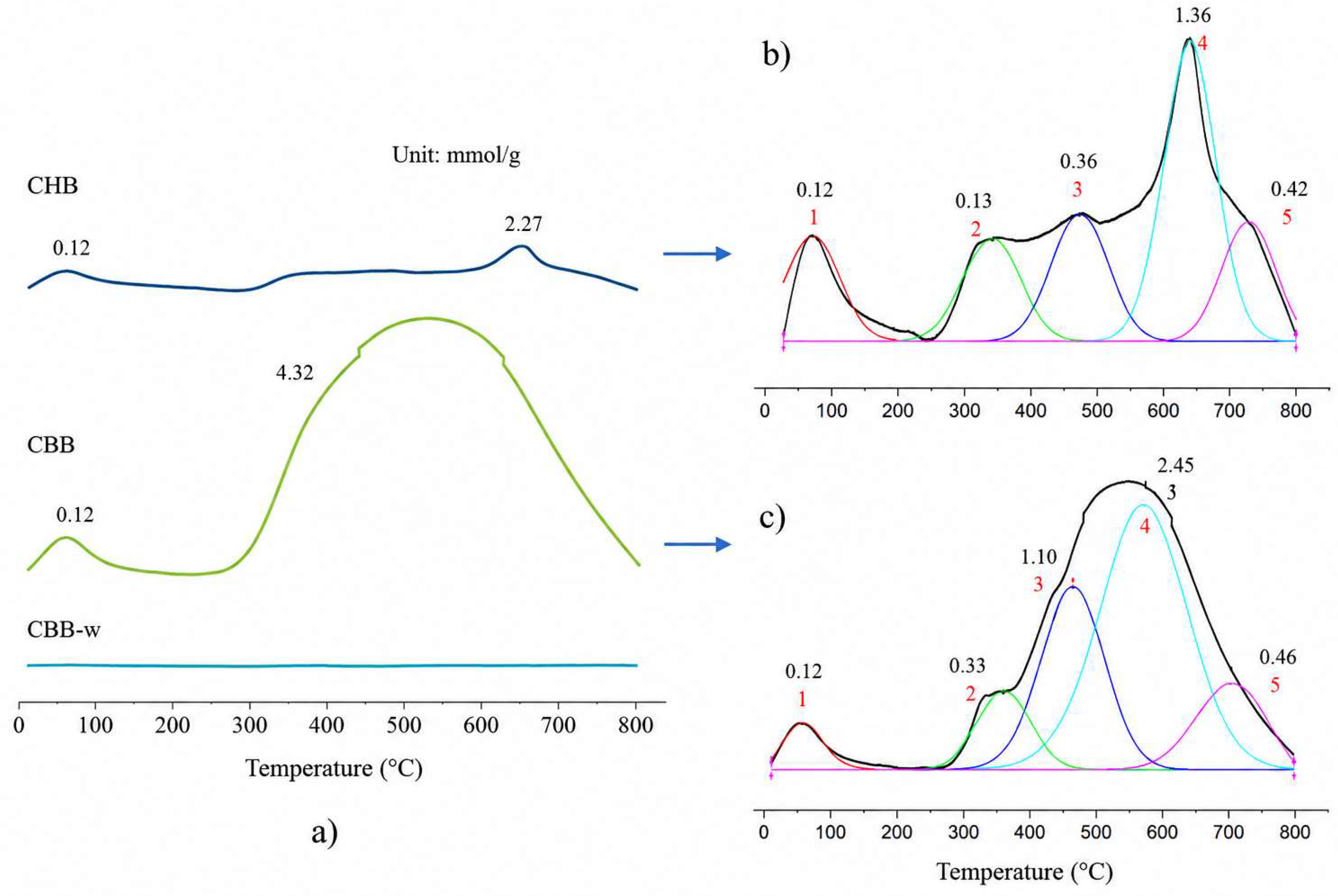
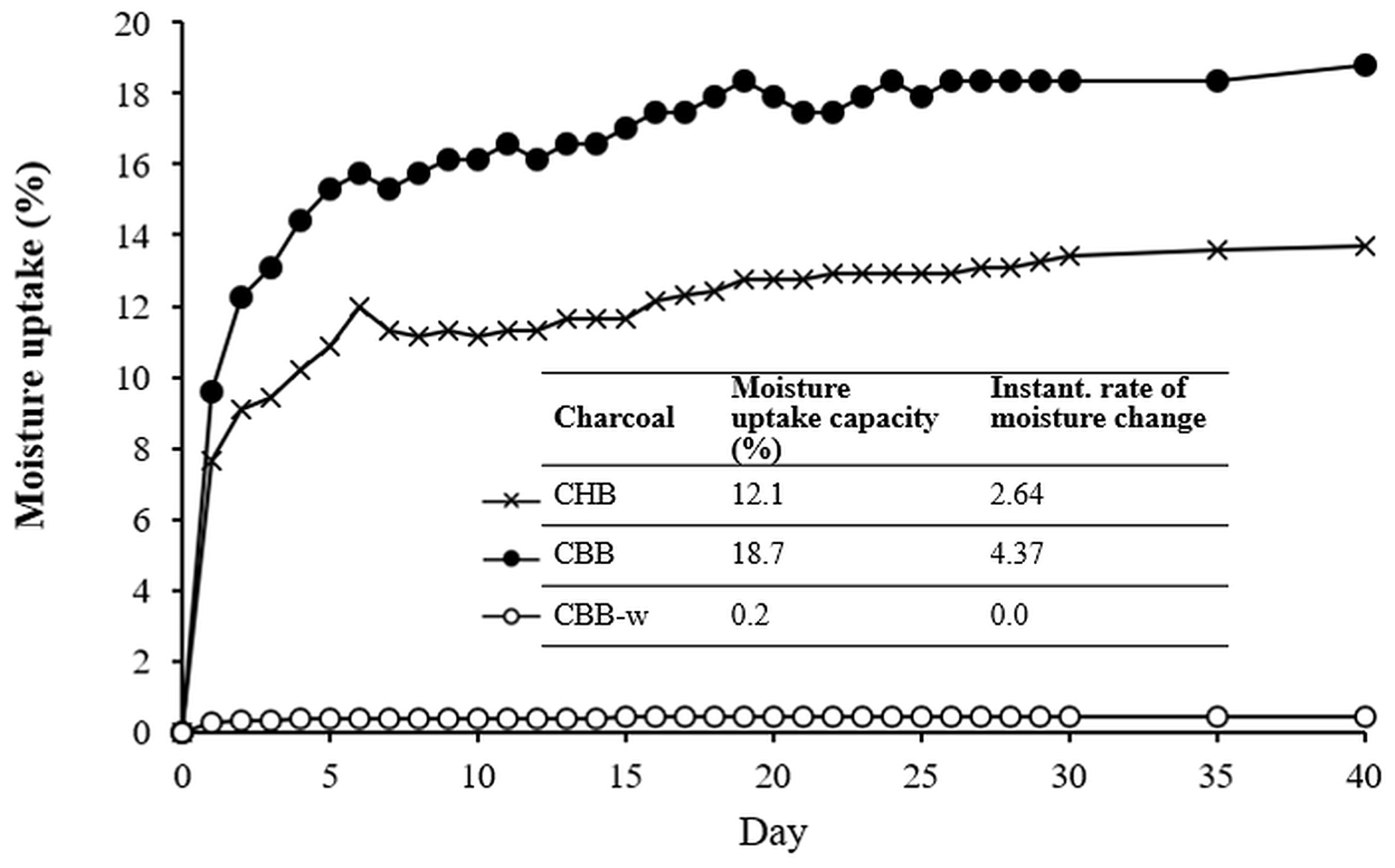


| Materials | Moisture (%) | Elements (%) | Yield (%) | H/C Ratio | O/C Ratio | Ash (%) | ||||
|---|---|---|---|---|---|---|---|---|---|---|
| C | H | N | O | S | ||||||
| CH | 18.8 | 45.58 | 6.13 | 0.34 | 47.88 | 0.07 | N/A | 0.13 | 1.05 | 3.51 |
| CB | 16.4 | 43.46 | 6.05 | 0.52 | 55.94 | 0.08 | N/A | 0.14 | 1.28 | 6.76 |
| CHB | 1.56 | 65.60 | 4.71 | 0.14 | 29.46 | 0.09 | 26.7 | 0.07 | 0.45 | 10.18 |
| CBB | 2.35 | 69.25 | 3.45 | 0.18 | 27.02 | 0.10 | 21.9 | 0.05 | 0.39 | 20.24 |
| Element | By Weight | ||
|---|---|---|---|
| CHB | CBB | CBB-w | |
| K | 5.61 | 7.85 | Nil |
| Cl | 2.44 | 5.26 | Nil |
| Ca | 0.83 | 3.08 | Nil |
| Na | 0.62 | 1.60 | Nil |
| P | 0.13 | 0.35 | Nil |
| S | 0.04 | 0.07 | Nil |
| Si | 0.20 | 0.71 | Nil |
| Mg | 0.14 | 1.05 | Nil |
| Fe | 0.04 | 0.09 | Nil |
| Zn | 0.05 | 0.07 | Nil |
| Cu | 0.01 | 0.01 | Nil |
| Mn | 0.01 | 0.01 | Nil |
| Br | 0.02 | 0.02 | Nil |
| Al | Nil | 0.02 | Nil |
| Sr | Nil | 0.01 | Nil |
| Cr | 0.01 | Nil | Nil |
| Charcoal | Surface Area (m2/g) | Total Pore Volume (cm3/g) | Micropore Volume (cm3/g) | Mesopore Volume (cm3/g) | Macropore Volume (cm3/g) | Micropore Fraction (%) | Average Pore Size (Å) | Iodine Number (mg/g) |
|---|---|---|---|---|---|---|---|---|
| CHB | 25.60 | 0.0764 | 0.0437 | 0.0146 | 0.0181 | 57.20 | 21.31 | 255.07 |
| CBB | 175.02 | 0.0949 | 0.0709 | 0.0159 | 0.0081 | 74.71 | 22.97 | 343.16 |
| CBB-w | 177.17 | 0.0957 | 0.0799 | 0.0154 | 0.0004 | 83.49 | 14.37 | 583.47 |
| Materials | Pyrolysis Temperature (K) | CO2 Uptake (mmol/g) | Ref. |
|---|---|---|---|
| Mixed metal oxide | 298 | 2.27 | [64] |
| MgO/FS | 298 | 3.43 | [65] |
| CaO/FS | 298 | 3.11 | |
| CaO-loaded charcoal | 298 | 8.00 | [66] |
| CHB | 303 | 2.39 | This work |
| CBB | 303 | 4.44 | |
| CBB-w | Nil | Nil |
| Biochar | Langmuir | Freundlich | Temkin | Dubinin–Radushkevich | ||||||||||||||||
|---|---|---|---|---|---|---|---|---|---|---|---|---|---|---|---|---|---|---|---|---|
| qm | KL | R2 | RMSE | χ2 | KF | 1/n | R2 | RMSE | χ2 | B | KT | R2 | RMSE | χ2 | β | E | R2 | RMSE | χ2 | |
| (mg/g) | (L/mg) | (mg/g) | (mg/g)(L/mg)1/n | (mg/g) | (J/mol) | (L/g) | (mol2/J2) | (kJ/mol) | ||||||||||||
| CBB | 8.81 | 8.28 | 0.9867 | 0.175 0.401 1.477 | 0.026 | 7.86 | 0.225 | 0.9324 | 0.299 | 0.299 | 0.665 | 0.000376 | 0.9662 | 0.2255 | 0.051 | 2.00 × 10⁻⁸ | 4.81 | 0.9766 | 0.026 | 0.026 |
| CBB-w | 7.36 | 22.14 | 0.8727 | 0.124 | 7.28 | 0.157 | 0.8322 | 0.440 | 0.441 | 0.855 | 0.000588 | 0.8110 | 0.413 | 0.149 | 1.00 × 10⁻⁸ | 6.71 | 0.8591 | 0.124 | 0.124 | |
| CHB | 30.03 | 3.62 | 0.8370 | 1.160 | 33.93 | 0.625 | 0.8273 | 1.524 | 1.323 | 0.141 | 2.33 × 10⁻¹¹ | 0.8248 | 1.164 | 1.458 | 3.00 × 10⁻⁸ | 4.32 | 0.8502 | 1.16 | 1.453 | |
| Products | Materials | Location | Cost ($/kg) | Biochar Production Rate (kg/Day) | Production Temperature (°C) | Ref. |
|---|---|---|---|---|---|---|
| Biochars | Water oak wood | USA | 0.4–0.6 | N/A | 400–800 | [71] |
| Chicken manure | Korea | 1.3 | N/A | 450 | [25] | |
| Sludge | USA | 0.7–1.0 | 1000 | 400–700 | [72] | |
| Orchard biomass | USA | 0.57–1.45 | 500–3500 | N/A | [37] | |
| Aromatic coconut residue | Thailand | 0.86–1.1 | 8–200 | 500 | This work | |
| Oil tea camellia shell | China | 0.67–1.44 | N/A | 500 | [73] | |
| Modified Biochars | Silicate-modified oil tea camellia shell | China | 0.67–5.49 | N/A | 500 | [73] |
| Amine-modified chicken manure | Korea | 2.6 | N/A | 450 | [25] | |
| Nutshells | Chile | 2.15 | 10,000 | N/A | [74] | |
| Activated Carbon | Coconut shell | USA | 5.6 | N/A | N/A | [75] |
Disclaimer/Publisher’s Note: The statements, opinions and data contained in all publications are solely those of the individual author(s) and contributor(s) and not of MDPI and/or the editor(s). MDPI and/or the editor(s) disclaim responsibility for any injury to people or property resulting from any ideas, methods, instructions or products referred to in the content. |
© 2026 by the authors. Licensee MDPI, Basel, Switzerland. This article is an open access article distributed under the terms and conditions of the Creative Commons Attribution (CC BY) license.
Share and Cite
Intarapong, P.; Vinitnantharat, S.; Sukkhee, N.; Pratinthong, N. Valorization of Aromatic Coconut Wastes into Biochars for Carbon Dioxide Uptake and Dye Adsorption: Adsorption Behavior and Economic Feasibility. Sustainability 2026, 18, 8403. https://doi.org/10.3390/su18168403
Intarapong P, Vinitnantharat S, Sukkhee N, Pratinthong N. Valorization of Aromatic Coconut Wastes into Biochars for Carbon Dioxide Uptake and Dye Adsorption: Adsorption Behavior and Economic Feasibility. Sustainability. 2026; 18(16):8403. https://doi.org/10.3390/su18168403
Chicago/Turabian StyleIntarapong, Pisitpong, Soydoa Vinitnantharat, Nareerat Sukkhee, and Naris Pratinthong. 2026. "Valorization of Aromatic Coconut Wastes into Biochars for Carbon Dioxide Uptake and Dye Adsorption: Adsorption Behavior and Economic Feasibility" Sustainability 18, no. 16: 8403. https://doi.org/10.3390/su18168403
APA StyleIntarapong, P., Vinitnantharat, S., Sukkhee, N., & Pratinthong, N. (2026). Valorization of Aromatic Coconut Wastes into Biochars for Carbon Dioxide Uptake and Dye Adsorption: Adsorption Behavior and Economic Feasibility. Sustainability, 18(16), 8403. https://doi.org/10.3390/su18168403