A Carbon Efficiency Traceability Monitoring Model for Discrete Manufacturing Workshops with Event Concurrency




Abstract
1. Introduction
- (1)
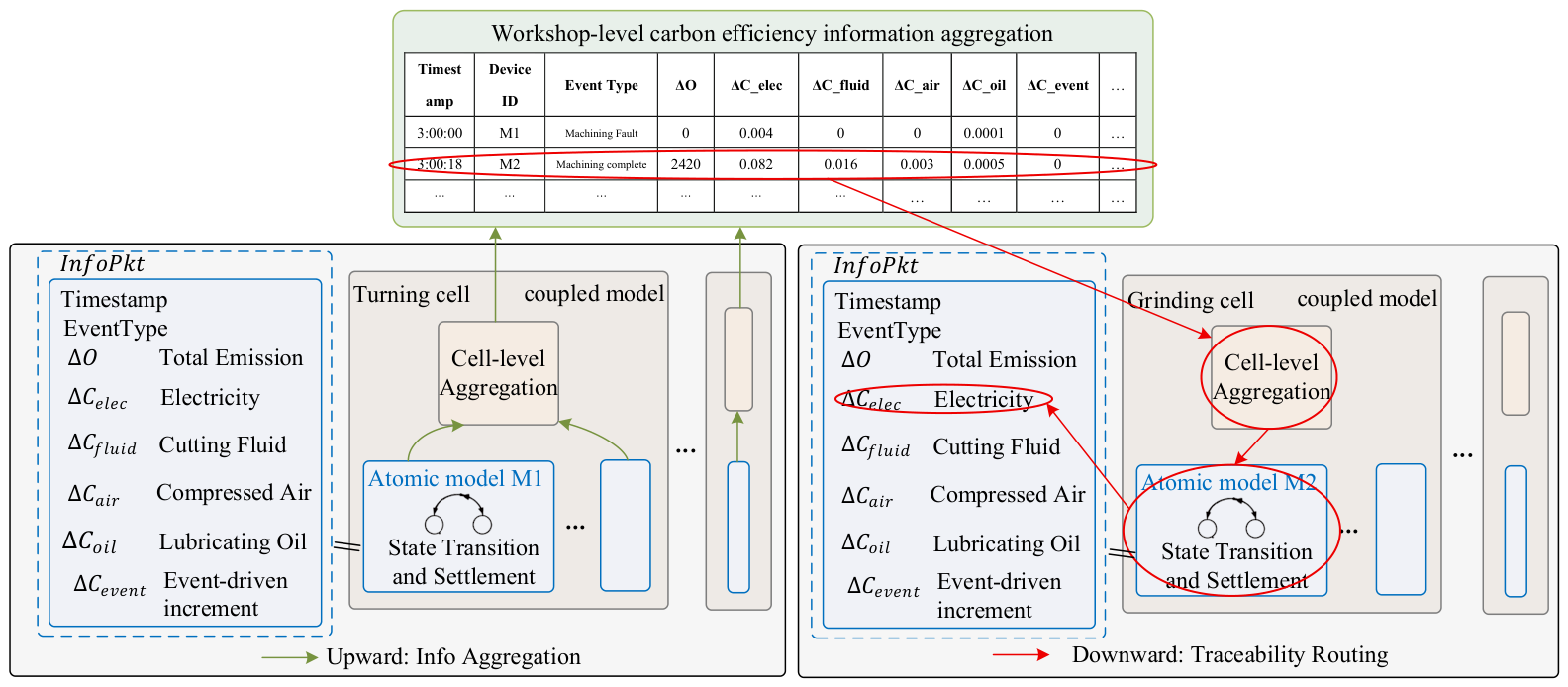
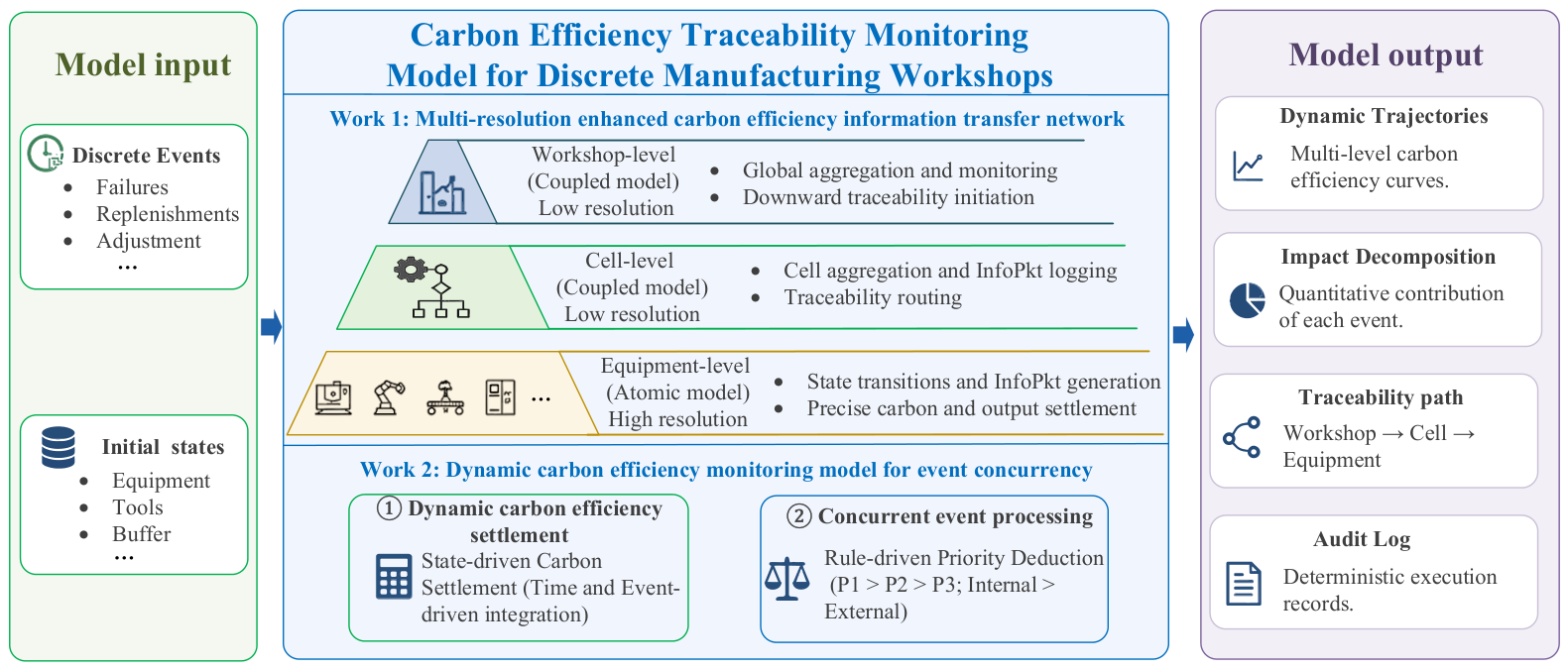
- Establishing a multi-resolution enhanced carbon efficiency information transfer network to overcome the broken traceability in existing models. Existing approaches lack systematic coupling among emission factors, equipment states, and discrete events, while treating all data at an undifferentiated granularity. To bridge this gap, this network classifies carbon emission factors into time-driven and event-driven categories, constructing high-resolution equipment atomic models and low-resolution cell/workshop coupled models within the PDEVS framework. By coordinating upward aggregation of event information packets (InfoPkt) and downward mapping of impact degrees, it provides a transparent, three-level traceability path from workshop-level macro fluctuations down to specific equipment and root-cause emission factors.
- (2)
- Designing a dynamic carbon efficiency monitoring model for event concurrency to resolve trajectory ambiguity in discrete event simulation. Traditional simulation models suffer from execution path uncertainty under concurrent events, making it difficult to obtain deterministic trajectories or isolate individual event impacts. To resolve this ambiguity, a state-driven dynamic settlement mechanism is integrated with a rule-driven priority deduction strategy. Equipment state switches automatically trigger incremental carbon settlement, while manufacturing operation rules are formalized into a three-level event priority system and internal precedence principles. This ensures a deterministic and reproducible carbon efficiency trajectory under concurrent scenarios, enabling independent quantitative decomposition of each event’s impact degree to guide targeted maintenance decisions.
2. Literature Review
2.1. Research Status of Carbon Efficiency Information Modeling
2.2. Research Status of Carbon Efficiency Change Process
3. Method Framework
- (1)
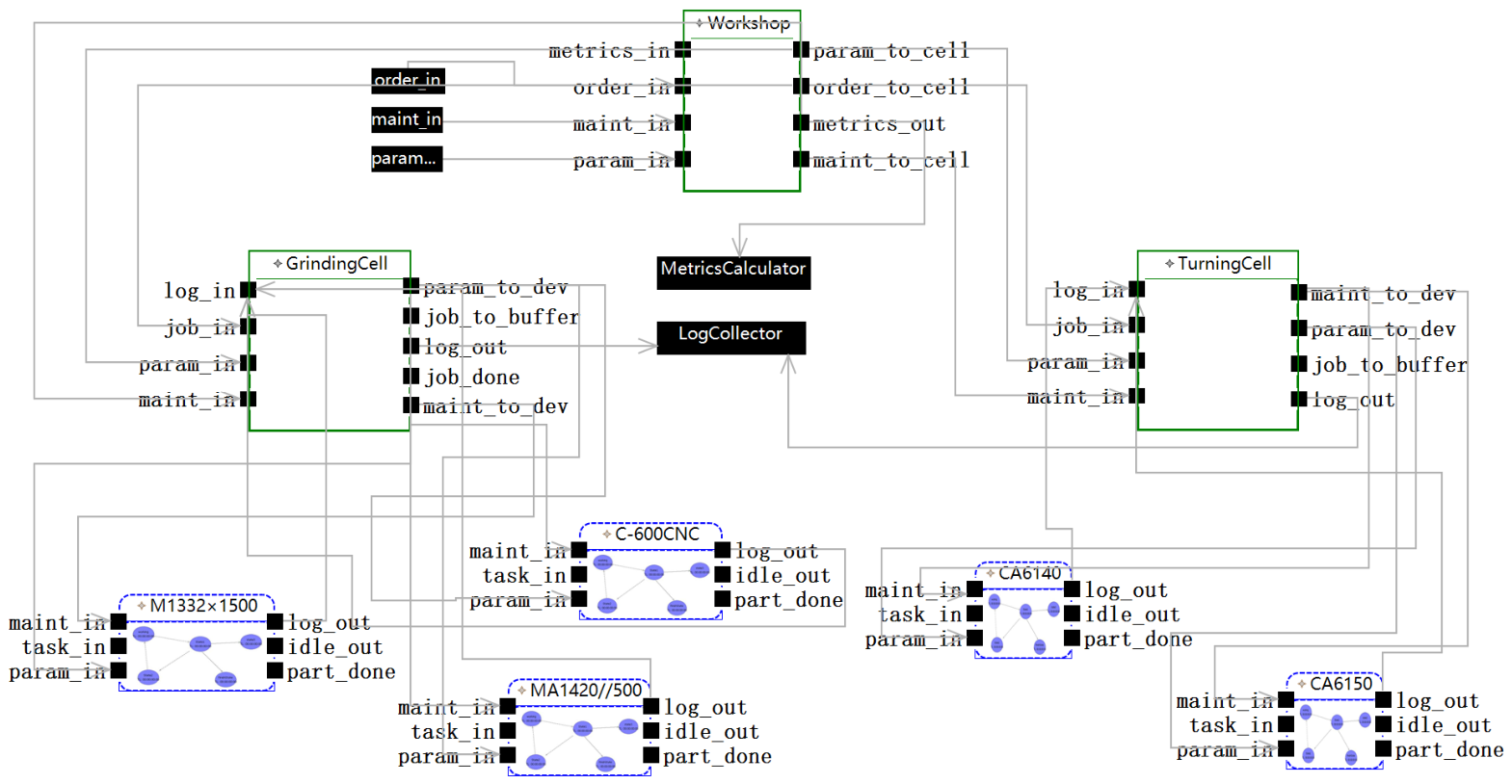
- Multi-resolution enhanced information transfer network. This part assumes the functions of static organization and hierarchical association of carbon emission factors. Carbon emission factors are divided into time-driven and event-driven types according to the settlement mechanism. A quantitative association between the carbon efficiency calculation formula and each factor is established. Within the PDEVS coupled model framework, a three-layer information transfer structure is constructed, with the equipment level as the high-resolution layer and the cell and workshop levels as the low-resolution layers. In terms of data aggregation and monitoring, the equipment atomic model reports carbon emission and output increments through InfoPkt at each state switch. These are aggregated step-by-step from the cell level to the workshop-level carbon efficiency. In terms of anomaly tracing and attribution, when abnormal fluctuations in carbon efficiency occur, maintenance personnel can trace down the path of workshop, cell, equipment, and factor to locate the dominant equipment and the triggering event. This network provides a structured information flow for carbon efficiency monitoring and traceability.
- (2)
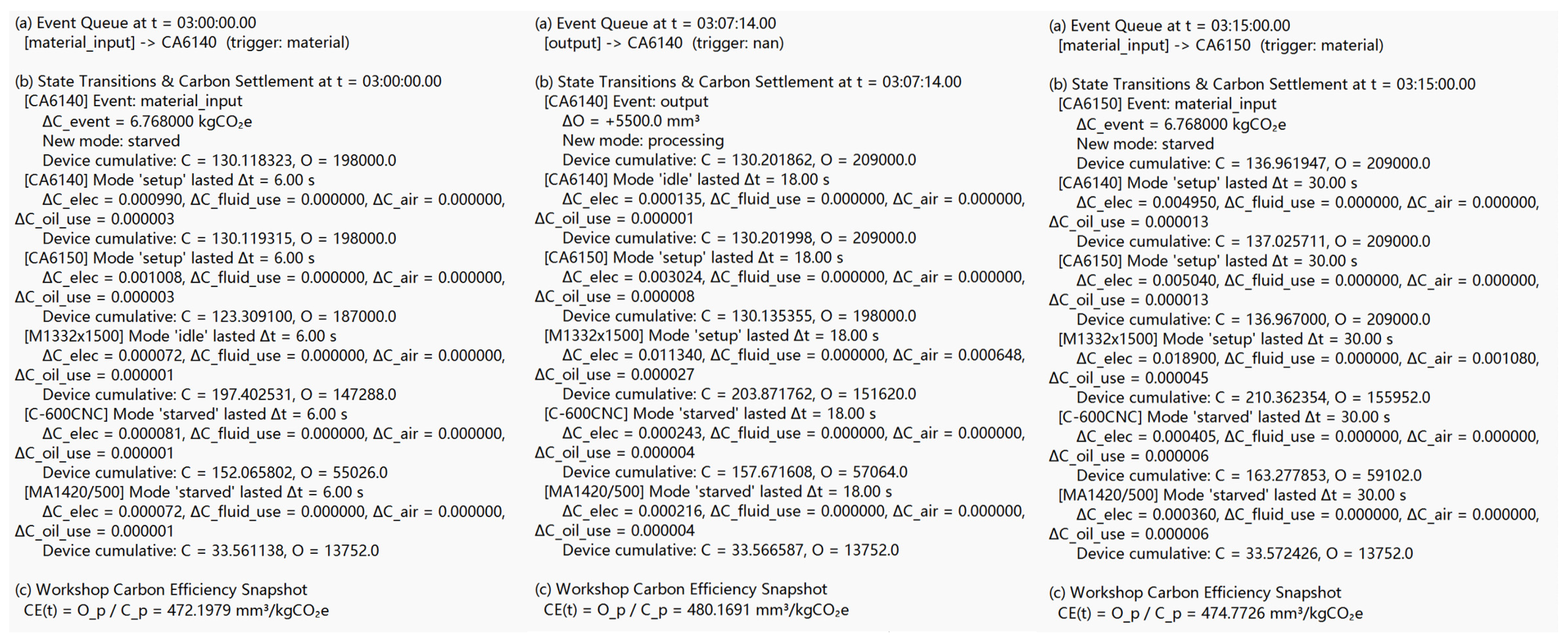
- Dynamic carbon efficiency monitoring model for event concurrency. This part assumes the functions of dynamic carbon emission deduction and concurrent event processing. Inside the equipment atomic model, a state-driven dynamic carbon efficiency settlement method is designed. It automatically completes carbon emission settlement with each equipment state switch. This ensures that every change point on the carbon efficiency curve has a precise timestamp and an event cause. At the deduction engine level, a rule-driven priority deduction strategy for concurrent events is designed. Based on workshop operation specifications, the event response logic is formalized into a three-level event priority and an internal priority principle. This effectively reduces the uncertainty of results when multiple events are concurrent and improves the determinism and reproducibility of the carbon efficiency monitoring trajectory.
4. Multi-Resolution Enhanced Carbon Efficiency Information Transfer Network
4.1. Composition of Carbon Efficiency Information
- (1)
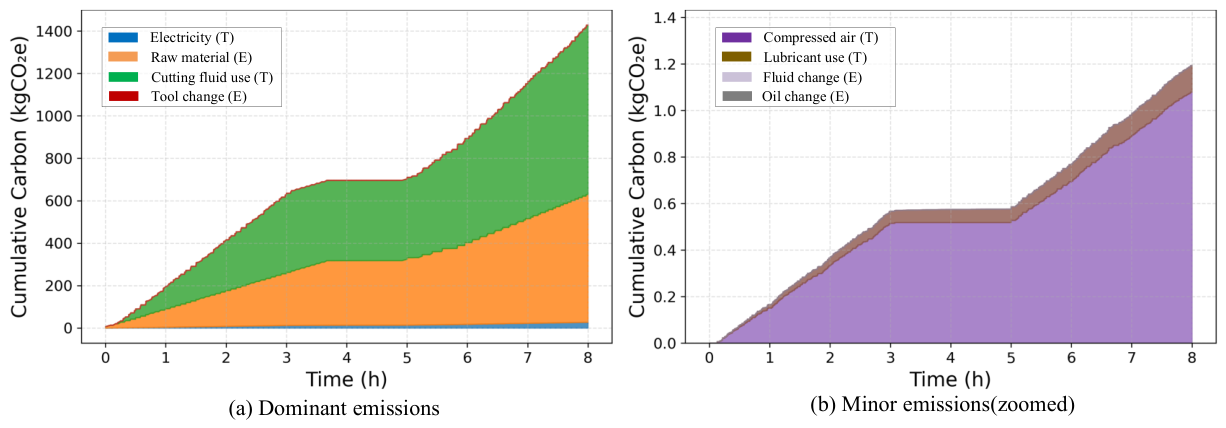
- Electricity carbon emissions: The power varies under different equipment states. It accumulates linearly with the duration of each state and the corresponding power.
- (2)
- Cutting fluid daily consumption carbon emissions: This occurs only in the processing state. It accumulates linearly with processing time and flow rate.
- (3)
- Compressed air carbon emissions: This originates from the air compressor’s electricity consumption. The consumption rate is related to the equipment state.
- (4)
- Lubricating oil daily consumption carbon emissions: This accumulates at different consumption rates under various states.
- (5)
- Tool replacement carbon emissions: This is accounted for once each time a grinding wheel or cutting tool is replaced.
- (6)
- Cutting fluid replacement carbon emissions: This is accounted for once each replacement, including carbon emissions from new fluid production and waste fluid treatment.
- (7)
- Lubricating oil replacement carbon emissions: This is accounted for once each replacement, including carbon emissions from new oil production and waste oil treatment.
- (8)
- Workpiece material carbon emissions: The embodied carbon of raw material is accounted for once only when the blank enters the workshop for the first time (i.e., when the first process begins machining this blank). Work-in-process transferred in subsequent processes is not accounted for again.
4.2. Carbon Efficiency Information Transfer Network
5. Dynamic Carbon Efficiency Monitoring Model for Event Concurrency
5.1. State-Driven Dynamic Carbon Efficiency Settlement
5.2. Rule-Driven Concurrent Event Processing
- P1
- Safety and functional integrity disruption. This causes the equipment or system to lose basic functionality and requires an immediate response, typically an unexpected equipment failure. P1 has the highest priority.
- P2
- Resource and constraint release. This removes obstacles to production recovery or releases equipment capability, including material replenishment completion, fault repair completion, and tool/cutting fluid/lubricating oil replacement. State transition events generated internally by the equipment atomic model (processing completion, tool change completion, etc.) are all assigned to P2. When a preventive maintenance task exceeds its specified window without execution, its priority is automatically upgraded from P3 to P2, reflecting the principle of equipment health priority. Within the PDEVS framework, this expiration is tracked using a dedicated state variable representing the scheduled deadline and a Boolean flag indicating completion status . At any current simulation time , if the specific condition is satisfied for a maintenance task, its priority is dynamically upgraded before the Select function evaluates the concurrent event set.
- P3
- Efficiency adjustment. This optimizes operating parameters when system functionality is intact and there are no production obstacles, typically cutting parameter adjustment. P3 has the lowest priority.
- (1)
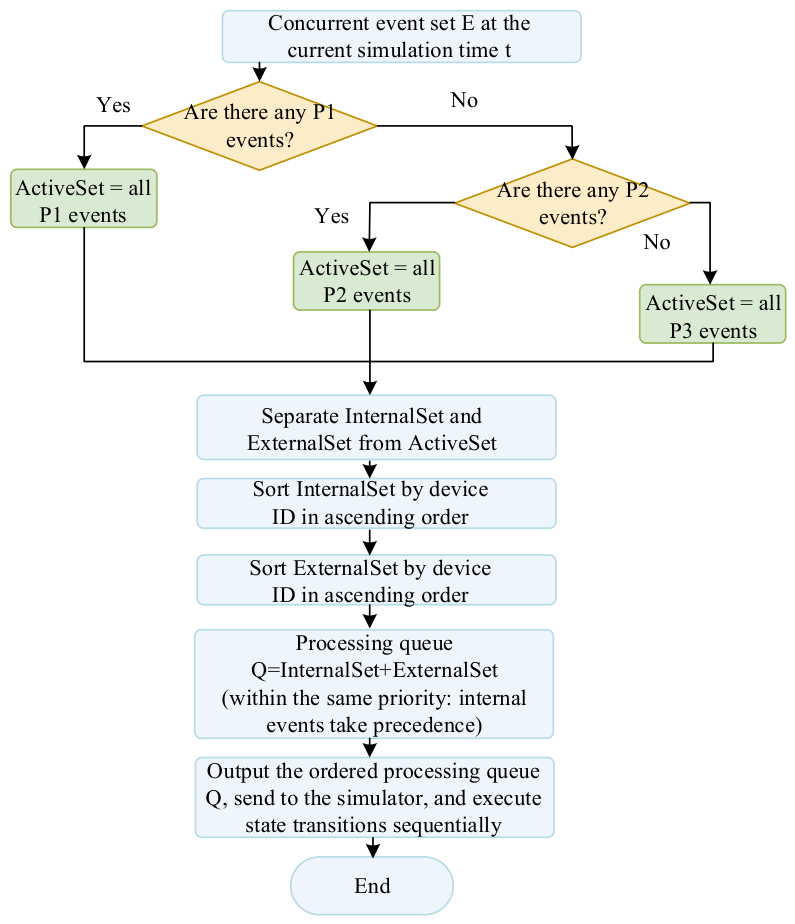
- Identify the highest priority category in the current concurrent event set. If P1 events exist, only all P1 events are processed. Otherwise, all P2 events are processed. Only when there are no P1 or P2 events are P3 events processed. Deferred low-priority events are retained until the next simulation moment.
- (2)
- Within the same priority, internal transition events take precedence over external events to ensure production continuity and state consistency. This rule does not override the higher priority. If an internal event is infeasible in the equipment’s current state (e.g., no processing completion in Starved state), processing is uniformly handled according to Step 3.
- (3)
- If still indistinguishable, events are processed in a deterministic order, such as ascending order of equipment numbers. It should be noted that sorting by equipment ID is not a mandatory operation; any consistent sorting rule can be applied here. This tie-breaker only dictates the algorithmic execution sequence at the exact same simulation time step t. It does not alter any equipment’s actual state duration, power-time product, output quantity, or material consumption. Therefore, the overall carbon efficiency trajectory remains unaffected, as the accrued emissions and physical output at that specific timestamp are identical regardless of the sorting method.
- (4)
- The list of concurrent events, the priority determination result, and the actual processing order are written to the audit log to support reproducibility.
6. Case Study
6.1. Baseline Scenario and Model Accuracy Verification
6.2. Verification of Traceability Capability Under a Single Fault Event
6.3. Deterministic Deduction Under Concurrent Events and Multi-Method Comparison
6.4. Verification of Traceability Robustness
6.5. Discussion
7. Conclusions and Outlook
- (1)
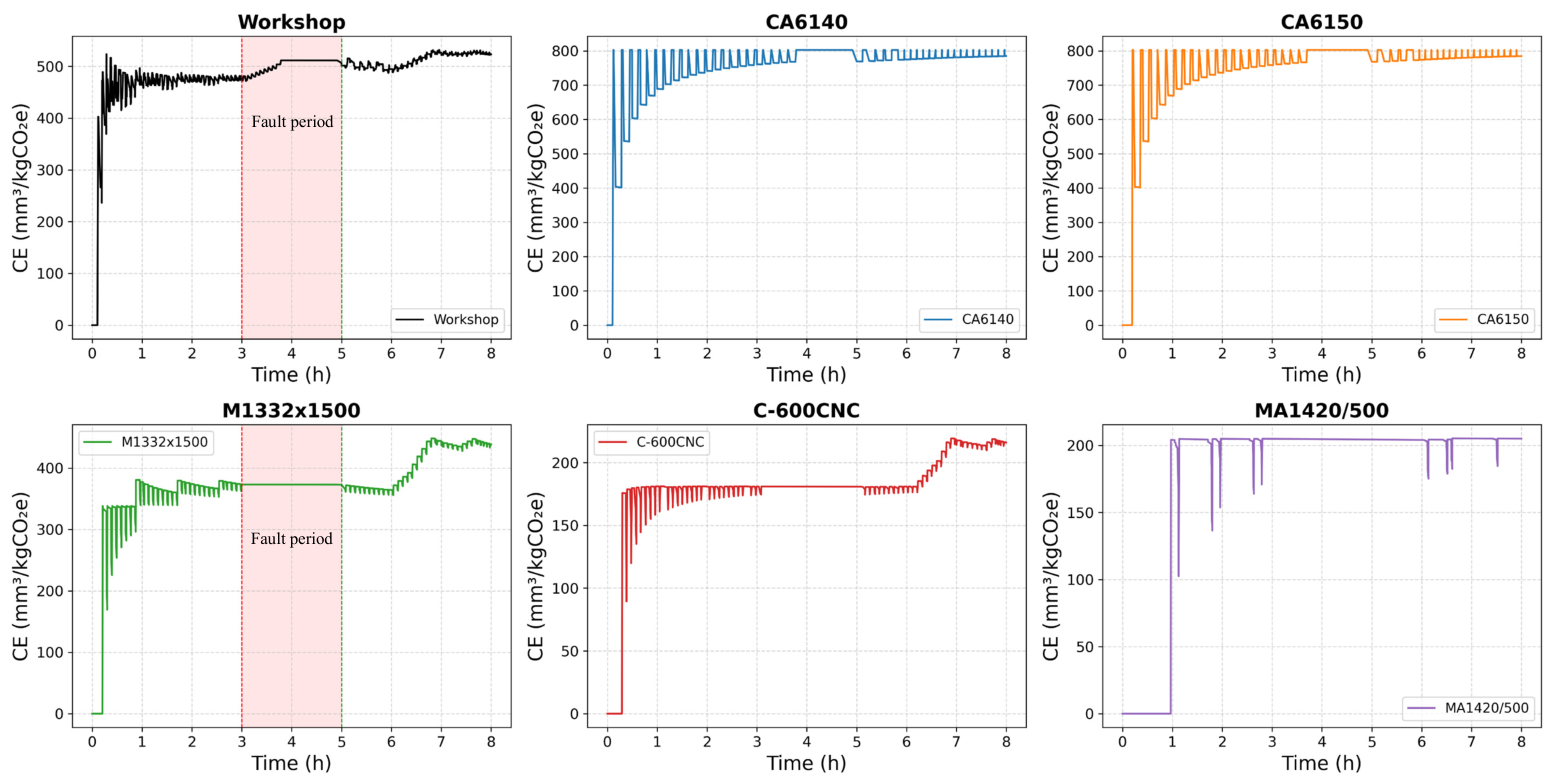
- A multi-resolution enhanced carbon efficiency information transfer network was constructed, which settles carbon emission factors according to two categories: time-driven and event-driven. By establishing high-resolution atomic models at the equipment level and low-resolution coupled models at the cell/workshop level under the multi-resolution enhanced PDEVS framework, a complete traceability path from workshop-level carbon efficiency fluctuations to specific equipment and carbon emission factors was built. The case study shows that in a single-fault scenario, the traceability path can clearly identify the primary contributing equipment and triggering event, and the impact degrees of each piece of equipment are quantified.
- (2)
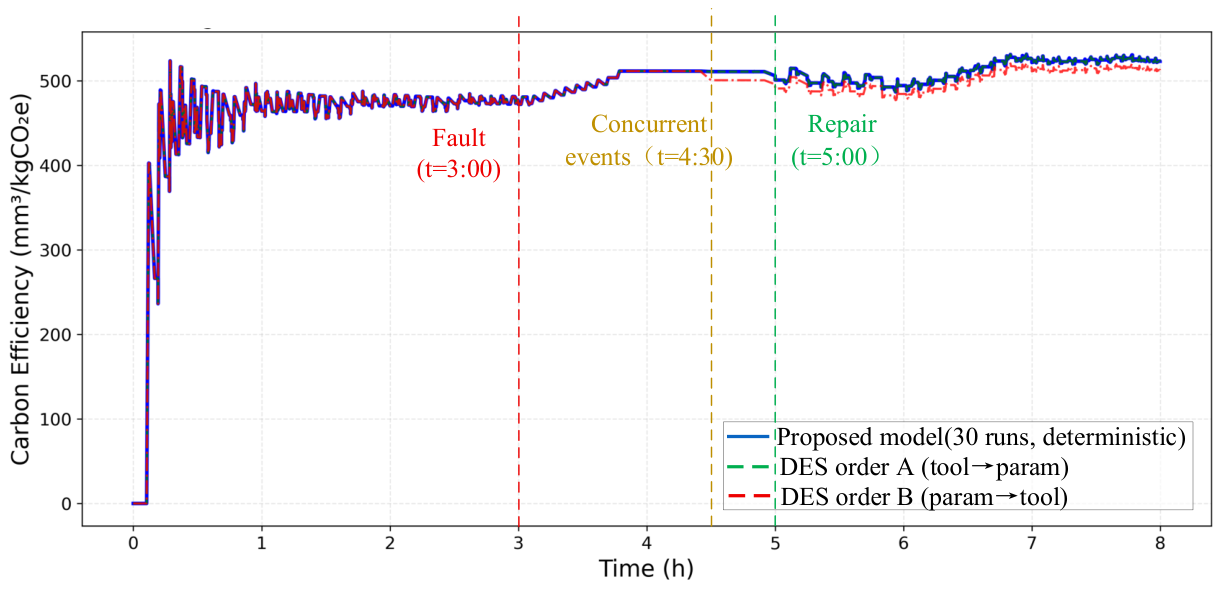
- A dynamic carbon efficiency monitoring model for event concurrency was proposed. It achieves precise alignment of carbon emissions and output through automatic settlement upon state switches, and drives the ordered deduction of concurrent events using a three-level priority rule. This keeps the carbon efficiency monitoring trajectory unique and reproducible. In comparison with traditional DES, the proposed model produced consistent results over 30 runs, and the impact degrees of each event could be independently accounted for, providing a mechanistic guarantee for fine-grained “event–carbon efficiency” attribution.
Author Contributions
Funding
Institutional Review Board Statement
Informed Consent Statement
Data Availability Statement
Conflicts of Interest
Appendix A
| Algorithm A1 Carbon settlement on state transition of device atomic model. |
| Input: current mode , elapsed time (h), trigger identifier , event type , device parameters , , , , , , , , emission factors , , , , , , , , , . In/out: , , . |
| Output: , , , , , , . |
| 1: function SettleCarbon (, , , ) |
| 2: // Step A: time-driven carbon settlement |
| 3: |
| 4: if then |
| 5: |
| 6: else |
| 7: |
| 8: end if |
| 9: |
| 10: |
| 11: // Step B: event-driven settlement |
| 12: |
| 13: |
| 14: if and then |
| 15: // scrap the part, no output counted |
| 16: else if then |
| 17: // only update buffer; material carbon deferred to first load |
| 18: else if then |
| 19: |
| 20: else if then |
| 21: |
| 22: else if then |
| 23: |
| 24: else if then |
| 25: // confirm one qualified output |
| 26: else if then |
| 27: // account for raw material carbon |
| 28: |
| 29: end if |
| 30: // Step C: accumulate and generate output |
| 31: |
| 32: |
| 33: |
| 34: return , , , , , , |
| 35: end function |
| Algorithm A2 Concurrent event priority processing. |
| Input: set of concurrent events at simulation time , each event has attributes (priority , type , ). |
| Output: ordered processing queue ; updated AuditLog. |
| 1: function ResolveConcurrency () |
| 2: |
| 3: |
| 4: |
| 5: if then |
| 6: |
| 7: else if then |
| 8: |
| 9: else |
| 10: |
| 11: end if |
| 12: |
| 13: |
| 14: Sort by ascending |
| 15: Sort by ascending |
| 16: // internal events precede external ones of same priority 17: |
| 18: Reschedule to // defer to next simulation instant, is the minimum step size of the simulation clock. |
| 19: |
| 20: Append to |
| 21: return |
| 22: end function |

| No. | Emission Source | Symbol | Value | Unit |
|---|---|---|---|---|
| 1 | Grid electricity | 0.540 | ||
| 2 | Air compressor specific energy | 0.120 | ||
| 3 | Steel raw material | 2.256 | ||
| 4 | Cutting fluid production | 2.850 | ||
| 5 | Cutting fluid waste treatment | 0.710 | ||
| 6 | Cutting fluid new fluid production | 2.850 | ||
| 7 | Turning tool manufacturing (per piece) | 0.671 | ||
| 8 | Grinding wheel manufacturing (per piece) | 1.625 | ||
| 9 | Lubricating oil production | 2.590 | ||
| 10 | Lubricating oil waste treatment | 0.650 | ||
| 11 | Lubricating oil new oil production | 2.590 |
| No. | Parameter | CA6140 | CA6150 | M1332×1500 | C-600CNC | MA1420/500 | Unit |
|---|---|---|---|---|---|---|---|
| 1 | Cell | Turning | Turning | Grinding | Grinding | Grinding | — |
| 2 | Processing type | Rough turning | Rough turning | Cylindrical grinding/Taper grinding | Cylindrical grinding/Taper grinding | Cylindrical grinding/Taper grinding | — |
| 3 | Standby power (Idle/Starved) | 0.05 | 0.05 | 0.08 | 0.09 | 0.08 | kW |
| 4 | No-load power (Setup) | 1.10 | 1.12 | 4.20/4.06 | 4.95/4.65 | 4.48/4.28 | kW |
| 5 | Load power (Processing) | 2.42 | 2.77 | 4.85/4.68 | 5.60/5.21 | 5.20/4.92 | kW |
| 6 | Fault power (Down) | 0.05 | 0.05 | 0.08 | 0.09 | 0.08 | kW |
| 7 | Preparation time | 360 | 360 | 250 | 240 | 250 | s |
| 8 | Idle running time | 15 | 13 | 10/14 | 13/16 | 10/12 | s |
| 9 | Load time (processing time) | 59 | 48 | 65/80 | 57/70 | 60/75 | s |
| 10 | Blank mass | 3.0 | 3.0 | — | — | — | kg |
| 11 | Material removal mass | 0.043 | 0.043 | 0.02/0.01 | 0.02/0.01 | 0.02/0.01 | kg |
| 12 | Material removal volume per piece | 5500 | 5500 | 2166/1274 | 2420/1019 | 2420/1146 | |
| 13 | Compressed air consumption rate (Setup) | 0.00 | 0.00 | 2.00/1.80 | 1.50/1.30 | 1.20/1.00 | |
| 14 | Compressed air consumption rate (Processing) | 0.00 | 0.00 | 3.50/3.00 | 2.80/2.50 | 2.20/2.00 | |
| 15 | Lubricating oil consumption rate (Idle/Starved) | 0.0001 | 0.0001 | 0.0003 | 0.0003 | 0.0003 | |
| 16 | Lubricating oil consumption rate (Setup) | 0.0006 | 0.0006 | 0.0021 | 0.0025 | 0.0025 | |
| 17 | Lubricating oil consumption rate (Processing) | 0.0020 | 0.0020 | 0.0069 | 0.0083 | 0.0083 | |
| 18 | Cutting fluid flow rate | 0 | 0 | 120 | 100 | 90 |
| No. | Parameter | Turning Cell | Grinding Cell | Unit |
|---|---|---|---|---|
| 1 | Turning tool life | 200 | — | pieces/piece |
| 2 | Turning tool replacement time | 3 | — | min |
| 3 | Grinding wheel life | — | 300 | pieces/piece |
| 4 | Grinding wheel replacement time | — | 5 | min |
| 5 | Cutting fluid tank volume | — | 3000 | L |
| 6 | Carbon emission per cutting fluid replacement | — | 10,680 | /replacement |
| 7 | Hydraulic oil tank volume | 100 | 200 | L |
| 8 | Carbon emission per hydraulic oil replacement | 324 | 648 | /replacement |
| 9 | Statistical waste rate (β) | 2% | 2% | — |
References
- Mencaroni, A.; Leyman, P.; Raa, B.; De Vuyst, S.; Claeys, D. Towards net-zero manufacturing: Carbon-aware scheduling for GHG emissions reduction. J. Clean. Prod. 2025, 529, 146787. [Google Scholar] [CrossRef] [Scilit]
- Debbarma, J.; Kumar, V.; Ekundayo, D. Measuring carbon emission efficiency in a developing country: A comparative study of sustainability initiatives and nonsustainability initiatives of manufacturing firms. Bus. Strategy Environ. 2025, 34, 9672–9699. [Google Scholar] [CrossRef] [Scilit]
- Diaz C., J.L.; Ocampo-Martinez, C. Energy efficiency in discrete-manufacturing systems: Insights, trends, and control strategies. J. Manuf. Syst. 2019, 52, 131–145. [Google Scholar] [CrossRef] [Scilit]
- Yao, M.; Chang, P.; Shao, Z.; Zhang, Q.; Niu, P. Data-Driven Energy Consumption Modeling and Simulation Method of Discrete Manufacturing Workshop Based on Simplified Power Curve. In Proceedings of the 2024 9th International Conference on Automation, Control and Robotics Engineering (CACRE); IEEE: Piscataway, NJ, USA, 2024; pp. 452–459. [Google Scholar] [CrossRef] [Scilit]
- Bin, H.; Liu, F.; Zheng, Y.; Yao, Q.; Zhang, Y. Enhancing carbon emission efficiency through the integration of “two industries”: A measurement based on an evaluation index system. Systems 2023, 11, 497. [Google Scholar] [CrossRef] [Scilit]
- Hu, S.; Yuan, Z.; Wang, A. Improving carbon emission efficiency in Chinese manufacturing: A study considering technological heterogeneity and noise. Energy 2024, 291, 130392. [Google Scholar] [CrossRef] [Scilit]
- Bian, H.; Meng, M. Carbon emission reduction potential and reduction strategy of China’s manufacturing industry. J. Clean. Prod. 2023, 423, 138718. [Google Scholar] [CrossRef] [Scilit]
- Zhang, T.; Ji, W.; Qiu, Y. A framework of energy-consumption driven discrete manufacturing system. Sustain. Energy Technol. Assess. 2021, 47, 101336. [Google Scholar] [CrossRef] [Scilit]
- Ye, L.; Du, P.; Wang, S. Industrial carbon emission forecasting considering external factors based on linear and machine learning models. J. Clean. Prod. 2024, 434, 140010. [Google Scholar] [CrossRef] [Scilit]
- Deng, S.; Zhu, Y.; Tsai, A.; Cooper, D.R. Decarbonizing the US aluminum ecosystem using a dynamic material flow simulation framework. J. Clean. Prod. 2026, 538, 147413. [Google Scholar] [CrossRef] [Scilit]
- Li, H.; Cao, H.; Pan, X. A carbon emission analysis model for electronics manufacturing process based on value-stream mapping and sensitivity analysis. Int. J. Comput. Integr. Manuf. 2012, 25, 1102–1110. [Google Scholar] [CrossRef] [Scilit]
- Yi, Q.; Li, C.; Tang, Y.; Chen, X. Multi-objective parameter optimization of CNC machining for low carbon manufacturing. J. Clean. Prod. 2015, 95, 256–264. [Google Scholar] [CrossRef] [Scilit]
- Zheng, J.; Shi, J.; Lin, F.; Hu, X.; Pan, Q.; Qi, T.; Ren, Y.; Guan, A.; Zhang, Z.; Ling, W. Reducing manufacturing carbon emissions: Optimal low carbon production strategies respect to product structures and batches. Sci. Total Environ. 2023, 858, 159916. [Google Scholar] [CrossRef] [Scilit] [PubMed]
- Zhang, C.; Ji, W. Digital twin-driven carbon emission prediction and low-carbon control of intelligent manufacturing job-shop. Procedia CIRP 2019, 83, 624–629. [Google Scholar] [CrossRef] [Scilit]
- Zhang, C.; Ji, W. Big Data Analysis Approach for Real-Time Carbon Efficiency Evaluation of Discrete Manufacturing Workshops. IEEE Access 2019, 7, 107730–107743. [Google Scholar] [CrossRef] [Scilit]
- Du, Y.; Yi, Q.; Li, C.; Liao, L. Life cycle oriented low-carbon operation models of machinery manufacturing industry. J. Clean. Prod. 2015, 91, 145–157. [Google Scholar] [CrossRef] [Scilit]
- Li, H.; Yang, H.; Cao, H.; Zhu, C. State space modelling carbon emission dynamics of machining workshop based on carbon efficiency. Int. J. Comput. Integr. Manuf. 2017, 31, 426–441. [Google Scholar] [CrossRef] [Scilit]
- He, B.; Qian, S.; Li, T. Modeling product carbon footprint for manufacturing process. J. Clean. Prod. 2023, 402, 136805. [Google Scholar] [CrossRef] [Scilit]
- Sun, Y.; Fu, Z.; Zhao, N. A modular multi-granularity simulation modelling method for manufacturing systems oriented towards digital twins. Int. J. Prod. Res. 2025, 1–12. [Google Scholar] [CrossRef] [Scilit]
- Zhang, W.; Zhang, H.; Liu, W. An improved time advance method for distributed multi-resolution modelling with interactive deviation characterization. Simul. Model. Pract. Theory 2024, 134, 102926. [Google Scholar] [CrossRef] [Scilit]
- Zhang, L.; Zhuang, C.; Tian, Y.; Yao, M. Construction and Application of Energy Footprint Model for Digital Twin Workshop Oriented to Low-Carbon Operation. Sensors 2024, 24, 3670. [Google Scholar] [CrossRef] [Scilit] [PubMed]
- Qian, W.; Guo, Y.; Zhang, H.; Huang, S.; Zhang, L.; Zhou, H.; Fang, W.; Zha, S. Digital twin driven production progress prediction for discrete manufacturing workshop. Robot. Comput.-Integr. Manuf. 2023, 80, 102456. [Google Scholar] [CrossRef] [Scilit]
- Li, X.; Cui, G.; Li, S.; Zhang, F. Study of workshop network stability based on pinning control in disturbance environment. Sci. Rep. 2023, 13, 5382. [Google Scholar] [CrossRef] [Scilit] [PubMed]
- Fang, W.; Guo, Y.; Liao, W.; Huang, S.; Yang, N.; Liu, J. A Parallel Gated Recurrent Units (P-GRUs) network for the shifting lateness bottleneck prediction in make-to-order production system. Comput. Ind. Eng. 2020, 140, 106246. [Google Scholar] [CrossRef] [Scilit]
- Negahban, A.; Smith, J.S. Simulation for manufacturing system design and operation: Literature review and analysis. J. Manuf. Syst. 2014, 33, 241–261. [Google Scholar] [CrossRef] [Scilit]
- Wang, X.J.; Choi, S.H. Impacts of carbon emission reduction mechanisms on uncertain make-to-order manufacturing. Int. J. Prod. Res. 2016, 54, 3311–3328. [Google Scholar] [CrossRef] [Scilit]
- Cao, H.; Li, H. Simulation-based approach to modeling the carbon emissions dynamic characteristics of manufacturing system considering disturbances. J. Clean. Prod. 2014, 64, 572–580. [Google Scholar] [CrossRef] [Scilit]
- Zhou, Y.; Zhou, G.; Zhang, C.; Chang, F.; Wang, Z.; Men, S. Multi-level modeling and robustness evaluation of disturbances in intelligent workshop with temporal snapshot network. J. Manuf. Syst. 2023, 71, 20–33. [Google Scholar] [CrossRef] [Scilit]
- Cai, H.; Wan, J.; Chen, B.; Zhang, C.; Zhang, W. Active monitoring of production status in discrete manufacturing workshops driven by digital twins. Int. J. Adv. Manuf. Technol. 2024, 135, 1649–1664. [Google Scholar] [CrossRef] [Scilit]
- Zeigler, B.P. Using the parallel DEVS protocol for general robust simulation with near optimal performance. Comput. Sci. Eng. 2017, 19, 68–77. [Google Scholar] [CrossRef] [Scilit]
- Batchoudi, G.; Ramat, E.; Foucher, C. FPDEVSML: A platform-independent parallel-DEVS specification language. SIMULATION 2026. [Google Scholar] [CrossRef] [Scilit]
- Fang, X.; Sun, W.; Li, W.; Ma, G.; Wang, P.; Zuo, C. Process-based life cycle inventory framework for assessing the carbon footprint of products from complex production paths: Case of dual-phase automotive strip steel. J. Clean. Prod. 2024, 447, 141551. [Google Scholar] [CrossRef] [Scilit]






| State | Electricity Carbon Emissions | Cutting Fluid Consumption Carbon Emissions | Compressed Air Carbon Emissions | Lubricating Oil Consumption Carbon Emissions | Attribution |
|---|---|---|---|---|---|
| Idle | Standby power | None | None | Trace (intermittent supply) | Scheduling waiting within this cell |
| Setup | Preparation power | None | Yes (tool change/fixturing) | Yes (tool holder/guideway movement) | Process preparation for this equipment |
| Processing | Processing power | Yes (by flow rate) | Yes (chip blowing/fixture holding pressure/air sealing) | Yes (full load lubrication) | Normal production activity |
| Down | Fault power | None | None | None | This equipment fault |
| Starved | Standby power | None | None | Trace (intermittent supply) | Upstream material supply |
| Conflict Type | Processing Rule |
|---|---|
| P1 conflict with P2/P3 | P1 takes the highest priority; P2/P3 are deferred. Safety and functional integrity events cannot be interrupted. Example: If a sudden failure (P1) occurs during a tool change (P2) or parameter adjustment (P3), the current operation is immediately interrupted to prioritize fault handling. |
| P2 conflict with P3 | P2 takes priority over P3. Removing obstacles to production recovery takes precedence over efficiency optimization. Example: If the equipment simultaneously receives a parameter adjustment (P3) instruction and a material replenishment completion (P2) signal, material replenishment is executed first. When preventive maintenance is overdue, it is automatically upgraded from P3 to P2, reflecting the principle of equipment health priority. |
| Conflict within the same priority | Internal state transition events take precedence over external injection events to ensure production continuity and state consistency. Example: If equipment processing completion (internal P2) and a tool replacement instruction (external P2) are triggered simultaneously, the current processing output and carbon emissions are settled first, then the tool change is executed. |
| Conflict still remains after the above rules | Processed in a deterministic order (e.g., ascending order of equipment numbers). This sorting method is not mandatory and only ensures trajectory reproducibility at the exact same time step. It does not alter any equipment’s state duration, energy consumption, or physical output, thus leaving the total carbon efficiency unaffected. Example: If two different pieces of equipment fail simultaneously (P1), they are processed in numerical order. |
| Equipment | Carbon Emission Increment () | Increment Proportion (%) | Output Increment () | Status Description |
|---|---|---|---|---|
| M1332×1500 | 0.26 | 0.3 | 0 | Downtime due to fault; only basic power maintained |
| C-600CNC | 5.70 | 7.0 | 1019 | Undertook transferred tasks; load slightly increased |
| MA1420/500 | 0.09 | 0.1 | 0 | No material to process; entered Starved |
| CA6140 | 41.11 | 50.5 | 27,500 | Processed five pieces; mainly material carbon and electricity consumption; entered Idle after processing due to downstream blockage |
| CA6150 | 34.29 | 42.1 | 27,500 | Processed five pieces; mainly material carbon and electricity consumption; entered Idle after processing due to downstream blockage |
| Total | 81.45 | 100 | 56,019 | — |
| Emission Source | Emission Amount () | Proportion of CA6140 Increment (%) | Description |
|---|---|---|---|
| Subtotal of normal processing emissions | 41.11 | 98.3 | Includes material embodied carbon of five processed workpieces, electricity, lubricating oil consumption, trace idle emissions during blockage, and material carbon settlement for previous workpieces |
| Tool change event emissions | 0.70 | 1.7 | Includes turning tool manufacturing carbon emission and electricity consumption in Setup state during the tool change |
| Total | 41.81 | 100 | — |
| Characteristic | Proposed Model (PDEVS + Priority) | Traditional DES | Statistical Analysis | Machine Learning |
|---|---|---|---|---|
| Trajectory determinism | Completely deterministic; identical results across 30 runs | Uncertain; depends on internal event sequence | Only provides smooth trends; cannot reflect transient fluctuations | Probabilistic output; inherent uncertainty |
| Independent decomposition of event impacts | Can independently quantify carbon emission increments caused by each event (e.g., tool change event 0.70 kgCO2e) | Cannot be independently decomposed; event impacts are aliased | Cannot be decomposed to the event level | Black-box model; cannot provide factor decomposition |
| Traceability | Three-level traceability; can be located to equipment, states, and specific factors | Partially traceable to equipment; event causes are ambiguous | Lacks event-level traceability | Lacks event-level traceability |
| Adaptability to unseen events | Mechanism-based state-driven; requires no historical fault data | Same as the proposed model; relies on mechanism modeling | Cannot handle abnormal events not present in historical data | Generalization depends on training set coverage; prone to large errors for unseen events |
| Implementation difficulty | Requires predefined state-factor binding, priority rules, and InfoPkt structure; slightly higher initial modeling effort | Moderate; requires constructing state charts and event lists | Low; based on average emission factor accounting | High; requires massive annotated data and model tuning |
Disclaimer/Publisher’s Note: The statements, opinions and data contained in all publications are solely those of the individual author(s) and contributor(s) and not of MDPI and/or the editor(s). MDPI and/or the editor(s) disclaim responsibility for any injury to people or property resulting from any ideas, methods, instructions or products referred to in the content. |
© 2026 by the authors. Licensee MDPI, Basel, Switzerland. This article is an open access article distributed under the terms and conditions of the Creative Commons Attribution (CC BY) license.
Share and Cite
Pan, Z.; Zhu, S.; Jiang, Z.; Chen, X.; Zhang, H. A Carbon Efficiency Traceability Monitoring Model for Discrete Manufacturing Workshops with Event Concurrency. Sustainability 2026, 18, 8363. https://doi.org/10.3390/su18168363
Pan Z, Zhu S, Jiang Z, Chen X, Zhang H. A Carbon Efficiency Traceability Monitoring Model for Discrete Manufacturing Workshops with Event Concurrency. Sustainability. 2026; 18(16):8363. https://doi.org/10.3390/su18168363
Chicago/Turabian StylePan, Zhiqiang, Shuo Zhu, Zhigang Jiang, Xin Chen, and Hua Zhang. 2026. "A Carbon Efficiency Traceability Monitoring Model for Discrete Manufacturing Workshops with Event Concurrency" Sustainability 18, no. 16: 8363. https://doi.org/10.3390/su18168363
APA StylePan, Z., Zhu, S., Jiang, Z., Chen, X., & Zhang, H. (2026). A Carbon Efficiency Traceability Monitoring Model for Discrete Manufacturing Workshops with Event Concurrency. Sustainability, 18(16), 8363. https://doi.org/10.3390/su18168363