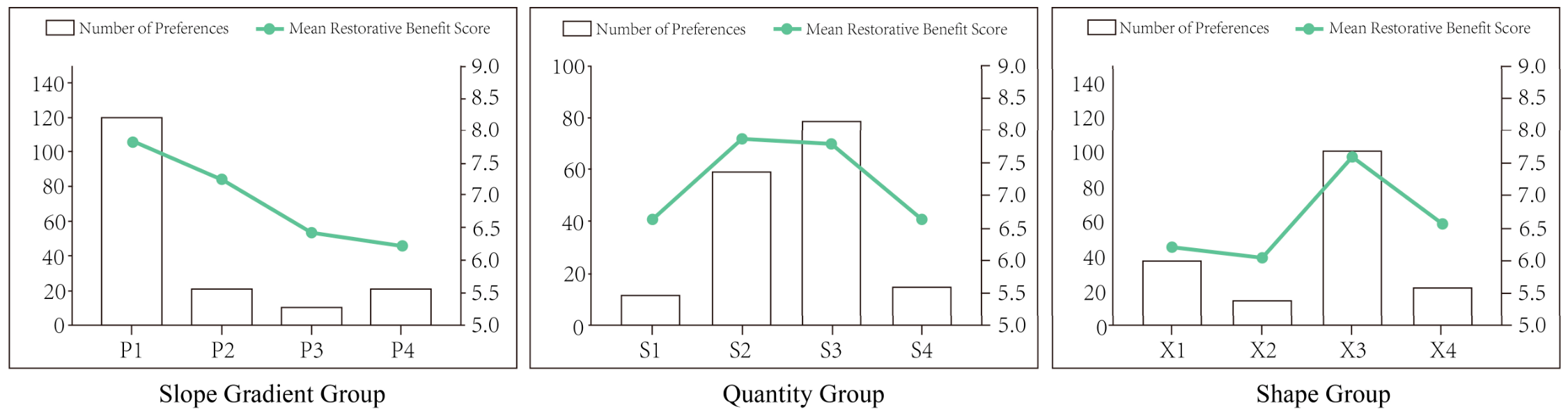
Research on the Impact of Slopes on Restorative Benefits and Landscape Preferences
Abstract
1. Introduction
2. Materials and Methods
2.1. Variable Selection and Control
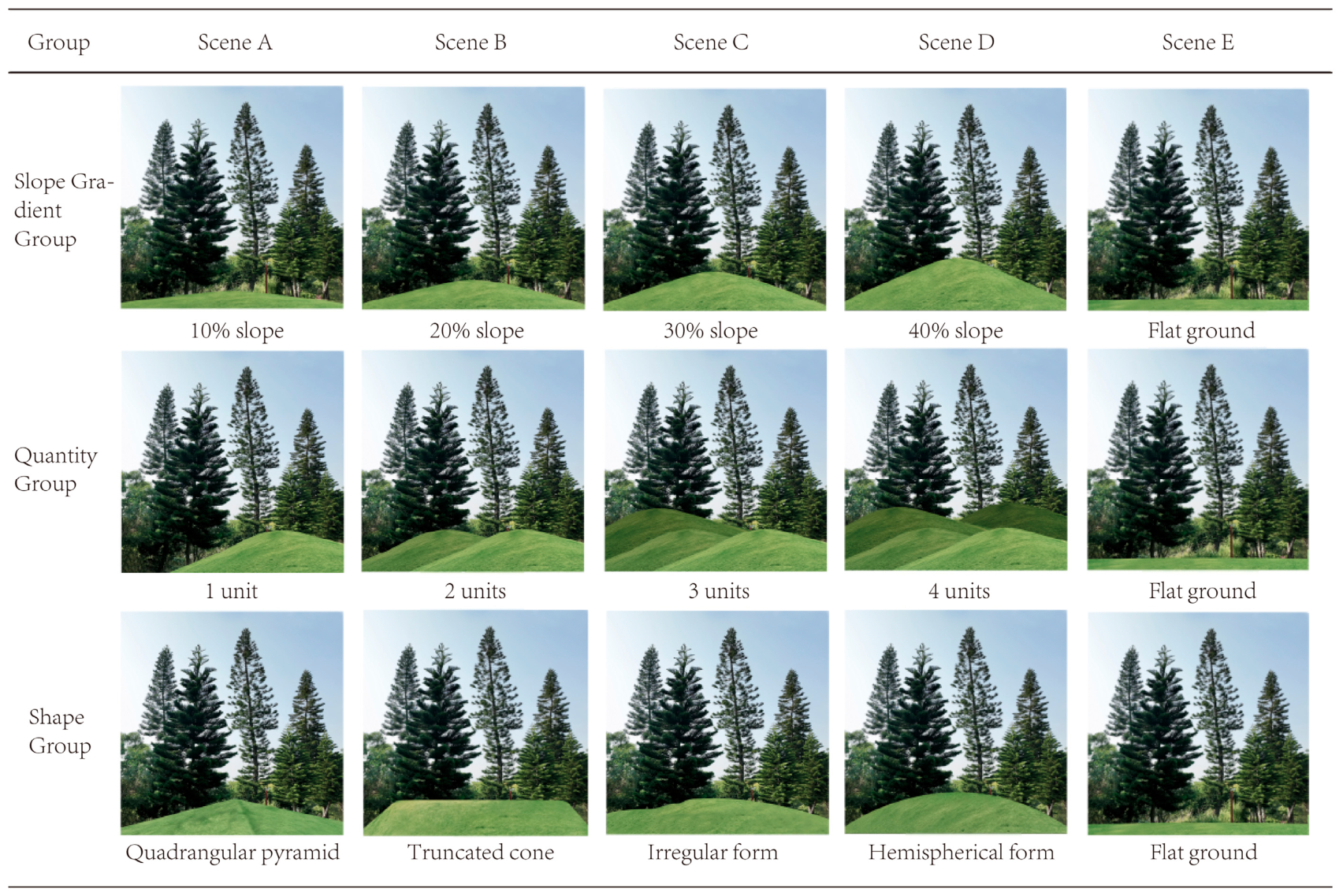
2.2. Scene Design
2.3. Questionnaire Design
2.4. Participants
2.5. Experimental Design
2.6. Data Analysis
3. Results
3.1. Demographic Characteristics of the Sample
3.2. Analysis of Restorative Benefits
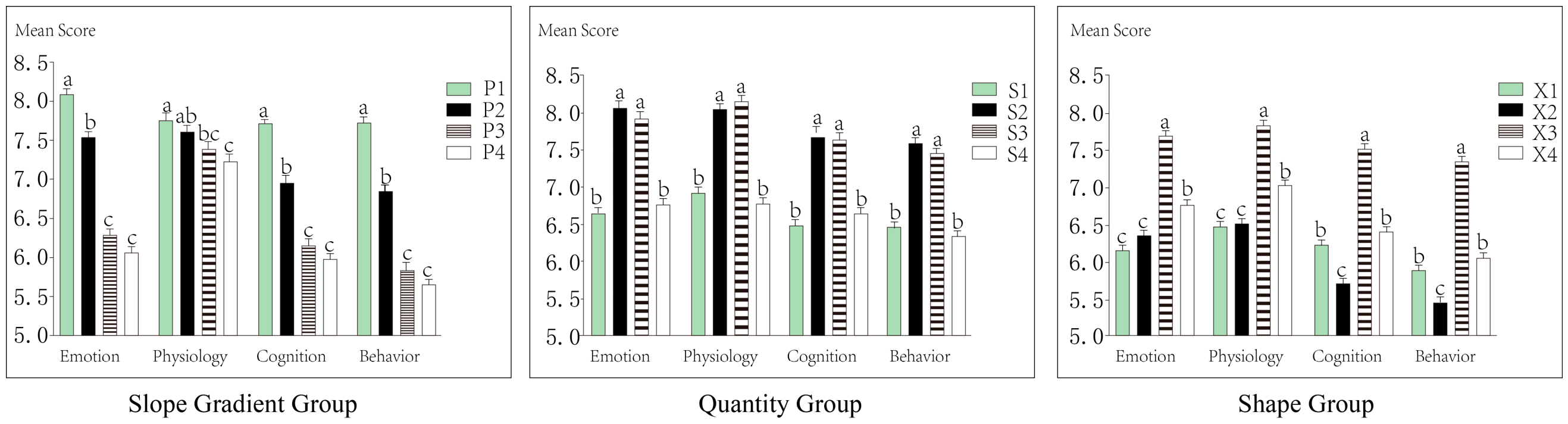
3.2.1. Effects of Slope Gradient Variation on Restorative Benefits
3.2.2. Effects of Quantity Variation on Restorative Benefits
3.2.3. Effects of Shape Variation on Restorative Benefits
3.3. Landscape Preference Analysis
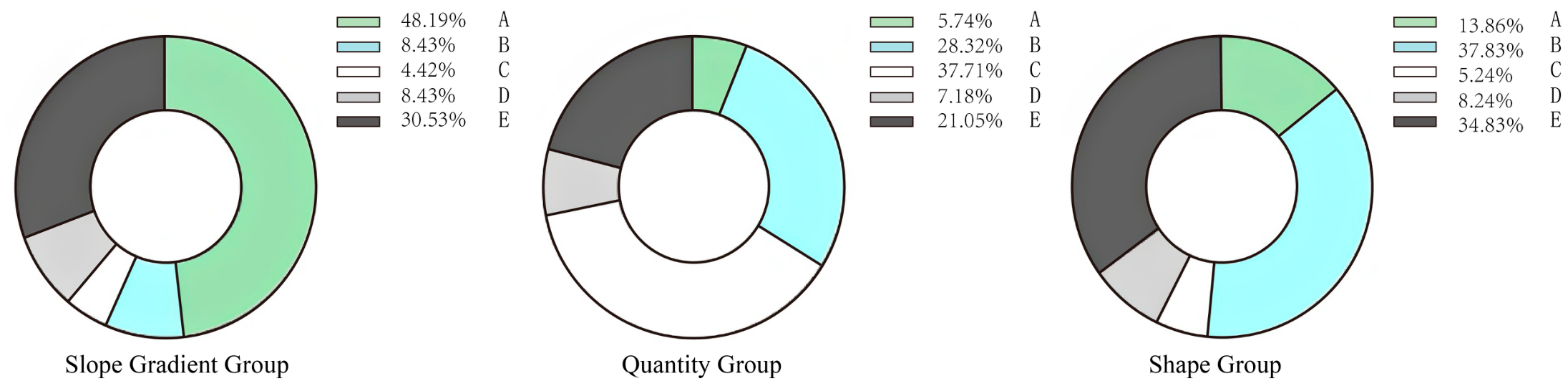
3.3.1. Effects of Slope Gradient Variation on Preferences
3.3.2. Effects of Quantity Variation on Preferences
3.3.3. Effects of Shape Variation on Preferences
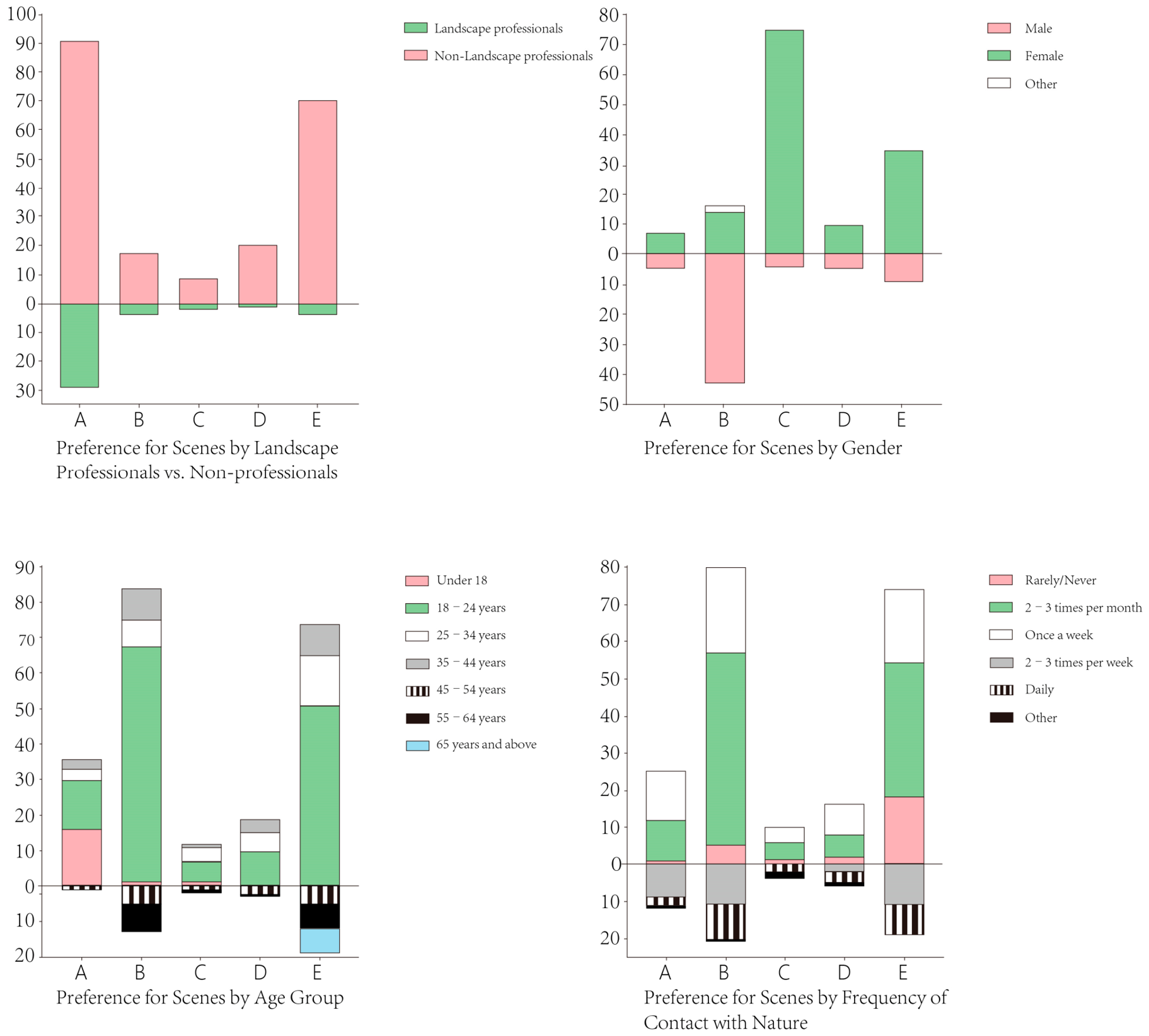
3.3.4. Effects of Demographic Characteristics on Preferences
3.4. Relationship Between Restorative Benefits and Landscape Preferences
3.5. Effects of Spontaneous Bodily Intention on Behavioral Motivation
4. Discussion
4.1. Slope Gradient Variation Shows a Threshold Effect and Professional Differentiation
4.2. Quantity Variation Shows a “Rise-and-Fall” Nonlinear Pattern with Gender Differences
4.3. Slope Shape Variation Reflects Evolutionary Preferences and Group Heterogeneity
4.4. Synesthetic Effects of Slope Landscapes: From Visual Affordance to Behavioral Activation
4.5. Limitations and Prospects
5. Conclusions
Author Contributions
Funding
Institutional Review Board Statement
Informed Consent Statement
Data Availability Statement
Acknowledgments
Conflicts of Interest
References
- Freeman, D. Global mental health challenges in the 21st century. Nat. Hum. Behav. 2022, 6, 1247–1252. [Google Scholar]
- Lyu, K.; de Dear, R.; Brambilla, A.; Globa, A. Restorative Benefits of Semi-outdoor Environments at the Workplace: Does the Thermal Realm Matter? Build. Environ. 2022, 222, 66–71. [Google Scholar] [CrossRef]
- Chen, Z.; Zhai, X.; Ye, S.; Zhang, Y.; Yu, J. A Meta-analysis of the Impact of Restorative Natural Environments on Urban Residents’ Mental Health and Planning Implications. Urban Plan. Int. 2016, 31, 16–26+43. (In Chinese) [Google Scholar] [CrossRef]
- Shanahan, D.F.; Franco, L.; Lin, B.B.; Gaston, K.J.; Fuller, R.A. The Benefits of Natural Environments for physical activity. Sports Med. 2016, 46, 989–995. [Google Scholar] [CrossRef] [PubMed]
- Ulrich, R.S.; Simons, R.F.; Losito, B.D.; Fiorito, E.; Miles, M.A.; Zelson, M. Stress recovery during exposure to natural and urban environments. J. Environ. Psychol. 1991, 11, 201–230. [Google Scholar] [CrossRef]
- Yang, C.; Tan, S.H. Health Enhancement Logic and Theoretical Framework of Restorative Environment in Park Green Spaces: Based on Supply-Demand Perspective. Chin. Landsc. Archit. 2025, 41, 92–99. (In Chinese) [Google Scholar]
- OECD; European Union. Health at a Glance: Europe 2022; OECD Publishing: Paris, France, 2022. [Google Scholar]
- Kaplan, S. The restorative benefits of nature: Toward an integrative framework. J. Environ. Psychol. 1995, 15, 169–182. [Google Scholar]
- Hartig, T.; Kahn, P.H. Living in cities, naturally. Science 2016, 352, 938–940. [Google Scholar] [CrossRef] [PubMed]
- Herzog, T.R.; Maguire, C.P.; Nebel, M.B. Assessing the restorative components of environments. J. Environ. Psychol. 2003, 23, 159–170. [Google Scholar] [CrossRef]
- Nordh, H.; Alalouch, C.; Hartig, T. Assessing restorative components of small urban parks using conjoint methodology. Urban For. Urban Green. 2011, 10, 95–103. [Google Scholar]
- Huang, Q.; Yang, M.; Jane, H.-A.; Li, S.; Bauer, N. Trees, grass, or concrete? The effects of different types of environments on stress reduction. Landsc. Urban Plan. 2020, 193, 103654. [Google Scholar] [CrossRef]
- Zhang, D.T.; Chen, C.X.; Hong, B.; Li, S.H. Impact of Urban Green Space on Residents’ Health and Its Sustainability. J. Northwest Univ. (Nat. Sci. Ed.) 2020, 50, 934–942. (In Chinese) [Google Scholar] [CrossRef]
- Senese, V.P.; Pascale, A.; Maffei, L.; Cioffi, F.; Sergi, I.; Gnisci, A.; Masullo, M. The influence of personality traits on the measure of restorativeness in an urban park: A Multisensory Immersive Virtual Reality study. Neural Approaches Dyn. Signal Exch. 2020, 15, 347–357. [Google Scholar]
- Berto, R. The Role of Nature in Coping with Psycho-Physiological Stress: A Literature Review on Restorativeness. Behav. Sci. 2014, 4, 394–409. [Google Scholar] [CrossRef] [PubMed]
- Zhang, L.; Dempsey, N.; Cameron, R. Flowers—Sunshine for the soul! How does floral colour influence preference, feelings of relaxation and positive up-lift. Urban For. Urban Green. 2023, 79, 127795. [Google Scholar] [CrossRef]
- Lin, W.; Zeng, C.; Bao, Z.; Jin, H. The therapeutic look up: Stress reduction and attention restoration vary according to the sky-leaf-trunk (SLT) ratio in canopy landscapes. Landsc. Urban Plan. 2023, 234, 104730. [Google Scholar] [CrossRef]
- Duan, Y.F.; Li, S.H. Effects of Ornamental Forms of Plant Community Landscapes on Human Physiological Responses. Landsc. Archit. 2022, 29, 105–111. [Google Scholar] [CrossRef]
- Chiang, Y.-C.; Li, D.; Jane, H.-A. Wild or tended nature? The effects of landscape location and vegetation density on physiological and psychological responses. Landsc. Urban Plan. 2017, 167, 72–83. [Google Scholar] [CrossRef]
- Wang, R.; Zhao, J.; Meitner, M.J.; Hu, Y.; Xu, X. Characteristics of urban green spaces in relation to aesthetic preference and stress recovery. Urban For. Urban Green. 2019, 41, 6–13. [Google Scholar] [CrossRef]
- Liu, J.; Guo, X.; Hong, X.C.; Zhang, X.W. Study on Individual Influencing Factors of Perceived Restorative Benefits of Soundscape in Urban Parks. Chin. Landsc. Archit. 2022, 38, 40–45. (In Chinese) [Google Scholar] [CrossRef]
- Ratcliffe, E.; Gatersleben, B.; Sowden, P.T. Bird sounds and their contributions to perceived attention restoration and stress recovery. J. Environ. Psychol. 2013, 36, 221–228. [Google Scholar] [CrossRef]
- Alvarsson, J.J.; Wiens, S.; Nilsson, M.E. Stress Recovery during Exposure to Nature Sound and Environmental Noise. Int. J. Environ. Res. Public Health 2010, 7, 1036–1046. [Google Scholar] [CrossRef] [PubMed]
- Weng, Y.X.; Zhu, Y.J.; Dong, J.Y.; Wang, M.; Dong, J. Effects of Campus Green Space Soundscape on Emotion and Attention: A Case Study of Fujian Agriculture and Forestry University. Chin. Landsc. Archit. 2021, 37, 88–93. (In Chinese) [Google Scholar] [CrossRef]
- White, M.; Smith, A.; Humphryes, K.; Pahl, S.; Snelling, D.; Depledge, M. Blue space: The importance of water for preference, affect, and restorativeness ratings of natural and built scenes. J. Environ. Psychol. 2010, 30, 482–493. [Google Scholar] [CrossRef]
- Faggi, A.; Breuste, J.; Madanes, N.; Gropper, C.; Perelman, P. Water as an appreciated feature in the landscape: A comparison of residents’ and visitors’ preferences in Buenos Aires. J. Clean. Prod. 2013, 60, 182–187. [Google Scholar] [CrossRef]
- Kaczynski, A.T.; Potwarka, L.R.; Smale, B.J.A.; Havitz, M.E. Association of parkland proximity with neighborhood and park-based physical activity: Variations by gender and age. Leis. Sci. 2009, 31, 174–191. [Google Scholar] [CrossRef]
- Meng, R.X.; Xu, L.Q. A Review of the Restorative Potential Model of Small Green Spaces in High-Density Environments. Urban Archit. 2019, 16, 171–175. (In Chinese) [Google Scholar] [CrossRef]
- Zhu, Y.J.; Weng, Y.X.; Huang, Y.L.; Wang, M.H.; Dong, J.W. A Preliminary Study on Restorative Soundscape in Campus Using Eye-tracking Analysis: A Case Study of Guanyin Lake in Fujian Agriculture and Forestry University Campus. Sci. Technol. Eng. 2020, 20, 10444–10451. (In Chinese) [Google Scholar] [CrossRef] [PubMed]
- Ulrich, R.S. Aesthetic and Affective Response to Natural Environment. Human Behavior and Environment; Springer: Berlin/Heidelberg, Germany, 1983; pp. 85–125. [Google Scholar]
- Deng, L.; Li, X.; Luo, H.; Fu, E.-K.; Ma, J.; Sun, L.-X.; Huang, Z.; Cai, S.-Z.; Jia, Y. Empirical study of landscape types, landscape elements and landscape components of the urban park promoting physiological and psychological restoration. Urban For. Urban Green. 2020, 48, 126488. [Google Scholar] [CrossRef]
- Sayadi, S.; González-Roa, M.C.; Calatrava-Requena, J. Public preferences for landscape features: The case of agricultural landscape in mountainous Mediterranean areas. Land Use Policy 2009, 26, 334–344. [Google Scholar] [CrossRef]
- Liu, B.-X.; Stenlund, T.; Nordin, M.; Lundell, Y.; Ahlgren, C.; Fjellman-Wiklund, A. Study on the effects of different landscapes on elderly people’s body-mind health. Landsc. Archit. 2016, 7, 113–120. [Google Scholar]
- Sonntag-Öström, E.; Stenlund, T.; Nordin, M.; Lundell, Y.; Ahlgren, C.; Fjellman-Wiklund, A.; Järvholm, L.S.; Dolling, A. “Nature’s effect on my mind”—Patients’ qualitative experiences of a forest-based rehabilitation programme. Urban For. Urban Green. 2015, 14, 607–614. [Google Scholar] [CrossRef]
- Crawford, D.W. The experience of landscape. J. Aesthet. Art Crit. 1976, 34, 367–369. [Google Scholar] [CrossRef] [PubMed]
- Ma, Y.H.; Jian, X.F.; Wang, J.S.; Chen, X. Differences in the Efficacy of Green Spaces in Cold-region University Campuses in Alleviating Student Anxiety between Summer and Winter and Their Environmental Driving Mechanisms. J. Chin. Urban For. 2026, 24, 60–67. (In Chinese) [Google Scholar]
- Cheng, S.; Li, Z.; Zhang, D.S. Methods and Application for Assessing Visual Characteristics and Natural Healing Potential of Mountain Views in Renewal Areas from a Multi-dimensional Perspective. Chin. Landsc. Archit. 2026, 42, 23–31. (In Chinese) [Google Scholar]
- Ye, J.J.; Huang, J.Q.; Xiao, L. A Study on the Perceived Restorative Benefits of Planting Scenes in University Campus Living Areas Based on Virtual Reality Technology. Chin. Landsc. Archit. 2023, 39, 97–103. (In Chinese) [Google Scholar]
- Cresswell, T. Place: A Short Introduction; John Wiley & Sons: Hoboken, NJ, USA, 2004. [Google Scholar]
- Sacks, O. The Mind’s Eye; Picador: New York, NY, USA, 2010. [Google Scholar]
- Peters, K. Where Land Meets Sea: Coastal explorations of landscape, representation and spatial experience. J. Hist. Geogr. 2015, 47, 120. [Google Scholar] [CrossRef]
- GB 50180-2018; Standard for Urban Residential Area Planning and Design. China Architecture & Building Press: Beijing, China, 2018.
- Zhang, S.Y.; Yang, Y.; Du, F.J.; Li, X.L.; Kong, Y.R. Formation Mechanism and Scale Development of Therapeutic Landscape Tasks in Urban Blue-Green Spaces. Prog. Geogr. 2025, 44, 1036–1049. (In Chinese) [Google Scholar] [CrossRef]
- Stamps, A.E. Simulation Effects on Environmental Preference. J. Environ. Manag. 1993, 38, 115–132. [Google Scholar] [CrossRef]
- Hoyle, H.; Hitchmough, J.; Jorgensen, A. All about the wow factor? The relationships between aesthetics, restorative effect and perceived biodiversity in designed urban planting. Landsc. Urban Plan. 2017, 164, 109–123. [Google Scholar] [CrossRef]
- Jiang, B.; Larsen, L.; Deal, B.; Sullivan, W.C. A dose—Response curve describing the relationship between tree cover density and landscape preference. Landsc. Urban Plan. 2015, 139, 16–25. [Google Scholar] [CrossRef]
- Birkhoff, G.D. Aesthetic Measure; Harvard University Press: Cambridge, MA, USA; London, UK, 1933. [Google Scholar]
- Sheppard, S.R.J. Visual Simulation: A User’s Guide for Architects, Engineers, and Planners; John Wiley & Sons Inc.: New York, NY, USA, 1989. [Google Scholar]
- Stamps, A.; Nasar, J.L.; Hanyu, K. Using Pre-construction Validation to Regulate Urban Skylines. J. Am. Plan. Assoc. 2005, 71, 73–91. [Google Scholar] [CrossRef]
- Bertacchini, F.; Bilotta, E.; Demarco, F.; Pantano, P.; Scuro, C. Multi-objective optimization and rapid prototyping for jewelry industry: Methodologies and case studies. Int. J. Adv. Manuf. Technol. 2021, 112, 2943–2959. [Google Scholar] [CrossRef]
- Stigsdotter, U.K.; Corazon, S.S.; Sidenius, U.; Refshauge, A.D.; Grahn, P. Forest design for mental health promotion—Using perceived sensory dimensions to elicit restorative responses. Landsc. Urban Plan. 2017, 160, 1–15. [Google Scholar] [CrossRef]
- Hassan, A.; Tao, J.; Li, G.; Jiang, M.; Liu, A.; Jiang, Z.; Liu, Z.; Chen, Q. Effects of Walking in Bamboo Forest and City Environments on Brainwave Activity in Young Adults. Evid.-Based Complement. Altern. Med. 2018, 2018, 9653857. [Google Scholar] [CrossRef] [PubMed]
- Han, K.-T. A reliable and valid self-rating measure of the restorative quality of natural environments. Landsc. Urban Plan. 2003, 64, 209–232. [Google Scholar] [CrossRef]
- Lin, N.; Xie, Y.S.; Zhuo, Z.X.; Huang, Q.T. Measurement and Application of the Self-Rating Restorative Scale in Urban Park Environments. J. Southwest For. Univ. (Soc. Sci.) 2018, 66–71. (In Chinese) [Google Scholar]
- Pazhouhanfar, M.; Kamal, M.S.; Maulan, S.; Mariapan, M.; Davoodi, S.R. Relationship between the Preference and Perceived Restorative Potential of Urban Landscapes. HortTechnology 2011, 21, 514–519. [Google Scholar] [CrossRef]
- Sang, Å.O.; Knez, I.; Gunnarsson, B.; Hedblom, M. The effects of naturalness, gender, and age on how urban green space is perceived and used. Urban For. Urban Green. 2016, 18, 268–276. [Google Scholar] [CrossRef]
- Diehl, E.R.M. Conceptual Definitions of Healing Garden Types. Landsc. Archit. 2024, 31, 75–90. [Google Scholar]
- Kaplan, R.; Kaplan, S. The Experience of Nature: A Psychological Perspective; Cambridge University Press: New York, NY, USA, 1989. [Google Scholar]
- Hartig, T.; Evans, G.W.; Jamner, L.D.; Davis, D.S.; Gärling, T. Tracking restoration in natural and urban field settings. J. Environ. Psychol. 2003, 23, 109–123. [Google Scholar] [CrossRef]
- Van den Berg, A.E.; Jorgensen, A.; Wilson, E.R. Evaluating restoration in urban green spaces: Does setting type make a difference. Landsc. Urban Plan. 2014, 127, 173–181. [Google Scholar] [CrossRef]
- Yu, K. Cultural variations in landscape preference: Comparisons among Chinese sub-groups and Western design experts. Landsc. Urban Plan. 1995, 32, 107–126. [Google Scholar] [CrossRef]
- Abello, R.P.; Bernaldez, F.G. Landscape preference and personality. Landsc. Urban Plan. 1986, 13, 19–28. [Google Scholar] [CrossRef]
- Chang, Y.H.; Feng, X.Y. Research on the Demand Structure and Design Path of Healing Hospital Landscapes. Urban Archit. 2026, 23, 67–70+78. [Google Scholar] [CrossRef]
- Kaplan, S.; Kaplan, R. Cognition and Environment: Functioning in an Uncertain World; Praeger: Santa Barbara, CA, USA, 1982. [Google Scholar]
- Casey, B.J.; Getz, S.; Galvan, A. The adolescent brain. Dev. Rev. 2008, 28, 62–77. [Google Scholar] [CrossRef] [PubMed]
- de Vries, S.; Verheij, R.A.; Groenewegen, P.P.; Spreeuwenberg, P. Natural environments-healthy environments? An exploratory analysis of the relationship between greenspace and health. Environ. Plan. 2003, 35, 1717–1731. [Google Scholar] [CrossRef]
- Taylor, A.F.; Kuo, F.E. Children with attention deficits concentrate better after walk in the park. J. Atten. Disord. 2009, 12, 402–409. [Google Scholar] [CrossRef] [PubMed]
- Stein, B.E.; Stanford, T.R. Multisensory integration: Current issues from the perspective of the single neuron. Nat. Rev. Neurosci. 2008, 9, 255–266. [Google Scholar] [CrossRef] [PubMed]
- Wang, T.T. A Study on Owen Zuber’s Landscape Perception Theory. Master‘s Thesis, Shandong University, Jinan, China, 2020. (In Chinese) [Google Scholar]
- Gibson, J.J. The Ecological Approach to Visual Perception: Classic Edition, 1st ed.; Psychology Press: East Sussex, UK, 2014. [Google Scholar]
- Liu, X.Z. Design and Practice of Greenways Based on Synesthesia Theory. Master‘s Thesis, Yanshan University, Qinhuangdao, China, 2015. (In Chinese) [Google Scholar]




| Slope Gradient Group | Quantity Group | Shape Group |
|---|---|---|
| P1: 10% | S1: 1 | X1: Quadrangular pyramid |
| P2: 20% | S2: 2 | X2: Truncated cone |
| P3: 30% | S3: 3 | X3: Irregular form |
| P4: 40% | S4: 4 | X4: Hemispherical form |
| Dimension | Eight Restorative Questions |
|---|---|
| Emotion | In this environment, how would you describe your emotional changes? |
| A1: Very irritable 1_2_3_4_5_6_7_8_9_10 Very gentle. Explanation: When viewing the current environment, do you feel irritable and easily annoyed, or calm and gentle? | |
| A2: Very anxious 1_2_3_4_5_6_7_8_9_10 Very relaxed. Explanation: When viewing the current environment, do you feel nervous and uneasy, or relaxed and at ease? | |
| Physiology | In this environment, how would you describe your physiological changes? |
| B1: My breathing is accelerating. Explanation: This item tests whether breathing becomes faster because of stimulation from the current environment, or remains steady. | |
| Accelerated breathing 1_2_3_4_5_6_7_8_9_10 Calm breathing | |
| B2: My palms are sweating. Explanation: This item observes whether the hands become tense and moist because of stimulation from the current environment, or remain relaxed and dry. | |
| Sweaty palms 1_2_3_4_5_6_7_8_9_10 Dry palms | |
| Cognition | In this environment, how would you describe your cognitive changes? |
| C1: I am interested in the current environment. Explanation: Do you find the current environment boring and dull, or full of interest? | |
| Not at all 1_2_3_4_5_6_7_8_9_10 Very much | |
| C2: My attention is attracted by the current environment. Explanation: Does the current environment distract you, or help you stay focused and engaged? | |
| Not at all 1_2_3_4_5_6_7_8_9_10 Very much | |
| Behavior | In this environment, how would you describe your behavioral changes? |
| D1: I would like to visit this place more often. Explanation: Would you be willing to experience this environment again in the future? | |
| Not at all 1_2_3_4_5_6_7_8_9_10 Very much | |
| D2: I would like to stay here for a longer time. Explanation: Would you prefer to shorten your stay in the current environment, or extend it? | |
| Not at all 1_2_3_4_5_6_7_8_9_10 Very much |
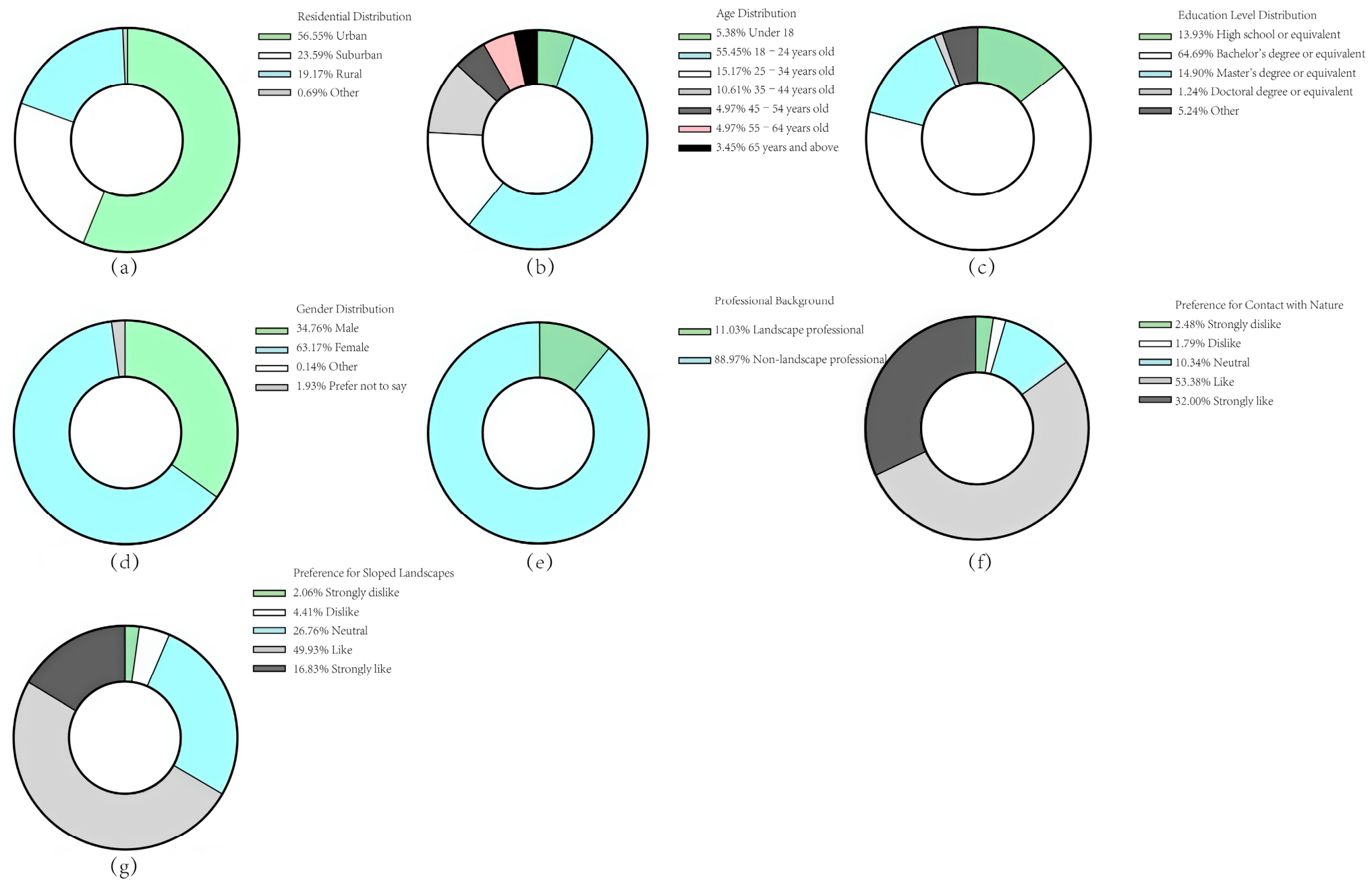
| Characteristic | Slope Group (n = 249) | Quantity Group (n = 268) | Shape Group (n = 210) |
|---|---|---|---|
| Male (%) | 34.1% (85) | 37.3% (100) | 36.7% (77) |
| Female (%) | 64.3% (160) | 61.2% (164) | 62.4% (131) |
| Under 18 years old (%) | 8.4% (21) | 10.1% (27) | 10.0% (21) |
| Bachelor’s degree or above (%) | 66.3% (165) | 64.2% (172) | 64.8% (136) |
| Landscape professionals (%) | 10.8% (27) | 11.2% (30) | 11.0% (23) |
| Source | Type III Sum of Squares | df | Mean Square | F | Significance | η2 |
|---|---|---|---|---|---|---|
| Slope gradient variation | 408.365 | 3 | 136.122 | 72.783 | < 0.001 | 0.180 |
| Quantity variation | 298.712 | 3 | 99.571 | 50.081 | < 0.001 | 0.153 |
| Shape variation | 390.793 | 3 | 130.264 | 48.499 | < 0.001 | 0.120 |
| Slope Gradient Group | Pairwise Comparison | Significance | Quantity Group | Pairwise Comparison | Significance | Shape Group | Pairwise Comparison | Significance | |||
|---|---|---|---|---|---|---|---|---|---|---|---|
| Emotion | P1 | P2 | <0.001 * | Emotion | S1 | S2 | 0.000 * | Emotion | X1 | X2 | 0.323 |
| P3 | 0.000 * | S3 | <0.001 * | X3 | 0.000 * | ||||||
| P4 | 0.000 * | S4 | 0.981 | X4 | <0.001 * | ||||||
| P2 | P3 | <0.001 * | S2 | S3 | 0.824 | X2 | X3 | <0.001 * | |||
| P4 | 0.000 * | S4 | <0.001 * | X4 | 0.057 | ||||||
| P3 | P4 | 0.527 | S3 | S4 | <0.001 * | X3 | X4 | <0.001 * | |||
| Physiology | P1 | P2 | 0.820 | Physiology | S1 | S2 | <0.001 * | Physiology | X1 | X2 | 0.796 |
| P3 | 0.032 * | S3 | 0.000 * | X3 | 0.000 * | ||||||
| P4 | <0.001 * | S4 | 0.936 | X4 | 0.003 * | ||||||
| P2 | P3 | 0.434 | S2 | S3 | 0.958 | X2 | X3 | <0.001 * | |||
| P4 | 0.03 * | S4 | 0.000 * | X4 | 0.087 | ||||||
| P3 | P4 | 0.800 | S3 | S4 | 0.000 * | X3 | X4 | <0.001 * | |||
| Cognition | P1 | P2 | <0.001 * | Cognition | S1 | S2 | <0.001 * | Cognition | X1 | X2 | 0.012 * |
| P3 | 0.000 * | S3 | 0.000 * | X3 | <0.001 * | ||||||
| P4 | 0.000 * | S4 | 0.923 | X4 | 0.868 | ||||||
| P2 | P3 | <0.001 * | S2 | S3 | 0.985 | X2 | X3 | 0.000 * | |||
| P4 | <0.001 * | S4 | 0.000 * | X4 | <0.001 * | ||||||
| P3 | P4 | 0.598 | S3 | S4 | 0.000 * | X3 | X4 | <0.001 * | |||
| Behavior | P1 | P2 | <0.001 * | Behavior | S1 | S2 | <0.001 * | Behavior | X1 | X2 | 0.159 |
| P3 | 0.000 * | S3 | <0.001 * | X3 | <0.001 * | ||||||
| P4 | 0.000 * | S4 | 0.984 | X4 | 0.860 | ||||||
| P2 | P3 | <0.001 * | S2 | S3 | 0.981 | X2 | X3 | 0.000 * | |||
| P4 | <0.001 * | S4 | <0.001 * | X4 | 0.005 * | ||||||
| P3 | P4 | 0.887 | S3 | S4 | <0.001 * | X3 | X4 | <0.001 * | |||
Disclaimer/Publisher’s Note: The statements, opinions and data contained in all publications are solely those of the individual author(s) and contributor(s) and not of MDPI and/or the editor(s). MDPI and/or the editor(s) disclaim responsibility for any injury to people or property resulting from any ideas, methods, instructions or products referred to in the content. |
© 2026 by the authors. Licensee MDPI, Basel, Switzerland. This article is an open access article distributed under the terms and conditions of the Creative Commons Attribution (CC BY) license.
Share and Cite
Wu, S.; Li, X.; Dong, R.; Dong, J. Research on the Impact of Slopes on Restorative Benefits and Landscape Preferences. Sustainability 2026, 18, 8205. https://doi.org/10.3390/su18168205
Wu S, Li X, Dong R, Dong J. Research on the Impact of Slopes on Restorative Benefits and Landscape Preferences. Sustainability. 2026; 18(16):8205. https://doi.org/10.3390/su18168205
Chicago/Turabian StyleWu, Shuling, Xingyang Li, Ruiyun Dong, and Jianwen Dong. 2026. "Research on the Impact of Slopes on Restorative Benefits and Landscape Preferences" Sustainability 18, no. 16: 8205. https://doi.org/10.3390/su18168205
APA StyleWu, S., Li, X., Dong, R., & Dong, J. (2026). Research on the Impact of Slopes on Restorative Benefits and Landscape Preferences. Sustainability, 18(16), 8205. https://doi.org/10.3390/su18168205