Article

When Cities Become Home, What Happens to Rural Memory? Nostalgic Experience in Rural Tourism and Implications for Village Development

1
School of Landscape Architecture, Beijing Forestry University, Beijing 100083, China
2
China Science and Technology Museum, Beijing 100101, China
3
Department of Tourism Management, Sichuan Institute of Tourism, Chengdu 610299, China
4
Pudong Agricultural Machinery Extension Station, Shanghai 201201, China
5
School of Architecture, Tsinghua University, Beijing 100084, China
*
Author to whom correspondence should be addressed.
Sustainability 2026, 18(16), 8146; https://doi.org/10.3390/su18168146
Submission received: 4 May 2026 / Revised: 19 July 2026 / Accepted: 20 July 2026 / Published: 10 August 2026
(This article belongs to the Section Tourism, Culture, and Heritage)

Abstract

Rural land is the spatial embodiment and physical manifestation of nostalgia. When people settle in cities, they become rural sojourners, returning to rural landscapes through travel. The rural history embedded in traditional landscapes is a treasure trove, and these landscapes provide ideal sites for nostalgic research. Tourism has proven to be a major driver for the development of traditional landscapes. This paper focuses on traditional villages with rich rural heritage and high cultural representativeness in the Huizhou region. This paper examined the nostalgic factors among 518 rural visitors to traditional villages. The results indicate that natural landscape (β = 0.30) and traditional agriculture (β = 0.20) directly influence visitors’ nostalgic experiences, while rural architecture and vernacular culture contribute to it indirectly through mediated pathways. The results also show that spiritual and historical nostalgia are the dominant aspects, while homeland nostalgia is relatively less significant in the Huizhou context. The study contributes to a better understanding of nostalgic experience in traditional villages and provides practical insights for balancing heritage protection and tourism development.

1. Introduction

With the continuous advancement of urbanization, the decline of traditional villages and towns is almost irreversible [1]. Traditional villages and towns carry the spiritual and emotional meaning of the wider geographical area. Preserving nostalgic elements in these areas helps to manage and preserve the remaining rural environment [2]. Some traditional villages have gradually evolved into a form of rural heritage [3], and act as the ideal carrier and rural idyll [4,5]. The rise of rural tourism reflects an active choice by highly developed cities [6]. It seeks ecological balance and a return to humanistic values. Meanwhile, it offers a historic opportunity for rural areas to redefine their value by leveraging the driving force of urban modernization. Rural tourism effectively protects and revitalizes traditional villages and towns [7] while showcasing local culture. This approach strengthens residents’ sense of belonging and satisfies visitors’ deep yearning for authentic nostalgic experiences [8,9]. Thus, rural tourism has emerged as a pathway for traditional landscape development and an ideal means of preserving nostalgic sentiments [10,11], playing a vital role in achieving sustainable development goals [12,13].
Nostalgia is commonly described as a sentimental longing or affection for the past [14]. It is a complex, predominantly positive emotional experience characterized by reflection on personally meaningful past events and periods [15,16]. Nostalgia is closely connected to emotional images like cultural background and collective identity at a spiritual level. It reflects one’s strong attachment to a familiar environment, cultural memories, and emotional bond [17]. Additionally, it shows a desire for belonging and spiritual roots [18,19]. This feeling goes beyond the search for familiar memories and focuses on cultural roots and emotional connection to customs and traditions [20,21]. Specific rural settings inherently possess characteristics that can awaken a sense of nostalgic emotions in visitors [22]. The physical spaces of agricultural production and life that evoke nostalgia primarily include the overall planning layout of villages and the spatial layout of buildings, as well as specific elements such as courtyards, architectural groupings, streets, cultural relics, ancestral temples, and ancient trees [23]. The psychological spaces triggered by nostalgia refer primarily to the lifestyles, emotional patterns, and working habits of local people, as exemplified by local customs and cultural activities [24]. Accordingly, the material carriers of nostalgia mainly include natural ecology, traditional human settlements, and visible agricultural production landscapes [25]. Non-material carriers are mainly local folk culture and a rural atmosphere [26]. As a key part of rural esthetics, nostalgia helps keep shared memory and support collective culture [27]. It can also be seen and expressed as a symbol of landscape.
With the increase in population mobility, individuals’ places of residence have become a key factor influencing their selection of tourism destinations, shaping both the distance and type of destinations they prefer [28,29]. Nostalgia can originate not only from direct experiences of a place but also from hearing others’ stories and memories about these locations [30]. Rural landscapes offer urban residents the opportunity to experience traditional life, while also providing them with spiritual comfort [31,32]. Researchers have also examined the concept of nostalgia in the context of rural tourism [18]. It is widely acknowledged that a place-based rural setting has a nostalgic character and evokes a response to the collective memory of a nostalgic past [33]. Stakeholders have recognized the positive associations of nostalgia, yet they have not fully harnessed the potential of cultivating nostalgia to attract visitors. Empirical research shows that heritage and rural contexts particularly elicit vicarious and collective experiences through curated narratives of the past, which in turn strengthen approach intentions, likelihood of revisiting, and advocacy behavior [34,35].
Existing research on rural tourism predominantly focuses on tourist loyalty [36,37], travel motivation [35,38], and experience quality [11]. Systematic investigations into the formation mechanism and dimensional classification of tourists’ nostalgic experiences in rural tourism, as well as the correlation between such experiences and the cultural environment of traditional villages, remain limited. This study provides a case-specific understanding of visitors’ nostalgic experiences in Huizhou traditional villages and broadens the scope of research perspectives on the rural tourism context. Furthermore, compared with general rural tourism contexts, traditional villages, as important carriers of historical and cultural memory, may exhibit nostalgia formation mechanisms that differ from those in typical rural tourism. However, this issue has not been thoroughly explored. Based on this, the study focuses on visitors to traditional villages and constructs a model of the formation mechanism of nostalgia experiences, aiming to enrich the theoretical framework of rural tourism and nostalgia research. These findings provide insights into visitors’ nostalgic experiences and enrich how rural elements contribute to nostalgia formation within this specific context.
Over the past few decades, China has experienced rapid urbanization, leading to significant changes in population distribution, land use, and social structures. In 1949, approximately 89% of the population lived in rural areas. By 2019, this proportion had dropped to 40%. It is estimated that currently about 67% of the population lives in urban areas [1]. More rural settlements move from rural areas to cities for employment and development opportunities. Many areas are gradually becoming less populated, with some even facing the risk of disappearing. To protect villages with profound historical heritage and traditional features, China started a traditional villages protection program in 2012 [39]. These traditional villages and towns are usually located in a natural environment, with fresh air, clean water resources, and a peaceful atmosphere. These places bear the historical accumulation of hundreds of years and form the foundation of local communities that have lived there for generations [40]. In modern society, traditional landscapes also offer a place for visitors to stay away from the hustle and bustle of the city, relax, and relive the old days. China is currently striving to realize rural revitalization, and many rural areas are encouraged to develop rural tourism. How to retain nostalgia in the process of rural revitalization is of great significance to the sustainable development of rural areas [41].
This study focuses on visitors’ nostalgic experiences in rural tourism and explores the influencing factors and formation pathways of nostalgia in Huizhou traditional village tourism from the visitor perspective. Based on questionnaire data, this study uses structural equation modeling to examine the research dimensions. Previous studies have focused on single factors such as landscape esthetics [42], cultural activities [43], or interactions [44], and this research integrates environmental features, cultural symbol perception, and visitors’ emotional foundations. It identifies three core aspects of rural nostalgia: homeland nostalgia, spiritual nostalgia, and historical nostalgia. The research also explores the roles of tangible heritage and cultural practices in shaping visitors’ cognition and engagement. The findings provide case-specific insights into visitors’ nostalgic experiences in Huizhou traditional villages and offer implications for heritage interpretation and tourism management within similar rural contexts.

2. Materials and Methods

2.1. Study Area

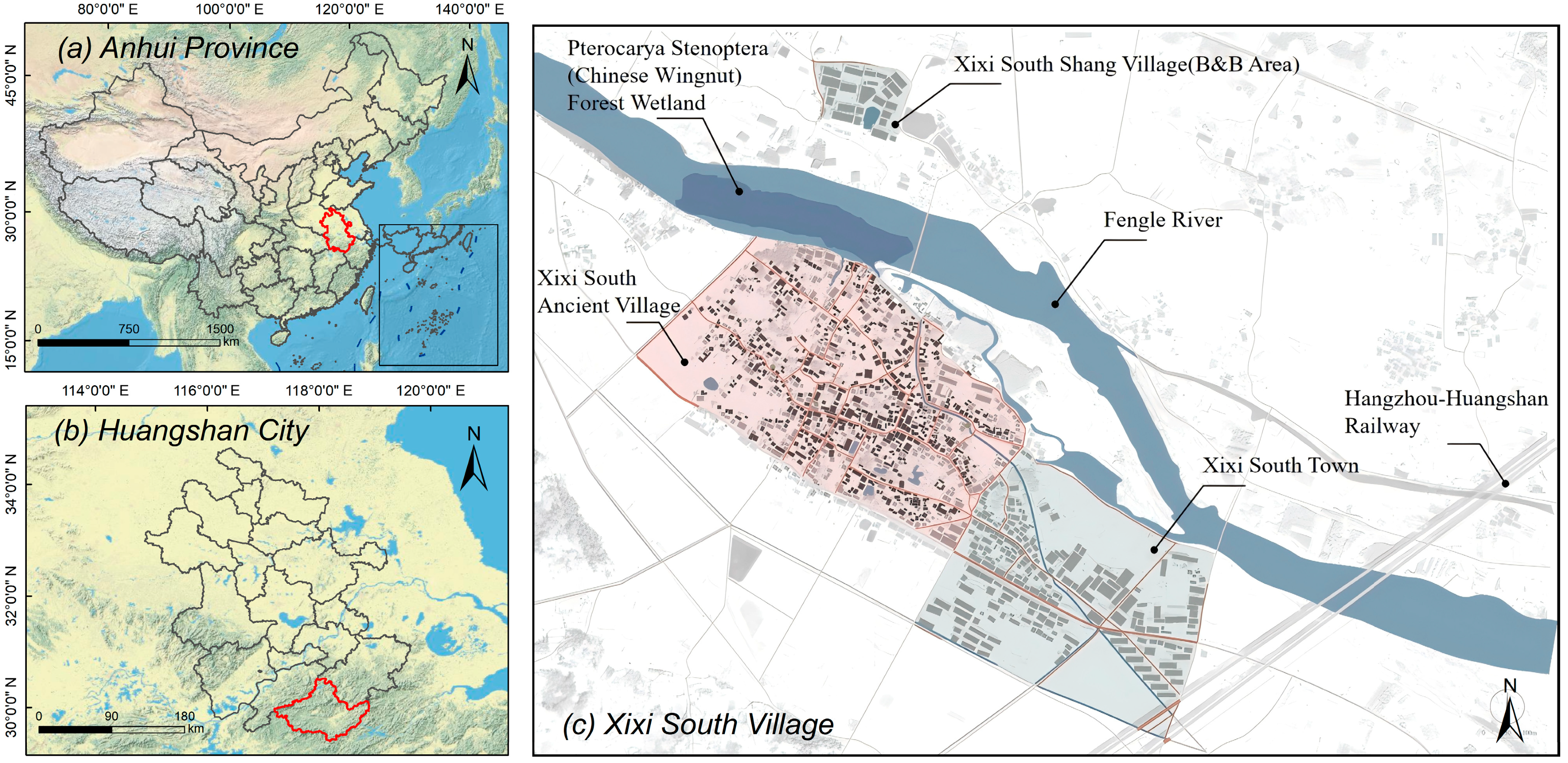
Xixi South Village is located in Xixi South Town, Huizhou District, Huangshan City, Anhui Province, China, with a permanent population of nearly 4000 people (refer to Figure 1). The village has a history of more than 1200 years and has a good geographical location. Xixi South Village is not only a cultural example with rich historical details but also a lively practice place for modern rural development.
Xixi South Village is the epitome of Huizhou culture. This village preserves an extremely complete ancient village pattern from the Ming and Qing dynasties, including the original water systems and historical buildings. The ancient village remains largely intact. Hui-style buildings with sweeping eaves, whitewashed walls, and dark brick-tiled roofs line the narrow alleys. Against this architectural backdrop, traditional lifestyles and customs have also been well preserved. However, at the beginning of the 21st century, Xixi South Village is facing challenges such as population outflow and damage to ancient buildings. By incorporating innovative ideas, the villagers have succeeded in transforming abandoned old houses into high-quality homestays, studios, and public culture spaces. In addition, new residents bring capital and ideals, which integrate the wisdom and regional knowledge of indigenous residents. With its unique wetland and forest landscape, Xixi South Village has quickly become popular on social media, presenting an ideal place to explore the effects of the influence economy, the balance between tourism and cultural heritage protection, and the harmonious coexistence of visitors and local residents.

2.2. Questionnaire and Procedure

2.2.1. Questionnaire Design

This study explores the nostalgic experience of visitors in traditional villages, and a questionnaire survey was conducted. The questionnaire was divided into three parts. The first part described the personal information of participants, including 5 items: age, gender, educational background, occupation and residence transition. The second part of the questionnaire consisted of 22 measurement items, which were developed based on five dimensions, aiming to assess the perceptual elements in rural regions. The third part measured the actual experience that visitors perceive when evoked by rural native elements, and this dimension comprises 3 items. Initially, the measurement scale consisted of 6 dimensions with 25 items developed based on previous studies and adapted to the traditional village context. All items were measured using a 5-point Likert scale to capture visitors’ subjective attitudes and cognition.
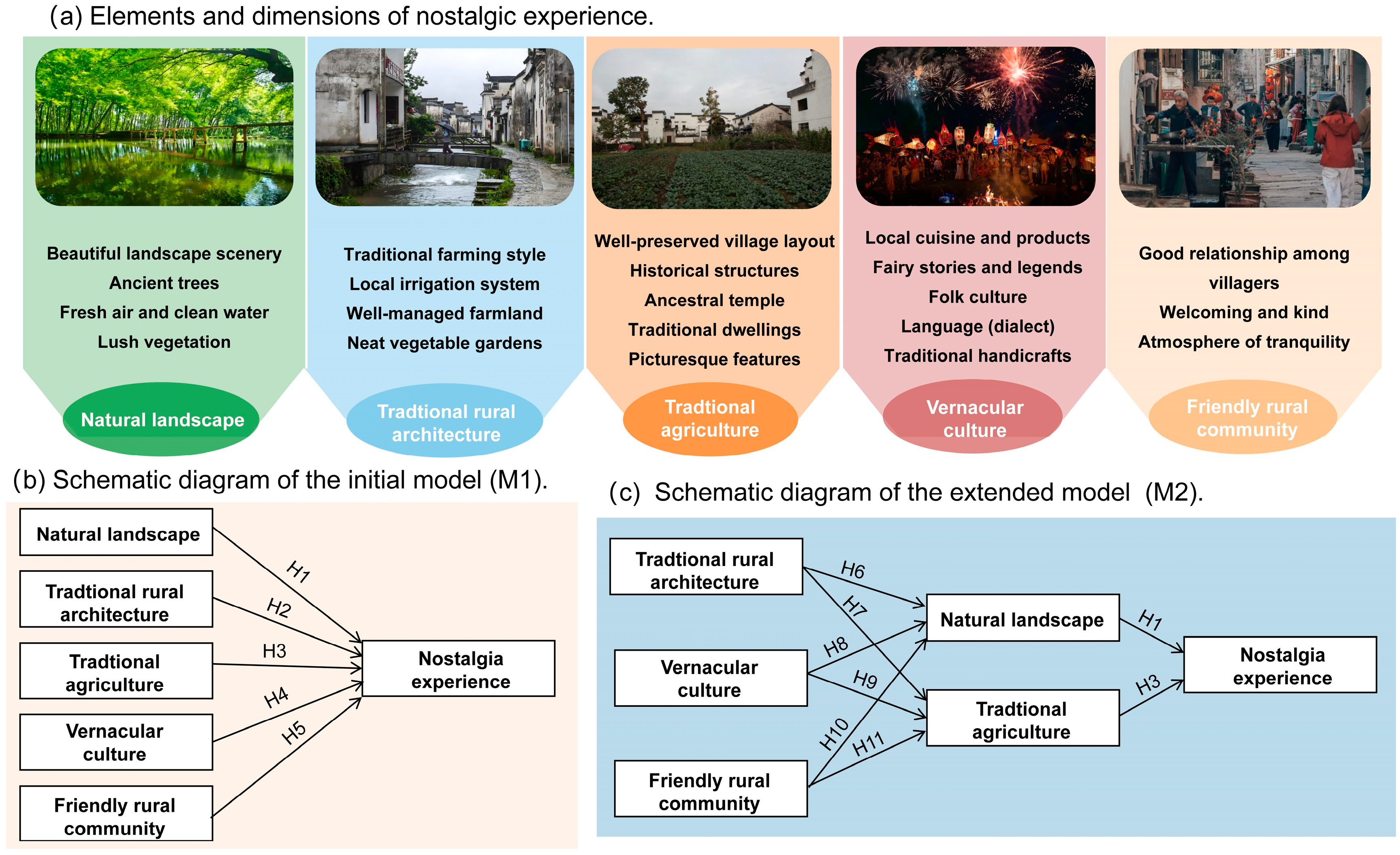
Nostalgia, as an emotional experience that is deeply rooted in real-life settings, can be evoked by actual environments, including tangible carriers and non-tangible atmosphere [25]. The material carriers of nostalgia fall into three core categories: pleasant natural ecological surroundings, traditional residential settlements, and visible agricultural production landscapes [23,26]. In line with the international context, this study collectively defines these three tangible dimensions as natural landscape, traditional rural architecture, and traditional agriculture. The non-material carriers mainly consist of local folk culture and authentic rural interpersonal bonds [24,26]. Accordingly, this study terms these two intangible dimensions as vernacular culture and friendly rural community. Together, these two aspects form a complete system that underpins the arousal of nostalgic emotion.
All measurement instruments are derived from previous studies. Concerning the measurement items for natural landscape, we referred to the classic scales proposed by Kaplan (1995) [45] and Korpela et al. (2001) [46], which were originally developed for environmental perception. We further adopted the revised items from Liu et al. (2016) [47] and Wang et al. (2019) [48] in rural contexts. For the traditional rural architecture dimension, we adapted items from Pola (2019) [49] and Zhou et al. (2019) [50], whose scales focused on the perception of traditional settlements and ancient buildings. Regarding the measurement items for traditional agriculture, we referred to the studies of Wang et al. (2018) [51], who designed relevant indicators for rural agricultural perception. For the vernacular culture dimension, the items were derived from Tao et al. (2018) [52] and Wang et al. (2019) [48] related to rural cultural symbolism and folk custom perception. The measurement items for friendly rural community, we followed the scales of Tian et al. (2016) [53] and Yu et al. (2018) [54] concerning rural social atmosphere and human interaction. As the measurement items for perceived nostalgic experience, we referred to Holak et al. (1998) [55], Boym (2002) [56] and Sedikides et al. (2019) [57], whose scales have been widely applied in tourism nostalgia and emotional experience research.
Two experts engaged in urban–rural coordination development and rural tourism were interviewed to assess the rationality of the questionnaire. Based on their feedback, some items were adjusted to enhance reliability and clarity. The revision work mainly focused on polishing the specific wording of each questionnaire item. We removed items that did not match the real scenario of rural background and modified statements to fit the cultural connotation of the Chinese context as well as local characteristics of Huizhou traditional villages.

2.2.2. Survey Implementation

Before the survey, 8 local young people were recruited as research assistants through an online platform. Due to scheduling conflicts, 2 assistants withdrew from the training, leaving 6 to take part in the following work. All assistants completed two online training sessions. In the first training, research objectives and detailed interpretation of questionnaire items were introduced. The second training focused on standard fieldwork norms, polite communication guidelines, and standardized opening remarks for approaching tourists. The survey was conducted by two researchers and six trained assistants using an on-site intercept sampling method in Xixi South Village. Visitors were approached at different locations within the site and invited to participate in the survey. At the beginning of the survey, participants were informed about the purpose of the study and their right to withdraw at any time. Questionnaires were completed independently by tourists and collected on the spot. Researchers offered no suggestive guidance and only answered factual questions raised by respondents. The survey took approximately 15–20 min to complete.
The pre-investigation was conducted from 11–20 September 2019. The scale adopted in this study is not a set of well-established standardized measurement tools. Instead, it was developed by broadly referring to existing relevant literature and revised in the context of traditional villages’ nostalgia experience. The applicability and validity of the scales still need to be verified with empirical data. Exploratory factor analysis was carried out in the pre-survey stage. During this process, 200 questionnaires were distributed. A total of 197 questionnaires were returned, with 182 valid questionnaires. The scale passed both reliability and validity tests. However, in exploratory factor analysis, the item pleasant climate under the natural landscape dimension was eliminated due to its factor loading below 0.5. After removing the item with insufficient factor loading, the remaining 24 items were retained as the final measurement scale for the formal survey.
The research was conducted twice, spanning over a period of four years. Formal investigation was launched from 28 September–3 October 2019. A total of 300 questionnaires were distributed. Two participants withdrew from the survey due to time constraints after agreeing to participate, so researchers collected 298 questionnaires on-site. After excluding 13 invalid questionnaires with incomplete answers, 285 valid samples were obtained, corresponding to a 95.6% valid response rate.
The secondary survey was conducted from 4–8 April 2023, shortly after the COVID-19 pandemic prevention and control restrictions were fully lifted. The second survey continued to use on-site intercept sampling to select tourists as the study subjects. A total of 250 questionnaires were distributed. After excluding 17 questionnaires with incomplete answers, 233 valid questionnaires were retained, with a valid rate of 93.2%. The number of visitors who declined to participate in the survey was not recorded during the field investigation. The original research plan arranged a second round of field surveys in the spring of the following year to supplement the overall sample size. This arrangement was postponed during the COVID-19 pandemic and was not implemented until the rural tourism market fully recovered after the pandemic. Furthermore, in the post-pandemic era, tourists’ travel motivations and local emotional perceptions present distinctive contemporary characteristics, which may help yield novel and valuable findings for this study. In the end, 548 formal questionnaires were collected, and 518 valid questionnaires were obtained, with an effective response rate of 94.5%, as shown in Table 1.
IBM SPSS 25.0 and Amos 24.0 were used for data analysis in this study. In SPSS, we did descriptive statistics and data screening. In Amos, we used structural equation modeling (SEM) to test the structural relationships between the measurement model and the hypotheses.

2.3. Research Hypotheses and Models

Following the exploratory factor analysis (EFA) procedures, we first addressed missing values and outliers in the sample data and performed a normality test. Subsequently, we conducted KMO (≥0.80) and a significant Bartlett’s test, indicating suitability for EFA. Principal component analysis was used to extract the factors, and the number of retained factors was determined based on the criterion of eigenvalues greater than 1. In order to improve the interpretability of the results, we applied the variance maximization rotation method. Factor loadings were set with a threshold of ≥0.50 and cross-loadings < 0.30, progressively eliminating items with low commonality and cross-loadings [58]. After several iterations, five stable factors were extracted: natural landscape, traditional rural architecture, traditional agriculture, vernacular culture, and friendly rural community. The cumulative variance explained by each factor reached an acceptable level (>60%), and reliability testing indicated that Cronbach’s α was ≥0.70 for all factors.

2.3.1. Original Hypotheses

Previous research has shown that visitors’ emotional responses to rural environments are influenced by both tangible and intangible elements of the destination. Among them, natural landscapes have been found to influence visitors’ emotional and cognitive responses at destinations [59,60]. Picturesque landscapes, lush greenery, and natural environments can evoke feelings of tranquility, nostalgic reminiscence, and deep attachment to rural life [23,48]. Architectural elements such as traditional houses, temples, and village layouts contribute to the local identity of rural experiences and are closely linked to feelings of nostalgia [26,50]. Traditional agriculture embodies rural authenticity through historical practices and lifestyles. Traditional elements, vernacular landscapes, and historical ways of life can act as nostalgic triggers, evoking visitors’ memories and emotions, and thus contribute to nostalgic experiences [18]. Vernacular culture, which encompasses local festivals, crafts, and rituals, acts as a cultural anchor capable of evoking both personal and collective memories. Engagement with these cultural elements enhances visitors’ sense of nostalgia and strengthens their emotional attachment to rural destinations [24,48]. Within the context of traditional villages, friendly rural communities refer to harmonious and welcoming social environments, characterized by amicable interpersonal relationships among residents, simple and hospitable local traits, and a tranquil, peaceful village atmosphere. Such community attributes enhance visitors’ emotional comfort, strengthen their sense of belonging, and can evoke nostalgic feelings [53,54].
Based on the relevant literature review and the research context, we initially proposed the following research hypotheses.
H1. 
Natural landscape has a positive influence on the nostalgia experience.
H2. 
Traditional rural architecture has a positive influence on the nostalgia experience.
H3. 
Traditional agriculture has a positive influence on the nostalgia experience.
H4. 
Vernacular culture has a positive influence on the nostalgia experience.
H5. 
Friendly rural community has a positive influence on the nostalgia experience.

2.3.2. Extended Hypotheses

To fully explore the relationships among latent variables and enrich the research content, we further put forward several extended hypotheses on the basis of the original theoretical framework.
Traditional architecture often aligns with topography, water systems, and vegetation through its site selection, materials, form, and spatial layout. These elements enhance the region’s distinct characteristics [61], thereby improving the overall quality and esthetic value of natural landscapes [62,63,64]. Rural buildings form a widespread heritage of high historical and architectural value, and play an important role in shaping the character of agricultural landscapes [63]. As spatial carriers of agricultural activities [65,66], such as storing tools, drying crops, and housing livestock. Architectural systems sustain the production modes of traditional agriculture [67]. Based on this, we proposed the following hypotheses:
H6. 
Traditional rural architecture has a positive influence on the natural landscape.
H7. 
Traditional rural architecture has a positive influence on traditional agriculture.
Vernacular culture is a regional cultural system shaped through long-term interactions between local communities and their environment [68,69]. The ecological values and traditional wisdom embedded in vernacular culture contribute to the conservation of natural landscapes and the preservation of their regional characteristics [70]. Meanwhile, farming customs [71], local agricultural knowledge, and traditional production practices [72] provide an important foundation for the continuity and sustainability of traditional agriculture [73]. Accordingly, the following hypotheses are proposed:
H8. 
Vernacular culture has a positive influence on the natural landscape.
H9. 
Vernacular culture has a positive influence on traditional agriculture.
Characterized by harmonious social relationships and a peaceful village atmosphere, friendly rural communities inspire villagers to collectively conserve mountains, woodlands, and water bodies [74], thereby enhancing the integrity and esthetic quality of natural scenery [75]. At the same time, community cohesion facilitates the free exchange of farming experience, the mutual sharing of labor and production tools, and the intergenerational transmission of traditional farming systems [76], all of which contribute positively to the productivity, stability, and cultural continuity of traditional agriculture [75]. Taken together, such friendly rural communities deliver dual positive impacts on both natural landscape preservation and the inheritance of traditional agricultural practices. Accordingly, the following hypotheses are proposed:
H10. 
Friendly rural community has a positive influence on the natural landscape.
H11. 
Friendly rural community has a positive influence on traditional agriculture.
All hypotheses have been fully integrated and clearly presented in Figure 2.

3. Results

3.1. Sample Profile

Drawing on the survey responses, we can initially establish a basic profile of the visitors. As presented in Table 2, the respondents are evenly split by gender, with 46.5% being male and 53.5% female. Additionally, 60% of them are aged between 18 and 34. The majority of the respondents are highly educated: 71.6% hold a bachelor’s degree or an associate’s degree, and 17% have a graduate degree. More than half of the respondents (54.4%) are office workers.
Childhood life experiences frequently become the source of nostalgia, while significant changes in the living environment often trigger it. The results show that the majority of respondents live in and around cities (71.4%), with 55.6% living in urban areas and 15.8% in the suburbs. We explore the nostalgic tendencies of visitors through the frequency with which they experienced nostalgia, rural yearning, and a preference for traditional villages. It is found that the surveyed visitors generally exhibited a strong nostalgic preference for traditional villages, suggesting that most visitors to traditional villages have clear nostalgia motives.

3.2. Reliability and Validity Analysis

This study conducted a reliability analysis on all measurement items. Initially, Cronbach’s α was employed to evaluate the reliability of the overall scale and each dimension, with α ≥ 0.70 indicating good reliability [77]. The α value obtained was 0.879, meeting the criterion for high reliability. Within the scale, the α values for four dimensions, traditional rural architecture, traditional agriculture, vernacular culture, and friendly rural community, were higher than 0.80, while those for two dimensions, natural landscape and nostalgia experience, fell between 0.6 and 0.8, which were deemed acceptable for reliability (refer to Table 3).
To ensure validity, we conducted confirmatory factor analysis on the 24 observed variables. The results showed that the standard loading coefficients for 23 variables were all larger than 0.5 and that one variable was below 0.5 and above 0.4 (homeland nostalgia had a loading of 0.448). The composite reliability (CR) values for all dimensions were larger than 0.6. The average variance extracted (AVE) of four dimensions (traditional rural architecture, traditional agriculture, vernacular culture, and friendly rural community) was higher than 0.5, and for the remaining two dimensions, natural landscape and nostalgia experience, the AVE was above the acceptable threshold of 0.36.

3.3. Robustness Checks

When all survey information is collected from the same respondents, common method bias (CMB) tends to occur, and this bias may interfere with the accurate interpretation of the relationships between variables. To ensure the robustness of the findings and rule out this potential issue, we implemented two complementary statistical tests. We first performed Harman’s single-factor test on all measurement items using unrotated principal component analysis. The first extracted factor explained 42.65% of the total variance, which is lower than the standard criterion of 50% [78,79]. This outcome demonstrates that severe common method bias does not exist in the current data.
Then, we employed a partial correlation analysis by controlling for the common method factor extracted from unrotated principal component analysis. After partialling out the method factor, the magnitudes of the correlations among the core constructs changed only marginally (all changes < 0.05), and all hypothesized relationships remained statistically significant (p < 0.05). The direction and magnitude of the coefficients remained unchanged.
Additionally, to examine potential multicollinearity among the independent variables, we computed the variance inflation factor (VIF) for each predictor in the regression model. The results showed that VIF values ranged from 1.607 to 4.276, all well below the commonly accepted threshold of 5. This indicates that multicollinearity is not a serious concern in the data.
Taken together, these findings suggest that neither common method bias nor multicollinearity seriously threatens the validity of results.

3.4. Structural Modeling Analysis

To test the theoretical model and estimate causal relationships, three alternative structural models (M1, M2, and M3) were specified. M1 was first constructed in AMOS and estimated using maximum likelihood estimation (MLE) to serve as the baseline model. As the baseline model, M1 only contains the core direct pathways. Prior to modeling, latent variables and measurement indicators were identified based on the confirmatory measurement model, and normality and multicollinearity were examined. Then, overall fit was assessed, and diagnostics were conducted using standardized residuals and the latent variable correlation matrix. According to the results (see Table 4), among the five structural paths, only H1 and H3 were significantly confirmed. The regression coefficients for the remaining paths were non-significant, and their effect directions were inconsistent with theory. This suggests that the factors influencing the nostalgia experience have not been fully identified, and the initial model may need to be revised. While some aspects of nostalgic perception may not directly impact visitors’ nostalgic experience, they may exert an indirect effect by influencing other elements.
M2 was specified as an extended model to further examine the relationships. Compared with M1, M2 treats traditional rural architecture, vernacular culture, and friendly rural community as exogenous variables, while modeling natural landscape and traditional agriculture as endogenous variables. M2 incorporates the extended hypotheses (H6 to H11), thereby providing a more comprehensive structural representation of the proposed theoretical framework. The estimation results of M2 (see Table 5) show that the paths from friendly rural community to natural landscape and traditional agriculture are not statistically significant within this model specification.
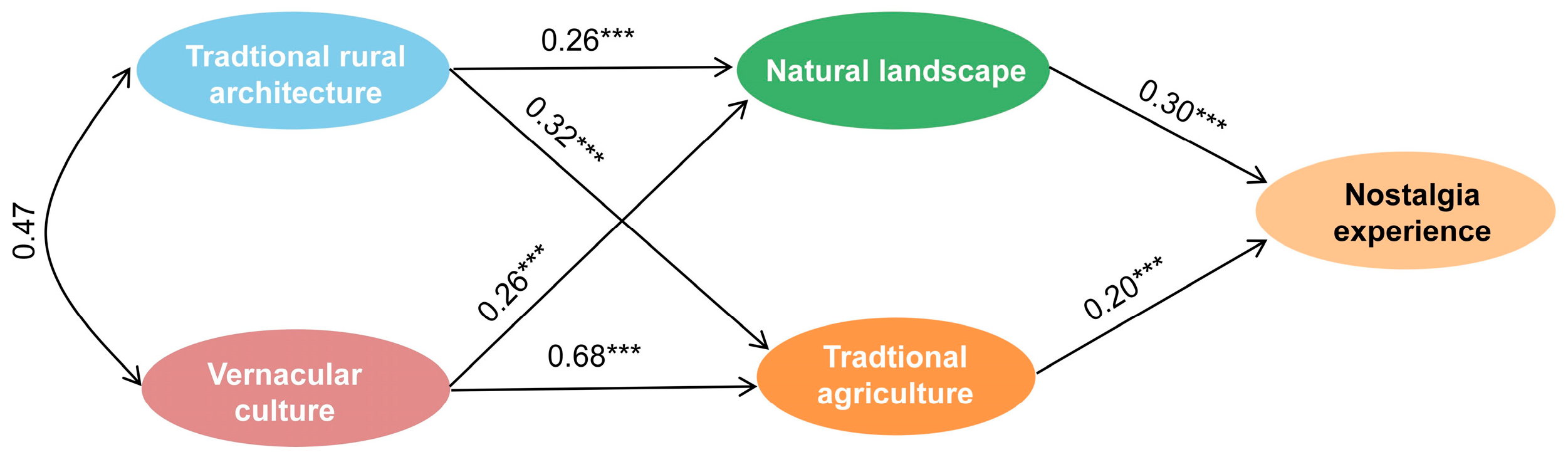
For the dimensions of vernacular culture and friendly rural community, existing literature on rural tourism and cultural commodification highlights that their effects on landscape perception and agricultural systems may be context-dependent, and are not consistently positive across different rural settings [80]. Accordingly, the constrained model (M3) was estimated to provide a comparative assessment of the stability of the hypothesized relationships. Results (see Table 6) indicate the standardized path coefficients for the six path assumptions. All six structural path coefficients in M3 were statistically significant at the 0.001 level, and path directions aligned with theoretical expectations. By integrating measurement and structural evidence, M3 enhances model interpretability while preserving model simplicity.
As indicated in Table 7, the results reveal that the constrained model (M3) has a chi-squared degrees of freedom ratio (χ2/df) of 2.571, which is below the threshold of 3; the root mean square error of approximation (RMSEA) is 0.055, which is under the acceptable limit of 0.08 [81]; and the standardized residual mean root (SRMR) is 0.046, which is less than the 0.05 benchmark [80]. In addition, the goodness-of-fit index (GFI) is 0.919, the comparative fit index (CFI) is 0.939, the incremental fit index (IFI) is 0.939, and the Tucker–Lewis index (TLI) is 0.930, with all the index values greater than 0.9, indicating a good fit for the model. When compared to models M1 and M2, model M3 exhibits the lowest Akaike information criterion (AIC) and consistent Akaike information criterion (CAIC) values. Consequently, model M3 has been selected as the final model for this paper (see Figure 3).
The SEM results show that the four dimensions, traditional rural architecture, vernacular culture, natural landscapes, and traditional agriculture, significantly and positively influence visitors’ nostalgic experiences. Specifically, natural landscapes (β = 0.30, p < 0.001) and traditional agriculture (β = 0.20, p < 0.001) have significant direct positive effects on visitors’ nostalgic experience. Although vernacular culture and traditional rural architecture do not exhibit significant direct effects, they indirectly influence nostalgia experience through natural landscapes and traditional agriculture.
Given that the data were collected during two different periods, a multi-group analysis was further conducted to assess whether the measurement model remained stable across time. This analysis aimed to examine measurement invariance between the two samples. The model fit was first assessed using the unconstrained model, indicating that the basic measurement structure was consistent across the two survey periods. Then, measurement invariance was examined by comparing the unconstrained model with increasingly constrained models. As shown in Table 8, the measurement weights model, which constrained factor loadings to be equal across the two groups, showed minimal changes in model fit compared with the unconstrained model (ΔCFI = 0.000, ΔTLI = 0.004, RMSEA = 0.057). These results indicate that the factor loadings of the measurement items were stable between the 2019 and 2023 samples, supporting metric invariance. Furthermore, the measurement intercepts model was tested to evaluate scalar invariance. Compared with the unconstrained model, the constrained model showed no substantial changes in fit indices (ΔCFI = 0.001, ΔTLI = 0.010, RMSEA = 0.056). Overall, the measurement invariance assessment confirmed that the constructs were measured consistently across the two survey periods. This finding supports the temporal comparability of the samples and strengthens the reliability of the SEM results, providing an empirical foundation for interpreting visitors’ nostalgic experiences across different periods.

4. Discussion

4.1. Theoretical Contribution

Visitors’ nostalgia is related to both direct predictors and indirect contributors. Natural landscape elements, such as lush vegetation, fresh air, water sources, ancient trees, and scenic views, provide a direct ecological and esthetic foundation for eliciting nostalgic experiences. Similarly, traditional agriculture, including farming practices, irrigation systems, well-managed farmland, and vegetable gardens, directly triggers visitors’ nostalgic memories related to rural production. Tang et al. [82] also suggest that rich agricultural landscapes can enhance the diversity of tourists’ recreational experiences in agritourism. This finding is consistent with Chen et al. [83], that rural natural environments and agricultural activities constitute essential rural resources and key elements. In addition, vernacular culture and traditional rural architecture do not directly evoke nostalgia, but instead serve as antecedent contexts that indirectly shape nostalgic experiences, which highlights the differentiated roles of rural landscape elements. In contrast, while Kou et al. (2024) [84] found that historical culture and integrated tourist routes exert the strongest influence, their study focused on influence magnitude rather than the indirect mechanisms examined in this paper. This is also aligned with existing research that vernacular culture and traditional rural architecture function as contextual environmental cues that shape nostalgic experiences through place perception and situational engagement [85].
This study primarily examines the experience of the visitors in traditional villages and towns based on three items (see Table 9). Homeland nostalgia (β = 0.448) is a profound attachment and longing for one’s native land, playing a crucial role in self-identity, participation and experience, cultural belonging and emotional comfort. Spiritual nostalgia (β = 0.724) goes beyond the remembrance of specific objects, particular places, or tangible scenes of life. Historical nostalgia (β = 0.625) centers on the protection and education of local traditions and historical villages, the inheritance of cultural heritage, and the cultural responsibility of maintaining collective memory. In a word, these three forms of nostalgia emphasize different meanings. From the formation of individual identity to spiritual and esthetic satisfaction and then to the inheritance of collective culture, these elements constitute the multifaceted aspects of nostalgia but also provide theoretical support for targeted cultural protection and emotional care initiatives related to nostalgia.
Among the three items, spiritual nostalgia shows the strongest effect, followed by historical nostalgia. Homeland nostalgia is relatively weaker in this tourism context because visitors mainly experience symbolic and cultural nostalgia rather than personal hometown memories. The relatively weaker role of homeland nostalgia does not indicate the absence of place attachment. Instead, it may reflect the fact that most visitors are outsiders who do not share direct personal memories with Huizhou villages. Therefore, their nostalgic experiences are more likely to be evoked by shared cultural memories, historical landscapes, and imagined rural lifestyles rather than personal hometown experiences. This also suggests that nostalgia in tourism contexts is not necessarily equivalent to residents’ emotional attachment to their homeland; instead, it is more likely to represent a form of cultural imagination and spiritual experience constructed through visitors’ engagement with rural landscapes and heritage. It should be noted that these three aspects are not mutually exclusive. Visitors may have different nostalgic experiences at different times and in different situations. When faced with historical sites, people may evoke multiple aspects of nostalgic experience at the same time.

4.2. Implications

Natural landscape functions as a key trigger of nostalgic experience, suggesting that rural tourism development should emphasize experiential exposure to authentic rural scenery rather than artificial landscape reconstruction. However, the tourism of historical villages has been integrated into the trend of modern life, and changes are certain. The COVID-19 pandemic has become a key turning point in the development of rural tourism, shifting its development model from pursuing authenticity to integrating modernity [86]. After the epidemic, a new modern-style visitor center with a parking lot was built in the north of the village to receive a large number of visitors. Western restaurants, cafes, and bars usually found in urban areas are also opening in and around the village. The traditional rural style and modern esthetic functions will blend here, forming a multifunctional space that carries nostalgia while meeting the needs of modern consumers. The findings highlight that natural landscapes in traditional villages should be understood not only as an ecological asset but also as a perceptual and emotional trigger of nostalgia.
From the perspective of Huizhou regional culture and rural life, traditional agriculture is a key local carrier that shapes nostalgic experiences. Rooted in the 24 solar terms, Huizhou traditional agriculture forms a clear seasonal farming system. Typical practices such as sun-drying harvests are important sources of rural nostalgia. In the mountainous areas of southern Anhui, the tradition of drying crops on rooftops has developed due to the local terrain. Around the autumn equinox, households spread crops in front of their houses, forming a unique rural landscape. The farming cycle of spring planting, summer care, autumn harvest, and winter storage has been passed down for generations and reflects a stable rural way of life. The scenes of farm work, the smell of crops, and the daily rural environment together form shared rural memories. Both tourists and local residents can relive rural traditions through these seasonal agricultural landscapes, which evoke nostalgia for the countryside and a slower way of life. Overall, traditional agricultural practices have a clear positive effect on the sense of nostalgia.
As an important manifestation of vernacular culture, local food has become the most preferred and highly valued cultural carrier among young visitors in China. It is highly effective in sustaining indigenous traditions, boosting rural tourism, and improving the quality of the local economy [87,88]. The regional cuisine has a natural inheritance and cultural background that forms the core of the local food. To urban visitors, the traditional food is an important transfer vehicle of nostalgic memories, and the past is in close contact with the present [89,90]. By keeping traditional food and cooking traditions and preserving them, rural areas will be able to preserve the cultural tradition and attract visitors, as well as recuperate the rural tourism sector, which will, in turn, contribute to the sustainable growth of the regional economy. With the further expansion of fast food brands to traditional villages, the local catering practitioners are in dire need of seeking and inventing unique home-based cuisines and innovating service ideas and business models. These restaurants might be separate, or they can be coupled with the rural homestays. It is an attempt to make residents feel included, and visitors have a complex experience that encompasses cultural nostalgia and life experiences.
The sustainable development of the traditional historical villages presupposes not only the socio-cultural authenticity of the local populations with particular respect but also the manner in which the latter will be directed in the development [91]. The best solution is to expand cultural heritage protection to include the involvement of young people [92,93], maintain the cultural spirit of the local population, actively arrange cultural festivals, and make oral history, traditional rituals, folk celebrations, and educative on-site regimes a part of the visitor experience. In addition to visual experience, it is also necessary to focus on the immersive interactions that will help to promote profound communication between the visitors and the inhabitants of the village. Besides this, local residents ought to be proactively enlisted and trained to work as tour guides and to be deployed to give interactive interpretation services to the visitors.
Traditional rural architecture is a symbolic spatial carrier of Huizhou traditional villages. In this region, residential buildings commonly follow a unified style characterized by white horse-head walls and black-tiled roofs. The layout and construction methods are highly similar, showing a clear degree of architectural homogeneity. This pattern results from the combined influence of the mountainous terrain in southern Anhui and traditional building techniques. At the same time, this unified building style has formed a unique and unrepeatable rural architectural landscape specific to Huizhou. Due to limited land in mountainous areas, local houses are often designed with compact courtyard layouts, roofed drying spaces, and multi-story structures. Groups of Huizhou-style buildings create a coherent rural landscape, forming shared visual memories for both residents and visitors and further strengthening people’s nostalgic attachment to the countryside.
In Xixi South Village, many visitors primarily learn about the destination through online promotion and social media, often resulting in a “tick off” tourism pattern [94]. Such visitors typically spend limited time in the village, reducing opportunities to experience the local social atmosphere. At the same time, empirical evidence suggests that interaction rituals and social relationships are not a dominant determinant of rural tourism experiences or nostalgic responses, as rural social relations mainly function as a structural background rather than an emotional trigger [95]. Thus, the friendly rural community element is not embraced by the model in this study, indicating that the current nostalgic experience of visitors is superficial.
The rural perceptual elements together form a complete system of nostalgic experience in Huizhou traditional villages. Meanwhile, emerging digital tourism formats are continuously reshaping the ways rural spaces are experienced, profoundly influencing how visitors’ nostalgic perceptions are formed. The utilization of digital techniques enables the systematic documentation, long-term preservation, and widespread dissemination of cultural heritage [96]. The construction of heritage databases and virtual museum platforms effectively expands public coverage of cultural heritage and facilitates the improvement of public cognition and conservation awareness [97]. Understanding visitor characteristics and behaviors is crucial for enhancing tourism experiences and fostering repeat visitation. Tourism organizations can leverage visitors’ travel preferences, residential characteristics, and age differences to design personalized tour routes and services. By predicting visitor flow patterns, they can optimize crowd management and alleviate congestion. At the same time, for the younger generation, who primarily rely on social media for information, organizations should use official accounts to disseminate high-quality visual content, interactive topics, and authentic reviews [98] to stimulate repeat visits, thereby creating a positive cycle of experiencing–sharing–revisiting.

4.3. Limitation

This study has potential limitations. First, two field surveys were conducted in 2019 (pre-pandemic) and 2023 (post-pandemic), with an interval of nearly four years. This gap was mainly due to the COVID-19 pandemic rather than a planned longitudinal design. Although the data were collected in two periods, the main structural model is based on the combined sample. Subsample results show that the direction of key relationships is consistent across the two periods, while some differences in effect size and significance may be due to smaller sample sizes.
Second, the study uses a single-source self-report questionnaire, which may introduce common method bias. Although we have applied several procedural controls, the possibility of this issue cannot be completely eliminated. Therefore, the results should be interpreted with caution. From this perspective, the findings should be interpreted as exploratory.
Third, the sample exhibits a relatively high proportion of respondents with higher education levels and urban backgrounds, which may introduce a degree of sampling bias and limit the generalizability of the findings to broader tourist populations. Furthermore, this study primarily focuses on Chinese visitors and did not collect questionnaires from samples of local residents. Future research should explore villagers’ perspectives on nostalgia experience to engage in local participation in nostalgic charming protection and creation. Then, nostalgia is characterized by its strong association with national and ethnic cultural identity; heritage sites do not evoke nostalgia in everyone.

5. Conclusions

This study employs SEM to investigate the elements of visitors’ nostalgia perception in Huizhou traditional villages, aiming to explain more accurately and systematically how these factors affect visitors’ nostalgic experience and the mechanisms behind such relationships. Different from previous empirical subjective inferences, this research uses mathematical models to systematically explain the influence of nostalgia perception elements. This study has the following conclusions.
Firstly, nostalgic elements associated with traditional villages contribute significantly to visitors’ nostalgic experiences through both direct and indirect pathways. For visitors to Huizhou traditional villages, natural landscape and traditional agriculture serve as direct perceptual factors influencing their nostalgic experiences, whereas rural architecture and vernacular culture contribute indirectly through mediated pathways. The elements that make up a friendly rural community are not covered in this study.
Secondly, different individuals have different experience aspects of nostalgia. Spiritual nostalgia and historical nostalgia represent the two most prominent aspects of visitors’ nostalgic experience, while homeland nostalgia is relatively weaker in the Huizhou rural region.
Thirdly, in the process of planning rural development and preserving cultural heritage, the primary goal should be to enhance the nostalgic atmosphere of destination villages. This necessitates further exploration and presentation of the unique nostalgic elements of each village, rational allocation of local resources, and enhancement of the nostalgic attraction of villages. Commercialization of tourism has the potential to change the local social climate and threaten community sentiment. Policymakers should give priority to preserving the cultural environment of local communities, preventing the destruction of residents’ sense of belonging, and avoiding excessive transformation of social and cultural landscapes, thus safeguarding the local nostalgic atmosphere.

Author Contributions

Conceptualization, J.C.; methodology, S.L.; software, S.L. and Y.L.; validation, M.Y.; formal analysis, S.L.; investigation, R.X.; resources, R.X. and Y.L.; data curation, Y.D. and M.Y.; writing—original draft preparation, M.Y.; writing—review and editing, Y.D.; visualization, Y.D.; supervision, J.C.; project administration, J.C.; funding acquisition, J.C. All authors have read and agreed to the published version of the manuscript.

Funding

This research received no external funding.

Institutional Review Board Statement

Ethical approval for the qualitative research underpinning this article was provided by the Human Study Ethics Committee of Beijing Forestry University on 28 July 2023 (BJFUPSY-2023-011).

Informed Consent Statement

Informed consent was obtained from all subjects involved in the study.

Data Availability Statement

The raw data supporting the conclusions of this article will be made available by the authors on request.

Acknowledgments

The authors would like to thank the teams of teachers and students who participated in this study for their dedication, time, effort, and the evaluations performed, without which it would not have been possible to write this article.

Conflicts of Interest

The authors declare no conflicts of interest.

References

  1. Zhu, H.; Tang, S.; Xu, Q. Spatial distribution and influencing factors of four types of floating population in urban and rural areas: A case study of Jiangsu Province. Geogr. Res. 2025, 44, 1655–1673. [Google Scholar] [CrossRef]
  2. Beetstra, M.; Slagle, K.; Toman, E. Recognizing dynamic agricultural identities in changing rural landscapes and their impact on conservation practices. Landsc. Urban Plan. 2021, 207, 103999. [Google Scholar] [CrossRef]
  3. Huang, Q.Y.; Bai, K.; Du, T. Everyday life of tourism destination and its therapeutic meaning: A case study of the old town of Lijiang. Tour. Trib. 2022, 37, 14–30. [Google Scholar] [CrossRef]
  4. Shucksmith, M. Re-imagining the rural: From rural idyll to Good Countryside. J. Rural Stud. 2018, 59, 163–172. [Google Scholar] [CrossRef]
  5. He, S.; Gong, W.; Qian, J. Unpacking the multifaceted rurality of Hong Kong’s countryside: A social representation approach. J. Rural Stud. 2025, 114, 103589. [Google Scholar] [CrossRef]
  6. Chen, Y.; La Rosa, D.; Yue, W. Does urban sprawl lessen green space exposure? Evidence from Chinese cities. Landsc. Urban Plan. 2025, 257, 105319. [Google Scholar] [CrossRef]
  7. Dai, M.L.; Fan, D.X.F.; Wang, R.; Ou, Y.H.; Ma, X.L. Does rural tourism revitalize the countryside? An exploration of the spatial reconstruction through the lens of cultural connotations of rurality. J. Destin. Mark. Manag. 2023, 29, 100801. [Google Scholar] [CrossRef]
  8. Zhou, J.; Wang, Y.; Wang, Y.; Miao, H. Destination authenticity as a halo? Enhancing emotional solidarity with residents in rural tourism. PLoS ONE 2025, 20, e0331644. [Google Scholar] [CrossRef] [PubMed]
  9. Shaykh-Baygloo, R. Foreign tourists’ experience: The tripartite relationships among sense of place toward destination city, tourism attractions and tourists’ overall satisfaction evidence from Shiraz, Iran. J. Destin. Mark. Manag. 2021, 19, 100518. [Google Scholar] [CrossRef]
  10. Sang, S. Digital-induced nostalgia: Homeland tourists’ nostalgic experiences in traditional-village digital museums. J. Hosp. Tour. Manag. 2024, 61, 57–65. [Google Scholar] [CrossRef]
  11. Kastenholz, E.; Fernández-Ferrín, P.; Rodrigues, A. Nostalgia, sensations and local products in rural tourism experiences in a Portuguese schist village. Eur. Countrys. 2021, 13, 599–621. [Google Scholar] [CrossRef]
  12. Bhatta, K.; Barbieri, C.; KC, B.; Roman, M. Agritourism and sustainability: Advancing the Sustainable Development Goals (SDGs). Tour. Rev. 2025, 81, 1121–1135. [Google Scholar] [CrossRef]
  13. Kumar, V.; Agarwala, T.; Kumar, S. Rural tourism as a driver of sustainable development: A systematic literature review and future research agenda. Tour. Rev. 2025, 81, 1101–1120. [Google Scholar] [CrossRef]
  14. Hakoköngäs, E. Collective memory and nostalgia. Curr. Opin. Psychol. 2025, 64, 102102. [Google Scholar] [CrossRef] [PubMed]
  15. Juhla, J.; Biskas, M. Nostalgia: An impactful social emotion. Curr. Opin. Psychol. 2022, 49, 101545. [Google Scholar] [CrossRef] [PubMed]
  16. Van Tilburg, W.A.P.; Wildschut, T.; Sedikides, C. Nostalgia’s place among self-conscious emotions. Cogn. Emot. 2018, 32, 742–759. [Google Scholar] [CrossRef] [PubMed]
  17. Kastenholz, E.; Marques, C.P.; Carneiro, M.J. Place attachment through sensory-rich, emotion-generating place experiences in rural tourism. J. Destin. Mark. Manag. 2020, 17, 100455. [Google Scholar] [CrossRef]
  18. Christou, P.A.; Farmaki, A.; Evangelou, G. Nurturing nostalgia? A response from rural tourism stakeholders. Tour. Manag. 2018, 69, 42–51. [Google Scholar] [CrossRef]
  19. Mars, M. Forgotten are the locals: Structures of common differences and the inauthentic curation of western boom town main streetscapes. J. Cult. Geogr. 2025, 42, 224–246. [Google Scholar] [CrossRef]
  20. Yao, X. Material narration of nostalgia: The linguistic landscape of a rural township in Australia. Socioling. Stud. 2020, 14, 7–31. [Google Scholar] [CrossRef]
  21. Zhou, G.H.; Tan, H.Y.; Yin, Z.X. Theoretical framework and important issues of rural attraction: An integrated geographical perspective. Acta Geogr. Sin. 2024, 79, 2460–2476. [Google Scholar]
  22. Christou, P.A. Tourism experiences as the remedy to nostalgia: Conceptualizing the nostalgia and tourism nexus. Curr. Issues Tour. 2020, 23, 612–625. [Google Scholar] [CrossRef]
  23. Wang, F.; Sun, R.M. Collective Memory of Chinese Traditional Villages: A Case Study of Content Analysis on the Documentary Homesickness in Mind. Geogr. Res. 2015, 34, 2368–2380. [Google Scholar]
  24. Liu, L.; Shu, B.Y.; Wang, C.J. The Driving Mechanism of Rural Complex to Tourism Emotional Motivation. J. Cent. South Univ. For. Technol. Soc. Sci. Ed. 2017, 11, 73–79. [Google Scholar] [CrossRef]
  25. Zhou, S.Y.; Cheng, Z.F. On the Morality of Nostalgia. Hum. Geogr. 2015, 30, 1–6. [Google Scholar] [CrossRef]
  26. Yang, J.H.; Wang, S.F.; Liu, T.Z.; Liu, Q. Construction of Rural Tourism Attraction System under Postmodern Nostalgia. Mark. Forum 2019, 3, 68–71. [Google Scholar]
  27. Cai, L.; Zhang, Z. How to evoke nostalgia? Identification and expression of nostalgia landscapes in rural tourism. Tour. Guide 2023, 7, 19–40. [Google Scholar] [CrossRef]
  28. Campón-Cerro, A.M.; Hernández-Mogollón, J.M.; Alves, H. Sustainable improvement of competitiveness in rural tourism destinations: The quest for tourist loyalty in Spain. J. Destin. Mark. Manag. 2017, 6, 252–266. [Google Scholar] [CrossRef]
  29. Tang, X.; Wang, D.; Sun, Y.; Chen, M.; Waygood, E.O.D. Choice behavior of tourism destination and travel mode: A case study of local residents in Hangzhou, China. J. Transp. Geogr. 2020, 89, 102895. [Google Scholar] [CrossRef]
  30. McIntyre, N. The personal meaning of participation: Enduring involvement. J. Leis. Res. 1989, 21, 167–179. [Google Scholar] [CrossRef]
  31. Zhao, C.; Shang, Z.; Pan, Y. Beauty and tourists’ sustainable behaviour in rural tourism: A self-transcendent emotions perspective. J. Sustain. Tour. 2024, 32, 1413–1432. [Google Scholar] [CrossRef]
  32. Xu, Y.; Yang, Y.; Zhang, H.; Zhou, X. Therapeutic landscapes in rural tourism: How flow experience, nostalgia, and restorative experience contribute to spiritual well-being. Int. J. Tour. Res. 2025, 27, e70101. [Google Scholar] [CrossRef]
  33. Tian, F.; Fu, S.; Yang, Y.; Wang, Z.; Liu, D. Understanding nostalgia in historical and cultural districts: What can we learn from documentaries? Tour. Manag. Perspect. 2024, 54, 101302. [Google Scholar] [CrossRef]
  34. Chi, O.H.; Chi, C.G. Reminiscing other people’s memories: Conceptualizing and measuring vicarious nostalgia evoked by heritage tourism. J. Travel Res. 2022, 61, 33–49. [Google Scholar] [CrossRef]
  35. Wang, F. Nostalgia in tourism. Curr. Opin. Psychol. 2023, 49, 101552. [Google Scholar] [CrossRef] [PubMed]
  36. Wang, G.; Huang, L.; Xu, C.; He, K.; Shen, K.; Liang, P. Analysis of the Mediating Role of Place Attachment in the Link between Tourists’ Authentic Experiences of, Involvement in, and Loyalty to Rural Tourism. Sustainability 2022, 14, 12795. [Google Scholar] [CrossRef]
  37. Lu, Y.; Lai, I.K.W.; Liu, X.Y.; Wang, X. Influence of memorability on revisit intention in welcome back tourism: The mediating role of nostalgia and destination attachment. Front. Psychol. 2022, 13, 1020467. [Google Scholar] [CrossRef] [PubMed]
  38. Li, J.; Liu, C.; Yuan, J.J.; Zhang, Z. Understanding Destination Immersion in Rural Tourism: The Effects of Destination Fascination and Resident-Tourist Interaction. J. Travel Res. 2025, 64, 1556–1574. [Google Scholar] [CrossRef]
  39. Kang, J.; Zhang, J.; Hu, H.; Wang, J.; Zhou, Y.; Li, J. Analysis on the spatial distribution characteristics of Chinese traditional villages. Prog. Geogr. 2016, 35, 839–850. [Google Scholar] [CrossRef]
  40. Wang, S.; Sun, J. Construction and empirical research on the evaluation system of sustainable development of Chinese traditional villages. Acta Geogr. Sin. 2021, 76, 921–938. [Google Scholar] [CrossRef]
  41. Zeng, Y.F.; Xu, R. An exploration of the relationships between nostalgia, involvement, and behavioral intention in diaspora tourism. Sustainability 2021, 13, 12273. [Google Scholar] [CrossRef]
  42. Qi, J.; Zhou, Y.M.; Zeng, L.; Tang, X.Q. Aesthetic Heterogeneity on Rural Landscape: Pathway Discrepancy between Perception and Cognition. J. Rural Stud. 2022, 92, 383–394. [Google Scholar] [CrossRef]
  43. Batista, M.d.G.; Castanho, R.A.; Sousa, Á.; Couto, G.; Pimentel, P. Assessing Rural Tourism Experiences: What Can We Learn from the Azores Region? Heritage 2023, 6, 4817–4833. [Google Scholar] [CrossRef]
  44. Zhang, S.; Liang, J.; Ma, Y.; Chen, Y.; He, Q. Destination Image, Nostalgic Feeling, Flow Experience and Agritourism: An Empirical Study of Yunling Tea Estate in Anxi, China. Front. Psychol. 2022, 13, 954299. [Google Scholar] [CrossRef] [PubMed]
  45. Kaplan, S. The restorative benefits of nature: Toward an integrative framework. J. Environ. Psychol. 1995, 15, 169–182. [Google Scholar] [CrossRef]
  46. Korpela, K.; Hartig, T.; Kaiser, F.G.; Fuhrer, U. Restorative experience and self-regulation in favorite places. Environ. Behav. 2001, 33, 572–589. [Google Scholar] [CrossRef]
  47. Liu, Y.L.; Ye, Q.Q.; Li, J.W.; Kong, X.S.; Jiao, L.M. Suitability evaluation of rural settlements based on accessibility of production and living: A case study of Tingzu Town in Hubei Province of China. Chin. Geogr. Sci. 2016, 26, 550–565. [Google Scholar] [CrossRef]
  48. Wang, X.G.; Yu, H.; Chen, T. Identifying elements of nostalgia culture from a tourism perspective: Taking the Ancient Huizhou cultural tourism area as case study. Resour. Sci. 2019, 41, 2237–2247. [Google Scholar] [CrossRef]
  49. Pola, A.P. When Heritage Is Rural: Environmental Conservation, Cultural Interpretation and Rural Renaissance in Chinese Listed Villages. Built Herit. 2019, 3, 64–80. [Google Scholar] [CrossRef]
  50. Zhou, M.; Chu, S.; Du, X. Safeguarding Traditional Villages in China: The Role and Challenges of Rural Heritage Preservation. Built Herit. 2019, 3, 81–93. [Google Scholar] [CrossRef]
  51. Wang, X.G.; Chen, T.; Lin, M.S.; Wang, S.K. Reviewe on Nostalgia Research. Hum. Geogr. 2018, 33, 7–17. [Google Scholar] [CrossRef]
  52. Tao, J.; Chen, H.; Zhang, S.; Xiao, D. Space and Culture: Isomerism in Vernacular Dwellings in Meizhou, Guangdong Province, China. J. Asian Archit. Build. Eng. 2018, 17, 15–22. [Google Scholar] [CrossRef]
  53. Tian, Q.; Guo, L.Y.; Zheng, L. Urbanization and Rural Livelihoods: A Case Study from Jiangxi Province, China. J. Rural Stud. 2016, 47, 577–587. [Google Scholar] [CrossRef]
  54. Yu, Z.Y.; You, J. A research on nostalgic experience in ancient town tourism field from the perspective of modernity: A case study of the ancient town anren. Tour. Sci. 2018, 32, 67–80. [Google Scholar] [CrossRef]
  55. Holak, S.L.; Havlena, W.J. Feelings, Fantasies, and Memories: An Examination of the Emotional Components of Nostalgia. J. Bus. Res. 1998, 42, 217–226. [Google Scholar] [CrossRef]
  56. Boym, S. The Future of Nostalgia; Basic Books: New York, NY, USA, 2002. [Google Scholar]
  57. Sedikides, C.; Wildschut, T. The Sociality of Personal and Collective Nostalgia. Eur. Rev. Soc. Psychol. 2019, 30, 123–173. [Google Scholar] [CrossRef]
  58. Holland, S.J.; Shore, D.B.; Cortina, J.M. Review and recommendations for integrating mediation and moderation. Organ. Res. Methods 2017, 20, 686–720. [Google Scholar] [CrossRef]
  59. Morais, J.; Castanho, R.A.; Loures, L.; Pinto-Gomes, C.; Santos, P. Villagers’ Perceptions of Tourism Activities in Iona National Park: Locality as a Key Factor in Planning for Sustainability. Sustainability 2019, 11, 4448. [Google Scholar] [CrossRef]
  60. Yu, C.-P.; Chang, W.-C.; Ramanpong, J. Assessing Visitors’ Memorable Tourism Experiences (MTEs) in Forest Recreation Destination: A Case Study in Xitou Nature Education Area. Forests 2019, 10, 636. [Google Scholar] [CrossRef]
  61. Wu, S.; Zhang, L.; Han, Z.; Hu, C.; An, D. Research on Microclimate Optimization of Traditional Residential Buildings in Central Anhui Based on Humid and Hot Climate Characteristics and Regional Architectural Features. Buildings 2024, 14, 2323. [Google Scholar] [CrossRef]
  62. Han, P.; Hu, S.; Xu, R. New Life in the Countryside: Conservation and Sustainability of Vernacular Architectural Facade Characteristics in the Jiangnan Region, China. Sustainability 2024, 16, 3426. [Google Scholar] [CrossRef]
  63. Ruggiero, G.; Parlavecchia, M.; Dal Sasso, P. Typological characterisation and territorial distribution of traditional rural buildings in the Apulian territory (Italy). J. Cult. Herit. 2019, 39, 278–287. [Google Scholar] [CrossRef]
  64. Zhao, P.H.; Wu, L.Y.; Li, Y.J. Analysis of the form characteristics of traditional dwellings in the Tongchuan area of Shaanxi Province, China. J. Asian Archit. Build. Eng. 2025, 24, 54–71. [Google Scholar] [CrossRef]
  65. Wang, L.; Yang, D.; Yang, Y.; Cui, Y.; Pan, H. Vernacular Wisdom in Hani Ethnic Courtyard Houses: Architectural Heritage and Construction Systems in the Samaba Terraced Landscape. Buildings 2025, 15, 3710. [Google Scholar] [CrossRef]
  66. de Pasquale, G.; Spinelli, E. The alpine rural landscape as a cultural reserve: The case study of Teglio in Valtellina. Biodivers. Conserv. 2022, 31, 2397–2420. [Google Scholar] [CrossRef]
  67. Ma, L.; Zhang, W.; Wang, X.; Chen, X.; Bai, J. Theoretical model of symbiosis between rural settlements and cultivated land and scenario simulation in a case study area. Acta Geogr. Sin. 2024, 79, 1265–1285. [Google Scholar]
  68. Lian, M.; Li, Y. Multi-Scale Ecological Coupling Mechanisms of Environment, Pattern, and Architecture in Traditional Villages of Southern Shaanxi. Sustainability 2026, 18, 5405. [Google Scholar] [CrossRef]
  69. Hasim, I.S.; Widiastuti, I.; Sudradjat, I.; Sabarilah, I. Symbolic interactionism in vernacular cultural landscape research. ARTEKS J. Tek. Arsit. 2023, 8, 135–144. [Google Scholar] [CrossRef]
  70. Wang, J.; Wen, X.; Zhou, S.; Zhang, Z.; Zhao, D. Towards Sustainable Human–Land Symbiosis: An Empirical Study of Chinese Traditional Villages. Land 2025, 14, 1676. [Google Scholar] [CrossRef]
  71. Chapke, R.R.; Satyavathi, C.T.; Babu, K.S.; Laxmiprasanna, P. Integrating indigenous traditional knowledge and ergonomic efficiency for sustainable millets farming: A study from Koraput, Odisha, India. Front. Sustain. Food Syst. 2025, 9, 1673772. [Google Scholar] [CrossRef]
  72. Sangha, K.K.; Leyton-Flor, S.A.; Kassa, G.; Ahammad, R.; Dendup, S. Key lessons from Indigenous Peoples and Local Communities’ farming systems: Insights from a global review. Front. Sustain. Food Syst. 2026, 10, 1743959. [Google Scholar] [CrossRef]
  73. Gu, M.; Wang, Y.; Wu, Y.; Dai, Y.; Fan, W. Formulating sustainable planning for Goulan Yao Village based on the integration of cultural landscape gene theory and spatial analysis. Sci. Rep. 2025, 15, 29872. [Google Scholar] [CrossRef] [PubMed]
  74. Balanay, R.M.; Aguilos, N.Z.A.M.; Aguilos, M.M.; Guinancias, A.R.; Seronay, R.A.; Tangcogo, F.B. Community Well-Being and Willingness as Key Drivers of Watershed Conservation in Mt. Magdiwata Watershed and Forest Reserve in Northeastern Mindanao, Philippines. Conservation 2025, 5, 53. [Google Scholar] [CrossRef]
  75. Sun, Y.; Zhu, L.; Zhang, N.; Wu, H.; Chen, Q.; Wang, H. Study on Pro-Environmental Behavior to Enhance Rural Social-Ecological Resilience: The Role of Place Identity and Social Cohesion as Mediating Mechanisms. Land 2024, 13, 2144. [Google Scholar] [CrossRef]
  76. Potter, C.; Sarapura-Escobar, S.; Navarrete, I.; Ccanto, R. Local and indigenous knowledge systems in the Peruvian Andes: Turno cultivation in the Campesino communities of Huancachi and Quilcas. Front. Sustain. Food Syst. 2025, 9, 1702404. [Google Scholar] [CrossRef]
  77. Hair, J.F.; Black, W.C.; Babin, B.J.; Anderson, R.E. Multivariate Data Analysis, 8th ed.; Cengage: Boston, MA, USA, 2019. [Google Scholar]
  78. Podsakoff, P.M.; MacKenzie, S.B.; Lee, J.-Y.; Podsakoff, N.P. Common Method Biases in Behavioral Research: A Critical Review of the Literature and Recommended Remedies. J. Appl. Psychol. 2003, 88, 879–903. [Google Scholar] [CrossRef] [PubMed]
  79. Viswanathan, M.; Kayande, U. Commentary on “Common Method Bias in Marketing: Causes, Mechanisms, and Procedural Remedies”. J. Retail. 2012, 88, 556–562. [Google Scholar] [CrossRef]
  80. Kline, R.B. Principles and Practice of Structural Equation Modeling, 2nd ed.; The Guilford Press: New York, NY, USA, 2005. [Google Scholar]
  81. Fornell, C.; Larcker, D.F. Evaluating structural equation models with unobservable variables and measurement error. J. Mark. Res. 1981, 18, 39–50. [Google Scholar] [CrossRef]
  82. Tang, R.; Zhao, X.; Guo, Z. Place Perception and Restorative Experience of Recreationists in the Natural Environment of Rural Tourism. Front. Psychol. 2024, 15, 1341956. [Google Scholar] [CrossRef] [PubMed]
  83. Chen, S.; Sotiriadis, M.; Shen, S. The influencing factors on service experiences in rural tourism: An integrated approach. Tour. Manag. Perspect. 2023, 47, 101122. [Google Scholar] [CrossRef]
  84. Kou, Y.; Xue, X. The Influence of Rural Tourism Landscape Perception on Tourists’ Revisit Intentions—A Case Study in Nangou Village, China. Humanit. Soc. Sci. Commun. 2024, 11, 620. [Google Scholar] [CrossRef]
  85. Chang, X.; Li, Z. Tourists’ Perceived Restoration of Chinese Rural Cultural Memory Space. Sustainability 2022, 14, 14825. [Google Scholar] [CrossRef]
  86. Zheng, T.; Yu, J.; Cheng, Q.; Pan, H. The Influence Mechanism and Measurement of Tourists’ Authenticity Perception on the Sustainable Development of Rural Tourism—A Study Based on the 10 Most Popular Rural Tourism Destinations in China. Sustainability 2023, 15, 1454. [Google Scholar] [CrossRef]
  87. Ingrassia, M.; Altamore, L.; Columba, P.; Raffermati, S.; Lo Grasso, G.; Bacarella, S.; Chironi, S. Mediterranean diet, sustainability, and tourism—A study of the market’s demand and knowledge. Foods 2023, 12, 2463. [Google Scholar] [CrossRef] [PubMed]
  88. Zhang, T.; Chen, J.; Hu, B. Authenticity, quality, and loyalty: Local food and sustainable tourism experience. Sustainability 2019, 11, 3437. [Google Scholar] [CrossRef]
  89. Guan, J.; Gao, J.; Zhang, C. Food heritagization and sustainable rural tourism destination: The case of China’s Yuanjia Village. Sustainability 2019, 11, 2858. [Google Scholar] [CrossRef]
  90. Tsai, C.T.; Wang, Y.C. Experiential value in branding food tourism. J. Destin. Mark. Manag. 2017, 6, 56–65. [Google Scholar] [CrossRef]
  91. Strålman, S.O.; Stojanovic, V.; Pantelic, M.; Markovic, V. Empowering local communities for sustainable tourism and resource conservation: A case study of Golija Studenica Biosphere Reserve. Eur. J. Tour. Res. 2025, 41, 4109. [Google Scholar] [CrossRef]
  92. Zhang, Y.; Ikiz Kaya, D.; van Wesemael, P.; Colenbrander, B.J. Youth participation in cultural heritage management: A conceptual framework. Int. J. Herit. Stud. 2023, 30, 56–80. [Google Scholar] [CrossRef]
  93. Göçer, Ö.; Boyacıoğlu, D.; Karahan, E.E.; Shrestha, P. Cultural tourism and rural community resilience: A framework and its application. J. Rural Stud. 2024, 107, 103238. [Google Scholar] [CrossRef]
  94. Siegel, L.; Tussyadiah, I.P.; Scarles, C. Exploring Behaviors of Social Media-Induced Tourists and the Use of Behavioral Interventions as Salient Destination Response Strategy. J. Destin. Mark. Manag. 2023, 27, 100765. [Google Scholar] [CrossRef]
  95. Wu, M.Y.; Tong, Y.; Li, Q.; Wall, G.; Wu, X. Interaction Rituals and Social Relationships in a Rural Tourism Destination. J. Travel Res. 2023, 62, 1480–1496. [Google Scholar] [CrossRef]
  96. Lian, Y.; Xie, J. The Evolution of Digital Cultural Heritage Research: Identifying Key Trends, Hotspots, and Challenges through Bibliometric Analysis. Sustainability 2024, 16, 7125. [Google Scholar] [CrossRef]
  97. Zheng, F.; Wu, S.; Liu, R.; Bai, Y. What Influences User Continuous Intention of Digital Museum: Integrating Task-Technology Fit (TTF) and Unified Theory of Acceptance and Usage of Technology (UTAUT) Models. Herit. Sci. 2024, 12, 253. [Google Scholar] [CrossRef]
  98. Shen, C. Social Media Marketing and Digital Influence for Visitor Flow Management in Sustainable Heritage Tourism. Sci. Rep. 2025, 15, 45767. [Google Scholar] [CrossRef] [PubMed]
Figure 1. Location map of Xixi South Village (drawn by the author).
Sustainability 18 08146 g001
Figure 2. Dimensions, elements and model comparison.
Sustainability 18 08146 g002
Figure 3. Schematic diagram of constrained model (M3) (*** p < 0.001).
Sustainability 18 08146 g003
Table 1. Distribution and collection of questionnaires.
Survey RoundSurvey PeriodTotal
Distributed
UnreturnedTotal
Collected
Valid
Questionnaires
Invalid
Questionnaires
Valid Rate
Pre-survey11–20 September 201920031971821592.4%
Formal Survey 128 September–3 October 201930022982851395.6%
Formal Survey 24–8 April 202325002502331793.2%
Formal Survey Total-55025485183094.5%
Note: The pre-survey (n = 200) was conducted for scale refinement and exploratory factor analysis and was not included in the final SEM analysis.
Table 2. Profile of respondents (n = 518).
CategoryVariablen%CategoryVariablen%
GenderMale24146.5Education levelJunior high school and below91.7
Female27753.5High school or higher vocational education509.7
Age18–2412724.5Bachelor’s degree or associate’s degree37171.6
25–3418435.5Graduate degree8817
35–4410720.7Childhood residenceVillage20539.6
45–547113.7Small Town12223.6
55 and over295.6Suburb366.9
OccupationOffice worker28254.4City area15529.9
Professional5310.2Current residenceVillage366.9
Business owner316.0 Small Town11221.6
Worker or farmer91.7Suburb8215.8
Student8516.4City area28855.6
Retiree214.1
Other377.1
Table 3. Results of reliability and validity analysis.
PathStandard Load CoefficientsStandard ErrorAVECRCronbach’s Alpha
Natural landscapeBeautiful landscape scenery0.67800.4670.7670.756
Ancient trees0.6860.104
Fresh air and clean water0.6860.085
Lush vegetation0.6380.061
Traditional rural architectureWell-preserved village layout0.68500.5930.8680.865
Well-preserved historical structures0.8410.075
Well-preserved ancestral temple0.7760.077
Traditional dwellings0.7620.074
Picturesque features of the village0.7010.072
Traditional agricultureTraditional farming style0.79600.6390.8640.861
Local irrigation system0.7830.05
Well-managed farmland0.8190.046
Neat and beautiful vegetable gardens0.7340.045
Vernacular cultureLocal cuisine and products0.68900.5330.8420.84
Fairy stories and legends0.7420.075
Folk culture0.7580.069
Language (dialect)0.6630.073
Traditional handicrafts0.740.069
Friendly rural communityGood relationship among villagers0.88200.6450.840.822
Welcoming and kind0.9070.046
Atmosphere of tranquility0.5770.045
Nostalgia experienceHistorical nostalgia0.62500.3720.6320.609
Spiritual nostalgia0.7240.128
Homeland nostalgia0.4480.117
Table 4. Path hypothesis test results of the initial model (M1).
HypothesisPathStandardized Path CoefficientStandard Errort-Valuep-ValueTesting
H1Natural landscapeNostalgia experience0.2260.0952.8210.005 **confirmed
H2Traditional rural architectureNostalgia experience−0.0340.094−0.3780.706disconfirmed
H3Traditional agricultureNostalgia experience0.210.0712.2440.025 *confirmed
H4Vernacular cultureNostalgia experience0.0770.1050.6750.5disconfirmed
H5Friendly rural communityNostalgia experience0.0590.0630.8470.397disconfirmed
Note: ** p < 0.01; * p < 0.05.
Table 5. Path hypothesis test results of the extended model (M2).
HypothesisPathStandardized Path CoefficientStandard Errort-Valuep-ValueTesting
H1Natural landscapeNostalgia experience0.2540.0833.594***confirmed
H3Traditional agricultureNostalgia experience0.2690.0514.023***confirmed
H6Traditional rural architectureNatural landscape0.2920.0673.833***confirmed
H7Traditional rural architectureTraditional agriculture0.2330.0863.741***confirmed
H8Vernacular cultureNatural landscape0.2790.0673.2530.001 **confirmed
H9Vernacular cultureTraditional agriculture0.5390.0927.047***confirmed
H10Friendly rural communityNatural landscape0.0980.0461.6430.1disconfirmed
H11Friendly rural communityTraditional agriculture0.030.0590.6060.544disconfirmed
Note: *** p < 0.001; ** p < 0.01.
Table 6. Path hypothesis test results of the constrained model (M3).
HypothesisPathStandardized Path CoefficientStandard Errort-Valuep-ValueTesting
H1Natural landscapeNostalgia experience0.300.0833.569***confirmed
H3Traditional agricultureNostalgia experience0.200.0514.027***confirmed
H6Traditional rural architectureNatural landscape0.260.0683.887***confirmed
H7Traditional rural architectureTraditional agriculture0.320.0863.718***confirmed
H8Vernacular cultureNatural landscape0.260.0614.221***confirmed
H9Vernacular cultureTraditional agriculture0.680.0867.931***confirmed
Note: *** p < 0.001.
Table 7. Regression results for the structural model.
Fit IndexAbsolute Fit IndexValue Added IndexSimplified Fit Index
χ2/dfRMSEASRMRGFICFITLIIFIAICCAIC
Standard value1–3<0.08≤0.1>0.9>0.9>0.9>0.9The smaller the betterThe smaller the better
M12.4880.0540.05020.9130.9370.9270.938715.5941046.342
M22.4880.0540.05170.910.9360.9270.937717.7041027.453
M32.5710.0550.04560.9190.9390.930.939565.904823.153
Table 8. Results of measurement invariance testing between 2019 and 2023 samples.
Modelχ2Dfχ2/DfΔχ2ΔDfCFITLIΔCFIΔTLIRMSEA
Unconstrained944.24821.959--0.8840.868--0.058
Measurement weights964.4225001.92920.222180.8840.87200.0040.057
Measurement intercepts985.6625241.88141.462420.8850.8780.0010.010.056
Table 9. Description of nostalgia in traditional villages.
Nostalgia AspectNostalgia SubjectNostalgia ObjectNostalgia CharacteristicsNostalgia Implications
Homeland nostalgiaAlmost everyoneHomeland or place one has studied/workedLove, longing for one’s hometown or a place one has livedIdentity recognition, participatory experience, cultural belonging, emotional comfort
Spiritual nostalgiaUrban residentsImaginary homelandA romantic imagination with no specific era or place Esthetic pleasure, emotional attachment, consumption
Historical nostalgiaCultural esthetesAuthentic historical towns or villagesCherishing historical buildings and local culturePreserving tangible and intangible heritages, education, esthetic appreciation
Disclaimer/Publisher’s Note: The statements, opinions and data contained in all publications are solely those of the individual author(s) and contributor(s) and not of MDPI and/or the editor(s). MDPI and/or the editor(s) disclaim responsibility for any injury to people or property resulting from any ideas, methods, instructions or products referred to in the content.