1. Introduction
In recent years, project management (PM) has become increasingly central to organizations operating in complex and rapidly changing environments [
1]. As organizations rely on projects to implement strategic objectives, foster innovation, and manage change, the effectiveness of PM practices has become a critical determinant of organizational performance, resilience, and well-being [
2]. Beyond the traditional focus on time, cost, and quality, contemporary PM has progressively expanded to include broader organizational and social objectives, reflecting the growing expectation that projects, across both national and international settings, act as vehicles for sustainable change [
3].
Within this evolving landscape, sustainability has emerged as a key dimension shaping PM practices [
4]. Organizations are increasingly expected to integrate environmental and social considerations into project planning and execution, moving beyond short-term deliverables toward long-term value creation. Sustainability, in this context, is not limited to environmental performance; it also encompasses internal organizational dimensions, social responsibility, and long-term viability, including the capacity of organizations to maintain or self-sustain project-induced benefits after the formal project period has ended [
5]. This shift has been driven by intensifying environmental challenges, regulatory pressures, and growing stakeholder expectations regarding responsible organizational conduct. As a result, PM is no longer confined to technical and operational concerns but is increasingly expected to embed sustainability principles in decision-making, implementation, and evaluation processes [
6].
In this context, project-based organizations, including universities, public institutions, and private enterprises, increasingly need employees with the competencies required to plan, implement, and manage projects while integrating sustainability principles into everyday project practices [
7,
8,
9].
From a theoretical perspective, the importance of developing employees’ capabilities within PM contexts can be understood through
Human Capital Theory [
10]. This framework posits that investments in education and training enhance individuals’ knowledge, skills, and competencies, thereby increasing their productivity and effectiveness within organizations. In the present study, Human Capital Theory provides the overarching rationale for examining whether a sustainability-oriented training intervention is associated with improvements in employees’ psychological resources relevant to project management, extending beyond technical expertise to include the capabilities needed to manage complexity, adapt to change, and implement new practices effectively [
11]. Within project-based environments, training interventions can therefore be conceptualized as strategic mechanisms through which organizations develop the human capital needed to support both project performance and the integration of sustainability principles [
12]. This perspective can be further enriched by drawing on key theories in the PM literature that illustrate how training can foster enduring change within organizations. In particular,
Organizational Learning Theory [
13] posits that organizations enhance their effectiveness through processes of knowledge acquisition, reflection, and adaptation. Through these processes, individual learning becomes embedded within organizational routines and practices. Accordingly, PM training not only contributes to the development of individual knowledge and competencies but also promotes collective learning processes that support the continuous improvement of project management practices. Together, these theoretical perspectives provide the conceptual foundation for interpreting the potential effects of the training programme, rather than serving as theoretical models to be formally tested. At the same time, research on sustainability in PM suggests that projects should be managed from a broader perspective that emphasises the pursuit of long-term economic, environmental, and social value, rather than focusing exclusively on short-term efficiency [
14]. Accordingly, training in sustainability-oriented PM can be viewed as a strategic investment through which organizations develop the competencies and readiness for change required to integrate sustainable practices into everyday project activities and promote enduring organizational benefits.
Beyond organizational structures and procedures, the integration of sustainability into PM depends on individuals’ capabilities to interpret, adopt, and enact sustainability-oriented practices within their project-related activities [
6]. Projects therefore represent the context in which organizational sustainability goals are translated into concrete actions, making the individual-level factors that support this process an important area of inquiry.
The integration of sustainability into PM practices requires not only technical competencies but also psychological resources that enable individuals to navigate complex and uncertain environments effectively [
15,
16]. Among these resources, self-efficacy has been widely recognized as a critical determinant of sustainable behaviors [
17,
18,
19]. Rooted in
Social Cognitive Theory [
20], self-efficacy refers to individuals’ beliefs in their capability to organize and execute the courses of action required to achieve specific goals. Extensive research has shown that higher levels of self-efficacy are associated with greater persistence, adaptive coping, and engagement in challenging tasks across various domains [
21,
22,
23].
Within sustainability and PM, task-specific forms of self-efficacy have received increasing scholarly attention. Recent work on self-efficacy in technology-mediated environments also supports a domain-specific and multidimensional understanding of the construct, showing that perceived capability may include task-oriented, social, interpersonal, and emotional components [
24]. Project sustainability self-efficacy (PSS-E) reflects individuals’ perceived capability to integrate sustainability principles into project-related activities [
15,
17], whereas project management self-efficacy (PMSE) refers to confidence in managing and implementing project-related tasks effectively [
25]. These constructs are particularly relevant in organizational settings that require employees to adopt new practices, respond to evolving environmental demands, and engage in innovation-oriented behaviors. Higher education institutions provide a particularly salient context for examining these dynamics, as academic and administrative staff are increasingly required to integrate sustainability principles into their activities and engage with project-based approaches to support institutional development and innovation agendas [
26,
27,
28]. This need is particularly evident in higher education institutions in the Western Balkans, where ongoing reforms in higher education and increasing engagement in international initiatives have highlighted the importance of strengthening the PM capacities of university personnel. In response to these challenges, the SuProM project
Sustainable Project Management in Balkan Higher Education Institutions (Erasmus+, KA2) was established to enhance sustainability-oriented PM competencies through specialised training activities and the development of innovative curricula. Despite growing interest in PM practices within higher education, a gap remains between PM frameworks and their practical implementation in this sector. This gap highlights the importance of evaluating whether targeted training programmes can effectively strengthen the psychological resources required to support sustainability-oriented project management in higher education.
In addition to self-efficacy, behavioral intentions are essential to understanding how psychological resources are translated into action. Drawing on frameworks such as the
Theory of Planned Behavior [
29], behavioral intentions are considered proximal predictors of actual behaviors [
30,
31]. In sustainability-related contexts, pro-sustainability behavioral intentions (PS-BI) and intentions to engage in new project management practices (PNPM-BI) represent key indicators of individuals’ readiness to adopt and implement change-oriented behaviors within their professional roles [
32,
33,
34,
35,
36,
37,
38]. Rather than testing the assumptions of the
Theory of Planned Behavior or
Human Capital Theory, the present exploratory study draws on these frameworks as complementary interpretative perspectives for understanding the short-term psychological changes associated with participation in a sustainability-oriented project management training programme. These theories provide the conceptual basis for interpreting the observed changes in self-efficacy and behavioral intentions, rather than constituting models to be empirically validated within the present study.
Although prior research has extensively examined the determinants of self-efficacy and behavioral intentions [
17,
18,
19], comparatively less attention has been devoted to the role of structured training interventions in shaping these outcomes, particularly within short-term, intensive formats. Training programmes are widely used to enhance knowledge, skills, and competencies [
39]; however, their effectiveness in fostering psychological changes, such as increases in self-efficacy and behavioral intentions, remains underexplored, especially in sustainability-oriented PM. Furthermore, few studies have simultaneously examined changes in PSS-E, PMSE, and sustainability-related behavioral intentions following a short-term intensive training intervention, particularly within higher education settings.
Moreover, existing studies have predominantly relied on cross-sectional designs or focused on longer-term interventions [
40,
41], leaving a gap in understanding the immediate effects of intensive, short-term training experiences. While such programmes may generate rapid psychological changes, these effects are unlikely to be uniform across participants and may depend on how individuals cognitively process and evaluate the training experience. In this regard, motivational and cognitive factors are particularly salient. On the one hand, perceived training utility (PTU) may enhance engagement and promote more favorable learning outcomes by increasing the perceived relevance and applicability of the training [
42]. However, the cognitive demands associated with intensive programmes may give rise to cognitive fatigue (CF), potentially constraining individuals’ capacity to absorb information and fully benefit from the intervention [
43].
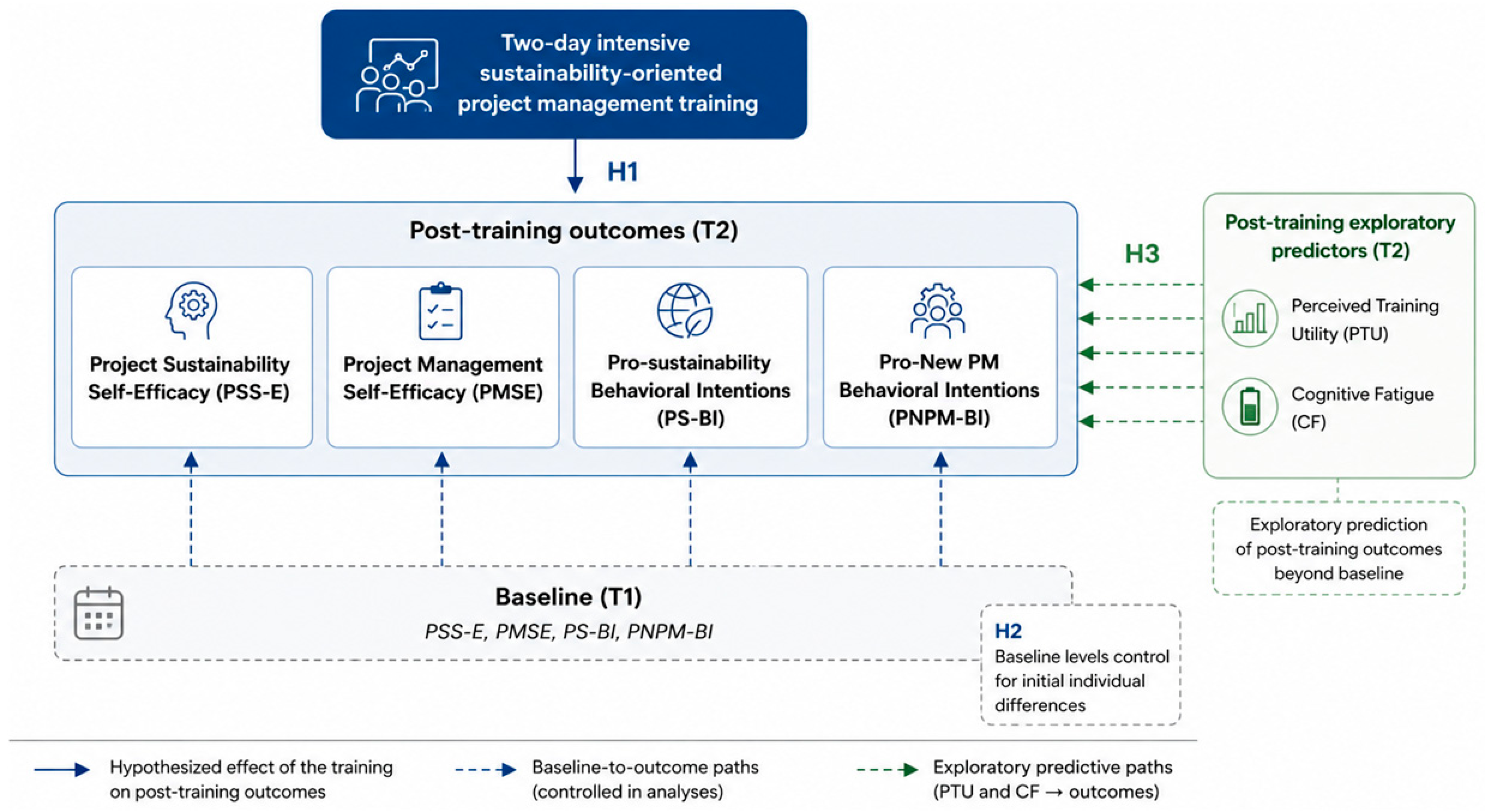
Figure 1 summarizes the conceptual framework underlying the present study and illustrates the hypothesized relationships among the training intervention, the study variables, and the proposed hypotheses.
Given these gaps, empirical research adopting a within-person, repeated-measures approach is needed to examine how psychological outcomes evolve across short-term training interventions. Such designs allow for a more precise assessment of change over time while controlling for baseline individual differences. Accordingly, the present exploratory study investigates the immediate psychological changes associated with a short-term sustainability-oriented PM training intervention by examining changes in PSS-E, PMSE, PS-BI, and PNPM-BI, and by considering the role of PTU and CF in shaping participants’ responses to the intervention. Unlike previous research, which has primarily relied on cross-sectional evidence or longer-term educational programmes, this study provides an exploratory evaluation of the immediate psychological effects of a short-term sustainability-oriented project management training intervention using a repeated-measures design. By integrating sustainability-specific and project-management-specific self-efficacy with behavioral intentions, it offers preliminary evidence and a novel contribution to the emerging literature on sustainability-oriented project management training.
The Study
The present exploratory study is conducted within the framework of the SuProM project Sustainable Project Management in Balkan Higher Education Institutions (Programme: EACEA–Erasmus+, KA2–Capacity Building in the Field of Higher Education), which seeks to support universities and research institutions in the Balkan region in integrating sustainability principles into project design, management, and evaluation processes. The present exploratory study aims to examine the short-term changes associated with a two-day intensive training programme on sustainability-oriented and project-management-related psychological outcomes. Specifically, the study investigates changes in project sustainability self-efficacy (PSS-E), project management self-efficacy (PMSE), pro-sustainability behavioral intentions (PS-BI), and pro-new project management behavioral intentions (PNPM-BI), as well as the role of post-training factors such as perceived training utility (PTU) and cognitive fatigue (CF).
A repeated-measures design was adopted, with participants assessed at two time points: prior to the training (T1) and immediately after its completion (T2). Participants took part in a structured two-day training programme focused on PM and on integrating sustainability principles into PM practices and enhancing project-related competencies. The training included interactive sessions, applied exercises, and opportunities for reflection, designed to simulate real-world PM challenges and decision-making processes.
To capture changes in key psychological outcomes, participants completed self-report measures at both time points. At T1 and T2, task-specific self-efficacy and behavioral intentions were assessed, including PSS-E, PMSE, PS-BI, and PNPM-BI. These constructs reflect individuals’ perceived capability to implement sustainability within projects, manage project-related tasks effectively, and engage in sustainability-oriented and innovative PM behaviors. At T2, additional measures of PTU and CF were administered to capture participants’ immediate post-training experience and to account for potential variability in training effectiveness.
The short interval between T1 and T2 was chosen to capture immediate psychological changes resulting from the training intervention. While this design does not allow for the assessment of long-term effects, it provides insight into the initial impact of intensive training experiences on self-efficacy and behavioral intentions, as well as the extent to which participants’ responses may be influenced by concurrent factors such as PTU and CF.
The first aim of the study is to examine changes in self-efficacy and behavioral intentions from pre- to post-training. It is hypothesized that both PSS-E and PMSE will increase from T1 to T2, along with PS-BI and PNPM-BI (H1).
The second aim is to examine the extent to which baseline levels of each outcome are associated with post-training scores. Consistent with prior research on psychological stability and change [
44], it is expected that higher baseline levels will be positively associated with higher post-training outcomes, reflecting individual differences in the temporal stability of these psychological constructs (H2).
The third aim is to explore the role of post-training factors in shaping outcomes at T2. Specifically, PTU is expected to be positively associated with post-training self-efficacy and behavioral intentions, whereas CF is explored as a potential factor that may be associated with variability in participants’ responses (H3).
2. Materials and Methods
2.1. Participants
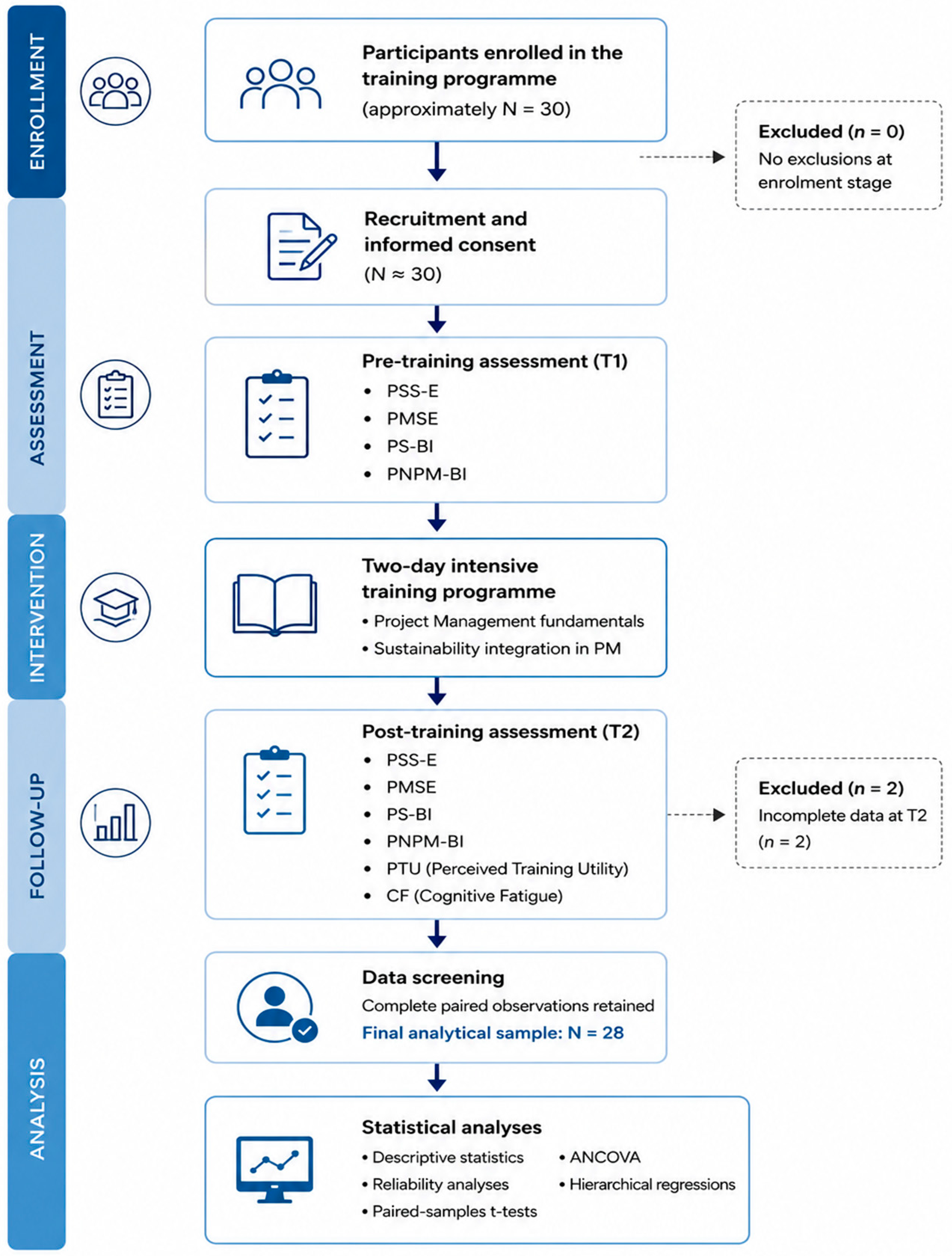
The initial training cohort included approximately 30 participants from academic and professional contexts. After data screening, only participants who completed both the pre-training (T1) and post-training (T2) assessments were retained, resulting in a final analytical sample of 28 individuals. The sample was heterogeneous in terms of professional background, including academics, researchers, administrative staff, and participants classified as having other professional roles. Participants’ age ranged from 23 to 59 years (M = 42.5 years; SD = 8.51), representing both early-career and senior professionals. Most participants identified as female (N = 23; 82.1%). Participants were recruited among individuals enrolled in the SuProM training programme. No selection criteria based on gender were applied; therefore, the gender distribution reflects the composition of the training cohort rather than a deliberate sampling strategy.
The training programme consisted of a two-day intensive course delivered at higher education institutions in the Western Balkans, specifically in Mostar, Bosnia and Herzegovina, and Korçë, Albania. The training focused on project management (PM) and the integration of sustainability principles into PM practices. Participation in the study was voluntary, and participants were invited to complete evaluation questionnaires before and after the training. Analyses requiring complete paired observations were conducted only on participants who provided valid data at both measurement points. The final sample size was therefore determined by the number of individuals participating in the training programme and by the availability of complete paired observations, rather than by an a priori power analysis. Given the exploratory nature of the study, the objective was to provide preliminary evidence regarding short-term changes associated with the intervention rather than to generate population-level estimates.
The study was conducted in accordance with the ethical standards of the Italian Association of Psychology (AIP) and the Declaration of Helsinki. The study protocol was approved by the Ethics Committee of the University of Palermo (Ethics Committee approval code: 384/2026). Informed consent was obtained from all participants prior to data collection.
2.2. Procedure
The study adopted a repeated-measures pre-post design to assess changes in psychological outcomes associated with participation in the training programme. Data were collected at two time points: prior to the start of the training (T1) and immediately after its completion (T2). A separate pilot study was not conducted prior to the main intervention. The study instruments were adapted from previously validated measures, and the data collection procedures were implemented directly with the participants enrolled in the training programme. Consequently, the final sample was not exposed to a prior testing phase that could have introduced familiarity or response bias.
At T1, participants completed a baseline questionnaire including demographic information (e.g., age, gender, professional role) and measures of PSS-E, PMSE, PS-BI, and PNPM-BI.
Participants then attended a two-day intensive training programme designed to enhance competencies related to PM and the integration of sustainability principles in PM. The training included structured sessions, interactive discussions, and applied activities aimed at fostering both technical understanding and reflective engagement with sustainability-oriented project practices.
At T2, immediately following the conclusion of the training, participants completed a second questionnaire assessing the same psychological constructs measured at baseline (PSS-E, PMSE, PS-BI, PNPM-BI). In addition, measures of PTU and CF were administered to capture participants’ immediate evaluation of the training and their cognitive state following the intervention.
The procedure was identical for all participants, and all measures were administered in a standardized format. The short interval between T1 and T2 allowed for the assessment of immediate changes associated with the training experience.
Figure 2 describes the flow diagram of the study design and data collection process.
2.3. Measures
Unless otherwise specified, composite scores were computed by summing the responses to the relevant items, with higher scores indicating higher levels of the target construct. Responses were provided on a 5-point Likert scale (1 = strongly disagree, 5 = strongly agree).
Sociodemographic Data. Sociodemographic information was collected through a six-item questionnaire assessing participants’ age, gender identity, educational attainment, academic or professional role, disciplinary area, and prior experience with PM.
Project Sustainability Self-Efficacy (PSS-E). Participants’ perceived self-efficacy in integrating sustainability principles into project-related activities was assessed using a 7-item scale adapted from the
Environmental Self-Efficacy Scale [
45]. Items were reworded to reflect the PM context. A sample item is: “I apply sustainable practices in my projects, even when it requires additional time or resources.” Higher scores indicated greater perceived capability to integrate sustainability into project-related activities. The scale showed acceptable internal consistency at both time points (T1 α = 0.81; T2 α = 0.71).
Project Management Self-Efficacy (PMSE). Project management self-efficacy was assessed using the short version of the
Project Management Self-Efficacy Scale (6 items) [
25]. The items assess individuals’ confidence in their ability to perform key PM tasks. A sample item is: “Clearly define key characteristics and business benefits of the project deliverables and obtain sign-off from key stakeholders on these specifications.” Higher scores indicated greater perceived competence in PM tasks. Reliability analyses indicated good internal consistency at both time points (T1 α = 0.82; T2 α = 0.93).
Pro-sustainability Behavioral Intentions (PS-BI). Intentions to engage in sustainability-oriented behaviors were assessed using a 3-item scale developed for this study and grounded in the
Theory of Planned Behavior [
29]. A sample item is: “I intend to apply sustainability principles in all my project-related activities.” Higher scores indicated stronger intentions to engage in sustainability-oriented behaviors. The scale showed acceptable internal consistency at both time points (T1 α = 0.76; T2 α = 0.81).
Behavioral Intentions to Adopt New Project Management Practices (PNPM-BI). Intentions to adopt new PM practices were assessed using a 3-item scale developed for this study and based on Ajzen’s [
29] framework. The scale was designed to capture participants’ readiness to implement new PM strategies, tools, or approaches in their work or study projects. A sample item is: “I plan to adopt new strategies or tools in my work/study projects.” Higher scores indicated stronger intentions to implement new PM practices. Internal consistency was good at both time points (T1 α = 0.89; T2 α = 0.88).
Cognitive Fatigue (CF). Cognitive fatigue was assessed at T2 using two items developed for this study to capture participants’ perceived mental exhaustion immediately after the training. A sample item is: “I feel mentally fatigued right now.” Higher scores indicated greater perceived cognitive fatigue. Because the measure consisted of two items, reliability was assessed using the Spearman–Brown coefficient, which indicated excellent reliability (0.91).
Perceived Training Utility (PTU). Perceived training utility was assessed at T2 using two items developed for this study to measure the perceived relevance and applicability of the training. A sample item is: “I find the content of this training relevant to my work or studies.” Higher scores indicated greater perceived utility of the training. Because the measure consisted of two items, reliability was assessed using the Spearman–Brown coefficient, which indicated good reliability (0.78).
2.4. Data Analysis
Descriptive statistics were computed for all study variables. Internal consistency was assessed using Cronbach’s alpha for scales composed of three or more items and the Spearman–Brown coefficient for two-item measures. Given the exploratory nature of the study and the limited sample size, reliability estimates were interpreted as preliminary indicators of internal consistency rather than as evidence of scale validation. Furthermore, analyses examining potential effects of demographic characteristics (e.g., gender) were not conducted, as subgroup comparisons would have resulted in insufficient statistical power given the sample size.
Pre-post changes in PSS-E, PMSE, PS-BI, and PNPM-BI were examined using paired-samples t-tests based on participants with valid data at both T1 and T2. Missing data at T2 were handled through complete-case analysis for all analyses requiring paired observations. To examine whether baseline levels were associated with post-training outcomes, a series of ANCOVA models were conducted using T1 scores as covariates and T2 scores as dependent variables. Finally, hierarchical multiple regression analyses were conducted to assess whether perceived training utility (PTU) and cognitive fatigue (CF) explained additional variance in post-training outcomes beyond baseline levels. All statistical analyses were conducted using IBM SPSS Statistics version 26.0 (IBM Corp., Armonk, NY, USA).
3. Results
3.1. Preliminary Analyses
Descriptive statistics and reliability indices for all study variables at T1 and T2 are reported in
Table 1. Reliability analyses indicated satisfactory preliminary levels of internal consistency across the investigated constructs, with Cronbach’s alpha values ranging from 0.71 to 0.93 across measurement occasions. Given the exploratory design and limited sample size, these reliability estimates should be interpreted cautiously and considered preliminary.
3.2. Changes from T1 to T2
With regard to the first hypothesis of the study, paired-samples
t-tests were conducted to examine changes in self-efficacy and behavioral intentions from pre-training (T1) to post-training (T2) (
Table 2).
Results showed a significant increase in PSS-E from T1 (M = 17.93, SD = 4.97) to T2 (M = 19.71, SD = 3.34), t(27) = −2.21, p = 0.036. PMSE also increased significantly from T1 (M = 16.18, SD = 3.32) to T2 (M = 22.11, SD = 3.50), t(27) = −7.15, p < 0.001.
Similarly, PS-BI increased from T1 (M = 8.50, SD = 2.03) to T2 (M = 12.64, SD = 1.45), t(27) = −10.99, p < 0.001, as did PNPM-BI, which increased from T1 (M = 9.54, SD = 2.56) to T2 (M = 12.64, SD = 1.50), t(27) = −7.31, p < 0.001. Effect sizes indicated moderate effects for PSS-E and large to very large effects for the remaining variables.
Overall, these findings provide preliminary support for Hypothesis 1, indicating significant improvements in self-efficacy and behavioral intentions following the training intervention.
3.3. Baseline-Controlled Analyses
With regard to the second hypothesis of the study, a series of baseline-controlled analyses (ANCOVA) were conducted to examine the extent to which baseline (T1) scores were associated with post-training (T2) outcomes while accounting for initial individual differences (
Table 3).
Baseline PSS-E was significantly associated with post-training PSS-E, F(1, 26) = 10.14, p = 0.004, R2 = 0.281. Similarly, baseline PS-BI and PNPM-BI were significantly associated with their respective post-training outcomes, F(1, 26) = 4.36, p = 0.047, R2 = 0.144 and F(1, 26) = 8.08, p = 0.009, R2 = 0.237, respectively. In contrast, baseline PMSE was not significantly associated with post-training PMSE, F(1, 26) = 0.81, p = 0.377, R2 = 0.030.
Overall, these findings indicate that baseline levels were associated with most post-training outcomes, suggesting a degree of temporal stability for these constructs. These analyses were intended to examine associations between baseline and post-training scores and should not be interpreted as evidence that the training intervention caused the observed changes.
3.4. Hierarchical Regression Analyses
With regard to the third hypothesis of the study, a series of hierarchical multiple regression analyses were conducted to examine whether perceived training utility (PTU) and cognitive fatigue (CF) explained additional variance in post-training outcomes beyond baseline levels (
Table 4). Ordinary least squares (OLS) estimation was used for all models. In each regression model, the corresponding baseline score (T1) was entered in Step 1, whereas PTU and CF were added in Step 2 to examine their incremental contribution to post-training outcomes.
Baseline levels showed differential associations with post-training outcomes. In the final models (Step 2), baseline PSS-E significantly predicted post-training PSS-E (β = 0.417, p = 0.025), and baseline PNPM-BI significantly predicted post-training PNPM-BI (β = 0.484, p = 0.007). Conversely, baseline PMSE was not significantly associated with post-training PMSE (β = 0.175, p = 0.363), whereas baseline PS-BI showed a marginal association with post-training PS-BI (β = 0.311, p = 0.069).
The inclusion of PTU and CF in Step 2 resulted in significant increases in explained variance for all models, including PSS-E (ΔR2 = 0.176, p = 0.036), PMSE (ΔR2 = 0.198, p = 0.042), PS-BI (ΔR2 = 0.285, p = 0.012), and PNPM-BI (ΔR2 = 0.201, p = 0.019). However, neither PTU nor CF emerged as significant individual predictors in the final models. PTU showed positive but non-significant associations with post-training behavioral intentions (PS-BI: β = 0.371, p = 0.065; PNPM-BI: β = 0.346, p = 0.080), whereas CF did not significantly predict any post-training outcome (all ps > 0.17). Given the limited sample size and the exploratory nature of these analyses, the observed increases in explained variance should be interpreted cautiously and not considered as evidence of reliable individual effects of PTU or CF.
Overall, these findings provide partial preliminary support for Hypothesis 3. Although the inclusion of immediate post-training perceptions improved the explanatory power of the regression models, the individual contributions of PTU and CF remained non-significant. Given the exploratory design, small sample size, and limited statistical power, these findings should be interpreted cautiously and require replication in larger samples.
3.5. Summary of Findings
Overall, the results indicate significant pre-post increases in all key outcomes observed following participation in the training programme, particularly for behavioral intentions and project management self-efficacy. However, given the absence of a control group, these changes cannot be attributed exclusively to the training experience.
Baseline-controlled analyses revealed differential patterns across constructs. Behavioral intentions showed a degree of temporal stability, whereas self-efficacy, particularly PMSE, showed weaker associations with baseline levels, suggesting that capability beliefs may represent more dynamic psychological outcomes in the context of short-term training experiences. Nevertheless, these patterns should be interpreted cautiously, as the study design does not allow conclusions regarding the specific contribution of the training programme to observed changes.
Finally, although the inclusion of PTU and CF increased the explained variance of the hierarchical regression models, neither variable emerged as a significant individual predictor of post-training outcomes. These findings suggest that immediate post-training perceptions may have a limited and exploratory role in explaining individual differences in post-training scores, although larger samples are needed to clarify these associations.
4. Discussion
The present exploratory study was conducted within the framework of the SuProM project—Sustainable Project Management in Balkan Higher Education Institutions (Programme: EACEA–Erasmus+, KA2–Capacity Building in the Field of Higher Education). The study aimed to examine the short-term changes associated with an intensive two-day training programme on sustainability-oriented and project-management-related psychological outcomes. Overall, the findings showed significant pre-post increases in all the psychological variables examined, namely project sustainability self-efficacy (PSS-E), project management self-efficacy (PMSE), pro-sustainability behavioral intentions (PS-BI), and behavioral intentions to adopt new project management practices (PNPM-BI). Given the pre-post design, these findings should be interpreted as preliminary evidence of short-term psychological changes associated with participation in the training, rather than as definitive causal evidence. Moreover, these changes may reflect multiple complementary processes, including increased awareness of sustainability-related issues, engagement with the training activities, and immediate motivational responses following participation in the programme.
First, the results showed significant improvements from T1 to T2 in both self-efficacy beliefs and behavioral intentions. These findings are consistent with previous research showing that training interventions can promote pro-environmental attitudes and behaviors [
46,
47]. They are also in line with evidence suggesting that even short-term and intensive educational programmes can generate meaningful improvements in sustainability-related outcomes [
48,
49]. In the present study, the observed increases suggest that brief capacity-building activities may be associated with improvements in not only to knowledge acquisition but also to participants’ perceived capability and motivational readiness to integrate sustainability principles into project-related practices. However, these psychological changes should not be interpreted as direct evidence of behavioral transformation, as the present design did not assess actual workplace application or long-term changes in project practices. This interpretation is broadly consistent with perspectives derived from Organizational Learning Theory [
13], which conceptualizes learning experiences as potential contributors to the development of adaptive capabilities and organizational improvement. However, the present study did not directly assess organizational learning processes or changes in organizational practices.
From a theoretical perspective, the Theory of Planned Behavior provides a useful interpretative framework for understanding the observed changes in behavioral intentions, although the present study was not designed to empirically test the TPB model or its underlying mechanisms. According to Ajzen [
29], behavior is largely goal-directed and guided by intentional processes, with behavioral intentions representing the most proximal determinant of action. Within this framework, behavioral intentions represent proximal indicators of individuals’ readiness to engage in future behaviors. In the present study, the increase in behavioral intentions following the training suggests that the intervention may have been associated with greater readiness to engage in sustainability-oriented and PM-related behaviors. Moreover, the observed increase in self-efficacy may be conceptually related to perceived behavioral control, although this construct was not directly assessed in the present study. In line with Ajzen’s perspective [
29], individuals who perceive themselves as more capable of performing a given behavior are more likely to develop stronger intentions to enact it; this association has also been empirically supported in the context of pro-environmental behaviors [
32].
Interestingly, the pattern of associations observed across time suggests that self-efficacy beliefs may remain relatively domain-specific. In particular, baseline PMSE was not significantly associated with post-training PSS-E, indicating limited cross-domain transfer. This finding aligns with theoretical perspectives emphasizing that self-efficacy is context-dependent and task-specific rather than a generalized belief system. It also suggests that improvements in one domain, such as general project management confidence, may not automatically translate into increased perceived capability in another domain, such as the integration of sustainability principles into project activities. This result highlights the importance of explicitly targeting both PM-related and sustainability-related competencies in training programmes.
Second, the increase in PMSE over time is particularly relevant in light of existing literature highlighting its role as a predictor of performance in project-based contexts [
25]. Strengthening self-efficacy beliefs may therefore represent an important psychological factor associated with training-related improvements, although further research is needed to establish whether these changes translate into improved project practices and outcomes. This interpretation is further supported by research showing that strategic PM capabilities are associated with enhanced organizational performance and competitive advantage [
2]. In this sense, the present findings extend prior work [
40,
41] by suggesting that even short-term interventions can enhance psychological resources that are foundational for project success.
The regression analyses further indicated that baseline levels of the outcome variables were generally positively associated with post-training scores, suggesting a degree of temporal stability in the constructs under investigation. At the same time, the observed increases from T1 to T2 indicate that participants reported meaningful improvements following the training. Notably, for some constructs, particularly PMSE, baseline levels were not strong predictors of post-training outcomes. This pattern may indicate that the training provided a shared and intensive learning experience capable of reducing the weight of initial individual differences. Accordingly, post-training PMSE may have been influenced more strongly by exposure to the intervention than by participants’ initial competence beliefs. However, this interpretation should be considered cautiously, given the small sample size and the absence of a control group. Additional analyses examining the contribution of post-training factors provided further insight into the robustness of these findings. Specifically, hierarchical regression models showed that the inclusion of perceived training utility and cognitive fatigue significantly increased the explained variance of post-training outcomes beyond baseline levels. However, neither PTU nor CF emerged as significant individual predictors in the final models. This pattern suggests that immediate post-training perceptions may contribute collectively to explaining individual differences in post-training outcomes, although their specific effects could not be reliably estimated given the exploratory nature and limited sample size of the study.
Perceived training utility (PTU) did not emerge as a significant individual predictor of post-training outcomes. Participants who perceived the training as more useful did not report significantly higher levels of self-efficacy or behavioral intentions compared with those reporting lower perceived utility. This finding contrasts with previous research highlighting the importance of perceived relevance and usefulness in facilitating learning transfer and behavioral change. In the context of sustainability-oriented PM, this result is particularly noteworthy, as it is often assumed that the effective integration of sustainability practices depends on individuals’ willingness to apply acquired knowledge in real-world contexts [
4]. However, the absence of a significant individual effect in the present study may be explained by the highly structured and intensive nature of the training, which may have standardized participants’ learning experiences and reduced the relative influence of subjective utility evaluations. Alternatively, the limited sample size may have reduced statistical power and prevented the detection of smaller effects. Therefore, these findings should not be interpreted as evidence that perceived utility is irrelevant, but rather as preliminary evidence suggesting that its role requires further investigation through larger samples and longitudinal designs.
Complementarily, Human Capital Theory [
10] offers a broader conceptual perspective for understanding why investments in training may contribute to the development of individual competencies. However, the present study did not directly assess human capital development, knowledge acquisition, or organizational performance outcomes. In the present study, the training programme can be regarded as an investment in both project-management-related human capital and sustainability-related human capital. The observed increases in self-efficacy and behavioral intentions suggest that the intervention may have enhanced participants’ perceived capabilities and readiness to act, which represent important psychological components of human capital development. Importantly, also within the TPB framework, improvements in perceived capability, or perceived behavioral control, are expected to translate into stronger behavioral intentions and, ultimately, into actual behavior [
30,
31]. However, the present study did not directly examine whether these intentions resulted in observable sustainability-oriented behaviors.
Importantly, the theoretical perspectives discussed in this manuscript should be considered as interpretative frameworks rather than as models empirically tested in the present study. Future research should explicitly examine the mechanisms proposed by these theories through longitudinal designs, multi-source assessments, and measures directly capturing learning processes, behavioral change, and organizational outcomes.
At a broader level, the integration of sustainability into PM practices represents a key challenge for contemporary organizations. Prior research has highlighted both the importance and the difficulty of embedding sustainability principles into project lifecycles, often due to a lack of appropriate competencies and structured training opportunities [
4,
6]. The present findings suggest that short-term, intensive training may represent a useful capacity-building strategy for supporting this integration, especially in higher education institutions and project-based organizational contexts. This perspective is consistent with the sustainability-oriented approach to PM proposed by Silvius and Schipper [
14], which argues that projects should aim to generate long-term economic, environmental, and social value rather than focusing solely on short-term efficiency and traditional performance indicators. Furthermore, by strengthening project-management-related competencies, such interventions may also support organizational processes such as strategic alignment, performance monitoring, and knowledge development [
1].
4.1. Theoretical Contributions and Practical Implication
The present exploratory study contributes to the literature by providing preliminary insights into how a short-term training intervention is associated with changes in key psychological constructs related to sustainability-oriented and PM-related behaviors. Specifically, the findings highlight the role of self-efficacy and behavioral intentions as potential psychological processes associated with participants’ post-training responses. In doing so, the study offers an initial empirical exploration of the relevance of the Theory of Planned Behavior to the context of sustainability-oriented PM training and project-based learning. While prior research has often examined training effectiveness or TPB constructs separately, the present study provides preliminary evidence of their joint functioning, suggesting that increases in perceived capability were accompanied by stronger behavioral intentions in both sustainability and PM domains.
The study also contributes to the broader literature on training and development by interpreting these findings through the lens of
Human Capital Theory [
10]. The results provide preliminary support for the idea that even short, intensive training programmes may represent strategic investments in human capital by enhancing individuals’ perceived capabilities and readiness to act. This contribution is particularly relevant in the context of sustainability in PM, where the translation of abstract sustainability principles into concrete project practices often depends on individuals’ competencies, confidence, and motivation to apply them.
From a practical perspective, these findings suggest that organizations and higher education institutions should recognize the importance of designing training programmes that address both skills development and motivational processes. Training should not be limited to the transmission of technical knowledge; rather, it should also include applied activities, problem-based tasks, guided reflection, and opportunities for mastery experiences that strengthen participants’ self-efficacy. This is particularly important for sustainability-related skills, which often require the application of complex and abstract principles to concrete PM contexts.
Professionals and academic staff may benefit from training programmes that integrate contextualized examples, case-based learning, and opportunities for active engagement. Such strategies may help participants perceive sustainability not as an additional or external requirement, but as an integral part of project planning, implementation, and evaluation. Moreover, training interventions should explicitly address the intention–behavior gap by creating conditions that facilitate the translation of intentions into practice. This may involve strengthening sustainability-oriented norms within project teams, embedding sustainability criteria into organizational PM procedures, and providing follow-up opportunities for participants to apply what they have learned in real project settings.
Finally, drawing on the TPB framework, practitioners could design interventions that explicitly target key psychological determinants of behavior, particularly perceived behavioral control and behavioral intentions, while also fostering supportive organizational environments. In this way, training can contribute not only to individual-level change but also to broader institutional capacity for sustainable project management. Nevertheless, the effectiveness of such interventions should be considered within a broader organizational context, where institutional support, opportunities for application, and continuous learning processes are likely to influence whether newly developed capabilities are translated into sustained practices. Future research should therefore examine these dynamics through longitudinal and multi-context designs.
4.2. Limitations and Future Research
Despite its contributions, the study has several limitations. First, the single-group pre-post design, combined with the absence of a control group, limits the ability to draw causal inferences, as changes over time cannot be definitively attributed to participation in the training programme. Although the findings provide preliminary evidence of short-term changes associated with the training experience, alternative explanations, such as maturation effects, external events, or repeated measurement effects, cannot be excluded. Future studies should include comparison groups or adopt randomized controlled or quasi-experimental designs to strengthen causal interpretations.
Second, the relatively small sample size limits the generalizability of the findings and reduces the statistical power of the analyses. This is particularly relevant for regression models, where estimates may be unstable in small samples. Replication with larger and more diverse samples is needed to confirm the robustness of the results.
Third, the gender imbalance in the sample, with the majority of participants identifying as female, may further limit the generalizability of the findings. This unbalanced composition could have influenced the observed results, as gender may be associated with differences in self-efficacy perceptions and responsiveness to training interventions. Future studies should aim to recruit more gender-balanced samples to ensure greater external validity.
Fourth, all measures were based on self-report, which may introduce common method bias and social desirability effects. Participants may have reported more favorable responses after the training because of perceived expectations or the immediate evaluation context. Given the exploratory design and the limited sample size, no formal statistical assessment of common method bias was conducted. Therefore, the potential influence of shared method variance cannot be excluded. Future research should incorporate objective indicators of learning, behavioral, observational, and performance-based measures, as well as multisource assessments (e.g., supervisor ratings), to complement self-reported data.
Fifth, some measures were adapted or developed specifically for this study. Although reliability indices were satisfactory, further research is needed to confirm their psychometric properties in larger samples and across different cultural and organizational contexts.
Finally, the assessment was limited to immediate post-training outcomes. Therefore, the observed increases may partly reflect short-term cognitive activation, recall of recently presented content, or increased motivation immediately following participation, rather than fully consolidated learning or sustained behavioral change. Longitudinal studies incorporating delayed follow-up assessments are needed to determine whether changes in self-efficacy and behavioral intentions persist over time and translate into objective learning outcomes, actual sustainability-oriented workplace behaviors, and measurable improvements in project outcomes. Moreover, given the absence of a control group and the use of repeated self-report assessments, the observed changes may also be influenced by demand characteristics, repeated measurement effects, or social desirability processes. Participants may have adjusted their responses after the training due to increased awareness of sustainability-related topics, perceived expectations regarding the purpose of the intervention, or immediate motivational reactions generated by participation. Therefore, the magnitude of the observed pre-post changes should be interpreted cautiously and cannot be considered as a definitive estimate of the training effect.
Despite these limitations, the present exploratory study represents an initial attempt to examine short-term psychological changes associated with sustainability-oriented project management training. The findings should therefore be interpreted as preliminary evidence that can inform the development of more rigorous longitudinal and controlled evaluations in future research.





 ,
,