Designing Authentic Virtual Heritage Experiences for Sustainable Cultural Heritage Communication: A Mixed-Methods Study
Abstract
1. Introduction
2. Literature Review
2.1. Design of Virtual Cultural Heritage Exhibitions
2.2. Heritage Experience Authenticity in Virtual Technology Contexts
3. Materials and Methods
4. Results
4.1. Qualitative Research Process and Results for the Concept of Experience Authenticity
4.1.1. Semi-Structured Interviews
4.1.2. Analysis and Results
4.2. Quantitative Research Process and Results for the Construct Dimensions of Experience Authenticity
4.2.1. Questionnaire Design and First-Round Distribution
4.2.2. Exploratory Factor Analysis and Results
4.2.3. Second-Round Questionnaire Distribution
4.2.4. Confirmatory Factor Analysis and Results
5. Design Framework Construction and Strategy Generation
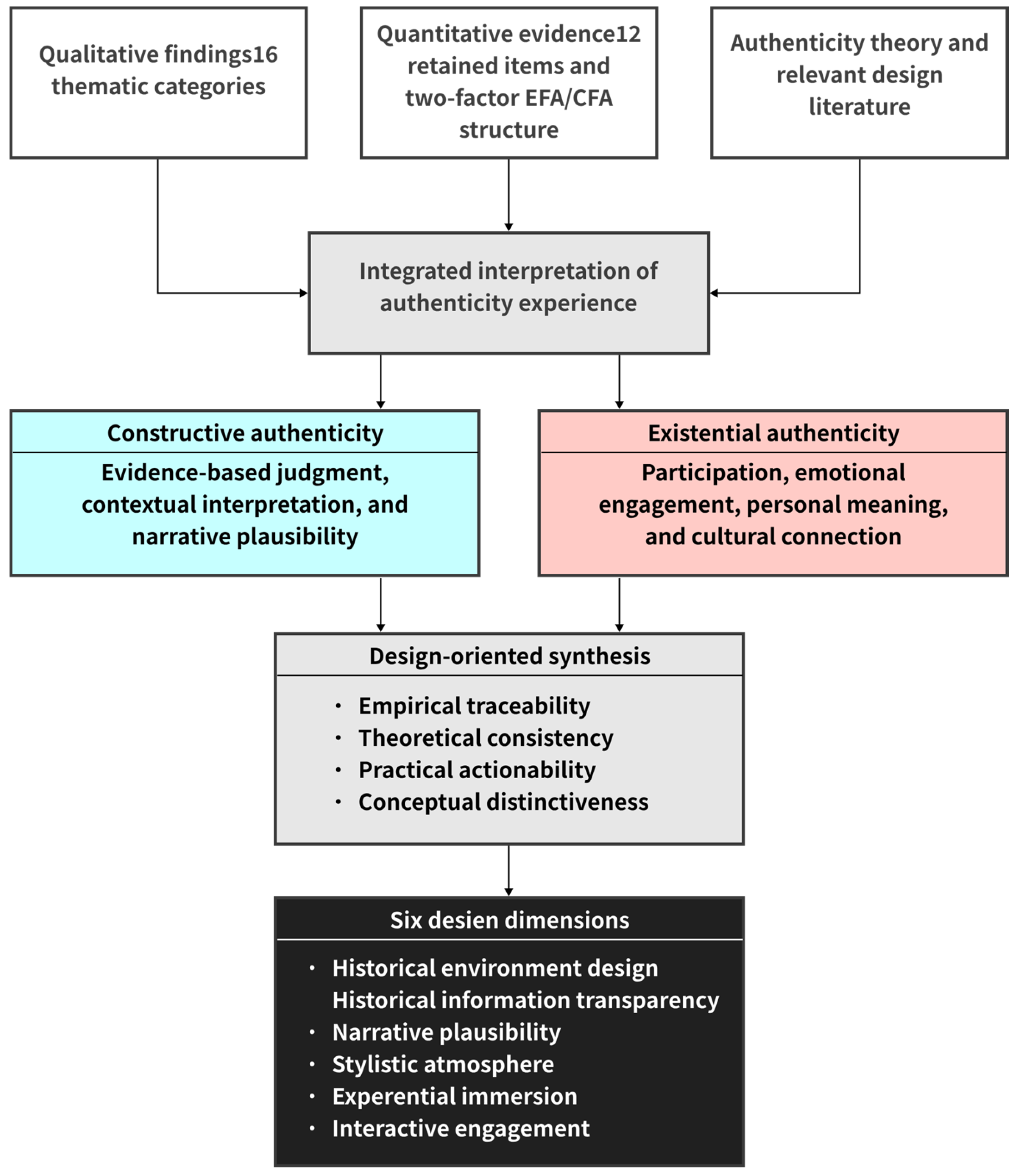
5.1. Design Framework
5.2. Historical Environment Design
5.3. Historical Information Transparency
5.4. Narrative Plausibility
5.5. Stylistic Atmosphere
5.6. Experiential Immersion
5.7. Interactive Engagement
6. Design Prototype Development and Evaluation
6.1. Design Workshop
6.2. Prototype Evaluation
7. Discussion
Supplementary Materials
Author Contributions
Funding
Institutional Review Board Statement
Informed Consent Statement
Data Availability Statement
Conflicts of Interest
References
- Hede, A.M.; Garma, R.; Josiassen, A.; Thyne, M. Perceived authenticity of the visitor experience in museums: Conceptualization and initial empirical findings. Eur. J. Mark. 2014, 48, 1395–1412. [Google Scholar] [CrossRef]
- Atzeni, M.; Del Chiappa, G.; Mei Pung, J. Enhancing visit intention in heritage tourism: The role of object-based and existential authenticity in non-immersive virtual reality heritage experiences. Int. J. Tour. Res. 2022, 24, 240–255. [Google Scholar] [CrossRef]
- Samaniego-Chávez, C.E.; Shi, F.; Khamidullin, T. What makes online tours authentic? A semiotic analysis. Ann. Tour. Res. 2025, 114, 104018. [Google Scholar] [CrossRef]
- International Council on Monuments and Sites. The Nara Document on Authenticity; International Council on Monuments and Sites: Paris, France, 1994. [Google Scholar]
- United Nations Educational, Scientific and Cultural Organization. Convention for the Safeguarding of the Intangible Cultural Heritage; United Nations Educational, Scientific and Cultural Organization: Paris, France, 2003. [Google Scholar]
- Smith, L. Uses of Heritage; Routledge: Abingdon-on-Thames, UK, 2006. [Google Scholar]
- Beacham, R.; Denard, H.; Niccolucci, F. An introduction to the London charter. Jt. Event CIPA/VAST/EG/EuroMed 2006, 1, 1–6. [Google Scholar]
- Pietroni, E.; Ferdani, D. Virtual restoration and virtual reconstruction in cultural heritage: Terminology, methodologies, visual representation techniques and cognitive models. Information 2021, 12, 167. [Google Scholar] [CrossRef]
- Taheri, B.; Gannon, M.J.; Kesgin, M. Visitors’ perceived trust in sincere, authentic, and memorable heritage experiences. Serv. Ind. J. 2020, 40, 705–725. [Google Scholar] [CrossRef]
- Li, Y.K.; Xiao, C.L.; Ren, H.; Li, W.R.; Guo, Z.; Luo, J.Q. Unraveling the effectiveness of new media teaching strategies in pharmacology education under different educational backgrounds: Insights from 6447 students. Eur. J. Pharmacol. 2025, 989, 177255. [Google Scholar] [CrossRef] [PubMed]
- Park, E.; Choi, B.-K.; Lee, T.J. The role and dimensions of authenticity in heritage tourism. Tour. Manag. 2019, 74, 99–109. [Google Scholar] [CrossRef]
- Ji, F.; Wang, F.; Wu, B. How does virtual tourism involvement impact the social education effect of cultural heritage? J. Destin. Mark. Manag. 2023, 28, 100779. [Google Scholar] [CrossRef]
- Yi, X.; Fu, X.; Lin, B.; Sun, J. Authenticity, identity, self-improvement, and responsibility at heritage sites: The local residents’ perspective. Tour. Manag. 2024, 102, 104875. [Google Scholar] [CrossRef]
- López-Menchero Bendicho, V.M.; Grande, A. Hacia una carta internacional de arqueología virtual: El borrador SEAV. Virtual Archaeol. Rev. 2011, 2, 71–75. [Google Scholar] [CrossRef]
- Bentkowska-Kafel, A.; Denard, H.; Baker, D. (Eds.) Paradata and Transparency in Virtual Heritage; Ashgate: Farnham, UK, 2012. [Google Scholar]
- Barbieri, L.; Bruno, F.; Muzzupappa, M. User-centered design of a virtual reality exhibit for archaeological museums. Int. J. Interact. Des. Manuf. 2018, 12, 561–571. [Google Scholar] [CrossRef]
- Bozzelli, G.; Raia, A.; Ricciardi, S.; De Nino, M.; Barile, N.; Perrella, M.; Tramontano, M.; Pagano, A.; Palombini, A. An integrated VR/AR framework for user-centric interactive experience of cultural heritage: The ArkaeVision project. Digit. Appl. Archaeol. Cult. Herit. 2019, 15, e00124. [Google Scholar] [CrossRef]
- Chu, J.H.; Mazalek, A. Embodied engagement with narrative: A design framework for presenting cultural heritage artifacts. Multimodal Technol. Interact. 2019, 3, 1. [Google Scholar] [CrossRef]
- Mason, M.; Vavoula, G. Digital cultural heritage design practice: A conceptual framework. Des. J. 2021, 24, 405–424. [Google Scholar] [CrossRef]
- Gong, Q.; Zou, N.; Yang, W.; Zheng, Q.; Chen, P. User experience model and design strategies for virtual reality-based cultural heritage exhibition. Virtual Real. 2024, 28, 69. [Google Scholar] [CrossRef]
- Vichnevetskaia, A.; Wang, Y.-W.; Webb, N.; Li, Y. Enhancing authenticity in XR heritage: Practitioner insights and preliminary recommendations. Int. Arch. Photogramm. Remote Sens. Spat. Inf. Sci. 2025, XLVIII-M-9-2025, 1555–1562. [Google Scholar] [CrossRef]
- Liu, C.; Cui, R.; Wang, Z. Digital virtual simulation for cultural clothing restoration: Case study of tang dynasty mural ‘diplomatic envoys’ from crown prince zhang huai’s tomb. J. Theor. Appl. Electron. Commer. Res. 2024, 19, 1358–1391. [Google Scholar] [CrossRef]
- Bajaj, A.J.; Bhattacharjee, A. Design and development of digital humans in virtual exhibition space. Multimed. Tools Appl. 2024, 83, 36157–36174. [Google Scholar] [CrossRef]
- Liu, Z. Regeneration of Liangzhu culture: Multimedia exhibition, simulated restoration, innovative cultural products, nearby area integration, virtual reality and augmented reality. Humanit. Soc. Sci. Commun. 2023, 10, 374. [Google Scholar] [CrossRef]
- Montusiewicz, J.; Barszcz, M.; Skulimowski, S.; Baran, K.; Kayumov, R. Acceptation of the developed mobile Virtual Reality visualisations of 3D objects from the area of the Silk Road. Adv. Sci. Technol. Res. J. 2022, 16, 4. [Google Scholar] [CrossRef]
- Hu, W.; Han, H.; Wang, G.; Peng, T.; Yang, Z. Interactive design and implementation of a digital museum under the background of AR and blockchain technology. Appl. Sci. 2023, 13, 4714. [Google Scholar] [CrossRef]
- Hu, Q.; He, X.; Wei, T.; Yuan, Y. A Spatio-Temporal Overlap Narrative Experience Model for Archaeological Site Museums: A Case Study of the Panlongcheng Archaeological Site Museum. Buildings 2025, 15, 3956. [Google Scholar] [CrossRef]
- Hao, X.; Xu, J.; An, G. Human-centric participation paradigm: Exploring the enjoyment experience of cultural heritage virtual museum based on system usability and VR technology. Sci. Rep. 2026, 16, 14527. [Google Scholar] [CrossRef] [PubMed]
- Zhou, B.H.; Tang, Q.Y. Viewing from Afar or Involving Intimately: An Empirical Investigation the Effects of VR Agency Affordance on Cultural Heritage Identification and Engagement. Chin. J. Commun. 2024, 46, 30–54. [Google Scholar]
- Jones, S. Experiencing authenticity at heritage sites: Some implications for heritage management and conservation. Conserv. Manag. Archaeol. Sites 2009, 11, 133–147. [Google Scholar] [CrossRef]
- Waterton, E.; Watson, S. Framing theory: Towards a critical imagination in heritage studies. Int. J. Herit. Stud. 2013, 19, 546–561. [Google Scholar] [CrossRef]
- Harrison, R. Heritage: Critical Approaches; Routledge: Abingdon-on-Thames, UK, 2012. [Google Scholar]
- Harvey, D.C. Heritage pasts and heritage presents: Temporality, meaning and the scope of heritage studies. Int. J. Herit. Stud. 2001, 7, 319–338. [Google Scholar] [CrossRef]
- Mehraliyev, F.; Choi, Y.; King, B. Expert online review platforms: Interactions between specialization, experience, and user power. J. Travel Res. 2021, 60, 384–400. [Google Scholar] [CrossRef]
- Cheng, B.; Han, W.; Xue, J.; Chen, T. “Double authenticity” in digital heritage communication: Examining the interaction effects of virtual cultural ambassadors on tourist behavioral intentions. Asia Pac. J. Tour. Res. 2026, 31, 413–433. [Google Scholar] [CrossRef]
- Guo, Y.; Lu, S.; Shen, M.; Huang, W.; Yi, X.; Zhang, J. Differences in heritage tourism experience between VR and AR: A comparative experimental study based on presence and authenticity. ACM J. Comput. Cult. Herit. 2024, 17, 1–21. [Google Scholar] [CrossRef]
- Huang, X.; Yang, Y.; Liu, S.; Wang, J. 46Does ‘the real’matter? Technological affordances and Generation Z’s experience of authenticity in heritage games. Ann. Tour. Res. 2026, 116, 104112. [Google Scholar] [CrossRef]
- Creswell, J.W.; Clark, V.L.P. Designing and Conducting Mixed Methods Research; Sage Publications: Thousand Oaks, CA, USA, 2017. [Google Scholar]
- Kvale, S.; Brinkmann, S. Interviews: Learning the Craft of Qualitative Research Interviewing; Sage: Thousand Oaks, CA, USA, 2009. [Google Scholar]
- Willig, C. Introducing Qualitative Research in Psychology: Adventures in Theory and Methods, 2nd ed.; Open University Press: Seoul, Republic of Korea, 2008. [Google Scholar]
- Corbin, J.; Strauss, A. Basics of Qualitative Research: Techniques and Procedures for Developing Grounded Theory; Sage Publications: Thousand Oaks, CA, USA, 2014. [Google Scholar]
- Tabachnick, B.G.; Fidell, L.S.; Ullman, J.B. Using Multivariate Statistics; Pearson: Boston, MA, USA, 2007; Volume 5, pp. 481–498. [Google Scholar]
- Churchill, G.A., Jr. A paradigm for developing better measures of marketing constructs. J. Mark. Res. 1979, 16, 64–73. [Google Scholar] [CrossRef]
- Guilford, J.P. Psychometric Methods, 2nd ed.; McGraw-Hill: New York, NY, USA, 1954. [Google Scholar]
- Burgess, J.; Jones, C.M. Exploring player understandings of historical accuracy and historical authenticity in video games. Games Cult. 2022, 17, 816–835. [Google Scholar] [CrossRef]
- Bagozzi, R.P.; Yi, Y. On the evaluation of structural equation models. J. Acad. Mark. Sci. 1988, 16, 74–94. [Google Scholar] [CrossRef]
- Hair, J.F.; Black, W.C.; Babin, B.J.; Anderson, R.E. Multivariate Data Analysis; Cengage: Boston, MA, USA, 2019. [Google Scholar]
- Nunnally, J.C. Psychometric theory—25 years ago and now. Educ. Res. 1975, 4, 7–21. [Google Scholar] [CrossRef]
- Nyhan, R.C.; Marlowe, H.A. Development and Psychometric Properties of the Organizational Trust Inventory. Eval. Rev. 1997, 21, 614–635. [Google Scholar] [CrossRef]
- Fornell, C.; Larcker, D.F. Structural Equation Models with Unobservable Variables and Measurement Error: Algebra and Statistics; Publications Sage: Thousand Oaks, CA, USA, 1981. [Google Scholar] [CrossRef]
- Viola, L. Networks of migrants’ narratives: A post-authentic approach to heritage visualisation. ACM J. Comput. Cult. Herit. 2023, 16, 1–21. [Google Scholar] [CrossRef]
- Jiang, Q.; Qian, J.; Zang, Y. Integrating intangible cultural heritage elements into mobile games: An exploration of player cultural identity. Inf. Technol. People 2026, 39, 482–500. [Google Scholar] [CrossRef]
- Kenderdine, S. Embodiment, entanglement, and immersion in digital cultural heritage. In A New Companion to Digital Humanities; Wiley: Hoboken, NJ, USA, 2015; pp. 22–41. [Google Scholar] [CrossRef]
- Olsen, T.; Hutson, J.; O’Brien, C.; Ratican, J. Simulacra and historical fidelity in digital recreation of lost cultural heritage: Reconstituting period materialities for the period eye. Arts Commun. 2024, 2, 2719. [Google Scholar] [CrossRef]
- Gao, B.W.; Li, Y.; Bu, N.; Zhu, C.Z.G. Beyond authenticity: Scale development and validation for virtual authenticity. Curr. Issues Tour. 2026, 29, 1773–1789. [Google Scholar] [CrossRef]
- Barzaghi, S.; Bordignon, A.; Gualandi, B.; Peroni, S. Enlightening the Black Box of Humanities Research. Methodological Documentation as a Way to Transparency and Accountability of Digital Exhibitions. Umanist. Digit. 2025, 9, 97–114. [Google Scholar] [CrossRef] [PubMed]
- Schwan, S.; Dutz, S. How do visitors perceive the role of authentic objects in museums? Curator Mus. J. 2020, 63, 217–237. [Google Scholar] [CrossRef]
- Ryan, M.L. Possible Worlds, Artificial Intelligence, and Narrative Theory; Indiana University Press: Bloomington, IN, USA, 1991. [Google Scholar]
- Hassenzahl, M. Experience Design: Technology for All the Right Reasons; Morgan & Claypool Publishers: San Rafael, CA, USA, 2010; Volume 8. [Google Scholar]
- Tussyadiah, I.P.; Wang, D.; Jung, T.H.; Tom Dieck, M.C. Virtual reality, presence, and attitude change: Empirical evidence from tourism. Tour. Manag. 2018, 66, 140–154. [Google Scholar] [CrossRef]
- Böhme, G. Atmosphere as the fundamental concept of a new aesthetics. Thesis Elev. 1993, 36, 113–126. [Google Scholar] [CrossRef]
- Kenderdine, S. “Pure Land”: Inhabiting the Mogao Caves at Dunhuang. Curator Mus. J. 2013, 56, 199–218. [Google Scholar] [CrossRef]
- Kotler, P. Atmospherics as a marketing tool. J. Retail. 1973, 49, 48–64. [Google Scholar]
- Slater, M. A note on presence terminology. Presence Connect. 2003, 3, 1–5. [Google Scholar]
- Slater, M.; Wilbur, S. A framework for immersive virtual environments (FIVE): Speculations on the role of presence in virtual environ7ments. Presence Teleoperators Virtual Environ. 1997, 6, 603–616. [Google Scholar] [CrossRef]
- Ning, W. Rethinking authenticity in tourism experience. In The Political Nature of Cultural Heritage and Tourism; Routledge: Abingdon-on-Thames, UK, 2017; pp. 469–490. [Google Scholar]
- Pratisto, E.H.; Thompson, N.; Potdar, V. Immersive technologies for tourism: A systematic review. Inf. Technol. Tour. 2022, 24, 181. [Google Scholar] [CrossRef]
- Norman, D. The Design of Everyday Things: Revised and Expanded Edition; Basic Books: New York, NY, USA, 2013. [Google Scholar]
- Zhu, P.; Chi, X.; Ryu, H.B.; Han, H. Experience economy and authenticity in the heritage tourism sector: A multiple-dimensional approach. Acta Psychol. 2025, 257, 105118. [Google Scholar] [CrossRef] [PubMed]
- Xiao, W.; Yu, B.; Zhang, H. Tourist Loyalty in Intangible Cultural Heritage Tourism: The Roles of Perceived Attributes, Involvement, and Cultural Identity. Sustainability 2025, 17, 8056. [Google Scholar] [CrossRef]
- Wang, Y.; Zhang, Z.; Wang, C.; Li, Z.; Law, R.; Zhang, Z. Too concise to decide? The impact of AI-generated review summaries on tourist decision satisfaction. Tour. Manag. 2026, 115, 105415. [Google Scholar] [CrossRef]
- Cohen, E.; Cohen, S.A. Authentication: Hot and cool. Ann. Tour. Res. 2012, 39, 1295–1314. [Google Scholar] [CrossRef]
- Rickly-Boyd, J.M. Authenticity & aura: A Benjaminian approach to tourism. Ann. Tour. Res. 2012, 39, 269–289. [Google Scholar] [CrossRef]
- Jones, S. Negotiating authentic objects and authentic selves: Beyond the deconstruction of authenticity. J. Mater. Cult. 2010, 15, 181–203. [Google Scholar] [CrossRef]
- Jin, L.; Xiao, H.; Shen, H. Experiential authenticity in heritage museums. J. Destin. Mark. Manag. 2020, 18, 100493. [Google Scholar] [CrossRef]
- Zhu, C.; Io, M.-U.; Ngan, H.F.B.; Peralta, R.L. Understanding augmented reality marketing in world cultural heritage site, the lens of authenticity perspective. J. Vacat. Mark. 2023, 29, 242–255. [Google Scholar] [CrossRef]
- Nam, K.; Dutt, C.S.; Baker, J. Authenticity in objects and activities: Determinants of satisfaction with virtual reality experiences of heritage and non-heritage tourism sites. Inf. Syst. Front. 2023, 25, 1219–1237. [Google Scholar] [CrossRef] [PubMed]
- Qiao, G.; Shao, Z.; Gu, J.; Chen, X. Accessible tourism for tourists with visual impairment: The role of auditory perception in shaping behavioral attitudes. Tour. Rev. 2026, 81, 1–24. [Google Scholar] [CrossRef]



| No. | Thematic Category | Description | Illustrative Quotation | Preliminary Theoretical Interpretation |
|---|---|---|---|---|
| 01 | Historical Information Credibility | Users’ preliminary judgments, based on prior knowledge, common sense, or accessible information, regarding whether the historical settings, figures, events, and heritage objects represented in virtual heritage content are consistent with established historical facts. | “The content of the game is connected to factual evidence; it has a basis and is historically consistent.”—P4 | Objective authenticity |
| 02 | Quality of Historical Detail Reconstruction | Users’ evaluation of whether scenes, character representations, costumes, artefacts, and other visual and auditory details are carefully reconstructed and correspond to the period-specific and cultural characteristics of the represented heritage context. | “The settings, the characters’ clothing, and the in-game props all fit the historical period and are consistent with the historical context.”—P2 | Objective authenticity |
| 03 | Credibility of Authoritative Endorsement | Users’ assessment of the professionalism and credibility of virtual heritage content based on the participation, recognition, or endorsement of museums, research institutions, expert teams, or other authoritative bodies. | “If it clearly states which museum collaborated on the project and which team produced it—and that team is well known—I would find it much more convincing.”—P1 | Objective authenticity |
| 04 | Transparency of Evidence Sources | Users’ perception of whether virtual heritage content is supported by identifiable historical evidence, traceable information sources, and explicit rationales for reconstruction. The clearer the sources and inferential process, the more likely users are to regard the content as evidence-based rather than arbitrarily fabricated. | “I would look at whether it is connected to factual evidence, whether it has a clear basis, and whether it is historically consistent.”—P4 | Objective authenticity |
| 05 | Historically Congruent Atmosphere | The overall atmosphere created through visual style, sound, colour, lighting, and environmental elements, and the extent to which this atmosphere is congruent with a specific historical period and cultural context, thereby shaping users’ authenticity judgments. | “The setting of the ox-cart game fits the historical context, and even the sound effects feel appropriate to the period.”—P8 | Constructive authenticity |
| 06 | Plausibility of the Narrative Context | When users cannot directly verify all historical details, they infer credibility from whether the narrative setting, relationships among characters, event configurations, and cultural context appear coherent and plausible. | “If the historical background, characters, and events are presented well, I would feel that the narrative logic is clear.”—P4 | Constructive authenticity |
| 07 | Plausibility of Narrative Progression | The extent to which event development, character actions, and the disclosure of information follow a coherent chronology, causal structure, and behavioural logic appropriate to the represented historical context, allowing users to perceive the unfolding narrative as reasonable and credible. | “I may not be able to judge whether every historical detail is accurate, but if the later plot developments follow logically from the earlier setup, I would consider the narrative reasonable.”—P3 | Constructive authenticity |
| 08 | Congruence with Stylistic Expectations | The extent to which the visual representation, character imagery, sound, language, and environmental style of virtual heritage content correspond to users’ historically informed expectations and culturally shaped mental images. | “Although I cannot determine whether every detail is completely historically accurate, the costumes, colours, and sounds match how I imagine an ancient setting, so the presentation feels credible overall.”—P6 | Constructive authenticity |
| 09 | Internal Narrative Consistency | The extent to which background settings, character behaviour, causal relationships among events, and information presented at different points remain mutually coherent and free from obvious contradiction. | “If the text or characters contain historical statements that are clearly inconsistent with the facts or simply illogical, the content feels inauthentic to me.”—P1 | Constructive authenticity |
| 10 | Deep Immersion | A state in which users’ attention is continuously absorbed by the virtual content, their awareness of the physical environment and the passage of time diminishes, and they may enter a state of intense concentration or flow. | “It feels like entering a state of flow and almost forgetting the surrounding real-world environment.”—P2 | Existential authenticity |
| 11 | Experiential Participation | The extent to which users feel personally involved in or present within the historical situation rather than positioned as external observers. This shift in experiential position strengthens perceived realism and personal involvement. | “‘Being present’ means personally experiencing the environment that has been created, rather than watching other people go through it like a spectator; it feels as though you are genuinely experiencing it yourself.”—P2 | Existential authenticity |
| 12 | Emotional Engagement and Immersion | The extent to which characters, events, narrative elements, and audiovisual atmosphere elicit emotional responses; such emotional engagement can further intensify attentional involvement, immersion, and the perceived authenticity of the experience. | “It does more than help me understand the content; it also engages my emotions. When the story moves me, I become more immersed and the experience feels more authentic.”—P7 | Existential authenticity |
| 13 | Cultural Familiarity and Affinity | The sense of familiarity, closeness, and cultural affinity that arises when the heritage theme, cultural symbols, and narrative mode correspond to users’ familiar cultural backgrounds or prior understandings. | “This theme is close to the cultural background I am familiar with, so it feels personally familiar and makes it easier for me to believe that it represents authentic life within that culture.”—P5 | Existential authenticity |
| 14 | Overall Experience Evaluation | Users’ holistic evaluation of content quality, narrative, technical performance, interaction fluency, and emotional experience. Noticeable deficiencies in the overall experience may spill over into authenticity judgments and reduce trust in the content. | “The smoothness of the exhibition and whether it contains bugs affect my overall experience. Even minor technical flaws can make me trust the exhibition less.”—P1 | Existential authenticity |
| 15 | Embodied Interactive Experience | Users’ direct participation in heritage-related activities through manipulation, bodily action, or sensory feedback, thereby producing bodily sensations of contact, agency, and engagement with historical practices. | “It is not just a matter of watching through a screen; you can actually interact with it. For example, assembling parts of the heritage object or imitating the original action makes you feel that this is how people would have done it at the time.”—P8 | Existential authenticity |
| 16 | Perceived Meaningfulness of the Experience | Users’ understanding, through virtual experience, of the function and cultural value of a heritage object and its relationship to historical life, together with their perception that the experience has cognitive, cultural, or personal significance. | “You first need to understand how the heritage object was used at the time and under what circumstances; only then can you further understand its cultural value and significance.”—P3 | Existential authenticity |
| Items Retained After EFA. | Original Code | Factor 1 | Factor 2 | Final Label |
|---|---|---|---|---|
| I feel that the details of this virtual heritage content have been carefully researched and restored. | Q3 | 0.657 | Constructive authenticity | |
| The virtual heritage objects and scenes presented in the media bear a realistic resemblance to their real-world counterparts. | Q6 | 0.688 | ||
| I consider this virtual heritage content to be authoritative in terms of academic reference. | Q7 | 0.658 | ||
| This experience aligns with my overall imagination of this cultural or historical context. | Q9 | 0.655 | ||
| Even when I cannot judge the historical details, the experience still makes the historical setting feel plausible. | Q11 | 0.465 | ||
| The narrative approach used in the experience is consistent with my understanding of this culture. | Q12 | 0.644 | ||
| During the experience, I felt that I was participating in the historical setting. | Q13 | 0.626 | Existential authenticity | |
| During the experience, I felt emotionally moved. | Q14 | 0.753 | ||
| During the experience, I felt a sense of connection with the history or culture presented. | Q15 | 0.659 | ||
| During the experience, I was able to temporarily forget my real surroundings and become immersed in the experience. | Q16 | 0.619 | ||
| This experience holds important personal meaning for me. | Q17 | 0.647 | ||
| During the experience, I felt a sense of cultural resonance. | Q19 | 0.576 | ||
| Eigenvalue | 4.273 | 1.238 | ||
| Total variance explained | 45.923% | |||
| Dimension After EFA | Original Code | Item | Std. Loading | Construct Metrics |
|---|---|---|---|---|
| Constructive authenticity | Q3 | I feel that the details of this virtual heritage content have been carefully researched and restored. | 0.386 | Cronbach’s α = 0.743 CR = 0.629 AVE = 0.223 |
| Q6 | The virtual heritage objects and scenes presented in the media bear a realistic resemblance to their real-world counterparts. | 0.464 | ||
| Q7 | I consider this virtual heritage content to be authoritative in terms of academic reference. | 0.488 | ||
| Q9 | This experience aligns with my overall imagination of this cultural or historical context. | 0.497 | ||
| Q11 | Even when I cannot judge the historical details, the experience still makes the historical setting feel plausible. | 0.557 | ||
| Q12 | The narrative approach used in the experience is consistent with my understanding of this culture. | 0.419 | ||
| Existential authenticity | Q13 | During the experience, I felt that I was participating in the historical setting. | 0.657 | Cronbach’s α = 0.766 CR = 0.747 AVE = 0.333 |
| Q14 | During the experience, I felt emotionally moved. | 0.604 | ||
| Q15 | During the experience, I felt a sense of connection with the history or culture presented. | 0.533 | ||
| Q16 | During the experience, I was able to temporarily forget my real surroundings and become immersed in the experience. | 0.556 | ||
| Q17 | This experience holds important personal meaning for me. | 0.631 | ||
| Q19 | During the experience, I felt a sense of cultural resonance. | 0.460 |
| Dominant Authenticity Route | Heritage Content and Representation | User Encounter and Experience |
|---|---|---|
| Cognitive–interpretive | Historical environment design; historical information transparency; narrative plausibility | Interactive engagement, particularly embodied manipulation, action-based understanding, and interpretive feedback |
| Affective–embodied | Stylistic atmosphere | Experiential immersion |
| Design Dimension | Primary Design Object | Unique Contribution to Perceived Authenticity | Boundary from Adjacent Dimensions |
|---|---|---|---|
| Historical environment design | Heritage objects, architecture, costumes, spatial settings, and environmental details | Provides materially and historically defensible representations grounded in archaeological, documentary, and period-specific evidence | Concerns the evidential and structural plausibility of what is represented, rather than the overall sensory mood of the exhibition |
| Historical information transparency | Provenance, scholarly authority, evidence level, reconstruction rationale, and uncertainty | Provides traceable grounds on which non-specialists can evaluate credibility and distinguish documented information from interpretive reconstruction | Concerns why the content should be trusted, rather than whether the story itself is causally or chronologically coherent |
| Narrative plausibility | Chronology, causality, character motivation, event progression, and reasoned narrative extension | Maintains coherence between historical anchors and the interpretive narrative used to fill evidential gaps | Concerns how the represented world unfolds over time, rather than the accuracy of individual visual objects or the disclosure of their sources |
| Stylistic atmosphere | Visual tone, color, materiality, sound, lighting, language, and editing rhythm | Creates a culturally congruent perceptual gestalt that corresponds to historically informed expectations and supports felt plausibility | Concerns the integrated sensory and affective field, rather than the factual correctness of each artifact or the user’s degree of attentional absorption |
| Experiential immersion | Attention, presence, emotional absorption, narrative continuity, and sensory enclosure | Supports the subjective sense of being situated within and emotionally involved in the represented historical world | Describes an experiential state and the conditions supporting it, rather than the user’s ability to act on or alter the experience |
| Interactive engagement | Agency, manipulation, choice, embodied participation, feedback, and action-based learning | Enables users to construct personal and cultural meaning through situated action and responsive participation | Concerns what the user can meaningfully do, rather than passive absorption, visual atmosphere, or narrative coherence alone |
| Design Dimension | Framework-Derived Design Requirement | Implementation in the Group A Prototype |
|---|---|---|
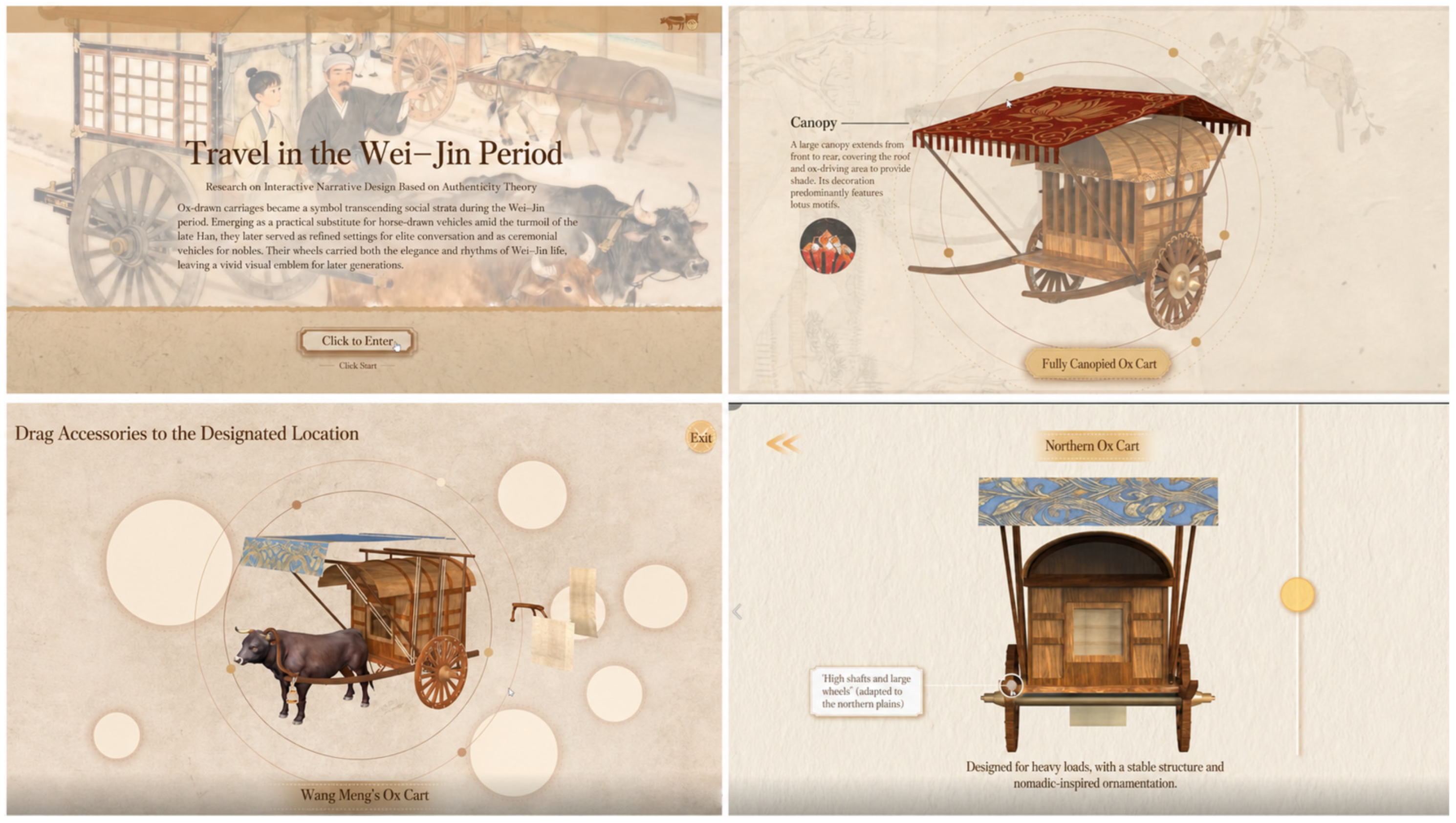
| Historical environment design | Base the form and structure of heritage objects and their setting on period-appropriate archaeological, documentary, and comparative evidence. | The prototype used three-dimensional reconstructions of Wei–Jin ox-drawn vehicles, annotated structural components, and comparisons among cart forms to communicate differences in vehicle form, function, and regional or historical use. |
| Historical information transparency | Make the basis of reconstruction and interpretation visible rather than presenting the digital model as self-evidently authoritative. | Annotated model views, component descriptions, and comparative explanations exposed part of the reasoning behind the vehicle reconstruction and linked visible features to period-related information. The workshop prototype did not implement a complete paradata system or graded uncertainty labels; its transparency function was therefore preliminary. |
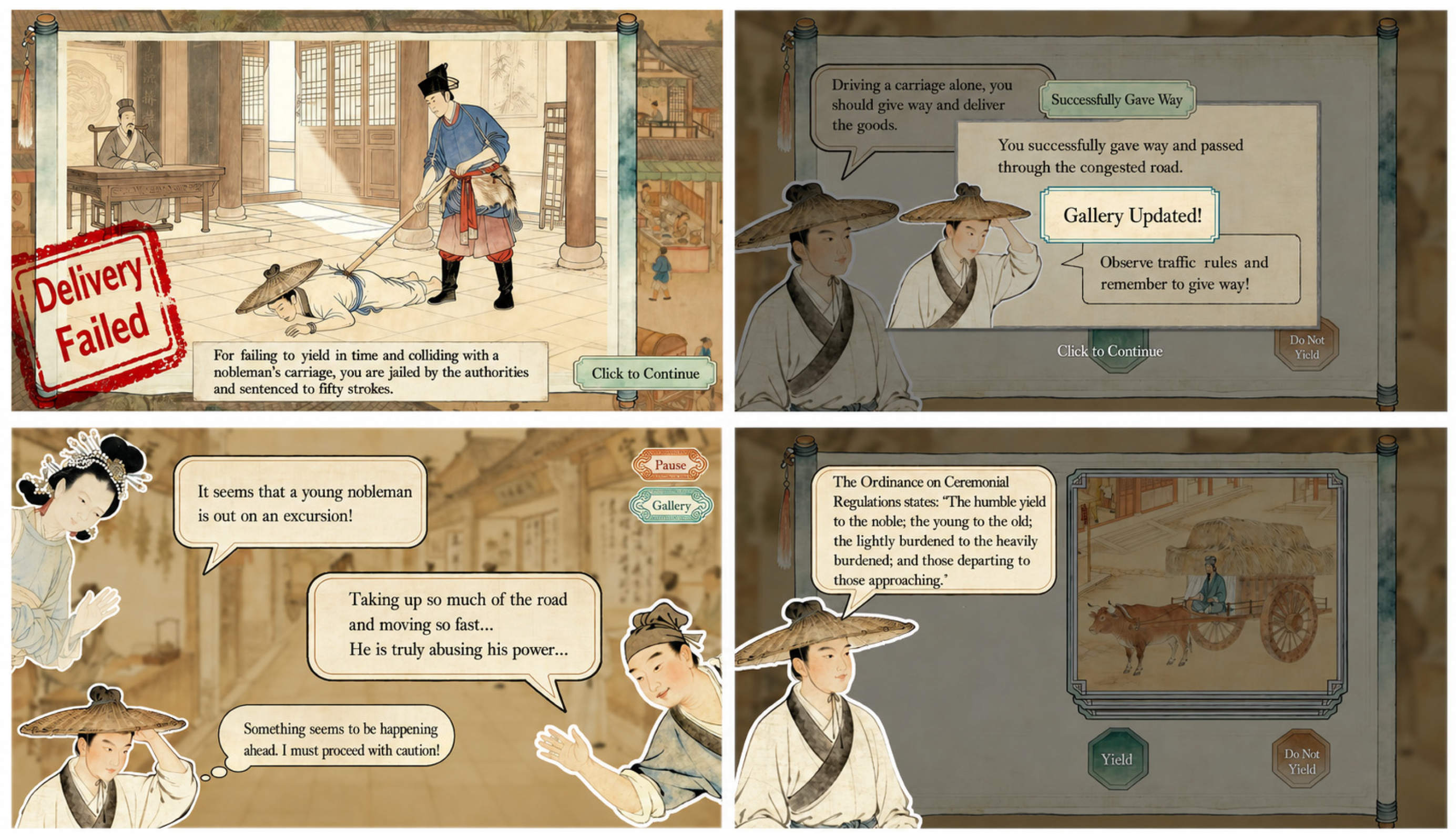
| Narrative plausibility | Connect historical anchor points through a chronologically and causally coherent narrative in which characters, events, and material practices remain culturally plausible. | A three-act narrative structured around Wang Meng connected successive uses and social meanings of the ox-drawn vehicle. Historical information was disclosed through a progressive journey. Rather than being presented as isolated facts, historical information was integrated into the broader narrative network and progressively communicated in relation to the exhibition’s plot development, character experiences, and relevant historical and cultural contexts. |
| Stylistic atmosphere | Coordinate visual, textual, and temporal cues into a culturally congruent perceptual whole instead of relying only on object-level realism. | Muted earth colors, paper-like textures, period-referential illustrations, restrained typography, and a consistent visual rhythm were used across the interface to establish a unified historical atmosphere. |
| Experiential immersion | Support sustained attention, narrative continuity, emotional involvement, and a sense of progressing through a historically situated experience. | Users followed a route-based sequence across the three narrative acts. Progressive information disclosure, continuous scene transitions, and the character-centered journey were used to maintain experiential continuity and encourage identification with the historical situation. |
| Interactive engagement | Use agency and responsive action to help users understand the structure, use, and meaning of the heritage object. | Users could inspect and manipulate vehicle models, drag components to designated positions, assemble or compare cart elements, and complete context-related tasks. Immediate visual feedback linked the interaction to structural and cultural information rather than using interaction solely as decoration. |
| Outcome | Exhibition A n = 31; M (SD) | Exhibition B n = 30; M (SD) | t(59) | p | Mean Difference [95% CI] | Hedges’ g [95% CI] |
|---|---|---|---|---|---|---|
| User loyalty (UL) | 5.56 (0.72) | 4.23 (1.08) | 5.657 | <0.001 | 1.323 [0.855, 1.791] | 1.430 [0.867, 1.984] |
| User satisfaction (US) | 5.69 (0.92) | 4.11 (1.14) | 5.962 | <0.001 | 1.577 [1.048, 2.106] | 1.507 [0.937, 2.067] |
| Cultural identity (CI) | 5.81 (0.85) | 4.48 (1.20) | 5.003 | <0.001 | 1.329 [0.797, 1.860] | 1.265 [0.715, 1.806] |
| Behavioral intention (BI) | 5.73 (0.93) | 4.09 (1.04) | 6.472 | <0.001 | 1.634 [1.129, 2.139] | 1.636 [1.055, 2.208] |
Disclaimer/Publisher’s Note: The statements, opinions and data contained in all publications are solely those of the individual author(s) and contributor(s) and not of MDPI and/or the editor(s). MDPI and/or the editor(s) disclaim responsibility for any injury to people or property resulting from any ideas, methods, instructions or products referred to in the content. |
© 2026 by the authors. Licensee MDPI, Basel, Switzerland. This article is an open access article distributed under the terms and conditions of the Creative Commons Attribution (CC BY) license.
Share and Cite
Chen, H.; Hu, Y.; Hu, W. Designing Authentic Virtual Heritage Experiences for Sustainable Cultural Heritage Communication: A Mixed-Methods Study. Sustainability 2026, 18, 7922. https://doi.org/10.3390/su18157922
Chen H, Hu Y, Hu W. Designing Authentic Virtual Heritage Experiences for Sustainable Cultural Heritage Communication: A Mixed-Methods Study. Sustainability. 2026; 18(15):7922. https://doi.org/10.3390/su18157922
Chicago/Turabian StyleChen, Hui, Yue Hu, and Weifeng Hu. 2026. "Designing Authentic Virtual Heritage Experiences for Sustainable Cultural Heritage Communication: A Mixed-Methods Study" Sustainability 18, no. 15: 7922. https://doi.org/10.3390/su18157922
APA StyleChen, H., Hu, Y., & Hu, W. (2026). Designing Authentic Virtual Heritage Experiences for Sustainable Cultural Heritage Communication: A Mixed-Methods Study. Sustainability, 18(15), 7922. https://doi.org/10.3390/su18157922