1. Introduction
Scholarly work around sustainability transitioning has continued to evolve in management and policy studies at a rapid pace over the years [
1]. Sustainability challenges are experienced differently across a wide range of context, including the energy sector facing natural resource depletion, greenhouse gas emissions, air pollution, energy poverty and supply insecurity in the short- and long-term [
2]. Other sectors affected by the sustainability challenge include the water sector, transportation, agriculture and food systems, all experiencing socioeconomic and environmental sustainability challenges [
1].
As organisations grapple with competing demands, decision-making is affected when faced with cost and regulatory uncertainties in response to sustainability obligations. Organisations adapt differently, focusing their resources to the most efficient use [
3]. Uncertainty could be defined as a condition where the probability of an outcome from a certain event is unquantifiable [
4,
5]. The uncertainties surrounding outcomes of events require a dynamic approach to addressing organisational concerns.
Most existing studies report broad-based findings. This paper investigates how SMEs in Northeast England pursue sustainability transitions while facing rising input costs, market volatility, and uncertain environmental regulations occasioned by frequent policy changes. It advances understanding of firm-level transition strategies under constraint by integrating recent evidence on leadership commitment, eco-innovation, and digital capability. In doing so, it contributes to debates on sustainability transitions, resilience, and SME strategy by identifying pathways that balance economic viability with environmental performance [
6,
7,
8,
9,
10,
11].
While the findings of this paper are consistent with the broader literature such as the prevalence of cost filtering, incremental adaptation, and risk aversion under regulatory uncertainty, the study advances the field in several distinct ways. First, it provides an integrated analysis of how cost pressures and regulatory uncertainty interact to shape SME sustainability transitions, rather than examining these factors in isolation as most previous studies have done. This interaction is shown to produce not only constraints but also distinct strategic response patterns, including incremental adaptation, strategic delay, collaborative adjustment, and selective innovation. Second, the research offers regionally specific insights by focusing on SMEs in Northeast England, a context that has been underexplored in the literature. The study demonstrates how regional market dynamics, local policy environments, and sectoral differences influence the adoption and timing of sustainability strategies, providing a more granular understanding than studies focused solely on manufacturing or technology sectors.
The paper sets out to address the following research questions:
- (1)
How do SMEs interpret and respond to cost pressures during sustainability transitions?
- (2)
In what ways does regulatory uncertainty shape strategic decision-making and investment timing?
- (3)
Which transition strategies enable SMEs to balance economic viability with environmental performance?
By addressing these questions, this paper will suggest how SMES respond to costs and regulatory pressures amidst sustainability transitioning journey. The rest of the paper will be structured as follows:
Section 2 will explore literature and conceptual background on sustainability transitions in SMEs, decision under cost pressures, regulatory uncertainties and trade-offs management;
Section 3 will present the methodology;
Section 4 will highlight the findings while
Section 5 will present the discussions and implications.
Section 6 will be the conclusion of the paper.
2. Sustainability Transitions in SMEs: From Systemic Change to Firm-Level Strategy
Earlier scholarships on sustainability transitions were largely concerned with large corporations and industry-wide or systemic transformations, often neglecting the complex realities of small and medium-sized enterprises (SMEs). However, SMEs are increasingly recognised as key actors in sustainability transitions due to their prevalence in regional economies, supply chains and their cumulative environmental impact [
7,
11]. Recent research [
12] redirects the attention from macro-level forces to the micro-dynamics of SMEs, highlighting their dual role as both objects of external pressures and agents actively navigating sustainability challenges in the context of resource constraints.
The Multi-Level Perspective (MLP) continues to be a fundamental theoretical framework for understanding sustainability transitions, conceptualising change as an interactive process among niche innovation, socio-technical regimes, and broader landscape pressures [
7]. The MLP has been widely applied at the sectoral or national level; however, an increasing number of research [
13] suggest adapting the MLP to firm-level analysis, especially in SMEs. SMEs often occupy niches that allow experimentation but are also limited by resources constraint, managerial capacity and institutional support, which limits their potential for transformational change.
The MLP is complemented by the Dynamic Capabilities Theory, which emphasises the internal capacities that allow firms to adapt to external turbulence. Dynamic capabilities (e.g., sensing environmental change, seizing new opportunities, and reconfiguring resources) are critical to SMEs that embed sustainability in their core strategy [
14,
15]. The importance of leadership commitment, learning orientation, and innovation capability as determinants of SME participation in sustainability transitions has been confirmed consistently [
11]. However, the fact that access to these capabilities is unevenly distributed leads to different transition paths among SMEs, indicating the importance of context-sensitive analysis. The literature indicates that sustainability transitions in SMEs are shaped by the complex interplay of external system-level pressures and internal firm-specific capabilities. This conceptualisation informs the present study, which explores how SMEs in diverse sectors manage sustainability transitions under cost pressure and regulatory uncertainty.
Specific environmental and climate-related requirements affecting UK SMEs include mandatory energy efficiency measures, waste reduction targets, and sectoral standards for emissions and resource use. Firms are also increasingly expected to comply with carbon reporting obligations, which require them to track and disclose their greenhouse gas emissions. In addition, there are ongoing developments in UK climate policy, such as the tightening of emissions targets, introduction of new sustainability reporting frameworks, and potential changes to environmental compliance enforcement. These developments generate uncertainty because SMEs must anticipate not only current requirements but also future regulatory shifts, which may render existing investments obsolete or require further adaptation. The regulatory uncertainty affecting UK SMEs is driven by the complexity, frequency, and ambiguity of environmental, climate-related, and sustainability requirements. This uncertainty disrupts investment timing, fosters risk-averse behaviour, and shapes the strategic responses of SMEs, who balance economic viability with environmental performance by prioritising incremental adaptation and collaborative approaches.
2.1. Cost Pressures and SME Responses in Sustainability Transitions
There is broad consensus that cost pressures are a significant barrier to sustainability for SMEs. SMEs, especially in manufacturing, logistics, services, retail and construction, have tight profit margins and are disproportionately affected by rising costs including energy, labour, regulatory compliance and other operational inputs. Literature indicates that the limited financial resources of SMEs often result in short-term focus on efficiency-oriented measures rather than long-term innovative sustainability strategies [
9].
Empirical studies show that SMEs usually take on incremental improvements, such as optimising energy consumption, reducing waste or upgrading equipment, when these actions offer immediate cost savings [
9]. The adoption of new technologies or sustainable practices is often modular or phased, a pragmatic approach that balances innovation with risk aversion [
16]. Cost pressures therefore act as a filter, and SMEs only consider sustainability initiatives if there is an operational or financial rationale. This behaviour is consistent with wider findings that SMEs under financial stress are more prone to use incrementalism and selective adoption rather than transformative change [
9,
16].
2.2. Regulatory Uncertainty and Strategic Decision-Making
Regulatory uncertainty strongly affects the strategic behaviour of SMEs towards sustainability objectives. Environmental regulations (e.g., carbon reporting and sector-specific sustainability standards) are complex and often change, which makes it difficult for SMEs in all sectors to plan towards sustainability. Additionally, ambiguity of policy direction and inconsistent enforcement increase perceived risk, leading many SMEs to postpone or downplay investments in sustainability [
17].
The literature suggests that SMEs tend to employ reactive or compliance-oriented strategies to deal with regulatory uncertainty, investing in sustainability only when the requirements are clarified [
17,
18]. This risk-averse attitude values flexibility and short-term survival more than long-term innovation. SMEs may also seek to reduce uncertainty by forming collaborative arrangements, such as joining industry networks or adopting voluntary standards, sharing information, reducing compliance costs and collectively interpreting regulatory changes. However, empirical studies specifying the precise mechanism through which regulatory uncertainty affects timing and type of SME sustainability transitions are still limited.
2.3. Strategic Responses: Trade-Offs Between Profitability and Environmental Objectives
SMEs’ strategic responses to sustainability transitions are diverse and depend on internal and external factors. SMEs do not follow standard paths but adapt their strategies according to the resources they have, the market situation and the regulatory context. Literature outlines several key response patterns: incremental adaptation (small-scale, efficiency-driven changes), strategic delay (postponing investments), selective adoption (prioritising sustainability only for clear benefits), collaboration (pooling resources and knowledge), and innovation (business model or product transformation) [
9,
17].
Cost pressures tend to encourage incremental adaptation and cost-based optimisation, while regulatory uncertainty leads to strategic delay and risk aversion. SMEs are increasingly aware that collaboration is a way to overcome individual constraints and gain access to otherwise unavailable resources and capabilities [
11]. Just a few SMEs, usually those with strong dynamic capabilities, implement innovation-led strategies in which sustainability is a source of differentiation and long-term value. However, there is little strong comparative evidence in the existing research of which strategies are most effective under different contextual conditions. This study aims to fill this gap by analysing strategic responses in different sectors and regions.
2.4. SMEs and Regional Context: An Underexplored Setting
The sectoral and regional contexts are very important for the sustainability transitions of SMEs. The mix of cost pressures, regulatory complexity and market dynamics is unique for SMEs in manufacturing, logistics, retail, services and construction. Recent reviews have called for more granular research at the firm level beyond traditional manufacturing or technology sectors [
19,
20]. For example, the way in which SMEs perceive and respond to sustainability issues is influenced by regional variations in local policy contexts, supply chain infrastructure and market features. Of special importance are dynamic capabilities, such as sensing opportunities and reconfiguring resources, which allow SMEs to pursue innovation even under external constraints [
11,
14,
15].
2.5. Conceptual Framework
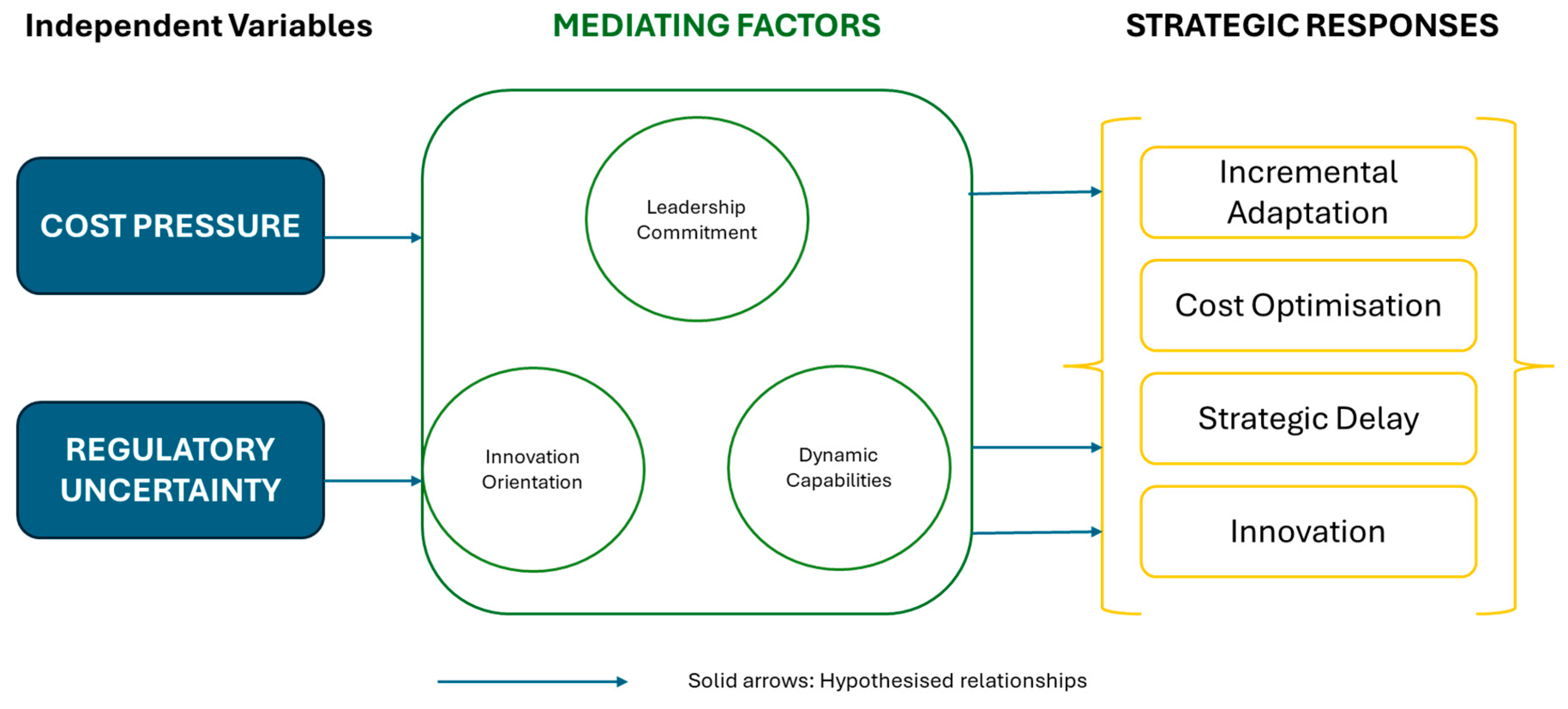
The conceptual framework for this research (
Figure 1) considers that cost pressures and regulatory uncertainty impact SME sustainability strategies, mediated by several factors, namely leadership commitment, innovation orientation, and dynamic capabilities. Strategic responses are expected to be incremental adaptation, cost optimisation, strategic delay, collaboration or innovation [
6,
8,
9,
11].
This section demonstrates that sustainability transitions in SMEs are influenced by the interplay of cost pressures, regulatory uncertainty and firm-level strategic responses. Prior studies have provided useful insights into these factors in isolation, but integrated understanding is lacking, especially across different regional contexts. This study adds to the knowledge on how SMEs balance economic viability and sustainability ambitions under constraint by examining these dynamics in a comparative, multi-sector framework, and provides a foundation for future empirical research and policy development.
3. Materials and Methods
This study adopts a qualitative multiple-case research design to examine how SMEs navigate sustainability transitions under conditions of cost pressure and regulatory uncertainty. A qualitative approach is analytically appropriate given that the research questions focus on interpretation, decision-making, and strategic response under uncertainty rather than variance-based explanation or hypothesis testing [
21]. Unlike quantitative approaches that seek to establish generalisable causal relationships, qualitative methods enable in-depth examination of how organisational actors interpret and respond to external pressures in context-dependent and often non-linear ways [
22].
The study is grounded in a critical realist–interpretivist perspective, recognising that while cost pressures such as energy inflation, labour costs, and supply chain volatility, together with regulatory uncertainty, constitute real external constraints, their strategic implications are mediated through firm-level sensemaking and bounded rationality [
23]. In SME contexts, decision-making is highly centralised and often informal, with owner–managers relying on experience-based judgement rather than formalised analytical systems. Consequently, sustainability responses are not deterministic outcomes of external pressures but are actively constructed through managerial interpretation and organisational routines [
24,
25].
A multiple-case design was employed to enable systematic cross-case comparison and analytical generalisation [
21,
26]. The objective is not statistical representativeness but the identification of recurring mechanisms such as cost filtering, strategic delay, and incremental adaptation that link external pressures to firm-level responses across heterogeneous organisational contexts [
27]. This design aligns with established qualitative research approaches that prioritise theoretical insight over empirical generalisation.
A purposive sampling strategy was used to identify information-rich cases capable of providing detailed insights into sustainability decision-making under constraint [
28]. Participants were selected based on four criteria: SME status, operation within the Northeast of England, exposure to cost pressures (e.g., energy, labour, supply chain volatility), and engagement with sustainability practices (formal or informal). Interviewees held strategic decision-making roles, including owner–managers, directors, and senior managers. This approach aligns with theoretical sampling principles, where cases are selected for their relevance to the research problem and their ability to illuminate variation in response patterns [
27,
29].
A total of 22 SME leaders were interviewed. Sample adequacy was guided by the principle of information power, whereby the richness and relevance of the data determine sufficiency rather than numerical thresholds [
30]. Saturation was reached by interview 19, with subsequent interviews confirming rather than extending thematic patterns [
31]. The sample spans multiple sectors, including manufacturing, retail, services, construction, logistics, and hospitality, enabling examination of cross-sector variation while maintaining a shared regional context.
Data were collected through semi-structured interviews, which are well suited to capturing managerial cognition, tacit knowledge, and informal strategic processes [
32,
33]. Interviews were conducted over 6 weeks, lasted between 45 and 65 min (mean: 54 min), and were held online via video conferencing using Microsoft Office Teams (v.2). The interview protocol was structured around three domains: cost pressures as operational constraints, regulatory uncertainty as a source of strategic ambiguity, and firm-level responses to sustainability challenges. The semi-structured format ensured comparability across cases while allowing flexibility to explore emergent themes [
34,
35]. All interviews were audio-recorded with consent, transcribed verbatim, and anonymised. Verbatim transcription preserves meaning and supports interpretive validity, particularly when analysing nuanced decision-making processes [
36]. Transcripts were not returned for participant validation, consistent with reflexive thematic analysis, which prioritises interpretive depth [
37].
Data was analysed using reflexive thematic analysis combined with an abductive analytical strategy [
37,
38]. Analysis proceeded in three stages. First, open coding identified first-order concepts grounded in the data (e.g., cost filtering, delayed investment, incremental adaptation) [
39]. Second, axial coding grouped these into higher-order themes, including cost pressures as a filtering mechanism, regulatory uncertainty as a temporal disruptor, and strategic responses such as incrementalism, delay, collaboration, and innovation [
40]. Third, cross-case comparison was undertaken to identify patterns and conditional variation across firms using structured thematic matrices [
41].
Table 1 presents an illustrative coding framework showing how representative interview extracts were iteratively interpreted into first-order concepts, higher-order themes, and aggregate dimensions through the abductive analytical process.
Although the analysis was theoretically informed through an abductive approach, the four strategic response themes were not predetermined from the literature. Rather, they emerged iteratively through repeated comparison of interview data during open and axial coding before being interpreted in relation to the literature on SME sustainability transitions and dynamic capabilities. Existing theory was therefore used to refine, explain, and theoretically position the emerging patterns rather than to prescribe them a priori.
The abductive approach enabled iterative movement between empirical observations and theoretical constructs, allowing the study to generate explanatory insights rather than descriptive categorisation [
38]. This directly addresses a known limitation in SME sustainability research, which has often remained descriptive and under-theorised [
42,
43]. To ensure analytical rigour, the study follows established qualitative quality criteria [
44]. Credibility was achieved through verbatim transcription and cross-case comparison. Dependability was ensured through consistent application of the interview protocol and maintenance of an audit trail [
45]. Confirmability was supported through transparent analytical procedures and reflexive engagement [
46]. Transferability was enabled through detailed contextual description and cross-case analysis [
47]. Ethical approval was obtained prior to data collection. Participants were provided with detailed information regarding the study’s purpose, confidentiality, and their rights, including voluntary participation and withdrawal. All data were anonymised and stored securely in accordance with GDPR and institutional guidelines.
Table 2 summarises the characteristics of the participating SMEs, including sector, size, leadership role, and years of operation.
4. Findings
The analysis reveals that SMEs do not respond uniformly to sustainability pressures. Instead, their responses are shaped by the interaction between cost pressures and regulatory uncertainty, producing distinct but overlapping strategic patterns. Three dominant mechanisms emerged across cases: cost filtering, temporal disruption under regulatory uncertainty, and strategic response variation. These mechanisms collectively explain how SMEs balance economic viability with environmental performance under constraint.
4.1. Cost Pressures
Across all cases, cost pressures acted as a primary filtering mechanism, determining which sustainability initiatives were pursued, delayed, or rejected. Rather than treating sustainability as an independent strategic objective, SMEs consistently evaluated initiatives through a financial viability lens, prioritising actions with immediate or short-term returns.
Participants frequently emphasised that rising energy costs, input inflation, and labour pressures constrained their ability to engage in more ambitious sustainability investments:
“Everything starts with cost now. If it doesn’t save money or at least pay back quickly, it’s not even on the table.”
(SME-07, Manufacturing)
This filtering effect was particularly pronounced in capital-intensive firms, where upfront investment costs created significant barriers:
“We know what we should be doing environmentally, but the numbers just don’t work right now. You can’t justify a £50,000 upgrade when margins are tight.”
(SME-02, Food Production)
As a result, sustainability adoption was selective and incremental, focused on efficiency-oriented measures such as energy reduction, waste minimisation, and process optimisation:
“We’ve done the small wins LED lighting, cutting waste, tweaking processes but the bigger changes are just too risky financially.”
(SME-08, Hospitality)
Importantly, cost pressures did not eliminate sustainability activity but reframed it. Environmental actions were pursued primarily when aligned with cost savings:
“If it reduces our bills, we’ll do it. If it’s just for sustainability, it’s harder to justify.”
(SME-16, Packaging)
This suggests that cost pressures operate not simply as constraints, but as decision filters, shaping both the scope and nature of sustainability engagement.
4.2. Regulatory Uncertainty
While cost pressures shaped what SMEs did, regulatory uncertainty influenced when they acted. Participants consistently described uncertainty around environmental regulations as a source of temporal disruption, leading to delayed or cautious investment decisions.
A recurring pattern was the adoption of a “wait-and-see” approach, particularly for capital-intensive sustainability investments:
“We’re holding back on bigger changes because the rules keep shifting. You don’t want to invest in something that’s outdated in two years.”
(SME-18, Logistics)
Uncertainty regarding compliance requirements, reporting standards, and future policy direction created hesitation and risk aversion:
“It’s not clear what’s required versus what’s coming. That uncertainty makes it difficult to commit to long-term investments.”
(SME-03, Construction)
In several cases, regulatory ambiguity resulted in strategic delays, even when firms were willing to act:
“We had plans to upgrade equipment, but we paused because we weren’t sure if it would meet future standards.”
(SME-06, Manufacturing)
However, this uncertainty did not produce uniform inactivity. Instead, SMEs continued to pursue low-risk, reversible actions while deferring larger commitments:
“We’ll keep improving things step by step, but anything major—we’re waiting for clearer direction.”
(SME-20, Hospitality)
This indicates that regulatory uncertainty does not simply constrain action but restructures decision timelines, pushing firms toward incrementalism and flexibility rather than proactive transformation.
4.3. Strategic Responses
The interaction of cost pressures and regulatory uncertainty produced four dominant strategic response patterns across cases: incremental adaptation, strategic delay, collaborative adjustment, and selective innovation.
4.3.1. Incremental Adaptation
The most common response was incremental adaptation, where firms pursued low-cost, efficiency-driven sustainability measures:
“We’re improving things bit by bit. Nothing radical, just steady changes that make sense financially.”
(SME-12, Retail)
This approach reflects a pragmatic balance between sustainability and economic survival but rarely resulted in transformative change.
Unlike selective innovation, incremental adaptation focuses on improving existing operations through low-risk efficiency gains rather than using sustainability to create new competitive opportunities.
4.3.2. Strategic Delay
A second group of firms adopted a deliberate delay strategy, postponing major investments until greater clarity emerged:
“We’re not against sustainability, but we can’t move too early and get it wrong. Timing matters.”
(SME-09, Logistics)
Delay was not passive, but a calculated response to uncertainty, reflecting risk management rather than disengagement.
4.3.3. Collaborative Adjustment
Some SMEs mitigated constraints through collaboration, including supplier partnerships, shared knowledge, and local networks:
“We work closely with suppliers to reduce costs and improve sustainability together. It’s easier when you’re not doing it alone.”
(SME-13, Supply Chain)
Collaboration functioned as a risk-sharing mechanism, enabling firms to engage in sustainability without bearing full costs.
Whereas collaborative adjustment enables firms to respond immediately by sharing resources and knowledge, strategic delay intentionally postpones major investment until external uncertainty is reduced.
4.3.4. Selective Innovation
A smaller subset of firms adopted more proactive, innovation-led strategies, using sustainability as a source of differentiation:
“We’ve leaned into sustainability as part of our brand. It’s risky, but it’s also opened new opportunities.”
(SME-17, Artisan Production)
These firms typically exhibited stronger strategic orientation and willingness to absorb short-term costs for long-term positioning.
4.4. Conditional Variation Across Firms
Although common patterns emerged across the dataset, important differences were evident according to firm size, sector, and resource capacity. These differences influenced not only the types of sustainability initiatives pursued but also how cost pressures and regulatory uncertainty were interpreted and incorporated into strategic decision-making.
Firm size was a significant source of variation. Medium-sized SMEs with greater financial and organisational resources demonstrated higher levels of strategic flexibility and were more willing to invest in sustainability despite prevailing economic uncertainty. These firms were better positioned to absorb short-term costs and viewed sustainability investments as opportunities to improve long-term competitiveness and operational resilience.
“We’ve got a bit more flexibility, so we can invest ahead of time rather than just reacting.”
(SME-11, Processing)
In contrast, micro and smaller SMEs consistently prioritised business continuity and cash flow preservation. Limited financial reserves, tighter operating margins, and the concentration of decision-making within the owner–manager resulted in a stronger emphasis on immediate survival, making long-term sustainability investments considerably more difficult to justify.
“For us, it’s day-to-day survival first. Sustainability comes after that.”
(SME-19, Retail)
Sectoral differences were equally apparent. Manufacturing, processing, and logistics firms generally perceived sustainability through the lens of capital investment, where environmental improvements often required significant expenditure on equipment, machinery, fleet upgrades, or production processes. Consequently, rising energy prices and investment costs had a more direct influence on sustainability decision-making, with firms frequently postponing major initiatives until economic conditions improved.
By contrast, service-oriented businesses, including retail, hospitality, and catering, were more likely to associate sustainability with operational efficiencies and behavioural changes, such as reducing waste, improving energy management, or modifying day-to-day business practices. These initiatives typically required lower levels of capital investment, allowing firms to continue making incremental sustainability improvements despite financial constraints.
Overall, the findings suggest that sector and firm size do not merely moderate sustainability responses but fundamentally shape how external pressures are interpreted and acted upon. Resource-rich SMEs were generally better able to adopt proactive sustainability strategies, whereas smaller firms and those operating in more capital-intensive industries adopted incremental, risk-managed approaches that balanced environmental objectives against immediate commercial realities.
To synthesise the cross-case patterns identified,
Table 3 summarises the key themes, underlying mechanisms, and representative evidence, highlighting how SMEs navigate sustainability under cost and regulatory constraints.
5. Discussion
This study aimed to address three key research questions: (1) How do SMEs interpret and respond to cost pressures during sustainability transitions? (2) In what ways does regulatory uncertainty shape strategic decision-making and investment timing? (3) Which transition strategies enable SMEs to balance economic viability with environmental performance? The findings reveal that SMEs do not respond uniformly to sustainability pressures. Instead, their responses are shaped by the interaction between cost pressures and regulatory uncertainty, producing distinct but overlapping strategic patterns. These findings align with and extend existing literature on sustainability transitions in SMEs.
The study employed a qualitative, multi-sector, and cross-case design, enabling the identification of conditional variation in SME responses based on resource capacity, sector, and strategic orientation. This approach moves beyond descriptive accounts by uncovering the mechanisms such as cost filtering and temporal disruption that link external pressures to firm-level strategic choices. The research also extends the application of the Multi-Level Perspective (MLP) and Dynamic Capabilities Theory to the SME context, illustrating how internal capabilities like leadership commitment and innovation orientation mediate responses to external constraints. Importantly, the study identifies collaboration as a key risk-sharing mechanism, showing how SMEs leverage supplier partnerships and local networks to overcome resource limitations, a finding that is less emphasised in prior work.
5.1. Cost Pressures as a Filtering Mechanism
The study found that cost pressures act as a primary filtering mechanism, determining which sustainability initiatives are pursued, delayed, or rejected. SMEs consistently evaluate sustainability initiatives through a financial viability lens, prioritising actions with immediate or short-term returns. This finding is consistent with Faiz et al. [
9], who highlight that cost is a major determinant in the timing and extent of sustainability investments. SMEs often adopt modular or phased approaches to balance innovation with financial risk, focusing on cost-saving measures such as energy optimisation and waste reduction. This behaviour reflects the broader trend of selective adoption, where sustainability initiatives are pursued only when they offer immediate operational or cost-cutting benefits.
The findings also support Klewitz and Hansen [
40], who argue that SMEs prioritise economically viable sustainability actions under resource constraints. For example, participants in this study emphasised that rising energy costs, input inflation, and labour pressures constrained their ability to engage in more ambitious sustainability investments. This aligns with the notion that cost pressures reinforce incrementalism, as SMEs experiencing financial distress are more likely to adopt cost-driven optimisation strategies rather than transformative sustainability transitions. This pattern aligns with recent research demonstrating that SMEs prioritise economically viable sustainability actions under resource constraints and uncertainty [
6,
9,
42,
43,
48].
5.2. Regulatory Uncertainty as a Temporal Disruptor
The study also found that regulatory uncertainty significantly influences the timing of sustainability investments. Unclear and inconsistent environmental regulations lead SMEs to adopt a “wait-and-see” approach, delaying major investments until greater clarity emerges. This finding resonates with Teeter and Sandberg [
16], who argue that policy uncertainty constrains green capability development and fosters risk-averse behaviour. Similarly, Puumalainen et al. [
15] highlight that regulatory ambiguity often results in reactive or compliance-focused strategies, rather than proactive innovation.
Participants in this study described regulatory uncertainty as a source of strategic hesitation, particularly for capital-intensive sustainability investments. This aligns with the literature, which suggests that SMEs prioritise flexibility and risk avoidance in uncertain regulatory environments [
4]. However, the study also found that SMEs continued to pursue low-risk, reversible actions while deferring larger commitments. This incremental approach to sustainability under regulatory uncertainty is consistent with findings by Klewitz and Hansen [
40], who emphasise the importance of economically aligned sustainability practices in resource-constrained contexts.
5.3. Interaction Between Cost Filtering and Temporal Disruption
A key contribution of this study is demonstrating that cost pressures and regulatory uncertainty operate as complementary mechanisms rather than independent influences on SME sustainability transitions. Cost pressures determine which sustainability initiatives are economically feasible, whereas regulatory uncertainty shapes when firms are willing to implement them. Their interaction narrows the range of viable strategic options, encouraging incremental and economically aligned sustainability practices over transformational change, extending previous studies that have largely examined these pressures separately [
40,
43].
This interaction also explains the four strategic responses identified in the study. Incremental adaptation reflects low-risk efficiency improvements under financial constraint [
9,
40], while strategic delay postpones major investments until regulatory uncertainty is reduced [
17]. Collaborative adjustment enables SMEs to overcome resource constraints through shared knowledge and partnerships [
11], whereas selective innovation is evident among firms with stronger dynamic capabilities that view sustainability as a source of competitive advantage rather than simply a compliance requirement [
15,
48].
The findings suggest that sustainability transitions are shaped not by single external pressures but by the combined influence of economic constraints, institutional uncertainty, and firm-level capabilities. This provides a more integrated explanation of SME sustainability strategies and extends existing understanding of sustainability transitions under conditions of constraint [
15].
5.4. Strategic Responses to Sustainability Transitions
The interaction of cost pressures and regulatory uncertainty produced four dominant strategic response patterns across cases: incremental adaptation, strategic delay, collaborative adjustment, and selective innovation. Incremental adaptation was the most common response, with SMEs pursuing low-cost, efficiency-driven sustainability measures. This approach reflects a pragmatic balance between sustainability and economic survival but rarely resulted in a transformative change. These findings are consistent with Faiz et al. [
9], who note that SMEs often focus on short-term cost-saving measures rather than larger long-term systemic changes.
Strategic delay emerged as another prevalent response, with SMEs postponing major investments until greater clarity on regulations was achieved. This behaviour aligns with the literature, which highlights the role of regulatory uncertainty in fostering strategic delay [
17]. However, the study found that delay was not passive but a calculated risk management strategy, reflecting a nuanced understanding of the challenges faced by SMEs. Collaborative adjustment was identified as a key strategy for mitigating constraints, with SMEs leveraging supplier partnerships, shared knowledge, and local networks to reduce costs and improve sustainability. This finding supports Wojtaszek et al. [
11], who emphasise the role of collaboration in enabling SMEs to engage in sustainability transitions despite resource limitations.
A smaller subset of SMEs adopted selective innovation strategies, using sustainability as a source of differentiation. These firms exhibited stronger dynamic capabilities and leadership commitment, which enabled them to pursue proactive, innovative strategies. This finding aligns with Dynamic Capabilities Theory [
14,
15], which highlights the importance of leadership commitment, learning orientation, and innovation capability in enabling SMEs to incorporate sustainability into their strategic decision-making processes.
The study also identified conditional variation in strategic responses based on firm characteristics, particularly resource capacity, sector, and strategic orientation. Larger SMEs with greater resource slack were more able to engage in proactive strategies, while smaller firms focused on immediate survival. This finding is consistent with Klewitz and Hansen [
40], who argue that resource constraints significantly influence the sustainability strategies of SMEs. Sectoral differences were also evident, with manufacturing and logistics firms emphasising capital investment challenges, while service-based firms focused more on operational adjustments and behavioural changes.
Finally, by synthesising these insights, the study provides actionable implications for both managers and policymakers, addressing the practical gap often noted in SME sustainability research. In summary, the unique value of this study lies in its integrated, context-sensitive analysis of SME sustainability transitions under constraint, its focus on underexplored regional and sectoral variation, and its identification of actionable mechanisms and differentiated strategic responses that inform both theory and practice.
5.5. Study Implications
5.5.1. Managerial Implications
Managerial implications of this study are rooted in the practical realities faced by SME leaders in Northeast England as they navigate sustainability transitions under cost pressures and regulatory uncertainty. The evidence shows that managers consistently use cost as a primary filter for decision-making, prioritising sustainability initiatives that deliver immediate or short-term financial returns. This means that actions such as energy optimisation, waste reduction, and process improvements are favoured, while larger, capital-intensive investments are often delayed or rejected unless there is a clear operational or financial rationale.
For some managers, sustainability is seen as an opportunity to differentiate their business, attract new customers, and build long-term value. These leaders are more likely to pursue innovation-led strategies, invest in eco-friendly products, and leverage sustainability as part of their brand identity, even if it involves short-term costs. For others, sustainability is perceived mainly as a regulatory burden, shaped by frequent changes and ambiguity in environmental requirements. This group tends to adopt a compliance-oriented, risk-averse approach, prioritising flexibility and short-term survival over proactive investment. They delay major sustainability actions until regulations are clarified, viewing sustainability obligations as external pressures rather than strategic opportunities.
The majority, however, treat sustainability as a necessary adaptation process, balancing economic viability with environmental performance. They focus on incremental, efficiency-driven measures—such as energy optimisation and waste reduction—that align with immediate financial returns and minimise risk. These perceptions directly explain variations in strategic responses: opportunity-driven managers pursue selective innovation, burden-focused managers adopt strategic delay, and adaptation-oriented managers favour incrementalism and collaboration. Sector, resource capacity, and leadership orientation further mediate these perceptions, with larger firms and those with stronger dynamic capabilities more likely to see sustainability as an opportunity, while smaller, resource-constrained firms emphasise compliance and survival. This nuanced understanding of managerial perceptions significantly strengthens the explanatory power of the study, clarifying why SMEs adopt different sustainability strategies under cost and regulatory constraints.
Managers adopt incremental adaptation as the dominant strategy, making small, efficiency-driven changes that are low-risk and reversible. Strategic delay is also prevalent, with managers postponing major investments until regulatory requirements are clarified, reflecting a calculated risk management approach rather than disengagement. Collaboration emerges as a key mechanism, enabling SMEs to share risks and resources through supplier partnerships, local networks, and industry groups. Only a minority of firms with stronger dynamic capabilities and leadership commitment pursue innovation-led strategies, using sustainability as a source of differentiation and long-term value. Overall, managers should focus on cost-saving measures, maintain flexibility in investment timing, leverage collaborative arrangements, and selectively innovate where resources and market conditions allow, always balancing economic viability with environmental performance.
5.5.2. Policy Implications
The study highlights the critical role of regulatory clarity and targeted support in enabling SME sustainability transitions. Policymakers should recognise that regulatory uncertainty acts as a temporal disruptor, causing SMEs to delay or downplay sustainability investments due to perceived risk and ambiguity. To address this, policies must aim for clearer, more consistent environmental regulations, providing advance notice of changes, guidance on compliance, and predictable enforcement. Support mechanisms should be tailored to the incremental and collaborative nature of SME responses, offering grants or incentives for small-scale improvements and facilitating industry networks for information sharing and joint projects. Targeted assistance is especially important for resource-constrained SMEs, such as micro and small enterprises, which require financial support, training, and advisory services to engage in sustainability. Furthermore, policies should foster dynamic capabilities within SMEs by funding leadership development, innovation incubators, and digital transformation initiatives that integrate sustainability. By reducing regulatory uncertainty, supporting incremental and collaborative approaches, and encouraging innovation, policymakers can help SMEs overcome barriers and pursue more ambitious sustainability strategies, ultimately balancing economic viability with environmental goals in the regional context.
6. Conclusions
The findings in this paper underscore the importance of understanding the interplay between cost pressures and regulatory uncertainty in shaping SME sustainability transitions. While these factors constrain action, they also create opportunities for incremental adaptation, collaboration, and selective innovation. Future research should explore how policy interventions and support mechanisms can reduce transition risks and enable SMEs to pursue more ambitious sustainability strategies.
SMEs in Northeast England face significant challenges in implementing sustainability, shaped by rising costs and regulatory uncertainty. Most firms adopt incremental, efficiency-driven measures such as energy optimisation and waste reduction, prioritising actions with immediate financial returns. Larger, capital-intensive investments are often delayed due to unclear and shifting environmental regulations, leading to a widespread ‘wait-and-see’ approach. Strategic responses vary: incremental adaptation is most common, while some SMEs pursue strategic delay, collaborative adjustment with suppliers and networks, or selective innovation for differentiation. Resource capacity, sector, and leadership orientation influence these choices, with smaller firms focusing on survival and larger firms able to invest proactively. Regulatory ambiguity disrupts investment timing and fosters risk aversion, pushing SMEs toward low-risk, reversible actions. The study highlights the need for clearer policy signals and targeted support to enable more ambitious sustainability transitions, offering regionally specific insights that strengthen both theoretical and practical relevance.
This study contributes to the literature on sustainability transitions and SME strategy by providing empirical evidence on how SMEs navigate sustainability under cost and regulatory constraints. It extends existing research by highlighting the interaction between cost pressures and regulatory uncertainty as key determinants of SME sustainability transitions. Additionally, the study provides regionally specific insights into the challenges faced by SMEs in Northeast England, addressing a significant gap in the literature [
19,
20].