1. Introduction
The construction process, especially in the case of projects with significant environmental impacts, entails inevitable interference with the natural environment. In the European Union, the issue of invasive alien species (IAS) has the status of a systemic challenge and has been embedded in the legal framework through Regulation (EU) No 1143/2014 of the European Parliament and of the Council [
1], which emphasizes prevention and limiting the spread of these species. The Regulation is based on the “prevention–early detection–rapid response–management” approach, assuming that preventive measures and early intervention are more effective than actions undertaken after populations become established in the environment. This is consistent with current scientific and expert assessments indicating increasing IAS pressure on biodiversity and the need for a systemic approach, particularly in sectors generating habitat disturbance and intensive material transport [
2,
3]. Under Central European conditions, where the scale of infrastructure investment is substantial and land transformation and material transport accompany many projects, the risk of secondary IAS spread along investment corridors and in disturbed areas should be regarded as particularly important [
4,
5]. In Europe, IAS cause damage of around EUR 12 billion per year, which highlights how important early detection and prevention of these species are—also during the implementation of investment projects [
6].
The course of the construction process is the responsibility of its participants. Pursuant to Article 17 of the Construction Law Act [
7], these are the investor, the designer, the construction manager, and the investor’s supervision inspector. In large territorial-scale projects, these entities operate in practice as teams, carrying out duties arising from environmental and nature protection regulations. One of the key environmental objectives is biodiversity conservation, which can be supported by limiting IAS spread during project implementation. Scientific evidence indicates that biological invasions contribute to local and regional species extinctions, the impoverishment of community species structure, and disruptions to ecosystem functioning, including trophic and biogeochemical processes [
8,
9]. The expansion of alien species is further facilitated by ongoing climate warming through increased survival during autumn and winter, an extended growing season, and the colonization of areas previously constrained by climatic barriers [
10,
11,
12,
13]. As a result, IAS expansion potential may be reinforced by local environmental disturbances associated with the implementation of investment projects.
These mechanisms become particularly significant in high-impact projects with extensive territorial scope, including linear developments (e.g., road and railway construction). In such cases, activities undertaken during construction may directly initiate or accelerate invasion processes. IAS spread is promoted, inter alia, by the movement of soil masses, transport of soil and aggregates, vegetation removal, and other transformations of habitat structure—especially along infrastructure corridors and in heavily disturbed areas [
4,
5,
14,
15,
16]. The most recent global IPBES assessment confirms that the effects of biological invasions and climate change are synergistic, intensifying pressure on ecosystems and hampering effective biodiversity protection [
2].
In the context of investment implementation, the stage of obtaining an environmental decision and a building permit is particularly important for limiting the spread of invasive species. The presence of IAS in project areas has not only ecological but also economic relevance, because it necessitates remedial measures (removal or containment), including field operations, monitoring, and follow-up actions, which may affect the project schedule and budget. One of the most important legal acts regulating environmental protection in the investment process in Poland is the Act of 3 October 2008 on Sharing Information and Protecting Environment, Participation of the Citizens in Environment’s Protection and Environmental Impact Assessments [
17]. Although this Act does not directly refer to IAS, these species should be identified during the preparation of the environmental impact assessment (EIA) report as a factor potentially threatening the environment. This enables planning measures to limit their spread during project implementation [
18]. Obligations to prevent the spread and remove IAS arise from Regulation (EU) No 1143/2014 and, at the national level, from the Polish Act of 11 August 2021 on Alien Species [
19], giving the issue environmental, legal and—within implementation practice—economic and technical/logistical dimensions.
Failure to consider IAS at the planning and implementation stages may lead to long-term environmental degradation and the generation of substantial additional costs during project delivery or operation [
4,
8,
20]. Therefore, reliable ecological baseline surveys and appropriate environmental management throughout the entire investment life cycle—from the preparatory phase, through construction, to the operational phase—are of fundamental importance.
Despite the growing body of research on the ecological impacts, dispersal mechanisms and management of invasive alien species, their role in the practical implementation of infrastructure projects remains insufficiently systematised. This is particularly relevant for projects in which earthworks, soil movement, topsoil reuse, ancillary works and habitat disturbance may create favourable conditions for secondary IAS spread. Therefore, a closer examination of real investment cases can help identify when and under what site-specific conditions IAS risk becomes significant during project delivery, and how this risk can be incorporated into environmental supervision, construction organisation and post-implementation monitoring.
Accordingly, the aim of this study was to examine, based on three infrastructure-project case studies from Poland, how environmental, legal, technical, organizational, economic, and construction-management risks associated with invasive alien species arise and are managed during project implementation. Particular attention was paid to construction stages involving earthworks, soil and topsoil movement, habitat disturbance, ancillary works, and contact with external propagule sources. A further aim was to identify recurring operational risk mechanisms and use them to propose an exploratory, case-informed, semi-quantitative decision-support framework for IAS risk identification, preventive planning, environmental supervision, and post-intervention monitoring. The framework is intended as a practical and transparent tool for organizing project-specific information rather than as a statistically validated predictive model.
2. Materials and Methods
2.1. Study Design and Case Selection
The study was designed as an exploratory comparative multiple-case analysis of invasive alien species (IAS) management during the implementation of large infrastructure projects in Poland. Three cases were selected purposively to represent different types of spatially extensive infrastructure, different construction settings, and different stages at which Japanese knotweed (Reynoutria japonica Houtt.) was detected. The analysed projects included flood embankment reconstruction, railway line modernisation, and express road construction.
The selected projects shared several characteristics relevant to the study objective. Under Polish legislation, all of them were classified as projects that may have a significant impact on the environment and required an Environmental Impact Assessment (EIA), including the preparation of an EIA report before project implementation. All projects were also subject to ecological supervision during construction.
The projects were implemented under FIDIC (Fédération Internationale des Ingénieurs-Conseils—International Federation of Consulting Engineers) contractual conditions. Under this procedural framework, the Engineer supervised compliance with contractual provisions, design documentation, quality requirements, and environmental obligations, while the Contractor was responsible for reporting environmental risks, obtaining the required approvals, and implementing risk-mitigation measures in accordance with the established procedures.
The study was not designed as a controlled intervention trial or as a statistical validation study. The three projects differed in infrastructure type, project scale, infestation extent, timing of IAS detection, intervention method, technical constraints, and monitoring duration. No untreated control sites were available, and the number of cases was insufficient for reliable inferential statistical testing.
Consequently, the study was intended to document and compare observable site conditions, intervention characteristics, and post-intervention outcomes within individual cases rather than to estimate a general causal treatment effect. The analysis focused on recorded IAS presence, infestation characteristics, soil and plant-material management, applied control measures, post-intervention regrowth, and reinvasion potential.
2.2. Before–After Assessment Framework
To provide a consistent descriptive comparison between the analysed cases, the available information was organised according to a “Before–Intervention–After” framework [
21,
22].
The “Before” stage referred to the condition of the project area before the relevant intervention or construction phase. Information was obtained from pre-construction ecological inventories, EIA documentation, baseline ecological reports, construction records, and field observations made before or at the beginning of works.
The baseline assessment included, where available: (1) presence or absence of IAS, (2) area occupied by Japanese knotweed, (3) number of shoots or individuals, (4) plant density, (5) plant height or growth stage, (6) location of the occurrence in relation to planned earthworks, soil movement, topsoil storage, and construction access routes and (7) presence of potential external propagule sources.
Where Japanese knotweed had been recorded before the commencement of works, these parameters were used to characterise the baseline condition. Where the species had not been identified in the available documentation, the baseline was reported as “no IAS recorded within the project area”. This classification referred only to the available survey records and did not imply the confirmed absence of IAS from the site or its surroundings.
The “Intervention” stage comprised actions undertaken after IAS detection. These included field verification, delineation and marking of infested areas, suspension or modification of works, and implementation of control measures.
The following intervention characteristics were documented: (1) timing of IAS detection, (2) type of control method applied, (3) quantity of contaminated soil or plant material handled, where available, (4) disposal or treatment method, (4) technical and environmental constraints affecting control, (5) suspension or modification of construction works.
Depending on site-specific conditions, the applied measures included manual removal, mechanical removal, selective chemical treatment, screening of contaminated soil, disposal of plant material, soil treatment, and installation of physical barriers.
The “After” stage referred to the condition of the treated area during post-intervention monitoring. The assessment focused on the presence or absence of Japanese knotweed regrowth, evidence of reinvasion from neighbouring areas, and persistence of potential external propagule sources.
Post-intervention outcomes were documented descriptively. The absence of regrowth during the available monitoring period was treated as an observed local outcome rather than as proof of complete eradication or statistically demonstrated intervention effectiveness. Where no regrowth was recorded within the project area but source populations remained outside the project boundaries, the intervention was classified as locally effective during the observation period, while continued monitoring was considered necessary because of the risk of reinvasion.
2.3. Semi-Quantitative IAS Risk Assessment Framework
Based on the comparative analysis of the three infrastructure projects, a semi-quantitative framework was developed to support a transparent and reproducible classification of invasive alien species (IAS) risk. The framework was designed as an operational decision-support tool for project planning, construction supervision, and post-intervention monitoring.
Nine indicators were selected because they represented the principal mechanisms affecting the probability of IAS introduction, secondary spread, persistence, and reinvasion in the analysed projects. These indicators comprised:
(1) IAS occurrence within or adjacent to the project area, (2) scale of earthworks and soil movement, (3) type of construction activities, (4) proximity and connectivity to external propagule sources, (5) risk associated with soil and plant-material management, (6) species-specific regeneration and dispersal potential, (7) timing of IAS detection in relation to construction works, (8) technical or administrative constraints affecting control and (9) potential for reinvasion.
Each indicator was assigned an ordinal score of 0, 1, or 2, corresponding to a low, moderate, or high contribution to the overall IAS risk, respectively. The scoring criteria were defined using observable project characteristics obtained from ecological inventories, environmental documentation, construction records, field inspections, and post-intervention monitoring. The operational definitions used to assign individual scores are presented in
Table 1.
The total IAS risk score was calculated using Equation (1):
where
is the total IAS risk score and
is the score assigned to the
-th risk indicator.
As nine indicators were assessed on a scale from 0 to 2, the total score ranged from 0 to 18. Scores of 0–5 were classified as low risk, scores of 6–11 as moderate risk, and scores of 12–18 as high risk.
The thresholds represent equal-width operational intervals and should be interpreted as decision-support boundaries rather than statistically derived ecological thresholds. The corresponding minimum management responses are presented in
Table 2.
Low-risk conditions are characterised by the absence of IAS within the project area and its surveyed surroundings, limited soil disturbance, no substantial transfer of soil between work zones, and the absence of major technical constraints affecting control.
Moderate-risk conditions occur where IAS have not been confirmed within the affected work area but potential propagule sources or material-transfer pathways are present. Moderate risk may also apply where soil is temporarily stockpiled or reused locally and where construction activities generate limited but identifiable habitat disturbance.
High-risk conditions include confirmed IAS occurrences within or immediately adjacent to the construction area, large-scale soil movement, the presence of species capable of regeneration from small fragments, delayed detection, restricted control options, or a continuing source of reinvasion.
A precautionary override rule was additionally applied. Irrespective of the numerical score, a project stage was classified as high risk when at least one of the following conditions occurred: (1) IAS were confirmed in soil or topsoil scheduled for excavation, transport, storage, or reuse, (2) contaminated soil or viable plant fragments had already been redistributed within or outside the project area, (3) complete removal was technically impossible and a confirmed source of reinvasion remained adjacent to the project area.
The assessment was treated as dynamic and was updated when new IAS occurrences were identified, new work fronts were opened, soil-management procedures changed, or additional propagule sources were detected.
The framework was retrospectively applied to each of the three analysed projects. For every case, the nine indicators were scored on the basis of documented project characteristics, and the scores were summed to determine the overall risk category. The resulting classifications were compared descriptively with the observed scale of infestation, intervention complexity, contaminated-material management requirements, technical constraints, and reinvasion potential.
The IAS risk-scoring framework should be interpreted as an exploratory, case-informed, semi-quantitative decision-support tool. Its scoring rules were derived from recurring risk mechanisms identified across the three cases and from the operational requirements of infrastructure-project management. The retrospective application was used to examine the internal logic and traceability of the scoring procedure to the available case observations. It did not constitute statistical or external validation.
2.4. Study Limitations
This study has several important limitations. First, the analysis was based on three infrastructure projects that differed in project type, spatial scale, timing of IAS detection, infestation extent, intervention method, technical constraints, and monitoring duration. Consequently, the cases cannot be treated as statistical replicates of a common intervention.
Second, the available data were collected primarily for environmental supervision and project-management purposes rather than according to a standardized experimental protocol. Some indicators, such as infestation area, shoot number, plant height, contaminated-soil volume, and monitoring duration, were available only for selected cases. Missing values were not imputed.
Third, no untreated control sites were available, and repeated measurements were not conducted at uniform time intervals. Therefore, the study cannot estimate a causal treatment effect or test whether the observed Before–After changes are statistically significant. The absence of regrowth during the monitoring period should be interpreted only as an observed local outcome, not as proof of complete eradication.
Fourth, the proposed IAS risk framework is semi-quantitative and exploratory. The indicators were assigned equal weights, and the low, moderate, and high risk thresholds represent operational decision-support boundaries rather than statistically estimated ecological cut-off values. Because all three analysed cases were classified as high risk, the study could not assess the empirical discriminative ability of the proposed low, moderate, and high risk thresholds. Potential overlap and correlation among some indicators were not formally assessed. The framework was examined for internal consistency through retrospective application to the three cases, but no formal sensitivity analysis or external validation was conducted.
Fifth, all three cases involved Japanese knotweed as the principal model species. The applicability of the framework to IAS with different dispersal pathways, life histories, and regeneration strategies remains to be tested.
Future research should include a larger number of infrastructure projects, standardized baseline and follow-up measurements, multiple IAS taxa, repeated observations over several growing seasons, independent assessors, and, where feasible, comparison or reference sites. Such data would allow formal model estimation, indicator weighting, threshold optimization, inter-rater reliability testing, and external validation of predictive performance.
3. Results and Discussion
3.1. Case 1: Flood Embankments
The project involved the reconstruction of river flood embankments along a section several tens of kilometres in length. The incident described below occurred on an embankment segment several hundred metres long, located several tens of metres from allotment gardens. The scope of the project included, among other works, raising the embankment crest and installing a waterproof barrier in the form of a bentonite mat. The scale of the earthworks was substantial: approximately 500,000 m3 of soil and topsoil (humus) was used for shaping and covering the embankment slopes, and the project was implemented over several months.
Before the commencement of construction, a natural inventory was conducted as part of the baseline ecological assessment. No invasive alien species were identified within the project area at that stage. However, the absence of IAS during an initial ecological survey does not preclude their introduction or detection at later stages of the development process. Non-native species may enter and spread within a project area at any stage of investment implementation and may only be identified during construction as part of ongoing ecological supervision and monitoring.
No IAS were recorded during the main construction phase, which included raising the embankments and installing the bentonite barrier. Single specimens of Japanese knotweed (Reynoutria japonica Houtt.) were detected only during the finishing stage, when a layer of topsoil was being applied and grass was being sown on the newly formed slopes.
The occurrence was immediately reported to the main contractor and the investor. Ecological supervision recommended the immediate suspension of works within the affected area and the performance of a detailed field inspection. During the inspection, the locations of the plants were inventoried and marked. Approximately 30 individuals were recorded, ranging from 0.1 to 0.6 m in height and representing an early stage of growth.
Because of the proximity of the river and the location of the plants on newly constructed flood embankments, chemical treatment was excluded due to the potential risk to the aquatic environment. Mechanical excavation of the affected section was also ruled out, as it could have compromised the stability and watertightness of the embankment. Consequently, a control method that minimised both structural and environmental risks was selected. The plants were removed manually, together with their underground parts, and the treated area was subsequently subjected to detailed monitoring aimed at the early detection of regrowth from surviving rhizome fragments. No regrowth was observed during the following months or after one full growing season.
An attempt was also made to identify the source and pathway of Japanese knotweed introduction. Observations conducted during environmental supervision indicated two probable mechanisms. The dumping of plant and garden waste containing knotweed fragments by local residents, particularly users of nearby allotment gardens, was identified as a documented anthropogenic pathway. The spatial distribution of the plants supported this explanation, as the occurrence was located downslope from the allotment gardens, which represented a likely source of propagules.
It was also established that alien plants had probably been cultivated several decades earlier as a hedge separating the allotment gardens from the adjacent road. Their shoots or rhizome fragments could have been removed as garden waste or displaced during a severe windstorm, when trees and surrounding vegetation, including knotweed, were damaged. The fragments may subsequently have been deposited on or near the construction site and introduced into a topsoil stockpile located approximately 100 m from the allotment gardens. The contaminated material could then have been incorporated into the newly formed embankment slopes during the finishing works.
A flood or periodic high-water event capable of transporting rhizome and shoot fragments was additionally considered a potential natural dispersal pathway. Although this mechanism could not be conclusively confirmed in the analysed case, it was regarded as plausible because of the location of the project within a riverine environment. Knotweeds can spread along rivers through hydrochory, and episodes of elevated flow may transport viable plant fragments over considerable distances downstream, resulting in the establishment of new invasion foci within the catchment [
23].
Owing to the rapid response and the removal of the plants at an early growth stage, Japanese knotweed did not become established over a larger area. The case demonstrates that the absence of IAS from baseline documentation should not be interpreted as evidence that no invasion risk exists during subsequent construction phases. It also highlights the importance of continuous ecological supervision, rapid field verification, and the immediate adjustment of construction activities following IAS detection. The effectiveness of early interventions, including the manual removal of shoots and rhizome fragments in riverine environments, has also been confirmed by Rouleau et al. [
24].
3.2. Case 2: Railway
The second case concerned the comprehensive modernisation of a railway line that had not been in use for several decades. The project included the complete reconstruction of the track infrastructure, including railway embankments and the subgrade, as well as the modernisation of power supply systems and automated railway traffic control systems. The scope of the project required, among other activities, the dismantling of the existing subgrade and the construction of a new one, which involved intensive earthworks and the large-scale transport of construction materials. Approximately 0.2 million m3 of soil was moved during the project, significantly increasing the risk of the mechanical spread of invasive alien species through contaminated soil and plant material.
Before construction commenced, a natural inventory was conducted as part of the baseline ecological assessment. During the survey, Japanese knotweed (Reynoutria japonica Houtt.) was recorded both on the railway embankment scheduled for reconstruction and on a plot directly adjacent to the construction site. The total area occupied by the species was estimated at approximately 300 m2. Around 1000 shoots were recorded, with individual plants reaching a height of up to 2 m.
The area occupied by Japanese knotweed was determined on the basis of measurements covering the entire occurrence. When delineating the boundaries of the stand, account was taken not only of visible above-ground shoots but also of the potential presence of underground organs, particularly rhizomes extending beyond the area of visible vegetation. Consequently, the area classified as occupied by the species included both the zone covered by shoots and the surrounding zone in which underground organs could potentially occur.
Following identification of the risk, ecological supervision recommended the immediate suspension of works in the affected area and the urgent implementation of measures aimed at preventing further spread. As the reconstruction required the replacement of soil within the embankment, the plants were initially removed mechanically, followed by the manual collection of all visible shoots and underground fragments, particularly roots and rhizomes. This procedure had important preventive value because Japanese knotweed was deeply rooted in the embankment, and any rhizome fragments left in the ground could have resulted in subsequent regrowth.
The handling of potentially contaminated material was a key component of the intervention. Approximately 70 m3 of soil from the infested area was screened, and approximately 5 m3 of Japanese knotweed rhizomes were separated from it. The removed rhizomes were subsequently transported for thermal treatment. According to current market rates in Poland, the estimated cost of the thermal disposal of material containing knotweed rhizomes ranges from approximately EUR 250 to EUR 700 per Mg. The final cost depends on several factors, including the proportion of rhizomes in the material, soil density and moisture content, and the distance to the thermal waste-treatment facility. The need to screen the soil, separate the rhizomes, transport the contaminated material, and dispose of it appropriately therefore generated additional project costs.
This case supports the findings of Colleran and Goodall [
25], who indicated that the early detection and removal of Japanese knotweed is generally easier, more effective, and less costly than the management of well-established stands. Without appropriate precautions during removal and with uncontrolled movement of infested soil, the species could have rapidly colonised additional sections of the construction site and spread into neighbouring areas. This risk is consistent with the findings of Ferus et al. [
26], who demonstrated the ability of this taxon to regenerate and establish from both underground and above-ground plant organs.
Following reconstruction of the railway embankment, ecological monitoring was conducted for several months. No renewed occurrence of Japanese knotweed was recorded within the reconstructed section during the monitoring period, indicating that the intervention was locally effective within the boundaries of the construction site.
Despite the successful removal of the species from the project area, the Japanese knotweed stand located on the adjacent privately owned plot remained a significant source of potential reinvasion. The management of the development process and the responsibilities of the contractor and project manager are limited to the construction site. Nevertheless, the presence of invasive species in surrounding areas remains relevant because propagules may spread from neighbouring land into the project area.
The removal of invasive alien species from privately owned land, municipal land, or other areas outside the construction site falls within the remit of the landowner and the competent environmental or administrative authorities. The project manager should therefore coordinate with these entities to develop an appropriate management strategy. In the analysed case, discussions with the landowner and the relevant nature protection authorities were initiated to identify a control method that would minimise both costs and disturbance to the site. Until a comprehensive solution could be agreed, the main contractor regularly mowed the vegetation in the neighbouring area to restrict above-ground growth and reduce the immediate risk of secondary spread into the construction site. However, because mowing does not eliminate the underground rhizome system, continued monitoring and coordinated long-term management remain necessary.
Ecological supervision also recommended an investigation into the probable source of Japanese knotweed introduction. The most likely scenario linked the occurrence to long-abandoned land situated near a stream, where the species may have been introduced and become established in the past. Its presence may also have resulted from the water-mediated transport of shoot or rhizome fragments. Such transport can facilitate the establishment of new invasion foci near watercourses and their subsequent spread along both river valleys and transport corridors.
Overall, the case demonstrates that the effective management of Japanese knotweed during railway modernisation requires not only the removal and controlled disposal of contaminated material within the construction site but also consideration of invasion sources located outside the project boundaries. Although the intervention prevented regrowth within the reconstructed embankment during the monitoring period, the continued presence of the species on neighbouring land means that the long-term effectiveness of the measures depends on sustained monitoring and coordination among the contractor, project manager, landowner, and competent environmental authorities.
3.3. Case 3: Express Road
The third case concerned the construction of an express road that also formed part of the bypass of a Polish city. The route crossed both highly urbanised zones and rural areas characterised by low population density. Project implementation required not only works within the main road corridor but also numerous ancillary activities, including the reconstruction and relocation of power, district heating, gas, fibre-optic, and other utility networks. Consequently, substantial ground disturbance occurred not only within the area directly affected by road construction but also at dispersed work sites located up to several hundred metres from the main construction corridor. Owing to the complexity of the project and the spatial dispersion of the work fronts, construction had been ongoing since early 2021.
During the project preparation phase, an environmental impact assessment was conducted as part of the administrative procedure required to obtain the relevant permits, in accordance with the Act of 3 October 2008 [
17]. Neither the ecological section of the EIA report nor the subsequent baseline ecological report identified invasive alien species within the project area. However, the EIA documentation had been prepared before the entry into force of the Act of 11 August 2021 on Alien Species [
19], which introduced specific obligations concerning the prevention of IAS spread and their control during investment implementation. The list of IAS posing a threat to Poland was subsequently specified in the Regulation of the Council of Ministers of 9 December 2022 [
27].
The relevant legislative changes therefore entered into force after the project had already commenced. Following their introduction, the contractor identified Japanese knotweed (Reynoutria japonica Houtt.) during construction works in 2025. Because the applicable IAS regulations had not been in force when the project began and the associated control measures had not been included in the original project assumptions, the costs of removing the species were borne by the investor.
Japanese knotweed was recorded on a plot fragment covering approximately 100 m2. The stand consisted of several hundred individuals reaching up to 0.5 m in height and representing an early growth stage. The infested area directly bordered a highly urbanised zone in which Japanese knotweed was also present, suggesting that the species had been introduced secondarily from the surrounding area. Ecological supervision recommended the immediate implementation of measures aimed at preventing further spread, taking into account the technical constraints of the site and its planned final land use.
To identify the most probable pathway of introduction, the surrounding areas were inspected and construction activities involving soil disturbance and movement were reviewed. The most likely scenario was the transfer of Japanese knotweed onto the construction site during the relocation of gas infrastructure on an adjacent plot. This activity may have disturbed soil containing rhizome fragments and facilitated their mechanical transport into the project area.
An integrated control strategy was adopted, combining chemical, mechanical, organisational, and technical measures. Initially, selective foliar treatment was carried out using products containing three different active substances. The treatment was applied twice and was limited exclusively to Japanese knotweed individuals. Approximately eight weeks later, after the treated plants had died back, the above-ground biomass was removed.
The underground parts were then mechanically excavated together with the surrounding soil to a depth of approximately 0.5 m, and the removed material was transported for disposal. More extensive excavation was not possible because active underground gas and power infrastructure crossed the infested area. These technical constraints limited the safe depth of soil removal and prevented the complete excavation of rhizomes potentially extending into deeper soil layers.
To reduce the risk of regeneration from rhizome fragments that may have survived chemical treatment or remained below the excavation depth, the exposed soil was treated with a high dose of quicklime (CaO). A water-permeable membrane was subsequently installed at a depth of approximately 0.5 m as a physical barrier intended to restrict both rhizome regeneration and the upward emergence of new shoots. The membrane was then covered with a layer of topsoil.
The applied technology was complex and costly, but it was selected because the planned final use of the area involved the establishment of a lawn and landscaped green space. Under these conditions, a durable reduction in the risk of regrowth and reinvasion was considered necessary. The integrated approach was also justified by the presence of active underground utilities, which made reliance on mechanical excavation alone impossible. Integrated strategies combining several control methods have been identified as among the most effective approaches to Japanese knotweed management by Hocking et al. [
28], Jones et al. [
29], and Dusz et al. [
30].
Less costly methods of limiting Japanese knotweed populations, such as regular and repeated mowing during the growing season, could also have been considered. However, such methods do not result in rapid elimination and require systematic application over several consecutive years. Even after two or more years of repeated mowing, new shoots may continue to emerge because of regeneration from rhizomes remaining in the soil. Regular mowing should therefore be regarded primarily as a population-limiting measure rather than a method of complete eradication, and its effectiveness depends on consistent, long-term implementation.
Post-intervention monitoring remains necessary in the analysed case. Although the integrated treatment substantially reduced the occurrence of Japanese knotweed within the project area, the inability to remove rhizomes from deeper soil layers means that delayed regrowth cannot be excluded. Continued observation is also required because the species remains present in the surrounding urbanised area, creating an additional risk of reinvasion.
This case demonstrates that IAS-related risks may emerge during long-term and spatially extensive infrastructure projects even when no invasive species were identified in the initial environmental documentation. The risk may be particularly high at the interface between construction areas and urbanised land, where multiple earthworks, utility relocations, and soil-transport operations can create pathways for secondary introduction. The case also shows that legislative changes introduced during project implementation may generate additional obligations and costs that were not anticipated at the planning stage. Under technically constrained conditions, such as the presence of active underground infrastructure, effective Japanese knotweed management may require a site-specific combination of chemical treatment, biomass removal, limited excavation, soil treatment, physical barriers, and long-term post-implementation monitoring.
3.4. Comparative Synthesis of the Case Studies
The three cases—flood embankment reconstruction, railway line modernisation and express road construction—showed that invasive alien species (IAS) risk is closely linked to earthworks, soil and topsoil movement, habitat disturbance and contact with external propagule sources. Although the projects differed in scale, setting and the stage of Japanese knotweed detection, the same operational problem recurred: viable fragments could be introduced or redistributed through construction materials and disturbed corridors.
Japanese knotweed (Reynoutria japonica Houtt.) was the principal species in all cases. Its ability to regenerate from small rhizome or stem fragments makes soil handling particularly important. The cases also confirm that a negative baseline inventory does not exclude later occurrence. Knotweed was detected before earthworks in the railway case, during topsoiling in the flood embankment case, and during ongoing ancillary works in the express road case.
3.4.1. Critical Stages and Pathways
The highest-risk stages were site preparation and earthworks; stripping, storage, transport and reuse of topsoil; formation of embankments and slopes; utility relocation; and finishing and landscaping works. These activities create open habitats and enable contaminated material to move between work zones. Finishing works are especially important because young shoots may only become visible after fresh soil has been spread and vegetation establishment has begun [
6,
14,
15,
31].
Three main pathways were identified. Material pathways comprised soil, topsoil, excavated material and plant waste. Spatial pathways included railway and road corridors, river valleys and disturbed urban edges. External sources included allotment gardens, private plots, abandoned land, watercourses and areas affected by associated works. Because these sources often lie outside the formal construction boundary, successful control may require cooperation among the investor, contractor, landowners and environmental authorities [
32,
33,
34,
35].
3.4.2. Main Comparative Findings
Early detection reduced both technical difficulty and cost. The small flood-embankment occurrence was removed manually, whereas the established railway stand required soil screening and thermal disposal of rhizomes. The express-road occurrence required an integrated chemical, mechanical and physical-barrier approach because active underground utilities prevented complete excavation. Consequently, control methods must be selected according to infestation size, environmental setting, infrastructure safety, technical constraints and intended land use.
The absence of regrowth within the treated area should be interpreted cautiously. Where rhizomes could not be removed completely or source populations remained on neighbouring land, the intervention was locally effective but continued monitoring was required.
Table 3 summarises project characteristics and principal lessons, while
Table 4 compares intervention and monitoring outcomes.
The comparison presented in
Table 3 shows that the level and character of IAS risk were determined not only by the scale of the projects, but also by the timing of species detection, the type of soil disturbance, and the proximity of external propagule sources. Although Japanese knotweed occurred in all three cases, the circumstances of its detection differed considerably. In the railway project, the species was identified before the main construction works, whereas in the flood embankment and express road projects it was detected only during project implementation. This confirms that the absence of IAS in baseline documentation cannot be treated as evidence of negligible risk throughout the entire construction process. The table also demonstrates that site-specific constraints, including river proximity, embankment stability, underground utilities, and neighbouring private land, directly influenced the selection of control measures.
The comparison presented in
Table 4 follows the “Before–Intervention–After” logic adopted in the study. The “Before” stage included the baseline ecological documentation and the condition of the site before the relevant phase of construction. The “Intervention” stage covered field verification, suspension or modification of works, delineation of the infested area, and implementation of the selected control measures. The “After” stage comprised monitoring for regrowth or reinvasion following treatment.
The results indicate that the effectiveness and cost of IAS management depend strongly on the timing of detection. Early identification before intensive soil movement makes it possible to isolate affected areas and prevent contaminated material from being distributed across the project site. Detection during or after topsoiling, utility relocation, or finishing works may require the removal of already incorporated material, repeated treatment, additional disposal procedures, or modification of completed works.
The scale of infestation is also important. The limited occurrence detected in the flood embankment case could be addressed through manual removal. The more extensive railway occurrence required soil screening and specialist disposal, while the technically constrained road occurrence required an integrated and comparatively costly treatment. The cases therefore support the conclusion that early intervention is generally more effective and less costly than management undertaken after a species has become established or contaminated material has been widely redistributed [
25,
28,
36].
However, the absence of regrowth within the project area should not automatically be interpreted as complete eradication. Where source populations remain on neighbouring land or where deep rhizome removal is technically impossible, an intervention should be considered locally effective but subject to continued monitoring. This distinction is particularly relevant to Cases 2 and 3, where reinvasion from adjacent areas or delayed regeneration from residual underground fragments remains possible.
3.4.3. Application of the Semi-Quantitative IAS Risk Assessment Framework
To assess the practical applicability of the semi-quantitative procedure described in
Section 2.3, the IAS risk-scoring framework was retrospectively applied to the three analysed projects. Each case was evaluated against the nine predefined indicators. The criterion-level scores, total scores, assigned risk categories, and principal observed management consequences are presented in
Table 5.
All three cases were classified as high risk, although the combinations of contributing indicators differed among the projects. As no low- or moderate-risk cases were included, the empirical ability of the framework to discriminate among the three proposed risk categories could not be evaluated.
The flood-embankment case obtained a total score of 18 points. The high score resulted from the combination of large-scale soil and topsoil movement, delayed detection during topsoil application, proximity to confirmed or probable propagule sources, high regeneration potential of Japanese knotweed, and substantial environmental and structural constraints affecting control.
The railway case obtained a total score of 15 points. The lower score for the timing-of-detection indicator reflected the identification of Japanese knotweed before the main earthworks. However, the established population, large-scale soil movement, contaminated-soil handling requirements, and persistence of an adjacent source of reinvasion resulted in an overall high-risk classification.
The express-road case obtained a total score of 16 points. The high-risk classification was associated with detection during ongoing construction, multiple soil-disturbance and material-transfer pathways, proximity to IAS populations in the surrounding urban area, and major technical constraints caused by active underground utilities.
The results show that projects assigned to the same overall risk category may have different risk profiles. In the flood-embankment case, the principal contributors were delayed detection, topsoil handling, and restrictions resulting from river proximity and embankment stability. In the railway case, the dominant factors were the established infestation, contaminated-soil management, and the persistent adjacent source of reinvasion. In the express-road case, the principal factors were delayed detection, utility-relocation works, incomplete excavation, and the continuing potential for regeneration and reinvasion.
The management consequences were consistent with the high-risk classifications. All three cases required field verification and modification or suspension of works in the affected area. However, the required control measures differed substantially—from manual removal in the flood-embankment case, through soil screening and specialist disposal in the railway case, to an integrated chemical, mechanical, and physical-barrier strategy in the express-road case.
The retrospective application demonstrates that the scoring procedure can organise heterogeneous project observations in a transparent and traceable manner. However, the classification should not be interpreted as statistical or external validation of the framework. The same three cases were used both to identify recurring risk mechanisms and to illustrate the operation of the scoring procedure. The resulting risk categories are therefore provisional and case-informed.
The identified risk profiles also have direct implications for the scope of ecological inventories and the intensity of environmental supervision during project implementation.
3.4.4. Implications for Inventories and Supervision
Ecological inventories should be treated as operational tools rather than one-time permit documents. For extensive linear projects, surveys should cover the construction corridor, a site-specific buffer, topsoil and excavated-material storage areas, temporary roads, construction compounds, utility-relocation zones and nearby potential propagule sources. The survey range should reflect hydrological connectivity, terrain, construction access, material-flow routes and species biology [
37,
38,
39].
Environmental supervision should be intensified at critical control points: before major earthworks, during topsoil stripping and reuse, at the opening of new work fronts, during utility relocation, and throughout finishing and landscaping. Soil origin and destination should be documented, potentially contaminated material separated, and machinery cleaned before transfer between infested and clean zones. Following treatment, monitoring should continue where residual rhizomes or neighbouring populations may cause delayed regrowth or reinvasion.
In addition to ecological and technical implications, the identified IAS risks also generate legal, organisational, and economic consequences for project participants.
3.4.5. Legal, Organisational, and Economic Implications
IAS responsibilities should be clearly assigned to the investor, contractor, environmental supervision team and site management. Contracts should regulate reporting, work suspension, contaminated-soil handling, plant-material disposal, monitoring and communication with the competent authorities. Under the Polish Act of 11 August 2021 on Alien Species [
19], investors and contractors may be responsible for preventing spread; non-compliance may entail administrative or criminal consequences. Late detection also creates direct costs of surveys, treatment, soil screening, transport, disposal and monitoring, as well as indirect costs caused by work stoppages, equipment downtime, reorganisation and schedule delays [
24,
28,
40]. Expenditure on extended inventories and preventive material controls should therefore be considered risk reduction rather than an optional environmental cost.
4. Conclusions and Recommendations
The construction process, particularly in the case of projects that significantly affect the environment, requires systematic consideration of risks associated with invasive alien species (IAS). From the perspective of sustainability, IAS management should not be regarded solely as a nature conservation issue but as an integrated environmental, technical, legal, economic and organizational challenge. IAS may lead to ecosystem degradation, biodiversity loss, simplification of environmental structure, increased maintenance costs, delays in project implementation and long-term negative effects on land-use sustainability. Therefore, the prevention and control of IAS directly correspond to the objectives of sustainable development, particularly those related to biodiversity preservation, sustainable land management, responsible infrastructure development and the reduction in environmental risks.
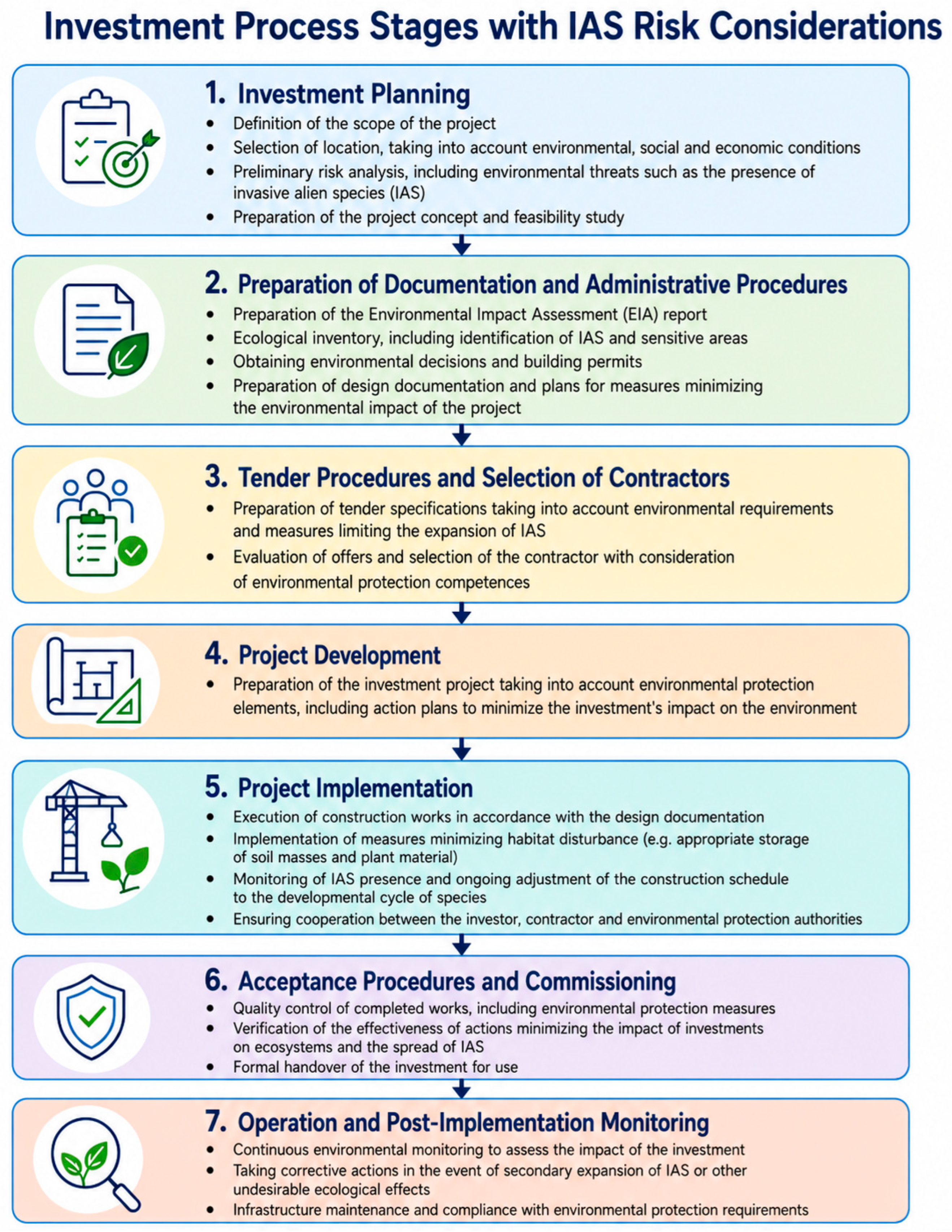
Effective IAS risk management depends on the clearly defined responsibility of all participants in the investment process—the investor, designer, construction manager and supervising inspector—as well as on the implementation of preventive measures and monitoring throughout all stages of project implementation (see
Scheme 1). In this context, the investment process should be understood as a practical field for implementing sustainability principles, where environmental protection, economic efficiency, legal compliance and organizational responsibility must be considered jointly. This is particularly important in large infrastructure projects, where earthworks, soil movement, topsoil management, transport of construction materials and habitat disturbance may create favorable conditions for the introduction and secondary spread of IAS.
Practical recommendation 1: IAS risk should be assessed already at the planning and permitting stage. Ecological inventories and the Environmental Impact Assessment (EIA) report should constitute the basic tools for identifying IAS-related risks before construction begins. However, from the perspective of sustainable environmental management, inventories should not be limited only to the formal boundaries of the investment area. In the case of linear and large-scale projects, they should also include buffer zones, ancillary work areas, construction facilities, temporary access roads, topsoil stockpiles, material storage sites and potential external sources of propagules, such as private plots, allotment gardens, urbanized areas and watercourses. This broader approach supports more reliable impact assessment, improves the prediction of environmental risks and allows preventive actions to be planned before irreversible ecological and economic consequences occur.
Practical recommendation 2: ecological inventory should be treated as an operational sustainability tool, not only as a formal element of environmental documentation. The results of ecological inventories and EIA reports should be directly incorporated into project documentation, construction site organization plans, environmental management plans and contractual provisions. Tender specifications should include clear requirements concerning IAS prevention, procedures for handling contaminated soil and plant material, rules for storage and transport of topsoil, and obligations for rapid reporting and response in the event of IAS detection. Such integration strengthens the practical implementation of sustainability policies and laws by translating environmental knowledge into enforceable technical and organizational procedures.
Practical recommendation 3: modern monitoring technologies should support evidence-based and reproducible sustainability assessment. The application of modern technologies such as remote sensing, drone-based imaging, GIS tools and machine learning algorithms should be integrated into ecological inventories, EIA procedures, construction supervision and post-implementation monitoring [
41]. These methods enable rapid, repeatable and spatially extensive detection of IAS, especially in large, heterogeneous or difficult-to-access areas. Airborne and drone-based remote sensing, including multispectral and hyperspectral imaging supported where appropriate by LiDAR data, can provide objective information on the distribution of invasive and expansive plant species. Machine learning algorithms can then be used to transform classification results into practical distribution maps supporting environmental assessment, investment planning and monitoring [
42,
43,
44]. This approach is consistent with sustainability science because it improves the measurability, transparency and reproducibility of environmental monitoring, while also supporting better prediction and assessment of development impacts.
Practical recommendation 4: particular attention should be paid to high-risk construction stages. The highest IAS risk occurs during site preparation, earthworks, stripping and storage of topsoil, transport and reuse of soil material, formation of embankments and slopes, utility relocation, finishing works and landscaping. These stages should be covered by intensified environmental supervision. Soil, vegetation and construction materials should be managed in a way that prevents the transfer of plant fragments, seeds or rhizomes. Where IAS are detected, works in the affected area should be suspended or modified until field verification is completed and appropriate control measures are selected. Such procedures reduce the risk of ecosystem degradation and support the sustainable use of land and biological resources.
Practical recommendation 5: construction schedules should take species biology into account. Where possible, construction and maintenance works should be planned with regard to the phenological stages and life cycles of invasive species. This is especially important for species capable of regenerating from small plant fragments or rhizomes, such as Japanese knotweed. Monitoring should be intensified during periods when target species are easier to detect, and follow-up inspections should be continued after removal measures to identify possible regrowth or reinvasion. This recommendation reflects the need to combine engineering practice with ecological knowledge, which is essential for sustainable infrastructure development.
Practical recommendation 6: cooperation between the investor, contractor, site supervision, landowners and environmental authorities is essential. Failure to coordinate actions may result in permanent ecological changes, increased costs, delays and legal consequences. This is particularly important where IAS sources are located outside the construction site, for example on neighbouring private plots, in urbanized areas, near allotment gardens or along watercourses. In such cases, effective management requires not only action within the investment area but also cooperation with landowners and competent environmental authorities to reduce the risk of reinvasion. This highlights the social and institutional dimension of sustainability, where environmental effectiveness depends on cooperation, shared responsibility and the practical implementation of legal obligations.
At every stage of the investment process—from planning to construction and operation—reliable ecological inventories, preventive measures, environmental supervision and post-implementation monitoring should therefore be implemented. The results of IAS risk assessment should be incorporated into project documentation, contractual provisions and practical site procedures. During project implementation, habitat disturbance should be minimized, soil and plant material should be carefully controlled, and construction schedules should, where possible, consider species life cycles. The systematic use of modern monitoring methods, including remote sensing, drone-based imaging and machine learning, can support earlier detection of IAS, better planning of mitigation measures, faster response during construction works and more reliable documentation of compliance with environmental requirements.
The principles proposed in this study—early detection, risk classification, integration of IAS requirements into EIA procedures and construction contracts, controlled management of soil and plant material, cooperation among stakeholders, and post-implementation monitoring—may also be applicable beyond Poland. They are particularly relevant to countries implementing large infrastructure projects under environmental impact assessment procedures and biodiversity protection obligations. Although national legal and institutional frameworks differ, the fundamental mechanisms of IAS introduction and secondary spread through earthworks, material transport, habitat disturbance, and contact with external propagule sources are not geographically specific. The proposed approach may therefore provide a transferable framework for sustainability-oriented infrastructure planning and environmental risk management in other national and regional contexts.
In this sense, IAS management in investment projects represents an important practical contribution to sustainability-oriented infrastructure development. It links environmental protection with technical project management, legal compliance, economic risk reduction and biodiversity preservation. Such an integrated approach is consistent with the broader aims of sustainability research, as it provides applicable recommendations for improving environmental governance, monitoring development impacts, protecting ecosystems and supporting more responsible use of land and biological resources.



 ,
,