1. Introduction
Aquaculture has become one of the fastest growing food production sectors worldwide, contributing substantially to food supply, export revenues, employment, and regional economic activity in many coastal economies [
1,
2,
3,
4]. As capture fisheries have stagnated in many regions, aquaculture has continued to expand in response to increasing seafood demand and changing consumption patterns. Recent estimates indicate that aquaculture now accounts for more than half of global aquatic animal production intended for human consumption [
5,
6]. Recent global assessments have likewise emphasized the growing strategic importance of aquaculture for food security and nutritional sustainability under increasing environmental pressure [
7].
The rapid growth of the sector has also intensified concerns related to environmental sustainability, ecosystem pressure, climate vulnerability, marine spatial use, and regulatory capacity [
8,
9,
10]. In export-oriented production systems, competitiveness now depends heavily not only on production efficiency but also on compliance with sustainability standards, certification requirements, traceability systems, and environmental monitoring practices [
11,
12]. Consequently, aquaculture development increasingly depends on governance capacity and institutional adaptation rather than production performance alone. Similar governance-oriented pressures have also been discussed within broader blue economy and sustainability transition frameworks emphasizing equity, institutional coordination, and environmental adaptation [
13].
Türkiye represents a notable example of this transformation. Over the last decade, the country’s aquaculture sector has expanded rapidly through technological intensification, production growth, and increasing integration into international seafood markets. According to Turkish Statistical Institute data, aquaculture production increased from approximately 168 thousand tons in 2010 to more than 556 thousand tons in 2023 [
14]. In particular, sea bass and sea bream production have become major contributors to both seafood exports and the economic vitality of coastal regions.
In comparative terms, Türkiye occupies a distinctive position among aquaculture-producing countries because its sectoral development combines rapid production growth, strong export orientation, and increasing exposure to sustainability-related market requirements. While countries such as Norway and Chile are frequently discussed in relation to salmon aquaculture governance, and Mediterranean producers such as Greece and Spain are commonly associated with sea bass and sea bream production, Türkiye has become one of the most dynamic producers in the Mediterranean aquaculture system. This makes the Turkish case well suited for examining how export competitiveness, certification requirements, environmental management, and institutional coordination interact within a rapidly expanding production environment. Recent global aquaculture research has emphasized that sustainability challenges are increasingly shaped by the integration of production systems into international markets, environmental regulation, and governance capacity rather than by production growth alone [
4,
6]. In this context, Türkiye provides a useful empirical setting for extending conventional SWOT-based assessment toward a relational framework focused on strategic interdependencies.
At the same time, rapid sectoral expansion has increased pressure related to environmental management, certification compliance, climate-related risks, coastal space competition, and regulatory adaptation. These issues are no longer independent from one another. Environmental performance increasingly affects export access, certification requirements influence production practices, and institutional coordination shapes the sector’s capacity to respond to evolving sustainability expectations. Understanding how these pressures relate to one another has therefore become an important issue for long-term sectoral planning and governance.
Despite the growing importance of sustainability governance in aquaculture systems, much of the strategic literature continues to rely on conventional SWOT-based approaches centered primarily on factor identification and descriptive categorization [
15]. Earlier critiques similarly argued that many SWOT applications remained analytically limited in addressing complex strategic environments [
16,
17]. More recent studies have attempted to strengthen SWOT-based assessment through quantitative and hybrid approaches [
18,
19]. While these approaches provide useful strategic overviews, they often remain limited in explaining how environmental, institutional, market-related, and regulatory pressures interact simultaneously within rapidly changing production systems. Recent sustainability transition research has similarly emphasized the increasing importance of integrated governance and strategic adaptation processes within agrifood production systems [
20].
In parallel, sustainability governance research has placed growing emphasis on relational and systems-oriented perspectives for interpreting complex environmental management problems [
21,
22,
23,
24,
25]. From this perspective, strategic conditions are better understood as closely related processes shaped by overlapping ecological, institutional, economic, and regulatory processes. Such an approach appears particularly relevant for aquaculture systems, where production expansion, environmental management, technological adaptation, and policy responses often evolve simultaneously under conditions of increasing ecological and regulatory complexity [
26].
Against this background, the present study examines strategic alignment in Türkiye’s aquaculture sector through an expert-based strategic interaction framework. The study does not focus exclusively on the relative importance of individual strategic factors. Instead, it evaluates how strategic conditions are perceived to relate to one another within the institutional setting of the sector.
The study aims to identify the principal strategic conditions affecting Türkiye’s aquaculture sector, evaluate perceived relationships among these conditions, and examine how governance-related pressures are distributed across the broader sectoral environment. Rather than treating SWOT factors as isolated categories, the proposed framework explores how environmental, institutional, regulatory, and market-related conditions are perceived to interact within an export-oriented aquaculture system, thereby providing a governance-oriented perspective on strategic alignment. Unlike causal influence approaches such as DEMATEL, the framework focuses on relational patterns of strategic interdependence within the governance environment of an export-oriented aquaculture sector.
The remainder of this paper is organized as follows.
Section 2 describes the research design, expert panel, analytical framework, and methodological procedures.
Section 3 presents the empirical findings, including orientation-level interaction patterns, strategic relational structures, subgroup comparisons, and robustness analyses.
Section 4 discusses the findings in relation to the existing sustainability governance and aquaculture literature. Finally,
Section 5 summarizes the main theoretical and practical implications of the study and outlines its limitations together with directions for future research.
2. Materials and Methods
2.1. Study Design
The present analysis examined strategic alignment in Türkiye’s aquaculture sector within the broader context of sustainability governance and export-oriented sectoral development. The analytical framework was designed to evaluate how strategic conditions are perceived to relate to one another under increasing environmental, institutional, and regulatory pressure.
Aquaculture systems are shaped by multiple processes that frequently evolve simultaneously, including production expansion, environmental management, technological adaptation, market integration, and regulatory change [
22,
24,
27]. In rapidly expanding sectors, these processes rarely operate independently. Strategic pressures emerging in one area often influence conditions in others, particularly in production systems increasingly exposed to sustainability-oriented market expectations and governance requirements.
Türkiye was therefore selected as a suitable empirical setting because it combines rapid export-oriented aquaculture expansion with increasing sustainability-related governance pressures.
Given the multidimensional character of these issues, the study adopted an expert-based relational assessment framework. The purpose of the analysis was not to establish causal relationships or develop predictive models, but rather to examine perceived strategic relationships within the sustainability governance context.
The analytical process consisted of five main stages:
Identification of strategic factors;
Expert-based evaluation of strategic associations;
Construction of the aggregated interaction matrix;
Orientation-level and subgroup comparisons;
Reliability and robustness analyses.
The framework was developed to facilitate the systematic interpretation of sustainability-related strategic interactions affecting Türkiye’s aquaculture sector.
2.2. Identification of Strategic Factors
Strategic factors affecting Türkiye’s aquaculture sector were identified through a multi-stage review process incorporating academic studies, institutional reports, sectoral assessments, and policy-related documents concerning aquaculture sustainability, environmental governance, export competitiveness, and blue economy transitions.
The preliminary factor pool was developed using literature related to sustainability-oriented aquaculture development, international fisheries governance, sectoral transition processes, and export-oriented aquaculture policy frameworks [
4,
5,
28,
29,
30]. Initial factors included issues associated with production growth, institutional coordination, environmental pressure, climate-related risks, certification systems, technological adaptation, and international market integration.
Following the literature review, the preliminary factor structure was refined to improve conceptual clarity and sectoral relevance. Overlapping expressions were merged or removed, and the remaining strategic conditions were revised to establish a concise analytical framework representing the sustainability governance context of Türkiye’s aquaculture sector.
The final analytical framework consisted of 20 strategic factors distributed equally across four SWOT dimensions:
Strengths;
Weaknesses;
Opportunities;
Threats.
A balanced distribution across SWOT categories was preferred in order to maintain comparability during the interaction assessment process and to avoid excessive concentration within a single strategic dimension. The final strategic factor framework used in the analysis is presented in
Appendix A. The final factor structure was additionally reviewed by three independent experts with experience in aquaculture governance, sustainability assessment, and sectoral policy analysis. Minor editorial refinements were subsequently introduced to improve clarity while preserving the analytical structure of the framework.
Although several governance-related factors operated within related institutional domains, they were retained intentionally in order to represent analytically distinct aspects of institutional support, coordination capacity, and regulatory adaptation within the sectoral governance structure.
2.3. Expert Panel and Data Collection
The empirical analysis was based on the evaluations of 25 experts representing academia, public institutions, producer organizations, and the aquaculture industry.
The panel consisted of:
10 academics;
7 public sector specialists;
6 industry representatives;
2 representatives from producer organizations.
Experts were selected purposively rather than randomly. Such purposive expert selection procedures are commonly employed in expert-based analytical frameworks involving uncertainty, expert judgement, and complex governance or environmental decision contexts [
31,
32]. The objective was not statistical representation of the broader population, but the inclusion of individuals directly involved in aquaculture production, governance, environmental management, seafood markets, or sectoral policy processes in Türkiye.
Although the expert panel was not numerically balanced across stakeholder groups, proportional representation was not an objective of this study. Instead, the panel was intentionally designed to capture informed perspectives from the principal stakeholder groups within Türkiye’s aquaculture sector. This approach is consistent with expert-based inquiry, where the credibility of findings depends primarily on the expertise, diversity, and relevance of participants rather than statistical representativeness [
31,
32]. Accordingly, the findings should be interpreted as structured expert judgments rather than population-level estimates.
The unequal distribution of experts across stakeholder groups reflects the institutional composition of Türkiye’s aquaculture sector rather than an attempt to achieve proportional sampling. To examine whether subgroup size influenced the overall findings, subgroup comparisons together with bootstrap resampling and leave-one-out robustness analyses were conducted. These complementary analyses indicated that the overall interaction patterns remained stable despite the unequal subgroup distribution.
All participants had professional experience related to aquaculture systems, sustainability governance, environmental regulation, seafood trade, or sectoral planning. Particular attention was given to institutional diversity and practical sectoral knowledge during panel formation. Most participants had more than ten years of professional experience within their respective fields. The panel size was considered adequate for an expert-based exploratory assessment emphasizing depth of expertise and institutional diversity rather than statistical representativeness, consistent with recommendations in the expert elicitation literature [
31].
Data collection was conducted between December 2025 and January 2026 using a structured evaluation form. Participants were asked to evaluate the perceived strength of association between internal and external strategic conditions using pairwise assessments. Each interaction pair was evaluated on a five-point Likert scale:
1 = very weak association
2 = weak association
3 = moderate association
4 = strong association
5 = very strong association
Each participant evaluated 100 strategic interaction pairs derived from relationships between internal and external strategic dimensions. Reciprocal interaction pairs were evaluated only once within the aggregated interaction framework in order to avoid duplicated scoring structures. Accordingly, the framework captured associations between internal (strengths and weaknesses) and external (opportunities and threats) factors only; within-block interactions (e.g., strength–strength or threat–threat) were not assessed, consistent with the internal–external logic of TOWS-type strategic analysis.
To improve evaluation consistency, all strategic factors were accompanied by short explanatory descriptions clarifying the analytical meaning of each item. Participants were also allowed to complete the evaluation process in multiple sessions in order to reduce response fatigue and improve scoring consistency. Similarly structured expert-evaluation procedures have frequently been applied in Delphi-oriented strategic assessment studies involving complex policy environments [
33].
Participation was voluntary, informed consent was obtained prior to data collection, and all evaluations were anonymized before analysis.
2.4. Construction of the Strategic Interaction Matrix
Individual expert evaluations were aggregated to construct a strategic interaction matrix representing the average perceived association between strategic conditions.
The aggregated interaction score between strategic factors was calculated as the arithmetic mean of expert evaluations:
where
represents the aggregated interaction score between factors
and
,
represents the score assigned by expert
, and
represents the total number of experts.
The interaction scores should be interpreted as perceived strategic connectedness rather than objective measures of causality, influence, or dependence. Higher scores indicate that experts considered two strategic conditions to be more closely associated within the broader sustainability governance environment of the sector. Accordingly, the interaction matrix represents a structured summary of perceived strategic relationships rather than a causal or predictive model. Nor should it be interpreted as a directional influence matrix.
The analytical purpose of the matrix was to provide a structured representation of how sustainability-related strategic conditions are perceived to be interconnected within the institutional setting of the sector.
For transparency and reproducibility purposes, the aggregated strategic interaction matrix is provided in
Appendix B. The interaction matrix was not designed to identify causal direction, dependency hierarchy, or predictive influence among factors. Instead, it was used as an exploratory relational tool to summarize expert-perceived strategic connectedness among sustainability-related conditions.
2.5. Orientation-Level Evaluation
To support broader interpretation, interaction scores were grouped into four strategic orientations:
For each strategic orientation, average interaction intensity was calculated as:
where
represents the mean interaction score for orientation
,
represents the aggregated interaction score between factors,
and
represent the number of internal and external strategic factors included within the corresponding interaction block.
Orientation-level averages were used to evaluate how institutional pressures were distributed across the broader sectoral setting. The analysis did not aim to rank orientations competitively, but rather to examine whether particular strategic domains exhibited relatively stronger perceived interaction patterns.
In addition to mean orientation scores, standard deviations and bootstrap-based confidence intervals were calculated to evaluate score dispersion and estimate stability.
2.6. Exploratory Relational Interpretation
In addition to orientation-level comparisons, the aggregated interaction structure was examined descriptively in order to identify recurring strategic association patterns within the sector.
Particular attention was given to relationships involving:
Interaction pairs associated with more visible strategic associations were interpreted as strategically prominent relational linkages within the sectoral structure.
To support descriptive interpretation of the interaction pattern, aggregate interaction prominence values were additionally calculated for each strategic factor:
where
represents the interaction prominence value of factor
,
represents the aggregated interaction score between factors
and
,
represents the number of connected strategic factors.
Higher interaction prominence values indicate that a strategic factor is associated with stronger interaction tendencies within the overall sectoral setting.
The interaction-based framework adopted in the study was intended to support structured evaluation of perceived strategic associations rather than formal graph-theoretical modelling or causal network inference.
2.7. Reliability and Robustness Analysis
Several procedures were conducted to evaluate the consistency and stability of the findings.
Internal consistency among interaction evaluations was assessed using Cronbach’s alpha [
34]:
where
is the number of items (interaction cells treated as items within a block),
is the variance of each item, and
is the total variance.
Inter-rater agreement was further evaluated using the intraclass correlation coefficient (ICC). A two-way random-effects model based on absolute agreement, ICC(2, k), was employed because the evaluation process involved multiple experts assessing the same strategic interaction profiles under a common analytical framework.
Differences among orientation-level scores were examined using the Friedman test [
35]:
where
is the number of experts,
is the number of groups, and
is the sum of ranks.
The degree of agreement among orientation-level rankings was additionally evaluated using Kendall’s coefficient of concordance:
where
represents the sum of squared deviations from mean ranks,
represents the number of experts, and
represents the number of orientations.
Subgroup comparisons were conducted separately for academia, public sector participants, and industry representatives in order to examine whether broader interaction patterns differed substantially across institutional perspectives.
To evaluate the stability of orientation-level estimates, bootstrap resampling procedures with 5000 iterations were additionally conducted to generate bias-corrected 95% confidence intervals for mean orientation scores.
Robustness was further evaluated using perturbation-based sensitivity procedures and leave-one-out analyses. In the sensitivity analysis, each aggregated interaction cell was independently perturbed with Gaussian noise (SD ≈ 0.16, approximating the sampling standard error of the cell means given the observed rating dispersion) across 5000 iterations, and orientation-level scores were recalculated to examine whether interpretations remained stable under alternative scoring conditions.
For each iteration, perturbed scores were constrained within the five-point Likert range. The purpose of this procedure was to evaluate whether minor scoring variation altered the overall orientation pattern.
Leave-one-out robustness procedures were conducted by sequentially excluding individual expert evaluations and recalculating orientation-level scores in order to examine the influence of single-rater variation on the overall strategic interaction profile.
All analyses were conducted using IBM SPSS Statistics 26 and R 4.3.2.
2.8. Methodological Considerations
The analytical framework was designed to support a governance-oriented interpretation of perceived strategic relationships within a rapidly expanding aquaculture sector operating under evolving environmental and regulatory pressures. Accordingly, the findings should be understood as structured expert-based evaluations of strategic association rather than as predictive estimates of sectoral outcomes.
3. Results
3.1. Overview of Strategic Interaction Patterns
The aggregated expert evaluations revealed moderately strong interaction patterns distributed across the strategic orientations shaping Türkiye’s aquaculture sector. Across much of the interaction matrix, environmental, institutional, and regulatory pressures were perceived as interconnected rather than operating independently.
Relatively strong interaction patterns were observed around export competitiveness, sustainability certification, production expansion, environmental pressure, and regulatory adaptation. Several governance-related conditions also appeared repeatedly across multiple interaction pathways, suggesting that sustainability-related challenges are embedded within the sectoral development structure.
The distribution of orientation-level interaction scores is presented in
Table 1. As shown in both the tabular and graphical results, interaction levels remained moderately differentiated across all strategic orientations, indicating a broadly integrated strategic setting within the sector.
Among the four orientations, the Strength–Opportunity (SO) dimension produced the highest mean interaction score (3.84), followed by the Strength–Threat (ST) orientation (3.66). Weakness-oriented dimensions also exhibited comparatively lower but still visible interaction intensity, with Weakness–Opportunity (WO) and Weakness–Threat (WT) reaching 3.43 and 3.19, respectively (
Table 1).
Although moderate differences emerged across orientation-level scores, experts generally did not perceive governance pressures as sharply separated strategic domains. Instead, environmental management, institutional coordination, export integration, sustainability certification, and adaptive governance pressures were generally evaluated as closely linked components of the sector’s overall sustainability setting.
The relatively limited dispersion among orientation-level scores suggests that experts did not perceive sustainability-related challenges as belonging to clearly separated strategic domains. Instead, the findings indicate that environmental, institutional, regulatory, and market-related pressures are experienced simultaneously and tend to reinforce one another within the broader governance environment of the sector.
3.2. Strategic Interaction Patterns
The aggregated interaction matrix indicated visible interaction tendencies across multiple strategic dimensions within Türkiye’s aquaculture sector. High-scoring interaction pairs were concentrated primarily around sustainability certification, export competitiveness, institutional support, environmental pressure, and regulatory adaptation.
Among the governance-relevant interaction pairs, the strongest associations were observed between export competitiveness and sustainability certification (4.02) and between production growth and climate change impacts (3.94). Additional comparatively strong interaction pairs included institutional support and regulatory tightening (3.91), environmental pressure and international market expansion (3.86), and governance fragmentation and blue economy policies (3.79) (
Table 2).
The interaction pairs presented in
Table 2 also have direct practical implications for the sustainable development of Türkiye’s aquaculture sector. The strong association between export competitiveness and sustainability certification suggests that access to international seafood markets increasingly depends on compliance with sustainability standards and certification schemes. The relationship between production growth and climate change impacts indicates that long-term production planning should incorporate adaptation to environmental and climatic risks. Similarly, the association between institutional support and regulatory tightening suggests that effective governance requires coordinated policy implementation that can balance environmental protection with sectoral competitiveness. Overall, these high-scoring interaction pairs indicate that sustainability challenges in the sector should be addressed through integrated governance strategies rather than isolated policy interventions. These interaction patterns provide the empirical basis for the governance-oriented interpretation developed in the subsequent Discussion section.
Sustainability certification, export competitiveness, institutional support mechanisms, and regulatory adaptation appeared more prominent within the broader interaction structure. In contrast, spatial competition and operational cost-related factors exhibited relatively lower interaction prominence values within the broader strategic configuration.
Overall, the interaction structure did not reveal clearly separated strategic clusters. Instead, governance-related factors were interconnected across multiple environmental, institutional, regulatory, and market-related dimensions, reinforcing the interpretation of sustainability governance as an integrated strategic system.
This pattern further supports the interpretation that sustainability-related governance pressures within the sector are structurally interconnected rather than concentrated within isolated strategic domains.
3.3. Reliability and Agreement Results
Internal consistency analysis produced high reliability values across the aggregated interaction evaluations. The Cronbach’s alpha coefficient was calculated as 0.84, indicating strong internal consistency among expert assessments (
Table 3). Here, Cronbach’s α was computed by treating interaction cells within each orientation block as items reflecting a common perceived-connectedness dimension, and it should therefore be interpreted as an indicator of internal scoring coherence rather than of a psychometric latent construct.
Inter-rater agreement analysis also indicated a high level of scoring consistency across participants. The intraclass correlation coefficient calculated under the ICC(2,k) model was 0.76, suggesting substantial agreement among expert evaluations.
Differences among orientation-level interaction scores were evaluated using the Friedman test. The analysis produced a Friedman chi-square value of 8.91 with a corresponding p-value of 0.031. Although orientation-level mean scores differed numerically, the statistical results indicated moderate but statistically detectable differentiation among the four strategic orientations.
Kendall’s coefficient of concordance (W = 0.14) indicated relatively weak concentration of rankings within a single strategic orientation. Orientation-level interaction patterns therefore appeared broadly distributed across multiple strategic dimensions rather than dominated by a single interaction category.
3.4. Subgroup Comparisons
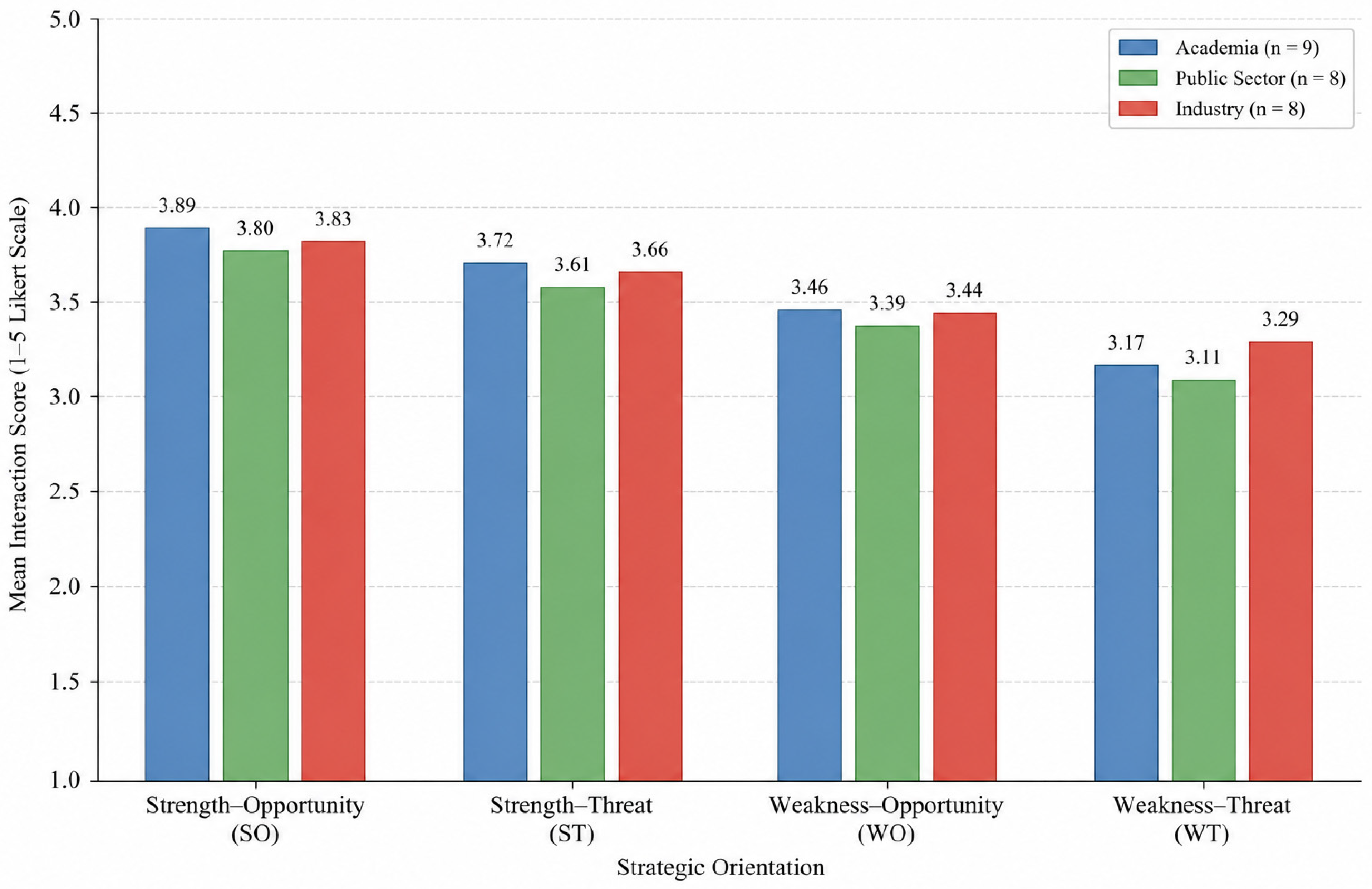
Orientation-level interaction scores remained relatively consistent across institutional subgroups (
Table 4). Academic participants produced slightly higher mean scores within the SO and ST orientations, whereas industry representatives reported more visible interaction tendencies within the WT dimension. Public sector evaluations remained close to the overall orientation averages across all strategic dimensions.
As shown in
Figure 1, the orientation-level interaction patterns remain highly consistent across academia, public sector, and industry participants.
Despite modest variation in orientation-level means, subgroup distributions followed similar interaction patterns overall. Mean differences among institutional groups remained limited across all four strategic orientations.
3.5. Robustness and Sensitivity Results
Bootstrap resampling procedures produced relatively stable confidence intervals across all orientation-level estimates. Orientation rankings remained unchanged across repeated resampling iterations.
Perturbation-based sensitivity procedures applied independent Gaussian noise to each aggregated interaction cell (SD ≈ 0.16, approximating the sampling standard error of the cell means) across 5000 iterations. Orientation-level means remained within narrow intervals, and the SO > ST > WO > WT ordering was preserved in all iterations, indicating that the overall pattern is not sensitive to minor scoring variation (
Table 5).
Leave-one-out analyses similarly indicated limited sensitivity to individual expert exclusion. Sequential removal of single-rater evaluations did not substantially alter orientation-level interaction rankings or overall score distributions.
3.6. Factor-Level Relational Results
Factor-level evaluations identified several strategic conditions exhibiting stronger prominence within the aggregated interaction structure.
Sustainability certification emerged as one of the most prominent factors within the overall interaction structure. These factors were associated with comparatively strong interaction scores across multiple strategic dimensions simultaneously.
As shown in
Table 6, governance-related strategic conditions occupied relatively prominent positions within the aggregated interaction pattern, particularly those associated with certification, institutional coordination, and regulatory adaptation.
In contrast, operational cost-related factors and spatial competition variables occupied less prominent positions within the aggregated strategic structure.
The overall distribution of interaction prominence values suggested that sustainability-oriented governance conditions occupied relatively central positions within the broader sectoral setting of Türkiye’s aquaculture sector. Prominence values were calculated as the average interaction intensity of each factor across all associated interaction pairs within the aggregated interaction matrix. These values should be interpreted as descriptive indicators of strategic visibility rather than measures of causal influence or strategic importance.
4. Discussion
4.1. General Interpretation of Strategic Alignment
The findings indicated moderately strong interaction patterns distributed across multiple strategic orientations within Türkiye’s aquaculture sector. Although the Strength–Opportunity orientation produced the highest mean interaction score, differences among orientations remained limited overall. Such interaction structures may indicate that sectoral sustainability challenges are distributed across multiple strategic dimensions rather than concentrated within a single domain.
The interaction patterns observed across orientations also suggest that export-oriented aquaculture systems are shaped by closely connected environmental, institutional, and market-related pressures. Environmental management, certification requirements, institutional coordination, and export-related market access appear to be evaluated as interrelated processes within the broader sectoral environment.
This interpretation is broadly consistent with sustainability governance literature emphasizing the integrated character of socio-ecological production systems [
22,
23,
24]. Previous studies similarly noted that environmental management challenges in rapidly expanding production sectors frequently evolve together with institutional adaptation and regulatory complexity rather than as isolated sectoral problems [
21,
27].
The current position of Türkiye in the European seafood market provides a practical illustration of these governance dynamics. According to the European Market Observatory for Fisheries and Aquaculture Products (EUMOFA), Türkiye was the dominant supplier of fresh European sea bass to the European Union in 2024, accounting for 98% of all extra-EU imports of this species. Likewise, Türkiye supplied 88% of extra-EU imports of fresh gilthead sea bream during the same period. These figures demonstrate that Türkiye’s export-oriented aquaculture sector has become closely integrated with European seafood markets, where market access increasingly depends on compliance with sustainability certification, traceability systems, food safety requirements, and environmental standards. Consequently, these market characteristics provide a practical context within which the interaction patterns identified in the present study can be interpreted. Rather than validating the expert evaluations directly, the EUMOFA statistics illustrate the governance environment in which sustainability certification, institutional coordination, export competitiveness, and regulatory adaptation have become increasingly interconnected. This interpretation is further supported by FAO, which identifies sustainability certification, traceability, and compliance with increasingly demanding market requirements as central determinants of contemporary aquaculture development, as well as by recent analyses showing that maintaining the international competitiveness of Türkiye’s sea bass exports increasingly depends on market diversification together with sustainability and quality requirements [
4,
36,
37,
38].
The combination of a statistically detectable Friedman result (p = 0.031) with a low Kendall’s W (0.14) suggests that, although orientation-level scores differed modestly, expert evaluations were broadly distributed across strategic dimensions rather than concentrated in a single orientation. This limited differentiation may partly reflect central-tendency tendencies common in pairwise Likert assessments; however, the convergent reliability statistics (Cronbach’s α = 0.84; ICC(2,k) = 0.76) indicate consistent rather than indiscriminate scoring.
4.2. Sustainability Governance and Export-Oriented Pressure
Several of the strongest interaction pairs involved sustainability certification, export competitiveness, environmental pressure, and regulatory adaptation. In particular, the close association between export competitiveness and sustainability certification suggests that maintaining access to international seafood markets increasingly depends on compliance with sustainability-oriented production standards. Recent reviews similarly emphasized that eco-certification mechanisms increasingly influence market access, governance adaptation, and sustainability-oriented competitiveness within aquaculture systems [
39].
This pattern likely reflects recent developments in international seafood trade, where certification procedures, traceability systems, and environmental monitoring increasingly influence market access and competitiveness [
5,
40,
41]. Similar governance-oriented dynamics have been reported across aquaculture value chains emphasizing sustainability diffusion and institutional coordination [
42,
43].
The strong interaction observed between production growth and climate-related pressures also suggests that sectoral expansion is frequently evaluated together with ecological vulnerability and environmental management capacity. Similar dynamics have been emphasized in previous aquaculture studies discussing the growing importance of adaptive governance under conditions of environmental uncertainty and climate-related stress [
8,
9,
10].
At the same time, the findings indicate that environmental governance challenges do not appear to operate independently across separate policy domains. Certification requirements, environmental performance, institutional coordination, and regulatory adaptation appear to operate together within the broader governance structure of the sector.
This interpretation is consistent with earlier studies suggesting that sustainability transitions in food production systems increasingly depend on institutional coordination capacity in addition to technological development and production efficiency [
11,
26]. In export-oriented aquaculture sectors, governance quality and adaptive regulatory capacity may therefore play an important role in long-term sectoral stability and competitiveness.
4.3. Institutional Coordination and Regulatory Adaptation
Institutional support and regulatory adaptation emerged as more visible components within the broader interaction pattern. The strong association observed between institutional support mechanisms and regulatory tightening suggests that governance adaptation is increasingly evaluated in relation to coordination among public institutions, producers, and market actors.
This finding is particularly relevant for rapidly expanding aquaculture sectors operating under increasing environmental and international market pressure. Regulatory expansion alone may not be sufficient to support long-term sustainability objectives if institutional coordination mechanisms remain fragmented or administratively weak. Previous governance studies similarly emphasized that adaptive environmental management processes often depend on coordination across multiple institutional levels rather than isolated regulatory intervention [
22,
23].
The interaction patterns identified in this study also suggest that institutional fragmentation may generate pressures affecting certification compliance, environmental monitoring, and export adaptation simultaneously. In export-oriented production systems, regulatory inconsistency or limited coordination capacity may therefore influence both environmental governance outcomes and market continuity.
Another notable finding concerns the relationship between blue economy policies and governance fragmentation. Although blue economy strategies are generally presented as integrated sustainability frameworks, their implementation may involve overlapping institutional responsibilities and complex coordination processes across environmental, economic, and regulatory domains. Similar governance challenges have been discussed in earlier blue economy studies [
10,
44]. Comparable coordination-related governance challenges have also been reported in recent circular bioeconomy transition studies involving sustainability-oriented policy integration processes [
45].
For Türkiye, these findings may be particularly relevant given the sector’s rapid export-oriented expansion over the last decade. Maintaining international competitiveness may increasingly depend on the capacity of regulatory institutions, producer organizations, and industry stakeholders to coordinate sustainability-related adaptation processes in a coherent manner.
4.4. Methodological Interpretation
The analytical framework adopted in this study was designed to support interaction-based interpretation within a complex sustainability governance setting rather than formal causal modelling. In this respect, the findings should be understood as structured expert-based evaluations reflecting perceived strategic relationships within Türkiye’s aquaculture sector.
Conventional SWOT-based approaches have frequently been criticized for remaining descriptive and analytically static when applied to complex strategic systems [
16]. In response to these limitations, more recent studies have attempted to strengthen SWOT-oriented assessment through quantitative and hybrid extensions intended to improve strategic interpretation and decision-support capacity [
19,
28,
29]. The present study contributes to this broader methodological direction by examining perceived strategic connectedness among sustainability-related factors rather than relying solely on categorical SWOT classification. Unlike causal influence frameworks that seek to identify directional effects, the proposed interaction framework examines perceived strategic connectedness and systemic alignment within sustainability governance settings.
The framework was therefore intended to provide a governance-oriented interpretation of how environmental, institutional, regulatory, and market-related pressures are perceived to evolve together within an export-oriented aquaculture system. From this perspective, the interaction matrix should instead be understood as a structured relational interpretation derived from expert evaluations within a complex governance environment.
Rather than prioritizing causal inference, the framework was designed to capture expert perceptions of strategic interdependencies within a complex governance environment. This perspective is particularly relevant in sustainability-oriented sectors where institutional, environmental, and market-related processes often evolve simultaneously and cannot easily be examined as isolated phenomena.
The robustness procedures nevertheless supported the internal stability of the analytical structure. Bootstrap confidence intervals remained relatively narrow across orientation-level estimates, while perturbation and leave-one-out procedures produced limited variation in orientation rankings. Inter-rater agreement statistics also indicated substantial consistency among expert evaluations.
At the same time, the comparatively consistent interaction scores observed across multiple orientations may partly reflect the systemic nature of sustainability governance in export-oriented aquaculture systems. Environmental regulation, certification compliance, institutional coordination, and market adaptation are often experienced simultaneously rather than as isolated strategic pressures. Under such conditions, experts may perceive stronger interdependence across several strategic domains, which may help explain the limited differentiation observed among orientation-level interaction scores. From this perspective, the observed interaction structure may be interpreted as evidence of strategic complexity rather than weak differentiation among strategic orientations.
4.5. Limitations and Future Research
Several limitations should be considered when interpreting the findings of the study.
First, the analytical framework was based on expert evaluations rather than direct behavioral or longitudinal sectoral data. Accordingly, the resulting strategic interaction profile reflects perceived strategic relationships rather than empirically observed causal effects.
Second, subgroup distributions were not fully balanced across all institutional categories. In particular, representation from producer organizations remained comparatively limited due to difficulties associated with expert availability during the evaluation period. Although subgroup comparisons were interpreted cautiously, future studies involving larger and more balanced stakeholder distributions may provide additional analytical depth.
Third, the relational framework adopted in the study was intentionally interpretive rather than predictive. The objective was to examine perceived strategic alignment patterns rather than estimate causal interactions or forecast sectoral outcomes. Future studies may also integrate DEMATEL, ANP, or network-analytic approaches to examine the direction and intensity of strategic influence relationships in greater detail.
Despite these limitations, the study provides a structured interpretation of sustainability-related strategic pressures affecting Türkiye’s aquaculture sector. The findings also suggest that sustainability governance challenges within export-oriented aquaculture systems involve overlapping environmental, institutional, market-related, and regulatory dimensions operating simultaneously within the sector rather than independently. Consequently, the findings should be interpreted primarily within the context of Türkiye’s aquaculture sector and should not be generalized directly to other national aquaculture systems without additional empirical validation. Future comparative cross-country studies involving multiple aquaculture-producing nations may further evaluate the transferability and practical applicability of the proposed interaction framework across different institutional, environmental, and regulatory contexts.
5. Conclusions
The present study examined strategic alignment in Türkiye’s aquaculture sector using an expert-based strategic interaction framework developed within the context of sustainability governance and export-oriented sectoral development. Rather than treating SWOT dimensions as isolated categories, the proposed framework explored the perceived interactions among strategic conditions affecting the sector. The findings indicate that environmental management, sustainability certification, institutional coordination, regulatory adaptation, and market-related pressures are closely interconnected components of the governance environment shaping long-term sectoral development.
Among the four strategic orientations, the Strength–Opportunity (SO) orientation exhibited the highest mean interaction score (3.84), although differences among the remaining orientations were relatively limited. This pattern suggests that sustainability-related challenges are not concentrated within a single strategic domain but emerge through multiple interacting institutional, environmental, and market processes. In particular, the strong interactions identified among sustainability certification, export competitiveness, institutional support, and regulatory adaptation highlight the strategic importance of governance capacity for export-oriented aquaculture systems operating under increasingly demanding environmental and international market conditions.
5.1. Theoretical and Methodological Contributions
From a methodological perspective, this study extends conventional SWOT-based assessment by shifting the analytical focus from the identification of individual strategic factors to the evaluation of perceived relationships among them. Unlike traditional SWOT applications that primarily classify strengths, weaknesses, opportunities, and threats, the proposed framework provides a relational perspective that captures how strategic conditions interact within a complex governance system. Accordingly, the analytical framework should be interpreted as an expert-based approach for understanding perceived strategic interactions rather than establishing causal relationships. By integrating SWOT with an interaction-oriented analytical perspective, the study contributes to sustainability governance research through a more comprehensive interpretation of strategic complexity in export-oriented aquaculture systems.
5.2. Policy and Managerial Implications
The findings also provide practical implications for different stakeholder groups involved in Türkiye’s aquaculture sector. For government authorities, strengthening institutional coordination, ensuring regulatory consistency, and supporting sustainability-oriented certification systems will be essential for balancing environmental protection with export-oriented growth. Producer organizations and industry associations can facilitate sector-wide adaptation by promoting knowledge sharing, certification awareness, and collaborative governance mechanisms among stakeholders. At the enterprise level, continued investment in certification compliance, traceability systems, environmental monitoring, and technological innovation will be increasingly important for maintaining competitiveness in international seafood markets.
Taken together, these findings indicate that the long-term sustainability and international competitiveness of Türkiye’s aquaculture sector depend not only on production performance but also on the capacity of public institutions, industry organizations, and private enterprises to respond collectively to evolving environmental, regulatory, and market requirements. Future research may further strengthen this line of inquiry by incorporating longitudinal analyses, broader international comparisons, and additional stakeholder groups to evaluate how strategic interaction patterns evolve under changing sustainability conditions.
Despite these limitations, the proposed interaction framework provides a structured basis for interpreting strategic interdependencies within sustainability-oriented aquaculture governance and may be transferable to comparable export-oriented aquaculture systems.





 ,
,