From Technology Monopoly to Industrial Sharing: How Leading Manufacturers Realize Sustainable Value Circulation
Abstract
1. Introduction
2. Theoretical Background
2.1. Knowledge Interaction Drives Core Technological Breakthroughs
2.2. Core Technologies Empowering Business Model Innovation
2.3. Sustainable Business Model Innovation
3. Method
3.1. Research Approach
- The research is exploratory in nature, focusing on the complex relationships among core technologies, sustainable business model innovation, and technological value sharing, which requires in-depth and systematic case investigation;
- The co-evolution of core technologies and business models is a long-term process. A longitudinal design supports continuous tracking of key events and causal mechanisms.
- The single-case design is suitable for analyzing typical enterprises with rich empirical evidence, enabling comprehensive description and rigorous theoretical construction [50] (p. 137050).
3.2. Case Presentation
3.3. Data Analysis and Quality Assurance
4. Results
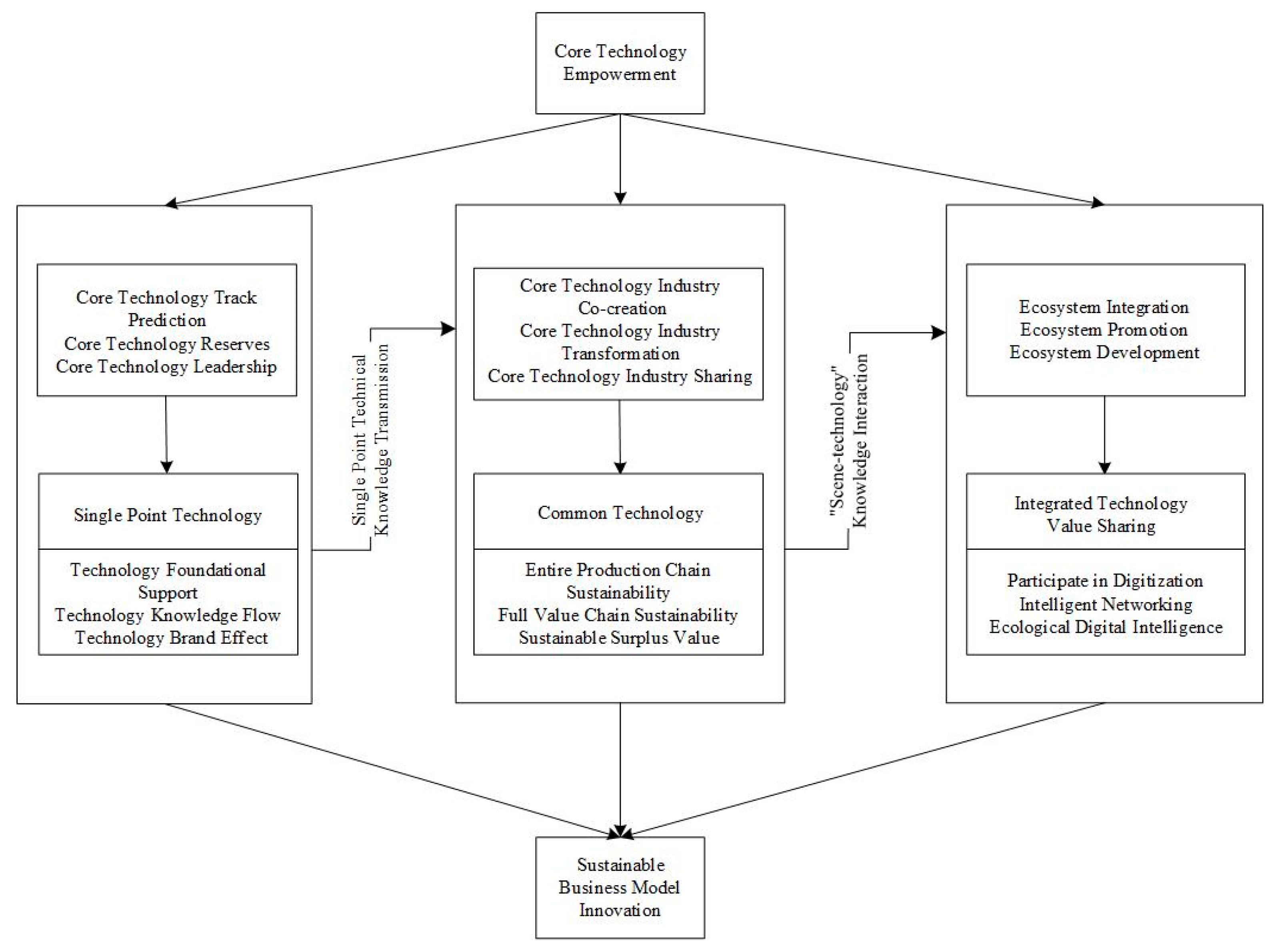
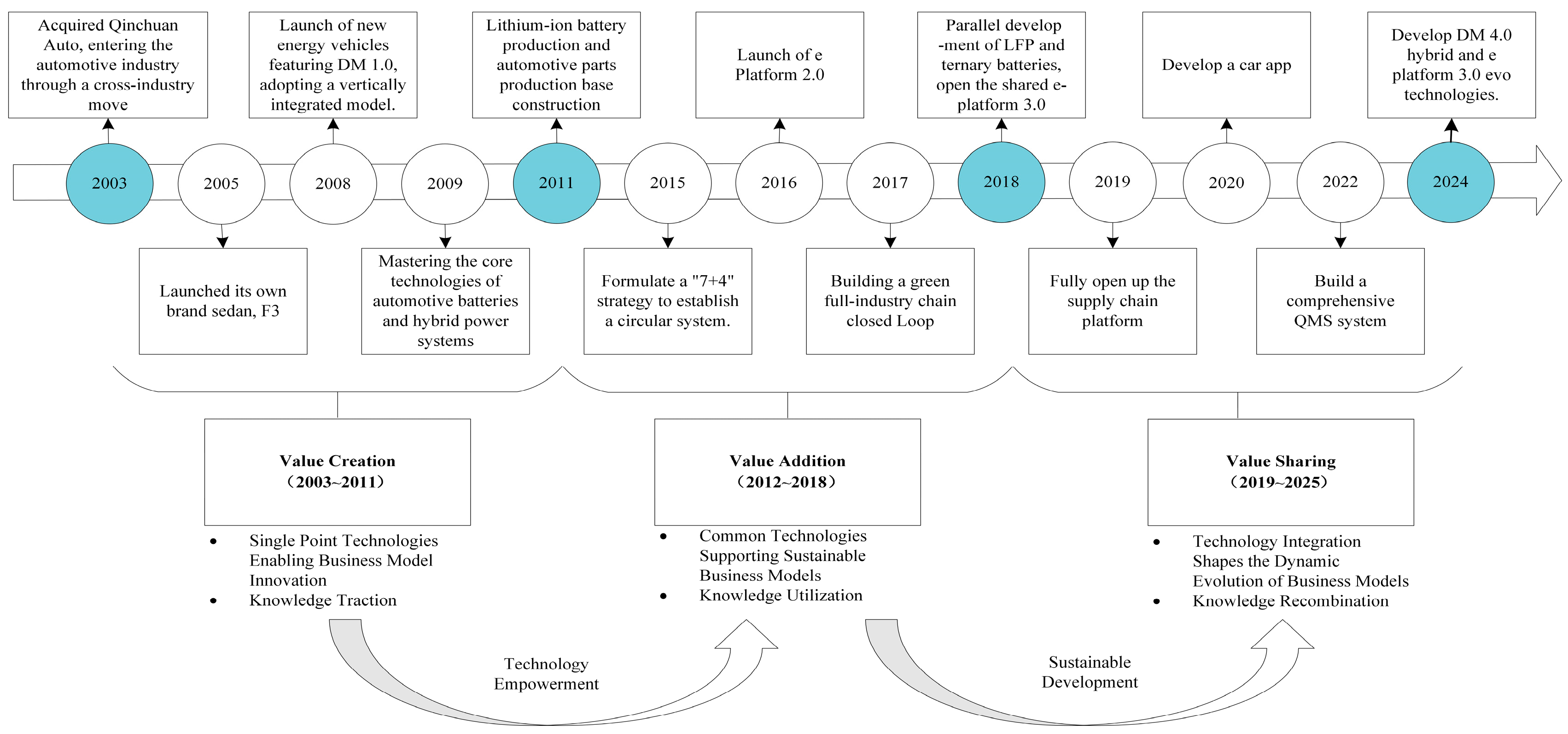
4.1. Implementation Path of BYD’s Technology Sharing
4.1.1. Single-Point Technology-Driven Value Creation (2003–2011)
4.1.2. Integration of Generic Product Technologies for Value Addition (2012–2018)
4.1.3. Value Sharing Derived from Industrial Technology Integration (2019–2025)
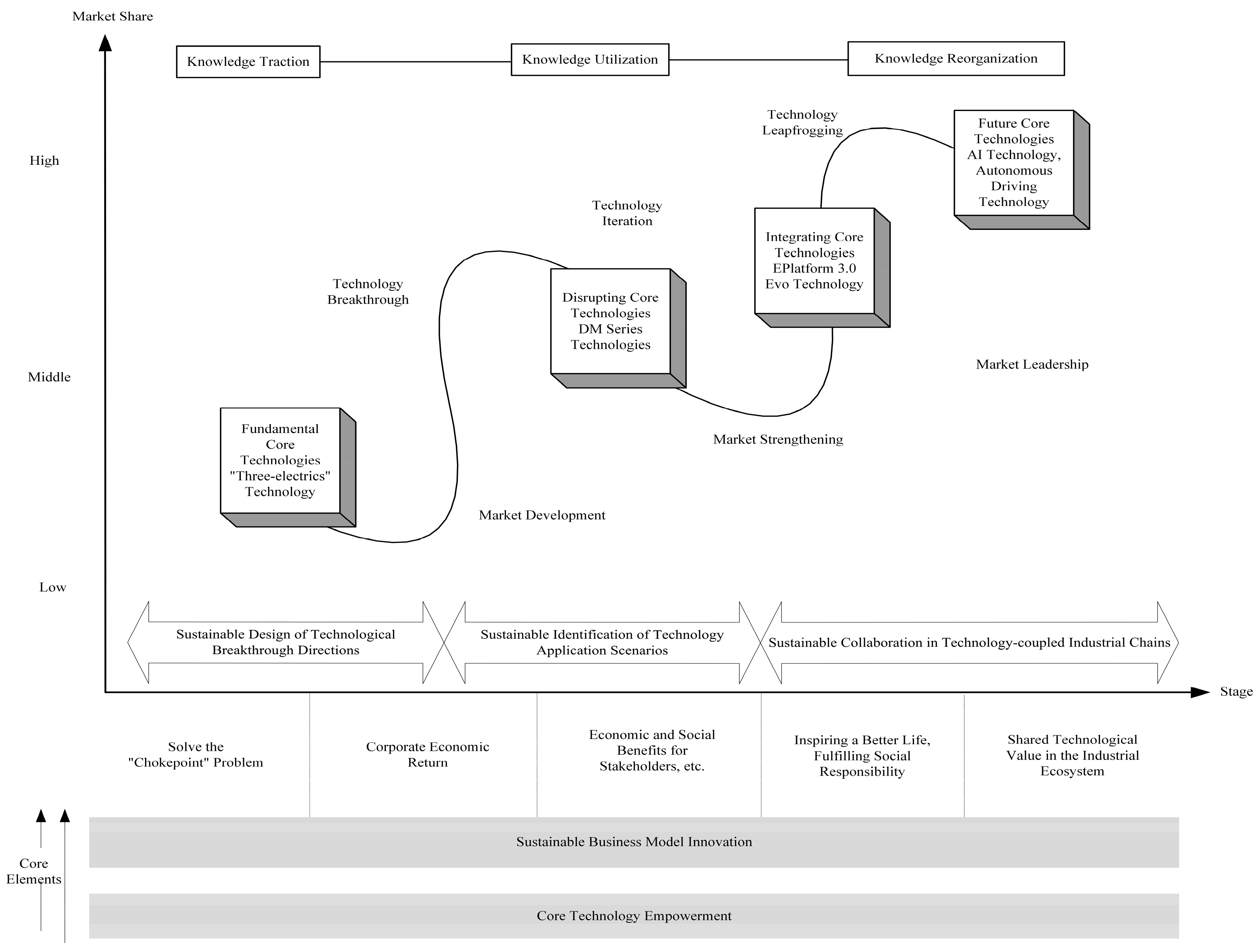
5. Discussion
6. Conclusions
6.1. Theoretical Implications
6.2. Practical Implications
6.2.1. Recommendations for Leading Manufacturers
6.2.2. Recommendations for Stakeholders in the Industrial Ecosystem
6.2.3. Recommendations for Industrial Policymakers
6.3. Limitations and Future Research
Author Contributions
Funding
Institutional Review Board Statement
Informed Consent Statement
Data Availability Statement
Conflicts of Interest
References
- Ding, Y.; Luo, Q. Polycentric Spatial Structure, Digital Economy and Urban Green Sustainable Development. J. Clean. Prod. 2024, 468, 143080. [Google Scholar] [CrossRef] [Scilit]
- Hernandez, J.C.R.; Villa-Enciso, E.; Cardona-Acevedo, S.; Valencia, J.; Velasquez Salas, S. Smart innovation for a circular economy: A systematic review of emerging trends and the future of AI in the sustainable economy. Sustainability 2025, 17, 5793. [Google Scholar] [CrossRef] [Scilit]
- Chauhan, C.; Parida, V.; Dhir, A. Linking circular economy and digitalisation technologies: A systematic literature review of past achievements and future promises. Technol. Forecast. Soc. Change 2022, 177, 121508. [Google Scholar] [CrossRef] [Scilit]
- Han, M.S.; Ma, S.S.; Wang, Y.; Tian, Q. Impact of technology-enabled product eco-innovation: Empirical evidence from the Chinese manufacturing industry. Technovation 2023, 128, 102853. [Google Scholar] [CrossRef] [Scilit]
- Mejía-Moncayo, C.; Kenné, J.P.; Hof, L.A. On the development of a smart architecture for a sustainable manufacturing-remanufacturing system: A literature review approach. Comput. Ind. Eng. 2023, 180, 109282. [Google Scholar] [CrossRef] [Scilit]
- Akter, S.; Hani, U.; Dwivedi, Y.K.; Sharma, A. The future of marketing analytics in the sharing economy. Ind. Mark. Manag. 2022, 104, 85–100. [Google Scholar] [CrossRef] [Scilit]
- Madanaguli, A.; Parida, V.; Sjödin, D.; Oghazi, P. Literature Review on Industrial Digital Platforms: A Business Model Perspective and Suggestions for Future Research. Technol. Forecast. Soc. Change 2023, 194, 122606. [Google Scholar] [CrossRef] [Scilit]
- Ouyang, Z.; Lv, R.; Liu, Y. Can Corporate Social Responsibility Protect Firm Value during Corporate Environmental Violation Events? Corp. Soc. Responsib. Environ. Manag. 2023, 30, 1942–1952. [Google Scholar] [CrossRef] [Scilit]
- Schrade-Grytsenko, L.; Kappler, K.E.; Smolnik, S. Assisted Sustainability: How Digital Technologies Promote Corporate Sustainability. Sustainability 2025, 17, 5561. [Google Scholar] [CrossRef] [Scilit]
- Geissdoerfer, M.; Pieroni, M.P.P.; Pigosso, D.C.A.; Soufani, K. Circular Business Models: A Review. J. Clean. Prod. 2020, 277, 123741. [Google Scholar] [CrossRef] [Scilit]
- Alshukri, T.; Seun Ojekemi, O.; Öz, T.; Alzubi, A. The Interplay of Corporate Social Responsibility, Innovation Capability, Organizational Learning, and Sustainable Value Creation: Does Stakeholder Engagement Matter? Sustainability 2024, 16, 5511. [Google Scholar] [CrossRef] [Scilit]
- Lee, S.; Kim, K.N.; Ha, Y.; Han, C.S. How Trust and IT Usage Empower Knowledge Sharing for Sustainability Goals. New Horiz. Adult Educ. Hum. Resour. Dev. 2026, 38, 22–36. [Google Scholar] [CrossRef] [Scilit]
- Ferreira, J.J.M.; Fernandes, C.I.; Veiga, P.M. The Effects of Knowledge Spillovers, Digital Capabilities, and Innovation on Firm Performance: A Moderated Mediation Model. Technol. Forecast. Soc. Change 2024, 200, 123086. [Google Scholar] [CrossRef] [Scilit]
- Yang, H.; Shi, X.; Bhutto, M.Y.; Ertz, M. Do Corporate Social Responsibility and Technological Innovation Get along? A Systematic Review and Future Research Agenda. J. Innov. Knowl. 2024, 9, 100462. [Google Scholar] [CrossRef] [Scilit]
- Abbas, A.; Luo, X.; Shahzad, F.; Wattoo, M.U. Optimizing Organizational Performance in Manufacturing: The Role of IT Capability, Green Supply Chain Integration, and Green Innovation. J. Clean. Prod. 2023, 423, 138848. [Google Scholar] [CrossRef] [Scilit]
- Al Halbusi, H.; Al-Sulaiti, K.I.; Alalwan, A.A.; Al-Busaidi, A.S. AI Capability and Green Innovation Impact on Sustainable Performance: Moderating Role of Big Data and Knowledge Management. Technol. Forecast. Soc. Change 2025, 210, 123897. [Google Scholar] [CrossRef] [Scilit]
- Zhang, J.Z.; Watson Iv, G.F. Marketing Ecosystem: An Outside-in View for Sustainable Advantage. Ind. Mark. Manag. 2020, 88, 287–304. [Google Scholar] [CrossRef] [Scilit]
- Palmié, M.; Aebersold, A.; Oghazi, P.; Pashkevich, N.; Gassmann, O. Digital-sustainable Business Models: Definition, Systematic Literature Review, Integrative Framework and Research Agenda from a Strategic Management Perspective. Int. J. Manag. Rev. 2025, 27, 346–374. [Google Scholar] [CrossRef] [Scilit]
- Bjartmarz, T.K.; Bocken, N.M.P. Sustainable Business Models and Organizational Boundaries—A Literature Review. Bus. Strategy Environ. 2024, 33, 6716–6736. [Google Scholar] [CrossRef] [Scilit]
- Hina, M.; Chauhan, C.; Sharma, R.; Dhir, A. Circular Economy Business Models as Pillars of Sustainability: Where Are We Now, and Where Are We Heading? Bus. Strategy Environ. 2023, 32, 6182–6209. [Google Scholar] [CrossRef] [Scilit]
- Zhu, P.; Wang, Z.; Singh, R.; Tan, X. China’s Model of Technology Leapfrog: A Case Study of Electric Vehicle Policies and the Development of Green Technology. Renew. Sustain. Energy Rev. 2026, 226, 116414. [Google Scholar] [CrossRef] [Scilit]
- Gong, Y.; Zhang, Y.; Dong, L. Numerical Simulation and Governance Framework for Multi Stakeholder Symbiotic Evolution in Digital Innovation Ecosystems. Sci. Rep. 2025, 15, 23638. [Google Scholar] [CrossRef] [Scilit] [PubMed]
- Savin, I. On Optimal Regimes of Knowledge Exchange: A Model of Recombinant Growth and Firm Networks. J. Econ. Interact. Coord. 2021, 16, 497–527. [Google Scholar] [CrossRef] [Scilit]
- Fait, M.; Palladino, R.; Mennini, F.S.; Graziano, D.; Manzo, M. Enhancing Knowledge Brokerage Drivers for Dynamic Capabilities: The Effects on Sustainable Supply Chain Ecosystem. J. Knowl. Manag. 2024, 28, 355–380. [Google Scholar] [CrossRef] [Scilit]
- Tang, H.; Ma, Z.; Xiao, J.; Xiao, L. Toward a More Efficient Knowledge Network in Innovation Ecosystems: A Simulated Study on Knowledge Management. Sustainability 2020, 12, 6328. [Google Scholar] [CrossRef] [Scilit]
- Zhong, C.; Huang, R.; Duan, Y.; Sunguo, T.; Dello Strologo, A. Exploring the Impacts of Knowledge Recombination on Firms’ Breakthrough Innovation: The Moderating Effect of Environmental Dynamism. J. Knowl. Manag. 2024, 28, 698–723. [Google Scholar] [CrossRef] [Scilit]
- Xing, Z.; Chin, T.; Huang, J.; Perano, M.; Temperini, V. Knowledge-Driven Networking and Ambidextrous Innovation Equilibrium in Power Systems Transition. J. Knowl. Manag. 2024, 28, 1414–1443. [Google Scholar] [CrossRef] [Scilit]
- Felicetti, A.M.; Corvello, V.; Ammirato, S. Digital Innovation in Entrepreneurial Firms: A Systematic Literature Review. Rev. Manag. Sci. 2024, 18, 315–362. [Google Scholar] [CrossRef] [Scilit]
- Scuotto, V.; Alfiero, S.; Cuomo, M.T.; Monge, F. Knowledge Management and Technological Innovation in Family SMEs Context. J. Knowl. Manag. 2024, 28, 789–798. [Google Scholar] [CrossRef] [Scilit]
- Cheng, Q.; Peng, C.; Wan, H.; Dai, Y.; Zhang, S. How to Realize Digital Knowledge Innovation through Digital Technology? A Perspective Based on Knowledge Digitization and Inter-Organizational Knowledge Sharing. Technol. Soc. 2025, 82, 102905. [Google Scholar] [CrossRef] [Scilit]
- Zhang, Y.; Ma, X.; Pang, J.; Xing, H.; Wang, J. The Impact of Digital Transformation of Manufacturing on Corporate Performance—The Mediating Effect of Business Model Innovation and the Moderating Effect of Innovation Capability. Res. Int. Bus. Financ. 2023, 64, 101890. [Google Scholar] [CrossRef] [Scilit]
- Xie, X.; Yu, H. Collaborative Innovation and Knowledge Spillovers in Open Innovation Ecosystems: Exploring the Roles of Network Stability and Technological Niche. Technol. Forecast. Soc. Change 2025, 219, 124289. [Google Scholar] [CrossRef] [Scilit]
- Schmidt, J.; Foss, N.J. Modularity, Adaptation Problems, and the Governance and Problem-Solving Capabilities of Core Firms in Ecosystems. J. Manag. 2025, 51, 1484–1513. [Google Scholar] [CrossRef] [Scilit]
- Schroedel, S. The Sustainable Business Model Database: 92 Patterns That Enable Sustainability in Business Model Innovation. Sustainability 2023, 15, 8081. [Google Scholar] [CrossRef] [Scilit]
- Sjödin, D.; Parida, V.; Palmié, M.; Wincent, J. How AI Capabilities Enable Business Model Innovation: Scaling AI through Co-Evolutionary Processes and Feedback Loops. J. Bus. Res. 2021, 134, 574–587. [Google Scholar] [CrossRef] [Scilit]
- Civelek, M.; Krajčík, V.; Ključnikov, A. The impacts of dynamic capabilities on SMEs’ digital transformation process: The resource-based view perspective. Oecon. Copernic. 2023, 14, 1367–1392. [Google Scholar] [CrossRef] [Scilit]
- Severo, E.A.; De Guimarães, J.C.F.; Dellarmelin, M.L. Impact of the COVID-19 Pandemic on Environmental Awareness, Sustainable Consumption and Social Responsibility: Evidence from Generations in Brazil and Portugal. J. Clean. Prod. 2021, 286, 124947. [Google Scholar] [CrossRef] [Scilit] [PubMed]
- Tapaninaho, R.; Heikkinen, A. Value Creation in Circular Economy Business for Sustainability: A Stakeholder Relationship Perspective. Bus. Strategy Environ. 2022, 31, 2728–2740. [Google Scholar] [CrossRef] [Scilit]
- Fumagalli, A. Is Platform Capitalism Socially Sustainable? Sustainability 2025, 17, 7071. [Google Scholar] [CrossRef] [Scilit]
- Pesce, D.; Franzè, C.; Paolucci, E. Meeting the Closed-loop Challenge: The “Who-What-How” Strategic Choices for a Successful Remanufacturing Approach. Bus. Strategy Environ. 2024, 33, 5661–5680. [Google Scholar] [CrossRef] [Scilit]
- Jarzabkowski, P.; Bednarek, R.; Chalkias, K.; Cacciatori, E. Enabling Rapid Financial Response to Disasters: Knotting and Reknotting Multiple Paradoxes in Interorganizational Systems. Acad. Manag. J. 2022, 65, 1477–1506. [Google Scholar] [CrossRef] [Scilit]
- Peçanha, L.M.; Ferreira, J.J. Sustainable Strategies and Circular Economy Ecosystems: A Literature Review and Future Research Agenda. Bus. Strategy Environ. 2025, 34, 1440–1459. [Google Scholar] [CrossRef] [Scilit]
- Baldwin, C.Y.; Bogers, M.L.A.M.; Kapoor, R.; West, J. Focusing the Ecosystem Lens on Innovation Studies. Res. Policy 2024, 53, 104949. [Google Scholar] [CrossRef] [Scilit]
- Mele, C.; Russo-Spena, T. Agencement of Onlife and Phygital: Smart Tech–Enabled Value Co-Creation Practices. J. Serv. Manag. 2025, 36, 217–240. [Google Scholar] [CrossRef] [Scilit]
- Coffay, M.; Bocken, N. Sustainable by Design: An Organizational Design Tool for Sustainable Business Model Innovation. J. Clean. Prod. 2023, 427, 139294. [Google Scholar] [CrossRef] [Scilit]
- Kurek, J.; Brandli, L.L.; Leite Frandoloso, M.A.; Lange Salvia, A.; Mazutti, J. Sustainable Business Models Innovation and Design Thinking: A Bibliometric Analysis and Systematic Review of Literature. Sustainability 2023, 15, 988. [Google Scholar] [CrossRef] [Scilit]
- Yang, M.; Evans, S.; Vladimirova, D.; Rana, P. Value Uncaptured Perspective for Sustainable Business Model Innovation. J. Clean. Prod. 2017, 140, 1794–1804. [Google Scholar] [CrossRef] [Scilit]
- Dembek, K.; Lüdeke-Freund, F.; Rosati, F.; Froese, T. Untangling Business Model Outcomes, Impacts and Value. Bus. Strategy Environ. 2023, 32, 2296–2311. [Google Scholar] [CrossRef] [Scilit]
- Gioia, D.A.; Corley, K.G.; Hamilton, A.L. Seeking Qualitative Rigor in Inductive Research: Notes on the Gioia Methodology. Organ. Res. Methods 2013, 16, 15–31. [Google Scholar] [CrossRef] [Scilit]
- Shahid, M.S.; Hossain, M.; Shahid, S.; Anwar, T. Frugal Innovation as a Source of Sustainable Entrepreneurship to Tackle Social and Environmental Challenges. J. Clean. Prod. 2023, 406, 137050. [Google Scholar] [CrossRef] [Scilit]
- Ding, Y.; Wu, P.; Zhao, J.; Zhou, L. Forecasting Product Sales Using Text Mining: A Case Study in New Energy Vehicle. Electron. Commer. Res. 2025, 25, 495–527. [Google Scholar] [CrossRef] [Scilit]
- Turner, S.F.; Cardinal, L.B.; Burton, R.M. Research Design for Mixed Methods: A Triangulation-Based Framework and Roadmap. Organ. Res. Methods 2017, 20, 243–267. [Google Scholar] [CrossRef] [Scilit]
- Langley, A.; Smallman, C.; Tsoukas, H.; Van De Ven, A.H. Process Studies of Change in Organization and Management: Unveiling Temporality, Activity, and Flow. Acad. Manag. J. 2013, 56, 1–13. [Google Scholar] [CrossRef] [Scilit]
- Hottenrott, A.; Schiffer, M.; Grunow, M. Flexible Assembly Layouts in Smart Manufacturing: An Impact Assessment for the Automotive Industry. IISE Trans. 2023, 55, 1144–1159. [Google Scholar] [CrossRef] [Scilit]
- Wu, Z.; Shao, Q.; Su, Y.; Zhang, D. A Socio-Technical Transition Path for New Energy Vehicles in China: A Multi-Level Perspective. Technol. Forecast. Soc. Change 2021, 172, 121007. [Google Scholar] [CrossRef] [Scilit]
- Pan, X.; Wei, Y.; Mangla, S.K.; Song, M. How Do ESG Practices Promote Collaboration on Green Investment for Supply Chain Enterprises in China? Transp. Res. Part E Logist. Transp. Rev. 2025, 198, 104118. [Google Scholar] [CrossRef] [Scilit]
- Wang, X.; Zhu, L.; Zheng, H. The Relationship between Technical Innovation and Market Value: Evidence from the China’s New Energy Vehicles Industry. Energy Policy 2025, 202, 114606. [Google Scholar] [CrossRef] [Scilit]
- Camilleri, M.A. Cocreating Value Through Open Circular Innovation Strategies: A Results-Driven Work Plan and Future Research Avenues. Bus. Strategy Environ. 2025, 34, 4561–4580. [Google Scholar] [CrossRef] [Scilit]
- AlHousrya, O.; Bennagi, A.; Cotfas, P.A.; Cotfas, D.T. The Role of the Industrial IoT in Advancing Electric Vehicle Technology: A Review. Appl. Sci. 2025, 15, 9290. [Google Scholar] [CrossRef] [Scilit]
- Cao, J.; Chen, X.; Qiu, R.; Hou, S. Electric Vehicle Industry Sustainable Development with a Stakeholder Engagement System. Technol. Soc. 2021, 67, 101771. [Google Scholar] [CrossRef] [Scilit]
- Zhou, F.; Liu, Y.; Chen, R. Research on Collaborative Innovation of Intelligent Connected Vehicles Industry Based on Test Field: Embedded Case Study from the Perspective of Open Innovation. Sustainability 2021, 13, 5880. [Google Scholar] [CrossRef] [Scilit]
- Tang, M.; Liu, Y.; Hu, F.; Wu, B. Effect of Digital Transformation on Enterprises’ Green Innovation: Empirical Evidence from Listed Companies in China. Energy Econ. 2023, 128, 107135. [Google Scholar] [CrossRef] [Scilit]
- Pan, Y.; Zhang, H. Research on the Value Co-Creation Mechanism of Digital Intelligence Empowerment in Shared Manufacturing Ecosystems: Taking Zhiyun Tiangong as an Example. Systems 2025, 13, 969. [Google Scholar] [CrossRef] [Scilit]
- Lyu, X.; Zhang, Z.; Fu, L. Collaborative Business Models for the Second-Life Utilization of New Energy Vehicle (NEV) Batteries in China: A Multi-Case Study. Sustainability 2024, 16, 8972. [Google Scholar] [CrossRef] [Scilit]
- Feng, B.; Sun, K.; Chen, M.; Gao, T. The Impact of Core Technological Capabilities of High-Tech Industry on Sustainable Competitive Advantage. Sustainability 2020, 12, 2980. [Google Scholar] [CrossRef] [Scilit]



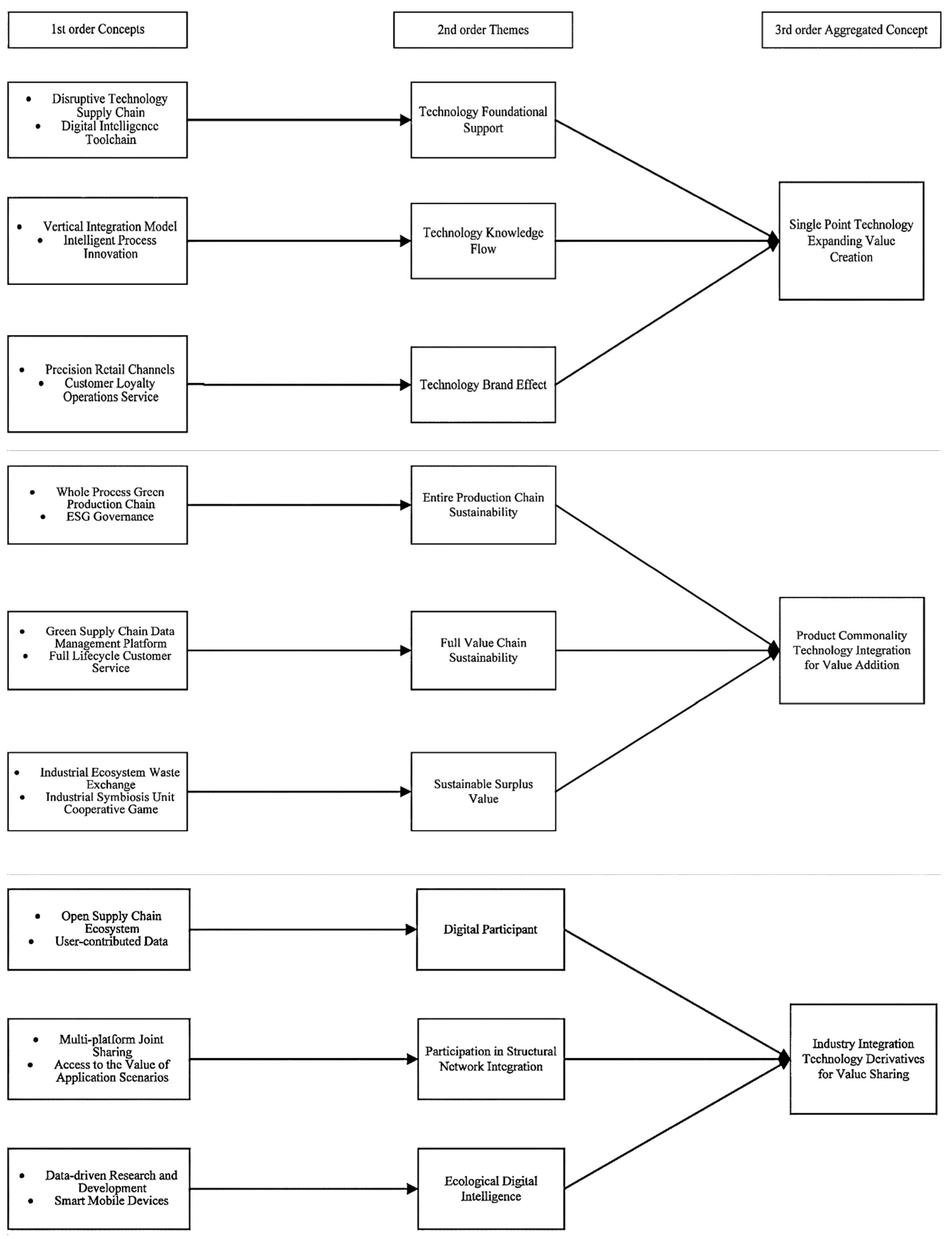
| Methods | Semi-Structured Interviews | Internal Documentation Analysis | Public Data Research |
|---|---|---|---|
| Period | 2022–2025 | 2003–2025 | 2003–2025 |
| Source | We conducted single 50–90 min interviews with senior managers familiar with BYD’s full development trajectory using a multi-doctor revised protocol centered on this study’s core themes. (This study selects senior executives as exclusive interview respondents based on the research theme positioning. Since the research focuses on the enterprise’s top-level strategic evolution of core technology opening and industrial value sharing, senior managers who participate in group strategic planning, R&D resource allocation and industrial ecological layout can provide systematic, long-term and holistic cognitive information matching the longitudinal case analysis demand. To avoid research scope divergence, grassroots technicians, suppliers and end users are not included in the interview scope of this paper.) | unpublished internal documents | Annual Reports; Public Media Reports; White Papers; China Automotive Technology and Research Center Co., Ltd. (Tianjin, China) |
| Amount of Data | Five interviews with the co-founders | >50 external conferences and internal company reports | >100 Resources Related to New Energy Vehicles |
| Encoding | A | B1 | B2 |
| Dimension | Key Constructs | Representative Code | Evidence Examples (Typical Citations) |
|---|---|---|---|
| Single-Point Technology-Driven Value Creation | Fundamental Support of Technology | Reserve of Disruptive Technology Chain |
|
| Digital Intelligence Toolchain |
| ||
| Knowledge Flow of Technology | Vertically Integrated Model |
| |
| Intelligent Process Innovation |
| ||
| The Brand Effect of the Technology | Precision Retail Channels |
| |
| User Retention Operations Service |
|
| Dimension | Key Constructs | Representative Code | Evidence Examples (Typical Citations) |
|---|---|---|---|
| Integration of Generic Product Technologies for Value Addition | Sustainability Across the Entire Production Chain | Full-process Green Production Chain |
|
| ESG Governance |
| ||
| Sustainability Across the Full Value Chain | Green Supply Chain Data Management Platform |
| |
| Full Lifecycle User Service |
| ||
| Sustainable Surplus Value | Industrial Chain Ecosystem Resource Exchange |
| |
| Cooperative Game of Industrial Symbiotic Units |
|
| Dimension | Key Constructs | Representative Code | Evidence Examples (Typical Citations) |
|---|---|---|---|
| Value Sharing Derived from Industrial Technology Integration | Digital Participants | Supply Chain System Opening |
|
| User Participation in Data Construction |
| ||
| Participate in Networked Infrastructure | Multi-platform Joint Sharing |
| |
| Application Scenario Value Integration |
| ||
| Ecological Digital Intelligence | Data-driven Development |
| |
| Smart Mobile Device |
|
Disclaimer/Publisher’s Note: The statements, opinions and data contained in all publications are solely those of the individual author(s) and contributor(s) and not of MDPI and/or the editor(s). MDPI and/or the editor(s) disclaim responsibility for any injury to people or property resulting from any ideas, methods, instructions or products referred to in the content. |
© 2026 by the authors. Licensee MDPI, Basel, Switzerland. This article is an open access article distributed under the terms and conditions of the Creative Commons Attribution (CC BY) license.
Share and Cite
Li, Y.; Huang, Z.; Liu, J.; Han, Z. From Technology Monopoly to Industrial Sharing: How Leading Manufacturers Realize Sustainable Value Circulation. Sustainability 2026, 18, 7281. https://doi.org/10.3390/su18147281
Li Y, Huang Z, Liu J, Han Z. From Technology Monopoly to Industrial Sharing: How Leading Manufacturers Realize Sustainable Value Circulation. Sustainability. 2026; 18(14):7281. https://doi.org/10.3390/su18147281
Chicago/Turabian StyleLi, Yijia, Ziwei Huang, Jingjing Liu, and Zhiyong Han. 2026. "From Technology Monopoly to Industrial Sharing: How Leading Manufacturers Realize Sustainable Value Circulation" Sustainability 18, no. 14: 7281. https://doi.org/10.3390/su18147281
APA StyleLi, Y., Huang, Z., Liu, J., & Han, Z. (2026). From Technology Monopoly to Industrial Sharing: How Leading Manufacturers Realize Sustainable Value Circulation. Sustainability, 18(14), 7281. https://doi.org/10.3390/su18147281