Article

Evidence-Based Governance of Clean-Fuel Hub Claims: A Sustainability Transition Framework from Ulsan, South Korea


Korea Energy Economics Institute, Ulsan 44543, Republic of Korea
Sustainability 2026, 18(14), 7223; https://doi.org/10.3390/su18147223
Submission received: 9 June 2026 / Revised: 4 July 2026 / Accepted: 13 July 2026 / Published: 15 July 2026
(This article belongs to the Section Energy Sustainability)

Abstract

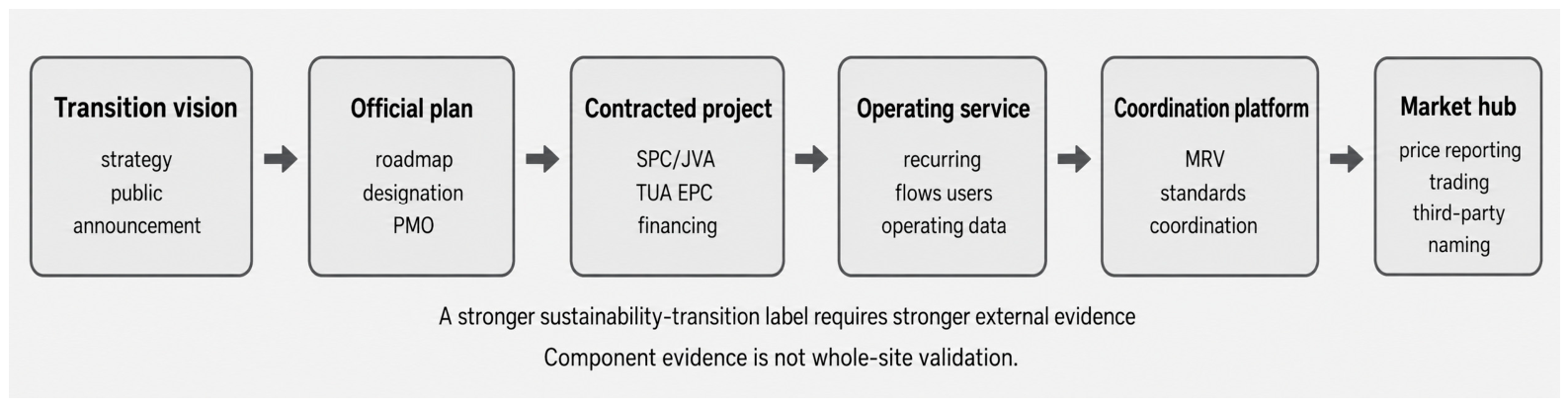
Ports and industrial regions increasingly call clean-fuel projects “hubs,” although the market functions behind those projects are often still being developed. In Ulsan, this language has shifted from the Northeast Asian Oil Hub to an oil–gas hub and then to a hydrogen–ammonia vision. This article does not ask whether the infrastructure matters. It asks whether the “hub” label is supported by publicly visible evidence. It develops a public-evidence framework for calibrating claims against evidence and adds a public-label validation layer to sustainability-transition and port-governance analysis. The framework is applied to public documents on Ulsan’s oil, oil–gas, and hydrogen–ammonia projects. The oil-hub narrative began with the use of stockpiling assets and tankage leasing. The North Port later became an oil/LNG terminal through project vehicles, terminal-use agreements, EPC contracts, financing, and commercial operation. These records confirm terminal implementation, not the existence of a trading hub. The South Port is better understood as a low-carbon infrastructure vision, while the April 2026 ammonia-bunkering operation is treated as a port-system fuel-supply milestone. By linking public labels to evidence of implementation, recurring use, coordination routines, market institutions, and external recognition, the framework treats hub naming as a sustainability–accountability issue tied to SDG-related infrastructure claims and ESG disclosure integrity, rather than merely as project branding.
Keywords: sustainability transition; clean-fuel infrastructure; energy hubs; hydrogen; ammonia; green ports; evidence-based governance; market validation; SDGs; ESG; sustainability accountability; greenwashing sustainability transition; clean-fuel infrastructure; energy hubs; hydrogen; ammonia; green ports; evidence-based governance; market validation; SDGs; ESG; sustainability accountability; greenwashing