1. Introduction
Clean-fuel projects are often called “hubs” before their market functions are fully established. This is especially clear in port and industrial regions, where the word hub can be attached to planned terminals, future hydrogen or ammonia functions, and even a single bunkering milestone. Such early language can be useful. Public agencies, investors, and firms need a shared term before technologies, standards, users, and business models are settled. However, the same language also creates a governance risk. A berth, a tank farm, or a fuel-supply operation may support a transition plan, but it does not automatically show that a site operates as a hub [
1,
2,
3,
4].
This article addresses that risk. It asks not whether clean-fuel infrastructure is important, but what kind of public evidence is needed before a clean-fuel project should be called a hub. The framework answers by matching public labels to observable functions: vision, demonstration, terminal operation, recurring services, coordination platform, and market hub. Stronger labels require stronger evidence of recurring use, committed actors, contracts, standards, market institutions, and external recognition.
This is a sustainability-governance problem. Sustainability is not only about whether a technology is low-carbon in principle. It is also about whether public claims about transition progress are credible, monitorable, and proportionate to observable evidence. A clean-fuel hub label can suggest that a region is already advancing energy transition, industrial transformation, port-city development, and climate-policy capacity. Within the 2030 Agenda, such labels can imply progress on affordable and clean energy infrastructure (SDG 7), resilient and sustainable industrial infrastructure (SDG 9), sustainable port-city development and integrated planning (SDG 11), and climate-policy capacity (SDG 13) [
5,
6,
7,
8,
9]. In ESG terms, the same label can signal governance quality, disclosure integrity, implementation readiness, and climate-transition opportunity. If used too early, it can therefore mislead audiences about environmental performance, social and spatial benefits, economic investability, and institutional capacity, even when each project component has value [
10,
11,
12,
13,
14,
15,
16].
The verification problem is particularly important for hydrogen and ammonia. Policy expectations for these fuels have moved faster than routine market use. The IEA reports both a growing project pipeline and a continuing gap between announced low-emission hydrogen projects and realized use [
17,
18]. ACER links European project delivery to demand uncertainty, cost gaps, and the timing of infrastructure [
19]. IRENA and the WTO make a similar point for trade: renewable hydrogen and its derivatives need standards, certification, interoperability, market design, and credible demand as well as import capacity [
20]. For that reason, the evidence test used in this article looks beyond physical infrastructure. It also examines flows, users, contracts, standards, market institutions, and external recognition.
Existing transition theories help explain why clean-fuel hub narratives appear. The Multi-Level Perspective and wider sustainability-transition research explain how technologies, infrastructures, users, regulations, markets, and meanings are reconfigured during transitions [
21,
22,
23,
24]. Strategic Niche Management and the sociology of expectations explain how future-oriented hydrogen and ammonia claims can mobilize actors, learning, and investment before markets are mature [
25,
26,
27,
28]. Transition Management explains the governance role of long-term visioning, experimentation, monitoring, and reflexive adjustment [
29,
30,
31]. Port-governance research shows why port authorities increasingly act not only as landlords but also as energy coordinators and environmental managers [
32,
33,
34].
These studies are important, but they do not fully answer the question addressed here. They explain why hub narratives emerge and why they can matter. They do not specify how to audit whether a public clean-fuel hub label is proportionate to observable evidence at a particular site, for a particular fuel, and for a particular function. This article therefore does not offer a replacement theory for MLP, SNM, Transition Management, or port governance. Instead, it adds a claim–evidence calibration layer to sustainability-transition governance. It asks what is actually evidenced, by whom, at which site, for which fuel, and with what degree of operational, contractual, institutional, or market validation.
The need for this calibration is also supported by the literature on institutional legitimacy and sustainability accountability. Public hub labels can work as legitimacy devices. They can signal investment readiness, climate progress, regional-development value, and institutional capacity before those functions are externally visible [
35,
36]. Greenwashing and disclosure research similarly suggest that sustainability communication can mislead when favorable claims are selectively emphasized or when broad environmental labels are not matched by verifiable evidence [
37,
38]. Infrastructure-transition and innovation-system research also shows that life-cycle stage, spatial embedding, market formation, and functional evidence should be distinguished rather than collapsed into one broad hub label [
39,
40,
41,
42].
Ulsan, South Korea, provides a useful case for examining this problem. The same regional policy narrative has moved from the Northeast Asian Oil Hub to an oil–gas hub and then to a hydrogen–ammonia hub vision. The documentary record links state stockpiling-asset utilization, tankage leasing, terminal project development, efforts to restore bankability, and recent low-carbon fuel ambition [
43,
44,
45]. It also shows an important contrast. The North Port Project has materialized as an oil/LNG terminal through project vehicles, terminal-use agreements, engineering, procurement, and construction (EPC) contracts, financing, and commercial operation [
44,
46]. The South Port Project, by contrast, remains closer to a hydrogen–ammonia infrastructure vision. The April 2026 ammonia-bunkering operation at Ulsan Main Port strengthened Ulsan’s port-system fuel-supply capability, but it did not by itself validate the South Port as a recurring hydrogen–ammonia service node or market hub [
47].
Ulsan is also deeply embedded in Korea’s national energy and industrial development. The port-industrial region has long combined petroleum stockpiling, liquid-bulk handling, petrochemical production, and export-oriented manufacturing. For this reason, hub language in Ulsan has carried national energy-security and regional-development meanings, as well as site-specific project meanings. The scale of this legacy remains visible in recent operating data. Ulsan Port handled 199.47 million tons of total cargo in 2024, including 159.82 million tons of liquid cargo, with crude oil, petroleum products, and chemical products forming the major categories [
48]. This historical path dependence helps explain both why inherited oil and LNG infrastructure can make hydrogen and ammonia narratives credible and why premature clean-fuel hub labels may be more likely.
Against this background, this article asks a labeling question rather than a capacity question. Ulsan plainly has substantial energy infrastructure. What is less clear is the strongest label that public evidence can support at each stage. The analysis therefore follows three issues. First, it examines how storage and stockpiling language expanded into Ulsan’s oil and oil–gas hub narratives. Second, it asks what the North Port actually delivered and which market-hub functions remained unvalidated. Third, it considers what the current South Port hydrogen–ammonia agenda should be named until stronger evidence appears.
This article’s contribution is to turn hub-label overextension into an evidence-based governance problem. It offers two linked tools: a staged ladder for assigning labels to evidence and an external-validation sequence built around recurrence, actors, commitments, market institutions, and third-party recognition. The conceptual advance is to translate flexible hub language into staged, source-level evidence claims. The methodological advance is to convert those labels into auditable claims that can be accepted, limited, or withheld according to observable evidence.
This focus also positions the article relative to the maritime decarbonization literature. Much of that literature appropriately examines fuels, technologies, pathways, and implementation readiness [
1,
2,
3,
4]. The issue addressed here is narrower: how should public hub language be verified when technical readiness, infrastructure delivery, and market formation do not advance at the same pace? When a port, city, or public agency uses the word hub, what should a reader be able to verify? A trial without recurrence, a terminal backed by anchor users or contracts, and a regulatory-exemption demonstration zone each provide different kinds of evidence. Treating all of them as the same type of hub would make technical and policy assessments harder to interpret, not easier.
The case design follows from this focus. Ulsan connects a legacy petroleum infrastructure story with a newer clean-fuel narrative. The North Port is not presented as a sustainability endpoint, and the oil/LNG terminal is not treated as a low-carbon achievement. Instead, it is used as a retrospective benchmark. It shows how far a hub narrative can move from public ambition to contracts and operations without becoming a market hub. The South Port is the prospective case. Its hydrogen–ammonia vision has value as option-building, but stronger market language still depends on staged evidence.
Finally, this framing clarifies what the article does not do. It does not conduct a life-cycle assessment, calculate greenhouse gas reductions, or rank hydrogen and ammonia against competing fuels. Those tasks belong to environmental performance assessment. The contribution here is a governance framework for assessing the credibility of sustainability-transition claims. A project can have strong decarbonization potential and still be described prematurely. Conversely, a project can be correctly labeled as a vision or demonstration and still contribute to sustainability by building safety knowledge, institutional capacity, and future demand options.
2. Materials and Methods
2.1. Theoretical Synthesis: Clean-Fuel Hub Labels as Sustainability-Transition Claims
A clean-fuel hub label is not only a description of infrastructure. It is also a claim about transition progress. When a port or industrial region is called a hydrogen hub, ammonia hub, or clean-fuel hub, the label can imply that the site is moving beyond a single asset or project and toward a wider role in connecting fuels, users, contracts, information, standards, and institutions. For that reason, the central issue is not simply whether a public actor uses the word hub. The central issue is whether the function implied by that label is supported by observable public evidence.
This article treats clean-fuel hub naming as a sustainability-transition governance problem. A transition claim should be credible, monitorable, and proportionate to the evidence. A planned berth, a tank farm, or a one-off bunkering event may support a transition vision, but it does not by itself prove that a site operates as a hub. The framework therefore asks a more precise question: what function is actually evidenced, by whom, at what spatial scale, for which fuel, and with which validation layer? This shift moves the analysis from public vocabulary to observable function.
The framework builds on eight literature streams that are often cited separately but need to be read together for hub-claim governance.
Table 1 synthesizes these streams by separating what each stream explains from the validation gap addressed in this article. Sustainability-transition research, including the Multi-Level Perspective, explains how technologies, infrastructures, users, regulations, markets, and meanings are reconfigured during transitions [
21,
22,
23,
24]. Strategic Niche Management and the sociology of expectations explain how future-oriented hydrogen and ammonia claims can mobilize actors, learning, and investment before markets are mature [
25,
26,
27,
28]. Transition Management explains the role of long-term visioning, experimentation, monitoring, and reflexive adjustment [
29,
30,
31]. Port-governance research explains why port authorities increasingly act not only as landlords but also as energy coordinators and environmental managers [
32,
33,
34].
The legitimacy, sustainability–accountability, infrastructure transition, and innovation system literature add further elements. Institutional legitimacy research explains how public labels can signal readiness, capacity, and credibility before those functions are fully visible [
35,
36]. Greenwashing and disclosure research warns that sustainability communication can mislead when broad environmental labels are not matched by verifiable evidence [
37,
38]. Infrastructure-transition and innovation-system research shows why life-cycle stage, spatial embedding, market formation, and functional evidence should be distinguished rather than collapsed into one broad label [
39,
40,
41,
42]. Together, these studies explain why clean-fuel hub narratives emerge, why they are useful, and why they can become risky.
However, these studies do not fully answer the question addressed here. They explain the emergence, diffusion, and governance relevance of hub narratives, but they do not provide a source-level method for auditing whether a public clean-fuel hub label is proportionate to observable evidence at a particular site, for a particular fuel, and for a particular function. The contribution of this article is therefore not a replacement theory for transition studies, Strategic Niche Management, Transition Management, or port governance. It is a claim–evidence calibration layer within sustainability-transition governance.
Such calibration is needed because the word hub is useful precisely because it is elastic. In policy documents, hub can mean an asset cluster, a strategic gateway, a flagship project, a regional-development slogan, or a future market. In mature commodity markets, by contrast, hub language usually implies repeated market use, a delivery or trading reference point, price information, standardized transactions, risk-management services, and third-party naming. Korean oil-hub studies themselves distinguish storage capacity from trading, financial, and price-formation functions [
49,
50,
51,
52]. The framework therefore applies a stricter test than promotional language. A site becomes hub-like only when actors beyond the project coalition repeatedly use it as a reference point for flows, contracts, delivery, price information, risk allocation, or business services.
This stricter test matters because a hub claim performs work outside the document that states it. Users may interpret the label as evidence of service maturity. Investors may interpret it as evidence of stabilized demand. Regulators may interpret it as the beginning of market formation. Local communities may interpret it as proof that a low-carbon transition has already arrived. If the public record shows only a plan, a facility, or a single operation, these inferences exceed the evidence. In that case, the transition narrative becomes less credible even if the underlying project remains valuable.
The sustainability relevance of the label lies in the claims it enables. A clean-fuel hub can be read as evidence of clean-energy capacity, sustainable industrial upgrading, integrated port-city transition, and climate-action implementation [
5,
6,
7,
8,
9]. It can also be read by investors and project partners as a signal of transition-plan credibility and governance quality [
10,
11,
12,
13,
14,
15,
16]. The evidence framework disciplines these inferences by asking which sustainability-facing claim is actually supported by the public record.
Operationally, the framework uses five labels. These labels should not be read as a mechanical sequence that every project must pass through in the same way. Rather, they are a vocabulary for matching public language to observable evidence.
First, a low-carbon infrastructure vision covers strategic intent, policy ambition, and option-building. At this level, public actors may describe a future role, but the evidence remains mainly prospective. Second, a contracted clean-fuel project adds accountable ownership, implementation commitments, and a construction or cash-flow basis. At this level, the claim is stronger because identifiable actors have made commitments. Third, an operating service node requires repeated storage, handling, bunkering, or supply. At this level, the evidence moves from project delivery to recurring service provision. Fourth, a coordination platform adds shared routines for certification; monitoring, reporting, and verification (MRV); safety; data; and contracting. At this level, the site begins to coordinate actors and rules, not only assets. Fifth, a market hub requires price discovery, standardized transactions, trading mechanisms, finance or clearing functions, and repeated external naming. At this level, the site is not merely used by project participants; it is recognized and used by wider market actors.
This distinction also clarifies the difference between ambition and validation. Clean-fuel systems may require public leadership before demand is fully visible. Without early public ambition, infrastructure for hydrogen and ammonia may not be built at all. Validation asks a different question. It asks whether someone outside the project coalition can verify that the claimed function is already present. This distinction is especially important for hydrogen and ammonia because infrastructure, safety rules, market design, standards, and demand are still being assembled in many jurisdictions [
3,
4,
20].
The separation between ambition and validation is the basis of the framework’s originality. The labels used in this article are not intended to rank projects normatively or to decide whether a transition ambition is desirable. They are intended to discipline public naming. A vision should be named as a vision. An official plan should be named as a plan. A contracted project should be named as a contracted project. A single operation should be named as an event-level milestone. A repeated operation can support a service-node label. Coordination routines can support a coordination-platform label. A market-hub label should be reserved for cases where recurring use, external actors, commitments, market institutions, and third-party recognition are publicly visible.
The methodological advance is therefore to convert a flexible public label into auditable source-level claims. Instead of accepting or rejecting the word hub as a whole, the framework asks which part of the hub claim can be accepted, limited, or withheld according to observable evidence. In this way, the framework translates broad transition and governance theories into a source-level audit protocol for clean-fuel hub naming.
2.2. Evidence Categories and Staged Validation Logic
Because public documents often mix claims and functions, this study applies a conservative component-evidence rule from the outset: evidence may upgrade only the claim it directly supports, not the whole port, fuel system, or project portfolio around it. A terminal-use agreement supports a terminal project. A special-zone designation supports public experimentation. One ammonia operation supports an event-level milestone. None of these, by itself, makes an entire port a hydrogen–ammonia market hub.
This rule is necessary because a literal document-level reading of the Ulsan sources is unreliable. A report can record an EPC sequence or a terminal-use agreement and, a few pages later, use broad hub language. The coding therefore separates the public label from the function being evidenced. Tanks and berths are coded as infrastructure, not trading. A demonstration is coded as event-level evidence, not recurring bunkering. A price index is relevant only if Ulsan is actually part of the index, delivery point, or trading practice.
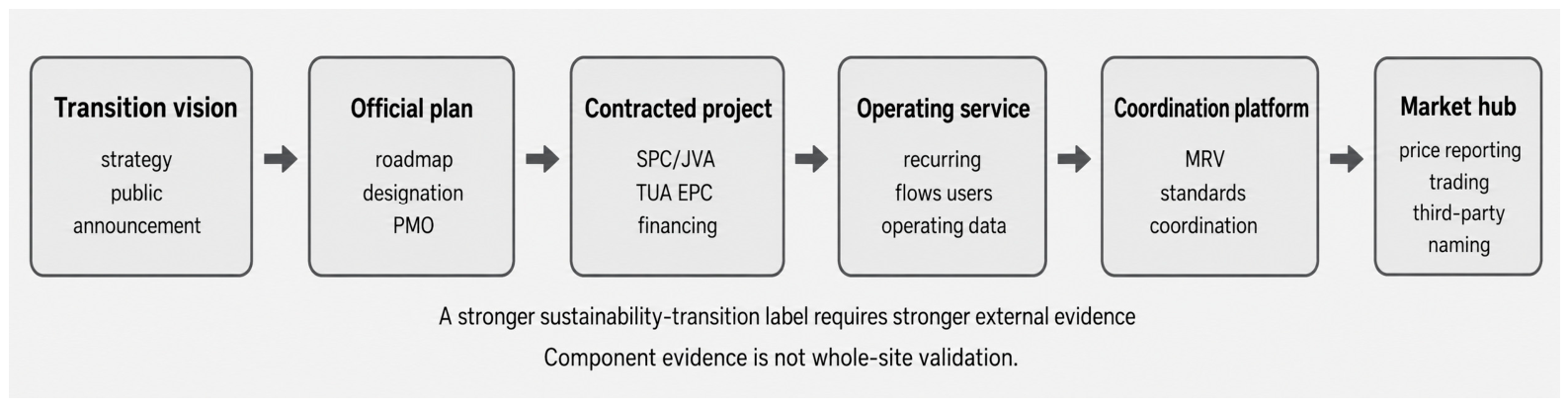
Table 2 keeps this separation visible by defining the five coding categories used in the document analysis. To avoid presenting overlapping schemata, the table is limited to category definitions and minimum evidence requirements. The staged labeling logic is then carried by
Figure 1 and by the surrounding discussion in
Section 4.4.
The recurrence threshold is deliberately conservative. Novelty does not prove recurrence. Because no universal rule specifies exactly how many clean-fuel operations are sufficient across all fuels, ports, and safety regimes, this study applies a functional threshold. One completed transfer, trial, loading, or bunkering operation is coded as an event. Two or more externally documented operations for the same fuel or service at the same port or clearly defined site may support only an operating-node candidate interpretation, unless multi-event and multi-period evidence is also available. An operating service node requires multi-month or multi-year evidence, repeated users or flows, and official or independent operating data. A market hub requires recurring operations, plus market institutions and third-party recognition.
External validation is also layered. A single event shows capability. Repeated events may show emerging service use. Multiple users make the site less dependent on one sponsor. Bankable commitments reveal who has accepted risk and capital exposure. Market institutions turn physical activity into something certifiable, tradable, or price-informed. External recognition then shows whether actors outside the project coalition treat the site as a reference point. Missing evidence at any layer need not imply project failure, but it should limit the public label.
The same logic governs the use of international examples. These examples are not treated as model hubs for Ulsan or as direct comparators. They are used as boundary markers for particular functions. HYDRIX marks a price-information layer; it does not make a port a hub [
53]. H2Global marks contract-backed demand for renewable ammonia rather than site-level validation [
54]. HyXchange points to a trading platform design linked with certificates [
55]. Rotterdam and Singapore mark different layers again: Rotterdam links production, imports, transport, and demand, whereas Singapore’s ammonia work remains closer to trials and public-private studies [
56,
57,
58]. Read in this way, the examples sharpen the coding choice. Price transparency, demand creation, platform design, import capacity, and trials are not interchangeable evidence.
These boundary markers are used as functional robustness checks rather than as formal validation cases. They show that event evidence, operating data, coordination or market-design mechanisms, price-information layers, and mature market-hub institutions are different evidence types. Accordingly, the framework withholds higher labels when the public record shows only a lower-layer function, even if the source itself uses broad hub language.
Supplementary Table S13 records this benchmark mapping.
Together, the coding categories, recurrence threshold, and benchmark checks define the evidentiary basis of the framework. They allow the article to distinguish lower-layer functions, such as planning, single events, operating data, and price information, from the stronger claims implied by recurring service, coordination-platform, or market-hub language.
Figure 1 keeps the staged labeling logic in visual form and is interpreted in
Section 4.4 as a governance device for public naming. In that interpretation, the event category is deliberately kept outside the main upgrade path. An event can show capability, safety learning, or actor coordination, but it does not by itself establish a recurring operation.
2.3. Case Selection, Source Inventory, and Coding Protocol
2.3.1. Case Selection Rationale
Methodologically, Ulsan was selected because it places several evidence stages in one post-industrial sequence. The documentary record links state oil stockpiling, international joint stockpiling, storage leasing, the Northeast Asian Oil Hub, Korea Energy Terminal, the North Port Project, South Port planning, and the April 2026 ammonia-bunkering event [
43,
44,
47,
59,
60,
61]. This makes the case useful for theory-building because the same regional narrative moves from storage ambition to terminal implementation and then to a prospective hydrogen–ammonia transition claim. Ulsan is therefore not treated as a statistical sample. It is used as a claim-validation case in which public labels, spatial sites, fuels, and evidence functions can be compared across time.
2.3.2. Source Selection and Inclusion/Exclusion Criteria
The source base was assembled around the public claims that had to be tested, not by keyword frequency alone. The working source inventory contains 33 claim-relevant records: ten government documents, eight academic articles, five international organization sources, three market institution sources, three port authority sources, two industry sources, and two media reports. Sources were included when they met at least one of four criteria: they introduced or explained an Ulsan oil, oil–gas, hydrogen, ammonia, or bunkering hub claim; they provided evidence on a specific Ulsan site, project, fuel, contract, operation, or market function; they supplied an official or independent cross-check for a disputed claim; or they provided a functional benchmark for distinguishing asset, event, operating-node, coordination-platform, and market-hub evidence. Sources were excluded, or treated only as cautionary context, when they repeated already included promotional language without new evidence, lacked a verifiable source or site, did not identify the relevant fuel or function, or discussed clean fuels without bearing on governance, market formation, infrastructure status, or public claim validation. The full source-inventory fields are summarized in
Supplementary Tables S10 and S11.
2.3.3. Coding Unit and Evidence Categories
The coding unit is a source excerpt linked to a site, project, fuel, or commodity, evidenced function, and public claim wording. A single document could therefore generate more than one coding record if it reported distinct functions. This kept site-, fuel-, and function-specific evidence from being collapsed into one broad maturity label. Each source excerpt was coded using the AC/PO/event/UC/EO categories defined in
Table 2. The coding deliberately follows the function evidenced by the source rather than the label used by the source. For example, an official plan using hub language is coded as PO unless it also documents binding implementation or repeated operation; one completed bunkering operation is coded as an event unless subsequent public evidence shows recurrence; and a terminal that has entered commercial operation is coded as EO for the terminal function alone.
Recurrence is operationalized conservatively through an explicit threshold hierarchy. A first, inaugural, pilot, demonstration, or single fuel-supply operation remains event-level evidence even when it has named actors, a vessel, a site, a volume, and safety coordination. Two or more externally documented operations for the same fuel or service at the same port or clearly identified site may support only an operating-node candidate interpretation unless multi-month or multi-year evidence, repeated users or contracts linked to executed operations, recurring throughput, or equivalent official or independent operating data are also available. This is why the April 2026 ammonia-bunkering record is coded as an event, while April–May 2026 Ulsan port-system bunkering statistics support port-system EO only for the recurring services actually reported. The threshold rule is summarized in
Supplementary Table S15.
2.3.4. Two-Pass Coding Procedure
The analysis used a two-pass reading procedure. The first pass traced the genealogy and movement of hub language: when the term appeared, which actor used it, which site it was attached to, and whether it referred to oil, LNG, hydrogen, ammonia, bunkering, storage, or a wider market role. The second pass separated the wording from the evidenced function and assigned the strongest category supported by public evidence. For each source excerpt, the audit recorded source origin, site, fuel or commodity, exact claim wording, evidenced function, evidence category, cross-check source, bias risk, and a short coding memo. The procedure was designed to answer a narrow question: what could an outside reader verify from public documents at the time of analysis? It does not infer private contracts, confidential safety records, or unpublished negotiations.
2.3.5. Conflict Handling and Spatial Attribution
When sources conflicted, the analysis used a conservative hierarchy. First, source-specific functional evidence was prioritized over broad promotional labels. Second, spatial attribution was kept at the scale identified by the source. Evidence from Ulsan Main Port Pier 2, Ulsan New Port North Port, Korea Energy Terminal, or the Ulsan port system was not assigned to Ulsan New Port South Port unless a source explicitly made that link. Third, port-system statistics were treated as port-system evidence unless a source identified a berth, pier, terminal, or sub-port. These rules are important for the April 2026 ammonia operation: the official evidence supports a single event at Ulsan Main Port Pier 2, not a recurring South Port operation [
47,
61].
2.3.6. Source-Origin Bias and Mitigation
Several sources originate from public agencies, port authorities, project promoters, or participating firms, and these actors may have incentives to use attractive hub language to mobilize finance, regulatory support, public legitimacy, or regional-development expectations. The analysis, therefore, treats hub wording as a claim rather than as evidence. Promotional or strategic wording did not upgrade a case unless the same source, or an independent cross-check, documented the corresponding function. Government and project documents were triangulated where possible with official statistics, credit-rating or market-institution sources, industry reporting, and third-party price or benchmark sources. Negative public-evidence searches were also retained as audit records: they show what was searched and why a stronger label was withheld, while not asserting that private activity is absent.
For transparency, source-origin coding also flags institutionally affiliated or self-authored public sources. Some source documents used in the analysis were authored or co-authored by the author or produced by the author’s institution before this study. These sources were used only as public documentary evidence and were not treated as independent corroboration or validation of hub status.
2.3.7. Independent Coding Check and Reliability Limits
Because the study is a single-author qualitative document analysis, formal full-corpus double coding was not performed, and a full inter-coder reliability statistic was not calculated for the entire corpus. To improve transparency, however, a subset of 18 Ulsan source excerpts was independently recoded using the same AC/PO/event/UC/EO categories. The independent coding check was conducted by an energy-policy researcher who was not involved in the original coding and was provided with the coding definitions but not with the original coding results. For the item-level comparison, composite original records (for example, EO + UC or PO + AC) were first reduced to the primary category used for the excerpt-specific claim boundary. The independent coding agreed with the original primary coding on all 18 source excerpts (18/18; percentage agreement = 100%; Cohen’s kappa = 1.00). The coding distribution was PO = 6, event = 4, UC = 1, EO = 7, and AC = 0. This agreement figure is reported as a targeted auditability and consistency check for selected boundary judgments, not as a full-corpus reliability statistic. The check focused on the North Port/Korea Energy Terminal as operating-terminal evidence, the Ulsan port-system data as port-system EO, the April 2026 ammonia-bunkering operation as an event at Ulsan Main Port Pier 2, and the South Port hydrogen–ammonia evidence as planned or committed project evidence rather than EO or market-hub validation. The item-level comparison is reported in
Supplementary Table S12.
2.3.8. Public-Evidence Boundary and Bounded Meaning of Validation
This article uses the term validation in a bounded public-evidence sense. Validation here means whether a public label is supportable under the stated coding rules and available public evidence. It does not mean that the framework has been externally validated as a universal instrument through stakeholder consultation, Delphi validation, comparative case testing, or statistical validation.
This boundary is important because the study asks what an outside reader can verify from public documents. It does not infer private contracts, confidential safety records, unpublished negotiations, or non-public market activity. A missing public record, therefore, does not prove that a function is absent. It means only that the stronger public label is not supported by the evidence available for audit.
The framework’s bounded validation status is supported by procedural transparency rather than by formal external validation. The analysis uses a documented source inventory, explicit inclusion and exclusion rules, a two-pass coding protocol, spatial-attribution rules, source-origin bias checks, positive and negative public-evidence search logs, and an independent coding check for a subset of 18 Ulsan source excerpts, including the item-level agreement reported in
Section 2.3.7. These procedures make the interpretation auditable while keeping the validation claim limited to public evidence.
2.3.9. Functional Robustness Checks and Future Validation
To reduce speculation within this public-evidence boundary, the study applies four functional robustness checks. First, the independent coding check tested the main boundary judgments in the Ulsan evidence set, including the North Port/Korea Energy Terminal as operating-terminal evidence, the April 2026 ammonia-bunkering operation as event evidence at Ulsan Main Port Pier 2, and South Port hydrogen–ammonia evidence as planned or committed-project evidence rather than operating-node or market-hub validation.
Second, functional benchmark mapping distinguishes evidence types that are often conflated in hub language: trials, recurring operating data, coordination mechanisms, market-design tools, price-information layers, and mature market-hub institutions. Third, South Port and third-party market-recognition search logs record where stronger public evidence was sought but not found. Fourth, the operational-threshold hierarchy makes the recurrence boundary explicit: one completed operation is coded as an event; more than one externally documented operation may support only an operating-node candidate interpretation unless multi-period evidence is available; an operating service node requires multi-event and multi-month or multi-year evidence; and a market hub requires recurring operations plus market-institution evidence and third-party recognition.
Taken together, these checks support analytical robustness, but they do not turn the framework into a formally validated universal instrument. Future research could extend the framework through expert interviews, stakeholder consultation, Delphi testing, inter-coder reliability assessment across a larger corpus, or comparative application to other ports and fuels.
3. Results
Building on that coding protocol,
Section 3 treats the Ulsan documents as evidence of governance mechanisms, not as a chronology alone. Each subsection asks what the hub label did, which actors the label helped mobilize, and where the public label moved faster than the observable function. This makes the descriptive record analytically useful: the same evidence can show implementation progress and, at the same time, reveal an incentive to overstate market maturity.
3.1. From Stockpiling Assets to Energy-Hub Narratives
Ulsan’s oil-hub narrative began with storage, not with a functioning trading hub. Korea National Oil Corporation’s 2006 stockpiling strategy placed international joint stockpiling, stockpiled oil trading, storage facility leasing, and Northeast Asian oil-logistics hub development inside a broader move toward dynamic stockpiling and asset utilization [
43]. The early business logic was spare-capacity use. Price discovery, standardized trading, clearing, and an open market platform were not yet visible functions.
The international joint-stockpiling model made that logic explicit. Shin and Kim describe international joint stockpiling as leasing surplus state-owned storage capacity to international users, including oil-producing companies, oil majors, and traders [
60]. Park presents the same basic logic from the perspective of the international stockpiling team [
59]. Joint stockpiling was not identical to the later oil-hub project, but it provided a clear predecessor and business-model prototype. The policy upgrade linked a storage-leasing business to energy security, petroleum industry development, port logistics, and regional growth. Ulsan’s industrial-port identity made the label attractive because it promised more than tankage leasing. Thus, the Ulsan port narrative developed alongside South Korea’s national energy-security and industrial-development agenda rather than as a detached local port slogan.
This historical–national context is not incidental. The Ulsan label linked inherited petroleum and petrochemical port functions to Korea’s energy security, industrial logistics, and regional development agenda. It therefore helped translate a large liquid-bulk port-industrial base into a public claim about national competitiveness and future market formation. The same context also explains why accumulated numerical information, such as cargo handling, liquid-bulk volumes, berth development, and terminal-use evidence, can be useful for future operationalization of the proposed criteria. In this article, however, those data are used conservatively: legacy scale supports the plausibility of Ulsan as a transition case, but it does not by itself validate clean-fuel market-hub status.
The model-borrowing mechanism is clear in Korean policy commentary. Song described Singapore, Amsterdam-Rotterdam-Antwerp, and the U.S. Gulf Coast as integrated logistics and trading centers that combine storage, blending, trading, finance, and institutional support [
49]. Jang described a development path from storage and transportation toward trading, financial products, and related services [
50]. These sources show that Korean policy actors understood that storage infrastructure was only one component of hub formation. They also show that the oil-hub discourse borrowed the imagery of mature international hubs before equivalent market functions were externally observable in Ulsan.
The same evidence shows early hub-label overextension. Song argued that physical terminal development in Yeosu and Ulsan was advancing but that regulatory reform, logistics systems, exchange functions, financial products, and financial services were still underprepared [
49]. Kim and Kim later diagnosed the project as too dependent on storage leasing and proposed a broader petroleum industry development strategy [
51]. Kim et al. proposed additional market links, including a possible connection between Ulsan storage facilities and Shanghai International Energy Exchange delivery functions [
52]. These diagnoses did not reject the hub vision. They confirmed that the storage-to-trading transition remained incomplete.
The sequence shows why evidence timing matters. In the oil-hub period, storage capacity and policy designation came before the trader ecosystem. In the North Port period, bankability improved only after LNG anchor demand and contracts reshaped the project. In the South Port period, ambition and demonstration planning again come before recurring flows and market validation. The details differ, but the governance problem is similar: the hub label appears before all the functions implied by it.
On that reading, Ulsan’s oil-hub language should be treated as bounded. It grew from tankage leasing and stockpiling-asset use, and was later enlarged through international hub models, national energy policy, regional-development goals, and the search for users and investors. The terminal base made the narrative plausible. It did not itself demonstrate trader ecosystems, price discovery, standardized transactions, or financial services. Infrastructure made the market-hub story credible enough to tell before the market-hub claim was true.
This genealogy also explains why legacy infrastructure matters for sustainability-transition governance. Clean-fuel transition narratives often start from inherited tanks, berths, pipelines, and industrial users. Those assets can make a region plausible as a future hydrogen or ammonia site. They can also make a new clean-fuel label sound more mature than the market behind it. Ulsan shows both effects.
Analytically, the oil-hub narrative worked as a coalition-building device. For national energy actors, it linked stockpiling assets to energy security and dynamic asset use. For the port authority and local government, it linked liquid-bulk infrastructure to regional development and investment attraction. For terminal users and prospective traders, it signaled that Ulsan might become more than a storage location. The same usefulness created the incentive to over-label: the broader the word hub became, the easier it was to mobilize support before the market functions associated with mature hubs were externally visible.
3.2. North Port Project: Implementation Success Without Market-Hub Validation
The North Port is the strongest retrospective test of the framework. Unlike the South Port, which remains largely prospective, the North Port moved from policy ambition to project structuring, financing, construction, and commercial operation. It therefore allows the framework to ask a harder question: when a project has clearly been implemented, what kind of label can the evidence support?
For this section, market-hub validation means public evidence of repeated market use, price reporting or price discovery, standardized delivery or trading contracts, exchange or over-the-counter trading structures, clearing or financial-risk services, observable liquidity, and repeated recognition by actors outside the project coalition. This definition is not imposed from outside the case. The 2020 North Port Project report itself defines an oil–gas hub as more than tanks and berths. It lists commodities, markets, traders, logistics infrastructure, trading systems, and financial systems, and states that port facilities and storage tanks alone are insufficient [
44]. That internal benchmark matters. The project report already separates infrastructure provision from market-hub status.
The internal benchmark divides the North Port evidence into three functional groups. The first is asset evidence: tanks, berths, pipelines, loading equipment, and handling capacity. The second is project-implementation evidence: shareholders, financing, EPC contracts, construction, and terminal-use agreements. The third is market evidence: traders, repeated multi-party transactions, price reporting, standard contracts, exchange or OTC structures, clearing, and financial services. The North Port is strong in the first two groups and thin in the third.
The North Port is therefore best understood as a contracted terminal project that later entered commercial operation. The public record is strong on sites, tanks, berths, pipelines, project vehicles, terminal-use agreements, EPC contracts, financing, construction schedules, and later operation [
44,
46,
62]. These records show delivery, implementation readiness, and terminal operation. They do not show open trading, price discovery, an exchange function, OTC market activity, clearing, or related financial services.
The project’s bankability history makes this distinction concrete. The North Port had already passed several public milestones, including national-agenda selection in 2008, inclusion in national energy planning, and preliminary feasibility review in 2010. However, the remaining challenge was not whether the idea had public status. It was whether the project had a commercially financeable structure. The 2020 report records Vopak’s withdrawal, Sinomart’s non-participation, and Hanwha Total’s non-participation [
44]. Momentum returned when SK Gas entered, LNG was added, and the 2019 joint-venture agreement, LNG terminal-use agreements, EPC contracts, financing, and construction sequence followed [
44]. In other words, the project became bankable because anchor demand and long-term contractual commitments repaired the terminal business model. It did not become bankable because a broad trading hub had already been demonstrated.
This distinction matters for sustainability governance because the terminal claim and the market-hub claim communicate different levels of maturity. A terminal financed through long-term terminal-use agreements rests on anchor users, committed demand, and contractual credit. A market hub requires something more: liquidity, multiple counterparties, price transparency, delivery rules, standardized contracts, trading mechanisms, clearing or financial-risk services, and external recognition. The North Port supports the terminal claim. On the public record, it does not support the stronger market-hub claim.
Later government and media reporting strengthens the terminal diagnosis without changing the market-hub conclusion. The Ministry of Trade, Industry, and Energy reported in 2024 that Korea Energy Terminal had started commercial operation at Ulsan New Port [
46]. Yonhap reported the same operation, storage capacity, and oil–gas facility scope [
62]. These records support operational coding for terminal functions when recurring use and external operating evidence are available. They do not convert terminal operation into market-hub validation. A terminal can be operating, strategically important, and financeable while price reporting, standard contracts, exchange or OTC trading, clearing, financial services, observable liquidity, and external hub naming remain absent or weakly evidenced.
The updated North Port/Korea Energy Terminal (KET) public-evidence audit supports the same interpretation. Public sources now support commercial operation, completed storage assets, long-term terminal-use arrangements, named anchor users, EPC and financing records, construction milestones, and early operating indicators. The same audit did not locate KET- or North Port-specific public evidence of active price reporting, standardized delivery contracts, exchange or OTC trading, clearing, financial-risk services, observable liquidity, or repeated independent market-institution naming. The governance mechanism evidenced by the North Port is therefore bankability repair and terminal implementation, not market institutionalization.
This distinction is also fairer to the project itself. The North Port overcame shareholder and user difficulties, added LNG, secured contractual support, reached financing and construction milestones, and entered commercial operation. Calling it an operating terminal rather than a market hub does not downgrade those achievements. It states more precisely what the project has proved.
The same discipline should guide future clean-fuel projects. Anchor users, state support, and long-term contracts can make hydrogen or ammonia infrastructure feasible. They may turn a vision into a bankable project and eventually into an operating terminal or service node. They do not, by themselves, create price discovery, standardized trading, a multi-user market, clearing, financial-risk services, or external hub recognition.
Table 3 summarizes the North Port diagnosis by separating terminal assets, implementation and bankability evidence, operating evidence, and market-hub functions that remain unvalidated. This separation makes clear why the North Port can be credited as an implementation success without being upgraded to market-hub status.
3.3. South Port Project: Low-Carbon Infrastructure Vision Before Market Validation
The South Port sits at an earlier stage than the North Port. The current public record supports a low-carbon infrastructure vision and Ulsan-level ammonia-bunkering programs, but it does not yet show recurring South Port hydrogen–ammonia flows, multi-user market participation, price reporting, standard contracts, trading rules, or third-party recognition as a hub. Site boundaries are crucial here: the North Port and South Port are parts of the Ulsan New Port development, while the April 2026 ammonia-bunkering operation occurred at Ulsan Main Port Pier 2 [
47,
61].
A cautious label is appropriate because the hydrogen and ammonia markets are still being assembled. It can be rational to build import, storage, bunkering, or industrial-use options before demand is mature. The word hub, however, implies more than preparedness. It implies repeated and institutionally recognizable use. The South Port’s public record is stronger on policy preparation and demonstration than on market use.
The April 2026 operation is therefore important, but limited evidence. The Ulsan Regional Office of Oceans and Fisheries reported that 600 metric tons of green ammonia were supplied by Lotte Fine Chemical to the ammonia carrier ANTWERPEN at Ulsan Main Port Pier 2 using a pipe-to-ship method [
47]. Port Technology International also reported the operation as a first-of-its-kind commercial ammonia-bunkering operation [
63]. The event shows capability and coordination at the port-system level. It does not show recurrence, South Port throughput, multi-user demand, price transparency, or a trading institution.
The South Port public evidence search reinforces that boundary. The strongest South Port-specific hydrogen–ammonia evidence located in public sources remains planned or announced infrastructure evidence: the Ulsan City-Hyundai Oil Terminal memorandum of understanding (MOU) for future ammonia storage and Ulsan Port Authority (UPA) planning language for future South Port or New Port energy functions. Public sources reviewed for 2024–2026 did not show South Port-specific hydrogen–ammonia terminal-use agreements, offtake or bunkering-supply contracts, EPC, financing close, commissioning, recurring flows, multiple users, MRV or certification routines, price reporting, trading rules, clearing, or third-party market-hub naming. In contrast, recurring bunkering evidence is visible at the Ulsan port-system level for conventional fuels and some LNG, while ammonia remains one event in the public record.
The South Port can move upward only claim by claim. A project vehicle or JVA would clarify scope, ownership, and risk allocation. Terminal-use, offtake, or bunkering contracts would show who is prepared to carry commercial risk. EPC contracts and construction would evidence implementation. Recurring operations and external data would support an operating-node label. A coordination platform or market-hub label would require still more: multiple users, certification or MRV routines, standard contracts, price information, trading mechanisms, and external naming.
Singapore’s ammonia examples help keep this distinction in view. The Fortescue Green Pioneer trial demonstrated propulsion and maneuverability using ammonia with diesel and hydrotreated vegetable oil in 2024 [
58]. Ulsan’s 2026 operation moved the learning curve toward pipe-to-ship supply for a commercial ammonia carrier [
47]. Both are meaningful transition events. Neither removes the need to separate trials, single operations, recurring bunkering nodes, coordination platforms, and market hubs.
For the South Port, the next task is therefore not to defend the hub label but to specify the upgrade route. At the present stage, the safer public language is vision, plan, demonstration program, or event-level milestone. Stronger labels should wait for documents and data that identify the site, the actors, the contracts, the recurring service, and the market institution involved.
This restraint should not be read as pessimism. The South Port can still create value through safety learning, regulatory experimentation, standards work, and early demand formation. The framework simply keeps that value distinct from market-hub validation. A vision-stage project can contribute to sustainability without being described as if the market around it already exists.
The two trajectories provide evidence of maturity in contrast. The North Port shows a label moving into users, contracts, finance, construction, and operations. The South Port shows a clean-fuel future being framed before recurring commercial use is visible. Neither trajectory is simply success or failure. The useful point is that sustainability labels need different evidence thresholds as a project moves from option-building to implementation and then, possibly, to market formation.
The South Port, therefore, is the hardest application of the attribution rule introduced in
Section 2.2. Hub language helps local and national actors keep a clean-fuel option visible, attract regulatory attention, organize demonstration programs, and signal future hydrogen–ammonia demand to terminal developers, fuel suppliers, shipbuilders, and industrial users. The incentive is understandable because early clean-fuel markets need coordination before routine demand is visible. The naming risk is that Ulsan port-system evidence, North Port terminal evidence, or the Main Port Pier 2 ammonia event could be rhetorically transferred to the South Port. The South Port should therefore be upgraded only by South Port-specific evidence of commitments, construction, recurring flows, users, coordination routines, or market institutions.
Table 4 translates the South Port diagnosis into a label-upgrading pathway. It distinguishes the evidence that would justify vision, planning, event-level, contracted, operating, platform, and hub labels, and it identifies the stronger labels that should be avoided until the relevant evidence is externally visible.
3.4. Cross-Case Synthesis: What Changes Across the Ulsan Sequence
The Ulsan sequence can be read as three successive reframings of the word hub. In the oil-hub stage, the hub language reframed spare stockpiling and tankage capacity into a national energy-security and regional-development claim. In the oil–gas stage, the same language was attached to a terminal project that achieved implementation through contracts, anchor demand, financing, construction, and commercial operation. In the hydrogen–ammonia stage, the label is being reframed again toward a low-carbon future in which the market is not yet mature.
The analytical pattern is therefore not simply descriptive chronology. Hub language repeatedly performs governance work before the full evidence base is available. It mobilizes actors, frames infrastructure as nationally strategic, attracts investment and regulatory attention, and makes future market formation appear plausible. Those functions are useful in early transitions, but they also create a predictable incentive to let the public label move faster than contracts, recurring operations, market institutions, or external recognition.
Table 5 summarizes this governance mechanism across the three Ulsan stages. The table distinguishes what the hub narrative does, which actors may benefit, where the evidence boundary lies, and which label is safest under the public record reviewed here.
Taken together, this synthesis helps explain why a yes-or-no answer to the hub question would be misleading. Ulsan is neither simply a failed hub nor a fully validated clean-fuel hub. The North Port shows materialization without market-hub validation; the South Port shows option-building before recurring commercial use. The staged framework preserves these distinctions while also identifying the institutional incentives that make over-labeling likely.
4. Discussion
4.1. Hub Labels as Institutional Legitimacy and SDG/ESG Sustainability Accountability
The first implication is that public clean-fuel hub labels should be treated as part of sustainability accountability and institutional legitimacy, not as neutral project descriptions. A public clean-fuel hub label does more than describe infrastructure. It can signal practical value to investors and users, normative alignment with decarbonization goals, and familiarity with wider transition narratives. In Ulsan, the same label may suggest multi-user access, platform services, price information, or supporting business functions. If the public record shows only a vision, a contracted facility, or one operation, a narrower label keeps missing market functions visible instead of hiding them behind ambition [
35,
36].
Read in this way, hub-label governance covers environmental, social, and economic sustainability. Environmentally, it affects whether a low-carbon fuel claim is linked to actual fuel availability, safety routines, and measurable transition progress. Socially and spatially, it affects what local communities and port-city stakeholders may infer about jobs, resilience, land use, and risk management. Economically, it affects whether public narratives imply investment readiness, bankable demand, and market maturity before those functions are visible. This is why SDG, ESG-disclosure, and green-claims sources point to the same governance requirement: sustainability labels should be supported by reliable, comparable, and verifiable evidence, and they should disclose both implementation status and remaining limits [
5,
6,
7,
8,
9,
10,
11,
12,
13,
14,
15,
16].
The Ulsan case therefore adds a sector-specific application to legitimacy and greenwashing research. Hub language can be substantively grounded when it is tied to assets, contracts, recurring operations, coordination routines, and external recognition. It becomes more symbolic when it mainly aligns a project with a desired transition identity. The framework does not assume intentional greenwashing. It treats over-labeling as a governance risk that can arise whenever promotional vocabulary moves faster than verifiable public evidence [
35,
36,
37,
38].
This does not mean that ambition should be avoided. Clean-fuel systems need early visioning because demand, safety rules, certification, infrastructure investment, and regulation develop together. The discipline proposed here is to qualify that ambition. A vision, plan, contracted project, operating node, platform candidate, and market hub each require a different kind of evidence. Clear naming allows ambition to remain useful without presenting planned or partial functions as already validated market functions.
Narrower naming also protects intermediate achievements. The South Port can be valuable as a vision or demonstration program before it becomes a hub. A terminal may matter because it stores or handles fuel. A bunkering trial may matter because crews, suppliers, port officials, and safety routines are tested together. A roadmap may matter because it makes responsibilities and the next documents visible. These outputs deserve assessment on their own terms, rather than being treated as incomplete versions of a market hub.
The theoretical implication is that public labels are part of transition governance, not merely summaries of technical status. They help mobilize expectations, coalitions, and finance, but they also create accountability obligations. A hub vision can be announced as a policy goal, especially in an emerging market. It should, however, be accompanied by a clear account of what is still only planned, what has been contracted, what is already operating, and what has been recognized by actors outside the project coalition. This accountability problem becomes clearer once expectation-building is separated from validation.
4.2. From Transition Expectations to Public-Evidence Validation
The second implication follows from that separation: expectation-building and validation are both necessary, but they are not the same task. Strategic Niche Management and expectations research explain why hydrogen and ammonia narratives can be useful before markets are mature. They coordinate actors, attract attention, and structure learning. The Ulsan evidence supports that view. Oil-hub, oil–gas-hub, and hydrogen–ammonia-hub language each helped organize action before the full evidence base was visible. The contribution here is to separate that performative role from validation. A label may be useful as an expectation while still being too strong as a statement of achieved hub function [
25,
26,
27,
28].
Transition Management makes the same distinction from another angle. Visioning, experimentation, monitoring, and reflexive adjustment are legitimate governance tasks. The problem is not that Ulsan has visions or demonstrations. The problem would be to let visioning language substitute for monitoring. The staged framework turns Transition Management into a public-evidence discipline: each label should state whether the source provides evidence of strategy, planning, commitment, an event, recurring operations, a coordination routine, or a market institution [
29,
30,
31].
The North Port case shows the point at which implementation evidence no longer suffices as hub validation. The JVA, terminal-use agreements, EPC contracts, financing arrangements, and SK Gas anchor demand explain how a stalled public idea became a buildable terminal project. They show sponsor commitment, cash-flow repair, construction feasibility, and risk allocation. They do not show whether the site performs the market functions implied by the word hub: who trades through it, whether multiple parties use it on a recurring basis, whether it serves as a reference point for prices or delivery, and whether supporting market institutions have become visible.
Once these categories are mixed, the project is easy to misread. A terminal with one anchor user may be financially safer than a speculative platform while also being less hub-like in market terms. A demonstration can reduce safety and regulatory uncertainty without providing a recurring service. A price index can improve transparency without making a particular port a delivery or trading reference point. For Ulsan, this produces a mixed but defensible diagnosis: the North Port validates implementation and bankability repair; the South Port remains a clean-fuel infrastructure vision with event-level fuel-supply evidence.
This distinction can also be disclosed in a simple way. Project vehicles, TUAs, offtake agreements, EPC contracts, financing, and construction belong in an implementation column. Recurring flows, user diversity, market institutions, price reporting, trading rules, finance or clearing functions, and third-party naming belong in a hub-validation column.
Table 6 uses that separation to set out the external validation sequence.
At this level, the theoretical implication is that transition expectations need a second layer of public accountability. Strategic Niche Management explains why expectations matter. Transition Management explains why visioning and learning matter. The framework adds a rule for when expectation-building language can be upgraded into evidence-based public claims. It therefore complements, rather than replaces, transition theory.
4.3. Implementation, Bankability, and Market Institutionalization
The third implication builds on the external-validation sequence: implementation, bankability, and market institutionalization should be kept analytically separate. Here, market institutionalization refers to the emergence of repeated multi-party transactions, tradable products, price references, standardized delivery or trading rules, clearing, liquidity, financial-risk services, and external benchmark recognition. Innovation-system and market-formation research treats legitimation, resource mobilization, guidance of search, entrepreneurial activity, and market formation as related but distinct functions. The North Port shows strong resource mobilization, contractual commitment, and infrastructure delivery. It does not show the stronger market-formation functions associated with a hub: repeated multi-party transactions, tradable products, price references, liquidity, clearing, or external benchmark recognition [
41,
42].
The April 2026 Ulsan ammonia-bunkering event provides a complementary example of the same threshold logic. It shows that the Ulsan port system can coordinate a pipe-to-ship ammonia supply operation involving public and private actors. It does not show that the South Port has become a hydrogen–ammonia market hub, especially because the operation took place at Ulsan Main Port rather than at the South Port Project site.
The threshold distinction is therefore practical rather than semantic. A first operation proves that a port-system actor network can complete a controlled transfer. A second or later documented operation may show progression toward a service node, but routine operation should be claimed only when repeated activity is visible across reporting periods or through equivalent operating records. Hub status requires a still higher layer: recurring physical or contractual activity plus market institutions such as price references, standard products, delivery rules, clearing, liquidity, or independent market naming.
This reading also protects option-building by giving it a separate label. Hydrogen and ammonia may support maritime decarbonization, but the literature and the public record both point to infrastructure, safety, regulatory, demand, and readiness constraints [
2,
3,
4,
17,
18,
19,
20]. Early programs can test procedures, identify users, attract investment options, and build regulatory capacity before markets are liquid. Those contributions are real. They are simply not hub validation.
Over-labeling is not always deliberate. A city or port authority may use the word hub to attract investors, draw regulatory attention, or keep prospective users engaged before demand is secure. The risk arises when the label stops tracking the evidence. A label should change as contracts are signed, flows recur, users enter, and institutions become concrete. Outsiders usually see the public narrative before they see contracts or operating records, so the public label has to carry the burden carefully.
One practical response would be a public evidence register. It would not disclose confidential prices or negotiations. It could record the status of each claim: strategy, official plan, contracted subproject, construction, operating service, certification routine, recurring users, price information, or external recognition. For Ulsan, such a register would show why the ammonia-bunkering event is a milestone, why the South Port remains a vision, and what would justify an upgrade.
4.4. Port Authorities as Claim Governors and Infrastructure-Transition Mediators
These implementation and market distinctions also reshape port-governance roles. Port authorities are increasingly described as coordinators, regulators, landlords, energy managers, and community-facing institutions rather than passive providers of quay space. The Ulsan case adds one more role: port authorities and public agencies act as claim governors. Claim governors are actors that shape, qualify, and discipline the public claims attached to infrastructure projects. When they use hub language, they help define what outside audiences think has been achieved, which risks have been reduced, and which market functions are already credible [
32,
33,
34].
This claim-governor role is difficult because energy transitions are place-based and path-dependent. Legacy tanks, berths, pipelines, industrial users, and energy firms can make a clean-fuel future more plausible, but they can also blur the boundary between inherited capability and new transition function. In Ulsan, the petroleum and LNG infrastructure base makes hydrogen and ammonia narratives credible as options. It does not by itself validate South Port hydrogen–ammonia operation or market-hub status [
39,
40].
For Korea’s national clean-fuel transition, this means that Ulsan is most defensibly framed as a staged infrastructure, demonstration, and industrial-learning site rather than as a fully validated clean-fuel market hub. Its liquid-bulk scale, petrochemical and energy-industrial base, North Port terminal-implementation experience, ammonia-bunkering demonstration capability, and planned South Port storage agenda make the region suitable for tasks such as clean-fuel storage planning, ammonia and alternative-fuel bunkering trials, safety and regulatory learning, industrial fuel-supply coordination, and future ammonia logistics. These are important national tasks because they build operational and institutional capacity before mature markets exist. They should nevertheless be named as storage, demonstration, coordination, or option-building functions until South Port-specific contracts, repeated operations, multiple users, market-information layers, and third-party market recognition become visible.
Figure 1 is therefore used as a governance device rather than a decorative classification diagram. It should be read from left to right as a set of claim-upgrading tests: ambition can justify vision language; official plans can justify planning language; contracts, construction, and financing can justify implementation language; repeated operations can justify service-node language; shared routines can justify platform language; and market institutions can justify market-hub language. The figure also marks a boundary that the Ulsan case makes important: event-level evidence is a milestone, not a recurring operation.
Applied to Ulsan,
Figure 1 organizes the evidence into three distinct layers. First, the North Port/Korea Energy Terminal evidence supports operating-terminal status and, where shared coordination routines are publicly documented, coordination-platform language. Second, the April 2026 ammonia operation is a Main Port Pier 2 event and an Ulsan port-system capability milestone. Third, Ulsan-related price-reference information is in a market-information context. None of these layers is treated as a mature market-hub validation without the market-institution evidence described above.
These applications show why
Figure 1 is an attribution map rather than a general maturity ladder. The North Port, Main Port Pier 2, port-system statistics, and Ulsan-related price information each support different types of claims, so they are kept separate in the Ulsan interpretation.
The framework may also be transferable beyond Ulsan and beyond ports, but that transferability should be treated as a proposition for testing rather than as a result already established by this single case. Hydrogen import terminals, renewable-gas corridors, alternative-fuel bunkering sites, electricity-flexibility platforms, water-reuse systems, and district-energy systems can all pass through vision, plan, contract, operation, platform, and market stages. In each setting, the same question remains: which public label is supported by visible evidence?
No single international example supplies every ingredient. Rotterdam combines import, production, use, transport, and regional connection [
56]. Singapore illustrates trial governance and ammonia-bunkering safety learning [
57,
58]. HYDRIX, H2Global, and HyXchange represent price transparency, contract-backed demand creation, and platform design [
53,
54,
55]. Each function helps market formation differently. None proves, by itself, that a specific site has become a hub.
Future comparative work should start with cases that appear hub-like for different reasons. Rotterdam could test a broad platform trajectory; Singapore, a trial and bunkering pathway; Cushing or Amsterdam-Rotterdam-Antwerp, mature commodity-hub functions; and Ulsan, the shift from inherited oil infrastructure to clean-fuel ambition. Interviews could ask traders, terminal operators, regulators, and port authorities what makes them use the word hub. Quantitative work could then translate those judgments into indicators such as recurring flows, user diversity, contract diversity, price references, and financial services.
Table 7 closes the theoretical loop. The framework does not ask transition theory to become a document checklist. It uses transition theory to identify why hub claims matter, then adds an auditable rule for judging when those claims should be retained, qualified, or upgraded in public communication.
4.5. Limitations and Future Research
The framework has four limits, each following from its public-evidence design. The first limit is the public evidence base. Confidential contracts, operating data, safety files, and private negotiations may contain information not visible in the sources reviewed here. This limit is consistent with the research question because the article studies public labels and externally visible evidence. The finding is therefore bounded: stronger hub labels are not supported by the public evidence reviewed, but this does not prove that private activity is absent.
The second limit is formal validation. The framework has not been externally validated through expert interviews, a Delphi study, stakeholder consultation, or systematic comparative case testing. This article therefore treats the framework as an analytical instrument and documents robustness checks rather than claiming full validation. The independent coding check, functional benchmark mapping, source-inventory audit, and public search logs make the coding rationale transparent. They improve auditability, but they do not replace validation by users, regulators, traders, port authorities, or independent experts.
The third limit is the single-case design. Ulsan is useful because it combines a long historical sequence, a materialized terminal project, and a prospective hydrogen–ammonia agenda in one port-industrial region. It is not a statistical sample. Comparative work should test whether the same coding rules hold in Rotterdam, Singapore, Shanghai, Cushing, Amsterdam-Rotterdam-Antwerp, and other claimed hubs.
For the Korean port system specifically, the framework can be used as a comparative research design rather than as an additional empirical claim in this single-case article. Future work could select Korean ports by functional profile: liquid-bulk and energy ports, container and transshipment ports, LNG import and storage ports, industrial fuel-supply sites, and alternative-fuel bunkering demonstration sites.
Each case could then be coded using the same fields applied here. These fields would include port-system role, site specificity, dominant fuel or commodity, AC/PO/event/UC/EO evidence, contractual commitment, recurring operating data, coordination routines, market-institution evidence, and third-party naming. Such a design would allow Ulsan to be positioned within a wider national port-development map while keeping the present article’s evidentiary boundary intact.
The fourth limit concerns what this article deliberately leaves outside the test. It does not ask whether ammonia is better or worse than hydrogen, methanol, biofuels, electrification, or efficiency measures, nor does it calculate life-cycle emissions. The framework begins later in the policy chain: once an actor has already made a clean-fuel hub claim, can the public record support that label? Future work could connect this claim test to life-cycle assessment, techno-economic modeling, safety studies, or social-acceptance research, so that environmental performance and claim credibility are assessed side by side.
Future validation should proceed in stages before the framework is treated as a broadly generalized instrument. First, coding reliability should be tested more fully. A second coder or independent team could recode the full source log and calculate agreement around difficult boundaries, especially between event and EO evidence and between site-specific and port-system evidence.
Second, expert and stakeholder validation should test whether the stage definitions are recognizable to practitioners. Expert interviews, Delphi rounds, or stakeholder workshops could ask port authorities, terminal operators, users, traders, price agencies, and regulators whether the categories match how they distinguish vision, implementation, operation, platform formation, and market-hub status.
Third, comparative case testing should examine whether the same thresholds classify different hub-like cases consistently. Rotterdam could test a broad platform trajectory; Singapore, a trial and bunkering pathway; Cushing or Amsterdam-Rotterdam-Antwerp, mature commodity-hub functions; and Ulsan, the shift from inherited oil infrastructure to clean-fuel ambition.
Fourth, indicator design could translate these judgments into measurable variables. Possible indicators include recurrence duration, user diversity, contract diversity, certification routines, price references, liquidity metrics, financial services, and third-party naming. These steps would allow future research to move from an analytical public-evidence framework toward a more widely validated tool for assessing clean-fuel hub claims.
5. Conclusions
The conclusion from this analysis is that clean-fuel hub claims are best evaluated through staged evidence rather than ambition alone. Naming a project a hub does not create hub status. The framework separates vision and planning, binding implementation, recurring operations, coordination routines, and market-hub functions such as delivery references, price information, trading, clearing, liquidity, and external recognition. It should therefore be read as an analytical public-evidence tool, not as a definitive certification of hub status.
Ulsan illustrates this logic rather than statistically proving it. The Northeast Asian Oil Hub narrative began in tankage leasing and stockpiling-asset use, then borrowed language from mature international oil hubs before equivalent market functions were externally visible. The North Port later delivered a substantial but narrower outcome: an oil/LNG terminal backed by project vehicles, terminal-use agreements, EPC contracts, financing, construction, and commercial operation. Those facts support operating-terminal language and, where shared coordination routines are publicly documented, coordination-platform language. They do not, on the public record reviewed here, demonstrate trading, price reporting, or price discovery, liquidity, clearing, or repeated third-party market use.
The South Port is earlier in the same evidence sequence. Its hydrogen–ammonia agenda is better described as a low-carbon infrastructure vision or planned infrastructure pathway until South Port-specific subprojects meet stronger thresholds, such as binding commercial commitments, executed construction, recurring operations, multi-user service evidence, certification routines, price information, standard contracts, or third-party market recognition. The April 2026 ammonia-bunkering operation strengthens Ulsan port-system fuel-supply capability and safety learning, but the public record attributes it to Ulsan Main Port Pier 2 rather than the South Port.
The governance implication follows directly. Public agencies and project coalitions can communicate ambition, but they should make visible which part of a claim is aspirational, planned, contracted, operating, platform-based, or market-validated. This staged wording can support SDG- and ESG-relevant disclosure integrity by reducing premature maturity signals, greenwashing risk, and selective disclosure. It does not replace environmental performance assessment, life-cycle analysis, techno-economic modeling, safety evaluation, or social-acceptance research.
For South Korea, the same logic positions Ulsan as a plausible priority site for staged clean-fuel infrastructure learning, especially storage planning, safety demonstration, industrial fuel-supply coordination, and future ammonia logistics, while preserving the distinction between national-development potential and externally validated market-hub status.
Finally, the framework’s transferability should be tested rather than assumed. Future work should apply the coding protocol to additional port and infrastructure cases, conduct full-source independent recoding, and use expert interviews, Delphi exercises, or stakeholder consultation to refine thresholds. The findings are therefore best understood as bounded public-evidence conclusions from a theory-building case: they show how stronger hub labels can be earned, withheld, or revised as evidence changes.