1. Introduction
Sustainability in agriculture is no longer assessed solely through productivity, efficiency, technological advancement, or environmental conservation. Increasingly, it is understood as a multidimensional concept that also encompasses social outcomes related to equity, inclusion, well-being, and the long-term viability of rural communities [
1]. Among these dimensions, social sustainability has gained increasing recognition as a fundamental pillar of sustainable agri-food systems because it addresses equity, inclusion, quality of life, social cohesion, and the well-being of rural populations [
2,
3]. Although considerable progress has been made in conceptualizing social sustainability, it remains one of the least consolidated dimensions of sustainability research due to the diversity of theoretical approaches, measurement frameworks, and the complexity of capturing farmers’ lived experiences across different territorial contexts [
3,
4]. Consequently, contemporary approaches to sustainable rural development emphasize that agricultural sustainability depends not only on productive performance but also on the integration of social, economic, and institutional conditions that strengthen community resilience, improve living conditions, and promote long-term territorial development [
1,
2,
3,
4,
5].
Within this social dimension, gender equity has emerged as a fundamental determinant of sustainable agricultural development because it directly influences access to productive resources, decision-making processes, social inclusion, and community resilience [
6]. Although women make substantial contributions to agricultural production, food security, household management, and rural livelihoods, they continue to face persistent structural barriers related to land ownership, access to credit, training opportunities, information, technology, and leadership positions [
7,
8,
9]. Evidence from Latin America confirms that these inequalities are reinforced by cultural norms, unequal access to productive assets, and limited participation in local governance. For example, studies conducted in Guatemala and Colombia demonstrate that strengthening women’s organizational capacities and leadership enhances collective participation, improves local governance, and contributes to more inclusive and sustainable rural development [
10,
11]. Consequently, gender equity should not be viewed merely as a normative principle but as a structural condition that expands women’s empowerment, promotes equitable access to opportunities, and strengthens the social sustainability of agricultural systems [
5,
12,
13,
14]. Nevertheless, recent systematic reviews also indicate that the effects of gender-responsive agricultural interventions are highly context-dependent, varying according to institutional arrangements, land tenure systems, governance structures, and prevailing social norms, which suggests that women’s participation alone is insufficient to guarantee sustainable development outcomes [
15]. In this regard, evidence from Ecuador further demonstrates that collective action through women’s associations strengthens social capital, increases participation in agroecological markets, and reinforces local governance, highlighting that gender equity operates simultaneously at individual, organizational, and territorial levels [
16].
From a broader policy and development perspective, agricultural sustainability is increasingly examined through integrated frameworks that recognize the interdependence of social, institutional, and territorial dimensions. Recent studies argue that socially sustainable food systems require institutional arrangements that protect agricultural workers, promote decent rural employment, strengthen local governance, and ensure equitable access to productive resources [
17,
18,
19]. Consistent with this perspective, empirical evidence from Brazil, Peru, Bolivia, and Ecuador indicates that women’s empowerment enhances household resilience, collective action, participation in local organizations, and adaptive capacity within rural communities when accompanied by supportive institutional environments and inclusive governance mechanisms [
20,
21,
22,
23,
24,
25]. Likewise, recent structural equation modeling research has shown that socioeconomic conditions, women’s empowerment, and access to productive opportunities jointly influence women’s participation in agricultural decision-making, reinforcing the multidimensional nature of gender-related processes in rural development [
26]. Collectively, these studies demonstrate that gender equity constitutes a strategic component of socially sustainable agricultural systems; however, they have primarily focused on documenting empowerment outcomes or evaluating specific interventions rather than examining the mechanisms through which perceived gender-related barriers shape gender equity and, ultimately, broader social sustainability outcomes.
Despite these advances, important knowledge gaps remain regarding the mechanisms through which gender-related barriers influence social sustainability in rural agricultural systems, particularly in developing countries where agricultural livelihoods continue to be shaped by unequal access to productive resources and persistent gender disparities [
27]. Although recent research has expanded understanding of the relationships among gender, climate change, technological innovation, and sustainable agricultural development [
28], relatively little empirical evidence explains how perceived barriers related to access to land, credit, training opportunities, and decision-making processes affect perceptions of gender equity and subsequently influence broader social sustainability outcomes [
6,
29]. This limitation is especially evident in Latin America, where empirical studies applying structural equation modeling to examine these interrelationships remain scarce despite the region’s persistent social and institutional inequalities. Addressing this gap is essential for advancing the understanding of gender equity not only as a normative objective but also as a structural mechanism capable of promoting socially sustainable agricultural development.
To address this research gap, the present study examines the relationships among perceived gender barriers, gender equity, and social sustainability in agriculture in Tungurahua Province, Ecuador, using structural equation modeling (SEM). Specifically, the study evaluates whether perceived barriers related to access to credit, land, training opportunities, and discrimination influence gender equity, conceptualized through women’s access to financing, gender-responsive training, female leadership, and cultural change, and whether gender equity contributes to explaining social sustainability, represented by consumer safety, quality of life, and perceived economic impact. By empirically testing these relationships, this study contributes to the literature in three ways. First, it advances current discussions on gender and sustainable agriculture by examining gender equity as a structural mechanism linking perceived gender-related barriers with social sustainability. Second, it provides empirical evidence from Ecuador, an underrepresented Latin American context where research on the social dimension of agricultural sustainability remains limited. Third, by applying structural equation modeling, it provides robust empirical evidence on the direct and indirect relationships among perceived gender barriers, gender equity, and social sustainability, thereby contributing to a better understanding of the mechanisms through which gender equity supports socially sustainable rural development.
Research Hypotheses
Based on the literature on gender equity, rural development, and social sustainability, this study proposes three hypotheses to examine the relationships among perceived gender barriers, gender equity, and social sustainability in agriculture.
Previous studies suggest that barriers related to access to land, credit, training, and participation opportunities shape perceptions of equity within rural agricultural systems. Accordingly, the following hypothesis is proposed:
H1. Perceived gender barriers are significantly associated with gender equity.
Research on sustainable rural development further indicates that gender equity contributes to social inclusion, participation, well-being, and community resilience. Therefore, the following hypothesis is formulated:
H2. Gender equity is significantly associated with social sustainability.
Finally, gender-related constraints may influence broader sustainability outcomes by limiting access to productive resources and opportunities within agricultural systems. Consequently, the following hypothesis is proposed:
H3. Perceived gender barriers are significantly associated with social sustainability outcomes.
These hypotheses provide the basis for the structural equation model estimated in this study.
2. Materials and Methods
2.1. Study Design
The study was conducted during 2025 using a quantitative approach, with a non-experimental, cross-sectional design [
30]. This design was adopted because the variables were not manipulated but rather analyzed based on the perceptions of farmers in the province of Tungurahua, Ecuador. The methodological purpose was to examine the relationship between perceived gender barriers, gender equity, and social sustainability in the provincial agricultural context.
The province of Tungurahua was considered a relevant setting due to its connection with family farming activities, rural dynamics, local marketing, and community participation. In this context, the analysis of gender equity allows us to understand how conditions of access, leadership, training, and recognition can be related to agricultural social sustainability.
2.2. Participants and Data Collection
Primary data was obtained through structured surveys administered to farmers involved in agricultural activities in the province of Tungurahua. The final sample consisted of 930 farmers, considered appropriate given the 11 indicators observed indicators and the requirements for structural equation modeling [
31].
The survey was conducted across multiple cantons of Tungurahua Province, including Ambato, Baños de Agua Santa, Cevallos, Mocha, Patate, Píllaro, Pelileo, Quero, and Tisaleo. This territorial coverage allowed the inclusion of farmers from different agricultural contexts within the province.
The target population was based on official records from the Ecuadorian Ministry of Agriculture, which reported approximately 129,027 individuals engaged in agricultural activities. The required sample size was estimated using the infinite population formula with a 95% confidence level and a 3.2% margin of error [
32], resulting in a minimum sample of 930 farmers. A total of 930 valid responses were obtained and included in the analysis.
A non-probability quota sampling strategy was employed to recruit participants from the different cantons of Tungurahua Province. The sample was distributed across the participating cantons using predefined quotas to ensure the inclusion of farmers from diverse agricultural contexts. The allocation of questionnaires considered the diversity of agricultural production and the predominance of farming activities within each territory, allowing the sample to reflect the heterogeneity of the province’s agricultural sector. Within each quota, farmers actively engaged in agricultural production were invited to participate voluntarily in the survey. Eligible participants were adults involved in agricultural activities in Tungurahua Province. Individuals not engaged in agricultural production, duplicate responses, and incomplete questionnaires were excluded from the analysis. During data screening, questionnaires were reviewed for completeness and consistency before analysis; consequently, only valid questionnaires were retained, and no missing data were present in the final dataset.
The analytical sample comprised 930 farmers distributed across the nine participating cantons of Tungurahua Province: Ambato (n = 143), Baños de Agua Santa (n = 103), Cevallos (n = 100), Mocha (n = 99), Patate (n = 99), Pelileo (n = 104), Píllaro (n = 100), Quero (n = 100), and Tisaleo (n = 82).
The instrument included questions designed to measure perceptions of gender barriers, gender equity, and social sustainability. Items were measured using a five-point Likert scale [
33], which allowed for quantifying participants’ level of agreement with statements related to access to credit, land, training, female leadership, cultural change, consumer safety, quality improvement, and perceived economic impact.
The response options ranged from 1 = strongly disagree to 5 = strongly agree. Higher scores reflected more favorable perceptions of each construct. No reverse-coded items were included in the final instrument.
2.3. Operationalization of Variables
The model included three latent constructs: perceived gender barriers, gender equity, and social sustainability. Each construct was measured using observed indicators derived from the applied instrument. The operationalization of the constructs was based on the theoretical framework presented in the literature review and adapted to the context of rural agricultural producers in Tungurahua Province. The selected indicators were designed to capture farmers’ perceptions regarding access to productive resources, gender equity, and social sustainability, ensuring conceptual consistency between the theoretical constructs and the empirical measurement model.
The complete wording of the survey items and their descriptive statistics are reported in
Appendix A.
2.4. Model Specification
The analysis was performed using a structural equation model. The model’s structure was developed using a reflexive measurement approach, since the latent variables point to the observed variables. Equations (1)–(3) show the reflexive measurement model.
Subsequently, the structural model was estimated in order to analyze the direct relationships between the latent constructs, as can be seen in Equations (4) and (5).
This specification allowed for an assessment of whether perceived gender barriers are related to gender equity and whether gender equity contributes to explaining agricultural social sustainability. Furthermore, a direct relationship between perceived gender barriers and social sustainability was incorporated to examine whether these barriers have an additional effect on social sustainability.
2.5. Statistical Analysis Procedure
Initial data processing was performed using IBM SPSS Statistics version 29.0 (IBM Corp., Armonk, NY, USA), where variable coding, response consistency, missing values, and the suitability of indicators for multivariate analysis were reviewed. Subsequently, the structural equation model was estimated using IBM SPSS AMOS version 29.0 (IBM Corp., Armonk, NY, USA).
Additionally, the internal consistency of the indicators was assessed using Cronbach’s alpha coefficient to verify the reliability of the scales used to represent the model’s latent constructs.
Estimation was performed using maximum likelihood (ML). Although the observed indicators were measured using five-point Likert scales, they were treated as approximately continuous variables, a procedure commonly adopted in structural equation modeling when sample sizes are large and category distributions are reasonably balanced. Given the sample size of 930 observations, ML estimation was considered appropriate for the analysis.
The overall model fit was evaluated using absolute, incremental, and parsimony-adjusted fit indices, including CMIN/DF, GFI, AGFI, NFI, IFI, TLI, CFI, RMSEA, and PCLOSE. The significance of structural relationships was assessed using the Critical Ratio (C.R.) and p-values. With a significance level of 5% (α = 0.05), a relationship was considered statistically significant when |C.R.| ≥ 1.96 and p < 0.05. In addition, standardized coefficients were analyzed to interpret the magnitude of the relationships between constructs, while coefficients of determination (R2) were used to assess the proportion of variance explained by the endogenous variables.
For the descriptive analysis presented in
Table 1 and
Table 2, composite scores were calculated for the latent constructs of gender equity and social sustainability by averaging the indicators retained after the measurement model assessment. The resulting composite scores retained the original 1–5 measurement scale and were subsequently classified into three ordinal levels using equal-width intervals: low (1.00–2.33), medium (2.34–3.66), and high (3.67–5.00). These levels represent low, moderate, and high perceived gender equity or social sustainability, respectively. The categorized scores were used exclusively for the descriptive cross-tabulation analyses with respondents’ gender and the Pearson’s Chi-square test presented in
Table 1 and
Table 2, whereas the original continuous composite scores were retained for all reliability, validity, and structural equation modeling analyses.
2.6. Assumptions and Evaluation of the Measurement Model
The model’s reliability and convergent validity were assessed using factor loadings, Cronbach’s alpha, composite reliability (CR), and average variance extracted (AVE). Composite reliability (CR) was considered the primary indicator of internal consistency because it provides a more robust estimate of construct reliability than Cronbach’s alpha. The recommended thresholds were CR ≥ 0.70 and AVE ≥ 0.50.
Normality was assessed by examining skewness, kurtosis, and multivariate kurtosis. Since deviations from multivariate normality were observed, bootstrapping with 2500 resamples was applied to obtain robust estimates of standard errors and significance tests.
Multicollinearity was assessed using the variance inflation factor (VIF). In addition, Harman’s single-factor test was conducted to evaluate common method bias, considering that the first factor should not explain more than 50% of the total variance.
The VIF values ranged from 1.033 to 1.912, with tolerance values between 0.523 and 0.968, indicating the absence of multicollinearity. Harman’s single-factor test showed that the first factor explained 32% of the total variance, indicating that common method bias was not a significant concern.
2.7. Ethical Considerations and Data Availability
The research was conducted using information provided by farmers in the province of Tungurahua. The information was treated confidentially and used solely for academic and scientific purposes. The database does not contain any information that could compromise the respondents.
The data used in this study are not deposited in a public database due to participant confidentiality restrictions. However, they may be made available upon reasonable request to the authors, provided that applicable ethical and institutional conditions are respected.
3. Results
3.1. Levels of Gender Equity and Social Sustainability
Descriptive analysis allowed us to identify the levels of gender equity and social sustainability perceived by the farmers surveyed in the province of Tungurahua. The data in
Table 1 indicate that most respondents were classified at a high level of gender equity, at 80.3%. When analyzing the data between women and men, the figures are almost identical, at 79.3% and 81.6%, respectively. In contrast, the pessimistic view at the low level was low in both groups, at 2.5% for women and 2.0% for men.
To verify whether the differences are statistically significant, Pearson’s chi-squared test was applied, confirming that there is no statistically significant association between gender and the level of gender equity, χ2(2) = 0.831; p = 0.660. This demonstrates that the high value placed on gender equity is a homogeneous consensus that transcends the gender of the respondents.
When examining social sustainability,
Table 2 reflects even greater optimism, with 88.3% of the total sample at the high level, compared to 10.2% at the medium level and a marginal 1.5% at the low level. Looking at the data by gender, 86.7% of women and 90.3% of men perceived a high level of social sustainability. This percentage gap points to a favorable and shared consensus within the region.
This homogeneity was confirmed by the chi-square test, which ruled out a significant association between gender and the level of social sustainability, χ2(2) = 4.192; p = 0.123. It is worth noting that the test is robust, as 100% of the cells met the requirement of registering counts equal to or greater than 5.
3.2. Reliability and Validity of the Measurement Model
Internal consistency analyses yielded optimal levels for the gender equity (α = 0.809) and social sustainability (α = 0.750) scales. Meanwhile, the perceived gender barriers construct showed moderate consistency (α = 0.642). This figure reflects the nature of the variable; the indicator groups heterogeneous dimensions such as barriers to accessing credit, land, and discrimination.
The results of the measurement model in
Table 3 reflect robust factor loadings. For the construct of gender equity, the values range from 0.637 to 0.760, while for social sustainability, they range from 0.575 to 0.855. For perceived gender barriers, the factor loadings range from 0.677 to 0.805, indicating that limitations related to training, access to credit, and land ownership are representative dimensions of the construct.
The composite reliability values for all constructs were acceptable. The AVE for gender equity is 0.522 and for social sustainability, 0.534. For perceived gender barriers the AVE reached 0.579 and the CR was 0.804, indicating adequate convergent validity.
The Fornell-Larcker criterion presented in
Table 4 supports discriminant validity among the constructs. The square root of the AVE for each construct exceeds its correlations with the remaining constructs, indicating that each construct captures a distinct aspect of the proposed model.
3.3. Overall Fit of the Structural Model
The goodness-of-fit indicators in
Table 5 confirmed the structural model’s consistency with the data. The indices showed an adequate fit. The comparative fit index (CFI) was 0.989, the Tucker–Lewis index (TLI) was 0.985, the incremental fit index (IFI) was 0.989, and the normed fit index (NFI) was 0.979. All values exceeded the recommended threshold of 0.90, supporting the adequacy of the proposed model.
The approximation error, with an RMSEA of 0.034 and a 90% confidence interval between 0.022 and 0.045, is well below the maximum limit of 0.08. The parsimony indices were also well-balanced (PRATIO = 0.745, PNFI = 0.725, and PCFI = 0.735). Multivariate normality was not supported (multivariate kurtosis = 69.171; C.R. = 62.367). Therefore, bootstrap estimates based on 2500 resamples were used to evaluate the significance and stability of the structural parameters.
3.4. Structural Relationships of the Model
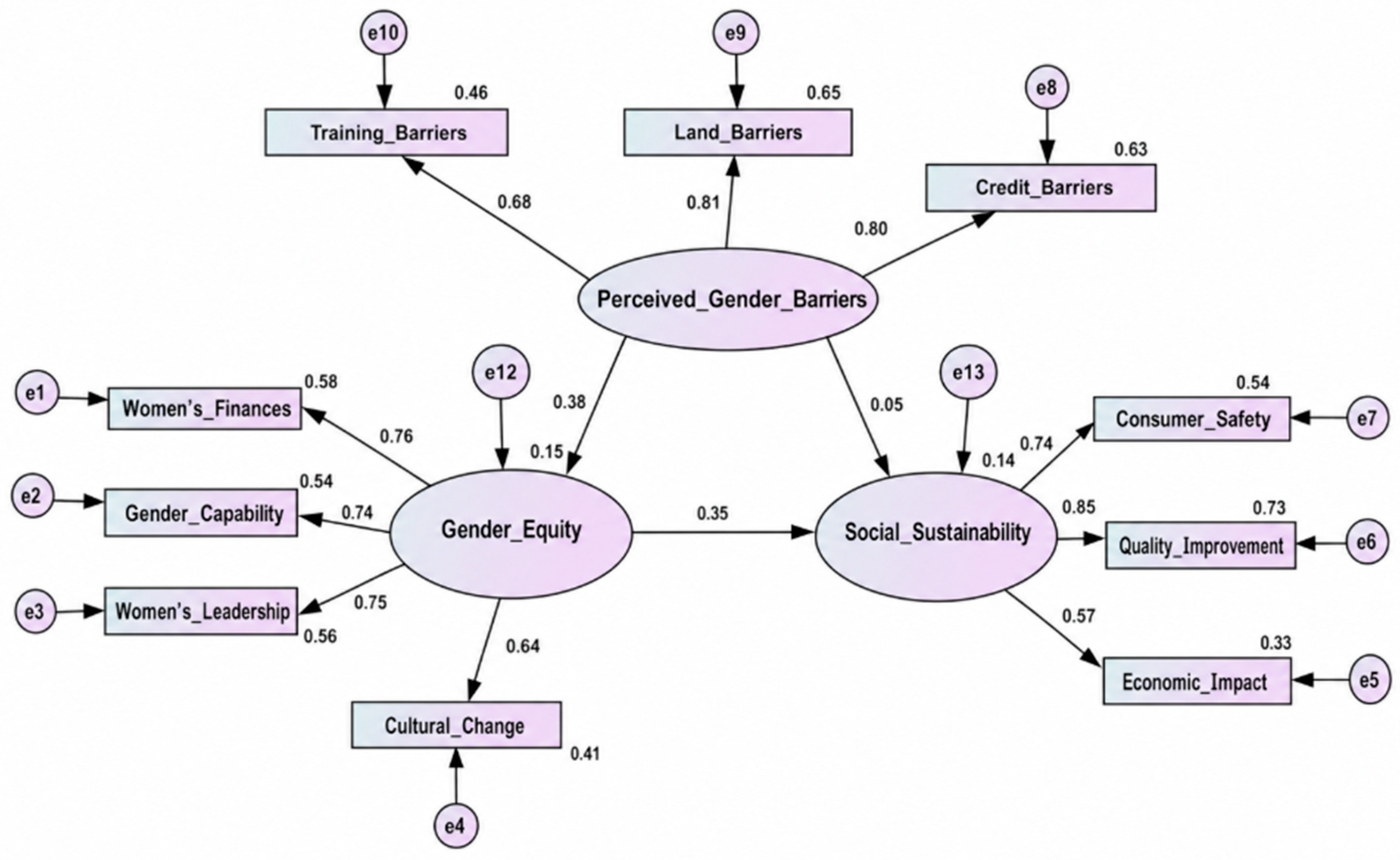
The structural model assessed the relationships between gender barriers, gender equity, and social sustainability. The relationship between gender barriers and gender equity was positive and statistically significant, with an unstandardized coefficient of 0.277, CR = 9.271, and
p < 0.001. Furthermore, the standardized coefficient was
β = 0.383, indicating a moderate association between the two constructs. The estimated structural equation model with standardized coefficients is presented in
Figure 1.
The relationship between gender equity and social sustainability was also positive and significant. The unstandardized coefficient was 0.324, with a CR of 7.557 and p < 0.001. Its standardized coefficient was β = 0.349, indicating that gender equity is the main predictor of social sustainability within the estimated model.
On the other hand, the direct relationship between perceived gender barriers and social sustainability was not statistically significant. The unstandardized coefficient was 0.036, with a CR of 1.256 and
p = 0.209. Furthermore, the standardized coefficient was low,
β = 0.054. This result indicates that perceived gender barriers do not directly explain social sustainability, but rather their role is primarily linked to their relationship with gender equity. Therefore, Hypothesis H3 was not supported, indicating that the direct effect of perceived gender barriers on social sustainability was not statistically significant. The significance tests of all structural relationships, including the estimated coefficients, critical ratios (CR),
p-values, standardized coefficients (
β), and hypothesis decisions, are summarized in
Table 6.
3.5. Variance Explained by the Model
The explained variance in
Table 7 assesses the model’s predictive capacity. Perceived_Gender_Barriers explained 14.7% of the variation in Gender Equity, while Perceived Gender Barriers and Gender Equity together explained 13.9% of the variation in Social Sustainability. Although these values are moderately low, they are consistent with complex social phenomena, in which social sustainability may also depend on economic, institutional, cultural, and territorial factors not incorporated into the model.
Among the observed indicators, Land_Barriers and Credit_Barriers showed the highest R2 values within the Perceived_Gender_Barriers construct, with 0.647 and 0.629, respectively. Within Gender_Equity, Women’s Finance, Women’s Leadership, and Gender Capability stood out, with values of 0.578, 0.559, and 0.545. Finally, within Social_Sustainability, the highest R2 corresponded to Quality_Improvement with 0.731, followed by Consumer_Safety with 0.540 and Economic_Impact with 0.330.
Overall, the results show that gender equity and social sustainability are at relatively high levels in agriculture in Tungurahua, with no statistically significant differences according to the respondents’ gender. The structural equation model showed adequate fit indices and confirmed two significant relationships: perceived gender barriers were significantly associated with gender equity, and gender equity was significantly associated with social sustainability. However, the direct relationship between perceived gender barriers and social sustainability was not significant, suggesting that this association operates primarily through gender equity.
3.6. Mediation Analysis
A mediation analysis was conducted to evaluate the indirect association between perceived gender barriers and social sustainability through gender equity. The standardized indirect effect was 0.134, whereas the direct effect was 0.054 and not statistically significant. The total effect was 0.188, indicating that approximately 71.3% of the overall association operates through gender equity. These findings suggest that gender equity plays an important mediating role in the relationship between perceived gender barriers and social sustainability.
4. Discussion
The results indicate a positive and statistically significant association between gender equity and social sustainability, providing empirical support for the proposed hypothesis. This finding confirms that equity should not be interpreted solely as a normative principle or one of social justice, but rather as a functional component of rural agricultural development. Higher levels of women’s access to financing, leadership opportunities, technical training, and cultural participation are associated with improvements in quality of life, consumer safety, and the economic dynamism of the region. This interpretation aligns with recent evidence suggesting that gender equity and women’s empowerment contribute to fairer, more resilient, and more sustainable food systems [
4,
6,
15]. Similar findings have been reported in recent studies demonstrating that women’s equitable participation in agricultural decision-making strengthens community resilience, improves access to productive resources, and promotes more inclusive rural development. These findings reinforce the argument that gender equity functions not only as a social objective but also as a mechanism that enhances the long-term social sustainability of agricultural systems [
6,
15].
The present findings are consistent with recent empirical evidence reported across Latin America. Studies conducted in Colombia indicate that strengthening women’s leadership within agricultural value chains enhances collective participation and improves local governance, while research from Peru demonstrates that women’s inclusion in agroecological initiatives contributes to greater social cohesion when supported by adequate institutional frameworks. Likewise, evidence from Bolivia suggests that empowering women through collective organization and participatory governance facilitates the transformation of rural food systems and reinforces long-term social sustainability. Collectively, these studies support the interpretation that gender equity functions as a multidimensional mechanism linking women’s participation, institutional support, and sustainable rural development, which is consistent with the mediating role identified in the present study [
11,
21,
25].
Furthermore, the mediation analysis indicated that the effect of perceived gender barriers on social sustainability is largely indirect and operates through gender equity. Consistent with the structural model, Hypothesis H3 was not supported because the direct relationship between perceived gender barriers and social sustainability was not statistically significant. This finding suggests that reducing structural constraints alone may not be sufficient; rather, gender equity appears to play an important mediating role in the relationship between perceived gender barriers and social sustainability [
6,
15].
The positive association observed in the model may reflect the structural inequalities that characterize the agricultural sector. In rural areas, women face distinct barriers in accessing land, credit, technology, markets, training, and decision-making spaces; obstacles that diminish their participation in community production processes. In the case of Ecuador, studies in agricultural value chains confirm that these gaps not only hinder women’s participation but also the economic benefits they obtain within production systems [
24]. According to local evidence, guaranteeing land tenure security and formalizing their production rights triggers direct improvements in their economic autonomy, access to financing, and family well-being [
34]. The results from Tungurahua reflect a dynamic consistent with the literature: when conditions of equity expand, the social outcomes associated with agriculture are also strengthened.
The results of the structural model corroborate that gender equity transcends the individual benefit of women and constitutes a key mechanism through which perceived gender barriers are linked to social sustainability. This impact makes sense when we understand that women’s empowerment in rural areas is multidimensional, encompassing not only participation in productive tasks, but also autonomy in decision-making, real control over resources, and collective action [
15]. Conversely, recent literature indicates that perceived gender barriers in rural areas remain rooted in social norms and stereotypes that ultimately limit innovation, productivity, and the resilience of agricultural systems [
19,
35,
36].
Considering social sustainability, the findings suggest that gender equity can function as a mechanism for territorial cohesion and community strengthening. Social sustainability in the agri-food sector goes beyond simply measuring labor or physical performance indicators; its scope integrates well-being, inclusion, security, and collective capacities. This perspective is consistent with sustainable rural development research emphasizing that community well-being depends on strengthening local capacities, social participation, and institutional support mechanisms in rural territories [
12]. Therefore, the link between gender equity and social sustainability found in Tungurahua aligns with theoretical approaches that propose evaluating the social dimension through quality of life, community trust, and food security [
23]. Furthermore, evidence from small-scale farming shows that women’s empowerment can be associated with improved sustainability performance, especially when linked to social participation and decision-making capacity [
29].
A key contribution of this research is the identification of the significant relationship between gender equity and social sustainability, together with the finding that the association between perceived gender barriers and social sustainability operates primarily through the mediating role of gender equity. This allows us to discuss gender equity as a shared social construct, not as an agenda exclusive to women. In rural systems, sustainable changes require the participation of men, women, agricultural organizations, public institutions, and community networks. The literature on food systems argues that gender inequalities affect agency, access to resources, social norms, and governance; therefore, responses must be comprehensive and not focus solely on individual-level interventions [
13]. Likewise, recent reviews on women’s participation in agriculture indicate that recognizing women’s work, including them in production decisions, and reducing institutional barriers are necessary conditions for improving rural sustainability [
9].
Regarding policy implications, the results suggest that the social sustainability of agriculture in Tungurahua can be strengthened by including public programs with a gender focus. This implies promoting equitable access to credit, technical assistance, training, agricultural technologies, associative leadership, and marketing channels. In Ecuador, studies on rural women’s entrepreneurship show that interventions aimed at strengthening capacities, self-confidence, agency, and economic performance can contribute to achieving goals related to gender equity, decent work, and sustainable development [
35]. Similarly, research on sustainable food systems indicates that gender equity must be incorporated as part of adaptation, food security, and rural resilience strategies, especially in contexts affected by climate and economic pressures [
36].
However, these findings should also be interpreted with caution. Although the SEM model allows for estimating a structural relationship between gender equity and social sustainability, the cross-sectional design of the study does not allow for establishing definitive causality. Furthermore, recent literature suggests that agricultural empowerment interventions do not always produce homogeneous effects. Some programs improve autonomy, participation, or access to resources, but they do not necessarily immediately transform social norms, the division of labor, or power relations within the household and the community [
15,
34]. Therefore, the results should be understood as empirical evidence of a significant association and as a basis for further longitudinal, comparative, and qualitative studies.
Although the explained variance of the endogenous constructs was modest, this is consistent with findings commonly reported in social science research, where complex phenomena such as social sustainability are influenced by multiple economic, institutional, cultural, territorial, and household factors beyond those incorporated into the present model. Therefore, the proposed model should be interpreted as explaining part of the variability in perceived social sustainability rather than providing an exhaustive explanation of this multidimensional phenomenon.
Finally, this research contributes to the debate on sustainable agriculture by providing empirical evidence that gender equity represents an important dimension of social sustainability in rural agricultural systems. The findings also suggest that considering gender equity as a pathway linking perceived gender barriers and social sustainability contributes to current discussions on the social dimension of sustainable rural development. Future research could expand the analysis using multi-group models with invariance tests, canton studies, longitudinal analyses, and mixed approaches to understand how cultural norms, associative networks, and agricultural policies influence the relationship between gender and social sustainability.
5. Conclusions
This study analyzed the relationship between perceived gender barriers, gender equity, and social sustainability in agriculture in Tungurahua, Ecuador, using a sample of 930 farmers. The results suggest that agricultural social sustainability is not limited to productivity or economic outcomes, but also incorporates dimensions related to well-being, community participation, social recognition, quality of life, and perceived security in the agricultural environment. This interpretation aligns with recent studies indicating that social sustainability should be evaluated from the farmers’ own experiences and from a multidimensional perspective of rural territory.
The structural equation model revealed a positive and statistically significant relationship between gender equity and social sustainability. Consequently, improving women’s access to financing, gender-focused training, female leadership, and cultural change are relevant dimensions for strengthening social well-being in Tungurahua’s agriculture. This finding suggests that gender equity should not be understood solely as a normative demand, but as a strategic component for consolidating more inclusive, participatory, and socially sustainable agricultural systems. Along these lines, recent literature posits that gender equity is a key element for agroecological transitions and for the sustainable transformation of agri-food systems.
Perceived gender barriers are significantly related to gender equity; however, their direct effect on social sustainability was not statistically significant. Therefore, Hypothesis H3 was not supported. These results suggest that restrictions associated with access to credit, land, and training do not directly explain social sustainability; rather, their effects are primarily expressed through conditions of gender equity. This interpretation is supported by the mediation analysis, which showed that the indirect effect through gender equity was substantially greater than the direct effect.
From an applied perspective, the findings suggest that agricultural policies in Tungurahua should explicitly incorporate a gender perspective into programs for financing, technical assistance, training, association building, and rural leadership. It is not enough to promote women’s participation in agricultural activities; it is necessary to guarantee real conditions so that they can make decisions, access productive resources, and strengthen their recognition within the community. Evidence from agricultural interventions in Latin America shows that empowerment programs can generate better results when they recognize internal differences among women and consider factors such as land ownership, family participation, and decision-making capacity.
The research has limitations inherent to a cross-sectional design, as it allows for the identification of associations between variables but does not establish definitive causality. Furthermore, since it is based on farmers’ perceptions, future studies could complement these results with interviews, focus groups, and objective indicators on access to credit, land, income, organizational participation, and workload. It would also be pertinent to apply multi-group models by gender, age, canton, or crop type, as well as longitudinal analyses that allow for observing the evolution of equity and social sustainability over time. Overall, the evidence suggests that socially sustainable agriculture in Tungurahua requires strengthening gender equity as a central element linking inclusion, rural well-being, and territorial development. Recent studies on women-led agricultural livelihoods reinforce that participation, decision-making capacity, and access to resources are necessary conditions for moving toward more sustainable rural systems.