1. Introduction
The construction sector is under increasing pressure to decarbonise its operations, leading to a surge in interest in low-carbon alternatives that can either supplement or replace ordinary Portland cement (OPC) [
1]. Approximately 8% of global carbon dioxide emissions originate from cement manufacture alone, making it one of the major industrial contributors to climate change [
2]. Concurrently, the world faces escalating challenges in managing and disposing of organic and agricultural waste streams [
3]. The convergence of cement’s substantial environmental footprint and the underutilization of biomass waste present a compelling opportunity for innovation by incorporating biomass materials into alternative cementitious systems, particularly geopolymers and alkali-activated binders (AABs) [
4].
Geopolymers and AABs are inorganic polymers synthesised from aluminosilicate sources activated by alkaline solutions. Beyond their inherently lower carbon emissions compared to OPC, these binders can incorporate a diverse array of industrial and agricultural by-products, including fly ash, slag, and biomass-derived ashes [
4]. Biomass materials such as rice husk ash (RHA), sugarcane bagasse ash (SCBA), palm oil fuel ash (POFA), wood ash, and biochar have demonstrated considerable promise as primary or supplemental precursors, offering benefits including microstructural refinement, pozzolanic activity, and porosity control [
5]. Their integration can enhance durability, compressive strength, thermal stability, and impermeability while simultaneously diverting waste from landfills and mitigating environmental impacts [
6]. This dual benefit positions biomass-integrated binders as a critical pathway toward achieving circular economy principles in the construction industry, aligning with global sustainability imperatives and the urgent transition toward greener infrastructure and net-zero carbon pathways [
7].
Despite growing research interest, the current literature on biomass integration in cementitious systems remains fragmented, case-specific, and lacking in a systematic assessment of the various biomass types, treatment techniques, combination ratios, and their comprehensive effects on material performance [
8]. There is a conspicuous absence of standardised frameworks for evaluating the mechanical properties, sustainability credentials, and durability performance of biomass-integrated geopolymers and alkali-activated binders across diverse applications [
9]. This methodological inconsistency, stemming from variations in biomass sources, processing methods, and experimental configurations, makes it challenging to draw generalised conclusions regarding the benefits and limitations of biomass incorporation, particularly concerning scalability and long-term performance [
10,
11,
12].
Furthermore, despite evidence of favourable environmental outcomes, insufficient data exist to support the large-scale commercial deployment of biomass-based alternatives to conventional cement [
13]. Although biomass is widely recognised as a cost-effective ingredient that facilitates waste reduction, the absence of consistent performance standards and certification frameworks for biomass-based composites has significantly hindered their widespread adoption [
14]. The disparity between laboratory-scale promising results and field-scale implementation reflects technical uncertainties and also gaps in understanding the economic viability, life-cycle sustainability, and regulatory compliance requirements of biomass-integrated binder systems [
15]. These knowledge gaps necessitate a comprehensive and systematic synthesis of existing research to establish a robust evidence base for both academic advancement and industrial applications.
This systematic review addresses the identified critical knowledge gaps by synthesising recent research and providing a comprehensive, comparative analysis of diverse biomass resources incorporated into alkali-activated binders and composite geopolymers. The primary aim of this study is to evaluate the impact of biomass incorporation on the engineering properties and sustainability potential of composite geopolymers and alkali-activated binders. Through a rigorous evaluation of the current state of knowledge, this research aims to enhance understanding of how biomass utilisation can contribute to the production of sustainable concrete and environmentally responsible binder systems. To achieve this aim, the study pursues four specific objectives that collectively address the technical, practical, and environmental dimensions of biomass integration in alternative binder systems. First, it identifies and characterises the most frequently utilised biomass types in geopolymer and alkali-activated binder systems. Building on this foundation, the engineering properties and technical performance of biomass-integrated binder systems are comprehensively evaluated. The study also assesses the environmental and sustainability potential of biomass incorporation, including carbon footprint reduction and life-cycle impacts. Finally, it analyses the economic feasibility, industrial scalability, and implementation challenges of biomass-integrated binder systems, providing a holistic understanding of the barriers and opportunities associated with their broader adoption.
2. Literature Review
This section provides a comprehensive synthesis of existing research on biomass-integrated geopolymer and alkali-activated binder systems, establishing the theoretical and empirical foundation for addressing the study’s objectives. The review critically examines the current state of knowledge across four interconnected dimensions that collectively define the performance, sustainability, and viability of biomass-based cementitious materials. The review commences with an overview of geopolymer and alkali-activated binder technologies, elucidating their fundamental chemistry, reaction mechanisms, and distinction from conventional Portland cement systems. Subsequently, biomass materials are examined as sustainable resource inputs, analysing their chemical composition, pozzolanic reactivity, and environmental advantages. The third subsection comprehensively evaluates engineering properties, including mechanical performance, durability, workability, thermal resistance, and microstructural development. Finally, a comparative analysis synthesises findings across different biomass types and binder systems, identifying performance benchmarks, knowledge gaps, and implementation challenges. Through systematic integration of peer-reviewed evidence spanning materials science, environmental engineering, and sustainable construction disciplines, this literature review establishes a robust knowledge base that informs subsequent data analysis and supports evidence-based recommendations for advancing biomass-integrated binder technologies toward commercial viability.
2.1. Overview of Geopolymer and Alkali-Activated Binder Systems
Alkali-activated binders (AABs) and geopolymers are both members of the broader family of alternative cementitious systems designed to reduce the carbon footprint of conventional Portland cement [
6,
16]. They should be clearly distinguished, despite being frequently used interchangeably in literature, due to their basic variations in chemical composition, reaction processes, gel structures, and precursor compatibility [
17]. Inorganic polymers known as “geopolymers,” popularised by Davidovits, [
18], form when aluminosilicate-rich materials, such as metakaolin or low-calcium fly ash, polycondense under extremely alkaline conditions [
19]. The primary binding phase is a three-dimensional amorphous network of sodium aluminosilicate hydrate (N-A-S-H) gel formed during the polymerisation process. Equation (1) is a simplified representation of the geo-polymerisation reaction [
20]:
This reaction forms a strong structure composed of alternating Si-O-Al bonds, resulting in a tetrahedral network that is resistant to both chemical and thermal stress. Geopolymers work best when made from low-calcium feedstocks and typically don’t contain calcium [
20]. Alkali-activated binders, on the other hand, are a more general class of materials that include geopolymers as well as those activated from calcium-rich precursors, like biomass ash, ground granulated blast furnace slag (GGBFS), or even naturally occurring volcanic materials [
21]. The type of gel phase generated is where the main distinction lies. AABs with high calcium content typically generate calcium-aluminosilicate-hydrate (C-A-S-H) or hybrid C-(N)-A-S-H gels, which are denser and less crystalline than the hydration products of OPC, whereas geopolymers produce N-A-S-H gels. For calcium-rich AABs, the main reaction are presented in Equation (2) [
20]:
AABs are therefore more adaptable for commercial applications due to their shorter setting times and greater early strength compared to geopolymers [
22]. However, the application of CA-S-H gels in fire-resistant materials is limited because they are less thermally stable than N-A-S-H gels [
20].
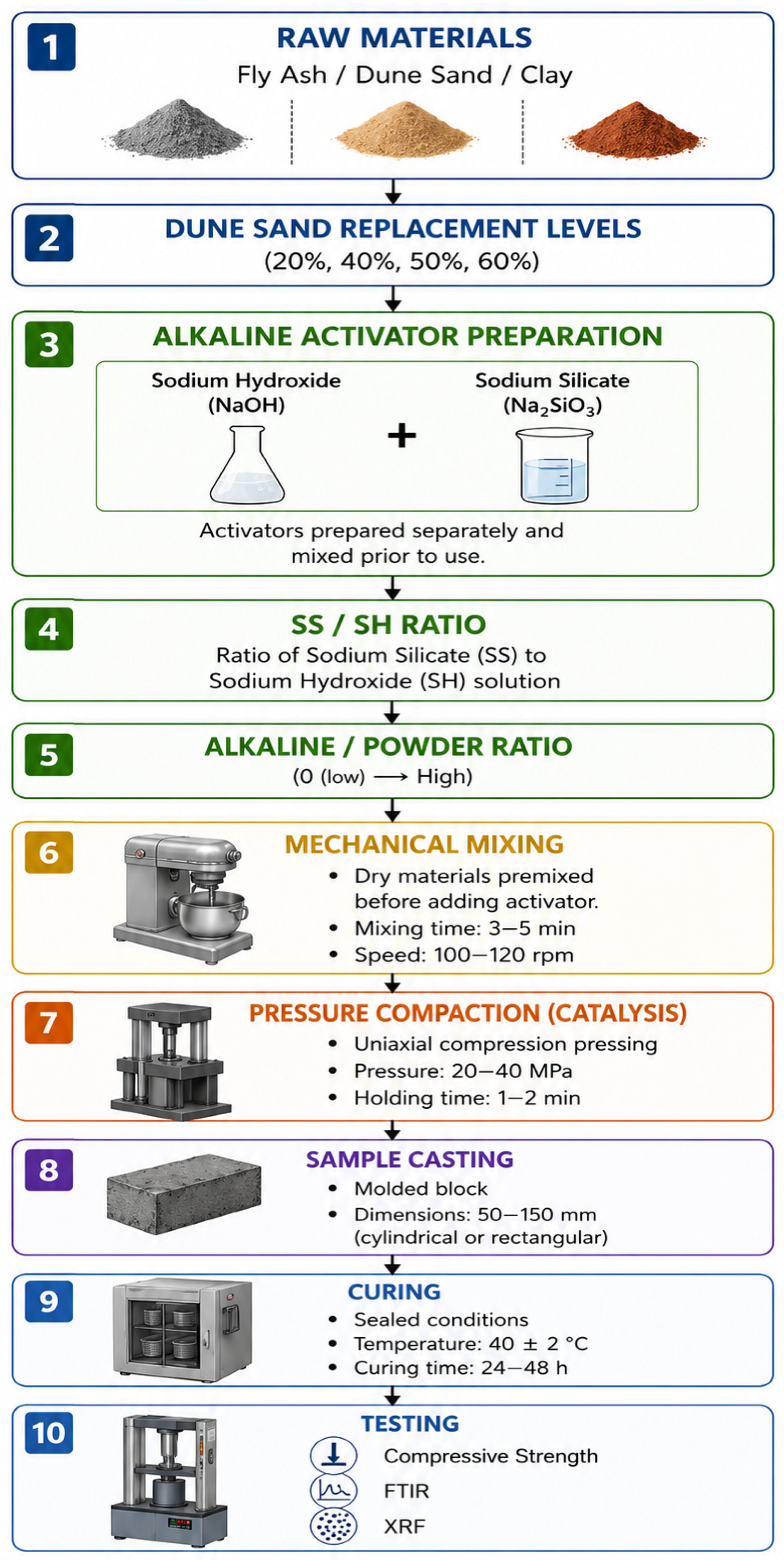
The production of geopolymer concrete (GPC) follows a sequential process distinct from conventional OPC manufacturing. Aluminosilicate precursors (fly ash, metakaolin, slag, or biomass-derived ash) are first proportioned and, where required, calcined or ground to achieve the target particle fineness and reactivity. An alkaline activator solution, typically a combination of sodium hydroxide and sodium silicate, is prepared separately and allowed to stabilise before mixing. The precursor and activator are then combined with aggregates and any admixtures in a controlled mixing sequence to ensure homogeneous dispersion of the alkaline solution throughout the matrix. The resulting paste is cast into formwork and subjected to a defined curing regime, either ambient curing or elevated-temperature curing (typically 60–90 °C for several hours), which governs the rate and extent of geopolymerisation [
20]. Curing condition exerts a strong influence on final strength and microstructural development, a factor that becomes particularly relevant when biomass-derived precursors of variable reactivity are introduced into the system.
In conclusion, whereas geopolymers and AABs both depend on alkaline activation, their distinct structural configurations and chemistries yield distinctive engineering characteristics and potential applications [
19]. Selecting the right binder system requires an understanding of these variations, especially when using biomass-based materials that may bring extra calcium, silica, or variability that affects the primary reaction pathway and overall performance [
23].
Figure 1 summarises this variation, comparing the range of preparation and curing pathways reported across the included studies. Within a systematic review context, this figure serves a methodological purpose: it illustrates the degree of procedural heterogeneity present in the reviewed literature, specifically the diversity of curing temperatures, durations, and ambient versus thermal regimes, which is a primary source of variability in reported performance outcomes.
2.2. Biomass as a Sustainable Material Resource
Biomass-derived materials used in alkali-activated systems fall into two broad categories based on their chemical character: silica-rich ashes (e.g., rice husk ash, sugarcane bagasse ash) that contribute reactive amorphous silica and are compatible with low-calcium geopolymer chemistry, and calcium-rich or carbon-based materials (e.g., palm oil fuel ash, biochar) that interact with the binder matrix through different mechanisms POFA via calcium-driven gel formation, and biochar primarily through physical effects such as moisture retention and pore modification rather than pozzolanic reaction [
24,
25,
26,
27]. This compositional diversity, combined with variability introduced by feedstock source, combustion conditions, and processing method, is a central reason why biomass integration requires systematic, comparative evaluation rather than reliance on any single study [
28,
29,
30].
Environmentally, biomass ashes offer sustainability advantages as agricultural waste products requiring minimal additional embodied energy, while biochar incorporation can sequester atmospheric carbon, potentially producing carbon-negative materials [
28]. Decentralised biomass supply chains enable localised production, reducing transportation emissions and supporting regional development [
29]. However, challenges persist in compositional variability, the absence of standardised systems, limited long-term durability data, insufficient understanding of synergistic effects in hybrid systems, and scarce techno-economic assessments [
30]. Addressing these gaps requires coordinated research spanning material characterisation, performance validation, economic analysis, and standardisation development to facilitate transition from laboratory demonstration to commercial implementation.
2.3. Engineering Properties of Biomass-Integrated Geopolymers and Alkali-Activated Binders
The chemical makeup of the precursor materials and the activation process parameters play a significant role in determining the engineering properties of geopolymers and alkali-activated binders [
31]. The performance of the finished composite may be improved or, in certain situations, challenged by the new chemical and physical dynamics introduced by incorporating biomass-derived materials into these systems. To optimise mix designs and ensure consistent quality in real-world applications, it is essential to understand these consequences.
2.3.1. Workability and Setting Behaviour
Two critical factors that affect the ease of mixing, installing, and curing binder systems are workability and setting time. Because biomass ash alters the surface area and particle fineness of geopolymer mixtures, it typically modifies their rheological properties [
32]. Finely ground ash, such as rice husk ash, tends to require more water, making it less workable. On the other hand, coarser ashes might increase flowability but have a more negligible effect on binder reactivity. Setting behaviour can also be affected by unburned carbon and uneven particle shape, which can adsorb alkaline activators or hinder the dissolving of aluminosilicate phases [
33]. The setting properties are further influenced by the alkali content, water-to-binder ratio, and curing temperature. According to studies, the composition and reactivity of the ash determine whether partially substituting biomass ash for fly ash or slag speeds up or slows down setting [
34]. While ashes with a larger calcium or potassium concentration may result in flash setting or instability if not adequately balanced, ashes high in reactive silica generally encourage early strength growth through improved polymerisation kinetics.
2.3.2. Compressive and Flexural Strength
A critical measure of binder effectiveness and structural appropriateness is compressive strength. Because different research studies utilise various biomass sources and preparation techniques, the impact of biomass integration on compressive strength varies significantly [
35]. For instance, by encouraging further gel formation and densifying the microstructure, rice husk ash, when properly treated and crushed, can increase compressive strength. However, poorly handled ashes with high carbon content or crystalline phases may degrade the matrix by lowering reactivity or causing cavities [
36]. The behaviour of flexural strength exhibits comparable patterns. By enhancing energy absorption and crack resistance, the addition of tiny biomass particles can enhance flexural performance. This is frequently ascribed to the refining of the pore structure and the filler effect. However, flexural strength may be compromised by weak interfacial bonding between the matrix and aggregates due to excessive ash content or large particle size [
4]. Although this varies with the nature and reactivity of the biomass, the ideal replacement level typically falls between 10% and 20% of the overall binder mass.
2.3.3. Density and Porosity
The density and porosity of biomass-integrated binders significantly influence their mechanical and durability performance. Generally speaking, biomass ashes have a lower specific gravity than conventional cementitious materials, which lowers their bulk density [
37]. When creating lightweight concrete for non-structural or thermal insulation applications, this reduction may be beneficial. Higher porosity, however, can have a detrimental effect on permeability and mechanical strength. For long-lasting performance, the mix design must be optimised to strike a balance between low density and sufficient compaction [
38]. The morphology and fineness of biomass ash significantly impact the composite’s microstructural properties. By filling in the spaces between bigger particles, a finely graded ash can increase packing density and decrease porosity. This “filler effect” enhances interfacial bonding and contributes to overall strength development [
39]. On the other hand, coarser ashes with irregularly shaped particles might have more empty spaces, which would weaken the matrix and make it easier for hostile ions and moisture to enter.
2.3.4. Durability and Chemical Resistance
Durability refers to a binder system’s ability to withstand long-term exposure to chemicals and environmental conditions. Compared with Portland cement, geopolymers and AABs are renowned for superior chemical resistance, particularly in sulphate and acidic environments [
40]. Depending on their makeup, adding biomass ashes can either increase durability or, in certain situations, decrease it [
41]. When handled correctly, rice husk ash and sugarcane bagasse ash help create a denser microstructure and reduced permeability, which improves resistance to sulphate attack and chloride penetration. Stable gel phases that prevent ion diffusion are supported by a higher silica concentration [
41]. On the other hand, biomass ashes that contain a high amount of alkali or unburned carbon may increase the likelihood of efflorescence or interfere with gel formation, thereby reducing their endurance [
42]. To maintain durability performance, adjustments to calcination and mixing parameters are essential.
2.3.5. Thermal and Fire Resistance
The exceptional fire and heat resistance of geopolymer binders is one of their unique qualities. This characteristic can be further enhanced by incorporating specific biomass resources. For instance, adding biochar or rice husk ash can increase thermal stability by slowing down structural deterioration at high temperatures and lowering thermal conductivity [
43]. These composites are suitable for fire-resistant building applications due to the carbon-rich materials’ ability to enhance insulation and reduce heat transfer. However, by creating microcracks when heated, excessive amounts of organic material or incomplete combustion by-products can jeopardise integrity [
44]. Therefore, it is crucial to carefully prepare biomass materials to balance structural stability and thermal performance.
2.3.6. Microstructural Characteristics
The addition of biomass ash can alter the porosity and gel shape of alkali-activated and geopolymer systems at the microstructural level. Several research studies using scanning electron microscopy have shown that fine silica-rich biomass ashes promote a denser, more continuous gel matrix with fewer unreacted particles [
41]. The production of hybrid C-A-S-H/N-A-S-H gels is enhanced by a secondary reaction between calcium and silica, resulting in increased strength and decreased permeability [
45]. Reactivity, particle fineness, and composition must all be carefully balanced for biomass-integrated binders to have overall durability and microstructural integrity.
2.3.7. Sustainability Potential
Integrating biomass into geopolymer and alkali-activated binder systems enhances sustainability across environmental, economic, and social dimensions [
46]. These binders reduce carbon emissions by eliminating the high-temperature calcination required for Portland cement production, while biochar supports carbon sequestration and the potential development of carbon-negative materials. The use of agricultural residues such as rice husks and sugarcane bagasse supports circular economy principles by converting waste into valuable construction inputs and reducing open burning and landfill impacts [
47]. Biomass ash production can utilise waste heat, improving energy efficiency. Decentralised biomass supply chains lower transport emissions, strengthen rural economies, enhance resilience, and promote closed-loop material cycles [
48].
It is important to note that the engineering properties reviewed across
Section 2.3.1,
Section 2.3.2,
Section 2.3.3,
Section 2.3.4,
Section 2.3.5,
Section 2.3.6 and
Section 2.3.7 are not uniformly consistent across studies. Discrepancies arise from three primary sources: (i) biomass source and feedstock variability, whereby RHA produced at 600 °C exhibits predominantly amorphous silica with high pozzolanic reactivity, while combustion at temperatures above 800 °C promotes crystalline phase development that reduces reactivity and compromises mechanical performance; (ii) processing conditions, including grinding fineness, calcination duration, and loss on ignition, which critically govern whether biomass ash strengthens or weakens the binder matrix; and (iii) binder composition and curing regime, where thermally cured systems consistently achieve higher strength gains than ambient-cured equivalents under otherwise identical mix designs. These sources of inter-study variability are addressed systematically in the data extraction and synthesis methodology (
Section 3.2.2) and are discussed in detail in the context of specific performance findings in
Section 4.1 and
Section 4.5.
2.4. Comparative Analysis
2.4.1. Material Characteristics
Alkali-activated binders (AABs) and geopolymers are two alternative cementitious materials that have emerged as promising low-carbon alternatives to ordinary Portland cement (OPC) as the global construction industry faces the twin challenges of managing industrial and agricultural waste and lowering carbon emissions [
49]. The use of biomass-derived ashes, waste products from rice husk, palm oil, sugarcane bagasse, and sawdust, is particularly intriguing because it improves binder performance and reduces landfill disposal, benefiting both the environment and engineering [
50]. This comparative study examines the incorporation of biomass ashes into geopolymers and AAB systems, with a particular focus on the materials’ chemical compatibility, mechanical and durability performance, microstructural traits, thermal properties, workability, environmental implications, and implementation difficulties [
29].
In terms of chemistry, the silica, alumina, and calcium content of biomass ashes varies, affecting their compatibility and reactivity with binder systems. Rice husk ash (RHA) and sugarcane bagasse ash (SCBA) are examples of high-silica, low-CaO ashes that geopolymers, which prefer low-calcium aluminosilicate precursors, work best with [
51]. This helps to create stable N-A-S-H (sodium aluminosilicate hydrate) gels. AABs, on the other hand, can handle a wider range of ashes, including sawdust ash and palm oil fuel ash (POFA), which have high calcium concentrations. This allows them to create C-A-S-H or hybrid C-(N)-A-S-H gels with better early strength [
52].
2.4.2. Mechanical Performance
Mechanically, AABs tend to outperform geopolymers at early ages due to rapid calcium-based reactions, achieving compressive strengths of 45–65 MPa within 28 days, while geopolymers with biomass ashes typically reach 35–55 MPa, particularly when thermally cured [
4]. Nevertheless, geopolymer systems excel in durability, exhibiting strong resistance to acids, sulphates, and chloride-ion penetration due to their chemically stable, low-calcium matrices. In contrast, high-CaO AABs can be more susceptible to leaching and carbonation unless carefully formulated [
53].
2.4.3. Microstructural Characteristics
Biomass ashes refine pore architectures in both systems, as indicated by microstructural SEM and XRD investigations. POFA enhances gel formation and packing in AABs, whereas RHA and SCBA densify the geopolymer matrices. Because N-A-S-H gels are thermally stable, geopolymer binders perform better thermally, maintaining integrity at higher temperatures, while AABs may lose strength at high temperatures [
54].
2.4.4. Workability and Processing Behaviour
AABs, especially those with calcium-rich ashes, are often more forgiving in terms of water demand and setting behaviour. In contrast, RHA, with its high surface area, can limit flowability in geopolymers and may require the use of superplasticisers [
32]. Pre-treatment (such as grinding, sieving, and calcination) is necessary to address processing issues, including variability, unburned carbon, and uneven fineness, which can affect the sustainability and scalability of the production process.
2.4.5. Environmental and Sustainability Aspects
In terms of the environment, both technologies offer notable reductions in embodied carbon compared to OPC, particularly when ashes are obtained locally and require minimal processing [
32]. Because geopolymers don’t undergo calcium hydration, they might have slightly lower life-cycle emissions. However, this advantage may be negated using commercially generated sodium silicate. The activators and calcium-rich components of AABs, particularly those based on slag, have a higher embodied energy but require less energy for curing [
55]. The lack of standardised quality, classification, and performance assessment standards for biomass ash is a barrier to commercial implementation, despite the fact that biomass integration is economically advantageous and supports the objectives of the circular economy [
56]. The general relevance of the findings is further limited by regional diversity in biomass composition, driven by variations in plant species, soil types, and combustion methods.
Although significant knowledge gaps remain, incorporating biomass ashes holds great promise, despite these obstacles. These include the creation of hybrid multi-source systems, the need for long-term durability studies under actual exposure conditions, and thorough life cycle assessments that account for post-use, transportation, and energy processing scenarios [
29]. To put this technique into practice, field-scale validation of lab data is also required, particularly across a range of climatic and environmental conditions. While geopolymers offer long-term durability and exceptional chemical resistance, AABs provide superior early-age mechanical properties and processing resilience, making both suitable for a range of applications [
57]. Selecting the appropriate ash type, binder chemistry, and processing technique, based on performance objectives and local resources, is crucial to the success of biomass-integrated binders [
29]. To mainstream these sustainable options in the future, it will be essential to harmonise research findings, establish international performance standards, and encourage industrial adoption through certification frameworks and legislation [
46]. In conclusion, there is a revolutionary opportunity to decarbonise construction, valorise agricultural waste, and create robust, environmentally friendly building materials that align with the circular economy and global climate goals by integrating biomass into geopolymers and AABs.
2.4.6. Alignment with United Nations Sustainable Development Goals
This research on biomass-integrated geopolymer and alkali-activated binder systems aligns closely with three critical United Nations Sustainable Development Goals (SDGs), positioning these innovative materials as transformative pathways toward achieving global sustainability and climate-mitigation objectives [
46]. The findings align particularly strongly with SDG 9 (Industry, Innovation and Infrastructure), SDG 11 (Sustainable Cities and Communities), and SDG 13 (Climate Action), as identified in the study’s comprehensive assessment of technical performance, environmental benefits, and economic viability [
47].
The development of biomass-integrated binders represents a significant contribution to SDG 9 by advancing innovation in construction materials technology and offering resilient, sustainable infrastructure solutions [
4]. By transforming agricultural waste into high-performance construction materials, this research promotes inclusive and sustainable industrialisation while fostering innovation in green building technologies [
6]. The integration of locally available biomass resources supports the development of sustainable infrastructure that can withstand environmental stresses while reducing dependency on conventional, carbon-intensive materials, thereby strengthening industrial capacity and technological capabilities in both developed and developing regions [
29].
Biomass-integrated binders directly contribute to SDG 11 by making cities and human settlements more inclusive, safe, resilient, and sustainable [
47]. The demonstrated carbon footprint reductions of 40–60% compared to ordinary Portland cement, combined with material cost reductions of 15–35% under localised production models, make sustainable construction more accessible and economically viable for diverse communities [
46]. These figures represent synthesised ranges derived from multiple quantitative life-cycle assessment and techno-economic studies within the reviewed literature rather than values extracted from any single study; the full range reflects variation in processing efficiency, energy sourcing, transportation distance, and regional production context across the included studies. These materials support the creation of resilient urban infrastructure while simultaneously addressing waste management challenges by valorising agricultural residues, thereby promoting circular economy principles within urban development frameworks and reducing environmental degradation associated with both cement production and agricultural waste disposal [
29].
Furthermore, the research directly addresses SDG 13 by achieving substantial reductions in greenhouse gas emissions from cement production, which accounts for approximately 8% of global CO
2 emissions [
2]. By eliminating energy-intensive limestone calcination, reducing reliance on clinker, and incorporating waste-derived biomass, these binder systems offer concrete pathways toward decarbonising the construction sector [
6]. The potential for carbon sequestration through biochar incorporation further enhances climate action outcomes, potentially enabling carbon-negative construction materials that actively remove atmospheric carbon dioxide while providing structural performance [
28]. Collectively, the findings demonstrate that biomass-integrated geopolymer and alkali-activated binder technologies serve as transformative solutions integrating environmental stewardship, economic viability, and social responsibility, aligning construction practices with global climate mitigation strategies and advancing progress toward achieving multiple interconnected sustainable development objectives [
46,
47]
3. Research Methodology
This study employed a dual-methodological approach, combining a Systematic Literature Review with expert peer review, to comprehensively investigate the integration of biomass in geopolymer and alkali-activated binder systems. These mixed methods design enabled triangulation of evidence from published research and professional expertise, ensuring robust, validated findings that address both theoretical understanding and practical applicability.
3.1. Research Design and Philosophical Approach
The research adopted an evidence-based synthesis approach, utilising secondary data from peer-reviewed sources rather than generating primary experimental data. This systematic review design is particularly appropriate given the dispersed nature of existing research on biomass-integrated sustainable construction materials, which uses varying methodologies and yields diverse outcomes that require consolidation and critical assessment. The methods adhered to the PRISMA (Preferred Reporting Items for Systematic Reviews and Meta-Analyses) framework to ensure transparency, reproducibility, and methodological rigour throughout the review process [
58]. In compliance with the PRISMA 2020 statement [
58], this review followed all applicable reporting items, including structured search documentation, transparent eligibility criteria, systematic screening procedures, data extraction protocols, and risk of bias considerations. A completed PRISMA 2020 checklist is provided as
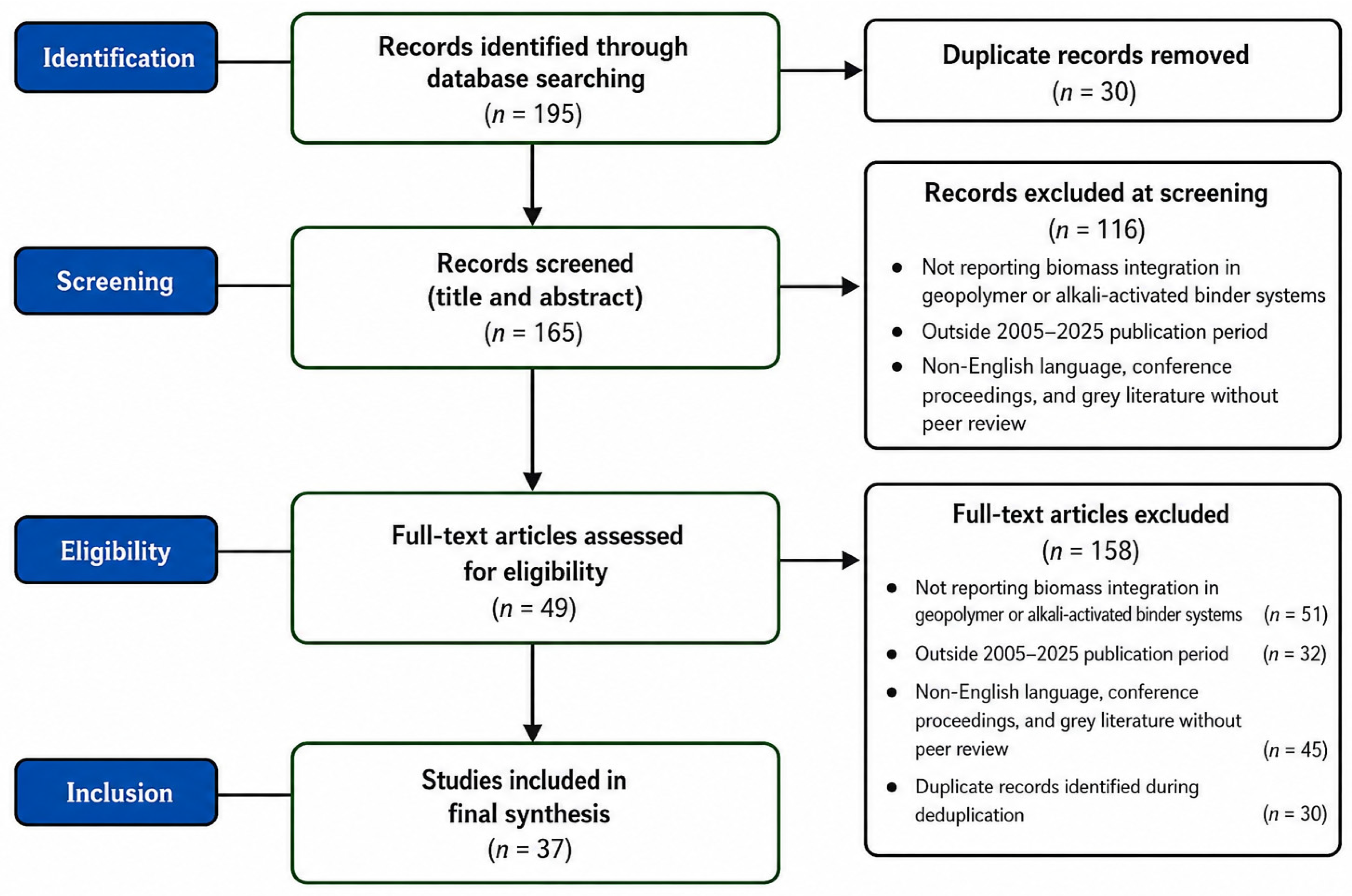
Supplementary Material (Table S1). The PRISMA 2020 flow diagram illustrating the complete article identification, screening, eligibility assessment, and inclusion process is presented in
Figure 2.
The study employed a mixed-methods structure that integrated quantitative performance metrics, such as compressive strength, density, and durability indicators, with qualitative assessments of sustainability, scalability, and material behaviour. This integration was further strengthened by expert validation, which provided professional perspectives on industrial feasibility and real-world applications. The balanced representation of technical, environmental, and socioeconomic dimensions ensured comprehensive coverage of all aspects relevant to the integration of biomass in alternative binder systems.
3.2. Systematic Literature Review
3.2.1. Search Strategy and Paper Identification
A systematic literature search was conducted across four major databases: Scopus, Web of Science, ScienceDirect, and Google Scholar, ensuring comprehensive coverage of materials science and engineering literature. The use of Scopus, Web of Science, ScienceDirect, and Google Scholar ensures comprehensive, multi-database coverage, minimising publication bias. Scopus and Web of Science capture high-impact, peer-reviewed, indexed literature; ScienceDirect provides access to specialised engineering journals, while Google Scholar broadens coverage to include grey literature and emerging research [
59]. The search focused on biomass residues (biochar, rice husk ash, sugarcane bagasse ash, palm oil fuel ash) incorporated into geopolymer and alkali-activated binder systems. A three-group Boolean search strategy was developed to maximise coverage of relevant terminology. Group 1 captured biomass-derived precursor terms: (“biochar” OR “rice husk ash” OR “sugarcane bagasse ash” OR “sugar cane bagasse ash” OR “palm oil fuel ash” OR “palm oil ash” OR “wood ash” OR “sawdust ash” OR “biomass ash”). Group 2 captured binder-type terms: (“alkali-activated” OR “geopolymer”). Group 3 captured the cementitious application domain: (“cement” OR “mortar” OR “concrete”). The three groups were combined with the Boolean operator AND, yielding the full search string: TITLE-ABS-KEY [(biochar OR “rice husk ash” OR “sugarcane bagasse ash” OR “sugar cane bagasse ash” OR “palm oil fuel ash” OR “palm oil ash” OR “wood ash” OR “sawdust ash” OR “biomass ash”) AND (“alkali-activated” OR “geopolymer”) AND (cement OR mortar OR concrete)]. This structure was applied consistently across Scopus, Web of Science, ScienceDirect, and Google Scholar. Searches were limited to peer-reviewed English journal publications from 2005 to 2025, balancing current relevance with temporal depth. This process yielded 195 potentially relevant documents for detailed screening, a substantially larger initial pool than the narrower single-string search used in the original review protocol, reflecting more comprehensive coverage of the terminology variation present in this literature.
The scope of biomass materials included in this review was deliberately broad, encompassing rice husk ash (RHA), sugarcane bagasse ash (SCBA), palm oil fuel ash (POFA), wood ash, sawdust ash, and biochar, rather than restricting the search to a narrower subset of feedstocks. This decision reflects two considerations. First, biochar itself is not a single material but a product class derived from multiple agro-industrial sources (e.g., rice husk, sugarcane bagasse, palm kernel shell, wood) under varying pyrolysis conditions, meaning that excluding biochar broadly, or restricting it to a single feedstock, would arbitrarily fragment a substantial and relevant body of evidence. Second, many primary studies directly compare multiple biomass types within a single experimental programme (e.g., RHA versus SCBA versus POFA under comparable binder formulations and curing conditions), and a narrower scope would exclude this valuable comparative evidence and prevent synthesis across feedstocks. The trade-off of this broad scope is increased compositional and methodological heterogeneity across the included studies, a limitation that is acknowledged and addressed methodologically by reporting performance outcomes disaggregated by specific biomass type (
Table 1 and
Table 2) rather than as pooled values across all biomass categories.
Following initial identification, all records were entered into reference management software, and duplicates were systematically eliminated. Two independent reviewers conducted abstract screening to filter studies unrelated to biomass-based binder systems, enhancing objectivity and reducing selection bias. Where disagreements arose during abstract screening, a third reviewer was consulted to reach consensus. Full-text eligibility assessment was conducted independently by both reviewers, with disagreements resolved by discussion until consensus was reached. Studies passing abstract screening underwent full-text evaluation against established eligibility criteria [
60]. Eligible studies were peer-reviewed journal articles published in English between 2005 and 2025 that addressed the incorporation of biomass into alkali-activated binders or geopolymer systems. Both theoretical and experimental research were accepted if they provided substantial information on engineering performance or sustainability assessment. Studies evaluated the physical, mechanical, chemical, microstructural, and environmental characteristics of binders incorporating biomass-derived materials (biochar, rice husk ash, sugarcane bagasse ash, palm oil fuel ash). Priority was given to articles assessing durability characteristics, including acid, sulphate, or freeze-thaw resistance, alongside compressive, flexural, and thermal conductivity strengths, shrinkage, and porosity measurements.
Biomass materials were excluded if they lacked sufficient peer-reviewed data, had low silica/alumina content limiting pozzolanic reactivity, had high loss on ignition compromising performance, or were not scalable. The study focused on rice husk ash and sugarcane bagasse ash due to high amorphous silica content, widespread availability, and substantial research validation. The search last conducted in September 2025. Initially, 195 records were identified through database searching. During the deduplication stage, 30 duplicate records were removed, leaving 165 studies for title and abstract screening. Following the screening process, 116 records were excluded because they did not satisfy the predefined inclusion criteria. The primary reasons for exclusion included studies that did not report biomass integration in geopolymer or alkali-activated binder systems, publications outside the 2005–2025 timeframe, and non-English language publications, conference proceedings, and grey literature lacking peer review. Subsequently, 49 full-text articles were assessed for eligibility. After detailed evaluation, an additional 12 studies were excluded for failing to fully meet the eligibility requirements, resulting in a final dataset of 37 studies included in the qualitative synthesis. The PRISMA framework ensured transparency, reproducibility, and methodological rigor throughout the systematic review process.
A quality appraisal of all 37 included studies was conducted using the Mixed Methods Appraisal Tool (MMAT), with full results provided in the
Supplementary Material (Table S1). The appraisal assessed each study against five criteria: clarity of research questions, appropriateness of data sources, adequacy of analytical methods, sufficiency of experimental condition reporting, and transparency of mix design proportioning. Of the 37 studies, 22 (approximately 59%) met all five applicable MMAT criteria, demonstrating high methodological quality across all assessed dimensions. A further 15 studies (approximately 41%) met four of the five criteria and were classified as meeting most but not all quality thresholds. Across these 15 studies, the most frequently identified weaknesses were incomplete reporting of curing conditions (eight studies), insufficient description of biomass ash characterisation procedures (five studies), and limited transparency in mix design proportioning (two studies). No study was found to meet fewer than four of the five criteria. Studies with identified quality limitations were not excluded from the synthesis, as their performance data remained relevant to the review objectives; however, findings drawn from these studies are reported with explicit reference to their limitations where they affect interpretive confidence. This appraisal process ensured that the synthesised conclusions are weighted toward the higher-quality body of evidence across the full dataset of 37 included studies.
3.2.2. Data Extraction and Synthesis
A systematic extraction matrix was developed to gather pertinent data fields from each selected study, capturing comprehensive information including study characteristics such as author names, year of publication, and geographic location, as well as detailed material specifications including biomass type, precursor material, binder formulation, curing processes, and experimental design, alongside performance data encompassing mechanical properties such as compressive and flexural strength, microstructural features revealed through scanning electron microscopy and X-ray diffraction, durability metrics including resistance to chemical attack, and sustainability indicators such as lifecycle impact and carbon footprint. The extracted results were organised using a thematic synthesis approach that grouped findings into three main categories: engineering performance, which examined mechanical strength, workability, durability, and microstructural characteristics; environmental sustainability, which assessed carbon footprint reduction, waste valorisation, and energy efficiency; and application potential, which evaluated economic feasibility, scalability, and industrial readiness. Performance benchmarks and descriptive comparison tables were developed where suitable to enable analytical contrast across investigations. When disagreements arose over data interpretation, discussions among reviewers were held to reach consensus, enabling this thorough methodology to facilitate a logical synthesis of trends, knowledge gaps, and emerging opportunities in the integration of biomass materials into alkali-activated and geopolymer systems.
Because the included studies varied substantially in curing regime (ambient curing versus thermal curing at temperatures typically ranging from 60–90 °C), alkali activator type and concentration (e.g., sodium hydroxide molarity, sodium silicate modulus), and biomass replacement level (ranging from below 10% to above 30%), these three parameters were systematically extracted as moderating variables for each study rather than treated as incidental detail. During synthesis, performance outcomes were not pooled into single average values across all studies; instead, findings are reported as ranges conditional on these variables (e.g., strength or durability outcomes at a stated replacement level and curing regime), reflecting the spread of values reported under comparable conditions rather than implying direct equivalence across studies conducted under substantially different parameters. Where comparative statements are made between binder systems or biomass types in
Section 4, these comparisons are restricted, where possible, to studies employing broadly similar curing regimes and activator concentrations; instances where this was not possible are noted explicitly alongside the relevant finding.
3.3. Expert Peer Review
3.3.1. Reviewer Selection and Qualification
Experts in environmental engineering, green construction policy, and sustainable building materials from academia and industry were consulted throughout the assessment process. Experts were selected based on three explicit criteria: (i) a minimum of five years of directly relevant professional experience in at least one of the five thematic domains central to the study’s objectives (binder chemistry and materials science, structural durability and engineering performance, environmental and life-cycle sustainability, industrial processing and production economics, and regulatory and standards policy); (ii) active engagement in either academic research or industry practice involving geopolymer, alkali-activated, or supplementary cementitious material systems; and (iii) demonstrated familiarity with sustainable construction materials, evidenced through publications, professional roles, or project involvement. Recruitment was conducted through purposive sampling via professional networks and academic contacts and continued until domain coverage across all five thematic areas was confirmed. Interviews were conducted online via Microsoft Teams, lasting approximately 45–60 min each. Each participant received an information sheet and provided informed consent prior to participation. Throughout
Section 4, expert contributions are explicitly distinguished according to their function: corroborating SLR-derived findings, supplying practical implementation detail not captured in the reviewed literature, or identifying research and knowledge gaps insufficiently addressed by existing studies.
Expert interviews were designed to serve three distinct functions within the triangulated methodology, rather than solely to validate findings already established by the systematic literature review. First, experts provided corroboration of SLR findings, lending independent professional confidence to patterns observed across the reviewed studies. Second, experts contributed practical and implementation-level insight not typically captured in laboratory-based publications, including specific processing thresholds, production economics, supply-chain logistics, and field-deployment considerations encountered in professional practice. Third, experts performed a gap-identification function, highlighting areas insufficiently addressed by the existing literature, such as the scarcity of long-term field performance data and realistic timelines for regulatory and standardisation processes. These three contributions are distinguished where relevant throughout
Section 4, allowing the reader to identify which insights extend beyond, rather than simply restate, the evidence base established by the systematic review.
The expert validation interviews were conducted online via Microsoft Teams. Prior to the interviews, participants were fully informed about the study’s objectives, procedures, and the voluntary nature of their participation. They were also provided with clear explanations regarding confidentiality, anonymity, and their right to withdraw at any stage, in accordance with established ethical research guidelines. The applied interviews conformed to Part 6.5 exemption criteria and were therefore exempt from the Auckland University of Technology Ethics Committee (AUTEC) approval process. Furthermore, all data collection, storage, and management procedures strictly complied with the requirements of the New Zealand Privacy Act 2020 to ensure responsible handling and protection of participants’ information. The panel size of seven experts reflects a purposive sampling approach rather than an attempt at statistical representativeness. Experts were selected to ensure substantive coverage across the five domains relevant to the study’s objectives: binder chemistry and materials science, structural durability and engineering performance, environmental and life-cycle sustainability, industrial processing and production economics, and regulatory and standards policy. As shown in
Table 1, the panel’s composition, spanning academic and industry roles in civil and environmental engineering, materials science, industrial engineering, environmental consultancy, sustainable construction research, and geotechnical engineering, was assembled to ensure each of these domains was represented by at least one expert with directly relevant professional experience. This approach is consistent with established practice for expert validation and triangulation in qualitative and mixed-methods systematic reviews, where the objective is informed professional judgement on the validity, completeness, and practical relevance of synthesised findings, rather than population-level generalisability achieved through probability-based sampling. Representativeness in this context was assessed through two complementary means: domain coverage, confirmed by mapping each expert’s primary area of expertise against the study’s four core objectives prior to interview commencement, and thematic saturation, observed across the six interview themes outlined in
Section 3.3.2, whereby the final interviews yielded no substantially new themes beyond those already identified, indicating that the panel size was adequate for the validation purpose it served.
Table 1 presents the list of peer reviewers and expert contributors.
3.3.2. Review Process and Interview Protocol
The expert review process was structured around a comprehensive set of interview questions carefully crafted to address six critical thematic areas that encompassed the full spectrum of considerations relevant to biomass-integrated binder systems [
61]. Sustainability in design, exploring experts’ familiarity with geopolymer and alkali-activated binder technologies as sustainable alternatives to Portland cement; material characteristics and technical performance, inquiring about technical challenges in ensuring consistency and quality control of biomass-based materials; sustainability and environmental impact, questioning how life cycle assessment or embodied energy analysis could support validation of sustainability claims; economic and industrial feasibility, targeting major cost factors influencing commercial viability of biomass-derived binder materials; future research directions, identifying key research areas or experimental parameters requiring more attention to enhance understanding of biomass-based binder performance; and regulatory barriers, identifying the most significant obstacles to implementing biomass-based binders in large-scale construction projects.
4. Data Analysis
This section presents an integrated analysis of data from the Systematic Literature Review and expert interviews to develop a comprehensive understanding of biomass integration in geopolymer and alkali-activated binder systems. The review provided quantitative evidence on material performance, sustainability outcomes, and cost implications, while expert interviews contributed practical insights from industry experience. A triangulated approach enabled validation, comparison, and refinement of findings. Throughout this section, expert input is presented not merely as confirmation of literature-based findings but is distinguished, where applicable, according to its specific contribution: corroborating SLR evidence, supplying practical implementation detail absent from the literature, or identifying gaps the literature does not adequately address (see
Section 3.3.1). Results are organised into five themes: technical performance, environmental sustainability, economic feasibility, strategic and policy considerations, and implementation challenges and opportunities. This framework offers a holistic and empirically grounded assessment of biomass-based binders as sustainable alternatives to conventional cementitious materials.
4.1. Technical Performance Analysis
This subsection examines the influence of biomass-derived materials, specifically rice husk ash (RHA), sugarcane bagasse ash (SCBA), sawdust ash, and biochar on the mechanical properties, workability characteristics, and durability performance of geopolymer and alkali-activated binder systems. The analysis integrates quantitative findings from the Systematic Literature Review with qualitative insights from expert interviews to provide a comprehensive assessment of technical performance across multiple parameters, including compressive and flexural strength, setting behaviour, microstructural development, and long-term durability under various environmental conditions.
Table 2 summarises the mechanical performance of biomass-integrated geopolymers and alkali-activated binders (AABs).
4.1.1. Compressive and Tensile Strength
The majority of the 37 reviewed studies demonstrated that partial replacement of fly ash or slag with biomass-derived ash enhanced compressive strength, attributed primarily to the high amorphous silica content and fine particle size of biomass residues. Rice husk ash (RHA) and sugarcane bagasse ash (SCBA) proved particularly effective in strengthening the geopolymer matrix through denser microstructural packing and enhanced pozzolanic reactivity. At optimal replacement levels ranging from 10% to 20%, strength improvements of 15% to 40% were consistently reported across multiple investigations. This range reflects variation in curing regime and alkali activator concentration across the reviewed studies; strength gains at the upper end of this range are predominantly associated with thermally cured systems and higher-molarity activators, while ambient-cured systems with lower activator concentrations tend toward the lower end.
Expert validation corroborated these findings while emphasising critical processing parameters that govern mechanical performance. One expert noted, “The key to achieving consistent strength gains with RHA lies in maintaining strict control over combustion temperature, typically between 600 °C and 700 °C to maximise amorphous silica formation while minimising crystalline phases [P1].” Another expert emphasised, “Particle fineness is absolutely critical; we’ve observed that RHA ground to pass through a 45-micron sieve consistently outperforms coarser fractions by 20–25% in terms of 28-day compressive strength [P2]”
Experts cautioned that inadequately treated biomass ash, characterised by high unburned carbon content or excessive crystallinity, can result in microcracking and insufficient geopolymerisation, ultimately compromising long-term strength development. One materials scientist warned, “We’ve seen cases where poorly processed bagasse ash with more than 8% loss on ignition actually weakened the matrix rather than strengthening it, the unburned carbon interferes with alkali activation and creates voids that become failure points under load [P4].”
Biochar incorporation exhibited distinctly different mechanical behaviour compared to mineral ashes. Due to its inherently porous microstructure and lower pozzolanic reactivity, biochar addition typically resulted in modest reductions in compressive strength, particularly at higher dosages exceeding 10%. However, this was counterbalanced by improvements in flexural resistance and crack-bridging capacity. An expert specialising in biochar-modified binders explained, “Biochar functions more as a physical modifier than a chemical one. We’ve documented up to 30% improvement in flexural strength at 5% biochar addition, even though compressive strength dropped by about 12% [P5].”
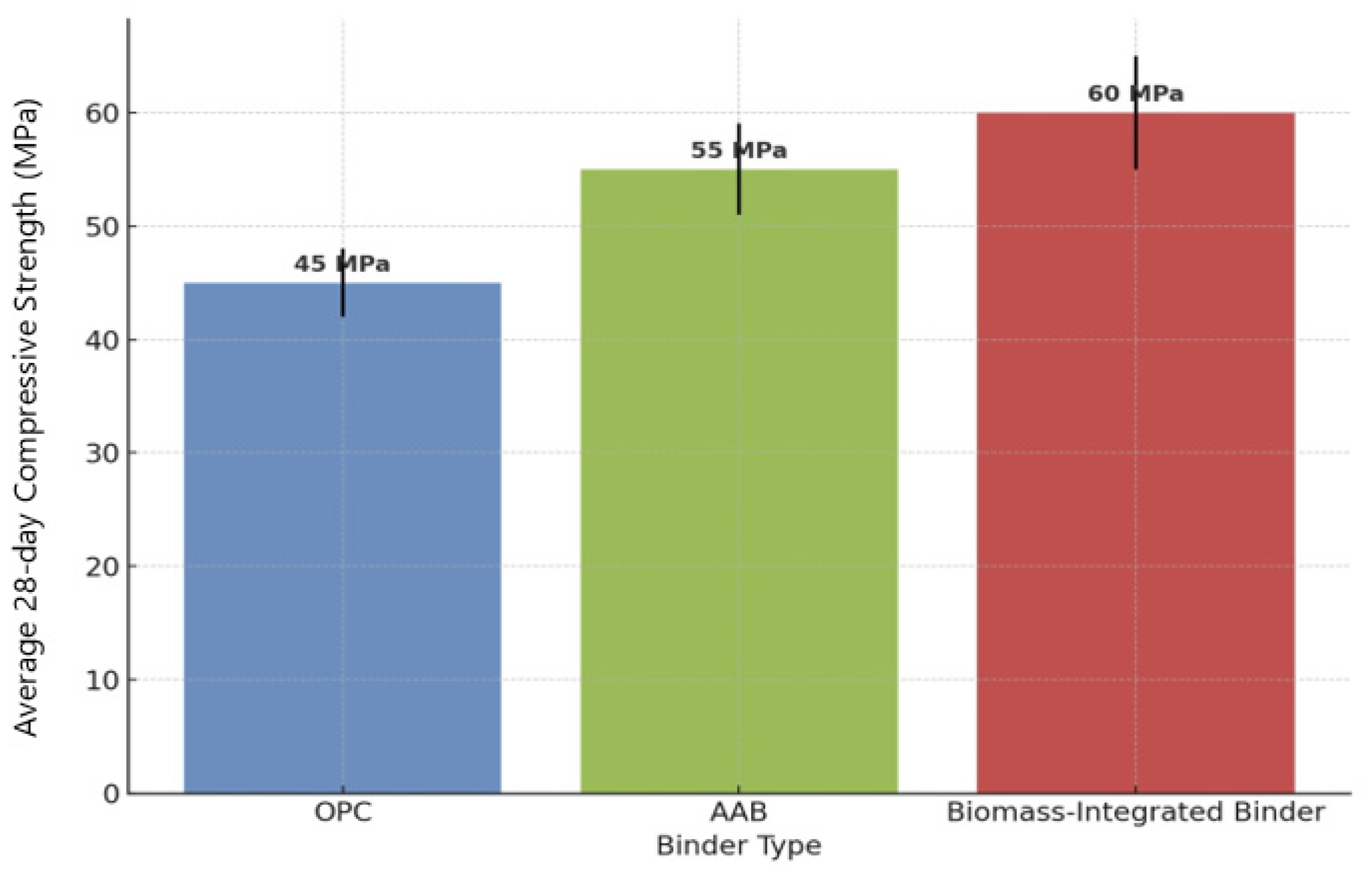
Figure 3 presents a comparative analysis of average 28-day compressive strength across three binder categories: ordinary Portland cement (OPC), standard alkali-activated binders (AABs), and biomass-integrated AAB systems in which a proportion of the primary precursor (fly ash or slag) is partially replaced with biomass-derived ash, such as rice husk ash (RHA) or sugarcane bagasse ash (SCBA). It should be noted that all biomass-integrated values presented refer exclusively to geopolymer and AAB matrices. The results demonstrate that appropriately formulated biomass-integrated AAB systems can achieve compressive strengths comparable to or exceeding those of conventional AAB systems, with average values reaching 60 MPa at 28 days, compared to 55 MPa for standard AAB and 45 MPa for OPC under similar curing conditions [
4,
53]. These strength gains, observed consistently at optimal replacement levels of 10–20%, are primarily attributed to the high amorphous silica content and fine particle size of biomass residues, which promote denser microstructural packing and enhanced pozzolanic reactivity within the alkali-activated matrix [
25,
29,
35].
4.1.2. Durability and Chemical Resistance
Durability assessments from the reviewed literature consistently demonstrate the enhanced performance of biomass-modified binder systems, particularly in terms of resistance to acid exposure, sulphate attack, and chloride ion penetration. The reactive silica and alumina content in biomass ashes promotes the formation of dense, stable binding gel phases, including sodium aluminosilicate hydrate (N-A-S-H) and calcium aluminosilicate hydrate (C-A-S-H) networks, thereby significantly improving chemical stability and reducing matrix permeability. Studies have reported that RHA-incorporated geopolymers exhibit chloride diffusion coefficients up to 35% lower than those of conventional AAB systems. At the same time, SCBA addition improves sulphate resistance by reducing expansion and mass loss under aggressive chemical exposure. One expert observed, “The pore refinement we see with properly processed RHA is remarkable, we’re essentially creating a much tighter microstructure that physically blocks aggressive ions from penetrating the matrix. This translates directly to improved service life in harsh environments [P3].”
Expert reviewers validated these laboratory findings while highlighting critical knowledge gaps and real-world implementation concerns. They emphasised the pronounced scarcity of long-term field exposure data, noting that most durability studies are confined to accelerated laboratory testing over 90 to 180 days, which may not adequately represent the decades-long service life under natural weathering conditions. A senior materials engineer stated, “The problem is that we’re making 50-year performance claims based on 6-month accelerated tests. That’s a significant extrapolation, and we’ve learned from past mistakes with other ‘innovative’ materials that lab performance doesn’t always translate to field durability [P6].” Another expert added, “What concerns me most is that we don’t have real structures that have been standing for 20, 30, 40 years with these biomass-integrated binders. Until we do, there will always be hesitation from designers and specifiers, especially for critical infrastructure [P4].”
Experts identified inconsistent curing regimes and alkali leaching as practical challenges that can compromise durability in field applications, particularly in environments with variable temperature and humidity conditions. Despite these limitations, expert consensus affirmed that properly processed biomass integration can enhance both structural integrity and service life longevity compared to ordinary Portland cement systems. An industry consultant emphasised, “The quality control issue cannot be overstated. Biomass ash from agricultural burning has enormous variability, and it’s currently the single biggest technical barrier to widespread adoption [P8].” Experts recommend that future research prioritise field-scale pilot studies with extended monitoring periods to bridge the gap between laboratory promise and real-world validation.
4.1.3. Workability and Setting Time
Analysis of the reviewed literature revealed that incorporating biomass ash exhibits dose-dependent effects on the fresh-state properties of geopolymer and AAB systems [
25,
29,
35]. At low to moderate replacement levels (up to 20%), biomass ashes can enhance workability through improved particle packing efficiency and matrix densification. The fine particle size distribution of properly processed RHA and SCBA contributes to the filling effect within the paste matrix, optimising rheological behaviour and facilitating better flowability during casting operations [
25]. One expert noted,
“At around 15% replacement, we actually see improved workability compared to the control mix, the fine RHA particles fill the voids between larger particles, creating a smoother, more cohesive paste that’s easier to place and consolidate [P1].”However, higher biomass ash levels (exceeding 20–25%) frequently compromise workability, leading to increased viscosity and reduced flowability. This phenomenon is attributed to the irregular particle morphology and high specific surface area of biomass ashes, which increase water demand and modify paste consistency [
4,
32]. A construction materials specialist explained,
“Once you exceed about 25% biomass ash, the mix becomes noticeably stiffer and harder to work with. The irregular, porous particles absorb water like little sponges, and the angular shapes create more internal friction [P2].” Expert practitioners emphasised that maintaining consistent workability requires careful adjustment of liquid-to-binder ratios and incorporation of chemical admixtures. Superplasticisers were identified as particularly effective in offsetting increased water absorption rates [
38]. One ready-mix producer stated,
“Superplasticisers are essential when working with biomass ashes, we typically need 30–50% more dosage compared to conventional AAB mixes to achieve the same slump [P3].”Setting time behaviour exhibited material-specific patterns. Highly reactive ashes such as SCBA and RHA marginally accelerate setting times by promoting faster dissolution and polycondensation reactions [
51]. Conversely, biochar incorporation resulted in delayed setting attributed to its high porosity and lower chemical reactivity. One researcher noted,
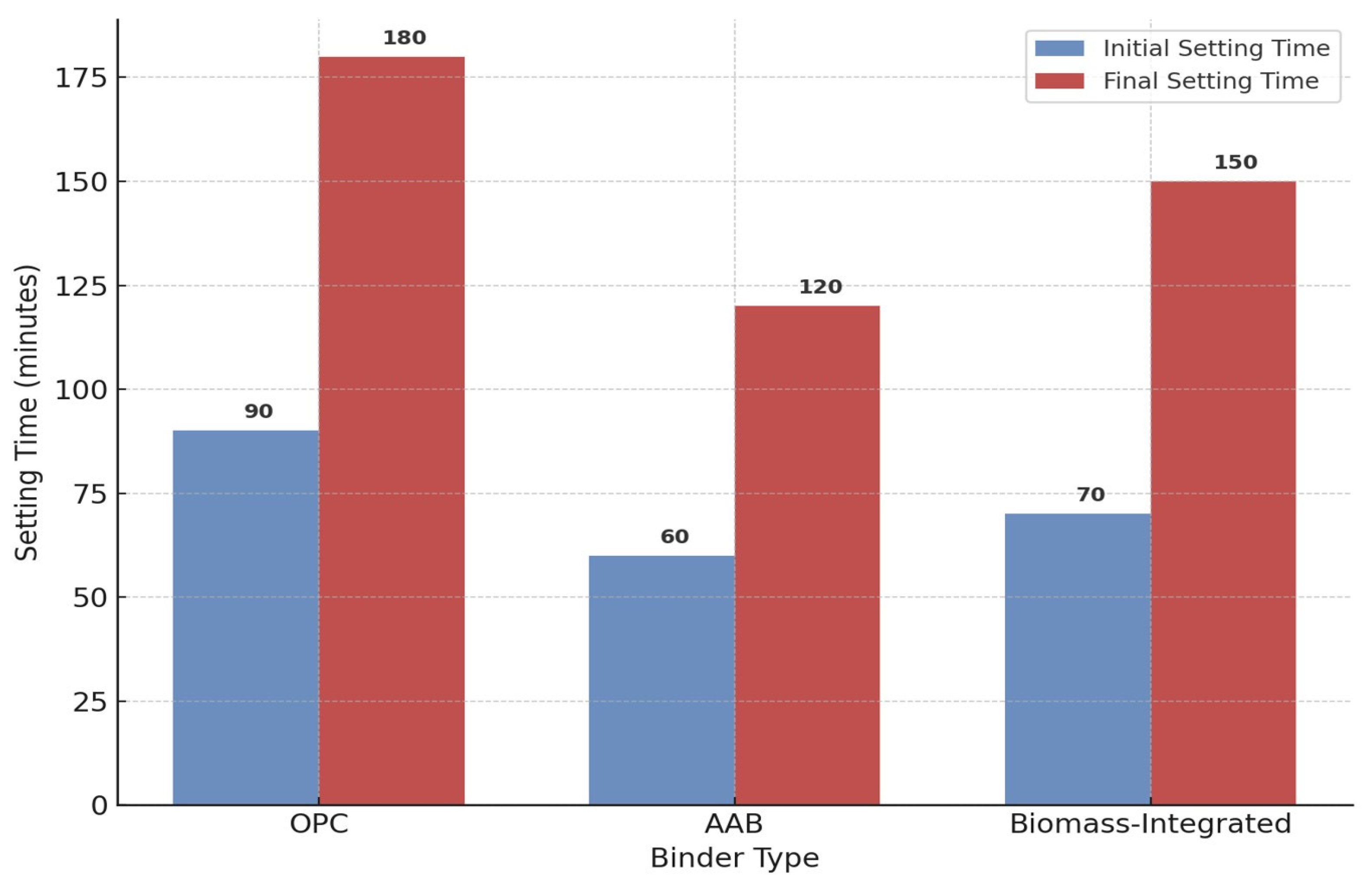
“Biochar acts almost like a retarder, it absorbs a significant portion of the alkaline solution into its porous structure, delaying setting by 30–60 min depending on dosage [P7].”Figure 4 demonstrates that while initial setting times for biomass-integrated AAB systems fall within acceptable ranges for practical applications (60–90 min), final setting times are moderately longer (120–150 min) than those of OPC, providing adequate working time for field placement while maintaining reasonable formwork removal schedules [
4,
29,
53].
4.1.4. Microstructural Observations
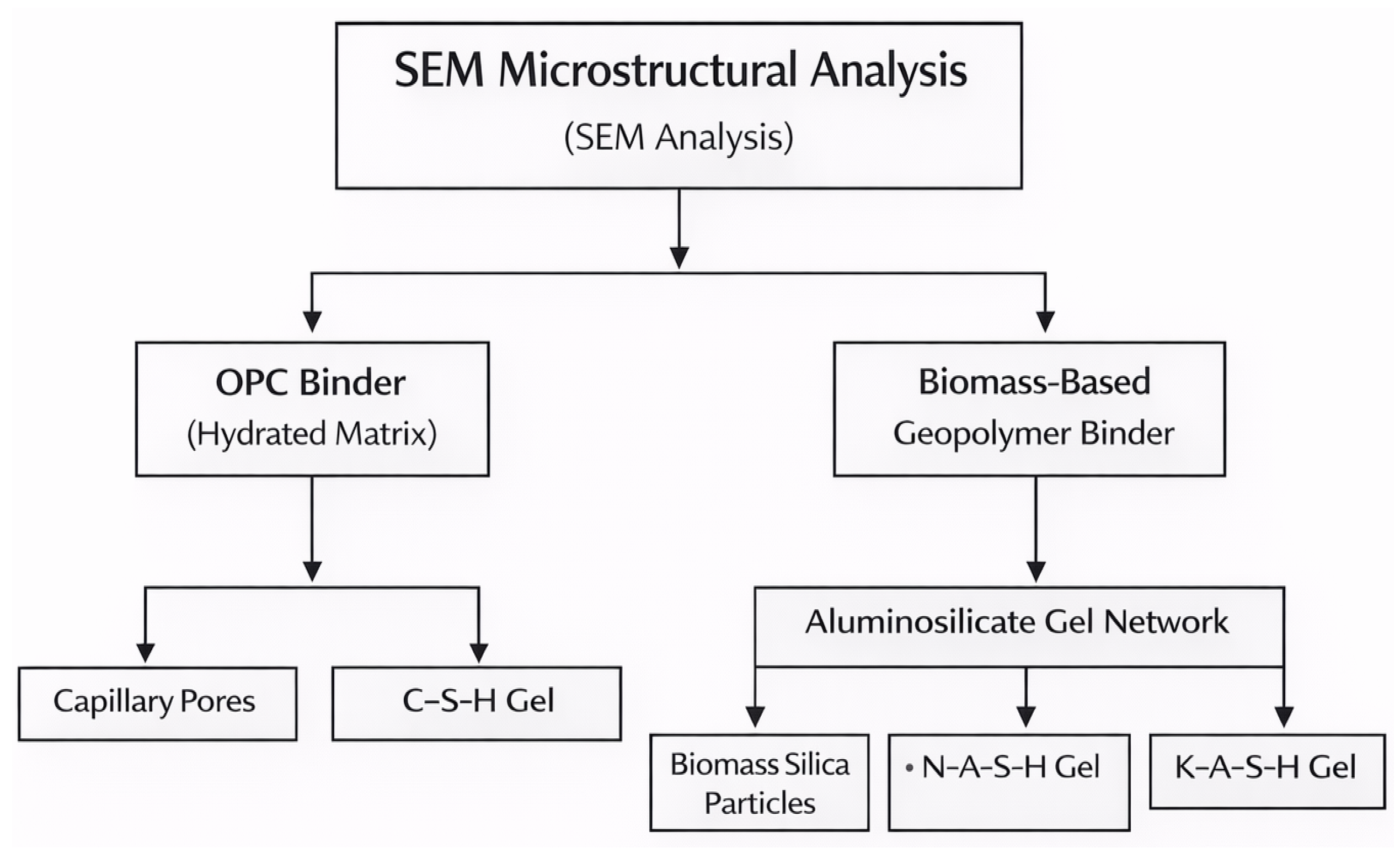
Microscopic and mineralogical examinations from the reviewed literature consistently demonstrated that biomass integration produces denser, more refined microstructures with reduced pore connectivity compared to conventional binder systems. Scanning electron microscopy (SEM) imaging revealed that compositions incorporating SCBA and RHA exhibited enhanced gel formation, characterised by homogeneous, continuous networks with significantly reduced capillary porosity. The fine particle size and high surface reactivity of these biomass ashes facilitate improved particle packing and promote more complete dissolution-polycondensation reactions, resulting in compact aluminosilicate gel structures. X-ray diffraction (XRD) analyses confirmed the formation of predominantly amorphous gel phases, specifically N-A-S-H (sodium aluminosilicate hydrate) in low-calcium geopolymers and hybrid C-(N)-A-S-H (calcium-sodium aluminosilicate hydrate) gels in calcium-enriched systems.
Expert reviewers validated these microstructural findings while emphasising their significance as predictive indicators of long-term performance stability. They noted that microstructural densification correlates strongly with reduced permeability, enhanced durability, and sustained mechanical properties under service conditions. One microstructural analyst explained, “When we see dense, well-connected gel networks with minimal capillary porosity in SEM images, that’s a strong predictor of long-term durability. The microstructure essentially tells us how the material will perform 20, 30, 50 years down the line [P2].”
The refinement of pore structure, characterised by a reduction in average pore diameter from 50–100 nm in conventional AAB systems to 20–50 nm in optimised biomass-integrated systems, directly contributes to improved resistance against aggressive ion ingress and moisture-related degradation mechanisms. A materials characterisation specialist noted, “The pore refinement we achieve with properly processed RHA is extraordinary, we’re cutting average pore diameters by more than half. In marine environments or de-icing salt exposure, this could translate to decades of additional service life [P5].”
However, the pore-refinement benefits described above are dosage-dependent and are not observed uniformly across the reviewed literature. At moderate replacement levels, typically up to 15–20%, the fine particle size and high reactivity of biomass ashes such as RHA and SCBA improve particle packing and promote denser gel formation, consistent with the findings above. Beyond this range, however, several reviewed studies report the opposite trend: increased total porosity, coarser and less continuous pore networks, and reduced compressive strength. This reversal is attributed to a combination of factors, including dilution of the reactive aluminosilicate phase as biomass content increases relative to the primary precursor, incomplete dissolution and reaction of excess fine particles that consequently act as inert fillers or microstructural flaws, and elevated water demand associated with the high surface area and porosity of biomass ashes, which increases capillary porosity upon drying. SEM and XRD evidence from these higher-dosage studies typically shows a greater proportion of unreacted or partially reacted particles embedded within a less continuous gel matrix, contrasting with the dense, homogeneous networks observed at optimal replacement levels. These conflicting findings indicate that pore structure development in biomass-integrated systems follows a non-linear, dosage-dependent relationship rather than a consistent trend of improvement with increasing biomass content, reinforcing that replacement level, alongside feedstock characterisation and curing regime (
Section 3.2.2), is a critical variable governing whether biomass incorporation refines or degrades the binder microstructure.
Nonetheless, experts stressed that compositional variability in biomass ash remains a persistent challenge affecting microstructural consistency. Consequently, rigorous quality control protocols are essential during both ash processing and mix design development to ensure reproducible microstructural characteristics and reliable performance outcomes. An industry consultant emphasised,
“Until we establish industry-wide standards for biomass ash production similar to fly ash and slag, microstructural variability will remain the barrier preventing widespread commercial adoption [P3].” Figure 5 presents the microstructural SEM illustration of biomass-integrated geopolymer and AAB systems.
4.2. Environmental and Sustainability Analysis
This subsection examines the extent to which biomass integration in geopolymer, and alkali-activated binder systems contributes to reducing the environmental footprint of construction materials, addressing one of the core objectives of sustainable building practices. The analysis focuses on four primary dimensions: reducing the carbon footprint by decreasing reliance on energy-intensive cement production, valorising waste through the utilisation of agricultural residues, improving energy efficiency across material processing and production, and conducting a comprehensive life-cycle sustainability assessment that encompasses both cradle-to-gate and cradle-to-grave impacts.
It is important to note at the outset that the environmental and sustainability benefits discussed in this section are not an automatic or unconditional consequence of substituting biomass for conventional precursors; rather, they depend on the full processing chain associated with the biomass-derived material, including transportation distance from feedstock source to processing facility, drying, grinding to target particle fineness, calcination temperature and duration where required, and the energy source used for both ash processing and alkaline activator production. Where this processing chain is inefficient or reliant on carbon-intensive energy, the theoretical sustainability advantages of biomass incorporation can be substantially reduced or, in poorly configured systems, eliminated. The following
Section 4.2.1,
Section 4.2.2,
Section 4.2.3 and
Section 4.2.4 examine each of these factors in turn, alongside the carbon, resource-efficiency, and life-cycle benefits they qualify.
The evaluation integrates quantitative environmental metrics extracted from the SLR, including greenhouse gas emission reductions, embodied energy calculations, and life-cycle assessment data, with qualitative insights from expert interviews regarding practical implementation challenges, regional variations in environmental benefits, and barriers to achieving theoretical sustainability potential. This dual-perspective approach enables a comprehensive assessment of both the demonstrated environmental advantages of biomass-based binder systems and the real-world constraints that may limit their sustainability performance in diverse geographic and industrial contexts. The findings are organised into thematic subsections that address carbon-reduction pathways, resource efficiency and circular-economy contributions, energy consumption considerations, and life-cycle environmental implications.
4.2.1. Carbon Footprint Reduction
The reviewed literature consistently demonstrates substantial reductions in carbon dioxide (CO
2) emissions when biomass-derived ashes partially replace conventional cementitious materials in geopolymer and AAB systems. Quantitative life-cycle assessment studies reported that substituting 20–30% of cement or fly ash with biomass ash yielded CO
2 emission reductions ranging from 25% to 45% compared to equivalent OPC-based systems, with specific reduction magnitudes dependent on activator type, biomass ash processing conditions, and inherent ash reactivity [
2,
6]. Studies incorporating highly reactive RHA achieved the upper range of emission reductions (40–45%), while those utilising SCBA typically reported moderate decreases (30–40%), and less reactive biomass residues showed lower but still significant benefits (25–35%) [
4].
Expert validation corroborated these findings while identifying two primary emission reduction pathways: direct displacement of Portland cement clinker production, which eliminates both calcination-related process emissions (approximately 525 kg CO
2 per tonne from limestone decomposition) and fossil fuel combustion emissions (approximately 400 kg CO
2 per tonne from kiln heating), and waste stream diversion that prevents methane and CO
2 emissions from biomass decomposition in landfills or uncontrolled open burning [
46]. An environmental engineer stated,
“The carbon savings are two-fold, you’re not only avoiding the massive emissions from cement clinker production, but you’re also preventing emissions that would occur anyway from agricultural waste disposal [P7].” However, experts emphasised that system boundaries and processing requirements substantially influence net carbon benefits. The energy consumed during biomass ash processing, particularly calcination at 600–800 °C, mechanical grinding, and sieving, can constitute 15–30% of total embodied energy [
62,
63]. Transportation distances further impact the carbon balance, with benefits diminishing significantly when biomass must be transported more than 200–300 km [
64].
Consequently, localised production models that minimise transportation and utilise waste heat from existing industrial processes represent optimal configurations for maximising carbon reduction potential [
65]. Experts particularly highlighted the transformative potential of coupling biomass ash production with renewable energy sources, noting that overall carbon reduction can approach or exceed 60% compared to OPC systems [
38]. A renewable energy specialist stated,
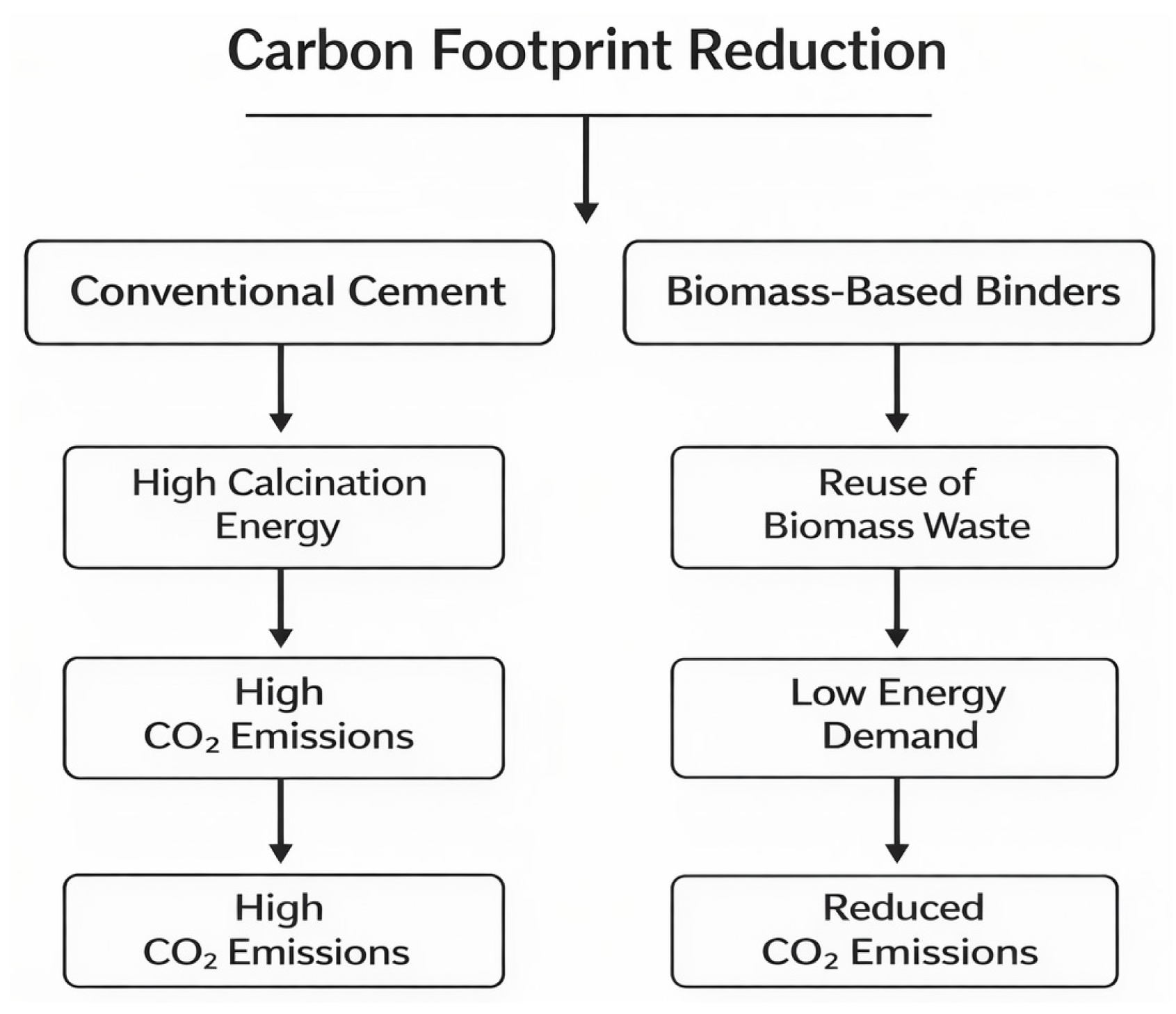
“When we’ve modelled scenarios using solar thermal calcination or renewable grid electricity, the carbon reduction jumps from 35–40% to potentially 55–65%. This is the future, decarbonising not just the material chemistry but the entire production pathway [P5].”Figure 6 illustrates the comparative carbon footprint reduction pathways, demonstrating that traditional cement manufacturing requires high calcination energy inputs and substantial CO
2 emissions from both fuel combustion and limestone decarbonization. In contrast, biomass binder systems leverage waste-stream reuse, lower processing energy demands, and reduced emissions, ultimately achieving significantly lower overall carbon footprints.
4.2.2. Waste Utilisation and Resource Efficiency
The transformation of agricultural by-products into functional construction materials represents a significant advancement in resource efficiency and waste management. The SLR revealed that global agricultural production generates approximately 140 million tonnes of rice husks, 180 million tonnes of sugarcane bagasse, and 54 million tonnes of palm oil residues annually, much of which is currently underutilised, landfilled, or openly burned [
9]. An agricultural waste management expert noted,
“The sheer volume of agricultural residues being wasted is staggering. Converting even 20–30% of these residues into construction materials would make a measurable impact on both waste management and material sustainability [P1].”Incorporating these materials into binder systems at replacement levels of 20–30% could theoretically consume millions of tonnes of agricultural waste annually [
6]. This waste valorisation approach directly addresses resource depletion, with each tonne of biomass ash displacing equivalent quantities of non-renewable resources such as limestone or fly ash, which are in short supply in regions transitioning away from coal-fired power generation [
10]. A materials resource specialist explained,
“The fly ash supply crisis is already here, biomass ashes can fill that gap while actually improving the sustainability profile [P2].”Experts emphasised the potential for localised, decentralised production models that maximise resource efficiency while supporting regional economic development. By establishing small- to medium-scale processing facilities proximate to agricultural zones, the construction industry can access locally abundant residues at minimal transportation costs [
64]. A regional development economist noted,
“Decentralised processing creates employment in rural areas where opportunities are limited. We’ve documented cases in Vietnam where small ash processing cooperatives employ 20–30 people per facility [P3].” Such localisation strategies reduce material transportation distances from 500–1000 km for conventional cement to 50–200 km for biomass-based systems, strengthen rural economies through job creation, and enhance supply chain resilience [
65]. Expert consensus affirmed that maximising resource efficiency benefits requires coordinated development of collection infrastructure, standardised processing protocols, and quality assurance systems [
34].
4.2.3. Energy Consumption and Processing Efficiency
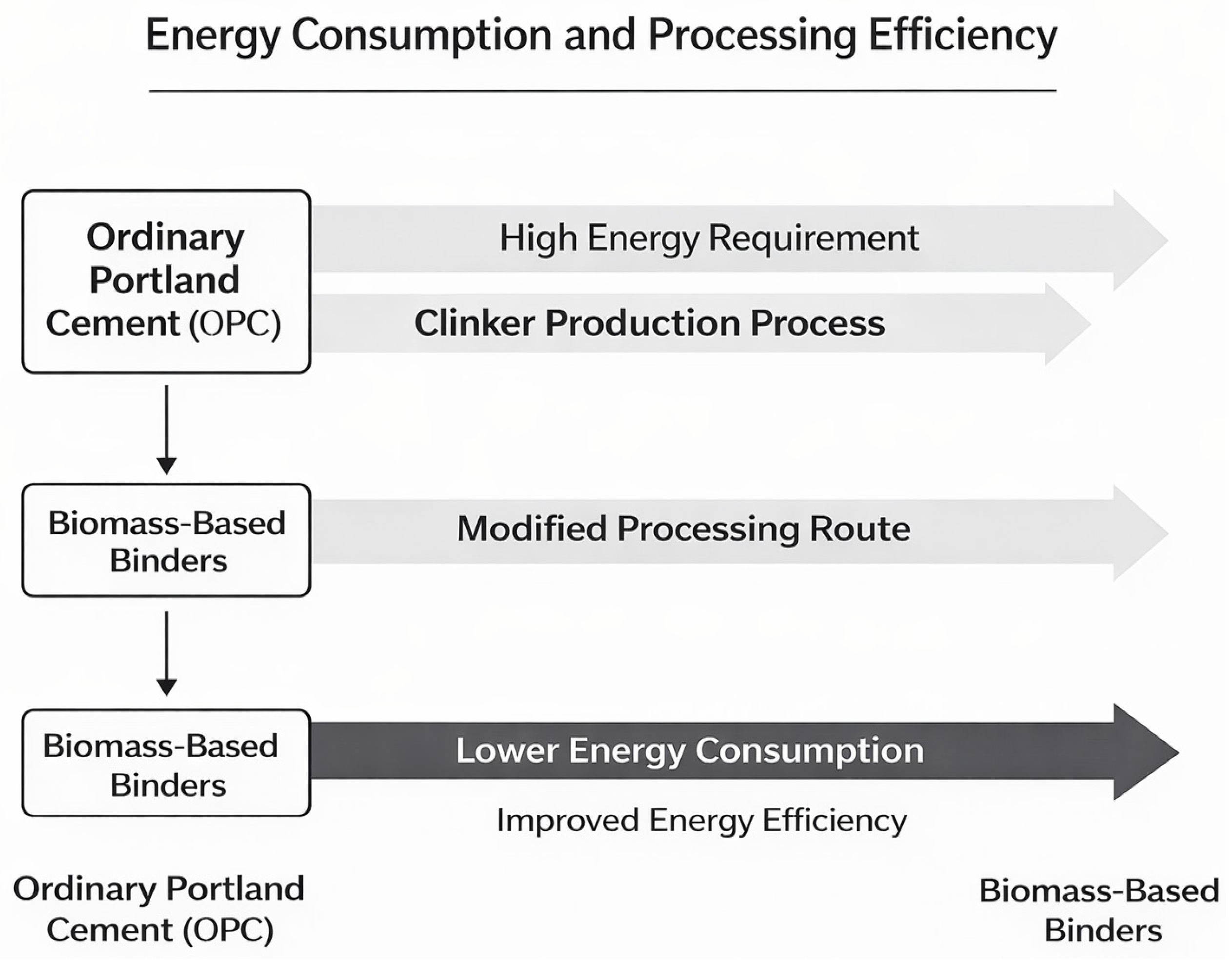
The reviewed literature consistently demonstrates that biomass-based binder production requires substantially lower energy inputs than conventional Portland cement manufacturing. Quantitative assessments revealed that geopolymer and AAB systems incorporating biomass ashes consume 30–50% less energy during synthesis than OPC-based systems, primarily attributable to eliminating energy-intensive limestone calcination at 1450 °C and lower processing temperatures (600–800 °C) for biomass ash calcination [
26,
63]. Studies reported typical embodied energy values of 1.8–2.5 MJ/kg for biomass-integrated geopolymers, compared to 4.5–5.5 MJ/kg for OPC [
38]. However, expert respondents provided critical qualifications, noting that biomass ash preparation involves energy-consuming steps, drying, grinding, and sieving, which, when conducted inefficiently, can consume 0.8–1.5 MJ/kg of processed ash, potentially offsetting 25–40% of theoretical energy savings [
54]. A process engineer cautioned,
“Without proper equipment and process optimisation, you can lose most of the theoretical advantage [P2].”Experts emphasised the critical importance of integrated energy recovery systems, noting that rice mills that generate RHA as a combustion byproduct already produce thermal energy for paddy drying, making the ash essentially a zero-additional-energy byproduct [
65]. An industrial systems specialist stated,
“The best implementations we’ve seen are fully integrated systems where ash is a byproduct of energy generation, the effective energy cost of the ash is nearly zero [P4].” Expert consensus affirmed that achieving full energy efficiency potential requires holistic system optimisation spanning feedstock collection, preprocessing, and binder formulation, with strategic co-location of processing facilities with existing agricultural industries representing key pathways for maximising energy performance.
Figure 7 presents the energy consumption and processing efficiency of biomass-integrated geopolymer and AAB systems.
4.2.4. Life-Cycle Sustainability
Studies examined within the SLR framework demonstrated that the environmental benefits of biomass-integrated binders extend substantially beyond immediate energy and carbon savings, encompassing broader life-cycle sustainability advantages across multiple impact categories. Comprehensive life-cycle assessment (LCA) studies employing cradle-to-gate or cradle-to-grave methodologies reported favorable environmental profiles across diverse indicators including acidification potential (reduced by 20–35%), eutrophication potential (reduced by 15–30%), photochemical ozone creation potential (reduced by 25–40%), and abiotic depletion potential (reduced by 30–50%) compared to equivalent OPC-based systems. These multidimensional environmental improvements reflect cumulative benefits of reduced fossil fuel consumption, decreased virgin raw material extraction, avoidance of agricultural waste decomposition emissions, and elimination of high-temperature industrial processing. An LCA specialist explained, “When we look beyond just carbon emissions to the full spectrum of environmental impacts, acidification from sulfur oxides, eutrophication from nutrient runoff, resource depletion, biomass binders consistently outperform conventional systems across nearly every category. It’s a genuinely holistic environmental improvement, not just trading one impact for another [P8].”
Enhanced durability characteristics of properly formulated biomass-integrated binders contribute additional life-cycle benefits through extended service life and reduced maintenance requirements, with studies documenting that refined microstructure and improved chemical resistance can extend functional service life by 15–25% compared to conventional concrete in aggressive exposure environments [
29]. A structural engineer noted,
“Service life extension is where the real long-term environmental benefits emerge. If a bridge deck lasts 60 years instead of 50 because of improved durability, you’re avoiding an entire reconstruction cycle, all the materials, energy, transportation, and disruption that entails [P5].” Expert assessments suggested that when service life extension is properly accounted for, the total environmental benefit can increase by 20–30% beyond production-phase analysis alone. Expert respondents emphasised strong alignment with multiple United Nations Sustainable Development Goals (SDGs), particularly SDG 9, 11, 12, and 13, with biomass integration establishing circular material flows, reducing industrial emissions, valorising waste streams, and creating climate-resilient materials [
34].
However, experts identified significant methodological challenges that complicate consistent measurement across contexts. The absence of standardised LCA frameworks specifically calibrated for biomass-based binders creates substantial variability in assessment methodologies, system boundaries, and allocation procedures [
15]. An LCA methodology specialist cautioned,
“The LCA literature on biomass binders is all over the place methodologically. Some studies include agricultural impacts, others don’t. When you compare results across studies, you’re often comparing apples to oranges, the conclusions can vary by 50% or more based purely on methodological choices [P6].” Expert consensus affirmed that, while existing studies consistently demonstrate favourable environmental profiles, realising the full potential requires coordinated development of standardised assessment protocols, comprehensive inventory databases, and transparent reporting practices. A final expert concluded,
“Standardisation isn’t just academic, it’s essential for commercial viability. Until we establish these standards, biomass binders will struggle to move from niche applications to mainstream construction materials, regardless of their technical merits [P7].” 4.3. Economic and Industrial Feasibility Analysis
This subsection evaluates the economic viability and industrial scalability of biomass-integrated binder systems through a systematic assessment of cost-effectiveness, production scalability, market readiness, and institutional prerequisites for commercial deployment. As with the environmental findings discussed in
Section 4.2, the economic advantages presented below are not unconditional: they depend critically on transportation distance between feedstock source and processing facility, processing scale and technology, and energy sourcing strategy, each of which is examined in the following
Section 4.3.1,
Section 4.3.2,
Section 4.3.3 and
Section 4.3.4. The analysis integrates quantitative cost data from the Systematic Literature Review with qualitative insights from expert interviews regarding real-world implementation challenges, investment requirements, and pathways to market competitiveness.
Table 3 presents the key comparative indicators of biomass-integrated binder systems.
The Overall Performance classification (Outstanding/Very Good/Good/Average) reflects a composite assessment across four indicators: compressive strength relative to OPC baseline, reported durability performance (chemical and permeability resistance), CO2 reduction potential, and thermal resistance. Each indicator was assessed against thresholds reported across the 37 reviewed studies: compressive strength above 50 MPa at 28 days, CO2 reduction exceeding 45%, and strong durability and thermal ratings across multiple studies were required for an “Outstanding” classification. “Very Good” reflects strong performance in three of four indicators; “Good” reflects moderate performance across most indicators; and “Average” reflects limited, mixed, or insufficiently reported performance in two or more indicators.
4.3.1. Material Cost Competitiveness
The reviewed literature consistently demonstrates that incorporating biomass ash offers substantial material cost advantages compared to conventional cementitious systems [
29]. Quantitative economic assessments reported that partial substitution of cement or fly ash with biomass-derived ashes such as rice husk ash (RHA) and sugarcane bagasse ash (SCBA) can reduce direct material costs by 15–35%, with the specific savings magnitude dependent on regional material pricing, replacement proportion, and feedstock availability. In agricultural regions where biomass residues are locally abundant, such as rice-producing areas of Southeast Asia or sugarcane cultivation zones in Brazil and India, raw biomass ash can be acquired at costs ranging from
$10–30 per tonne compared to
$50–120 per tonne for fly ash and
$90–150 per tonne for Portland cement, representing cost reductions of 60–80% at the precursor material level [
65]. An agricultural economics specialist stated,
“The raw material cost advantage is dramatic when you’re in a rice-producing region. We’ve documented cases where ready-mix producers reduced material costs by 25–30% simply by substituting locally available RHA for imported fly ash. That’s a significant competitive advantage [P1].”Expert respondents validated these theoretical cost advantages, while also emphasising critical contextual factors that determine realised economic benefits. They noted that material cost savings are most pronounced in localised production scenarios, where biomass waste is generated in proximity to binder manufacturing facilities, thereby minimising transportation expenses that can constitute 20–40% of delivered material costs when distances exceed 100–200 km [
65]. A construction materials consultant cautioned,
“Transportation kills the economics if you’re not careful. We’ve seen projects where trucking biomass ash 300 km eliminated all cost savings. The sweet spot is within 50–100 km of the agricultural source, beyond that, the value proposition deteriorates rapidly [P2].”Experts highlighted that agricultural residue pricing exhibits significant seasonal and regional variability influenced by alternative demand sources, harvest cycles, and competing waste management pathways [
9]. One procurement specialist explained,
“Feedstock costs can triple during off-season periods when supply is scarce. You need long-term contracts with guaranteed volumes and price ceilings, or you’re exposed to volatility that makes production planning and pricing nearly impossible [P4].” 4.3.2. Processing and Production Economics
While raw biomass waste is generally inexpensive, processing costs represent a substantial component of overall production economics, accounting for 20–25% of total binder manufacturing costs according to reviewed techno-economic assessments. Primary cost drivers include controlled combustion or calcination at 600–800 °C, mechanical grinding to achieve target particle fineness below 45 μm, and quality control procedures [
54]. An industrial engineer noted,
“Processing is where small operators struggle. Without economies of scale, unit costs can exceed $ 100 per tonne, eliminating the cost advantage over conventional materials. You need throughput of at least 10,000–15,000 tonnes annually to be economically viable [P2].”Expert respondents emphasised that processing cost competitiveness depends critically on production scale, technology selection, and energy sourcing strategies. Small-scale facilities processing less than 5,000 tonnes annually face unit costs of
$80–120 per tonne, while medium- to large-scale facilities processing 20,000–50,000 tonnes annually can achieve unit processing costs of
$40–70 per tonne through economies of scale and energy-efficient technologies [
38].
Energy sourcing emerged as a particularly critical determinant of processing economics [
26]. Facilities utilising waste heat recovery or renewable energy sources can reduce energy costs from
$15–30 per tonne to
$5–12 per tonne, improving overall cost competitiveness by 10–25% [
63]. An energy systems analyst stated,
“Energy sourcing makes or breaks the business case. Operations co-located with rice mills using waste heat have processing costs 40–50% lower than standalone facilities buying grid electricity. That difference determines whether you’re profitable or not [P6].” 4.3.3. Supply Chain Stability and Infrastructure Requirements
Both the SLR and expert interviews identified supply chain variability and infrastructure gaps as significant limitations constraining economic viability and scalability [
10]. Agricultural biomass generation exhibits pronounced seasonal fluctuations, aligning with harvest cycles, which create periods of abundant supply alternating with scarcity. A supply chain manager explained,
“Seasonal variability is the operational nightmare. Post-harvest, you’re drowning in feedstock. Three months later, there’s nothing available locally. Without 2–3 months of storage capacity, you’re either shutting down production or paying premium prices for distant supply [P4].”Expert respondents recommended establishing regional biomass collection and preprocessing hubs as a practical solution. These centralised facilities would aggregate residues from multiple farms, conduct primary processing, and provide storage capacity sufficient to buffer 2–3 months of production demand. An infrastructure development specialist noted, this recommendation reflects a practical contribution from expert interviews not addressed in the reviewed literature: “Hub-and-spoke models work well in other agricultural value chains. The capital requirement is $500,000–2 million, depending on scale, but the operational efficiency gains and supply reliability justify the investment. Cooperative ownership models can distribute the financial burden across multiple stakeholders [P8].”
4.3.4. Market Scalability and Commercial Viability
Assessment of market scalability potential revealed that biomass-integrated binders demonstrate economic competitiveness in specific geographic and regulatory contexts characterised by abundant local waste resources, supportive policy frameworks, and receptive construction markets. However, experts emphasised that translating technical feasibility into market penetration requires addressing multiple institutional barriers. The absence of standardised material specifications creates regulatory uncertainty, while a lack of familiarity among practitioners creates barriers to risk perception [
10]. A standards development consultant stated,
“Without ASTM or ISO standards, you can’t write specifications, can’t get approval from building officials, and can’t access public procurement markets. Standardisation is the single most important barrier to overcome for commercial scaling [P1].”Expert consensus identified several critical prerequisites for achieving broad industrial adoption: development of clear material standards, recognition in green building certification programs, and government policy interventions including tax incentives, preferential procurement policies, and carbon pricing mechanisms [
66]. An industry advocate concluded,
“The technology is ready. The economics work in the right contexts. What’s missing is the institutional infrastructure, standards, certifications, and policies that enable mainstream adoption. That requires coordinated stakeholder engagement across industry, academia, and government [P2].”The analysis concludes that biomass integration demonstrates economic viability under conditions of localised production systems with stable supply chains, energy-efficient processing technologies, and supportive policy environments. Achieving commercial scalability requires strategic investments in regional processing infrastructure, standardised specifications, demand-side policy incentives, and market awareness through demonstration projects.
4.4. Strategic and Policy Analysis
This subsection examines the institutional, regulatory, and policy dimensions that shape the adoption trajectory of biomass-integrated binder technologies. While technical feasibility and environmental benefits have been demonstrated through extensive research, the transition from laboratory innovation to mainstream construction practice depends fundamentally on strategic alignment between technological capabilities, regulatory frameworks, market incentives, and stakeholder coordination. The analysis integrates findings from the Systematic Literature Review with expert insights on policy interventions, institutional barriers, and strategic pathways for accelerating market adoption.
4.4.1. Regulatory and Standardisation Barriers
The SLR revealed a pronounced disparity between the technical maturity of biomass-integrated binder systems and their regulatory recognition within construction codes and material standards. Despite well-documented evidence of adequate mechanical performance, enhanced durability, and substantial environmental benefits, most national and international construction standards lack specific provisions for geopolymer and alkali-activated binder systems incorporating biomass-derived materials. This regulatory vacuum creates significant barriers to commercial deployment by generating specification uncertainty, limiting professional liability insurance coverage, restricting access to building permits, and excluding biomass-based materials from public procurement opportunities that constitute 30–40% of construction material demand in most markets. A regulatory affairs specialist explained, “Without code recognition, you’re fighting an uphill battle on every project. Engineers won’t specify materials they can’t reference in building codes. Contractors won’t use them without clear approval pathways. Insurers won’t provide coverage for non-standard materials. The technical performance is irrelevant if the regulatory framework doesn’t exist [P1].”
Expert respondents identified the absence of performance benchmarks and certification protocols as particularly constraining factors hampering large-scale adoption. Without standardised testing procedures and acceptance criteria comparable to those established for Portland cement, specifying engineers and regulatory officials lack objective frameworks for evaluating material suitability [
67]. A building official noted,
“When someone submits an alternative materials request for biomass geopolymers, I have no reference standard to evaluate it against. ASTM C150 tells me exactly what Portland cement should be, we have nothing equivalent for these materials. That forces case-by-case evaluation, which is time-consuming, expensive, and creates inconsistent outcomes [P4].”Experts emphasised that regulatory development for emerging construction materials typically requires 10–15 years from initial research demonstration to full standard adoption, involving extensive round-robin testing programs, inter-laboratory validation studies, and consensus-building among diverse stakeholder groups [
68]. Experts also identified a specific gap not addressed in the reviewed literature regarding realistic adoption timelines: A standards committee chair stated,
“Standards development is deliberately slow because public safety depends on it. You need years of testing data, multiple laboratories confirming results, industry consensus on requirements, and bureaucratic review. Ten to fifteen years is optimistic, not pessimistic. But there are ways to accelerate through coordinated advocacy and sustained technical committee engagement [P5].” 4.4.2. Policy Incentives and Market Development Mechanisms
Both literature findings and expert consensus strongly emphasised the critical role of government policy interventions in catalysing market development for sustainable construction materials. The research identified multiple policy mechanisms with demonstrated effectiveness, including carbon pricing systems, tax incentives, preferential procurement policies, and research and development subsidies. A policy analyst explained, “Policy can create markets where none existed. Look at renewable energy, without feed-in tariffs, tax credits, and renewable portfolio standards, we wouldn’t have the solar and wind industries we have today. Construction materials need similar policy support to overcome inertia and enable market entry for sustainable alternatives [P2].”
Expert respondents particularly emphasised the strategic importance of public infrastructure projects as demonstration platforms that can build market confidence while generating performance validation data under real-world conditions. A transportation infrastructure director stated, “Government projects are ideal proving grounds. We can accept a higher technical risk in pursuit of sustainability objectives; we have long-term monitoring capabilities; and our specifications influence private-sector practice. When departments of transportation successfully use biomass concrete in highway projects, private developers take notice [P3].”
Several experts cited specific examples of effective policy frameworks. The Netherlands’ environmental performance requirements for building materials create market pull for low-impact alternatives [
24]. South Korea’s green certification system offers tax benefits and preferential procurement access for certified sustainable products. A sustainability policy consultant noted,
“California’s embodied carbon limits for public projects are game-changing. When you establish maximum carbon thresholds, conventional high-carbon materials become non-compliant, and suddenly biomass-integrated alternatives move from ‘nice to have’ to ‘necessary to compete.’ That regulatory shift creates immediate market demand [P4].”Experts identified carbon pricing mechanisms as potentially transformative policy interventions. Under carbon-pricing scenarios with charges of
$50–100 per tonne of CO
2-equivalent, the 40–60% emission-reduction potential of biomass-integrated binders translates into cost advantages of
$40–80 per tonne of binder material [
2]. A climate policy economist stated,
“Carbon pricing internalises environmental costs that markets currently ignore. At $75 per tonne CO2-a level many jurisdictions are approaching, biomass binders gain a $50–60 per tonne cost advantage over conventional cement purely from avoided emissions. That’s enough to overcome most technical risk premiums and drive rapid market adoption [P5].” 4.4.3. Multi-Stakeholder Engagement and Strategic Pathway
Expert respondents consistently emphasised that successful commercialisation requires coordinated engagement across multiple stakeholder groups with distinct yet complementary roles [
69]. Research institutions possess the scientific expertise necessary for continued innovation, while construction material manufacturers control production capabilities essential for scaling. An industry collaboration manager explained,
“No single stakeholder can drive this transition alone. Researchers develop the science, manufacturers scale production, contractors apply it, regulators approve it, and policymakers incentivise it. Success requires alignment across all these actors, which is why consortium models and public-private partnerships are so critical [P2].”Expert consensus emphasises that institutional coordination across regulatory agencies, standards development organisations, green building certification programs, and professional engineering societies is particularly critical [
33]. A professional society executive stated,
“We need coherent, mutually reinforcing frameworks. Building codes reference standards, green rating systems recognise certified materials, and engineering curricula teach specification practices. When these institutional elements align, adoption accelerates exponentially. When they’re fragmented or contradictory, even technically superior materials struggle [P4].”The synthesis of policy analysis findings suggests that accelerating adoption from experimental innovation to mainstream practice requires coordinated advancement across three strategic timescales [
67]. In the near term (1–3 years), priorities include expanding demonstration projects, initiating standardisation activities, and implementing targeted policy incentives. In the medium term (3–7 years), strategic priorities include achieving formal standard adoption, establishing regional supply chain infrastructure, and building professional capacity. In the longer term (7–15 years), strategic objectives encompass achieving market competitiveness without policy support and establishing biomass-integrated binders as conventional material options [
29]. A strategic planning consultant concluded,
“The pathway is clear but requires patience and coordination. Technical readiness exists today. What’s needed is systematic institution-building, standards, policies, infrastructure, and education, developed in parallel over the next decade. Jurisdictions that commit to this strategic pathway will lead the transition to sustainable construction. Those who wait for others will follow [P8].
4.5. Challenges and Opportunities
The integration of biomass-derived materials into geopolymer and alkali-activated binder systems represents a transformative approach to sustainable construction. Yet, it faces multiple interconnected challenges that hinder widespread adoption while simultaneously presenting substantial opportunities for innovation and environmental benefits. This subsection synthesises findings from the Systematic Literature Review and expert interviews to assess the barriers to current adoption and identify pathways to overcome these limitations.
4.5.1. Key Implementation Challenges
Material variability and quality control emerged as the most critical technical challenge across both literature and expert testimony [
15]. Biomass ashes exhibit substantial heterogeneity in chemical composition, particle fineness, and pozzolanic activity depending on feedstock species, combustion temperature, and post-processing treatments. For example, rice husk ash produced at 600 °C exhibits predominantly amorphous silica with high reactivity, whereas combustion at 800 °C develops crystalline phases with reduced pozzolanic potential [
54]. A quality control manager stated,
“Batch-to-batch variability is the industry’s biggest headache. Two shipments from the same supplier, collected one month apart, can differ by 20% in silica content and exhibit completely different reactivity. That inconsistency makes standardised mix designs nearly impossible without rigorous incoming material testing [P1].”Beyond feedstock variability, differences in experimental conditions across the reviewed literature particularly curing regime, activator concentration, and replacement level represent a further source of variability that complicates direct cross-study comparison and must be accounted for when interpreting reported performance ranges (see
Section 3.2.2). This variability has direct implications for how the performance and sustainability outcomes reported throughout this review should be interpreted: the optimal replacement levels, strength gains, and emission-reduction figures presented in
Section 4.1,
Section 4.2 and
Section 4.3 reflect central tendencies observed under conditions of reasonably consistent feedstock characterisation and processing control, rather than outcomes guaranteed for any biomass ash irrespective of composition. Reconciling this variability with generalisable conclusions is precisely why standardised characterisation and quality control protocols are identified in this review as a prerequisite for reliable, scalable adoption, rather than an optional refinement. Processing energy requirements represent another significant challenge that can partially offset environmental benefits. Optimal biomass ash performance requires controlled calcination at 600–800 °C, consuming 0.8–1.5 GJ per tonne, which, when sourced from fossil fuels, can generate 60–110 kg CO
2 per tonne of ash [
28]. An environmental engineer cautioned,
“Processing energy is the hidden carbon cost. If you’re using coal-fired electricity for calcination and grinding, you can eliminate 40% of your theoretical carbon savings. The full life cycle must account for processing, not just avoiding cement production [P5].”Regulatory and standardisation barriers constitute fundamental institutional obstacles [
31]. Despite extensive research documentation, biomass-integrated binders lack formal recognition in most building codes, creating specification uncertainty and exclusion from public procurement opportunities. Supply chain reliability constraints compound economic viability challenges [
64]. Agricultural biomass generation exhibits seasonal fluctuations synchronised with harvest cycles, complicating continuous production scheduling. Knowledge and capacity gaps among construction professionals represent significant barriers to adoption [
33]. A construction educator noted,
“Most practising engineers graduated before geopolymers were part of the curriculum. They’re comfortable specifying what they learned in school, Portland cement. Changing that requires both formal education reform and extensive continuing professional development [P6].” 4.5.2. Strategic Opportunities
Despite these challenges, biomass integration offers compelling opportunities to advance the circular economy and realise environmental benefits [
70]. Transforming agricultural residues into construction materials establishes closed-loop flows and creates value from discarded resources. The 40–60% reduction potential in carbon emissions represents a substantial contribution to construction sector decarbonization [
2]. A climate strategy consultant stated,
“Few technologies offer this combination of waste reduction, carbon mitigation, and economic value creation simultaneously. Biomass binders check multiple sustainability boxes, that multi-benefit profile makes them attractive for climate finance and sustainable development funding [P3].”Economic development opportunities include regional value creation through local employment, new revenue streams for agricultural producers, and reduced construction costs. Policy interventions present high-leverage opportunities, with carbon pricing mechanisms substantially enhancing economic competitiveness [
66]. The synthesis reveals that while biomass-integrated binders face substantial barriers, none are insurmountable with appropriate strategic interventions combining technological innovation, institutional development, and coordinated stakeholder action [
67].
5. Discussion of Findings
This research integrates insights from the SLR, expert interviews, and peer review evaluations to develop a comprehensive understanding of biomass integration in geopolymer and alkali-activated binder systems. The triangulated methodology ensured validity and balance between theoretical and applied perspectives, with the SLR uncovering performance patterns and environmental outcomes from empirical studies, expert interviews providing practical insights into industrial processes and scalability challenges, and peer review confirming the methodological rigour and applicability of the findings. The synthesis demonstrates that properly processed biomass ashes, particularly rice husk ash (RHA) and sugarcane bagasse ash (SCBA), significantly enhance mechanical performance, environmental sustainability, and economic competitiveness when substituted at optimal proportions of 20–30% in binder systems [
4,
6]. These materials achieve compressive strengths comparable to or exceeding those of conventional systems, while reducing CO
2 emissions by 40–60% and transforming agricultural waste into valuable construction materials [
2]. These figures represent typical outcomes for properly processed and characterised feedstocks; given the substantial chemical and mineralogical variability documented across biomass sources (
Section 4.5.1), they should be interpreted as central tendencies rather than guaranteed performance, with feedstock characterisation and quality control remaining essential preconditions for achieving these outcomes in practice.
However, material variability, high energy requirements for processing in regions lacking efficient infrastructure, and the absence of standardised testing protocols remain significant barriers to widespread adoption [
15]. The findings align strongly with United Nations Sustainable Development Goals, particularly SDG 9 (Industry, Innovation, and Infrastructure), SDG 11 (Sustainable Cities and Communities), and SDG 13 (Climate Action), positioning biomass-integrated binders as critical enablers of circular economy principles and low-carbon construction futures [
34].
Economic analysis confirmed that biomass-integrated systems are cost-competitive under localised production models, with material cost reductions of 15–35% achievable when agricultural residues are sourced proximally, and processing infrastructure is efficiently configured [
65]. However, economic viability depends critically on supply chain stability, energy-efficient processing technologies, and supportive policy frameworks rather than raw material availability alone [
64]. Expert consensus emphasised that governmental incentives, including carbon credits, tax benefits, and green procurement mandates, are essential for accelerating the transition from laboratory innovation to commercial production, particularly given the regulatory inertia and specification uncertainty created by the absence of formal building code recognition for biomass-based alternative binders [
66]. Industry-academic partnerships and public-private collaborations have emerged as critical mechanisms for facilitating technology transfer, optimising processing protocols, and strengthening supply chain coordination, all of which are necessary for industrial-scale implementation [
29]. The strategic analysis revealed that while technical feasibility and environmental benefits are well-documented, mainstream adoption requires coordinated development of standardised performance specifications, demonstration projects validating long-term field performance, and institutional frameworks supporting cross-sectoral collaboration among research institutions, material manufacturers, construction practitioners, and regulatory agencies [
68].
Future research priorities include developing regionalised life-cycle assessment datasets accounting for local energy infrastructure and transportation logistics, establishing universal performance benchmarks enabling consistent material specification across diverse contexts, and implementing pilot-scale industrial applications that bridge the gap between laboratory validation and commercial deployment. Technological innovations, including energy-efficient calcination processes, hybrid binder formulations that combine multiple biomass types or integrate industrial by-products, and nanomodification approaches that enhance mechanical and durability properties, offer pathways for overcoming current performance limitations and processing cost constraints [
54]. The global momentum toward decarbonization of the construction sector and the proliferation of green building policies create an increasingly favourable environment for the adoption of biomass binders, provided that parallel advancements occur in material standardisation, quality assurance protocols, professional education, and regulatory frameworks. The synthesis demonstrates that biomass integration represents a technically viable, environmentally beneficial, and economically practical pathway to sustainable construction, with successful large-scale implementation dependent on coordinated progress across material innovation, process optimisation, policy alignment, and industry readiness dimensions. Addressing current gaps in institutional support and standardisation frameworks through sustained multi-stakeholder collaboration, biomass-integrated binder systems can transition from innovative research to mainstream practice, establishing themselves as cornerstone technologies for twenty-first-century low-carbon construction initiatives aligned with global climate and sustainability objectives.
6. Conclusions
This SLR comprehensively investigates the potential of biomass integration in geopolymer and alkali-activated binder systems as sustainable alternatives to conventional Portland cement, employing a triangulated methodology that combines a systematic literature review, expert interviews, and peer validation to ensure robust, multidimensional findings. The research demonstrates that biomass-derived materials, particularly rice husk ash (RHA), sugarcane bagasse ash (SCBA), and biochar, when properly processed and proportioned at optimal replacement levels of 20–30%, achieve mechanical performance comparable to or exceeding that of conventional cementitious systems while delivering substantial environmental benefits. This performance is conditional on adequate feedstock characterisation, given the considerable chemical and mineralogical variability documented across biomass sources and even across batches from the same supplier (
Section 4.5.1); the general conclusions of this review should therefore be read as describing achievable outcomes under proper quality control, not as universally guaranteed properties of biomass-integrated binders. Technical analysis has confirmed that biomass ashes enhance compressive strength, refine microstructural integrity, and improve durability by increasing pozzolanic reactivity and forming a densified gel phase.
Environmental assessment revealed that biomass integration can achieve CO2 emission reductions of 40–60% compared to ordinary Portland cement, provided that processing energy demand, transportation distance, and activator-related emissions are properly managed; under inefficient processing or long-distance supply chains, these benefits are substantially reduced. These findings interpreted with three important caveats. First, the reported performance ranges reflect outcomes achievable under conditions of adequate feedstock characterisation and processing control; given the substantial chemical and mineralogical variability documented across biomass sources, geographic regions, and even between batches from the same supplier, they should not be treated as universally guaranteed properties of all biomass-integrated binder systems. Second, regional differences in biomass composition driven by variation in plant species, soil chemistry, combustion methods, and post-processing practices mean that performance outcomes reported for one context may not transfer directly to another without independent validation. Third, methodological heterogeneity across the reviewed studies, particularly in curing regime, alkali activator concentration, and replacement level, limits the precision of direct cross-study comparisons, and the general conclusions of this review should be read accordingly.
Biomass integration simultaneously addresses agricultural waste management challenges and supports circular economy principles by valorising residues that would otherwise be landfilled or openly burned. Economic analysis demonstrated cost competitiveness under localised production models, with material cost reductions of 15–35%. However, viability depends critically on the efficient development of the supply chain, energy-optimised processing infrastructure, and supportive policy frameworks. Strategic evaluation identified that widespread adoption requires coordinated advancement across multiple dimensions, including development of standardised material specifications and testing protocols, establishment of regulatory recognition within building codes, implementation of governmental incentives such as carbon credits and green procurement mandates, and cultivation of industry awareness through professional education and demonstration projects.
Findings indicate strong alignment with UN Sustainable Development Goals 9, 11, and 13, positioning these binders as transformative pathways toward resilient, low-carbon, sustainable construction practices. The research confirms that biomass-integrated binder systems represent a technically viable, environmentally beneficial, and economically practical pathway toward sustainable construction, directly supporting United Nations Sustainable Development Goals including SDG 9 (Industry, Innovation, and Infrastructure), SDG 11 (Sustainable Cities and Communities), and SDG 13 (Climate Action) through reduced carbon emissions, waste valorisation, and development of resilient, low-carbon infrastructure materials. However, transitioning from laboratory innovation to mainstream practice requires addressing current gaps in standardisation frameworks, regulatory inclusion, supply chain stability, and institutional coordination through sustained multi-stakeholder collaboration among research institutions, industry practitioners, government agencies, and professional organisations. As these enabling conditions are progressively established, biomass-integrated binders can emerge as cornerstone technologies for twenty-first-century sustainable construction, aligned with global climate-mitigation and circular-economy objectives.
7. Recommendations
For industry practitioners, policymakers, and material manufacturers, priority should be given to establishing regional biomass processing facilities near agricultural production zones to minimise transportation costs and ensure a stable feedstock supply. These facilities should implement standardised quality control protocols, including compositional testing, particle-size analysis, and reactivity assessment, to ensure consistent material performance. Policymakers should develop comprehensive frameworks that incorporate biomass-based alternative binders into national building codes and material standards, while implementing financial incentives, such as carbon credits, tax benefits, and research subsidies, to enhance market competitiveness. Green procurement mandates requiring sustainable materials in public infrastructure projects will further create guaranteed market demand and accelerate mainstream adoption.
For researchers and academic institutions, conducting long-term field exposure studies beyond typical laboratory testing periods is critical to validate durability predictions under real-world service conditions. Developing regionalised databases documenting biomass ash characteristics and performance outcomes across diverse geographic contexts will support broader adoption. Investigating hybrid formulations combining multiple biomass types and employing digital modelling tools, including machine learning algorithms for mix design optimisation, will accelerate development cycles. Cross-sectoral collaboration through industry-academic research consortia, international knowledge-sharing platforms, and multi-stakeholder working groups linking regulatory agencies, manufacturers, and sustainability advocates will facilitate technology transfer and coordinate standardisation efforts essential for transitioning biomass-integrated binders into mainstream construction materials.
8. Limitations
Despite the comprehensive scope of this review, several limitations should be acknowledged. The study relies predominantly on laboratory-based findings, with limited long-term field performance data available to validate durability predictions under real-world service conditions. Additionally, the deliberately broad scope adopted for biomass feedstock types encompassing multiple agro-industrial sources of biochar and ash rather than a narrower subset introduces compositional heterogeneity that is only partially mitigated by disaggregating results by biomass type (
Section 3.2.1,
Table 2 and
Table 3); cross-feedstock comparisons should therefore be interpreted with this heterogeneity in mind. The chemical and mineralogical composition of biomass feedstocks varies substantially, not only across geographic regions and agricultural systems but even between batches from the same source (
Section 4.5.1), introducing variability that limits direct comparison across studies and means the general performance conclusions of this review apply most reliably under conditions of proper feedstock characterisation and processing control rather than universally. This heterogeneity is compounded by methodological variation across studies, including differences in curing regime (ambient versus thermal curing), alkali activator type and concentration, and biomass replacement level, which were treated as moderating variables during synthesis (
Section 3.2.2) but which nonetheless limit the precision with which findings from different studies can be directly compared. Additionally, the review is constrained by publication bias, as studies reporting positive outcomes are more likely to be published, potentially overstating the performance benefits of biomass-integrated binder systems. Future research should address these gaps through standardised testing protocols and longitudinal field investigations.
Author Contributions
Conceptualisation, R.K., F.E.R. and S.M.; methodology, R.K., F.E.R. and S.M.; formal analysis, data curation, S.M. and T.D.M.; investigation, S.M. and T.D.M.; visualisation, T.D.M. and S.M., writing–original draft preparation, T.D.M. and S.M.; writing–review and editing, F.E.R. and R.K. All authors have read and agreed to the published version of the manuscript.
Funding
This research received no external funding.
Institutional Review Board Statement
The applied interviews conformed to Part 6.5 exemption criteria and were therefore exempt from the Auckland University of Technology Ethics Committee (AUTEC) approval process.
Informed Consent Statement
Prior to the interviews, participants were fully informed about the study’s objectives, procedures, and the voluntary nature of their participation. They were also provided with clear explanations regarding confidentiality, anonymity, and their right to with-draw at any stage, in accordance with established ethical research guidelines. Each participant received an information sheet and provided informed consent prior to participation. Furthermore, all data collection, storage, and management procedures strictly complied with the requirements of the New Zealand Privacy Act 2020 to ensure responsible handling and protection of participants’ information.
Data Availability Statement
No new data were created or analysed in this study. Data sharing does not apply to this article.
Conflicts of Interest
The authors declare no conflicts of interest.
References
- Ige, O.E.; Kabeya, M. Decarbonizing the Cement Industry: Technological, Economic, and Policy Barriers to CO2 Mitigation Adoption. Clean. Technol. 2025, 7, 85. [Google Scholar] [CrossRef] [Scilit]
- Devi, K.S.; Lakshmi, V.V.; Alakanandana, A. Impacts of cement industry on environment—An overview. Asia Pac. J. Res. 2017, 1, 156–161. [Google Scholar]
- Li, N.; Unluer, C. Towards a net zero built environment: Decarbonisation of the UK cement industry. npj Mater. Sustain. 2025, 3, 10. [Google Scholar] [CrossRef] [Scilit]
- Thomas, B.S.; Yang, J.; Mo, K.H.; Abdalla, J.A.; Hawileh, R.A.; Ariyachandra, E. Biomass ashes from agricultural wastes as supplementary cementitious materials or aggregate replacement in cement/geopolymer concrete: A comprehensive review. J. Build. Eng. 2021, 40, 102332. [Google Scholar] [CrossRef] [Scilit]
- Onsongo, S.K.; Olukuru, J.; Munyao, O.M.; Mwabonje, O. The role of agricultural ashes (rice husk ash, coffee husk ash, sugarcane bagasse ash, palm oil fuel ash) in cement production for sustainable development in Africa. Discov. Sustain. 2025, 6, 62. [Google Scholar] [CrossRef] [Scilit]
- Nasir, M.; Mahmood, A.H.; Bahraq, A.A. History, recent progress, and future challenges of alkali-activated binders–An overview. Constr. Build. Mater. 2024, 426, 136141. [Google Scholar] [CrossRef] [Scilit]
- Chatha, J.S. Advances in sustainable technologies for industry and environment for a greener future. Environ. Sci. Pollut. Res. 2025, 32, 30971–31017. [Google Scholar] [CrossRef] [Scilit]
- Murillo, M.; Manzano, S.; Silva, Y.F.; Burbano-García, C.; Araya-Letelier, G. Valorization of Medical Waste in Cement-Based Construction Materials: A Systematic Review. Buildings 2025, 15, 1643. [Google Scholar] [CrossRef] [Scilit]
- Rani, G.M.; Pathania, D.; Umapathi, R.; Rustagi, S.; Huh, Y.S.; Gupta, V.K.; Kaushik, A.; Chaudhary, V. Agro-waste to sustainable energy: A green strategy of converting agricultural waste to nano-enabled energy applications. Sci. Total Environ. 2023, 875, 162667. [Google Scholar] [CrossRef] [Scilit]
- Vo, L.T.T.; Navard, P. Treatments of plant biomass for cementitious building materials—A review. Constr. Build. Mater. 2016, 121, 161–176. [Google Scholar] [CrossRef] [Scilit]
- Alcocer-García, H.; Sánchez-Ramírez, E.; García-García, E.; Ramírez-Márquez, C.; Ponce-Ortega, J.M. Unlocking the potential of biomass resources: A review on sustainable process design and intensification. Resources 2025, 14, 143. [Google Scholar] [CrossRef] [Scilit]
- Wang, K.; Tong, R.; Zhai, Q.; Lyu, G.; Li, Y. A critical review of life cycle assessments on bioenergy technologies: Methodological choices, limitations, and suggestions for future studies. Sustainability 2025, 17, 3415. [Google Scholar] [CrossRef] [Scilit]
- Luo, Z.; Song, H.; Huang, Y.; Jin, B. Recent advances on the uses of biomass alternative fuels in cement manufacturing process: A review. Energy Fuels 2024, 38, 7454–7479. [Google Scholar] [CrossRef] [Scilit]
- Sundaramoorthi, G.; Selvam, K.; Mayakrishnan, M.M.; Chandraraju, T.S.; Kirupha, S.D. Compliance and Standars in Biomass Processing: Regulatory Aspects. In Biomass Waste: Processing, Valorization, Industrial Applications; Springer: Berlin/Heidelberg, Germany, 2026; pp. 197–214. [Google Scholar]
- Dacić, A.; Kopecskó, K.; Fenyvesi, O.; Merta, I. The obstacles to a broader application of alkali-activated binders as a sustainable alternative—A review. Materials 2023, 16, 3121. [Google Scholar] [CrossRef] [Scilit] [PubMed]
- Awoyera, P.; Adesina, A. A critical review on application of alkali activated slag as a sustainable composite binder. Case Stud. Constr. Mater. 2019, 11, e00268. [Google Scholar] [CrossRef] [Scilit]
- Razeghi, T.P.; Arjomand, M.A.; Behbahaninia, A.; Kargari, N. Compatibility Studies of NASH and CASH Gels in Alkali-Activated Geopolymer Mortar. Iran. J. Chem. Chem. Eng. 2024, 43, 3737–3747. [Google Scholar]
- Davidovits, J. Geopolymers: Inorganic polymeric new materials. J. Therm. Anal. Calorim. 1991, 37, 1633–1656. [Google Scholar] [CrossRef] [Scilit]
- Kumar, S.G.K.M.; Kinuthia, J.M.; Oti, J.; Adeleke, B.O. Geopolymer Chemistry and Composition: A Comprehensive Review of Synthesis, Reaction Mechanisms, and Material Properties—Oriented with Sustainable Construction. Materials 2025, 18, 3823. [Google Scholar] [CrossRef] [Scilit] [PubMed]
- Zhao, C.; Li, Z.; Peng, S.; Liu, J.; Wu, Q.; Xu, X. State-of-the-art review of geopolymer concrete carbonation: From impact analysis to model establishment. Case Stud. Constr. Mater. 2024, 20, e03124. [Google Scholar] [CrossRef] [Scilit]
- Mawra, K.; Rashid, K.; Irfan-ul-Hassan, M.; Zafar, I.; Ltifi, M. Enhancing strength and quantifying sustainability of building blocks manufactured by geopolymerization. Materials 2024, 17, 964. [Google Scholar] [CrossRef] [Scilit] [PubMed]
- Brambila-Mendívil, A.; García-Lodeiro, I.; Gómez-Zamorano, L.Y. Hybrid alkaline cements with low clinker content: Strength development, gel chemistry, and microstructural evolution. Constr. Build. Mater. 2026, 521, 146071. [Google Scholar] [CrossRef] [Scilit]
- Pradhan, P.; Panda, S.; Parhi, S.K.; Panigrahi, S.K. Factors affecting production and properties of self-compacting geopolymer concrete–A review. Constr. Build. Mater. 2022, 344, 128174. [Google Scholar] [CrossRef] [Scilit]
- Marathe, S.; Sadowski, Ł. Developments in biochar incorporated geopolymers and alkali activated materials: A systematic literature review. J. Clean. Prod. 2024, 469, 143136. [Google Scholar] [CrossRef] [Scilit]
- Das, S.K.; Adediran, A.; Kaze, C.R.; Mustakim, S.M.; Leklou, N. Production, characteristics, and utilization of rice husk ash in alkali activated materials: An overview of fresh and hardened state properties. Constr. Build. Mater. 2022, 345, 128341. [Google Scholar] [CrossRef] [Scilit]
- Amran, M.; Fediuk, R.; Murali, G.; Avudaiappan, S.; Ozbakkaloglu, T.; Vatin, N.; Karelina, M.; Klyuev, S.; Gholampour, A. Fly ash-based eco-efficient concretes: A comprehensive review of the short-term properties. Materials 2021, 14, 4264. [Google Scholar] [CrossRef] [Scilit] [PubMed]
- Smith, C. Utilisation of Rice Husk Ash and Fly Ash as a Partial Replacement for Cement in Self-Consolidating Concrete. Bachelor’s Thesis, University of Southern Queensland, Brisbane, Australia, 2016. [Google Scholar]
- Akhter, F.; Soomro, S.A.; Jamali, A.R.; Chandio, Z.A.; Siddique, M.; Ahmed, M. Rice husk ash as green and sustainable biomass waste for construction and renewable energy applications: A review. Biomass-Convers. Biorefinery 2023, 13, 4639–4649. [Google Scholar]
- Marathe, S.; Sadowski, Ł.; Shree, N. Geopolymer and alkali-activated permeable concrete pavements: Bibliometrics and systematic current state of the art review, applications, and perspectives. Constr. Build. Mater. 2024, 421, 135586. [Google Scholar] [CrossRef] [Scilit]
- Amran, M.; Fediuk, R.; Murali, G.; Vatin, N.; Karelina, M.; Ozbakkaloglu, T.; Krishna, R.S.; Kumar, A.S.; Kumar, D.S.; Mishra, J. Rice husk ash-based concrete composites: A critical review of their properties and applications. Crystals 2021, 11, 168. [Google Scholar] [CrossRef] [Scilit]
- Nodehi, M.; Taghvaee, V.M. Alkali-activated materials and geopolymer: A review of common precursors and activators addressing circular economy. Circ. Econ. Sustain. 2022, 2, 165–196. [Google Scholar] [CrossRef] [Scilit]
- Zhu, Z.; Zhang, Q.; Zhang, H.; Liu, R.; Shao, C.; Ma, C.; Chen, M.; Bai, J. Effect of different superplasticizers on the mechanism, workability, and microstructure of biomass-activated grouts. Constr. Build. Mater. 2023, 373, 130857. [Google Scholar] [CrossRef] [Scilit]
- Blesson, S.; Rao, A.U. Symbiotic effects of coffee husk ash incorporated ternary AAB system on qualitative, durability and sustainable characteristics. Constr. Build. Mater. 2024, 425, 136058. [Google Scholar] [CrossRef] [Scilit]
- Isaza, A.V.; Arcila, J.M.M.; Restrepo, J.W.; García, M.F.V.; Peña, L.V.W. Performance and applications of lightweight geopolymer and alkali activated composites with incorporation of ceramic, polymeric and lignocellulosic wastes as aggregates: A review. Heliyon 2023, 9, e20044. [Google Scholar] [CrossRef] [Scilit]
- Muthukutti, G.P.; Singh, M.K.; Palaniappan, S.K.; Vijayananth, K.; Boonyasopon, P.; Rangappa, S.M.; Siengchin, S. Sustainable polymer composites from agro and municipal green wastes: A comprehensive review of materials, properties, and applications. J. Mater. Cycles Waste Manag. 2025, 27, 3121–3142. [Google Scholar] [CrossRef] [Scilit]
- Zhu, C. Development of Alkali-Activated Materials Using Biomass Fly Ash, Phosphogypsum, and Recycled Concrete Aggregates. Ph.D. Thesis, Vilniaus Gedimino Technikos Universitetas, Vilniaus, Lithuania, 2024. [Google Scholar]
- Akram, R.; Farooq, U.; Usman, M.; Ahmad, S.; Batool, A.; Firdous, N.; Saleem, H.; Ain, H.B.U. Sustainable Utilization and Valorization of Sugar Industry Waste Products. In Importance of Plant Based Byproducts: Nutritional and Functional Properties; Springer: Berlin/Heidelberg, Germany, 2026; pp. 289–325. [Google Scholar]
- Prasittisopin, L. Power plant waste (fly ash, bottom ash, biomass ash) management for promoting circular economy in sustainable construction: Emerging economy context. Smart Sustain. Built Environ. 2024, 15, 1341–1365. [Google Scholar] [CrossRef] [Scilit]
- Blesson, S.; Rao, A.U. Agro-industrial-based wastes as supplementary cementitious or alkali-activated binder material: A comprehensive review. Innov. Infrastruct. Solut. 2023, 8, 125. [Google Scholar] [CrossRef] [Scilit]
- Duzy, P. Study of the Mechanical Behaviour and Durability of Geopolymer Concrete Exposed to Chlorides. Ph.D. Thesis, Nantes Université, Nantes, France, Uniwersytet Jagielloński, Kraków, Poland, 2025. [Google Scholar]
- Elhag, A.B.; Raza, A.; Khan, Q.U.Z.; Abid, M.; Masood, B.; Arshad, M.; Deifalla, A.F. A critical review on mechanical, durability, and microstructural properties of industrial by-product-based geopolymer composites. Rev. Adv. Mater. Sci. 2023, 62, 20220306. [Google Scholar] [CrossRef] [Scilit]
- Bumanis, G.; Vitola, L.; Pundiene, I.; Sinka, M.; Bajare, D. Gypsum, Geopolymers, and starch—Alternative binders for bio-based building materials: A review and life-cycle assessment. Sustainability 2020, 12, 5666. [Google Scholar] [CrossRef] [Scilit]
- Luhar, S.; Nicolaides, D.; Luhar, I. Fire resistance behaviour of geopolymer concrete: An overview. Buildings 2021, 11, 82. [Google Scholar] [CrossRef] [Scilit]
- Vickers, L.; Van Riessen, A.; Rickard, W.D.A. Fire-Resistant Geopolymers: Role of Fibres and Fillers to Enhance Thermal Properties; Springer: Berlin/Heidelberg, Germany, 2015. [Google Scholar]
- Lei, Z.; Pavia, S. Geopolymer based on biomass ash from agricultural residues. Constr. Build. Mater. 2024, 441, 137471. [Google Scholar] [CrossRef] [Scilit]
- Umer, M.; Ahmad, J.; Mukhtar, H. Innovative valorization of biomass waste-derived sodium silicate for geopolymer concrete synthesis: Sustainability assessment and circular economy potential. J. Clean. Prod. 2024, 452, 142181. [Google Scholar] [CrossRef] [Scilit]
- Zaid, O.; Sor, N.A.H.; Martínez-García, R.; de Prado-Gil, J.; Elhadi, K.M.; Yosri, A.M. Sustainability evaluation, engineering properties and challenges relevant to geopolymer concrete modified with different nanomaterials: A systematic review. Ain Shams Eng. J. 2024, 15, 102373. [Google Scholar] [CrossRef] [Scilit]
- Manickaraj, K.; Palanisamy, S. Innovations in Biomass Waste Processing: Emerging Trends and Global Perspective. In Biomass Waste: Processing, Valorization, Industrial Applications; Springer: Singapore, 2026; pp. 273–308. [Google Scholar]
- Kumar, A.; Kumar, P.; Gogineni, A.; Ahmed, M.; Chen, W. Evolution of cementitious binders: Overview of History, environmental Impacts, and emerging Low-Carbon alternatives. Buildings 2025, 15, 3811. [Google Scholar] [CrossRef] [Scilit]
- Meraj, A.; Jawaid, M. Plant biomass-based materials: An overview. Plant Biomass Appl. 2024, 1–24. [Google Scholar] [CrossRef] [Scilit]
- Gayathri, K.S.; Salman, M. Emerging Supplementary Cementitious Materials: A Comprehensive Review of Material Properties, Reactivity and Impact on Concrete Properties. J. Sustain. Met. 2025, 12, 1–23. [Google Scholar] [CrossRef] [Scilit]
- Sani, W.N.H.M.; Jaya, R.P.; Masri, K.A.; Yaacob, H.; Al-Saffar, Z.H. Potential of Palm Oil Fuel Ash, Garnet Waste and Sawdust in Modified Asphalt Binder and Their Correlation. Environ. Sci. Pollut. Res. 2024. [Google Scholar] [CrossRef] [Scilit] [PubMed]
- Anjomshoa, E. Physical, strength, durability and microstructural analysis of geopolymer concrete: A review. Int. J. Build. Pathol. Adapt. 2025, 44, 1460–1488. [Google Scholar] [CrossRef] [Scilit]
- Lei, Z.; Pavia, S.; Wang, X. Biomass ash waste from agricultural residues: Characterisation, reactivity and potential to develop one-part geopolymer cement. Constr. Build. Mater. 2024, 431, 136544. [Google Scholar] [CrossRef] [Scilit]
- Wu, Y.; Jia, Z.; Qi, X.; Wang, W.; Guo, S. Alkali-activated materials without commercial activators: A review. J. Mater. Sci. 2024, 59, 3780–3808. [Google Scholar] [CrossRef] [Scilit]
- Liu, Z.; Deng, P.; Zhang, Z. Application of silica-rich biomass ash solid waste in geopolymer preparation: A review. Constr. Build. Mater. 2022, 356, 129142. [Google Scholar] [CrossRef] [Scilit]
- Qureshi, M.U.; Al-Shamakhi, A.; Rumhi, M.; Javid, M.A.; Badaruzzaman, W.H.W.; Al-Kindi, G.; Tawfeeq, W.M.; Belwal, R.; Al-Handasi, H. Utilisation of Sulphur By-Products in Diverse Civil Engineering Applications: A Systematic Review. Materials 2026, 19, 784. [Google Scholar] [CrossRef] [Scilit] [PubMed]
- Nezameslami, R.; Nezameslami, A.; Mehdikhani, B.; Mosavi-Jarrahi, A.; Shahbazi, A.; Rahmani, A.; Masoudi, A.; Yeganegi, M.; Akhondzardaini, R.; Bahrami, M.; et al. Adapting PRISMA Guidelines to Enhance Reporting Quality in Genetic Association Studies: A Framework Proposal. Asian Pac. J. Cancer Prev. APJCP 2025, 26, 1641. [Google Scholar] [CrossRef] [Scilit] [PubMed]
- Yasin, A.; Fatima, R.; Wen, L.; Afzal, W.; Azhar, M.; Torkar, R. On using grey literature and google scholar in systematic literature reviews in software engineering. IEEE Access 2020, 8, 36226–36243. [Google Scholar] [CrossRef] [Scilit]
- Hermont, A.P.; Cruz, P.V.; Occhi-Alexandre, I.G.P.; Bendo, C.B.; Auad, S.M.; Pordeus, I.A.; Martins, C.C. The importance of full text screening when judging eligibility criteria in a systematic review: A systematic survey. Arq. Em Odontol. 2022, 58, 160–165. [Google Scholar] [CrossRef] [Scilit]
- Creswell, J.; Clark, V. Designing and Conducting Mixed Methods Research; Sage Publications: Thousand Oaks, CA, USA, 2017; Available online: https://www.scirp.org/reference/referencespapers?referenceid=2875785 (accessed on 12 July 2025).
- Makul, N.; Fediuk, R.; Amran, M.; Zeyad, A.M.; Murali, G.; Vatin, N.; Klyuev, S.; Ozbakkaloglu, T.; Vasilev, Y. Use of recycled concrete aggregates in production of green cement-based concrete composites: A review. Crystals 2021, 11, 232. [Google Scholar] [CrossRef] [Scilit]
- Du, S.; Zhao, Q.; Shi, X. High-Volume Fly Ash-Based Cementitious Composites as Sustainable Materials: An Overview of Recent Advances. Adv. Civ. Eng. 2021, 2021, 4976169. [Google Scholar] [CrossRef] [Scilit]
- Lautala, P.T.; Hilliard, M.R.; Webb, E.; Busch, I.; Hess, J.R.; Roni, M.S.; Hilbert, J.; Handler, R.M.; Bittencourt, R.; Valente, A.; et al. Opportunities and challenges in the design and analysis of biomass supply chains. Environ. Manag. 2015, 56, 1397–1415. [Google Scholar] [CrossRef] [Scilit]
- Gbadeyan, O.J.; Sibiya, L.; Mpongwana, N.; Linganiso, L.Z.; Linganiso, E.C.; Deenadayalu, N. Manufacturing of building materials using agricultural waste (sugarcane bagasse ash) for sustainable construction: Towards a low carbon economy. A review. Int. J. Sustain. Eng. 2023, 16, 368–382. [Google Scholar] [CrossRef] [Scilit]
- Shehata, N.; Mohamed, O.A.; Sayed, E.T.; Abdelkareem, M.A.; Olabi, A.G. Geopolymer concrete as green building materials: Recent applications, sustainable development and circular economy potentials. Sci. Total Environ. 2022, 836, 155577. [Google Scholar] [CrossRef] [Scilit] [PubMed]
- Kriven, W.M.; Leonelli, C.; Provis, J.L.; Boccaccini, A.R.; Attwell, C.; Ducman, V.S.; Ferone, C.; Rossignol, S.; Luukkonen, T.; van Deventer, J.S.J.; et al. Why geopolymers and alkali-activated materials are key components of a sustainable world: A perspective contribution. J. Am. Ceram. Soc. 2024, 107, 5159–5177. [Google Scholar] [CrossRef] [Scilit]
- Nodehi, M.; Aguayo, F.; Madey, N.; Zhou, L. A comparative review of polymer, bacterial-based, and alkali-activated (also geopolymer) binders: Production, mechanical, durability, and environmental impacts (life cycle assessment (LCA)). Constr. Build. Mater. 2024, 422, 135816. [Google Scholar] [CrossRef] [Scilit]
- Arifeen, S.U.; Amin, M.N.; Ahmad, W.; Althoey, F.; Ali, M.; Alotaibi, B.S.; Abuhussain, M.A. A comparative study of prediction models for alkali-activated materials to promote quick and economical adaptability in the building sector. Constr. Build. Mater. 2023, 407, 133485. [Google Scholar] [CrossRef] [Scilit]
- Shehata, M.E.; El-Gohary, K.M. Towards improving construction labor productivity and projects’ performance. Alex. Eng. J. 2011, 50, 321–330. [Google Scholar] [CrossRef] [Scilit]
| Disclaimer/Publisher’s Note: The statements, opinions and data contained in all publications are solely those of the individual author(s) and contributor(s) and not of MDPI and/or the editor(s). MDPI and/or the editor(s) disclaim responsibility for any injury to people or property resulting from any ideas, methods, instructions or products referred to in the content. |