1. Introduction
Firewood remains an important energy resource due to its local availability and its relatively rapid renewal compared to the geological timescales associated with fossil fuels [
1]. Consequently, in many regions, the lack of accessible and affordable alternative energy forces households to rely primarily on firewood for basic needs such as heating and cooking [
2,
3]. In some cases, this dependence is explained not only by limited energy infrastructure, including inadequate electrification and the absence of gas distribution networks, but also by economic limitations that hinder the adoption of new technologies and cleaner fuels [
4].
In Chile, firewood has historically been one of the main energy resources used by households in the central-southern regions to meet heating and cooking needs, with its consumption intensifying during the coldest months of the year [
5]. This preference is largely explained by the abundance of the resource and its low acquisition cost for households [
6,
7,
8]. According to the Chilean Ministry of Energy, national household energy consumption is composed of 39.6% firewood, 31.4% gas (liquified petroleum gas or natural gas), and 25.7% electricity. Kerosene (2.6%) and wood pellet (0.8%) account for a much smaller share of household energy use [
9]. However, these values vary considerably by geographic area. For example, in south-central Chile, firewood accounts for 76.7% of energy demand, compared to 7.2% for kerosene, 6.7% for electricity, and 3.8% for gas [
10,
11]. Firewood use is most prevalent in households of southern Chile, with penetration rates ranging from 82% to 99% in rural areas and from 36% to 96% in urban areas [
9]. In the Metropolitan Region of Santiago (central Chile), the average firewood consumption was 1.09 m
3 per household per year. In contrast, southern regions such as La Araucanía recorded firewood consumption of up to 7.49 m
3 per household per year, while in the Aysén Region, the average consumption was 14.01 m
3 per household per year [
12].
A major problem associated with the intensive use of firewood in residential areas is the negative impact on air quality due to smoke emissions containing particulate matter (PM) and other substances generated during the incomplete combustion of firewood [
13,
14]. This contributes to severe air pollution episodes during the colder months of the year. Numerous studies have documented the adverse health effects of high concentrations of smoke in urban populations. According to Mardones and Cornejo [
15], these air pollution episodes are linked to respiratory conditions, such as asthma and chronic obstructive pulmonary disease (COPD). These effects are particularly greater in vulnerable groups, such as children, pregnant women, and elderly persons. Prolonged exposure to air pollution not only exacerbates pre-existing conditions but also contributes to increased premature mortality in exposed populations [
16,
17,
18,
19]. Therefore, the intensive use of firewood and its implications for urban air quality represent a major challenge for regions that depend on this energy resource [
20,
21].
In this context, it is crucial to consider strategies aimed at diversifying energy sources and introduce cleaner technologies for residential heating, which must be adapted to local conditions to improve the air quality in urban areas [
8]. To address this problem, various policies, regulations, and economic incentives have been implemented to improve the quality of firewood, promote the adoption of cleaner technologies, and encourage alternative energy sources to firewood [
22]. In addition, Atmospheric Prevention and Decontamination Plans (PPDA in Spanish) have been implemented in several urban areas of Chile to restore air quality to levels considered safe for the population. These plans include strategies targeting the main sources of air pollutant emissions, according to the productive and socioeconomic context of each locality [
23].
One of the main intervention strategies includes programs to replace outdated firewood heaters in homes [
24]. Replacement alternatives include wood pellet heaters, which not only emit less smoke but also offer greater thermal efficiency, offsetting fuel costs [
25,
26]. Previous reports indicate that wood pellet heaters can produce substantially lower smoke emissions than wood-burning heaters, with a 4.5-fold reduction reported under the evaluated conditions [
27]. Reports also indicate that households using wood pellet heaters may experience lower indoor concentrations of fine particulate matter (PM
2.5; particulate matter with an aerodynamic diameter of less than 2.5 µm), with an average reduction of 14% compared with households using traditional wood-burning appliances [
24]. However, while pellet heaters generally produce lower PM mass emissions than firewood heaters, recent evidence indicates that their particle-bound organic fraction is qualitatively distinct, being organic carbon-rich and containing higher relative abundances of certain aromatic compound classes compared to firewood combustion [
28]. The extent to which PM mass reduction translates into a proportional reduction in the toxicological burden of particle-bound organic compounds therefore remains an open question and constitutes a central objective of this study.
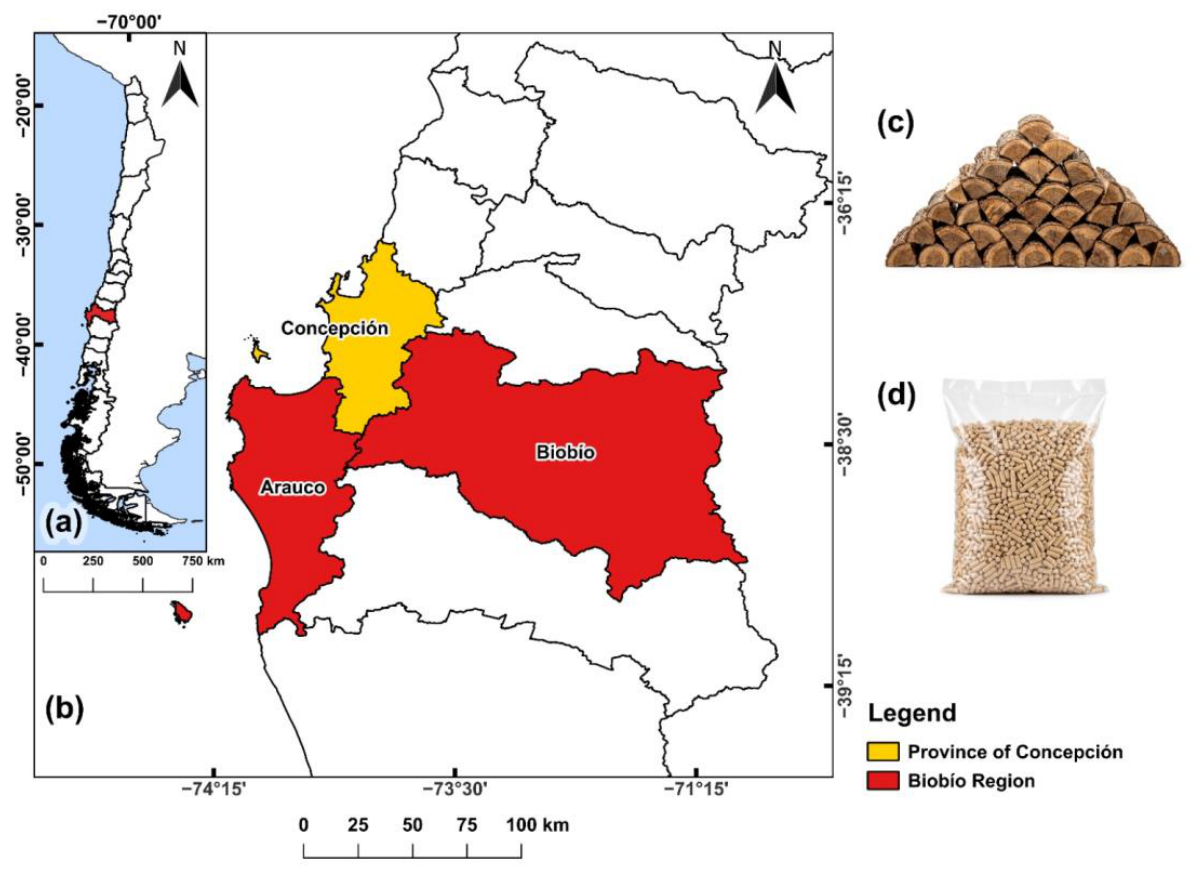
In the Biobío region of Chile (
Figure 1), firewood remains the dominant residential heating fuel, while wood pellets, produced regionally from dry pine sawdust, have gained relevance through heater replacement programs under local PPDA plans.
Although wood heater replacement programs may improve air quality in urban areas [
29], critical air pollution episodes still persist, with fine atmospheric particles (PM
2.5) concentrations exceeding the Chilean national air quality standards [
30]. Life cycle assessments (LCAs) of different energy sources have shown that, for firewood, smoke emissions during combustion account for 96–99% of the impact, whereas emissions during wood pellet combustion represent a smaller share, ranging from 52% to 60% [
31]. Despite these relative advantages, and its potential as a sustainable source of energy for residential heating, the use of wood pellets remains limited in Chile.
Wood pellets in Chile are produced mainly from dry pine sawdust mixtures and there is a need to characterize combustion emissions using specific chemical markers. Previous studies [
32,
33] have highlighted the importance of identifying specific chemical markers in emissions generated by biomass combustion, such as polycyclic aromatic hydrocarbons (PAHs) and their nitrated derivatives (nitro-PAHs), which are relevant for source attribution and health risk assessment. These markers allow for establishing links between combustion technologies, fuel characteristics, and the risks they pose to public health [
34].
PAHs are characterized by the presence of at least two fused aromatic rings, which can be arranged in linear, clustered, or angular configurations. This structural diversity gives rise to many compounds, allowing for the evaluation of their behavior in the environment and the traceability of their origin based on the specific formation conditions attributable to an emission source [
35,
36,
37]. Furthermore, nitro-PAH compounds are particularly relevant because they incorporate nitro groups (
−NO
2) into the aromatic structure. These compounds can form directly during combustion or be generated in the atmosphere through photochemical reactions of PAHs with nitrogen oxides (NOx). Their importance lies not only as useful tracers for identifying combustion sources and fuels, but also due to their greater toxicity to humans, including mutagenic and carcinogenic effects that make them priority pollutants of public health concern. In particular, benzo[a]pyrene (BaP), a widely used reference compound in PAH toxicology and potency equivalency frameworks, has been classified as a Group 1 carcinogen by the International Agency for Research on Cancer (IARC) due to its ability to induce tumors in experimental models and its association with lung cancer in epidemiological studies.
Nitro-PAHs are generally considered more toxic than their non-nitrated precursors. Compounds such as 1-nitropyrene and 3-nitrobenzo[a]pyrene have demonstrated high genotoxic activity and carcinogenic potential, even at low concentrations [
36,
38,
39]. Chronic exposure to PAHs and nitro-PAHs through smoke inhalation has been associated with adverse effects on respiratory and cardiovascular health, as well as alterations in the immune and endocrine systems [
40,
41,
42]. A study by Wang et al. [
43] on the toxicity and carcinogenic risk of PAHs and nitro-PAHs in air reported that certain nitro-PAHs, such as 6-nitrochrysene, exhibit a much higher carcinogenic effect than benzo[a]pyrene (BaP), indicating that nitro-PAHs have greater mutagenic and carcinogenic potential.
Nitro-PAH compounds can be emitted directly from combustion through high-temperature reactions of PAH precursors with nitrogen oxides in post-flame zones (primary formation) or generated secondarily in the atmosphere through heterogeneous reactions of particle-bound PAHs with ·OH and ·NO
3 radicals in the presence of NO
2 [
44]. The relative importance of these pathways depends on combustion temperature, oxygen availability, fuel composition, and appliance design, and may differ substantially between open-flame wood combustion and controlled forced-draft pellet combustion [
28,
45]. Studies on the secondary formation of oxygenated and nitrated polycyclic aromatic compounds have shown that atmospheric aging, meteorological conditions, and seasonal variation substantially alter the relative abundance of nitro-PAH derivatives in the particulate phase, with secondary formation dominating in warmer seasons and primary combustion sources dominating in winter [
46,
47]. These findings highlight that evaluating biomass combustion emissions solely in terms of PM mass may underestimate relevant differences in organic composition and toxicological profile across combustion technologies.
Jimenez et al. [
48] have characterized PM and PAHs emission factors from residential firewood combustion in Chile providing important evidence on source contributions. However, these studies were limited to parent PAHs and did not include nitro-PAH speciation or comparison with wood pellet heater technology. Heater replacement programs in Chile have been evaluated primarily through PM
2.5 reduction potential and cost-effectiveness indicators [
24,
49], without incorporating chemical speciation of the organic particulate fraction. International evidence indicates that reductions in PM mass following appliance substitution do not necessarily reflect proportional changes in the toxicological profile of the emitted particulate matter. Wood pellet combustion has been shown to produce PAH and nitroarene distributions that differ substantially from those of wood combustion and that warrant further toxicological evaluation [
50,
51,
52], which is a limitation acknowledged even in regulatory contexts with more developed emission inventories [
53]. Studies characterizing PAH and nitro-PAH profiles and BaP-equivalent toxic equivalents from both residential firewood and pellet appliances under controlled conditions have been conducted in Europe [
45] and Asia [
54,
55], but not for the fuel-appliance combinations relevant to south-central Chile. This study addresses this gap by providing one of the first regional characterizations of particle-bound PAH and nitro-PAH emission profiles and screening-level BaP-TEQ for combustion of eucalyptus firewood and wood pellets from pine (dry sawdust) under controlled conditions, contributing the chemical speciation evidence needed to evaluate whether PM-based metrics alone are sufficient to assess if wood pellets represent a sustainable fuel source for residential heating in Chile.
The objective of this study was to provide a preliminary characterization and comparison between particle-bound PAH and nitro-PAH emission factors and BaP-equivalent toxic equivalents (BaP-TEQ) from residential firewood and a wood pellet heater used in populated areas of the Biobío region of Chile. Eucalyptus firewood and commercial wood pellets from dry pine sawdust were selected as they are commonly available in the region.
The novelty of this study lies in three specific contributions. First, it is one of the first studies in Chile to characterize PAH and nitro-PAH emission profiles from residential firewood and pellet wood heaters extensively used in urban areas, filling a gap in the South American literature on residential biomass combustion. Second, it provides a preliminary approach to compare combustion technologies based on a TEQ-based toxicological profile of aerosol emissions. Third, it provides useful information for risk assessment and analysis of the implication of public policies and replacement programs targeting residential wood heaters.
2. Materials and Methods
2.1. Particulate Matter Sampling
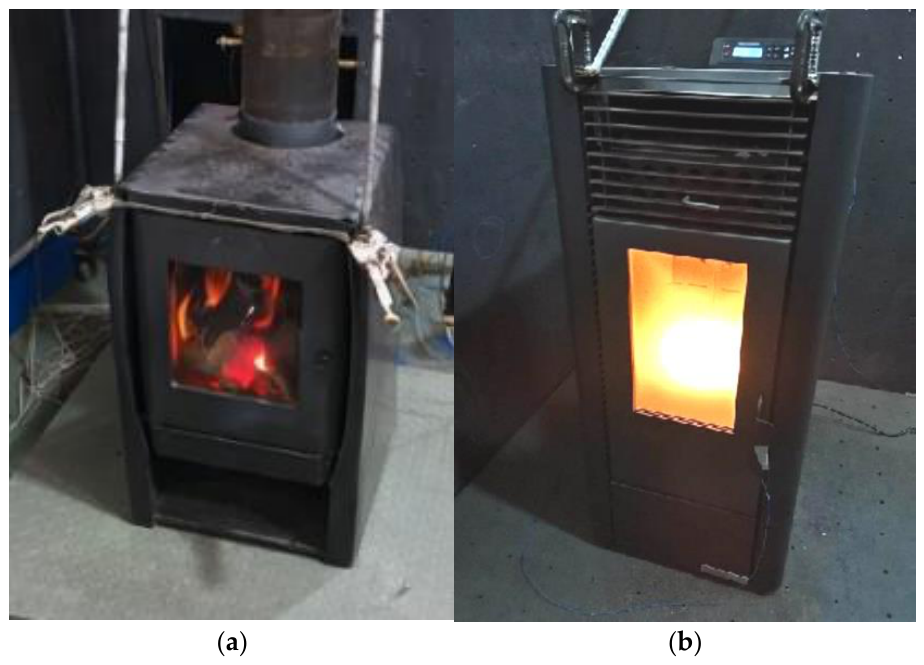
PM samples were collected from controlled combustion experiments using a commercial wood-burning and wood pellet heater. The heating technologies selected are shown in
Figure 2 and were representative of equipment commercially available in Chile for residential heating (
Figure 1b shows the geographic study area). Wood combustion tests were conducted in an Amesti Scantek 380 (Amesti, Colina, Chile), a slow-combustion heater equipped with draft regulator and a nominal heat output of approximately 8 kW, and this type of heater technology represents 65% of the wood appliances available in homes of the main populated areas of the region, while wood pellet heaters represent ~6%, but are steadily increasing due to replacement programs.
Wood pellet combustion tests were carried out in a Toyotomi Pellettissima PS-7500 (Toyotomi, Nagoya, Japan) electronically controlled forced-draft pellet heater with a nominal heat output of approximately 8 kW. PM was collected on Millipore hydrophilic filters (47 mm diameter, 1.6 μm pore size, 90% porosity; Sigma-Aldrich, St. Louis, MO, USA). Due to the selected method, the sampling train did not include a size-selective inlet; therefore, the collected fraction represents total suspended particulate matter (TSP) from the dilution tunnel effluent.
Both heaters are appliances commercially available in Chile, complying with national certification requirements for solid-fuel burning appliances, which mandate testing for PM
2.5 emissions, energy efficiency, and safety [
56,
57]. Certified appliance programs distinguish two main residential heating technology types: slow-combustion wood-burning heaters with draft regulation, and electronically controlled forced-draft pellet heaters. These two technology archetypes represent the dominant certified appliance categories available under PPDA replacement programs in south-central Chile [
49], and the heaters evaluated in this study correspond to each of these categories operating at a nominal thermal power of 8 kW, the most common size class in the regional residential market. Regarding fuel selection, eucalyptus (
Eucalyptus globulus) firewood and pine (
Pinus radiata) derived wood pellets are the predominant biomass fuels used in residential combustion systems in south-central Chile [
58], making them the most representative fuel types for characterizing residential heating emissions in the study region.
The firewood used in the experiments consisted exclusively of air-dried logs of eucalyptus (Eucalyptus globulus), with a moisture content ranging from 15 to 19% w/w on a dry basis. Wood pellets were made from dry pine sawdust and had a moisture content of 7% w/w on a dry basis. Consequently, both fuels had low moisture content and were classified as dry biomass fuels.
A total of seven (n = 7) smoke samples were collected from wood combustion tests and eight (n = 8) from wood pellet combustion tests, allowing a comparison between both combustion systems with respect to the presence of PAH and nitro-PAH compounds.
2.2. Experimental Conditions
Combustion tests were conducted following the methodology described by Jimenez et al. [
48] and based on the U.S. Environmental Protection Agency’s (EPA) Method 5G. The experimental setup consisted of a dilution tunnel designed to cool and sample the combustion gases generated by biomass combustion in residential and commercial appliances. The system was installed in a specialized laboratory at Cerylab, a company accredited for the certification of forest biomass heaters. The test bench included a stainless steel hood (0.30 m in diameter) for mixing the exhaust gases with ambient air, as well as 90° elbows and a straight stainless steel duct (0.15 m in diameter) equipped with ports for isokinetic sampling of particulate matter, temperature, and combustion gases, including carbon monoxide (CO), carbon dioxide (CO
2) and oxygen (O
2).
Combustion gases were cooled to a controlled temperature of approximately 30–32 °C, facilitating the condensation of volatile organic compounds (VOC) for sampling on analytical-grade filters. The heaters were mounted on a mass balance to record fuel consumption throughout the experiments. This setup allowed for strict control of the experimental conditions and ensured the reproducibility and accuracy of the emission measurements.
The combustion tests were operated under an intermediate regime corresponding to nominal power conditions. The wood pellet heater and the firewood heater were both operated at their respective nominal settings throughout all tests. This study evaluates each fuel-appliance system as an integrated unit, reflecting a representative configuration in which each technology is deployed in residential settings in Chile. The comparison is not intended to isolate the effect of a single variable (e.g., fuel species, moisture content, or combustion technology), but rather to characterize the emission profiles of complete systems as they are used in practice, which is the relevant unit of analysis for evaluating heater replacement programs. Across the firewood combustion tests, the average fuel load was 3.59 ± 0.77 kg, the test duration was 77.1 ± 17.0 min, and the burn rate was 2.40 ± 0.28 kg/h. For wood pellet combustion, the average fuel load was 3.07 ± 1.13 kg, the test duration was 120.0 ± 0.0 min, and the burn rate was 1.43 ± 0.53 kg/h. Particulate matter was collected at similar sampling flow rates for both systems: 16.56 ± 0.37 L/min for firewood and 16.48 ± 0.32 L/min for wood pellets, corresponding to normalized sampled gas volumes of 1.30 ± 0.29 m3 and 1.95 ± 0.04 m3, respectively. The average particulate matter mass retained on the filters was 8.34 ± 7.72 mg for firewood combustion and 6.62 ± 3.61 mg for wood pellet combustion. Combustion temperature inside the chamber was not directly measured in either system. For firewood combustion, the available thermocouple records corresponded to the temperature at the tempering device, with an average value of 450.2 ± 2.6 °C for the four tests with available records. For pellet combustion, the available thermal record corresponded to the appliance surface temperature, which averaged 165.5 ± 35.6 °C across all tests. These values are descriptive operating parameters and should not be interpreted as direct indicators of combustion temperature conditions inside the chamber. The samples represent integrated whole-cycle particulate matter collections; combustion phase-resolved sampling (ignition vs. steady-state) was not performed in this study.
Combustion gas concentrations (CO, CO
2, O
2) and flue gas temperatures were recorded under the applicable certification protocol in this study. Available records indicate different combustion behaviors between appliances: the wood pellet heater showed stable concentrations of CO (0.014 to 0.027%), CO
2 (6.45 to 8.20%) and O
2 (12.93 to 14.62%). The flue (exhaust) gas temperatures ranged from 145 to 241 °C depending on the power output setting. The firewood heater exhibited phase-dependent behavior, with CO, CO
2 and O
2 ranging from 0.045%, 14.15% and 6.20%, respectively during active combustion to 0.589%, 3.87% and 16.78%, respectively during the smoldering/char phase, while the flue gas temperatures ranged from a peak of 431 °C to 188 °C at char phase. The lower flue gas temperatures for the pellet heater were due to its higher thermal efficiency (85.8 to 88.8%) compared to the wood heater (69.2 to 77.4%). However, the literature reports significantly higher combustion chamber temperatures (>650 °C) when burning pellets from pine woods [
59,
60]. In addition, the results of this study are consistent with combustion regimes documented for comparable appliance types [
61,
62].
NOx concentration plays a central role in gas-phase and heterogeneous nitro-PAH formation pathways through radical-mediated nitration of PAH precursors [
63]. However, this parameter was not measured in this study to state why the nitro-PAH-dominated profile was observed only in pellet combustion emissions. The combustion regime documented in the literature for comparable electronically controlled pellet heaters [
59,
60] is consistent with conditions under which NOx-mediated nitration has been proposed to operate. Future work should therefore incorporate NOx monitoring alongside combustion chamber temperature to enable direct mechanistic attribution of the observed emission profiles.
2.3. Laboratory Sample Analysis
Particulate matter samples collected in the filters were processed at the Natural Products Laboratory of the University of Concepción. The analytical methodology described in Jimenez et al. [
48], Sarti et al. [
55] and Thepnuan et al. [
64] was followed to extract and analyze PAHs and nitro-PAHs from the particulate matter collected from the filters (particle phase). Minor modifications were made to the extraction method to optimize analytical performance under the available laboratory conditions and instrumentation. Consequently, the characterization procedure was carried out in three stages: sample extraction, sample purification, and analyte detection by gas chromatography-mass spectrometry (GC-MS).
2.3.1. Extraction
Filters were placed in 250 mL borosilicate glass tubes fitted with inert caps, and 20 mL of dichloromethane for analysis (EMSURE® ACS, ISO, Reag. Ph Eur; Merck, Darmstadt, Germany) was added as the extraction solvent. Samples were subjected to four 5 min ultrasonication cycles at room temperature (25 °C), for a total extraction time of 20 min. The temperature was carefully controlled during the procedure to minimize evaporation of the most volatile compounds. Sonication was performed in deionized water using a Branson ultrasonic bath (model 1210; Branson Ultrasonics, Danbury, CT, USA) operating at 40 kHz.
Dichloromethane was selected as the extraction solvent because of its broader polarity range compared with non-polar solvents such as hexane, which provides improved recovery of semi-polar compounds including nitro-PAHs and oxygenated PAH derivatives. While hexane is commonly applied in parent PAH extractions, its lower polarity limits recovery of nitrated and oxygenated derivatives. Dichloromethane has been used as the primary extraction solvent in published studies characterizing PAH, nitro-PAH, and oxy-PAH emissions from PM collected during biomass combustion and atmospheric sampling [
36,
55,
64,
65].
2.3.2. Clean-Up
During the clean-up step, the extracts were filtered through 25 mm PTFE syringe filters (0.45 µm pore size; Jinlong, China) using 10 mL glass syringes. After filtration, the extract volume was reduced to 0.2 mL by evaporation under a gentle stream of nitrogen gas. The concentrated extract was transferred to 2 mL amber vials fitted with 0.25 mL conical inserts for subsequent instrumental analysis [
48].
2.3.3. Analyte Detection
The extracted samples were analyzed using gas chromatography-mass spectrometry (GC-MS) with an Agilent Technologies (Santa Clara, CA, USA) system consisting of a 7890A gas chromatograph coupled to a 5975C mass selective detector. Separation was performed on an HP-5MS UI column (30 m × 0.25 mm internal diameter × 0.25 µm film thickness; 7-inch cage). Electronic-grade helium was used as the carrier gas at a constant flow rate of 1 mL/min.
The GC oven temperature program was as follows: the initial temperature was set at 90 °C and held for 1 min, followed by a ramp of 10 °C/min to 120 °C, which was held for 6 min. The temperature was then increased at 6 °C/min to 280 °C and held for 5 min. Finally, the oven temperature was increased at a rate of 6 °C/min until reaching 300 °C and was maintained for 10 min, resulting in a total analysis time of 55 min. The mass spectrometer was operated in scanning mode, and electron impact ionization was set to 70 eV [
48,
55].
Compound identification was based on a tiered approach. Particulate matter blank filters were spiked with analytical standards (99% purity; Merck, Darmstadt, Germany): 1-nitropyrene, 9-nitroanthracene, 3-nitrofluoranthene, 1,3-dinitronaphthalene, and 6-nitrochrysene, as well as a 16-compound EPA PAH standard mixture. All were prepared in dichloromethane and processed through the complete clean-up and concentration procedure. This approach allowed retention-time confirmation for representative parent PAHs and nitro-PAHs and served simultaneously to assess analytical recovery. The average analytical recovery was 89.7 ± 1.5% (n = 3), and reported concentrations were corrected accordingly. Dichloromethane was also analyzed as a solvent blank, and no contamination issues were detected. NIST Mass Spectral Library 2005 (NIST.05; National Institute of Standards and Technology, Gaithersburg, MD, USA) spectral library matching implemented in MSD ChemStation software (version E.02.02.1431; Agilent Technologies, Santa Clara, CA, USA) was used as supplementary spectral evidence for compounds without compound-specific analytical standards. Compounds confirmed by both retention-time match with an analytical standard and NIST match are reported as confirmed identifications; compounds identified by NIST library matching alone are reported as tentative identifications.
For quantification, a calibration curve was constructed using 1-nitropyrene (99% purity; Merck, Darmstadt, Germany) as an index calibration compound. The calibration signal was based on total ion chromatogram (TIC) integration of the chromatographic peak corresponding to 1-nitropyrene under the applied GC-MS conditions. This compound was selected because it is a combustion-related nitro-PAH and a nitrated derivative of pyrene, providing a chemically relevant bridge between parent PAHs and nitrated PAH derivatives. Its use is further supported by source-apportionment approaches in which 1-nitropyrene and pyrene are jointly used as markers of combustion-derived particulate matter, reflecting the relationship between parent PAHs, nitrated derivatives, and combustion conditions [
45,
54,
66]. In addition, 1-nitropyrene showed stable chromatographic behavior and a clear EI-GC-MS response under the analytical conditions applied in this study. It is directly associated with biomass combustion [
66], exhibits suitable thermal stability and volatility for GC-MS analysis, and has a well-characterized chromatographic and mass spectrometric behavior [
34,
67].
Calibration was performed under the same GC-MS operating conditions using standard solutions of 0.15, 0.25, 0.50, 0.75, and 1.00 mg/L. The relationship between concentration and peak intensity was evaluated using linear regression, yielding a coefficient of determination R2 = 0.9927.
Instrument repeatability (three replicate injections of the 0.50 mg/L 1-nitropyrene standard) yielded a relative standard deviation (RSD) of 5.6%. Method reproducibility, estimated from three spiked blank filter replicates, was 1.7% RSD. Matrix effects were not formally evaluated; their potential influence is acknowledged as a contributing source of uncertainty within the combined analytical uncertainty of 13–32% reported in
Section 2.6.
The limit of detection (LOD) and limit of quantification (LOQ) were estimated from the 1-nitropyrene calibration curve using 3.3 σ/S and 10 σ/S, respectively, where σ corresponds to the residual standard deviation of the calibration curve and S is the slope of the regression line. The estimated LOD and LOQ were 0.115 and 0.347 mg/L, respectively, corresponding to 22.9 ng and 69.5 ng per filter after concentration to a final extract volume of 0.2 mL. These values are expressed as 1-nitropyrene-equivalent detection and quantification limits and should be interpreted as method-level screening estimates rather than compound-specific LOD/LOQ values for each PAH and nitro-PAH.
Concentrations below the estimated LOD were considered below the detection criterion under the analytical conditions applied. Signals between the LOD and LOQ were treated as detected but below the reliable quantification range. Accordingly, all reported concentrations, emission factors, and BaP-equivalent toxic equivalents should be interpreted as semi-quantitative estimates expressed as 1-nitropyrene-equivalent values, suitable for screening-level comparison and toxicological prioritization.
Future studies should include compound-specific calibration curves and isotopically labeled internal standards to improve quantitative accuracy. For reporting purposes throughout this study, oxygenated PAH derivatives (oxy-PAHs: benzanthrenone, 11H-benzo[a]fluoren-11-one, and benz[a]anthracene-7,12-dione) detected in the same GC-MS analytical run as parent PAHs are grouped within the PAH category unless otherwise specified. This grouping reflects their common analytical origin and does not imply structural equivalence with parent PAHs.
Table 1 and
Table 2 summarize the GC-MS identification parameters (compound class, retention time, quantifier and qualifier ions, and confirmed/tentative identification status) for the PAH and oxygenated PAH (oxy-PAH) compounds, and for the nitro-PAH compounds, respectively, detected in this study.
2.4. Determination of Emission Factors
To determine the emission factors (EFs) of PAHs and nitro-PAHs per unit mass of fuel burned during combustion (ng/kg), the methodology described in Jimenez et al. [
48] was used. To estimate the amount of biomass burned, the burn rate (BR) was calculated as the mass of fuel consumed per unit time, adjusted for moisture content. The corresponding expression is shown in Equation (1).
where BR is the burn rate, expressed in (kg/h);
is the initial fuel mass (kg);
is the final fuel mass after combustion (kg);
is the duration of the experiment (h); and %Mw represents the fuel moisture content (%). In contrast, the emission rate (ER) indicates the amount of substance released per unit time (ng/h) and is determined according to Equation (2):
where
is the concentration of compound
in the combustion gases (ng/m
3), and
is the average volumetric flow rate of gases in the dilution chamber (m
3/h). The concentration of particle-phase PAHs and nitro-PAHs (ng/m
3) was obtained from the concentration determined in the particulate matter collected on the filter (ng/g) and the gravimetric PM concentration in the combustion gases (g/m
3), according to Equation (3).
where
corresponds to the concentration of compound
in the particulate matter (ng/g), and
is the particulate matter concentration in the combustion gases (g/m
3). Finally, the EF, expressed in ng/kg, relates the amount of pollutant emitted to the mass of fuel combusted, as shown in Equation (4).
This method made it possible to quantify the atmospheric pollutants released during biomass combustion and provided comparable values to assess the differences in emissions from heaters that operate with wood and with pellets.
2.5. Screening-Level BaP-Equivalent Toxic Equivalency Assessment
The risk to human health was assessed using benzo[a]pyrene equivalents (BaP-TEQ), applying Equation (5) [
68]:
where TEQ is the total toxic equivalent,
corresponds to the concentration of each compound, and
is the toxic equivalency factor relative to benzo[a]pyrene (BaP, TEF = 1). TEQ was calculated by multiplying the concentration of each PAH and nitro-PAH by its corresponding consolidated TEF and summing the individual contributions. Compounds without an official TEF were reported as absolute concentrations, designated as n.a. (not available in published TEF consensus frameworks), and discussed qualitatively in terms of their toxicity potential. TEFs are assigned according to the relative carcinogenic or mutagenic potency of each PAH and nitro-PAH, allowing complex mixtures to be integrated into a single equivalent risk indicator. For this study, the term Ci in Equation (5) corresponds to the mean emission factor of each compound i calculated across all replicate combustion tests conducted for the respective system. Non-detected values were assigned zero for the purpose of mean EF calculation, consistent with the absence of a quantifiable signal in those tests.
2.6. Statistical Analysis
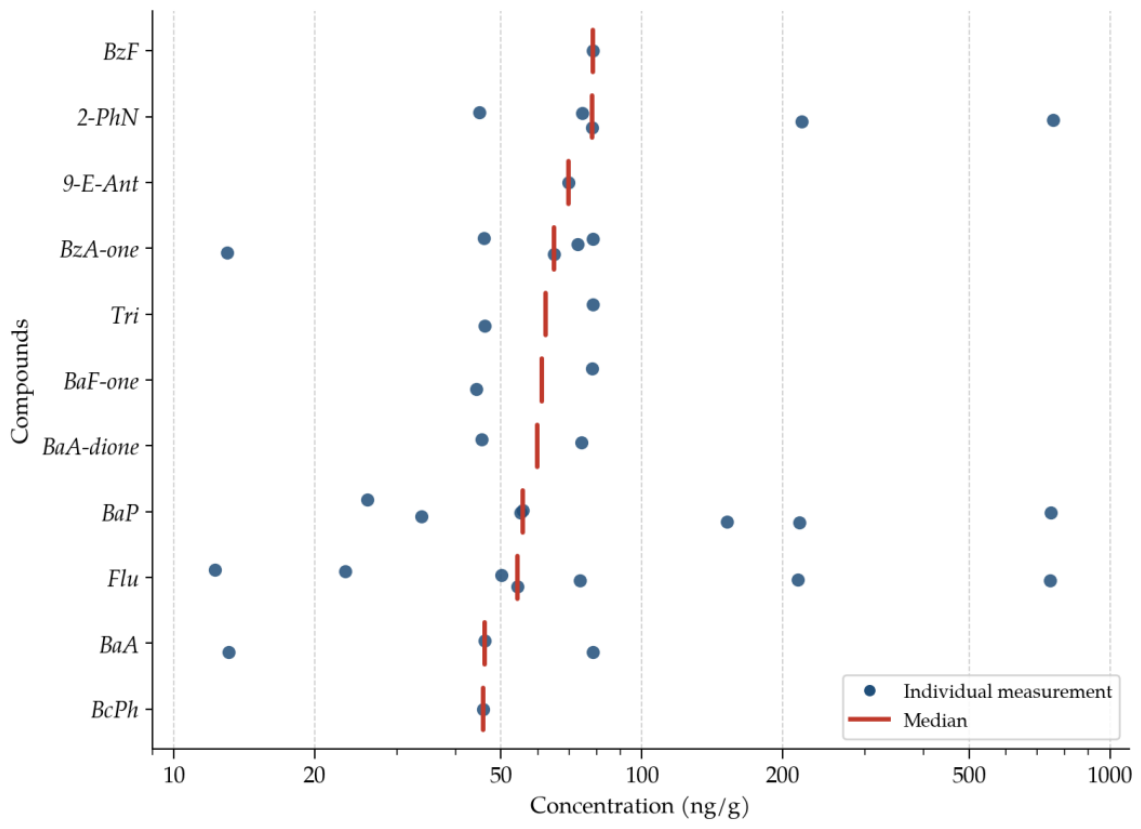
Statistical analyses and graph generation were performed using RStudio software v4.3. Given the small number of combustion tests, the presence of non-detects, and the skewed distribution expected for combustion-derived organic compounds, results were summarized using both conventional and descriptive statistics, including mean, standard deviation (SD), minimum, maximum, and detection frequency (n detected/N total). Median values for individual compound EFs are reported in
Supplementary Table S1. Given the non-normal distribution and high variability characteristic of combustion emission data at small sample sizes, non-parametric approaches were applied. Potential outliers were evaluated using the Grubbs test (α = 0.05). For compounds detected in a sufficient number of samples, 95% confidence intervals (CI) were estimated using non-parametric bootstrap resampling with 10,000 iterations. Given the high within-group variability and small sample sizes (n = 7 firewood, n = 8 wood pellets), formal statistical hypothesis testing between groups has a retrospective power of approximately 19%, estimated using a parametric approximation (Cohen’s d = 0.56; α = 0.05, two-tailed; n
1 = 8, n
2 = 7), and an estimated n ≈ 51 per group would be required to achieve 80% power under the same effect size. Cohen’s d was calculated from the observed pooled standard deviation and mean difference between systems. Consequently, between-system comparisons of individual compound EFs are reported descriptively rather than inferentially and should be interpreted as preliminary and exploratory estimates suitable for hypothesis generation rather than causal inference.
Given that the total BaP-TEQ EF was calculated as a single aggregate value per combustion system (derived from the mean EF of each detected compound multiplied by its TEF and summed across all compounds), no between-system statistical comparison was performed for the TEQ. The result is reported as a descriptive, screening-level toxicological indicator and interpreted in the context of the analytical uncertainty estimated below.
Uncertainty in individual EF values was estimated by propagation of relative uncertainties from the main analytical sources, following the root-sum-of-squares approach (ISO GUM), using reference values from the literature in the absence of instrument-specific calibration certificates: calibration uncertainty (~10–30%, reflecting the use of a single index compound for multi-analyte quantification), gravimetric PM determination (~5%), volumetric flow measurement (~3%), and fuel burn rate (~5%), yielding a combined relative uncertainty per compound per test of approximately 13–32%. This approach is consistent with the uncertainty estimation methodology applied in comparable PAH emission factor studies from residential biomass combustion appliances [
50,
69]. This estimate should be considered a lower bound given the semi-quantitative nature of the single-index calibration. Uncertainty in total BaP-TEQ EF was propagated accordingly; TEF values themselves carry additional unquantified structural uncertainty across published schemes, which was not incorporated into this estimate.
4. Discussion
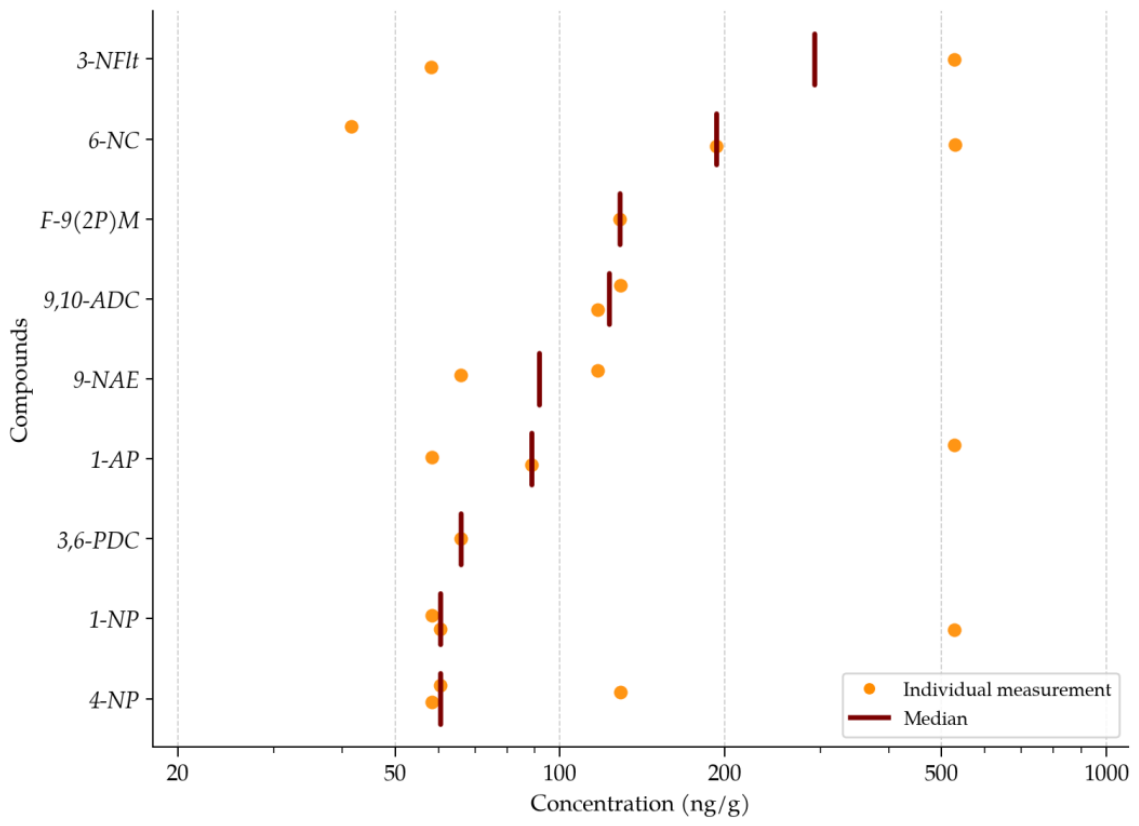
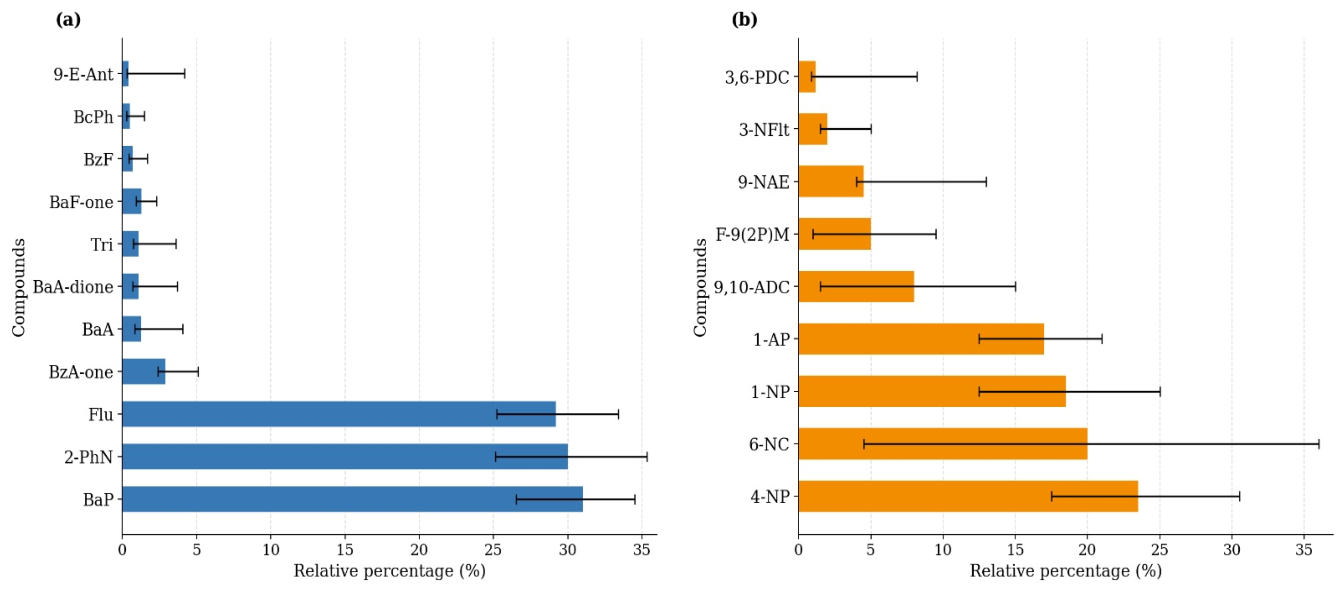
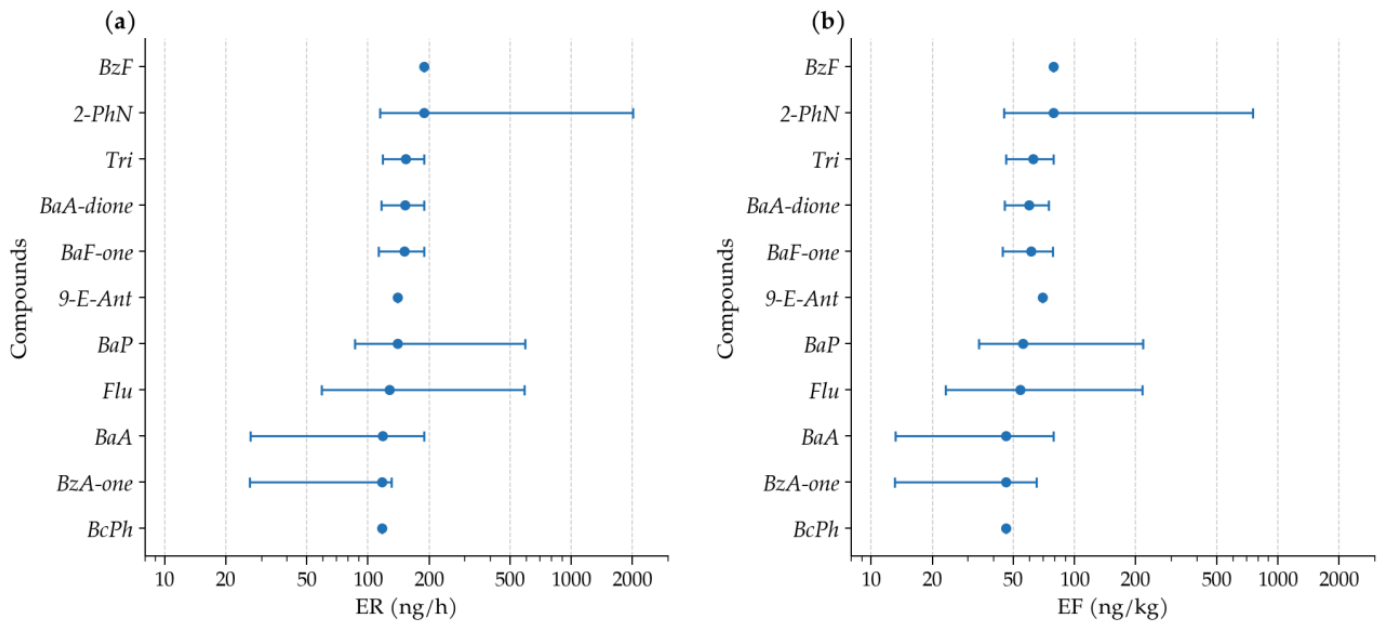
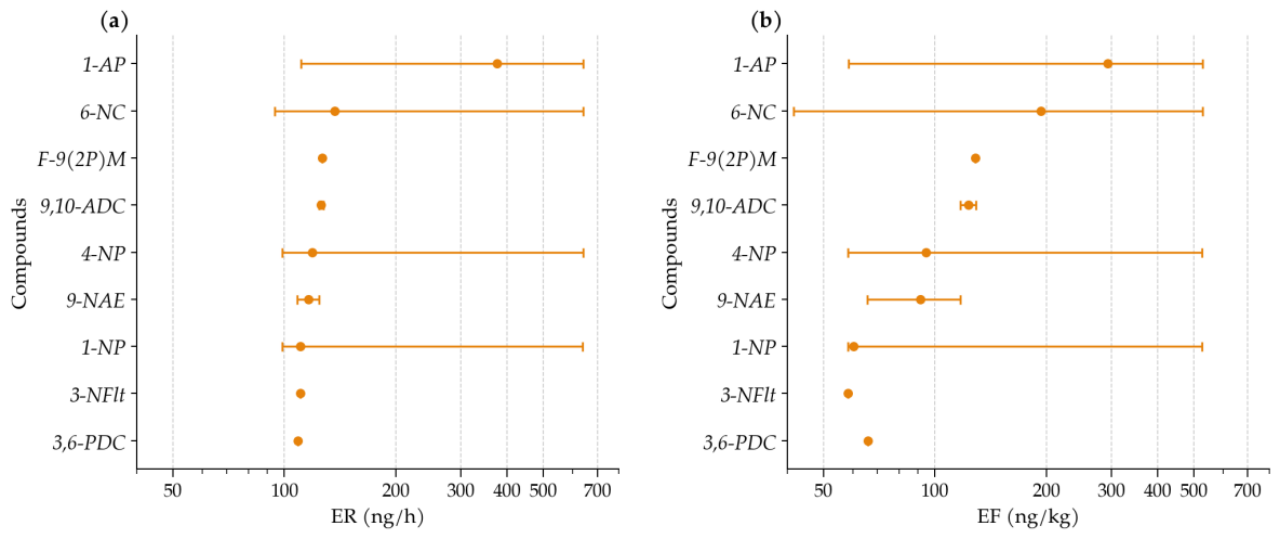
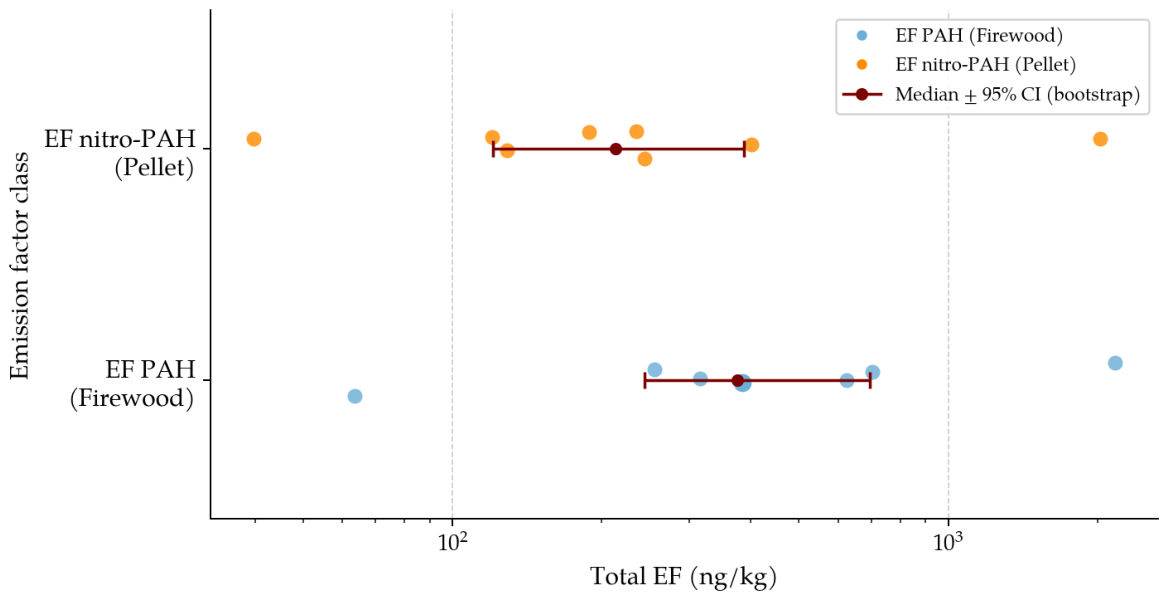
The emission profiles observed in this study under the applied analytical conditions showed a pattern of differences between the two residential heater systems under the tested conditions. Under the applied semi-quantitative analytical conditions, firewood combustion yielded a particulate phase dominated by parent PAHs, with benzo[a]pyrene as the main contributor to the BaP-TEQ EF, while wood pellet combustion yielded a profile dominated by nitro-PAHs (particularly 1-nitropyrene, 1-aminopyrene, and 6-nitrochrysene) noting that several of these compounds were identified tentatively by NIST library matching and that all concentrations represent 1-nitropyrene-equivalent screening estimates. The higher within-group variability observed for firewood EFs relative to pellet EFs (CV: 53% vs. 21%;
Section 3.3) is consistent with the greater operational variability expected from batch-fed combustion systems with draft regulation, compared with the more controlled and reproducible combustion regime of a forced-draft pellet heater. These observations are reported under the constraints of a screening-level, semi-quantitative analytical approach, and their interpretation is necessarily qualitative; while supplementary operational data from certification testing (flue gas temperatures and CO concentrations) are reported in
Section 2.2, direct combustion chamber temperature measurements were not incorporated as analytical variables in this study.
The differential emission profiles observed in this study are consistent with mechanisms described in the literature for these types of combustion systems, although the operating parameters that drive those mechanisms, combustion temperature, air-to-fuel ratio, and NOx concentrations, were not measured in this study and therefore cannot be directly confirmed for the specific equipment evaluated. Studies on forced-draft wood pellet appliances comparable to the heater used in this study documented operating conditions characterized by higher and more stable combustion temperatures and controlled excess air relative to batch-fed wood heaters [
45,
72]. Under such conditions, more complete oxidation of gas-phase PAH precursors has been reported, while residual NO
x in the post-flame zone can promote heterogeneous nitration of particle-bound PAHs. Precursor compounds (particularly pyrene and chrysene-type structures) can react with OH· and NO
3· radicals to form intermediate adducts that subsequently undergo nitration in the presence of NO
2 to produce nitro-PAHs [
44]. This pathway has been proposed to explain the predominance of 1-nitropyrene, 1-aminopyrene, and 6-nitrochrysene in pellet combustion emissions in comparable studies [
28,
54,
72].
Conversely, firewood combustion in batch-fed appliances with draft regulation has been associated with PAH-dominated profiles, attributed to incomplete combustion and greater variability in temperature and fuel loading across the combustion cycle [
54,
72]. Real-time combustion studies have further shown that PAH emission peaks in wood combustion tend to coincide with ignition and incomplete combustion phases, while nitro-PAH emissions in wood pellet heaters have been linked to higher-temperature steady-state operation [
51,
73] and substantially reduced parent PAH emissions relative to traditional wood combustion, yet the organic particulate fraction retained mutagenic activity attributable to nitroarenes.
The emission profiles observed in the present study are qualitatively consistent with this theoretical framework. Future work should address the specific combustion conditions in terms of temperatures, gas-phase NOx, residence time and combustion efficiency to support these findings. Additionally, the sensitivity limitations of the semi-quantitative analytical approach applied in this study cannot be entirely ruled out as a contributing factor to the apparent exclusivity of detection between compound classes, and compound-specific calibration with lower detection limits would be required to confirm the complete absence of either compound class in each system.
From a toxicological perspective, the dominant compounds identified in wood pellet combustion represent compounds of established carcinogenic and mutagenic concern. According to the IARC classifications summarized by [
74], 1-nitropyrene and 6-nitrochrysene are classified as Group 2A agents (“probably carcinogenic to humans”), and 4-nitropyrene as Group 2B. This classification is consistent with their TEF values under the [
68] framework, among which 6-nitrochrysene stands out with a TEF of 10 (indicating a potency ten times greater than benzo[a]pyrene). Both 1-nitropyrene and 6-nitrochrysene have shown experimental evidence of DNA adduct formation, direct mutagenicity, and carcinogenicity in animal models, in some cases without requiring metabolic activation [
43,
75]. The presence of 1-aminopyrene in PM emissions from wood pellet combustion is also noteworthy; although it is primarily known as a metabolic biomarker of nitro-PAH exposure in biological monitoring studies [
54], its detection in primary combustion emissions may reflect in-stack reduction of 1-nitropyrene under the applied combustion conditions and warrants further investigation.
These findings suggest that the nitro-PAH compounds identified in wood pellet combustion emissions are consistent with expected formation pathways and represent compounds of potential toxicological relevance that merit further characterization in future studies. Notably, 4-nitropyrene showed the highest mean EF among pellet combustion compounds (96.9 ng/kg;
Table 3), followed closely by 6-NC (95.4 ng/kg). 1-aminopyrene (1-AP, 73.3 ng/kg) is currently designated as n.a. in the TEF framework applied, meaning its contribution is excluded from the BaP-TEQ summation entirely. Similarly, 9,10-ADC, 3,6-PDC, 9-NAE, 3-NFlt, and F-9(2P)M, collectively representing a substantial fraction of the detected nitro-PAH mass in pellet emissions, lack available TEF values. The exclusion of these compounds from the TEQ summation suggests that the total BaP-TEQ EF of 972.1 ng/kg reported for pellet combustion may underestimate the actual aggregate toxicological load, rather than overestimate it. This reinforces the value of complementing TEQ-based assessments with bioassay-based approaches in future work.
Placing the semi-quantitative EF estimates from this study in the context of published benchmarks, the firewood BaP EF observed here (183.9 ng/kg) falls within the range reported by Jimenez et al. [
48] for eucalyptus combustion in south-central Chile, and is consistent with values reported for residential wood combustion in Europe and China, where total PAH EFs typically range from tens to thousands of ng/kg depending on fuel species, moisture, and appliance type [
45,
54]. For pellet combustion, the nitro-PAH EFs estimated here are consistent in order of magnitude with the semi-volatile organic compound profiles described for automatically fired appliances under comparable conditions [
72]. The mean PM EF was approximately 1.5-fold higher for firewood than for pellet combustion (1.05 vs. 0.69 g/kg;
Section 3.3), yet the BaP-TEQ EF was approximately five-fold higher for pellet combustion (972.1 vs. 187.8 ng/kg). This divergence between PM mass and TEQ-based comparison, observed under the tested conditions, is consistent with international evidence showing that the shift from firewood to wood pellet combustion can alter the chemical class composition of the organic fraction even when total PM emissions decrease [
50,
53]. The present data do not by themselves demonstrate that this pattern holds across combustion technologies or fuel types more broadly, but they are consistent with that broader evidence base. Importantly, these findings do not demonstrate that the smoke emissions from wood pellet heaters result in greater human health risk than smoke from firewood heaters; the BaP-TEQ comparison is an internally consistent screening indicator for the two fuel–appliance systems evaluated, not an assessment of comparative population exposure or carcinogenic risk. The result is best interpreted as identifying 6-nitrochrysene as a priority compound for compound-specific quantification and toxicological confirmation in future studies. The ~1.5-fold PM difference observed here is lower than the up-to-4.5-fold reduction reported by Ghorashi and Khandelwal [
27], which reflects comparisons between automatic pellet heaters and masonry or conventional combustion heaters (MMH/CMH)—a fundamentally different technology pairing. In contrast, the firewood heater evaluated in this study is a certified slow-combustion, draft-regulated appliance, the dominant certified technology class in Chilean residential heating programs, which already operates at substantially lower PM emissions than masonry-type heaters. The 1.5-fold PM ratio reported here is therefore consistent with a comparison between two certified, technologically equivalent appliances operating under controlled EPA Method 5G conditions.
The divergence between lower PM emission factor and higher BaP-TEQ EF for the pellet heater reflects a qualitative shift in the chemical character of particulate emissions rather than a proportional change in pollution burden: pellet combustion favors a nitro-PAH-dominated profile, whose compounds carry substantially higher toxic equivalency factors than the parent PAHs dominant in firewood smoke [
28]. This finding indicates that PM mass alone is an insufficient metric for evaluating the air quality implications of biomass combustion technology transitions.
Regarding the potential scale of implications, Mardones (2021) [
49] reports that within the Temuco stove replacement program, pellet consumption per household grew from 330 to 1511 kg/year between 2015 and 2017, representing a 4.6-fold increase in two years. This contextual data illustrates that consumption-based scaling of emission profiles may be relevant when evaluating heater replacement programs, and that TEQ-based metrics could provide complementary information to PM mass in that context. However, extrapolating the emission profile of the single heater model evaluated in this study to program-level estimates would require data from multiple appliance models, fuel lots, and combustion conditions, and is outside the scope of this work. The result is noted here solely to illustrate the potential relevance of chemical speciation data in the evaluation of residential biomass heater replacement programs, not as a quantitative projection.
From a screening perspective, the preliminary results of this study suggest that chemical speciation of particulate emissions from residential biomass appliances may reveal relevant differences in toxicological profile that are not captured by PM mass alone. Although heater replacement programs have been shown to be socially cost-effective and to reduce PM emissions [
49], the preliminary findings of this study highlight the potential value of incorporating chemical speciation and TEQ-based indicators into the evaluation of residential heating programs alongside PM mass metrics. Systematic monitoring of nitro-PAH and oxygenated PAH (oxy-PAH) compounds from residential appliances would strengthen the evidence base needed to assess whether PM reductions achieved by shifting from firewood to wood pellet heaters are accompanied by changes in the toxicological profile of smoke emissions. While the dataset of this study is insufficient to support specific regulatory recommendations, the findings are consistent with international concerns and evidence suggesting that chemical composition indicators beyond PM may provide relevant complementary information in the evaluation of residential biomass appliances [
53]. Whether such indicators are applicable in the Chilean regulatory context requires broader evidence across multiple heater models, fuel sources, and combustion conditions than is currently available from this or other regional studies.
This study has several limitations that define the scope of its conclusions and point to the methodological improvements needed in future work. The analytical approach was limited, based on a single index calibration compound (1-nitropyrene), which does not account for compound-specific response factors, ionization efficiencies, or recovery differences. The results should be interpreted accordingly as 1-nitropyrene-equivalent screening estimates. The comparison involves a simultaneous change in both fuel type and combustion technology, which are therefore confounded in this design. Eucalyptus firewood and pine-derived pellets were selected because they represent the most common fuel used with each appliance type in south-central Chile: pine-derived pellets are produced from plantation forestry residues and constitute the dominant commercial pellet type in the country, while eucalyptus is the most widely used firewood species in the region given its fast growth, high calorific value, and broad availability. The fuel-appliance combinations thus reflect typical residential use conditions. Nevertheless, the study cannot isolate whether the observed differences in emission profiles are attributable to fuel composition, combustion technology, or their interaction. A factorial design crossing fuel species with appliance type would be required to separate these effects and is identified as a priority for future work.
Direct combustion chamber temperature measurement and NOx concentrations were not incorporated as analytical variables in this study. Supplementary operational data from the applicable certification protocol (flue gas temperatures and CO concentrations) are reported in
Section 2.2 as contextual information; however, these do not substitute for direct combustion chamber measurements. The mechanistic interpretation of the observed differences in PAH versus nitro-PAH profiles therefore remains qualitative, and direct attribution of chemical differences to specific combustion parameters is not possible based on the available data. As whole-cycle integrated collections, the samples do not resolve emission dynamics across combustion phases, meaning that contributions from ignition, steady-state, and smoldering periods cannot be distinguished. Only particle-bound PAH and nitro-PAH fractions were characterized in this study; gas-phase PAH fractions sampling was not performed. Since lower-molecular-weight PAHs can partition substantially into the gas phase under combustion conditions, the reported emission factors represent particle-bound fractions only and likely underestimate total PAH emissions from both systems.
Finally, the BaP-TEQ assessment is based on emission factors alone, without exposure assessment, dose estimation, or inhalation risk modeling, and should not be interpreted as a population health risk estimate. Future studies addressing these limitations, through larger sample sizes, multiple heater models and different fuel types, compound-specific calibration, combustion gas monitoring, and phase-resolved sampling, would substantially strengthen the evidence base for the comparative toxicological characterization of residential biomass emissions in Chile.
5. Conclusions
This study provides the first screening-level for a semi-quantitative characterization of particle-bound PAH and nitro-PAH emission factors and BaP-equivalent toxic equivalents for a typical residential firewood heater and a wood pellet heater used in the Biobío region of Chile. Pellet combustion exhibited ~5-fold higher levels of BaP-TEQ EF compared to firewood, despite only a ~1.5-fold difference in PM mass, highlighting the importance of considering for analysis the toxicological profile of the emissions. These findings are constrained by the screening-level design and do not support inferential or risk-based conclusions.
A key screening-level finding of this study is the asymmetrical difference in PM emission factors and its estimated toxicological load between the two systems. The mean PM EF was approximately 1.5-fold higher for firewood combustion than for wood pellet combustion (1.05 vs. 0.69 g/kg), whereas the BaP-TEQ EF was approximately five-fold higher for wood pellet combustion, a difference driven primarily by 6-nitrochrysene and its assigned TEF value (TEF = 10); as TEF values for nitro-PAHs are not uniformly established across studies, this estimate functions as a potency-weighted screening metric rather than a health-risk comparator. As preliminary results, reductions in PM mass metrics alone may not capture relevant differences in the toxicological profile of smoke emissions between combustion technologies, and chemical composition indicators could provide complementary information for assessing how sustainable wood pellets are for replacing residential heating needs. The shift from a PAH-dominated to a nitro-PAH-dominated profile observed between the eucalyptus firewood heater and the pine pellet heater evaluated in this study represents a qualitative change in emission character that PM mass alone did not capture under the tested conditions.
These results are based on a single heater model per technology, a single fuel type per system, and a semi-quantitative analytical approach using 1-nitropyrene as an index calibration compound. All tests were conducted under conditions consistent with the Chilean regulatory certification framework [
56], with sample sizes exceeding the applicable minimum in both systems. Nevertheless, the retrospective statistical power of approximately 19% for between-system comparisons confirms that this work should be interpreted as a pilot, hypothesis-generating investigation rather than as inferential evidence applicable across appliance types or fuel species. The data contribute a preliminary regional reference for the comparative characterization of PAH and nitro-PAH emission factors and BaP-TEQ from residential biomass appliances in Chile, and provide a quantitative basis (however preliminary) for initiating more comprehensive toxicological studies that incorporate real environmental variables, including atmospheric dispersion, inhalation dose estimation, and compound-specific exposure assessment under field conditions. Confirmation with larger sample sizes, multiple heater models and fuel types, compound-specific calibration, and combustion gas monitoring is needed before broader conclusions can be drawn.
Future studies should expand the range of biomass fuels evaluated, including other firewood species and pellet formulations produced from different raw materials, such as eucalyptus, oak, or agricultural residues, given that wood species composition, lignin content, and cellulose-to-hemicellulose ratio influence the pool of precursor compounds available for PAH and nitro-PAH formation during pyrolysis. Variations in fuel composition may also interact with appliance-specific combustion parameters and heating value, since fuels with higher energy density may reduce total consumption per heating cycle while altering the chemical profile of emissions per unit mass.
Future study designs should consider factorial matrices crossing fuel type with combustion technology, given that the heater type is likely an independent determinant of the PAH versus nitro-PAH emission profile. Phase-resolved sampling, distinguishing ignition, steady-state, and shutdown contributions would additionally allow identification of the combustion stage that drives the toxicological burden, which is relevant for characterizing peak human exposure scenarios in real residential use.
The findings of this study are particularly relevant in the context of south-central Chile, where residential wood burning is the dominant source of air pollution during the wintertime and where atmospheric decontamination plans are actively implemented. Nitro-PAH compounds are not routinely characterized in source-level emission studies from this region, and the present results suggest that their systematic investigation, alongside conventional PM and parent PAH measurements, could contribute to a more complete understanding of the toxicological profile of residential biomass emissions.
A specific methodological need identified in this study is the development of TEF values for compounds such as 1-aminopyrene, 9,10-anthracenedicarbonitrile, 3,6-phenanthrenedicarbonitrile, and related nitro-PAH derivatives that currently do not have consensus for potency equivalency factors, as these were among the most abundant compounds detected in PM from wood pellet combustion and their exclusion from TEQ calculations introduces a systematic underestimation of the aggregate toxicological load. Whether this dimension of emission characterization can be considered in regulatory or monitoring frameworks is a question that requires a broader evidence base than is currently available, but the preliminary data presented here supports the value of investing in that evidence base.




 ,
,