Article

Converting Pine Cone Waste into Sustainable Biosorbent for FeII Removal: A Comprehensive Equilibrium, Thermodynamic, Kinetic, and Mechanistic Study


1
Faculty of Chemical Engineering, Biotechnologies and Environmental Protection, Politehnica University Timisoara, Bd. V. Parvan Nr. 6, 300223 Timisoara, Romania
2
National Institute for Research and Development in Electrochemistry and Condensed Matter, Str. Dr. Aurel Paunescu Podeanu Nr. 144, 300587 Timisoara, Romania
*
Author to whom correspondence should be addressed.
Sustainability 2026, 18(14), 7064; https://doi.org/10.3390/su18147064
Submission received: 4 May 2026 / Revised: 7 June 2026 / Accepted: 8 July 2026 / Published: 10 July 2026
(This article belongs to the Special Issue Sustainable Research Progress on Treatment of Wastewater)

Abstract

This study advances sustainable wastewater management by investigating the efficacy of untreated pine cone powder (PCP), an abundant and renewable forest byproduct, for FeII removal from aqueous solutions. The surface morphology and composition of PCP was characterized by performing SEM-EDX, FTIR, point of zero charge, and total specific surface area analysis. Investigation of experimental factors revealed that equilibrium adsorption capacity increases with higher pH and temperature but decreases with elevated initial FeII concentration and ionic strength. The experimental kinetic and equilibrium data were best fitted to the pseudo first-order and Freundlich models, respectively. Thermodynamic analysis further indicated that the adsorption process was spontaneous and endothermic in nature, accompanied by an increase of randomness at the solid–liquid interface. Low activation and Temkin bonding energies suggest that physical adsorption is the dominant removal mechanism. With a maximum Langmuir adsorption capacity of 12.7 mg g−1, PCP represents a promising eco-friendly adsorbent for the removal of FeII. By transitioning from conventional, high-footprint water treatments to such low-impact, eco-friendly alternatives, this research supports the circular valorization of biomass as a viable solution for the sustainable mitigation of industrial heavy metal pollution.

1. Introduction

While industrialization has been traditionally seen as a sign of advancement, it has also led to a rise in environmental pollution. The continuously increasing number of industrial activities release numerous harmful pollutants, including heavy metals, polluting ecosystems and causing them to degrade [1]. Unlike most organic pollutants, which eventually break down in the environment, metal contaminants are more persistent because they do not biodegrade; this allows them to build up in living organisms, becoming more concentrated as they move up the food chain [2,3,4]. Essential heavy metals like zinc, copper, iron, manganese, and cobalt are required as micronutrients for organism growth in low quantities; however, they may exert toxic effects at higher concentrations. In addition, most other heavy metals have no biological function, and their environmental presence is detrimental to a wide range of living organisms, including humans [5,6]. Numerous industrial sectors contribute to the environmental release of heavy metals by failing to properly treat gaseous/aqueous emissions, neglecting necessary precautions, or experiencing accidental spills. These include iron and steel production, metal finishing and power station industries, electroplating, mining processing, wood preservation, pigment manufacturing, etc.; in addition, fossil fuel combustion and the use of pesticides and chemical fertilizers in agriculture substantially increase environmental heavy metal accumulation [2,6,7,8].
Iron is a critical heavy metal utilized across a wide range of industrial applications, being the primary constituent of ferrous alloys and steels used for fabrication of a variety of metal products (industrial machinery, transportation equipment, construction equipment, electronics, instruments, automotive parts, sports goods, etc.). Within natural aqueous environments, iron predominantly exists as FeII and FeIII, two oxidation states that exhibit stability across a broad spectrum of environmental conditions; however, while FeII predominates in anoxic waters, FeIII is the most stable oxidation state in well oxygenated waters [9]. Under circumneutral conditions, the dominant species of FeIII is the solid Fe(OH)3, which frequently confines FeIII to the particulate phase. Conversely, FeII remains predominantly in the form of a simple hydrated ion up to pH 8, rendering it the iron species with highest solubility and mobility [10,11].
In aerobic river waters, the dissolved iron concentration is typically below 1 mg L−1, though values can reach up to 6 mg L−1 [12,13,14]. Significantly higher levels occur in anaerobic groundwaters, where concentrations usually range from 0.5 to 10 mg L−1 and can escalate up to or beyond 50 mg L−1 under strongly reducing conditions [14,15]. An even more extreme scenario is observed in mine drainage waters; characterized by high acidity and low dissolved oxygen, these systems can harbor massive iron loads, with reported concentrations as high as 1940 mg L−1 [16].
Owing to its redox activity, iron readily undergoes electron transfer processes, which are fundamental to various metabolic processes in most living cells; therefore, as an essential micronutrient, iron is indispensable to the metabolic frameworks of nearly all living organisms, driving vital physiological processes that include molecular oxygen transport, storage, and activation, as well as the reduction of dinitrogen and ribonucleotides, oxidative pathways, and cellular proliferation [17,18,19,20].
However, the very same ability of iron to gain or lose electrons, which is crucial for life, can also turn toxic when iron builds up excessively inside cells. The toxicological effects and environmental hazards associated with iron contamination are primarily driven by its divalent form for two key reasons. First, FeII represents the most bioavailable species in aquatic ecosystems. Second, it acts as the biologically active form of the element, as intracellular iron metabolism utilizes FeII rather than FeIII. The toxicological effects of FeII are driven by its capacity to induce the formation of highly reactive free radicals within biological tissues via three main mechanisms [19]: (1) Fe-catalyzed reduction of oxygen, yielding toxic hydroxyl radicals; (2) Fenton reaction, which similarly generates hydroxyl radicals; and (3) decomposition of lipid peroxides, producing alkoxyl and peroxyl radicals. Subsequently, all these generated free radicals may attack cellular membranes, proteins, and DNA [18,21]. Disorders of iron metabolism may include microbial infections or tissue damage; furthermore, evidence suggests that elevated levels of free iron might contribute to carcinogenesis, as well as to neurodegenerative pathologies like Alzheimer’s and Parkinson’s diseases [9,22].
Consequently, FeII removal is an essential remediation step that must be implemented across all iron-bearing aqueous effluents to mitigate potential public health risks. Several techniques can be used for heavy metal ion removal from contaminated waters, including chemical precipitation, chemical coagulation and flocculation, electrochemical methods, membrane filtration, ion exchange, bioremediation, and adsorption [2,6,23]. Among these, chemical precipitation is the conventional process most extensively used due to its straightforward controllability; however, this technology has some important drawbacks, such as the requirement of high quantities of chemicals, slow metal precipitation, the generation of toxic sludge needing additional processing, associated increased operational costs, and the potential for long-term environmental consequences [2,24].
On the other hand, adsorption has emerged over the last decades as a promising alternative for the treatment of heavy-metal-contaminated water; this approach owes its success to a simple design, flexible operation under various conditions, high selectivity, and excellent efficiency [2,25]. Adsorption is the process in which a dissolved substance transfers from a liquid to a solid surface, binding via physical (physisorption) or chemical (chemisorption) interactions [7,24]. Adsorption-based water treatment processes rely on two different adsorbent classes, conventional and novel, each with their own advantages and limitations [26]. Activated carbon stands out as the preferred conventional adsorbent, thanks to its exceptional combination of large surface area, extensive porosity, ease of surface functionalization, high chemical reactivity, and excellent adsorption capacity; however, relatively high costs associated with acquiring and regenerating activated carbons often prohibited their use in low-income developing countries [27,28]. Recently, biosorption techniques have garnered considerable attention for their ability to retain heavy metals from contaminated waters; these include the use of a wide range of low-cost vegetal materials as a replacement for costly activated carbons, owing to their abundance, physiochemical properties, availability in large quantities, and low cost [8]. Utilizing biomass in its raw state eliminates the energy-intensive chemical and thermal treatments associated with synthetic adsorbents; it also promotes a sustainable circular economy, offering an environmentally responsible alternative to conventional water purification methodologies [4,6,8,24,25,26,29,30,31].
Over the last two decades, pine cone biomass has attracted great interest for its adsorptive removal of various heavy metals and metalloids (PbII, CuII, CoII, NiII, CdII, CrVI, SbV, AsIII) from aqueous effluents, owing to its [32,33,34,35,36,37,38,39,40,41,42,43,44,45,46,47,48,49,50,51]: (1) worldwide availability in large amounts as forestry waste, (2) excellent physicochemical properties, and (3) content of various functional groups (hydroxyl, carbonyl, carboxyl, lactone, sulfhydryl, sulfonate, thioether, amine, alcohols, phenols, and esters) capable of binding contaminants through different mechanisms. While efforts have predominantly focused on the potential of pine cones as a precursor for activated carbons and biochars [32,33,34,35,36,37,38,39,40,41,42,43,44,45,46], only a few works attempted to minimize operational expenses and the complexity of the adsorptive removal process by simply using unmodified (i.e., no physical/chemical activation) milled pine cone powder [47,48,49,50,51]. Similarly, with respect to the removal of FeII, while the use of bioadsorbents has been a topic of some research interest [52,53,54,55,56,57,58,59,60], only a few studies have been devoted to the cost-effective and straightforward approach of using unmodified vegetal precursors [55,58]. In addition, to our knowledge, no prior studies have investigated pristine or engineered pine cone biomass for the elimination of this metallic ion. Therefore, this study aimed to investigate the effectiveness of FeII removal from aqueous media by adsorption onto raw pine cone powder (PCP). First, the adsorbent’s physicochemical properties were investigated to understand how they relate to its ability to adsorb ferrous ions. We subsequently evaluated how pH, initial iron ion concentration, ionic strength, and temperature influenced the overall adsorption performance. Finally, adsorption kinetics, equilibrium, and thermodynamics were systematically investigated to model and predict the overall sorption behavior of FeII onto PCP.

2. Materials and Methods

2.1. Materials

Analytical reagent-grade FeSO4·7H2O, H2SO4 98%, 1,10-phenanthroline, and NaCl were used as supplied. The pine cones were collected from pine trees (Pinus sylvestris) located in proximity to our faculty. After being harvested, the cones were thoroughly rinsed with distilled water, ambiently air-dried for one week, and then pulverized with an electric grinder. The obtained pine cone powder (PCP) was washed repeatedly with distilled water until there was no longer a brown tint to the rinse water and subsequently dried in an oven at 60 °C for 24 h. After cooling, the biomass cake was ground using a mortar and pestle and fractioned to particles sized < 0.5 mm. The resulting PCP was further used without any other treatment in the experiments described below.

2.2. Experimental Procedure

A 1000 mg L−1 FeII stock solution was prepared by dissolving the calculated amount of FeSO4·7H2O in distilled water. This solution was sequentially diluted with distilled water to yield target FeII concentrations for the adsorption experiments. The pH of the solution was adjusted with 1 M of H2SO4 solution. Batch kinetic experiments were performed by mixing 5 g of PCP with 500 mL of working FeII solution in a Berzelius beaker. Agitation was maintained at 200 rpm via a jar test apparatus (Ovan, Badalona, Spain); solution aliquots were collected at predetermined intervals, filtered through a 0.45 µm syringe filter, and subsequently analyzed for FeII. The influence of solution pH, FeII concentration, ionic strength, and temperature on the adsorption process was systematically evaluated, as summarized in Table S1. For the equilibrium studies, different amounts of the adsorbent were suspended in Erlenmeyer flasks containing 50 mL of 10 mg/L FeII solution at pH 3.2. Flasks were sealed and stirred at 100 strokes per minute using a Julabo SW22 (Seelbach, Germany) apparatus for 24 h to allow the adsorption to reach the equilibrium (Table S2); subsequently, the solutions were filtered, and the resulting filtrates were analyzed to determine the residual FeII concentration.

2.3. Analytical Procedure

The residual FeII in the filtrate was determined spectrophotometrically at 510 nm following the 1,10-phenantroline method [61], using a Specord 200 PLUS (Analytik Jena, Jena, Germany) spectrophotometer. Solution pH values were determined using a pH meter (WTW Inolab 7320, Frankfurt, Germany), calibrated across the operational range using standard buffers (pH 4.0, 7.0, and 10.0). The pH drift method was applied to determine the PCP’s point of zero charge (pHpzc) [62]. The PCP’s total specific surface area (SSA) was determined via the EGME method [63]. The surface morphology and chemical composition of fresh and exhausted adsorbent were investigated via scanning electron microscopy (SEM—Inspect S, FEI, Eindhoven, The Netherlands) equipped with energy dispersive X-ray spectroscopy (EDX—GENESIS XM 2i, Eindhoven, The Netherlands), complemented by Fourier transform infrared spectrometry (FTIR—VERTEX 70, Bruker, Germany).

2.4. Experimental Data Processing

Five kinetic models (pseudo-first-order, pseudo-second-order, pseudo-nth-order, Elovich, Weber–Morris intraparticle diffusion [64,65,66,67,68,69,70,71,72,73,74,75]) and five isotherm models (Langmuir, Freundlich, Langmuir–Freundlich, Temkin, Redlich–Peterson [67,68,72,76,77,78,79,80,81,82,83,84,85]) were employed to evaluate the kinetics and equilibrium aspects of the adsorption; they were chosen based on their widespread validation and prevalence in contemporary adsorption literature, which ensures comparability with existing datasets. Models were analyzed using nonlinear equations, in line with numerous recent reports revealing that linear regression fitting fails to provide accurate model parameters [68,73,78,84,86,87,88]. Detailed descriptions of these models are given in Tables S3 and S4. The Solver tool in Microsoft Excel (Microsoft 365) was used for fitting experimental data to model equations [89]. To assess the validity of our models, in addition to R2, several other statistical parameters were used, including χ2, SSE, RMSE, and HYBRID, as recommended by previous researchers [65,78,88,89,90].
Results of the kinetic modelling at three temperatures were applied to calculate the adsorption activation energy (Ea) using the Arrhenius equation [72] (Table S5).
To predict the sorption behavior of FeII onto PCP (spontaneity, favorability for the given experimental conditions, thermal feasibility, nature of the adsorption reaction), standard Gibbs free energy (ΔG°), standard enthalpy (ΔH°), and standard entropy (ΔS°) changes were derived from the equilibrium datasets acquired at three temperatures, according to equations listed in Table S6 [77,78,88,91,92,93,94,95,96,97,98].
All experimental data are presented as the mean of two independent replicates, with a relative error of less than 5%. Statistical evaluations were carried out using Microsoft Excel software (Microsoft 365).

3. Results and Discussion

3.1. Adsorbent Characterization

FTIR spectra of fresh and metal-loaded biomass were recorded in the wavenumber range of 400–4000 cm−1 at a spectral resolution of 4 cm−1. The Essential FTIR software (3.50 free trial version) was used for analyzing the obtained FTIR spectra. Figures S1 and S2 show several absorption peaks typical for a lignocellulosic structure, highlighting the complexity of the PCP biomass. The strong wide absorption band with maximum intensity centered around 3448 cm−1 corresponds to the O-H stretching vibrations of hydroxyl groups originating from alcoholic and phenolic structures [38,41,51,53]. The high intensity peak at 2922 cm−1 can be assigned to the C-H bonds stretch in the methylene group [47,51,99]. The strong band with two peaks at around 1736 cm−1 and 1645 cm−1 was assigned to the C = O stretching vibration of ketone and carbonyl groups [42,100]. The band observed at 1514 cm−1 corresponded to the aromatic skeletal vibration of the C = C bond [45,101]. The peaks located around 1458 cm−1 and 1377 cm−1 are indicative for the C-H bending in CH3 and CH2 [51,102,103]. The absorption band at approximately 1269 cm−1 can be attributed to the presence of carboxylic and phenolic groups, associated with characteristic C–O stretching vibrations [47], and/or C–N stretching with amine [104]. The strong band located at about 1032 cm−1 corresponds to C–O groups stretching vibration in primary alcohol groups [39,48]; furthermore, shoulders around 1057, 1111, and 1163 cm−1 correspond to C-O stretch in primary, secondary, and tertiary alcohol, respectively [74,105]. The minor peak observed at approximately 897 cm−1 belongs to the glycosidic C1−H deformation [100,106]. Absorption bands below 800 cm−1 correspond to complex vibrational modes that typically originate from aromatic compounds. A comparison of Figures S1 and S2 reveals that both fresh and Fe-loaded biomass samples showed similar peaks; furthermore, no peaks disappeared, and no supplementary peaks emerged after the adsorption process. However, slight changes in the peaks’ positions were noticed in the surface structure of PCP upon metal adsorption, as revealed in Table S7 [42,45,47,48,51,99,100,101,104,107]. These alterations in the FTIR spectrum confirm the direct involvement of the PCP functional groups in binding Fe2+ during adsorption. The fact that all major characteristic peaks of the biomass remained intact after metal loading, with no new peaks appearing or any existing ones disappearing, indicates that the core structural framework of the PCP biomass remains stable during the process.
The surface and textural morphology of the fresh and Fe-loaded PCP are depicted in Figures S3 and S4, respectively. Visual examination of the SEM images revealed the particles to be needle-shaped, with a rough surface and pores of consistent size (~2–5 micrometers) distributed uniformly; a non-uniform surface morphology is advantageous for the adsorption process, as it provides a greater number of accessible sites for adsorbate molecules to bind [107]. However, SEM micrographs showed no significant changes in the adsorbent’s surface after the adsorption process; additionally, no visible contaminant buildup was observed on the exhausted adsorbent, likely because of the minimal amount of retained metal on its surface.
The EDX spectra of fresh and Fe-loaded adsorbent (PCP-Fe) are shown in Figures S5 and S6, respectively. Examination of this data reveals that additional signals corresponding to Fe appeared in the EDX spectra of PCP-Fe in comparison to the pristine PCP, indicating the retention of Fe at the surface of the adsorbent.
The determination of PCP’s point of zero charge yielded a value of 6.0, which falls within the range reported in previous studies for pine cone biomass (5.62–7.49) [42,45,47,49] and is also close to the values (5.5–6.6) determined for other untreated agricultural waste biosorbents, such as walnut shell, sour cherry leaves, sour cherry stones, and avocado kernel seeds [55,108,109]. The PCP’s SSA was found to be 163.9 m2 g−1; a comparison of the SSA values reported in the literature for different raw agricultural waste bioadsorbents is provided in Table S8 [109,110,111,112,113,114].

3.2. Influence of Parameter Variability on FeII Removal Performance

3.2.1. Influence of pH

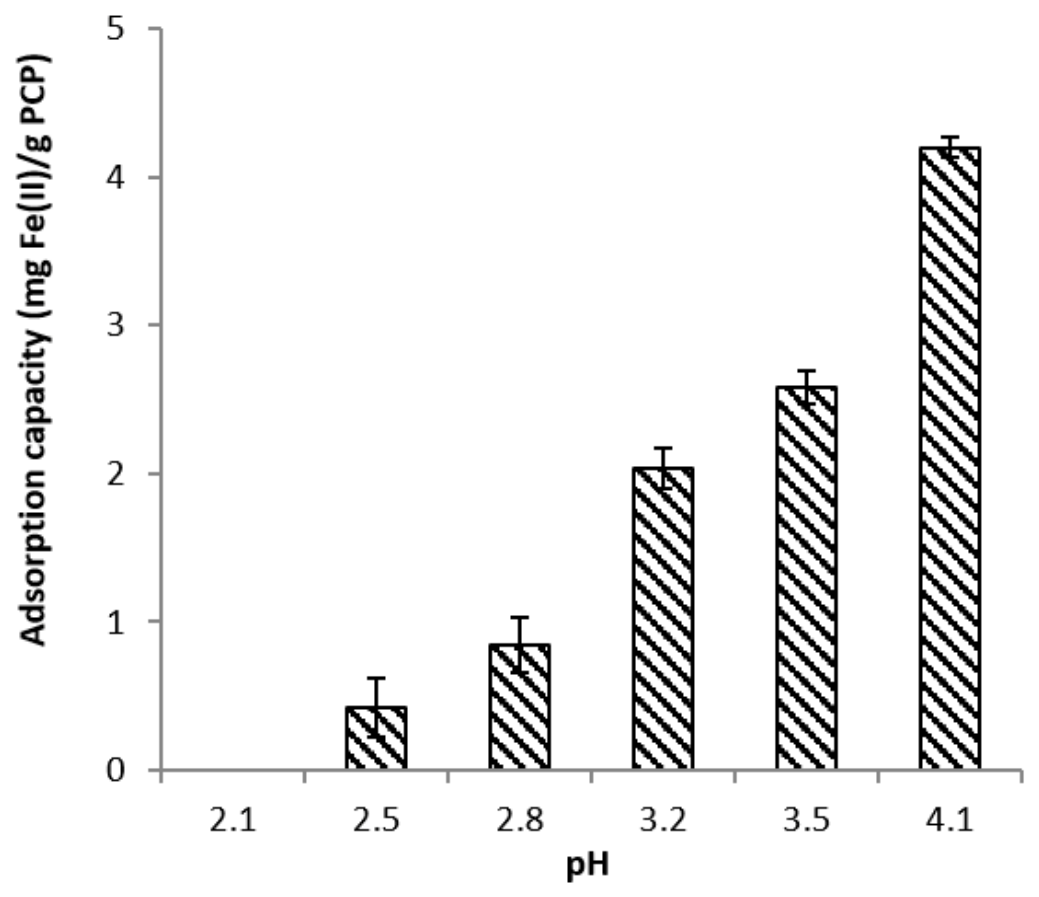
The aqueous medium pH represents a well-documented fundamental variable governing the biosorption of metal ions; by determining both the protonation state of the adsorbent functional groups and the speciation of the metal ions, pH fundamentally dictates the interfacial interaction mechanisms between the adsorbent and the metal ions, thereby controlling the overall adsorption capacity [47,52]. To investigate the influence of pH on FeII removal, the metal ion solution pH varied across a range from 2.1 to 4.1. This low pH range was chosen to prevent precipitation of FeII as well as its oxidation to FeIII; it is representative of acid mine drainages, where iron is often the main heavy metal present [115,116]. The dependence of FeII adsorption onto PCP as a function of solution pH is illustrated in Figure 1 and Figure 2.
As can be seen, no FeII removal was observed at pH 2.1, while only limited adsorption was noticed at pH 2.5. However, as the pH increased towards 4.1, both the efficiency of FeII retention and the adsorption capacity of PCP were significantly improved. This is consistent with previous studies on FeII adsorption using different waste biomass-based adsorbents (walnut shell, orange peels, jamun seeds, aloe vera leaves, crownflower roots), which also documented a similar increase in removal efficiency with an increase in aqueous phase pH [52,53,54,55,56,57].
The findings reported here most likely result from the electrostatic coulombic interactions between the cationic ferrous species and the localized surface charges on the PCP matrix. At pH values lower than pHpzc (i.e., <6.0), the PCP surface acquires a net positive charge; conversely, when the solution pH exceeds the pHpzc, deprotonation occurs, causing the PCP surface to acquire a net negative charge. Thus, it is evident that, over the entire studied pH range, the PCP surface will carry a net positive charge. Hence, throughout the investigated pH range, repulsion forces will generally make adsorption onto PCP unfavorable. Accordingly, the complete prevention of adsorption at pH 2.1 can be explained by the high abundance of H3O+ ions, which protonate the PCP surface functionalities, establishing a strong positive charge density that prevents metal binding. Nevertheless, increasing the solution pH to 4.1 causes the PCP surface to develop more negative charges and loses positive charges, which explains why adsorption is initiated at pH greater than 2.1, and its effectiveness increases as the pH rises. In addition, higher pH values also contribute to increased FeII cation removal by decreasing the H3O+ ion concentration, thereby enhancing metal accessibility to the negatively charged binding functional sites on the PCP matrix. However, it must be noted that, at pH 4.1, FeII precipitation and/or oxidation to FeIII already had a small but distinct contribution to removal of the metal, as can be seen from the control experiments (no PCP added) depicted in Figure S7. Therefore, to guarantee that FeII elimination was governed exclusively by surface adsorption rather than precipitation, all further experiments were conducted at a controlled pH of 3.2.
The pH-dependent behavior observed in the batch adsorption experiments correlates strongly with FTIR spectral shifts in the carbonyl, carboxyl, and phenolic regions (Table S7). At higher pH values, the deprotonation of these groups reduces electrostatic repulsion and provides negatively charged sites, facilitating enhanced surface complexation and ion exchange with the positively charged Fe2+.

3.2.2. Influence of FeII Initial Concentration

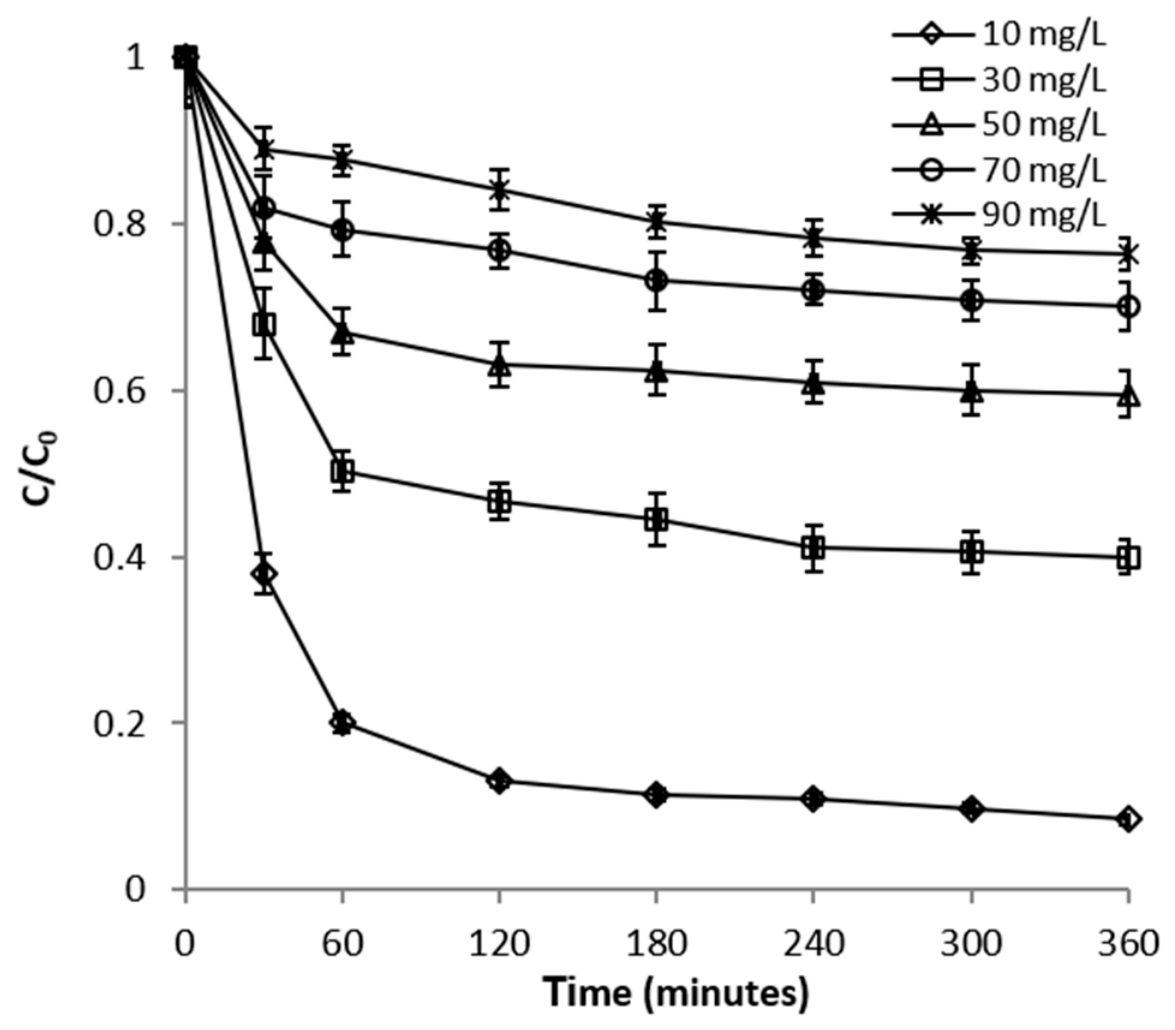
Another important parameter influencing sorption efficiency is the initial metal concentration; in this work, it was investigated across a range spanning from 10 to 90 mg L−1. The temporal evolution of FeII concentration as a function of its initial load, presented in Figure 3, reveals that the higher the concentration of FeII, the less efficiently PCP can take it up. At low initial adsorbate loadings, a high ratio exists between the number of PCP adsorption sites and the concentration of FeII ions in the solution; therefore, this abundance of binding sites facilitated the efficient removal of FeII ions through adsorption. However, as illustrated in Figure 3, the kinetic profile of FeII uptake onto PCP exhibits a distinct biphasic behavior rather than a uniform progression. During the primary phase, a steep decrease in solution concentration is observed; this behavior arises because the initial density of unoccupied surface functionalities is vastly superior to the concentration of the FeII ions, minimizing competitive effects. The time span of this stage decreased with increasing FeII concentration; the first step lasted about 60 min for the 10–50 mg L−1 concentration, and only approximately 30 min for the 70 and 90 mg L−1 concentrations (Figure 3). The second stage exhibited a significant decline in adsorption rates, ascribed to an increasing degree of adsorption site saturation and diminished accessibility of the remaining adsorption-active sites.
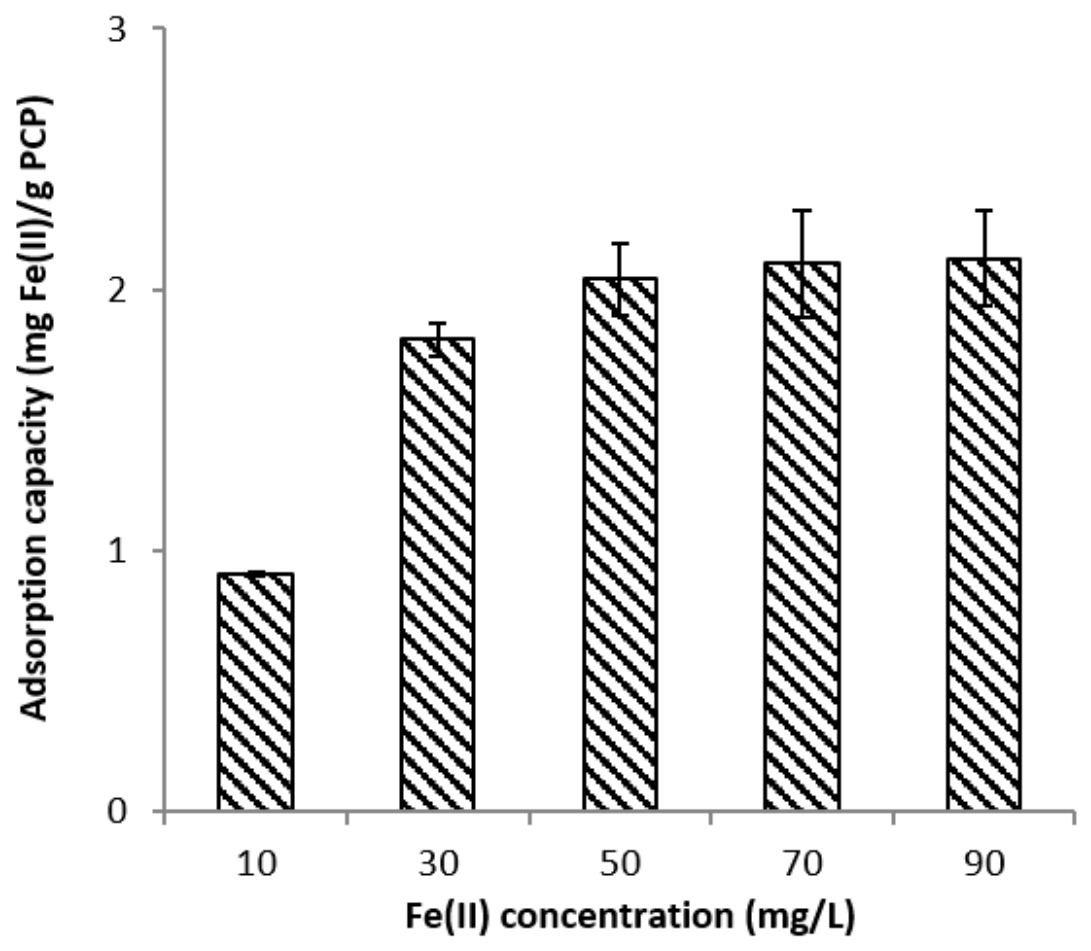
In contrast, as the initial FeII concentration was elevated, the mass-dependent adsorption capacity of PCP increased correspondingly until a saturation steady-state was attained (Figure 4). The PCP surface reached saturation only for FeII concentrations starting with 50 mg/L, when the experimental maximal adsorption capacity tended towards a constant value of about 2.1 mg g−1. The increased adsorption capacity observed at higher initial FeII concentrations is driven by an enhanced concentration gradient between the aqueous phase and the solid–liquid interface, which [53,117]: (1) increased the probability of metal ion collision with the biosorbent surface, (2) counteracted any mass transfer limitations that might hinder the FeII ions from reaching the surface of the PCP, and (3) enhanced the rate of metal ions mass transfer into the biosorbent pore. These results align consistently with findings presented by previous researchers for FeII sequestration utilizing alternative waste biomass-derived adsorbents (walnut shell, orange peels, jamun seeds, pine bark, coir fibre, crownflower roots) [53,55,56,57,58,59].

3.2.3. Influence of Temperature

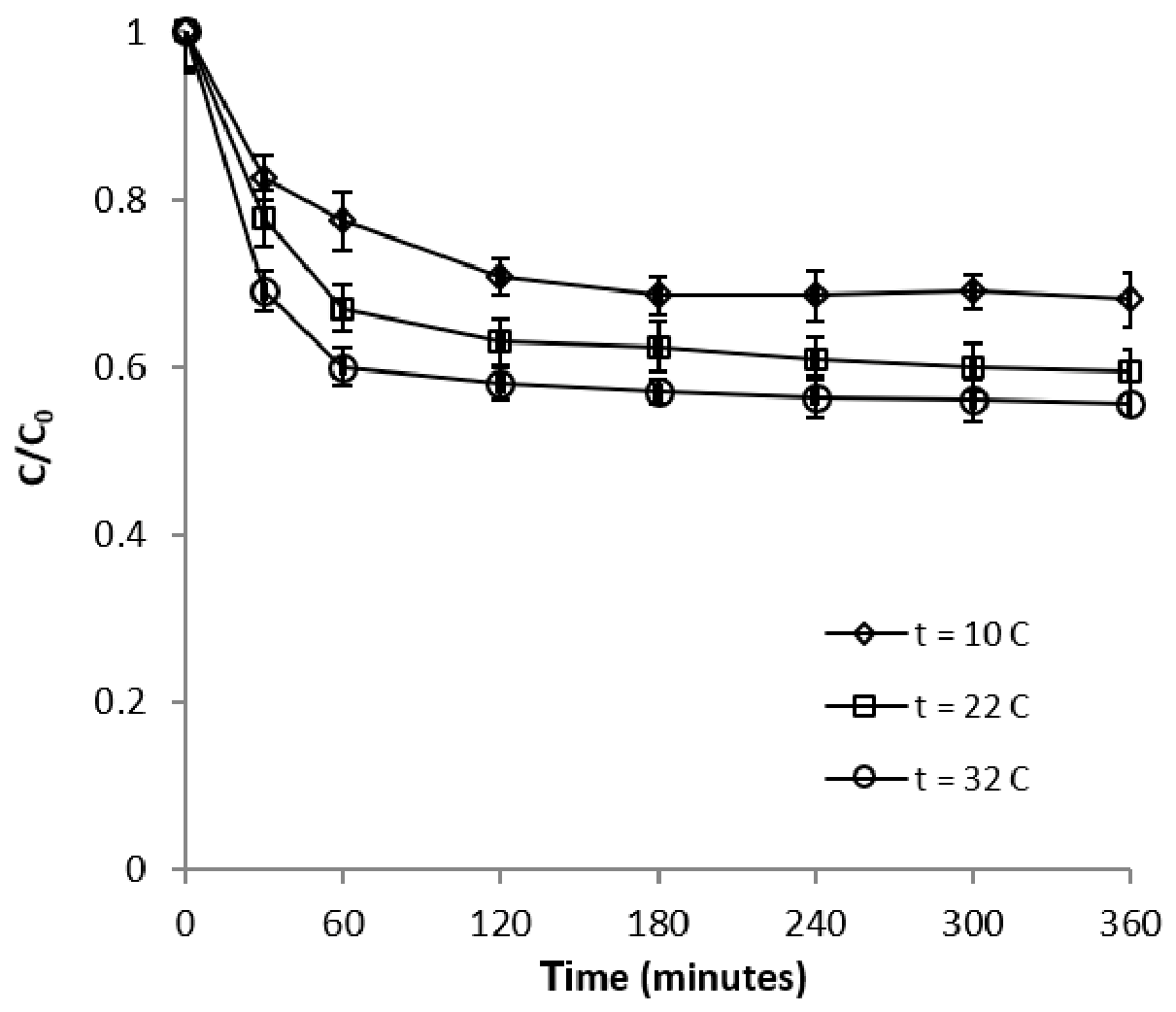
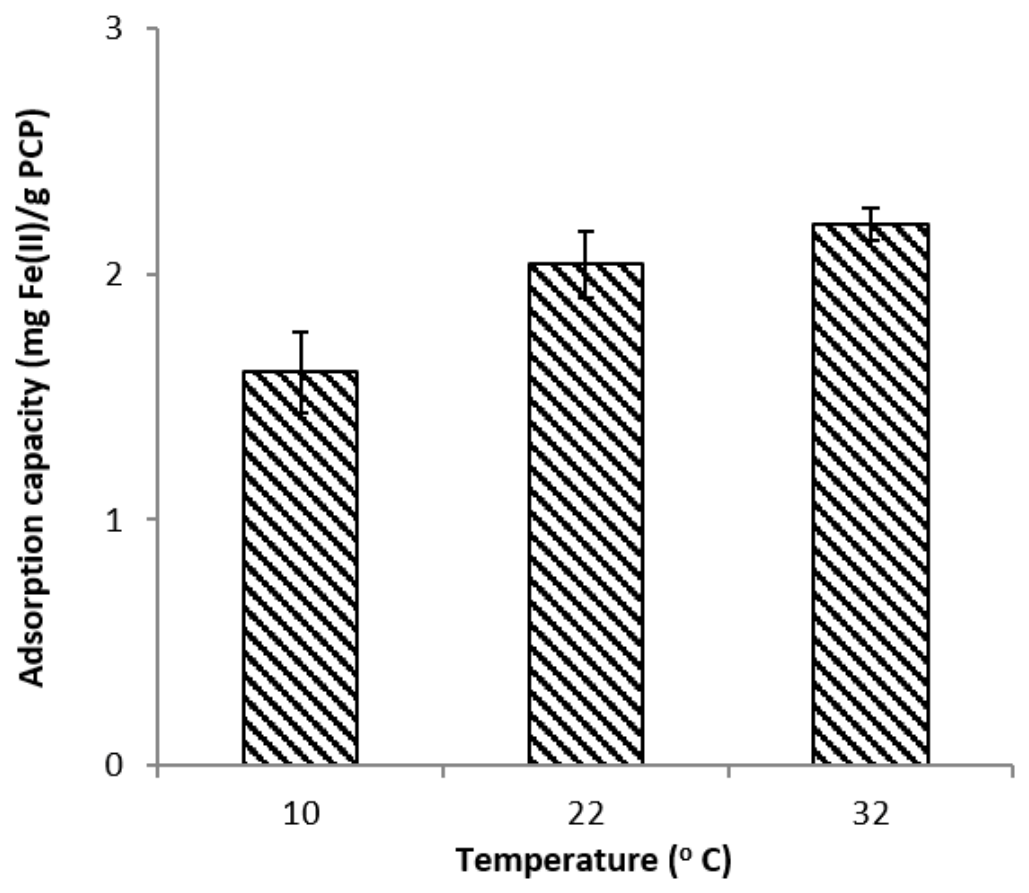
Temperature represents another key operational parameter in adsorption processes, as it simultaneously governs the mass transport and solubility of the adsorbate, while shifting the thermodynamic equilibrium capacity [118]; thus, temperature can affect the adsorption process from both a kinetic and thermodynamic perspective. The influence of temperature on the system was systematically evaluated across a thermal range of 10–32 °C; the resulting data sets are presented in Figure 5 and Figure 6.
Both the removal efficiency and equilibrium adsorption capacity of the PCP matrix exhibited a strong positive correlation with temperature across the entire investigated range. Notably, the most important improvement was exhibited when the operating temperature was raised from 10 to 22 °C. Further increasing the temperature to 32 °C offered some benefit for the FeII uptake, but the improvement was less significant compared to previous increases. This suggests that higher temperatures would not be cost-effective for the adsorptive sequestration process. The positive correlation between elevated temperature and FeII binding may be attributed to [38,51]: (1) an increase in the number of adsorption sites; (2) higher thermal energy of the adsorbing species, which increases their speed and frequency of collisions with PCP; and (3) desolvation of incoming adsorbing species, along with a compression of the boundary layer surrounding the PCP matrix; this decreases mass transfer resistance in the boundary layer, leading to increased rates of intraparticle adsorbate diffusion in PCP pores. The observed relationship between temperature and adsorption capacity indicates the process is endothermic. A comparable positive thermal effect on removal efficiency has been documented in earlier literature examining FeII adsorption on agro-waste adsorbents (walnut shell, orange peels, jamun seeds) [53,55,56]. However, when utilizing acid-modified aloe vera leaves for FeII adsorption, it was reported that as temperature increased, the elimination percentage decreased [52].

3.2.4. Influence of Ionic Strength

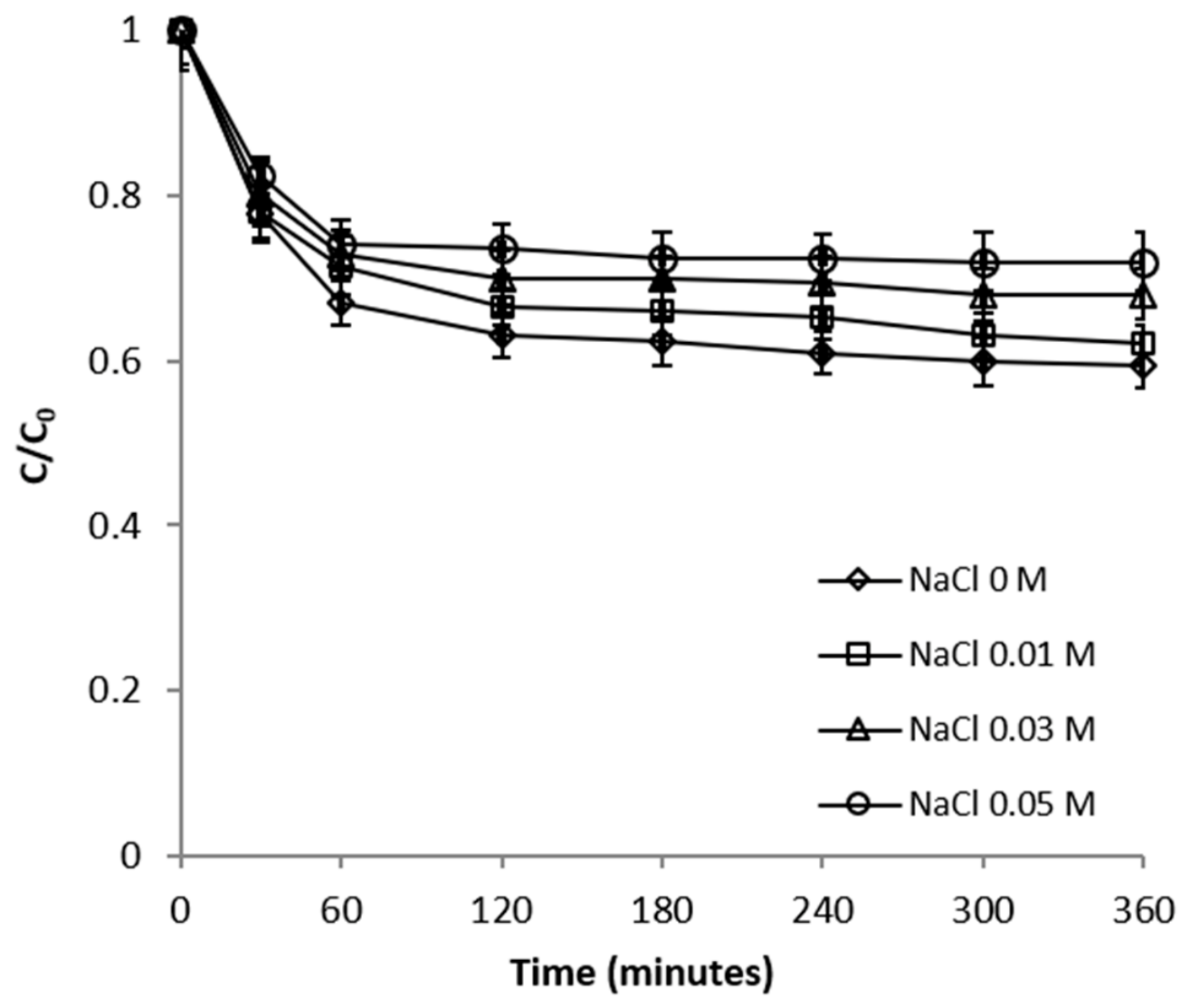
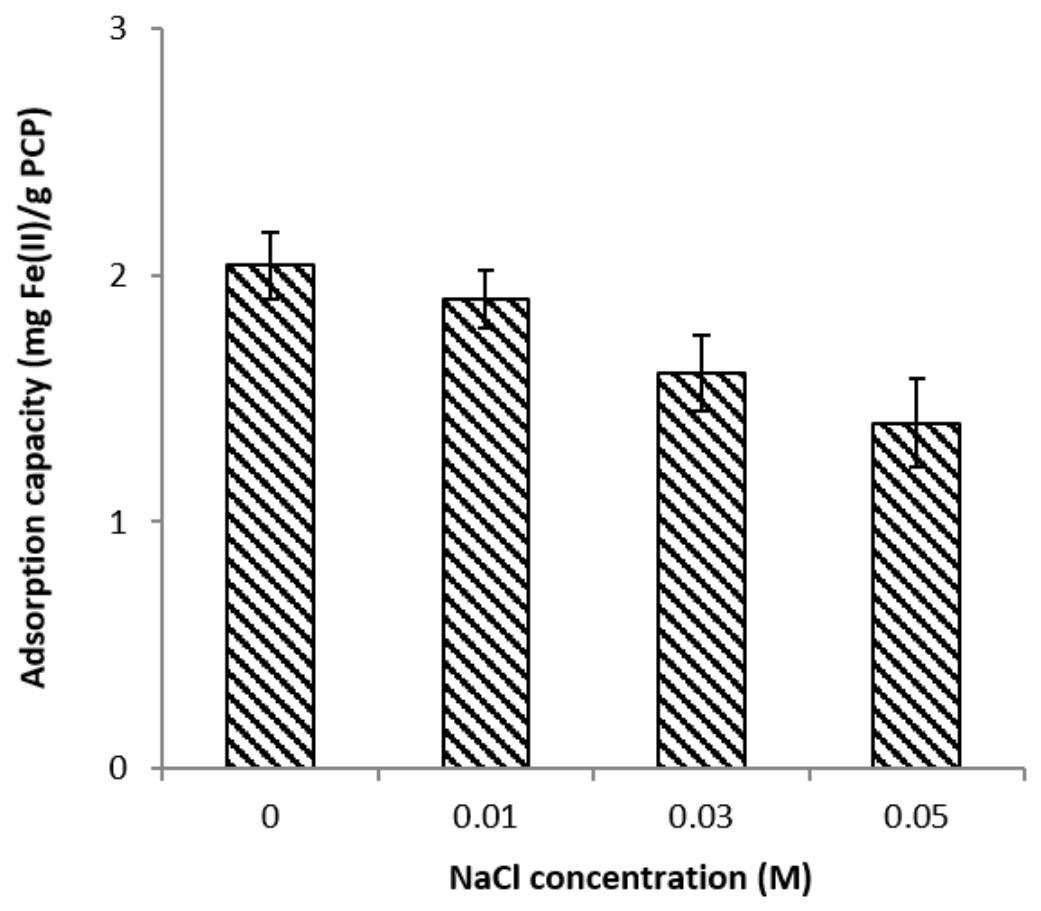
Ionic strength is another important parameter to be studied because both natural water bodies and wastewater effluents usually contain various concentrations of dissolved salts, which could affect adsorption performance [119]. In addition, by analyzing how metal adsorption changes with increasing ionic strength, we can distinguish between the two main mechanisms by which ions bind to minerals: physical adsorption (weak, non-specific) and chemical adsorption (strong, specific). In the present work, the influence of ionic strength on FeII adsorption was systematically evaluated by varying the concentration of a background electrolyte between 0 and 0.05 M. NaCl was selected as an indifferent electrolyte because its chemically inert behavior isolates ionic strength effects without pH interference or competitive reactions, while its ubiquity realistically models natural and industrial aquatic matrices. As illustrated in Figure 7 and Figure 8, it resulted that higher ionic strength values gradually slow down the adsorption of FeII. The observed influence of ionic strength is likely driven by electrostatic competition between sodium and iron cations for the available binding functional groups on the biosorbent surface [120]. This finding indicates that adsorption occurs predominantly by the formation of outer sphere complexes involving weak, non-specific interactions, characteristic of physisorption [121,122,123].

3.3. Kinetic Studies

3.3.1. Kinetic Modelling

The fitted curves of the studied kinetic models and the parameter values with their statistical fits are given in Figures S8–S13 and Table 1, respectively. According to the parameters listed in Table 1, the high coefficients (R2) indicate that both the pseudo-first-order and pseudo-second-order kinetic models correlate strongly with the experimental data, exhibiting only marginal variations in their regression values. Hence, this is a clear example of why calculating R2 alone is not enough in evaluating how well models represent the experimental data; as confirmed by previous studies, other error functions must be determined and used as criteria for assessing the fitting quality of the investigated models [78,84,88,90]. Accordingly, a further comparison of the error functions summarized in Table 1 (lower values mean a better fit of the model) established the pseudo-first-order framework as the more accurate representation of the empirical kinetic profile. The validity of this mechanism is verified by the striking proximity between the empirically determined uptake capacity (qeexp = 2.02) and the theoretical value predicted by the pseudo-first-order model (qecalc = 1.96). This is consistent with previous reports on FeII adsorption using pine bark, jamun seeds, and aloe vera leaves as waste biomass-based adsorbents [52,56,58]; the kinetic parameters derived from the pseudo-first-order model across various investigations are compiled for comparative analysis in Table S9 [52,56,58]. Instead, other studies employing orange peels, walnut shells, and pomegranate peels as adsorbent biomaterials demonstrated that the sequestration process conformed closely to pseudo-second-order kinetics [53,55,60].
From a physicochemical perspective, first-order models are typically applicable when adsorption is limited by film diffusion or when transport has negligible impact on the overall adsorption rate [124]. At the same time, a pseudo-first order kinetics implies that adsorption is fast and adsorbent equilibrium is more rapidly attained, knowing that the saturation time exponentially increases with the rate order [66].
To elucidate the primary rate-controlling steps governing the FeII uptake, the Weber–Morris intraparticle diffusion model was applied to the kinetic experimental data. Generally, the process of contaminant removal via adsorption can be separated into four stages [67,89,125]: (1) transport of the contaminant through the bulk aqueous phase, (2) film diffusion of the contaminant across the stagnant liquid film surrounding the particle to reach its external periphery, (3) contaminant intraparticle diffusion from the external surface into the internal porous matrix of the adsorbent, and (4) contaminant immobilization onto the active functional groups. However, since a well mixed batch system was employed in this study, stage 1 cannot become a rate-limiting step [126]. Furthermore, stage 4 is typically also a fast process and does not usually limit the overall rate of adsorption [127]. Thus, only the film diffusion (stage 2) and intraparticle diffusion (stage 3) resistances may act as the potential rate-limiting steps during the solute immobilization process. According to the Weber–Morris framework, intraparticle diffusion governs the overall adsorption velocity, provided that the regression of qt against t0.5 yields a linear relationship that intersects the origin [67]. However, the profile displayed in Figure S13 exhibits a distinct segmented linearity, indicating that the adsorption process proceeds via two separate, successive mass transfer stages. As illustrated by the high slope of the first segment, the early kinetic phase is governed predominantly by mass transfer boundary layer diffusion effects (i.e., film diffusion). The subsequent segment, characterized by a markedly reduced slope, corresponds to a kinetic regime predominantly governed by the gradual adsorption inside the pores (i.e., intraparticle diffusion). Hence, it can be concluded that intraparticle diffusion does not act as the exclusive kinetic bottleneck during the sequestration of FeII onto PCP [67,128]. In addition, the Weber–Morris kd and C parameters can provide further information regarding transport resistances. Specifically, the intraparticle diffusion rate coefficient kd serves as an indicator of internal mass transfer resistance, where lower values signify heightened diffusional limitations within the pore architecture. Concurrently, the intercept C correlates directly with the boundary layer thickness; an elevated C value denotes a thicker stagnant fluid film, thereby imposing a greater hindrance on solute transport [129,130]. Similar Weber–Morris profiles characterized by deviation from the origin and the presence of segmented linearity have been documented in prior literature analyzing FeII sequestration on biosorbents based on pine bark, walnut shell, jamun fruit seeds, and aloe vera leaves [52,55,56,58]; a comparison of the Weber–Morris parameters reported in these studies is provided in Table S10 [55,56,58].

3.3.2. Energy of Activation

To evaluate the activation energy governing the adsorption process, the linearized Arrhenius relationship [72] was applied (Table S5). Utilizing kinetic coefficients determined at 283, 295, and 305 °K, the activation energy of the adsorption process was calculated to be 17.8 KJ mol−1 from the linear slope representing lnk1 versus 1/T (Figure S14). The numeric value of the activation energy provides a clear diagnostic criterion to distinguish between the domination of weaker physisorption or stronger chemisorption processes. An activation energy below 40 KJ mol−1 confirms physisorption as the dominant process [118,131]. This is in line with previous results (Ea = 12.9 KJ mol−1) reported for adsorption of FeII by pine bark biomass [58].

3.4. Equilibrium Isotherm Studies

The five studied equilibrium isotherms are depicted in Figures S15–S19, while their parameters and error functions are outlined in Table 2. The experimental results were best described by the Freundlich and Redlich–Peterson isotherms, which have identical R2 coefficients. This can be ascribed to the fact that, at elevated adsorbate concentrations, the Redlich–Peterson model converges toward the Freundlich isotherm [132]. However, the lower error function values calculated for the Freundlich model confirm its superior fit to the experimental data. The assumptions underlying the empirical Freundlich model include [78,84,133]: (1) adsorption takes place across heterogeneous surfaces, featuring multiple distinct sites; (2) ion retention is reversible and can occur in multiple layers; and (3) the value of the adsorption energy is not constant for all adsorption sites. Similar best fitting of the Freundlich isotherm was previously reported for FeII adsorption on pine bark, orange peels, jamun seeds, and crownflower roots as waste biomass-based adsorbents [53,56,57,58].
The Freundlich constant 1/nF quantifies the process favorability; adsorption is considered favorable if 0 < 1/nF < 1 and unfavorable if 1/nF > 1. Furthermore, the Freundlich constant 1/nF can also give information on the heterogeneity of the adsorbent surface. If 1/nF = 1, the adsorbent surface is homogeneous, with equal adsorption energies for all sites, resulting in linear adsorption. Instead, values of 1/nF < 1 signify surface heterogeneity and varied site energies, leading to isotherm nonlinearity; the closer the 1/nF value to 0, the higher the surface heterogeneity and the broader the distribution of binding energies on the adsorbent surface. In this last case, the binding sites with the highest energy are occupied first and, as these sites become occupied, adsorption continues on sites with progressively lower energies [88,134]. In this study, we determined a value of 1/nF = 0.70 (Table 2), indicating that adsorption of FeII on PCP was favorable. This is in accord with the Langmuir RL separation factor (determined as detailed in Supplementary Material) having a value of 0.39 (Table 2); given that this parameter falls between 0 and 1, it reveals the favorability of the adsorption system [88].
Because the Freundlich model assumes a multilayer retention of adsorbate on adsorbent, it could suggest that physisorption is the primary mechanism [62,68]. However, as with kinetic models, the successful fit of an adsorption isotherm model offers limited insight into the specific mechanism governing the adsorption process; other analyses may be needed to fully understand the adsorption process [68,128].
Since the Temkin bonding energy b value (Table 2) is below 8 KJ mol−1, weak physical interactions can be designated as the primary force governing the uptake process [131]; this conclusion is consistent with the recorded activation energy (see Section 3.3.2), which also identifies physisorption as the dominant process involved the in retention of FeII by PCP.

3.5. Thermodynamic Studies

To evaluate the thermodynamic nature of the adsorption process, the standard Gibbs free energy (ΔG°), standard enthalpy (ΔH°), and standard entropy (ΔS°) changes were determined. These parameters were calculated utilizing equilibrium data gathered across a temperature range of 283, 295, and 305 °K. Because using equilibrium constant values with dimensions for the calculation of ΔG°, ΔH°, and ΔS° thermodynamic parameters is mathematically incorrect [94], we first calculated the dimensionless standard adsorption equilibrium constants K° at temperatures of 283, 295, and 305 °K, from the KL Langmuir constants obtained at the same temperatures, as presented in Table S6 [91]. Then, based on the linearized van ’t Hoff relationship (Table S6), the values for ΔS° and ΔH° were derived from the resulting intercept and slope of the linear regression of lnK° against 1/T (Figure S20). Finally, the variations in ΔG° values across the investigated temperature range were determined from the equation describing the relationship of ΔG° with ΔH° and ΔS° (Table S6) [68,92]. As indicated by the negative ΔG° values (Table 3), adsorption is a favorable process at all examined temperatures; the more negative ΔG° is, the more favorable the adsorption [96]. The endothermic character of the adsorption process is confirmed by the positive ΔH° (Table 3) [62]. This aligns with experimental results, which demonstrated that increasing the temperature has a beneficial impact on overall adsorption capacity. Furthermore, the magnitude of ΔH° can be used to infer the main pathway by which the adsorbent and adsorbate interact [73]; a physisorption-dominated removal mechanism is indicated by the fact that the obtained ΔH° was under 40 kJ mol−1 in this study [94]. Lastly, the positive ΔS° value reflects an enhanced degree of disorder at the solid–liquid interface during the adsorption process, along with a good affinity of the PCP adsorbent towards FeII [88].

3.6. Fate of the Spent Adsorbent

While the regeneration and reusability of traditional, high-cost synthetic adsorbents are essential to balance process economics [2], the system investigated here relies on abundant, low-cost vegetal waste. From a technoeconomic standpoint, the chemical and energetic expenditure required for desorption surpasses the value of the precursor material, rendering regeneration economically unviable. Furthermore, because of the relatively low FeII toxicity, the disposal challenges associated with other hazardous heavy metals are largely averted. Therefore, instead of being subject to discarding or regeneration, the exhausted adsorbent can be valorized in several circular economy applications including iron-rich agricultural soil amendment, low-cost stabilizing filler in construction materials, and reactive material for other water treatment processes [2,55]. Nevertheless, it is worth noting that a reliable regeneration profile cannot be fully represented by simplified synthetic aqueous FeII systems. Real-world FeII bearing effluents (e.g., acid mine drainage or industrial wastewater) feature complex co-existing ions and organic matter that can trigger surface fouling, irreversible competitive binding, and altered desorption behavior. Consequently, meaningful evaluation of regeneration and longevity metrics will be targeted in future work under such realistic conditions.

4. Conclusions

This study reported the successful use of pine cone lignocellulosic material as a sustainable bioadsorbent utilized for the remediation of FeII-contaminated aqueous phases. Heavy metal adsorption correlated positively with temperature and pH but showed an inverse relationship with increasing ionic strength and initial FeII concentration. To evaluate the adsorption process, the reaction kinetics and equilibrium behavior were characterized using five distinct kinetic models and five isotherm equations, respectively. An analysis utilizing four error functions revealed that the pseudo-first-order model approach offered the best fit for the kinetic data, while the Freundlich isotherm successfully characterized the adsorption equilibrium. Thermodynamic parameters ΔG°, ΔH°, and ΔS° for FeII adsorption on PCP have been evaluated.
The positive ΔH° reflects that the sorption process is endothermic. The negative ΔG° implies that adsorption was favorable over the studied temperature spectrum. This is in line with the RL Langmuir separation factor and 1/nF Freundlich constant, which consistently point towards favorable adsorption conditions. Similarly, the positive ΔS° value implies a good affinity of the PCP for FeII, reflecting a higher state of disorder at the adsorbent–solution boundary. The combined kinetic and thermodynamic analysis points towards physisorption as the main mechanism for binding FeII onto PCP. Furthermore, both intraparticle diffusion and boundary layer (film) diffusion were found to control the kinetics of the process, as revealed by the Weber–Morris plot. The maximum Langmuir adsorption capacity of PCP reached 12.7 mg g−1. Compared to the single untreated waste-derived adsorbent found in the literature (2.02 mg g−1 for pine bark, [58]), PCP demonstrates superior performance, establishing it as an efficient and economical alternative to commercial activated carbons. The findings demonstrate that PCP serves as an effective, low-cost alternative to traditional water treatment media. By repurposing biological waste into a functional resource, this research provides a scalable, eco-friendly solution for industrial heavy metal mitigation. This ”waste-to-resource” strategy aligns with green chemistry principles, offering a cost-effective pathway to mitigate environmental pollution while minimizing the ecological footprint of water purification technologies. To further advance the significance and practical application of this work, future research directions should focus on: (1) continuous-flow fixed-bed column studies to transition from batch scales to realistic industrial configurations, (2) testing the adsorbent against complex multi-metal matrices and real effluents to validate its robustness in real-world environmental remediation, and (3) evaluating the desorption behavior and reusability profiles of the spent PCP biomass to ensure process economy. Addressing these aspects will bridge the gap between laboratory findings and field-scale applications, further establishing PCP as a viable, eco-friendly technology for heavy metal remediation.

Supplementary Materials

The following supporting information can be downloaded at: https://www.mdpi.com/article/10.3390/su18147064/s1, Figure S1: FTIR spectra of fresh PCP; Figure S2: FTIR spectra of fresh PCP-Fe; Figure S3: SEM micrograph of PCP; Figure S4: SEM micrograph of PCP-Fe; Figure S5: EDX pattern of PCP; Figure S6: EDX pattern of PCP-Fe; Figure S7: Effect of pH on FeII concentration in control experiments; Figure S8: Fitting results of the pseudo-first-order kinetic model; Figure S9: Fitting results of the pseudo-second-order kinetic model; Figure S10: Fitting results of the pseudo-nth-order kinetic model; Figure S11: Fitting results of the Elovich kinetic model; Figure S12: Fitting results of the Weber–Morris kinetic model (qt vs. time); Figure S13: Fitting results of the Weber–Morris kinetic model (qt vs. time0.5); Figure S14: Arrhenius plot of ln k1 versus 1/T for the determination of the activation energy; Figure S15: Fitting results of the Langmuir isotherm model; Figure S16: Fitting results of the Freundlich isotherm model; Figure S17: Fitting results of the Langmuir–Freundlich isotherm model; Figure S18: Fitting results of the Temkin isotherm model; Figure S19: Fitting results of the Redlich–Peterson isotherm model; Figure S20: Plot of lnK° versus 1/T for the determination of the ΔH° and ΔS°; Table S1: Setup design of batch kinetic experiments; Table S2: Setup design of batch equilibrium experiments; Table S3: Kinetic models applied for the evaluation of the adsorption process; Table S4: Thermodynamic models applied for the evaluation of the adsorption process; Table S5: Arrhenius equation used for the evaluation of activation energy; Table S6: Equations used for the evaluation of thermodynamic parameters; Table S7: Assignments in the FTIR spectrum of fresh and exhausted PCP; Table S8: Comparison of specific surface area reported in the literature for various agricultural waste bioadsorbents; Table S9: Comparison of pseudo-first-order kinetic parameters reported in the literature for the adsorption of FeII on various agricultural waste bioadsorbents; Table S10: Comparison of Weber–Morris kinetic parameters reported in the literature for the adsorption of FeII on various bioadsorbents.

Author Contributions

Conceptualization, M.G. and I.B.; methodology, M.G. and I.B.; software, M.G.; validation, M.G. and I.B.; formal analysis, M.G. and I.B.; investigation, M.G. and I.B.; resources, M.G. and I.B.; data curation, M.G. and I.B.; writing—original draft preparation, M.G.; writing—review and editing, M.G.; visualization, M.G. and I.B.; supervision, M.G. All authors have read and agreed to the published version of the manuscript.

Funding

This research was funded by a grant of the Ministry of Research, Innovation and Digitization, CNCS/CCCDI—UEFISCDI, through the project Center of Excellence in water management, materials, by-products and waste valorisation for circular bioeconomy implementation, proposal number PN-IV-P6-6.1-CoEx-2024-0056, contract 6 CoEx/02.06.2026.

Institutional Review Board Statement

Not applicable.

Informed Consent Statement

Not applicable.

Data Availability Statement

The original contributions presented in this study are included in the article/Supplementary Material.

Acknowledgments

We sincerely thank the four anonymous reviewers whose insightful comments and suggestions provided on earlier version of this manuscript helped improve and clarify this study.

Conflicts of Interest

The authors declare no conflicts of interest. The funders had no role in the design of the study; in the collection, analyses, or interpretation of data; in the writing of the manuscript; or in the decision to publish the results.

Abbreviations

The following abbreviations are used in this manuscript:
PCPFresh pine cone powder
PCP-FeFe-loaded exhausted pine cone powder

References

  1. Mingelgrin, U.; Nasser, A. Diagnosis and prognosis of the distribution of contaminants in the Geosphere. In Soil and Water Pollution Monitoring, Protection and Remediation; Twardowska, I., Allen, H.E., Haggblom, M.H., Eds.; Springer: Dordrecht, The Netherlands, 2006; pp. 3–23. [Google Scholar]
  2. Fouda-Mbanga, B.G.; Velempini, T.; Pillay, K.; Tywabi-Ngeva, Z. Heavy metals removals from wastewater and reuse of the metal loaded adsorbents in various applications: A review. Hybrid Adv. 2024, 6, 100193. [Google Scholar] [CrossRef]
  3. Shrivastava, R.; Upreti, R.K.; Chaturvedi, U.C. Various cells of the immune system and intestine differ in their capacity to reduce hexavalent chromium. FEMS Immunol. Med. Microbiol. 2003, 38, 65–70. [Google Scholar] [CrossRef] [PubMed]
  4. Corda, N.; Kini, M.S. Recent studies in adsorption of Pb(II), Zn(II) and Co(II) using conventional and modified materials: A review. Sep. Sci. Technol. 2020, 55, 2679–2698. [Google Scholar]
  5. Rehman, K.; Fatima, F.; Waheed, I.; Akash, M.S.H. Prevalence of exposure of heavy metals and their impact on health consequences. J. Cell. Biochem. 2018, 119, 157–184. [Google Scholar]
  6. Vardhan, K.H.; Kumar, P.S.; Panda, R.C. A review on heavy metal pollution, toxicity and remedial measures: Current trends and future perspectives. J. Mol. Liq. 2019, 290, 111197. [Google Scholar] [CrossRef]
  7. Dhokpande, S.R.; Deshmukh, S.M.; Khandekar, A.; Sankhe, A. A review outlook on methods for removal of heavy metal ions from wastewater. Sep. Purif. Technol. 2024, 350, 127868. [Google Scholar] [CrossRef]
  8. Yaashika, P.R.; Palanivelu, J.; Hemavathy, R.V. Sustainable approaches for removing toxic heavy metal from contaminated water: A comprehensive review of bioremediation and biosorption techniques. Chemosphere 2024, 357, 141933. [Google Scholar] [CrossRef]
  9. Stefansson, A.; Seward, T. A spectrophotometric study of iron(III) hydrolysis in aqueous solutions to 200 °C. Chem. Geol. 2008, 249, 227–235. [Google Scholar] [CrossRef]
  10. Davison, W.; Seed, G. The kinetics of the oxidation of ferrous iron in synthetic and natural waters. Geochim. Cosmochim. Acta 1983, 47, 67–79. [Google Scholar] [CrossRef]
  11. Davison, W. Iron and manganese in lakes. Earth Sci. Rev. 1993, 34, 119–163. [Google Scholar] [CrossRef]
  12. Khatri, N.; Tyagi, S.; Rawtani, D. Recent strategies for the removal of iron from water: A review. J. Water Process Eng. 2017, 19, 291–304. [Google Scholar] [CrossRef]
  13. Ekstrom, S.M.; Regnell, O.; Reader, H.E.; Nilsson, P.A.; Lofgren, S.; Kritzberg, E.S. Increasing concentrations of iron in surface waters as a consequence of reducing conditions in the catchment area. J. Geophys. Res. Biogeosci. 2016, 121, 479–493. [Google Scholar] [CrossRef]
  14. World Health Organization. Iron. In Guidelines for Drinking-Water Quality. Vol. 2. Health Criteria and Other Supporting Information, 2nd ed.; Mastercom/Wiener Verlag: Wien, Austria, 1996; pp. 248–253. [Google Scholar]
  15. Jensen, D.L.; Boddum, J.K.; Redemann, S.; Christensen, T.H. Speciation of dissolved iron(II) and manganese(II) in a groundwater pollution plume. Environ. Sci. Technol. 1998, 32, 2657–2664. [Google Scholar] [CrossRef]
  16. Espana, J.S.; Pamo, E.L.; Pastor, E.S. The oxidation of ferrous iron in acidic mine effluents from the Iberian Pyrite Belt (Odiel Basin, Huelva, Spain): Field and laboratory rates. J. Geochem. Explor. 2007, 92, 120–132. [Google Scholar] [CrossRef]
  17. Lieu, P.; Heiskala, M.; Peterson, P.; Yang, Y. The roles of iron in health and disease. Mol. Asp. Med. 2001, 22, 1–87. [Google Scholar] [CrossRef]
  18. Nair, M.; Iyengar, V. Iron content, bioavailability & factors affecting iron status of Indians. Indian J. Med. Res. 2009, 130, 634–645. [Google Scholar] [PubMed]
  19. Fontecave, M.; Pierre, J.L. Iron: Metabolism, toxicity and therapy. Biochimie 1993, 75, 767–773. [Google Scholar] [CrossRef] [PubMed]
  20. Abbaspour, N.; Hurrell, R.; Kelishadi, R. Review on iron and its importance for human health. J. Res. Med. Sci. 2014, 19, 164–174. [Google Scholar] [PubMed]
  21. Andrews, N.C. Iron metabolism: Iron deficiency and iron overload. Annu. Rev. Genom. Hum. Genet. 2000, 1, 75–98. [Google Scholar] [CrossRef]
  22. Oliveira, F.; Rocha, S.; Fernandes, R. Iron metabolism: From health to disease. J. Clin. Lab. Anal. 2014, 28, 210–218. [Google Scholar] [CrossRef] [PubMed]
  23. Mortadi, A.; El Hafidi, E.M.; El Moznine, R. Monitoring the coagulation mechanism and aluminum sulfate impact on textile wastewater treatment: Insights from impedance spectroscopy. J. Indian Chem. Soc. 2025, 102, 101501. [Google Scholar] [CrossRef]
  24. Barakat, M.A. New trends in removing heavy metals from industrial wastewater. Arab. J. Chem. 2011, 4, 361–377. [Google Scholar] [CrossRef]
  25. Chai, W.S.; Cheun, J.Y.; Kumar, P.S.; Mubashir, M.; Majeed, Z.; Banat, F.; Ho, S.H.; Show, P.L. A review on conventional and novel materials towards heavy metal adsorption in wastewater treatment application. J. Clean. Prod. 2021, 296, 126589. [Google Scholar] [CrossRef]
  26. Wibowo, Y.G.; Taher, T.; Khairurrijal, K.; Ramadan, B.S.; Safitri, H.; Sudibyo, S.; Yuliansyah, A.T.; Petrus, H.T.B.M. Recent advances in the adsorptive removal of heavy metals from acid mine drainage by conventional and novel materials: A review. Bioresour. Technol. Rep. 2024, 25, 101797. [Google Scholar] [CrossRef]
  27. Ghosh, S.; Debsarkar, A.; Dutta, A. Technology alternatives for decontamination of arsenic-rich groundwater—A critical review. Environ. Technol. Innov. 2019, 13, 277–303. [Google Scholar] [CrossRef]
  28. Deliyanni, E.A.; Kyzas, G.Z.; Triantafyllidis, K.S.; Matis, K.A. Activated carbons for the removal of heavy metal ions: A systematic review of recent literature focused on lead and arsenic ions. Open Chem. 2015, 13, 699–708. [Google Scholar] [CrossRef]
  29. Bailey, S.E.; Olin, T.J.; Brick, R.M.; Adrian, D.D. A review of potentially low-cost sorbents for heavy metals. Water Res. 1999, 33, 2469–2479. [Google Scholar] [CrossRef]
  30. Joshi, N.C.; Joshi, A.; Mitra, D.; Gururani, P.; Kumar, N.; Joshi, H.K. Removal of heavy metals using cellulose-based materials: A mini-review. Environ. Nanotechnol. Monit. Manag. 2024, 21, 100942. [Google Scholar] [CrossRef]
  31. El Hafidi, E.M.; Mortadi, A.; Lizoul, B.; Hairch, Y.; Mghaiouini, R.; Sabor, A.; Mnaouer, K.; Chahid, G.; Jebbari, S.; El Moznine, R.; et al. Assessment of sand and hearth ash filtration for wastewater treatment and novel monitoring via complex conductivity. Euro-Mediterr. J. Environ. Integr. 2025, 10, 1137–1148. [Google Scholar] [CrossRef]
  32. Zafar, M.; Van Vinh, N.; Behera, S.K.; Park, H.S. Ethanol mediated As(III) adsorption onto Zn-loaded pinecone biochar: Experimental investigation, modeling, and optimization using hybrid artificial neural network-genetic algorithm approach. J. Environ. Sci. 2017, 54, 114–125. [Google Scholar] [CrossRef]
  33. Yu, H.; Miksik, F.; Thu, K.; Miyazaki, T. Characterization and optimization of pore structure and water adsorption capacity in pinecone-derived activated carbon by steam activation. Powder Technol. 2024, 431, 119084. [Google Scholar] [CrossRef]
  34. Teng, D.; Zhang, B.; Xu, G.; Wang, B.; Mao, K.; Wang, J.; Sun, J.; Feng, X.; Yang, Z.; Zhang, H. Efficient removal of Cd(II) from aqueous solution by pinecone biochar: Sorption performance and governing mechanisms. Environ. Pollut. 2020, 265, 115001. [Google Scholar] [CrossRef] [PubMed]
  35. Muslim, A. Optimization of Pb(II) adsorption onto australian pine cones-based activated carbon by pulsed microwave heating activation. Iran. J. Chem. Chem. Eng. 2017, 36, 115–127. [Google Scholar]
  36. Muslim, A. Australian pine cones-based activated carbon for adsorption of copper in aqueous solution. J. Eng. Sci. Technol. 2017, 12, 280–295. [Google Scholar]
  37. Huang, W.H.; Chang, Y.J.; Lee, D.J. Layered double hydroxide loaded pinecone biochar as adsorbent for heavy metals and phosphate ion removal from water. Bioresour. Technol. 2024, 39, 129984. [Google Scholar] [CrossRef]
  38. Huong, P.T.; Lee, B.K.; Kim, J.; Lee, C.H.; Chong, M.N. Acid activation pine cone waste at differences temperature and selective removal of Pb2+ ions in water. Proc. Saf. Environ. Prot. 2016, 100, 80–90. [Google Scholar] [CrossRef]
  39. Khan, B.A.; Ahmad, M.; Iqbal, S.; Ullah, F.; Bolan, N.; Solaiman, Z.M.; Shafique, M.A.; Siddique, K.H.M. Adsorption and immobilization performance of pine-cone pristine and engineered biochars for antimony in aqueous solution and military shooting range soil: An integrated novel approach. Environ. Pollut. 2023, 317, 120723. [Google Scholar] [CrossRef] [PubMed]
  40. Masuku, M.; Nure, J.F.; Atagana, H.I.; Hlongwa, N.; Nkambule, T.T.I. Advancing the development of nanocomposite adsorbent through zinc-doped nickel ferrite-pinecone biochar for removal of chromium (VI) from wastewater. Sci. Total Environ. 2024, 908, 168136. [Google Scholar] [CrossRef] [PubMed]
  41. Momcilovic, M.; Purenovic, M.; Bojic, A.; Zarubica, A.; Randelovic, M. Removal of lead(II) ions from aqueous solutions by adsorption onto pine cone activated carbon. Desalination 2011, 276, 53–59. [Google Scholar] [CrossRef]
  42. Ofomaja, A.; Naidoo, E.; Modise, S. Removal of copper (II) from aqueous solution by pine and base modified pine cone powder as biosorbent. J. Hazard. Mater. 2009, 168, 909–917. [Google Scholar] [CrossRef] [PubMed]
  43. Ofomaja, A.E.; Naidoo, E.B. Biosorption of lead(II) onto pine cone powder: Studies on biosorption performance and process design to minimize biosorbent mass. Carbohydr. Polym. 2010, 82, 1031–1042. [Google Scholar] [CrossRef]
  44. Ofomaja, A.; Naidoo, E.; Modise, S. Biosorption of copper (II) and lead (II) onto potassium hydroxide treated pine cone powder. J. Environ. Manag. 2010, 91, 1674–1685. [Google Scholar] [CrossRef]
  45. Pholosi, A.; Naidoo, E.B.; Ofomaja, A.E. Enhanced Arsenic (III) adsorption from aqueous solution by magnetic pine cone biomass. Mat. Chem. Phys. 2019, 222, 20–30. [Google Scholar] [CrossRef]
  46. Zhang, Y.; Qu, J.; Yuan, Y.; Song, H.; Liu, Y.; Wang, S.; Tao, Y.; Zhao, Y.; Li, Z. Simultaneous scavenging of Cd(II) and Pb(II) from water by sulfide-modified magnetic pinecone-derived hydrochar. J. Clean. Prod. 2022, 341, 130758. [Google Scholar] [CrossRef]
  47. Amar, M.B.; Walha, K.; Salvado, V. Valorisation of pine cone as an efficient biosorbent for the removal of Pb(II), Cd(II), Cu(II), and Cr(VI). Ads. Sci. Technol. 2021, 2021, 6678530. [Google Scholar] [CrossRef]
  48. Amar, M.B.; Mallek, M.; Valverde, A.; Monclus, H.; Myers, T.G.; Salvado, V.; Cabrera-Codony, A. Competitive heavy metal adsorption on pinecone shells: Mathematical modelling of fixed-bed column and surface interaction insights. Sci. Total Environ. 2024, 917, 170398. [Google Scholar] [CrossRef] [PubMed]
  49. Ouafi, R.; Omor, A.; Gaga, Y.; Akhazzane, M.; Taleb, M.; Rais, Z. Pine cone powder for the adsorptive removal of copper ions from water. Chem. Ind. Chem. Eng. Q. 2021, 27, 341–354. [Google Scholar] [CrossRef]
  50. Ucun, H.; Bayhan, Y.K.; Kaya, Y.; Cakici, A.; Algur, O.F. Biosorption of lead (II) from aqueous solution by cone biomass of Pinus sylvestris. Desalination 2003, 154, 233–238. [Google Scholar] [CrossRef]
  51. Malkoc, E. Ni(II) removal from aqueous solutions using cone biomass of Thuja orientalis. J. Hazard. Mater. 2006, B137, 899–908. [Google Scholar] [CrossRef]
  52. Sivalingam, S.; Gopal, V. Low-cost adsorbent from biomass for removal of Fe(II) and Mn(II) for water treatment: Batch and column adsorption study. Chem. Pap. 2024, 78, 4891–4908. [Google Scholar] [CrossRef]
  53. Adebayo, G.B.; Mohammed, A.A.; Sokoya, S.O. Biosorption of Fe(II) and Cd(II) ions from aqueous solution using a low cost adsorbent from orange peels. J. Appl. Sci. Environ. Manag. 2016, 20, 702–714. [Google Scholar] [CrossRef]
  54. Ghasemi, M.; Ghoreyshi, A.A.; Younesi, H.; Khoshhal, S. Synthesis of a high characteristics activated carbon from walnut shell for the removal of Cr(VI) and Fe(II) from aqueous solution: Single and binary solutes adsorption. Iran. J. Chem. Eng. 2015, 12, 28–51. [Google Scholar]
  55. Gheju, M.; Balcu, I. Sequential abatement of FeII and CrVI water pollution by use of walnut shell-based adsorbents. Processes 2021, 9, 218. [Google Scholar] [CrossRef]
  56. Nilavazhagi, A.; Felixkala, T. Adsorptive removal of Fe(II) ions from water using carbon derived from thermal/chemical treatment of agricultural waste biomass: Application in groundwater contamination. Chemosphere 2021, 282, 131060. [Google Scholar] [CrossRef] [PubMed]
  57. Verma, Y.; Pandey, P.; Choubey, S. Removal of Fe (II) from aqueous solution by Calotropis Procera: Kinetics, isotherm studies, and measurement of competitive adsorption with UV-Visible spectrophotometer. Anal. Met. Environ. Chem. J. 2023, 6, 18–30. [Google Scholar] [CrossRef]
  58. Acemioglu, B. Removal of Fe(II) ions from aqueous solution by Calabrian pine bark wastes. Bioresour. Technol. 2004, 93, 99–102. [Google Scholar] [CrossRef] [PubMed]
  59. Shukla, S.R.; Pai, R.S.; Shendarkar, A.D. Adsorption of Ni(II), Zn(II) and Fe(II) on modified coir fibres. Sep. Purif. Technol. 2006, 47, 141–147. [Google Scholar] [CrossRef]
  60. Moghadam, M.R.; Nasirizadeh, N.; Dashti, Z.; Babanezhad, E. Removal of Fe(II) from aqueous solution using pomegranate peel carbon: Equilibrium and kinetic studies. Int. J. Ind. Chem. 2013, 4, 19. [Google Scholar] [CrossRef]
  61. American Public Health Association (APHA); American Water Works Association (AWWA); Water Environment Federation (WEF). 3500-Fe B. Phenantroline method. In Standard Methods for the Examination of Water and Wastewater, 21st ed.; Eaton, A.D., Clesceri, L.S., Rice, E.W., Greenberg, A.E., Franson, M.A.H., Eds.; American Public Health Association: Washington, DC, USA, 2005; pp. 3.77–3.78. [Google Scholar]
  62. Zach-Maor, A.; Semiat, R.; Shemer, H. Synthesis, performance, and modeling of immobilized nano-sized magnetite layer for phosphate removal. J. Colloid Interface Sci. 2011, 357, 440–446. [Google Scholar] [CrossRef] [PubMed]
  63. Cerato, A.B.; Lutenegger, A.J. Determination of surface area of fine-grained soils by the ethylene glycol monoethyl ether (EGME) method. Geotech. Test. J. 2002, 25, 314–320. [Google Scholar] [CrossRef]
  64. Lagergren, S. Zur theorie der sogenannten adsorption gelöster stoffe. K. Sven. Vetenskapsakademiens Handl. 1898, 24, 1–39. [Google Scholar]
  65. Wang, J.; Guo, X. Adsorption kinetic models: Physical meanings, applications, and solving methods. J. Hazard. Mat. 2020, 390, 122156. [Google Scholar] [CrossRef]
  66. Huang, J.; Liu, F.; Zhang, J. Insights into adsorption rate constants and rate laws of preset and arbitrary orders. Sep. Purific. Technol. 2021, 255, 117713. [Google Scholar] [CrossRef]
  67. Opotu, L.A.; Inuwa, I.M.; Wong, S.; Ngadi, N.; Razmi, F.A. Errors and inconsistencies in scientific reporting of aqueous phase adsorption of contaminants: A bibliometric study. Clean. Mater. 2022, 5, 100100. [Google Scholar] [CrossRef]
  68. Tran, H.N.; You, S.J.; Hosseini-Bandegharaei, A.; Chao, H.P. Mistakes and inconsistencies regarding adsorption of contaminants from aqueous solutions: A critical review. Water Res. 2017, 120, 88–116. [Google Scholar] [CrossRef] [PubMed]
  69. Ho, Y.S.; McKay, G. Pseudo-second order model for sorption processes. Process Biochem. 1999, 34, 451–465. [Google Scholar] [CrossRef]
  70. Ozer, A. Removal of Pb(II) ions from aqueous solutions by sulphuric acid-treated wheat bran. J. Hazard. Mater. 2007, 14, 753–761. [Google Scholar] [CrossRef]
  71. Tseng, R.L.; Wu, P.H.; Wu, F.C.; Juang, R.S. A convenient method to determine kinetic parameters of adsorption processes by nonlinear regression of pseudo-nth order equation. Chem. Eng. J. 2014, 237, 153–161. [Google Scholar] [CrossRef]
  72. Lima, E.C.; Adebayo, M.A.; Machado, F.M. Kinetic and equilibrium models of adsorption. In Carbon Nanomaterials as Adsorbents for Environmental and Biological Applications; Bergmann, C., Machado, F., Eds.; Springer: Cham, Switzerland, 2015; pp. 33–69. [Google Scholar]
  73. Vareda, J.P. On validity, physical meaning, mechanism insights and regression of adsorption kinetic models. J. Mol. Liq. 2023, 376, 121416. [Google Scholar] [CrossRef]
  74. Weber, W.J., Jr.; Morris, J.C. Kinetics of adsorption on carbon from solution. J. Sanit. Eng. Div. Am. Soc. Civ. Eng. 1963, 89, 31–59. [Google Scholar] [CrossRef]
  75. Obradovic, B. Guidelines for general adsorption kinetics modeling. Hem. Ind. 2020, 74, 65–70. [Google Scholar] [CrossRef]
  76. Langmuir, I. The adsorption of gases on plane surface of glasses, mica and platinum. J. Am. Chem. Soc. 1918, 40, 1361–1403. [Google Scholar] [CrossRef]
  77. Azizian, S.; Eris, S.; Wilson, L.D. Re-evaluation of the century-old Langmuir isotherm for modeling adsorption phenomena in solution. Chem. Phys. 2018, 513, 99–104. [Google Scholar] [CrossRef]
  78. Chen, X.; Hossain, M.F.; Duan, C.; Lu, J.; Tsang, Y.F.; Islam, M.S.; Zhou, Y. Isotherm models for adsorption of heavy metals from water—A review. Chemosphere 2022, 307, 135545. [Google Scholar] [CrossRef] [PubMed]
  79. Foo, K.Y.; Hameed, B.H. Insights into the modeling of adsorption isotherm systems. Chem. Eng. J. 2010, 156, 2–10. [Google Scholar] [CrossRef]
  80. Freundlich, H. Über die adsorption in Lösungen. Z. Phys. Chem. 1907, 57, 385–470. [Google Scholar] [CrossRef]
  81. Jeppu, G.P.; Clement, T.P. A modified Langmuir-Freundlich isotherm model for simulating pH-dependent adsorption effects. J. Contam. Hydrol. 2012, 129–130, 46–53. [Google Scholar] [CrossRef] [PubMed]
  82. de Vargas Briao, G.; Hashim, M.A.; Chu, K.H. The Sips isotherm equation: Often used and sometimes misused. Sep. Sci. Technol. 2023, 58, 884–892. [Google Scholar] [CrossRef]
  83. Temkin, M.I. Adsorption equilibrium and the kinetics of processes on nonhomogeneous surfaces and in the interaction between adsorbed molecules. Zhurnal Fiz. Khimii 1941, 15, 296–332. [Google Scholar]
  84. Hu, Q.; Lan, R.; He, L.; Liu, H.; Pei, X. A critical review of adsorption isotherm models for aqueous contaminants: Curve characteristics, site energy distribution and common controversies. J. Environ. Manag. 2023, 329, 117104. [Google Scholar] [CrossRef]
  85. Redlich, O.; Peterson, D.L. A useful adsorption isotherm. J. Phys. Chem. 1959, 63, 1024–1026. [Google Scholar] [CrossRef]
  86. Lima, E.C.; Sher, F.; Guleria, A.; Saeb, M.R.; Anastopoulos, I.; Tran, H.N.; Hosseini-Bandegharaei, A. Is one performing the treatment data of adsorption kinetics correctly? J. Environ. Chem. Eng. 2021, 9, 104813. [Google Scholar] [CrossRef]
  87. Moussout, H.; Ahlafi, H.; Aazza, M.; Maghat, H. Critical of linear and nonlinear equations of pseudo-first order and pseudo-second order kinetic models. Karbala Int. J. Mod. Sci. 2018, 4, 244–254. [Google Scholar] [CrossRef]
  88. Al-Ghouti, M.A.; Da’ana, D.A. Guidelines for the use and interpretation of adsorption isotherm models: A review. J. Hazard. Mater. 2020, 393, 122383. [Google Scholar] [CrossRef] [PubMed]
  89. Suwannahong, K.; Wongcharee, S.; Kreetachart, T.; Sirilamduan, C.; Rioyo, J.; Wongphat, A. Evaluation of the microsoft excel solver spreadsheet-based program for nonlinear expressions of adsorption isotherm models onto magnetic nanosorbent. Appl. Sci. 2021, 11, 7432. [Google Scholar] [CrossRef]
  90. Benmessaoud, A.; Nibou, D.; Mekatel, E.H.; Amokrane, S. A comparative study of the linear and non-linear methods for determination of the optimum equilibrium isotherm for adsorption of Pb2+ ions onto Algerian treated clay. Iran. J. Chem. Chem. Eng. 2020, 39, 153–171. [Google Scholar]
  91. Zhou, X.; Yu, X.; Hao, J.; Liu, H. Comments on the calculation of the standard equilibrium constant using the Langmuir model in Journal of Hazardous Materials 422 (2022) 126863. J. Hazard. Mater. 2022, 429, 128407. [Google Scholar] [CrossRef] [PubMed]
  92. Lima, E.C.; Sher, F.; Saeb, M.R.; Abatal, M.; Seliem, M.K. Comments on “Reasonable calculation of the thermodynamic parameters from adsorption equilibrium constant, Journal of Molecular Liquids 322 (2021) 114980.”. J. Mol. Liq. 2021, 334, 116542. [Google Scholar] [CrossRef]
  93. Tran, H.N.; Lima, E.C.; Juang, R.S.; Bollinger, J.C.; Chao, H.P. Thermodynamic parameters of liquid–phase adsorption process calculated from different equilibrium constants related to adsorption isotherms: A comparison study. J. Environ. Chem. Eng. 2021, 9, 106674. [Google Scholar] [CrossRef]
  94. Tran, H.N. Improper estimation of thermodynamic parameters in adsorption studies with distribution coefficient Kd (qe/ce) or Freundlich constant (KF): Considerations from the derivation of dimensionless thermodynamic equilibrium constant and suggestions. Ads. Sci. Technol. 2022, 2022, 5553212. [Google Scholar] [CrossRef]
  95. Chen, T.; Da, T.; Ma, Y. Reasonable calculation of the thermodynamic parameters from adsorption equilibrium constant. J. Mol. Liq. 2021, 322, 114980. [Google Scholar] [CrossRef]
  96. Salvestrini, S.; Bollinger, J.C. Revisiting the extended van’t Hoff equation: Comments on “Highly-efficient nitrogen self-doped biochar for versatile dyes’ removal prepared from soybean cake via a simple dual-templating approach and associated thermodynamics”. J. Clean. Prod. 2022, 373, 133632. [Google Scholar] [CrossRef]
  97. Salvestrini, S.; Ambrosone, L.; Kopinke, F.-D. Some mistakes and misinterpretations in the analysis of thermodynamic adsorption data. J. Mol. Liq. 2022, 352, 118762. [Google Scholar] [CrossRef]
  98. Zhou, X.; Yu, X.; Maimaitiniyazi, R.; Zhang, X.; Qu, Q. Discussion on the thermodynamic calculation and adsorption spontaneity re Ofudje et al. (2023). Heliyon 2024, 10, e28188. [Google Scholar] [CrossRef] [PubMed]
  99. Coates, J. Interpretation of infrared spectra, a practical approach. In Encyclopedia of Analytical Chemistry; Meyers, R.A., Ed.; John Wiley & Sons: Chichester, UK, 2000; pp. 10815–10837. [Google Scholar]
  100. Shi, J.; Xing, D.; Lia, J. FTIR studies of the changes in wood chemistry from wood forming tissue under inclined treatment. Energy Proc. 2012, 16, 758–762. [Google Scholar] [CrossRef]
  101. Bykov, I. Characterization of Natural and Technical Lignins Using FTIR Spectroscopy. Master’s Thesis, Lulea University of Technology, Lulea, Sweden, 2008. [Google Scholar]
  102. He, L.; Hu, W. Lignocellulose determination and categorization analysis for biofuel pellets based on FT-IR Spectra. Spectrosc. Suppl. 2022, 37, 14–22. [Google Scholar] [CrossRef]
  103. Bai, R.S.; Abraham, T.E. Studies on enhancement of Cr(VI) biosorption by chemically modified biomass of Rhizopus nigricans. Water Res. 2002, 36, 1224–1236. [Google Scholar] [CrossRef] [PubMed]
  104. Sen, T.K.; Afroze, S.; Ang, H.M. Equilibrium, kinetics and mechanism of removal of methylene blue from aqueous solution by adsorption onto pine cone biomass of pinus radiata. Water Air Soil Pollut. 2011, 218, 499–515. [Google Scholar]
  105. Mahmoodi, N.M.; Hayati, B.; Arami, M.; Lan, C. Adsorption of textile dyes on pine cone from colored wastewater: Kinetic, equilibrium and thermodynamic studies. Desalination 2011, 268, 117–125. [Google Scholar] [CrossRef]
  106. Javier-Astete, R.; Jimenez-Davalos, J.; Zolla, G. Determination of hemicellulose, cellulose, holocellulose and lignin content using FTIR in Calycophyllum spruceanum (Benth.) K. Schum. and Guazuma crinita Lam. PLoS ONE 2021, 16, e0256559. [Google Scholar] [CrossRef] [PubMed]
  107. Cheng, F.; Luo, H.; Hu, L.; Yu, B.; Luo, Z.; Fidalgo de Cortalezzi, M. Sludge carbonization and activation: From hazardous waste to functional materials for water treatment. J. Environ. Chem. Eng. 2016, 4, 4574–4586. [Google Scholar] [CrossRef]
  108. Mosoarca, G.; Vancea, C.; Popa, S.; Dan, M.; Boran, S. A novel high-efficiency natural biosorbent material obtained from sour cherry (Prunus cerasus) leaf biomass for cationic dyes adsorption. Materials 2023, 16, 4252. [Google Scholar] [CrossRef] [PubMed]
  109. Mekonnen, E.; Yitbarek, M.; Soreta, T.R. Kinetic and thermodynamic studies of the adsorption of Cr(VI) onto some selected local adsorbents. S. Afr. J. Chem. 2015, 68, 45–52. [Google Scholar] [CrossRef]
  110. Popoola, L.T. Taguchi parametric optimization and cost analysis of hexavalent chromium sequestration from aqueous solution by NaOH-modified Garcinia kola hull particles. Environ. Health Insights 2023, 17, 11786302231200867. [Google Scholar] [CrossRef] [PubMed]
  111. Gheju, M.; Balcu, I.; Jurchescu, P. Removal of hexavalent chromium from aqueous solutions by use of chemically modified sour cherry stones. Desalin. Water Treat. 2016, 57, 10776–10789. [Google Scholar] [CrossRef]
  112. Sarin, V.; Pant, K.K. Removal of chromium from industrial waste by using eucalyptus bark. Bioresour. Technol. 2006, 97, 15–20. [Google Scholar] [CrossRef] [PubMed]
  113. Rangabhashiyam, S.; Selvaraju, N. Adsorptive remediation of hexavalent chromium from synthetic wastewater by a natural and ZnCl2 activated Sterculia guttata shell. J. Mol. Liq. 2015, 207, 39–49. [Google Scholar] [CrossRef]
  114. Albadarin, A.B.; Mangwandi, C.; Walker, G.M.; Allen, S.J.; Ahmad, M.N.M.; Khraisheh, M. Influence of solution chemistry on Cr(VI) reduction and complexation onto date-pits/tea-waste biomaterials. J. Environ. Manag. 2013, 114, 190–201. [Google Scholar] [CrossRef]
  115. Rakotonimaro, T.V.; Neculita, C.M.; Bussiere, B.; Zagury, G.J. Comparative column testing of three reactive mixtures for the bio-chemical treatment of iron-rich acid mine drainage. Miner. Eng. 2017, 111, 79–89. [Google Scholar] [CrossRef]
  116. Blodau, C. A review of acidity generation and consumption in acidic coal mine lakes and their watersheds. Sci. Total Environ. 2006, 369, 307–332. [Google Scholar] [CrossRef] [PubMed]
  117. Baral, S.S.; Das, S.N.; Rath, P. Hexavalent chromium removal from aqueous solution by adsorption on treated sawdust. Biochem. Eng. J. 2006, 31, 216–222. [Google Scholar] [CrossRef]
  118. Brahma, D.; Saikia, H. Synthesis of ZrO2/MgAl-LDH composites and evaluation of its isotherm, kinetics and thermodynamic properties in the adsorption of congo red dye. Chem. Thermodyn. Therm. Anal. 2022, 7, 100067. [Google Scholar] [CrossRef]
  119. Bernal, V.; Giraldo, L.; Moreno-Pirajan, J.C. Thermodynamic analysis of acetaminophen and salicylic acid adsorption onto granular activated carbon: Importance of chemical surface and effect of ionic strength. Thermochim. Acta 2020, 683, 178467. [Google Scholar] [CrossRef]
  120. Schiewer, S.; Wong, M.H. Ionic strength effects in biosorption of metals by marine algae. Chemosphere 2000, 41, 271–282. [Google Scholar] [CrossRef] [PubMed]
  121. Wang, L.; Zhang, J.; Zhao, R.; Li, Y.; Li, C.; Zhang, C. Adsorption of Pb(II) on activated carbon prepared from Polygonum orientale Linn.: Kinetics, isotherms, pH, and ionic strength studies. Bioresour. Technol. 2010, 101, 5808–5814. [Google Scholar] [CrossRef] [PubMed]
  122. McBride, M.B. A critique of diffuse double layer models applied to colloid and surface chemistry. Clays Clay Miner. 1997, 45, 598–608. [Google Scholar] [CrossRef]
  123. Brown, G., Jr.; Parks, G. Sorption of trace elements on mineral surfaces: Modern perspectives from spectroscopic studies, and comments on sorption in the marine environment. Int. Geol. Rev. 2001, 43, 963–1073. [Google Scholar] [CrossRef]
  124. Douven, S.; Paez, C.A.; Gommes, C.J. The range of validity of sorption kinetic models. J. Colloid Interface Sci. 2015, 448, 437–450. [Google Scholar] [CrossRef] [PubMed]
  125. Benmahdi, F.; Semra, S.; Haddad, D.; Mandin, P.; Kolli, M.; Bouhelassa, M. Breakthrough curves analysis and statistical design of phenol adsorption on activated carbon. Chem. Eng. Technol. 2019, 42, 355–369. [Google Scholar]
  126. Ho, Y.S.; Ng, J.C.Y.; McKay, G. Kinetics of pollutant sorption by biosorbents: Review. Sep. Purif. Methods 2000, 29, 189–232. [Google Scholar] [CrossRef]
  127. Mohan, D.; Pittman, C.U., Jr. Activated carbons and low cost adsorbents for remediation of tri- and hexavalent chromium from water. J. Hazard. Mater. 2006, B137, 762–811. [Google Scholar] [CrossRef]
  128. Mudhoo, A.; Pittman, C.U., Jr. Adsorption data modeling and analysis under scrutiny: A clarion call to redress recently found troubling flaws. Chem. Eng. Res. Des. 2023, 192, 371–388. [Google Scholar] [CrossRef]
  129. Mortazavian, S.; An, H.; Chun, D.; Moon, J. Activated carbon impregnated by zero-valent iron nanoparticles (AC/nZVI) optimized for simultaneous adsorption and reduction of aqueous hexavalent chromium: Material characterizations and kinetic studies. Chem. Eng. J. 2018, 353, 781–795. [Google Scholar] [CrossRef]
  130. Valderrama, C.; Cortina, J.L.; Farran, A.; Gamisans, X.; de las Heras, F.X. Kinetic study of acid red ‘‘dye” removal by activated carbon and hyper-cross-linked polymeric sorbents Macronet Hypersol MN200 and MN300. React. Funct. Polym. 2008, 68, 718–731. [Google Scholar] [CrossRef]
  131. Inglezakis, V.J.; Zorpas, A.A. Heat of adsorption, adsorption energy and activation energy in adsorption and ion exchange systems. Desalin. Water Treat. 2012, 39, 149–157. [Google Scholar] [CrossRef]
  132. Serafin, J.; Dziejarski, B. Application of isotherms models and error functions in activated carbon CO2 sorption processes. Microporous Mesoporous Mater. 2023, 354, 112513. [Google Scholar] [CrossRef]
  133. Kalam, S.; Abu-Khamsin, S.A.; Kamal, M.S.; Patil, S. Surfactant adsorption isotherms: A review. ACS Omega 2021, 6, 32342–32348. [Google Scholar] [CrossRef] [PubMed]
  134. Farrell, J.; Reinhard, M. Desorption of halogenated organics from model solids, sediments, and soil under unsaturated conditions. 1. Isotherms. Environ. Sci. Technol. 1994, 28, 53–62. [Google Scholar] [CrossRef] [PubMed]
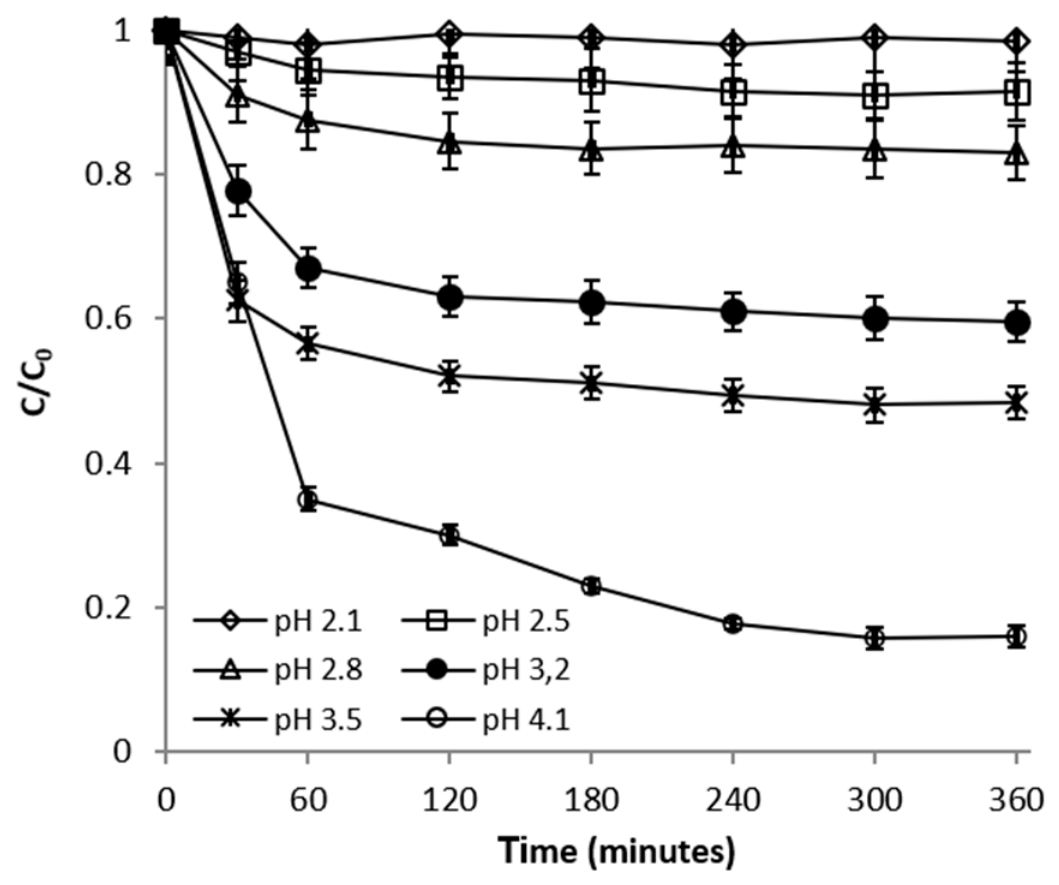
Figure 1. Influence of initial solution pH on FeII adsorption by PCP. Experimental conditions: C0 = 50 mg L−1; temperature = 22 °C; mixing intensity: 200 rpm; PCP dose = 10 g L−1; ionic strength = 0 M NaCl; contact time = 360 min.
Sustainability 18 07064 g001
Figure 2. Influence of initial solution pH on FeII adsorption capacity of PCP. Experimental conditions: C0 = 50 mg L−1; temperature = 22 °C; mixing intensity: 200 rpm; PCP dose = 10 g L−1; ionic strength = 0 M NaCl; contact time = 360 min.
Sustainability 18 07064 g002
Figure 3. Influence of initial FeII concentration on FeII adsorption by PCP. Experimental conditions: pH = 3.2; temperature = 22 °C; mixing intensity: 200 rpm; PCP dose = 10 g L−1; ionic strength = 0 M NaCl; contact time = 360 min.
Sustainability 18 07064 g003
Figure 4. Influence of initial FeII concentration on FeII adsorption capacity of PCP. Experimental conditions: pH = 3.2; temperature = 22 °C; mixing intensity: 200 rpm; PCP dose = 10 g L−1; ionic strength = 0 M NaCl; contact time = 360 min.
Sustainability 18 07064 g004
Figure 5. Influence of temperature on FeII adsorption by PCP. Experimental conditions: pH = 3.2; C0 = 50 mg L−1; mixing intensity: 200 rpm; PCP dose = 10 g L−1; ionic strength = 0 M NaCl; contact time = 360 min.
Sustainability 18 07064 g005
Figure 6. Influence of temperature on FeII adsorption capacity of PCP. Experimental conditions: pH = 3.2; C0 = 50 mg L−1; mixing intensity: 200 rpm; PCP dose = 10 g L−1; ionic strength = 0 M NaCl; contact time = 360 min.
Sustainability 18 07064 g006
Figure 7. Influence of ionic strength on FeII adsorption by PCP. Experimental conditions: pH = 3.2; C0 = 50 mg L−1; mixing intensity: 200 rpm; PCP dose = 10 g L−1; temperature = 22 °C; contact time = 360 min.
Sustainability 18 07064 g007
Figure 8. Influence of ionic strength on FeII adsorption capacity of PCP. Experimental conditions: pH = 3.2; C0 = 50 mg L−1; mixing intensity: 200 rpm; PCP dose = 10 g L−1; temperature = 22 °C; contact time = 360 min.
Sustainability 18 07064 g008
Table 1. Results of FeII adsorption kinetic modeling.
Kinetic ModelParameters and
Error Functions
Value
Pseudo-first-orderk1 (min−1)2.83·10−2
qe (mg g−1)1.96
R20.9950
χ20.0090
SSE0.0169
RMSE0.0492
HYBRID0.1802
Pseudo-second-orderk2 (g mg−1 min−1)1.86·10−2
qe (mg g−1)2.17
R20.9933
χ20.0155
SSE0.0225
RMSE0.0567
HYBRID0.3111
Pseudo-nth-orderkn (g(n−1) mg(−1) min−1)7.86·10−3
qe (mg g−1)2.47
n3.0
R20.9897
χ20.0241
SSE0.0349
RMSE0.0706
HYBRID0.6074
Elovichα (mg g−1 min−1)0.47
β (g mg−1)2.96
R20.9801
χ20.0459
SSE0.0677
RMSE0.0984
HYBRID0.9438
Weber–Morriskd (mg g−1 min−0.5)9.77·10−2
C (mg g−1)0.46
R20.8166
χ20.7424
SSE0.6247
RMSE0.2987
HYBRID4.59
Table 2. Results of FeII adsorption equilibrium modeling.
Thermodynamic ModelParameters and
Error Functions
Value
Langmuirqmax (mg g−1)12.7
KL (L mg−1)1.54·10−1
RL0.39
R20.9886
χ20.7133
SSE0.4652
RMSE0.2157
HYBRID3.89
FreundlichKF ((mg g−1) (mg L)−1/n)1.74
1/nF0.70
R20.9989
χ20.0427
SSE0.448
RMSE0.0638
HYBRID0.5005
Langmuir–Freundlichqmax (mg g−1)649.7
KLF (L mg−1)2.83·10−4
n0.76
R20.9894
χ20.0780
SSE0.0652
RMSE0.0808
HYBRID0.8380
TemkinKT (L mg−1)4.58
b (kJ mol−1)1.50
R20.9083
χ23.88
SSE3.79
RMSE0.6161
HYBRID27.2
Redlich–PetersonKRP (L mg−1)1938.0
a (L mg−1)g1113.4
g0.29
R20.9989
χ20.0428
SSE0.0448
RMSE0.0669
HYBRID0.5725
Table 3. Thermodynamic parameters of FeII adsorption on PCP.
ΔG° (kJ mol−1)ΔH° (kJ mol−1)ΔS° (J mol−1 K−1)
T = 283 °KT = 295 °KT = 305 °K
−20.5−22.1−23.519.0139.5
Disclaimer/Publisher’s Note: The statements, opinions and data contained in all publications are solely those of the individual author(s) and contributor(s) and not of MDPI and/or the editor(s). MDPI and/or the editor(s) disclaim responsibility for any injury to people or property resulting from any ideas, methods, instructions or products referred to in the content.