Article

Adsorptive Removal of Short-Chain PFAS (PFHxA) from Water Matrices Using Synthesised and Commercial Graphene for Sustainable Water Treatment


1
School of Fashion and Textiles, RMIT University, Brunswick, VIC 3056, Australia
2
Department of Biomedical and Analytical Chemistry, Institute of Biological Sciences, Faculty of Medicine, The John Paul II Catholic University of Lublin, Konstantynów 1J, 20-708 Lublin, Poland
3
Department of Radiochemistry and Environmental Chemistry, Institute of Chemical Sciences, Faculty of Chemistry, Maria Curie-Sklodowska University in Lublin, Pl. M. Curie-Skłodowskiej 3, 20-031 Lublin, Poland
4
Institute for Frontier Materials, Deakin University, Waurn Ponds, VIC 3216, Australia
*
Authors to whom correspondence should be addressed.
Sustainability 2026, 18(14), 7053; https://doi.org/10.3390/su18147053
Submission received: 11 June 2026 / Revised: 3 July 2026 / Accepted: 7 July 2026 / Published: 10 July 2026

Abstract

Per- and polyfluoroalkyl substances (PFAS), and the short-chain representative perfluorohexanoic acid (PFHxA), are persistent environmental pollutants that pose serious health risks due to their resistance to degradation, mobility, and widespread presence in aquatic systems. This study investigates the adsorption of PFHxA onto graphene-based materials synthesised from graphite using a scalable, resource-efficient route and compares their performance with three commercial reduced graphene oxides. The graphene samples were characterised by BET surface area analysis, SEM, XPS, and Raman spectroscopy, revealing significant differences in surface area, pore volume, and surface chemistry that govern adsorption behaviour. Batch adsorption experiments in different water matrices (tap water, river water, and treated wastewater) under controlled pH conditions showed that graphene materials with higher surface area and optimised oxygen-containing functional groups achieved enhanced PFHxA removal, even in complex, real-world waters. Based on the physicochemical properties of both the adsorbent and adsorbate, hydrophobic interactions may contribute to adsorption alongside pore-filling effects, hydrogen bonding, and other intermolecular forces. Among the tested sorbents, the SG-X material, with its high BET surface area and hydrophobic character, and the CG-A material, which retained high performance across a broad pH range, exhibited the most promising adsorption capacities and operational robustness. These findings demonstrate the potential of engineered graphene-based adsorbents as a sustainable remediation option for short-chain PFASs, supporting circular and low-chemical-intensity approaches to protecting water quality under diverse environmental conditions.

1. Introduction

Per- and polyfluoroalkyl substances (PFAS) are a large group of synthetic chemicals defined by the European Chemicals Agency (ECHA) as substances containing at least one fully fluorinated methyl (CF3) or methylene (CF2) carbon atom. In perfluoroalkyl substances, all C–H bonds are replaced by C–F bonds, whereas polyfluoroalkyl substances retain at least one C–H bond [1]. The exceptional strength of the C–F bond (≈488 kJ/mol [2]) imparts high chemical and thermal stability, making PFASs highly resistant to degradation. Owing to their surfactant-like properties, PFASs have been widely used in industrial processes and consumer products, including firefighting foams, non-stick coatings, and water-repellent materials [3]. As a consequence of their widespread use and persistence, PFASs are now ubiquitously detected in environmental compartments, including surface water, groundwater, soils, and biota. Human exposure occurs primarily through drinking water and food consumption, with additional contributions from inhalation and dust ingestion [3]. These concerns have led to increasingly stringent regulatory actions. In 2024, the U.S. Environmental Protection Agency (EPA) established maximum contaminant levels (MCLs) of 4–10 ng/L for several PFASs in drinking water and designated perfluorooctanoic acid (PFOA) and perfluorooctanesulfonic acid (PFOS) as hazardous substances under CERCLA (Comprehensive Environmental Response, Compensation, and Liability Act) [4,5,6]. Similar regulatory limits have been adopted in multiple countries [5]. Notably, regulatory attention is progressively shifting toward short-chain PFAS, which are increasingly used as replacements for legacy long-chain compounds but remain environmentally persistent and mobile.
Perfluorohexanoic acid (PFHxA; C6HF11O2) is a short-chain perfluorinated carboxylic acid (PFCA) that is frequently detected in natural waters, wastewater effluents, and drinking water sources [3,7,8]. Toxicological assessments indicate that PFHxA exposure can induce hepatic, developmental, haematopoietic, and endocrine effects [7]. PFHxA has been detected in human tissues, including liver and brain, and in biological fluids of patients with hepatocellular carcinoma [9,10]. Due to its resistance to hydrolysis, photolysis, and biodegradation, PFHxA exhibits long environmental persistence, with an estimated half-life of 417 days in agricultural soils [7]. These characteristics underscore the need for effective treatment technologies targeting short-chain PFASs.
Among available PFAS removal technologies, including ion exchange, membrane filtration, electrochemical methods, and advanced oxidation, adsorption remains the most widely studied approach due to its operational simplicity and cost-effectiveness [11]. PFAS adsorption onto carbonaceous materials is governed by a combination of hydrophobic interactions, electron donor–acceptor interactions, electrostatic forces, and charge-assisted hydrogen bonding [12]. However, conventional adsorbents such as activated carbon generally exhibit reduced affinity toward short-chain PFASs because of their lower hydrophobicity and weaker intermolecular interactions, leading to rapid saturation and limited removal efficiency [13,14]. This limitation motivates the development of alternative carbon-based sorbents with tailored surface chemistry [15].
Graphene-based materials, including graphene oxide (GO) and reduced graphene oxide (rGO), have attracted increasing attention as PFAS adsorbents due to their high surface area, two-dimensional structure, and tunable surface functionalities [14,16,17,18,19]. Surface defects, edges, and oxygen-containing functional groups can enhance water–solid interactions and provide adsorption sites for polar contaminants [20]. Previous studies have demonstrated that heteroatom doping (e.g., N, S, or F) can further modulate adsorption performance through enhanced electrostatic interactions, hydrogen bonding, or hydrophobicity [21,22]. While graphene-based adsorbents have been extensively studied for long-chain PFASs such as PFOA [14,16,23], systematic investigations into the removal of short-chain PFASs, particularly PFHxA, from environmentally relevant water matrices remain limited. Moreover, the influence of graphene physicochemical heterogeneity on PFHxA adsorption has not been clearly elucidated. In this work, we investigate PFHxA adsorption using multiple classes of reduced graphene oxide, including commercially available materials and rGO synthesised in-house. Rather than directly benchmarking “performance,” this comparison is intended to elucidate structure–property–function relationships, specifically how differences in surface chemistry, reduction degree, and structural characteristics influence PFHxA adsorption behaviour. To the best of our knowledge, this study provides the first systematic comparison of commercially available and laboratory-synthesised reduced graphene oxide materials for the adsorption of the short-chain PFASs PFHxA under environmentally relevant conditions. By correlating PFHxA removal performance with differences in graphene physicochemical properties, this work advances mechanistic understanding beyond prior studies that focused primarily on long-chain PFASs or single graphene materials.
The objectives of this study are (i) to evaluate the removal of PFHxA from different water matrices using rGO-based adsorbents, and (ii) to investigate the kinetics and adsorption mechanisms governing PFHxA interaction with graphene-like materials.

2. Materials and Methods

2.1. Adsorbent’s Preparation and Characterisation

A graphene sample was synthesised following the detailed nitration–oxidation procedure described in our previous work [20]. Briefly, graphite was oxidised using a mixed acid and chlorate system under controlled temperature, then quenched, washed to neutral pH, and dried. The resulting GO was thermally reduced in an argon-purged muffle furnace at 900 °C for 1 min (0.5–1 L/min) to obtain thermally reduced graphene (TRG, denoted SG-X). For comparative evaluation of how graphene’s physical and chemical properties influence removal performance, SG-X was benchmarked against three commercial reduced graphene oxides (CG-A, CG-B and CG-C) obtained from Asbury (Quebec, QC, Canada), First Graphene (Henderson, WA, Australia) and Standard Graphene (Ulsan, Republic of Korea). The characterisation of SG-X, CG-A, CG-B, and CG-C was conducted using Renishaw InVia Raman Spectrometer (Gloucestershire, UK) to observe the D and G bands, which correspond to defects and the graphitic structure. This was achieved with the use of Raman spectroscopy in 5 different regions of materials and seven tests for making an average. Additionally, the BET surface area and pore size analyses were performed in a Quantachrome Autosorb (Quantachrome Instruments, Boynton Beach, FL, USA) using low-temperature nitrogen adsorption–desorption (BJH for pore size distribution, p/p0 ≈ 0.99 and surface area calculated in the range 0.05–0.3 with 40-point adsorption and 40-point desorption). These methods provided detailed insights into both the structural and surface properties of the material, highlighting the presence of specific defects, alongside comprehensive data on porosity and surface characteristics. The graphene surfaces were examined using scanning electron microscopy (SEM) to assess their structural properties, layer bonding, and interlayer porosity. The SEM Supra 55VP (Carl Zeiss, Oberkochen, Germany) microscope was utilised for this analysis. The XPS technique (UVH Prevac, with prssure below 2 × 10⁻⁸ Pa, using a Kα-Al anode) was employed to examine the surface chemical properties of the samples (Thermo Fisher, Waltham, MA, USA).

2.2. Adsorption Studies

PFHxA and acetic acid (AA, Suprapur®) were purchased from CPAchem (Trappes, France) and Merck (Darmstadt, Germany), respectively. Ultrapure water (UW) was produced using a Millipore Direct Q 3UV water purification system (Millipore, Molsheim, France). Adsorption was performed using the batch technique according to the protocol applied in our previous studies [21] with slight modifications. In the studies of PFHxA removal from different water matrices (tap water, TW, river water, RW, and treated wastewater, TWW, Table 1), the sorption was performed without and with pH correction (using AA). The adsorption experiments were conducted at pH 3 to ensure analytical stability and reproducibility of PFHxA quantification. An amount of 1 mg of material was contacted with 1 mL of a solution containing 10 mg/L of PFHxA for kinetic studies (m/v ratio was kept constant). For isotherm modelling, the concentrations 0.5 mg/L, 1.0 mg/L, 2.5 mg/L, 5.0 mg/L, 10.0 mg/L, and 20 mg/L of PFHxA were applied. For kinetic studies, the samples were collected after 1, 3, 6, 16, 24, and 48 h. For the isotherm modelling, the time was set at 24 h. It should be noted that the PFHxA concentrations employed for kinetic and isotherm experiments were higher than environmentally relevant levels. This approach was necessary to ensure accurate quantification and robust modelling of sorption processes. However, PFASs behaviour may vary under lower, environmentally realistic concentrations. Therefore, while the present study provides important mechanistic insights into PFHxA adsorption, extrapolation to natural systems should be done cautiously, and future research should validate these findings under environmentally relevant conditions. All samples were mixed using an IKA MS5 basic mechanical stirrer (Woburn, MA, USA) (1500 rpm, room temperature). Although it was noted that PFASs can adsorb to certain filter materials (e.g., polypropylene), which may introduce bias during sample preparation [24], in this study, samples were filtered using 0.22 μm polypropylene filters (Bioanalytic, Gdansk, Poland) and 98.35–102.78% recoveries were noted. The clear solutions were placed into PP chromatographic vials and analysed via high-performance liquid chromatography coupled with electrospray ionisation/single-quadrupole mass spectrometry (HPLC-ESI-MS). All experiments were performed in duplicate at room temperature in PP containers according to the US EPA protocol [25]. The amount of adsorbed target compound (qmax, µmol/g) was calculated considering the decrease in the PFHxA content after the adsorption process. For kinetic and isotherm modelling, the well-known models—pseudo-first-order (PFO), pseudo-second-order (PSO), Elovich (E), intraparticle diffusion (IPD), and Langmuir (L), Freundlich (F), Temkin (T), and Dubinin–Radushkevich (DR), respectively—were applied.

2.3. Quantification of PFHxA by HPLC-ESI-MS

PFHxA was determined according to the procedure described in [21]. Clear samples were analysed three times using an HPLC system (1200 series) connected to a mass spectrometer (single-quadrupole, model 6120) purchased from Agilent Technologies (Santa Clara, CA, USA). Chromatographic separation was achieved on the Zorbax Eclipse Plus C18 (4.6 × 100 mm, 3.5 µm) analytical column (PN 959961-902, Agilent Technologies, Santa Clara, CA, USA). The mobile phase consisted of solvent A (5 mM HCOONH4 (LC-MS grade, Sigma-Aldrich, St. Louis, MO, USA) in ultrapure water) and solvent B (acetonitrile, LC-MS grade, Merck, Germany). For elution, the following gradient programme of the mobile phase was used: 0–3 min, 30–70% solvent B and 3–5 min, 70–30% solvent B (post-run: 2 min). The injection volume and the column temperature were 2 µL and 40 °C, respectively. Ions were generated using an electrospray ionisation source (API-ESI) in negative ion mode. The conditions for PFHxA ionisation and detection were detailed in [1]. For adsorption studies, the concentration of PFHxA was calculated from the calibration curve, which was constructed by analysing standards containing the analyte in the concentration range from 0.51 to 20 mg/L (standards prepared in distilled water with pH = 3, R2 = 0.9999). The detailed procedure of PFHxA analysis was described in [21]. Blank was routinely monitored. In the case of analysis of real samples, the standard addition method was used for PFHxA quantification.

2.4. Statistical Analysis

PFAS concentrations at different points were expressed as relative concentrations and were reported as mean values ± standard error. Analysis of variance (ANOVA) was used to assess significant differences between treatments at a confidence level of p < 0.05.

3. Results and Discussion

3.1. Physicochemical Properties of Tested Sorbents

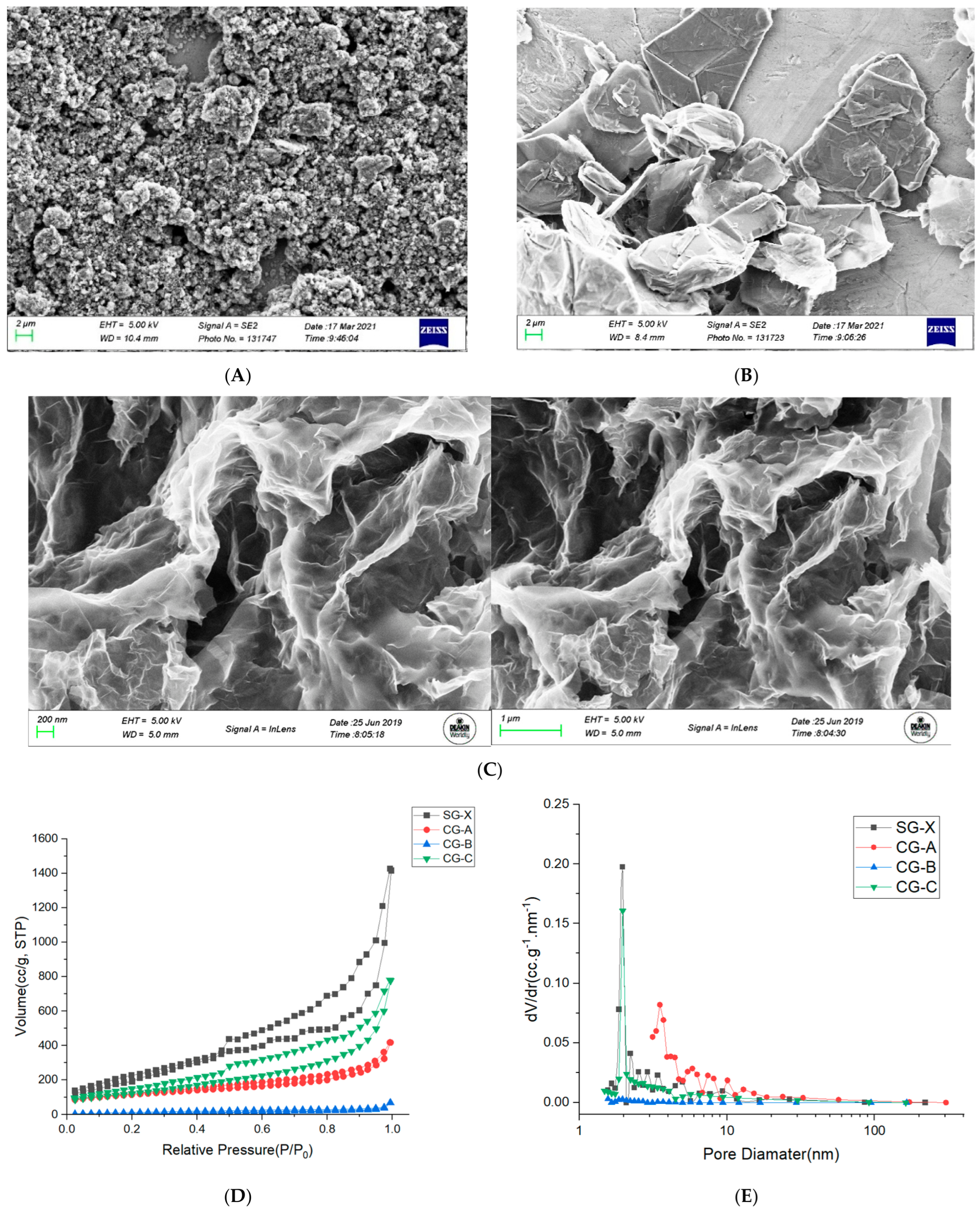
The results of the surface area analysis are presented in Figure 1 and Table 2. The surface area of the samples varies depending on the technology, precursors, and processing conditions developed by the supplier. The commercial rGO samples used in this study were produced by different suppliers using proprietary methods based on the chemical reduction of graphene oxide. In general, these routes involve oxidation of graphite to graphene oxide, followed by reduction (thermal and/or chemical) and subsequent drying and post-treatment steps [26]. Each supplier employs distinct precursors, oxidation–reduction conditions, and thermal treatments, which are not fully disclosed but are known to significantly influence the resulting porosity and surface chemistry. The differences in rGO characteristics reported in Table 2 arise from these variations in technology, precursors, and processing parameters. As a result, the commercial samples show relatively lower BET surface areas (all below 500 m2/g) and smaller pore volumes. In contrast, our synthesised graphene, prepared via an optimised route specifically targeting high porosity, achieved a BET surface area of 928 m2/g. The CG-A sample also exhibited a higher pore volume than the other commercial materials, which provides greater potential for adsorption and removal applications.
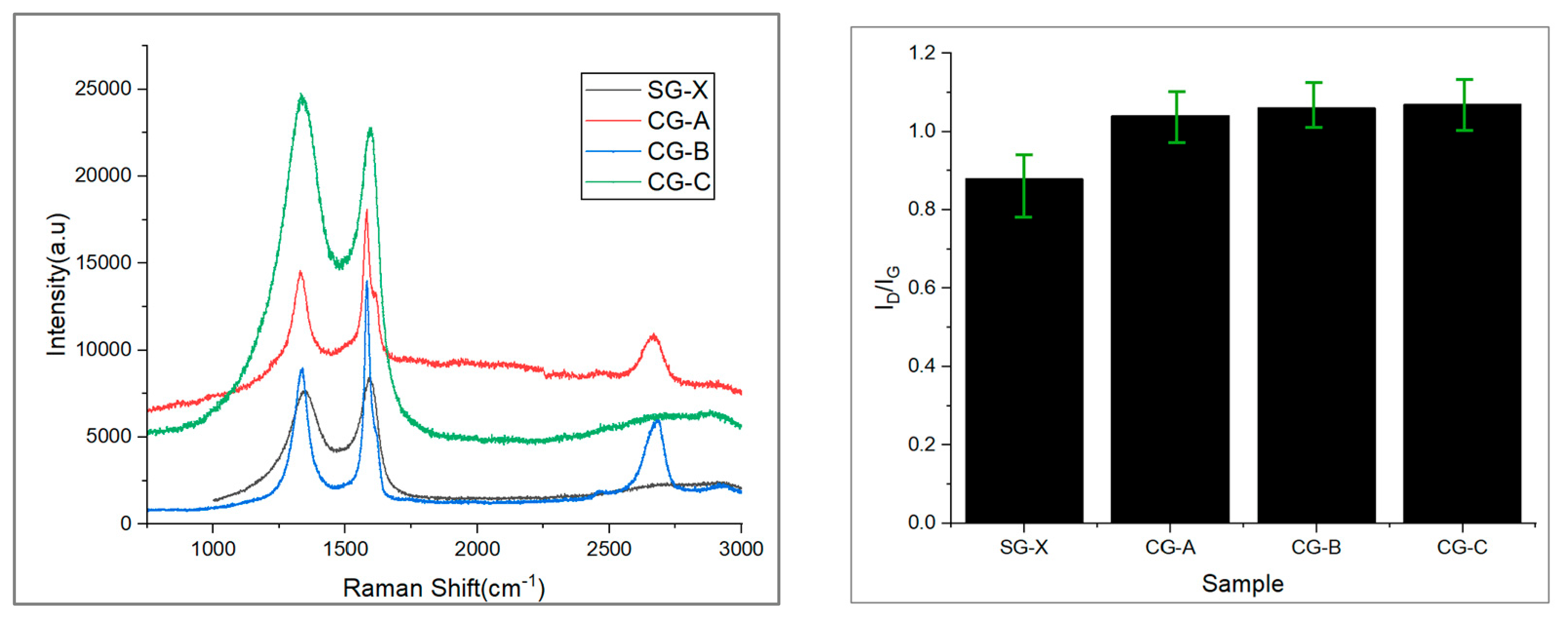
The results of Raman spectroscopy are presented in Figure 2. It is evident that the synthesised graphene exhibited a higher graphitic structure with fewer defects. The ID/IG ratio in Raman spectroscopy is a key metric used to quantify the structural disorder, defects, and crystallinity in carbon-based materials. This is indicated by the ID/IG ratio of this sample being below 1, whereas all other samples had a ratio above 1.
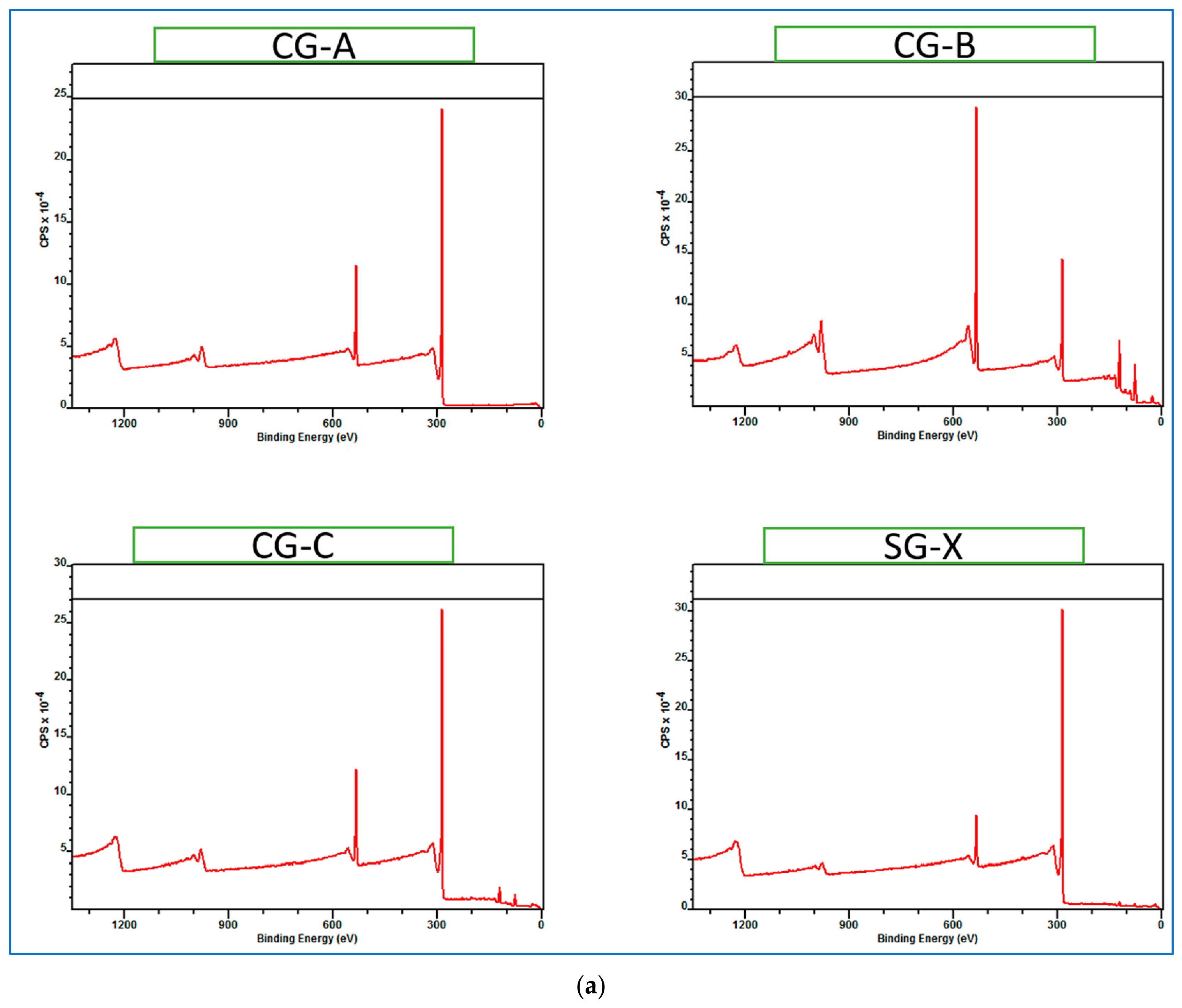
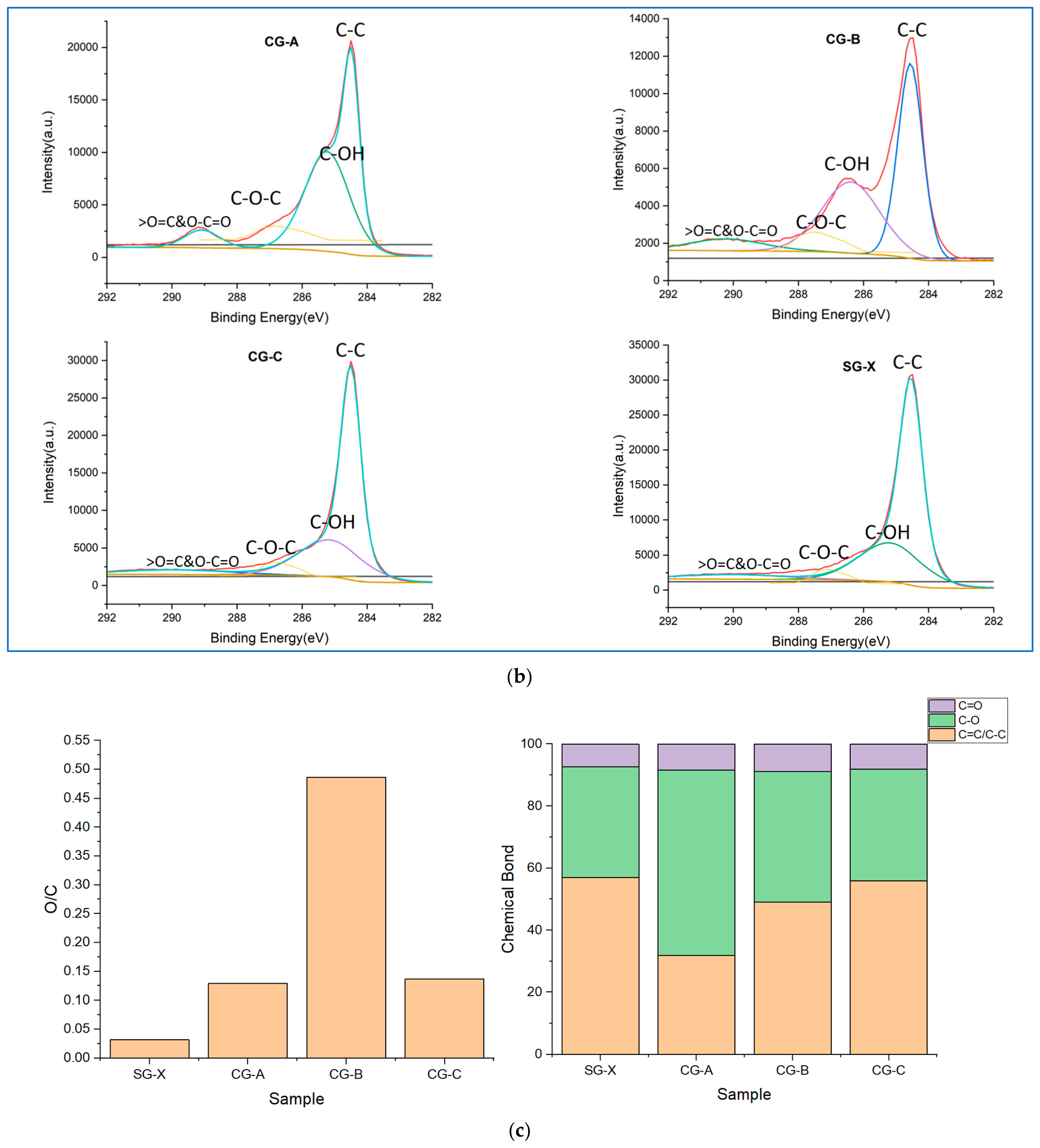
Regarding the XPS results (Figure 3), CG-A exhibited the highest C-O bond concentration compared to other samples, followed by CG-C and SG-X. The presence of C-O bonds can enhance the adsorption and removal of PFAS molecules.
The presence of oxygen-containing functional groups (e.g., C–O, –OH, –COOH) on the graphene surface does not directly enhance PFAS adsorption via electrostatic attraction, since both the PFAS molecules and the surface are negatively charged at environmentally relevant pH values, leading to electrostatic repulsion. Instead, these functional groups contribute indirectly by increasing surface hydrophilicity, polarity, and hydrogen-bonding potential. Such effects can promote PFAS partitioning through hydrogen bonding between oxygenated surface groups and the fluorinated carbon backbone or carboxyl groups of PFASs, as well as by modifying the overall sorption environment. Similar mechanisms were recently highlighted by [27].
The oxygen-containing bonds on the surface create a negatively charged surface, which can engage in electrostatic interactions with the negatively charged PFAS molecules. Sample CG-B presented the highest O/C ratio but very low surface area, which minimised its adsorption capacity for PFASs removal. O/C ratio is a common indicator of the hydrophilic character of the carbonaceous materials [28].
The hydrophobic surface of SG-X may favour the adsorption of hydrophobic substances. The surface properties of SG-X, in comparison to other materials, make it a better adsorbent: it has a high available surface area, high pore volume, and a median pore size (~2 nm). The topological surface area of PFHxA is 37.3 Å2, which suggests that pore filling is not the predominant mechanism. Among the tested physicochemical parameters of the adsorbents, some trends can be observed. At higher C content, higher SBET, and lower S content, the maximum adsorption capacity was increased.

3.2. Sorption Studies

Sorption of PFHxA from Water Samples

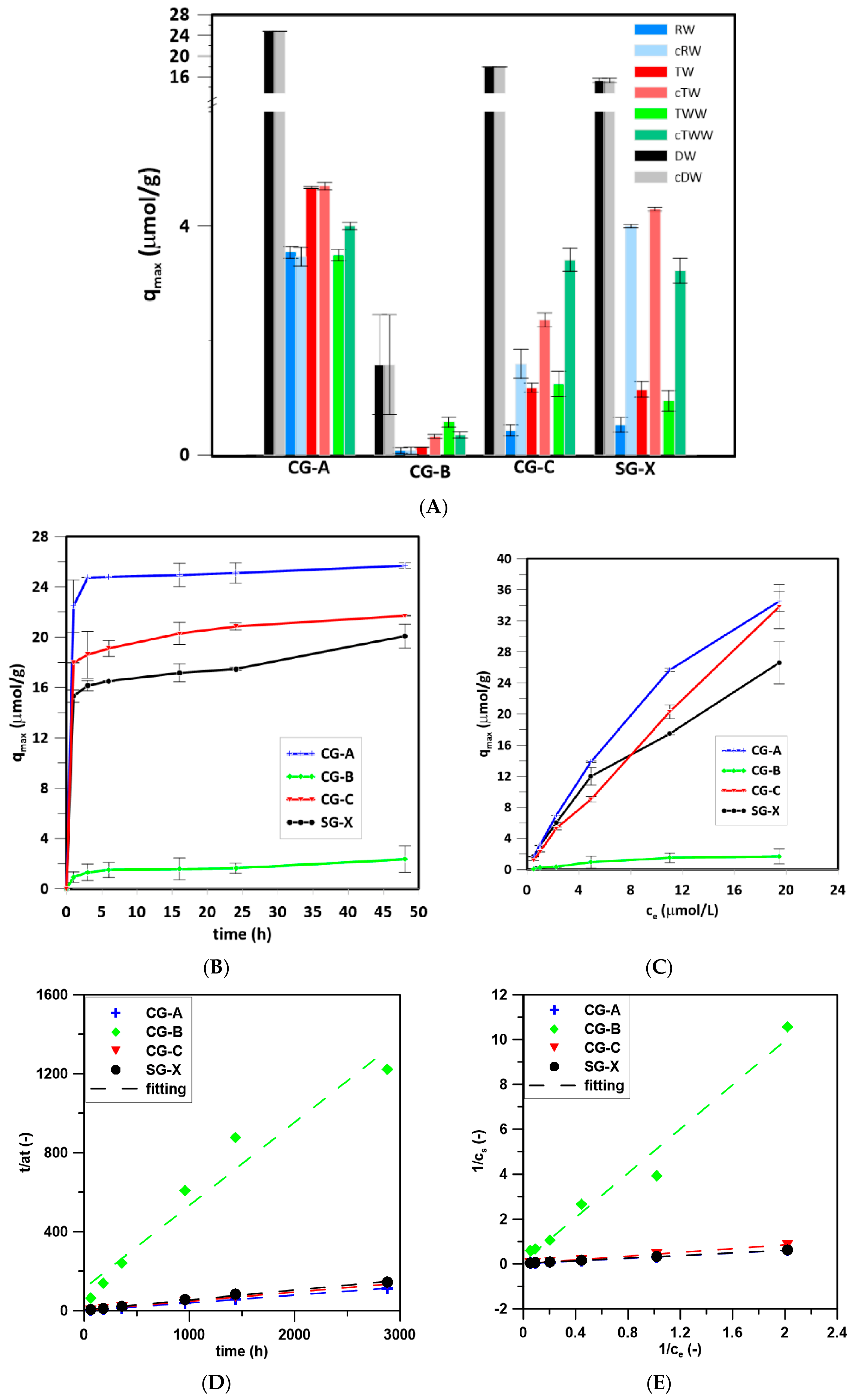
The results of the sorption studies are presented in Table 3, Table 4, Table 5 and Table 6 and Figure 4.
PFHxA in the environment is present as an anion (pKa = −0.16), and its environmental fate is primarily associated with adsorption onto sediments or transport with water, rather than volatilisation [29]. Similarly, PFHxA lacks functional groups typically prone to hydrolysis, such as ester or amide linkages; therefore, any observed indications of hydrolytic degradation in the environment are unexpected and warrant further investigation. The removal of tested pollutants was performed in real water samples under optimal sorption conditions (an acidic environment) or without pH correction (Figure 4A). It can be seen that the tested materials revealed significant differences in the removal of the target compound. The highest sorption (gmax ~25 μmol/g) was noted on CG-A across all water types, particularly for DW, TW and cTW. SG-X showed high sorption only for TW and TTW, with and without pH correction, with significantly lower values in other water matrices, whereas CG-B and CG-C were less effective in all water matrices. CG-C and SG-X, values for PFHxA adsorption in RW, TW, and TWW are very similar. The effect of pH correction was observed for SG-X and CG-C, mainly. CG-A, the most effective material, was not affected by the solution pH. Although zeta potential measurements were not available for the GO samples in this study, the literature consistently reports that GO becomes increasingly negatively charged with increasing pH due to deprotonation of surface carboxyl and phenolic groups. Therefore, the adsorption differences observed between pH 3 and pH ~6.4 can be partially attributed to changes in hydrophobic partitioning, fluorocarbon–graphitic interactions, van der Waals forces, pore-filling effects, and surface chemistry-dependent interactions. It was noted that the amount of adsorbed PFHxA onto tested materials was negatively correlated with the content of S (RW, p < 0.01, TW p < 0.05) and Cl (RW p < 0.05). Similarly, higher pore size induced adsorption (p < 0.05 using RW or TWW or even p < 0.02 for TW). In general, the maximum adsorption capacities for PFHxA were changed in the following order: DW CG-A > SG-X ≈ CG-C > CG-B, RW CG-A > SG-X > CG-C > CG-B, CG-A > SG-X ≈ CG-C > CG-B, and TWW CG-A > CG-C > SG-X > CG-B, whereas under pH correction was DW CG-A > CG-C > SG-X > CG-B, RW SG-X > CG-A > CG-C > CG-B, TW CG-A > SG-X > CG-C > CG-B, and TWW CG-A > CG-C > SG-X > CG-B (Table 3).
Considering the type of the water matrix, adsorption in RW and TWW was similar, stressing the role of organics and inorganic ions in the sorption process. RW was more effective, which results from the presence of natural ions such as Na+, Ca2+, or Cl, and dissolved organic matter, which can compress the electrical double layer on the surface of adsorbents and the PFAS molecules (or other contaminants/water components), reducing electrostatic repulsion [30], stressing therefore that multiple processes may occur simultaneously, including ionic strength effects (double-layer compression), specific ion interactions (e.g., Ca2+ bridging), and competitive adsorption or surface coating by dissolved organic matter.
The role of dissolved organic matter is more complex [31]. On one hand, DOM may compete directly with PFAS molecules for adsorption sites or form a coating on the sorbent surface, thereby reducing the number of accessible adsorption sites. On the other hand, certain DOM fractions may interact with PFASs through hydrophobic associations, potentially affecting their transport and availability for adsorption. In treated wastewater (TWW), where DOM concentrations are typically higher and more chemically diverse, these competitive effects likely contributed to the slightly lower adsorption efficiencies observed compared with RW. Similar observations have been reported for activated carbons and biochar-based sorbents, where organic matter reduced PFAS adsorption by blocking micropores and occupying high-energy adsorption sites (Table 7).
Therefore, the surface of the adsorbent is much more available for PFASs to be adsorbed. Additionally, some cations (like Ca2+ or Mg2+) may form bridges between negatively charged PFAS molecules and slightly negatively charged adsorbent surfaces. Therefore, the hydrophobic interactions were enhanced with increased ionic strength and in the presence of cations [32]. Also, the solvation of PFAS molecules in the presence of ions was lower, resulting in a stronger interaction of the hydrophobic tail of PFHxA with the hydrophobic surface of the sorbent [33]. Among the tested physicochemical parameters of the water matrix, the increase in EC of the water matrix shows a decreasing trend for the adsorption on both CG-A and SG-X. The results clearly indicate that both the sorbent and water matrix greatly affect adsorption efficiency. CG-A was the most effective overall, likely due to favourable surface chemistry or structure. The presence of dissolved organic matter (mainly) in TWW hindered the adsorption.
The values of partition coefficients were calculated according to [34] and stressed that CG-A revealed a strong affinity towards PFHxA (Table 4, Kd >> 1). What is interesting, pH correction increased partitioning when CG-C and SG-X were used. The effect of pH correction was contrary when CG-A was used, and the adsorption was performed in RW and TW. The affinity of the adsorbent to PFHxA is connected with the chemical nature of the adsorbent. The hydrophilic heads are ionised in water, whereas the hydrophobic tails are responsible for hydrophobic properties. Therefore, the adsorption of PFASs onto positively charged potential and/or hydrophobic adsorbent surfaces should be enhanced [35].

3.3. Sorption Mechanism

To elucidate the mechanism of PFHxA adsorption on the tested graphene-based materials, kinetic and equilibrium studies were performed. Kinetic analysis (Table 5, Figure 4B) showed that PFHxA adsorption was relatively rapid, reaching equilibrium within 6 h for most sorbents, with 80–90% removal. CG-B was less effective, achieving only 63% removal after 6 h, consistent with its lower maximum adsorption capacity (qmax = 2.358 µmol/g) and slower PSO rate constant (k2 = 1.567 g/µmol min). In general, the adsorption capacities followed the order: CG-A > CG-C > SG-X > CG-B. PSO provided the best fit among tested kinetic models, suggesting adsorption proceeds via a multi-step process and is not purely first-order in nature [36].
CG-A, characterised by medium SBET, hydrophilicity, and surface doping with nitrogen and oxygen, exhibited the highest adsorption (qmax = 25.68 µmol/g; Kd = 7.93 L/µmol). This suggests that heteroatoms such as nitrogen enhance PFHxA uptake, likely by providing additional sites for electrostatic interaction or hydrogen bonding, as also predicted by molecular dynamics simulations [16]. Correlation analysis further supported this interpretation: the PSO rate constant k2 negatively correlated with sulfur (p < 0.05) and chlorine (p < 0.001), highlighting the role of surface heteroatoms in modulating adsorption. The weaker performance of S-doped graphene may stem from its low sulfur content (≤1.2 wt.%), explaining the apparent discrepancy with literature reports [37,38].
Equilibrium isotherm modelling (Table 6, Figure 4C) indicated that the Langmuir model (R2 = 0.9999 for CG-A) provides a good empirical description of the equilibrium data. PFHxA’s amphiphilic structure underlies its interaction with graphene surfaces: the hydrophobic fluorocarbon tail associates with nonpolar graphitic regions (fluorocarbon–carbon interactions), while the negatively charged headgroup interacts electrostatically indirectly via adsorbed dissolved organic matter [39]. The ion-mediated interactions (e.g., Ca2+ bridging) can also participate in PFHxA adsorption. The oxygen-containing functional groups primarily influence surface polarity, wettability, hydrogen-bonding capability, and interactions with dissolved ions rather than directly enhancing electrostatic attraction toward PFHxA. Increasing ionic strength may promote adsorption through electrical double-layer compression and cation bridging mechanisms. Collectively, hydrophobic interactions, electrostatic interactions with water constituents, and hydrogen bonding dominate PFHxA sorption on graphene-based sorbents (Table 6) [40] in real water matrices. The adsorption mechanism is therefore hierarchical [34]. Hydrophobic interactions associated with the perfluoroalkyl chain primarily drive sorption, particularly on CG-A and CG-C. Electrostatic interactions, modulated by solution ionic strength and pH, play a secondary but significant role, especially for short-chain PFASs. Finally, adsorbent surface chemistry, including oxygen- or nitrogen-containing functional groups, modulates affinity via hydrogen bonding or specific site interactions. This framework provides a coherent mechanistic explanation for the observed adsorption behaviour across sorbents and experimental conditions.
In summary, the adsorption of PFHxA onto the tested graphene-based materials is governed by a combination of hydrophobic and fluorocarbon–graphitic interactions, and hydrogen bonding, with surface heteroatoms (N, O) playing a key role in enhancing sorption. Kinetic analyses indicate rapid uptake for CG-A and CG-C, following pseudo-second-order behaviour, while intraparticle diffusion contributes to rate-limiting steps in SG-X and CG-B. Equilibrium isotherms demonstrate predominantly monolayer adsorption on energetically favourable sites, with CG-A exhibiting the highest Langmuir capacity and Kd values across all water matrices. Importantly, the performance of CG-A is robust across diverse environmental conditions, including variations in pH, ionic strength, and dissolved organic matter, highlighting its potential applicability in real-world water treatment.
These findings provide mechanistic guidance for the rational design of next-generation GO-based adsorbents, emphasising the importance of hydrophobic graphitic domains and surface functionalisation in PFAS removal. From an environmental perspective, such materials offer a promising strategy for mitigating the mobility and persistence of short-chain PFASs, like PFHxA, in surface water, groundwater, and treated wastewater, ultimately contributing to improved water quality and reduced ecological and human exposure to these persistent contaminants.
Table 7. Comparison of the obtained results with data from the literature.
AdsorbentPollutantsqmaxKineticsIsothermReferences
CG-APFHxA25.68 µmol/g
(8.065 mg/g)
PSOLThese studies
MgAl-carbonate layered double hydroxidePFHxA89.54%, 0.1 g CLDH at 65 °C for 30 min in 30 mL PFHxA of 0.3592 g/L.PFO [41]
GAC and GAC adsorption followed by microfiltration PFHxA43 μg/g GAC
rGO + MF 138 μg/g
[42]
Douglas fir biochar and its Fe3O4 hybridsPFOS, PFOAPFOS 7.4–14.6 mg/g PFOA 3.8–652 mg/gPSO [43]
Activated carbon from Vitis vinifera PFOS~8 µg/gPFOF[44]
GO modified by a cationic surfactant, cetyltrimethylammonium chloride (CTAC)11 PFASsƩ11 PFASs
48.47 mg/g
PSOSips[23]
N-doped porous carbons 255.9 mg/g [40]

4. Conclusions

The results presented the potential of various graphene-based materials, including a synthesised graphene (SG-X) and three commercial graphene samples (CG-A, CG-B, CG-C), for the sustainable adsorption and removal of short-chain PFAS representative—PFHxA from different environmental water matrices. Considering the material properties of graphenes, the synthesised graphene (SG-X) exhibited the highest BET surface area (928 m2/g) among the tested samples, as well as a favourable pore size distribution (~2 nm), supporting its potential for effective adsorption processes. XPS and Raman analyses confirmed variations in oxygen-containing groups, hydrophilicity, and structural defects among the samples, all influencing adsorption behaviour. Among the tested materials, CG-A demonstrated the highest PFHxA adsorption capacity (~4.5 μmol/g) across all tested water matrices, regardless of pH adjustment. SG-X also showed significant adsorption in tap water, particularly after pH correction. In contrast, CG-B and CG-C were less effective, particularly in river water and treated wastewater. The effectiveness of PFHxA removal was strongly dependent on the type of water matrix and pH. Acidic conditions (pH ~ 3) improved adsorption performance for certain materials, highlighting the role of solution chemistry in PFHxA removal efficiency. Higher carbon content, greater specific surface area (SBET), and lower sulfur content correlated positively with maximum adsorption capacity. The presence of oxygen-containing functional groups and larger pore sizes also enhanced PFHxA uptake. The findings emphasise the potential of advanced graphene materials, particularly CG-A and SG-X, as promising sorbents for mitigating PFAS contamination in various water sources. Future research should focus on solving key problems, including the removal of mixed PFASs from environmental samples, the development of regenerated sorbents for longer application, and the effective detoxification of spent sorbents.

Author Contributions

Conceptualisation, K.S., I.S., B.C. and M.N.; Methodology, A.K.-T., I.S., B.C. and O.Z.; Validation, O.Z. and M.N.; Formal Analysis, K.S., A.K.-T., I.S., B.C. and O.Z.; Investigation, A.K.-T., I.S., B.C. and O.Z.; Resources, K.S.; Data Curation, A.K.-T., I.S. and B.C.; Writing—Original Draft, K.S., A.K.-T., I.S., B.C., O.Z. and M.N.; Writing—Review and Editing, K.S., B.C. and M.N.; Supervision, K.S. and M.N.; Project Administration, B.C. and M.N.; Funding Acquisition, M.N. All authors have read and agreed to the published version of the manuscript.

Funding

This research received no external funding.

Institutional Review Board Statement

Not applicable.

Informed Consent Statement

Not applicable.

Data Availability Statement

The original contributions presented in this study are included in the article. Further inquiries can be directed to the corresponding authors.

Conflicts of Interest

The authors declare no conflicts of interest.

References

  1. European Chemicals Agency (ECHA). Annex XV Restriction Report, Proposal for a Restriction, Substance Name(s): Per- and Polyfluoroalkyl Substances (PFASs) in Firefighting Foams; European Chemicals Agency (ECHA): Helsinki, Finland, 2022.
  2. Smart, B.E.; Dixon, D.A. Heterolytic C-F bond energies and stabilities of poly(perfluoroethers). J. Fluor. Chem. 1992, 57, 251–258. [Google Scholar] [CrossRef]
  3. Agency for Toxic Substances and Disease Registry (ATSDR). Toxicological Profile for Perfluoroalkyls; Department of Health and Human Services, Public Health Service: Atlanta, GA, USA, 2021. [CrossRef]
  4. U.S. Environmental Protection Agency. PFAS National Primary Drinking Water Regulation; Fact Sheet; U.S. Environmental Protection Agency: Washington, DC, USA, 2024.
  5. Modiri, M.; Sasi, P.C.; Thompson, K.A.; Lee, L.S.; Marjanovic, K.; Hystad, G.; Khan, K.; Norton, J. State of the science and regulatory acceptability for PFAS residual management options: PFAS disposal or destruction options. Chemosphere 2024, 368, 143726. [Google Scholar] [CrossRef] [PubMed]
  6. Uhlmann, D.M. PFAS Enforcement Discretion and Settlement Policy Under CERCLA; U.S. Environmental Protection Agency: Washington, DC, USA, 2024.
  7. IRIS Toxicological Review of Perfluorohexanoic Acid [PFHxA, CASRN 307-24-4] and Related Salts (Interagency Science Consultation Draft, 2021) | IRIS | US EPA; Assessment UENC for E; U.S. Environmental Protection Agency: Washington, DC, USA, 2023.
  8. Guo, R.; Sim, W.-J.; Lee, E.-S.; Lee, J.-H.; Oh, J.-E. Evaluation of the fate of perfluoroalkyl compounds in wastewater treatment plants. Water Res. 2010, 44, 3476–3486. [Google Scholar] [CrossRef] [PubMed]
  9. Pérez, F.; Nadal, M.; Navarro-Ortega, A.; Fàbrega, F.; Domingo, J.L.; Barceló, D.; Farré, M. Accumulation of perfluoroalkyl substances in human tissues. Environ. Int. 2013, 59, 354–362. [Google Scholar] [CrossRef] [PubMed]
  10. Dai, C.; Peng, L.; Li, Y.; Li, Z.; Chen, D.; Wang, F.; Lin, N. Distribution of per- and polyfluoroalkyl substances in blood, serum, and urine of patients with liver cancer and associations with liver function biomarkers. J. Environ. Sci. 2024, 139, 418–427. [Google Scholar] [CrossRef] [PubMed]
  11. Sharma, N.; Rasheed, A.; Zargar, N.; Das, S. A critical review on mitigation strategies for per- and polyfluoroalkyl substances from water matrices with special emphasis on techno-economic and life cycle assessment: Current status, knowledge gaps, and future perspectives. J. Environ. Chem. Eng. 2024, 12, 114863. [Google Scholar] [CrossRef]
  12. Kim, G.; Mengesha, D.N.; Choi, Y. Adsorption dynamics of per- and polyfluoroalkyl substances (PFAS) on activated carbon: Interplay of surface chemistry and PFAS structural properties. Sep. Purif. Technol. 2024, 349, 127851. [Google Scholar] [CrossRef]
  13. Wang, R.; Lin, Z.-W.; Klemes, M.J.; Ateia, M.; Trang, B.; Wang, J.; Ching, C.; Helbling, D.E.; Dichtel, W.R. A Tunable Porous β-Cyclodextrin Polymer Platform to Understand and Improve Anionic PFAS Removal. ACS Cent. Sci. 2022, 8, 663–669. [Google Scholar] [CrossRef] [PubMed]
  14. Behroozi, A.H.; Meunier, L.; Mirahsani, A.; Champagne, P.; Koupaie, E.H. Graphene-based materials and technologies for the treatment of PFAS in water: A review of recent developments. J. Hazard. Mater. Adv. 2025, 17, 100626. [Google Scholar] [CrossRef]
  15. Shirvanimoghaddam, K.; Ozen, I.; Wu, P.; Jafarzadeh, S.; Yadav, R.; Naebe, M. Surface Functionality through Periodical Patterning on Carbon Nanotubes. Small Struct. 2024, 5, 2300539. [Google Scholar] [CrossRef]
  16. Bresnahan, C.G.; Schutt, T.C.; Shukla, M.K. Exploration of functionalizing graphene and the subsequent impact on PFAS adsorption capabilities via molecular dynamics. Chemosphere 2023, 345, 140462. [Google Scholar] [CrossRef] [PubMed]
  17. Adeola, A.O.; de Lange, J.; Forbes, P.B.C. Adsorption of antiretroviral drugs, efavirenz and nevirapine from aqueous solution by graphene wool: Kinetic, equilibrium, thermodynamic and computational studies. Appl. Surf. Sci. Adv. 2021, 6, 100157. [Google Scholar] [CrossRef]
  18. Ersan, G.; Apul, O.G.; Perreault, F.; Karanfil, T. Adsorption of organic contaminants by graphene nanosheets: A review. Water Res. 2017, 126, 385–398. [Google Scholar] [CrossRef] [PubMed]
  19. Li, Y.; Sheng, G.; Sheng, J. Magnetite decorated graphene oxide for the highly efficient immobilization of Eu(III) from aqueous solution. J. Mol. Liq. 2014, 199, 474–480. [Google Scholar] [CrossRef]
  20. Shirvanimoghaddam, K.; Krzyszczak-Turczyn, A.; Sadok, I.; Czech, B.; Zabihi, O.; Naebe, M. Graphene as a Soil Amendment for the Mitigation of Fungicide Kresoxim-Methyl Pollution. Clean Technol. 2026, 8, 39. [Google Scholar] [CrossRef]
  21. Czech, B.; Nasri-Nasrabadi, B.; Krzyszczak, A.; Sadok, I.; Hojamberdiev, M.; Yadav, R.; Shirvanimoghaddam, K.; Naebe, M. Enhanced PFAS adsorption with N-doped porous carbon beads from oil-sand asphaltene. J. Water Process Eng. 2023, 54, 104058. [Google Scholar] [CrossRef]
  22. Shirvanimoghaddam, K.; Zabihi, O.; Ahmadi, M.; Gibbs, R.; Fox, B.; Naebe, M. 22 Years of Graphene: From Laboratory Discoveries to Market Applications. Small Struct. 2026, 7, e70461. [Google Scholar] [CrossRef]
  23. Pervez, M.d.N.; Jiang, T.; Mahato, J.K.; Ilango, A.K.; Kumaran, Y.; Zuo, Y.; Zhang, W.; Efstathiadis, H.; Feldblyum, J.I.; Yigit, M.V.; et al. Surface Modification of Graphene Oxide for Fast Removal of Per- and Polyfluoroalkyl Substances (PFAS) Mixtures from River Water. ACS EST Water 2024, 4, 2968–2980. [Google Scholar] [CrossRef] [PubMed]
  24. Lath, S.; Knight, E.R.; Navarro, D.A.; Kookana, R.S.; McLaughlin, M.J. Sorption of PFOA onto different laboratory materials: Filter membranes and centrifuge tubes. Chemosphere 2019, 222, 671–678. [Google Scholar] [CrossRef] [PubMed]
  25. Mills, M. Analysis of Per- and Polyfluoroalkyl Substances (PFAS) in Aqueous, Solid, Biosolids, and Tissue Samples by LC-MS/MS; Method 1633A; U.S. Environmental Protection Agency: Cincinnati, OH, USA, 2024.
  26. Xie, W.; Li, D.; Huang, R. Innovative applications of graphene-based materials for sustainable advanced wastewater treatment: A comprehensive review. Sep. Purif. Technol. 2025, 337, 134219. [Google Scholar] [CrossRef]
  27. Khaliha, S.; Tunioli, F.; Foti, L.; Bianchi, A.; Kovtun, A.; Marforio, T.D.; Zambianchi, M.; Bettini, C.; Briñas, E.; Vázquez, E.; et al. Upcycling of plastic membrane industrial scraps and reuse as sorbent for emerging contaminants in water. Environ. Sci. Water Res. Technol. 2024, 10, 1097–1107. [Google Scholar] [CrossRef]
  28. Leary, R.; Westwood, A. Carbonaceous nanomaterials for the enhancement of TiO2 photocatalysis. Carbon 2011, 49, 741–772. [Google Scholar] [CrossRef]
  29. Loveless, S.E.; Slezak, B.; Serex, T.; Lewis, J.; Mukerji, P.; O’Connor, J.C.; Donner, E.M.; Frame, S.R.; Korzeniowski, S.H.; Buck, R.C. Toxicological evaluation of sodium perfluorohexanoate. Toxicology 2009, 264, 32–44. [Google Scholar] [CrossRef] [PubMed]
  30. Delle Site, A. Factors Affecting Sorption of Organic Compounds in Natural Sorbent/Water Systems and Sorption Coefficients for Selected Pollutants. A Review. J. Phys. Chem. Ref. Data 2001, 30, 187–439. [Google Scholar] [CrossRef]
  31. Lin, D.; Xing, B. Tannic Acid Adsorption and Its Role for Stabilizing Carbon Nanotube Suspensions. Environ. Sci. Technol. 2008, 42, 5917–5923. [Google Scholar] [CrossRef] [PubMed]
  32. Cai, W.; Navarro, D.A.; Du, J.; Ying, G.; Yang, B.; McLaughlin, M.J.; Kookana, R.S. Increasing ionic strength and valency of cations enhance sorption through hydrophobic interactions of PFAS with soil surfaces. Sci. Total Environ. 2022, 817, 152975. [Google Scholar] [CrossRef] [PubMed]
  33. Zhang, Y.; Thomas, A.; Apul, O.; Venkatesan, A.K. Coexisting ions and long-chain per- and polyfluoroalkyl substances (PFAS) inhibit the adsorption of short-chain PFAS by granular activated carbon. J. Hazard. Mater. 2023, 460, 132378. [Google Scholar] [CrossRef] [PubMed]
  34. Schwarzenbach, R.P.; Gschwend, P.M.; Imboden, D.M. Environmental Organic Chemistry; John Wiley & Sons: Hoboken, NJ, USA, 2003. [Google Scholar]
  35. Lei, X.; Lian, Q.; Zhang, X.; Karsili, T.K.; Holmes, W.; Chen, Y.; Zappi, M.E.; Gang, D.D. A review of PFAS adsorption from aqueous solutions: Current approaches, engineering applications, challenges, and opportunities. Environ. Pollut. 2023, 321, 121138. [Google Scholar] [CrossRef] [PubMed]
  36. Liu, G.; Stewart, B.A.; Yuan, K.; Ling, S.; Zhang, M.; Wang, G.; Lin, K. Comprehensive adsorption behavior and mechanism of PFOA and PFCs in various subsurface systems in China. Sci. Total Environ. 2021, 794, 148463. [Google Scholar] [CrossRef] [PubMed]
  37. Trifoglio, A.; Mantovani, S.; Khaliha, S.; Kovtun, A.; Marforio, T.D.; Calvaresi, M.; Melucci, M. Tailoring graphene oxide nanosheets by alkyl amine grafting for enhanced adsorption of PFASs in drinking water: A combined theoretical and experimental study. Nanoscale 2025, 17, 12124–12133. [Google Scholar] [CrossRef] [PubMed]
  38. Lee, J.; Noh, S.; Pham, N.D.; Shim, J.H. Top-down synthesis of S-doped graphene nanosheets by electrochemical exfoliation of graphite: Metal-free bifunctional catalysts for oxygen reduction and evolution reactions. Electrochim. Acta 2019, 313, 1–9. [Google Scholar] [CrossRef]
  39. Duan, P.; Jiao, L.; He, J.; Yang, Y. Effect of dissolved organic matter and heavy metals ions on sorption of phenanthrene at sedimentary particle scale. J. Hazard. Mater. 2022, 436, 129175. [Google Scholar] [CrossRef] [PubMed]
  40. Yan, Z.; Sun, Y.; Yan, J.; Liu, R.; Zhang, J.; Song, J. Rapid adsorption of per- and polyfluoroalkyl substances (PFAS) on N-doped porous carbons (NPCs) derived from ZIF-8 over a wide pH range: Adsorption behaviors and mechanisms. Sep. Purif. Technol. 2025, 365, 132575. [Google Scholar] [CrossRef]
  41. Wu, Y.; Wang, Y.; Li, J.; Dai, J.; Lu, W.; He, M.; Dong, Z.; Xu, W.; Lv, L. Removal efficiency and adsorption kinetics of perfluorohexanoic acid by MgAl-carbonate layered double hydroxide and its calcined products. Desalin. Water Treat. 2020, 174, 106–115. [Google Scholar] [CrossRef]
  42. Khaliha, S.; Bianchi, A.; Kovtun, A.; Tunioli, F.; Boschi, A.; Zambianchi, M.; Paci, D.; Bocchi, L.; Valsecchi, S.; Polesello, S.; et al. Graphene oxide nanosheets for drinking water purification by tandem adsorption and microfiltration. Sep. Purif. Technol. 2022, 300, 121826. [Google Scholar] [CrossRef]
  43. Rodrigo, P.M.; Navarathna, C.; Pham, M.T.H.; McClain, S.J.; Stokes, S.; Zhang, X.; Perez, F.; Gunatilake, S.R.; Karunanayake, A.G.; Anderson, R.; et al. Batch and fixed bed sorption of low to moderate concentrations of aqueous per- and poly-fluoroalkyl substances (PFAS) on Douglas fir biochar and its Fe3O4 hybrids. Chemosphere 2022, 308, 136155. [Google Scholar] [CrossRef] [PubMed]
  44. Fabregat-Palau, J.; Vidal, M.; Rigol, A. Examining sorption of perfluoroalkyl substances (PFAS) in biochars and other carbon-rich materials. Chemosphere 2022, 302, 134733. [Google Scholar] [CrossRef] [PubMed]
Figure 1. SEM imaging of graphene samples ((A) CG-A, (B) CG-B and (C) SG-X); isotherm and pore volume/pore size distribution of graphene samples (D,E).
Sustainability 18 07053 g001
Figure 2. RAMAN results showing the ID/IG of different samples.
Sustainability 18 07053 g002
Figure 3. (a) XPS Full Spectra of all graphene samples. (b) C1S spectra—all graphene samples. (c) XPS results: O/C, carbon chemical bonds of graphene samples.
Sustainability 18 07053 g003aSustainability 18 07053 g003b
Figure 4. The removal of PFHxA (A) from real water samples, (B) the sorption kinetics, (C) isotherms of PFHxA adsorption onto tested materials, (D) fitting to the PSO kinetics, (E) fitting to Langmuir isotherm model. DW—distilled water, cDW—distilled water with corrected pH, RW—river water, cRW—river water with corrected pH, TW—tap water, cTW—tap water with corrected pH, TWW—treated wastewater, cTWW—treated wastewater with corrected pH; cs—adsorbed PFHxA [µmol/g], ce—final PFHxA concentration in the solution [µmol/L], dashed line represents fitting to the respective model.
Sustainability 18 07053 g004
Table 1. The properties of the tested water matrices.
MatrixpHEC
[µS/cm]
TOC
[mg/L]
NO3−
[mg/L]
Cl
[mg/L]
Na
[mg/L]
Ca
[mg/L]
Fetotal
[mg/L]
TSS
[mg/L]
TW7.17712.971.9423410.8148.6676.4
RW7.54884.362.32319201000.7302
TWW7.25999510.72968251000.74670.5
EC—electric conductivity, TOC—total organic carbon, TSS—total suspended solids.
Table 2. The BET test result of the graphene samples.
SampleBET Surface Area (m2/g)Pore Volume (cc/g)Pore Size (nm)
CG-A396.90.513.51
CG-B35.80.091.15
CG-C451.71.141.96
SG-X928.12.151.95
Table 3. Heatmap presenting the highest adsorption capacities among different treatments.
no pH Correction [µmol/g]
RWTWTWWDW
CG-A3.5434.6713.49324.733
CG-B0.0730.1280.5711.578
CG-C0.4261.1721.23617.97
SG-X0.5231.1420.94515.303
pH Correction [µmol/g]
CG-A3.4664.74.00324.733
CG-B0.0730.320.3451.578
CG-C1.5912.3593.41417.97
SG-X3.9994.2983.22215.303
Table colors represent an activity heatmap. Green indicates the highest value (maximum adsorption capacity), and red indicates the lowest value (minimum adsorption capacity).
Table 4. Partition coefficients (Kd) of PFHxA in various water matrices.
CG-ACG-BCG-CSG-X
Kd
[L/µmol]
DW7.93 a0.224 d4.35 b3.45 c
RW15.9 a0.055 c0.354 b0.450 b
cRW8.53 a0.041 d1.419 c7.20 b
TW29.9 a0.081 c0.944 b0.923 b
cTW11.2 a0.204 d2.53 c5.91 b
TWW5.30 a0.372 d0.953 b0.677 c
cTWW9.55 a0.219 d3.66 c4.43 b
The same letters (a–d) in columns are assigned to the same homogeneous groups, n = 3.
Table 5. Kinetics of the sorption of PFHxA onto tested materials.
PFOPSOELOVICHIPD
qmax [µmol/g]k1 (×103)
[min−1]
qe
[µmol/g]
R2
[-]
k2
[g/µmol min]
q2
[µmol/g]
R2
[-]
α
[µmol/g h]
β
[g/µmol]
R2
[-]
kR2
[-]
Kd
[L/µmol]
CG-A25.681.390.8330.88982.38825.710.99987.70 × 10121.4740.77130.05000.59907.928
CG-B2.3581.370.6630.85681.5672.3790.95050.10083.2920.85160.02620.90240.224
CG-C21.701.121.450.99371.05621.860.99941,008,4291.0150.97140.08280.98174.352
SG-X20.081.822.180.83730.56820.100.993729,5700.9630.81620.09300.93623.448
Table 6. Isotherm modelling.
L F T DR
QLKLR2RLKFnR2QTBR2QDEBR2
[µmol/g][L/µmol][-][-][µmol/g][-][-][L/µmol][-][-][mg/g][kJ/mol][mol2/kJ2][-]
CG-A76.310.0440.99990.2283.240.8430.99331.515275.40.921317.511180.92.2010.7847
CG-B9.620.0210.97350.8310.2100.7850.96231.76253300.94921.0371198.2.1380.8292
CG-C81.900.0290.99940.2952.290.9080.99781.316299.70.840613.791153.32.3070.7482
SG-X35.030.0990.99940.2253.070.7520.99101.698379.20.923113.901245.71.9780.7944
Disclaimer/Publisher’s Note: The statements, opinions and data contained in all publications are solely those of the individual author(s) and contributor(s) and not of MDPI and/or the editor(s). MDPI and/or the editor(s) disclaim responsibility for any injury to people or property resulting from any ideas, methods, instructions or products referred to in the content.