From Experimentation to Sustainability Transformation: Developing a Tool to Better Anticipate Upscaling of Urban Innovation Experiments

Abstract
1. Introduction
Experiments are often seen as the seeds of sustainable change that should be cherished and protected since they might flourish to transform incumbent socio-technical systems. They are geared to engender structural change by allowing the actors involved to learn about the kind of structures that are prohibiting wider diffusion of the tested socio-technical configuration by directly initiating change on the small scale of the experiment’s direct environment. (p. 161)
2. Materials and Methods
2.1. Conceptual Approach
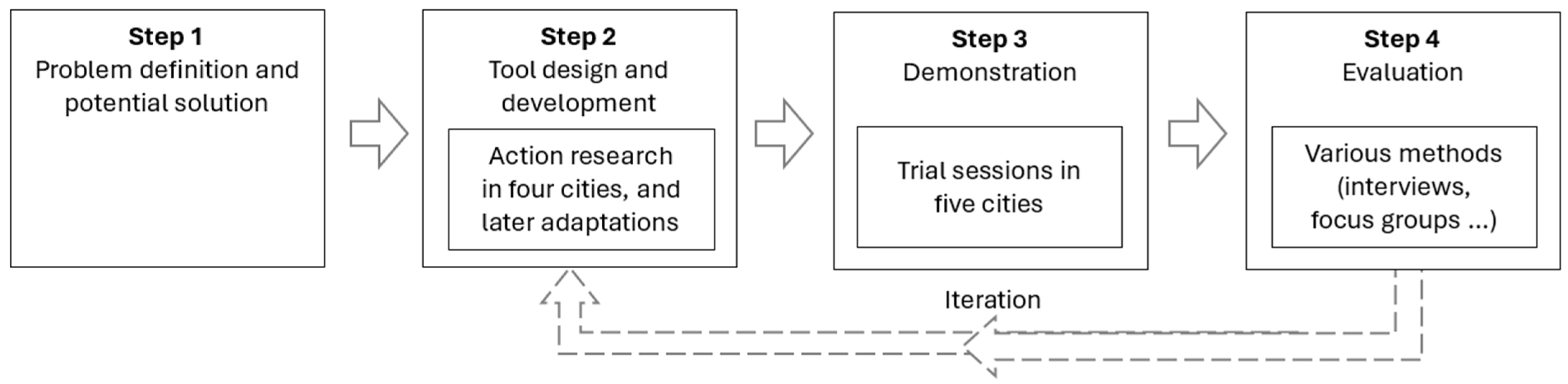
2.2. Method
- Identify an ongoing urban innovation project that is done with the ambition to be implemented more broadly, i.e., scale up (see Table 1).
- Identify which of the (generic) constraints on upscaling are applicable for this particular project, and determine how to intervene, i.e., anticipate these specific constraints (see Appendix B).
- Intervene through a series of experimental activities (see Appendix C).
- Evaluate the (role of the tool in the) wider impact of the intervention. (Appendix D explicates the interview or focus group formats, with which these interventions were evaluated, while Appendix E presents the results of these interviews and focus groups, by describing the observed effects per constraint, in each city it was applied. Appendix F describes wider effects of the intervention.)
3. Results
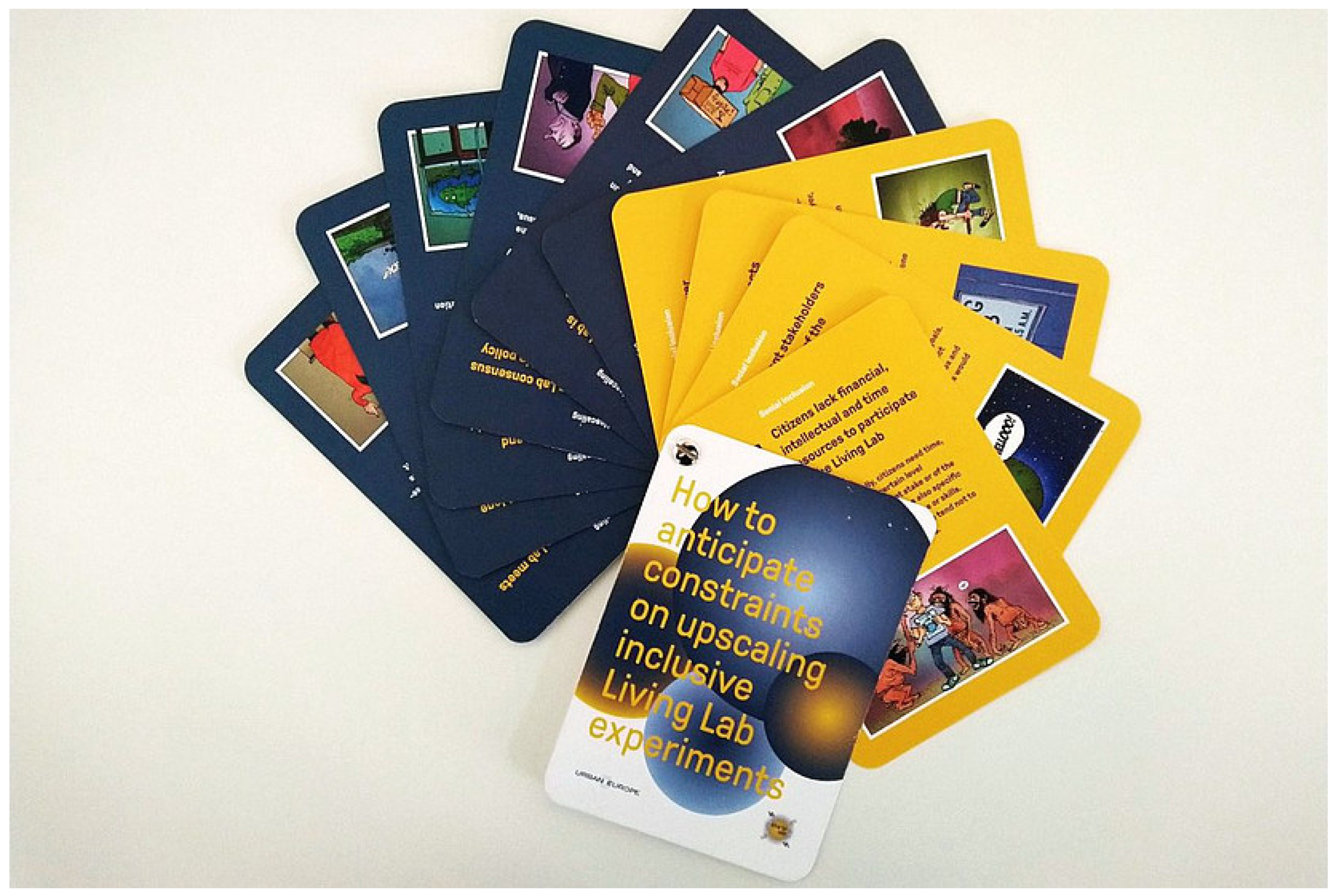
3.1. The Tool
- Constraint #1: Citizens lack financial, intellectual and temporal resources to participate in the experiment
- Constraint #2: Relevant stakeholders remain out of the experiment
- Constraint #3: Groups and impacts outside the experiment context are overlooked
- Constraint #4: Existing power structures are reproduced inside the experiment
- Constraint #5: The experiment’s potential for learning is underexploited
- Constraint #6: The experiment is disconnected from broader societal debate
- Constraint #7: The ‘co-created’ experiment’s result is not reflected in policy and society
- Constraint #8: Stakeholders and institutions are highly fragmented
- Constraint #9: The urban assemblage is sticky and locked-in
- Constraint #10: The experiment meets low institutional receptiveness
3.2. How the Tool Evolved During Design Iteration
4. Discussion
4.1. Contribution to Practice: Typical Effects of the Tool
4.2. Ways of Using the Tool
4.3. Contribution to Science
4.4. Limitations and Points for Improvement
5. Conclusions
Author Contributions
Funding
Institutional Review Board Statement
Informed Consent Statement
Data Availability Statement
Acknowledgments
Conflicts of Interest
Abbreviations
| DSR | Design Science Research |
| ULLs | Urban Living Labs |
| TM | Transition Management |
Appendix A

| City | Cases |
|---|---|
| Bellinzona | Regional bike sharing schemes (incl. Riccletta) Mobility plans for schools Redevelopment of Pratocarasso area |
| Brussels | Pollution peak emergency plan Environmental impact assessment expAir |
| Graz | Redevelopment Griesplatz (1996–2001) Redevelopment Neutorgasse Redevelopment Sonnenfelsplatz |
| Maastricht | Zero-emission bus project P + R Station Maastricht Noord |
Appendix B
| Specific Constraints | Way of Anticipating Each Constraint Through the Intervention |
|---|---|
| Bellinzona | |
| #1: There was a large risk of excluding elderly people, young people and migrants #2: There was a large risk of just attracting people who had already reduced their car use, not ‘mainstream’ car drivers #5 Since the project was not part of the formal policy process of the municipality, there was a risks that they would not be committed to learn in any systematic way. #10 The City of Bellinzona was not familiar with living lab approaches, and therefore tends to take a passive stance. | #1&2 First, a stakeholder analysis was performed in order to identify the key target groups to be engaged. Then, a hybrid recruitment campaign was designed, including both bottom-up and top-down activities. #5 A ‘learning monitoring’ scheme was used, including scoring the project’s impacts according to a multi-criteria framework, assessing the level of engagement and satisfaction of participants. #10 Early and urgent invitation of representatives of the City of Bellinzona (both civil servants and political decision-makers) to lab meetings. |
| Brussels | |
| #1 Various groups may feel uneasy working with air quality devices and smartphone data apps because of a lack of proficiency or time, such as less-skilled people, as well as people with children or busy jobs. Car commuters significantly contribute to emissions, but tend not to participate because they do not live in Brussels. | #1 At very early stages, LL organizers reflected together to identify potentially excluded sub-groups. To anticipate time limits, a strategic choice for venues and timings was made. For EU officials, meetings were convened in the EU premises at lunchtime; for groups of parents and shopkeepers, small meetings were organized in the early morning, just after leaving the children in school/just before opening the shop; for young professionals, meetings were organized in the early evening in a central neighborhood. Smartphones were provided to people who did not have one. More time for training was allocated for people less familiar with apps. |
| #2 Many people do not feel urgency to spend their time discussing car mobility issues (but do when it addresses their health and that of their children). | #2 Although ultimately aimed at ‘smarter mobility’, the initiative was framed as one where air quality and people’s health were at the core. |
| #6 There was a threat that lessons would be limited to those interested in the environmental impacts of air quality. | #6 The activities were coordinated from the onset as a broader citizen movement for a cleaner air in the city, by establishing a platform for discussion for all civic movements active for better air, and a network of researchers working on air quality and citizen science. |
| #10 Various attempts were made by BRAL and the local university to engage with regional governmental institutions responsible for mobility, environment, and smart city, but they were not interested in participating. | #10 Political parties were approached in the context of the local and regional elections. |
| Graz | |
| #2 The particular type of residents in the area of the square are not interested in participating (i.e., high proportion of migrants with various cultures and ethnics, education levels and incomes below average). | #2 Offer various communication channels (newspapers, Facebook, public events, and direct interaction with people via the Living Lab’s district office) and different formats of Living Lab activities, such as online questionnaires, workshops, social safaris, and mental maps. |
| #4 At participatory events, a number of people repeatedly disturbed events by excessively raising their voices and acting as opinion leaders, often including (verbal) ‘municipality bashing’. | #4 Use different formats of activities; offer activities over a longer period of time; set up a ‘district office’. |
| #9 The multi-mode traffic purpose of the square (bus, car, bicycle, or walking), as well as the contracts with the bus operator, limit opportunities to cater to residents’ wishes. | #9 Implement some short-term measures to show some effect of the activities. |
| Maastricht | |
| #3 The municipality’s project focus on the station area runs the risk of overlooking the impacts of Maastricht as a whole. | #3 The experiment focused on the Maastricht as a whole, to help include effects on other areas than the station area. |
| #8 The fragmented nature of public transport mobility in Maastricht: Public transport operators are large firms that are primarily focused on their own business; key stakeholders (residents, commuters, businesses) normally do not discuss (let alone co-create) these matters in an organized way. | #8 The experiment brought together a high diversity of relevant stakeholders (such as residents, Q-park, shop owners, urban planners, and current car commuters). |
| #9 There is an ‘obdurate urban assemblage’ around car use and (underground) parking in the inner-city of Maastricht. | #9 The visioning assessment experiment was designed by considering a year further in the future, 2040, in order to move beyond the interests and structures of today (‘sticky urban assemblage’), allowing envisioning and discussing more structural change. |
| #10 Policymakers in Maastricht typically believe that interactions with stakeholders add much complexity to the policy development process and accordingly have a preference of working with professional experts (architects, engineers, etc.) as opposed to ‘practice experts’ (citizens, CSOs, etc.), especially in the more strategic phases of a project, when typically civil servants are not sure themselves of what they/the municipality wants | #10 In the participatory visioning & assessment activities (1) stakeholder groups first worked separately, before a larger discussion with a mix of stakeholders, helping to better structure their arguments; (2) in the second session, groups build further upon the work of the first, whilst receiving reflections from externals; (3) the municipality was included as a(n) (equal) participant. |
Appendix C. Activities in the Four Living Lab Experiments
| Bellinzona | Citizens of Bellinzona were invited to join the Bellidea Living Lab to co-design a mobile app to promote more sustainable mobility patterns among their peers. One year later, the resulting app was launched to the whole population. Overall, forty-six citizens answered the public invitation to join the Living Lab, and fifteen of them were regularly active in the seven monthly meetings held. Activities in the Bellidea Living Lab were organized in three phases:
|
| Graz | Initiated by the city government, the team of Living Lab Griesplatz consisted of three external participation experts and one employee of the Executive Directorate for Urban Planning. Researchers from the RCE Graz-Styria supported the team and strengthened the scientific (transdisciplinary) backbone of the Living Lab. A temporarily installed ‘city district office’ located next to the Griesplatz was the starting point for manifold activities. These aimed to reach as many people as possible, but above all to involve diverse stakeholders (social inclusion). Over an extended period of time, the Living Lab team facilitated workshops, mental maps, social safaris, city walks, pop-up markets and an online survey. The activities were partly open to the general public, and in other cases, stakeholders (e.g., non-governmental organizations, citizen groups, and local businesses) were directly approached. Taking into account the multicultural character of the district, informal events also including non-verbal elements were included. All these activities helped to shape what the organizers called the ‘Gries DNA’. Please bear in mind that short and medium-term measures were developed and partly quickly implemented (e.g., new benches), while a complete redesign of the Griesplatz was envisaged for a later stage after the end of the Living Lab process. |
| Brussels | The Brussels Living Lab took the form of a platform of cooperation between the university (the Cosmopolis Centre for Urban Studies—VUB), the local civil society association (BRAL), and various groups of citizens using a citizen science methodology. Activities included:
|
| Maastricht | The Living Lab experiment in Maastricht consisted of a series of activities:
|
Appendix D. Interview and Focus Group Format for Demonstration and Evaluations
- -
- Demonstration:
- ○
- [Identify] To what extent are the following constraints applicable to your innovation project/experiment? In what way? [Go through all applicable constraints 1, 2, 3, etc., one after the other.]
- ○
- [Intervene] How could the following ways to anticipate be helpful in your case? How could they be applied? [Go through all applicable constraints 1, 2, 3, etc., one after the other]
- -
- Evaluation:
- ○
- How does our dialog, applying the tool to your case, help you to work on the follow-up of your innovation project/experiment?
- To what extent are the following constraints applicable to your innovation project/experiment? In what way? [Go through all applicable constraints 1, 2, 3, etc., one after the other.]
- How could the following ways to anticipate be helpful in your case? How could they be applied? [Go through all applicable constraints 1, 2, 3, etc., one after the other.]
- How does our dialogue, applying the tool to your case, help you to work on the follow-up of your innovation project/experiment?
Appendix E. More Details About the Demonstration and Evaluation Step
Appendix F. Wider Impact of the Intervention
References
- Scholl, C.; De Kraker, J. Urban planning by experiment: Practices, outcomes, and impacts. Urban Plan. 2021, 6, 156–160. [Google Scholar] [CrossRef] [Scilit]
- Voytenko, Y.; McCormick, K.; Evans, J.; Schliwa, G. Urban living labs for sustainability and low carbon cities in Europe: Towards a research agenda. J. Clean. Prod. 2016, 123, 45–54. [Google Scholar] [CrossRef] [Scilit]
- Bulkeley, H.; Gareth, A.; Edwards, S.; Fuller, S. Contesting climate justice in the city: Examining politics and practice in urban climate change experiments. Glob. Environ. Change 2014, 25, 31–40. [Google Scholar] [CrossRef] [Scilit]
- Hellsmark, H.; Frishammar, J.; Söderholm, P.; Ylinenpää, H. The role of pilot and demonstration plants in technology development and innovation policy. Res. Policy 2016, 45, 1743–1761. [Google Scholar] [CrossRef] [Scilit]
- Rip, A.; Kemp, R. Technological change. In Human Choice and Climate Change: Vol. II, Resources and Technology; Battelle Press: Columbus, OH, USA, 1998; pp. 327–399. [Google Scholar]
- Kemp, R.; Schot, J.; Hoogma, R. Regime shifts to sustainability through processes of niche formation: The approach of strategic niche management. Technol. Anal. Strateg. Manag. 1998, 10, 175–198. [Google Scholar] [CrossRef] [Scilit]
- Sengers, F.; Wieczorek, A.J.; Raven, R. Experimenting for sustainability transitions: A systematic literature review. Technol. Forecast. Soc. Change 2019, 145, 153–164. [Google Scholar] [CrossRef] [Scilit]
- Rotmans, J.; Loorbach, D. Transition management: Refl exive steering of societal complexity through searching, learning and experimenting. In The transition to Renewable Energy: Theory and Practice; Van den Bergh, J.C.J.M., Bruinsma, F.R., Eds.; Edward Elger: Cheltenham, UK, 2006. [Google Scholar]
- Van den Bosch, S. Transition Experiments: Exploring Societal Changes Towards Sustainability. Ph.D. Thesis, Dutch Research Institute for Transitions (DRIFT), Erasmus University Rotterdam, Rotterdam, The Netherlands, 2010. [Google Scholar]
- Kivimaa, P.; Hildén, M.; Huitema, D.; Jordan, A.; Newig, J. Experiments in climate governance–A systematic review of research on energy and built environment transitions. J. Clean. Prod. 2017, 169, 17–29. [Google Scholar]
- Laakso, S.; Berg, A.; Annala, M. Dynamics of experimental governance: A meta-study of functions and uses of climate governance experiments. J. Clean. Prod. 2017, 169, 8–16. [Google Scholar] [CrossRef] [Scilit]
- Evans, J.; Vácha, T.; Kok, H.; Watson, K. How Cities Learn: From Experimentation to Transformation. Urban Plan. 2021, 6, 171–182. [Google Scholar] [CrossRef] [Scilit]
- Van Mierlo, B.; Halbe, J.; Beers, P.J.; Scholz, G.; Vinke-de Kruijf, J. Learning about learning in sustainability transitions. Environ. Innov. Soc. Transit. 2020, 34, 251–254. [Google Scholar] [CrossRef] [Scilit]
- Laakso, S.; Aro, R.; Heiskanen, E.; Kaljonen, M. Reconfigurations in sustainability transitions: A systematic and critical review. Sustain. Sci. Pract. Policy 2021, 17, 15–31. [Google Scholar] [CrossRef] [Scilit]
- Hölscher, K.; Wittmayer, J.M.; Loorbach, D. Transition versus transformation: What’s the difference? Environ. Innov. Soc. Transit. 2018, 27, 1–3. [Google Scholar] [CrossRef] [Scilit]
- Stirling, A. Pluralising progress: From integrative transitions to transformative diversity. Environ. Innov. Soc. Transit. 2011, 1, 82–88. [Google Scholar] [CrossRef] [Scilit]
- Porter, N.; Claassen, M.; Timmermans, J. Transition experiments in Amsterdam: Conceptual and empirical analysis of two transition experiments in the WATERgraafsmeer program. Technol. Forecast. Soc. Change 2015, 90, 525–537. [Google Scholar] [CrossRef] [Scilit]
- Raven, R.; Kern, F.; Verhees, B.; Smith, A. Niche construction and empowerment through socio-political work. A meta-analysis of six low-carbon technology cases. Environ. Innov. Soc. Transit. 2016, 18, 143–159. [Google Scholar]
- Smith, A.; Raven, R. What is protective space? Reconsidering niches in transitions to sustainability. Res. Policy 2012, 41, 1025–1036. [Google Scholar] [CrossRef] [Scilit]
- Karvonen, A.; van Heur, B. Urban Laboratories: Experiments in Reworking Cities. Int. J. Urban Reg. Res. 2014, 38, 379–392. [Google Scholar]
- Dijk, M.; de Kraker, J.; Hommels, A. Anticipating Constraints on Upscaling from Urban Innovation Experiments. Sustainability 2018, 10, 2796. [Google Scholar] [CrossRef] [Scilit]
- Frantzeskaki, N.; Broto, V.C.; Coenen, L.; Loorbach, D. (Eds.) Urban Sustainability Transitions; Routledge: New York, NY, USA, 2017; Volume 5. [Google Scholar]
- Eneqvist, E.; Karvonen, A. Experimental governance and urban planning futures: Five strategic functions for municipalities in local innovation. Urban Plan. 2021, 6, 183–194. [Google Scholar] [CrossRef] [Scilit]
- Beukers, E.; Bertolini, L. Learning for transitions: An experiential learning strategy for urban experiments. Environ. Innov. Soc. Transit. 2021, 40, 395–407. [Google Scholar] [CrossRef] [Scilit]
- Beukers, E.; Bertolini, L. Fostering learning beyond urban experiment boundaries. Environ. Innov. Soc. Transit. 2023, 46, 100684. [Google Scholar] [CrossRef] [Scilit]
- Ryghaug, M.; Skjølsvold, T.M. Pilot Society and the Energy Transition: The Co-Shaping of Innovation, Participation and Politics; Springer Nature: Berlin/Heidelberg, Germany, 2021. [Google Scholar]
- Grandin, J.; Haarstad, H.; Kjærås, K.; Bouzarovski, S. The politics of rapid urban transformation. Curr. Opin. Environ. Sustain. 2018, 31, 16–22. [Google Scholar] [CrossRef] [Scilit]
- Schreiber, F.; Fokdal, J.; Ley, A. A Catalyst for Innovation? A Conceptual Framework for Analyzing the Potential of Urban Experiments to Transform Urban Planning Practices. Plan. Theory Pract. 2023, 24, 224–241. [Google Scholar] [CrossRef] [Scilit]
- Castán Broto, V.; Trencher, G.; Iwaszuk, E.; Westman, L. Transformative capacity and local action for urban sustainability. Ambio 2018, 48, 449–462. [Google Scholar] [CrossRef] [Scilit] [PubMed]
- Torrens, J.; von Wirth, T. Experimentation or projectification of urban change? A critical appraisal and three steps forward. Urban Transform. 2021, 3, 8. [Google Scholar] [CrossRef] [Scilit] [PubMed]
- Kern, K.; Haupt, W. Von Reallaboren zu urbanen Experimenten: Deutsche und internationale Debatten zu Skalierung und urbanen Nachhaltigkeitstransformationen. Raumforsch. Und Raumordn./Spatial Res. Plan. 2021, 79, 322–335. [Google Scholar]
- Puerari, E.; De Koning, J.I.; Von Wirth, T.; Karré, P.M.; Mulder, I.J.; Loorbach, D.A. Co-creation dynamics in urban living labs. Sustainability 2018, 10, 1893. [Google Scholar] [CrossRef] [Scilit]
- Von Wirth, T.; Fuenfschilling, L.; Frantzeskaki, N.; Coenen, L. Impacts of urban living labs on sustainability transitions: Mechanisms and strategies for systemic change through experimentation. Eur. Plan. Stud. 2019, 27, 229–257. [Google Scholar]
- Zolfagharian, M.; Walrave, B.; Raven, R.; Romme, A.G.L. Studying transitions: Past, present, and future. Res. Policy 2019, 9, 103788. [Google Scholar] [CrossRef] [Scilit]
- Lam, D.P.; Martín-López, B.; Wiek, A.; Bennett, E.M.; Frantzeskaki, N.; Horcea-Milcu, A.I.; Lang, D.J. Scaling the impact of sustainability initiatives: A typology of amplification processes. Urban Transform. 2020, 2, 3. [Google Scholar] [CrossRef] [Scilit]
- Westley, F.; Antadze, N.; Riddell, D.J.; Robinson, K.; Geobey, S. Five configurations for scaling up social innovation: Case examples of nonprofit organizations from Canada. J. Appl. Behav. Sci. 2014, 50, 234–260. [Google Scholar]
- Moore, M.L.; Riddell, D.; Vocisano, D. Scaling out, scaling up, scaling deep: Strategies of non-profits in advancing systemic social innovation. J. Corp. Citizsh. 2015, 2015, 67–84. [Google Scholar] [CrossRef] [Scilit]
- Kemp, R.; Grin, J. Opschaling van Transitie—Experimenten en Verankering van Systeem—Innovatieve Vernieuwing (Upscaling of Transition—Experiments and Anchoring of SystemInnovative Renewal); TNO: Delft, The Netherlands, 2009. [Google Scholar]
- Rogers, E.M. Diffusion of Innovations; Simon and Schuster: New York, NY, USA, 2010. [Google Scholar]
- Meijer, L.L.J.; Schipper, F.; Huijben, J.C.C.M. Align, adapt or amplify: Upscaling strategies for car sharing business models in Sydney, Australia. Environ. Innov. Soc. Transit. 2019, 33, 215–230. [Google Scholar] [CrossRef] [Scilit]
- Bauwens, T.; Vaskelainen, T.; Frenken, K. Conceptualising institutional complexity in the upscaling of community enterprises: Lessons from renewable energy and carsharing. Environ. Innov. Soc. Transit. 2022, 42, 138–151. [Google Scholar] [CrossRef] [Scilit]
- Koehrsen, J. Religious agency in sustainability transitions: Between experimentation, upscaling, and regime support. Environ. Innov. Soc. Transit. 2018, 27, 4–15. [Google Scholar] [CrossRef] [Scilit]
- Meelen, T.; Truffer, B.; Schwanen, T. Virtual user communities contributing to upscaling innovations in transitions: The case of electric vehicles. Environ. Innov. Soc. Transit. 2019, 31, 96–109. [Google Scholar] [CrossRef] [Scilit]
- Hodson, M.; Geels, F.W.; Mcmeekin, A. Reconfiguring urban sustainability transitions, analysing multiplicity. Sustainability 2017, 9, 299. [Google Scholar] [CrossRef] [Scilit]
- Ehnert, F. Review of research into urban experimentation in the fields of sustainability transitions and environmental governance. Eur. Plan. Stud. 2023, 31, 76–102. [Google Scholar] [CrossRef] [Scilit]
- Peffers, K.; Tuunanen, T.; Rothenberger, M.A.; Chatterjee, S. A design science research methodology for information systems research. J. Manag. Inf. Syst. 2007, 24, 45–77. [Google Scholar] [CrossRef] [Scilit]
- Carstensen, A.K.; Bernhard, J. Design science research–a powerful tool for improving methods in engineering education research. Eur. J. Eng. Educ. 2019, 44, 85–102. [Google Scholar]
- Baldassarre, B.; Konietzko, J.; Brown, P.; Calabretta, G.; Bocken, N.; Karpen, I.O.; Hultink, E.J. Addressing the design-implementation gap of sustainable business models by prototyping: A tool for planning and executing small-scale pilots. J. Clean. Prod. 2020, 255, 120295. [Google Scholar]
- Diethart, M.; Höflehner, T.; Drage, T. (Eds.) Report on Retrospective Analysis of Urban Mobility Governance, Deliverable 3.1; SmarterLabs project; JPI Urban Europe: Vienna, Austria, 2017. [Google Scholar]
- Wisker, G. The Undergraduate Research Handbook; Palgrave Macmillan: Basingstoke, UK, 2009. [Google Scholar]
- Yin, R. Case Study Research and Applications: Design and Methods; Sage Publications: Thousand Oaks, CA, USA, 2017. [Google Scholar]
- Luederitz, C.; Schäpke, N.; Wiek, A.; Lang, D.J.; Bergmann, M.; Bos, J.J.; Burch, S.; Davies, A.; Evans, J.; König, A.; et al. Learning through Evaluation—A Tentative Evaluative Scheme for Sustainability Transition Experiments. J. Clean. Prod. 2016, 169, 61–76. [Google Scholar] [CrossRef] [Scilit]
- McCrory, G. Learning hard or hardly learning? Exploring processes of experiential, transformative and social learning in an urban living lab. In Master Thesis Series in Environmental Studies and Sustainability Science; Lund University: Lund, Sweden, 2016. [Google Scholar]
- McCormick, K.; Kiss, B. Learning through Renovations for Urban Sustainability: The Case of the Malmö Innovation Platform. In Current Opinion in Environmental Sustainability; Elsevier B.V.: Dutch, The Netherlands, 2015; Volume 16, pp. 44–50. [Google Scholar] [CrossRef] [Scilit]
- Dieleman, H. Organizational Learning for Resilient Cities, through Realizing Eco-Cultural Innovations. J. Clean. Prod. 2013, 50, 171–180. [Google Scholar] [CrossRef] [Scilit]
- Abas, A.; Arifin, K.; Ali, M.A.M.; Khairil, M. A systematic literature review on public participation in decision-making for local authority planning: A decade of progress and challenges. Environ. Dev. 2023, 46, 100853. [Google Scholar] [CrossRef] [Scilit]
- Scholl, C.; Eriksen, M.A.; Baerten, N.; Clark, E.; Drage, T.; Essebo, M.; Wlasak, P. Guidelines for Urban Labs; Urb@Exp project 2014–2017; JPI Urban Europe: Vienna, Austria, 2017. [Google Scholar]
- Weber, M.; Hoogma, R.; Lane, B.; Schot, J. Experimenting with Sustainable Transport Innovations. A Workbook for Strategic Niche Management; Twente University: Enschede, The Netherlands, 1999. [Google Scholar]
- Savini, F.; Bertolini, L. Urban experimentation as a politics of niches. Environ. Plan. A Econ. Space 2019, 51, 831–848. [Google Scholar] [CrossRef] [Scilit]
- Raven, R.P.J.M.; Heiskanen, E.; Lovio, R.; Hodson, M.; Brohmann, B. The contribution of local experiments and negotiation processes to field-level learningin emerging (niche) technologies: Meta-analysis of 27 new energy projects in Europe. Bull. Sci. Technol. Soc. 2008, 28, 464–477. [Google Scholar]
- Vreugdenhil, H.; Slinger, J.; Thissen, W.; Rault, P.K. Pilot projects in water management. Ecol. Soc. 2010, 15, 13. [Google Scholar] [CrossRef] [Scilit]
- Hommels, A. Unbuilding Cities. Obduracy in Urban Sociotechnical Change; The MIT Press: Cambridge, MA, USA, 2005. [Google Scholar]
- Valderrama-Pineda, A. How do we co-produce urban transport systems and the city? The case of Transmilenio and Bogota. In Urban Assemblages. How Actor-Network Theory Changes Urban Studies; Farias, I., Bender, T., Eds.; Routledge: London, UK, 2010; pp. 123–138. ISBN 978-0-41-548662-0. [Google Scholar]
- Banister, D.; Anderton, K.; Bonilla, D.; Givoni, M.; Schwanen, T. Transportation and the environment. Ann. Rev. Environ. Resour. 2011, 36, 247–270. [Google Scholar] [CrossRef] [Scilit]
- Quist, J.; Thissen, W.; Vergragt, P. The impact and spin-off of participatory backcasting after 10 years: From Vision to Niche. Technol. Forecast. Soc. Change 2011, 78, 883–897. [Google Scholar]
- Blok, A. Urban Green Assemblages: An ANT view on Sustainable City Building Projects. Sci. Technol. Stud. 2013, 26, 5–24. [Google Scholar]
- Smith, N. Homeless/global: Scaling places. In Mapping the Futures: Local Cultures, Global Change; Bird, J., Curtis, B., Putnam, T., Robertson, G., Tickner, T., Eds.; Routledge: London, UK, 1993; pp. 87–119. ISBN 978-0-41-507018-8. [Google Scholar]
- Cellina, F.; Castri, R.; Simão, J.V.; Granato, P. Co-creating app-based policy measures for mobility behavior change: A trigger for novel governance practices at the urban level. Sustain. Cities Soc. 2020, 53, 101911. [Google Scholar]
- Van Poeck, K.; Östman, L.; Block, T. Opening up the black box of learning-by-doing in sustainability transitions. Environ. Innov. Soc. Transit. 2020, 34, 298–310. [Google Scholar] [CrossRef] [Scilit]
- Wiegmann, P.M.; Talmar, M.; de Nijs, S.B. Forging a sharper blade: A design science research approach for transition studies. Environ. Innov. Soc. Transit. 2020, 48, 100760. [Google Scholar] [CrossRef] [Scilit]
- Moulaert, F.; Swyngedouw, E.; Martinelli, F.; Gonzalez, S. (Eds.) Can Neighbourhoods Save the City? In Community Development and Social Innovation; Routledge: London, UK, 2010. [Google Scholar]
- Pfotenhauer, S.; Laurent, B.; Papageorgiou, K.; Stilgoe, A.J. The politics of scaling. Soc. Stud. Sci. 2022, 52, 3–34. [Google Scholar] [CrossRef] [Scilit] [PubMed]
- Upham, P.; Sovacool, B.; Ghosh, B. Just Transitions for Industrial Decarbonisation: A Framework for Innovation, Participation, and Justice. Renew. Sustain. Energy Rev. 2022, 167, 112699. [Google Scholar] [CrossRef] [Scilit]
- Da Schio, N. The Empowering Virtues of Citizen Science: Claiming Clean Air in Brussels. Engag. Sci. Technol. Soc. 2022, 8, 29–52. [Google Scholar] [CrossRef] [Scilit]


| City | Action Research Activities |
|---|---|
| Bellinzona (Switzerland) | The municipal government of Bellinzona has been aiming to reduce individual car use, especially by creating new cycling infrastructures and improving bus/train connections, but without success. The local university suggested developing an innovative mobility tracking app providing rewards in a gamified fashion, co-developed together with citizens and other organizations. The app was applied as an intervention to better anticipate constraints on upscaling car alternatives. |
| Brussels (Belgium) | Building on the experience of a project started by the environmental agency ‘Brussels Environment’ for measurement of urban air quality through eight high-detail wearable devices in 2013, a local civil society organization (BRAL), together with the university, suggested intervening and better anticipating upscaling societal and policy attention for air quality by involving a wide range of citizen groups using low-cost but user-friendly measurement devices. |
| Graz (Austria) | The municipality of Graz had a project aiming to scale up more participatory forms of mobility & spatial planning, but struggled with how to do this in practice. Graz University applied the upscaling tool in a series of participatory activities on (co)-redesigning a square annex and traffic hub. |
| Maastricht (Netherlands) | Like Bellinzona’s, Maastricht’s municipal government has aimed to restrain individual car use for years, but without success. A new project in the train station area has a similar aim, mainly planning new cycling crossings. Maastricht University applied the upscaling tool to design a number of participatory visioning & assessment activities to anticipate a number of ‘Maastricht-specific’ factors that might constrain upscaling car alternatives. |
| Type of Evaluation | Place | Evaluation Methods |
|---|---|---|
| Action Research | Bellinzona | One final focus group with civil servants and participants, and an interview with civil servants about (1) the future of mobility for the Bellinzona region and potential measures, and (2) the usefulness of the upscaling tool in designing and testing the app |
| Action Research | Brussels | Citizens and stakeholders participated in a total of 5 focus groups and 5 in-depth interviews on the potential of participatory measurements of air quality and the potential/limits of the approach. |
| Action Research | Graz | Two focus groups with members of the Executive Directorate for Urban Planning and three interviews with two external participation experts and one urban stakeholder, facilitated by two researchers, addressing the lessons for redesigning a square, as well as the usefulness of the upscaling tool. |
| Action Research | Maastricht | Nine interviews with participants (three civil servants, six urban stakeholders), to evaluate their experiences with the experiment, and a 90 min. focus group session with the municipality (to discuss the relevance of lessons learned for the City and Railway plan, as well as the usefulness of the tool). |
| First batch of (three) trials | Helsinki, Istanbul, Santander | One 120 min. focus group with three to five local civil servants in each city, plus five researchers participating. Together, they discussed both the case content as well as the need to adapt the tool due to local specificities. |
| Second batch of (two) trials | Amsterdam, Rotterdam | One 75–120 min. focus group with 3–5 civil servants; additionally, two interviews in Amsterdam. Both the case content, as well as the need to adapt the tool due to local specificities, were discussed. |
| Iteration | Changes | Rationale |
|---|---|---|
| #1 |
|
|
| #2 |
|
|
| #3 |
|
|
Disclaimer/Publisher’s Note: The statements, opinions and data contained in all publications are solely those of the individual author(s) and contributor(s) and not of MDPI and/or the editor(s). MDPI and/or the editor(s) disclaim responsibility for any injury to people or property resulting from any ideas, methods, instructions or products referred to in the content. |
© 2026 by the authors. Licensee MDPI, Basel, Switzerland. This article is an open access article distributed under the terms and conditions of the Creative Commons Attribution (CC BY) license.
Share and Cite
Dijk, M.; Cellina, F.; da Schio, N.; Höflehner, T.; Diethart, M. From Experimentation to Sustainability Transformation: Developing a Tool to Better Anticipate Upscaling of Urban Innovation Experiments. Sustainability 2026, 18, 6926. https://doi.org/10.3390/su18136926
Dijk M, Cellina F, da Schio N, Höflehner T, Diethart M. From Experimentation to Sustainability Transformation: Developing a Tool to Better Anticipate Upscaling of Urban Innovation Experiments. Sustainability. 2026; 18(13):6926. https://doi.org/10.3390/su18136926
Chicago/Turabian StyleDijk, Marc, Francesca Cellina, Nicola da Schio, Thomas Höflehner, and Mario Diethart. 2026. "From Experimentation to Sustainability Transformation: Developing a Tool to Better Anticipate Upscaling of Urban Innovation Experiments" Sustainability 18, no. 13: 6926. https://doi.org/10.3390/su18136926
APA StyleDijk, M., Cellina, F., da Schio, N., Höflehner, T., & Diethart, M. (2026). From Experimentation to Sustainability Transformation: Developing a Tool to Better Anticipate Upscaling of Urban Innovation Experiments. Sustainability, 18(13), 6926. https://doi.org/10.3390/su18136926