Emotional Intelligence as a Driver of Pro-Environmental Behavior: A Conceptual Review for Climate Action

 , and
, and 
Abstract
1. Introduction
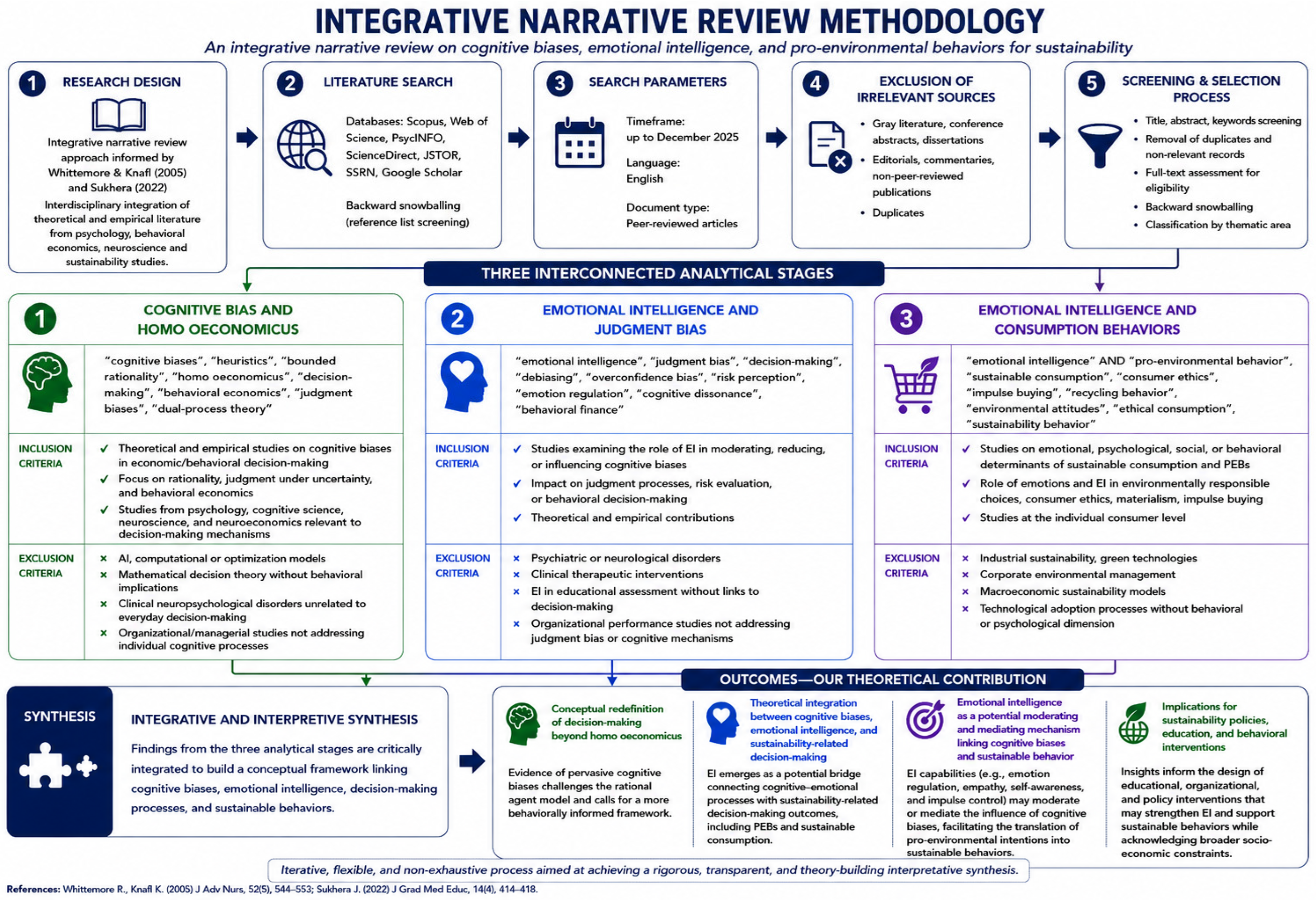
2. Methodology
3. The Concept of Homo Oeconomicus and Its Contradictions
4. Debiasing the Decision-Making Process: A Possible Role for Affective System and Emotional Intelligence
4.1. The Dual-Process Theory and the Contribution of Neuroscience in Understanding the Mechanisms of the Decision-Making Process
4.2. Debiasing the Decision-Making Process: A Possible Role for Emotional Intelligence
5. Promoting Pro-Environmental Behaviors by Favoring Sustainable Consumption: A Possible Role for Emotional Intelligence
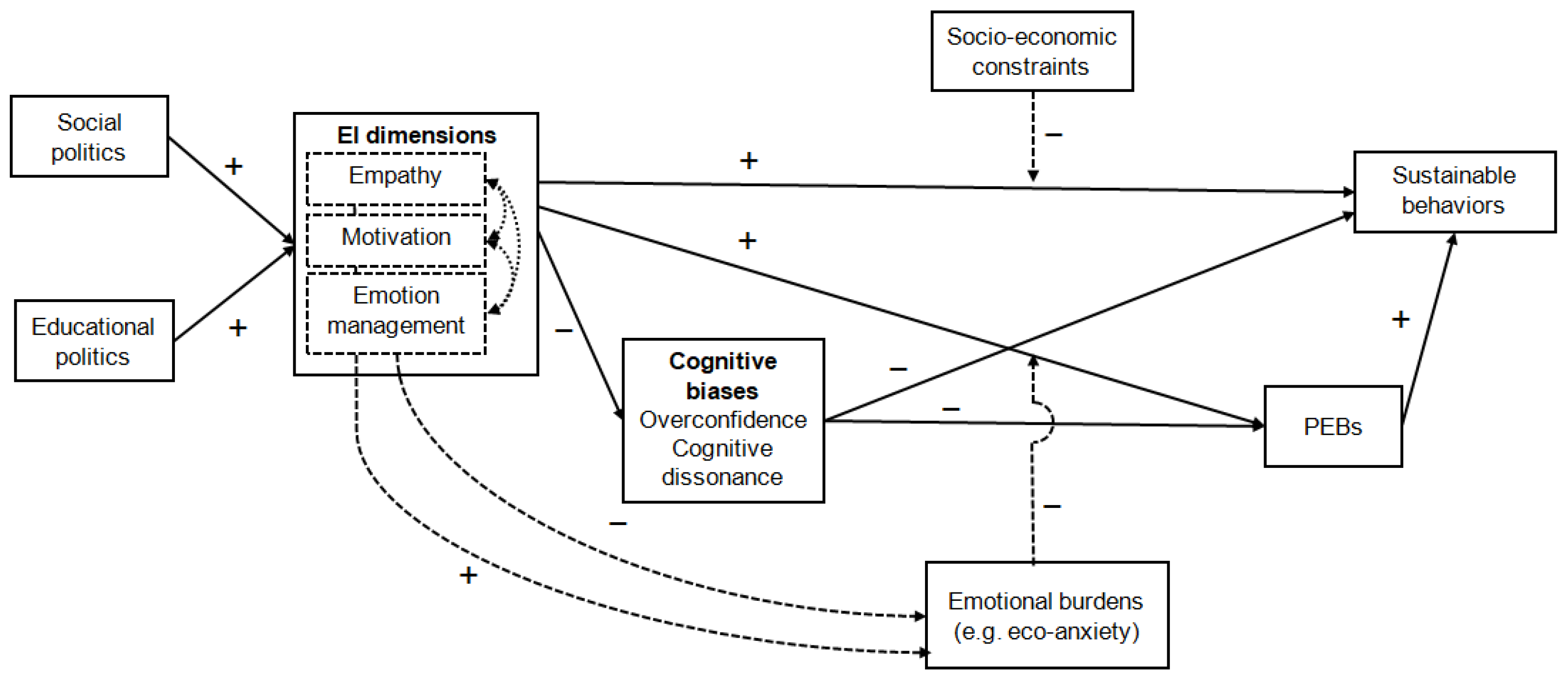
6. Discussion: Closing the Gap—The Role of Emotional Intelligence in Mitigating Cognitive Biases and Promoting Pro-Environmental Behaviors
7. Conclusions
Author Contributions
Funding
Institutional Review Board Statement
Informed Consent Statement
Data Availability Statement
Conflicts of Interest
References
- United Nations. Transforming Our World: The 2030 Agenda for Sustainable Development; United Nations: New York, NY, USA, 2015. [Google Scholar]
- Steg, L.; Vlek, C. Encouraging Pro-Environmental Behavior: An Integrative Review and Research Agenda. J. Environ. Psychol. 2009, 29, 309–317. [Google Scholar] [CrossRef] [Scilit]
- Quoquab, F.; Mohammad, J.; Sukari, N.N. A Multiple-Item Scale for Measuring “Sustainable Consumption Behavior” Construct: Development and Psychometric Evaluation. Asia Pac. J. Mark. Logist. 2019, 31, 791–816. [Google Scholar] [CrossRef] [Scilit]
- Valkengoed, A.M.; Abrahamse, W.; Steg, L. To Select Effective Interventions for Pro-Environmental Behavior Change, We Need to Consider Determinants of Behavior. Nat. Hum. Behav. 2022, 6, 1482–1492. [Google Scholar] [CrossRef] [Scilit] [PubMed]
- Blankenberg, A.K.; Alhusen, H. On the Determinants of pro-Environmental Behavior: A Literature Review and Guide for the Empirical Economist. Cege Discuss. Pap. 2019. [Google Scholar]
- Dzhengiz, T.; Niesten, E. Competences for Environmental Sustainability: A Systematic Review on the Impact of Absorptive Capacity and Capabilities. J. Bus. Ethics 2020, 162, 881–906. [Google Scholar] [CrossRef] [Scilit]
- Farr, D. Sustainable Nation: Urban Design Patterns for the Future; John Wiley & Sons: Hoboken, NJ, USA, 2018. [Google Scholar]
- Gatersleben, B.; Murtagh, N.; Cherry, M.; Watkins, M. Moral, Wasteful, Frugal, or Thrifty? Identifying Consumer Identities to Understand and Manage Pro-Environmental Behavior. Environ. Behav. 2019, 51, 24–49. [Google Scholar] [CrossRef] [Scilit]
- Hess, D.J. Sustainable Consumption, Energy and Failed Transitions: The Problem of Adaptation. In Sustainable Consumption; Cohen, M.J., Brown, H.S., Vergragt, P.J., Eds.; Edward Elgar Publishing: Cheltenham, UK, 2013; pp. 159–178. [Google Scholar]
- Sawitri, D.R.; Hadiyanto, H.; Hadi, S.P. Pro-Environmental Behavior from a SocialCognitive Theory Perspective. Procedia Environ. Sci. 2014, 23, 27–33. [Google Scholar] [CrossRef] [Scilit]
- Godazgar, H. Islam versus Consumerism and Postmodernism in the Context of Iran. Soc. Compass 2007, 54, 389–418. [Google Scholar] [CrossRef] [Scilit]
- Alfredsson, E.; Bengtsson, M.; Brown, H.S.; Isenhour, C.; Lorek, S.; Stevis, D.; Vergragt, P. Why Achieving the Paris Agreement Requires Reduced Overall Consumption and Production. Sustain. Sci. Pract. Policy 2018, 14, 1–5. [Google Scholar] [CrossRef] [Scilit]
- De, S.; Singh, P.; Ibrahim, M.; Dikkatwar, A.P.; Chaudhary, R. Mindful, Responsible, and Sustainable Consumption: A Hybrid Review of Evolving Research Trends. Discov. Sustain. 2025, 6, 512. [Google Scholar] [CrossRef] [Scilit]
- Rieckmann, M. Learning to Transform the World: Key Competencies in Education for Sustainable Development. In Issues and Trends in Education for Sustainable Development; Leicht, A., Heiss, J., Byun, W.J., Eds.; UNESCO: Paris, France, 2018; pp. 39–59. [Google Scholar]
- Chowdhury, R.M. Emotional Intelligence and Consumer Ethics: The Mediating Role of Personal Moral Philosophies. J. Bus. Ethics 2017, 142, 527–548. [Google Scholar] [CrossRef] [Scilit]
- Schneider, U.A.; Havlík, P.; Schmid, E.; Valin, H.; Mosnier, A.; Obersteiner, M.; Fritz, S. Impacts of Population Growth, Economic Development, and Technical Change on Global Food Production and Consumption. Agric. Syst. 2011, 104, 204–215. [Google Scholar] [CrossRef] [Scilit]
- Vitell, S.J.; King, R.A.; Singh, J.J. A Special Emphasis and Look at the Emotional Side of Ethical Decision-Making. AMS Rev. 2013, 3, 74–85. [Google Scholar] [CrossRef] [Scilit]
- Zagonari, F. Environmental Sustainability Is Not Worth Pursuing Unless It Is Achieved for Ethical Reasons. Palgrave Commun. 2020, 6, 108. [Google Scholar] [CrossRef] [Scilit]
- Kollmuss, A.; Agyeman, J. Mind the Gap: Why Do People Act Environmentally and What Are the Barriers to pro-Environmental Behavior? Environ. Educ. Res. 2002, 8, 239–260. [Google Scholar] [CrossRef] [Scilit]
- Stern, P.C. Psychology and the Science of Human-Environment Interactions. Am. Psychol. 2000, 55, 523. [Google Scholar] [CrossRef]
- Whittemore, R.; Knafl, K. The Integrative Review: Updated Methodology. J. Adv. Nurs. 2005, 52, 546–553. [Google Scholar] [CrossRef] [Scilit] [PubMed]
- Sukhera, J. Narrative Reviews: Flexible, Rigorous, and Practical. J. Grad. Med. Educ. 2022, 14, 414–417. [Google Scholar] [CrossRef] [Scilit] [PubMed]
- Robbins, L. Essay on the Nature and Significance of Economic Science, 3rd ed.; The Macmillan Press, Ltd.: London, UK, 1935. [Google Scholar]
- Mill, J.S. On the Definition of Political Economy, and on the Method of Investigation Proper to It. Lond. Westminst. Rev. 1836, 4, 120–164. [Google Scholar]
- Wheeler, G. Bounded Rationality. In The Stanford Encyclopedia of Philosophy; Zalta, E.N., Ed.; Stanford University: Stanford, CA, USA, 2018. [Google Scholar]
- Kidwell, B.; Lopez-Kidwell, V.; Blocker, C.; Mas, E.M. Birds of a Feather Feel Together: Emotional Ability Similarity in Consumer Interactions. J. Consum. Res. 2020, 47, 215–236. [Google Scholar] [CrossRef] [Scilit]
- Soltys, A.; Sokol-Gozdek, I.; Czerwonka, M.; Tyburski, E. Emotions in Decision Making. In Neuroeconomic and Behavioral Aspects of Decision Making; Nermend, K., Łatuszyńska, M., Eds.; Springer: Cham, Switzerland, 2017; pp. 35–47. [Google Scholar]
- Tyburski, E. Psychological Determinants of Decision Making. In Neuroeconomic and Behavioral Aspects of Decision Making; Nermend, K., Łatuszyńska, M., Eds.; Springer: Cham, Switzerland, 2017; pp. 19–34. [Google Scholar]
- Hersing, W.S. Managing Cognitive Bias in Safety Decision Making: Application of Emotional Intelligence Competencies. J. Space Saf. Eng. 2017, 4, 124–128. [Google Scholar] [CrossRef] [Scilit]
- Potemkowski, A. Neurobiology of Decision Making: Methodology in Decision-Making Research. Neuroanatomical and Neurobiochemical Fundamentals. In Neuroeconomic and Behavioral Aspects of Decision Making; Nermend, K., Łatuszyńska, M., Eds.; Springer: Berlin/Heidelberg, Germany, 2017. [Google Scholar]
- Korteling, J.; Paradies, G.L.; Sassen-van Meer, J.P. Cognitive Bias and How to Improve Sustainable Decision Making. Front. Psychol. 2023, 14, 1129835. [Google Scholar] [CrossRef] [Scilit] [PubMed]
- Simon, H.A. A Behavioral Model of Rational Choice. Q. J. Econ. 1955, 69, 99–118. [Google Scholar] [CrossRef] [Scilit]
- Neumann, J.; Morgenstern, O. Theory of Games and Economic Behavior; Princeton University Press: Princeton, NJ, USA, 1944. [Google Scholar]
- Simon, H.A. Theories of Bounded Rationality. In Decision and Organization; McGuire, C.B., Radner, R., Eds.; Elsevier: Amsterdam, The Netherlands, 1972; pp. 161–176. [Google Scholar]
- Simon, H.A. Rational Decision Making in Business Organizations. Am. Econ. Rev. 1979, 69, 493–513. [Google Scholar]
- Tversky, A.; Kahneman, D. Judgment under Uncertainty: Heuristics and Biases. Science 1974, 185, 1124–1131. [Google Scholar] [CrossRef] [Scilit] [PubMed]
- Evans, J.S.B. In Two Minds: Dual-Process Accounts of Reasoning. Trends Cogn. Sci. 2003, 7, 454–459. [Google Scholar] [CrossRef] [Scilit] [PubMed]
- Kahneman, D. Attention and Effort; Prentice-Hall Inc.: Englewood Cliffs, NJ, USA, 1973. [Google Scholar]
- Kahneman, D. Maps of Bounded Rationality: A Perspective on Intuitive Judgement and Choice. Am. Psychol. 2002, 58, 697–720. [Google Scholar] [CrossRef] [Scilit] [PubMed]
- Kahneman, D. Maps of Bounded Rationality: Psychology for Behavioral Economics. Am. Econ. Rev. 2003, 93, 1449–1475. [Google Scholar] [CrossRef] [Scilit]
- Rakitta, M.; Wernery, J. Cognitive Biases in Building Energy Decisions. Sustainability 2021, 13, 9960. [Google Scholar] [CrossRef] [Scilit]
- Svenson, O. Differentiation and Consolidation Theory of Human Decision Making: A Frame of Reference for Pre- and Post-Decision Processes. Acta Psychol. 1992, 80, 143–168. [Google Scholar] [CrossRef] [Scilit]
- Das, T.K.; Teng, B.S. Cognitive Biases and Strategic Decision Processes: An Integrative Perspective. J. Manag. Stud. 1999, 36, 757–778. [Google Scholar] [CrossRef] [Scilit]
- Teovanović, P.; Knežević, G.; Stankov, L. Individual Differences in Cognitive Biases: Evidence against One-Factor Theory of Rationality. Intelligence 2015, 50, 75–86. [Google Scholar] [CrossRef] [Scilit]
- Shaw, D.; Carrington, M.; Chatzidakis, A. (Eds.) Ethics and Morality in Consumption: Interdisciplinary Perspectives; Routledge: London, UK, 2016. [Google Scholar]
- Engler, J.O.; Abson, D.J.; Wehrden, H. Navigating Cognition Biases in the Search of Sustainability. Ambio 2018, 48, 605–618. [Google Scholar] [CrossRef] [Scilit] [PubMed]
- Andrade, E.B.; Ariely, D. The Enduring Impact of Transient Emotions on Decision Making. Organ. Behav. Hum. Decis. Process. 2009, 109, 1–8. [Google Scholar] [CrossRef] [Scilit]
- Schwarz, N. Emotion, Cognition, and Decision Making. Cogn. Emot. 2000, 14, 433–440. [Google Scholar] [CrossRef] [Scilit]
- Milkman, K.L.; Chugh, D.; Bazerman, M.H. How can decision making be improved? Persp. Psychol. Sc. 2009, 4, 379–383. [Google Scholar] [CrossRef] [Scilit] [PubMed]
- Finucane, M.L.; Alhakami, A.; Slovic, P.; Johnson, S.M. The affect heuristic in judgments of risks and benefits. J. Behav. Decis. Mak. 2000, 13, 1–17. [Google Scholar]
- Bazerman, M.H.; Tenbrunsel, A.E.; Wade-Benzoni, K.A. Negotiating with yourself and losing: Making decisions with competing internal preferences. Acad. Manag. Rev. 1998, 23, 225–241. [Google Scholar] [CrossRef] [Scilit]
- Zajonc, R.B. Feeling and thinking: Preferences need no inferences. Amer. Psychol. 1980, 35, 151–175. [Google Scholar] [CrossRef]
- Mazutis, D.; Eckardt, A. Sleepwalking into catastrophe: Cognitive biases and corporate climate change inertia. Calif. Manag. Rev. 2017, 59, 74–108. [Google Scholar] [CrossRef] [Scilit]
- Ariely, D.; Loewenstein, G.; Prelec, D. “Coherent arbitrariness”: Stable demand curves without stable preferences. Q. J. Econ. 2003, 118, 73–106. [Google Scholar] [CrossRef] [Scilit]
- Dlugosch, D.; Wang, M. Ambiguity, ambiguity aversion and foreign bias: New evidence from international panel data. J. Bank. Financ. 2022, 140, 106509. [Google Scholar] [CrossRef] [Scilit]
- Kocher, M.G.; Lahno, A.M.; Trautmann, S.T. Ambiguity aversion is not universal. Eur. Econ. Rev. 2018, 101, 268–283. [Google Scholar] [CrossRef] [Scilit]
- Fehr, E.; Herz, H.; Wilkening, T. The lure of authority: Motivation and incentive effects of power. Am. Econ. Rev. 2013, 103, 1325–1359. [Google Scholar] [CrossRef] [Scilit]
- Singh, R.; Ryvola, R. Cognitive Biases in Climate Risk Management; Red Cross Red Crescent Climate Centre: The Hague, The Netherlands; BRACED: London, UK, 2018; Volume 5. [Google Scholar]
- Bindra, S.; Sharma, D.; Parameswar, N.; Dhir, S.; Paul, J. Bandwagon effect revisited: A systematic review to develop future research agenda. J. Bus. Res. 2022, 143, 305–317. [Google Scholar] [CrossRef] [Scilit]
- Shin, H.; Hwang, J. Illusions of clustering: A systematic evaluation on the effects of clusters on regional economic performance in Korea. Internat. Reg. Sc. Rev. 2022, 45, 135–160. [Google Scholar] [CrossRef] [Scilit]
- Festinger, L. A Theory of Cognitive Dissonance; Stanford University Press: Redwood City, CA, USA, 1957. [Google Scholar]
- Newell, B.R.; Pitman, A.J. The psychology of global warming: Improving the fit between the science and the message. Bul. Amer. Meteorol. Soc. 2010, 91, 1003–1014. [Google Scholar] [CrossRef] [Scilit]
- Nebel, J.M. Status quo bias, rationality, and conservatism about value. Ethics 2015, 125, 449–476. [Google Scholar] [CrossRef] [Scilit] [PubMed]
- Luo, G.Y. Conservatism bias and asset price overreaction or underreaction to new information in the presence of strategic interaction. In Asset Price Response to New Information: The Effects of Conservatism Bias and Representativeness Heuristic; Springer: Berlin/Heidelberg, Germany, 2013; pp. 15–25. [Google Scholar] [CrossRef] [Scilit]
- Johnson, E.J.; Goldstein, D.G. Do defaults save lives? Science 2003, 302, 1338–1339. [Google Scholar] [CrossRef] [Scilit] [PubMed]
- Thaler, R.H.; Sunstein, C.R. Libertarian paternalism. Amer. Econ. Rev. 2003, 93, 175–179. [Google Scholar] [CrossRef] [Scilit]
- Thaler, R.H.; Sunstein, C.R. Nudge: Improving Decisions About Health, Wealth, and Happiness, revised and expanded ed.; Penguin Books: London, UK, 2009. [Google Scholar]
- Tversky, A.; Kahneman, D. The framing of decisions and the psychology of choice. Science 1981, 211, 453–458. [Google Scholar] [CrossRef] [Scilit] [PubMed]
- Chen, D.L.; Moskowitz, T.J.; Shue, K. Decision-making under the gambler’s fallacy: Evidence from asylum judges, loan officers, and baseball umpires. Q. J. Econ. 2016, 131, 1181–1242. [Google Scholar] [CrossRef] [Scilit]
- Thorndike, E.L. A constant error in psychological ratings. J. Appl. Psychol. 1920, 4, 25–29. [Google Scholar] [CrossRef] [Scilit]
- Brickman, P.; Campbell, D.T. Hedonic relativism and planning the good society. In Adaptation-Level Theory: A Symposium; Appley, M.H., Ed.; Academic Press: Cambridge, MA, USA, 1971; pp. 287–302. [Google Scholar]
- Dasgupta, P.; Maskin, E. Uncertainty and hyperbolic discounting. Amer. Econ. Rev. 2005, 95, 1290–1299. [Google Scholar] [CrossRef] [Scilit]
- Ajzen, I.; Brown, T.C.; Rosenthal, L.H. Information bias in contingent valuation: Effects of personal relevance, quality of information, and motivational orientation. J. Environ. Econ. Manag. 1996, 30, 43–57. [Google Scholar] [CrossRef] [Scilit]
- Capozza, D.; Brown, R. (Eds.) Social Identity Processes: Trends in Theory and Research; SAGE Publications: Thousand Oaks, CA, USA, 2000. [Google Scholar]
- Heine, S.J.; Lehman, D.R. Culture, dissonance, and self-affirmation. Personal. Soc. Psychol. Bull. 1997, 23, 389–400. [Google Scholar] [CrossRef] [Scilit]
- Tajfel, H. Experiments in intergroup discrimination. Sci. Amer. 1970, 223, 96–102. [Google Scholar] [CrossRef] [Scilit]
- Tajfel, H.; Billig, M.G.; Bundy, R.P.; Flament, C. Social categorization and intergroup behaviour. Eur. J. Soc. Psychol. 1971, 1, 149–178. [Google Scholar] [CrossRef] [Scilit]
- Schlösser, T.; Dunning, D.; Johnson, K.L.; Kruger, J. How unaware are the unskilled? Empirical tests of the “signal extraction” counterexplanation for the Dunning–Kruger effect in self-evaluation of performance. J. Econ. Psychol. 2013, 39, 85–100. [Google Scholar] [CrossRef] [Scilit]
- Kahneman, D.; Knetsch, J.L.; Thaler, R.H. Anomalies: The endowment effect, loss aversion, and status quo bias. J. Econ. Perspect. 1991, 5, 193–206. [Google Scholar] [CrossRef] [Scilit]
- Taleb, N.N. The Black Swan: The Impact of the Highly Improbable; Random House: Brooklyn, NY, USA, 2007. [Google Scholar]
- Sunstein, C.R. Probability neglect: Emotions, worst cases, and law. Yale Law J. 2002, 112, 61–107. [Google Scholar] [CrossRef] [Scilit] [PubMed]
- Monat, A.; Averill, J.R.; Lazarus, R.S. Anticipatory stress and coping reactions under various conditions of uncertainty. J. Person. Soc. Psychol. 1972, 24, 237–253. [Google Scholar] [CrossRef] [Scilit] [PubMed]
- Murata, A. Cultural difference and cognitive biases as a trigger of critical crashes or disasters: Evidence from case studies of human factors analysis. J. Behav. Brain Sci. 2017, 7, 399–415. [Google Scholar] [CrossRef]
- Murata, A.; Nakamura, T.; Karwowski, W. Influence of cognitive biases in distorting decision making and leading to critical unfavorable incidents. Safety 2015, 1, 44–58. [Google Scholar] [CrossRef] [Scilit]
- van Vugt, M.; Griskevicius, V.; Schultz, P.W. Naturally green: Harnessing stone age psychological biases to foster environmental behavior. Soc. Issues Policy Rev. 2014, 8, 1–32. [Google Scholar] [CrossRef] [Scilit]
- Wilson, M.; Daly, M. Do pretty women inspire men to discount the future? Proc. R. Soc. Lond. Ser. B Biol. Sci. 2004, 271, S177–S179. [Google Scholar] [CrossRef] [Scilit] [PubMed]
- Galai, D.; Sade, O. The “ostrich effect” and the relationship between the liquidity and the yields of financial assets. J. Bus. 2006, 79, 2741–2759. [Google Scholar] [CrossRef] [Scilit]
- Silver, N. The Signal and the Noise: Why So Many Predictions Fail—But Some Don’t; Penguin Press: New York, NY, USA, 2012. [Google Scholar]
- Lichtenstein, S.; Fischhoff, B.; Phillips, L.D. Calibration of probabilities: The state of the art to 1980. In Judgment Under Uncertainty: Heuristics and Biases; Kahneman, D., Slovic, P., Tversky, A., Eds.; Cambridge University Press: Cambridge, UK, 1982; pp. 306–334. [Google Scholar] [CrossRef] [Scilit]
- Nordgren, L.F.; van Harreveld, F.; van der Pligt, J. The restraint bias: How the illusion of self-restraint promotes impulsive behavior. Psychol. Sc. 2009, 20, 1523–1528. [Google Scholar] [CrossRef] [Scilit] [PubMed]
- Cassell, M.M.; Halperin, D.T.; Shelton, J.D.; Stanton, D. Risk compensation: The Achilles’ heel of innovations in HIV prevention? BMJ 2006, 332, 605–607. [Google Scholar] [CrossRef] [Scilit] [PubMed]
- Adams, J.; Hillman, M. The risk compensation theory and bicycle helmets. Inj. Prev. 2001, 7, 89–91. [Google Scholar] [CrossRef] [Scilit] [PubMed]
- Evans, W.N.; Graham, J.D. Risk reduction or risk compensation? The case of mandatory safety-belt use laws. J. Risk Uncertain. 1991, 4, 61–73. [Google Scholar] [CrossRef] [Scilit]
- Delaney, L.; Lades, L.K. Present bias and everyday self-control failures: A day reconstruction study. J. Behav. Decis. Mak. 2017, 30, 1157–1167. [Google Scholar] [CrossRef] [Scilit]
- Thaler, R.H.; Shefrin, H.M. An economic theory of self-control. J. Pol. Econ. 1981, 89, 392–406. [Google Scholar] [CrossRef] [Scilit] [PubMed]
- Garcia, S.M.; Song, H.; Tesser, A. Tainted recommendations: The social comparison bias. Organ. Behav. Hum. Decis. Process. 2010, 113, 97–101. [Google Scholar] [CrossRef] [Scilit]
- Samuelson, W.; Zeckhauser, R. Status quo bias in decision making. J. Risk Uncertain. 1988, 1, 7–59. [Google Scholar] [CrossRef] [Scilit]
- Janssen, M.A.; Scheffer, M. Overexploitation of renewable resources by ancient societies and the role of sunk-cost effects. Ecol. Soc. 2004, 9, 6. [Google Scholar] [CrossRef] [Scilit]
- Staw, B.M. Knee-deep in the big muddy: A study of escalating commitment to a chosen course of action. Organ. Behav. Hum. Perform. 1976, 16, 27–44. [Google Scholar] [CrossRef] [Scilit]
- Jost, J.T.; Banaji, M.R. The role of stereotyping in system-justification and the production of false consciousness. Br. J. Soc. Psychol. 1994, 33, 1–27. [Google Scholar] [CrossRef] [Scilit]
- Jost, J.T.; Banaji, M.R.; Nosek, B.A. A decade of system justification theory: Accumulated evidence of conscious and unconscious bolstering of the status quo. Political Psychol. 2004, 25, 881–919. [Google Scholar] [CrossRef] [Scilit]
- Rottenstreich, Y.; Hsee, C.K. Money, kisses, and electric shocks: On the affective psychology of risk. Psychol. Sci. 2001, 12, 185–190. [Google Scholar] [CrossRef] [Scilit] [PubMed]
- Baron, J.; Gowda, R.; Kunreuther, H. Attitudes toward managing hazardous waste: What should be cleaned up and who should pay for it? Risk Anal. 1993, 13, 183–192. [Google Scholar] [CrossRef] [Scilit]
- Viscusi, W.K.; Magat, W.A.; Huber, J. An investigation of the rationality of consumer valuations of multiple health risks. RAND J. Econ. 1987, 18, 465–479. [Google Scholar] [CrossRef] [Scilit]
- Dunning, D. A Newer Look: Motivated Social Cognition and the Schematic Representation of Social Concepts. Psychol. Inq. 2000, 10, 1–11. [Google Scholar] [CrossRef] [Scilit] [PubMed]
- Forgas, J.P. Mood and Judgment: The Affect Infusion Model (AIM). Psychol. Bull. 1995, 117, 39–66. [Google Scholar] [CrossRef] [PubMed]
- Schwarz, N. Feelings as Information: Informational and Motivational Functions of Affective States. In Handbook of Motivation and Cognition; Higgins, E.T., Sorrentino, R.M., Eds.; Guilford Press: New York, NY, USA, 1990; pp. 521–561. [Google Scholar]
- Damasio, R. Descartes’ Error: Emotion, Reason and the Human Brain; Grosset/Putnam Book: New York, NY, USA, 1994. [Google Scholar]
- Fuchs, F.; Lingnau, V. The Homo Economicus as a Prototype of a Psychopath? A Conceptual Analysis and Implications for Business Research and Teaching. J. Bus. Ethics 2024, 195, 763–777. [Google Scholar] [CrossRef] [Scilit]
- Boddy, C.R. Is the Only Rational Personality That of the Psychopath? Homo Economicus as The Most Serious Threat to Business Ethics Globally. Humanist. Manag. J. 2023, 8, 315–327. [Google Scholar] [CrossRef] [Scilit]
- Nelson, J.A. Getting Past ‘Rational Man/Emotional Woman’: Comments on Research Programs in Happiness Economics and Interpersonal Relations. Int. Rev. Econ. 2010, 57, 233–253. [Google Scholar] [CrossRef] [Scilit]
- Rotondi, V.; Bruni, L.; Crivelli, L.; Mancuso, S.; Santori, P. In Praise of the Persona Economica: Listening to Plants for a New Economic Paradigm. Humanit. Soc. Sci. Commun. 2022, 9, 288. [Google Scholar] [CrossRef] [Scilit]
- Arkes, H.R. Costs and Benefits of Judgment Errors: Implications for Debiasing. Psychol. Bull. 1991, 110, 486–498. [Google Scholar] [CrossRef]
- Morewedge, C.K.; Yoon, H.; Scopelliti, I.; Symborski, C.W.; Korris, J.H.; Kassam, K.S. Debiasing Decisions: Improved Decision Making with a Single Training Intervention. Policy Insights Behav. Brain Sci. 2015, 2, 129–140. [Google Scholar] [CrossRef] [Scilit]
- Chapman, C.S.; Gallivan, J.P.; Wood, D.K.; Milne, J.L.; Culham, J.C.; Goodale, M.A. Reaching for the Unknown: Multiple Target Encoding and Real-Time Decision-Making in a Rapid Reach Task. Cognition 2010, 116, 168–176. [Google Scholar] [CrossRef] [Scilit] [PubMed]
- Mellers, B.; Ungar, L.; Baron, J.; Ramos, J.; Gurcay, B.; Fincher, K.; Tetlock, P.E. Psychological Strategies for Winning a Geopolitical Forecasting Tournament. Psychol. Sci. 2014, 25, 1106–1115. [Google Scholar] [CrossRef] [Scilit] [PubMed]
- Beshears, J.; Kosowsky, H. Nudging: Progress to Date and Future Directions. Organ. Behav. Hum. Decis. Process. 2020, 161, 3–19. [Google Scholar] [CrossRef] [Scilit] [PubMed]
- Damasio, A.R. Towards a neuropathology of emotion and mood. Nature 1997, 386, 769–770. [Google Scholar] [CrossRef] [Scilit] [PubMed]
- Bechara, A.; Damasio, H.; Tranel, D.; Damasio, A.R. Deciding Advantageously before Knowing the Advantageous Strategy. Science 1997, 275, 1293–1295. [Google Scholar] [CrossRef] [Scilit] [PubMed]
- Bechara, A.; Damasio, A.R.; Damasio, H.; Anderson, S.W. Insensitivity to Future Consequences Following Damage to Human Prefrontal Cortex. Cognition 1994, 50, 7–15. [Google Scholar] [CrossRef] [Scilit] [PubMed]
- Yilmaz, S. The Relationship Between Emotional Intelligence and Decision-Making. Neuropsychiatr. Investig. 2023, 61, 117–121. [Google Scholar] [CrossRef] [Scilit]
- Ohira, H. The Somatic Marker Revisited: Brain and Body in Emotional Decision Making. Emot. Rev. 2010, 2, 245–249. [Google Scholar] [CrossRef] [Scilit]
- Di Cesare, S.; Silveri, F.; Sala, S.; Petti, L. Positive Impacts in Social Life Cycle Assessment: State of the Art and the Way Forward. Int. J. Life Cycle Assess. 2018, 23, 406–421. [Google Scholar] [CrossRef] [Scilit]
- Serra, D. Decision-Making: From Neuroscience to Neuroeconomics—An Overview. Theory Decis. 2021, 91, 1–80. [Google Scholar] [CrossRef] [Scilit]
- Gallese, V.; Fadiga, L.; Fogassi, L.; Rizzolatti, G. Action Recognition in the Premotor Cortex. Brain 1996, 119, 593–609. [Google Scholar] [CrossRef] [Scilit] [PubMed]
- Rizzolatti, G.; Fadiga, L.; Gallese, V.; Fogassi, L. Premotor Cortex and the Recognition of Motor Actions. Cogn. Brain Res. 1996, 3, 131–141. [Google Scholar] [CrossRef] [Scilit] [PubMed]
- Wicker, B.; Keysers, C.; Plailly, J.; Royet, J.P.; Gallese, V.; Rizzolatti, G. Both of Us Disgusted in My Insula: The Common Neural Basis of Seeing and Feeling Disgust. Neuron 2003, 40, 655–664. [Google Scholar] [CrossRef] [Scilit] [PubMed]
- Craig, A.D. How Do You Feel? Interoception: The Sense of the Physiological Condition of the Body. Nat. Rev. Neurosci. 2002, 3, 655–666. [Google Scholar] [CrossRef] [Scilit] [PubMed]
- Iacoboni, M.; Molnar-Szakacs, I.; Gallese, V.; Buccino, G.; Mazziotta, J.C.; Rizzolatti, G. Grasping the Intentions of Others with One’s Own Mirror Neuron System. PLoS Biol. 2005, 3, e79. [Google Scholar] [CrossRef] [Scilit] [PubMed]
- Kaneko, A.; Asaoka, Y.; Lee, Y.A.; Goto, Y. Cognitive and Affective Processes Associated with Social Biases. Int. J. Neuropsychopharmacol. 2021, 24, 645–655. [Google Scholar] [CrossRef] [Scilit] [PubMed]
- Gardner, H. Frames of Mind: A Theory of Multiple Intelligences; Basic Books: New York, NY, USA, 1983. [Google Scholar]
- Mayer, J.D.; Caruso, D.R.; Salovey, P. Emotional Intelligence Meets Traditional Standards for an Intelligence. Intelligence 1999, 27, 267–298. [Google Scholar] [CrossRef] [Scilit]
- Mayer, J.D.; Salovey, P. The intelligence of emotional intelligence. Intelligence 1993, 17, 433–442. [Google Scholar] [CrossRef] [Scilit]
- Goleman, D. Emotional Intelligence; Bantam Books: New York, NY, USA, 1995. [Google Scholar]
- Petrides, K.V.; Furnham, A. Trait Emotional Intelligence: Psychometric Investigation with Reference to Established Trait Taxonomies. Eur. J. Personal. 2001, 15, 425–448. [Google Scholar] [CrossRef] [Scilit]
- Petrides, K.V. Ability and Trait Emotional Intelligence. In The Wiley-Blackwell Handbook of Individual Differences; Chamorro-Premuzic, T., Furnham, A., von Stumm, S., Eds.; Wiley-Blackwell: Hoboken, NJ, USA, 2011; p. 658. [Google Scholar]
- Bar-On, R. The Emotional Quotient Inventory (EQ-i): A Test of Emotional Intelligence; Multi-Health Systems: Toronto, ON, USA, 1997. [Google Scholar]
- Bar-On, R. Emotional and Social Intelligence: Insights from the Emotional Quotient Inventory. In The Handbook of Emotional Intelligence: Theory, Development, Assessment, and Application at Home, School, and in the Workplace; Bar-On, R., Parker, J.D.A., Eds.; Jossey-Bass/Wiley: Hoboken, NJ, USA, 2000; pp. 363–388. [Google Scholar]
- Carter, S.; Pasqualini, M.C.S. Stronger Autonomic Response Accompanies Better Learning: A Test of Damasio’s Somatic Marker Hypothesis. Cogn. Emot. 2004, 18, 901–911. [Google Scholar] [CrossRef] [Scilit]
- Fiori, M. A New Look at Emotional Intelligence: A Dual-Process Framework. Personal. Soc. Psychol. Rev. 2009, 13, 21–44. [Google Scholar] [CrossRef] [Scilit] [PubMed]
- George, P.; Cosgrove, J.; Taylor, J.; Rao, N.; Marshall, T.; Ghose, S.S.; Patel, N.A. Antibullying Interventions in Schools: Assessing the Evidence Base. Psychiatr. Serv. 2024, 75, 908–920. [Google Scholar] [CrossRef] [Scilit] [PubMed]
- Gil, Y.; Garijo, D.; Khider, D.; Knoblock, C.A.; Ratnakar, V.; Osorio, M.; Shu, L. Artificial Intelligence for Modeling Complex Systems: Taming the Complexity of Expert Models to Improve Decision Making. ACM Trans. Interact. Intell. Syst. 2021, 11, 1–49. [Google Scholar] [CrossRef] [Scilit]
- Buontempo, G.; Brockner, J. Emotional Intelligence and the Ease of Recall Judgment Bias: The Mediating Effect of Private Self- Focused Attention. J. Appl. Soc. Psychol. 2008, 38, 159–172. [Google Scholar] [CrossRef] [Scilit]
- Johnsi, S.; Sunitha, K.A. Impact of Personality and Emotional Intelligence on Investor Behavior. J. Manag. 2019, 10, 21–29. [Google Scholar] [CrossRef] [Scilit]
- Jamil, N.; Bashir, T. Impact of Cognitive Dissonance Bias on Investors’ Decisions: Moderating Role of Emotional Intelligence. Pak. Soc. Sci. Rev. 2021, 5, 538–552. [Google Scholar] [CrossRef] [Scilit]
- Chen, C.; Ishfaq, M.; Ashraf, F.; Sarfaraz, A.; Wang, K. Mediating Role of Optimism Bias and Risk Perception between Emotional Intelligence and Decision-Making: A Serial Mediation Model. Front. Psychol. 2022, 13, 914649. [Google Scholar] [CrossRef] [Scilit] [PubMed]
- Gulzar, T.I.; Ali, N. The Influence of Behavioral Biases on Investment Decisions; Moderating Role of Emotional Stability. J. Dev. Soc. Sci. 2023, 4, 692–708. [Google Scholar] [CrossRef] [Scilit]
- Annapurna, R.; Basri, S. The Influence of Emotional Intelligence and Behavioural Biases on Mutual Fund Churning Frequency: Evidence from India. Acta Psychol. 2024, 248, 104426. [Google Scholar] [CrossRef] [Scilit] [PubMed]
- Im, M.; Oh, J. Effect of Emotion Regulation as a De-Biasing Mechanism on Overconfidence in Investment Behavior. J. Financ. Serv. Mark. 2016, 21, 209–225. [Google Scholar] [CrossRef] [Scilit]
- Wong, C.S.; Wo, T.L.; Wu, A.M.S. Validation of the Pro-Environmental Behavior (PEB) Scale in Malaysia: Assessing Cross-Age and Gender Invariance. Discov. Sustain. 2025, 6, 544. [Google Scholar] [CrossRef] [Scilit]
- Tian, H.; Liu, X. Pro-Environmental Behavior Research: Theoretical Progress and Future Directions. Int. J. Environ. Res. Public Health 2021, 19, 6721. [Google Scholar] [CrossRef] [Scilit] [PubMed]
- Larson, L.R.; Stedman, R.C.; Cooper, C.B.; Decker, D.J. Understanding the Multi-Dimensional Structure of pro-Environmental Behavior. J. Environ. Psychol. 2015, 43, 112–124. [Google Scholar] [CrossRef] [Scilit]
- Gifford, R. The Dragons of Inaction: Psychological Barriers That Limit Climate Change Mitigation and Adaptation. Am. Psychol. 2011, 66, 290–302. [Google Scholar] [CrossRef] [Scilit] [PubMed]
- Lange, F. Behavioral Paradigms for Studying Pro-Environmental Behavior: A Systematic Review. Behav. Res. Methods 2023, 55, 600–622. [Google Scholar] [CrossRef] [Scilit] [PubMed]
- Creutzig, F.; Roy, J.; Lamb, W.F.; Azevedo, I.M.L.; Bruin, W.; Dalkmann, H.; Edelenbosch, O.Y.; Geels, F.W.; Grubler, A.; Hepburn, C.; et al. Towards Demand-Side Solutions for Mitigating Climate Change. Nat. Clim. Change 2018, 8, 260–263. [Google Scholar] [CrossRef] [Scilit]
- Lucas, K.; Brooks, M.; Darnton, A.; Jones, J.E. Promoting Pro-Environmental Behavior: Existing Evidence and Policy Implications. Environ. Sci. Policy 2008, 11, 456–466. [Google Scholar] [CrossRef] [Scilit]
- Dioba, A.; Kroker, V.; Dewitte, S.; Lange, F. Barriers to Pro-Environmental Behavior Change: A Review of Qualitative Research. Sustainability 2023, 16, 8776. [Google Scholar] [CrossRef] [Scilit]
- Ajzen, I. The Theory of Planned Behavior. Organ. Behav. Hum. Decis. Process. 1991, 50, 179–211. [Google Scholar] [CrossRef] [Scilit]
- Wyss, A.M.; Knoch, D.; Berger, S. When and How Pro-Environmental Attitudes Turn into Behavior: The Role of Costs, Benefits, and Self-Control. J. Environ. Psychol. 2022, 79, 101748. [Google Scholar] [CrossRef] [Scilit]
- Rezvani, Z.; Jansson, J.; Bengtsson, M. Cause I’ll Feel Good! An Investigation into the Effects of Anticipated Emotions and Personal Moral Norms on Consumer Pro-Environmental Behavior. J. Promot. Manag. 2017, 23, 163–183. [Google Scholar] [CrossRef] [Scilit]
- Innocenti, M.; Perilli, A.; Santarelli, G.; Carluccio, N.; Zjalic, D.; Acquadro Maran, D.; Ciabini, L.; Cadeddu, C. How Does Climate Change Worry Influence the Relationship between Climate Change Anxiety and Eco-Paralysis? A Moderation Study. Climate 2023, 11, 190. [Google Scholar] [CrossRef] [Scilit]
- Coates, Z.; Kelly, M.; Brown, S. The Relationship between Climate Anxiety and Pro-Environment Behaviours. Sustainability 2024, 16, 5211. [Google Scholar] [CrossRef] [Scilit]
- Niedzwiedz, C.L.; Kankawale, S.M.; Katikireddi, S.V. A systematic review of social, political and geographic factors associated with eco-anxiety in children and young people. Nat. Ment. Health 2025, 3, 1579–1615. [Google Scholar] [CrossRef] [Scilit]
- Freedman, P.E.; Choi, D.Y.; Marczak, M.; Chisti, H.; Freedman, J.M. A climate of emotions pilot study reducing climate anxiety and strengthening resilience. Discov. Sustain. 2026, 7, 807. [Google Scholar] [CrossRef] [Scilit]
- Ortner, C.N.M.; Armstrong, M.; Ulmer, E.J. Emotion regulation, climate distress, and climate action in climate activist and student samples. Discov. Psychol. 2025, 5, 15. [Google Scholar] [CrossRef] [Scilit]
- Solomon, M.R. The Role of Products as Social Stimuli: A Symbolic Interactionism Perspective. J. Consum. Res. 1983, 10, 319–329. [Google Scholar] [CrossRef] [Scilit]
- Childers, T.L.; Rao, A.R. The Influence of Familial and Peer-Based Reference Groups on Consumer Decisions. J. Consum. Res. 1992, 19, 198–211. [Google Scholar] [CrossRef] [Scilit] [PubMed]
- Connolly, J.; Prothero, A. Green Consumption: Life-Politics, Risk and Contradictions. J. Consum. Cult. 2008, 8, 117–145. [Google Scholar] [CrossRef] [Scilit]
- Argo, J.J.; Dahl, D.W.; Manchanda, R.V. The Influence of a Mere Social Presence in a Retail Context. J. Consum. Res. 2005, 32, 207–212. [Google Scholar] [CrossRef] [Scilit]
- McFerran, B.; Dahl, D.; Firzsimons, G.J.; Morales, A.C. I’ll Have What She’s Having: Effects of Social Influence and Body Type on the Food Choices of Others. J. Consum. Res. 2010, 36, 915–929. [Google Scholar] [CrossRef] [Scilit] [PubMed]
- Cherrier, H. Ethical Consumption Practices: Co-production of Self-expression and Social Recognition. J. Consum. Behav. Int. Res. Rev. 2007, 6, 321–335. [Google Scholar] [CrossRef] [Scilit]
- Zhong, B.; Niu, N.; Li, J.; Wu, Y.; Fan, W. How Subjective Socioeconomic Status Influences Pro-Environmental Behavior: The Mediating Role of Sense of Control and Life History Strategy. Behav. Sci. 2024, 14, 591. [Google Scholar] [CrossRef] [Scilit] [PubMed]
- Tan, M.; Luo, X.; Li, J.; Zhang, G.; Zhong, Y. Emergency and costs effect pro-environmental behavior: An event-related potential (ERP) study. Curr. Psychol. 2024, 43, 19883–19893. [Google Scholar] [CrossRef] [Scilit]
- Zollo, L. The Consumers’ Emotional Dog Learns to Persuade Its Rational Tail: Toward a Social Intuitionist Framework of Ethical Consumption. J. Bus. Ethics 2021, 168, 295–313. [Google Scholar] [CrossRef] [Scilit]
- Lisboa, P.V.; Gómez-Román, C.; Guntín, L.; Monteiro, A.P. Pro-Environmental Behavior, Personality and Emotional Intelligence in Adolescents: A Systematic Review. Front. Psychol. 2024, 15, 1323098. [Google Scholar] [CrossRef] [Scilit] [PubMed]
- Aziz, F.; Md Rami, A.A.; Zaremohzzabieh, Z.; Ahari, S. Effects of Emotions and Ethics on Pro-Environmental Behavior of University Employees: A Model Based on the Theory of Planned Behavior. Sustainability 2021, 13, 7062. [Google Scholar] [CrossRef] [Scilit]
- Bissing-Olson, M.J.; Iyer, A.; Fielding, K.S.; Zacher, H. Relationships between Daily Affect and Pro-Environmental Behavior at Work: The Moderating Role of Pro-environmental Attitude. J. Organ. Behav. 2013, 34, 156–175. [Google Scholar] [CrossRef] [Scilit]
- Reser, J.P.; Bradley, G.L. Fear Appeals in Climate Change Communication. In Oxford Research Encyclopedia of Climate Science; Oxford University Press: New York, NY, USA, 2017. [Google Scholar] [CrossRef] [Scilit]
- Ogunbode, C.A.; Doran, R.; Hanss, D.; Ojala, M.; Salmela-Aro, K.; Van Den Broek, K.L.; Bhullar, N.; De Aquino, S.D.; Marot, T.A.; Schermer, J.A.; et al. Climate Anxiety, Wellbeing and Pro-Environmental Action: Correlates of Negative Emotional Responses to Climate Change in 32 Countries. J. Environ. Psychol. 2022, 84, 101887. [Google Scholar] [CrossRef] [Scilit]
- Antinienė, D.; Lekavičienė, R.; Rūtelionė, A.; Šeinauskienė, B. Emotional Intelligence Training as an Intervention to Diminish Consumer Materialism. Entrep. Sustain. Issues 2022, 10, 328–343. [Google Scholar] [CrossRef] [Scilit] [PubMed]
- Abdollahi, A.; Vakili Mobarakeh, M.R.; Karbalaei, S. Locus of Control, Hardiness, and Emotional Intelligence as Predictors of Waste Prevention Behaviors. Rom. J. Appl. Psychol. 2015, 17, 8–16. [Google Scholar]
- Ntanos, S.; Ntanos, G.; Chalikias, M. The Role of Emotional Intelligence as an Underlying Factor towards Social Acceptance of Green Investments. In Proceedings of the 8th International Conference on Information and Communication Technologies in Agriculture, Food and Environment, Chania, Greece, 21–24 September 2017. [Google Scholar]
- Argan, M.T.; Argan, M.; Dursun, M.T. The Effect of Emotional Intelligence on Behavioral Satisfaction: The Mediating Effect of Recycle Behavior. Present Environ. Sustain. Dev. 2022, 16, 97–113. [Google Scholar] [CrossRef] [Scilit]
- Welsch, H.; Kühling, J. Pro-Environmental Behavior and Rational Consumer Choice: Evidence from Surveys of Life Satisfaction. J. Econ. Psychol. 2010, 31, 405–420. [Google Scholar] [CrossRef] [Scilit]
- DeVille, N.V.; Tomasso, L.P.; Stoddard, O.P.; Wilt, G.E.; Horton, T.H.; Wolf, K.L.; Brymer, E.; Kahn, P.H., Jr.; James, P. Time Spent in Nature Is Associated with Increased Pro-Environmental Attitudes and Behaviors. Int. J. Environ. Res. Public Health 2021, 18, 7498. [Google Scholar] [CrossRef] [Scilit] [PubMed]
- Liu, Y.; Cleary, A.; Fielding, K.S.; Murray, Z.; Roiko, A. Nature Connection, Pro-Environmental Behaviours and Wellbeing: Understanding the Mediating Role of Nature Contact. Landsc. Urban Plan. 2022, 228, 104550. [Google Scholar] [CrossRef] [Scilit]
- Koay, W.I.; Dillon, D. Community Gardening: Stress, Well-Being, and Resilience Potentials. Int. J. Environ. Res. Public Health 2020, 17, 6740. [Google Scholar] [CrossRef] [Scilit] [PubMed]
- Carrieri, A.; Fermani, A. Sustainable Accommodation Choice in Tourism and Emotional Intelligence Connected: An Exploratory Study Looking for Evidence. Cogent Psychol. 2018, 5, 1485474. [Google Scholar] [CrossRef] [Scilit]
- Balundė, A.; Jovarauskaitė, L.; Poškus, M.S. Exploring Adolescents’ Waste Prevention via Value-Identity-Personal Norm and Comprehensive Action Determination Models. J. Environ. Psychol. 2020, 72, 101526. [Google Scholar] [CrossRef] [Scilit]
- Koessler, A.K.; Vorlaufer, T.; Fiebelkorn, F. Social Norms and Climate-Friendly Behavior of Adolescents. PLoS ONE 2022, 17, 0266847. [Google Scholar] [CrossRef] [Scilit] [PubMed]
- Hasford, J.; Hardesty, D.M.; Kidwell, B. More than a Feeling: Emotional Contagion Effects in Persuasive Communication. J. Mark. Res. 2015, 52, 836–847. [Google Scholar] [CrossRef] [Scilit]
- Wang, J.; Wu, L. The Impact of Emotions on the Intention of Sustainable Consumption Choices: Evidence from a Big City in an Emerging Country. J. Clean. Prod. 2016, 126, 325–336. [Google Scholar] [CrossRef] [Scilit]
- Ahn, H. Emotional Intelligence as a Personality Trait That Predicts Consumption Behavior: The Role of Consumer Emotional Intelligence in Persuasive Communication. Sustainability 2022, 14, 15461. [Google Scholar] [CrossRef] [Scilit]
- Huang, M.H.; Rust, R.T. Sustainability and Consumption. J. Acad. Mark. Sci. 2011, 39, 40–54. [Google Scholar] [CrossRef] [Scilit]
- York, R.; Clark, B. Critical Materialism: Science, Technology, and Environmental Sustainability. Sociol. Inq. 2010, 80, 475–499. [Google Scholar] [CrossRef] [Scilit] [PubMed]
- Minton, E.A.; Kahle, L.R.; Jiuan, T.S.; Tambyah, S.K. Addressing Criticisms of Global Religion Research: A Consumption-based Exploration of Status and Materialism, Sustainability, and Volunteering Behavior. J. Sci. Study Relig. 2016, 55, 365–383. [Google Scholar] [CrossRef] [Scilit]
- Zhang, L.; Shao, Z.; Li, X.; Feng, Y. Gamification and Online Impulse Buying: The Moderating Effect of Gender and Age. Int. J. Inf. Manag. 2021, 61, 102267. [Google Scholar] [CrossRef] [Scilit]
- Obukhovich, S.; Sipilä, J.; Tarkiainen, A. Strategies for Reducing the Environmental Impact of Impulse Buying. In Sustainable Marketing, Branding, and Reputation Management: Strategies for a Greener Future; Masengu, R., Bigirimana, S., Chiwaridzo, O., Bensson, R., Blossom, C., Eds.; IGI Global Scientific Publishing: Hershey, PA, USA, 2023; pp. 195–211. [Google Scholar]
- Nair, D.; Das, S. Impact of Emotional Intelligence on Impulse Buying and Product Value Proposition. Eur. J. Bus. Manag. 2015, 7, 165–172. [Google Scholar]
- Muncy, J.A.; Vitell, S.J. Consumer Ethics: An Investigation of the Ethical Beliefs of the Final Consumer. J. Bus. Res. 1992, 24, 297–311. [Google Scholar] [CrossRef] [Scilit]
- Hopkins, M.; Deepa, R. The Impact of Emotional Intelligence on Ethical Judgment. J. Manag. Dev. 2018, 37, 503–511. [Google Scholar] [CrossRef] [Scilit]
- Singh, J.J.; Garg, N.; Govind, R.; Vitell, S.J. Anger Strays, Fear Refrains: The Differential Effect of Negative Emotions on Consumers’ Ethical Judgments. J. Bus. Ethics 2018, 151, 235–248. [Google Scholar] [CrossRef] [Scilit]
- Escadas, M.; Jalali, M.S.; Farhangmehr, M. What Goes around Comes around: The Integrated Role of Emotions on Consumer Ethical Decision-making. J. Consum. Behav. 2020, 19, 409–422. [Google Scholar] [CrossRef] [Scilit]
- Schubert, C. Green Nudges: Do They Work? Are They Ethical? Ecol. Econ. 2017, 132, 329–342. [Google Scholar] [CrossRef] [Scilit]
- Hertwig, R.; Grüne-Yanoff, T. Nudging and Boosting: Steering or Empowering Good Decisions. Perspect. Psychol. Sci. 2017, 12, 973–986. [Google Scholar] [CrossRef] [Scilit] [PubMed]
- Michaelsen, P. Transparency and Nudging: An Overview and Methodological Critique of Empirical Investigations. Behav. Public Policy 2024, 8, 807–817. [Google Scholar] [CrossRef] [Scilit]
- Angelidis, J.; Ibrahim, N.A. The Impact of Emotional Intelligence on the Ethical Judgment of Managers. J. Bus. Ethics 2011, 99, 111–119. [Google Scholar] [CrossRef] [Scilit]
- Fu, W. The Impact of Emotional Intelligence, Organizational Commitment, and Job Satisfaction on Ethical Behavior of Chinese Employees. J. Bus. Ethics 2014, 122, 137–144. [Google Scholar] [CrossRef] [Scilit]
- DiClemente, D.F.; Hantula, D.A. Applied Behavioral Economics and Consumer Choice. J. Econ. Psychol. 2003, 24, 589–602. [Google Scholar] [CrossRef] [Scilit]
- Loewenstein, G. Hot-Cold Empathy Gaps and Medical Decision Making. Health Psychol. 2005, 24, S49–S56. [Google Scholar] [CrossRef] [Scilit] [PubMed]
- Kidwell, B.; Hardesty, D.M.; Childers, T.L. Consumer Emotional Intelligence: Conceptualization, Measurement, and the Prediction of Consumer Decision Making. J. Consum. Res. 2008, 35, 154–166. [Google Scholar] [CrossRef] [Scilit]
- Zeidner, M.; Roberts, R.D.; Matthews, G. Can Emotional Intelligence Be Schooled? A Critical Review. Educ. Psychol. 2002, 37, 215–231. [Google Scholar] [CrossRef] [Scilit] [PubMed]
- Aguilar-Luzón, M.C.; Calvo-Salguero, A.; Salinas, J.M. Beliefs and Environmental Behavior: The Moderating Effect of Emotional Intelligence. Scand. J. Psychol. 2014, 55, 619–629. [Google Scholar] [CrossRef] [Scilit] [PubMed]
- Kadic-Maglajlic, S.; Arslanagic-Kalajdzic, M.; Micevski, M.; Dlacic, J.; Zabkar, V. Being Engaged Is a Good Thing: Understanding Sustainable Consumption Behavior among Young Adults. J. Bus. Res. 2019, 104, 644–654. [Google Scholar] [CrossRef] [Scilit]



| Authors | Cognitive Bias | Definition | Homo Oeconomicus Dimension Impacted |
|---|---|---|---|
| [49,50,51,52] | Affect Heuristic | When making decisions, we rely on our emotions rather than concrete information. | Unlimited Cognitive Capacity |
| [53,54] | Anchoring Bias | We rely on the first piece of information we receive about a topic. | Perfect Information |
| [55,56] | Ambiguity Bias | We prefer options with a probability of a known favorable outcome over an option with an unknown outcome. | Flawless Rationality |
| [57] | Authority Bias | We are more influenced by the opinion of an authority figure (unrelated to its content). | Unlimited Cognitive Capacity |
| [53,58] | Availability Bias | The tendency to think that whatever is easiest for us to recall should provide the best context for future predictions. | Flawless Rationality |
| [59] | Bandwagon Effect | The tendency to adopt a specific behavior, belief, style, or attitude because others do it. | Narrow Self-Interest |
| [60] | Clustering Illusion | The tendency to perceive patterns or clusters in random data when no such pattern exists. | Flawless Rationality |
| [61] | Cognitive Dissonance | The tendency to seek consistency between beliefs, attitudes, and behaviors while reducing psychological discomfort caused by conflicting cognitions. | Preference Consistency |
| [36,62] | Confirmation Bias | The tendency to use information to confirm or support one’s prior beliefs or values. | Perfect Information |
| [63,64] | Conservatism Bias | The tendency to correct beliefs insufficiently when new evidence is presented. | Flawless Rationality |
| [65,66,67] | Default Bias | The tendency to prefer the default option to other available options. | Preference Consistency |
| [68] | Framing Bias | The tendency to make different decisions depending on how equivalent information is presented. | Preference Consistency |
| [69] | Gambler’s Fallacy | The tendency to think that something has occurred several times before will happen less often in the future. | Profit Maximization |
| [70] | Halo Effect | Positive impressions of people, companies, brands, and products in one area positively influence our feelings in another area, even if it has nothing to do with it. | Unlimited Cognitive Capacity |
| [71] | Hedonic Adaptation | (Hedonic Treadmill) The tendency to rapidly return to a stable level of satisfaction despite positive or negative changes in life conditions or consumption. | Profit Maximization |
| [72] | Hyperbolic Discounting | The tendency to prefer smaller immediate rewards over larger delayed rewards. | Profit Maximization |
| [73] | Information Bias | The tendency to selectively seek, gather, or interpret information. | Perfect Information |
| [74,75,76,77] | Ingroup–Outgroup Bias | The inclination to prefer one’s group over different groups. | Narrow Self-Interest |
| [78] | Knowledge Illusion | (The Dunning–Kruger Effect) People without skills overestimate their abilities, and people with many skills underestimate them. | Unlimited Cognitive Capacity |
| [79] | Loss Aversion | The inclination to prefer avoiding losses to acquiring equivalent gains; being more afraid of losing something than winning something. | Profit Maximization |
| [80,81,82] | Neglect of Probability | The tendency to disregard probability when deciding under uncertainty; small risks can be entirely ignored or overestimated. | Perfect Information |
| [83,84] | Normalcy Bias | We tend to disbelieve or minimize threat warnings; we underestimate things that might come; sometimes, we do not even believe they will come. | Perfect Information |
| [53,85,86] | Optimism Bias | (Positive outcome bias, wishful thinking) We overestimate the probability of experiencing positive events compared to adverse events. | Unlimited Cognitive Capacity |
| [87] | Ostrich Effect | The tendency to ignore negative things like feedback or criticism. | Unlimited Cognitive Capacity |
| [88,89] | Overconfidence Bias | The tendency to think we make better decisions than we actually do, especially if our self-confidence is high. | Flawless Rationality |
| [90] | Restraint Bias | The inclination to overestimate our ability to control impulsive behavior, e.g., we do not think we will get addicted to something. | Narrow Self-Interest |
| [91,92,93] | Risk Compensation | (The Peltzman Effect) We tend to be more cautious when risk is high and less cautious when we feel confident and secure. | Profit Maximization |
| [94,95] | Self-Control Bias | The failure to pursue long-term interests because of a lack of self-discipline. | Narrow Self-Interest |
| [96] | Social Comparison Bias | The tendency to evaluate oneself and make decisions relative to others’ status, possessions, or behaviors. | Narrow Self-Interest |
| [46,79,97] | Status Quo Bias | The preference for the status quo, perceived as a reference point, and every change is perceived as a loss. | Preference Consistency |
| [98,99] | Sunk Cost Fallacy | (Irrational escalation or Concorde Effect) The tendency to continue with something we have invested money, effort, or time into—even if the current costs outweigh the benefits. | Profit Maximization |
| [100,101] | System Justification Bias | The tendency to defend, legitimize, and preserve existing social, economic, or institutional arrangements. | Flawless Rationality |
| [102,103,104] | Zero-Risk Bias | The tendency to eliminate all current possibilities of risks even when alternatives may reduce more risks and may produce better results. | Profit Maximization |
| Authors | EI/EI Dimensions | Judgment Bias | Effects |
|---|---|---|---|
| [143] | Understanding emotions | Ease of Recall Judgment Bias | ↓ |
| [144] | EI | Herding Loss Aversion Overconfidence Anchoring Asymmetric Information Cognitive Dissonance Mental Accounting Status Quo Sensation Seeking Representativeness Risk Perception Illusion of Control | — — ↓ — — ↓ — — — — ↑ ↓ |
| Empathy | Overconfidence Cognitive Dissonance | ↓ ↓ | |
| Motivation/emotion management | Cognitive Dissonance Locus of Control | ↓ ↓ | |
| [145] | Not specified | Cognitive Dissonance | ↓ |
| [146] | EI | Risk Perception | ↑ |
| Optimism Bias | ↑ | ||
| [147] | EI | Anchoring Availability Self-Control Overconfidence Illusion of Control Representative Prejudice | ↓ ↓ ↓ ↓ ↓ — |
| [148] | Self-motivation | Herding Overconfidence Disposition Effect | ↑ — ↑ |
| Self-awareness | Herding Overconfidence Disposition Effect | ↑ ↓ — | |
| Self-regulation | Herding Overconfidence Disposition Effect | ↓ ↑ — |
| Authors | Consumption Behavior | Emotional Intelligence | Effects |
|---|---|---|---|
| [199] | Impulse buying | General domain | Impulse buying behavior is negatively correlated with emotional intelligence. |
| [15] | Consumer ethics | Appraise and recognize others’ emotions | The ability to appraise and recognize others’ emotions is positively related to beliefs regarding both “doing-good” actions and pro-environmental buying actions. |
| [188] | Tourism accommodations | General domain | Sustainable accommodation choices are positively correlated with emotional intelligence. |
| [180] | Materialism | Identify their own emotions and regulate emotions | Identifying their emotions and regulating emotional reactions can diminish consumer materialism. |
| [183] | Recycle behavior | General domain | Recycle behavior is positively correlated with emotional intelligence. |
| [175] | Pro-environmental behaviors (PEBs) | Management and control of emotions | Emotional management and control are the dimensions of emotional intelligence positively associated with PEBs. |
Disclaimer/Publisher’s Note: The statements, opinions and data contained in all publications are solely those of the individual author(s) and contributor(s) and not of MDPI and/or the editor(s). MDPI and/or the editor(s) disclaim responsibility for any injury to people or property resulting from any ideas, methods, instructions or products referred to in the content. |
© 2026 by the authors. Licensee MDPI, Basel, Switzerland. This article is an open access article distributed under the terms and conditions of the Creative Commons Attribution (CC BY) license.
Share and Cite
Limata, P.; Cianfanelli, B.; Callea, A.; Ferri, G.; Costanzi, M. Emotional Intelligence as a Driver of Pro-Environmental Behavior: A Conceptual Review for Climate Action. Sustainability 2026, 18, 6904. https://doi.org/10.3390/su18136904
Limata P, Cianfanelli B, Callea A, Ferri G, Costanzi M. Emotional Intelligence as a Driver of Pro-Environmental Behavior: A Conceptual Review for Climate Action. Sustainability. 2026; 18(13):6904. https://doi.org/10.3390/su18136904
Chicago/Turabian StyleLimata, Plinio, Beatrice Cianfanelli, Antonino Callea, Giovanni Ferri, and Marco Costanzi. 2026. "Emotional Intelligence as a Driver of Pro-Environmental Behavior: A Conceptual Review for Climate Action" Sustainability 18, no. 13: 6904. https://doi.org/10.3390/su18136904
APA StyleLimata, P., Cianfanelli, B., Callea, A., Ferri, G., & Costanzi, M. (2026). Emotional Intelligence as a Driver of Pro-Environmental Behavior: A Conceptual Review for Climate Action. Sustainability, 18(13), 6904. https://doi.org/10.3390/su18136904