1. Introduction
Rising global temperatures have triggered frequent extreme weather events [
1], resulting not only in significant loss of life and economic damage [
2], but also directly impacting the agricultural sector, with developing countries being affected to a significantly greater extent [
3]. As a major agricultural nation and the largest developing country, China sees meteorological disasters account for over 70% of losses from natural disasters. From 1978 to 2024, the area of crops affected by disasters has remained at a high level, with the proportion of severely affected areas nearing 50%. This poses severe constraints on the sustainable development of agriculture and the long-term profitability of new agricultural operators, making it urgent to strengthen the climate adaptation capacity of agricultural entities as they transition toward modernization and sustainability. The Central Committee of the Communist Party of China and the State Council attach great importance to addressing agricultural climate risks. Central Document No. 1 for 2022–2025 has continuously deepened relevant deployments, progressing from theoretical research to capacity building and institutional improvement, and then to precise implementation through multi-stakeholder collaboration. This has formed a systematic approach to response, driving the transformation of agriculture from high-carbon and extensive practices toward low-carbon, resilient, green, and efficient models, aligning with the core objectives of the United Nations Sustainable Development Goals (SDGs)—“Zero Hunger,” “Climate Action,” and Sustainable Cities and Communities” [
4]. At the same time, China has achieved remarkable results in building a “Digital China,” having already met the 5G and gigabit optical network construction targets for the 14th Five-Year Plan ahead of schedule. With the improvement of rural digital infrastructure, digital technology has become a key pathway for driving sustainable agricultural transformation and enhancing the sector’s resilience to climate risks. The development of digital rural areas also lays a solid foundation for the digital transformation of agriculture. Identifying the factors influencing the adoption of digital technology by new agricultural operators is of great significance for formulating relevant guidance policies and ensuring food security.
Existing domestic research on the impact of the rapid development of digital technology on the adoption of digital agricultural technologies by new agricultural operators has primarily focused on the external environment. The level of policy support and subsidy policies for technology extension services directly influence the effectiveness of technology implementation [
5]; measures to improve rural digital infrastructure—such as increased internet penetration rates at the county level, seamless network coverage, and specialized technical guidance [
6]—can effectively reduce adoption costs and perceived risks, thereby enhancing the willingness to adopt digital agricultural technologies; formal digital technology extension is more effective than informal extension, which can strengthen the influence of digital capabilities on farmers’ adoption of digital agricultural technologies [
7]; and support measures such as technical training and economic incentives can also significantly increase the probability and level of digital technology adoption among agricultural operators [
8]. Overall, existing domestic research has yielded substantial findings regarding the application value, adoption determinants, and adoption mechanisms of digital agricultural technologies. However, there remains a research gap regarding the impact and underlying mechanisms of extreme weather on the adoption of digital agricultural technologies by new types of agricultural business entities. Furthermore, there is insufficient research on the differentiated application of these technologies across different regions and among business entities of varying types and scales, and there is a lack of systematic policy package design and long-term incentive mechanisms. Further research is needed to support policy formulation.
In contrast, international research has recognized that digital agricultural technologies are a key driver in addressing the climate crisis, and related studies are showing a shift from isolated technological applications toward systematic governance. Some studies focus on the practical implementation of specific technologies, such as using multi-scale remote sensing to monitor crop water stress and establishing precision irrigation systems through IoT devices [
9]. Recent studies, however, have shifted their focus to technology integration and institutional coordination, such as the “science–policy–stakeholder” tripartite linkage mechanism proposed by Ghirardelli et al. [
10]. Through resilient policy design, collaborative research mechanisms, and digital platforms, these studies have effectively addressed the “mismatch in spatial scales” encountered in technology dissemination [
11]. From a policy perspective, agricultural subsidy policies abroad exhibit diverse classifications, with core components including market price support, coupled subsidies linked to inputs or outputs, direct transfer payments, and support for comprehensive agricultural services. The application of digital technologies in meteorological observation and information integration provides new agricultural operators with opportunities and platforms to learn about climate crisis response measures and purchase relevant materials, thereby helping to enhance agricultural climate resilience [
12]. However, foreign scholars also recognize that the empowerment brought by digital technology has given rise to new challenges. For example, algorithmic pricing power may to some extent erode farmers’ residual claims [
13]; monopolies in agricultural big data platforms can easily lead to data hegemony [
14]; and patent barriers for smart agricultural machinery have exacerbated developing countries’ dependence on foreign technology [
15]. The case of the EU’s agricultural and environmental policy reform demonstrates that technological subsidies alone are insufficient to drive the widespread adoption of digital technologies; they must be accompanied by market access mechanisms and phased transition safeguards [
16]. Overall, existing international research has largely focused on the impact of climate risks on agricultural cropping systems [
17], agricultural factor inputs [
18], outputs [
19], and agricultural production [
20]. Research on the mechanisms through which digital technologies influence the adoption of climate risk management strategies across the entire production cycle by new agricultural operators remains limited. In particular, there is a lack of empirical analysis on the heterogeneous responses of operators of different scales, and research coverage in this area is relatively sparse.
This study focuses on the adoption of digital technologies by new agricultural operators in response to climate risks. The core research questions are: How do experiences with extreme weather, perceptions of climate risks, and digital technology cognition collectively influence the decision-making process regarding the adoption of digital technologies among these operators? What are the underlying mechanisms and patterns of heterogeneity among these operators? How can we develop policies and long-term incentive mechanisms to guide the adoption of digital technologies in the context of climate risk scenarios?
Based on the research questions outlined above, this study focuses on the factors influencing the adoption of digital technologies by new agricultural operators in response to climate risks. It aims to promote the adoption of relevant digital technologies, enhance their capacity to respond to climate risks and build resilience, identify key influencing factors, alleviate the mismatch between technology supply and operational capabilities, and refine theoretical frameworks while proposing policy recommendations. Current academic research on the diffusion of digital agricultural technologies tends to emphasize economic factors and macro-policy effects, while studies on the adoption of such technologies by new agricultural operators in the context of climate risk response remain limited. In particular, there is a lack of research that integrates technological cognition, climate risk expectations, experiences with extreme weather, and multiple socio-economic and cultural barriers into a unified analytical framework to systematically reveal direct and moderating effects. By constructing an integrated analytical framework, this study examines three key dimensions—perception of climate risks, experiences with extreme weather, and levels of digital technology awareness—while simultaneously investigating the inhibitory effects of risk factors and the transmission pathways of various barriers. This approach effectively addresses the shortcomings of existing research, such as narrow perspectives and insufficient mechanism analysis, and further reveals the extent of influence exerted by various factors on adoption decisions. It can expand the theoretical framework of agricultural climate adaptation, laying a theoretical foundation for targeted policy implementation and future research. The findings provide scientific evidence to support governments in designing differentiated support policies, assist agricultural producers in optimizing technology application, and enable R&D professionals to advance technological iteration. Consequently, this research enhances agricultural climate resilience, reduces disaster losses, promotes the deep integration of digital technology with agriculture, and contributes to the construction of a climate-smart agricultural system and the process of agricultural modernization. The findings provide a scientific basis for governments to formulate policies on the digital transformation of sustainable agriculture, for new agricultural operators to optimize green and low-carbon production, and for technology developers to advance tailored innovations. They will help enhance agricultural climate resilience, reduce ecological and economic losses, and promote the deep integration of digital technologies with sustainable agriculture, thereby contributing to the development of climate-smart agricultural systems and the process of agricultural modernization.
2. Conceptual Definitions and Research Hypotheses
The adoption of digital agricultural technologies is not merely a technical issue, but rather a managerial decision involving expected returns, resource endowments, risk exposure, institutional support, learning capacity, and social interactions [
21,
22]. Early research on agricultural innovation adoption primarily explained farmers’ technology adoption behavior in terms of expected returns, farm size, human capital, credit availability, access to information, extension services, and risk tolerance [
22]. This research tradition has corrected the simplistic view that “technologically advanced innovations will inevitably be adopted,” emphasizing that adoption decisions depend on the economic viability, operational suitability, and institutional environment of technologies [
22,
23]. With the development of precision agriculture and smart agriculture, the research focus has gradually shifted from traditional agricultural technologies to digital agricultural technologies [
24,
25]. Unlike traditional technologies, digital agricultural technologies are characterized by data-intensity, knowledge-intensity, and service dependency, integrating elements such as sensors, remote sensing, artificial intelligence, big data analytics, decision support systems, cloud platforms, and mobile applications [
26,
27].
Rogers’ diffusion theory suggests that technology diffusion is influenced by perceived characteristics such as relative advantage, compatibility, complexity, trialability, and observability [
28]. However, empirical studies in agricultural economics show that the diffusion of agricultural innovations is uneven, largely due to heterogeneity in expected returns, production conditions, and resource endowments across farmers [
29]. Farmers are not passive adopters but rational decision-makers operating under resource constraints and limited opportunities [
30,
31]. Incomplete information, uncertainty, credit constraints, and heterogeneity are central to understanding agricultural technology adoption [
32]. Adoption or non-adoption depends not only on the technical advantages of innovations but also on their economic feasibility and institutional context [
23,
33]. Importantly, non-adoption should not be interpreted as backwardness, as farmers may rationally reject technologies when costs, risks, or incompatibility outweigh benefits [
34,
35]. Therefore, the adoption of digital technologies should be understood as a constrained and conditional choice rather than an automatic response to technological progress [
36].
With the incorporation of behavioral decision-making theories into agricultural technology adoption research, frameworks such as the Theory of Planned Behavior, the Technology Acceptance Model, and the Unified Theory of Acceptance and Use of Technology have been widely used to explain how perceived usefulness, perceived ease of use, subjective norms, and perceived behavioral control influence adoption intentions [
37,
38]. While these models provide important insights into cognitive mechanisms, the relationship between cognition and actual adoption remains context-dependent and may be moderated by external constraints such as risk and resource availability [
39].
Some studies have focused on climate adaptation behaviors and agricultural resilience. Smit and Skinner classified agricultural adaptation strategies, noting that adaptation measures can encompass multiple aspects, including technical, managerial, financial, and institutional dimensions [
40]. Farmers’ adaptation to climate change is influenced by a combination of biophysical exposure and socioeconomic conditions [
41,
42]. Furthermore, adaptation behaviors are subject to social constraints, as they are shaped by values, institutions, knowledge, and resources [
43]. Farmers’ choice of adaptation strategies is influenced by their educational level, access to climate information, availability of extension services, and household characteristics [
44]. Farmers’ perceptions of climate play a significant role in adaptation responses [
45]. Farmers’ beliefs and concerns regarding climate change affect their level of support for adaptation and mitigation measures [
46]. Furthermore, agricultural stakeholders’ views on climate change are not uniform but are shaped by social, political, and personal experiences [
47]. There is a gap between climate information and farmers’ use of decision-support tools; awareness does not necessarily lead to action [
48,
49]. While there is an association between climate beliefs and adaptation strategies, this association is moderated by factors such as water availability, farm context, and risk attitudes [
50]. Adaptive capacity depends not only on objective resources but also on human cognition, perceived efficacy, and risk assessment [
51]. Climate risks influence the demand for digital agricultural technologies, but the impact of perceptions of future risks and past experiences on technology adoption remains to be verified.
Research focusing on precision agriculture, smart agriculture, and digital agriculture indicates that, compared to traditional agricultural technologies, digital agricultural technologies rely more heavily on data, knowledge, and related services. The adoption of precision agriculture is influenced by factors such as farm size, profitability, farmer characteristics, information sources, and external support [
52]. Technological characteristics, economic factors, and institutional environments also collectively shape decision-making regarding precision agriculture adoption [
25]. Smart agriculture systems involve socio-ethical challenges, including farmer autonomy, advisory service relationships, and data governance issues [
53]. These studies indicate that the adoption of digital agricultural technologies is not only related to perceived usefulness but is also inextricably linked to infrastructure, trust, service systems, and governance arrangements. Research focusing on agricultural innovation systems and socio-technical support reveals that innovation capacity depends on interactions among actors rather than isolated technology transfer [
54,
55]. Innovation brokers and adaptive management can support transformation within agricultural systems [
56]. Rural innovation relies on communication, social learning, and negotiation [
57]. As farmers’ needs become increasingly diverse and knowledge-intensive, services such as agricultural extension face new challenges and must be adapted to local conditions to achieve optimal alignment [
58,
59]. Without adequate infrastructure and economic support, even operators with strong digital literacy may be unable or unwilling to adopt these technologies; however, there remains a lack of systematic examination of how the barriers faced by new agricultural operators influence final adoption.
In the context of precision agriculture, farmers’ decisions regarding technology adoption are influenced by factors such as expected profitability, farm size, technological complexity, compatibility with existing production systems, and the availability of advisory services [
23,
24]. Empirical evidence further suggests that the adoption of precision agriculture technologies varies across regions and farmer groups, reflecting differences in production systems and resource endowments [
23]. The emergence of smart agriculture technologies has further highlighted the importance of data, connectivity, skills, and service support, implying that technology adoption depends not only on individual willingness but also on the broader agricultural innovation system [
27]. From the perspective of digital agriculture, issues such as data ownership, platform dependency, institutional coordination, and farmer engagement have become key constraints affecting technology application [
27,
60]. Research on agricultural mobile applications and digital decision-support tools indicates that while perceived utility and ease of use are important, actual adoption depends on practical needs, functionality, and production contexts [
37]. When climate risks are incorporated into analytical frameworks, farmers’ adoption of digital technologies should be understood as a decision-making process shaped by perceived benefits, perceived risks, resource constraints, institutional support, and behavioral cognition, and should account for heterogeneity [
39,
61].
The adoption of digital agricultural technologies lies at the intersection of technology acceptance, climate adaptation, risk response, and innovation systems. Existing research has confirmed that factors such as digital technology cognition, perceived usefulness, access to information, risk perception, and institutional support have a significant impact on adoption behavior. However, existing research has not yet examined the role of digital technology cognition in the context of climate risks, has paid insufficient attention to situations where climate risks may trigger defensive rather than innovative responses, and has failed to simultaneously integrate the two risk pathways of climate risk perception and experiences of extreme weather events. While digital agriculture research emphasizes barriers such as digital literacy and infrastructure, it provides insufficient explanation of how multidimensional barriers—including technological, economic, social, and policy barriers—influence the “cognition-to-adoption” transformation mechanism. To address these gaps, this study proposes that the adoption of digital technologies should be understood within the joint constraints of digital technology cognition, climate risk perception, and the perception of multidimensional barriers. Rather than treating digital adoption as a simple extension of technological adoption models, this study conceptualizes it as a decision-making behavior jointly shaped by cognitive levels, climate shocks, and the perception of barriers. The relationship between cognition and adoption is not static but varies across contexts. Under climate risks, adoption decisions must pass through multiple filters of climate risk perception, perceived feasibility, and past experiences. By integrating digital technology cognition, climate risk perception, multidimensional barriers, and climate adaptation and sustainable development goals, this study reveals an integrated pathway for research on farmer adoption. Consequently, it enhances the explanatory power of technology acceptance models in climate contexts and supplements and expands the theoretical framework of agricultural technology adoption.
2.1. Digital Technology Cognition and Digital Technology Adoption Behavior
The issue of digital technology cognition has long been a key area of research for scholars both domestically and internationally. This study primarily investigates the level of digital technology cognition among new agricultural operators, defining digital technology cognition as their understanding of the value and operational aspects of the digital technologies they are familiar with [
62].
Digital technology cognition influences the adoption of digital technologies. The impact of digital technology cognition on technology adoption is rooted in the core proposition of the Technology Acceptance Model (TAM): an individual’s adoption decision depends on their subjective evaluation of the technology [
63]. Among these, “perceived usefulness” and “perceived ease of use” are widely recognized as core variables influencing the willingness of new agricultural operators to adopt digital technologies [
64], and they exert a significant influence on technology adoption [
65].
The Technology Acceptance Model (TAM) explains and predicts individuals’ acceptance and usage of new technologies through two core variables: perceived usefulness and perceived ease of use. Perceived usefulness refers to the extent to which an individual believes that using a new technology can improve work efficiency, while perceived ease of use refers to the ease with which an individual believes a new technology can be used [
66]. Based on the Technology Acceptance Model (TAM) and its core variables, when new agricultural operators cognitively determine that digital technology offers significant advantages in helping them improve production efficiency—that is, when they recognize that digital technology has high utility value—they will develop positive adoption expectations. When these operators recognize that the operational barriers or learning costs associated with digital technology are within an acceptable range, their reluctance toward the new technology will decrease, making them more likely to adopt digital technology. Therefore, when the digital technology cognition of new agricultural operators is at a higher level, their likelihood of adopting digital technology increases; that is, digital technology cognition has a positive impact on technology adoption behavior.
Digital technology cognition is a key factor influencing the adoption of digital technologies by new agricultural operators [
67]. Digital technology cognition has a significant positive impact on both the adoption decisions and the degree of adoption among new agricultural operators [
68], playing a positive role in the technology adoption process [
69]. However, when new agricultural operators face limitations in their digital technology cognition, they tend to be less likely to adopt digital technologies [
70]. Focusing on the perception of benefits within digital technology cognition, new agricultural operators with higher levels of digital technology cognition exhibit a higher degree of adoption of digital technologies [
71].
Based on the above analysis, this study proposes Hypothesis 1.
H1. Digital technology cognition of new agricultural operators will promote the adoption of digital technologies.
2.2. The Impact of Climate Risk Perception and Experiences with Extreme Weather on the Adoption of Digital Technologies
Climate risk perception and the number of extreme weather events experienced will influence the adoption of digital technologies. In recent years, climate risks have become frequent, and the increasing number of experienced extreme climate events poses a significant threat to agricultural production by new agricultural operators, creating uncertainty regarding their expectations for future agricultural yields. This study uses prospect theory to explain the relationship between climate risk perception and the adoption of digital technologies, and uses threat rigidity theory to explain the relationship between the number of extreme weather events experienced and the adoption of digital technologies.
According to prospect theory [
72], when faced with uncertainty, people base their decisions not on their final wealth level, but on gains and losses relative to a specific reference point; furthermore, people are more sensitive to losses than to gains, a phenomenon known as loss aversion. In this study, the psychological reference point for new agricultural operators is their current production model, specifically the status quo of not adopting digital technologies. New agricultural operators are influenced by the high upfront investment costs of new technologies and the uncertainty of expected returns [
73], meaning they face both certain risks and potential risks. According to prospect theory, prior losses intensify the pain of subsequent losses; therefore, the presence of certain losses and the potential for future probabilistic losses will inhibit the adoption behavior of new agricultural operators. Issues such as rising temperatures and precipitation imbalances caused by climate change increase agricultural production risks and uncertainty [
74], which may result in losses for new agricultural operators; however, these losses are characterized by time lags and uncertainty. Compared to the certain losses associated with technology adoption, new agricultural operators assign a lower decision-making weight to climate-related risks; that is, they place greater emphasis on certain losses and consequently refuse to adopt digital technologies.
According to the theory of threat rigidity, when organizations or individuals face threats of operational difficulties arising from internal or external environments, they develop an extremely strong fear of failure [
75], enter a state of extreme risk aversion, and lose their ability to manage [
76]. In this study, the increasing number of extreme weather events experienced by new agricultural operators indicates that they face a broader range of threats, which in turn heightens their perception of uncertainty. According to the theory of threat rigidity, new agricultural operators tend to adopt conservative strategies when facing threats and reject the exploration of new technologies.
Climate risk perception and the increasing frequency of extreme weather events expose new agricultural operators to risks, making agricultural production more vulnerable to natural disasters and subjecting their production revenues to greater uncertainty [
77]. Furthermore, these new agricultural operators’ risk aversion inhibits their technology adoption behavior [
78]. At the same time, new technologies expose these new agricultural operators to varying degrees of uncertainty or risk, thereby inhibiting their adoption of digital technologies [
79]. Under conditions of ambiguity—that is, uncertainty—risk and ambiguity preferences significantly influence technology selection; new agricultural operators who are averse to ambiguity tend to choose safer options [
80]. That is, when faced with the threat of uncertainty and risk, new agricultural operators are more inclined to adopt conservative strategies rather than adopt new technologies.
Based on the above analysis, this paper proposes the following hypotheses:
H2. High climate risk perceptions for the future among new agricultural operators will inhibit the adoption of digital technologies.
H3. When faced with an increasing number of extreme weather events, new agricultural operators tend to adopt conservative strategies rather than embrace new technologies.
2.3. The Moderating Role of Perceived Multidimensional Barriers
Multidimensional barriers mitigate the impact of digital technology cognition on the adoption of digital technologies. As mentioned earlier, high digital technology cognition promotes the adoption of digital technologies, while the presence of multidimensional barriers inhibits such adoption. In this paper, multidimensional barriers include technological, economic, social, and policy barriers. Numerous studies in agricultural economics, both domestically and internationally, have examined the impact of barrier factors on technology adoption. It is currently widely recognized that the barrier factors affecting the adoption of digital technologies span multiple dimensions. Cui, L., et al. categorized these factors into five major categories: socioeconomic, agroecological, technological, institutional, and psychological and behavioral [
81]. Jaron Porciello et al. categorized influencing factors into four dimensions: performance expectancy, effort expectancy, social influence, and facilitating conditions, with a corresponding number of influencing factors under each dimension [
31]. Following a literature review, Ulucak S Z et al. proposed a constraint typology model encompassing five major barrier domains: economic, technical, political, sociocultural, and environmental. Since climate risk and environmental factors form the primary research context of this study, this paper adopts technical, economic, social, and policy barriers as the main barrier factors. Based on the literature by Ulucak S Z et al., the four types of barriers are explained as follows: technical barriers refer to a lack of technical information, unmet training needs for agricultural professionals, a shortage of (supporting) equipment, inadequate infrastructure, supply chain shortages, uncertainty regarding future impacts, high perceived risk, and technical complexity; economic barriers include insufficient farm size, lack of credit, and high costs associated with technology, credit, labor, land, and operations, as well as long payback periods and high economic uncertainty; social barriers include prejudice against new technologies, negative influences from social networks and peers, negative media coverage, traditional beliefs and practices, insufficient knowledge and negative perceptions among new agricultural operators, misinformation about new technologies, and strong resistance to changing habits; policy barriers include insufficient incentives, lack of subsidies, regulatory restrictions, bureaucratic procedures, lack of policy support, and property rights issues [
82].
According to the Theory of Planned Behavior, all factors that may influence behavior indirectly affect behavioral performance through behavioral intention. Behavioral intention, in turn, is influenced by three variables: behavioral attitude—an individual’s evaluation of how much they like or dislike the consequences of performing a particular behavior; subjective norm—the social pressure an individual feels when deciding whether to perform a particular behavior, reflecting the influence of others or groups on the individual’s behavioral decision; and perceived behavioral control—the individual’s perception of how easy or difficult it is to perform a particular behavior [
83]. The intention to adopt technology among new agricultural operators—that is, behavioral intention—depends not only on their positive perception of the technology itself (i.e., behavioral attitude) but is also influenced by their assessment of the ease or difficulty of the adoption process (i.e., perceived behavioral control). The perceptions of technological, economic, social, and policy barriers examined in this study essentially conceptualize negative perceived behavioral control in this specific context. According to the Theory of Planned Behavior, when new agricultural operators face high implementation resistance—that is, when they encounter barriers—their behavioral intention to adopt digital technology is significantly inhibited, even if they hold a positive attitude toward its adoption. Therefore, we introduce the perception of barriers as a key moderating variable to explain why some new agricultural operators with high levels of digital technology cognition fail to adopt digital technology after perceiving significant external barriers.
In terms of technological barriers, successful adoption requires new agricultural operators to trust the technology, undergo technical training, and find the technology easy to use [
84]. That is, technological simplicity promotes adoption, while technological complexity inhibits it. Furthermore, when technical barriers exist, new agricultural operators may develop a fear of difficulty, leading to a decline in their perceived trust in digital technologies, which in turn suppresses the positive impact of their digital technology cognition on the adoption of digital technologies [
85,
86]. Second, regarding economic barriers, when such barriers exist—particularly high technology costs—they can dampen the positive impact of digital technology cognition on the adoption of digital technologies, thereby reducing the likelihood that new agricultural operators will adopt these technologies [
87]. Next, regarding social barriers, when new agricultural operators receive inaccurate or one-sided information about a technology—that is, when they receive false information about a new technology—they tend not to adopt that technology [
88]. At the same time, social networks may also lead to class-based disparities in information access, hindering the distribution of information resources and thereby inhibiting technology adoption [
89]. Finally, regarding policy barriers, when funding for agricultural technology extension is reduced and the extension system is characterized by compartmentalization across sectors, departments, and regions [
90], that is, a lack of policy support and systemic flaws can inhibit technology adoption. When the government implements regulatory systems—that is, when it employs command-and-control measures—the probability that new agricultural operators will not adopt digital technologies also increases [
91].
Based on the above analysis, this paper proposes the following hypothesis:
H4. Multidimensional barriers perception will moderate the positive effect of digital technology cognition on digital technology adoption among new agricultural operators.
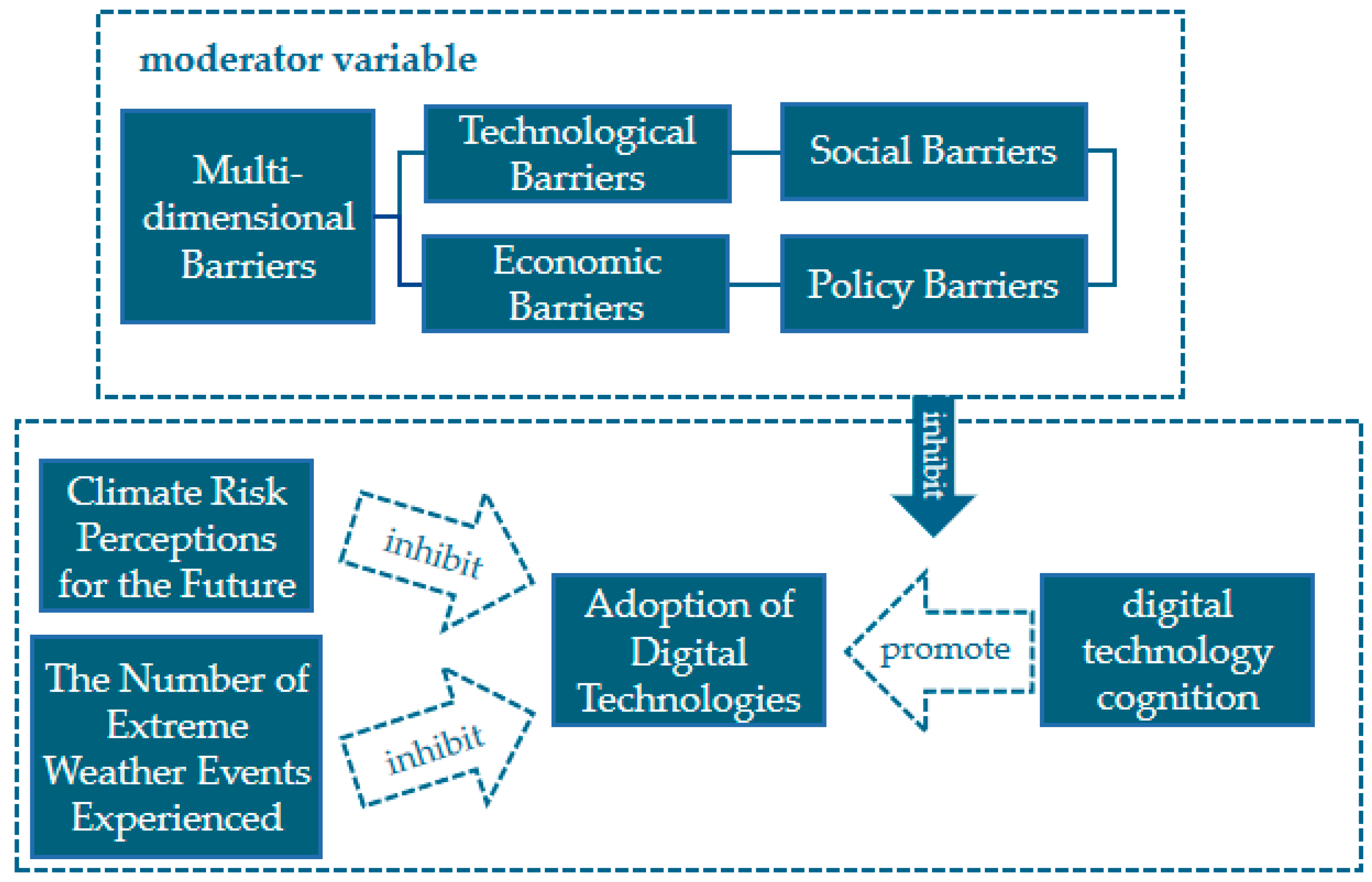
Based on the theoretical analysis presented above, this paper constructs an analytical framework, as shown in
Figure 1.
5. Conclusions
5.1. Policy Implications
Based on the above findings, the study offers the following policy implications:
First, attention should be paid to the pivotal role that digital technology cognition plays in driving the adoption of digital technologies by new agricultural operators, and tiered and categorized strategies for enhancing digital technology cognition should be implemented for different groups. The government must not only leverage platforms such as the agricultural technology extension system and digital rural service stations to establish a training system that integrates online and offline approaches, thereby expanding the reach of digital technology cognition; it must also provide basic hands-on training for small-scale and other entities with low risk resilience, while offering specialized, in-depth training for large-scale, highly organized entities. This will precisely enhance the digital technology cognition and application capabilities of different operator types, thereby stimulating their willingness to adopt digital technologies to address climate risks.
Second, recognizing the impact of multi-dimensional barriers, efforts must be made from multiple angles to comprehensively reduce adoption barriers, overcome these obstacles, and mitigate the negative effects of moderating variables. Efforts should be made to strengthen rural digital infrastructure, improve after-sales maintenance systems, and resolve technical barriers such as operational difficulties and network reliability. Concurrently, the application process for digital technology subsidies should be streamlined, and subsidy standards and coverage expanded to alleviate economic barriers. A digital technology exchange platform for new agricultural operators should be established to break the path dependence on traditional production experience and resolve social barriers. Additionally, specialized policies integrating climate risk and digital agriculture should be introduced, and a policy consultation and support mechanism should be established to eliminate policy barriers.
Third, given the significant heterogeneity across different groups in terms of digital technology cognition and climate risk perception—factors that influence the adoption of digital technologies—targeted measures are needed to address the specific adoption challenges faced by different groups. The government should strengthen climate risk protection for small-scale and other entities with low risk resilience, expand the coverage of climate index insurance, and provide small-scale subsidies and credit support to mitigate the conservative decision-making resulting from their risk aversion. It should encourage large-scale entities to establish digital agriculture demonstration bases to serve as models and lead the way, helping them transform their experiences with extreme weather into motivation for adoption. At the same time, the government should support farmers’ cooperatives and agricultural enterprises in pooling resources to build collective digital technology application platforms, leveraging the advantages of organization to reduce the costs and risks of adoption for individual entities.
Efforts should be made to mitigate the inhibitory effects of climate risk-related factors and stimulate adoption. A routine climate risk early warning and public education system should be established to disseminate climate trend forecasts and digital technology response plans through authoritative channels, helping new agricultural operators rationally assess risks. Successful cases of digital technology application following extreme weather events should be summarized and promoted to strengthen demonstration and leadership, guiding operators to transform risk experiences into motivation for adoption.
Moreover, supporting mechanisms should be improved to amplify scale and organizational effects. Encourage all entities to continuously improve their organizational governance structures and enhance their capabilities for risk diversification and risk perception transformation. Further refine the institutional mechanisms related to the transfer of farmland management rights and large-scale land management, promote the standardized operation of farmland transaction markets, help agricultural operators reduce transaction costs, and guide them to appropriately expand their operational scale through land transfers. This will fully unleash the catalytic effect of economies of scale on digital technology adoption and enhance the overall digital capabilities of new agricultural operators in addressing climate risks.
5.2. Discussion and Insights
Digital technology is a key pathway to promoting sustainable agricultural development, enhancing climate resilience, and achieving a green and low-carbon transition. Against the backdrop of climate risks, this study deepens and expands the theoretical understanding of digital technology adoption among new agricultural operators. It systematically integrates empirical findings into the theoretical frameworks of technology acceptance theory, behavioral decision-making theory, agricultural technology diffusion theory, and climate adaptation theory. This not only provides empirical insights into digital technology adoption but also represents a further extension of agricultural technology adoption theory in the context of climate risks. Existing research has largely focused on the influence of individual characteristics of new agricultural operators on the adoption of digital technologies, while relatively neglecting the roles of multiple factors—such as digital technology cognition, climate risk perception, and past experiences—and their underlying transmission mechanisms. Furthermore, there has been insufficient exploration of the differentiated response characteristics among different operator types. Based on survey data from 516 new agricultural operators in climate risk-prone regions such as Northeast China, Hunan, and Hebei, this study employs Logit models, propensity score matching, moderation effect tests, and heterogeneity analysis to investigate the impact and mechanisms through which digital technology cognition, climate risk perception, and experiences with extreme climate risks influence the adoption of digital technology by new agricultural operators. The following research conclusions were drawn:
First, there is significant directional heterogeneity in the effects of digital technology cognition, climate risk perception, and past climate experiences on the adoption of digital technologies by new agricultural operators. Digital technology cognition significantly and positively promotes the adoption of digital technologies, while climate risk perception and past experiences of extreme climate events both exert significant negative inhibitory effects, highlighting the role of core factors as key drivers. The significant positive impact of digital technology cognition on adoption behavior reinforces and extends the explanatory power of the Technology Acceptance Model (TAM). The TAM posits that an individual’s willingness to adopt technology depends primarily on perceived usefulness and perceived ease of use [
63,
64]. The empirical results of this study indicate that when new agricultural operators fully recognize the practical value and advantages of digital technology, their probability of adoption increases significantly. This conclusion is consistent with research on agricultural technology adoption, which posits that farmers’ behavior is essentially a rational decision based on expected benefits, feasibility, and resource constraints [
22,
23]. Therefore, this study further reinforces the theoretical proposition that “cognition is a prerequisite for adoption”; the negative effects of climate risk perception and experiences with extreme weather provide an important supplement and refinement to climate adaptation theory. Consequently, this study extends Prospect Theory [
72] and Threat Rigidity Theory to the field of digital agricultural technology adoption. Under sustained stress, individuals tend to adopt conservative strategies, are more sensitive to certain losses, and place lower weight on future gains; both perceived future climate risks and past experiences of extreme weather exert significant inhibitory effects.
Second, the perception of multidimensional barriers plays a significant negative moderating role between digital technology cognition and the adoption of digital technologies, thereby expanding the Theory of Planned Behavior (TPB) and the theory of agricultural innovation systems. As evidenced by the results of the moderation analysis, the combined perception of four types of barriers—technological, economic, social, and policy—significantly weakens the positive influence of digital technology cognition on adoption behavior. When new agricultural operators perceive high adoption barriers, the positive effect of digital technology cognition is significantly weakened, making it difficult to effectively translate this cognition into actual adoption behavior. Technology adoption depends on the institutional environment, service systems, and multi-stakeholder interactions [
54,
56,
57]. The perception of multidimensional barriers plays a crucial moderating role in determining whether digital technology cognition translates into adoption decisions.
Third, there is significant group heterogeneity in the effects of digital technology cognition, climate risk perception, and experiences with extreme weather on digital technology adoption. While digital technology cognition is a key driver of adoption behavior, its impact varies depending on the characteristics of the actors and their operational conditions. Climate risk factors primarily exert a inhibitory effect, which is more pronounced among actors with lower risk tolerance or lower levels of organization. This study extends research on the influence of resource endowments and organizational capabilities on adoption to the context of climate risk and digital transformation [
22,
24].
By validating the positive role of digital technology cognition in agricultural digital transformation under climate risk conditions, this study reinforces the applicability of Technology Acceptance Theory in the agricultural sector; supplements climate adaptation theory by demonstrating that climate risk perception and experiences of extreme weather may trigger conservative behavioral responses; and, by introducing the perception of multidimensional barriers as a moderating mechanism, revises and enriches the theory of agricultural technology diffusion, explaining why higher levels of digital technology cognition do not fully translate into actual adoption behavior. These theoretical contributions provide a more integrated analytical framework for understanding the digital technology adoption behavior of new agricultural operators under the goals of climate adaptation and sustainable agricultural development.
Combined with the empirical findings of this study, these results can provide theoretical support and practical guidance for new agricultural operators in making production decisions, managing climate risks, and undergoing digital transformation. The study clarifies the core driving value of digital technology cognition in agricultural digital transformation. It helps new agricultural operators objectively recognize the practical value of digital technologies in meteorological early warning, disaster prevention and control, and ensuring stable and secure production. It elucidates the intrinsic role of digital applications in mitigating climate shocks and enhancing production resilience, thereby providing directional guidance for optimizing their own production models. The study verifies the inhibitory effect of experiences with extreme weather and climate risk perception on digital adoption behavior. It objectively demonstrates that excessive risk aversion and negative disaster experiences can easily lead to rigid production decision-making. This helps new agricultural operators confront cognitive biases regarding climate risks, strike a reasonable balance between risk prevention and technological innovation, and reduce the developmental limitations caused by conservative business thinking. The conclusion regarding the negative moderating effect of multidimensional barrier perception clearly demonstrates that practical constraints—such as technical limitations, investment costs, reliance on traditional approaches, and insufficient policy alignment—can weaken the efficiency of translating awareness into actual action. This enables new agricultural operators to objectively assess the practical bottlenecks in digital transformation based on their own operational conditions and reasonably plan the pace of technological investment and implementation strategies. Based on the results of heterogeneity analysis across different business scales, key features, and degrees of organization, this approach can be tailored to the specific characteristics of various operator types, providing a reference for the differentiated selection of digital tools and the adoption of either streamlined or systematic digital agriculture models. The advantages in technology adoption offered by highly organized collaborative models also provide a practical basis for new agricultural operators to deepen cooperative ties, share digitalization costs through collective resources, and jointly build climate risk response systems, thereby continuously enhancing overall operational stability and climate resilience.
This paper contributes to the broader discussion on technology application and climate change adaptation in three key ways: First, it expands the research context by extending the adoption of digital technologies from conventional production settings to climate risk response scenarios, thereby strengthening research on the link between technology application and enhanced climate resilience and enriching the discussion on technical pathways for agricultural climate adaptation. Second, it deepens the explanation of underlying mechanisms by integrating risk perception, experiences with extreme weather, digital technology cognition, and external environmental factors. This reveals the adoption mechanisms under the interaction of multiple factors, addresses the shortcomings of single-perspective studies, and provides new evidence from a climate perspective for theories of technology diffusion. Third, it reinforces a practice-oriented approach by identifying the heterogeneous response patterns of new agricultural operators of different scales and types, proposing actionable policy combinations and incentive mechanisms, and offering Chinese experience and a reference framework for developing countries to leverage digital technologies to enhance agricultural climate resilience.
Although this paper reveals the roles of digital technology cognition, climate risk perception, and past experiences in the adoption of digital technologies by new agricultural operators, as well as the impact of perceived multidimensional barriers, it still has limitations. The research data captures only the behavioral characteristics of new agricultural operators at a specific point in time, failing to depict the dynamic evolution of how perceptions of digital technology, experiences with extreme climate risks, and climate risk perceptions influence digital technology adoption. Consequently, it is difficult to analyze the sustained impact of long-term climate risk changes and improvements in digital technology cognition on adoption behavior. To address these research limitations and in light of trends in agricultural digital technology development and climate risk management, future studies could employ panel data to conduct longitudinal research. This would allow for long-term monitoring of changes in how digital technology cognition, experiences with extreme climate risks, and climate risk perception influence the adoption behavior of new agricultural operators. Such research would analyze the dynamic evolution patterns and long-term impact mechanisms, thereby revealing the long-term interactive relationship between climate risks and digital technology adoption.