Article

Climate Change Action and Climate Geoengineering Under Neorealism

by
Filipe Duarte Santos
1 and
Yvette Ramos
2,*
1
cE3c-Centre for Ecology, Evolution and Environmental Changes, CHANGE-Global Change and Sustainability Institute, Department of Physics, Faculty of Sciences, University of Lisbon, 1749-016 Lisbon, Portugal
2
Institute of Social Sciences, University of Lisbon, Av. Professor Aníbal Bettencourt 9, 1600-189 Lisboa, Portugal
*
Author to whom correspondence should be addressed.
Sustainability 2026, 18(13), 6850; https://doi.org/10.3390/su18136850
Submission received: 14 May 2026 / Revised: 23 June 2026 / Accepted: 30 June 2026 / Published: 6 July 2026

Abstract

Climate change politics has been largely analyzed through the lenses of a liberal international order. This is the most favorable approach, because liberalism contains a powerful universalistic strand, defends the rights of people, and engages in multilateral negotiations and agreements, which are important to deal with a global issue that requires intra- and intergenerational solidarity. Yet despite robust scientific consensus and decades of international multilateral agreements under the United Nations, global greenhouse-gas atmospheric concentrations continue to increase, and high fossil-fuel dependence persists. One may say that without those negotiations, the situation would be worse, but humanity is increasingly distant from complying with the objective of the United Nations Framework Convention on climate change (UNFCCC). The present work addresses climate change politics under liberal and neorealist international orders and follows the Mearsheimer hypothesis of a transition from a unipolar liberal order to a bipolar neorealistic bounded orders dominated by the US and China. The effect of international orders on sustainability and, more specifically, on climate change politics is analyzed with a methodology based on three structural determinants: (1) the world evolution of climate change variables; (2) primary-energy sources and critical minerals, and (3) climate change responses—mitigation, adaptation and climate geoengineering. The distinct energy and climate policies of the US and China are discussed using these structural determinants. US climate change policy appears to be less driven by climate observation, science and the severity of harmful impacts of climate change than by the vested interests of the fossil-fuel industry. It is argued that solar radiation manipulation (SRM) is a technological fix involving negative side-effects, uncertainties, risks and geopolitical implications, while lacking an agreed international governance framework. Potential deployment is more likely under a neorealistic international order, although it adds further uncertainty and risks without solving the climate change challenge.

1. Introduction

Climate change is one of the defining challenges of the twenty-first century, with profound implications for sustainability, including, explicitly, its three components—social, economic and environmental [1]. Over the past three decades, global governance has expanded significantly, from the United Nations Framework Convention on Climate Change (UNFCCC), which entered into force in 1994, to the Paris Agreement and a growing ecosystem of climate institutions. These developments have largely been grounded in liberal institutionalist assumptions: that states, guided by shared vulnerability, scientific consensus and climate justice norms, would cooperate to reduce collectively greenhouse-gas emissions in time to prevent a dangerous interference with the climate system, as stated in Article 2 of the UNFCCC, and promoting climate adaptation.
However, empirical trends challenge this expectation. Global greenhouse-gas (GHG) emissions continue to increase, fossil fuels continue to dominate the energy mix, and decarbonization is progressing too slowly to meet agreed targets [2]. The persistent gap between governance ambition and outcomes calls for a reassessment of the theoretical frameworks used to analyze international climate politics. While existing approaches emphasize institutions, norms, and cooperation [3], they often underestimate the role of structural constraints. The difficulty in achieving meaningful progress on climate change mitigation has been mainly attributed to the lack of recognition of climate science and norms of climate justice in the design of the international climate change regime.
Liberal institutionalism can be traced back Woodrow Wilson, one of the promoters of idealism, who advocated international law, diplomacy, and collective security through institutions such as the League of Nations. Liberalism builds on this perspective, emphasizing democracy and economic interdependence as pathways to peace. Liberalism and, later, liberal institutionalism expanded this perspective by emphasizing democracy, economic interdependence, international organizations, and rules-based cooperation as pathways to peace and collective problem solving [4,5,6]. By contrast, realism and neorealism stress the enduring importance of power, security, and national interests in an anarchic international system [7,8,9].
Addressing and solving the climate change challenge is indispensable for achieving sustainability because climate change directly undermines the environmental, social, and economic foundations upon which sustainable development depends. Rising temperatures, changing precipitation patterns, sea-level rise, biodiversity loss, and increasing frequency of extreme weather events threaten food security, water availability, public health, economic development, and social stability [10]. Climate change action is critical to achieving most of the Sustainable Development Goals (SDGs) of the UN 2030 Agenda.
Climate change entered international-relations scholarship during the 1990s and became a central concern in the 2000s and 2010s through its implications for governance, security, diplomacy, and sustainable development. In the 2020s, it moved to the core of global politics because it constitutes a global problem that involves all countries, specifically because of its links to energy, economic competitiveness, migration, inequality, geopolitical rivalry, and international order [11,12]. The UNFCCC expectations that multilateral cooperation would substantially reduce global GGH emissions have only been partially fulfilled. Although many mitigation technologies are available and increasingly cost-competitive, progress has been constrained by political–economic structures, fossil-fuel dependence and lock-in, collective-action problems, and conflicting national interests [2,12] Consequently, a persistent gap remains between institutional ambitions and implementation, while inequalities in the vulnerability to climate change between the Global North and Global South increasingly need international climate cooperation.
In response, some scholars have turned to classical realism to address climate change [13,14,15], which, together with neorealism or structural realism, constitute the two main forms of realism. Symons [13] argues that classical realism can guide leaders in managing systemic climate risks while avoiding overly idealistic distributive demands. He advocates choosing the “lesser evil” among imperfect policy options, yet does not provide a concrete pathway to overcome the structural impasse of international climate politics. This limitation is evident in the persistent lack of cooperation between the two major emitters of GHGs—China and the United States—whose climate and energy policies remain divergent, up to 2026. Purdon [16] presented a neoclassical realist theory of climate change that opposes the idea that cooperation on climate change is compelled alone by shared norms and interests emanating at the international level. However, the question remains of how to effectively address the global climate change challenge under declining multilateralism, geopolitical and geoeconomic fragmentation, and entrenched conflicts. Purdon [16] offers a neoclassical realist critique of liberal institutionalism in climate politics. He argues that state leaders generally possess sufficient scientific knowledge of climate risks and are aware of the moral implications of inaction, but their decisions are constrained by political factors. Chief among these are “relative-gains concerns” associated with international resource transfers for mitigation, adaptation, and climate finance. These concerns make states cautious in negotiations, as they seek to preserve domestic resources and maintain their relative position within the international system [16,17].
While in classical realism Morgenthau [7] attributes conflict to human nature and allows a role for moral judgment, neorealism [8,18] locates the source of conflict in the structure of the international system itself and emphasizes that its anarchic nature compels states to prioritize survival, security, and relative gains. Instead of looking inward at the flaws of human nature, neorealism looks outward at the system’s architecture, to explain why countries act the way they do. Cooperation in neorealism remains possible but limited, as states are constrained by competition and strategic positioning, and the need to maintain relative gains.
This article presents a novel approach and a framework for international climate politics based on neorealism instead of classical realism. This work is based on the observation of a weakening of liberal multilateralism and the advancement of neorealism in current international relations. It explores the consequences of this transition in international climate change politics. The methodology used involves the recognition that international climate politics is dominated by three structural determinants that will be presented and analytically discussed. The research question is how near- and long-term global climate action will unfold in an international environment increasingly characterized by neorealism. The present work presents a new framework to address the climate change challenge in the context of a rapid transformation of the world order, fast technological, social and economic changes, systemic crises, and entrenched conflicts.

2. Methodology—The Structural Determinants of Climate Change Action and Climate Geoengineering in International Climate Politics

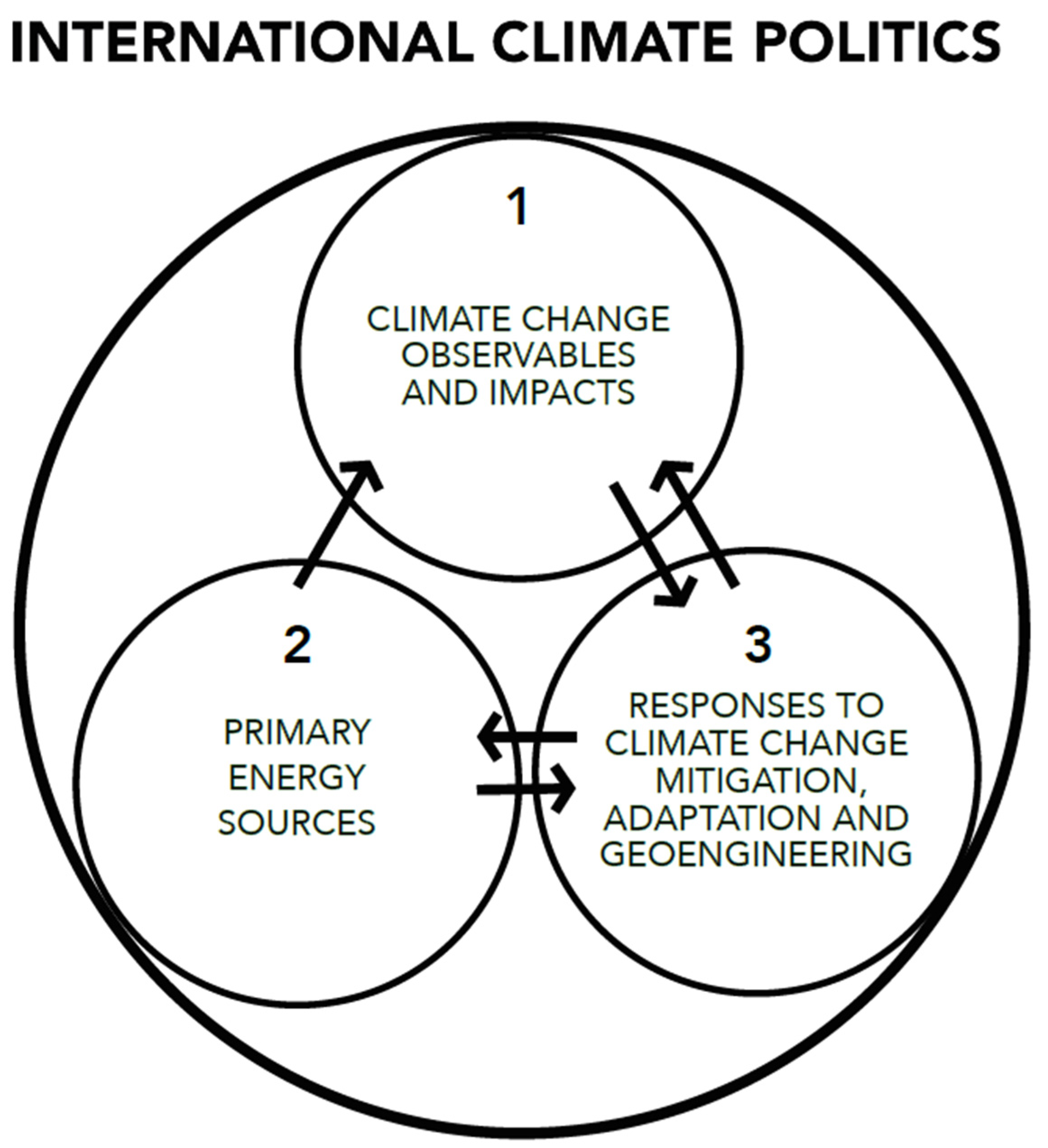
In neorealism, the structure of the international system is the primary driver of state behavior. We argue that there is an analogy with international climate politics, where there are structural core determinants shaping state behavior in climate change mitigation, adaptation and climate geoengineering, here called structural determinants. Three structural determinants are identified: (1) the world evolution of climate change variables (climate change observables, GHG emissions and atmospheric concentrations, and climate change impacts); (2) primary-energy sources (fossil fuels, renewables, nuclear and associated critical minerals); and (3) climate change responses (mitigation, adaptation and geoengineering). These determinants do not merely signal trends, but constitute the physical, social, political, economic and environmental foundations and drivers of national and international climate politics. This tripartite structure provides the methodological and analytical backbone of the paper and allows a systemic contemporaneous interpretation of global climate change action, climate geoengineering and international climate politics. An analysis and discussion of these three structural determinants and their interactions, represented schematically in Figure 1, is presented here.

2.1. Climate Change Observations and Impacts

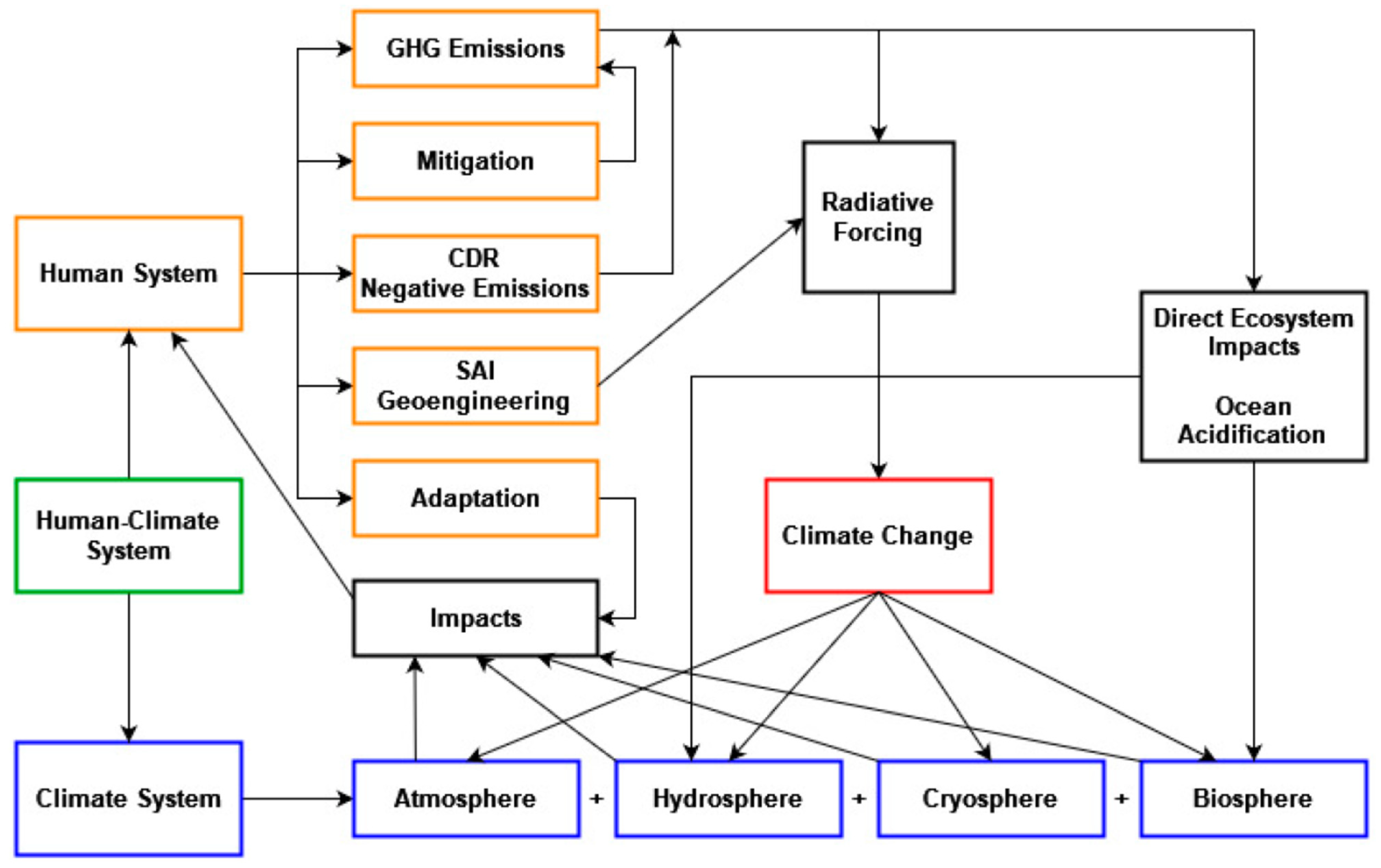
This determinant is, essentially, the scientific evidence for anthropogenic climate change [19]. Climate science relies on a global observing system that continuously measures key variables in the climate system represented schematically in Figure 2, through a combination of ground-based stations, weather balloons, ocean buoys, research vessels, aircraft, glaciers and ice-sheet monitoring networks, and Earth-observing satellites. The resulting long-term datasets are essential to detect climate change, understand its causes, validate climate models, and monitor extreme events, through the measurement of GHG concentrations, global mean surface temperature (GMST), Earth’s energy imbalance (EEI), global mean sea level (GMSL), ocean heat content, ice cover, precipitation, and other observables of the climate system.
From this vast amount of data, we select two indicators that the authors believe are critical for the present work—EEI and GMST. The former is usually accessible only in specialized literature, although it is arguably the most fundamental indicator of anthropogenic climate change. EEI is the difference between the energy entering the Earth system from the Sun and the energy leaving the Earth system to outer space, measured at the top of the atmosphere (TOA), the upper boundary of the Earth’s atmosphere where exchanges of radiant energy between the Earth system and space are measured. Two mechanisms contribute to the observed increase in EEI: the increase in the intensity of the greenhouse effect caused by rising global anthropogenic GHG emissions, which is the principal cause, and a decrease in the Earth’s albedo. Climate change can only be resolved when the Earth’s energy balance is in equilibrium and when, therefore, EEI is close to zero.
EEI has increased significantly, signaling an accelerating accumulation of heat in the climate system [20,21,22]. Observations indicate that EEI is increasing faster than projected by IPCC models based solely on anthropogenic GHG emissions [21], reaching 1.8 Wm−2 in 2023 and more than doubling over two decades. This result shows that the Eart’s albedo is decreasing, amplifying the effect of GHG emissions. One likely factor is the reduction in anthropogenic aerosol emissions resulting from stricter air-quality regulations. Aerosols offset a significant portion of GHG-induced warming [23]. Hodnebrog et al. [24] estimate that aerosol reductions contributed approximately 0.2 ± 0.1 Wm−2 per decade to the EEI trend between 2001 and 2019, although models still underestimate the observed imbalance (0.47 ± 0.17 Wm−2 per decade). Continued reductions in aerosols, as projected under air-quality policies, are therefore expected to accelerate global warming. A complementary factor may be the observed decline in planetary albedo, driven largely by reduced low-cloud cover in northern mid-latitudes and tropical regions [25]. Because low clouds reflect more solar radiation than the cloud-free ocean, their reduction increases energy absorption and contributes to rising EEI. Although the mechanisms remain uncertain, this trend may indicate a natural positive feedback loop, whereby ocean warming reduces cloud cover, further amplifying anthropogenic warming.
The increase in EEI means that the Earth system continues to accumulate heat, with 381 ± 61 ZJ accumulated from 1971 to 2020. Most of this heat, about 89%, is stored in the ocean, followed by about 6% on land, 1% in the atmosphere, and about 4% available for melting the cryosphere [26]. The accumulated heat in the atmosphere increases the GMST. According to the World Meteorological Organization, the consolidated three-year average 2023–2025 global mean surface temperature is 1.48 ± 0.13 °C above the pre-industrial era [27,28,29]. Approximately two-thirds of total warming has occurred since 1975, at a rate of 0.15–0.2 °C per decade [30,31]. These developments are reshaping geopolitical dynamics through the growing frequency, intensity, and economic impacts of extreme weather events, including heatwaves, droughts, floods, tropical cyclones, and extratropical storms. Such impacts of climate change influence resource competition, inequities, and global stability, especially in the most vulnerable countries [32].

2.2. Primary Energies Sources

The analysis concentrates on greenhouse-gas (GHG) emissions arising from fossil-fuel combustion and industrial processes, because they account for approximately 72% of total anthropogenic GHG emissions. Agriculture, forestry, and other land-use activities (AFOLU) account for most of the remainder. Although all major sources of emissions must ultimately be addressed, it is impossible to effectively address climate change without substantially reducing the use of fossil fuels.
Energy security plays an increasingly critical role in global development. Global final energy consumption has increased almost continuously since the beginning of the industrial era, with only temporary slowdowns or declines during major disruptions such as the two World Wars, the Great Depression, the oil crises of the 1970s, the global financial crisis of 2008–2009, and the COVID-19 pandemic. Between 2000 and 2025, global final energy consumption grew at an average annual rate of approximately 2%, driven by population growth, economic development, urbanization, industrialization, rising living standards, and, increasingly, the rapid expansion of digital infrastructure [33]. According to the International Energy Agency [34], global data-center electricity demand by data centers is likely to double from about 415–485 TWh in 2024–2025 to around 945–950 TWh by 2030, growing at roughly 15% per year, largely due to AI-related workloads.
There is a very well-known and strong relation between energy and climate change. Since the 1970s, about 80% of global primary-energy consumption has been provided by fossil fuels, including the period 2000–2025. The share of renewable energy (hydro plus other renewables) has been increasing fast, reaching 14.6% in 2023. Although a large growth rate, it is insufficient to initiate an energy transition from fossils to low-carbon primary energies, especially renewables, which would reduce the total share of fossil use. Thus, up to now, we are witnessing at the global level an energy addition, instead of an energy transition, to support the fast-increasing world demand for energy. At the regional level, there are examples of an energy transition. The fossil-fuel share of gross available energy in the countries that now constitute the EU (European Union)—27—declined from approximately 84% in 1990 to about 68% in 2025, reflecting substantial growth in renewable energy, improvements in energy efficiency, and the gradual phase-out of coal [35,36]. Still, fossil fuels continue to provide more than two-thirds of the EU’s total energy needs, highlighting both the significant progress achieved and the scale of the remaining decarbonization challenge.
Energy transitions are a critical objective of climate change mitigation, although they are not the main topic of the present work. Historical analyses of socio-technical transitions show that major energy transitions—such as the shift from biomass to coal during the Industrial Revolution and from coal to oil and natural gas during the 20th century—typically unfolded over many decades, and were driven by the co-evolution of technologies, infrastructures, institutions, markets, economic growth and social practices [37,38,39]. Transitions toward sustainable energy systems require the co-evolution of technologies (including greater energy-efficient technology use), institutions, business models, user practices, and ecological constraints [40,41]. Accelerating decarbonization therefore depends not only on technological progress, but also on transforming the social and institutional conditions that shape energy production and consumption.
In this context, the work of Garrett et al. [42] is particularly relevant. He has shown that there is a persistent relationship between global energy consumption and cumulative economic production and that global demand is largely determined by that cumulative production, rather than by short-term policies and technological change. Eventually, global GHG emissions will decline, but to achieve that goal the cuts must be deep and sustained to overcome the growth in GHG atmospheric concentrations resulting from the cumulative economic production.
The present situation implies that fossil fuels are likely to continue sustaining a large percentage of global energy demand and the countries endowed with reserves will continue to benefit from exploiting them. Fossil-fuel energy producers perceive decarbonization as a source of instability, potentially generating lower demand and losses in relative-gains [43]. Currently the four countries that are the largest producers of oil, natural gas, and coal are the US, Saudi Arabia, Russia and Canada; the US, Russia, Iran and China; and China, India, Indonesia and US, respectively [33,44,45]. The countries that collectively hold the largest fossil-fuel reserves—Russia, the United States, Saudi Arabia, Iran, Canada, China, Australia, Venezuela, Qatar, and Iraq—also play a disproportionate role in shaping global climate and energy policy, because a large fraction of future potential greenhouse-gas emissions remains embedded in their fossil-fuel resources. The uneven geographical distribution of fossil-fuel resources creates structural asymmetries in the international system that shapes national interests, economic development strategies, and geopolitical interests and power, thereby complicating global action aimed at reducing fossil-fuel dependence, and eventually phasing out their production and use.
Renewable energy is currently the fastest-growing source of electricity in the world. In 2024, renewables supplied about one-third of global electricity generation, while renewables and nuclear together provided approximately 40% of global electricity generation. Renewable electricity generation is expected to continue growing rapidly, with global renewable capacity projected to increase by nearly 4600 GW between 2025 and 2030, roughly double the expansion achieved during the previous five years. Hydropower still provides almost half of all renewable electricity worldwide, but solar and wind together already account for nearly half of renewable generation, and are responsible for most of the current growth and increased investment in renewable energy and energy efficiency, particularly in developed economies [46,47]. Electrification of the economy is also advancing, especially in China, the European Union, and the United States. China’s electricity share of final energy consumption has increased from 6% in 1990 to 27% in 2023, positioning it as a potential leading “electrostate” [47], while electrification in the EU and US has stabilized at around 22%, in recent years.
In addition to energy security, states must ensure access to critical minerals that are essential for defense, digital technologies, and renewable energy systems. Critical minerals, such as lithium, cobalt, nickel, graphite, copper, and rare-earth elements are essential for batteries, electricity grids, electric vehicles, wind turbines and other renewable energy systems. Unlike fossil fuels, critical minerals are more geographically dispersed, and can often be recycled. The geopolitical influence and power of countries possessing large reserves of critical minerals depends mostly on control of refining, processing, manufacturing, and technological supply chains. Currently China dominates not only critical mineral production, but also refining, processing, renewable energy-systems manufacturing, and rare-earth supply chains.
As regards nuclear-fission primary-energy sources, the recent development of small modular nuclear reactors (SMRs) could help support the transition to a low-carbon economy across the world. Global operational SMR capacity in 2026 is approximately 270 MWe, and is located mostly in China (MWe HTR-PM reactor) and Russia (Akademik Lomonosov floating nuclear plant) [48] Global SMR capacity is forecast to increase roughly fivefold from 2025 to 2030. Most scientific assessments conclude that nuclear fusion reactors are very unlikely to play a major role in the decarbonization of the world economy by 2050, since large-scale commercial deployment is generally expected no earlier than the 2050s.

2.3. Climate Change Responses—Mitigation, Adaptation and Geoengineering

-
Mitigation and Adaptation
The three types of actual or potential responses to the climate change challenge are governed and carried out at national and regional level. They constitute the backbone of climate action and climate geoengineering at the global level, and they are deeply linked with international climate politics in view of the global physical nature of the climate challenge.
Adaptation and mitigation actions at the national and regional level have been regularly described and discussed in the IPCC reports, so there is no need to address them further. It suffices to emphasize that there are very significant differences in historical responsibility for anthropogenic GHG emissions, in vulnerabilities to climate change impacts and in financial, economic, technological and institutional capacities for mitigation and adaptation, between the industrialized high-income countries of the Global North and the many low- and middle-income countries of the Global South. These questions are addressed in the principle of Common but Differentiated Responsibilities and Respective Capabilities (CBDR-RC) that constitutes Principle 7 of the United Nations (UN) 1992 Rio Declaration on Environment and Development, and which was codified in the UNFCCC. Failing to put into practice this principle aggravates the climate change inequities and does not contribute to climate justice across the world. A few examples may illustrate the current situation.
Faced with rising destructive impacts of climate change, adaptation becomes an urgent response, particularly in the countries that are more vulnerable. The industrialized high-income countries of the Global North finally accepted, at COP27 in Egypt in 2022, the constitution of a Loss and Damage fund for adaptation, a concept initially proposed by the Association of Small Island States (AOSIS), which was first mentioned at COP13 in Bali in 2007 and aroused strong opposition from those countries. Most Global South countries need support for adaptation and cannot make the energy transition to low-carbon primary-energy sources without technological support and public and private funding from industrialized countries and from Multilateral Development Banks. They need support because their priority is to implement the socioeconomic development agenda that fulfils their legitimate ambition to achieve a better level of well-being and economic prosperity.
The effect of sanctions, which are currently the most common geopolitical intervention used to accomplish diversified geopolitical aims, such as preventing and ending wars and bringing an end to armed conflict, human rights violations, and democratic regression, is also mentioned as a last example. Unilateral international sanctions resulting from policy interventions caused around 560,000 annual deaths in 152 countries between 1971 and 2021, mostly of them associated with humanitarian crises [49]. Sanctions imposed by the current international political system have substantial human-development consequences that undermine climate change resilience in many countries.
On the other hand, climate finance can effectively support both mitigation and adaptation when combined with strong institutions, local ownership, international cooperation, and long-term investment frameworks. Successful examples include Morocco’s Noor solar complex, Indonesia’s REDD+ forest-conservation program, Bangladesh’s climate-resilience investment, Kenya’s locally led adaptation funds, and coastal protection projects in Egypt’s Nile Delta.
-
Two Types of Climate Geoengineering
Climate geoengineering differs from the two main forms of climate action: mitigation and adaptation. There are fundamentally two types of climate geoengineering with the objective of countervailing some of the impacts of global climate change. One is carbon dioxide (CO2) removal (CDR). There are many forms of CDR, some through the enhancement of natural CO2 sinks, others from engineered technologies for removing CO2 from the atmosphere or the ocean [50]. In the case of the atmosphere, CO2 can be removed from point sources of CO2, such as flue gases from biomass power stations, or directly from the atmosphere using negative emission technologies (NETs). CDR is already being developed and applied, and is essential for completing a transition to a decarbonized world economy [51]. The essential point about CO2 is that, once emitted, it is only very slowly removed from the atmosphere by natural processes. CDR is a technology that helps reduce the currently very high values of CO2 atmospheric concentration, which is the main cause of anthropogenic climate change. Large-scale deployment of engineered systems of CDR remains constrained by high costs and technological constraints. Most current carbon capture and storage (CCS) projects are deployed in the fossil-fuel industry or in energy-intensive industrial sectors, and are intended primarily to reduce emissions from ongoing fossil-fuel use and industrial production. While such projects may lower net CO2 emissions compared to conventional operations, they do not remove CO2 already accumulated in the atmosphere and, therefore, do not qualify as CDR.
The other form is solar radiation modification (SRM), which is a last-ditch controversial response involving considerable uncertainties and risks. It consists in purposely modifying the Earth’s radiative energy balance through the increase of the Earth’s albedo to reduce the excessively positive radiative forcing caused by the anthropogenic GHG emissions, thereby reducing the GMST [52,53,54,55]. There are two prominent forms of SRM. The first is stratospheric aerosol injection (SAI), consisting of launching sulfate aerosols into the stratosphere to reflect an additional small part of the incoming solar radiation. The second is marine cloud brightening (MCB) [56], which consists of spraying SO2 or salt crystals to seed low-lying marine clouds with sub-micrometer particles to enhance the concentration of cloud droplets, thereby increasing the cloud albedo over the ocean. There are many forms of climate geoengineering besides SAI and CMB. A listing and discussion can be found in Ramos and Santos [50].
-
SRM Geoengineering. Side Effects, Uncertainties, Risks and Costs
SAI geoengineering simulates the effect of large volcanic eruptions that emit huge amounts of ash, dust and sulfate aerosols into the stratosphere, thereby increasing the Earth’s albedo. These large eruptions, like the one of Mount Pinatubo volcano in 1991, are known to effectively lower GMST for about 15 months [57,58]. However, they also produce negative side effects. Increasing the albedo slows down the global water cycle, leading to reduced global precipitation and river runoff [59,60], leading to changes in the global precipitation patters and increasing the frequency of droughts. This well-established empirical knowledge is reproduced by climate models, and indicates that the deployment of SAI would have the negative side-effects of lowering global precipitation and runoff.
Advocates of SRM research and field experiments agree that SRM must not be a substitute for mitigation, which should be the priority to address climate change. The reasons that are more frequently invoked for the increasing private and public investment in SRM research is the climate emergency argument, in which interventions are considered less damaging than allowing unabated warming [61], and the knowledge argument, claiming that decisions about SRM cannot be made responsibly without scientific knowledge. A third kind of argument—the unilateral deployment—is that SRM research is necessary because SRM technologies being relatively inexpensive, a single state, a coalition of states or non-state actors could attempt unilateral deployment, with potential implications for other states [62,63,64]. This last argument has a geopolitical nature, and is therefore closely related to the dynamics of the international relations system.
While SRM research remains relatively low-cost, full-scale deployment of SAI or MCB would require substantial global investment. Nevertheless, in comparison to the costs of global mitigation required to comply with the Paris Agreement, SRM strategies are frequently characterized as “low-cost, high-risk” interventions.
Several proposals for delivering aerosols to the stratosphere have been assessed. Among the most widely discussed is the use of high-altitude aircraft; studies of these have found them to be technically feasible with limited innovation, leveraging existing aerospace technologies [65,66,67]. These aircraft would operate at altitudes of 20 km or higher to deliver SO2 or other aerosols directly into the stratosphere. In line with the highest current estimates for a very large-scale deployment, it is assumed that such a program would require an initial capital outlay of approximately $50 billion for aircraft development and infrastructure, along with annual operating costs of $12.5 billion for continued deployment [65].
MCB, which involves dispersing fine sea salt particles into marine clouds to increase their albedo, is less mature technologically, but likely to be similarly low-cost. Preliminary assessments 2015 [68] suggest a global-scale program might cost a few billion dollars annually, although this depends heavily on the chosen delivery mechanisms—such as ships, drones, or autonomous spray platforms—and their fuel and material requirements.
For context, the estimated annual global cost of mitigation required to stay below 1.5 °C ranges between an annual cost of $3 to $4 trillion through 2030, increasing to over $6 trillion by 2040 [69,70]. This stark contrast underscores why SRM is often promoted as a cost-effective backup measure. However, its relatively low price tag belies significant technical, environmental, social, political, and ethical risks that require long-term international governance.
Although SRM may be capable of reducing the GMST, substantial uncertainties remain regarding its regional climatic effects and its impacts on precipitation patterns, monsoon systems, and ecosystem responses [67]. There are no rigorous modelling assessment of different SRM deployment scenarios and no reliable assessment of impacts on regional weather and climate variability. A major concern with SRM is the potential for a termination shock—a rapid rise in GMST if geoengineering deployment is suddenly halted. Beyond these technical concerns, SRM raises profound questions regarding legitimacy, accountability, justice, and democratic participation. Decisions about research, testing, deployment, and governance could affect populations worldwide, including future generations, yet there is no consensus on who should make such decisions or according to what principles. Concerns have also been raised about unequal distributions of risks and benefits, the possibility of exacerbating geopolitical tensions, and the moral hazard that the prospect of future SRM deployment could weaken incentives for mitigation and adaptation.
A clear illustration of these concerns is provided by a proposal advocating a global international non-use agreement on SRM geoengineering, which would prohibit its development and deployment [71]. The central argument is that “SRM geoengineering at planetary scale is not governable in a globally inclusive and just manner within the current international political system.” This position reflects broader concerns regarding the ability of existing institutions to ensure equitable participation, transparency, accountability, and compensation for potential harms. The scientific and policy literature on SRM governance has expanded enormously over the past two decades, generating numerous proposals for research oversight, international cooperation, and governance frameworks. Despite increasing investment and growing scientific interest, no dedicated international treaty or widely accepted governance regime currently regulates SRM research, field experimentation, or potential future deployment at the global level [53,72,73,74,75]. Consequently, the future of SRM is likely to depend not only on scientific and technological developments, but also on society’s ability to address the associated ethical, political, legal, and governance challenges.
In conclusion, SRM geoengineering is a dangerous technological fix for sustainability [75]. Its deployment would add new uncertainties and risks to those of climate change. By far the best option is to increase the global effort to mitigate climate change. The growing involvement of commercial actors introduces additional governance and ethical challenges. This is illustrated by the £60 million geoengineering program funded by the UK’s ARIA agency, whose emphasis is on technological innovation and whose portfolio includes several projects developed in collaboration with private companies [76]. Even more significant is the emergence of venture-capital-backed startups seeking to commercialize SRM technologies. The Israeli–US company Stardust (Ness Ziona, Israel) has reportedly raised more than US$60 million in private investment, and appears to operate on the assumption that SRM technologies could be deployed in the relatively near future. Such developments raise concerns about the increasing influence of commercial incentives on technologies with potentially global climatic consequences before adequate international governance frameworks have been established [77].
Finally, we recall the interactions between the structural determinants of climate change action and climate geoengineering in international climate politics, schematically shown in Figure 2. The second determinant is the main cause of the first, because GHG emissions arising from fossil-fuel combustion and industrial processes account for approximately 72% of total anthropogenic GHG emissions and, since the1970s, about 80% of global primary-energy consumption has been provided by fossil fuels. The third determinant interacts with the first determinant because it constitutes the human response to climate change. In addition, the third determinant interacts with the second because it constitutes the main cause of climate change.

3. The Influence of a Neorealist International Order on Climate Change Politics, Climate Change Action and Climate SRM Geoengineering

3.1. The Transition from a Unipolar Liberal Order to a Bipolar Neorealist Order

To discuss climate change under different international orders, we adopt the approach of John Mearsheimer [78] briefly described here. Order is defined as “an organized group of international institutions that help govern the interactions among the member states” [78]. The type of order that emerges during a certain time depends mostly on the global distribution of power, because the world is deeply and increasingly interconnected in many ways, particularly through the economy, financial systems, technology and natural resources. The great powers can organize liberal, agnostic or neorealist kinds of international orders and the international system can be unipolar, bipolar or multipolar. International orders are a perennial feature of contemporary international politics. They include all the world’s great powers and, ideally, all states. International bounded orders contain just a set of institutions that have limited state membership. According to Mearsheimer [78], only realist international orders are accompanied by bounded orders that are necessary to marshal the power required to contend for security and power competition between them. If the system is unipolar, the political ideology of the dominant power tends to determine the nature of the international order. Unipolar systems in which the dominant power is a liberal democracy embracing liberalism strive to establish a liberal international order. In bipolar systems, the diffusion of the political ideology of the two main powers becomes secondary because their priority is to engage in security competition between each other, making sure that the balance of power does not shift against one of them. Bipolar and multipolar systems adopt neorealism because the great powers need to follow neorealistic principles to engage successfully in security and power competition with each other or other great powers [78]. Ideological aspects become subservient to security objectives.
The global distribution of power in the Cold War from 1945 to 1989 was bipolar dominated by the US, a liberal democracy and the Soviet Union, a communist autocracy. They were also two bounded orders, one largely confined to the West and dominated by the United States, the other consisting mainly of the world’s communist countries and dominated by the Soviet Union. When the Soviet Union collapsed in 1989 and the Cold War ended, the US became a unipolar major power that attempted to transform the realist Western bounded order of the Cold War into a liberal international order by vigorously spreading liberal democracy, norms, institutions and economic integration across the globe [79]. This golden period of liberalism prevailed in the 1990–2004 period [78]. There are many interrelated reasons for its decline: the rise in nationalism, the successive wars in the Middle East (Iraq, Afghanistan, and Syria), the economic damage caused by the 2007–08 global financial crisis, the Eurozone crisis of 2009, the globalization that produced significant economic costs for many people in liberal democracies, the growth of xenophobic right-wing political parties in the West, Brexit, the declining trend in the number of democracies, reversing the Cold War trend that seemed unstoppable, and the loss of trust in the elites that manage the liberal international order. Assuming China’s economy continues to rise, the security competition with the United States will be the central feature of international politics during the 21st century, leading to the consolidation of neorealistic bounded orders dominated by China and the United States [78]. High levels of cooperation within the two bounded orders of countries are essential for security competition with the opposing great power. On the other hand, the economic, financial and technological interdependence between the two great powers remains strong. Both great powers are likely to be deeply involved in managing the unavoidable cooperative aspects of the global economy.
The transition from a unipolar liberal international order to a bipolar neorealistic bounded order is seriously detrimental to achieving sustainability because sustainability challenges such as climate change, biodiversity loss, ocean degradation, and natural resource depletion are global collective-action problems that require long-term cooperation, trust, and effective multilateral institutions.
The interaction between international relations theories and national politics in both democracies and autocracies should be clarified. Although international relations theories are not political ideologies, national ideological political orientations often influence how states pursue their interests in the international system. Nationalism, national conservatism, sovereigntist, and forms of political exceptionalism tend to support policies consistent with realist and neorealist assumptions, emphasizing sovereignty, national interests, strategic autonomy, security, and power politics. By contrast, social democracy, democratic socialism, liberal internationalism, and Green political movements generally place greater emphasis on international cooperation, multilateralism, international institutions, international law, and collective responses to global challenges. Consequently, electoral shifts in democratic countries can produce substantial changes in foreign policy, including attitudes toward climate change action. In autocratic systems, foreign-policy orientations often display greater continuity because leadership change is less frequent and political competition is more limited, although significant policy shifts can occur.

3.2. Effects of the Transition from a Liberal to a Neorealistic Order on Climate Change Action, Climate SRM Geoengineering and Climate Change Politics

Currently, the US and China have quite distinct climate policies, although they are both confronted with a very rapid energy demand, mainly because of digitalization, AI, and expanding data-center infrastructure. China still relies heavily on coal, and is the world’s largest emitter of GHGs. On the other hand, it has the world’s largest installed renewable electricity capacity and renewable-energy market, accounting for around 40% of global renewable-capacity expansion. It acknowledges anthropogenic climate change and has adopted mitigation objectives of peaking GHG emissions before 2030 and achieving carbon neutrality before 2060. The US is the world’s second largest emitter of GHGs, and its current government devalues or ignores climate change. It notified the UN of its withdrawal from the UNFCCC on 27 February 2026 (after two withdrawal cycles from the Paris agreement), which, according to Article 25 of the Convention, takes effect one year later. From that time on, only the US and three other countries that have not ratified the Paris agreement will have no mitigation objectives adopted under a multilateral international agreement.
The US administration’s hostility and rejection of climate science led to major cuts in the funding of climate change research and data collection at NASA and NOAA [80]. The discontinuation of NOAA’s Disasters Database, a resource used by researchers, emergency planners, and policymakers used to register highly damaging and dangerous weather events since 1980, has significant negative consequences for human safety and health [81]. These new developments are in line with the long-standing effort of the fossil-fuel industry to fund scientific uncertainty and weaken regulatory ambition, obstruct climate policy, and delay mitigation measures [82,83,84], showing the large political power of that industry. US climate change policy appears to be less driven by the severity of the harmful impacts resulting from unabated GHG emissions than by the vested interests of the fossil-fuel industry. In the framework developed in this work, the US government devalues the first structural determinant and objects to the impacts of climate change being addressed through the second structural determinant. Selective anti-science movements are not restricted to climate science. A Nature editorial [85] called on scientific leaders and influential scientific organizations to speak out about anti-science agendas and threats to academic freedom.
Historically, the US has always used its influence and power in international climate change negotiations and fossil-fuel use. Under the current US government, the tone and tenor of intervention represent a significant escalation, relative to previous governments. An example is provided by the opposition and derailment of the International Maritime Organization Net-Zero Framework, aiming to regulate and eventually eliminate GHG emissions from international shipping. In official-position papers and diplomatic cables in 2025 and 2026, the U.S. has stated that it will not tolerate any economic element, including carbon taxes, fuel penalties, levies, or a multilateral fund administered by the UN.
The UN system and, in particular, the UNFCCC, will continue to play a critical role in the three structural core determinants, but its capacity to promote an acceleration of global climate action is very limited. Faced with the ineffectiveness of the UNFCCC-COP process, caused by the consensus-based nature of decision-making, the absence of meaningful enforcement mechanisms, and the growing influence of fossil-fuel industry interests within that process, 57 countries decided to meet in Santa Marta, Colombia, from 24 to 29 April 2026 for the first Conference on the Transition Beyond Fossil Fuels. Unlike other climate clubs [86,87], which emphasize carbon pricing, trade measures, and incentives against free-riding, Santa Marta focuses directly on the practical implementation of a fossil-fuel phase-out and on Global North–Global South scientific and technical cooperation. As expected, the conference did not lead to a negotiated decision or binding commitments. Nevertheless, participants discussed practical proposals aimed at progressively replacing fossil fuels by decarbonized energy sources, such as ending subsidies for fossil fuels; accelerating electrification of the economy; strengthening carbon-pricing mechanisms; increasing energy efficiency and sufficiency; and the taxation of fossil-fuel industry profits. From the point of view of the authors, the Santa Marta initiative is a welcome and encouraging development that shows the vitality and the potential impact of North–South focused climate initiatives that transcend the shortcomings of the current bipolar neorealistic international order.
Finally, we address SRM geoengineering under the present geopolitical transitional environment. Deploying SRM on a planetary scale presents states with a novel source of geopolitical influence through a relatively rapid intervention on the global climate. Although SRM geoengineering, particularly SAI and MCB, remains at the research stage, its mere plausibility has already entered the realm of security policy. In recent years, SRM has shifted from a much-discussed academic idea to being a subject of state-level attention, intelligence assessments, and international relations, as well as a security issue [88,89,90,91]. This shift has the potential for SRM to interfere with geopolitical stability long before any actual deployment. The absence of agreed governance and regulation over research transparency, field trials, and potential deployment thresholds raises the risk that the first significant SRM activity will occur amid crisis conditions, amplifying misinterpretation and the possibility of escalation.
On the other hand, anthropogenic climate change by itself is considered by some scholars to be a threat to peace and international security, by linking it to factors like more intense extreme weather events, such as heatwaves, droughts and floods, resource scarcity, migration, and destabilization in vulnerable regions [92,93,94,95]. SRM deployment without a globally agreed governance framework would add a new layer of risk to peace and international security.
One of the main reasons why SRM is potentially a security problem is attribution uncertainty. Extreme weather-event attribution is a relatively recent field of climate change science that quantifies the extent to which anthropogenic climate change influences specific extreme weather events, using weather observations and climate models. It would be difficult to estimate the relative probabilities linking anthropogenic climate change and SRM geoengineering to the intensity and likelihood of specific extreme weather events or changes in regional precipitation regimes. This difficulty creates an attribution gap that may fuel accusations of intentional harm. This international dynamic mirrors historical disputes over water diversion projects and weather modification, but on a planetary scale.
The security risks of SRM arise from its strategic characteristics: low-cost relative to scale, global effects, dual-purpose nature, uncertainties about its impacts and attribution, and lack of agreed governance frameworks. Designed for the purpose of countervailing some aspects of anthropogenic climate change, it could also be repurposed, intentionally, for harmful strategic uses of climate intervention. One possibility is counter-deployment of SRM geoengineering to neutralize, offset, or undermine the climate effects of another actor’s SRM activities. Even without overt weaponization, controlling SRM capabilities could become a bargaining chip in climate politics, or, more generally, in international politics.
SRM involves significant undesirable side-effects, uncertainties and risks, but would allow the continuation of fossil-fuel exploitation on a large scale, which would satisfy the geostrategic interests of countries whose economies and power depend on their large fossil-fuel production and reserves. It is therefore conceivable that in an increasingly bipolar neorealistic international order, SRM becomes more likely to be deployed than in a liberal international order.

4. Conclusions

The present work presents a discussion of the consequences for international climate change politics of the possible transition from a unipolar liberal order to a bipolar bounded neorealistic order centered on the US and China, using the analytical framework of Mearsheimer [78]. The methodology used in the analytical discussion is based on the identification of three structural determinants for climate change politics: (1) climate change observables and impacts, (2) primary-energy sources, and (3) responses to climate change—mitigation, adaptation and climate geoengineering. It is shown that the transitional state from a liberal to a neorealist international order is devaluing the prominence of global climate change mitigation and adaptation relative to more short-term and pressing challenges associated with that possible transition. These include systemic food insecurity, entrenched armed conflicts, geoeconomic fragmentation, economic stagnation in some world regions, and social and security risks from the hypercompetitive development of disruptive digital technologies, in particular regenerative AI and humanoids. The consequences of the divergent energy–climate policies of the US and China Climate are discussed. Under the present scenario, climate change carries the risk of becoming a fringe concern that affects disproportionally the Global South relative to the Global North, thereby aggravating climate inequities.
The UN system and, in particular, the UNFCCC, will continue to play a critical role in the three structural determinants, but its capacity to promote an acceleration of global climate action is very limited. The growing influence of fossil-fuel industry interests within the UNFCCC COP process made it almost inoperative. The Santa Marta conference on Conference on the Transition Beyond Fossil Fuels is an encouraging development that shows the vitality and the potential impact of North-South focused climate change initiatives that transcend the shortcomings of the evolving bipolar neorealistic international order. Further new initiatives on climate change involving the collaboration between the Global North and the Global South should be encouraged and supported. SRM climate geoengineering is addressed in the present work because it is a technological fix with geopolitical implications, deeply linked to the neorealist international order, and involving significant undesirable side-effects, uncertainties and risks. It would allow the continuation of fossil-fuel exploitation on a massive scale, which would potentially satisfy the geostrategic interests of countries whose economies and power depend on their large fossil-fuel production and reserves.
As regards the future, it is encouraging that, although fossil fuels still dominate global primary-energy consumption, the electricity sector is undergoing a profound transformation. Renewables supplied roughly one-third of global electricity generation in 2024–2025, whereas fossil fuels still accounted for about four-fifths of total primary-energy consumption worldwide [48]. Global renewable electricity-generation capacity is able to provide a major foundation for long-term decarbonization of the global economy. The critical question is how fast the GHG emissions from fossil-fuel combustion and industrial processes will decline. In the middle scenario of the Scenario Model Intercomparison Project for CMIP7 [96], which explores and extends current global GHG emission policies and trends into the future, the GMST continues to increase at least until 2150, which demands the implementation of very robust and long-term adaptation measures to increase the resilience of populations across the world, but especially in the more populous Global South.
The present work assumes the emergence, proposed by Mearsheimer, of a stable bipolar bounded neoliberal order, which may not happen. It provides a framework for further research exploring the interactions between different international orders, climate action politics and climate SRM geoengineering governance. It can also be extended to the more inclusive challenge of achieving sustainability and adapting it to a transition from a liberal to a neorealist international order.

Author Contributions

Conceptualization, F.D.S.; methodology, F.D.S.; validation, F.D.S.; formal analysis, F.D.S.; investigation, F.D.S. and Y.R.; resources, F.D.S.; writing—original draft, F.D.S. and Y.R.; writing—review and editing, F.D.S. and Y.R.; supervision, F.D.S.; project administration, Y.R. All authors have read and agreed to the published version of the manuscript.

Funding

F.D.S. acknowledges the support of Fundação para a Ciência e a Tecnologia (UID/00329/2025), Portugal.

Institutional Review Board Statement

Not applicable.

Informed Consent Statement

Not applicable.

Data Availability Statement

The original contributions presented in this study are included in the article. Further inquiries can be directed to the corresponding author.

Conflicts of Interest

The authors declare no conflicts of interest.

References

  1. Santos, F.D.; O’Riordan, T.; Rocha De Sousa, M.; Pedersen, J.S.T. The Six Critical Determinants That May Act as Human Sustainability Boundaries on Climate Change Action. Sustainability 2024, 16, 331. [Google Scholar] [CrossRef] [Scilit]
  2. Stoddard, I.; Anderson, K.; Capstick, S.; Carton, W.; Depledge, J.; Facer, K.; Gough, C.; Hache, F.; Hoolohan, C.; Hultman, M.; et al. Three Decades of Climate Mitigation: Why Haven’t We Bent the Global Emissions Curve? Annu. Rev. Environ. Resour. 2021, 46, 653–689. [Google Scholar] [CrossRef] [Scilit]
  3. Keohane, N.O. Leadership, Equality & Democracy. Daedalus 2016, 145, 8–20. [Google Scholar] [CrossRef] [Scilit]
  4. Wilson, W. The Fourteen Points Address. In Address to a Joint Session of Congress, 1918. Available online: https://www.archives.gov/milestone-documents/president-woodrow-wilsons-14-points (accessed on 1 June 2026).
  5. Keohane, R.O. After Hegemony: Cooperation and Discord in the World Political Economy; Princeton University Press: Princeton, NJ, USA, 1984. [Google Scholar]
  6. Ikenberry, G.J. Liberal Leviathan: The Origins, Crisis, and Transformation of the American World Order; Princeton University Press: Princeton, NJ, USA, 2011. [Google Scholar]
  7. Morgenthau, H.J. Politics Among Nations: The Struggle for Power and Peace; Knopf: New York, NY, USA, 1948. [Google Scholar]
  8. Waltz, K.N. Theory of International Politics; Addison-Wesley Publishing Company: Reading, MA, USA; University of California, Berkeley: Berkeley, CA, USA, 1979. [Google Scholar]
  9. Mearsheimer. The Tragedy of Great Power Politics. Survival 2002, 44, 150–151. [Google Scholar] [CrossRef] [Scilit]
  10. Pradhan, P.; Joshi, S.; Dahal, K.; Hu, Y.; Subedi, D.R.; Putra, M.P.I.F.; Vaidya, S.; Pant, L.P.; Dhakal, S.; Hubacek, K.; et al. Policy relevance of IPCC reports for the Sustainable Development Goals and beyond. Resour. Environ. Sustain. 2025, 19, 100192. [Google Scholar] [CrossRef] [Scilit]
  11. Bulkeley, H.; Newell, P. Governing Climate Change, 1st ed.; Routledge: London, UK, 2010. [Google Scholar] [CrossRef] [Scilit]
  12. Keohane, R.O.; Victor, D.G. The Regime Complex for Climate Change. Perspect. Politics 2011, 9, 7–23. [Google Scholar] [CrossRef] [Scilit]
  13. Symons, J. Realist climate ethics: Promoting climate ambition within the Classical Realist tradition. Rev. Int. Stud. 2019, 45, 141–160. [Google Scholar] [CrossRef] [Scilit]
  14. Lieven, A. Climate Change and the Nation State: The Case for Nationalism in a Warming World; Oxford University Press: New York, NY, USA, 2020. [Google Scholar]
  15. Collomb, J.-D. The Limitations of U.S. Climate Leadership: A Realist Perspective. In U.S. Leadership in a World of Uncertainties; Stricof, M., Vagnoux, I., Eds.; Springer International Publishing: Berlin/Heidelberg, Germany, 2022; pp. 155–172. [Google Scholar] [CrossRef] [Scilit]
  16. Purdon, M. Neoclassical realism and international climate change politics: Moral imperative and political constraint in international climate finance. J. Int. Relat. Dev. 2014, 17, 301–338. [Google Scholar] [CrossRef] [Scilit]
  17. Lebow, R.N. The Tragic Vision of Politics: Ethics, Interests and Orders; Cambridge University Press: Cambridge, UK, 2003. [Google Scholar]
  18. Mearsheimer, J.J. The Tragedy of Great Power Politics (Updated Edition), 1st ed.; W. W. Norton & Company, Incorporated: New York, NY, USA, 2014. [Google Scholar]
  19. IPCC. Climate Change 2021: The Physical Science Basis. Contribution of Working Group I to the Sixth Assessment Report of the Intergovernmental Panel on Climate Change; Connors, S.L., Péan, C., Berger, S., Caud, N., Chen, Y., Goldfarb, L., Gomis, M.I., Huang, M.K., Eds.; Cambridge University Press: Cambridge, UK, 2021. [Google Scholar]
  20. Loeb, N.G.; Johnson, G.C.; Thorsen, T.J.; Lyman, J.M.; Rose, F.G.; Kato, S. Satellite and Ocean Data Reveal Marked Increase in Earth’s Heating Rate. Geophys. Res. Lett. 2021, 48, e2021GL093047. [Google Scholar] [CrossRef] [Scilit]
  21. Mauritsen, T.; Tsushima, Y.; Meyssignac, B.; Loeb, N.G.; Hakuba, M.; Pilewskie, P.; Cole, J.; Suzuki, K.; Ackerman, T.P.; Allan, R.P.; et al. Earth’s Energy Imbalance More Than Doubled in Recent Decades. AGU Adv. 2025, 6, e2024AV001636. [Google Scholar] [CrossRef] [Scilit]
  22. Rahmstorf, S.; Foster, G. Global Warming has Accelerated Significantly. Res. Square 2025. [Google Scholar] [CrossRef] [Scilit] [PubMed]
  23. Seong, M.-G.; Min, S.-K.; Kim, Y.-H.; Zhang, X.; Sun, Y. Anthropogenic Greenhouse Gas and Aerosol Contributions to Extreme Temperature Changes during 1951–2015. J. Clim. 2021, 34, 857–870. [Google Scholar] [CrossRef] [Scilit]
  24. Hodnebrog, Ø.; Myhre, G.; Jouan, C.; Andrews, T.; Forster, P.M.; Jia, H.; Loeb, N.G.; Olivié, D.J.L.; Paynter, D.; Quaas, J.; et al. Recent reductions in aerosol emissions have increased Earth’s energy imbalance. Commun. Earth Environ. 2024, 5, 166. [Google Scholar] [CrossRef] [Scilit]
  25. Goessling, H.F.; Rackow, T.; Jung, T. Recent global temperature surge intensified by record-low planetary albedo. Science 2025, 387, 68–73. [Google Scholar] [CrossRef] [Scilit] [PubMed]
  26. Von Schuckmann, K.; Minière, A.; Gues, F.; Cuesta-Valero, F.J.; Kirchengast, G.; Adusumilli, S.; Straneo, F.; Ablain, M.; Allan, R.P.; Barker, P.M.; et al. Heat stored in the Earth system 1960–2020: Where does the energy go? Earth Syst. Sci. Data 2023, 15, 1675–1709. [Google Scholar] [CrossRef] [Scilit]
  27. WMO. State of the Global Climate 2023; World Meteorological Organization: Geneva, Switzerland, 2024; Available online: https://library.wmo.int/idurl/4/68835 (accessed on 1 June 2026).
  28. WMO. State of the Global Climate 2024; World Meteorological Organization: Geneva, Switzerland, 2025; Available online: https://library.wmo.int/idurl/4/69455 (accessed on 1 June 2026).
  29. WMO. State of the Global Climate 2025; World Meteorological Organization: Geneva, Switzerland, 2026. [Google Scholar] [CrossRef] [Scilit]
  30. NASA. Global Temperature Change Analysis (GISS Surface Temperature Analysis); NASA Earth Observatory: Washington, DC, USA, 2023. Available online: https://science.nasa.gov/earth/earth-observatory/ (accessed on 3 February 2026).
  31. Hansen, J.E.; Sato, M.; Simons, L.; Nazarenko, L.S.; Sangha, I.; Kharecha, P.; Zachos, J.C.; von Schuckmann, K.; Loeb, N.G.; Osman, M.B.; et al. Global warming in the pipeline. Oxf. Open Clim. Change 2023, 3, kgad008. [Google Scholar] [CrossRef] [Scilit]
  32. IPCC. Climate Change 2022—Impacts, Adaptation and Vulnerability: Working Group II Contribution to the Sixth Assessment Report of the Intergovernmental Panel on Climate Change, 1st ed.; Cambridge University Press: Cambridge, UK, 2022. [Google Scholar] [CrossRef] [Scilit]
  33. EI. Statistical Review of World Energy 2025; Energy Institute: London, UK, 2025; Available online: https://www.energyinst.org/statistical-review (accessed on 28 April 2026).
  34. IEA. World Energy Outlook 2025; IEA: Paris, France, 2025; Available online: https://www.iea.org/reports/world-energy-outlook-2025 (accessed on 23 April 2026).
  35. EEA. Share of Energy Consumption from Renewable Sources in Europe; European Environment Agency: Copenhagen, Denmark, 2026; Available online: https://www.eea.europa.eu/en/analysis/indicators/share-of-energy-consumption-from (accessed on 26 April 2026).
  36. Eurostat. Energy in Europe—2026 Edition; Publications Office of the European Union: Luxembourg, 2026; Available online: https://ec.europa.eu/eurostat/web/interactive-publications/energy-2026 (accessed on 3 May 2026).
  37. Ayres, R.U.; Warr, B. The Economic Growth Engine: How Energy and Work Drive Material Prosperity; E. Elgar: Cheltenham, UK, 2009. [Google Scholar]
  38. Fouquet, R. The slow search for solutions: Lessons from historical energy transitions by sector and service. Energy Policy 2010, 38, 6586–6596. [Google Scholar] [CrossRef] [Scilit]
  39. Smil, V. Energy and Civilization: A History, 1st ed.; The MIT Press: Cambridge, MA, USA, 2017. [Google Scholar] [CrossRef]
  40. Foxon, T.J. A coevolutionary framework for analysing a transition to a sustainable low carbon economy. Ecol. Econ. 2011, 70, 2258–2267. [Google Scholar] [CrossRef] [Scilit]
  41. Geels, F.W. The multi-level perspective on sustainability transitions: Responses to seven criticisms. Environ. Innov. Soc. Transit. 2011, 1, 24–40. [Google Scholar] [CrossRef] [Scilit]
  42. Garrett, T.J.; Grasselli, M.; Keen, S. Past world economic production constrains current energy demands: Persistent scaling with implications for economic growth and climate change mitigation. PLoS ONE 2020, 15, e0237672. [Google Scholar] [CrossRef] [Scilit] [PubMed]
  43. Ozili, P.K.; Ozen, E. Global Energy Crisis: Impact on the Global Economy; MPRA Paper No. 118791; Munich Personal RePEc: Munich, Germany, 2023. [Google Scholar] [CrossRef] [Scilit]
  44. IEA. Key World Energy Statistics; IEA: Paris, France, 2026; Available online: https://www.iea.org/data-and-statistics/data-product/world-energy-statistics (accessed on 1 June 2026).
  45. WEC. World Energy Resources. 2019. Available online: https://www.worldenergy.org/assets/downloads/WEC_2019_Annual_Report_Signed.pdf (accessed on 1 June 2026).
  46. Le Quéré, C.; Korsbakken, J.I.; Wilson, C.; Tosun, J.; Andrew, R.; Andres, R.J.; Canadell, J.G.; Jordan, A.; Peters, G.P.; van Vuuren, D.P. Drivers of declining CO2 emissions in 18 developed economies. Nat. Clim. Change 2019, 9, 213–217. [Google Scholar] [CrossRef] [Scilit]
  47. EMBER. Global Electricity Review 2024; Ember Climate: London, UK, 2024; Available online: https://ember-energy.org/app/uploads/2024/05/Report-Global-Electricity-Review-2024.pdf (accessed on 3 May 2026).
  48. IEA. World Energy Outlook 2026; IEA: Paris, France, 2026; Available online: https://www.iea.org/reports/world-energy-outlook-2026 (accessed on 1 June 2026).
  49. Rodríguez, F.; Rendón, S.; Weisbrot, M. Effects of international sanctions on age-specific mortality: A cross-national panel data analysis. Lancet Glob. Health 2025, 13, e1358–e1366. [Google Scholar] [CrossRef] [Scilit] [PubMed]
  50. Ramos, Y.; Santos, F.D. Are Climate Geoengineering Technologies Being Patented? An Overview. Climate 2025, 13, 77. [Google Scholar] [CrossRef] [Scilit]
  51. IEA. Is Carbon Capture Too Expensive? IEA: Paris, France, 2021; Available online: https://www.iea.org/commentaries/is-carbon-capture-too-expensive (accessed on 15 March 2026).
  52. IPCC. Meeting Report of the Intergovernmental Panel on Climate Change Expert Meeting on Geoengineering; IPCC Working Group III Technical Support Unit: Geneva, Switzerland, 2012; p. 99. [Google Scholar]
  53. Reynolds, J.L. The Governance of Solar Geoengineering: Managing Climate Change in the Anthropocene, 1st ed.; Cambridge University Press: Cambridge, UK, 2019. [Google Scholar] [CrossRef] [Scilit]
  54. NASEM. Reflecting Sunlight: Recommendations for Solar Geoengineering Research and Research Governance; National Academies Press: Washington, DC, USA, 2021; p. 25762. [Google Scholar] [CrossRef] [Scilit] [PubMed]
  55. Santos, F.D. Time, Progress, Growth and Technology: How Humans and the Earth are Responding; Springer International Publishing: Cham, Switzerland, 2021. [Google Scholar] [CrossRef] [Scilit]
  56. Haywood, J.M.; Jones, A.; Jones, A.C.; Halloran, P.; Rasch, P.J. Climate intervention using marine cloud brightening (MCB) compared with stratospheric aerosol injection (SAI) in the UKESM1 climate model. Atmos. Chem. Phys. 2023, 23, 15305–15324. [Google Scholar] [CrossRef] [Scilit]
  57. Parker, D.E.; Wilson, H.; Jones, P.D.; Christy, J.R.; Folland, C.K. The Impact of Mount Pinatubo on World-Wide Temperatures. Int. J. Climatol. 1996, 16, 487–497. [Google Scholar] [CrossRef] [Scilit]
  58. Pauling, A.G.; Bitz, C.M.; Armour, K.C. The Climate Response to the Mt. Pinatubo Eruption Does Not Constrain Climate Sensitivity. Geophys. Res. Lett. 2023, 50, e2023GL102946. [Google Scholar] [CrossRef] [Scilit]
  59. Trenberth, K.E.; Dai, A. Effects of Mount Pinatubo volcanic eruption on the hydrological cycle as an analog of geoengineering. Geophys. Res. Lett. 2007, 34, 2007GL030524. [Google Scholar] [CrossRef] [Scilit]
  60. Joseph, R.; Zeng, N. Seasonally Modulated Tropical Drought Induced by Volcanic Aerosol. J. Clim. 2011, 24, 2045–2060. [Google Scholar] [CrossRef] [Scilit]
  61. Keith, D. A Case for Climate Engineering. In Boston Review; MIT Press: Cambridge, MA, USA, 2013. [Google Scholar]
  62. Sikorsky, E.; Ellison, T. Geoengineering and Climate Change in an Age of Disinformation and Strategic Competition; Briefer nº 58; Center for Climate and Security: Washington, DC, USA, 2024; p. 58. [Google Scholar]
  63. Bodansky, D. The who, what, and wherefore of geoengineering governance. Clim. Change 2013, 121, 539–551. [Google Scholar] [CrossRef] [Scilit]
  64. Victor, D.G.; Morgan, M.G.; Apt, J.; Steinbruner, J.; Ricke, K. The geoengineering option: A last resort against global warming? Foreign Aff. 2009, 88, 64–76. Available online: https://www.foreignaffairs.com/articles/arctic-antarctic/2009-03-01/geoengineering-option (accessed on 1 June 2026).
  65. McClellan, J.; Keith, D.W.; Apt, J. Cost analysis of stratospheric albedo modification delivery systems. Environ. Res. Lett. 2012, 7, 034019. [Google Scholar] [CrossRef] [Scilit]
  66. Moriyama, R.; Sugiyama, M.; Kurosawa, A.; Masuda, K.; Tsuzuki, K.; Ishimoto, Y. The cost of stratospheric climate engineering revisited. Mitig. Adapt. Strateg. Glob. Change 2017, 22, 1207–1228. [Google Scholar] [CrossRef] [Scilit]
  67. Robock, A.; Oman, L.; Stenchikov, G.L. Regional climate responses to geoengineering with tropical and Arctic SO2 injections. J. Geophys. Res. Atmos. 2008, 113, 2008JD010050. [Google Scholar] [CrossRef] [Scilit]
  68. NRC. Climate Intervention: Reflecting Sunlight to Cool Earth; National Academies Press: Washington, DC, USA, 2015; p. 18988. [Google Scholar] [CrossRef] [Scilit] [PubMed]
  69. Gallagher, K.S. The Coming Carbon Tsunami; Foreign Affairs, The Council on Foreign Relations, Inc.: New York, NY, USA, 2022; Available online: https://www.foreignaffairs.com/articles/world/2021-12-14/coming-carbon-tsunami (accessed on 1 June 2026).
  70. Timperley, J. The broken $100-billion promise of climate finance—And how to fix it. Nature 2021, 598, 400–402. [Google Scholar] [CrossRef] [Scilit] [PubMed]
  71. Biermann, F.; Oomen, J.; Gupta, A.; Ali, S.H.; Conca, K.; Hajer, M.A.; Kashwan, P.; Kotzé, L.J.; Leach, M.; Messner, D.; et al. Solar geoengineering: The case for an international non-use agreement. WIREs Clim. Change 2022, 13, e754. [Google Scholar] [CrossRef] [Scilit]
  72. Reynolds, J.L. Solar geoengineering to reduce climate change: A review of governance proposals. Proc. R. Soc. A Math. Phys. Eng. Sci. 2019, 475, 20190255. [Google Scholar] [CrossRef] [Scilit] [PubMed]
  73. Jinnah, S.; Nicholson, S. The hidden politics of climate engineering. Nat. Geosci. 2019, 12, 876–879. [Google Scholar] [CrossRef] [Scilit]
  74. Jinnah, S.; Dove, Z. Solar radiation management: A history of the governance and political milestones. Environ. Sci. Atmos. 2025, 5, 656–673. [Google Scholar] [CrossRef] [Scilit]
  75. RS. Solar Radiation Modification Research: Recommendations for Future Governance; Royal Society: London, UK, 2025. [Google Scholar]
  76. O’Callaghan, J. Controversial geoengineering projects to test Earth-cooling tech funded by UK agency. Nature 2025, 641, 567–568. [Google Scholar] [CrossRef] [Scilit] [PubMed]
  77. Keith, D.; Visioni, D. Why the For-Profit Race into Solar Geoengineering is Bad for Science and Public Trust: CSEI Op-Ed&Analysis [Podcast]. The University of Chicago Institute for Climate and Sustainable Growth. 4 November 2025. Available online: https://climate.uchicago.edu/insights/why-the-for-profit-race-into-solar-geoengineering-is-bad-for-science-and-public-trust/ (accessed on 1 June 2026).
  78. Mearsheimer, J.J. Bound to Fail: The Rise and Fall of the Liberal International Order. Int. Secur. 2019, 43, 7–50. [Google Scholar] [CrossRef] [Scilit]
  79. Daalder, I.H.; Lindsay, J.M. The Empty Throne: America’s Abdication of Global Leadership; PublicAffairs: New York, NY, USA, 2018. [Google Scholar]
  80. Voosen, P. NASA, NOAA face major climate science cuts. Science 2025, 388, 237–238. [Google Scholar] [CrossRef] [Scilit] [PubMed]
  81. Jacobs, J.W.; Khan, S.S. Erasing the evidence: United States climate rollbacks and the implications for public health. PLoS Clim. 2025, 4, e0000667. [Google Scholar] [CrossRef] [Scilit]
  82. Brulle, R.J. Institutionalizing delay: Foundation funding and the creation of U.S. climate change counter-movement organizations. Clim. Change 2014, 122, 681–694. [Google Scholar] [CrossRef] [Scilit]
  83. Brulle, R.J.; Roberts, J.T.; Spencer, M.C. Climate Obstruction Across Europe; Oxford University Press: Oxford, UK, 2024. [Google Scholar]
  84. Franta, B. Weaponizing economics: Big Oil, economic consultants, and climate policy delay. Environ. Politics 2022, 31, 555–575. [Google Scholar] [CrossRef] [Scilit]
  85. Nature Editorial. In the face of anti-science politics, silence is not without cost. Nature 2025, 642, 840. [Google Scholar] [CrossRef] [Scilit] [PubMed]
  86. Nordhaus, W. Climate Clubs: Overcoming Free-riding in International Climate Policy. Am. Econ. Rev. 2015, 105, 1339–1370. [Google Scholar] [CrossRef] [Scilit]
  87. Falkner, R.; Nasiritousi, N.; Reischl, G. Climate clubs: Politically feasible and desirable? Clim. Policy 2022, 22, 480–487. [Google Scholar] [CrossRef] [Scilit]
  88. Lockley, A. Security of solar radiation management geoengineering. Front. Eng. Manag. 2019, 6, 102–116. [Google Scholar] [CrossRef] [Scilit]
  89. Floyd, R. Solar Geoengineering: The View from Just War/Securitization Theories. J. Glob. Secur. Stud. 2023, 8, ogad012. [Google Scholar] [CrossRef] [Scilit]
  90. Sovacool, B.K.; Baum, C.; Low, S. The next climate war? Statecraft, security, and weaponization in the geopolitics of a low-carbon future. Energy Strategy Rev. 2023, 45, 101031. [Google Scholar] [CrossRef] [Scilit]
  91. Morrissey, W. Avoiding atmospheric anarchy: Geoengineering as a source of interstate tension. Environ. Secur. 2024, 2, 291–315. [Google Scholar] [CrossRef] [Scilit]
  92. Burke, M.B.; Miguel, E.; Satyanath, S.; Dykema, J.A.; Lobell, D.B. Warming increases the risk of civil war in Africa. Proc. Natl. Acad. Sci. USA 2009, 106, 20670–20674. [Google Scholar] [CrossRef] [Scilit] [PubMed]
  93. Burke, M.; Hsiang, S.; Miguel, E. Global non-linear effect of temperature on economic production. Nature 2015, 527, 235–239. [Google Scholar] [CrossRef] [Scilit] [PubMed]
  94. Mach, K.J.; Kraan, C.M.; Adger, W.N.; Buhaug, H.; Burke, M.; Fearon, J.D.; Field, C.B.; Hendrix, C.S.; Maystadt, J.-F.; O’Loughlin, J.; et al. Climate as a risk factor for armed conflict. Nature 2019, 571, 193–197. [Google Scholar] [CrossRef] [Scilit] [PubMed]
  95. Sharifi, A.; Simangan, D.; Lee, C.Y.; Reyes, S.R.; Katramiz, T.; Josol, J.C. Climate-induced stressors to peace: A review of recent literature. Environ. Res. Lett. 2021, 16, 073006. [Google Scholar] [CrossRef] [Scilit]
  96. Van Vuuren, D.P.; O’Neill, B.C.; Tebaldi, C.; Sanderson, B.M.; Chini, L.P.; Friedlingstein, P.; Hasegawa, T.; Riahi, K.; Govindasamy, B.; Bauer, N.; et al. The Scenario Model Intercomparison Project for CMIP7 (ScenarioMIP-CMIP7). Geosci. Model Dev. 2026, 19, 2627–2656. [Google Scholar] [CrossRef] [Scilit]
Figure 1. The structural determinants of climate change action and climate geoengineering in international climate politics.
Sustainability 18 06850 g001
Figure 2. Interactions between the human (represented in orange) and climate (represented in blue) subsystems, through anthropogenic climate change (represented in red), including the response processes of adaptation, mitigation, and two main forms of climate geoengineering, carbon dioxide removal (CDR) and stratospheric aerosol injection, one of the main forms of solar radiation modification (SRM). Note that SRM does not prevent the direct ecosystem impacts and ocean acidification that result from CO2 emissions. The climate subsystem includes only four of its subsystems, since the role played by the lithosphere in the anthropogenic climate change time frame is likely to be relatively small. Adapted from Santos et al. [1].
Sustainability 18 06850 g002
Disclaimer/Publisher’s Note: The statements, opinions and data contained in all publications are solely those of the individual author(s) and contributor(s) and not of MDPI and/or the editor(s). MDPI and/or the editor(s) disclaim responsibility for any injury to people or property resulting from any ideas, methods, instructions or products referred to in the content.