Influence of Shea Shell Waste as a Biomass Additive on Thermal Transformations, Gas Emissions, and the Properties of Sustainable Building Ceramics



Abstract
1. Introduction
2. Methods and Materials
2.1. Research Methods
2.2. Raw Materials
2.3. Physicochemical Characterization of Shea Fruit Waste
2.4. Relative Humidity
- U—relative humidity [%];
- mw—mass of water contained in the sample [g];
- m0—mass of the sample in the wet state [g].
2.5. Thermal Analysis
2.6. Calorific Value
2.7. Carbon Analysis
2.8. Research Concept
3. Results and Discussion
3.1. Preparation, Shaping, and Technological Properties of the Investigated Ceramic Bodies
3.2. Comprehensive Analysis of Thermal Transformations of the Investigated Ceramic Bodies
3.3. Porosity
3.4. Compressive and Flexural Strength Tests
4. Conclusions
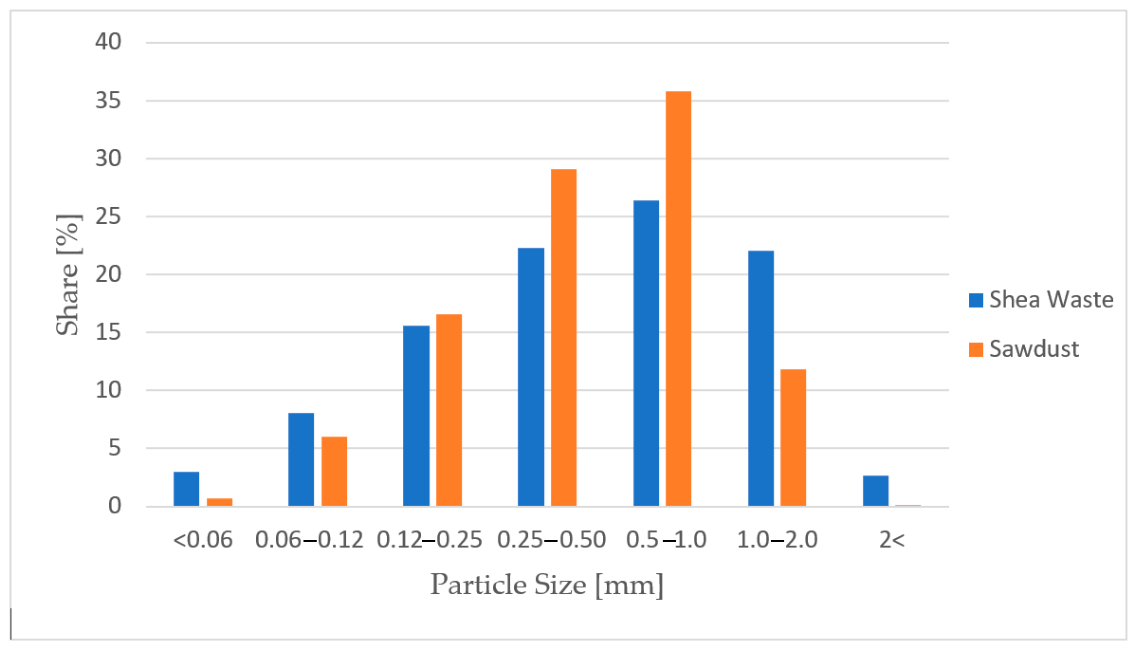
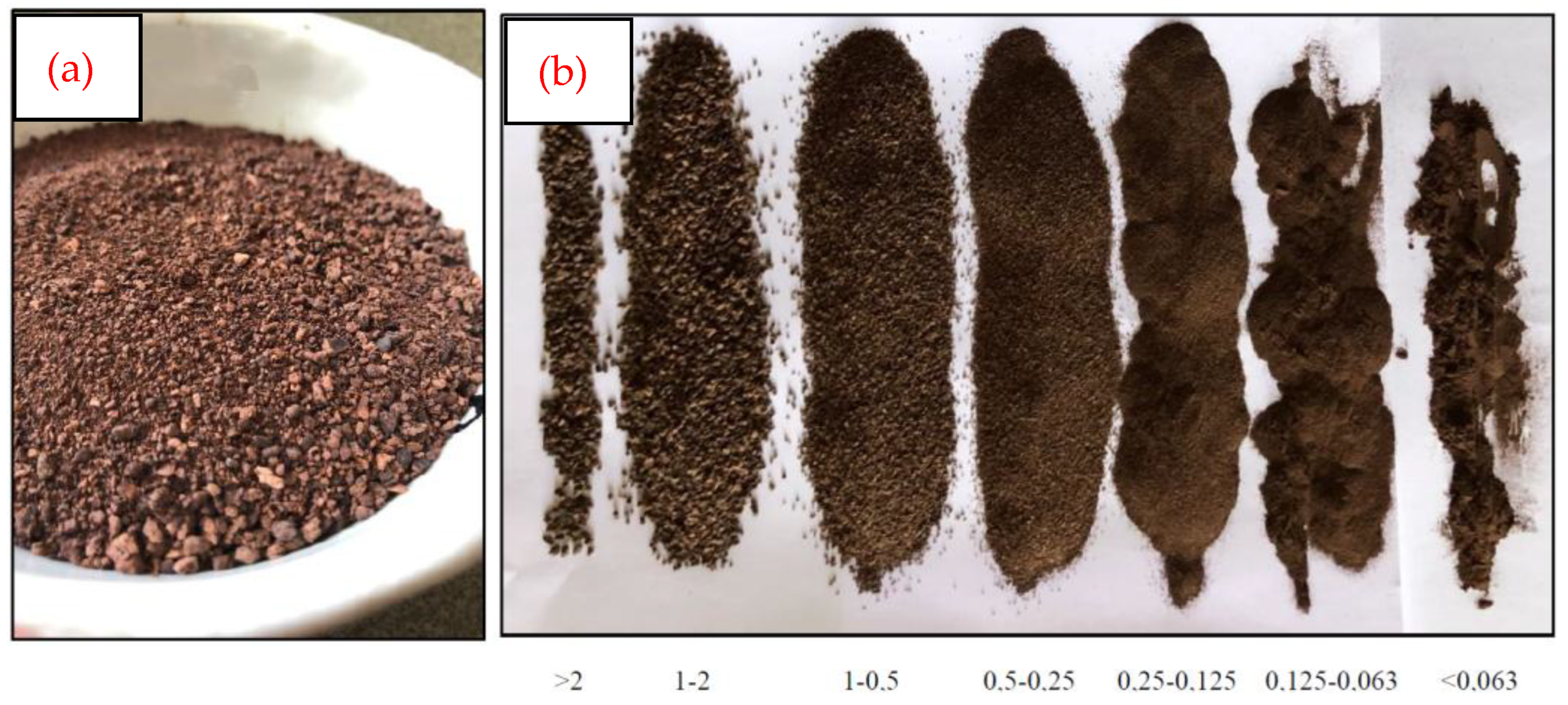
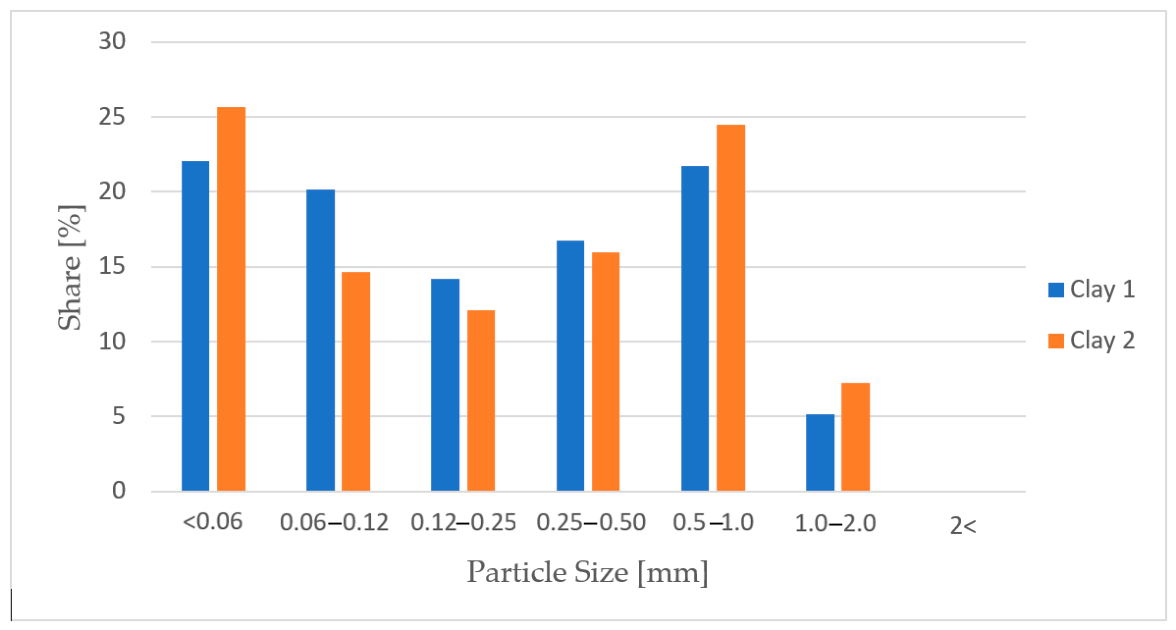
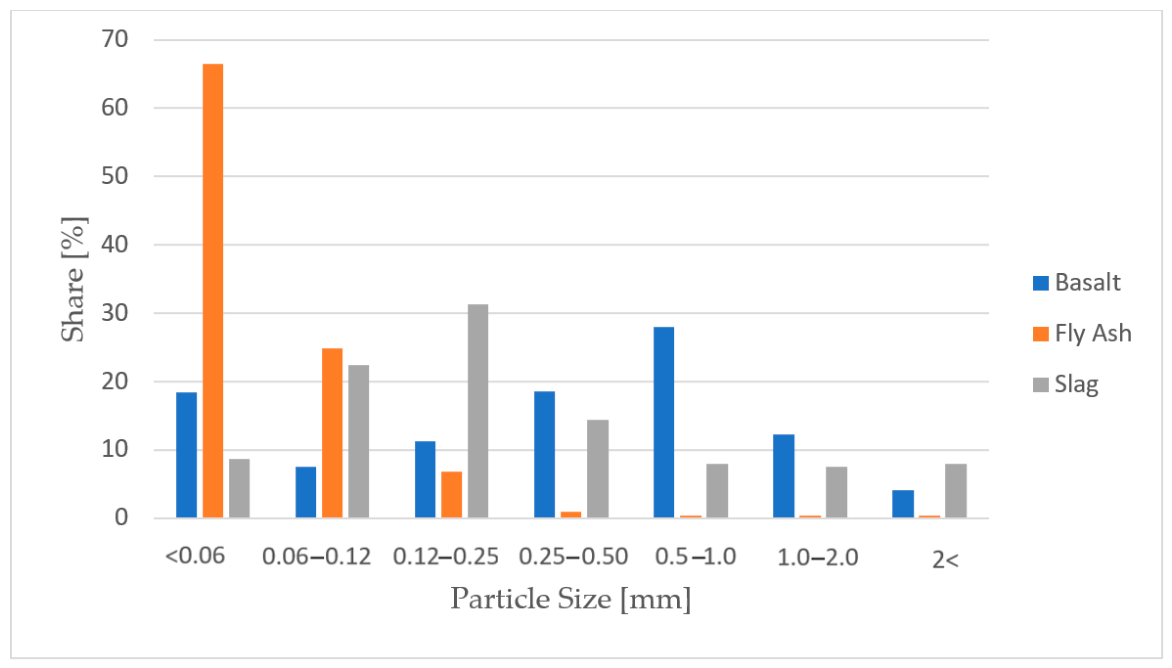
- Sieve analyses demonstrated that all applied raw materials were characterized by an appropriate particle size distribution enabling their use in the preparation of homogeneous ceramic bodies. Shea waste differed from sawdust in terms of grain morphology, exhibiting a more irregular and granular shape, which influenced the manner of pore formation within the structure of the fired ceramic materials.
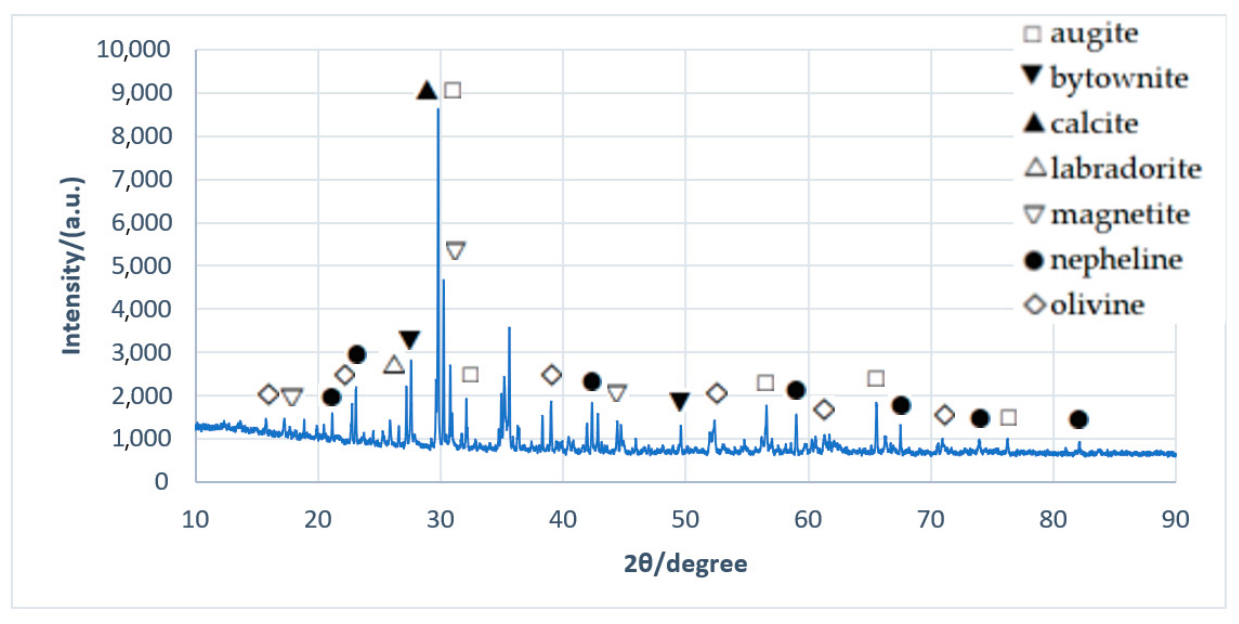
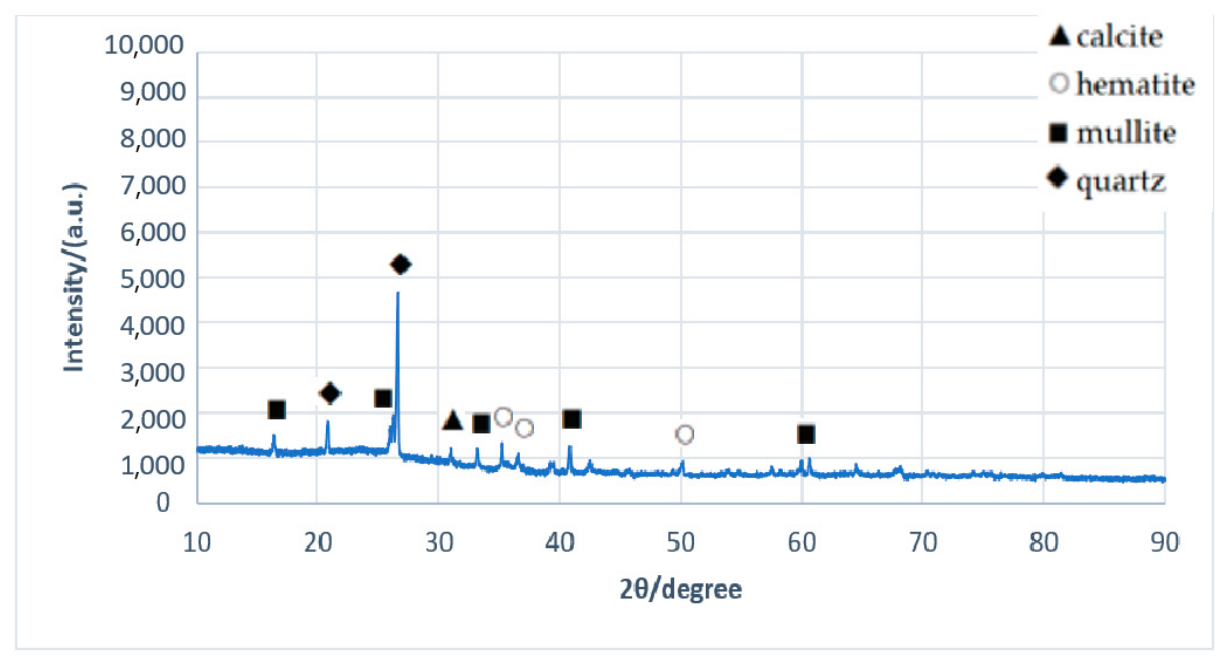
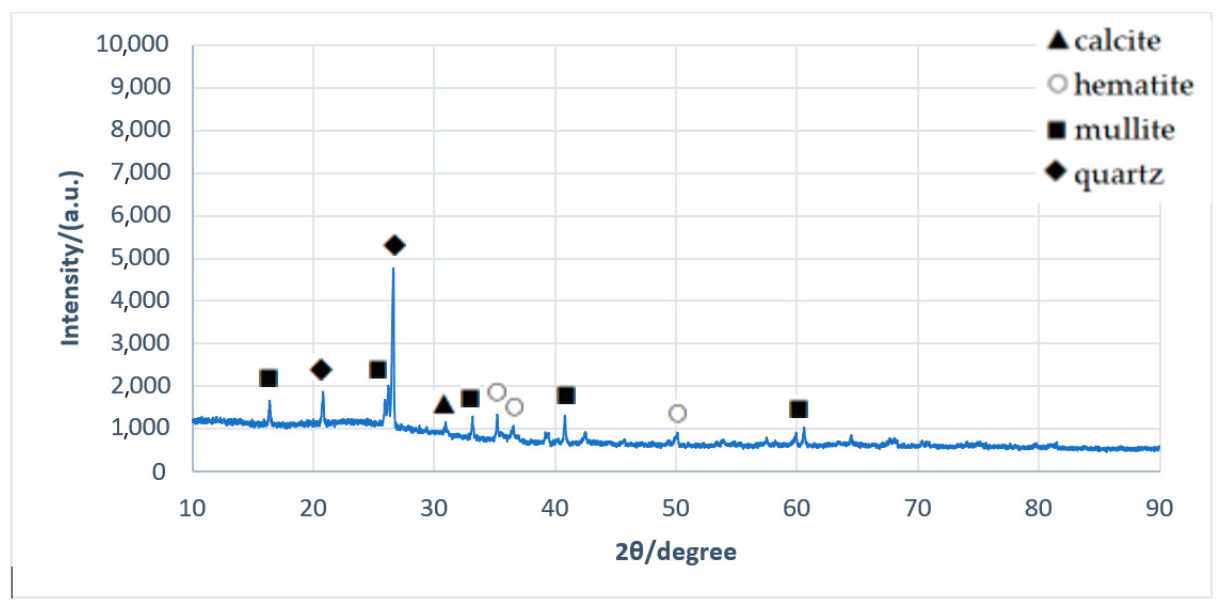
- Chemical and mineralogical analyses of the raw materials confirmed the presence of phases characteristic of clay materials, igneous rocks, and combustion by-products. Basalt was found to consist mainly of aluminosilicate and iron-bearing minerals, whereas ash and slag were dominated by quartz, mullite, hematite, and calcite. The mineral composition of the technological additives influenced the course of sintering processes and the final properties of the ceramic materials.
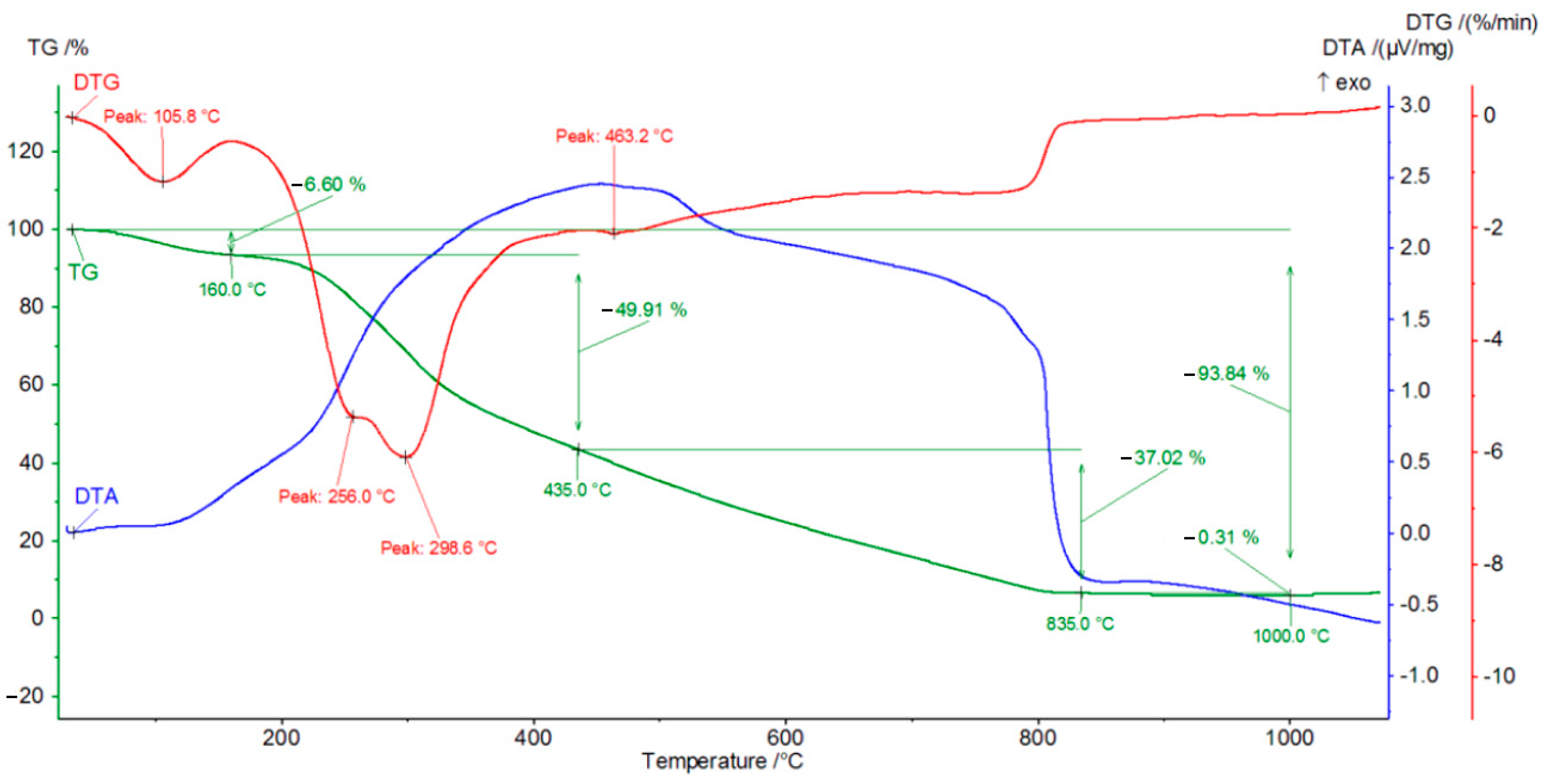
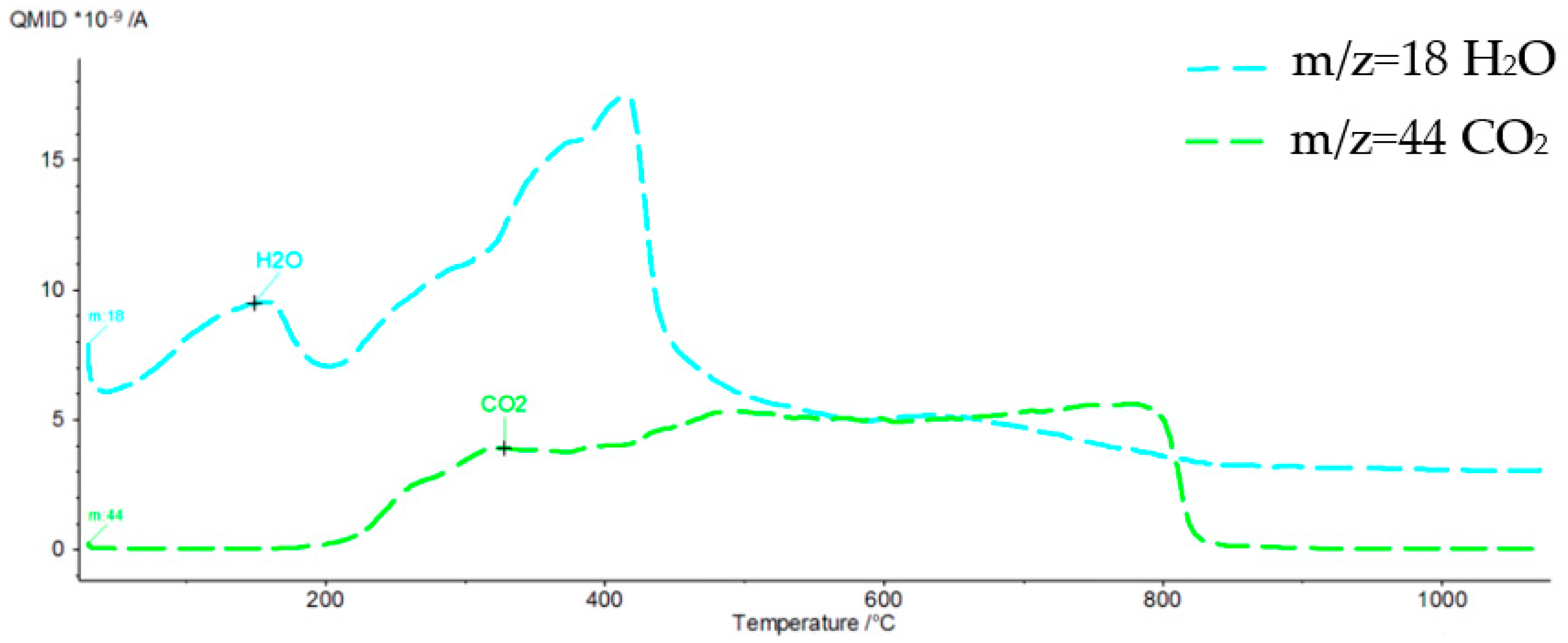
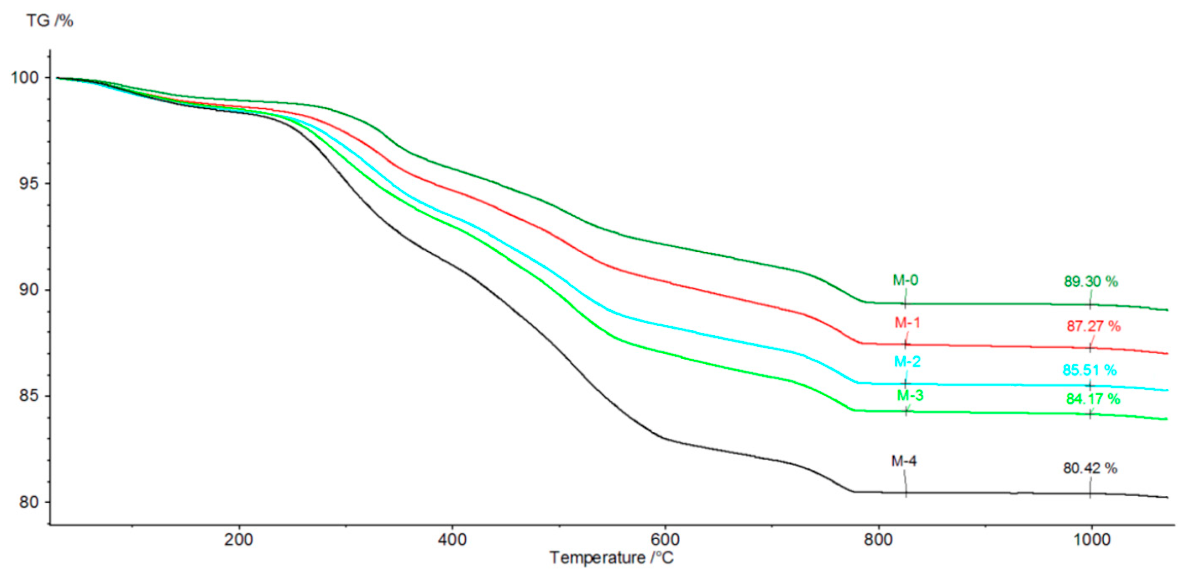
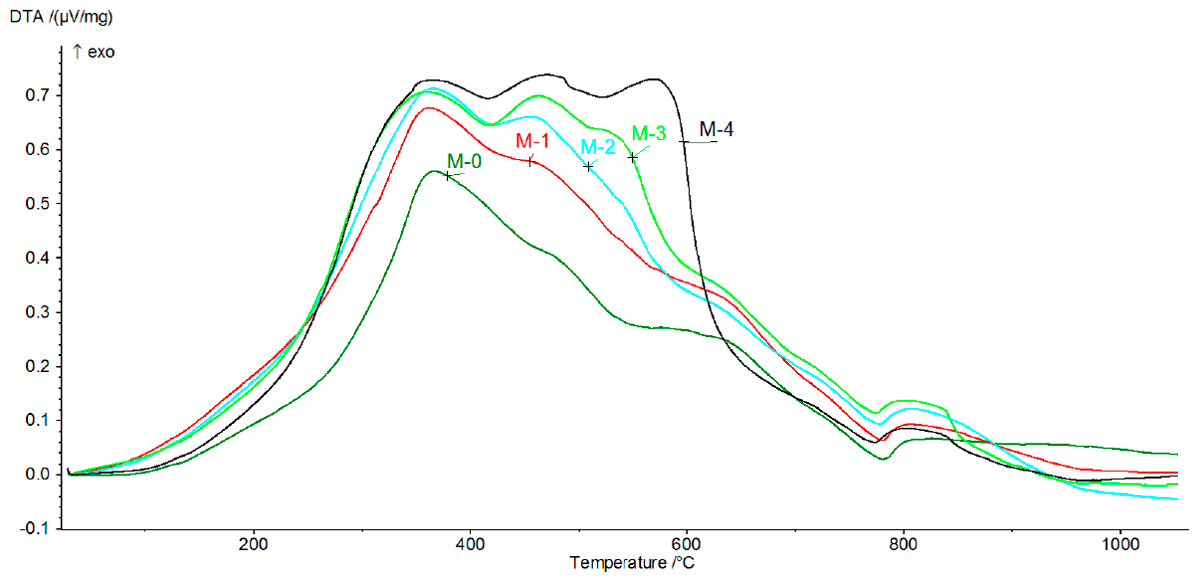
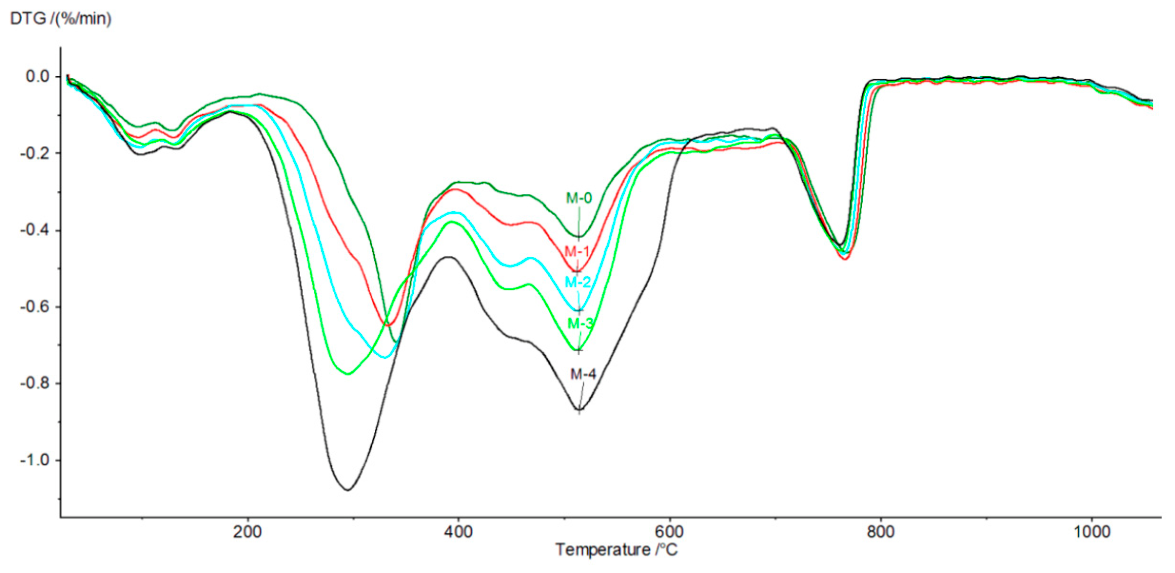
- Thermal analyses demonstrated that shea waste is characterized by a high content of organic matter and a significant mass loss during heating. The combustion process proceeded in two stages and covered a wide temperature range. With increasing shea waste content in the mixtures, the amount of released heat and the loss on ignition values increased, indicating a significant influence of the biomass on the firing process.
- Replacing part of the conventional additives with shea waste increased the calorific value of the ceramic mixtures from 865 J/g (reference mixture) to 2665 J/g (mixture No. 4), indicating the potential for partial substitution of external fuel demand during firing. Although direct CO2 emissions were not measured, the obtained results suggest that the use of shea waste may contribute to lowering the carbon footprint of ceramic production.
- Increasing the proportion of shea waste in the ceramic mixtures resulted in higher open porosity and lower apparent density of the materials. This effect was associated with the combustion of organic matter and the formation of additional voids within the microstructure of the ceramic bodies.
- The mechanical strength of the ceramic materials decreased with increasing content of shea waste. Both compressive and flexural strength tests demonstrated a clear correlation between increased porosity and deterioration of mechanical parameters. The greatest reduction in strength was recorded for mixtures containing the highest proportion of biomass.
- Despite the decrease in mechanical strength, most of the investigated materials containing up to 20% shea waste retained parameters corresponding to strength classes enabling their application in construction. The samples from mixture No. 4 exhibited the lowest compressive strength (10.10 MPa), measured on solid ceramic cubes. Considering that the compressive strength of hollow ceramic cubes units is lower, the use of this composition in load-bearing masonry units may be limited. Nevertheless, this material may still be suitable for non-load-bearing applications, such as partition walls or infill walls.
- The obtained results confirm the feasibility of using shea fruit waste as an organic additive in building ceramics technology. An appropriately selected proportion of biomass makes it possible to obtain materials with reduced density and potentially lower CO2 emissions, while maintaining parameters enabling their practical application in the production of ceramic building products.
Author Contributions
Funding
Institutional Review Board Statement
Informed Consent Statement
Data Availability Statement
Conflicts of Interest
References
- Olaniyi, H.F.; Elinge, C.M.; Lawal, M.; Jinga, D.D. Ignition and Burning Rate of Sheanut Shell Briquettes Produced at Moderate Temperature and Die Pressure. Int. Res. J. Appl. Sci. Eng. Technol. 2024, 10, 1–7. [Google Scholar]
- Jannat, N.; Al-Mufti, R.L.; Hussien, A.; Abdullah, B.; Cotgrave, A. Utilisation of Nut Shell Wastes in Brick, Mortar and Concrete: A Review. Constr. Build. Mater. 2021, 293, 123546. [Google Scholar] [CrossRef]
- Kováč, J.; Trník, A.; Medveď, I.; Štubňa, I.; Vozár, L. Influence of Fly Ash Added to a Ceramic Body on Its Thermophysical Properties. Therm. Sci. 2016, 20, 603–612. [Google Scholar] [CrossRef]
- Bolewski, A.; Budkiewicz, M.; Wyszomirski, P. Surowce Ceramiczne; Wydawnictwo Geologiczne: Warszawa, Poland, 1991.
- Zhang, Z.; Zhang, L.; Li, A. Development of a sintering process for recycling oil shale fly ash and municipal solid waste incineration bottom ash into glass ceramic composite. Waste Manag. 2015, 38, 185–193. [Google Scholar] [CrossRef] [PubMed]
- Stoch, L. Minerały Ilaste; Wydawnictwo Geologiczne: Warszawa, Poland, 1974.
- Wiśniewski, P. Dodatki organiczne we współczesnej ceramice. Cz. II. Właściwości spoiw. Szkło Ceram. 2008, 59, 43–47. [Google Scholar]
- Lubas, M.; Nowak, A.; Iwaszko, J.; Jasinski, J.J.; Zajemska, M. Characterization of calumite-modified melaphyre glass in terms of mineral fibres and glass-ceramic materials production. Ceram. Int. 2024, 50, 3624–3632. [Google Scholar] [CrossRef]
- Aleksakhin, A.; Sala, D.; Golovin, K.; Kovalev, R. Reducing energy costs for pipeline transportation. Transp. Res. Procedia 2021, 57, 24–32. [Google Scholar] [CrossRef]
- Haberko, K.; Kordek, M.; Pampuch, R. Nauka o Procesach Ceramicznych; PWN: Warszawa, Poland, 1992. [Google Scholar]
- Sala, D.; Bieda, B. Application of uncertainty analysis based on Monte Carlo (MC) simulation for life cycle inventory (LCI). Inżynieria Miner. 2019, 2, 80. [Google Scholar] [CrossRef]
- Adazabra, A.N.; Viruthagiri, G.; Ravisankar, R. Cleaner Production in the Shea Industry via the Recovery of Spent Shea Waste for Reuse in the Construction Sector. J. Clean. Prod. 2016, 122, 335–344. [Google Scholar] [CrossRef]
- Jiang, G.; Husseini, G.A.; Baxter, L.L.; Linford, M.R. Analysis of Shea Nut Shells by X-ray Photoelectron Spectroscopy. Surf. Sci. Spectra 2004, 11, 112–118. [Google Scholar] [CrossRef]
- Richert, M.; Dudek, M.; Sala, D. Surface Quality as a Factor Affecting the Functionality of Products Manufactured with Metal and 3D Printing Technologies. Materials 2024, 17, 5371. [Google Scholar] [CrossRef] [PubMed]
- European Integrated Pollution Prevention and Control Bureau. Reference Document on Best Available Techniques in the Ceramic Manufacturing Industry (CER); MB/FS/EIPPCB/CER_Final Draft; Seville, Spain, 2010. [Google Scholar]
- Garcia-Ten, J.; Monfort, E.; Gómez-Tena, M.; Sanz, V. Use of Coatings to Minimise Acid Emissions during Ceramic Tile Firing. J. Clean. Prod. 2011, 19, 1110–1116. [Google Scholar] [CrossRef]
- da Fonseca, B.S.; Vilão, A.; Galhano, C.; Simão, J.A.R. Reusing Coffee Waste in Manufacture of Ceramics for Construction. Adv. Appl. Ceram. 2014, 113, 3. [Google Scholar]
- Sermyagina, E.; Martinez, C.L.M.; Nikku, M.; Vakkilainen, E. Spent Coffee Grounds and Tea Leaf Residues: Characterization, Evaluation of Thermal Reactivity and Recovery of High-Value Compounds. Biomass Bioenergy 2021, 150, 106141. [Google Scholar] [CrossRef]
- Pelozo, G.; Quaranta, N.; Caligaris, M. Effect of the Incorporation of Biomass Wastes on the Properties of Fired Clay Bricks; Food and Agriculture Organization of the United Nations: San Nicolás, Argentina, 2018. [Google Scholar]
- Kłosek-Wawrzyn, E.; Wiśniewska, K.; Wons, W. Badanie wpływu rodzaju, ilości i uziarnienia dodatków poryzujących na porowatość i podciąganie kapilarne tworzyw ceramicznych. Mater. Ceram. 2020, 72, 151–160. [Google Scholar]
- Aniszewska, M.; Gendek, A. Porównanie ciepła spalania i wartości opałowej szyszek wybranych gatunków drzew leśnych. Leśne Pr. Bad. 2014, 75, 231–236. [Google Scholar]
- Dychkovskyi, R.; Sala, D.; Pyzalski, M.; Miroshnykov, I.; Sujak, A.; Durczak, K.; Kotsan, I.; Pererva, A. Management of Chemical Synthesis Processes of Potassium Humate During Coal Beneficiation Waste Processing. Sustainability 2026, 18, 2196. [Google Scholar] [CrossRef]
- Fedoreiko, V.; Kravchenko, O.; Sala, D.; Zahorodnii, R.; Pyzalski, M.; Dychkovskyi, R. Management and Optimization of Bio-Resource Decentralized Energy Generation Under Political Instability. Energies 2026, 19, 737. [Google Scholar] [CrossRef]
- Pavlychenko, A.; Sala, D.; Pyzalski, M.; Dybrin, S.; Antoniuk, O.; Dychkovskyi, R. Utilizing Fuel and Energy Sector Waste as Thermal Insulation Materials for Technical Buildings. Energies 2025, 18, 2339. [Google Scholar] [CrossRef]
- Dziarmagowski, M.; Karbowniczek, M.; Pyzalski, M.; Okoń, J. Reduction of Converter Slag in Electric Arc Furnace. Ironmak. Steelmak. 1992, 19, 45–49. [Google Scholar]
- Karamanov, A.; Pelino, M.; Salvo, M.; Metekovits, I. Sintered glass-ceramics from incinerator fly ashes. Part II. The influence of the particle size and heat-treatment on the properties. J. Eur. Ceram. Soc. 2003, 23, 1609–1615. [Google Scholar]
- Dejean, A.; Ouédraogo, I.W.; Mouras, S.; Valette, J.; Blin, J. Shea nut shell based catalysts for the production of ethanolic biodiesel. Energy Sustain. Dev. 2017, 40, 103–111. [Google Scholar] [CrossRef]
- Quainoo, A.K.; Konadu, A.; Kumi, M. The potential of shea nut shells in phytoremediation of heavy metals in contaminated soil using lettuce (Lactuca sativa) as a test crop. J. Bioremediation Biodegrad. 2015, 6, 1. [Google Scholar]
- Kobomoje, O.S.; Mohammed, A.O.; Omojasola, P.F. The production of citric acid from shea nut shell (Vitellaria paradoxa) using Aspergillus niger. Adv. Appl. Sci. Res. 2013, 4, 25–28. [Google Scholar]
- Mbakbaye, M.R.; Ronoh, E.K.; Sanewu, I.F. Effects of shea nutshell ash on physical properties of lateritic soil. SSRG Int. J. Civ. Eng. 2021, 8, 1–6. [Google Scholar] [CrossRef]
- PN-EN 771-1+A1:2015-10; Specification for Masonry Units—Part 1: Clay Masonry Units. PKN: Warsaw, Poland, 2015.





| Basalt | Fly Ash | Slag | Clay 1 | Clay 2 | Shea Waste | |
|---|---|---|---|---|---|---|
| SiO2 | 39.15 | 50.94 | 52.45 | 63.88 | 58.28 | 0.35 |
| Al2O3 | 13.36 | 30.26 | 24.86 | 12.44 | 16.48 | 0.37 |
| CaO | 12.80 | 2.88 | 3.54 | 6.63 | 5.51 | 0.36 |
| Fe2O3 | 1.42 | 6.35 | 10.06 | 5.65 | 4.04 | 0.07 |
| MgO | 10.39 | 1.68 | 2.01 | 1.23 | 2.31 | 0.10 |
| Na2O | 6.05 | 1.23 | 0.81 | 0.32 | 0.88 | 0.19 |
| TiO2 | 2.41 | 1.37 | 1.38 | 0.80 | 0.80 | 0.01 |
| P2O5 | 1.55 | 0.94 | 0.38 | 0.431 | 0.431 | 0.01 |
| K2O | 0.92 | 2.93 | 3.19 | 1.81 | 2.74 | 2.11 |
| Mixture No. | Clay 1 [%] Vol. | Clay 2 [%] Vol. | Basalt [%] Vol. | Ash [%] Vol. | Slag [%] Vol. | Sawdust [%] Vol. | Shea Husk [%] Vol. |
|---|---|---|---|---|---|---|---|
| 0 | 40 | 20 | 5 | 7.5 | 7.5 | 20 | 0 |
| 1 | 40 | 20 | 5 | 7.5 | 7.5 | 15 | 5 |
| 2 | 40 | 20 | 5 | 5.0 | 5.0 | 15 | 10 |
| 3 | 40 | 20 | 5 | 7.5 | 7.5 | 0 | 20 |
| 4 | 40 | 20 | 5 | 2.5 | 2.5 | 0 | 30 |
| Mixture No. | Apparent Density [g/cm3] | ||||
|---|---|---|---|---|---|
| 0 | 1 | 2 | 3 | 4 | |
| Average | 1.76 ± 0.01 | 1.70 ± 0.01 | 1.66 ± 0.01 | 1.65 ± 0.01 | 1.53 ± 0.01 |
| Temperature Range (Maximum Transformation Temperature) [°C] | Mass Change [% w/w] | Type of Transformation | Exothermic/Endothermic | Substance |
|---|---|---|---|---|
| 30 ÷ 210 (96) | −1.08 | H2O− dehydration | endothermic | illite/montmorillonite |
| 30 ÷ 210 (129) | H2O− dehydration | endothermic | illite/montmorillonite | |
| 210 ÷ 400 (340) | −3.19 | H2O− and CO2− combustion | exothermic | organic matter |
| 400 ÷ 600 (ok. 460) | −3.58 | H2O− and CO2− combustion | exothermic | organic matter |
| 400 ÷ 600 (514) | H2O− dehydroxylation | endothermic | illite/montmorillonite | |
| 600 ÷ 1000 (768) | −2.84 | CO2− decarbonation | endothermic | carbonates |
| Total mass change 30 ÷ 1000 [°C] = −10.69 [%] | ||||
| Temperature Range (Maximum Transformation Temperature) [°C] | Mass Change [% w/w] | Type of Transformation | Exothermic/Endothermic | Substance |
|---|---|---|---|---|
| 30 ÷ 210 (96) | −1.40 | H2O− dehydration | endothermic | illite/montmorillonite |
| 30 ÷ 210 (129) | H2O− dehydration | endothermic | illite/montmorillonite | |
| 210 ÷ 400 (333) | −3.89 | H2O− and CO2− combustion | exothermic | organic matter |
| 400 ÷ 600 (ok. 449) | −4.32 | H2O− and CO2− combustion | exothermic | organic matter |
| 400 ÷ 600 (511) | H2O− dehydroxylation | endothermic | illite/montmorillonite | |
| 600 ÷ 1000 (766) | −3.12 | CO2− decarbonation | endothermic | carbonates |
| Total mass change 30 ÷ 1000 [°C] = −12.73 [%] | ||||
| Temperature Range (Maximum Transformation Temperature) [°C] | Mass Change [% w/w] | Type of Transformation | Exothermic/Endothermic | Substance |
|---|---|---|---|---|
| 30 ÷ 210 (97) | −1.58 | H2O− dehydration | endothermic | illite/montmorillonite |
| 30 ÷ 210 (129) | H2O− dehydration | endothermic | illite/montmorillonite | |
| 210 ÷ 400 (329) | −4.93 | H2O− and CO2− combustion | exothermic | organic matter |
| 400 ÷ 600 (449) | −5.18 | H2O− and CO2− combustion | exothermic | organic matter |
| 400 ÷ 600 (512) | H2O− dehydroxylation | endothermic | illite/montmorillonite | |
| 600 ÷ 1000 (763) | −2.79 | CO2− decarbonation | endothermic | carbonates |
| Total mass change 30 ÷ 1000 [°C] = −14.48 [%] | ||||
| Temperature Range (Maximum Transformation Temperature) [°C] | Mass Change [% w/w] | Type of Transformation | Exothermic/Endothermic | Substance |
|---|---|---|---|---|
| 30 ÷ 210 (102) | −1.51 | H2O− dehydration | endothermic | illite/montmorillonite |
| 30 ÷ 210 (130) | H2O− dehydration | endothermic | illite/montmorillonite | |
| 210 ÷ 400 (295) | −5.45 | H2O− and CO2− combustion | exothermic | organic matter |
| 400 ÷ 600 (447) | −5.18 | H2O− and CO2− combustion | exothermic | organic matter |
| 400 ÷ 600 (511) | H2O− dehydroxylation | endothermic | illite/montmorillonite | |
| 600 ÷ 1000 (761) | −2.87 | CO2− decarbonation | endothermic | carbonates |
| Total mass change 30 ÷ 1000 [°C] = −15.81 [%] | ||||
| Temperature Range (Maximum Transformation Temperature) [°C] | Mass Change [% w/w] | Type of Transformation | Exothermic/Endothermic | Substance |
|---|---|---|---|---|
| 30 ÷ 210 (98) | −1.54 | H2O− dehydration | endothermic | illite/montmorillonite |
| 30 ÷ 210 (133) | H2O− dehydration | endothermic | illite/montmorillonite | |
| 210 ÷ 400 (295) | −7.00 | H2O− and CO2− combustion | exothermic | organic matter |
| 400 ÷ 600 (514) | −8.82 | H2O− and CO2− combustion | exothermic | organic matter |
| 400 ÷ 600 (575) | H2O− dehydroxylation | endothermic | illite/montmorillonite | |
| 600 ÷ 1000 (761) | −2.22 | CO2− decarbonation | endothermic | carbonates |
| Total mass change 30 ÷ 1000 [°C] = −19.58 [%] | ||||
| Mixture No. | Calorific Value [J/g] |
|---|---|
| 0 | 865 |
| 1 | 1085 |
| 2 | 1560 |
| 3 | 1862 |
| 4 | 2665 |
| Mixture No. | Relative Porosity [%] | ||||
|---|---|---|---|---|---|
| 0 | 1 | 2 | 3 | 4 | |
| Average | 27.0 ± 0.23 | 27.69 ± 0.19 | 29.50 ± 0.15 | 30.79 ± 0.32 | 34.98 ± 0.31 |
| Mixture No. | Compressive Strength [MPa] | ||||
|---|---|---|---|---|---|
| 0 | 1 | 2 | 3 | 4 | |
| Average | 23.67 ± 2.91 | 21.00 ± 2.21 | 15.43 ± 2.04 | 19.69 ± 2.52 | 10.10 ± 1.33 |
| Product strength class | 20 | 15 | 10 | 15 | 7.5 |
| Mixture No. | Compressive Strength [MPa] | ||||
|---|---|---|---|---|---|
| 0 | 1 | 2 | 3 | 4 | |
| Average | 19.84 ± 2.47 | 21.29 ± 2.64 | 11.58 ± 1.68 | 16.86 ± 0.35 | 8.09 ± 0.90 |
| Product strength class | 15 | 15 | 7.5 | 10 | 5 |
| Mixture No. | Compressive Strength [MPa] | ||||
|---|---|---|---|---|---|
| 0 | 1 | 2 | 3 | 4 | |
| Average | 8.96 ± 0.24 | 8.36 ± 0.41 | 7.48 ± 0.17 | 6.21 ± 0.51 | 4.76 ± 0.23 |
Disclaimer/Publisher’s Note: The statements, opinions and data contained in all publications are solely those of the individual author(s) and contributor(s) and not of MDPI and/or the editor(s). MDPI and/or the editor(s) disclaim responsibility for any injury to people or property resulting from any ideas, methods, instructions or products referred to in the content. |
© 2026 by the authors. Licensee MDPI, Basel, Switzerland. This article is an open access article distributed under the terms and conditions of the Creative Commons Attribution (CC BY) license.
Share and Cite
Zaręba, W.; Murzyn, P.; Pyzalski, M. Influence of Shea Shell Waste as a Biomass Additive on Thermal Transformations, Gas Emissions, and the Properties of Sustainable Building Ceramics. Sustainability 2026, 18, 6828. https://doi.org/10.3390/su18136828
Zaręba W, Murzyn P, Pyzalski M. Influence of Shea Shell Waste as a Biomass Additive on Thermal Transformations, Gas Emissions, and the Properties of Sustainable Building Ceramics. Sustainability. 2026; 18(13):6828. https://doi.org/10.3390/su18136828
Chicago/Turabian StyleZaręba, Weronika, Paweł Murzyn, and Michał Pyzalski. 2026. "Influence of Shea Shell Waste as a Biomass Additive on Thermal Transformations, Gas Emissions, and the Properties of Sustainable Building Ceramics" Sustainability 18, no. 13: 6828. https://doi.org/10.3390/su18136828
APA StyleZaręba, W., Murzyn, P., & Pyzalski, M. (2026). Influence of Shea Shell Waste as a Biomass Additive on Thermal Transformations, Gas Emissions, and the Properties of Sustainable Building Ceramics. Sustainability, 18(13), 6828. https://doi.org/10.3390/su18136828