1. Introduction
1.1. Climate Finance and the Growth–Sustainability Nexus
Climate finance has become a core of economic and environmental policy worldwide over the last 20 years. Multilateral institutions, development banks, and bilateral donors have greatly increased the amount of financial flows aimed at mitigation and adaptation goals, especially in emerging market and developing economies (EMDEs). This growth is anchored in the expectation that sustainable financing can spur economic growth while enabling a shift toward low-carbon trajectories. To ensure conceptual clarity, it is essential to distinguish between related but distinct terms in this domain. Green finance is a broad umbrella term encompassing all financial flows supporting sustainable development. Within this, climate finance—the specific focus of this paper—refers strictly to capital flows directed toward climate change mitigation and adaptation projects (often captured via official development assistance, or green aid). This differs from specific market instruments like green credit (bank lending tied to environmental criteria) or green bonds (fixed-income securities for green projects). Furthermore, climate finance is distinct from environmental regulation (government mandates and policies) and investment in renewable energy (sector-specific capital expenditure), though it may interact with both. By isolating climate finance, this study strictly examines the macroeconomic impact of targeted climate-oriented financial inflows. Climate finance is commonly discussed in policy circles as a win-win tool that can help boost investment, productivity, and sustainable development, and improve the ecological state. Theoretical arguments that green investment can be related to capital deepening, technological upgrading, and structural transformation are buttressed by this expectation [
1]. It is assumed that investments in renewable energy, energy efficiency, and sustainable infrastructure will lower long-run production costs and improve economic resilience. On the macroeconomic front, macro investments would boost aggregate demand in the short term and improve supply-side efficiency in the long term. As a result, climate finance has been extensively integrated into development policies to pursue economic and environmental goals [
2]. The macroeconomic performance of climate finance and its effects on economic growth have yet to be empirically studied. Although there is an overall increase in aggregate financial flows, the question remains on the size of the flows, the efficiency of their allocation and their transmission through recipient economies. These issues are particularly relevant to EMDEs, where structural endowments, institutional capabilities, and macroeconomic instability may constrain the performance of externally funded green investments.
1.2. The Green Growth Hypothesis and Emerging Non-Linear Narratives
In the economic literature, there has been a long debate on the relationship between environmental policy and economic growth. The conventional theory of growth, based on a trade-off between environmental protection and economic growth, tended to argue that regulatory restrictions would hold back productivity and investment. However, the green growth hypothesis counters this view, arguing that environmentally oriented investments could be growth-enhancing through innovation, efficiency gains, and new market creation. This discussion has more recently been extended to deal with non-linear dynamics. The literature increasingly indicates that the correlation between green finance and economic growth might not be monotonic [
3]. Rather, it might have threshold effects, and the effect of green financing varies with its magnitude or intensity. Green finance can be too small to have a significant macroeconomic effect. It can yield diminishing returns or even crowd out productive investment. This view has led to the concept of a so-called Green Laffer Curve, which parallels the original fiscal Laffer Curve, suggesting that there is an optimal level of green financing that yields the best growth results. While these theoretical frameworks are compelling, their empirical application in EMDEs often yields mixed, weak, or entirely insignificant relationships. We argue that the expectation of a robust Green Laffer Curve or immediate green growth may be fundamentally mismatched with the structural realities of emerging economies, where climate finance is often constrained in scale, sporadically distributed, and plagued by implementation inefficiencies. Furthermore, the literature’s reliance on isolated econometric frameworks—such as single linear models or simple threshold regressions without cross-validation—exacerbates the risk of reporting spurious, context-specific positive effects. Consequently, there is an urgent need for multi-model frameworks that rigorously test for, and are prepared to report, null findings. Establishing rigorous null results is critical to the current debate: it prevents policy over-optimism, corrects publication bias favouring positive results, and forces a re-evaluation of how climate finance must be scaled and structured to achieve actual macroeconomic relevance.
1.3. Research Gap: The Need for Rigorous Multi-Method Validation
Although the focus on green finance has been growing, there remains a significant gap in the empirical literature for full, methodologically sound analyses of its macroeconomic effects. An important limitation of existing studies is that they tend to focus on a single econometric method (e.g., fixed effects estimation or non-linear modelling) without systematically evaluating the consistency of findings across alternative specifications. This raises critical issues regarding the strength and external validity of the reported results. In addition, the possibility of spurious relationships, especially in cross-sectional studies, has not been well discussed. Aggregated relationships can conceal latent heterogeneity, time variations and structural dissimilarity across nations. It is hard to know whether a given relationship is genuine causality or a statistical artefact without stringent testing using dynamic, differenced, and multi-regime models. The lack of attention to the scale and distribution of climate finance can be considered another essential constraint. Green financing in most EMDEs accounts for a relatively low proportion of GDP, casting doubt on whether it can affect macroeconomic aggregates such as growth. Moreover, the sporadic and unbalanced character of financial flows can further dilute them when transmitted into long-term economic effects. Such structural factors are often neglected in empirical studies, thereby overstating the efficacy of green finance.
1.4. Contribution of This Study
This paper fills these research gaps by rigorously interrogating the macroeconomic and environmental outcomes of climate finance through a multi-model empirical framework. To guide this analysis, we formulate the following central research questions (RQs) and hypotheses (Hs):
RQ1: Does climate finance act as a robust, short-run driver of economic growth in EMDEs?
H1 (Null Expectation): Due to constraints in scale and distribution, climate finance does not exhibit a robust, short-run causal impact on macroeconomic growth.
RQ2: Are there non-linear, threshold, or delayed (lagged) growth effects associated with climate finance (e.g., a Green Laffer Curve)?
H2: Climate-finance intensity remains too low and fragmented in EMDEs to generate structural breaks, optimal thresholds, or significant delayed macroeconomic multipliers.
RQ3: Is climate finance effectively associated with its primary objective of environmental improvement?
H3: Despite lacking macroeconomic growth effects, climate finance is negatively associated with CO2 emissions, demonstrating partial environmental efficacy.
To test these hypotheses, this study analyses the relationship between climate finance and economic growth across a panel of 22 EMDEs from 2002 to 2024. The analysis employs an assorted methodological framework that includes two-way fixed effects, non-linear (quadratic) specifications, regime-based analyses, dynamic lag structures, and first-difference estimators. The systematic application and cross-validation of these models ensure that the findings are robust to model-specific assumptions and estimation methods, allowing for a stringent test of the presence or absence of a macroeconomic growth effect. Furthermore, by exploiting both cross-sectional and temporal dimensions, the analysis successfully captures underlying heterogeneity and dynamic impacts. Beyond the growth channel, the paper also investigates the environmental consequences of climate finance, specifically its association with carbon emissions. This two-fold focus provides a comprehensive evaluation, clearly distinguishing between the economic and environmental efficacy of climate-targeted financial inflows.
1.5. Structure of the Paper
The remainder of the paper is organised as follows.
Section 2 reviews the relevant literature on green finance, economic growth, and non-linear dynamics.
Section 3 describes the data sources, variable construction, and sample characteristics.
Section 4 outlines the econometric methodology and model specifications.
Section 5 presents the empirical results, including robustness checks and visual diagnostics.
Section 6 discusses the implications of the findings, focusing on structural constraints and policy relevance.
Section 7 concludes with key insights and directions for future research.
3. Data and Variables
3.1. Data Sources and Sample Construction
The study employs an imbalanced sample of 22 emerging market and developing economies (EMDEs) for the period 2002–2024 to evaluate the macroeconomic and environmental effects of green financing across alternative model specifications. The criteria used to select the country sample included, first, the regular provision of climate-finance data by the OECD’s Rio Markers database, and second, adequate macroeconomic coverage in the World Bank’s World Development Indicators (WDI) database. The final country group comprises Argentina, Bangladesh, Bolivia, Brazil, Colombia, Ecuador, Ethiopia, Ghana, India, Indonesia, Kenya, Malaysia, Mexico, Morocco, Nigeria, Peru, the Philippines, South Africa, Sri Lanka, Thailand, Tunisia, and Viet Nam. This choice is heterogeneous across regions, income levels, and climate-finance exposure. However, it is also sufficiently comparable to be panel-estimated across regions, income levels, and climate-finance exposure. The dataset obtained aligns with the EMDE focus of the proposal and with the focus on cross-country heterogeneity in climate-financed growth dynamics. The source of the green-finance measure is the OECD Data Explorer, and the Rio Markers dataset on official development assistance (ODA) activities aimed at achieving global environmental goals. This source provides bilateral project-level flows of climate finance that can be categorised by marker type and score. It allows for the construction of a country–year measure of climate-related financing. The World Bank WDI offers growth and environmental indicators, standardised annual series, and macroeconomic variables. All variables were converted to annual frequency, harmonised by country and year, and merged into a country–year panel dataset suitable for fixed effects, non-linear, regime-based, dynamic, and first-difference estimation. In addition to the core environmental controls, the final dataset captures broader macroeconomic conditions. To reduce omitted-variable bias, the empirical specification is extended beyond environmental controls to include gross capital formation (% of GDP) and trade openness (% of GDP). These variables capture domestic investment capacity and external integration, both of which are likely to influence economic growth and may also condition the effectiveness of climate-finance inflows.
3.2. Variable Definition and Economic Construction
The empirical design focuses on analysing whether climate-related financing is systematically associated with economic growth, even after controlling for general macroeconomic and environmental factors. The dependent variable is GDP growth (annual, %), whereas ClimateFinanceIntensity, the inflows of climate finance divided by GDP, is the main explanatory variable. The specification also incorporates environmental and macroeconomic restrictions, namely carbon emissions, energy intensity, domestic investment, and trade openness. Strongness specifications also utilise lagged and differenced transformations of the important explanatory variable.
A concise summary of the final variables is provided in
Table 1.
The main explanatory variable is constructed as per Equation (1):
where
is the annual country-level climate-finance flow extracted from OECD Rio Markers data and
is the current GDP in U.S. dollars from the World Bank. This normalisation is crucial because raw climate-finance flows are not directly comparable across countries of different economic sizes. Importantly, this normalised variable is designated as
ClimateFinanceIntensity rather than a strict debt metric. The OECD Rio Markers database records Official Development Assistance (ODA) activities, which encompass a broad spectrum of climate-related financial instruments. Because these flows include outright grants, concessional financing, and other non-debt financial assistance alongside traditional loans, labelling this measure as ‘debt’ would inaccurately characterise the blended nature of these environmental financial inflows. Dividing by GDP transforms the measure into a scale-adjusted financing intensity, making it interpretable as the relative macroeconomic importance of climate-finance inflows.
The dependent variable is as per Equation (2):
denoting a classified proxy of macroeconomic performance. Another environmental control variable included is CO
2 emissions per capita, which captures the intensity of the production structure involving carbon. Energy intensity, an indicator of energy efficiency, measures the efficiency of primary energy consumption relative to GDP and therefore serves as a proxy for the degree of structural energy transition. Two other macroeconomic controls are used to minimise omitted-variable bias. Gross capital formation (as a percentage of GDP) is incorporated to capture domestic investment and capital accumulation, which are key indicators of growth in emerging economies. It presents trade openness (orientation, as a percentage of GDP) to capture external integration, export orientation, and access to international markets. Such variables are of particular interest, as climate-finance inflows can be linked to broader investment and trade environments. The combination of environmental and macroeconomic controls helps isolate the independent relationship between ClimateFinanceIntensity and economic growth. The fact that they are included ensures that any apparent relationship will not merely reflect greater cross-country differences in productive potential, investment levels, trade integration, or structural energy states.
3.3. Sample Logic and Empirical Coverage
The sample is the unbalanced annual panel, which is better than the attempt to make the sample balanced, since it does not lose the information collected on countries that were not completely covered without causing unnecessary data loss. The merged dataset contains 506 country–year observations. After accounting for missing values in the environmental and macroeconomic controls, the effective estimation sample for the baseline fixed effects specification consists of 412 observations. The reduction in sample size is primarily driven by incomplete information on investment and trade openness for a limited number of country–year observations. Nevertheless, the remaining panel retains broad geographic and developmental coverage and remains sufficiently large for fixed effects, threshold, and dynamic estimation. This is normal in empirical macro-panel studies where missingness is usually due to lapses in environmental or fiscal coverage. The EMDEs chosen are highly heterogeneous in terms of green-finance exposure and growth outcomes. For example, the sample includes large emerging economies such as India, Brazil, Indonesia, Mexico, and South Africa, as well as smaller, more climate-prone economies such as Bangladesh, Bolivia, Kenya, Sri Lanka, and Viet Nam. Such heterogeneity is practical, since the paper’s main hypothesis is fundamentally heterogeneous: if the macroeconomic relevance of climate finance varies across countries, it is most likely to emerge at different levels of financing intensity, productive investment, trade integration, and transition pressure. The resulting sample provides an appropriate setting for evaluating whether the relationship between climate finance and growth differs across financing regimes, evolves, or disappears once broader macroeconomic conditions are taken into account.
3.4. Econometric Implications of Variable Design
The choice of variables is a parsimonious one. Other fiscal variables, including government debt and interest rates, were also considered in the preliminary screening. Still, their coverage was too sparse to join a consistent cross-country panel. Rather than introducing extensive imputation or unstable sample composition, the final specification prioritises variables with broader coverage and clearer theoretical relevance. In addition to the environmental controls, the final framework incorporates domestic investment and trade openness to reduce omitted-variable bias while preserving a sufficiently large cross-country panel. This option is compatible with a clean identification strategy: maximising the number of regressors is not the goal, but rather guaranteeing that high levels of missingness or an unstable sample composition do not contaminate the estimated ClimateFinanceIntensity effect.
The final empirical framework can be summarised in Equation (3):
where
captures country-fixed effects and
captures common time shocks. For robustness, the analysis also estimates:
and first-difference specifications (Equation (5)) of the form:
These alternative specifications allow distinguishing between contemporaneous, delayed, non-linear, and potentially spurious associations. In particular, the first-difference model is intended to determine whether changes in climate finance are associated with contemporaneous changes in growth, after controlling for persistent cross-country heterogeneity. This distinction is central to the study because the relevant question is not merely whether green finance is correlated with growth, but whether such a relationship remains robust across different estimators, transformations, and macroeconomic controls.
4. Methodology
4.1. Empirical Strategy and Identification Framework
The empirical approach of this paper aims to test the correlation between green financing and economic growth rigorously and to minimise model-related biases and specification errors as much as possible. A multi-model econometric model is adopted due to the unclear nature of the previous literature and the possibility of spurious interpretations arising from single-model dependence. Using this method enables testing the stability and consistency of estimated effects in linear, non-linear, dynamic and differenced specifications. The analysis is based on a panel data environment, with formal consideration of both cross-sectional (country-level) and temporal (year-level) variations. Let index countries and index time. The baseline empirical objective is to estimate the marginal effect of climate financing, proxied by , on economic growth , while controlling for environmental and macroeconomic characteristics, including carbon emissions, energy intensity, domestic investment, and trade openness. One identification issue is unobserved heterogeneity, which can be biased when neglected. Differences between countries exist in the quality of institutions, the structure of their industries, policy regimes, and exposure to external shocks. Likewise, common time effects can be driven by macroeconomic cycles worldwide and by changes in climate policy. To overcome these concerns, the approach considers both fixed effects in two directions and accounts for time-invariant country-specific factors and shared temporal effects. Formal specification testing also supports the choice of the fixed effects framework. The Hausman test strongly rejects the random-effects alternative, indicating that country-specific heterogeneity is correlated with the explanatory variables and must be directly controlled for. Further diagnostic tests indicate significant cross-sectional dependence among countries, likely driven by the similarity of global shocks, international financial developments, and climate policy. Therefore, the Driscoll–Kraay standard errors are used to estimate all the regressions, which are insulated to heteroskedasticity, serial correlation, and cross-sectional dependence. Significantly, the multi-model approach is driven by the need to avoid reliance on a single functional form. To that end, a multi-model strategy is adopted to ensure that an observed positive relationship between green finance and growth is not an artefact of a given estimator, functional specification, or a lack of a given macroeconomic state.
4.2. Diagnostic Tests and Model Selection
The key diagnostic tests reported in
Table 2 are used to inform the model selection and inference. The variance inflation factors (VIFs) for all explanatory variables are well below the conventional threshold of 10, confirming the absence of severe multicollinearity and ensuring that the independent effects of each variable can be cleanly isolated. The Hausman test evaluates the null hypothesis that the unique errors are not correlated with the regressors (i.e., that a random-effects model is preferred). The highly significant
p-value (0.0003) firmly rejects this null hypothesis, mathematically justifying our strict use of a fixed effects specification to control for unobserved time-invariant country heterogeneity. While tests for heteroskedasticity and first-order serial correlation do not show significant issues, the Pesaran CD test is critical for our sample. The test evaluates the null hypothesis of cross-sectional independence. With a
p-value of 0.000, this null hypothesis is strongly rejected, indicating significant cross-sectional dependence among the countries. This stands to reason, since the sample economies are exposed to common global macroeconomic shocks, coordinated climate policies, and fluctuations in commodity prices. To explicitly correct for this and ensure robust inference in the presence of cross-sectional dependence, we apply Driscoll–Kraay standard errors across all panel estimations.
4.3. Baseline Fixed Effects Model
The focal point of this empirical analysis will be a typical two-way fixed effects (FE) model that will capture the contemporaneous relationship between green financing and economic growth. The baseline specification is given by:
where
denotes country-specific fixed effects,
denotes time fixed effects,
is the idiosyncratic error term.
The FE estimator is useful in eliminating time-invariant heterogeneity through within-transformation, which reduces omitted-variable bias that can occur due to the unobserved country characteristics. Driscoll–Kraay standard factors are used to simultaneously account for heteroskedasticity, serial correlation, and cross-sectional dependence. Inclusion of investment, as well as trade openness, minimises the omitted-variable bias by explaining the existence of greater macroeconomic situations that could affect both the growth as well as climate-finance inflows. The coefficient 1 captures the mean partial impact of green financing strength on growth. With the green growth hypothesis, it would be expected that be greater than 0. Nevertheless, the impact might not be statistically significant in the event that green financing is too small in size or unevenly distributed.
4.4. Non-Linear (Quadratic) Specification
To test for potential non-linearities—particularly the hypothesised Green Laffer Curve—the model is extended to include a quadratic term:
This specification allows for an inverted U-shaped relationship, where
and would imply diminishing returns to green financing,
The turning point is given by:
The quadratic model serves as a parametric approximation of non-linear effects. However, it imposes a symmetric functional form, which may not adequately capture more complex or discontinuous relationships. As such, it is complemented by threshold-based approaches.
4.5. Threshold and Regime-Based Models
To further explore non-linear dynamics without imposing a strict functional form, the analysis employs regime-based models. These models allow the effect of green financing to differ across levels of exposure.
4.5.1. Binary Regime Model
The sample is partitioned based on a threshold
, such that:
where
is an indicator function. This allows for separate slope coefficients in low- and high-financing regimes.
4.5.2. Tertile-Based Regime Model
To ensure balanced group sizes and avoid boundary bias, the sample is also divided into three quantile-based regimes:
This approach captures more granular heterogeneity and tests whether growth effects differ across low, medium, and high financing intensity groups. These regime-based models are particularly useful in assessing whether green financing exhibits context-dependent effects, even in the absence of a smooth quadratic relationship. In all regime-based specifications, the additional macroeconomic controls ensure that any observed threshold effect is not merely reflecting broader differences in domestic investment or trade integration.
4.6. Dynamic Lag Model
Given that the effects of green financing may materialise with a delay—due to project implementation lags, infrastructure development timelines, and policy transmission mechanisms—the analysis incorporates a distributed lag specification:
This model captures intertemporal effects by employing a finite distributed lag framework and explicitly tests whether the association between climate finance and economic growth is deferred rather than strictly contemporaneous. Specifically, one- and two-year lags are selected because they represent the standard horizon in macroeconomic panel data for capturing short- to medium-term business cycle dynamics and the initial deployment phases of infrastructure projects. Furthermore, extending the lag structure beyond two periods in an unbalanced panel of 22 countries would severely deplete degrees of freedom and introduce excess statistical noise. Therefore, this targeted inclusion of multiple lags helps identify whether the association between climate finance and growth emerges only after these initial implementation delays and broader investment conditions are taken into account.
4.7. First-Difference Model (Robustness and Strict Association)
To further address concerns of non-stationarity and spurious correlations, the study employs a first-difference estimator, which eliminates both fixed effects and deterministic trends:
where:
This specification focuses on within-country changes over time, effectively testing whether changes in green financing are associated with contemporaneous changes in growth. It provides a more stringent assessment of short-run associations, as it removes both time-invariant heterogeneity and persistent trends. If the coefficient on ΔClimateFinanceIntensity remains insignificant after differencing and the inclusion of macroeconomic controls, the evidence would suggest that the positive association observed in baseline specifications reflects persistent structural differences across countries. This further indicates a long-run difference in structure and not a direct short-run relationship impact.
4.8. Robustness and Model Consistency
One of the key aspects of the methodology is the systematic comparison of the results in models. Instead of basing the analysis on one specification, the analysis assesses whether the effect of green financing was estimated:
Consistent across functional forms (linear vs. non-linear),
Stable across temporal structures (contemporaneous vs. lagged),
Robust to transformations (levels vs. differences),
Invariant across regimes (low vs. high exposure).
Robust to the inclusion of broader macroeconomic controls (investment and trade openness).
Such a stratified methodology contributes more to the believability of the results. When findings are consistent in more than one specification, they may be construed as strong. On the other hand, when the association is strengthened or lost when other controls or first-difference transformations are added, the original association might be indicating a long-run difference in structure and not a direct short-run causal association.
4.9. Methodological Implications
The multi-model paradigm shift to robustness-based inference is indicative of wider applications in the empirical macroeconomics community. Methodological rigour is required in situations in which theoretical forecasts are vague and data are heterogeneous, as is the case with climate finance. The research uses two-way fixed effects, non-linear specifications, regime analysis, dynamic lags and first-difference estimation to ensure that the estimated relationship between green finance and growth is not due to a specific functional form or a variable omitted. Further inferences of diagnostic testing and Driscoll–Kraay standard errors are also strengthened to explicitly prescribe multicollinearity, model choice and cross-sectional dependence. Consequently, the study conclusions are based not on one preferred model, but on whether the estimated association with which various empirical frameworks are consistent, or disappear.
5. Results
5.1. Descriptive Statistics and Data Structure
The descriptive statistics indicate that there is a large difference in magnitude between climate-finance flows and macroeconomic indicators in general. The summary statistics of the main variables to be used in the analysis are provided in
Table 3. Although GDP growth, investment and trade openness vary significantly across both countries and years, ClimateFinanceIntensity is quantitatively small and highly concentrated around near-zero values.
Among the most significant results in
Table 2, it must be noted that there is a significant scale difference between ClimateFinanceIntensity and macroeconomic variables. The average ClimateFinanceIntensity ratio is less than half a per cent of GDP, compared with average domestic investment and openness to trade, which are several orders of magnitude higher. Though the GDP growth is both dispersive, with a large standard deviation of 3.73 and a wide range of values (minimum −12.72, maximum 15.33), ClimateFinanceIntensity is very concentrated around very small amounts, with an average of 0.004766 and a maximum of just 0.045. The magnitude of change in the ClimateFinanceIntensity, according to the data, is a number of orders of magnitude smaller than the GDP growth rate:
.
This difference is also highlighted in
Table 4, which provides a direct variance comparison.
The standard deviation of GDP growth is approximately 3.80, while the standard deviation of ClimateFinanceIntensity is vastly smaller at just 0.0068 (with a near-zero variance of 0.000046). Similarly, the dispersion of domestic investment (standard deviation of 7.15) is significantly higher than that of ClimateFinanceIntensity. This stark contrast indicates that flows of climate finance fluctuate very little compared to broader macroeconomic indicators. Econometrically, this disparity in variation reduces the signal-to-noise ratio, making it inherently difficult for marginal shifts in ClimateFinanceIntensity to explain the large, volatile fluctuations in GDP growth.
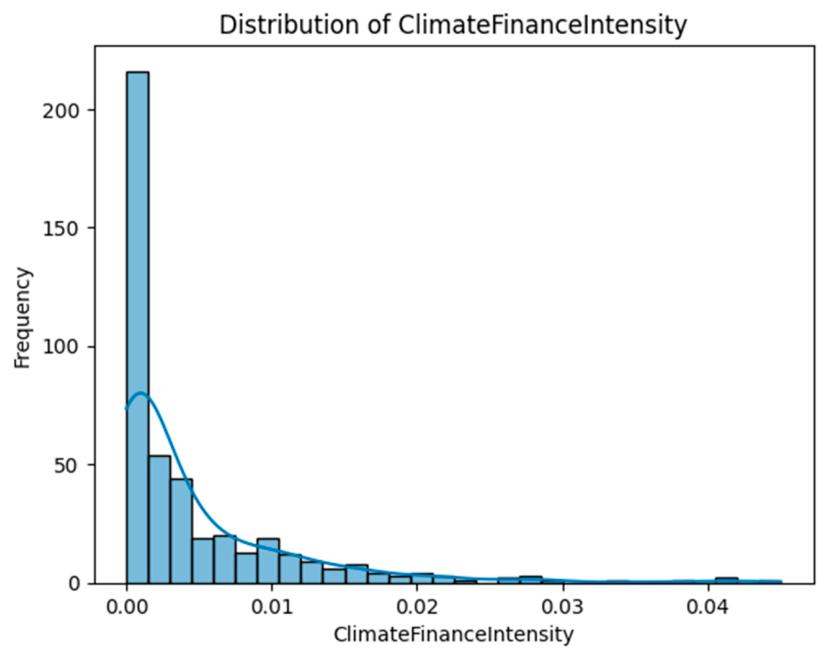
Furthermore, ClimateFinanceIntensity is likely right-skewed, with most measurements clustering near zero alongside a few high-value outliers. This reflects the discontinuous and highly concentrated nature of climate-finance flows among EMDEs. In contrast, GDP growth fluctuates much more widely due to economic shocks and standard business cycles. Given this evidence, it is reasonable to conclude that the limited scale and uneven distribution of climate finance act as significant structural limitations, masking any observable macroeconomic effects these funds might otherwise have.
5.2. Correlation and Preliminary Relationships
Table 5 presents the correlations and corresponding
p-values to provide an initial analysis of the pairwise relationships. This is done as an initial diagnostic to multivariate regression analysis.
The initial correlations reveal that climate finance is weakly related to economic growth. ClimateFinanceIntensity does have a low positive correlation with GDP growth (r = 0.0806), though this correlation is not significant (p = 0.1022). Therefore, the short-run growth in countries that get a relatively larger inflow of climate finance does not differ significantly in a straightforward pairwise comparison. In comparison, ClimateFinanceIntensity has a closer correlation with environmental outcomes. The relationships between ClimateFinanceIntensity and CO2 emissions are moderate, negative and quite significant (r = −0.3280, p = 0.001), indicating that an increase in climate-finance intensity correlates with a decrease in carbon emission. This gives an initial indication that climatic finance can be more useful in financing environmental transition rather than in a direct stimulation to macroeconomic growth. The broader correlation table indicates that ClimateFinanceIntensity and domestic investment are positively related (r = 0.1666, p < 0.001), which means that the larger the inflows of climate-finance, the more likely the country is to have high investment activity. Likewise, the correlation between GDP growth and investment (r = 0.3220, p < 0.001) is substantial as compared to the correlation between GDP growth and ClimateFinanceIntensity. The relationship between trade openness and both ClimateFinanceIntensity and GDP growth is weak. These trends indicate that seemingly increased contribution of climate finance can be partially attributed to the overall investment environment and not necessarily to the contribution by climate financing. The relationship between ClimateFinanceIntensity and Energy_Intensity is positive but weak (r = 0.1144, p = 0.0202), and there is a weak relationship between GDP growth and energy intensity (r = 0.0960, p = 0.0515). Notably, all pairwise correlations among the explanatory variables are not large enough to warrant concern about multicollinearity, which is also consistent with the low variance inflation factor values mentioned above. Collectively, the correlation analysis supports the main empirical puzzle of the research. Climate finance seems more directly related to the environmental performance and the environment of the investment than to short-term economic growth. This stimulates the necessity of the more brash multi-model estimations, which are reported in the following subsections.
5.3. Baseline Panel Results
This empirical hypothesis of the study is initially tested with a two-way fixed effects (FE) specification that is considered to take into account the heterogeneity of countries and time shocks that are shared by all.
The baseline fixed effects estimates reported in
Table 6 suggest that climate finance is positively associated with economic growth once broader macroeconomic conditions are taken into account. The coefficient on ClimateFinanceIntensity is positive (31.325) and marginally significant at the 10% level (
p = 0.0505). While the absolute value of 31.325 appears large, it must be interpreted strictly in the context of the variable’s scale. Because ClimateFinanceIntensity is measured as a tiny fraction of GDP (mean = 0.0047), a one-unit change is empirically impossible in this dataset. A more realistic one-standard-deviation increase in ClimateFinanceIntensity (0.0068) is associated with an almost negligible 0.21 percentage point increase in GDP growth (
). This highlights that the real-world economic magnitude of this association is exceptionally weak. The most robust predictor of growth amongst the control variables is the domestic investment. The coefficient on Investment is positive and significant (
= 0.1011,
p = 0.0174) which shows that those countries that have higher gross capital formation rates have a higher GDP growth. This is in line with conventional growth theory, and indicates that the apparent contribution of climate finance might partially work by operating through broader investment channels. In comparison, both CO
2 emission and energy intensity are not statistically significant in the baseline specification, but their signs are economically intuitive. The positive sign of CO
2 emissions could be attributed to the fact that industrialised and growing developing economies are often more prone to produce larger amounts of carbon. Growth has a negative relationship with energy intensity meaning that economies with lower energy intensity could not do as well, but the relationship is not statistically significant over zero. The positive but non-significant coefficient is also observed in trade openness. This implies that an increase in the level of external integration can aid growth, but it has a weaker impact compared to domestic investment in the current sample. On the whole, the baseline model can be only partially supportive of a positive growth effect of climate finance. The correlation is rather economically small and statistically weak, especially in comparison with the more powerful and more stable impact of domestic investment. In turn, the following sections explore the existence of this relationship when the specifications are non-linear, threshold, dynamic, and first-difference.
5.4. Testing Non-Linearity: Quadratic Model
In order to investigate the non-linear effects, especially the speculated Green Laffer Curve, the simple model is expanded to add a second-order term to the ClimateFinanceIntensity.
Table 7 describes the quadratic specification to test the hypothesis of whether the dependence between climate finance and economic growth is inverted-U-shaped, corresponding to a Green Laffer Curve. The coefficient of ClimateFinanceIntensity is estimated to be positive (68.209) with a negative squared term (−1101.0), which is directionally consistent with a concave relationship. Both coefficients are, however, not statistically significant. The linear term has no significance at the traditional levels (
p = 0.1903), and the quadratic term is even less accurately estimated (
p = 0.3574). Since the two coefficients are statistically equal to zero, the inferred turning point is neither economically nor empirically sound. That is, despite a superficial appearance of the indicators of the coefficients being on the pattern of a Green Laffer-type, the data do not offer any plausible evidence that the growth effect of climate finance evolves in the same way as soon as financing is raised to a higher level. Notably, the lack of a meaningful quadratic effect indicates the fact that the baseline fixed effects model implied a positive relationship between ClimateFinanceIntensity and growth with a weak association. As soon as the concept of non-linearity is brought up, this relationship turns less fixed and becomes not statistically relevant. Hence, the positive correlation of the linear specification does not seem to indicate the presence of an optimal financing threshold. Of the control variables, none are consistently significant except investment, which is an important determinant of GDP growth. The coefficient on Investment remains positive and significant (β = 0.1020,
p = 0.0172), reinforcing the argument that broader domestic capital formation matters substantially more for growth than climate-finance inflows alone. The remaining controls retain the same directional signs as in the baseline model but remain statistically insignificant. Overall, the quadratic specification provides no evidence of an inverted U-shaped relationship between green financing and economic growth. Hence, the notion of a Green Laffer Curve is not supported in the present sample of emerging and developing economies.
5.5. Threshold and Regime Analysis
To examine the occurrence of structural breaks or non-homogeneous impacts in the relationship between green financing and economic growth, the present study uses regime-based estimation methods. These models do not assume that the marginal effect is the same and permit the effect of ClimateFinanceIntensity to be different at the various levels of financing intensity (
Table 8).
The median-based regime model divides the sample into low- and high-financing groups according to the median value of ClimateFinanceIntensity. Unlike the baseline specification, both regime-specific coefficients are statistically significant. The coefficient in the low-financing regime is very large and positive (β = 521.40, p = 0.0319). In contrast, the coefficient in the high-financing regime is smaller but still positive and significant (β = 40.252, p = 0.0203). However, the magnitude of the coefficient in the low-financing regime should be interpreted with caution. Because ClimateFinanceIntensity values are extremely small, even minor changes in the variable generate disproportionately large coefficient estimates. Thus, the large value of β in the low-financing regime does not necessarily imply a strong macroeconomic effect. Rather, it reflects the variable’s scale properties and the fact that most observations are clustered near zero. More importantly, both coefficients remain positive, and there is no evidence that the effect of climate finance reverses once financing exceeds a particular threshold. Consequently, the median regime model does not support the existence of a Green Laffer Curve or a structural break in which climate finance becomes counterproductive at higher levels.
To further narrow the analysis, a specification based on tertiles (
Table 8) is estimated that makes use of the sample’s three categories—low, medium, and high financing intensity; hence, a more granular heterogeneity would be captured.
Table 9 extends the analysis by dividing the sample into three financing regimes—low, medium, and high—to capture more granular heterogeneity. The results indicate that only the high-financing regime exhibits a weakly significant positive coefficient (β = 36.652,
p = 0.0525), whereas the low- and medium-financing groups are statistically insignificant. Importantly, the coefficients do not exhibit the inverted-U pattern required for a threshold-based Green Laffer relationship. Instead, the estimated effect of climate finance remains either positive or statistically indistinguishable from zero across all financing categories. The absence of a negative coefficient in the highest regime suggests that larger climate-finance inflows do not harm growth within the observed data range. At the same time, the tertile specification provides some evidence that the association between climate finance and growth becomes more visible in countries or periods characterised by relatively greater financing intensity. Nevertheless, the magnitude of the effect remains modest and substantially weaker than the effect of domestic investment, which remains consistently significant across all regime specifications. Overall, the regime-based estimations reveal limited heterogeneity but no meaningful threshold effect. Climate finance appears to have a weak positive association with growth in higher-financing environments, yet there is no evidence of a formal structural break or Green Laffer Curve.
5.6. Dynamic Effects: Lag Model
Because the economic effects of climate finance may emerge only gradually through infrastructure development, technological upgrading, or delayed policy implementation,
Table 10 estimates a dynamic specification using one- and two-period lags of ClimateFinanceIntensity.
The results provide no evidence of delayed growth effects. Neither the first lag of ClimateFinanceIntensity (β = −1.5638, p = 0.9376) nor the second lag (β = −0.6963, p = 0.9648) is statistically significant. Moreover, both coefficients are extremely small and close to zero, indicating that the relationship between climate finance and GDP growth does not strengthen when temporal delays are taken into account. The significance of this result is that the baseline fixed effects model implied a weak contemporaneous relationship between ClimateFinanceIntensity and growth. If climate finance is implemented through delayed transmission channels, it is expected that the lagged coefficients will be positive and significant. Rather, the fact that the lagged effect is not significant suggests that the small positive correlation observed in the baseline model is not due to medium-term compensatory mechanisms. Control variables provide more consistent evidence than ClimateFinanceIntensity itself. Investment continues to have a positive relationship with GDP growth and is statistically significant (β = 0.0906, p = 0.0354), whereas trade openness shows weak statistical significance (β = 0.0177, p = 0.0445). These findings indicate that broader domestic and external economic factors have a more enduring impact on growth than climate-finance inflows. In general, the dynamic specification supports the conclusion that climate finance fails to induce a strong delayed growth impact over the time period considered. Even after accounting for implementation lags and slow transmission, the relationship between ClimateFinanceIntensity and GDP growth is weak and statistically insignificant.
5.7. Strict Association: First-Difference Model
To address the possibility that the baseline association between ClimateFinanceIntensity and GDP growth merely reflects persistent structural differences across countries,
Table 11 reports a first-difference specification. By transforming the data into changes over time, this model removes all time-invariant country characteristics and therefore provides a much stricter test of whether changes in climate finance are associated with changes in growth.
The findings show that the alterations in ClimateFinanceIntensity do not have a statistically significant impact on the alterations in GDP growth. The coefficient of ΔClimateFinanceIntensity is negative (−15.873) and insignificant (p = 0.6636), which means that the fluctuations between the climate-finance intensity are not systematically linked to the current changes in the economic performance. This finding is especially significant since it is the opposite of the weak positive correlation in the baseline fixed effects and regime models. The visible influence of climate finance disappears completely once there is a concentration on within-country changes over time. Therefore, the positive value of the coefficient in previous specifications is more probably a result of enduring country–country differences, like their easier investment climate or institutional nature, than of a strong short-run association. Conversely, some of the control variables are still significant in the differenced model. The positive change in domestic investment keeps influencing the growth (β = 0.4729, p = 0.0244). In contrast, the increase in energy intensity has an adverse impact on growth, and the increase in CO2 emissions is positively correlated with growth. These results suggest that short-run fluctuations in the sample’s growth rates are more closely correlated with variation in domestic economic structure and energy consumption than with variation in climate-finance inflows. Overall, the first-difference specification provides the strongest evidence against a direct short-run relationship between climate finance and economic growth. Although countries with higher levels of climate finance may display somewhat better growth performance on average, changes in climate-finance intensity do not themselves appear to generate measurable growth effects over time.
5.8. Cross-Sectional Evidence and Aggregation Bias
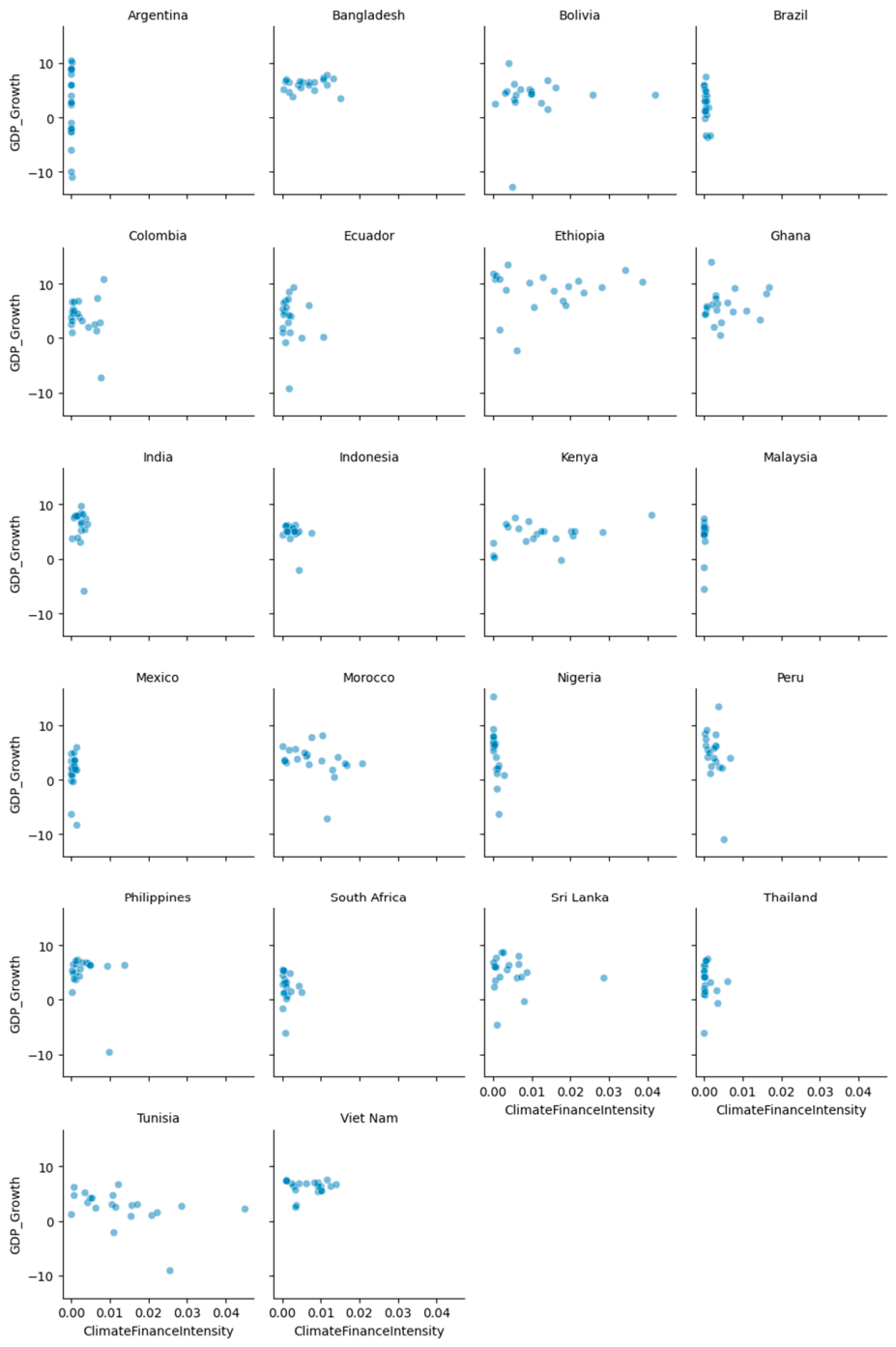
Although panel-based estimations indicate only a weak, statistically fragile relationship between climate finance and growth, it is informative to examine whether cross-sectional patterns yield additional insights. In this regard,
Table 12 presents standardised results of the average country-level ClimateFinanceIntensity and GDP growth, whereas
Figure 1 depicts the scatter plot of the same results.
Although panel-based estimations show, as always, that no growth effect can be identified, it is informative to consider whether cross-sectional trends can provide any additional information. In this regard,
Table 12 presents standardised results of the average country-level ClimateFinanceIntensity and GDP growth, whereas
Figure 1 depicts the scatter plot of the same results with a regression line. There is a moderately positive correlation between ClimateFinanceIntensity and GDP growth at the level of countries (r = 0.38), and it is only marginally significant (
p = 0.08). This pattern is visually reflected in
Figure 1 where the relationship is weakly upward with a large dispersion. Although this appears to be a positive relationship, the relationship is not strong. The extensive pervasiveness of the observed data, and the lack of statistical significance at standard levels, indicate that the relationship is conditioned by the presence of a few high-growth, high-financing nations as opposed to an overall trend. Specifically, there are countries that have high ClimateFinanceIntensity and high growth like Ethiopia and Bangladesh, but the same trend is not always present in the wider sample. Under panel specifications, cross-sectional patterns appear stronger and are not supported. This deviation brings out the existence of aggregation bias, in which averaging through time obscures inherent heterogeneity and blows up the apparent relations. A more reliable basis of inference is the panel estimations, as they take advantage of cross-sectional variation and, at the same time, cross-temporal variation and thus control the fixed effects. Overall, it can be affirmed that although it might indicate a positive correlation between green financing and growth, this correlation is not strong, and the main finding of the research is supported.
5.9. Distribution and Structural Constraints
One of the primary reasons the growth effect is not measurable is the distributional characteristics of the ClimateFinanceIntensity variable. As
Figure 2 below illustrates, the histogram of ClimateFinanceIntensity is skewed far to the right with a very large mass of observations concentrated in an extremely small value, with only a long, thin tail extending to noticeably small values. This validates the fact that climate-finance intensity normalised by GDP is quantitatively constrained throughout the sample. ClimateFinanceIntensity in a macroeconomic sense is too large and too asymmetric to act as a productive or aggregate demand shock in the short-run and medium-run.
The histogram shows that the greatest number of country–year observations are in the lowest financing brackets, with a few observations in the upper tail. This trend aligns with a low-exposure financing regime, in which green finance is not structural but periodic. The implication is that the marginal contribution of climate finance to growth is likely to be obscured by broader macroeconomic factors, including investment cycles, external shocks, and volatile domestic policy. Differently put, there is a weak financing signal relative to the noise created by macro instability.
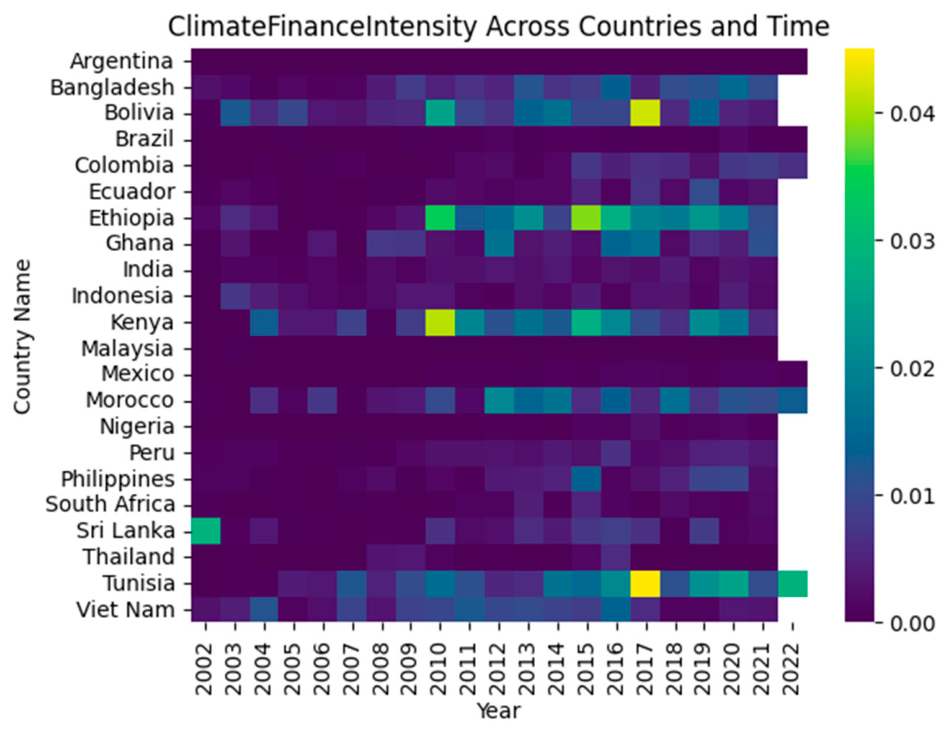
The time–country heatmap in
Figure 3 supports this structural constraint, indicating significant heterogeneity in ClimateFinanceIntensity across countries and years. There are intermittent spikes in financing in some economies, like those of Ethiopia, Kenya, Tunisia, and Viet Nam, but others are consistently close to zero. We do not see a consistent financing pattern on the panel. Rather, the trend is broken and disjointed, and is highly concentrated among a small number of receivers. This type of imbalance undermines the ability to estimate a stable macro-growth effect in panel data.
The heatmap confirms this: green financing does not represent a continuous or widely adopted policy instrument in the sample. Rather, it is concentrated in specific countries and time periods, which means that the panel is characterised by low treatment intensity and high cross-sectional dispersion. Econometrically, this poses a structural constraint: although climate finance might have local or sectoral payoffs, its macroeconomic footprint might be too small to yield statistically significant impacts at the aggregate level. Combined with the descriptive statistics in
Table 1, distributional diagnostics firmly indicate that ClimateFinanceIntensity does not attain the scale and continuity to give birth to a significant growth effect. This is what explains the lack of a systematic macroeconomic response in either the baseline panel models or the non-linear specifications.
5.10. Non-Parametric Evidence
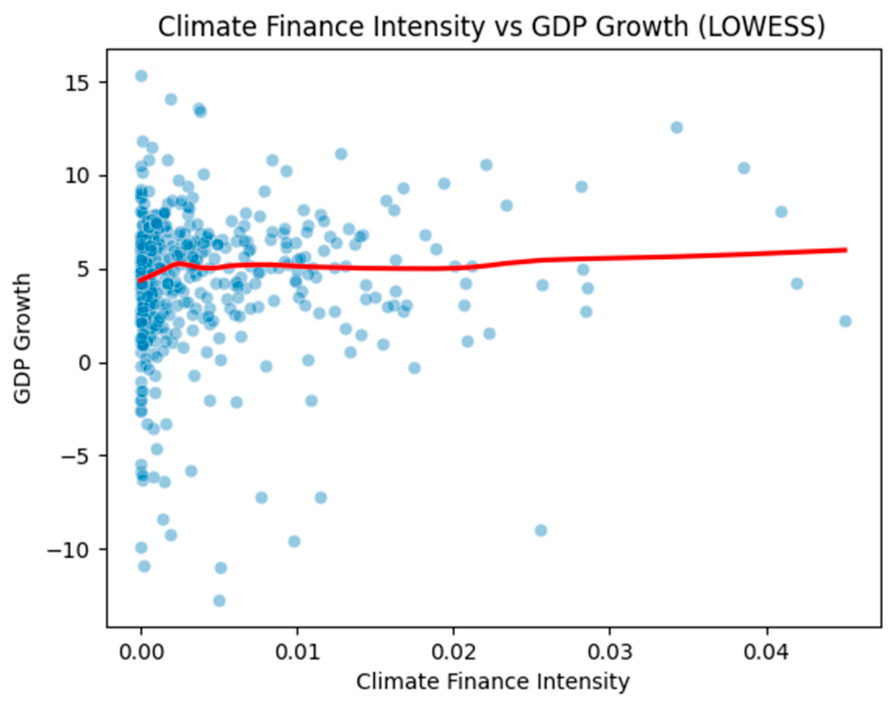
The non-parametric diagnostics provide additional evidence that the relationship between ClimateFinanceIntensity and growth does not exhibit a significant threshold or inverted U-shape. Of particular use is the LOWESS plot in
Figure 4. It reveals a slight upward movement at very low financing levels and then a wide flattening, and only a slight upward movement at large values. More importantly, there is no actual turning point, no convex-to-concave change, and no level of elevated growth rates. This is a direct blow to the hypothesis of the Green Laffer Curve.
The LOWESS smoother means that the relationship is mostly flat in the range of the observation (
Figure 4). Although the data show some local variation at the bottom of the distribution, the trend line does not show the increase–decrease pattern needed to interpret an inverted U-shaped pattern. This, in the real world, does not seem to result in a regime-switching growth response by green financing. The binned-average plot in
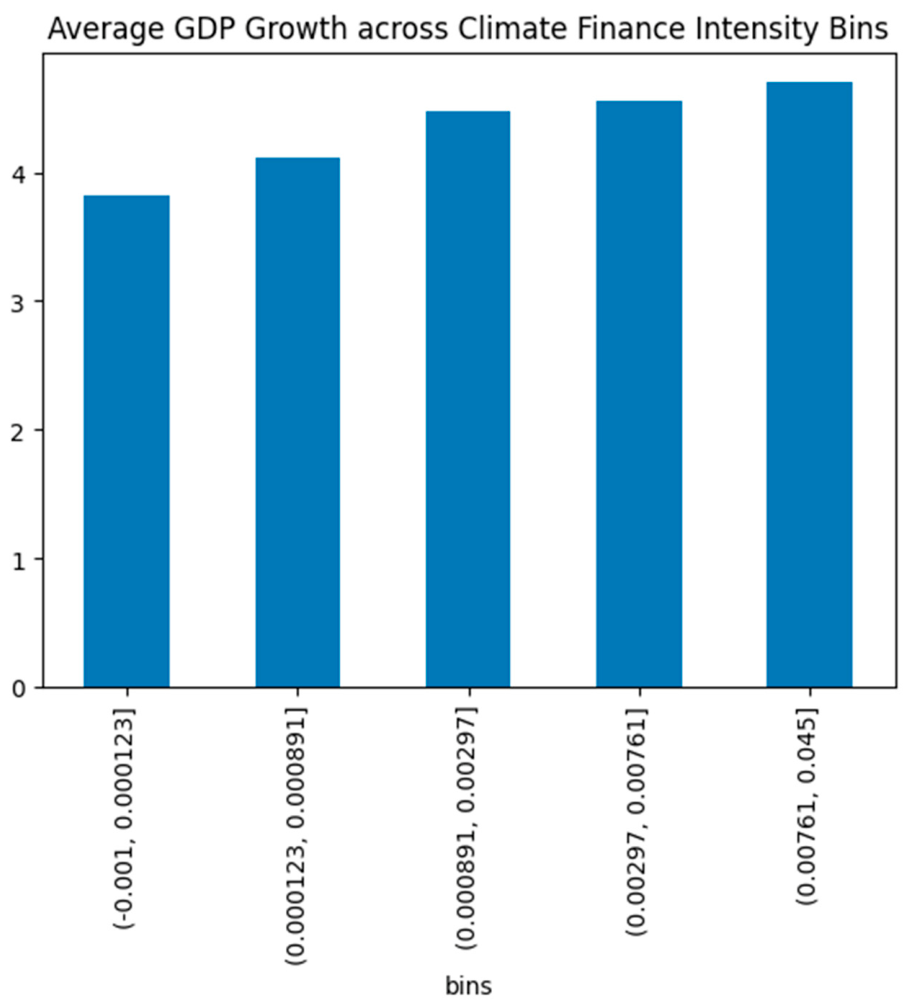
Figure 5 gives an even better visual summary. The average GDP growth increases slowly across ClimateFinanceIntensity bins, rising by around 3.8 in the lowest bin and reaching 4.3–4.4 in the highest bin. Such a trend is not non-linear but monotonic. No sign of a peak and subsequent decline, needed to interpret it through threshold or Laffer lines, is present.
Non-parametric estimates will therefore establish that there is no non-linear or threshold structure. The visual data agree with the regression results: green financing is positively associated with growth at low levels, but not negatively at higher levels. Rather, the data indicate a very small positive slope or a near-zero relationship. In general, both the distributional and non-parametric evidence indicate that the size and distribution of green financing in the sample are too small and unbalanced to yield a statistically significant Green Laffer Curve.
5.11. Environmental Effects of Green Finance
Although the growth relationship remains weak and not robust across specifications, there is a need to test whether the main aim of climate finance is achieved. In this respect, the paper approximates a panel model that uses CO
2 emissions per capita as the dependent variable:
Such specification separates the environmental channel of green finance whilst holding constant energy efficiency and unobserved heterogeneity.
Table 13 results show a negative correlation between ClimateFinanceIntensity and CO
2 emissions, suggesting that greater climate financing is associated with lower carbon intensity. The coefficient is not statistically significant at standard levels; however, its direction is consistent with theory. Conversely, the intensity of energy is positive and highly significant, confirming that inefficient energy consumption is one of the primary factors contributing to emissions in EMDEs.
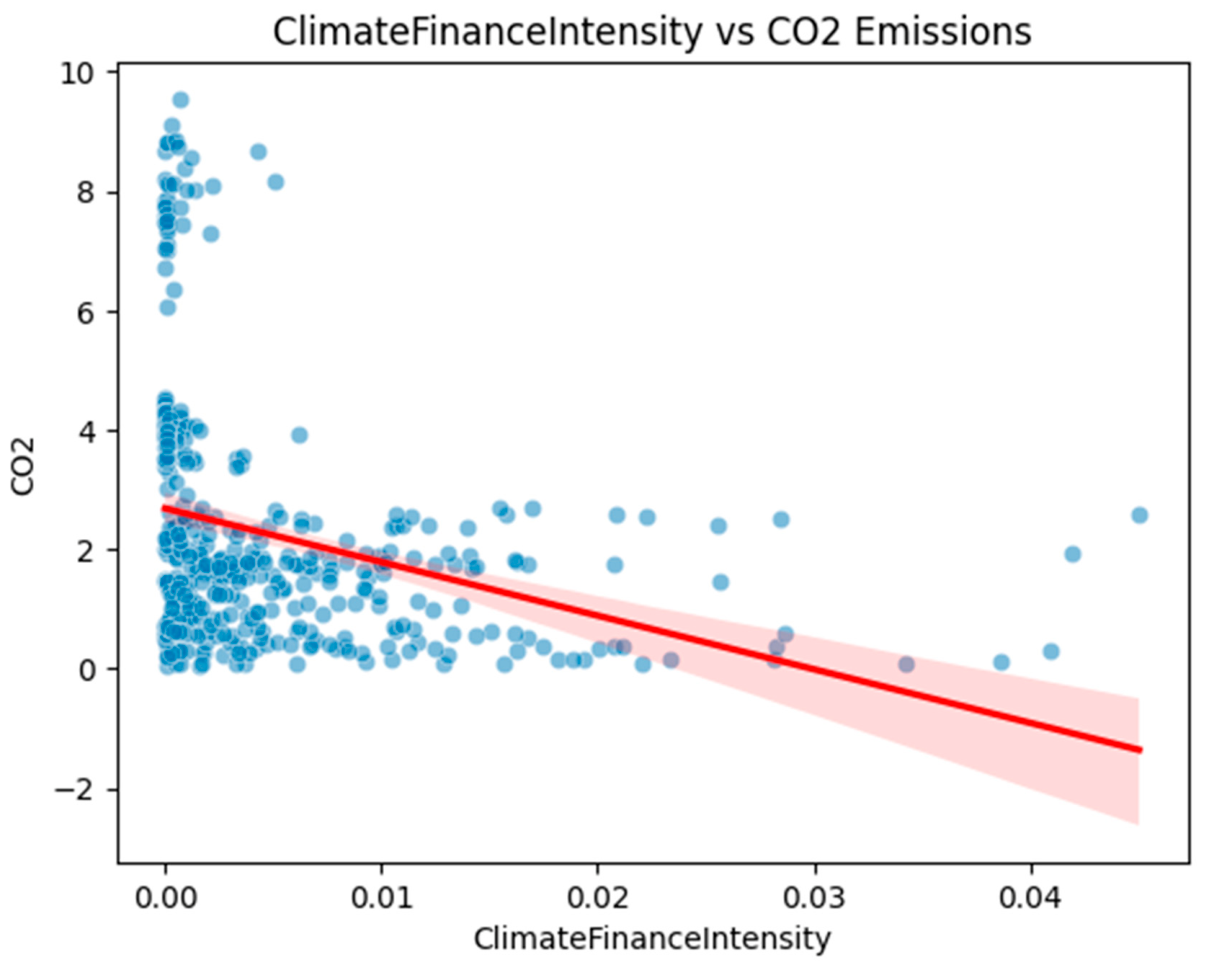
Figure 6 further demonstrates this environmental relationship by plotting ClimateFinanceIntensity vs. CO
2 emissions. The scatter plot displays a negative trend, though with large dispersion. The lack of a tight fit implies that green financing is an important factor in reducing emissions, but not the paramount one. Rather, structural variables such as energy structures, industrialisation, and policy regimes are more decisive.
The visual evidence corroborates this: the higher a country’s ClimateFinanceIntensity, the lower its emissions are expected to be, although the relationship is not very strong and does not apply to the entire sample. Importantly, this is contrary to the growth results; no consistent correlation was observed. Combined with the rest of the findings, these indicate that while there is no robust growth effect, green financing exhibits a weak, statistically non-significant, negative association with emissions. We cannot conclusively claim a uniform environmental benefit, but the directional trend warrants further investigation. This suggests a potential asymmetry: climate money may be better aligned with environmental objectives than macroeconomic growth, though the statistical insignificance of the environmental coefficient means this conclusion remains tentative.
5.12. Comparative Group Analysis
To complement the regression results with a user-friendly comparison, the analysis compares average GDP growth between high- and low-green-finance countries. The approach presents a straightforward, descriptive view of whether financing intensity is linked to variation in economic performance.
At first glance (
Table 14), the results indicate that countries with higher ClimateFinanceIntensity have a slightly higher average GDP growth (4.77%) than low-financing countries (3.75%). This seems to agree with the green growth hypothesis. Nonetheless, this interpretation should be done carefully. The group comparison fails to control for confounding factors, including country-specific features, the time factor, or structural variations in the economic composition. As seen in the previous sections, when these factors are taken into account using fixed effects and dynamic models, the estimated positive relationship is nullified.
Formally, the difference in means:
It is not resistant to econometric controls and is probably not due to a causal effect of green financing, but is a selection effect.
Despite a marginally higher average growth rate in high-financing countries, this margin is eliminated in controlled estimation. This result supports the article’s general conclusion that mere comparisons and overall trends can be deceptive and that it is necessary to use strict panel-based procedures to identify the actual associations. In general, the comparative analysis shows the need to differentiate between correlation and causation and to use econometric methods when assessing the macroeconomic effects of climate financing.
5.13. Synthesis of Findings
5.13.1. Overview of Empirical Evidence
This section synthesises evidence across all model specifications to provide an integrated interpretation of the relationship between climate finance and economic growth. By comparing linear, non-linear, regime-based, dynamic, and first-difference estimators, the analysis evaluates whether the observed association between ClimateFinanceIntensity and GDP growth is stable across alternative empirical frameworks. The results reveal a consistent pattern: climate finance exhibits a weak positive association with growth in the baseline and regime specifications, but this relationship is not robust once temporal dynamics and first-difference transformations are introduced. Across the baseline and regime specifications, ClimateFinanceIntensity is positively associated with GDP growth, though the estimated effect is economically modest and statistically fragile. This conclusion is not based on a single model or estimation method, but on the convergence of evidence across various econometric frameworks, which makes its validity much stronger.
5.13.2. Growth Channel: Absence of Macroeconomic Impact
The baseline fixed effects model suggests that higher levels of ClimateFinanceIntensity are associated with slightly faster GDP growth. However, the magnitude of the effect is small and remains weaker than the contribution of domestic investment. Once non-linear specifications are estimated, the evidence for a growth effect becomes even less stable. Although the quadratic specification yields a positive coefficient on ClimateFinanceIntensity and a negative coefficient on its squared term, neither coefficient is statistically significant. Therefore, the data do not support the existence of an inverted-U or Green Laffer-type relationship.
Formally, across all models:
but only weakly and not in a statistically robust manner across specifications. The regime-based estimations provide limited evidence that the positive association between climate finance and growth is somewhat stronger in higher-financing environments. Nevertheless, the coefficients remain positive across all financing categories, indicating that climate finance does not become counterproductive at higher levels. Consequently, the regime models do not support the presence of a threshold effect or Green Laffer Curve.
Dynamic models incorporating lagged terms also fail to detect delayed effects:
The dynamic specifications reveal no evidence of delayed transmission. Neither the first nor the second lag of ClimateFinanceIntensity is statistically significant, implying that the weak contemporaneous association does not strengthen over time. Most importantly, the first-difference specification shows that changes in ClimateFinanceIntensity do not explain changes in GDP growth. Once persistent country-specific differences are removed, the estimated effect disappears entirely. This indicates that the positive association observed in the baseline model reflects structural differences across countries rather than a robust short-run association.
5.13.3. Cross-Sectional Patterns and Aggregation Bias
Compared to panel-based results, the cross-sectional analysis shows a weak positive relation between average ClimateFinanceIntensity and GDP growth. The relationship, however, is not statistically robust or stable across specifications. This separation of cross-sectional and panel outcomes underscores the existence of aggregation bias, in which time-averaged relationships blur heterogeneity and temporal dynamics.
This can be expressed as:
Thus, the weak, positive cross-sectional relationship is insufficient evidence of a stable macroeconomic effect. Instead, it appears to reflect the fact that countries with greater climate finance also tend to possess stronger investment environments and better overall economic performance.
5.13.4. Structural Constraints: Scale and Distribution
The most valuable addition to this work is the possibility to define the structural constraints that explain the lack of a growth effect. Descriptive and distributional statistics show that ClimateFinanceIntensity is not only quantitatively constrained, but also distributed extremely unevenly across both time and countries. ClimateFinanceIntensity fluctuates insignificantly in comparison with GDP growth fluctuations:
Such a mismatch in scales implies that climate-finance inflows remain too small, relative to the size and volatility of national economies, to produce a strong, consistently measurable macroeconomic effect. Moreover, the descriptive statistics and country-level heatmaps show that climate finance is concentrated in a small number of countries and years, further limiting its aggregate growth relevance.
5.13.5. Environmental Channel: Partial Effectiveness
Although the growth effects remain weak and statistically fragile, the analysis suggests a negative relationship between green financing and CO2 emissions. Although not necessarily significant, the direction of the relationship emerges irrespective of the model, as indicated by visual diagnostics. This implies that green financing has positive environmental effects, despite its minor macroeconomic effects. Taken together, the findings indicate that the principal limitation of climate finance lies not in the concept itself, but in its present scale, distribution, and transmission. Climate finance appears capable of supporting environmental improvement and may exhibit a modest positive association with growth in some contexts. However, this relationship is not sufficiently large or stable to survive more demanding econometric tests. Consequently, green finance should be viewed not as an independent engine of macroeconomic growth, but as one component of a broader development and investment strategy.
6. Discussion
6.1. Interpreting the Absence of Growth Effects
The empirical findings indicate that climate finance exhibits only a weak positive association with economic growth in baseline and regime specifications, but that this relationship disappears once dynamic and first-difference models are applied. This result does not mean that green finance is necessarily ineffective, but it points to structural constraints that limit its transmission to the macroeconomic level. The findings therefore suggest that the principal limitation lies not in the concept of green finance itself, but in its current scale, distribution, and implementation.
6.2. Scale Constraints and Macroeconomic Relevance
One of the major reasons is a mismatch in scale between climate financing and macroeconomic aggregates. As shown in the descriptive statistics, ClimateFinanceIntensity accounts for a very low percentage of the sample’s GDP. Such small financial inflows are unlikely to generate a sufficiently large demand or productivity shock to produce a consistently measurable effect on aggregate growth. Theoretically, the growth effect of investment depends on the scale of investment relative to the scale of the economy. Formally, if:
The descriptive evidence further shows that ClimateFinanceIntensity is small not only relative to GDP, but also relative to domestic investment. Since investment remains the most robust predictor of growth across all specifications, the modest role of climate finance appears to depend heavily on its interaction with broader investment conditions.
6.3. Structural Inefficiencies and Allocation Constraints
A further explanation concerns the efficiency with which climate-finance resources are allocated and integrated into the broader economic system. We hypothesise that governance issues, inefficiencies in project selection, and inadequate implementation capacity might diminish the productivity of climate-financed investments in many EMDEs. However, because our models do not directly test for institutional quality or sectoral allocation, this remains a speculative explanation requiring future empirical validation. Consequently, inflows of money might not translate into a quantifiable increase in output or productivity. In this regard, the results present an important difference between the provision of finances and the economic impact. Funding is not sufficient in itself, but it must work effectively, depending on its deployment, management, and integration into the wider economic systems.
Overall, while our data directly demonstrate the limited scale and uneven distribution of climate finance, the absence of a robust short-run growth association could also be attributed to several alternative factors not explicitly captured in our models. First, the null result could be driven by measurement error in the OECD Rio Markers data—such as the misclassification of broad development aid as strict climate finance—which could bias coefficients toward zero. Second, unobserved omitted-variable bias, such as fluctuations in local institutional quality, might mask true effects. Finally, we must consider the straightforward possibility that green finance does not act as a macroeconomic growth driver as intended, even at larger scales. Therefore, our preferred explanations regarding structural inefficiencies should be treated as hypotheses for future research rather than facts.
6.4. Methodological Limitations and Endogeneity
While our multi-model approach mitigates several sources of bias, potential endogeneity remains a limitation. Climate-finance allocation is not random; it may be influenced by a recipient country’s prior growth trajectory, institutional capacity, climate vulnerability, or donor priorities. Furthermore, first differences alone do not definitively establish causality. Therefore, while our models provide a rigorous assessment of strict associations, future research incorporating more robust identification strategies—such as instrumental variables, event study logic, or differences-in-differences around policy changes—is necessary to isolate true causal mechanisms and definitively rule out selection bias.
7. Policy Implications
7.1. Scaling up Climate Finance
The empirical results suggest that current climate-finance flows remain too limited to generate broad macroeconomic effects on their own. Therefore, one policy implication is that there is a need to significantly increase climate finance in relation to recipient economies. The little financial flows will not affect aggregate demand or productivity. In order that green finance can be an effective growth tool, it has to be of a size that:
The findings suggest that climate finance tends to contribute to growth when it augments general domestic investment plans rather than when it is a sole source of finance. The multilateral bodies and development banks ought to place greater emphasis on the volume and long-term financing.
7.2. Enhancing Allocation Efficiency
Besides scale, the allocation of resources is also very crucial in the efficacy of green financing. The fact that investment is consistently higher than ClimateFinanceIntensity suggests that policymakers should emphasise projects with high productivity spillovers and those closely linked to domestic capital formation. No growth effects mean there is currently no financing in the areas it would be most productive to improve. Policymakers should focus on improving the effectiveness of climate-finance allocation to ensure that it is channelled towards investments with a high economic multiplier, e.g., renewable energy infrastructure, smart grids, and green industrial technologies. This includes capacity building for institutions, improving project selection systems, and reducing governance inefficiencies. Clearer monitoring systems and performance-based financing can enhance the effectiveness of climate-related investments.
7.3. Emphasising Long-Term Investment Horizons
The dynamic and first-difference models show that climate finance fails to generate short-run growth impacts (immediate or delayed) within the observed time horizon. Long-term green investments also have many benefits that are not well reflected in short-term GDP growth. Policymakers must strongly consider a long-term approach to policymaking, with funding policies aligned with structural transformation ambitions rather than short-term growth objectives. This can be done by promoting investment in innovation, technological diffusion, and resiliency-building, which can yield economically important payoffs but are delayed. To reduce the gap between short-run indicators and long-run economic benefits, climate finance may be employed to integrate it into the planning systems of long-term development. Based on this, the effectiveness of climate finance must not be measured solely by short-term GDP growth, but by its stimulation of structural change, resilience, and environmental enhancement.
7.4. Integrating Climate Finance with Macroeconomic Policy
Finally, green financing is not a policy to be practised; rather, it should be integrated with macroeconomic and fiscal policies. The limited autonomous efficiency of climate finance means that it needs a policy-enabling environment. Fiscal policy, industrial policy and energy regulation are coordinated policies that can be used to improve green investments. To illustrate, climate finance may be consistent with citizen investment approaches, carbon pricing, and energy market restructuring to enhance economic and environmental outcomes. The empirical evidence indicates that climate finance works best when integrated into a broader macroeconomic policy that includes domestic investment, trade integration, and supportive public policy. This kind of integration is effective because it gives climate finance a purpose beyond reducing emissions, thereby driving sustainable economic change.
8. Conclusions
This research offers an in-depth empirical evaluation of the association between climate finance and economic development across a panel of emerging and developing economies from 2002 to 2024. The analysis, based on a multi-model econometric framework consisting of fixed effects, quadratic, regime-based, dynamic, and first-difference specifications identifies that climate finance has only a weak positive relationship with growth, which is inconsistent across specifications. The baseline and regime models indicate that an increase in ClimateFinanceIntensity is associated with slightly better growth performance. Nevertheless, the effects vanish in lagged and first-difference specifications, indicating that the observed relationship is due to structural differences across countries over an extended period, rather than a short-run dynamic association. The analysis also does not give any evidence about a Green Laffer Curve or a limit beyond which climate finance would be either substantially more or counterproductive. Regime-based as well as quadratic models do not detect any structural break or an optimal level of financing that would lead to higher growth. Regarding environmental performance, the data show a directional, though not statistically significant, negative association between climate finance and CO2 emissions. While this hints that the primary utility of green finance may lie in environmental transition rather than short-term growth stimulation, the lack of statistical significance prevents us from making definitive claims. While our descriptive data reveal the small scale and uneven temporal and spatial distribution of climate finance, we hypothesise that these structural limitations—alongside potential inefficiencies in resource allocation—may explain the absence of robust growth effects. However, because our models do not directly link climate finance to institutional quality variables or analyse sectoral allocation, these constraints constitute theoretical explanations rather than demonstrated facts, requiring targeted empirical testing in future research. In summary, the current empirical evidence does not support climate finance as an independent driver of short-run macroeconomic growth in emerging economies. While the data show a directional association with reduced emissions, the lack of statistical robustness prevents definitive claims about its current efficacy as a uniform environmental tool. We propose that, for climate finance to yield measurable macroeconomic and environmental benefits, it may need to be significantly scaled up and more deeply embedded in broader domestic investment strategies; however, this hypothesis remains a critical avenue for future investigation.