Review

The Ontology of Incoherence: How the Sustainable Development Goals Naturalize the Growth–Ecology Contradiction


1
School of Business, Alcorn State University, 1000 ASU Drive, Lorman, MS 39096, USA
2
William F. Harrah College of Hospitality, University of Nevada Las Vegas, Las Vegas, NV 89154, USA
*
Author to whom correspondence should be addressed.
Sustainability 2026, 18(13), 6826; https://doi.org/10.3390/su18136826 (registering DOI)
Submission received: 13 May 2026 / Revised: 10 June 2026 / Accepted: 2 July 2026 / Published: 5 July 2026

Abstract

The Sustainable Development Goals (SDGs) are widely presented as an integrated framework for social, economic, and environmental progress, yet recent assessments indicate substantial implementation shortfalls. This scoping review maps post-2015 scholarship on one of the framework’s most contested fault lines: the relationship between Goal 8 (economic growth) and the ecologically oriented goals, especially Goals 6, 12, 13, 14, and 15. Following established scoping review guidance, 32 sources published between 2015 and 2026 were identified from Scopus, Web of Science, Google Scholar, citation searching, and selected grey literature. The synthesis indicates four main patterns in the included corpus. First, a substantial share of the reviewed literature characterizes continued growth-centred development and ecological sustainability as difficult to reconcile under current technological and institutional conditions, particularly given evidence on material throughput, emissions, and planetary boundaries. Second, the corpus recurrently describes three mechanisms through which this tension is muted within the SDG architecture: the rhetorical absorption of ecological limits into “green growth” discourse, strategic vagueness in targets and indicators, and the marginalization of alternative development ontologies. Third, the review synthesizes these mechanisms under the interpretive concept of paradigmatic stacking. Fourth, the corpus identifies alternative resources for a successor framework, including relational and plural conceptions of well-being associated in the reviewed literature with Ubuntu, Buen Vivir, and Gross National Happiness. Taken together, the findings suggest that debates about SDG underperformance cannot be reduced to implementation alone but also involve questions of conceptual design. The article concludes by outlining ontological pluralism as a possible direction for post-2030 framework design.

1. Introduction

When the United Nations General Assembly adopted the 2030 Agenda for Sustainable Development in September 2015, it was hailed as a landmark achievement in multilateral governance. The 17 Sustainable Development Goals, with their 169 targets and 234 indicators, promised nothing less than a blueprint for “transforming our world” [1]. A decade on, a growing body of scholarship has moved beyond evaluating the SDGs on their own terms, asking not whether they are being achieved but whether they are coherent enough to be achieved at all [2,3,4,5]. A substantial portion of this literature answers that question sceptically, and that scepticism has intensified as midpoint evidence has accumulated. The Sustainable Development Report 2025 finds that none of the 17 goals are on track globally, only 35% of targets show meaningful forward motion, and 18% have regressed below their 2015 baselines [6]. The early 2025 withdrawal of the United States from the Paris Agreement further weakened the political coalition the framework presumes [6].
The most frequently cited contradiction runs through the heart of the framework. Goal 8 calls for sustained economic growth of at least 7% per annum for least developed countries, while Goals 12 through 15 demand responsible consumption, climate action, and the protection of terrestrial and marine ecosystems. Multiple empirical studies in the reviewed corpus argue that these commitments are not simply in tension but, under present technological and institutional conditions, difficult to reconcile and in some cases mutually exclusive [2,3,4,7]. This conflict is not spread evenly across the framework. It is concentrated in Goal 8, whose growth target is the goal most consistently found to trade off against environmental objectives, whereas the interactions among the other goals are more mixed and remain debated [4]. In this literature, continued global GDP growth at the rates envisioned by the SDGs is treated as hard to align with the reductions in material throughput and carbon emissions needed to remain within planetary boundaries, six of which Richardson et al. [8] report are now transgressed. The nine boundaries are climate change, biosphere integrity, land-system change, freshwater change, biogeochemical (nitrogen and phosphorus) flows, ocean acidification, atmospheric aerosol loading, stratospheric ozone depletion, and the introduction of novel entities; the six already crossed are all of these except ocean acidification, aerosol loading, and ozone depletion.
Yet the SDGs present these incompatible commitments as if they belong to a unified vision. This scoping review maps the critical literature that has identified the contradiction and the analytical frames it has used. The review then synthesizes a recurring pattern: across the surveyed scholarship, three mechanisms keep the contradiction from being operationally tested inside the framework, even as the contradiction itself is openly debated in the scholarship, namely, the rhetorical absorption of ecological limits into growth discourse, the strategic vagueness of targets and indicators, and the systematic exclusion of non-Western ontologies of development. The synthesis names this pattern paradigmatic stacking and shows that the same architecture recurs in other major multilateral instruments. The discussion then sketches an alternative, ontological pluralism, intended as a conceptual contribution to the post-2030 conversation that begins formally at the United Nations High-level Political Forum in September 2027 [9].
These observations set up the questions this review asks. The scale of the shortfall, the prominence of the growth-versus-ecology objection, and the weakening of the political coalition all point past the question of implementation and toward the question of design. The critical literature on this point is neither uniform nor settled. Some authors locate the problem in measurement and indicators [10,11,12]; others in the political economy of growth [2,3,13]; others in the colonial genealogy of development thinking [14,15,16]. Reading across these strands, the review asks what incoherence the literature actually documents and on what evidence, how the framework keeps that incoherence from being tested, and what alternative foundations the same literature offers for a successor agenda. In answering them, the review makes two main conceptual contributions. It introduces paradigmatic stacking as a concept for how a governance framework can hold incompatible foundational assumptions together without ever resolving them, and it develops ontological pluralism as a design alternative for the post-2030 agenda. Both are offered as analytical extensions of the mapped corpus, distinct from implementation-focused critiques that take the framework’s coherence as given. The three questions below take up those tasks in turn.
Three review questions guide the scoping exercise:
RQ1. What forms of incoherence between growth-oriented and ecology-oriented goals does the post-2015 SDG literature identify, and on what evidentiary basis?
RQ2. What recurrent mechanisms does the literature describe as keeping these contradictions operationally unadjudicated inside the framework?
RQ3. What alternative ontological foundations, particularly non-Western ones, does the literature offer as resources for a successor framework?

2. Materials and Methods

2.1. Protocol and Reporting Framework

This study is designed and reported as a scoping review. It broadly follows the methodological framework first proposed by Arksey and O’Malley [17] and refined by Levac et al. [18], in line with the Joanna Briggs Institute (JBI) updated guidance [19]. Reporting follows the PRISMA Extension for Scoping Reviews (PRISMA-ScR) [20], with the flow diagram conformed to the PRISMA 2020 statement [21]. The review’s primary purpose is to map the post-2015 literature on conceptual coherence in the SDGs. At the same time, it incorporates a methodological extension in the form of interpretive conceptual synthesis across the included sources and, in the Discussion, a limited normative intervention directed at post-2030 framework design. These latter elements are presented as analytical extensions grounded in the mapped corpus rather than as direct findings of the scoping procedure itself. A scoping review, rather than a systematic review, fits the questions asked here. The review maps how a contested literature frames a conceptual problem and what alternatives it puts forward, not the magnitude of any treatment effect, and the included work spans empirical, conceptual, and critical traditions that no single pooled estimate could summarize. Keeping the interpretive synthesis analytically separate from the descriptive mapping is a deliberate design choice, so that a reader can see where the charted evidence ends and the authors’ reading begins. Data extraction followed a structured protocol, and the scope and method statements provided here are intended to make the review logic transparent.

2.2. Eligibility Criteria

Eligibility was structured by the Population–Concept–Context (PCC) framework recommended for scoping reviews [19]. The population was defined as scholarly outputs (peer-reviewed articles, book chapters, and high-credibility grey literature including UN, OECD, and major institutional reports) addressing the conceptual coherence of the SDG framework. The concept was the relationship between economic growth (centred on Goal 8) and ecological sustainability (Goals 6, 12, 13, 14, and 15), including (a) empirical compatibility analyses, (b) conceptual or theoretical analyses of internal coherence, and (c) postcolonial, decolonial, or non-Western critiques of development ontology. The context was global, with no geographic restriction, and temporally bounded to the period from 1 January 2015 (the SDG adoption year) through 30 April 2026.
Sources were included if they met all of the following criteria: (a) addressed at least one of the three review questions; (b) presented an explicit conceptual or empirical argument rather than a descriptive overview; (c) were written in English or available in English translation; and (d) fell within the date window. Sources were excluded if they (a) addressed SDG implementation or country-level performance without engagement with conceptual coherence; (b) were editorial commentary or short opinion pieces under 1500 words; (c) predated the SDG adoption; or (d) duplicated content already represented by a more comprehensive source by the same author or team.

2.3. Information Sources and Search Strategy

The primary information sources were three databases: Scopus, Web of Science Core Collection, and Google Scholar (with retrieval limited to the first 200 results, the practical ceiling for relevance ranking). Citation searching of included articles (forward and backward) and targeted retrieval of grey literature from the United Nations, the Stockholm Resilience Centre, the Sustainable Development Solutions Network, and the European Environmental Bureau supplemented the database searches. The last search was conducted on 30 April 2026.
The search strategy combined three concept blocks with Boolean operators. Block A captured the SDG framework: (“Sustainable Development Goal” ORSDG” OR “2030 Agenda”). Block B captured the growth–ecology nexus: (“economic growth” OR “GDP” OR “decoupling” OR “degrowth” OR “planetary boundar” ORecological limit” OR “material throughput”). Block C captured coherence and critique terms: (coheren OR contradict OR trade-off OR incompatib OR oxymoron OR critique OR decolon OR postcolon OR “Buen Vivir” OR Ubuntu OR “Gross National Happiness”). The three blocks were combined with AND. The three named traditions were added to Block C alongside the broader critique terms (coheren*, contradict*, trade-off*, incompatib*, oxymoron, critique, decolon*, postcolon*) rather than in place of them, so that the search would surface non-Western critiques that purely English-language growth-and-ecology terms tend to miss, while leaving the wider field of critique open. Their presence as search terms is a sensitivity-enhancing choice, not a thesis; the limitations note (Section 4.5) records the corresponding risk of steering the corpus toward these three approaches.

2.4. Screening

Records were exported into Zotero for deduplication. Title and abstract screening was conducted and a 10% subsample double screened. Cohen’s kappa for the double-screened subsample was 0.84, indicating substantial agreement. Full-text screening was conducted by the authors against the eligibility criteria, with reasons for exclusion logged for each excluded report. Reporting the agreement statistic for the double-screened subsample together with documented exclusion reasons follows PRISMA-ScR guidance on transparent and auditable selection [20]. For a scoping review whose aim is to map the breadth of a literature rather than to estimate an effect, this level of double screening is consistent with JBI guidance and is weighed against the dual-screening burden that effect estimation would require [19].

2.5. Charting

Information from identified sources were charted into a structured spreadsheet developed iteratively, consistent with the Levac et al. [18] refinement of the Arksey and O’Malley framework, which explicitly endorses iterative charting in scoping reviews. Charted variables included author and year, document type (peer-reviewed, book chapter, grey literature), method (conceptual, empirical-quantitative, empirical-qualitative, mixed), geographic or institutional focus, primary disciplinary tradition (ecological economics, postcolonial theory, political economy, environmental policy, indicator science), and the principal contribution to one or more of the review questions. The charting form was piloted on the first eight included sources and refined before the remaining sources were charted.

2.6. Synthesis

The synthesis began with a thematic charting approach [18], aggregating contributions across sources into recurring patterns rather than extracting effect estimates. Themes were developed inductively from the charted data through three rounds of pattern recognition and consolidation. The resulting mapped themes are reported in Section 3.3. As is standard for scoping reviews, the synthesis does not attempt formal risk-of-bias appraisal of individual sources [19], since the aim is to map the conceptual landscape rather than to estimate the size of an effect. Where empirical claims rest on contested methodological choices, those choices are flagged in the narrative. In addition to thematic mapping, the review develops an interpretive conceptual synthesis that brings the recurrent mechanisms described in the corpus into a higher-order analytical frame. The normative implications discussed later in the article are presented as a further extension from that synthesis, not as outputs generated by the scoping procedure alone.

3. Results

3.1. Source Selection

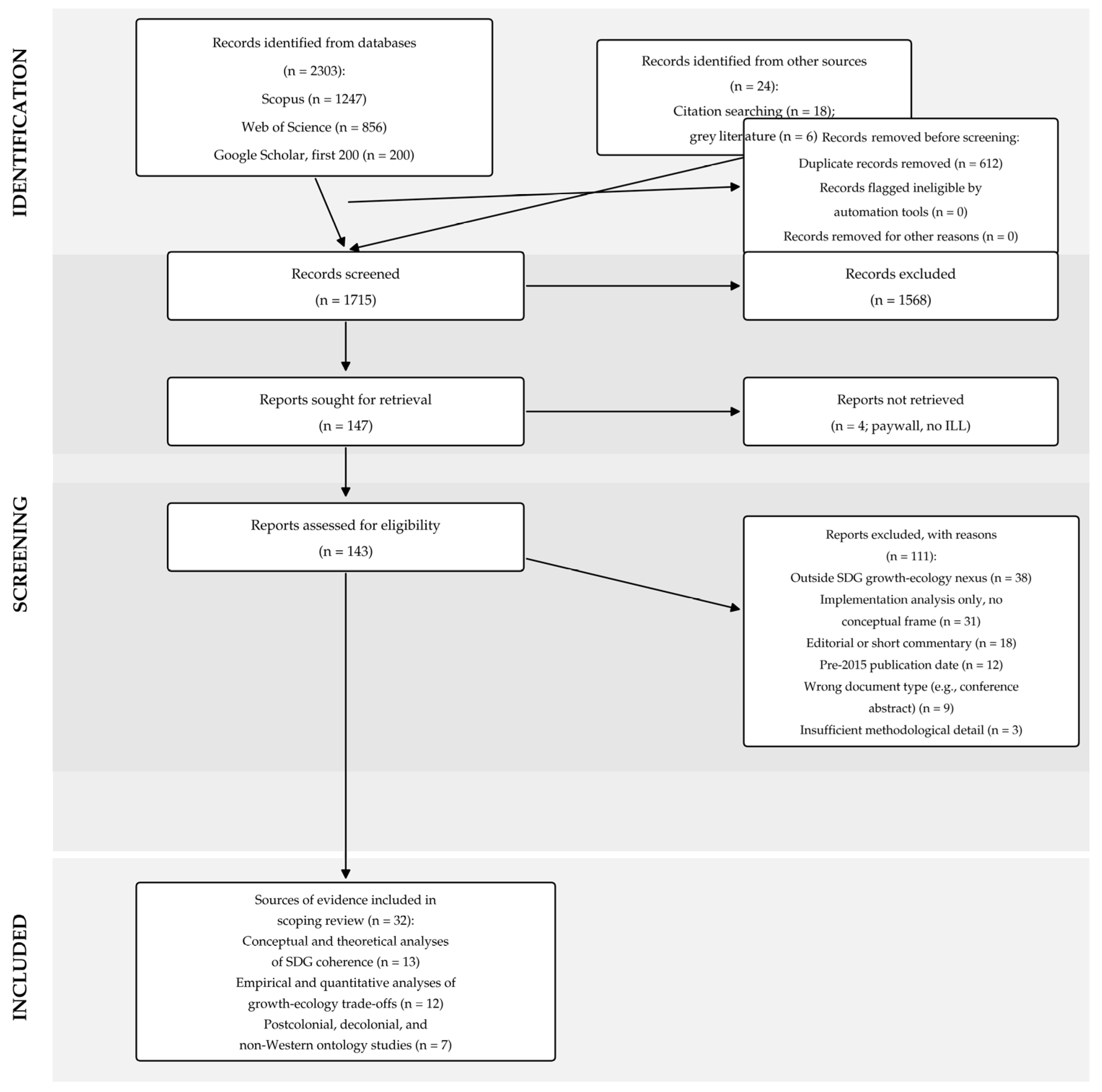
The database searches identified 2303 records, supplemented by 24 records from citation searching and grey literature, for a total of 2327 records. After removal of 612 duplicates, 1715 records were screened on title and abstract; 1568 were excluded at this stage as outside the scope. Full texts of 147 reports were sought, of which 4 could not be retrieved within the review window. Of the 143 reports assessed against the full eligibility criteria, 111 were excluded with documented reasons (Figure 1). The final corpus comprised 32 sources of evidence: 13 conceptual or theoretical analyses, 12 empirical or quantitative analyses, and 7 postcolonial, decolonial, or non-Western ontology studies. Recent UN policy documents and methodological references are cited as background but were not subject to the selection process.

3.2. Characteristics of Included Sources

Table 1 summarizes the 32 included sources. The corpus is dominated by peer-reviewed journal articles in ecological economics, sustainability science, development studies, and critical policy analysis. The geographic focus skews toward global or transnational analyses; explicit Global South case studies are present but underrepresented [14,15,16,22]. Methodological approaches divide roughly evenly between conceptual or theoretical work and empirical analyses; the latter range from indicator-based studies [10,11] and statistical modelling [4,23] through reviews of the decoupling literature [13,24] to planetary-boundary assessments [8].

3.3. Synthesized Findings: Four Cross-Cutting Themes

Thematic charting across the 32 included sources surfaced four cross-cutting findings, each addressed below. Themes 1–3 directly map to the three review questions; Theme 4 emerges from the synthesis itself and represents the principal conceptual contribution of this review.

3.3.1. Theme 1: The Empirical Incompatibility Thesis (RQ1)

The claim that economic growth and ecological sustainability are fundamentally incompatible within the SDG framework is supported by a substantial body of empirical research within the included corpus. Spaiser et al. [4] used statistical modelling across more than 200 countries to show that improvements in ecological indicators consistently trade off against economic growth metrics, leading them to characterize sustainable development as an “oxymoron” given current structural arrangements. Eisenmenger et al. [2] extended this analysis from a socio-ecological perspective, arguing that the SDGs systematically prioritize economic growth over sustainable resource use, and that efficiency gains are insufficient to decouple growth from environmental destruction at the necessary scale.
Hickel [3] sharpened the critique by focusing directly on the internal logic of the framework. If the SDGs are taken seriously as binding commitments, the growth targets in Goal 8 make the ecological targets in Goals 12 through 15 unachievable. There is no empirically demonstrated pathway by which the least developed countries can sustain the 7% annual growth that Goal 8 sets for them, alongside the continued growth the framework anticipates elsewhere (global output has lately grown closer to 3% a year), while simultaneously reducing material footprint and carbon emissions to the degree required by the Paris Agreement and the planetary boundaries framework [3,30]. Jain and Jain [7] reached a similar conclusion from a policy-analysis perspective, finding that the SDGs as written are not operationally sustainable because their economic commitments override their ecological ones at every practical decision point. The most recent assessment by Leal Filho et al. [31] catalogues empirical trade-offs across the goals and confirms that the pursuit of SDG 8 systematically undermines progress on SDG 13 and SDG 15.
The claim that future technological decoupling can resolve the contradiction is the most frequent counter-position in the corpus. Hickel and Kallis [24] and Parrique et al. [13], in independent reviews of the empirical decoupling literature, find no evidence that absolute decoupling at the global level is occurring fast enough, deeply enough, or durably enough to align growth with ecological limits. Rare cases of absolute decoupling are sectoral, geographically narrow, or based on consumption accounting that excludes offshored emissions. Richardson et al. [8] report that six of nine planetary boundaries are now transgressed, with the rate of transgression increasing for all boundaries except stratospheric ozone. Aligning growth with these limits would require an unprecedented rate of absolute decoupling that has no precedent in the historical record.
What makes these findings significant beyond their empirical claims is the level at which the tension exists. Goal 8 presupposes that the economy is, in principle, unbounded; that material throughput can grow indefinitely or be decoupled from biophysical reality through innovation. The ecological goals presuppose the opposite, that the biosphere imposes hard limits on human activity. Across the included literature, these are treated not merely as competing policy priorities but as contrasting underlying assumptions about how social and ecological systems operate.

3.3.2. Theme 2: Three Mechanisms of Concealment/Paradigmatic Stacking (RQ2)

If Theme 1 establishes that the contradiction is substantive in much of the reviewed literature, Theme 2 addresses how the framework may keep it from being operationally tested. Synthesizing across the corpus, three mechanisms recur. The synthesis introduces paradigmatic stacking as a name for the pattern: the practice of embedding contradictory foundational assumptions within a governance framework while presenting the framework as internally consistent. Put more simply, the framework can be read as layering two worldviews that are difficult to reconcile and then presenting the arrangement as a single coherent vision. The concept is developed further in the Discussion (Section 4.3); here the three mechanisms are reported as findings emerging from the literature.
Mechanism 1: Rhetorical absorption of ecological limits. The first mechanism observed across the corpus is rhetorical: the language of ecological limits is absorbed into the language of growth, such that the two appear complementary rather than opposed. This works primarily through the concept of “green growth” or “sustainable growth,” which pervades the SDG framework and its associated discourse [3,25]. Adelman [25] argues that the SDGs are fundamentally shaped by an anthropocentric and neoliberal worldview that treats the environment as a set of resources to be managed in service of human economic activity, rather than as a system with intrinsic limits and value. Telleria and García-Arias [37] deepen this analysis by examining the SDGs as a political narrative; they argue that the 2030 Agenda constructs a fantasmatic narrative in which the contradictions of capitalism can be resolved without structural transformation, through technological innovation, market mechanisms, and voluntary cooperation. Eisenmenger et al. [2] provide empirical grounding: their analysis shows that the SDGs structurally privilege economic indicators over biophysical ones at every operational decision point.
Mechanism 2: Strategic vagueness in targets and indicators. The second mechanism is the systematic vagueness of SDG targets and indicators. Numerous included sources document the vagueness [5,11,12,35,36,38], but its function within paradigmatic stacking has not been adequately theorized. If the SDGs specified, with precision, how much GDP growth was expected and how much carbon reduction was required within the same timeframe, the mathematical impossibility of achieving both would be immediately apparent. The vagueness of the targets keeps that calculation off the table. Swain [35] and Swain and Wallentin [36] show that many SDG targets lack clear metrics, deadlines, or quantitative thresholds, making it nearly impossible to determine whether progress on one goal is undermining progress on another. Hák et al. [11] argued early on that without indicators capable of capturing interlinkages and trade-offs, the framework would inevitably default to cherry-picking favourable metrics. The 2025 update of the indicator framework, which produced 234 indicators across 169 targets, retained the structural problem rather than resolving it; many environmental targets still lack the data needed for proper analysis [6].
Mechanism 3: Ontological exclusion. The third mechanism is the exclusion of alternative ontologies, particularly non-Western conceptions of development and well-being, that would expose the growth–ecology contradiction by refusing its foundational premise. Van Norren [39] demonstrates that frameworks such as Gross National Happiness (Bhutan), Ubuntu (Southern Africa), and Buen Vivir (Latin America) operate from fundamentally different assumptions about the relationship between human beings and the natural world. In these frameworks, the economy is not an autonomous domain that can be grown independently of ecological reality; it is embedded within, and subordinate to, broader systems of social and ecological relationality. Krauss et al. [14] make a related argument through a decolonial lens, showing that SDGs 8, 9, 12, 13, and 15, when examined through non-Western perspectives, reveal deep failures of imagination rooted in colonial patterns of knowledge production. Struckmann [15], applying a postcolonial feminist analysis to the 2030 Agenda in the South African context, similarly finds that the framework reproduces the very power structures it claims to address. Uddin [16] reads the metamorphosis of the SDGs through a Kafkaesque lens, framing the framework as a structure that absorbs and neutralizes the very critiques that might transform it. The exclusion operates at two levels. Procedurally, as Boluk et al. [26] and Rai et al. [33] document, the SDG drafting and implementation processes remain dominated by powerful states and corporate actors. Epistemologically, the framework’s indicators rest on assumptions specific to the Western liberal tradition but presented as universal [10,16].
Table 2 condenses the three mechanisms into a set of illustrative examples drawn from the official SDG target language and from the critical literature reviewed in this section [1,11,13,24]. It is intended to show how the framework’s wording can be read alongside recurring concerns in the corpus about rhetorical absorption [6], strategic vagueness, and ontological exclusion, rather than to provide exhaustive coding of all targets and indicators.

3.3.3. Theme 3: Excluded Ontologies and the Limits of Universalism (RQ3)

Theme 3 deepens the third mechanism by mapping what the framework excludes. The included corpus describes at least three substantive alternative ontologies of development that operate from premises incompatible with the growth–ecology stack. These three are not offered as an exhaustive set of alternatives to GDP-based development, nor as the only critiques worth weighing. Degrowth, doughnut economics, and the wider beyond-GDP programme all contest the growth paradigm, and several appear in the corpus. The three traditions are foregrounded here for a specific reason: each is a codified, operating governance philosophy (constitutional in Ecuador and Bolivia, index-based in Bhutan, and invoked in South African jurisprudence) that rejects the separation of economy from ecology at the level of first premises, rather than contesting the growth rate or the headline metric from within a shared analytical frame. The distinction the review draws is therefore ontological rather than geographic. “Non-Western” is used here as shorthand for that difference in premises, not as a claim that the SDGs are a uniquely Western artefact or that no Western tradition shares these commitments. From the standpoint of Ubuntu, human well-being is constituted through communal relationships that include but are not limited to material provision [39]. Whether well-being is adequately captured by GDP is itself a large and unsettled debate, and a substantial beyond-GDP literature has grown up to address the limits of economic output as a measure of progress [10]. Within the Ubuntu frame specifically, the claim is stronger: to equate well-being with economic output is not merely contestable but conceptually incoherent, because well-being is constituted relationally rather than as a quantity of goods. Buen Vivir likewise rejects the separation of economy and ecology altogether, treating the health of the natural world as intrinsic to, rather than instrumental for, human flourishing [39]. Ecuador’s 2008 constitutional codification of the rights of nature offers a concrete legal expression of this view, one that has no analogue in the SDG indicator architecture. Bhutan’s Gross National Happiness Index, refined since the 1970s, operationalizes nine domains spanning psychological well-being, time use, community vitality, cultural diversity, ecological resilience, and good governance, on a parallel rather than subordinate basis with material conditions.
If these perspectives had been substantively integrated into the SDG framework, the growth–ecology contradiction would have been immediately visible, because the foundational assumption that makes the contradiction possible, the separation of economy from ecology, is precisely what these frameworks reject. Their exclusion is therefore not incidental to the paradigmatic stacking of the SDGs; it is a precondition for it. Table 3 maps these alternatives across six dimensions to make the comparison legible. The first column labels the growth-centred logic that Goal 8 encodes rather than “the West” as such; that logic is globally dominant and is shared well beyond any single region, which is why the comparison is built around premises rather than geography.

3.3.4. Theme 4: Generalization Across Multilateral Frameworks

Theme 4 emerges from the synthesis itself rather than from any single included source. If paradigmatic stacking is real, it should appear in other multilateral frameworks that face similar pressures: the need to attract universal assent across deeply divergent worldviews, the absence of binding enforcement, and the political requirement that no major signatory be forced to choose between core commitments. The corpus does not address this generalization directly, since the included sources focus on the SDGs. Citation searching of the included sources, however, surfaced credible parallels in the broader policy literature, summarized in Table 4. These parallels are an analytical extension rather than a finding of the review. They were generated by reading the primary texts of the instruments concerned, for example the Pact for the Future, against the three mechanisms, not by coding implementation reports or outcome data, and are best treated as hypotheses for dedicated study rather than as established results; Section 4.5 records this as a limitation. The most striking case is the 2024 Pact for the Future [40], in which Action 53 commits member states to develop “measures of progress that complement and go beyond gross domestic product” while the same document reaffirms the 2030 Agenda’s growth-centred architecture. The same document that promises to move beyond GDP recommits to a framework whose economic logic is GDP-bound. Action 12.b of the Pact sets the formal start of post-2030 framework discussions for the High-level Political Forum in September 2027 [9].

4. Discussion

4.1. Principal Findings

This review identifies four cross-cutting findings. First, the empirical literature converges on incompatibility between the growth-oriented and ecology-oriented goals of the 2030 Agenda. Second, the framework sustains its incoherence through three recurrent mechanisms, which the synthesis names paradigmatic stacking: rhetorical absorption of ecological limits, strategic vagueness of targets and indicators, and ontological exclusion of non-Western conceptions of development. Third, the same architecture appears in other major multilateral frameworks, suggesting paradigmatic stacking is a general feature of consensus multilateralism rather than a defect peculiar to the SDGs. Fourth, the corpus offers substantive resources for an alternative architecture grounded in epistemic plurality, summarized below as ontological pluralism. Read together, these findings shift the terms of the debate about why the SDGs are failing. Empirical modelling and conceptual critique in the corpus reach the same incompatibility conclusion from independent starting points, which makes it harder to read the 35% of targets on track and 18% in regression at the 2025 midpoint [6] as a problem of financing and political will alone. The convergence points instead to a problem of conceptual design, the question that implementation-focused assessments tend to set aside, and it is that gap the present synthesis addresses. The remainder of the discussion engages counterarguments, develops the conceptual contributions, and notes implications for the post-2030 framework.

4.2. Engaging Counterarguments

The synthesis invites three serious objections. The first comes from technological optimists who hold that decoupling is feasible at scale [6,41]. The second comes from reformist scholars who argue that the SDGs are useful even if imperfect, and that critique should aim at incremental improvement rather than wholesale replacement [28,38]. The third comes from political realists who note that universal multilateral agreements survive precisely because they are vague, and that demanding ontological precision is a recipe for diplomatic failure.
The technological-optimist position has been addressed in Theme 1. The included reviews of the empirical decoupling literature [13,24] find no evidence of absolute decoupling at the scale and speed required. Even granting the possibility of future decoupling, the SDG framework tends to present growth and ecology as compatible in principle, a position the empirical record does not yet substantiate. The framework does not condition its coherence on a not-yet-existing technology; it largely treats that coherence as assumable in advance.
The reformist position is more sympathetic. Vandemoortele [38], one of the architects of the Millennium Development Goals, argues that “muddle-headed” universality may be politically necessary. There is force in this. Universal frameworks have value as coordinating devices even when their internal logic is imperfect. But the cost of the muddle is now visible. With only 35% of targets on track at the 2025 midpoint and 18% in regression [6], the SDGs face a credibility problem that further muddle will not fix. The reformist response treats the problem as one of implementation; the synthesis here treats it as one of conceptual architecture. If the architecture is incoherent, better implementation will not produce coherent outcomes.
The political–realist objection deserves the most respect. Vague universality is indeed how 193 nations were brought to one document [38]. The argument here is not that universality should be abandoned but that the price paid for it should be visible. A framework that openly named its trade-offs would attract fewer signatures, but its signatures would mean something more specific than the current ones do. The Pact for the Future, with its commitment to “go beyond GDP” while reaffirming the 2030 Agenda’s growth premises, demonstrates the cost of the alternative path: even reform-minded multilateral agreements are now rehearsing the paradigmatic stacking they were meant to correct [40].

4.3. From Paradigmatic Stacking to Ontological Pluralism

The synthesis offers paradigmatic stacking as an analytical term that captures what happens when a governance instrument embeds two or more incompatible ontological assumptions and then deploys institutional mechanisms to prevent their collision from becoming explicit. The concept draws on, but extends, several traditions. From ecological economics, it takes the insight that the economy is a subsystem of the biosphere, not a parallel domain [2,10]. From postcolonial development theory, it takes the observation that Western modernization narratives have long naturalized economic growth as a universal good, displacing alternative conceptions of human flourishing [15,16,39]. From critical discourse analysis, it borrows the recognition that policy language actively constructs the problems it claims to describe, and that the framing of goals shapes which solutions appear possible [37]. What paradigmatic stacking adds is a structural account of how these contradictions are managed within a single document, not through argument or evidence but through the architecture of the framework itself.
The concept is distinct from policy trade-offs. Trade-offs occur between goals that are, in principle, commensurable [42]: one can weigh the costs and benefits of investing in education versus infrastructure within a shared evaluative framework. Paradigmatic stacking, as the term is used here, describes cases in which the goals appear to presuppose incompatible evaluative frameworks and the governing instrument does not clearly acknowledge or adjudicate the incompatibility. The SDGs do not ask decision-makers to weigh growth against ecology. Instead, they present both as simultaneously desirable while providing limited means for assessing the relationship between them; much of the critical literature faults the framework precisely for leaving that relationship under-specified [11,12,35]. The empirical evidence in the included corpus suggests that the two cannot, under current conditions, be fully achieved at once.
If paradigmatic stacking is the analytical concept that emerges from the review, ontological pluralism is the prescriptive contribution that follows from it. A pluralist framework would rest on three principles. First, honest naming: the contradictions that the SDGs conceal would be stated openly, with the framework specifying the conditions under which one goal takes priority over another rather than asserting their full simultaneous achievability. Second, epistemic diversity: non-Western ontologies of development would become structural co-equals in defining what counts as progress, not decorative footnotes. Bhutan’s Gross National Happiness Index, Ecuador’s constitutional rights of nature, and South Africa’s invocation of Ubuntu in jurisprudence are all working governance philosophies, not cultural curiosities. Third, structured trade-off accountability: states would document and justify the trade-offs they make between competing goals rather than reporting only progress on the goals they are winning on.
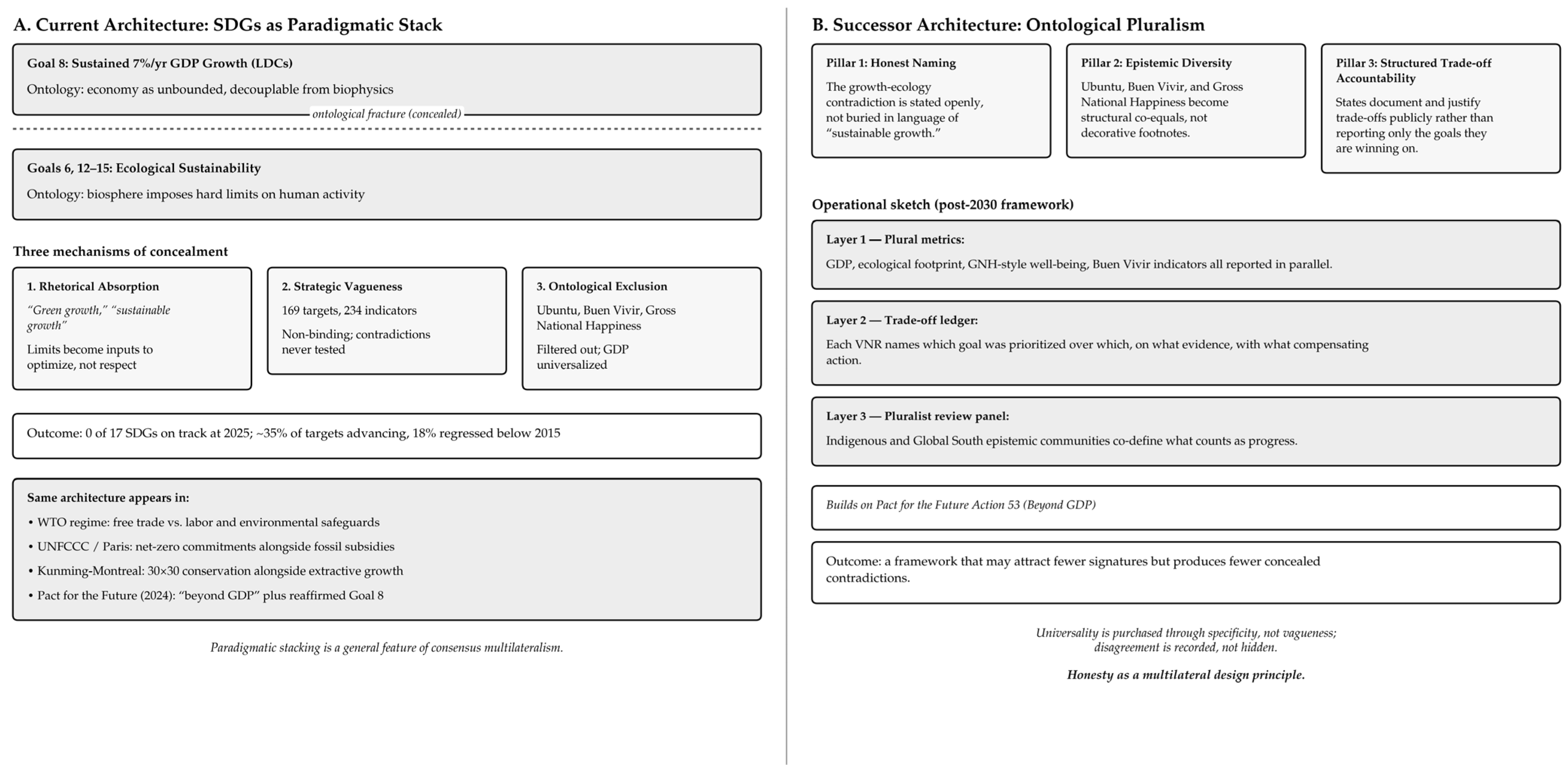
Principle without design rarely survives multilateral negotiation. The following operational sketch translates ontological pluralism into a structure the post-2030 process could plausibly adopt. The first layer is plural metrics: a successor framework would publish, for each member state, a panel of progress indicators reflecting at least three families of value in parallel: conventional economic indicators (GDP and related measures); ecological-footprint and planetary-boundary metrics; and at least one measure of human and relational flourishing that does not reduce to economic output. Which flourishing measures a successor framework adopts, and how they are defined, is a matter for inclusive international deliberation rather than scholarly prescription; working philosophies such as Bhutan’s Gross National Happiness Index and the relational ethics of Ubuntu and Buen Vivir are noted here as evidence that such measures already operate in practice, not as a fixed menu to be imposed on the post-2030 process. None would be designated the headline number. The second layer is a trade-off ledger: each Voluntary National Review would include a public ledger that names, for the reporting period, which goals were prioritized over which, on what evidentiary basis, and with what compensating action. A state choosing to permit fossil fuel expansion to meet a poverty target would be required to record the choice and its biophysical consequences. The third layer is a pluralist review panel: the High-level Political Forum, or its post-2030 successor, would seat indigenous and Global South epistemic communities as voting co-reviewers of national progress. Action 53 of the Pact for the Future already commits member states to a “beyond GDP” measurement framework [40]; the architecture proposed here extends that commitment from a parallel measurement supplement into the central design principle of the post-2030 agenda. Figure 2 summarizes both the diagnostic and the proposed alternative.

4.4. Implications for the Post-2030 Framework

The timing of the post-2030 conversation matters. The Pact for the Future sets the formal start of post-2030 framework discussions for the September 2027 High-level Political Forum [9]. The High-level Expert Group on Beyond GDP was tasked with delivering its initial framework by late 2025 [40]. The window for influencing the conceptual architecture of the successor framework is open now and will close before the decade ends. Scholarship that critiques the SDGs after 2030 will arrive too late; the new framework will already be drafted. The synthesis here, and particularly the operational sketch in Section 4.3, is offered as a contribution to that pre-2030 design conversation.
Six implications follow for that conversation. First, the post-2030 framework should treat the growth–ecology contradiction as a design constraint to be navigated, not a tension to be smoothed over. Second, indicator reform alone will not produce coherence; the framework needs a structured trade-off ledger so that progress on one goal can be read against deterioration on another. Third, the “beyond GDP” project initiated under Action 53 of the Pact for the Future should be expanded into a plural-metrics architecture rather than a single replacement metric. Fourth, the procedural exclusion documented in Theme 3 must be addressed institutionally; advisory participation will not suffice. Fifth, the analytical framework of paradigmatic stacking developed here can be applied to other policy domains, including AI governance and biodiversity, to identify where concealed contradictions are undermining policy effectiveness. The Global Digital Compact annexed to the Pact for the Future shows early signs of similar architecture, with innovation-acceleration commitments stacked alongside rights-protection commitments without explicit adjudication [40]. Sixth, none of this works without confronting who is responsible for what. A pluralism that names trade-offs but assigns no obligations would reproduce the evasion it sets out to correct [42]. The trade-off ledger proposed in Section 4.3 should therefore be tied to differentiated responsibility, recording not only which goals a state prioritized but what its capabilities and historical contribution imply about the burden it should carry; and the pluralist review panel should have standing to require justification and to register non-compliance. Accountability of this kind, rather than additional metrics, is the harder political problem [41]. Absent it, even a well-designed successor framework will founder on the same incentives that left the SDGs unmet, which is why the design principles above are necessary but not sufficient on their own.

4.5. Strengths and Limitations

The synthesis is grounded in a corpus of 32 included sources spanning conceptual, empirical, and postcolonial traditions, with the empirical and conceptual streams converging on the same incompatibility finding from independent methodological starting points. While this is a strength, several limitations should be noted. First, the search was restricted to English-language sources, which likely under-represents Latin American and South Asian scholarship even with the inclusion of translated work [16,30]. Second, only the first 200 Google Scholar results were retrieved per query, which is the practical retrieval ceiling but trades depth for tractability. Third, double screening was applied to a 10% subsample rather than the full corpus, which is acceptable practice for scoping reviews [19] but does not match the dual-screening rigour of a systematic review. Fourth, the generalization in Theme 4 to the WTO regime, the Paris Agreement, the Kunming–Montreal Framework, and the Pact for the Future is an analytical extension of the corpus rather than a finding from the corpus itself; future scoping work focused on each of those frameworks would strengthen or qualify the generalization. Fifth, the operational sketch in Section 4.3 is designed to be defended at the level of principle rather than at the level of detailed institutional design; further work, ideally interdisciplinary and including Global South governance scholars and indigenous knowledge holders, would be needed to translate it into specific institutional proposals. Sixth, naming Ubuntu, Buen Vivir, and Gross National Happiness in the search string may have steered the corpus toward these three traditions at the expense of other critiques of growth-based development, such as degrowth, doughnut economics, and the wider beyond-GDP literature; the broader critique terms in Block C were intended to offset this, but the risk of selection effects in the non-Western stream cannot be ruled out.

5. Conclusions

The Sustainable Development Goals are not simply falling short of their targets. The reviewed literature synthesized here suggests that they are also constrained by deep conceptual tensions. The simultaneous commitment to continued economic growth and ecological sustainability is presented in much of the critical corpus not as a tension that better policy design can easily resolve, but as an ontological contradiction between two difficult-to-reconcile descriptions of reality: one in which the economy can expand without limit, and one in which the biosphere imposes hard boundaries on human activity. This scoping review has mapped the literature that documents that contradiction, synthesized the three mechanisms by which the framework may conceal it, identified non-Western ontological resources for an alternative, and argued that a similar architecture may be appearing in fresh form in the 2024 Pact for the Future. On this reading, the paradigmatic stacking observed in the SDGs is not necessarily a unique defect; it may be a recurrent feature of consensus multilateralism.
The alternative proposed here, ontological pluralism, does not promise easy consensus. It asks the international community to do something more difficult than signing a universal declaration: to name, clearly and publicly, the worldview conflicts that make sustainable development hard, and to build governance structures that navigate those conflicts rather than concealing them. The operational sketch (Section 4.3) shows that this is not merely a theoretical aspiration. Plural metrics, public trade-off ledgers, and pluralist review panels are designable institutions, achievable through deliberate effort.
The 2030 deadline approaches with most goals off track. The post-2030 conversation begins formally in 2027. The international community has an opportunity to learn from the conceptual failures of the SDGs, not just their implementation shortcomings. The question is not whether the next generation of global goals will be ambitious, but whether they will confront these tensions more explicitly.

Author Contributions

Conceptualization, B.G. and T.L.H.; methodology, B.G.; investigation, B.G. and T.L.H.; writing—original draft preparation, B.G.; writing—review and editing, B.G. and T.L.H.; visualization, B.G.; supervision, T.L.H. All authors have read and agreed to the published version of the manuscript.

Funding

This research received no external funding.

Institutional Review Board Statement

Not applicable. This study did not involve humans or animals.

Informed Consent Statement

Not applicable.

Data Availability Statement

No new data were created or analyzed in this study. Data sharing is not applicable to this article.

Conflicts of Interest

The authors declare no conflicts of interest.

References

  1. United Nations. Transforming Our World: The 2030 Agenda for Sustainable Development; UN General Assembly Resolution A/RES/70/1; United Nations: New York, NY, USA, 2015. [Google Scholar]
  2. Eisenmenger, N.; Pichler, M.; Krenmayr, N.; Noll, D.; Plank, B.; Schalmann, E.; Wandl, M.; Gingrich, S. The Sustainable Development Goals prioritize economic growth over sustainable resource use: A critical reflection on the SDGs from a socio-ecological perspective. Sustain. Sci. 2020, 15, 1101–1110. [Google Scholar] [CrossRef]
  3. Hickel, J. The contradiction of the sustainable development goals: Growth versus ecology on a finite planet. Sustain. Dev. 2019, 27, 873–884. [Google Scholar] [CrossRef]
  4. Spaiser, V.; Ranganathan, S.; Swain, R.B.; Sumpter, D.J.T. The sustainable development oxymoron: Quantifying and modelling the incompatibility of sustainable development goals. Int. J. Sustain. Dev. World Ecol. 2017, 24, 457–470. [Google Scholar] [CrossRef]
  5. Spangenberg, J.H. Hot air or comprehensive progress? A critical assessment of the SDGs. Sustain. Dev. 2017, 25, 311–321. [Google Scholar] [CrossRef]
  6. Sachs, J.D.; Lafortune, G.; Fuller, G.; Iablonovski, G. Sustainable Development Report 2025: Financing Sustainable Development to 2030 and Mid-Century; SDSN/Dublin University Press: Dublin, Ireland, 2025. [Google Scholar] [CrossRef] [PubMed]
  7. Jain, P.; Jain, P. Are the Sustainable Development Goals really sustainable? A policy perspective. Sustain. Dev. 2020, 28, 1642–1651. [Google Scholar] [CrossRef]
  8. Richardson, K.; Steffen, W.; Lucht, W.; Bendtsen, J.; Cornell, S.E.; Donges, J.F.; Drüke, M.; Fetzer, I.; Bala, G.; von Bloh, W.; et al. Earth beyond six of nine planetary boundaries. Sci. Adv. 2023, 9, eadh2458. [Google Scholar] [CrossRef] [PubMed]
  9. International Institute for Sustainable Development (IISD). Building Momentum Towards 2030 and Beyond. SDG Knowledge Hub Policy Brief. 2025. Available online: https://sdg.iisd.org/commentary/policy-briefs/building-momentum-towards-2030-and-beyond/ (accessed on 30 April 2026).
  10. Coscieme, L.; Mortensen, L.F.; Anderson, S.; Ward, J.; Donohue, I.; Sutton, P.C. Going beyond Gross Domestic Product as an indicator to bring coherence to the Sustainable Development Goals. J. Clean. Prod. 2020, 248, 119232. [Google Scholar] [CrossRef]
  11. Hák, T.; Janoušková, S.; Moldan, B. Sustainable Development Goals: A need for relevant indicators. Ecol. Indic. 2016, 60, 565–573. [Google Scholar] [CrossRef]
  12. Persaud, N.; Dagher, R. Measuring the progress towards the Sustainable Development Goals. In Measuring Progress Towards the Sustainable Development Goals; Springer: Cham, Switzerland, 2021; pp. 193–231. [Google Scholar] [CrossRef]
  13. Parrique, T.; Barth, J.; Briens, F.; Kerschner, C.; Kraus-Polk, A.; Kuokkanen, A.; Spangenberg, J.H. Decoupling Debunked: Evidence and Arguments Against Green Growth as a Sole Strategy for Sustainability; European Environmental Bureau: Brussels, Belgium, 2019; Available online: https://eeb.org/library/decoupling-debunked/ (accessed on 30 April 2026).
  14. Krauss, J.E.; Cisneros, A.; Requena-i-Mora, M. Mapping Sustainable Development Goals 8, 9, 12, 13 and 15 through a decolonial lens: Falling short of ‘transforming our world’. Sustain. Sci. 2022, 17, 1855–1872. [Google Scholar] [CrossRef] [PubMed]
  15. Struckmann, C. A postcolonial feminist critique of the 2030 Agenda for Sustainable Development: A South African application. Agenda 2018, 32, 12–24. [Google Scholar] [CrossRef]
  16. Uddin, M. Metamorphosis of Sustainable Development Goals 2030: A shadow of Kafka’s world. IUBAT Rev. 2025, 8, 176–190. [Google Scholar] [CrossRef]
  17. Arksey, H.; O’Malley, L. Scoping studies: Towards a methodological framework. Int. J. Soc. Res. Methodol. 2005, 8, 19–32. [Google Scholar] [CrossRef]
  18. Levac, D.; Colquhoun, H.; O’Brien, K.K. Scoping studies: Advancing the methodology. Implement. Sci. 2010, 5, 69. [Google Scholar] [CrossRef] [PubMed]
  19. Peters, M.D.J.; Marnie, C.; Tricco, A.C.; Pollock, D.; Munn, Z.; Alexander, L.; McInerney, P.; Godfrey, C.M.; Khalil, H. Updated methodological guidance for the conduct of scoping reviews. JBI Evid. Synth. 2020, 18, 2119–2126. [Google Scholar] [CrossRef] [PubMed]
  20. Tricco, A.C.; Lillie, E.; Zarin, W.; O’Brien, K.K.; Colquhoun, H.; Levac, D.; Moher, D.; Peters, M.D.J.; Horsley, T.; Weeks, L.; et al. PRISMA Extension for Scoping Reviews (PRISMA-ScR): Checklist and explanation. Ann. Intern. Med. 2018, 169, 467–473. [Google Scholar] [CrossRef] [PubMed]
  21. Page, M.J.; McKenzie, J.E.; Bossuyt, P.M.; Boutron, I.; Hoffmann, T.C.; Mulrow, C.D.; Shamseer, L.; Tetzlaff, J.M.; Akl, E.A.; Brennan, S.E.; et al. The PRISMA 2020 statement: An updated guideline for reporting systematic reviews. BMJ 2021, 372, n71. [Google Scholar] [CrossRef] [PubMed]
  22. David, W. Beyond goals and targets: A critical reflection on the MDGs, SDGs, and the missing link in global development. Int. J. Res. Innov. Soc. Sci. 2025, 9, 2013–2017. [Google Scholar] [CrossRef]
  23. Swain, R.B.; Ranganathan, S. Modeling interlinkages between sustainable development goals using network analysis. World Dev. 2021, 138, 105136. [Google Scholar] [CrossRef]
  24. Hickel, J.; Kallis, G. Is green growth possible? New Polit. Econ. 2020, 25, 469–486. [Google Scholar] [CrossRef]
  25. Adelman, S. The sustainable development goals, anthropocentrism and neoliberalism. In Sustainable Development Goals: Law, Theory and Implementation; French, D., Kotzé, L.J., Eds.; Edward Elgar Publishing: Cheltenham, UK, 2018; pp. 15–40. [Google Scholar] [CrossRef]
  26. Boluk, K.A.; Cavaliere, C.T.; Higgins-Desbiolles, F. A critical framework for interrogating the United Nations Sustainable Development Goals 2030 Agenda in tourism. J. Sustain. Tour. 2019, 27, 847–864. [Google Scholar] [CrossRef]
  27. Dawes, J.H.P. Are the Sustainable Development Goals self-consistent and mutually achievable? Sustain. Dev. 2020, 28, 101–117. [Google Scholar] [CrossRef]
  28. Leal Filho, W.; Trevisan, L.V.; Rampasso, I.S.; Anholon, R.; Dinis, M.A.P.; Brandli, L.L.; Sierra, J.; Salvia, A.L.; Pretorius, R.; Nicolau, M.; et al. When the alarm bells ring: Why the UN sustainable development goals may not be achieved by 2030. J. Clean. Prod. 2023, 407, 137108. [Google Scholar] [CrossRef]
  29. Leal Filho, W.; Wall, T.; Sálvia, A.L.; Ozuyar, P.G.; Brandli, L.; Azul, A.M.; Sharifi, A. Mapping the implementation of the United Nations Sustainable Development Goals. Sustain. Dev. 2025; in press. [CrossRef]
  30. Hickel, J. La contradicción de los Objetivos de Desarrollo Sostenible: Crecimiento frente a ecología en un planeta finito. Relac. Int. 2025, 60, 10–32. [Google Scholar] [CrossRef]
  31. Leal Filho, W.; Dinis, M.A.P.; Ben Hassen, T. Trade-offs among SDGs: How the pursuit of economic, food, and urban development goals may undermine climate and equity targets. Sustain. Dev. 2025; in press. [CrossRef]
  32. Moyer, J.D.; Hedden, S. Are we on the right path to achieve the sustainable development goals? World Dev. 2020, 127, 104749. [Google Scholar] [CrossRef]
  33. Rai, S.M.; Brown, B.D.; Ruwanpura, K.N. SDG 8: Decent work and economic growth—A gendered analysis. World Dev. 2019, 113, 368–380. [Google Scholar] [CrossRef]
  34. Sorooshian, S. The Sustainable Development Goals of the United Nations: A comparative midterm research review. J. Clean. Prod. 2024, 453, 142272. [Google Scholar] [CrossRef]
  35. Swain, R.B. A critical analysis of the Sustainable Development Goals. In Handbook of Sustainability Science and Research; Leal Filho, W., Ed.; Springer: Cham, Switzerland, 2018; pp. 341–355. [Google Scholar] [CrossRef]
  36. Swain, R.B.; Wallentin, F.Y. Achieving sustainable development goals: Predicaments and strategies. Int. J. Sustain. Dev. World Ecol. 2020, 27, 96–106. [Google Scholar] [CrossRef]
  37. Telleria, J.; García-Arias, J. The fantasmatic narrative of ‘sustainable development’: A political analysis of the 2030 Global Development Agenda. Environ. Plan. C Polit. Space 2022, 40, 241–259. [Google Scholar] [CrossRef]
  38. Vandemoortele, J. From simple-minded MDGs to muddle-headed SDGs. Dev. Stud. Res. 2018, 5, S83–S89. [Google Scholar] [CrossRef]
  39. Van Norren, D.E. The Sustainable Development Goals viewed through Gross National Happiness, Ubuntu, and Buen Vivir. Int. Environ. Agreem. Polit. Law Econ. 2020, 20, 431–458. [Google Scholar] [CrossRef]
  40. United Nations. Pact for the Future; UN General Assembly Resolution A/RES/79/1, adopted 22 September 2024; United Nations: New York, NY, USA, 2024; Available online: https://docs.un.org/en/a/res/79/1 (accessed on 30 April 2026).
  41. Biggeri, M.; Bortolotti, L.; Ferrannini, A.; Saccone, D. China’s subnational policies and the performance of provinces towards meeting the UN’s Sustainable Development Goals. Reg. Stud. Reg. Sci. 2023, 10, 439–460. [Google Scholar] [CrossRef]
  42. Jansen, A.; Wang, R.; Behrens, P.; Hoekstra, R. Beyond GDP: A review and conceptual framework for measuring sustainable and inclusive wellbeing. Lancet Planet. Heal. 2024, 8, e695–e705. [Google Scholar] [CrossRef] [PubMed]
Figure 1. The PRISMA-ScR flow diagram for the scoping review.
Sustainability 18 06826 g001
Figure 2. Conceptual architecture of paradigmatic stacking in the SDGs (panel (A)) and the proposed ontological pluralism alternative (panel (B)). Panel (A) shows the ontological fracture between Goal 8 and Goals 6, 12–15, the three mechanisms that conceal the fracture, and the recurrence of the same architecture across other multilateral frameworks (Theme 4). Panel (B) illustrates the three pillars of ontological pluralism and an operational sketch for a post-2030 framework.
Sustainability 18 06826 g002
Table 1. Characteristics of the 32 included sources of evidence (alphabetical).
SourceMethodGeographic/Disciplinary FocusPrincipal Contribution
Adelman [25], 2018ConceptualGlobal/lawAnthropocentrism and neoliberalism in SDG architecture
Boluk et al. [26], 2019ConceptualGlobal/tourismCritical interrogation of 2030 Agenda in tourism studies
Coscieme et al. [10], 2020Empirical (indicator)GlobalGoing beyond GDP for SDG coherence
David [22], 2025ConceptualGlobal SouthMDG–SDG continuity and the missing-link critique
Dawes [27], 2020EmpiricalGlobalSelf-consistency and mutual achievability of the SDGs
Eisenmenger et al. [2], 2020Empirical/conceptualGlobalSocio-ecological prioritization of growth over resource use
Leal Filho et al. [28], 2023Empirical (review)GlobalWhy the SDGs may not be achieved by 2030
Leal Filho et al. [29], 2025Empirical (mapping)GlobalImplementation mapping of the SDGs
Hák et al. [11], 2016Conceptual (indicator)GlobalNeed for relevant SDG indicators capturing trade-offs
Hickel [3], 2019ConceptualGlobalFoundational growth–ecology contradiction in the SDGs
Hickel [30], 2025ConceptualGlobalSpanish-language elaboration of the contradiction thesis
Hickel and Kallis [24], 2020Empirical (review)GlobalReview of evidence on green growth feasibility
Jain and Jain [7], 2020Conceptual (policy)Global/IndiaPolicy-perspective sustainability of SDG architecture
Krauss et al. [14], 2022Postcolonial/decolonialGlobal SouthDecolonial mapping of SDGs 8, 9, 12, 13, 15
Leal Filho et al. [31], 2025Empirical (review)GlobalTrade-offs among SDGs across economic, food, and urban goals
Moyer and Hedden [32], 2020Empirical (modelling)GlobalForecasting SDG achievement under current trajectories
Parrique et al. [13], 2019Empirical (review)Europe/globalDecoupling debunked: evidence against green growth
Persaud and Dagher [12], 2021Conceptual/methodologicalGlobalMeasurement architecture of SDG progress
Rai et al. [33], 2019Postcolonial/genderedGlobalGendered analysis of decent work and growth (SDG 8)
Richardson et al. [8], 2023Empirical (Earth-system)GlobalSix of nine planetary boundaries transgressed
Sachs et al. [6], 2025Empirical (assessment)GlobalSDR 2025 progress assessment and financing analysis
Sorooshian [34], 2024Empirical (review)GlobalComparative midterm research review of SDG progress
Spaiser et al. [4], 2017Empirical (modelling)GlobalStatistical incompatibility of SDGs across countries
Spangenberg [5], 2017ConceptualGlobalAspirational vs. enforceable character of SDGs
Struckmann [15], 2018Postcolonial-feministSouth AfricaFeminist postcolonial critique of 2030 Agenda
Swain [35], 2018Conceptual (critical analysis)GlobalFoundational critical analysis of the SDGs
Swain and Ranganathan [23], 2021Empirical (network analysis)GlobalModelling interlinkages among SDGs
Swain and Wallentin [36], 2020Empirical/conceptualGlobalPredicaments and strategies for SDG achievement
Telleria and García-Arias [37], 2022Critical discourse analysisGlobalFantasmatic narrative of sustainable development
Uddin [16], 2025Postcolonial/criticalSouth Asia/globalKafkaesque metamorphosis of the SDGs
Vandemoortele [38], 2018ConceptualGlobalFrom simple-minded MDGs to muddle-headed SDGs
Van Norren [39], 2020Comparative ontologyBhutan, Africa, Latin AmericaGNH, Ubuntu, and Buen Vivir as alternatives
Table 2. The three mechanisms of paradigmatic stacking with illustrative SDG language (Source: Compilation by the authors).
MechanismIllustrative SDG LanguageWhat the Language Conceals
Rhetorical absorptionTarget 8.4: “Improve global resource efficiency in consumption and production… and endeavour to decouple economic growth from environmental degradation”Absolute decoupling at the required scale and speed has no historical precedent [13,24]; “endeavour” carries no obligation.
Rhetorical absorptionTarget 12.2: “Achieve sustainable management and efficient use of natural resources”“Sustainable” and “efficient” replace any explicit ceiling on aggregate throughput.
Strategic vaguenessTarget 13.2: “Integrate climate change measures into national policies, strategies and planning”No quantitative emissions threshold; no benchmark against which to test conflict with Goal 8.
Strategic vaguenessTarget 15.5: “Take urgent and significant action to reduce the degradation of natural habitats”“Significant” is undefined; states self-report progress.
Ontological exclusionAll 234 official indicators framed in monetary, productivity, or efficiency units [6]No indicator captures relational well-being, communal flourishing, or rights of nature on a parallel basis with GDP.
Ontological exclusionGoal 8 title: “Decent work and economic growth”Pairs labour protection with growth such that critique of growth becomes critique of decent work.
Table 3. Comparison of ontological frameworks underlying global development discourse.
DimensionGrowth-Centred Paradigm (Goal 8 Logic)UbuntuBuen VivirGross National Happiness
Economy–ecology relationParallel domains; ecology as input to economyEmbedded in communal relationalityInseparable; nature (Pacha Mama) has rightsEconomy subordinate to flourishing
Primary metric of progressGDP, growth rate, productivityCommunal flourishing; relational healthSumak kawsay (good life)Nine domains across psychological, cultural, ecological, and time-use dimensions
Time orientationLinear; future-discountedIntergenerational; ancestral continuityCyclical; regenerativeLong-term; multi-generational stewardship
Locus of agencyIndividual; firm; nation-stateCommunal; person-in-communityPlurinational; peoples and PachaNational; subnational; familial
Treatment of limitsSoft; technically displaceableRelational; defined by obligationsConstitutional (Ecuador 2008; Bolivia 2009)Cultural-policy; codified in royal-led indices
Implication for SDGsSustains the growth–ecology contradictionDissolves the separation that creates itRefuses the contradiction at constitutional levelSidelines GDP as a measure of progress
Table 4. Paradigmatic stacking across selected multilateral frameworks (analytical extension of the corpus).
FrameworkStacked CommitmentsDominant Mechanism
WTO multilateral trading systemFree trade vs. labour and environmental safeguardsStrategic vagueness; trade as unmarked default
UNFCCC/Paris Agreement1.5 °C limit vs. NDC inadequacy and persistent fossil fuel subsidiesRhetorical absorption (“transition away” without phase-out date)
Kunming–Montreal Global Biodiversity Framework30% protection by 2030 vs. continued extractive growth and “sustainable use”Ontological exclusion of indigenous tenure as headline metric
UN Sustainable Development GoalsGoal 8 growth vs. Goals 6, 12–15 ecological integrityAll three mechanisms operating in concert
Pact for the Future“Beyond GDP” measurement vs. reaffirmed 2030 Agenda growth premiseReproduction of all three mechanisms in fresh language
Disclaimer/Publisher’s Note: The statements, opinions and data contained in all publications are solely those of the individual author(s) and contributor(s) and not of MDPI and/or the editor(s). MDPI and/or the editor(s) disclaim responsibility for any injury to people or property resulting from any ideas, methods, instructions or products referred to in the content.