The Impact of Digital Inclusive Finance on the High-Quality Development of Rural Industries—Evidence from China


Abstract
1. Introduction
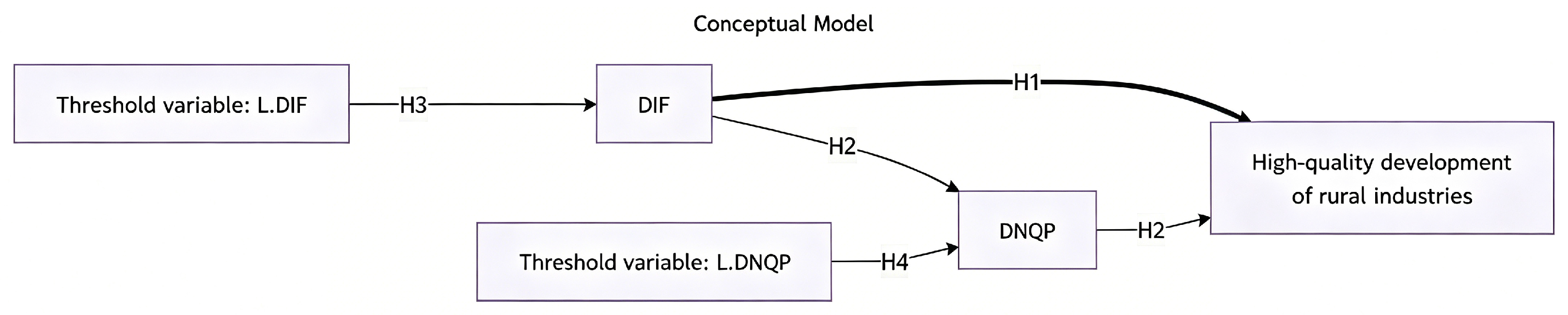
2. Theoretical Analysis and Research Hypotheses
2.1. DIF and High-Quality Development of Rural Industries
2.2. DIF, DNQP and High-Quality Development of Rural Industries
2.3. The Threshold Effect of DIF and DNQP
3. Research Methodology
3.1. Variable Selection and Data Sources
3.2. Model Settings
4. Empirical Analysis
4.1. Baseline Regression Analysis
4.2. Robustness Test
4.3. Mediation Mechanism Test
4.4. Threshold Effect Test
4.5. Heterogeneity Analysis Test
5. Conclusions and Policy Recommendations
5.1. Conclusions
5.2. Policy Recommendations
5.3. Limitations
Author Contributions
Funding
Institutional Review Board Statement
Informed Consent Statement
Data Availability Statement
Conflicts of Interest
Abbreviations
| DIF | Digital inclusion finance |
| DNQP | Digital new quality productivity |
| IV | Instrumental variable |
| VIF | Variance inflation factor |
References
- Wang, J.; Chen, X.; Li, X. Research on technology inducement mode of science and technology parks for rural industry revitalization. Issues Agric. Econ. 2023, 6, 135–144. [Google Scholar] [CrossRef]
- Liao, M.; Peng, H.; Jia, J. Rethinking China’s Rural Revitalization Strategy: Logical Framework, Patterns and Trends, and Implementation Strategies. China Popul. Resour. Environ. 2024, 34, 1–12. [Google Scholar]
- Qing, P.; Wang, J.; Cai, W. Reflections on the revitalization of rural industries in building up China’s strength in agriculture. Econ. Rev. J. 2023, 9, 21–28. [Google Scholar] [CrossRef]
- Tiwasing, P.; Clark, B.; Gkartzios, M. How can rural businesses thrive in the digital economy? A UK perspective. Heliyon 2022, 8, e10745. [Google Scholar] [CrossRef] [PubMed]
- Zhang, C.; Zhu, Y.; Zhang, L. Effect of DIF on common prosperity and the underlying mechanisms. Int. Rev. Financ. Anal. 2024, 91, 102940. [Google Scholar] [CrossRef]
- Du, Y.; Wang, Q.; Zhou, J. How does DIF affect economic resilience: Evidence from 285 cities in China. Int. Rev. Financ. Anal. 2023, 88, 102709. [Google Scholar] [CrossRef]
- Liu, D.; Li, Y.; You, J.; Balezentis, T.; Shen, Z. DIF and green total factor productivity growth in rural areas. J. Clean. Prod. 2023, 418, 138159. [Google Scholar] [CrossRef]
- Wang, J. DIF and rural revitalization. Financ. Res. Lett. 2023, 57, 104157. [Google Scholar] [CrossRef]
- Grossman, J.; Tarazi, M. Serving smallholder farmers: Recent developments in digital finance. Focus Note 2014, 94, 1–15. [Google Scholar]
- Guo, B.; Feng, Y.; Lin, J. DIF and digital transformation of enterprises. Financ. Res. Lett. 2023, 57, 104270. [Google Scholar] [CrossRef]
- Li, M.; Wang, C.; Wu, Y. Ensuring food security: How does DIF affect the new quality productivity of grain. Front. Sustain. Food Syst. 2025, 9, 1737358. [Google Scholar] [CrossRef]
- Sun, L.; Zhu, C. Impact of DIF on Rural High-Quality Development: Evidence from China. Discret. Dyn. Nat. Soc. 2022, 2022, 7939103. [Google Scholar] [CrossRef]
- Li, E.; Tang, Y.; Zhang, Y.; Yu, J. Mechanism research on DIF promoting high-quality economic development: Evidence from China. Heliyon 2024, 10, e25671. [Google Scholar] [CrossRef] [PubMed]
- Lee, C.-C.; Tang, M.; Lee, C.-C. Reaping digital dividends: DIF and high-quality development of enterprises in China. Telecommun. Policy 2023, 47, 102484. [Google Scholar] [CrossRef]
- Huang, S. The practical logic of the new endogenous development and power integration of rural characteristic industries. J. Nanjing Agric. Univ. (Soc. Sci. Ed.) 2026, 26, 69–78. [Google Scholar] [CrossRef]
- Lin, L. TRL Digital new quality productivity boosting farmers’ income: Theoretical mechanism and empirical test. Econ. Probl. 2025, 8, 104–112. [Google Scholar] [CrossRef]
- Zhang, Z.; Sun, C.; Wang, J. How can the digital economy promote the integration of rural industries—Taking China as an example. Agriculture 2023, 13, 2023. [Google Scholar] [CrossRef]
- Liu, Y.; Dai, L.; Long, H.; Woods, M.; Fois, F. Rural vitalization promoted by industrial transformation under globalization: The case of Tengtou village in China. J. Rural Stud. 2022, 95, 241–255. [Google Scholar] [CrossRef]
- Zhou, J.; Chen, H.; Bai, Q.; Liu, L.; Li, G.; Shen, Q. Can the integration of rural industries help strengthen China’s agricultural economic resilience? Agriculture 2023, 13, 1813. [Google Scholar] [CrossRef]
- Chen, X.; Wu, R. How can rural industrial revitalization and rural education level reduce the urban–rural income gap? Financ. Res. Lett. 2025, 73, 106592. [Google Scholar] [CrossRef]
- Zhang, L.; Azam, S.F.; Tham, J. Impact of DIF on the High-Quality Development of Rural Economy: Evidence from China. Res. World Agric. Econ. 2025, 6, 192–210. [Google Scholar] [CrossRef]
- Botta, A.; Caverzasi, E.; Russo, A.; Gallegati, M.; Stiglitz, J.E. Inequality and finance in a rent economy. J. Econ. Behav. Organ. 2021, 183, 998–1029. [Google Scholar] [CrossRef]
- Yu, C.; Hui, E.C.-M.; Dong, Z. DIF and entrepreneurship in rural areas: Evidence from China. China Agric. Econ. Rev. 2024, 16, 712–730. [Google Scholar] [CrossRef]
- Xi, J. Accelerate the Development of New Quality Productive Forces and Steadily Promote High-Quality Development. People’s Daily, 2 February 2024. Available online: https://cpc.people.com.cn/n1/2024/0201/c64094-40171173.html (accessed on 14 May 2026).
- Agency, X.N. Decision of the Central Committee of the Communist Party of China on Further Comprehensively Deepening Reform and Promoting Chinese-style Modernization. 2024. Available online: http://www.news.cn/politics/20240721/cec09ea2bde840dfb99331c48ab5523a/c.html (accessed on 21 July 2024).
- Li, M.; Wang, Z.; Wei, Z. Digital new quality productivity and high-quality development of enterprises. Int. Rev. Financ. Anal. 2025, 109, 104811. [Google Scholar] [CrossRef]
- Fan, L.J.; He, J.T.; Zhang, Q. Research on the empirical measurement, spatiotemporal distribution, and convergence of the development level of digital new quality productive forces in China. J. Zhejiang Univ. (Humanit. Soc. Sci.) 2025, 55, 21–40. [Google Scholar]
- Gao, Z.J.; Liu, L. The coupling coordination and convergence of digital new quality productive forces and high-quality development of foreign trade in Chinese provinces. Prices Mon. 2025, 12, 1–12. [Google Scholar] [CrossRef]
- Wang, G.S.; Cao, L.; Xu, L.L. The impact of DIF on household income: A perspective based on the moderating effect of new-type workers. J. Guangdong Univ. Financ. Econ. 2026, 41, 75–86. [Google Scholar] [CrossRef]
- Ministry of Agriculture Research Team; Zhang, H.Y. Key Tasks and implementation paths for the development of rural industries with Chinese characteristics. Seeker 2018, 2, 51–58. [Google Scholar] [CrossRef]
- Chen, Y.F.; Wang, G.G. Theoretical framework and policy considerations of rural industry development. Econ. Geogr. 2020, 40, 145–151. [Google Scholar] [CrossRef]
- Gerth, S.; Heim, L. Blockchain as an approach for secure data storage on digital consulting platforms. In Digital Entrepreneurship: Impact on Business and Society; Springer: Berlin/Heidelberg, Germany, 2020; pp. 103–120. [Google Scholar] [CrossRef]
- Wang, W.; He, T.; Li, Z. DIF, economic growth and innovative development. Kybernetes 2023, 52, 3064–3084. [Google Scholar] [CrossRef]
- Ge, H.; Li, B.; Tang, D.; Xu, H.; Boamah, V. Research on DIF promoting the integration of rural three-industry. Int. J. Environ. Res. Public Health 2022, 19, 3363. [Google Scholar] [CrossRef] [PubMed]
- Fan, Y.; Chen, S.T. Research on the effects of DIF on the efficiency of financial resource allocation. Front. Environ. Sci. 2022, 10, 957941. [Google Scholar] [CrossRef]
- Liu, Z.; Zhang, H.; Guo, C.; Yang, Y. New quality productive forces enabling high-quality development: Mechanism, measurement, and empirical analysis. Sustainability 2025, 17, 8146. [Google Scholar] [CrossRef]
- Chen, Y.M.; Wen, T. The Functional Mechanism and Micro Evidence of Digital Finance in Promoting the Integrated Development of Rural Industries: Based on Research Data of New Agricultural Business Entities in Central and Western China. Rural Econ. 2025, 23, 78–87. [Google Scholar] [CrossRef]
- Lee, C.-C.; Wang, F. How does DIF affect carbon intensity? Econ. Anal. Policy 2022, 75, 174–190. [Google Scholar] [CrossRef]
- Ma, K. DIF and corporate green technology innovation. Financ. Res. Lett. 2023, 55, 104015. [Google Scholar] [CrossRef]
- Hu, Y.; Jia, X. Empowering the Intelligent Transformation of the Manufacturing Sector Through New Quality Productive Forces: Value Implications, Theoretical Analysis, and Empirical Examination. Sustainability 2025, 17, 7006. [Google Scholar] [CrossRef]
- Ma, Y.; Zhou, Y. Empirical research on digital technology promoting the formation of new quality productive forces in agriculture. East China Econ. Manag. 2024, 38, 1–8. [Google Scholar] [CrossRef]
- Li, H.; Du, J. New Quality Productive Forces Empowering Industrial Structure Upgrading—Influencing Mechanism and Spatial Spillover Effect. J. Shanxi Univ. Financ. Econ. 2025, 47, 71–83. [Google Scholar] [CrossRef]
- Zhao, X.Q.; Hu, H.Q.; Cheng, Z.S. DIF, new quality productivity and modernization of industrial chain. Stat. Decis. 2025, 41, 5–10. [Google Scholar] [CrossRef]
- Yue, H.; Zhang, H. Development of Digital Finance and Optimization of Skilled Labor Structure. Foreign Econ. Manag. 2024, 46, 20–35. [Google Scholar] [CrossRef]
- Klapper, L.; Singer, D. The role of informal financial services in Africa. J. Afr. Econ. 2015, 24, i12–i31. [Google Scholar] [CrossRef]
- Ren, B.P.; Gong, Y.H. The mechanism and path of digital new quality productive forces promoting the new qualitative transformation of traditional industries. J. Lanzhou Univ. (Soc. Sci.) 2024, 52, 13–22. [Google Scholar] [CrossRef]
- Xie, F.; Jiang, N.; Kuang, X. Towards an accurate understanding of ‘new quality productive forces’. Econ. Political Stud. 2025, 13, 1–15. [Google Scholar] [CrossRef]
- Wei, S. Digital new quality productivity, technological changes and common prosperity for farmers and rural Areas. J. Tech. Econ. Manag. 2024, 12, 23–28. [Google Scholar]
- Li, H.M.; Zhang, Y.C.; Tian, G. Evaluation of mechanism and effect of new quality productive forces in enabling high-quality forestry development. J. Agro-For. Econ. Manag. 2025, 24, 545–556. [Google Scholar] [CrossRef]
- Liang, W.; Li, N. Research on the agglomeration of data elements empowering digital new quality productive forces. J. Stat. Inf. 2024, 39, 13–23. [Google Scholar] [CrossRef]
- Tian, Y.; Liu, Q.; Huang, J. The mechanism of digital economy enabling rural industrial revitalization: Based on the case analysis of three typical towns in Zigui county, Hubei province. Issues Agric. Econ. 2023, 12, 36–46. [Google Scholar] [CrossRef]
- Feng, W.R. Essence, evaluation, and breakthrough of high-Quality development of rural industries from the perspective of dynamic evolution. Reform Econ. Syst. 2025, 1, 127–136. Available online: https://kns.cnki.net/kcms2/article/abstract?v=-yxn0y4PbonpN9S4ttimPqJ016LttMpco_NqQtwhIzWttKWje1KiQyHJwx5nXaCDYiE3XBwbMLMOdKvpIoPPxmAZGjEhMm0PiO79t9G7F0rVQb2Fo8UuNfzFojjjmXN6AcbAn_J-mBdXc8v7po3KybxBYuFQTqqIKgujAwko97Qs_q89QWa1QPY0reJbSTWd&uniplatform=NZKPT&language=CHS (accessed on 14 May 2026).
- Wang, T.X. Digital new-quality productivity, integration of rural three industries and high-quality agricultural development. Stat. Decis. 2025, 41, 11–16. [Google Scholar] [CrossRef]
- Han, W.Y.; Guo, H.H.; Wang, D. Research on the spatiotemporal evolution and obstacle factors of new quality agricultural productivity development level. Chin. J. Eco-Agric. 2025, 33, 820–833. Available online: https://link.cnki.net/urlid/13.1432.S.20250311.1039.001 (accessed on 14 May 2026).
- Wang, Q.M.; Yang, J.G. Research on digital new quality productivity and high-quality development of Chinese agriculture. J. Shaanxi Norm. Univ. (Philos. Soc. Sci. Ed.) 2023, 52, 61–72. [Google Scholar] [CrossRef]
- Zhu, D.; Ye, L.X. Agricultural new quality productive force in China: Level measurement and dynamic evolution. Stat. Decis. 2024, 4, 24–30. [Google Scholar] [CrossRef]
- Cui, F.; Zhu, X.W. New quality productivity of digital agriculture, rural labor force transfer and urban-rural income gap. Stat. Decis. 2025, 41, 25–30. [Google Scholar] [CrossRef]
- Colin Cameron, A.; Miller, D.L. A practitioner’s guide to cluster-robust inference. J. Hum. Resour. 2015, 50, 317–372. [Google Scholar] [CrossRef]
- Hansen, B.E. Sample splitting and threshold estimation. Econometrica 2000, 68, 575–603. [Google Scholar] [CrossRef]
- Caner, M.; Hansen, B.E. Instrumental variable estimation of a threshold model. Econom. Theory 2004, 20, 813–843. [Google Scholar] [CrossRef]


| Primary Indicator | Secondary Indicator | Measurement Method | Weight | Unit | Attribute | |
|---|---|---|---|---|---|---|
| High-quality development level of rural characteristic industries | Expansion index | Production scale | Primary industry GDP | 0.065 | Ten million | + |
| Agricultural cooperative | Number of agricultural professional cooperatives | 0.062 | Count | + | ||
| Agricultural mechanization rate | Total power of agricultural machinery/Number of rural workers | 0.055 | Kilowatt per ten thousand persons | + | ||
| Per capita output value of the primary industry | Total output of the primary industry/Total population | 0.033 | Ten thousand | + | ||
| Quality improvement index | Level of digitization | Number of digital agriculture companies | 0.126 | Firm | + | |
| Industrial innovation capability | Number of patents | 0.160 | Count | + | ||
| Level of greening | Number of green agricultural enterprises | 0.080 | Count | + | ||
| National characteristic industry zone | Number of nationally characteristic agricultural product advantage areas | 0.139 | Count | + | ||
| Efficiency index | Agricultural product processing yield | Output value of the agricultural product processing industry/Total agricultural output value | 0.028 | Percent | + | |
| Intensity of agricultural fertilizer use | Total agricultural fertilizer use/Total cultivated land area | 0.039 | Tons per thousand hectares | - | ||
| Social security index | Number of urban and rural residents enrolled in insurance | 0.076 | Percent | + | ||
| Engel’s coefficient of rural residents | Total food expenditure/Total household consumption expenditure | 0.007 | Percent | - | ||
| Deep integration index | Industry structure optimization | Total value of the tertiary industry/Total value of the secondary industry | 0.066 | Percent | + | |
| Urbanization rate | Urban population/Total population | 0.012 | Percent | + | ||
| Urban-rural income ratio | Disposable income of urban residents/Disposable income of rural residents | 0.015 | Percent | - | ||
| Quality of life of rural residents | Motor vehicle ownership per 100 households | 0.037 | Vehicles per one hundred households | + | ||
| DNQP | New quality worker | Worker training | Vocational training expenses | 0.075 | Hundred billion | + |
| Labor force size | R&D personnel | 0.215 | Ten thousand | + | ||
| Labor efficiency | Agricultural labor productivity | 0.055 | Ten thousand per person | + | ||
| New quality means of labor | Digital agricultural infrastructure | Rural internet penetration | 0.111 | Percent | + | |
| Total volume of telecommunications services | 0.188 | Billion | + | |||
| Digital agricultural technology support | Agricultural science and technology R&D investment | 0.152 | Hundred million | + | ||
| Digital service level | Automatic weather station | 0.065 | Count | + | ||
| New quality objects of labor | Digital environment | Mobile base station | 0.086 | Count per ten thousand persons | + | |
| Use of digital resources | E-commerce sales | 0.020 | Billion | + | ||
| New business formats | Agricultural technology application | 0.032 | Ten thousand | + |
| Variable | Sample Size | Mean | Standard Deviation | Minimum Value | Maximum Value |
|---|---|---|---|---|---|
| High-quality development level of rural industries | 330 | 203.3 | 112.173 | 53.892 | 576.593 |
| DIF | 330 | 289.142 | 84.03 | 118.01 | 473.834 |
| Degree of agricultural disaster | 330 | 657.722 | 722.712 | 0.400 | 4224.000 |
| Agricultural meteorological monitoring capability | 330 | 0.654 | 0.152 | 0.355 | 0.971 |
| Import and export proportion | 330 | 0.039 | 0.04 | 0.001 | 0.220 |
| Population density | 330 | 6.253 | 8.370 | 1.110 | 38.209 |
| Per capita road area | 330 | 17.383 | 5.129 | 4.110 | 28.000 |
| Year | High-Quality Development Level of Rural Industries | DIF | Degree of Agricultural Disaster | Agricultural Meteorological Monitoring Capability | Import and Export Proportion | Population Density | Per Capita Road Area |
|---|---|---|---|---|---|---|---|
| High-quality development level of rural industries | 1 | ||||||
| DIF | 0.653 *** | 1 | |||||
| 0.000 | |||||||
| Degree of agricultural disaster | −0.086 | −0.350 *** | 1 | ||||
| 0.117 | 0.000 | ||||||
| Agricultural meteorological monitoring capability | 0.013 | −0.144 *** | 0.401 *** | 1 | |||
| 0.818 | 0.009 | 0.000 | |||||
| Import and export proportion | 0.010 *** | 0.207 *** | −0.349 *** | −0.273 *** | 1 | ||
| 0.859 | 0.000 | 0.000 | 0.000 | ||||
| Population density | 0.4393 *** | 0.469 | −0.134 ** | −0.044 | −0.093 * | 1 | |
| 0.000 | 0.000 | 0.015 | 0.4243 | 0.091 | |||
| Per capita road area | 0.4434 *** | 0.223 *** | 0.053 | 0.078 | −0.448 *** | 0.251 *** | 1 |
| 0.000 | 0.000 | 0.335 | 0.158 | 0.000 | 0.000 |
| (1) | (2) | |
|---|---|---|
| Variable | High-Quality Development Level of Rural Industries | High-Quality Development Level of Rural Industries |
| DIF | 0.921 *** | 0.850 *** |
| (0.071) | (0.103) | |
| Control Variables | No | Yes |
| Fixed time | Yes | Yes |
| Fixed individual | Yes | Yes |
| Constant | −62.899 *** | −13.367 |
| (20.707) | (160.043) | |
| N | 330 | 330 |
| R2 | 0.806 | 0.832 |
| (1) | (2) | (3) | (4) | (5) | ||
|---|---|---|---|---|---|---|
| Variable | First | Second | Lagged Explanatory Variable | Replace the Baseline Regression Model | Excluding Autonomous Region Samples | Shortening the Sample Period |
| DIF | 2.020 *** | 0.727 *** | 0.873 *** | 0.691 *** | ||
| (6.428) | (12.120) | (7.972) | (8.253) | |||
| Iv | −0.682 *** | |||||
| (−14.660) | ||||||
| L. DIF | 0.911 *** | |||||
| (7.918) | ||||||
| Control variables | Yes | Yes | Yes | Yes | Yes | |
| Fixed time | Yes | Yes | No | Yes | Yes | |
| Fixed individual | Yes | Yes | No | Yes | Yes | |
| LM test | 73.352 *** | |||||
| Wald F statistic | 214.861 *** | |||||
| Stock-Yogo 10% critical value | 16.38 | |||||
| Constant | 169.694 *** | −372.430 *** | 0.770 | −194.003 *** | 49.242 | 34.354 |
| (30.390) | (−7.693) | (0.004) | (−6.541) | (0.243) | (0.295) | |
| N | 330 | 330 | 300 | 330 | 286 | 240 |
| R2 | 0.567 | 0.840 | 0.646 | 0.550 | 0.833 | |
| (1) | (2) | (3) | ||
|---|---|---|---|---|
| Variable | DNQP | High-Quality Development of Rural Industries | High-Quality Development of Rural Industries | |
| DIF | 0.552 *** | 0.850 *** | 0.435 *** | |
| (0.076) | (0.103) | (0.090) | ||
| DNQP | 0.750 *** | |||
| (0.112) | ||||
| Control variables | Yes | Yes | Yes | |
| Fixed time | Yes | Yes | Yes | |
| Fixed individual | Yes | Yes | Yes | |
| Sobel test | t-value | 5.997 | ||
| p-value | 0.000 | |||
| Bootstrap method | 95% confidence interval | [0.217, 0.423] | ||
| mediating effect coefficient | 0.320 *** | |||
| Constant | 15.735 | −13.367 | −25.169 | |
| (122.933) | (160.043) | (101.544) | ||
| N | 330 | 330 | 330 | |
| R2 | 0.691 | 0.832 | 0.905 | |
| Threshold Variable | Number of Thresholds | F-Value | p-Value | Threshold Value | Critical Value | ||
|---|---|---|---|---|---|---|---|
| 10% Level | 5% Level | 1% Level | |||||
| L.DIF | Single threshold | 25.17 | 0.043 | 272.059 | 19.364 | 22.808 | 34.899 |
| Double threshold | 10.31 | 0.380 | 347.594 | 20.143 | 28.904 | 48.487 | |
| Triple threshold | 11.40 | 0.313 | 424.065 | 28.310 | 42.353 | 79.011 | |
| L.DNQP | Single threshold | 113.68 | 0.003 | 166.538 | 41.248 | 58.297 | 80.564 |
| Double threshold | 91.52 | 0.003 | 231.462 | 38.046 | 47.985 | 61.293 | |
| Triple threshold | 46.62 | 0.720 | 380.143 | 148.281 | 178.011 | 207.574 | |
| (1) | (2) | |
|---|---|---|
| Variable | L.DIF | L.DNQP |
| L.DIF·I (L.DIF ≤ 272.059) | 0.681 *** | |
| (6.712) | ||
| L.DIF·I (L.DIF > 272.059) | 0.795 *** | |
| (7.333) | ||
| L.DNQP·I (L.DNQP ≤ 166.538) | 0.665 *** | |
| (7.633) | ||
| L.DNQP·I (166.538 < L.DNQP ≤ 231.462) | 0.861 *** | |
| (11.817) | ||
| L.DNQP·I (L.DNQP > 231.462) | 1.066 *** | |
| (11.927) | ||
| Fixed time | Yes | Yes |
| Fixed individual | Yes | Yes |
| Control variables | Yes | Yes |
| Chow | 0.000 | 0.000 |
| Constant | 15.236 | −1.735 |
| (0.078) | (−0.013) | |
| N | 300 | 300 |
| Number of id | 30 | 30 |
| R2 | 0.850 | 0.911 |
| (1) | (2) | |||||
|---|---|---|---|---|---|---|
| Major Production Areas | Non-Major Production Areas | High-Level Fiscal Support for Agriculture | Low-Level Fiscal Support for Agriculture | High-Level Fiscal Support for Agriculture (iv) | Low-Level Fiscal Support for Agriculture (iv) | |
| DIF | 0.616 *** | 1.175 *** | 1.256 *** | 0.498 *** | 0.421 *** | 0.171 *** |
| (5.369) | (9.913) | (0.120) | (0.107) | (0.043) | (0.014) | |
| Fixed time | Yes | Yes | Yes | Yes | Yes | Yes |
| Fixed individual | Yes | Yes | Yes | Yes | Yes | Yes |
| Control variables | Yes | Yes | Yes | Yes | Yes | Yes |
| LM test | 73.697 *** | |||||
| Wald f | 406.278 *** | |||||
| Stock | 16.38 | |||||
| Constant | 15.686 | 277.895 | 269.400 * | 27.648 | −357.795 *** | −155.476 *** |
| (0.086) | (1.429) | (133.591) | (74.760) | (54.985) | (17.065) | |
| Chow | 0.000 | 0.000 | ||||
| Fisher’s combined test | 0.050 | 0.010 | ||||
| N | 187 | 143 | 154 | 176 | 131 | 199 |
| R2 | 0.781 | 0.930 | 0.918 | 0.849 | 0.783 | 0.678 |
Disclaimer/Publisher’s Note: The statements, opinions and data contained in all publications are solely those of the individual author(s) and contributor(s) and not of MDPI and/or the editor(s). MDPI and/or the editor(s) disclaim responsibility for any injury to people or property resulting from any ideas, methods, instructions or products referred to in the content. |
© 2026 by the authors. Licensee MDPI, Basel, Switzerland. This article is an open access article distributed under the terms and conditions of the Creative Commons Attribution (CC BY) license.
Share and Cite
Yang, J.; Wang, C.; Guo, H. The Impact of Digital Inclusive Finance on the High-Quality Development of Rural Industries—Evidence from China. Sustainability 2026, 18, 6825. https://doi.org/10.3390/su18136825
Yang J, Wang C, Guo H. The Impact of Digital Inclusive Finance on the High-Quality Development of Rural Industries—Evidence from China. Sustainability. 2026; 18(13):6825. https://doi.org/10.3390/su18136825
Chicago/Turabian StyleYang, Jingting, Chen Wang, and Haihong Guo. 2026. "The Impact of Digital Inclusive Finance on the High-Quality Development of Rural Industries—Evidence from China" Sustainability 18, no. 13: 6825. https://doi.org/10.3390/su18136825
APA StyleYang, J., Wang, C., & Guo, H. (2026). The Impact of Digital Inclusive Finance on the High-Quality Development of Rural Industries—Evidence from China. Sustainability, 18(13), 6825. https://doi.org/10.3390/su18136825