4.2. QVAR Connectedness Analysis
To keep the main text focused on the core findings, the three full static connectedness matrices (q = 0.05, 0.50, and 0.95) are reported in
Appendix A (
Table A3,
Table A4 and
Table A5); the main text discusses the summary statistics together with the block bootstrap confidence intervals (
Table 3) and the directional-network representation.
Table A3 reports the static connectedness matrix of the CEA and 20 commodity futures under the extreme downside quantile q = 0.05. Over the aggregate band, the system’s total connectedness index (TCI) reaches 92.17%, meaning that more than 90% of each asset’s variance is contributable to cross-market connectedness and reflecting a near-saturated linkage under extreme-downside conditions. The frequency decomposition shows that the short-term component (one to five days) contributes 75.30 percentage points (81.70% of the total), whereas the long-term component (more than five days) contributes only 16.87 percentage points (18.30% of the total), indicating that return transmission under extreme-downside conditions is highly concentrated in the high-frequency channel within one week [
6].
Over the aggregate band, RB (NET = 7.24), TA (7.14), and MA (6.21) rank among the leading net transmitters, while M (−15.68), AU (−14.26), and CEA (−13.96) rank among the leading net receivers. The frequency decomposition reveals a short- versus long-run sign change in net directional connectedness: in the short term, FU (13.23), TA (10.99), RB (9.69), and CF (8.23) are net transmitters, while CEA (−24.11), AU (−12.84), M (−11.33), and AL (−7.54) are net receivers; in the long term, FU switches from 13.23 to −7.65 and CF from 8.23 to −11.59—most industrial commodities reverse the sign of their NET—whereas AL and I reverse into net transmitters (AL from −7.54 to 13.32, I from −6.02 to 10.32). This short- versus long-run sign change is consistent with the short- and long-term bands being associated with different types of shocks: the short-term component is associated mainly with the rapid diffusion of high-frequency information and price shocks, whereas the long-term component is consistent with the cumulative transmission of structural and persistent shocks through the low-frequency channel [
6].
Under q = 0.05, the CEA exhibits a role configuration markedly different from that of the commodity system. Over the aggregate band, the CEA’s NET = −13.96 (95% bootstrap CI [−19.11, −8.40]), placing it among the leading net receivers together with M and AU. Under the direct constraint of the allowance system, the CEA mainly acts in the short term as a net receiver of high-frequency shocks from the energy, chemical, and ferrous-metal sectors, consistent with Jiang and Chen’s [
2] finding of strong short-term frequency–domain linkages among carbon, energy, and material markets; the long-term band is more associated with the low-frequency, cumulative influence of persistent and structural factors.
Table A4 reports the static connectedness matrix of the 21 assets under the median condition q = 0.50. Over the aggregate band, the TCI is 58.77%, a marked decline from 92.17% under q = 0.05, reflecting that cross-market return transmission under normal market conditions is substantially weaker than at the extreme tails. The frequency decomposition shows that the short-term component contributes 49.06 percentage points (83.48% of the total) and the long-term component contributes 9.71 percentage points (16.52%), a band-share structure similar to that under q = 0.05 but with markedly lower absolute levels in both bands.
Over the aggregate band, CU (NET = 18.75), TA (16.91), RB (16.53), and J (14.05) rank among the leading net transmitters, while SR (−14.89), FG (−13.63), AU (−13.45), CF (−13.35), and M (−13.05) rank among the leading net receivers. The frequency decomposition shows that the net-spillover directions are highly consistent between the short and long run: in the short term, TA (14.89), J (13.64), CU (13.59), and RB (11.23) remain net transmitters, while CF (−12.09), M (−12.06), and SR (−11.86) remain net receivers; in the long term, CU (5.16), RB (5.30), and TA (2.02) continue to transmit shocks, while SR (−3.04) and FG (−3.19) continue to receive them. In sharp contrast to the widespread short- versus long-run sign changes under q = 0.05, the system under the median condition exhibits stable frequency consistency, reflecting that under normal market conditions, the directions of transmission channels are highly consistent and structurally stable.
Under the median condition q = 0.50, the CEA exhibits a role configuration markedly decoupled from the commodity system. Over the aggregate band, the CEA’s NET is −0.74 (close to zero), with outward transmission TO = 1.51 and reception FROM = 2.26, both among the lowest in the entire table, indicating that under the median state the CEA neither meaningfully transmits to nor receives from the commodity system. Under the frequency decomposition, both the short- and long-term NET values are close to zero (−0.55 and −0.19), showing none of the frequency-band sign changes observed under q = 0.05. This decoupling reflects the CEA’s policy-driven nature and relatively low liquidity: as an allowance asset directly constrained by the allowance system and still at an early, thinly traded stage of development, the CEA has only limited capacity to absorb or transmit cross-market shocks, so that under normal market conditions its linkage with the commodity system contracts markedly. This median decoupling is consistent in direction with Chen et al.’s [
28] finding that the quantile connectedness of carbon–energy–metal markets is far higher at the extreme tails than at the median.
Table A5 reports the static connectedness matrix of the 21 assets under the extreme upside quantile q = 0.95. Over the aggregate band, the TCI reaches 92.08%, almost equal to the 92.17% under q = 0.05, reflecting tail symmetry in the system’s linkage under extreme market states. The frequency decomposition shows that the short-term component contributes 77.51 percentage points (84.18% of the total) and the long-term component contributes 14.57 percentage points (15.82%), a band-share structure similar to that under the other two quantiles.
Over the aggregate band, MA (NET = 6.72), J (6.17), EG (5.95), TA (5.85), and FU (5.42) rank among the leading net transmitters, while M (−14.60), AU (−11.32), and CEA (−10.65) rank among the leading net receivers. The frequency decomposition shows that, under q = 0.95, the system again exhibits widespread short- versus long-run sign changes in net directional connectedness: in the short term, FG (11.28), SA (10.84), EG (7.37), and CU (7.34) are net transmitters, while AU (−17.63), M (−10.91), CF (−9.38), and RB (−8.12) are net receivers; entering the long term, FG switches from 11.28 to −12.14 and SA from 10.84 to −14.89—most former short-term transmitters reverse into long-term receivers—whereas AU, CF, RB, and I reverse into long-term net transmitters (AU from −17.63 to 6.31, RB from −8.12 to 11.61, CF from −9.38 to 6.63, I from −5.40 to 6.78). The structural feature of short- versus long-run sign changes exists under both q = 0.05 and q = 0.95, but the specific set of assets involved differs, consistent with Wu and Huang’s [
10] evidence on the quantile–frequency heterogeneity of carbon–energy–metal markets.
Under the extreme-upside quantile q = 0.95, the CEA exhibits a role configuration asymmetric to that under q = 0.05. Over the aggregate band, the CEA’s NET = −10.65, placing it among the leading net receivers with M and AU, of a magnitude similar to its −13.96 under q = 0.05. However, the frequency decomposition shows that under q = 0.95, unlike at q = 0.05, the CEA is a net receiver in both frequency bands (short-term NET = −1.56, long-term NET = −9.09), with its long-term reception strength even exceeding its short-term reception. Descriptively, the CEA’s long-term net position is somewhat less negative under extreme-downside than under extreme-upside conditions. However, because the band-level net measures are estimated imprecisely—the bootstrap confidence intervals for the CEA’s short- and long-run net connectedness contain zero, as discussed for
Table 3 below—we interpret this pattern as descriptive rather than as evidence of a statistically established frequency-band directional change. This finding is highly consistent with Zhao and Yang’s [
7] evidence on the downside/upside asymmetry of risk spillovers in China’s carbon–commodity markets.
Table 3 reports 95% block bootstrap confidence intervals for the headline connectedness statistics. The total connectedness index is estimated precisely at every quantile, and the interval for the difference between the two tail indices, [−0.21, 0.46], contains zero, so the null of tail symmetry cannot be rejected. The short-run band accounts for the larger share of total connectedness at all quantiles. The CEA’s aggregate net connectedness is significantly negative at both tails and statistically indistinguishable from zero at the median, consistent with the interpretation that the CEA behaves as a net receiver under tail conditions while remaining largely decoupled under normal conditions. A formal cross-quantile difference test (
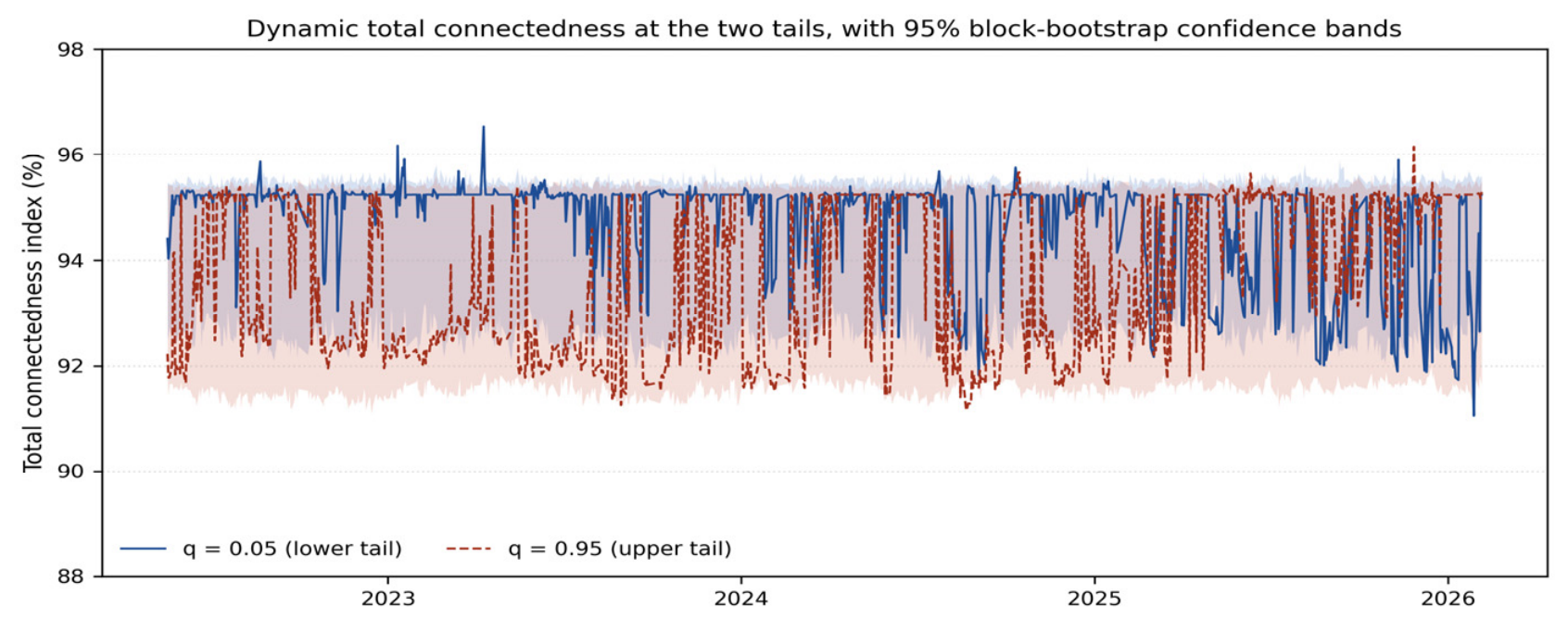
Table 3, Panel B) confirms these contrasts: both the total connectedness index and the CEA’s net connectedness differ significantly between each tail and the median (the corresponding intervals exclude zero), so the amplification of integration under extreme conditions and the CEA’s tail-specific role as a net receiver are statistically established rather than asserted. At the band level, by contrast, the net measures are estimated less precisely: the confidence intervals for the CEA’s short- and long-run net connectedness, and for their short-minus-long-run difference (e.g., −34.3 [−44.1, 12.0] at q = 0.05), all contain zero; we therefore do not interpret the frequency-band pattern as a statistically significant directional change. Confidence bands for the dynamic total connectedness index are reported in
Appendix A Figure A1, where the two tail-quantile bands overlap throughout the sample, reinforcing the tail-symmetry result.
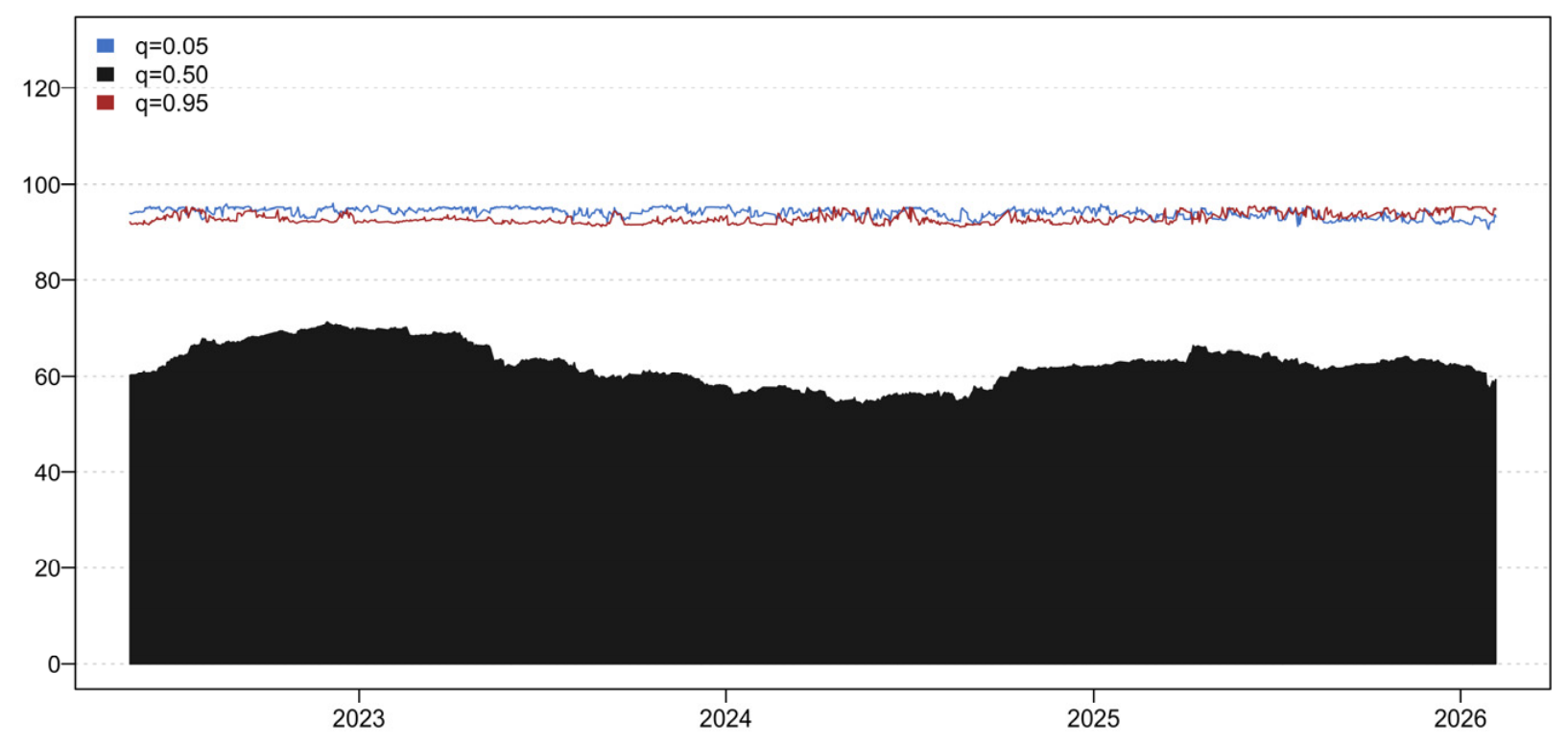
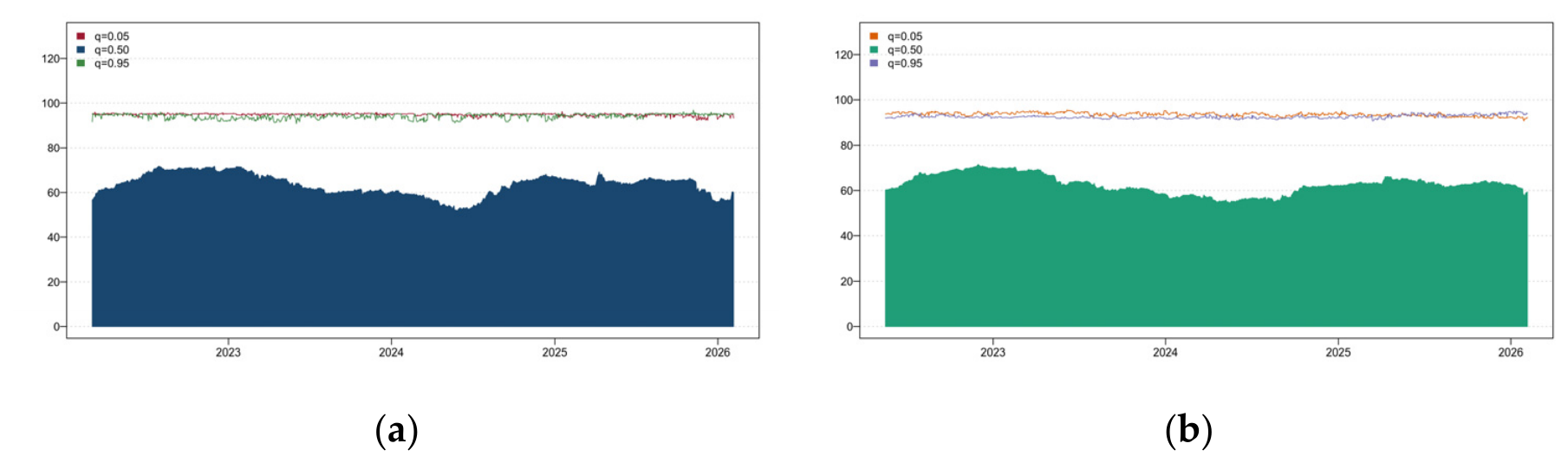
Figure 2 depicts the dynamic total connectedness index (TCI) of the system comprising the CEA and 20 commodity futures over the July 2021–February 2026 sample period at the three quantile levels q = 0.05, q = 0.50, and q = 0.95. Throughout the sample, the TCI under extreme-downside (q = 0.05) and extreme-upside (q = 0.95) conditions remains within a high and narrow band of 90–96%, with the two tail curves closely overlapping and exhibiting clear tail symmetry, whereas the median (q = 0.50) TCI fluctuates within a range of 54–70%, markedly below the tail levels. This dynamic pattern, in which tail connectedness exceeds the median, indicates that cross-market connectedness under extreme states is substantially stronger than during normal periods [
10,
28]. Because each estimate uses a 200-day rolling window, the dynamic series begins in May 2022; the February 2022 onset of the Russia–Ukraine conflict therefore predates the dynamic sample, so the dynamic figures capture only the conflict’s prolonged energy–commodity repercussions from the second half of 2022 onward, not its initial outbreak.
The median TCI exhibits a pronounced cyclical pattern over the sample. In the second half of 2022, the TCI climbed from about 60% to a sample peak of about 70% at the end of 2022, accompanying the global energy–commodity shock triggered by the Russia–Ukraine conflict. From the second half of 2024 to the second half of 2025, the TCI rose again to the 62–66% range, corresponding to the public consultation draft of the expansion reform in September 2024 and its first formal implementation in March 2025. Notably, the amplitude of the tail TCI over the sample is markedly smaller than that of the median: even in the face of cascading shocks such as the SVB collapse and the UBS takeover of Credit Suisse in March 2023, it shows no sharp rise or fall. This pattern of the dynamic tail TCI approaching its ceiling corroborates the earlier static analysis (
Table A3 and
Table A5), in which the TCI reaches 92.17%/92.08% under q = 0.05/0.95, indicating that in tail states the TCI is already near its ceiling and has limited marginal room to respond to individual events.
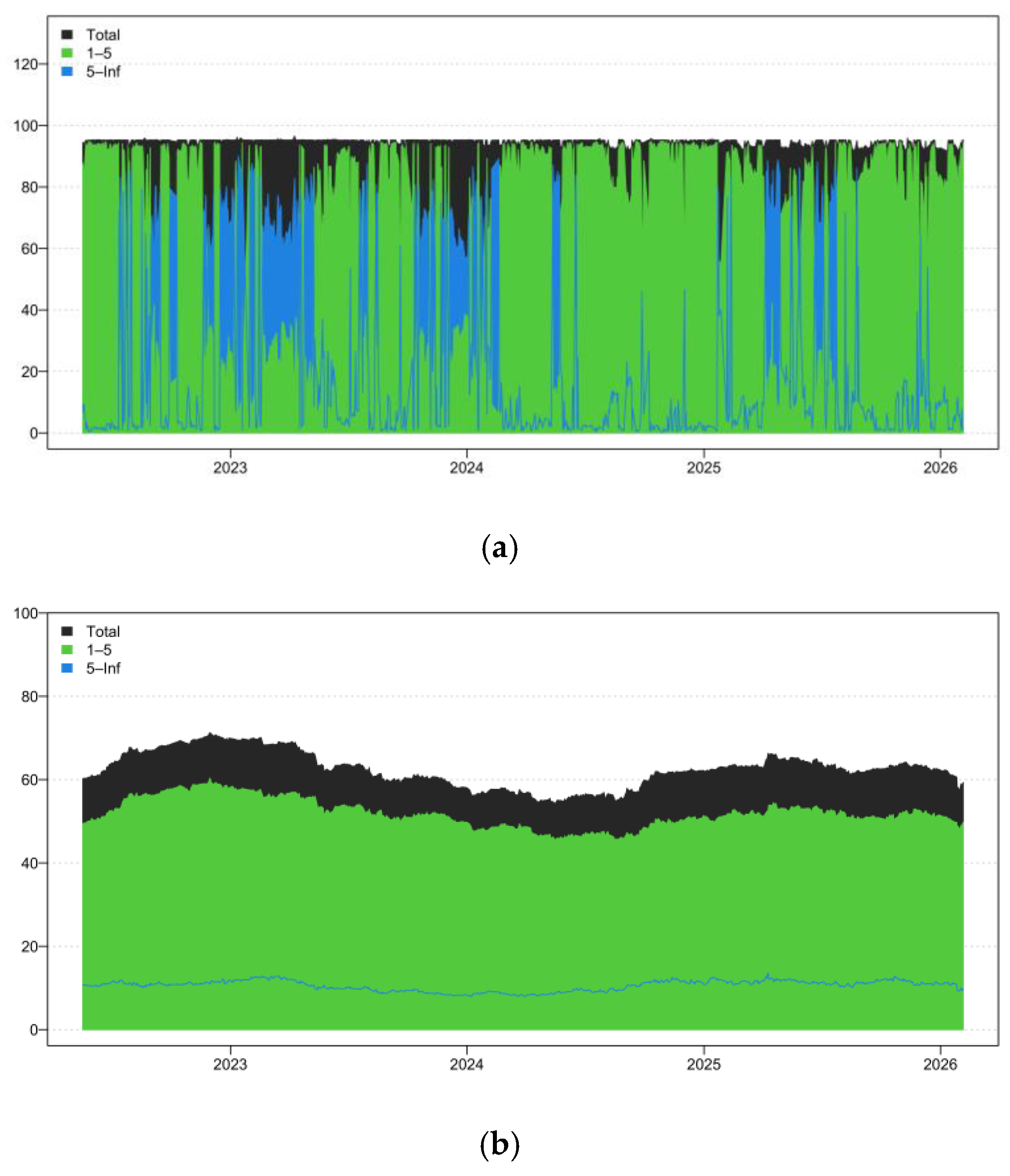
Figure 3 reports the time-varying paths of the short-term (one to five days) and long-term (more than five days) band components of the TCI under the three quantiles. Under the median condition q = 0.50 (
Figure 3b), the short-term component dominates throughout (about 80–86% of the total), and no episode of the long-term component overtaking the short-term component is observed over the sample, reflecting that under normal market conditions return transmission is dominated by high-frequency information diffusion.
Under extreme-downside conditions q = 0.05 (
Figure 3a), the switches in which the long-term component overtakes the short-term component are concentrated in windows of persistent external shocks. The most pronounced switch occurs during the cascading SVB–Credit Suisse crisis in the first quarter of 2023, when the long-term share rises to about 65–85%, constituting the most persistent long-term-dominated period in the sample. The second-half-2022 energy–commodity shock associated with the Russia–Ukraine conflict also coincides with a brief long-term-dominated switch. This pattern is consistent with the interpretation that cross-week persistent external shocks are transmitted more through the low-frequency channel, whereas transient information shocks are concentrated in the short-term channel [
6].
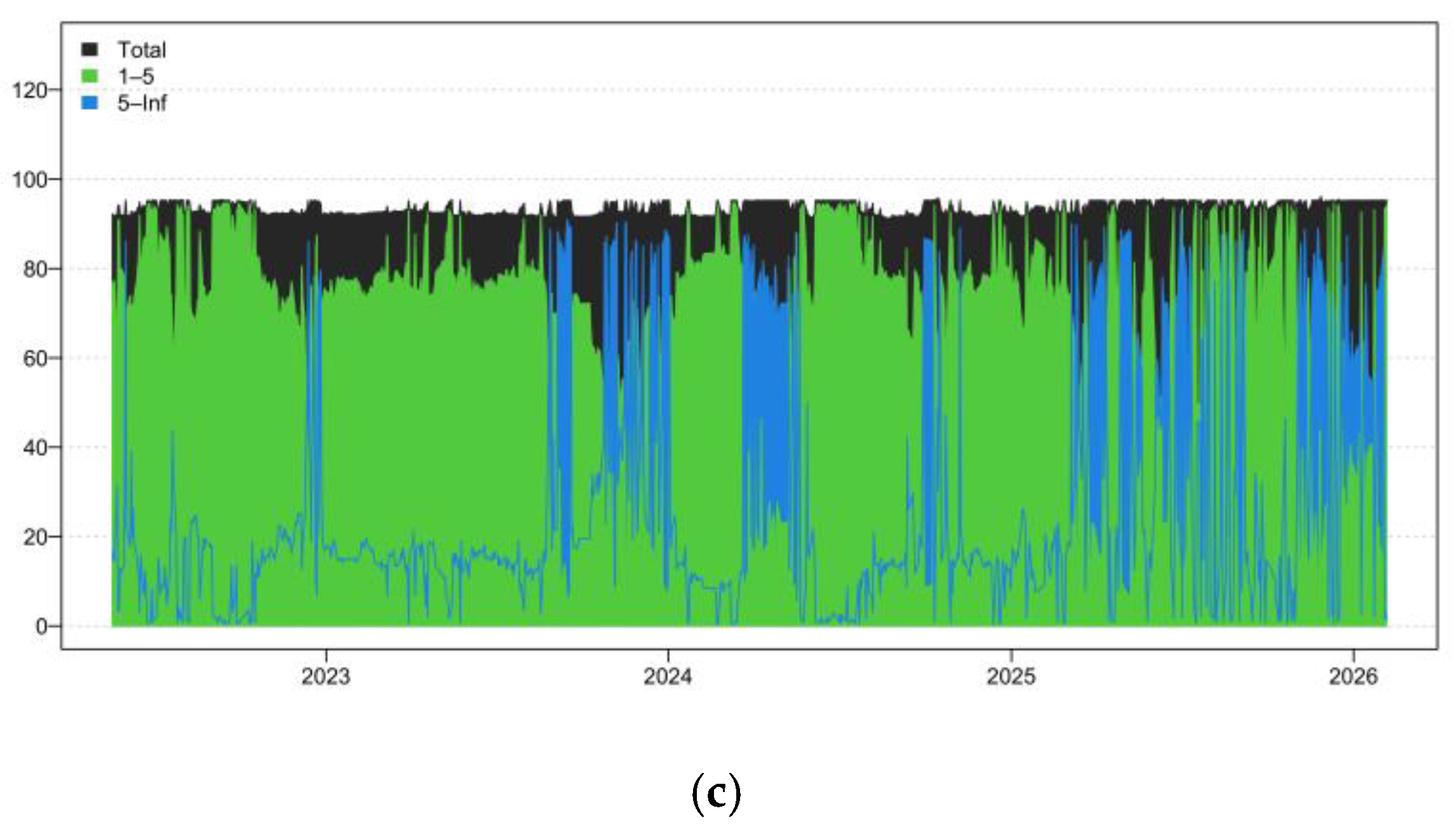
Under extreme-upside conditions q = 0.95 (
Figure 3c), the switching pattern exhibits a different event distribution: long-term-dominated switches concentrate in windows related to policy expectations and compliance, mainly the first formal expansion implementation in March 2025. This ‘policy expectations lifting the long-term component’ pattern is consistent with the contemporaneous rebound path of the median TCI in
Figure 2, revealing the asymmetry in the event contexts associated with the frequency switches under q = 0.05 and q = 0.95: the downside tail is accompanied by persistent external shocks and the upside tail by policy expectations, and the pattern in which the upside tail is accompanied by policy implementation is consistent in direction with He’s [
29] finding that the upside tail of China’s carbon market is associated with climate policy implementation.
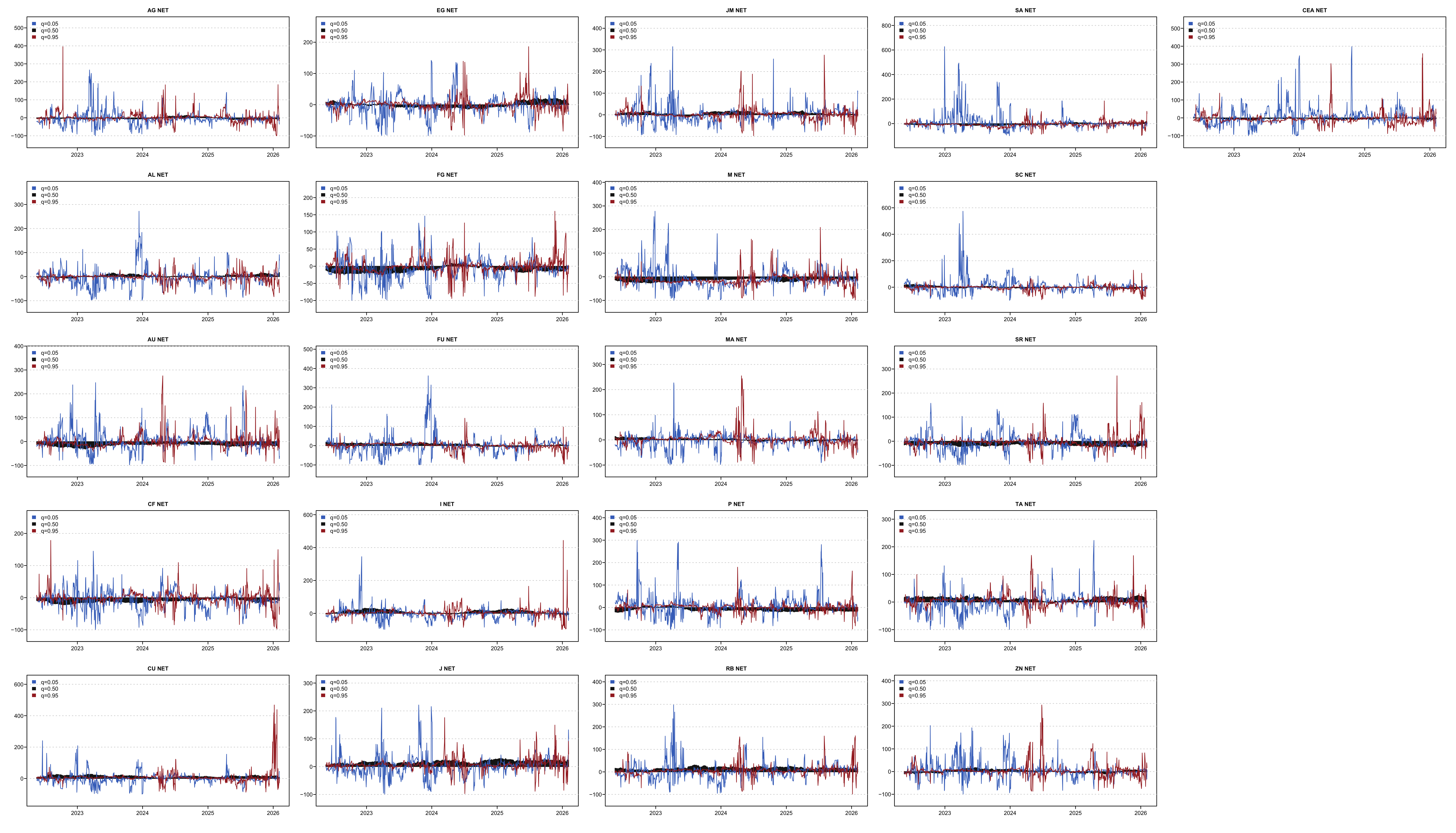
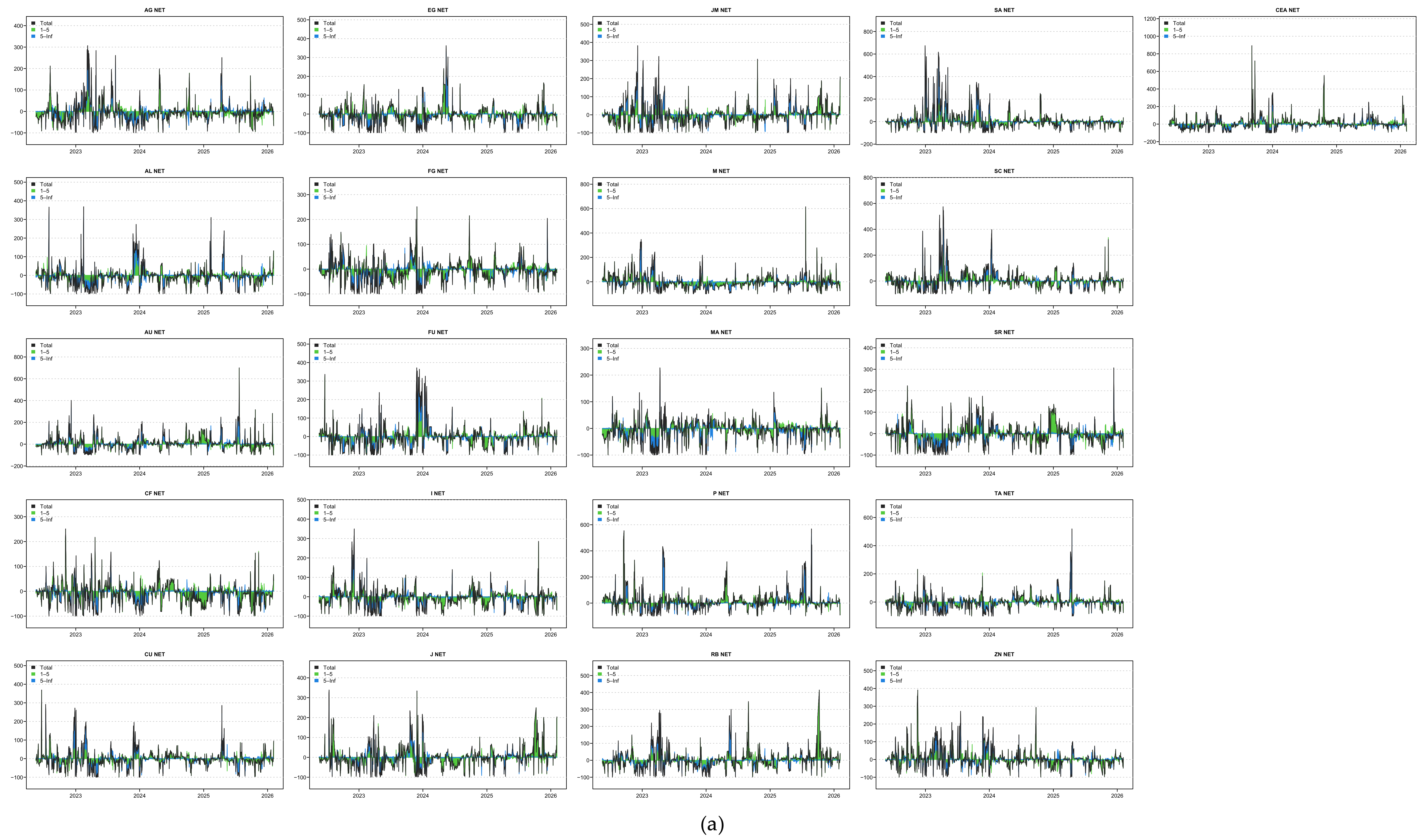
Figure 4 reports the dynamic NET paths of the CEA and 20 commodity futures under the three quantiles q = 0.05, q = 0.50, and q = 0.95. A positive NET indicates that an asset is a net transmitter in the system, and a negative NET indicates a net receiver. Overall, the NET of each asset switches between positive and negative over the sample, indicating the contagion source/receiver roles of the assets continuously evolve over time, with the frequency and magnitude of switching differing significantly across quantiles.
Under the median q = 0.50, the CEA persistently acts as a net receiver, with its path fluctuating tightly within a narrow range below the zero line. Under extreme-downside conditions, q = 0.05, the CEA’s NET exhibits several pronounced positive spikes, most notably concentrated during the cascading SVB–Credit Suisse crisis in the first quarter of 2023, when the CEA briefly switches into a contagion source. Under extreme-upside q = 0.95, the CEA mostly maintains a net receiver role but shows pronounced upward jumps at the beginning of the dynamic sample in the second half of 2022, when the market was still in its early post-launch phase, in September 2024 around the public consultation draft of the expansion reform, and in March 2025 around the first formal expansion implementation. The activation of the downside tail is concentrated in windows of external macro shocks, and that of the upside tail in windows related to policy expectations and compliance, forming an asymmetric structure in the event contexts associated with the downside/upside tails, consistent with Zhao and Yang’s [
7] evidence on the downside/upside asymmetry of risk spillovers in China’s carbon–commodity markets; the pattern in which the upside tail is accompanied by policy implementation is consistent in direction with He’s [
29] finding.
An event window analysis provides additional identification-oriented evidence on these channels (
Appendix A Table A1). Regressing the dynamic total connectedness index on event window dummies, while controlling for its own lag and using Newey–West standard errors, shows that the external shock window (the March 2023 SVB–Credit Suisse turmoil) is associated with significantly higher connectedness in the downside tail (q = 0.05) and significantly lower connectedness in the upside tail (q = 0.95), with no systematic effect at the median; this directional, tail-specific pattern is consistent with the interpretation that extreme-downside connectedness is particularly sensitive to external financial shocks, though the magnitudes are modest given that tail connectedness is already high. Policy-related events exhibit weaker and less consistent effects: while the formal expansion work plan of March 2025 is associated with higher post-event upside connectedness in before-after comparisons, the event window coefficients are statistically insignificant once persistence is controlled for, suggesting that policy effects may be gradual and partially anticipated rather than concentrated around a single date. The event window evidence thus provides stronger support for the external shock channel than for the policy channel, and we interpret the policy–tail association as suggestive rather than conclusive. To be explicit about the source of each result, the significant external shock effects (positive at q = 0.05, negative at q = 0.95) come from the event-window regressions in
Table A1, whereas the higher upside connectedness around the March 2025 plan appears only in the raw before-after comparison and loses significance in the regression once persistence is controlled for. Because the signs and significance of the policy events are mixed across events and quantiles, we treat the policy–tail association as suggestive.
Under the median q = 0.50, the roles of other assets are relatively stable: CU, RB, and J act as net transmitters most of the time, while M, SR, and AU act as net receivers most of the time. Under extreme-downside q = 0.05, J and RB remain net transmitters most of the time, and M, SR, and AL remain net receivers most of the time; however, AU and P—stable receivers under the median—switch into net transmitters here, exhibiting a clear change in directional role. Under extreme-upside conditions, q = 0.95, J, CU, and RB remain net transmitters most of the time, and M and SR remain net receivers most of the time; the stable receivers under the median largely remain receivers here, with none of the widespread role changes seen under q = 0.05. System-level role changes are highly concentrated in the downside tail, indicating that such role changes are more frequent in the downside tail.
To move beyond this descriptive reading and quantify how stable these directional roles are, we further assess the cross-window stability of the NET rankings: for each quantile and band, the 200-day window is rolled across the sample, and the concordance of the resulting asset rankings is measured by Kendall’s W and by the average Spearman correlation between each window’s ranking and the full-sample ranking (
Appendix A Table A7). The rankings are highly stable under the median state (Kendall’s W = 0.705 and average Spearman ρ = 0.779 in the aggregate band) but become unstable at both tails (W = 0.023 and 0.110, ρ = 0.060 and 0.267 at q = 0.05 and q = 0.95, respectively), confirming that the identities of net transmitters and receivers vary substantially across stress episodes, consistent with the view that connectedness intensifies and the transmitter–receiver structure reconfigures during systemic stress [
11]. We therefore do not base the tail-state conclusions on rolling window directional rankings; instead, the tail results rely on the full-sample bootstrap inference reported in
Table 3.
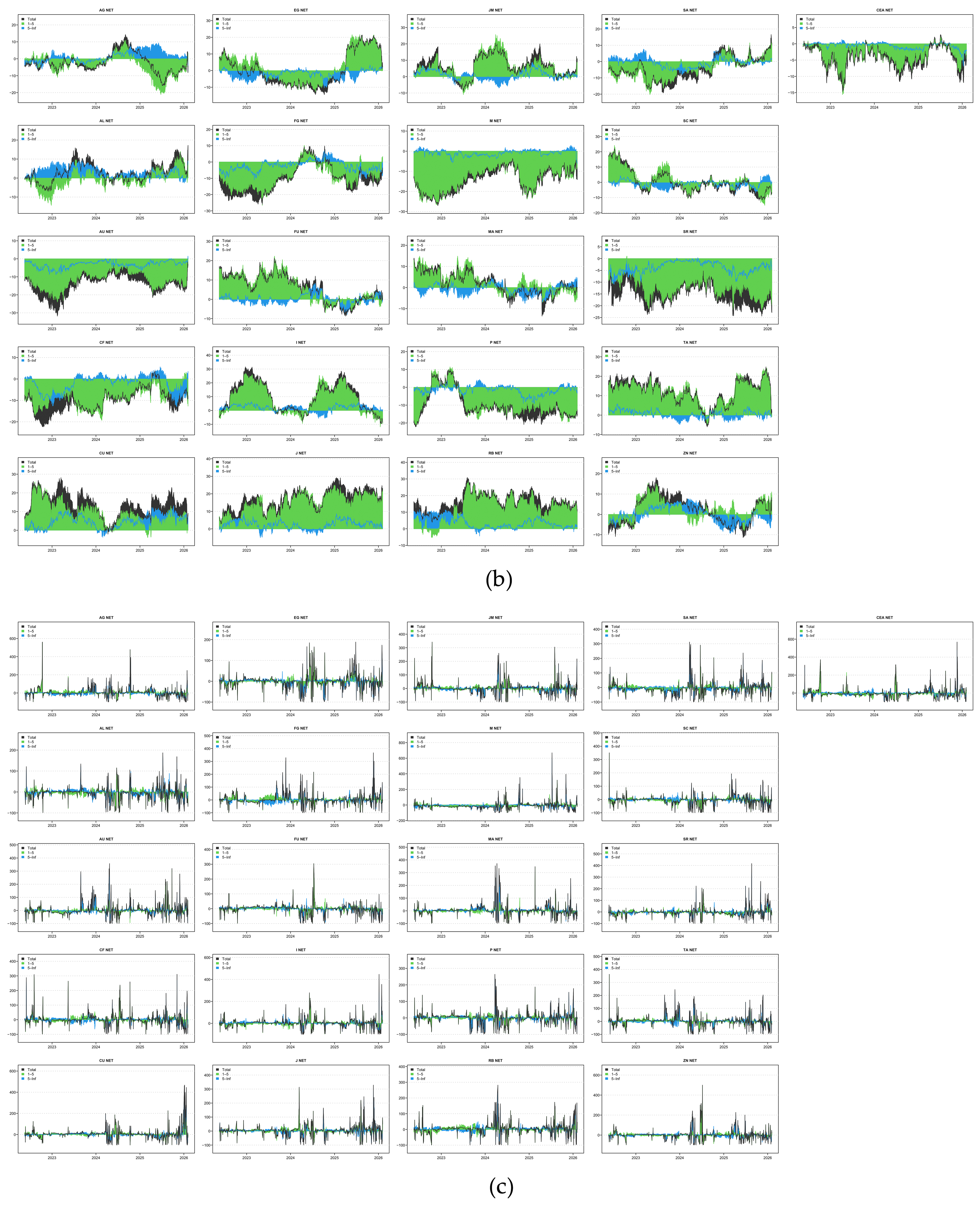
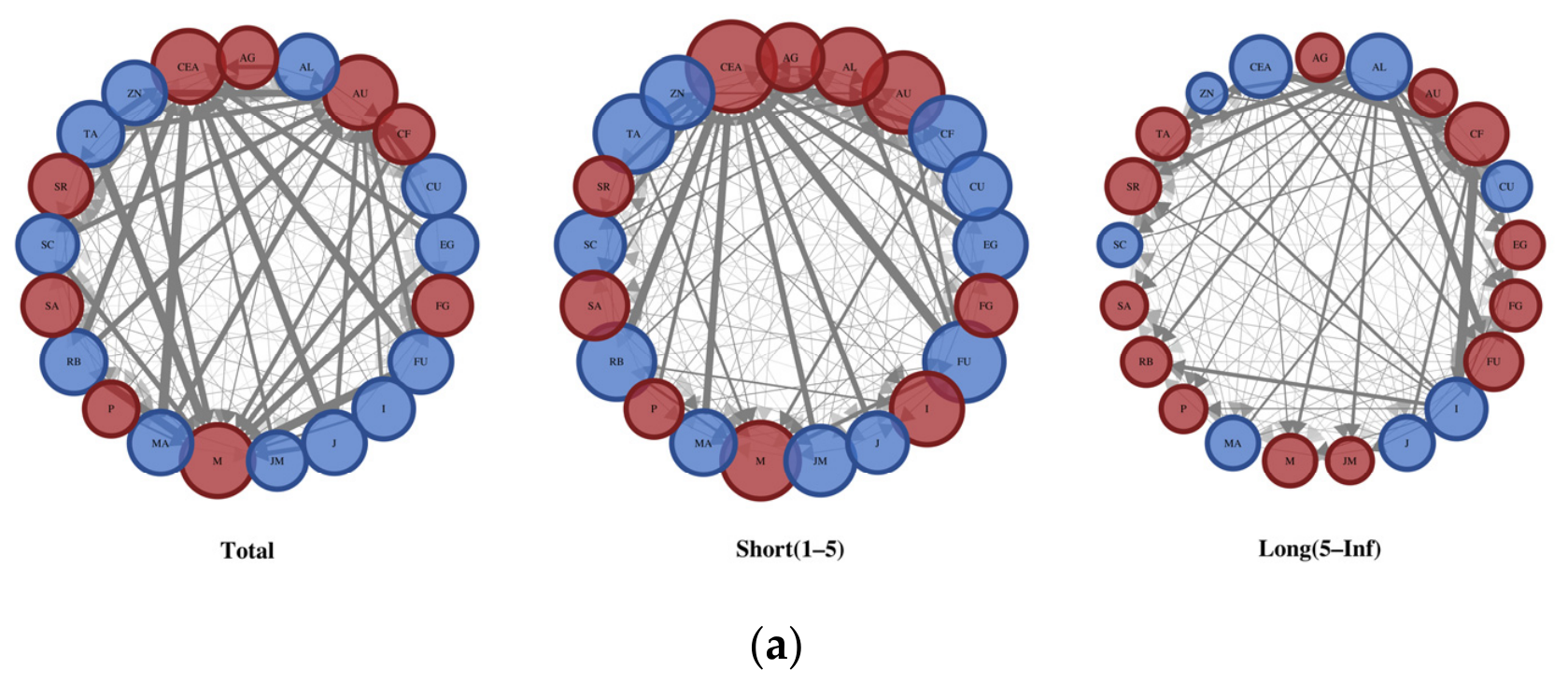
Figure 5 reports the decomposed dynamic NET paths of the CEA and 20 commodity futures on the short-term (one to five days) and long-term (more than five days) bands under the three quantiles. A positive NET indicates that an asset is a net transmitter on that band, and a negative NET indicates that it is a net receiver.
Under the median q = 0.50, the CEA’s short-term NET is negative most of the time, acting stably as a short-term net receiver; its long-term NET is also predominantly negative, with no significant role change or strength shift observed in either band within event windows. Under extreme-downside q = 0.05, the CEA’s short-term NET switches from net transmitter to net receiver around the cascading SVB–Credit Suisse crisis in 2023, with its strength rising markedly to a sample high after the public consultation draft of the expansion reform in September 2024; its long-term NET switches from around the zero line to a deep net receiver around the 2023 SVB–Credit Suisse crisis, and reverses from net receiver to net transmitter—accompanied by a pronounced jump in strength—around the first formal expansion implementation in March 2025. Under extreme-upside conditions, q = 0.95, the CEA’s short-term NET maintains a high net-transmitter role during the second-half-2022 energy–commodity shock associated with the Russia–Ukraine conflict and turns into a net receiver around the 2023 SVB–Credit Suisse crisis; its long-term NET reverses from net receiver to net transmitter during this second-half-2022 shock window, reverses back to net receiver around the 2023 SVB–Credit Suisse crisis, and turns into a net transmitter again after the public-consultation draft of the expansion reform in September 2024. These band-level directional movements trace the time path of imprecisely estimated rolling NET measures; consistent with the full-sample bootstrap evidence discussed for
Table 3—where the confidence intervals for the CEA’s short- and long-run net connectedness contain zero—the CEA’s band-level net positions are not statistically distinguishable from zero, so they are read as suggestive dynamics rather than established frequency band reversals.
The band roles of other assets are quantile-dependent. Under the median q = 0.50, in the short-term band, CU, J, RB, and TA—upstream industrial chain commodities—are stable net transmitters, while M, SR, and AU are stable net receivers; in the long-term band, AL, CU, I, J, and RB remain net transmitters and AU and SR remain net receivers, with most assets showing consistent judgments across the two bands. Under extreme-downside conditions, q = 0.05, in the short-term band only P is a net transmitter most of the time, while most other assets exhibit a time-varying pattern; in the long-term band AU reverses from a median receiver to a net transmitter, and CF, EG, and SR lean overall toward receivers. Around the first formal expansion implementation in March 2025, in the short-term band AU, M, and SA switch from net transmitters to net receivers, while FG, I, JM, and SC switch from net receivers to net transmitters; in the long-term band EG, I, MA, and SR switch from net transmitters to net receivers, while JM and P switch from net receivers to net transmitters, with the long-term NET of P and AU exhibiting a pronounced jump in strength in that window. Under extreme-upside conditions, q = 0.95, in the short-term band AG and CU are net transmitters most of the time, and M maintains a receiver role; in the long-term band I, MA, EG, and J are net transmitters most of the time, while most other assets exhibit a time-varying pattern. Around the 2023 SVB–Credit Suisse crisis, the divergence between the short- and long-term NET directions of assets such as AL, RB, CF, and SC reaches its sample high before gradually subsiding. The cross-quantile role change revealed in
Figure 4 and the within-quantile short- versus long-run sign divergence shown in this figure constitute two independent structural features; the overall band pattern is consistent with Wu and Huang’s [
10] evidence on the quantile–frequency heterogeneity of carbon–energy–metal markets.
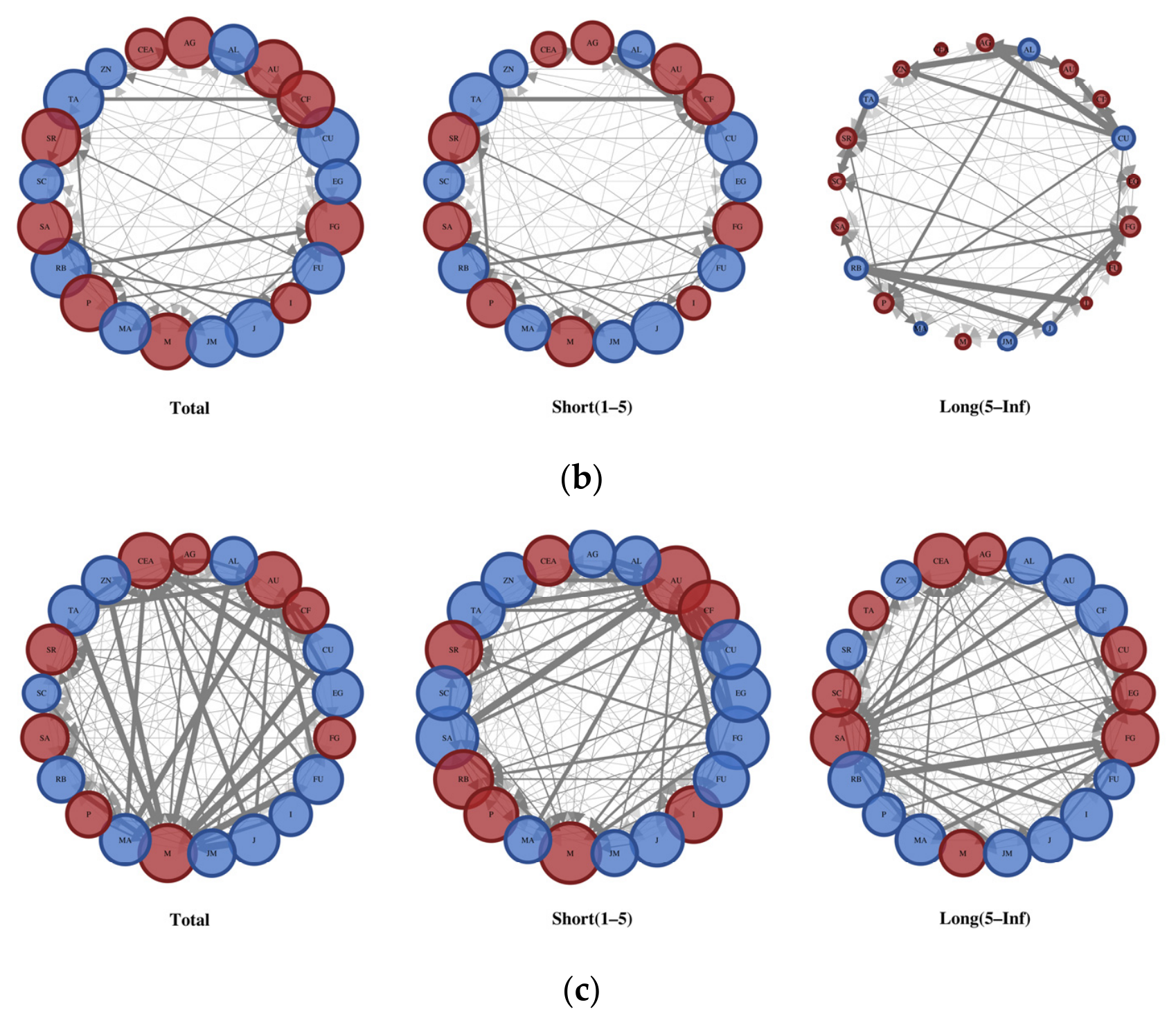
Figure 6b shows that under the median state q = 0.50, upstream industrial chain commodities such as CU, TA, RB, and J systematically act as core net transmitters across the three bands, while SR, FG, AU, CF, and M systematically act as the main net receivers, with node roles highly consistent across bands. The network is relatively dense in the aggregate and short-term bands, the most prominent transmission paths being AG → AU, CU → AU, and CU → AG (strong connections within precious metals and between non-ferrous and precious metals), as well as the outflows of industrial commodities to chemicals, glass, and soda ash, such as TA → CF, RB → FG, and RB → SA. In the long-term band, the network density drops sharply, with most cross-asset connections falling below the threshold and being omitted, leaving only a few weak connections such as CU → AG, AL → ZN, and RB → I. Across all three bands, the CEA is a node of very small magnitude that does not enter the leading ranks of net transmitters or receivers, and in the long-term band, it is almost fully decoupled from the system, reflecting the lack of a stable low-frequency linkage between the CEA and the commodity system under normal conditions.
Figure 6a shows that under the downside tail q = 0.05, the network density is markedly higher than under the median state. In the aggregate band, RB, TA, MA, AL, and J rank among the leading net transmitters, while M, AU, and CEA rank among the leading net receivers. In the short-term band, FU, TA, RB, and CF are the main net transmitters, whereas the CEA is the largest net receiver in the entire network—almost all of the strongest edges point toward the CEA (FU → CEA, RB → CEA, TA → CEA, MA → CEA, EG → CEA, CF → CEA, etc.), meaning that the energy, chemical, and ferrous-metal sectors collectively channel shocks into the CEA through the high-frequency channel under extreme-downside conditions, exhibiting a typical ‘many-to-one’ pattern. In the long-term band, a widespread short- versus long-run sign change in net directional connectedness occurs: AL and I reverse from short-term net receivers into long-term net transmitters, and the main low-frequency transmission paths shift to AL → CF, I → CF, CEA → CF, and AL → FU, meaning that energy-intensive metals in turn transmit shocks to the chemical and fuel oil sectors through the low-frequency channel. Zhou et al. [
30], using a quantile-VAR network, find significant extreme risk spillovers among the carbon, energy, and metal markets and pronounced differences in the network centrality of individual markets; this paper further characterizes the CEA’s role along the frequency dimension: its net reception is concentrated in the short-term high-frequency channel, whereas its long-term net position is not statistically distinguishable from zero (see the band-level bootstrap intervals discussed for
Table 3).
Figure 6c shows that under the upside tail q = 0.95, the network density is similar to that under q = 0.05 (tail symmetry), but the node role configuration is asymmetric with that of the downside tail. In the aggregate band, MA, J, EG, TA, and FU collectively assume the net-transmitter role, while M is the single largest net receiver in the entire network—almost all of the strongest edges point toward M (J → M, EG → M, MA → M, FU → M, TA → M, etc.), constituting a ‘many-to-one’ inflow pattern. In the short-term band, FG, SA, EG, and CU are the main net transmitters, and AU becomes the largest net receiver, with the strongest edges concentrated toward AU (SA → AU, FG → AU, AG → AU, TA → AU, etc.). In the long-term band, widespread sign changes reappear: FG and SA switch from short-term net transmitters into the largest long-term net receivers (with RB → SA, RB → FG, CF → FG, AU → SA, etc., pointing toward SA and FG), while AU, RB, CF, and I reverse into long-term net transmitters. Unlike under q = 0.05, the CEA remains a net receiver in both the aggregate and long-term bands and is close to zero in the short term, showing none of the downside tail pattern of short-term reception reversing into long-term transmission, which corroborates the upside/downside asymmetry of the CEA’s tail role. Across the three quantiles, the ‘sparse median, dense tails’ difference in network density is consistent with Chen et al.’s [
28] evidence that quantile connectedness is far higher at the tails than at the median; and the asymmetric pattern of different dominant sinks across the two tails (inflow to CEA in the downside short term, to M in the upside aggregate, and to AU in the upside short term) is consistent with Gong et al.’s [
31] finding of U-shaped asymmetric tail dependence in carbon finance risk.