


Abstract
The plastics industry sector is a massive contributor to greenhouse gas emissions. In this context, it is important to find alternatives to valorise plastic polymer waste, since 63.0% of the plastics produced between 1950 and 2015 were incinerated or disposed of in landfills. This study aims to evaluate the environmental and economic performance of a polymeric control panel for a domestic boiler. The environmental assessment was conducted using the Life Cycle Assessment (LCA) methodology from a cradle-to-grave perspective, allowing the identification of the hotspots of the panel under analysis in two scenarios: virgin panel (VP) and recycled panel (RP). The economic evaluation was performed through a techno-economic analysis (TEA) considering both operating expenditures (OpEx) and annualised capital expenditures (CapEx) allocated to the functional unit. The VP scenario used 100.0% virgin polymer, while the RP scenario used 70.0% virgin polymer and 30.0% internal recycled polymer. The analysis shows a clear synergy: substituting a portion of virgin polymer with recycled PC/ABS reduces both environmental impacts and production costs, while also increasing the sustainability. The results support internal recycling as a practical circularity strategy that can improve environmental performance. The RP scenario is both the environmentally preferable and the economically better option. Additionally, the consistency of results across both LCA and TEA indicates that the identified hotspots represent leverage points for future interventions to amplify benefits to further improve sustainability. For instance, further decarbonization of the Portuguese electricity grid or increased reliance on on-site PV electricity would strengthen the environmental profile of both scenarios. At the same time, continued optimisation of recycling processes could enhance cost savings.
1. Introduction
Climate change is one of the most significant global environmental challenges, primarily driven by rising greenhouse gas (GHG) emissions. Global GHG emissions reached a record 53.0 Gt CO2 eq in 2023, a 1.9% increase from 2022 [1]. There is a direct correlation between economic growth and, consequently, energy consumption, leading to increased carbon emissions [2,3]. The plastics industry accounted for approximately 1.8 Gt CO2 eq in 2023, corresponding to nearly 4.0% of global GHG emissions [4]. Projections suggest that this share will continue to grow, with the plastics industry potentially responsible for up to 15.0% of total GHG emissions by 2050 [5]. Despite the rising emissions, recycling and reuse rates remain low: it is estimated that only about 7.0% of all plastic produced worldwide between 1950 and 2015 was recycled, while approximately 63.0% was incinerated or disposed of in landfills, and around 30.0% remains in use [6]. The European Parliament [7] reported an increase in plastic recycling rates in Europe, rising from 25.2% in 2005 to 40.7% in 2022. In contrast, this upward trend has not been observed globally; OECD statistics [8] indicate that only 9.0% of plastic waste was recycled worldwide in 2019.
Plastics are widely used across multiple industrial sectors, including packaging, construction, automotive manufacturing, and electronic equipment [9]. This persistent reliance on using plastics is mainly due to their properties, such as high impact resistance, hardness, and high moldability [9]. Among the different types of plastic polymers, polycarbonate (PC), a thermoplastic, is one of the most used in engineering applications, due to its combination of, e.g., transparency, high impact resistance, and high thermal stability [10,11,12]. Although PCs are used in the engineering sector, there are some challenges regarding their use due to their limited processability [13]. Efforts to enhance PC processability can compromise key material properties—such as impact resistance and hardness—thereby increasing brittleness and failing to meet the technical requirements of demanding engineering applications [14,15,16]. To overcome these challenges, polymer blending has emerged as a strategy to enhance PC’s overall performance. Acrylonitrile butadiene styrene (ABS) has been used to increase PC hardness at lower temperatures, improve resistance to physical ageing, and reduce sensitivity to thickness and notch radius, which are critical to enhancing PC processability [17,18]. Consequently, the PC/ABS blend not only overcomes the processing limitations of pure PC but also results in a material with superior processability [15]. An additional advantage of the PC/ABS blend lies in its thermoplastic nature, as both PC and ABS can be reversibly melted and reprocessed without significant loss of properties, therefore facilitating recyclability [19,20].
Life Cycle Assessment (LCA) is an international methodology for assessing environmental impacts along the life cycle of products [21,22]. This methodology has been used to determine the potential environmental impacts of PC [12], ABS [17], and PC/ABS blend-based products [23]. Zhou et al. [12] quantified the environmental impacts of PC produced in China, following a cradle-to-gate perspective, identifying that the production of bisphenol A required for PC production was the primary contributor to global warming (GW), water depletion, and fossil depletion impact categories. The American Chemistry Council [17] conducted an LCA study, following a cradle-to-gate perspective, to identify hotspots in ABS production, reporting that approximately 80% of the GW impacts stem from the production of monomers used to make ABS, mainly styrene, while for acidification, eutrophication, and photochemical smog formation the hotspot is the energy used in the process of ABS production. Broeren et al. [23] evaluated and compared the environmental performance of a flame-retardant printing panel made from a PC/ABS blend with a non-flame-retardant printing panel produced solely from ABS, using a cradle-to-gate perspective and focusing on the GW and non-renewable energy use (NREU) categories. The authors found that polymer production is the primary hotspot across the two impact categories, with the PC/ABS blend showing lower GW impacts and higher NREU impacts than the ABS-only panel. Although there are a few LCA studies on PC and ABS production and their derived blending products, none have focused on the polymeric control panel of a domestic hot water boiler, and none have used internal recycling material to quantify the benefits of this procedure. Also, since this blend is widely used in industry, the results of this study provide insights that can be expanded to a diverse range of products.
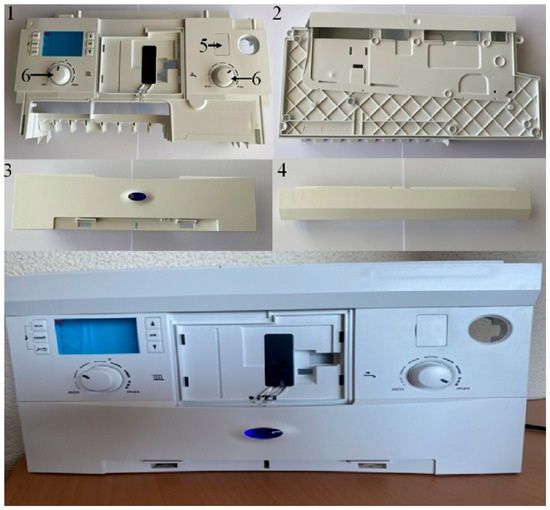
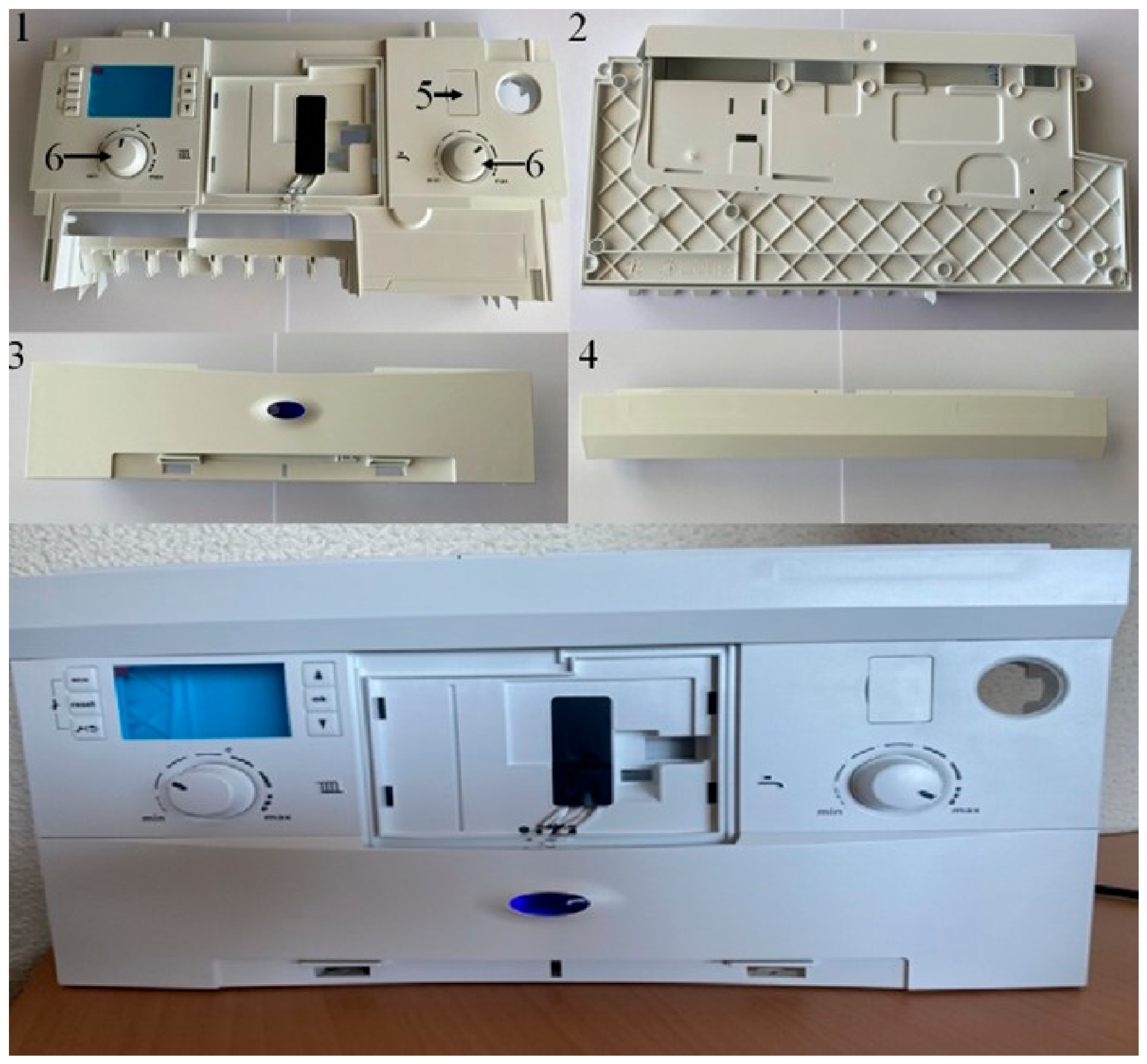
This study aims to evaluate the potential environmental impacts of producing a domestic boiler control panel, as exposed in Figure 1, under two scenarios: (i) the baseline using a 100% virgin PC/ABS blend and (ii) an alternative case incorporating 30.0% internally recycled PC/ABS from internal regrinding. Alongside the LCA, a techno-economic analysis (TEA) is also applied to evaluate the economic performance of both scenarios. Aligning the TEA with the functional unit and the cradle-to-grave system boundaries used in the LCA enables a direct comparison of environmental and economic outcomes, thereby providing a complementary perspective for decision-making. While LCA assesses the environmental impacts of the product life cycle and identifies environmental hotspots, TEA quantifies material, energy, and waste-related costs to determine whether integrating recycled polymers yields tangible financial benefits, as well as capital expenditures associated with manufacturing equipment and photovoltaic electricity generation systems. Regarding industrial production the synergy of both methodologies results in a more robust and sustainable analysis for decision-makers.
Figure 1.
Components of the control panel for a domestic hot water boiler: (1) front part; (2) rear part; (3) upper part; (4) lower part; (5) service key; (6) buttons. Assembled control panel.
2. Materials and Methods
The environmental assessment was conducted using the LCA methodology in accordance with ISO 14040 and ISO 14044 [21,22] (ISO, 2006a, 2006b). TEA focuses on operating expenditures (OpEx), including raw and ancillary material costs, electricity consumption from the Portuguese grid and from on-site photovoltaic (PV) panels, and internal closed-loop recycling costs.
2.1. Systems Analysed, Functional Unit and System Boundary
Two scenarios were evaluated as follows:
- -
- VP (virgin panel): Control panel for a domestic hot water boiler produced with 100.0% virgin PC/ABS blend.
- -
- RP (recycled panel): Control panel for a domestic hot water boiler produced with 70.0% virgin PC/ABS blend and 30.0% recycled PC/ABS blend (closed-loop internal regrinding).
Table 1 presents the formulation of the PC/ABS blend. The PC offers enhanced thermal and impact resistance, while ABS offers moldability and tenacity.
Table 1.
PC/ABS blend composition for the control panel of a domestic hot water boiler.
Table 2 summarises the physical properties (melting point, moulding temperature, density, and tensile strength) of the PC/ABS blend under study. These properties are ensured in both scenarios because the recycled material content is below 30.0%, which does not result in significant changes in the blend’s physical properties [24,25]. The addition of recycled material does not change the mechanical properties of PC/ABS blend in scenarios where toughness is not a critical parameter [26]. The incorporation of recycled PC/ABS blend reflects operational conditions already adopted in the company without reported processing difficulties or product-quality issues, increasing the sustainability of the process.
Table 2.
Physical properties of the PC/ABS blend.
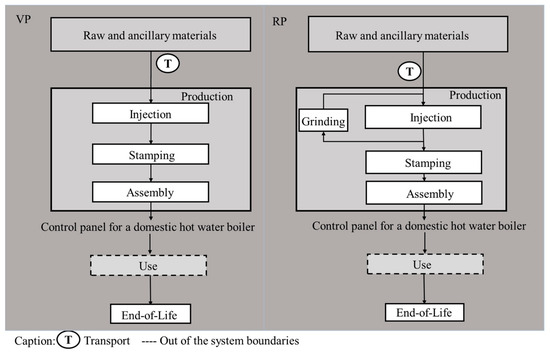
The functional unit (FU) is a control panel for a domestic hot water boiler, weighing 1.25 kg. A cradle-to-grave perspective was applied. Figure 2 shows the system boundary of the scenarios analysed.
Figure 2.
System boundary of the production of the control panel for a domestic hot water boiler for the VP and RP scenarios. VP: virgin panel; RP: recycled panel.
This system boundary encompasses: the (i) extraction and processing of raw and ancillary materials; (ii) injection, (iii) stamping, (iv) assembly and (v) end-of-life. Injection encompasses a drying pre-stage, in which the PC/ABS blend is dried at 80 °C for approximately 4 h until a humidity of 0.02% is reached, followed by injection. The polymer blend is packed in a polyamide (PA) big bag with polyamide and PE shrink film and transported on a wooden pallet.
At the injection stage, the blending is heated until 240 °C, producing the several components of the control panel: (1) front part, (2) rear part, (3) upper part, (4) lower part, (5) service key, and (6) buttons. Mechanical stamping, with stamping ink, is applied only to components 1 (front) and 6 (bottom). At the assembly stage, several elements are assembled, including a screen, a lightning pointer, a conduction filament, all made of polymethyl methacrylate (PMMA), a protective bonded polyethylene (PE) film, bolts, a fuse, and metallic filaments. The internal transportation of the material through the different stages is carried out in kraft paper boxes with polypropylene (PP) foam sheets, with a lifespan of 11 years. Regarding the RP scenario, an additional stage is needed: regrinding the PC/ABS blend waste recovered from internal injection operations (closed-loop recycling). The recycled material was obtained from PC/ABS-based products manufactured within the company. No additional environmental burdens were assigned to this material, as the environmental impacts associated with PC/ABS production were allocated exclusively to the virgin polymer. The recycled fraction was therefore considered free of upstream production burdens to avoid double-counting.
The packaging of ancillary materials was excluded from the system boundary because it accounted for less than 1.0% of the total input material mass, as was the fuse. The transport of workers and machinery, as well as the production of capital goods (including buildings, machinery, and equipment), were also excluded. The use stage was also excluded from the system boundaries due to its negligible expected contribution to the overall environmental profile of the control panel. Unlike active electrical or electronic components, the polymeric control panel does not consume energy, require consumable materials, or generate direct emissions during operation. Furthermore, no significant maintenance activities are typically required throughout its service life.
2.2. Inventory Analysis
Table 3 presents the inventory data for the production of the control panel for a domestic hot water boiler. All data are average primary data obtained from a survey of a plastic engineering mill in Portugal.
Table 3.
Inventory data to produce the control panel for the domestic hot water boiler under study.
Data for the production of raw and ancillary materials and packaging were sourced from the Ecoinvent database version 3.11 [27]. Data on the environmental impacts of the trucks and aircraft used to transport raw and ancillary materials were also sourced from the Ecoinvent database. Waste treatment of packaging materials was based on Portuguese data, in accordance with the report from the Portuguese Environment Agency (APA) regarding recycling. The types of transport and distances travelled for raw and ancillary materials are shown in Table 4. Electricity supplied from the grid was modelled according to the Portuguese electricity mix [28], while on-site photovoltaic (PV) electricity generation was modelled using data from the Ecoinvent database version 3.11 [27]. In the present study, the electricity demand was met by a combination of 78% grid electricity and 22% on-site PV-generated electricity. A representative European end-of-life (EoL) scenario was developed based on recent European plastic waste management statistics [7,29], since no primary data regarding the EoL of a control panel was available. The scenario considered the main treatment routes currently applied to plastic waste in Europe, namely mechanical recycling, incineration, and landfill disposal.
Table 4.
Transport profile for the raw and ancillary materials.
The types of transport and distances travelled for raw and ancillary materials are shown in Table 4.
2.3. Impact Assessment
The impact assessment was performed for nine different environmental impact categories—global warming (GW), terrestrial acidification (TA), freshwater eutrophication (FE), marine eutrophication (ME), mineral resource scarcity (MRS), fossil resource scarcity (FRS), fine particulate matter formation (FPM), human toxicity (HT), and water consumption (WU)—using the characterisation factors from the ReCiPe 2016 midpoint v.1.01 method [30]. The impact categories were selected based on their relevance to the environmental burdens typically associated with the plastics industry. These categories capture the most significant impacts across the product’s life cycle, including emissions and resource extraction. SimaPro version 10.3.0.1 [31] software was used for inventory and impact assessment modelling.
2.4. Techno-Economic Analysis
TEA was used to assess economic performance and it provides a methodological framework that relates process performance to costs and revenues, typically from an investor perspective, and is widely used to assess the viability of technologies, processes and products [32]. It is a methodology that requires adaptation to the specific technology and decision context, emphasising cost and market analysis [33,34,35].
The total production cost of a control panel for a domestic hot water boiler was calculated as the sum of operating expenditures (OpEx) and annualised capital expenditures (CapEx) allocated to the FU. OpEx comprises raw materials, auxiliary materials, packaging, transport, electricity consumption, labour costs, and maintenance activities. CapEx comprises the annualised depreciation of production equipment, the acquisition cost of manufacturing equipment, and the acquisition cost of the photovoltaic electricity generation system.
Unit prices for PC, ABS, masterbatch, ancillary materials, packaging and transport were based on supplier data and expressed in euros (without inflation). Analysis also included labour costs, equipment maintenance costs, acquisition costs of manufacturing equipment and annualised depreciation of production equipment. In contrast, electricity prices reflect the effective tariff the company pays for grid-supply and the levelized cost of PV generation. The other waste materials (packaging) are also recycled outside the company, and, as an assumption, valued at zero cost.
The economic assessment focuses on manufacturing-related costs and excludes EoL management expenses, which may vary significantly across regions due to waste management systems, regulatory frameworks, and producer responsibility schemes.
3. Results and Discussion
3.1. Environmental Impacts
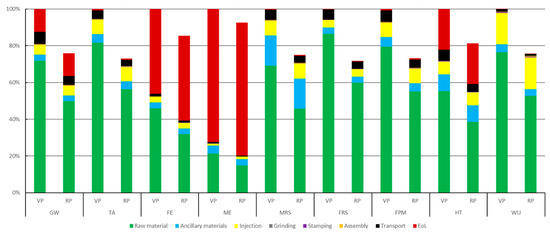
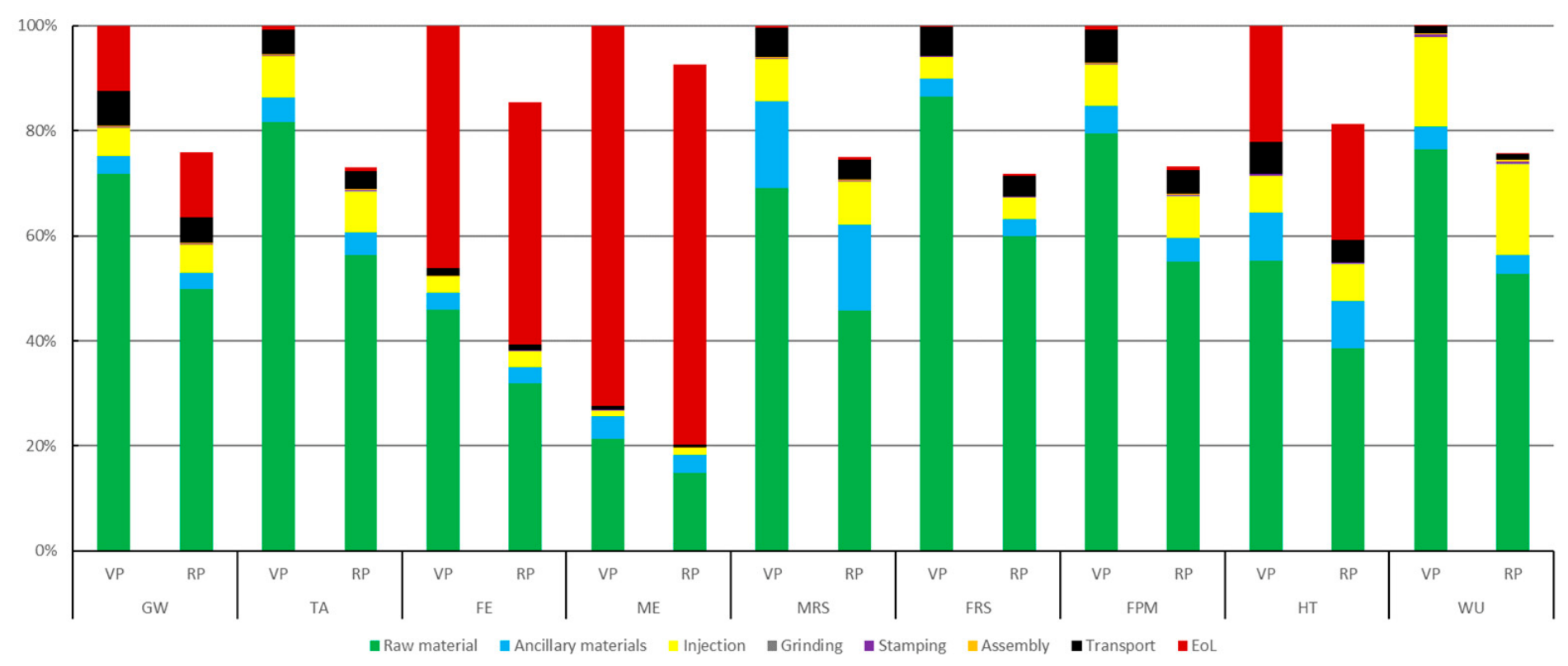
Table 5 shows the results of the impact assessment for the two scenarios under study, and Figure 3 presents the contribution of each life-cycle stage to the total impacts.
Table 5.
Total impacts of producing a control panel for a domestic hot water boiler.
Figure 3.
Relative contributions to the environmental impacts of the production of a control panel for a domestic hot water boiler. GW: global warming, TA: terrestrial acidification, FE: freshwater eutrophication, ME: marine eutrophication, MRS: mineral resource scarcity, FRS: fossil resource scarcity, FPM: fine particulate matter formation, HT: human toxicity, WU: water use.
The results indicate that the RP scenario has the best environmental profile across all impact categories, reducing impacts relative to the VP scenario by 29.3% (FRS) to 7.4% (ME).
Regarding the VP scenario, the raw materials are the primary hotspot across seven out of the nine impact categories analysed, accounting for 55.3% (HT) to 86.4% (FRS) of the total impacts in those categories. In comparison, the EoL was the hotspot in the other two categories analysed, accounting for 46.2% (FE) and 72.4% (ME) of the total impacts in those two categories. Regarding the RP scenario, the raw materials are also the primary hotspot across seven of the nine impact categories, accounting for 47.3% (HT) to 83.7% (FRS) of the total impacts in those categories. In comparison, the EoL was the hotspot in the other two categories analysed, accounting for 54.0% (FE) and 78.2% (ME) of the total impacts in those two categories.
For freshwater eutrophication (FE) and marine eutrophication (ME), EoL processes become the dominant hotspot. This behaviour is primarily associated with the landfill and incineration routes considered in the representative European EoL scenario. In landfill systems, nutrient-related emissions may arise from leachate formation, while incineration can lead to nitrogen oxide emissions during thermal treatment. These emissions are key contributors to eutrophication-related impact categories, explaining the higher relative importance of the EoL stage compared to other life-cycle phases in FE and ME indicators.
Regarding the raw materials, for both scenarios, the hotspots are associated with the production of the PC/ABS polymer blend, particularly PC production (mainly due to bisphenol A). This contribution dominates all of the nine impact categories analysed, accounting for 38.0% (WU) to 53.5% (MRS) in the VP scenario and 35.2% (WU) to 51.5% (FRS) in the RP scenario. The contributions towards the ABS production range from 3.0% (MRS) to 37% (WU) in the VP scenario, and from 2.8% (MRS) to 34.2% (WU) in the RP scenario. While the masterbatch contributes less than 10% in all categories for both scenarios.
The injection is the second-largest contributor in three out of nine impact categories (TA, FPM, and WU) in both scenarios, with a contribution between 7.9% (TA) and 17.2% (WU) in the VP, and between 10.8% (TA) and 22.7% (WU) for the RP, mainly because of the electricity consumption. Grid electricity contributes approximately 95.0% of the environmental impacts of the injection moulding phase, while photovoltaic electricity accounts for the remaining 5.0%. This is mainly due to the fossil fuel share in the Portuguese electricity mix, primarily natural gas and fuel oil.
The ancillary materials are the second-largest contributors to MRS, accounting for 16.5% and 21.9% in the RP and VP scenarios, respectively. This occurs mainly through the extraction of mineral resources to produce metallic components (bolts and filaments).
Under the VP scenario, transport contributes less than 1.0% to ME, and up to 6.7% to GW. Similar contributions are observed under the RP scenario, ranging from < 1.0% (ME) to 6.3% (GW). The contributions of stamping, assembly, and grinding remain below 1.0% across all impact categories in both scenarios.
Overall, the results indicate that reducing the raw materials consumption (virgin PC/ABS blend) constitutes the most effective strategy for improving the environmental performance of this type of product and increase sustainability. While manufacturing processes, electricity consumption, and transport contribute to specific impact categories (mainly WU and MRS), their influence remains secondary to that of polymer production. Also, the results also demonstrate that EoL management—landfill and incineration—plays a significant role in eutrophication-related categories. These findings suggest that the most effective mitigation pathways involve increasing the use of internally recycled materials, reducing reliance on virgin polymer production, and promoting waste management systems with higher recycling rates and lower reliance on landfill and incineration. Such measures would directly address the main life-cycle hotspots identified in this study while maintaining the industrial feasibility of the manufacturing process.
3.2. Comparison with Other LCA Studies
Other LCA studies have evaluated the environmental burdens of different products made from a PC/ABS blend, including automotive parts and exterior covers for electronic equipment (e.g., printers). However, it is important to note that comparisons between these studies and the present study should be approached with caution, as impact categories, system boundaries, impact assessment methods, and other methodological aspects were considered.
Broeren et al. [23] evaluated the environmental performance of two panels from an early-stage multifunctional printer design using a cradle-to-grave approach. One panel was flame-retardant and composed of a PC/ABS blend, whereas the other was non-flame-retardant and made primarily of ABS. In both cases, additives (i.e., materials incorporated into the panel that were not part of the polymer matrix/blend) accounted for 11.0–20.0% of the total panel mass.
The reported GW results, based on characterisation factors from the Intergovernmental Panel on Climate Change (IPCC), ranged from 6.3 to 7.3 kg CO2 eq/kg for the PC/ABS panel and from 7.1 to 7.5 kg CO2 eq/kg for the ABS panel, depending on additive content. Although the use of different IPCC Assessment Reports may introduce some uncertainties in cross-study comparisons, the values reported by Broeren et al. [23] are comparable to those obtained in the present study, particularly for the VP scenario (6.9 kg CO2 eq/kg), while remaining higher than those obtained for the RP scenario (5.2 kg CO2 eq/kg). The close agreement between the impact results obtained for the VP scenario analysed in this study and those reported by Broeren et al. [23] for the PC/ABS panel further supports the representativeness of the data and modelling assumptions adopted herein. Nevertheless, the differences in results may be attributed to methodological and technological factors. First, although both studies adopted cradle-to-grave system boundaries, their end-of-life assumptions differ. Broeren et al. [23] modelled EoL treatment through incineration, whereas the present study employed a representative European EoL scenario based on recycling, incineration, and landfill disposal [7,29].
Similar trends have also been reported in LCA studies of injection-moulded engineering plastic components. Tinz et al. [36] investigated injection-moulded parts made of engineering thermoplastics, including PC, ABS. They highlighted that environmental impacts are predominantly driven by polymer production rather than by the injection moulding process itself (which consumes energy). These findings are consistent with those of the present study, in which virgin PC/ABS production was identified as the dominant hotspot across most impact categories, and injection moulding contributed a comparatively minor share of total impacts.
Finally, the lower impacts observed for the RP scenario are strongly associated with the allocation approach adopted in the present study, which does not assign environmental burdens to recycled material. As a result, the environmental impacts in the RP scenario were mainly associated with reprocessing operations, whose contribution was comparatively small relative to virgin material production. From a broader perspective, these findings are consistent with sustainable circular economy principles applied to engineering plastics. The results confirm that strategies focused on reducing virgin polymer demand, such as internal mechanical recycling, represent an effective approach for lowering environmental impacts in injection-moulded products.
3.3. Techno-Economic Analysis Results
Table 6 summarises the data for both scenarios, detailing material flows, unit consumption, and associated costs across polymer inputs, ancillary materials, and electricity use. Transportation costs are already included in the purchase price of raw and ancillary materials.
Table 6.
OpEx and CapEx cost calculation (VP scenario vs RP scenario).
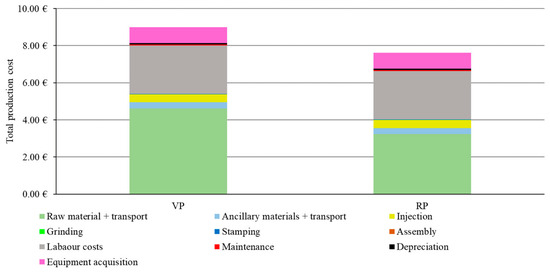
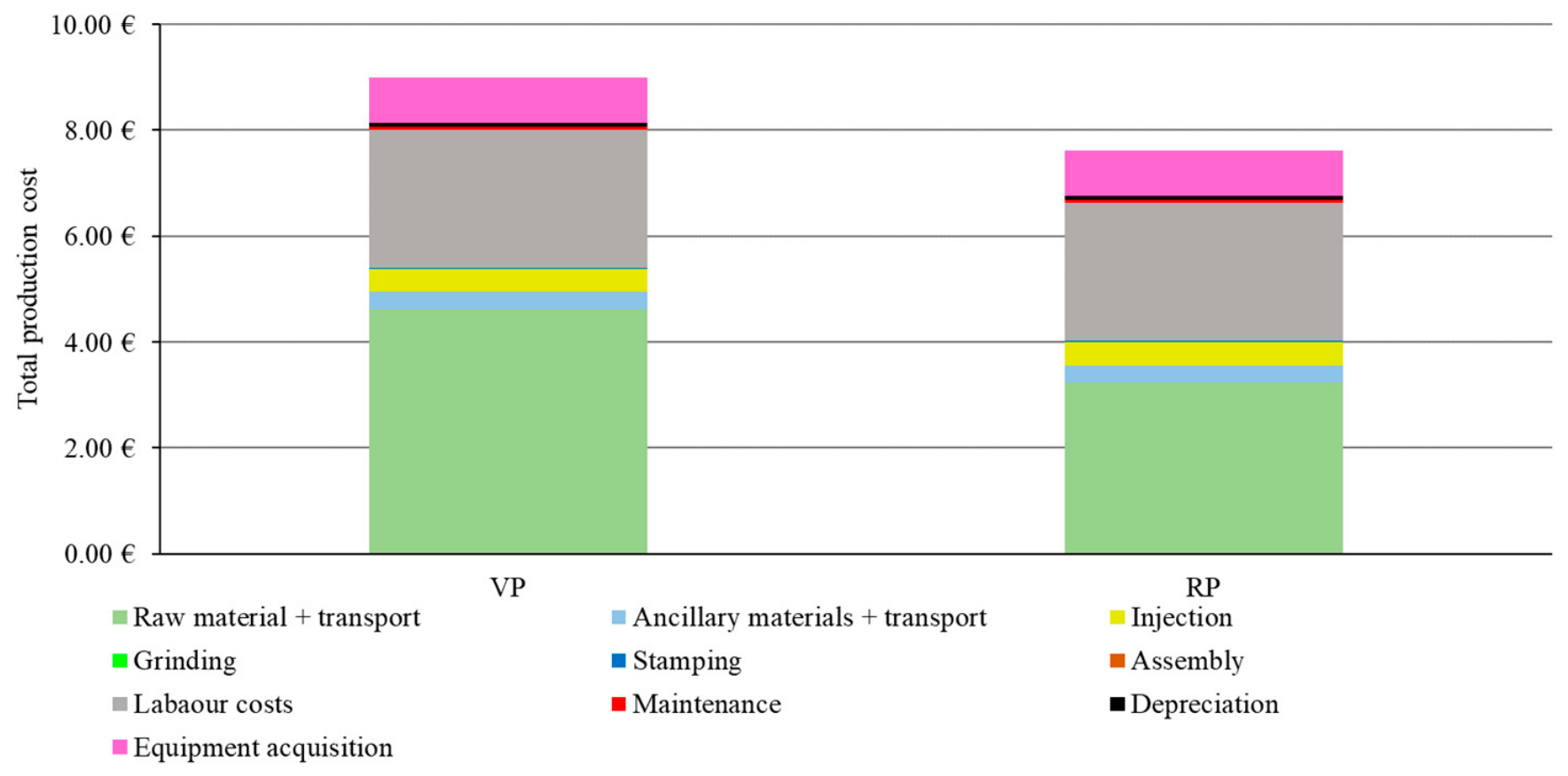
The cost of producing one control panel for a domestic hot water boiler decreases from 9.01 € in the VP scenario to 7.62 € in the RP scenario, a 15.4% reduction (Figure 4). The most substantial cost reductions arise from substituting a virgin PC/ABS blend with a recycled PC/ABS blend. In the RP scenario, virgin PC/ABS blend consumption decreases by 30.0%.
Figure 4.
Relative cost of the production of a control panel for a domestic hot water boiler.
Ancillary materials—such as stamping ink, thinner, lubricating oil, bolts, synthetic rubber buttons, PMMA filaments, bonded film, and metallic filaments—do not seem to change in consumption across scenarios. This similarity arises because the material inputs used are independent of polymer composition and relate solely to the assembly processes. As a result, their contribution to total costs remains unchanged in both scenarios. Regarding some ancillary materials, namely the stamping ink and its thinner, it was not possible to separate the expenses, so the values represent the ensemble.
Packaging materials associated with polymer supply—such as big bags, wooden pallets, shrink film, foam sheets, and kraft paper—are included under ancillary materials and decrease by 30.0% in the RP, consistent with the reduction in virgin polymer in this scenario. Material substitution accounts for the largest share of savings, reinforcing the economic benefits of promoting closed-loop recycling. Reductions in packaging requirements provide additional cost savings in the RP scenario, further strengthening the overall economic results.
Electricity consumption from grid and PV for injection, stamping, and assembly remains constant across both scenarios. Grinding of the recovered polymer results in an electricity cost of 0.0066 €/FU for grid electricity and 0.00060 €/FU for PV electricity. Despite this additional energy demand, its contribution to total cost is marginal, demonstrating that the economic burden associated with the internal recycling operations is lower than the savings achieved from reduced virgin material use, as shown in Figure 4.
Labour costs, depreciation, maintenance, and equipment acquisition for the RP scenario change less than 1%. Regarding annualised capital expenditures the changes are also less than 1% because the same manufacturing infrastructure and photovoltaic system were used in both. The additional costs for collection, sorting, and quality control activities included in the RP scenario accounted for less than 2% of the total costs for the remaining production stages (injection, stamping, and assembly). Even after accounting for these additional operations, the overall production costs for the RP scenario remained substantially lower than those of the VP scenario. Consequently, the differences observed in total production cost were primarily driven by reductions in operating expenditures (mainly in the polymer costs) rather than changes in capital investment requirements.
Overall, the economic assessment indicates that reducing virgin PC/ABS consumption is the main driver for improving the cost competitiveness of the control panel. The results demonstrate that the additional operations associated with internal recycling, including grinding and quality control, have a negligible impact on total production cost compared with the savings from reducing virgin polymer demand. Furthermore, because the existing manufacturing infrastructure can be maintained without requiring substantial additional investments, internal recycling can be implemented without significantly increasing capital expenditures. Internal recycling strategies represent a sustainable, technically feasible and economically attractive approach for manufacturers seeking to reduce production costs while simultaneously supporting more sustainable circular economy objectives and reducing dependence on virgin raw materials.
Finally, although the results provide robust insights into the environmental and economic performance of the analysed control panel, some limitations should be considered when interpreting the findings. First, the inventory data were obtained from a specific industrial partner and therefore reflect the characteristics of a particular manufacturing system, including its supply chain configuration and electricity consumption patterns. Therefore, the absolute environmental and economic results should not be directly extrapolated to other industrial contexts without accounting for differences in production systems, energy supply, and waste management practices. Nevertheless, the overall trends identified in this study are expected to remain applicable to similar injection-moulded PC/ABS blend products.
Furthermore, some modelling assumptions may influence the absolute environmental results, particularly those associated with the Portuguese electricity mix, the representative European EoL scenario, and the cut-off allocation approach applied to internally recycled material. However, a sensitivity analysis was not performed because the primary objective of this study was to compare two production scenarios under identical modelling conditions rather than to evaluate the uncertainty associated with individual parameters.
4. Conclusions
The environmental and economic performance of a polymeric control panel for a domestic hot water boiler produced in Portugal was evaluated for two scenarios: 100.0% virgin PC/ABS blend (VP scenario) and 70.0% virgin PC/ABS blend and 30.0% recycled PC/ABS blend (RP scenario).
Compared with VP, the RP scenario reduced environmental impacts by 7.4–28.3% across the assessed impact categories (minimum: 7.4% in ME; maximum: 28.3% in FRS). In both scenarios, raw material production was the dominant hotspot in seven out of the nine impact categories analysed (GW, TA, MRS, FRS, FPM, HT, WU), while the EoL was the hotspot in the other two categories (ME, FE), highlighting the virgin polymer production as the main leverage point for impact reduction, while also indicating the relevance of waste treatment processes in eutrophication-related impacts.
The environmental benefits of the RP scenario are primarily driven by the reduced demand for virgin PC/ABS, which constitutes the most impact-intensive stage of the product life cycle. In contrast, internal grinding operations associated with recycling accounted for less than 1.0% of total impacts across all impact categories, indicating a negligible influence on the overall results.
These findings highlight two key mitigation pathways for reducing the environmental footprint of PC/ABS-based components: increasing the use of internally recycled polymer to displace virgin material consumption, and improving EoL management through enhanced recycling rates, after the panel use.
The TEA corroborated the environmental results. The incorporation of recycled polymer reduced operating expenditures from 8.07 € to 6.68 € per panel. When capital expenditures were included, the total production cost decreased from 9.01 € to 7.62 € per panel, corresponding to a reduction of approximately 15.4%. The savings were primarily associated with lower virgin polymer demand, while capital-related costs remained practically unchanged between scenarios. Overall, the combined LCA–TEA results demonstrate synergy: internal recycling simultaneously improves environmental sustainability and economic competitiveness.
Author Contributions
Investigation, A.A.F.; Methodology, A.A.F., F.R.; Conceptualisation, P.Q.; Formal analysis, A.A.F., F.R.; Resources, L.d.S.; Validation, L.R., Writing—original draft, A.A.F., F.R.; Writing—review and editing, P.Q., M.F.D., L.R., L.d.S.; Supervision, P.Q. All authors have read and agreed to the published version of the manuscript.
Funding
This research was funded by Fundação para a Ciência e Tecnologia (UID/50017/2025; 2023.06946.CEECIND; UID/04058) and PRR—Plano de Recuperação e Resiliência under the Next Generation EU from the European Union (C644919832-00000035 Project nº 46).
Institutional Review Board Statement
Not applicable.
Informed Consent Statement
Not applicable.
Data Availability Statement
The data presented in this study are available on request from the corresponding author.
Acknowledgments
The present study was developed in the scope of the Project “Agenda ILLIANCE” [C644919832-00000035 Project n° 46], financed by PRR—Plano de Recuperação e Resiliência under the Next Generation EU from the European Union. This work was funded by national funds through FCT—Fundação para a Ciência e a Tecnologia I.P., under the project CESAM-Centro de Estudos do Ambiente e do Mar, references UID/50017/2025 (https://doi.org/10.54499/UID/50017/2025) and LA/P/0094/2020 (https://doi.org/10.54499/LA/P/0094/2020), and UID/04058—Research Unit on Governance, Competitiveness and Public Policies. Paula Quinteiro thanks FCT for the research contract 2023.06946.CEECIND, https://doi.org/10.54499/2023.06946.CEECIND/CP2840/CT0013.
Conflicts of Interest
Authors Lopes da Silva and Luís Rodrigues are employed by the Maxiplás Plastics Engineering. The remaining authors declare that the research was conducted in the absence of any commercial or financial relationships that could be construed as a potential conflict of interest.
References
- Crippa, M.; Guizzardi, D.; Pagani, F.; Banja, M.; Muntean, M.; Schaaf, E.; Monforti-Ferrario, F.; Becker, W.; Quadrelli, R.; Risquez Martin, A.; et al. GHG Emissions of All World Countries; JRC138862; European Union: Luxembourg, 2024. [Google Scholar] [CrossRef]
- Idowu, A.; Ohikhuare, O.; Chowdhury, M. Does industrialization trigger carbon emissions through energy consumption? Evidence from OPEC countries and high industrialised countries. Quant. Financ. Econ. 2023, 7, 165–186. [Google Scholar] [CrossRef] [Scilit]
- Wang, Y.; Wang, L.; Wang, Y.; Wu, Y.; Li, M.; Wang, X.; Zhou, W. Empirical study on the relationship between economic growth and implied carbon emissions in Western China’s undertaking of international industrial transfer. Sci. Rep. 2024, 14, 23404. [Google Scholar] [CrossRef] [Scilit] [PubMed]
- Our World in Data. How Much of Global Greenhouse Gas Emissions Come from Plastics? 2024. Available online: https://ourworldindata.org/ghg-emissions-plastics (accessed on 24 September 2024).
- Zheng, J.; Suh, S. Strategies to reduce the global carbon footprint of plastics. Nat. Clim. Change 2019, 9, 374–378. [Google Scholar] [CrossRef] [Scilit]
- Parida, D.; Aerts, A.; Vanbroekhoven, K.; Van Dael, M.; Mitta, H.; Li, L.; Eevers, W.; Van Geem, K.; Feghali, E.; Elst, K. Monomer recycling of polyethylene terephthalate, polycarbonate and polyethers: Scalable processes to achieve high carbon circularity. Prog. Polym. Sci. 2024, 149, 101783. [Google Scholar] [CrossRef] [Scilit]
- European Parliament. Plastic Waste and Recycling in the EU: Facts and Figures. 2024. Available online: https://www.europarl.europa.eu/topics/en/article/20181212STO21610/plastic-waste-and-recycling-in-the-eu-facts-and-figures#:~:text=In%20Europe%2C%20the%20most%20used,to%20treat%20the%20waste%20locally (accessed on 28 September 2025).
- OECD. Global Plastics Outlook: Policy Scenarios to 2060; OECD Publishing: Paris, France, 2022. [Google Scholar] [CrossRef] [Scilit]
- Zhang, J.; Hua, Y.; Liu, J.; Zhu, T.; Sun, J.; Gu, X.; Li, H.; Zhao, J.; Zhang, S. Constructing flame retardant silica nanoparticles through styrene maleic anhydride copolymer grafting for PC/ABS composites. Compos. Part A Appl. Sci. Manuf. 2023, 175, 107825. [Google Scholar] [CrossRef] [Scilit]
- British Plastic Federation. Polycarbonate (PC). 2024. Available online: https://www.bpf.co.uk/plastipedia/polymers/Polycarbonate.aspx (accessed on 9 October 2024).
- Moretti, E.; Zinzi, M.; Belloni, E. Polycarbonate panels for buildings: Experimental investigation of thermal and optical performance. Energy Build. 2014, 70, 23–35. [Google Scholar] [CrossRef] [Scilit]
- Zhou, X.; Zhai, Y.; Ren, K.; Cheng, Z.; Shen, X.; Zhang, T.; Bai, Y.; Jia, Y.; Hong, J. Life cycle assessment of polycarbonate production: Proposed optimization toward sustainability. Resour. Conserv. Recycl. 2023, 189, 106765. [Google Scholar] [CrossRef] [Scilit]
- Wehrmann, R. Polycarbonate. Encycl. Mater. Sci. Technol. 2001, 2, 7149–7151. [Google Scholar] [CrossRef] [Scilit]
- Fang, Q.; Wang, T.J.; Beom, H.G.; Zhao, H.P. Rate-dependent large deformation behavior of PC/ABS. Polymer 2009, 50, 296–304. [Google Scholar] [CrossRef] [Scilit]
- Hentati, F.; Masmoudi, N. The impact of injection molding process parameters on mechanical properties and microstructure of PC/ABS blends using Taguchi approach. Polym. Bull. 2024, 81, 10659–10679. [Google Scholar] [CrossRef] [Scilit]
- Pham, H.; Weckle, C.; Ceraso, J. Rheology enhancement in PC/ABS blends. Adv. Mater. 2000, 12, 23. [Google Scholar] [CrossRef] [Scilit]
- American Chemistry Council; Franklin Associates, a Division of ERG. Cradle-to-Gate Life Cycle Analysis of Acrylonitrile Butadiene Styrene (ABS) Resin: Final Report. 2022. Available online: https://www.americanchemistry.com/better-policy-regulation/plastics/resources/cradle-to-gate-life-cycle-analysis-of-acrylonitrile-butadiene-styrene-abs-resin (accessed on 15 April 2025).
- British Plastic Federation. Acrylonitrile Butadiene Styrene (ABS) and Other Specialist Styrenics. 2024. Available online: https://www.bpf.co.uk/plastipedia/polymers/ABS_and_Other_Specialist_Styrenics.aspx (accessed on 9 October 2024).
- Bruijn, F.; Makkus, R.; Mallant, R.; Janssen, G. Materials for state-of-the-art PEM fuel cells, and their suitability for operation above 100 °C. Adv. Fuel Cells 2007, 5, 235–336. [Google Scholar] [CrossRef] [Scilit]
- Vlasopoulos, A.; Malinauskaite, J.; Zabnieska-Góra, A.; Jouhara, H. Life cycle assessment of plastic waste and energy recovery. Energy 2023, 277, 127576. [Google Scholar] [CrossRef] [Scilit]
- ISO 14040; Environmental Management—Life Cycle Assessment—Principles and Framework. International Organization for Standardization: Geneva, Switzerland, 2006.
- ISO 14044; Environmental Management—Life Cycle Assessment—Requirements and Guidelines. International Organization for Standardization: Geneva, Switzerland, 2006.
- Broeren, M.L.M.; Molenveld, K.; van den Oever, M.J.A.; Patel, M.K.; Worrell, E.; Shen, L. Early-stage sustainability assessment to assist with material selection: A case study for biobased printer panels. J. Clean. Prod. 2016, 135, 30–41. [Google Scholar] [CrossRef] [Scilit]
- Türkan, O.T.; Çetin, E. Evaluating Combination of Solvent-Based Recycling and Mechanical Recycling of ABS Materials for Mitigating Plastic Pollution and Promoting Environmental Consciousness. Orclever Proc. Res. Dev. 2023, 3, 672–693. [Google Scholar] [CrossRef] [Scilit]
- Vassalo, C.; Rochman, A.; Refalo, P. The impact of polymer selection and recycling on the sustainability of injection moulded parts. Procedia CIRP 2020, 90, 504–509. [Google Scholar] [CrossRef] [Scilit]
- Orzan, E.; Janewithayapun, R.; Gutkin, R.; Lo Re, G.; Kallio, K. Thermo-mechanical variability of post-industrial and post-consumer recyclate PC-ABS. Polym. Test. 2021, 99, 107216. [Google Scholar] [CrossRef] [Scilit]
- Wernet, G.; Bauer, C.; Steubing, B.; Reinhard, J.; Moreno-Ruiz, E.; Weidema, B. The ecoinvent database version 3 (part I): Overview and methodology. Int. J. Life Cycle Assess. 2016, 21, 1218–1230. [Google Scholar] [CrossRef] [Scilit]
- REN. Sistema Elétrico Nacional—Dados Técnico 2024. Available online: https://www.ren.pt/media/al3n1imk/ren-dados-tecnicos-2024.pdf (accessed on 28 April 2026).
- Plastic Europe. The Circular Economy for Plastics—A European Analysis. Available online: https://plasticseurope.org/knowledge-hub/the-circular-economy-for-plastics-a-european-analysis-2024/ (accessed on 28 April 2026).
- Huijbregts, M.; Steinmann, Z.; Elshout, P.; Stam, G.; Verones, F.; Vieira, M.; Zijp, M.; Hollander, A.; van Zelm, R. ReCiPe 2016: A harmonised life cycle impact assessment method at midpoint and endpoint level. Int. J. Life Cycle Assess. 2016, 22, 138–147. [Google Scholar]
- Pré Consultants. SimaPro, version 9.5.0.2.; Pré Consultants: Amersfoort, The Netherlands, 2023. Available online: https://www.pre-sustainability.com/ (accessed on 28 April 2026).
- Beaucamp, A.; Muddasar, M.; Amiinu, I.S.; Moraes Leite, M.; Culebras, M.; Latha, K.; Gutiérrez, M.C.; Rodriguez-Padron, D.; Del Monte, F.; Kennedy, T.; et al. Lignin for energy applications—State of the art, life cycle, technoeconomic analysis and future trends. Green Chem. 2022, 24, 8193–8226. [Google Scholar] [CrossRef] [Scilit]
- Comidy, L.J.F.; Staples, M.D.; Barrett, S.R.H. Technical, economic, and environmental assessment of liquid fuel production on aircraft carriers. Appl. Energy 2019, 256, 113810. [Google Scholar] [CrossRef] [Scilit]
- Osman, A.I.; Fang, B.; Zhang, Y.; Liu, Y.; Yu, J.; Farghali, M.; Rashwan, A.K.; Chen, Z.; Chen, L.; Ihara, I.; et al. Life cycle assessment and techno-economic analysis of sustainable bioenergy production: A review. Environ. Chem. Lett. 2024, 22, 1115–1154. [Google Scholar] [CrossRef] [Scilit]
- Pan, S.; Zabed, H.M.; Zhao, M.; Qi, X.; Wei, Y. Techno-economic and life cycle assessments for bioenergy recovery from acid-hydrolyzed residues of sugarcane bagasse in the biobased xylose production platform. J. Clean. Prod. 2023, 400, 136718. [Google Scholar] [CrossRef] [Scilit]
- Tinz, J.; Ancos, T.; Völker, F.; Rohn, H. Application of allocation methods in open-loop recycling systems: The carbon footprint of injection molded products based on ABS, PA66GF30, PC and POM. Resour. Conserv. Recycl. Adv. 2023, 19, 200176. [Google Scholar] [CrossRef] [Scilit]

Disclaimer/Publisher’s Note: The statements, opinions and data contained in all publications are solely those of the individual author(s) and contributor(s) and not of MDPI and/or the editor(s). MDPI and/or the editor(s) disclaim responsibility for any injury to people or property resulting from any ideas, methods, instructions or products referred to in the content. |
© 2026 by the authors. Licensee MDPI, Basel, Switzerland. This article is an open access article distributed under the terms and conditions of the Creative Commons Attribution (CC BY) license.