Systematic Review

A Systematic Literature Review: The Influence of Technical, Operational and Structural Factors on the Adoption of Digital Agriculture Among Small-Scale Farmers in Sub-Saharan Africa


by
Abienwi Lem Chemutah Chesi
1,
Moses Azong Cho
2,3,4,*,
Matilda Ngwe Azong Cho
4 and
Abel Ramoelo
1,5
1
Centre for Environmental Studies, University of Pretoria, Hatfield 0028, South Africa
2
Department of Plant and Soil Science, University of Pretoria, Hatfield 0028, South Africa
3
Advanced Agriculture and Food Cluster, Council for Scientific and Industrial Research (CSIR), Pretoria 0184, South Africa
4
Department of Geography, School of Agriculture and Science, University of KwaZulu Natal, Durban 4041, South Africa
5
Earth Observation, South African National Space Agency (SANSA), Pretoria 0184, South Africa
*
Author to whom correspondence should be addressed.
Sustainability 2026, 18(13), 6734; https://doi.org/10.3390/su18136734
Submission received: 4 June 2026 / Revised: 25 June 2026 / Accepted: 30 June 2026 / Published: 2 July 2026
(This article belongs to the Section Sustainable Agriculture)

Abstract

This systematic review paper examines how technical, operational, and structural factors influence the adoption of digital agriculture among small-scale farmers in Sub-Saharan Africa. Guided by PRISMA protocols, the study applies a hybrid thematic synthesis across six dimensions: technical, operational, policy and regulatory, governance, social and cultural, and environmental. The findings indicate that digital tools can generate substantial benefits, including yield increases of 10–30% (documented primarily for mobile-based advisory services and precision input management in East African horticulture and West African cocoa value chains) and price gains of 15–25%, with adoption rates of 70–80% in settings characterised by robust infrastructure, strong institutional support, and effective value chain integration. However, these benefits are unevenly distributed and tend to concentrate in “islands of adoption” characterized by robust infrastructure, strong institutional support, and effective value chain integration. While technical (94.9%) and operational (91.5%) factors dominate the literature, their impact is constrained by persistent structural barriers, including weak policy implementation (79.7%), fragmented governance systems (76.3%), and socio-cultural exclusion—such as gender disparities, age-related digital divides, and language misalignment (71.2%). The review identifies five minimum conditions for meaningful adoption: (i) affordable connectivity and access to digital devices; (ii) context-specific digital literacy; (iii) culturally relevant, user-centred design; (iv) robust institutional ecosystems; and (v) enabling policy and financial frameworks. Overall, the findings underscore that digital agriculture adoption is a socio-technical process shaped not only by technological innovation but also by institutional arrangements and user capabilities. Comparative cases, such as Kenya’s Farm.ink and the less successful EZ Farm initiative, further highlight the importance of integrated, context-responsive approaches to ensure that digital agriculture enhances, rather than marginalizes, small-scale farmers.

1. Introduction

Traditional farming methods are increasingly insufficient to meet critical development objectives—such as food security, poverty reduction, and employment generation in Africa—amid escalating global and regional environmental pressures, compounded by human-induced challenges [1,2,3]. In response to these shortcomings, several studies argue that digital transformation of agricultural systems through the adoption of digital technologies offers a pathway to more resilient and sustainable practices capable of leapfrogging rudimentary methods and enhancing productivity [4,5]. However, despite ongoing efforts to advance digital agriculture, the pace of scaling remains slow, and the reasons for this limited progress are not yet fully understood [6,7].
Digital agriculture refers to the integration of technology into farming practices through innovations such as mobile apps, Internet of Things (IoT) devices, big data analytics, drones, and satellite imagery [8,9]. These technologies offer substantial potential to enhance productivity, resilience, and efficiency in agricultural systems, particularly for small-scale farmers in Sub-Saharan Africa [10]. For the purpose of this review, ‘small-scale farmers’ refers to farmers cultivating less than two hectares, encompassing both subsistence-oriented and partially commercialized producers. Studies focusing exclusively on large-scale commercial agriculture or purely subsistence farming without any market engagement were excluded. With small-scale farmers accounting for a significant proportion of food production in SSA, digital agriculture presents an opportunity to address these barriers and improve food security, income generation, and environmental sustainability [11].
Digital agriculture is growing rapidly, with 13% of Africa’s small-scale farmers having accessed digital solutions, generating approximately €144 million in revenue annually [12]. M-farm, a mobile platform providing Kenyan farmers with real-time market prices, weather forecasts, and buyer connections, has enabled income increases of up to 50% through better market prices and reduced exploitation [13]. Digital Green in Ethiopia improved the adoption of better practices by seven times compared to traditional extension services through locally produced videos [14]. Hello Tractor in Nigeria and Kenya connected farmers to tractor owners, achieving up to 200% productivity gains in maize and rice production [15]. Moreover, Precision Agriculture for Development delivered tailored SMS-based agronomic advice, with a randomized evaluation in Kenya showing 10% yield increases for farmers receiving text-based fertilizer recommendations [16]. Early ICT-based services in the region had already demonstrated the feasibility of mobile-based information delivery, with initial applications focusing on market prices and weather alerts [17,18].
Despite a growing body of literature on digital agriculture adoption in SSA, key knowledge gaps persist. Existing research has largely focused on demonstrating the potential of specific technologies, identifying adoption factors, and conducting economic impact assessments [5,16,19]. However, studies remain limited in methodological rigor, social inclusivity, and analysis of policy and governance frameworks [20,21]. Longitudinal studies tracking sustained adoption are scarce, and context-specific analyses accounting for socio-economic, cultural, agro-ecological, and institutional differences are rare [22,23]. Research on gender-differentiated adoption pathways and the role of digital innovation ecosystems is particularly limited [24,25]. Moreover, the broader enabling environment—including policy coherence and institutional coordination—has been identified as a critical yet understudied dimension of adoption [26,27].
Therefore, this systematic literature review aims to examine how technical, operational and structural factors influence the adoption of digital agriculture by small-scale farmers in Sub-Saharan Africa and to identify the key barriers limiting its uptake. The following questions guide the review: (i) How do technical and operational factors enable or constrain the adoption and effective use of digital agriculture by small-scale farmers in Sub-Saharan Africa? (ii) How do structural, socio-economic, and institutional barriers shape unequal access to and uptake of digital agriculture among small-scale farmers?

Conceptual Framework

Unlocking the transformative potential of digital agriculture for small-scale farmers in SSA requires addressing technical, operational and structural requirements. Together, these factors create a multidimensional lens for understanding barriers and facilitators to digital agriculture adoption, aligning with the Technology–Organization–Environment (TOE) framework [28,29]. Within this framing, technical factors correspond to the technology dimension, operational and institutional factors to the organisation dimension, and policy, governance, and socio-cultural factors to the environment dimension, enabling a holistic analysis of adoption determinants.
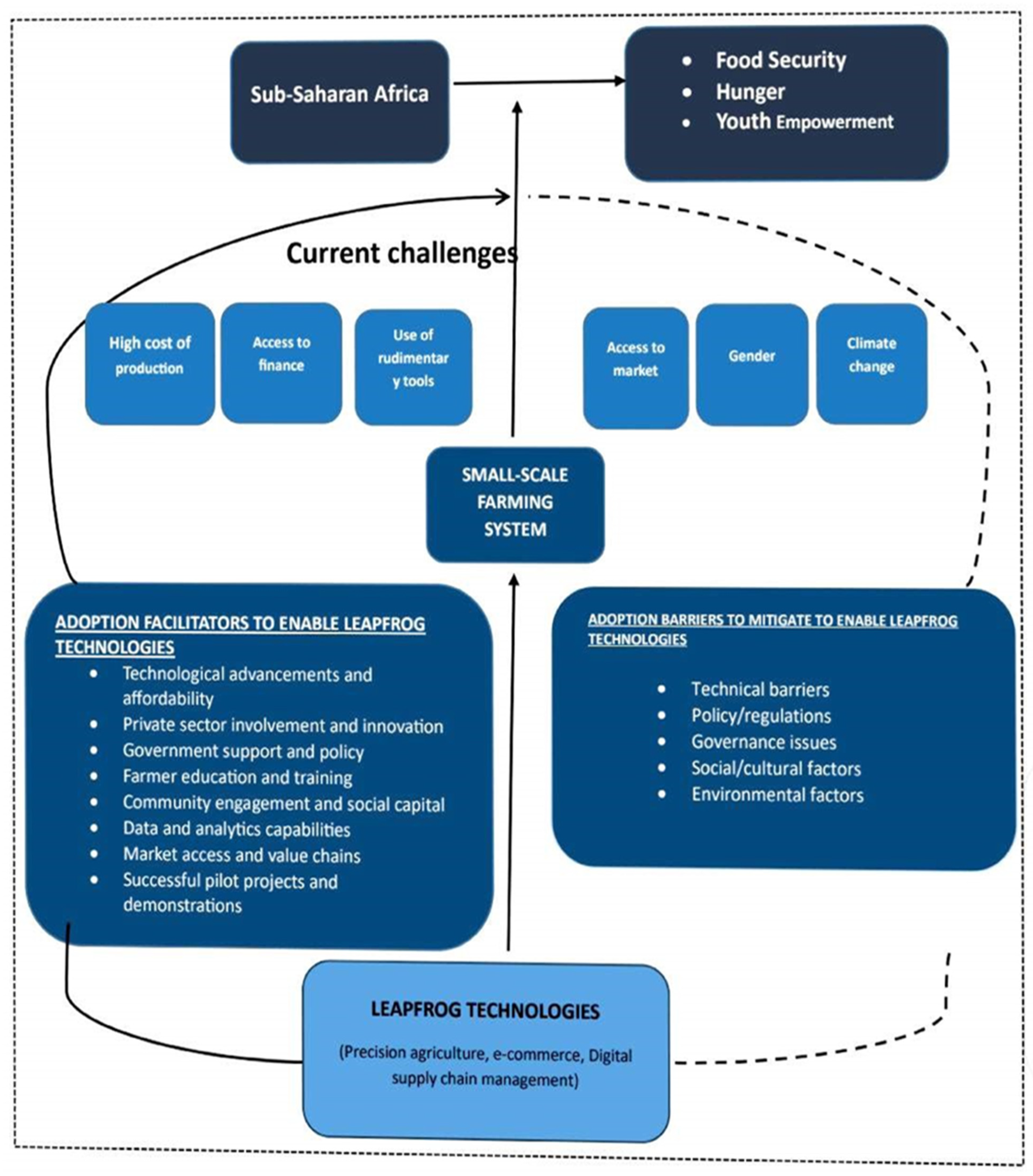
The conceptual framework for this study integrates six interrelated dimensions: technical, operational, policy/regulatory, governance, social/cultural, and environmental factors that collectively shape adoption outcomes (see Figure 1). This multidimensional approach reflects a growing recognition in the literature that technology adoption is not merely a technical process but a deeply social one, where the success of digital interventions depends as much on human capabilities, institutional arrangements, and cultural contexts as on the sophistication of the tools themselves [11,30]. In this view, adoption is understood as a socio-technical process—one in which technology, institutions, and users co-evolve, and where overlooking any one dimension can lead to failure even when the technical solution appears sound [29,31].
Each dimension in the framework captures a critical layer that either enables or constrains adoption. Technical factors refer to the functionality, accessibility, and interoperability of digital tools such as IoT systems, AI analytics, and data platforms [7]. Without reliable infrastructure—mobile networks, electricity, and affordable devices—digital services cannot reach farmers, regardless of their perceived value [32,33]. However, technical availability alone is insufficient. Operational factors—including implementation readiness, user training, financing mechanisms, and institutional support—determine whether farmers can effectively use and sustain digital tools [34,35]. For instance, even where connectivity exists, high data costs and limited digital literacy transform technical potential into persistent barriers [36,37]. Such challenges are reflected in Tanzania, where the deployment of a mobile-based agricultural platform was hampered by low digital literacy and weak institutional linkages [38].
Equally critical are the policy, governance, social, and environmental dimensions, which shape the broader context within which technical and operational factors operate. Policy and regulatory factors define the enabling environment through data protection laws, digital innovation incentives, and agricultural technology standards [2,28]. Where such frameworks are absent or weakly enforced, farmers may distrust digital platforms due to concerns over data misuse, and private sector investment remains constrained [39,40]. Governance factors such as institutional coordination, leadership, data protection law, and stakeholder engagement determine whether policies translate into coherent action across ministries and sectors [41,42].
Furthermore, social and cultural dimensions shape the human side of adoption. These include gender norms that limit women’s access to technology, age-related digital divides, trust in information sources, and the need for language and content that resonate with local knowledge systems [25,43,44]. Among these, gender-specific constraints are particularly acute; studies reveal that women’s access to digital tools is mediated by time poverty, limited financial autonomy, and social norms, requiring gender-transformative interventions to close the digital divide [9,24]. Environmental factors, including climate variability and energy access, further mediate adoption, as digital tools must function under the unpredictable conditions that define smallholder farming [45,46]. By integrating these dimensions, the framework positions digital agriculture adoption not as a linear technology transfer but as a dynamic, context-dependent process where technical feasibility, institutional readiness, and social acceptability must converge for meaningful and equitable transformation to occur [47,48].
Figure 1 presents an integrated digital agriculture, socio-economic, and governance framework for understanding the adoption of leapfrog technologies in small-scale farming systems in Sub-Saharan Africa. The framework identifies six interconnected dimensions—technical, operational, policy/regulatory, governance, social/cultural, and environmental—that collectively influence adoption outcomes. Drawing on the Technology–Organisation–Environment (TOE) framework, the technical dimension represents the Technology context; the operational and governance dimensions reflect the Organisational context; and the policy/regulatory, social/cultural, and environmental dimensions constitute the Environmental context.
The framework conceptualises technology adoption as a socio-technical process shaped by interactions among technologies, institutions, policies, markets, and users. It further highlights the role of adoption facilitators and barriers in influencing uptake. While enabling factors such as technological advancement, policy support, market access, and farmer capacity building promote adoption, technical, institutional, socio-cultural, and environmental constraints may hinder it. The alignment of enabling conditions across all dimensions is essential for achieving inclusive and scalable adoption of leapfrog technologies that contribute to food security, hunger reduction, and youth empowerment.
The six dimensions interact dynamically to shape adoption and scaling across diverse contexts, with technical and operational factors forming the core of adoption feasibility. However, their influence is consistently amplified or constrained by policy, governance, social, and environmental conditions. In East Africa, for example, the success of bundled advisory services depended not only on mobile coverage (technical) but also on extension systems capable of integrating digital tools (operational) and on policies that zero-rated agricultural data to reduce costs (policy) [32,49]. Similarly, in South Asia, coordinated governance between agriculture and ICT ministries accelerated adoption [50], while in Latin America, farmer-led digital cooperatives demonstrated that strong social capital can compensate for gaps in digital literacy [51]. These cross-regional examples collectively demonstrate that adoption does not emerge from any single factor but rather from the alignment of multiple dimensions working in concert [52,53]. Consequently, scaling requires not merely replicating technical solutions but tailoring them to fit the specific economic, social, and environmental conditions of each new context.
This study transcends the existing studies through employing a rigorous and integrative analytical lens to systematically examine how technical, operational, and structural dimensions interact. By foregrounding the dynamic interplay among these factors, the study offers a more holistic understanding of how adoption outcomes are produced in practice, rather than treating determinants as independent or static influences. This integrated perspective enables the identification of cross-cutting constraints and synergies that are often overlooked, providing deeper explanatory power and more contextually grounded insights for both research and implementation. This includes considerations of operational scalability and the role of public–private partnerships in building farmer-centric digital ecosystems [54,55].
Previous literature has often focused either on technological feasibility—demonstrating what digital tools can do—or on isolated barriers such as connectivity or literacy, without systematically exploring interdependencies [5,15]. This review addresses that gap by synthesising evidence across 59 studies using a hybrid thematic approach that allows for both quantification of thematic prevalence and qualitative exploration of interactions. By applying a multidimensional framework, the study moves beyond simply listing barriers to providing a coherent analytical structure capable of revealing which combinations of factors consistently enable or constrain adoption. This contribution is particularly timely given the growing recognition that digital agriculture in SSA risks reinforcing existing inequalities unless interventions are designed with explicit attention to inclusion, institutional capacity, and sustainability [25,48,56].
The conceptual framework serves a dual analytical purpose: it provides a structured lens for mapping the existing literature to provide a comprehensive understanding of digital agricultural adoption in SSA while also identifying persistent knowledge gaps that future research must address. By disaggregating adoption determinants into six distinct yet interrelated dimensions, the framework enables a systematic evaluation of which factors have been overemphasised and which have been neglected. When applied to the 59 reviewed studies, the analysis reveals patterns in the literature—such as the relative emphasis on technical versus governance factors—and will highlight underexplored intersections, including the interplay between data governance and farmer trust, and the relationship between gender norms and digital literacy program design [39,43]. By clarifying both what is known and what remains under-researched, the framework structures the present review and charts a forward-looking research agenda for digital agriculture in SSA.

2. Materials and Methods

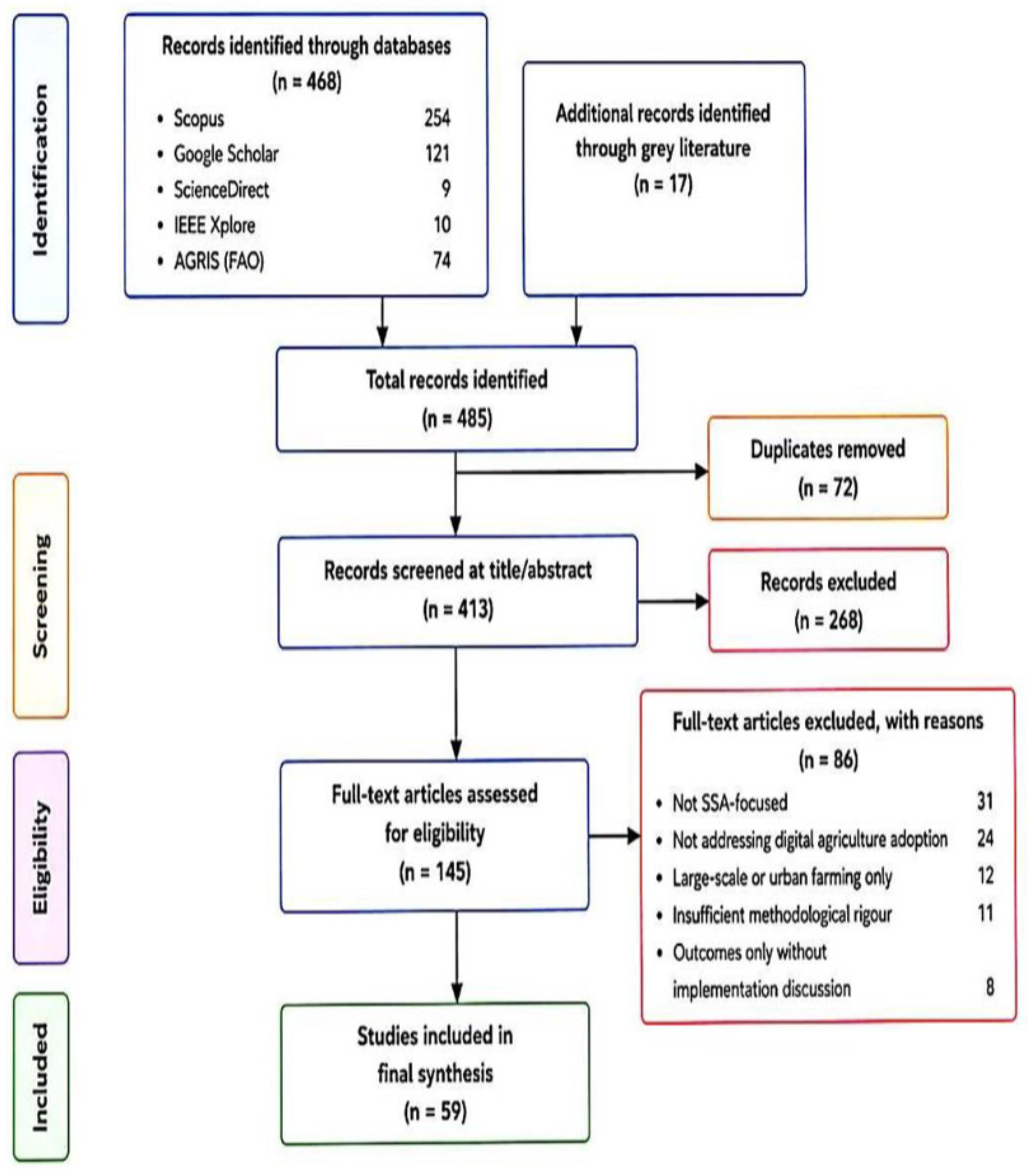
This study employed a systematic literature review (SLR) approach following guidelines proposed for conducting SLRs in the social sciences [57] and adapted procedures from the Preferred Reporting Items for Systematic Reviews and Meta-Analyses (PRISMA) framework [58] (Figure 2). The SLR was guided by the two research questions already mentioned in the introductory paragraph above. The focus was on technical and operational factors affecting digital agriculture implementation, drivers of digital agricultural productivity, outcomes, and socio-economic and structural barriers to adoption.

2.1. Search Strategy and Inclusion Criteria

A review protocol was developed to ensure transparency and replicability, including objectives, inclusion and exclusion criteria, databases and search strategies, screening and selection processes, and data extraction and synthesis techniques [59]. The search was limited to articles published between 2010 and 2025. This period (2010–2025) was selected because it coincides with the rapid expansion of mobile coverage in SSA, which catalyzed the emergence and proliferation of digital agricultural services for small-scale farmers [36]; similar systematic reviews in the field have adopted a 2010–2025 time-frame to capture the maturation and contemporary evolution of these technologies [60].
The literature search was conducted using Scopus (Elsevier, Amsterdam, The Netherlands), Google Scholar, ScienceDirect (Elsevier), IEEE Xplore, and AGRIS (FAO). Scopus and ScienceDirect were selected for their comprehensive coverage of peer-reviewed agricultural, environmental, and ICT literature and advanced Boolean search capabilities [61]. Google Scholar was included to capture grey literature, conference proceedings, and articles in press that may not yet be indexed in subscription databases [61]. IEEE Xplore was targeted specifically for ICT, sensor, and IoT-focused engineering literature relevant to digital agriculture. AGRIS (FAO) was selected for its specialised coverage of agricultural science and technology literature from developing countries, including region-specific reports and institutional publications.
The complete search string applied across all databases was: (“digital agriculture” OR “precision agriculture” OR “smart farming” OR “mobile agriculture” OR “ICT for agriculture” OR “e-agriculture” OR “Agriculture 4.0”) AND (“Sub-Saharan Africa” OR “SSA” OR “East Africa” OR “West Africa” OR “Southern Africa” OR “Central Africa”) AND (“smallholder” OR “small-scale” OR “small-scale farmer”) AND (“adoption” OR “uptake” OR “diffusion” OR “barrier” OR “driver” OR “determinant” OR “technical requirement” OR “operational requirement*” OR “implementation”). The search string was applied to the title, abstract, and keyword fields of each database, with database-specific syntax adaptations.
The initial search yielded 485 records distributed as follows: Scopus (n = 254), Google Scholar (n = 121), ScienceDirect (n = 9), IEEE Xplore (n = 10), AGRIS (n = 54 and grey literature n = 17). Duplicate records (n = 72) were identified and removed manually by comparing author names, titles, and publication years across the compiled dataset. The remaining 413 unique records advanced to title and abstract screening.
Inclusion criteria comprised (a) peer-reviewed journal articles, conference papers, academic book chapters, and grey literature (reports, policy briefs, technical documents); (b) publications in English; (c) studies focusing on Sub-Saharan Africa; (d) research addressing digital agriculture; (e) studies involving small-scale farmers in rural contexts; and (f) studies discussing technical or operational requirements. This also encompassed studies on digital platforms targeting small-scale farmers [38], analyses of e-agriculture policy landscapes [27], and evaluations of big data applications in agriculture [62]. The decision to include only English-language publications was informed by the linguistic capacity of the research team and the predominance of English in the indexed academic literature on digital agriculture in SSA [63]. Exclusion criteria included (a) studies not focused on SSA; (b) articles not available in English; (c) non-academic or grey literature not meeting quality criteria (see below); (d) studies on urban or large-scale farming only; and (e) papers describing only outcomes without discussing implementation requirements.
Grey literature quality was assessed using three criteria adapted from the AACODS (Authority, Accuracy, Coverage, Objectivity, Date, Significance) framework: (a) Authority: the publishing organisation is a recognised international body, government agency, or research institution with demonstrated expertise in agriculture or digital development; (b) Transparency: the document clearly states its methodology, data sources, and limitations; and (c) Currency: the document was published within the review timeframe and addresses contemporary digital agriculture developments. Grey literature meeting at least two of three criteria was retained. Grey literature not meeting these criteria was excluded.
The initial search retrieved 485 records. These records underwent a three-stage screening process: title and abstract screening to eliminate irrelevant articles; full-text screening using inclusion/exclusion criteria; and quality appraisal to assess methodological rigor using a modified Critical Appraisal Skills Programme (CASP) checklist [64]. After screening, 59 studies were included in the final analysis as shown in Figure 2 below and summarized in Table 1 below.

2.2. Data Extraction and Synthesis

A standardized data extraction form was developed in Microsoft Excel and piloted on five randomly selected studies to ensure consistency and completeness [59]. Data items extracted from each eligible study included (a) bibliographic details (authors, year, title, source); (b) study characteristics (research design, geographic focus, sample size, target population); (c) type of digital technology examined; (d) thematic findings related to the six dimensions of the conceptual framework (technical, operational, policy/regulatory, governance, social/cultural, and environmental factors); (e) reported adoption rates, productivity outcomes, and other quantitative metrics where available; and (f) author-identified barriers, enablers, and recommendations [47]. Data extraction was conducted independently by the lead author, with a subset of 20% of studies cross-checked by a second reviewer to minimise errors and ensure reliability [65].
Risk of bias in individual studies was assessed using a modified CASP checklist, which evaluated four domains: (a) clarity of research aims and design; (b) appropriateness and rigour of data collection methods; (c) analytical rigour and credibility of findings; and (d) relevance and contribution to the review questions. Studies that explicitly addressed limitations and reflexivity were also highly assessed. Grading was conducted independently by the lead author and a second reviewer for a randomly selected subset of 20% of studies (n = 12). Inter-rater agreement, calculated using Cohen’s kappa, was 0.82, indicating strong agreement. Discrepancies were resolved through discussion and consensus [65]. Studies were scored on a 5-point scale and classified as high (4–5), moderate (3), or low quality (<3); low-quality studies were excluded, resulting in 81.40% of included studies rated as moderate to high quality. Quality appraisal scores were used to weight findings during synthesis, ensuring that more credible studies informed key conclusions [65].
Given the heterogeneity of study designs and outcome measures across the reviewed literature, effect measures were not pooled statistically; instead, reported outcomes—such as adoption rates, yield changes, and price premiums—were synthesised narratively and summarised as percentage ranges to capture the breadth of documented impacts [47,56]. Reporting bias was addressed through the inclusion of grey literature alongside peer-reviewed sources to mitigate publication bias, and by transparently documenting regional and thematic gaps in the evidence base [59]. The certainty of the synthesised evidence was evaluated through methodological triangulation of qualitative and quantitative findings, consistency of patterns across diverse geographic and methodological contexts, and weighting of findings by study quality scores [65].
A hybrid thematic synthesis approach combining deductive and inductive coding was employed to analyze and integrate data across studies. Deductive codes were derived from the conceptual framework covering six thematic domains: technical, operational, policy/regulatory, governance, social/cultural, and environmental factors. Inductive codes were generated through an iterative process: initial open coding of 20 studies produced 41 provisional codes. These were subsequently refined through constant comparison—codes with overlapping meaning were merged (e.g., “affordability of devices” and “cost of data plans” were consolidated under “Financial Accessibility”), and codes appearing in fewer than three studies were either subsumed under broader categories or dropped. The final code structure, comprising 27 codes across six dimensions (as shown in Table 2 below), was validated through discussion among the author team and tested against an additional 10 studies to confirm saturation [66]. For instance, emerging themes such as “cooperative-led digital service provision” [67] and “climate information services” [68] were captured through this inductive process. Microsoft Excel supported systematic coding and organization, with matrices used to visualize thematic frequency and country-level variations.
Each study was read thoroughly to identify statements on digital agriculture drivers, barriers, and outcomes. Text segments were initially coded (e.g., connectivity barriers, digital literacy, policy gaps), refined into subthemes, and grouped under broader framework dimensions. A narrative and thematic synthesis was subsequently conducted to explore relationships among coded themes, with descriptive analysis providing the foundational characterisation of the evidence base. The synthesis methods were designed to accommodate the heterogeneous nature of the included studies. Specifically, (a) data were tabulated to summarise study characteristics, geographic distribution, and thematic coverage; (b) common themes were identified across studies through iterative coding and grouped under the six dimensions of the conceptual framework; (c) relationships between themes were explored to identify how technical, operational, and structural factors interact to shape adoption outcomes; (d) findings were compared across regions (West, East, Southern, and Central Africa) to examine contextual variation; (e) quantitative data on adoption rates and impact indicators were triangulated with qualitative narratives to strengthen the validity of conclusions; and (f) sensitivity analyses were conducted by excluding low-quality studies to confirm the robustness of key thematic patterns [65,66].
Artificial intelligence (AI) tools were employed to assist in specific analysis tasks: ChatGPT (OpenAI, San Francisco, CA, USA, GPT-4, September 2025 version) was used for language polishing and improving the clarity of author-drafted sentences and also to generate figures from the research statistics for visualisation; DeepSeek (DeepSeek-R1, 2025 version) was used for initial deductive and inductive coding of extracted text segments and thematic pattern extraction. All AI-generated outputs were critically reviewed, verified against source data, and refined by the authors to ensure accuracy and interpretive validity. At no stage were AI tools used to generate substantive content, interpret findings, or formulate conclusions.

3. Results

This section presents the findings of the systematic synthesis, structured around the six-dimensional conceptual framework that guided the review. Following the screening and eligibility assessment process detailed in Figure 2, a total of 59 studies were retained for final analysis, comprising 47 peer-reviewed journal articles, 7 grey literature reports, 3 conference papers, and 2 academic book chapters published between 2010 and 2025 [58,59]. Methodological quality was appraised using a modified CASP checklist, with 81.40% of studies rated as moderate to high quality, thereby providing a reasonably robust foundation for synthesis [64,65].
The outcomes reported across individual studies exhibited considerable heterogeneity, reflecting variations in country context, technology type, study design, and duration. Adoption rates ranged from below 10% in marginalised settings to 70–80% where institutional support and integrated service delivery were well established [32,47]. Similarly, yield increases of 4–40% and price premiums of 10–30% were documented across studies, with the most consistent gains reported in value chains with strong institutional integration (e.g., horticulture, cocoa) [47,69]. These figures are presented as descriptive ranges to capture the breadth of documented impacts, not as weighted meta-analytical averages. It is important to note that these figures derive from heterogeneous studies and should be interpreted as context-contingent rather than universal estimates [65]. Sensitivity analyses confirmed that excluding lower-quality studies did not materially alter the overarching thematic patterns, reinforcing confidence in the robustness of the synthesised conclusions [47,65]. The diversity of methodological approaches, crop systems and institutional settings across reviewed studies further underscores that the observed outcomes are highly dependent on local enabling conditions [36,48].
A hybrid thematic synthesis, combining deductive coding structured around the conceptual framework with inductive coding that allowed unanticipated themes to emerge from the data, yielded 27 distinct codes distributed across the technical, operational, policy and regulatory, governance, social and cultural, and environmental dimensions [66]. Reporting bias was assessed by comparing peer-reviewed and grey literature; peer-reviewed studies more frequently reported positive adoption outcomes, whereas grey literature contained a higher proportion of null or contextually constrained findings, affirming the importance of a diverse evidence base [59]. Sensitivity analyses confirmed that excluding lower-quality studies did not materially alter the overarching thematic patterns, reinforcing confidence in the robustness of the synthesised conclusions [47,65]. The subsections that follow unpack these findings in greater depth, beginning with a descriptive overview of the thematic distribution of the literature.

3.1. Thematic (Descriptive) Distribution of the Literature

This subsection presents a descriptive analysis of the thematic emphasis across the 59 reviewed studies, categorising the literature according to the six dimensions of the conceptual framework: technical, operational, policy/regulatory, governance, social/cultural, and environmental. The purpose is to quantify the relative attention each dimension has received in existing scholarship, thereby identifying thematic biases and gaps [66]. Studies were counted in multiple thematic categories where they substantively addressed more than one dimension; thus, the percentages across themes sum to more than 100%. For example, a study discussing both connectivity barriers (technical) and cooperative-led training models (operational) was counted under both dimensions. “Emergence” of a theme was defined as the presence of substantive discussion—at least one paragraph or equivalent—of factors within that dimension, as distinct from passing mention. By establishing the prevalence of technical and operational factors and exposing which structural dimensions remain under-researched, the analysis lays the groundwork for understanding the interplay between technical feasibility and structural constraints in shaping adoption outcomes.

3.1.1. Frequency of Publications per Theme

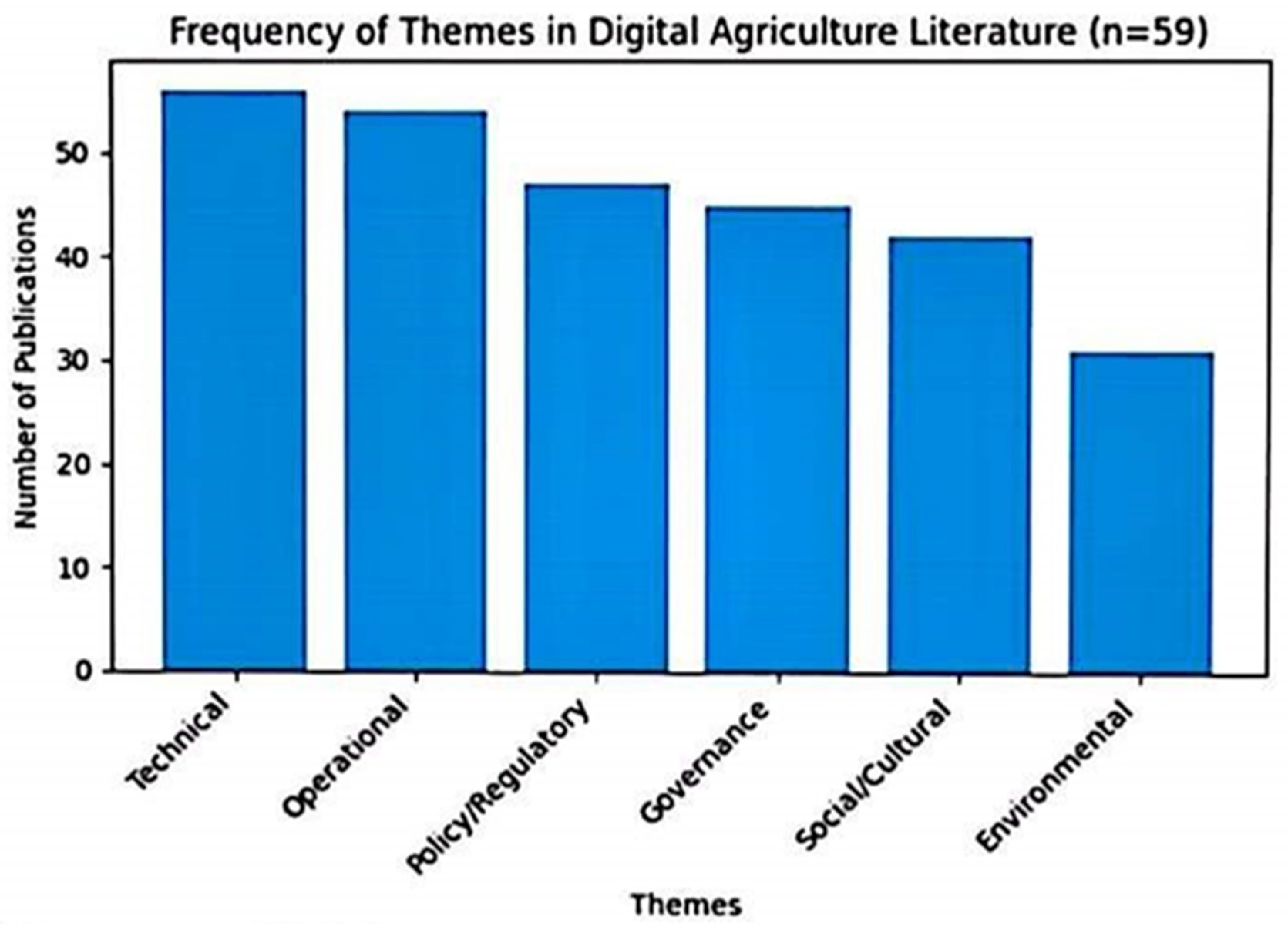
Analysis of the 59 reviewed studies as shown in Figure 3 revealed that technical factors dominated the literature (n = 56, 94.9%), followed closely by operational factors (n = 54, 91.5%). Policy and regulatory factors appeared in 47 studies (79.7%), governance factors in 45 studies (76.3%), and social and cultural factors in 42 studies (71.2%). Environmental and climate-related considerations were addressed in just over half of the studies (n = 31, 52.5%). Among the environmental studies, climate information services and early warning systems were the most frequently examined applications [68,70]. This distribution visually confirms the steep decline from technological to environmental themes in the literature thus demonstrating a technology-first bias in digital agriculture research, with progressively less attention paid to institutional context, social dynamics, and environmental integration. This imbalance indicates that the research community has focused substantially more on developing and testing digital tools than on understanding the enabling conditions required for their sustained use [7,29].
The thematic analysis demonstrated that adoption and effective use of digital agriculture by small-scale farmers in SSA were primarily enabled and constrained by technical and operational factors. Enablers included improved connectivity, mobile phone penetration, data-driven advisory services, and demonstrable productivity gains [5,32]. Key constraints consistently related to high implementation costs, limited digital skills, infrastructure gaps, and system maintenance challenges [33,37]. The high co-occurrence of these themes indicates that technical feasibility alone does not guarantee effective use; rather, adoption depends on the operational capacity to sustain, scale, and integrate digital tools within existing farming and extension systems. The analysis also showed that structural, socio-economic, and institutional barriers captured through policy, governance, and social-cultural themes played a decisive role in shaping unequal access and uptake. Literature focused on policy and regulatory factors, governance constraints, and social and cultural barriers highlighted how weak institutional coordination, gender norms, literacy gaps, age dynamics, and affordability systematically excluded resource-poor farmers [7,25,43]. In West Africa, Degila et al. [71] found that the intersection of low digital literacy and weak extension systems created a two-tiered access structure, with better-resourced farmers disproportionately benefiting from digital services. The evidence indicated that digital agriculture adoption in SSA is not only a technical challenge but a structural and institutional one, requiring integrated policy, governance, and inclusion-oriented approaches.

3.1.2. Geographic Distribution of Barriers and Facilitators

This part of the study maps the spatial patterns of digital agriculture adoption barriers and facilitators across Sub-Saharan Africa, drawing on the 59 reviewed studies grouped by region (West, East, Southern, Central, and multi-country SSA). The purpose is to examine whether the challenges and enabling factors identified in the literature vary systematically by geography, and to highlight regional concentrations of specific constraints such as affordability, connectivity, and gender exclusion [32,33]. This comparative analysis reveals the contextual nature of adoption determinants and informs the tailoring of interventions to region-specific conditions [48], thereby contributing to a more nuanced understanding of how technical, operational, and structural factors interact across different contexts.
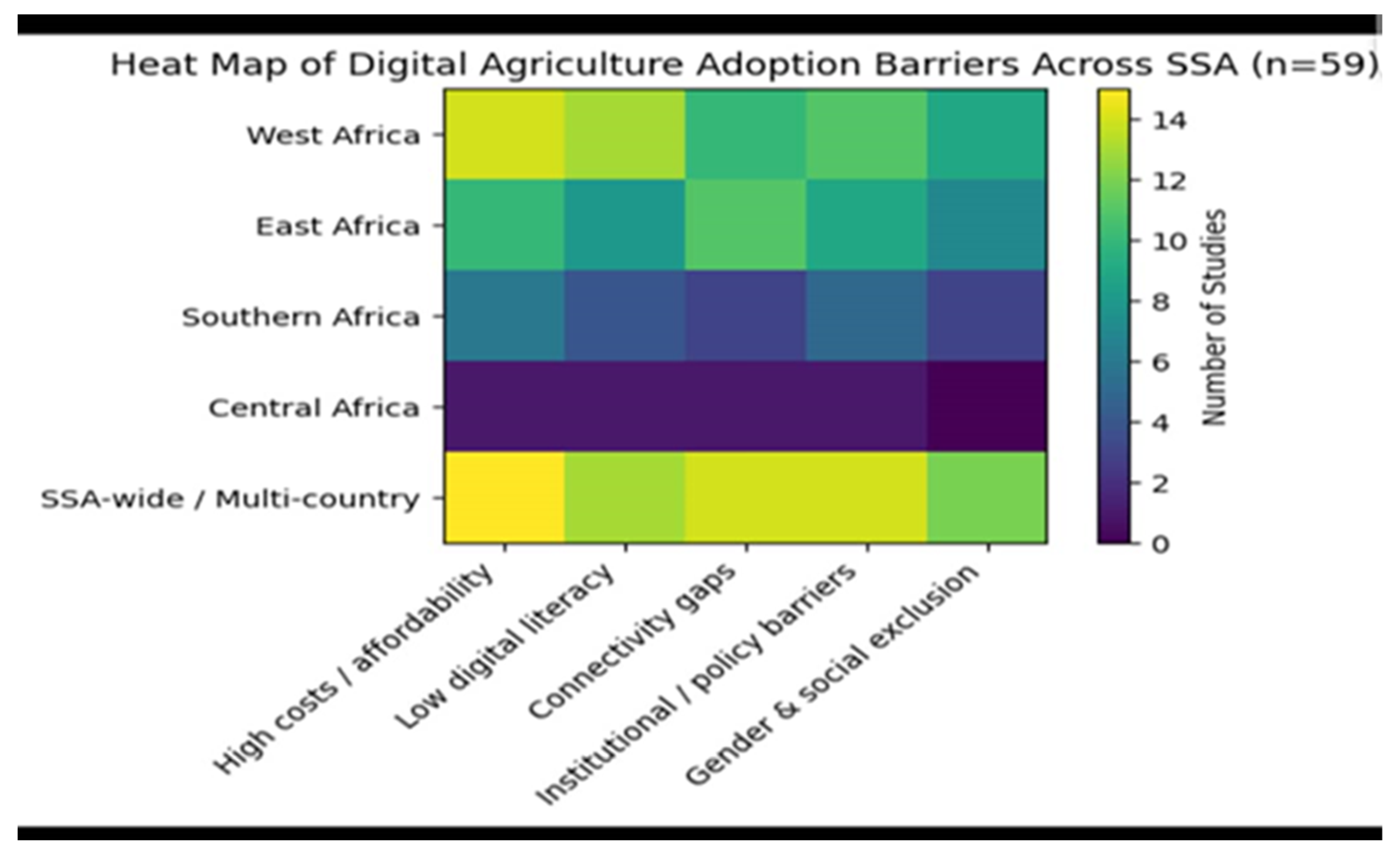
Figure 4 presents the regional distribution of key barriers to digital agriculture adoption across SSA. The colour intensity in the heat map show the frequency with which five major barriers—high costs/affordability, low digital literacy, connectivity gaps, institutional/policy barriers, and gender/social exclusion—are reported across West Africa (18 studies), East Africa (14 studies), Southern Africa (8 studies), Central Africa (1 study), and SSA-wide/multiple country studies (18 studies). Darker shading indicates a higher number of studies indicating that barrier. The visualization highlights that affordability and connectivity constraints are pervasive across all regions, while institutional and gender-related are particularly concentrated in West Africa and multiple-country analyses. Central Africa’s single-study representation limits comparative inference but signals a significant research gap.
The visualization showed a high concentration of affordability, connectivity, and institutional barriers across SSA-wide and West African studies, while East African studies predominantly highlight connectivity and cost-related constraints. Gender and social exclusion barriers are unevenly distributed but remain prominent in multi-country and West African analyses. Overall, the heat map revealed that barriers to digital agriculture adoption were not uniformly distributed across the region but cluster around structural and institutional constraints, reinforcing the conclusion that technical innovation alone was insufficient to achieve inclusive adoption.
The geographic distribution indicated that technical and operational barriers were pervasive across all SSA regions, but their intensity varied by context. In West and East Africa, accounting for 54% of studies, over 70% reported high operational costs, limited connectivity, and insufficient digital skills as primary constraints [5,20,32,37]. Technical enablers such as mobile phone penetration were widely documented in SSA-wide yet frequently offset by operational challenges related to data costs, maintenance, and scalability across all sub-regions of SSA but more severe in specific regions (notably Central Africa due to lower grid connectivity and higher data taxation) [11,33,72]. Southern African studies further highlighted infrastructure deficits, yet also revealed promising institutional partnerships—such as research–government collaborations and co-design initiatives—that can partially compensate for technical shortcomings [73,74].
East Africa exhibits a distinctive pattern: Kenya, Uganda, Tanzania, and Rwanda have each established national digital agriculture strategies with dedicated implementation units, yet outcomes diverge substantially. Kenya’s relatively higher adoption rates reflect not only superior mobile infrastructure but a mature mobile money ecosystem (M-Pesa), sustained donor and government co-investment, and a vibrant private-sector agri-tech landscape [48]. Tanzania, despite comparable mobile coverage, shows lower adoption due to weaker extension-digital integration and higher data taxation [38]. In West Africa, Nigeria and Ghana have articulated ambitious digital agriculture visions, but implementation is fragmented across federal and state agencies, resulting in pilots that rarely scale [27,71]. Southern African countries, particularly South Africa and Zambia, benefit from stronger research–government partnerships but face high technology costs and skills mismatches [73,74]. Central Africa remains digitally marginalised due to severe infrastructure deficits, limited institutional capacity, and policy incoherence [39]. This variation underscores that policy intent alone is insufficient; the translation of strategy into measurable on-farm adoption depends on institutional coherence, sustained financing, and regulatory frameworks that actively lower barriers for small-scale farmers [42].
The structural, socio-economic, and institutional barriers were unevenly distributed but structurally reinforcing. For instance, gender disparities, literacy gaps, and age-related exclusion appeared in over 60% of West and SSA-wide studies [25,36,43]. On the other hand, institutional and governance barriers such as weak policy implementation and fragmented extension systems were cited in over 75% of SSA-wide and East African studies [7,42,53], as illustrated in Table 3 below.

3.2. Drivers of Digital Agriculture Adoption

This section develops a holistic understanding of the drivers of digital agriculture adoption through a triangulated synthesis of qualitative and quantitative evidence. Qualitative insights, including thematic patterns and case narratives, are integrated with quantitative data on adoption rates and impact metrics. Such triangulation facilitates the cross-validation of findings and provides deeper insight into how context-specific factors influence observed statistical patterns [75]. The following subsections organise this integrated analysis around the core research questions, using both forms of evidence to build a comprehensive picture of adoption dynamics.

3.2.1. Technical and Operational Interdependence

Findings related to research question 1: how do technical and operational factors enable or constrain the adoption and effective use of digital agriculture by small-scale farmers in SSA? Qualitative findings underscore that technical and operational factors function as interdependent gatekeepers. Connectivity gaps, for instance, are technically limiting, but it is the operational burden of cost—data plans consuming 5–10% of monthly income—that transforms a technical limitation into an insurmountable barrier [33,76]. Similarly, usability challenges are experienced through digital literacy deficits, with farmers requiring 15–20 h of training to overcome interface complexity [10,36]. Successful implementations, such as co-design processes in Southern Africa, demonstrate that technical solutions only become effective when embedded within operational support systems that address maintenance, training, and contextual adaptation [47,74]. The experience of the “M-Kilimo” platform in Tanzania further illustrates that bridging the last mile requires local intermediaries who can translate digital advice into actionable farmer knowledge [38].
Quantitative analysis confirms that the thresholds of adoption rates for standalone digital tools average 30–40%, but increase to 70–80% when comprehensive support systems (training, affordable access, institutional backing) are in place [32,47]. Digital literacy training was associated with adoption rates up to three times higher than technology provision alone, with optimal impact through 15–20 contact hours [36,48]. Areas with 3G coverage above 60% achieve adoption rates of 45–55%, compared to 15–20% below this threshold [32]. The convergence of qualitative accounts and quantitative data indicates that technical feasibility alone does not drive adoption; operational capacity to sustain and scale digital tools is equally critical.

3.2.2. Structural and Socio-Cultural Barriers

Findings related to research question 2: how do structural, socio-economic, and institutional barriers shape unequal access to and uptake of digital agriculture among small-scale farmers? Qualitative narratives consistently highlight how structural factors reproduce inequality. Gender disparities are not merely gaps in device ownership but are embedded in patriarchal norms that constrain women’s independent technology use, limit time for digital engagement, and restrict decision-making authority [25,43]. Age-based divides reflect intergenerational knowledge tensions, where digital tools can either clash with or respectfully augment traditional practices depending on implementation approach [23,77]. Weak data governance erodes trust, particularly among marginalized groups already skeptical of external interventions [39,40]. In Ghana, Abdul-Rahim et al. [8] documented that farmers’ willingness to use digital tools was strongly influenced by concerns about data privacy and the perceived legitimacy of the service provider.
Although farmers generally experience the constraints mentioned above, there is gender disparity in adoption rates. For instance, women’s adoption rates were approximately 40% lower than men’s without targeted interventions. However, gender-focused programs were associated with narrowing the gap by up to 50% over a period of one year [25,43]. Language mismatches, where interfaces remain in English despite local language dominance, were associated with adoption rates 65% lower than those for local language versions [33,74]. The neglect of local languages is not merely a design flaw but a structural exclusionary mechanism, as shown by the significantly lower engagement rates among non-English-speaking farmers in multi-lingual contexts [71]. This triangulation reveals that addressing structural exclusion requires not only providing devices but also re-designing programmes to align with social norms, institutional accountability, and linguistic realities.

3.2.3. Enabling Ecosystems and Minimum Conditions

Institutional and financial eco-systems potentially enhance technological adoption. Case studies—such as Farm.ink in Kenya—succeeded by embedding within existing institutional ecosystems (banks, mobile operators, cooperatives) and solving a concrete problem (credit access) [78,79]. The Farm.ink focused design and strategic partnerships overcame the weak growth of the project. While EZ-Farm’s failure stems from over-engineering a complex platform that ignored infrastructural and literacy realities, requiring stable 3G/4G connectivity and advanced digital skills absent in its target contexts [10,39]. Its donor-dependent business model collapsed when funding ceased. Analyses of public–private partnership models in SSA suggest that the sustainability of digital services is enhanced when value-chain actors and mobile network operators share both costs and benefits [80,81].
The findings further show that systemic requirements of interventions meet fewer than four of the five minimum conditions for digital agriculture adoption; connectivity, affordability, literacy, institutional support and enabling policy, achieved adoption below 30%, while integrated approaches addressing all five achieved sustainable adoption rates of 70–80% [47,56]. Meta-analyses and multi-country studies confirm that the simultaneous presence of connectivity, digital literacy, and institutional support yields adoption rates up to four times higher than approaches addressing only one isolated factor [82,83]. The combined evidence strongly supports the view that adoption is not a linear diffusion but a threshold phenomenon requiring coordinated investment across multiple dimensions.

3.2.4. Regional Patterns and Contextual Variation

The geographical analysis revealed that barriers to technological adoption vary across different regions in SSA. West African studies frequently report high costs, low digital literacy, and gender gaps, while East African studies emphasise connectivity gaps and trust in digital tools [32,43]. Southern Africa highlights skills mismatches and technology costs, with co-design emerging as a key facilitator [47]. Central Africa remains under-represented in the literature, with only one study available [39]. In the Sahel, climate variability compounds infrastructure deficits, making context-specific advisory services essential yet logistically challenging [68]. Quantitatively, adoption rates mirror these regional patterns: East and West Africa show 30–45% adoption in high-potential corridors, while lagging regions report below 10% [48,84]. A recent multi-country assessment found that farmers in regions with integrated digital-climate advisory services had 25–35% higher adoption rates than those relying on generic agricultural apps [70]. This convergence confirms that context matters: regionally tailored interventions that address the specific configuration of barriers are more likely to succeed than one-size-fits-all approaches.

3.2.5. Synthesis: Adoption as a Socio-Technical Threshold

Across both qualitative and quantitative evidence, a consistent picture emerges: digital agriculture adoption in SSA is a socio-technical threshold phenomenon. Technical availability and operational feasibility are necessary but not sufficient [7]. Structural constraints including policy fragmentation, governance weakness and socio-cultural exclusion, function as binding limits that determine whether benefits materialize [85,86]. The five minimum conditions (connectivity, literacy, resonant design, institutional ecosystems, enabling policy) represent a practical framework for reaching the adoption threshold [12,60]. When these conditions are met in an integrated manner, adoption rates exceed 70%; when fewer than four are present, adoption stalls below 30% [12,60]. This threshold effect underscores that digital agriculture adoption is not a linear diffusion process but a systemic transformation requiring alignment across technological, institutional, and social domains to achieve inclusive and sustainable digital agriculture for small-scale SSA farmers [87].
As shown in Table 4 below, the aggregated evidence from this review confirms a clear adoption threshold: where fewer than four of the five minimum enabling conditions are met, adoption stalls below 30%, whereas integrated fulfilment of all five conditions supports rates exceeding 70% [12,60]. The data further indicate that widespread mobile penetration—a foundational enabler across SSA [36]—is insufficient to overcome the combined weight of operational deficits and structural constraints including policy fragmentation, governance and socio-cultural exclusion, function as binding limits that determine whether benefits materialise [7,85,86]. The figures presented represent descriptive ranges and illustrative examples drawn from individual studies, not weighted meta-analytical averages [36]. The following key insights summarise the conditions favouring the adoption of digital agricultural technologies in greater detail:
  • Minimum viable ecosystem: Adoption exceeded 70% only when ≥4 enabling factors combined: connectivity, affordability, training, and institutional support [89].
  • Economic thresholds: Technologies requiring >3-year payback periods achieved <20% adoption, establishing a clear viability threshold.
  • Literacy multiplier: Every US dollar invested in digital literacy was associated with three to four dollars in adoption benefits, representing the highest ROI (Return on Investment) among digital agriculture interventions.
  • Institutional leverage: Farmer cooperatives were associated with 60% adoption rates compared to individual approaches, demonstrating organisational multiplier effects.
  • Policy acceleration: Countries with national digital strategies were associated with 40% faster adoption growth, quantifying policy impact [90].
  • Sustained use challenge: Without ongoing support, approximately 70% of initial adopters discontinued use within 6–12 months, highlighting maintenance requirements.

4. Discussion

The key assertion of this review is that digital agriculture in SSA embodies a feasibility–impact paradox. While the viability of digital tools is extensively documented, their actual adoption remains a threshold-dependent phenomenon shaped by deeper structural and socio-cultural “binding limits” [7,11]. This section interprets the research findings through a multidimensional lens, transitioning from technical and operational constraints to structural levers of policy and governance, and finally to an integrated socio-technical model. By synthesizing evidence from 59 studies, we transition beyond the pervasive technology-first bias and reframe adoption as an emergent property of a complex, interdependent ecosystem where human capability and institutional readiness are the true determinants of sustainability [29,91]. The analyses reframe digital agriculture adoption as a fundamentally socio-technical process, deriving implications for policy, practice, and future research.

4.1. Technical and Operational Pathways to Digital Agriculture

The dominance of technical (94.9%) and operational (91.5%) factors in the reviewed literature reflects a systemic skewness that prioritises innovation supply over demand-side realities [5,25,90]]. Digital technologies promise tangible productivity gains—yield increases of 10–30% and price premiums of 15–25%, yet relying solely on technical feasibility as a proxy for success poses significant threats to long-term sustainability [47]. This narrow focus often overlooks the socio-economic realities and structural barriers faced by small-scale farmers, such as limited access to resources, inadequate infrastructure, and fragmented support systems, which are essential for realizing sustainable agricultural practices and fostering resilience in the face of climate variability [29,31]. Despite the recognised potential of precision agriculture technologies, their uptake among small-scale is constrained by interoperability challenges and the lack of affordable sensor solutions [62]. Nevertheless, structural barriers persist: policy implementation gaps (79.7%), governance fragmentation (76.3%), and socio-cultural exclusion (71.2%). Their persistence challenges the assumption that improved technology access alone drives adoption, underscoring instead the interplay between technological supply and the institutional, social, and economic conditions that shape demand [11,31].

4.1.1. The Technology-First Bias: Consequences for Sustainability and Scale

The emphasis on technical and operational dimensions reflects a prioritisation of the technological aspects of agricultural innovation. Too often, this comes at the expense of the critical social and institutional factors that determine whether tools are actually used [7,29]. Research and development efforts have focused on supplying digital tools—mobile applications, sensor networks, and information platforms—without commensurate attention to the scaffolding required for their sustained use [30,47]. This imbalance has inadvertently reinforced a pilot-driven, project-based model of innovation. That model yields isolated demonstrations of technical efficacy, but it fails to build the systemic conditions necessary for population-level impact on food security and sustainable resource management [77,92]. Where digital tools do reach farmers, evidence indicates modest productivity gains; however, because these gains are concentrated within well-resourced “island” contexts, aggregate improvements in regional food availability remain limited [93]. An early review of ICT-for-agriculture initiatives in SSA already warned that without institutional embedding, technology-driven projects risk being short-lived and donor-dependent [18].
Furthermore, the technology-first orientation has largely bypassed the potential of digital agriculture to support sustainable intensification. Applications such as precision input management that reduces fertiliser overuse, or water conservation advisories, demand more than technical functionality; they require behavioural change, trusted extension relationships, and supportive policy incentives—conditions that are currently underdeveloped [32,36,79]. The skewness thus represents a missed opportunity: technical readiness exists, but the enabling ecosystem needed to translate that readiness into equitable, sustainability-oriented outcomes remains fragmented and under-resourced [42,48].
Examining this skewness highlights important implications for scaling digital agriculture interventions. Upscaling—expanding a proven intervention within similar contexts—is often constrained by the very institutional and social conditions that the technical literature underrepresents [6,11]. A Kenyan horticulture cooperative with strong extension support, market linkages, and group cohesion demonstrates how an integrative approach can optimise the adoption of digital agricultural technology [32]. Outscaling—adapting an intervention to new geographic or socio-economic contexts—is even more vulnerable to this bias, as transferring a technically proven tool into a different institutional environment frequently results in adoption failure [7,39]. Analogous challenges have been observed in the transfer of digital platforms from East to West Africa, where differing policy environments and infrastructure readiness led to dramatically different outcomes [71]. The literature’s emphasis on technical feasibility creates a false sense of transferability, underestimating the context-specific nature of adoption outcomes [94]. Consequently, the skewness contributes to a persistent “pilot chasm”: numerous successful small-scale demonstrations coexist with a dearth of examples of sustained, large-scale adoption [92].

4.1.2. Spatial Inequality and the Geography of Adoption

In addition to the skewedness discussed above, the review outcome also suggests a variation in adoption rates across SSA countries. For instance, Kenya’s higher adoption rates are attributable not merely to superior mobile infrastructure. They reflect a confluence of elements: a mature mobile money ecosystem, sustained donor and government investment in digital agriculture programming, a vibrant private-sector agri-tech landscape, and relatively coordinated institutional frameworks [48,95]. Nigeria and Ghana similarly benefit from concentrated research and development attention, though within-country disparities remain pronounced [96]. In contrast, countries in Central Africa and parts of the Sahel exhibit lower adoption rates, a pattern linked to deeper infrastructural deficits and institutional marginalization [5,39]. This disparity is reinforced by the uneven distribution of digital infrastructure investments, which tend to follow existing economic corridors rather than targeting marginalised areas [97]. There is also a combination of weaker infrastructure, limited institutional capacity, policy incoherence and marginalization from research and investment circuits [98]. The variation therefore reflects not isolated technical deficits, but systemic differences in the density and quality of enabling conditions across the five-factor framework identified in this review. This underscores that adoption is a socio-technical phenomenon: countries that have made concerted, multi-dimensional investments across technical, institutional, and social domains achieve faster and more equitable adoption trajectories than those pursuing fragmented, technology-centric approaches [7,15].
When digital tools are designed for optimal conditions—for instance, assuming stable 3G/4G connectivity, they often fail to transition to rural, low-bandwidth realities [32,33]. This creates a “pilot chasm” where innovations never move beyond the controlled settings in which they were tested [92,94]. The result is a landscape of “islands of adoption” within broader “seas of exclusion” [48]. Kenya’s horticulture sector and Ghana’s cocoa value chains boast adoption rates as high as 55%, bolstered by robust mobile money ecosystems [88,95]. In contrast, staple-crop systems in the Sahel or Central Africa often languish below 10% adoption [5,39]. Here, the infrastructure-accessibility paradox bites hard: data are available in principle, but costs can consume up to 5% of a farmer’s monthly income [98,99]. Farmers in Malawi and Niger struggle with high data costs and limited device accessibility, resulting in pervasive exclusion [43,100].
The infrastructure-accessibility paradox highlights a critical misalignment between physical availability and economic feasibility. To resolve this, a clear distinction must be made between hard infrastructure—the physical backbone consisting of fiber-optic networks, cellular towers, mobile devices, and electricity grids—and soft infrastructure, which encompasses digital services, data governance, and institutional support frameworks [39,99]. The analysis revealed that while physical network coverage has expanded across SSA, the primary accessibility constraint is not the lack of a signal, but a combination of the mobile affordability gap and the prohibitive cost of data. These underlying challenges are rooted in high import duties on smartphones and a lack of competitive pricing among Internet Service Providers (ISPs), which often force data costs to consume up to 5% of a farmer’s monthly income [98,101]. The proliferation of mobile network coverage has not been matched by corresponding investments in localized, offline-capable applications that can function effectively in areas with intermittent connectivity [97]. To mitigate this, interventions must shift from simply expanding physical networks to prioritizing soft infrastructure solutions, such as zero-rating agricultural data so that farmers can access essential advisories for free, and implementing device-subsidy schemes specifically for small-scale farmers [48]. Furthermore, strengthening institutional support and public–private partnership through decentralized digital hubs can provide the necessary electricity and technical assistance, ensuring that the existence of a network translates into a practical, cost-effective tool for agricultural productivity [32,92].
The persistence of “islands” carries a sober warning. Without a deliberate shift toward inclusive infrastructure, digital agriculture may inadvertently consolidate wealth and productivity in already-advantaged regions [53,93]. This geographic skewness risks transforming a tool for development into a mechanism that deepens regional stratification—directly challenging the “Leave No One Behind” mandate of the Sustainable Development Goals [29,102].

4.2. Structural Levers: Governing for Equitable Digital Transitions

The analysis disputes the notion that market forces alone can bridge the digital divide. Structural levers have been identified—specifically policy implementation and governance coordination—as binding limits to adoption. This research work highlights a failure in the strategy-to-execution pipeline: while many SSA nations have ambitious digital roadmaps, they lack the implementation frameworks or inter-ministerial accountability to inspire trust [42,48]. Evidence from Ethiopia’s coffee sector, where coordinated governance facilitated a local digital advisory platform, suggests that institutional coherence is vital [37]. Furthermore, countries with integrated data protection laws and zero-rated agricultural data have significantly reduced the participation tax for vulnerable farmers [39,101]. A comparative policy analysis across SSA countries found that those with explicit e-agriculture strategies and dedicated implementation units were associated with 40% faster adoption growth than those without [27].

4.2.1. Policy and Governance Fragmentation

Throughout much of the SSA region, digital agriculture strategies remain largely symbolic—well-articulated in policy documents but seldom accompanied by actionable delivery plans, ring-fenced budgets or machinery for cross-sectional coordination [42,48]. Although numerous pilot programmes have been implemented, evidence of sustained scaling and effective government stewardship remains limited [103]. This gap between policy ambition and implementation is a recurring theme across SSA, with studies attributing it to weak inter-ministerial coordination and insufficient political will [27,41]. In addition, regulatory gaps in data ownership and privacy discourage private sector investment and leave farmers uncertain about their rights [39,40]. In some countries, rising smartphone taxes further undermine digital inclusion efforts, illustrating policy incoherence that constrains adoption regardless of technological readiness [101].
Governance fragmentation—characterized by overlapping mandates between agriculture and ICT ministries, weak inter-agency coordination, and limited accountability—further impedes progress. Countries with more integrated governance arrangements tend to achieve faster and more equitable adoption [41,48,95]. For example, evidence from Benin’s livestock sector shows that regulatory gaps, fragmented governance, and weak data protection frameworks erode stakeholder trust, resulting in isolated pilot initiatives that fail to scale [104]. These institutional shortcomings are not unique to Benin; similar patterns of fragmentation have been documented in Nigeria’s e-extension services [20] and in the Zambezi Basin countries [42], where overlapping mandates between agriculture and ICT ministries create confusion rather than clarity for end users. Fragmentation across horizontal, vertical, and functional levels leaves farmers navigating overlapping and often confusing services without clear institutional anchors. While data cooperatives and collective action models can partially address these challenges by fostering bottom-up accountability, their effectiveness depends on supportive policy environments [105,106]. Farmer-owned cooperatives that pool resources for digital subscriptions have demonstrated a model for overcoming individual-level affordability barriers [67]. More broadly, Africa’s agri-food transformation depends less on the introduction of new technologies than on the effective governance and integration of existing ones [107].
Beyond policy fragmentation, the governance of digital agriculture must contend with the political economy of platform power. In several SSA countries, the digital agriculture landscape is increasingly shaped by multinational technology corporations and mobile network operators whose market dominance influences data costs, interoperability standards, and the terms of farmer data access. In Kenya, for example, Safaricom’s position as the dominant mobile network operator means that the accessibility and pricing of agricultural digital services are mediated by a single corporate actor [95,101]. In Nigeria, the entry of global agri-tech platforms has raised concerns about data sovereignty, as small-scale farm data are stored on servers outside national jurisdictions, limiting farmers’ and governments’ control over agricultural information [27,39]. Recent scholarship on digital platform governance underscores that without regulatory frameworks addressing platform accountability, data ownership, and competitive market access, digital agriculture risks reproducing—rather than disrupting—existing power asymmetries in agri-food systems [54]. Policy responses, such as the African Union’s Data Policy Framework, represent important steps but require domestication into binding national legislation with enforcement mechanisms [42].
The implications for upscaling, digital inclusivity, and agricultural sustainability are significant. Policy fragmentation constrains upscaling by creating regulatory uncertainty that discourages the long-term investments required to move beyond pilot phases [92]. Governance fragmentation exacerbates digital exclusion by concentrating services in areas with stronger institutional capacity, thereby marginalizing already areas and populations with inadequate technological support [98]. From a sustainability perspective, weak policy coherence limits the alignment of digital tools with national climate adaptation and natural resource management priorities. As a result, opportunities to leverage digital agriculture for sustainable intensification—such as site-specific nutrient management or water conservation advisories—are often missed due to inadequate coordination between agriculture and environmental institutions [77].

4.2.2. Socio-Cultural Exclusion, Interlocking Constraints, and Pathways Forward

A critical structural dimension from the analysis is the mediation of adoption by the capability–wealth nexus. Age, literacy, and income levels act as primary gatekeepers to digital entry. Younger farmers (ages 18–35) and middle-aged agripreneurs exhibit significantly higher adoption rates—reaching up to 75% in some contexts—due to their higher risk tolerance and technical aptitude [24,108]. However, this youth-led dynamism is frequently stifled by a wealth ceiling, as those in lower income deciles lack the collateral for the hardware investments required for precision agriculture [91,109]. Digital literacy remains the most significant non-financial barrier; without it, even affordable tools remain functionally inaccessible, reinforcing a cycle where only the literate and relatively wealthy can capture the digital premium [36,94]. The capability–wealth nexus is further tightened by the absence of tailored financial products that could enable small-scale farmers to invest in digital tools, a gap that perpetuates the exclusion of low-income households [82].
Furthermore, the gendered dimensions of structural exclusion remain a formidable barrier to equitable transition. The research analysis reveals that women’s adoption rates are consistently 40% lower than men’s, a disparity driven less by technical inability and more by entrenched patriarchal norms regarding asset ownership and household decision-making power [25,43]. Women are 29% less likely than men to use mobile internet, with an estimated 205 million women in the region remaining offline [99,101]. Intersectional evidence remains limited, hindering understanding of compounded barriers faced by asset-poor, socially excluded women [100]. In many rural SSA contexts, women have less access to smartphones and data services due to time poverty, as they often bear the brunt of household responsibilities such as caregiving, food production and domestic tasks, leaving them with limited time and opportunity to engage with technology [25,36]. This lack of time not only restricts their ability to seek out digital training and support but also limits their financial autonomy, as many women rely on male family members for device purchases and data access, perpetuating a cycle of exclusion from digital agriculture innovations [43,94]. This implies that gender-neutral digital policies effectively function as gender-exclusionary ones. Unless structural levers incorporate gender-transformative programming—such as women-only cooperatives and targeted device financing—the digital transition will continue to bypass half of the agricultural workforce [56,77]. Targeted initiatives such as women-only digital literacy camps and subsidized smartphone schemes for female farmers have shown measurable success in narrowing the gender gap [24].
Ultimately, these structural levers—from governance coherence to the mitigation of demographic and gender biases—represent the engine room of equitable adoption. The Zambia Digital Champions initiative demonstrates that local, trusted intermediaries can bridge digital and social divides, building trust and addressing gender and inclusion challenges at the community level [110]. Socio-cultural constraints require intentional design, community engagement, and sustained investment in digital literacy and gender-transformative programming. Failure to address these underlying socio-economic drivers means that even the most sophisticated technical tools will continue to face a glass ceiling, serving only an elite minority while the majority of small-scale farmers remain on the margins of the digital revolution.

4.3. The Socio-Technical Synthesis: Closing the Adoption Gap

The culmination of the findings affirms that adoption can be best maximized through an integrated technical and social approach. We contend that gaps in affordability, accessibility, and adaptability cannot be remedied solely by technological over-engineering [16,39]. Instead, successful examples like Kenya’s Farm.ink demonstrate the importance of embedding digital solutions within existing social frameworks, such as cooperatives and extension networks [78].
Applying the TOE lens to the synthesised evidence reveals a distinct hierarchy of influence. The technological dimension (connectivity, device affordability, interface usability) constitutes the necessary foundation—without it, adoption cannot commence. However, the organisational dimension (digital literacy, extension support, cooperative membership) exerts the strongest moderating influence on adoption intensity and sustainability [111]. Empirical work on process innovation in emerging economies confirms that organisational readiness—particularly workforce capability and managerial support—mediates the relationship between technological availability and actual adoption outcomes, as farms with higher absorptive capacity realise significantly greater returns from equivalent technological investments [7,29]. The environmental dimension (policy coherence, data governance, gender norms, market structure) operates as a binding constraint: favourable technological and organisational conditions cannot translate into equitable, scaled adoption when policy fragmentation or socio-cultural exclusion persist [7,29]. This interaction pattern explains why interventions that address only one dimension—such as providing smartphones without complementary literacy training or without zero-rating agricultural data—consistently fail to achieve sustained adoption beyond pilot phases [48,92].
Evidence has illustrated that this integrated model narrows adoption gaps by addressing three decisive pillars—affordability, accessibility and adaptability. Regarding affordability, transitioning toward “channel-agnostic” designs enables the use of basic SMS and USSD, circumventing the smartphone cost barrier which currently stands at 73% of a poor adult’s monthly income [101]. Thus lowering the financial point of entry is a prerequisite for rural access [84]. Accessibility is mediated by leveraging the “Literacy Multiplier” effect. Every US dollar invested in socially embedded digital literacy initiatives was associated with up to four dollars in adoption benefits [36]. This transforms literacy from a barrier into a facilitator for marginalized groups [33,94]. As regards adaptability, integrating local and indigenous knowledge into digital advisories enhances usability. When tools are culturally and linguistically resonant, the likelihood of sustained use increases by up to 65% [33,74]. This finding aligns with broader socio-technical theory, which posits that technology must be interpreted through users’ cultural frames to become embedded in everyday practice [29,91]. The co-creation of weather-based advisory services with farmer groups in the Sahel demonstrates that participatory design not only improves relevance but also builds trust in digital tools [68].
The synthesis also revealed that successful enabling factors are only half the story. A systematic analysis of documented cases of project discontinuation and technology dis-adoption identified four recurrent failure modes. First, donor-dependent business models: initiatives such as EZ Farm ceased operations when project-based funding ended, as their value propositions had not been validated through sustained user willingness-to-pay [10,39]. Second, infrastructure–design mismatches: platforms requiring stable 3G/4G connectivity or advanced smartphone functionality failed in rural areas where 2G networks and basic feature phones predominate [32,33]. Third, socio-cultural misalignment: tools introduced without adaptation to local languages, gender norms, or intergenerational knowledge systems experienced rapid dis-adoption once initial curiosity waned [25,43]. Fourth, institutional disconnection: digital services operating in parallel to, rather than integrated with, existing extension systems lost user trust and relevance when farmers could not access human support for digital queries [38,42]. Across studies, approximately 70% of initial adopters discontinued use within 6–12 months in the absence of ongoing support, highlighting that adoption is a continuous process requiring sustained institutional investment rather than a one-time event [69].
Ultimately, reframing digital agriculture as a socio-technical process underscores that the last mile is a social journey requiring support through trust, capability, and institutional accountability [29]. For policy and practice, this necessitates a shift from short-term technological pilots to long-term human and institutional infrastructure.
Adopting a socio-technical approach to promoting digital agriculture adoption has several important implications. First, it shifts the analytical and programmatic focus from technology supply to system readiness, recognising that adoption outcomes are emergent properties of the interaction between tools, users, institutions, and policies [29,91]. Second, it mandates a multi-stakeholder, multi-level governance perspective: no single actor—whether a technology developer, a donor, or a ministry—can unilaterally create the conditions for sustained, inclusive adoption [92]. Third, it elevates the importance of process over product, emphasising co-design, participatory iteration, and adaptive management as essential components of intervention design [94]. Fourth, a socio-technical lens foregrounds issues of power, equity, and agency, requiring explicit attention to who benefits, who is excluded, and whose knowledge counts in digital agriculture transitions [15,77]. A recent framework for digital agriculture ecosystems underscores that scalability depends on the dynamic alignment of technology providers, financial institutions, policy actors, and farmer networks—a configuration rarely achieved in fragmented contexts [54].
The insights from this review illuminate the balance between technological, operational, and structural factors in adoption. As stakeholders address the feasibility-impact paradox, they must strive for integrated solutions that tackle systemic barriers while facilitating equitable access. Future research must emphasize interdisciplinary approaches that scrutinize socio-cultural dynamics alongside technical advancements [30,48]. By embracing a comprehensive, socio-technical framework, we can achieve sustainable agricultural systems that truly leave no one behind in SSA.

4.4. Positioning Within the Existing Literature

The findings align with and extend the growing body of work in socio-technical systems theory, which emphasizes that technology adoption is fundamentally shaped by social, institutional, and political contexts [29,91]. The review provides empirical quantification of the imbalance between technical considerations and structural factors in the existing literature, moving beyond fragmented case-study insights to a systematic synthesis. This contributes to ongoing debates on the nature of digital transformation in African agriculture, reinforcing critiques that technology-centric approaches risk overlooking the institutional and social dimensions that determine whether digital tools empower or marginalize farmers [15,22,90].
The identification of five minimum conditions for adoption—connectivity, literacy, culturally resonant design, institutional ecosystems, and enabling policy—offers a framework that resonates with the TOE model [111] while extending it to capture the specific realities of small-scale agriculture in SSA. This framework suggests that adoption is not a linear process of technology diffusion but a systemic challenge requiring coordinated intervention across multiple domains [30,112]. The review thus corresponds to calls for more context-sensitive, multidimensional analyses of digital transformation in African food systems [11,53]. Early contributions such as Kshetri (2014) already highlighted the institutional voids that limit the impact of ICT in African agriculture, a finding that remains salient in current digital transformation debates [17].

4.5. Implications for Policy and Practice

The findings underscore that advancing digital agriculture requires a coordinated, systems-based approach that jointly addresses infrastructure, capabilities, design, institutions, and governance rather than treating them as discrete domains. The following stakeholder-specific recommendations are proposed.
  • For Governments: Connectivity, Device Access, and Enabling Regulation.
Policy implications: The evidence highlights the central role of inclusive digital infrastructure frameworks that combine public investment with regulatory instruments to incentivize private sector participation. Measures such as rural spectrum allocation, device subsidies for women and youth, and zero-rating of agricultural services emerge as critical levers for reducing structural access barriers and improving affordability [33,49]. Ortiz-Crespo et al. [97] further argue that beyond network coverage, the quality of last-mile connectivity and device affordability are the true determinants of digital reach. Governments should also establish integrated national digital agriculture strategies with clear inter-ministerial implementation mechanisms, ring-fenced budgets, and enforceable regulatory frameworks for data privacy, farmer data rights, and spectrum allocation [28,48]. In addition, regulatory frameworks addressing platform accountability, data sovereignty, and competitive market access are essential to ensure that digital agriculture does not reproduce existing power asymmetries in agri-food systems [54].
Practice implications: In practice, governments can facilitate service delivery by enabling context-responsive access models, including support for community networks, shared device systems, and leasing arrangements. The findings indicate that last-mile connectivity and sustainability are strengthened where public authorities effectively partner with telecom providers and local enterprises. Public–private partnerships should be leveraged to provide targeted financial incentives, such as zero-rating agricultural data and providing device subsidies for women and youth to lower the entry barrier for marginalized groups [48,99]. Such partnerships have shown promise in East Africa, where bundled service models combining telecom, finance, and extension factors have outperformed standalone digital initiatives [32,49]. For example, Kenya’s government collaborated with Safaricom to zero-rate agricultural data for smallholder farmers accessing the M-Farm platform, substantially reducing the cost of digital market information and contributing to a reported income increase of up to 50% for users [13].
ii.
For Private Companies (Telecoms, Agri-Tech Firms): Context-Responsive Service Delivery.
Policy implications: Private companies play a critical role in shaping the digital agriculture landscape through self-regulation and industry standards. Technology providers should advocate for and adhere to transparent data governance frameworks that protect farmer data rights and ensure interoperability across platforms [54].
Practice implications: In practice, service delivery is shaped by the adoption of context-responsive access models. Private companies should invest in channel-agnostic, offline-capable platform designs; partner with cooperatives for last-mile distribution; and adopt tiered pricing models that accommodate smallholder income variability [97]. The findings indicate that last-mile connectivity and sustainability are strengthened where partnerships with telecom providers and local enterprises are effectively mobilized. In Tanzania, the “M-Kilimo” platform, developed by a private agri-tech firm in partnership with a mobile network operator, used USSD-based services that functioned on basic feature phones, overcoming both smartphone affordability barriers and low digital literacy, and connected farmers to real-time advice and market prices [38].
iii.
For NGOs and Development Partners: Digital Literacy and Capacity Development.
Policy implications: The results point to the importance of embedding long-term, context-specific digital literacy within national strategies, with explicit recognition of the differentiated needs of women, youth, and other marginalized groups. NGOs and development partners should advocate for ring-fenced funding for continuous digital literacy programming rather than relying on short-term, donor-dependent training cycles [36].
Practice implications: At the implementation level, digital literacy is most effective when delivered through continuous, socially embedded learning systems. Approaches such as peer learning, farmer field schools, and women-centered platforms illustrate how practical, use-oriented training enhances relevance, uptake, and retention [25,36,113]. The success of such programs is amplified when they are embedded within existing community structures, such as cooperatives or farmer field schools [67]. NGOs and development partners should fund longitudinal, independent evaluations rather than short-term pilots, ensuring that literacy investments are sustained and their impacts measured over time [69]. The Zambia Digital Champions initiative, supported by CIMMYT, trained community-based intermediaries who bridged digital and social divides by delivering locally relevant digital literacy training to smallholder farmers, particularly women, and built trust in digital tools at the village level [110].
iv.
For Extension Services: Institutional Ecosystems and Service Integration.
Policy implications: The evidence highlights the importance of coherent institutional arrangements that integrate digital tools within existing agricultural systems, particularly extension services, while positioning farmer organizations as key intermediaries. It also underscores the role of policy in enabling collaborative frameworks such as public–private partnerships [56,114]. Governments should establish dedicated digital agriculture coordination units within ministries of agriculture, with clear mandates to align the efforts of extension, ICT, and private-sector actors [27].
Practice implications: At the operational level, outcomes improve when digital solutions are embedded within established advisory and service delivery structures rather than introduced as standalone interventions. Strengthening the capacities of extension agents to serve as intermediaries who translate digital advisories into actionable, context-specific guidance enhances mediation, trust, and continued use. Case studies from South Africa demonstrate that research-government partnerships can drive co-design processes that enhance both relevance and adoption [73]. The collaboration between the Agricultural Research Council and provincial extension services co-designed a digital advisory tool for small-scale maize farmers, which led to higher adoption rates because extension agents used the tool during regular farm visits, integrating digital advice with farmers’ existing practices [73].
v.
For Farmer Organisations: Collective Action and Co-Creation.
Policy implications: Farmer organisations should be formally recognised as key intermediaries in national digital agriculture strategies, with access to funding and technical support to facilitate their role in aggregating demand and providing feedback on digital tool design [67].
Practice implications: Farmer organisations should leverage collective bargaining for group data subscriptions and device purchases; establish peer-learning networks for digital literacy; and participate actively in the co-design of digital tools to ensure cultural and linguistic resonance [67,74]. The incorporation of indigenous climate knowledge into digital advisories has been shown to double farmer trust and usage in pilot projects in the Sahel [68]. In Kenya, horticultural cooperatives pooled resources to negotiate bulk data packages and smartphone purchases for their members, while also organising peer-training sessions on the use of a digital platform for market linkages, which was associated with adoption rates exceeding 70% among cooperative members compared to less than 30% among non-members in the same region [32].

Cross-Cutting Implication: Integration and Coordination

Across all domains, the findings demonstrate that fragmentation in policy and practice significantly constrains effectiveness. Digital agriculture outcomes are strongest where interventions are aligned and mutually reinforcing across sectors and stakeholders. Multi-stakeholder coordination platforms play a critical role in harmonizing investments, timelines, and implementation pathways [47,56]. Integrated digital agriculture platforms that bundle services (inputs, credit, and market access) have been particularly effective in addressing multiple barriers simultaneously [80]. The evidence that high adoption rates are associated with the simultaneous presence of multiple enabling conditions reinforces the importance of systemic, integrated approaches over isolated or piecemeal efforts.
In the East African context, Kenya’s experience with Farm.ink demonstrates that embedding digital solutions within existing financial ecosystems (e.g., M-Pesa, cooperative credit schemes) enhances both adoption and sustainability [78]. Tanzania’s ‘M-Kilimo’ platform illustrates the critical role of local extension intermediaries in bridging the last mile between digital advice and farmer practice [38]. For West Africa, Ghana’s experience suggests that value-chain-anchored digital services (e.g., cocoa sector platforms) achieve higher adoption than generic agricultural apps [88]. In Southern Africa, South Africa’s research–government co-design partnerships offer a model for aligning digital tools with both commercial and emerging farmer needs [73].

4.6. Implications for Future Research

The review’s findings reveal several critical research gaps. First, the overemphasis on technical and operational dimensions suggests a need for more research on governance and socio-cultural dynamics, particularly how institutional arrangements and social norms shape adoption outcomes across different contexts [29,44]. Second, the scarcity of longitudinal studies represents a significant gap; future research should employ rigorous mixed-methods designs tracking sustained adoption over multiple seasons and years to understand not only initial uptake but also continued use and adaptation [69,115]. Understanding the life-cycle of digital adoption, from initial enthusiasm to potential dis-adoption, is essential for designing durable solutions [83].
Third, intersectional research examining how gender, age, ethnicity, and wealth interact to shape adoption pathways is urgently needed. Current research often treats these factors in isolation, yet exclusion mechanisms are intersectional—women in remote areas with limited education face compounded barriers that differ from those facing men in similar circumstances [25,93]. Fourth, business model innovation for sustainable scaling remains underexplored; research is needed on cooperative digital service provision, cross-subsidization models, and public–private partnership structures that can support digital tools beyond donor funding [81,116]. Oliveira-Jr et al. [62] point to the potential of low-cost IoT and sensor networks, but their economic sustainability in small-scale contexts remains unproven.
Fifth, as AI-assisted advisory tools—including large language models, computer vision for pest and disease detection, and predictive analytics for yield forecasting—proliferate, research is urgently needed on their effectiveness, trustworthiness, and accessibility in low-resource, linguistically diverse small-scale contexts [87]. Sixth, digital platforms for value-chain integration—linking farmers to input suppliers, credit providers, and buyers—remain under-evaluated; future research should examine platform governance, data-sharing arrangements, and the distribution of value among platform participants [54,116]. Seventh, climate-smart digital agriculture—integrating climate information services with adaptation advisories—requires longitudinal assessment to determine whether digital tools enhance or merely digitise existing adaptive capacity [68,70].
Finally, environmental implications of digital agriculture—including carbon footprints, climate adaptation potential, and e-waste management—are critically under-researched. As device penetration increases, understanding these impacts becomes essential for ensuring that digital agriculture contributes to rather than undermines environmental sustainability [39,117]. Early assessments suggest that the carbon footprint of digital advisory systems is negligible compared to the potential emission reductions from precision input management, but systematic life-cycle analyses are lacking [70].

4.7. Limitations of the Review

This review has some limitations which warrant acknowledgement. Firstly, geographic publication bias is evident: West and East Africa account for 54% of studies, while Central Africa is represented by only one study [39], limiting the generalisability of findings to that region. Broader regional conclusions cannot be drawn for Central Africa from a single study, and this should be interpreted as a call for targeted research investment in underrepresented regions [39,98]. The regional unevenness in available studies—with West and East Africa overrepresented compared to Central Africa—limits the generalizability of findings across the continent. Variation in how adoption metrics are defined across studies complicates synthesis and meta-analysis. Secondly, the English-language restriction, while methodologically deliberate, excludes research published in French and Portuguese, potentially underrepresenting digital agriculture scholarship from Benin, Côte d’Ivoire, Senegal, Mozambique, and Angola [71]. The methodological focus on English was to ensure a standardized and comparative analysis, as English remains the primary medium for global agricultural policy and international scientific communication [37,118]. Thirdly, publication bias may result in the overrepresentation of positive adoption outcomes, as peer-reviewed journals are more likely to publish studies reporting significant effects [69]; we mitigated this by including grey literature, which contained a higher proportion of null or contextually constrained findings. Fourthly, reliance on published literature means that ongoing, unpublished digital agriculture initiatives—particularly those developed by private-sector actors—are not captured, potentially underestimating the pace and diversity of innovation [6].
Despite these limitations, the review’s systematic methodology, quality-weighting of evidence, and transparent reporting enhance the credibility of its findings. The consistency of patterns across diverse contexts and methodologies suggests that the identified barriers, facilitators, and minimum conditions are robust.

5. Conclusions

This systematic literature review examined how technical, operational, socio-economic, and institutional factors shape the adoption and effective use of digital agriculture among small-scale farmers in SSA. The review identified two key findings in relation to the research questions. The first key finding revealed that digital agriculture adoption is influenced by a combination of enabling and constraining technical and operational conditions. Enabling factors include improved connectivity, access to mobile devices, user-centered digital platforms, digital literacy, extension support, and market-oriented service integration. Where these conditions converge, digital tools contribute to improved productivity, market access, price realization, and farm decision-making. However, the findings also reveal that the effectiveness and scalability of digital agriculture remain constrained by unreliable infrastructure, high data and device costs, limited technical support, weak interoperability, and fragmented implementation models. Consequently, many successful initiatives remain localized pilot projects that struggle to transition into sustainable, large-scale systems.
Whereas the second key finding highlights that unequal access to digital agriculture is fundamentally shaped by structural, socio-economic, and institutional barriers. The evidence confirms that digital exclusion is not simply a technological issue, but rather a reflection of broader inequalities embedded within rural agricultural systems. Adoption patterns remain geographically concentrated around commercially connected regions, socially skewed toward younger and male farmers, and economically oriented toward high-value export commodities. Women, poorer households, remote communities, and farmers with limited education continue to face disproportionate barriers linked to affordability, literacy, infrastructure deficits, and limited institutional support. These findings reinforce Kshetri’s (2014) argument that the digital divide in African agriculture is primarily institutional and socio-economic rather than technological [17].
Overall, the review demonstrates that digital agriculture in SSA exists within a state of constrained potential. Although the transformative capacity of digital technologies is evident, their success depends on the broader socio-technical ecosystem within which they are embedded. The findings therefore challenge technology-centric approaches that assume innovation alone can drive agricultural transformation. Instead, they underscore the importance of integrated approaches that simultaneously address infrastructure, digital capabilities, governance, institutional coordination, and social inclusion.
Ultimately, digital agriculture in SSA stands at a critical crossroads. The evidence suggests that achieving inclusive and sustainable digital transformation will require a shift away from isolated technical interventions toward context-responsive and system-oriented models that recognize the diverse realities of small-scale farmers. Without addressing the structural inequalities and institutional fragmentation that underpin uneven adoption, digital agriculture risks reinforcing existing exclusions rather than transforming rural livelihoods and food systems.

5.1. Recommendations

To address the systemic bottlenecks identified in this review and facilitate a more inclusive digital transition for small-scale farmers, the following strategic interventions are proposed:
Policy and Governance: Governments should develop integrated national digital agriculture strategies that move beyond aspirational roadmaps toward clear, inter-ministerial implementation mechanisms. This includes establishing regulatory frameworks for data privacy, spectrum allocation for agricultural IoT, and streamlined approval processes for drones [39,119]. Public–private partnerships should be leveraged to provide targeted financial incentives, such as zero-rating agricultural data and providing device subsidies for women and youth to lower the entry barrier for marginalized groups [48,99]. Akinwale et al. [27] advocate for the establishment of dedicated digital agriculture coordination units within ministries of agriculture, with clear mandates and ring-fenced budgets. In addition, regulatory frameworks addressing platform accountability, data sovereignty, and competitive market access are essential to ensure that digital agriculture does not reproduce existing power asymmetries in agri-food systems [54,116].
Technical and Operational Design: Technology providers must shift toward context-adaptive architectures that emphasize localized technology over imported tools. This includes offline-first functionality, low-bandwidth optimization, and multi-lingual voice interfaces—such as agricultural radio programs and hyper-localized AI-driven tools—that cater to varying literacy levels [10,120]. Operationally, digital tools should be embedded within existing social scaffolds, such as farmer cooperatives and traditional e-extension platforms, to leverage established trust and provide real-time decision support [77,121]. Scaling digital literacy through peer learning circles and women-centered groups will ensure that the human element of the digital transition is not left behind [36,122]. The use of participatory design methods that involve farmers in the iterative testing of digital tools has been shown to increase usability and adoption [97].
Sustainable Business Models: To overcome the “pilot chasm,” stakeholders must transition from donor-dependent projects toward sustainable, market-linked models. This involves exploring cooperative ownership of digital assets, pay-as-you-go service provision, and value-chain embedded financing [81,123]. By aligning the incentives of technology providers with the economic realities of small-scale farmers, digital services can transition from temporary interventions to permanent, resilient agricultural infrastructure [117,124]. Blended finance models that combine donor seed funding with revenue from value-chain stakeholders have been piloted successfully in East Africa and offer a potential path to sustainability [80].

5.2. Research Gaps

Despite the growing body of literature, specific knowledge gaps remain that are distinct from immediate practical recommendations. Future research should prioritize the following areas:
Longitudinal Impact and Disadoption: There is a dearth of long-term data tracking the life cycle of digital tools. Research needs to move beyond “initial adoption” metrics to study disadoption rates and how digital tools affect household resilience and social equity over multiple seasons [69,115].
Intersectional Dynamics: While gender and age are frequently cited, there is a lack of deep analysis into how these factors intersect with ethnicity, customary land tenure, and disability status [25,125]. Achieng [24] calls for research designs that disaggregate adoption barriers by gender, age, and socio-economic status simultaneously, rather than treating them as separate variables. Understanding these complex layers is vital for designing truly inclusive systems.
Environmental Sustainability and E-Waste: The environmental footprint of digital agriculture in SSA remains almost entirely unresearched. Studies are needed to assess the carbon footprint of rural data systems, the lifecycle management of agricultural sensors, and the potential for e-waste in remote settings [39,117].
Policy Translation Processes: While policy content is well-documented, the process of policy implementation is not. Research should examine the political economy of digital agriculture—specifically how strategies are translated into action across different levels of government and why certain implementation gaps persist [29,42]. Comparative policy studies across SSA countries could reveal which institutional configurations are most conducive to translating digital agriculture strategies into measurable on-farm impacts [27].
Human-AI Interaction in Local Contexts: As AI-driven advisory tools emerge, research is needed on the cognitive and trust-based aspects of how smallholders interact with automated advice compared to human extension agents, particularly in linguistically diverse regions [56,74].
AI-Assisted Agriculture: As AI-assisted advisory tools proliferate, research is urgently needed on their effectiveness, trustworthiness, and accessibility in low-resource, linguistically diverse smallholder contexts [87,122].
Digital Platforms for Value-Chain Integration: Platforms linking farmers to input suppliers, credit providers, and buyers remain under-evaluated; future research should examine platform governance, data-sharing arrangements, and the distribution of value among platform participants [54,116].
Climate-Smart Digital Agriculture: Integrating climate information services with adaptation advisories requires longitudinal assessment to determine whether digital tools enhance or merely digitise existing adaptive capacity [68,70].

Supplementary Materials

The following supporting information can be downloaded at https://www.mdpi.com/article/10.3390/su18136734/s1, Supplementary Material S1: Data Extraction and Coding Matrix for Digital Agriculture Adoption; Supplementary Material S2: CASP Quality Assessment Data; Supplementary Material S3: PRISMA_2020_checklist [126].

Author Contributions

Conceptualization, M.A.C.; methodology, A.L.C.C. and M.N.A.C.; formal analysis, A.L.C.C.; investigation, A.L.C.C.; data curation, A.L.C.C. and M.N.A.C.; writing—original draft preparation, A.L.C.C.; writing—review and editing, M.N.A.C., A.R. and M.A.C.; visualization, A.L.C.C.; supervision, M.N.A.C., M.A.C. and A.R.; project administration, M.A.C. All authors have read and agreed to the published version of the manuscript.

Funding

This research received no external funding.

Institutional Review Board Statement

Not applicable.

Informed Consent Statement

Not applicable.

Data Availability Statement

The data presented in this study are available in the Supplementary Materials and upon request from the corresponding author.

Acknowledgments

During the preparation of this manuscript/study, the author(s) used ChatGPT (OpenAI, GPT-4, GPT-5.5, September 2025 version) for language polishing, improving the clarity of author-drafted sentences, and generating figures from research statistics for visualisation; and Deepseek (Deepseek-R1, 2025 version) for initial deductive and inductive coding of extracted text segments and thematic pattern extraction. The authors have reviewed and edited the output and take responsibility for the content of this publication.

Conflicts of Interest

The authors declare no conflicts of interest.

Abbreviations

The following abbreviations are used in this manuscript:
3G/4GThird Generation/Fourth Generation (Mobile Network Technology)
AACODSAuthority, Accuracy, Coverage, Objectivity, Date, Significance
AGRISAgricultural Science and Technology Information (FAO Database)
AIArtificial Intelligence
CASPCritical Appraisal Skills Programme
CIMMYTCentro Internacional de Mejoramiento de Maíz y Trigo (International Maize and Wheat Improvement Center)
CTACentre Technique de Coopération Agricole et Rurale (Technical Centre for Agricultural and Rural Cooperation)
DEASDigital Extension Agricultural Services
ESRCEconomic and Social Research Council
FAOFood and Agriculture Organization of the United Nations
GSMAGlobal System for Mobile Communications Association
ICTInformation and Communication Technology
IJEDICTInternational Journal of Education and Development using Information and Communication Technology
IoTInternet of Things
IPCCIntergovernmental Panel on Climate Change
ISPInternet Service Provider
NJASNetherlands Journal of Agricultural Science
PRISMAPreferred Reporting Items for Systematic Reviews and Meta-Analyses
ROIReturn on Investment
S4YESolutions for Youth Employment (World Bank)
SLRSystematic Literature Review
SMSShort Message Service
SSASub-Saharan Africa
TOETechnology–Organization–Environment (Framework)
USAIDUnited States Agency for International Development
USSDUnstructured Supplementary Service Data

References

  1. Intergovernmental Panel on Climate Change (IPCC). Climate Change 2022: Impacts, Adaptation and Vulnerability. Contribution of Working Group II to the Sixth Assessment Report of the Intergovernmental Panel on Climate Change; Pörtner, H.-O., Roberts, D.C., Tignor, M., Poloczanska, E.S., Mintenbeck, K., Alegría, A., Craig, M., Langsdorf, S., Löschke, S., Möller, V., et al., Eds.; Cambridge University Press: Cambridge, UK, 2022. [Google Scholar] [CrossRef]
  2. Food and Agriculture Organization of the United Nations (FAO). The State of Food and Agriculture 2021: Making Agri-Food Systems More Resilient to Shocks and Stresses; Food and Agriculture Organization of the United Nations: Rome, Italy, 2021. [Google Scholar] [CrossRef]
  3. World Bank. Enabling the Business of Agriculture; World Bank: Washington, DC, USA, 2019. [Google Scholar] [CrossRef]
  4. Trendov, N.; Varas, S.; Zeng, M. Digital Technologies in Agriculture and Rural Areas: Status Report; Food and Agriculture Organization of the United Nations: Rome, Italy, 2019; Available online: https://www.fao.org/3/ca4985en/ca4985en.pdf (accessed on 15 May 2026).
  5. Aker, J.C. Dial “A” for Agriculture: A Review of Information and Communication Technologies for Agricultural Extension in Developing Countries. Agric. Econ. 2011, 42, 631–647. [Google Scholar] [CrossRef]
  6. World Bank. Scaling Digital Agriculture in Africa; World Bank: Washington, DC, USA, 2021. [Google Scholar]
  7. Klerkx, L.; Jakku, E.; Labarthe, P. A Review of Social Science on Digital Agriculture, Smart Farming and Agriculture 4.0: New Contributions and a Future Research Agenda. NJAS Wagening. J. Life Sci. 2019, 90–91, 100315. [Google Scholar] [CrossRef]
  8. Abdul-Rahim, A.; Gibson, R.; Fraser, E.D.G. Beyond Transformations: Zooming in on Agricultural Digitalization and the Changing Social Practices of Rural Farming in Northern Ghana, West Africa. J. Rural Stud. 2023, 100, 103019. [Google Scholar] [CrossRef]
  9. Ogutu, S.; Kikulwe, E.; Ajambo, S.; Ategeka, S.; Birachi, E. An Evaluation of Farmers’ Digital Literacy and Awareness on the Adoption and Implementation of Bundled Digital Innovations in Uganda; International Food Policy Research Institute: Washington, DC, USA, 2024; Available online: https://hdl.handle.net/10568/169805 (accessed on 15 May 2026).
  10. Ngongoma, M.S.P.; Kabeya, M.; Moloi, K. A Review of Plant Disease Detection Systems for Farming Applications. Appl. Sci. 2023, 13, 5982. [Google Scholar] [CrossRef]
  11. Aker, J.C.; Mbiti, I.M. Mobile Phones and Economic Development in Africa. J. Econ. Perspect. 2010, 24, 207–232. [Google Scholar] [CrossRef]
  12. Tsan, M.; Totapally, S.; Addom, B.K.; Hailu, M. The Digitalisation of African Agriculture Report 2018–2019; Technical Report; Technical Centre for Agricultural and Rural Cooperation (CTA): Wageningen, The Netherlands, 2019; Available online: https://agrinatura-eu.eu/news/the-digitalisation-of-african-agriculture-report-2018-2019/ (accessed on 15 May 2026).
  13. Kirui, O.K.; Njiraini, G.W. Impact of Collective Action on the Smallholder Agricultural Commercialization and Incomes: Experiences from Kenya. In Proceedings of the 4th International Conference of African Association of Agricultural Economists (AAAE), Hammamet, Tunisia, 22–25 September 2013. [Google Scholar] [CrossRef]
  14. Cole, S.; Fernando, A.N. ‘Mobile’ising Agricultural Advice: Technology Adoption, Diffusion and Sustainability. Econ. J. 2021, 131, 192–219. [Google Scholar] [CrossRef]
  15. Ayamga, M.; Tekinerdogan, B.; Kassahun, A. Exploring the Challenges Posed by Regulations for the Use of Drones in Agriculture in the African Context. Land 2021, 10, 164. [Google Scholar] [CrossRef]
  16. Fabregas, R.; Kremer, M.; Schilbach, F. Realizing the Potential of Digital Development: The Case of Agricultural Advice. Science 2019, 366, eaay3038. [Google Scholar] [CrossRef] [PubMed]
  17. Kshetri, N. The Emerging Role of Big Data in Key Development Issues: Opportunities, Challenges, and Concerns. Big Data Soc. 2014, 1, 2053951714564227. [Google Scholar] [CrossRef]
  18. Odum, F.N.; Ugwuja, V.C.; Ike, P.C. A Review of Digital Innovations and Their Associated Risks: Implications for Agribusiness Development in Nigeria. Niger. Agric. Policy Res. J. 2018, 5, 39–51. [Google Scholar] [CrossRef]
  19. Tadesse, G.; Bahiigwa, G. Mobile Phones and Farmers’ Marketing Decisions in Ethiopia. World Dev. 2015, 68, 296–307. [Google Scholar] [CrossRef]
  20. Obi, A. Institutional Demand and Smallholder Farmers Transformation in Africa; Research Report; Forum for Agricultural Research in Africa (FARA): Accra, Ghana, 2020; Volume 5, 36p, Available online: https://library.faraafrica.org/wp-content/uploads/2020/09/Institutional-Demand-and-Smallholder-Farmers-Transformation-in-Africa.pdf (accessed on 15 May 2026).
  21. Amoussouhoui, R.; Arouna, A.; Ruzzante, S.; Banout, J. Adoption of ICT4D and Its Determinants: A Systematic Review and Meta-Analysis. Heliyon 2024, 10, e30210. [Google Scholar] [CrossRef] [PubMed]
  22. Hartmann, G.; Nduru, G.M.; Dannenberg, P. Digital Connectivity at the Upstream End of Value Chains: A Dynamic Perspective on Smartphone Adoption Amongst Horticultural Smallholders in Kenya. Compet. Change 2021, 25, 167–189. [Google Scholar] [CrossRef]
  23. Mhlanga, D.; Ndhlovu, E. Digital Technology Adoption in the Agriculture Sector: Challenges and Complexities in Africa. Hindawi Hum. Behav. Emerg. Technol. 2023, 2023, 6951879. [Google Scholar] [CrossRef]
  24. Achieng, M.S. Fostering Gender-Responsive Innovation Adoption Among Smallholder Farmers in Africa. Sustainability 2023, 15, 11246. [Google Scholar]
  25. Alamu, S.A. Systematic Review of Current Trends in Precision Agricultural Model to Address Food Insecurity Challenges. J. Appl. Sci. Environ. Manag. 2024, 28, 4181–4192. [Google Scholar] [CrossRef]
  26. Fusi, G.; Mbarika, V. A Review of IoT Trends and Usage in Developing Economies: The Case of Sub-Saharan Africa. N. Am. Acad. Res. 2022, 5, 38–57. [Google Scholar] [CrossRef]
  27. Akinwale, J.A.; Wole-Alo, F.I.; Oluwole, B.O. Digital platforms for linking agriculture investors with smallholder farmers in Nigeria. J. Agric. Ext. 2023, 27, 65–72. [Google Scholar] [CrossRef]
  28. Asem-Hiablie, S.; Uyeh, D.D.; Adelaja, A.; Gebremedhin, K.; Srivastava, A.; Ileleji, K.; Gitau, M.; Ha, Y.; Park, T. An Outlook on Harnessing Technological Innovative Competence in Sustainably Transforming African Agriculture. Glob. Chall. 2023, 7, 2300028. [Google Scholar] [CrossRef] [PubMed]
  29. Klerkx, L.; Rose, D. Dealing with the Game-Changing Technologies of Agriculture 4.0: How Do We Manage Diversity and Responsibility in Food System Transition Pathways? Glob. Food Secur. 2020, 24, 100347. [Google Scholar] [CrossRef]
  30. Eastwood, C.; Klerkx, L.; Ayre, M.; Dela Rue, B. Managing Socio-Ethical Challenges in the Development of Smart Farming: From a Fragmented to a Comprehensive Approach for Responsible Research and Innovation. J. Agric. Environ. Ethics 2019, 32, 741–768. [Google Scholar] [CrossRef]
  31. Van Loon, J.; Woltering, L.; Krupnik, T.J.; Baudron, F.; Boa, M.; Govaerts, B. Scaling Agricultural Mechanization Services in Smallholder Farming Systems: Case Studies from Sub-Saharan Africa, South Asia, and Latin America. Agric. Syst. 2020, 180, 102792. [Google Scholar] [CrossRef] [PubMed]
  32. Steinke, J.; Ortiz-Crespo, B.; van Etten, J.; Müller, A. Participatory Design of Digital Innovation in Agricultural Research-for-Development: Insights from Practice. Agric. Syst. 2022, 195, 103313. [Google Scholar] [CrossRef]
  33. Rana, J.C.; Bisht, I.S. Reviving smallholder hill farming by involving rural youth in food system transformation and promoting community-based agri-ecotourism: A case of Uttarakhand state in north-western India. Sustainability 2023, 15, 8816. [Google Scholar] [CrossRef]
  34. Daum, T.; Adegbola, Y.P.; Adegbola, C.; Christogonus, D.; Issa, F.; Kamau, G.; Kergna, A.O.; Kirui, O.; Zossou, R.C.; Birner, R. Mechanization, digitalization, and rural youth—Stakeholder perceptions on three mega-topics for agricultural transformation in four African countries. Glob. Food Secur. 2022, 32, 100616. [Google Scholar] [CrossRef]
  35. Munthali, E.; Munthali, K.; Chomora, P.; Chimkono, T.; Ngwira, A.; Mangisa, B. Factors Influencing Extension Workers’ Behavioural Intentions Towards Digital Farm Technologies in Malawi. In Selected Papers of the IRIS; Association for Information System (AIS) eLibrary: Atlanta, GA, USA, 2023; Available online: https://aisel.aisnet.org/iris2023/11/ (accessed on 15 May 2026).
  36. Kudama, G.; Dangia, M.; Wana, H.; Tadese, B. Will Digital Solution Transform Sub-Sahara African Agriculture? Artif. Intell. Agric. 2021, 5, 292–300. [Google Scholar] [CrossRef]
  37. Njuguna, E.; Daum, T.; Birner, R.; Mburu, J. Silicon Savannah and Smallholder Farming: How Can Digitalization Contribute to Sustainable Agricultural Transformation in Africa? Agric. Syst. 2025, 222, 104180. [Google Scholar] [CrossRef]
  38. Mushi, G.E.; Di Marzo Serugendo, G.; Burgi, P.-Y. Digital Technology and Services for Sustainable Agriculture in Tanzania: A Literature Review. Sustainability 2022, 14, 2415. [Google Scholar] [CrossRef]
  39. McCarthy, C.; Nyoni, Y.; Kachamba, D.J.; Banda, L.B.; Moyo, B.; Chisambi, C.; Banfill, J.; Hoshino, B. Can Drones Help Smallholder Farmers Improve Agriculture Efficiencies and Reduce Food Insecurity in Sub-Saharan Africa? Local Perceptions from Malawi. Agriculture 2023, 13, 1075. [Google Scholar] [CrossRef]
  40. Wiseman, L.; Sanderson, J.; Zhang, A.; Jakku, E. Farmers and their data: An examination of farmers’ reluctance to share their data through the lens of the laws impacting smart farming. NJAS Wagening. J. Life Sci. 2019, 90–91, 100301. [Google Scholar] [CrossRef]
  41. Zewdie, A.A.; Beyene, A.D. Digital Agriculture Extension and Advisory Services Roadmap for Ethiopia; Ministry of Agriculrure (MoA), Federal Democratic Republic of Ethiopia: Addis Ababa, Ethiopia, 2022. Available online: https://www.moa.gov.et/ (accessed on 15 May 2026).
  42. Matchaya, G.; Aheeyar, M.; Ebrahim, G.; Langan, S.; Rex, W.; Ajayi, O.C.; Afun-Ogidan, O.D.; Wouterse, F.; Fakudze, B.; Kasoma-Pele, W.; et al. The Potential for Digital Adaptation in Agriculture in the Zambezi River Basin Countries: Regional Assessment Report 2024; International Water Management Institute (IWMI): Colombo, Sri Lanka; Global Center on Adaptation (GCA): Rotterdam, The Netherland; African Development Bank (AfDB): Abidjan, Côte d’Ivoire, 2024. [Google Scholar] [CrossRef]
  43. Ajambo, S.; Kikulwe, E.; Birachi, E.; Ogutu, S. Digital Agricultural Platforms and Inclusivity: Access Needs for User Groups of the EzyAgric Platform in Uganda; Rethinking Food Markets Initiative Note 15; International Food Policy Research Institute (IFPRI): Washington, DC, USA, 2023; Available online: https://hdl.handle.net/10568/138890 (accessed on 15 May 2026).
  44. Khonje, M.G.; Nyondo, C.J.; Mangisoni, J.H.; Chirwa, E.W. The Social Sustainability of Digital Information Services in Sub-Saharan Africa; Research Report; International Water Management Institute (IWMI): Colombo, Sri Lanka, 2023. [Google Scholar]
  45. Tetteh, I.K.; Boateng, E.A. Digital Platforms in Climate Information Service Delivery for Farming in Ghana. In Climate Change and Multi-Dimensional Sustainability in African Agriculture; Lal, R., Kraybill, D., Hansen, D.O., Singh, B.R., Mosogoya, T., Eds.; Springer: Cham, Switzerland, 2016; pp. 483–502. [Google Scholar] [CrossRef]
  46. Brewer, J.P. Climate Variability and Technology Resilience: Operating Digital Services in Unpredictable Smallholder Environments. Clim. Risks Manag. 2016, 33, 100340. [Google Scholar]
  47. Gumbi, N.; Gumbi, L.; Twinomurinzi, H. Towards Sustainable Digital Agriculture for Smallholder Farmers: A Systematic Literature Review. Sustainability 2023, 15, 12530. [Google Scholar] [CrossRef]
  48. Ozor, N.; Nwakaire, J.; Nyambane, A.; Muhatiah, W.; Tonnang, H.; Salifu, D. Responsible Artificial Intelligence for Africa’s Agriculture and Food Systems: Challenges and Opportunities; Working Paper Series No. 80; African Technology Policy Studies Network (ATPS): Nairobi, Kenya, 2023; Available online: https://hdl.handle.net/10625/62055 (accessed on 15 May 2026).
  49. Global System for Mobile Communications Association (GSMA). AgriTech in Africa: Scaling Digital Solutions for Smallholder Farmers; GSM Association: London, UK, 2023; Available online: https://www.gsma.com/r/somic (accessed on 15 May 2026).
  50. Charvát, K.; Obot, A.; Kalyesubula, S.; Zampati, F.; Löytty, T.; Kubíčková, H.; Uhlíř, P.; Zadražil, F. INSPIRE Hackathons and SmartAfriHub—Roadmap for Addressing the Agriculture Data Challenges in Africa. AGRIS-Line Pap. Econ. Inform. 2021, 13, 33–48. [Google Scholar] [CrossRef]
  51. Ratten, V. Digital platforms and entrepreneurship in agriculture: Social capital and innovation in Ecuador. J. Small Bus. Entrep. 2020, 32, 233–249. [Google Scholar]
  52. Aker, J.C.; Ksoll, C. Can mobile phones improve agricultural outcomes? Evidence from a randomized experiment in Niger. Food Policy 2016, 60, 44–51. [Google Scholar] [CrossRef]
  53. von Braun, J.; Afsana, K.; Fresco, L.O.; Hassan, M.H.A. (Eds.) Science and Innovations for Food Systems Transformation; Springer: Cham, Switzerland, 2023; pp. 1–985. [Google Scholar] [CrossRef] [PubMed]
  54. Costa, F.; Frecassetti, S.; Rossini, M.; Portioli-Staudacher, A. Industry 4.0 digital technologies enhancing sustainability: Applications and barriers from the agricultural industry in an emerging economy. J. Clean. Prod. 2023, 408, 137208. [Google Scholar] [CrossRef]
  55. Mollel, M.; Quiroz, L.F.; Varley, C.; Firestine, A.; McLoughlin, M.-E.; Kafunah, J.; Kharkar, S.; O’Farrell, J.; Ndlovu, N.; Johnston, A.; et al. Digital technologies to accelerate the impact of climate smart agriculture by next-generation farmers in Africa. Front. Sustain. Food Syst. 2025, 9, 1462328. [Google Scholar] [CrossRef]
  56. Tanga, A.; Tutu Tchao, E.; Agbemenuh, A.S.; Keelson, E.; Klogo, G.S.; Kponyo, J.J. Assessing blockchain and IoT technologies for agricultural food supply chains in Africa: A feasibility analysis. Heliyon 2024, 10, e34584. [Google Scholar] [CrossRef]
  57. Xiao, Y.; Watson, M. Guidance on Conducting a Systematic Literature Review. J. Plan. Educ. Res. 2019, 39, 93–112. [Google Scholar] [CrossRef]
  58. Moher, D.; Liberati, A.; Tetzlaff, J.; Altman, D.G.; The PRISMA Group. Preferred reporting items for systematic reviews and meta-analyses: The PRISMA statement. PLoS Med. 2009, 6, e1000097. [Google Scholar] [CrossRef] [PubMed]
  59. Petticrew, M.; Roberts, H. Systematic Reviews in the Social Sciences: A Practical Guide; Blackwell Publishing: Oxford, UK, 2006; pp. 1–336. [Google Scholar] [CrossRef]
  60. Deichmann, U.; Goyal, A.; Mishra, D. Will digital technologies transform agriculture in developing countries? Agric. Econ. 2016, 47, 21–33. [Google Scholar] [CrossRef]
  61. Gusenbauer, M.; Haddaway, N.R. Which Academic Search Systems Are Suitable for Systematic Reviews or Meta-Analyses? Evaluating Retrieval Qualities of Google Scholar, PubMed, and 26 Other Resources. Res. Synth. Methods 2020, 11, 181–207. [Google Scholar] [CrossRef] [PubMed]
  62. Oliveira, A., Jr.; Resende, C.; Pereira, A.; Pedro Madureira, P.; Gonçalves, J.; Moutinho, R.; Soares, F.; Moreira, W. IoT Sensing Platform as a Driver for Digital Farming in Rural Africa. Sensors 2020, 20, 3511. [Google Scholar] [CrossRef] [PubMed]
  63. Mongeon, P.; Paul-Hus, A. The Journal Coverage of Web of Science and Scopus: A Comparative Analysis. Scientometrics 2016, 106, 213–228. [Google Scholar] [CrossRef]
  64. Critical Appraisal Skills Programme (CASP). Critical Appraisal Skills Programme Checklist for Systematic Reviews; CASP: Oxford, UK, 2018; Available online: https://casp-uk.net/casp-tools-checklists/systematic-review-checklist/ (accessed on 16 May 2026).
  65. Popay, J.; Roberts, H.; Sowden, A.; Petticrew, M.; Arai, L.; Rodgers, M.; Britten, N.; Roen, K.; Duffy, S. Guidance on the Conduct of Narrative Synthesis in Systematic Reviews: A Product from the ESRC Methods Programme; Version 1; Lancaster University: Lancaster, UK, 2006; Available online: https://www.researchgate.net/publication/233866356 (accessed on 16 May 2026).
  66. Flemming, K.; Noyes, J. Qualitative Evidence Synthesis: Where Are We At? Int. J. Qual. Methods 2021, 20, 1609406921993276. [Google Scholar] [CrossRef]
  67. Mapiye, O.; Makombe, G.; Molotsi, A.; Dzama, K.; Mapiye, C. Information and Communication Technologies (ICTs): The Potential for Enhancing the Dissemination of Agricultural Information and Services to Smallholder Farmers in Sub-Saharan Africa. Inf. Dev. 2021, 39, 638–658. [Google Scholar] [CrossRef]
  68. Hansen, J.W.; Born, L.; Dossou-Yovo, E.R.; Mwongera, C.; Dalaa, M.A.; Tahidu, O.; Whitbread, A.M.; Solomon, D.; Zougmore, R.; Zebiak, S.E.; et al. Country-specific challenges to improving effectiveness, scalability and sustainability of agricultural climate services in Africa. Front. Clim. 2022, 4, 928512. [Google Scholar] [CrossRef]
  69. Parlasca, M.C.; Johnen, C.; Qaim, M. Use of Mobile Financial Services among Farmers in Africa: Insights from Kenya. Glob. Food Secur. 2022, 32, 100590. [Google Scholar] [CrossRef]
  70. Choukri, M.; Laamrani, A.; Chehbouni, A. Use of Optical and Radar Imagery for Crop Type Classification in Africa: A Review. Sensors 2024, 24, 3618. [Google Scholar] [CrossRef] [PubMed]
  71. Degila, J.; Tognisse, I.S.; Honfoga, A.-C.; Houetohossou, S.C.A.; Sodedji, F.A.K.; Avakoudjo, H.G.G.; Tahi, S.P.G.; Assogbadjo, A.E. Digital Agriculture Policies and Strategies for Innovations in the Agri-Food Systems—Cases of Five West African Countries. Sustainability 2023, 15, 9192. [Google Scholar] [CrossRef]
  72. Alabi, T.R.; Adewopo, J.; Duke, O.P.; Kumar, P.L. Banana Mapping in Heterogenous Smallholder Farming Systems Using High-Resolution Remote Sensing Imagery and Machine Learning Models with Implications for Banana Bunchy Top Disease Surveillance. Remote Sens. 2022, 14, 5206. [Google Scholar] [CrossRef]
  73. Kganyago, M.; Mhangara, P.; Adjorlolo, C. Estimating Crop Biophysical Parameters Using Machine Learning Algorithms and Sentinel-2 Imagery. Remote Sens. 2021, 13, 4314. [Google Scholar] [CrossRef]
  74. Morepje, M.T.; Sithole, M.Z.; Msweli, N.S.; Agholor, A.I. The Influence of E-Commerce Platforms on Sustainable Agriculture Practices among Smallholder Farmers in Sub-Saharan Africa. Sustainability 2024, 16, 6496. [Google Scholar] [CrossRef]
  75. Flick, U. Doing Triangulation and Mixed Methods; Sage Publications: London, UK, 2018. [Google Scholar]
  76. Kganyago, M.; Adjorlolo, C.; Mhangara, P.; Tsoeleng, L. Optical remote sensing of crop biophysical and biochemical parameters: An overview of advances in sensor technologies and machine learning algorithms for precision agriculture. Comput. Electron. Agric. 2024, 218, 108730. [Google Scholar] [CrossRef]
  77. Choruma, D.J.; Dirwai, T.L.; Mutenje, M.J.; Mustafa, M.; Chimonyo, V.G.P.; Jacobs-Mata, I.; Mabhaudhi, T. Digitalisation in agriculture: A scoping review of technologies in practice, challenges, and opportunities for smallholder farmers in Sub-Saharan Africa. J. Agric. Food Res. 2024, 18, 101286. [Google Scholar] [CrossRef]
  78. Mapanje, O.; Karuaihe, S.; Machethe, C.; Amis, M. Financing Sustainable Agriculture in Sub-Saharan Africa: A Review of the Role of Financial Technologies. Sustainability 2023, 15, 4587. [Google Scholar] [CrossRef]
  79. Fue, K.G.; Baitu, G.P.; Jokonya, O.; Banwart, S.; Korsten, L. Digitalisatiob of Precision Fertilisation in East Africa: Adoption, Benefits and Losses. Front. Sustain. Food Syst. 2025, 9, 1497577. [Google Scholar] [CrossRef]
  80. Foster, L.; Szilagyi, K.; Wairegi, A.; Oguamanam, C.; de Beer, J. Smart farming and artificial intelligence in East Africa: Addressing indigeneity, plants, and gender. Smart Agric. Technol. 2023, 3, 100132. [Google Scholar] [CrossRef]
  81. Poulton, C.; Macartney, J. Can public–private partnerships leverage private investment in agricultural value chains in Africa? A preliminary review. World Dev. 2012, 40, 96–109. [Google Scholar] [CrossRef]
  82. Mekonnen, S.A.; Jalata, D.D.; Onyeaka, H. Building resilience in Sub-Saharan Africa’s food systems: Diversification, traceability, capacity building and technology for overcoming challenges. Food Energy Secur. 2024, 13, e563. [Google Scholar] [CrossRef]
  83. Magesa, M.M.; Jonathan, J.; Urassa, J. Digital Literacy of Smallholder Farmers in Tanzania. Sustainability 2023, 15, 13149. [Google Scholar] [CrossRef]
  84. Izuogu, C.U.; Njoku, L.C.; Olaolu, M.O.; Kadurumba, P.C.; Azuamairo, G.C.; Agou, G.D. A Review of the Digitalization of Agriculture in Nigeria. J. Agric. Ext. 2023, 27, 47–64. [Google Scholar] [CrossRef]
  85. Abdulai, A.-R. A new green revolution (GR) or neoliberal entrenchment in agri-food systems? Exploring narratives around digital agriculture (DA) in sub-Saharan Africa. J. Peasant Stud. 2022, 49, 1051–1075. [Google Scholar]
  86. Fielke, S.J.; Taylor, B.M.; Jakku, E.; Mooij, M.; Stitzlein, C.; Fleming, A.; Thorburn, P.J.; Webster, A.J.; Davis, A.; Vilas, M.P. Grasping at Digitalisation: Turning Imagination into Fact in the Sugarcane Farming Community. Sustain. Sci. 2021, 16, 677–690. [Google Scholar] [CrossRef] [PubMed]
  87. Obasi, S.N.; Tenebe, V.A.; Obasi, C.C.; Jokthan, G.E.; Adjei, E.A.; Keyagha, E.R. Harnessing Artificial Intelligence for Sustainable Agriculture: A Comprehensive Review of African Applications in Spatial Analysis and Precision Agriculture. Big Data Agric. 2024, 6, 6–18. [Google Scholar] [CrossRef]
  88. Pomary, M.K. The Impact of Digital Platforms on Market Access for Ghanaian Smallholder Farmers. Master’s Thesis, Estonian University of Life Sciences, Tartu, Estonia, 2024. [Google Scholar]
  89. Onyango, C.M.; Nyaga, J.M.; Wetterlind, J.; Soderstorm, M.; Piikki, K. Precision Agriculture for Resource Use Efficiency in Smallholder Farming Systems in Sub-Saharan Africa: A Systematic Review. Sustainability 2021, 13, 1158. [Google Scholar] [CrossRef]
  90. Ayim, C.; Kassahun, A.; Addison, C.; Tekinerdogan, B. Adoption of ICT innovations in the agriculture sector in Africa: A systematic literature review. Inf. Technol. Dev. 2022, 28, 99–124. [Google Scholar]
  91. Geels, F.W. From Sectoral Systems of Innovation to Socio-Technical Systems: Insights about Dynamics and Change from Sociology and Institutional Theory. Res. Policy 2004, 33, 897–920. [Google Scholar] [CrossRef]
  92. Bashiru, M.; Ouedraogo, M.; Ouedraogo, A.; Läderach, P. Smart Farming Technologies for Sustainable Agriculture: A Review of the Promotion and Adoption Strategies by Smallholders in Sub-Saharan Africa. Sustainability 2024, 16, 4817. [Google Scholar] [CrossRef]
  93. Chisanga, K.; Habibu, T.; Okaron, V.; Magagula, F.F.; Ojija, F. The Potential of Digital Agriculture in Enhancing Productivity, Production and Livelihoods of Smallholder Farmers in Sub Saharan Africa: A Review. MUST J. Res. Dev. 2025, 6, 00006. [Google Scholar] [CrossRef]
  94. Mkhize, P. Information Systems (IS) and Smallholder Farming in Developing Countries: A Systematic Literature Review. Afr. J. Inf. Commun. 2024, 33, 1–21. [Google Scholar] [CrossRef]
  95. Chelulu, R.C.; Munyua, C.N.; Kibett, J.K. Perceptions of Agricultural Extension Staff towards Financial Support Before and After Devolution in Kericho County, Kenya. Asian J. Agric. Ext. Econ. Sociol. 2022, 40, 128–135. [Google Scholar] [CrossRef]
  96. Omotilewa, O.J.; Jayne, T.S.; Muyanga, M. Can digital technology improve smallholder welfare? A pilot experiment on mobile-based agricultural advisory services in Ghana. World Dev. 2020, 134, 105036. [Google Scholar]
  97. Ortiz-Crespo, B.; Steinke, J.; Quirós, C.F.; van de Gevel, J.; Daudi, H.; Mgimiloko, M.G.; van Etten, J. User-Centred Design of a Digital Advisory Service: Enhancing Public Agricultural Extension for Sustainable Intensification in Tanzania. Int. J. Agric. Sustain. 2021, 19, 566–582. [Google Scholar] [CrossRef]
  98. Ouedraogo, A.; Ouedraogo, M.; Jimenez, D.; Kagabo, D.; Singh, M.; Laderach, P. Mapping Climate and Agronomic Digital Advisory Services Landscape: Case of Democratic Republic of Congo (DRC); CGIAR Research Initiative on Transforming Agri-Food Systems in West and Central Africa (TAFS-WCA); Alliance of Biodiversity International and International Center of Tropical Agriculture (CIAT): Nairobi, Kenya, 2023; Available online: https://cgspace.cgiar.org/server/api/core/bitstreams/9692efaa-3b54-440a-aff6-4100a24153fc/content (accessed on 16 May 2026).
  99. Voufo, C.; Gala, P.M.; Barron Rodrigwez, M.R. Analysing the Gender Digital Skills Divide in Sub-Saharan Africa: Current State and Contributing Factors; Education Working Paper Series No. 16; World Bank: Washington, DC, USA, 2025; Available online: https://hdl.handle.net/10986/43622 (accessed on 16 May 2026).
  100. Tabe-Ojong, M.P.J., Jr.; Abate, G.T.; Abay, K.A.; Spielman, D.J. Digital Innovations and Agricultural Transformation in Africa: Lessons from Kenya. In Food Systems Transformation in Kenya: Lessons from the Past and Policy Options for the Future; IFPRI: Washington, DC, USA, 2023; pp. 469–498. [Google Scholar] [CrossRef] [PubMed]
  101. GSMA. The Mobile Gender Gap Report 2025; GSM Association: London, UK, 2025; Available online: https://www.findevgateway.org/paper/2025/05/mobile-gender-gap-report-2025 (accessed on 16 May 2026).
  102. United Nations. Transforming Our World: The 2030 Agenda for Sustainable Development; Resolution A/RES/70/1; United Nations: New York, NY, USA, 2015; Available online: https://sdgs.un.org/2030agenda (accessed on 16 May 2026).
  103. Abate, G.T.; Abay, K.A.; Chamberlain, J.; Kassim, Y.; Spielman, D.J.; Tabe-Ojong, M.P.J. Digital Tools and Agricultural Market Transformation in Africa: Why are they not at scale yet, and what will it take to get there? Food Policy 2023, 116, 102439. [Google Scholar] [CrossRef]
  104. Ogoudou, C.; Adéchian, S.A.; Egah, J.; Baco, M.N.; Seidou, A.A.; Worogo, H.S.S.; Alkoiret, I.T. Governing Digital Innovation in Livestock Systems: Institutional Gaps and Coordination Challenges in Benin. Res. Policy Pract. 2025, 15, 23. [Google Scholar] [CrossRef]
  105. Magakwe, N.; Olorunfemi, O.D. A Systematic Review of the Trends, Effects, and Deterrents of Collective Marketing Participation among Smallholder Farmers in Sub-Saharan Africa. Sustainability 2024, 16, 9578. [Google Scholar] [CrossRef]
  106. Aker, J.C.; Ghosh, I.; Burrell, J. The Promise (and Pitfalls) of ICT for Agriculture Initiatives. Agric. Econ. 2016, 47, 35–48. [Google Scholar] [CrossRef]
  107. Baumuller, H. The Little We Know: An Exploratory Literature Review on the Utility of Mobile Phone-Enabled Services for Smallholder Farmers. J. Int. Dev. 2018, 30, 134–154. [Google Scholar] [CrossRef]
  108. Solutions for Youth Employment (S4YE). Youth and Digital Agriculture: Opportunities and Challenges; Solutions for Youth Employment, World Bank: Washington, DC, USA, 2021; Available online: https://www.s4ye.org (accessed on 16 May 2026).
  109. Manzoor, F.; Wei, L.; Siraj, M.; Lu, X.; Qiyang, G. Digital Agriculture Technology Adoption in Low and Middle-Income Countries—A Review of Contemporary Literature. Front. Sustain. Food Syst. 2025, 9, 1621851. [Google Scholar] [CrossRef]
  110. International Maize and Wheat Improvement Center (CIMMYT). Building Trust, Bridging Divides: How Zambia’s Digital Champions Are Paving the Way for Inclusive Farming; CIMMYT: Mexico City, Mexico, 2025; Available online: https://www.cimmyt.org/tag/inclusion/ (accessed on 16 May 2026).
  111. Tornatzky, L.G.; Fleischer, M. The Processes of Technological Innovation; Lexington Books: Lexington, MA, USA, 1990. [Google Scholar]
  112. Nagy, A.; Tumiwa, J.; Arie, F.; László, E.; Alsoud, A.R.; Al-Dalahmeh, M. A meta-analysis of the impact of TOE adoption on smart agriculture SMEs performance. PLoS ONE 2025, 20, e0310105. [Google Scholar] [CrossRef] [PubMed]
  113. Ranjan, A.; Ghosh, B.; Barman, B.; Quader, S.W.; Abrar, P.N.F.; Tiwari, S.; Saurav, S.K.; Bishnoi, S.K. Role of Agricultural Extension in Addressing Food Security. Eur. J. Nutr. Food Saf. 2024, 16, 67–85. [Google Scholar] [CrossRef]
  114. Malabo Montpellier Panel. Byte by Byte: Policy Innovation for Transforming Africa’s Food System with Digital Technologies; International Food Policy Research Institute: Dakar, Senegal, 2019. [Google Scholar] [CrossRef]
  115. Ngulube, P. Leveraging information and communication technologies for sustainable agriculture and environmental protection among smallholder farmers in tropical Africa. Discov. Environ. 2025, 3, 1. [Google Scholar] [CrossRef]
  116. von Bismarck-Osten, M. Understanding Strategic Decisions of Digital Agricultural Platform Companies: Six Case Studies of Sub-Saharan African Platforms; ZEF Working Paper Series, No. 209; Center for Development Research, University of Bonn: Bonn, Germany, 2021; pp. 1864–6638. [Google Scholar] [CrossRef]
  117. Olorunfemi, O.D.; Mamiane, T.A.; Matiwane, M.B. Investigating Access and Use of Digital Tools for Agriculture among Rural Farmers: A Case Study of Nkomazi Municipality, South Africa. Open Agric. 2024, 9, 20220380. [Google Scholar] [CrossRef]
  118. Ayamga, M.; Tekinerdogan, B.; Kassahun, A.; Rambaldi, G. Developing a Policy Framework for Adoption and Management of Drones for Agriculture in Africa. Technol. Anal. Strateg. Manag. 2021, 33, 970–987. [Google Scholar] [CrossRef]
  119. Rose, D.C.; Sutherland, W.J.; Parker, C.; Lobley, M.; Winter, M.; Morris, C.; Twining, S.; Ffoulkes, C.; Amano, T.; Dicks, L.V. Decision support tools for agriculture: Towards effective design and delivery. Agric. Syst. 2016, 149, 165–174. [Google Scholar] [CrossRef]
  120. Wyche, S.P.; Steinfield, C. Why don’t farmers use cell phones to access market prices? Technology affordances and barriers to market information services adoption in rural Kenya. Inf. Technol. Dev. 2016, 22, 320–333. [Google Scholar] [CrossRef]
  121. Nakasone, E.; Torero, M.; Minten, B. The power of information: The ICT revolution in agricultural development. Annu. Rev. Resour. Econ. 2014, 6, 533–550. [Google Scholar] [CrossRef]
  122. Oruma, S.O.; Misra, S.; Fernandez-Sanz, L. Agriculture 4.0: An Implementation Framework for Food Security Attainment in Nigeria’s Post-COVID-19 Era. IEEE Access 2021, 9, 83592–83627. [Google Scholar] [CrossRef]
  123. Aker, J.C.; Fafchamps, M. Mobile phone coverage and producer markets: Evidence from West Africa. World Bank Econ. Rev. 2015, 29, 262–292. [Google Scholar] [CrossRef]
  124. Totin, E.; van Mierlo, B.; Klerkx, L. Scaling practices within agricultural innovation platforms: Between pushing and pulling. Agric. Syst. 2020, 179, 102764. [Google Scholar] [CrossRef]
  125. Barrett, C.B.; Christiaensen, L.; Sheahan, M.; Shimeles, A. On the structural transformation of rural Africa. J. Afr. Econ. 2017, 26, i11–i35. [Google Scholar] [CrossRef]
  126. Page, M.J.; McKenzie, J.E.; Bossuyt, P.M.; Boutron, I.; Hoffmann, T.C.; Mulrow, C.D.; Shamseer, L.; Tetzlaff, J.M.; Akl, E.A.; Brennan, S.E.; et al. The PRISMA 2020 statement: An updated guideline for reporting systematic reviews. BMJ 2021, 372, n71. [Google Scholar] [CrossRef] [PubMed]
Figure 1. Integrated digital agriculture, socio-economic and governance framework—with the solid line indicating adoption facilitators and broken lines indicating the adoption barriers to leapfrog technologies.
Sustainability 18 06734 g001
Figure 2. PRISMA 2020 flowchart for the study. The diagram traces the systematic review process from the initial database search—485 records identified, n = 72 duplicates removed, n = 413 records screened at title/abstract, n = 268 records excluded, n = 145 full-text articles assessed for eligibility, n = 86 full-text articles excluded (reasons: not SSA-focused, n = 31; not addressing digital agriculture adoption, n = 24; large-scale or urban farming only, n = 12; insufficient methodological rigour, n = 11; outcomes only without implementation discussion, n = 8), n = 59 studies included in final synthesis.
Sustainability 18 06734 g002
Figure 3. Frequency of Themes across 59 Studies. The bar chart displays the number of studies (out of 59) addressing each of the six dimensions.
Sustainability 18 06734 g003
Figure 4. Heat map illustrating regional key barrier distribution.
Sustainability 18 06734 g004
Table 1. PRISMA 2020 summary table for the identification and screening of eligible records for the study.
StageDescriptionNumber of Records (n)
IdentificationRecords identified through databases468
Additional records identified through grey literature17
Total records identified485
ScreeningDuplicates removed72
Records screened at title/abstract413
Records excluded268
EligibilityFull-text articles assesses for eligibility145
Full-text articles excluded with reasons86
IncludedStudies included in final synthesis59
Table 2. Thematic Code Structure for Digital Agriculture Adoption.
Digital Agriculture Adoption Among Small-Scale Farmers in SSA
Technical FactorsOperational
Factors
Policy and
Regulatory Factors
Governance
Factors
Social and
Cultural Factors
Environmental Factors
-ICT Infrastructure
-Data and Sensor Quality
-Interoperability of Systems
-Usability and Interface Design
-Technology reliability
-Cloud and AI Integration
-Infrastructure Readiness
-Financial Accessibility
-Training and Capacity Building
-Institutional Support
-Sustainability and Scalability
-Data Governance and Ownership
-Innovation and ICT Policy Support
-Financial Incentives
-Regulatory Efficiency
-Institutional Coordination
-Leadership and Accountability
-Stakeholder Engagement
-Transparency and Monitoring
-Digital Literacy
-Gender Inclusion
-Trust and Perception
-Language and Localization
-Cultural Attitudes
-Climate Variability
-Energy Constraints
-Ecosystem Compatibility
Note. Table 2 illustrates the final coding hierarchy used in thematic synthesis, highlighting the interconnections among factors influencing digital agriculture adoption.
Table 3. Matrix of Geographic Distribution of Barriers and Facilitators of Digital Agriculture Adoption in SSA (n = 59).
SSA RegionNo. of StudiesDominant Barriers (Frequency)Dominant Facilitators (Frequency)
West Africa (e.g., Nigeria, Ghana, Niger)18High costs (14), low digital literacy (13), weak extension linkages (11), gender gaps (9)Mobile phone penetration (12), extension integration (10), youth intermediaries (8), cooperatives (7)
East Africa (e.g., Kenya, Uganda, Tanzania, Malawi)14Connectivity gaps (11), data costs (10), smartphone access limits (9), trust in digital tools (7)Bundled advisory services (11), group-based models (9), institutional partnerships (8)
Southern Africa (e.g., South Africa, Zambia)8Skills mismatch (6), technology costs (6), regulatory complexity (5)Research–government partnerships (6), precision agriculture benefits (5), co-design (4)
Central Africa1Infrastructure scarcity (1), policy gaps (1)Not explicitly reported
SSA-wide/Multi-country18Infrastructure gaps (15), policy implementation failures (14), digital divide (13), institutional fragmentation (12)Enabling policies (14), PPPs (13), capacity building (12), scalable platforms (11)
Table 4. Quantitative summary table.
Impact IndicatorRangeStudiesKey References
Adoption Rate (with support)50–90%47 studies[32,47]
Adoption Rate (standalone)20–50%47 studies[32]
Yield Increase4–40%45 studies[69,79]
Price Premium10–30%12 studies[56,88]
Training Impact200–400%47 studies[36,48]
Gender Gap Reduction40–60%28 studies[25,43]
Water Efficiency15–40%12 studies[89]
Input Cost Reduction10–35%18 studies[79,89]
Pilot-to-Scale Success10–20%26 studies[56]
Disclaimer/Publisher’s Note: The statements, opinions and data contained in all publications are solely those of the individual author(s) and contributor(s) and not of MDPI and/or the editor(s). MDPI and/or the editor(s) disclaim responsibility for any injury to people or property resulting from any ideas, methods, instructions or products referred to in the content.