Article

Identification and Prioritization of Barriers to Circular Supply Chain Transformation in Vietnam’s Textile and Apparel Industry: An Integrated Spherical Fuzzy Delphi–AHP Approach


by
Ngoc-Ai-Thy Nguyen
1,* and
Thanh-Tuan Dang
2,*
1
Faculty of Business Administration, Industrial University of Ho Chi Minh City, Ho Chi Minh City 71423, Vietnam
2
Department of Logistics and Supply Chain Management, Hong Bang International University, Ho Chi Minh 72320, Vietnam
*
Authors to whom correspondence should be addressed.
Sustainability 2026, 18(13), 6703; https://doi.org/10.3390/su18136703
Submission received: 26 May 2026 / Revised: 15 June 2026 / Accepted: 30 June 2026 / Published: 2 July 2026

Abstract

This study examines the critical barriers to circular supply chain transformation in Vietnam’s textile and apparel industry using an integrated decision-making framework that combines Spherical Fuzzy Sets (SFSs), SF-Delphi, and SF-AHP. Circular supply chain transformation can help reduce textile waste, improve material recovery, strengthen traceability, and support sustainable development. However, its implementation is still limited by several economic, technological, regulatory, and managerial challenges. By collecting expert opinions and prioritizing barriers according to their relative importance, this study identifies the most influential barriers in the Vietnamese textile context. The SF-Delphi stage validated 22 barriers, and the SF-AHP results indicate that high investment cost, lack of traceability, lack of advanced technologies for reverse logistics, uncertainty in return on investment, and lack of sectoral standardization are the most critical barriers. The study also suggests practical directions, including phased investment, improved traceability systems, stronger reverse logistics technologies, and clearer textile-specific standards. The findings provide useful insights for firms, policymakers, and researchers seeking to support circular supply chain transformation in Vietnam’s textile and apparel industry.

1. Introduction

The circular economy (CE) represents an economic model designed to achieve optimal resource efficiency by utilizing renewable resources while reducing waste [1,2]. This approach provides a restorative alternative to the conventional linear “take–make–dispose” pattern, which is increasingly viewed as incompatible with sustainable industrial development [3]. Within the manufacturing sector, the textile and apparel (T&A) industry has become a focal point for CE implementation because it remains one of the most resource- and pollution-intensive manufacturing sectors, characterized by high water consumption and chemical usage [4]. Vietnam has emerged as a leading manufacturing hub in Southeast Asia, with the T&A industry deeply integrated into international value chains and providing extensive employment [5]. However, Vietnamese T&A firms currently face intensified pressure to balance rapid industrial growth with stricter sustainability standards and emerging environmental regulations. International markets and global brands increasingly mandate compliance with principles such as eco-design, material traceability, and the utilization of recycled or bio-based fibers. Consequently, maintaining competitiveness in the global landscape requires a systematic and holistic transition toward a circular supply chain (CSC). This transformation necessitates that all stakeholders, from manufacturers to recyclers, interact to close material loops and reduce the environmental burdens associated with the industry’s long supply chain.
Circular supply chain (CSC) transformation in the T&A industry involves the integration of forward and reverse material flows to create value from products, by-products, and waste throughout the extended value chain [6,7]. This systemic shift is not limited to end-of-pipe recycling but requires a whole-of-chain approach, from eco-design and raw material sourcing to manufacturing and distribution [8]. In this context, this industry needs to adopt multi-R strategies, including designing for durability, reusability and remanufacturability, to achieve effective closure of resource loops and reduce virgin material use. Enabling such circularity requires the simultaneous development of waste collection systems, automated sorting capacity, reliable reprocessing infrastructure, and the efficient circulation of materials. Moreover, transparency via material traceability is essential for tracking recycled content and substantiating sustainability claims throughout the value chain. The complexity of the T&A supply chain, with material converters, garment makers and retailers, requires close collaboration and information sharing among stakeholders for transformation. This is a complex system in which all components are interdependent and interactive, and waste is treated as a resource rather than as material for disposal [9]. Overall, the shift to a CSC requires a complete reorganization of conventional production processes and a common sustainability agenda for all parties involved in the supply chain.
The transformation requirements are particularly crucial for Vietnam’s T&A industry, one of the nation’s strategic export industries, with export turnover reaching about USD 44 billion in 2024 [5]. Contributing approximately 12–16% of national export revenue and employing over three million people, this industry is under growing sustainability pressure from key export markets including the EU, via policies like the EU Strategy for Sustainable and Circular Textiles, the Corporate Sustainability Due Diligence Directive (CSDDD) and the Ecodesign for Sustainable Products Regulation (ESPR) [10]. Durability, recyclability and material traceability are becoming more and more relevant requirements for access to international markets under these frameworks and under related buyer requirements. However, the situation today shows there is a significant gap in capacity. The industry produces about 1.185 million tons of textile waste per year, and only about 5% of domestic factories are reported to meet EU-related sustainability standards [11]. Moreover, the internal challenges include technological readiness, with only 18% of businesses having completely embraced digital transformation, and fragmented reverse logistics and recycling systems [12]. These conditions indicate that the process of CSC transformation in Vietnam is not only a strategic opportunity but also a complicated process with various barriers to implementation.
Although transforming the T&A supply chain into a circular supply chain is important for Vietnam’s sustainable and export-oriented development, implementation remains limited by multiple barriers at both the firm and supply chain levels. Similar to the broader CE and CSC literature, these barriers include economic constraints, regulatory and standardization gaps, technological and infrastructure limitations, material-related problems, knowledge and skill shortages, weak collaboration, and management-related challenges. The transition to circular supply chains is increasingly being facilitated by Supply Chain 4.0, which relies on digital technologies and traceability systems to enable real-time visibility [1,13]. For T&A businesses, this is particularly crucial as circularity requires accurate information on material origin, waste flow, and reverse logistics operations. Thus, the lack of traceability, inadequate digital infrastructure, and lack of information sharing are not only barriers to the circular economy but also significant challenges for digital transformation in the supply chain. Economic barriers are especially pronounced in the Vietnamese context, as the cost of implementing green technologies and complying with sustainability standards could be 8–12% higher, creating significant pressure on an industry dominated by small and medium-sized enterprises (SMEs), which account for approximately 70% of firms [11]. These financial constraints are further compounded by limited digital readiness, with only 18% of manufacturers reported to have adopted full digital transformation, and by underdeveloped recycling and reverse logistics systems, which make waste recovery, material traceability, and quality reprocessing difficult. Furthermore, the lack of coordination among supply chain actors hinders information sharing and joint circular initiatives. Circular implementation is further complicated by regulatory gaps, limited technical expertise, high reliance on imported raw materials, and processing challenges related to blended fiber waste. Since these barriers are interdependent rather than isolated, identifying and prioritizing the most critical barriers is necessary before firms and policymakers can allocate resources effectively and develop transition plans suited to Vietnam’s industrial context.
However, limited studies have specifically examined the implementation barriers to circular supply chain transformation in Vietnam’s T&A industry. Existing research has discussed circular economy practices, textile waste management, or sustainable supply chain issues in broader contexts, but less attention has been paid to identifying and prioritizing the barriers that prevent Vietnamese T&A firms from moving toward circular supply chains. This gap is important because the Vietnamese context is shaped by export dependence, fragmented supply chain structures, limited technological readiness, weak recycling and reverse logistics systems, and increasing requirements related to traceability and sustainability certification. Therefore, a context-specific barrier assessment is needed to support more realistic circular transition strategies.
To address this gap, this study develops an integrated Spherical Fuzzy Delphi–AHP framework for validating and prioritizing barriers to circular supply chain transformation in Vietnam’s T&A industry. Based on the literature review and expert evaluation, an initial set of 24 barriers was identified across nine dimensions. The Spherical Fuzzy Delphi (SF-Delphi) method was first used to validate and refine the initial barriers, resulting in 22 finalized barriers. The Spherical Fuzzy AHP (SF-AHP) method was then applied to determine the relative importance of the finalized barriers under uncertain expert judgments. The results show that high investment cost, lack of traceability, lack of advanced technologies for reverse logistics, uncertainty in return on investment, and lack of sectoral standardization are the most critical barriers. The findings contribute to the circular supply chain literature by providing Vietnam-specific evidence and offer practical guidance for firms and policymakers in allocating resources and designing transition strategies.

2. Literature Review

2.1. Literature Review on Circular Economy in the T&A Industry

Previous studies have extensively discussed the T&A industry as one of the most resource- and pollution-intensive manufacturing industries. Kazancoglu et al. (2020) positioned the textile industry as an important context for the adoption of the circular economy (CE) because of the environmental impacts of linear production and consumption [1]. These concerns have been exacerbated by the growth of fast fashion, which has led to higher production volumes, faster product turnover, and greater textile waste [7]. Bukhonka et al. (2025) [14] studied material efficiency in apparel manufacturing and pointed out that significant pre-consumer waste is produced during the manufacturing process, especially during cutting operations. Thinakaran et al. (2023) [2] also associated fast fashion with rising greenhouse gas emissions and landfill pressure, while Nguyen et al. (2025) [15] highlighted the sector’s impact on water consumption and microplastic pollution. To address these challenges, the CE literature introduces circularity as a means of minimizing waste, retaining material value, and prolonging the life of textile products.
The implementation of CE in the T&A sector is often associated with eco-design, reuse, repair, remanufacturing, recycling, waste collection, sorting, and reverse logistics. John and Rahman (2025) [7] conducted a review of 3R practices and found that reverse logistics activities such as product acquisition, collection, inspection, and sorting are important steps for value recovery. Sharma et al. (2025) [16] have focused on circular design and “Design for X” methods that promote product durability, disassembly, reuse, and recyclability. These practices need to be addressed not only technologically but also through coordination among material suppliers, manufacturers, retailers, recyclers, and consumers in textile supply chains. Traceability is also becoming an important prerequisite for tracking material flows and verifying recycled content in fragmented value chains. Textile-to-textile recycling and closed-loop material flows offer significant potential to enhance sustainability performance, but their adoption remains uneven and difficult in practice [13]. This suggests that the barriers preventing textile companies from implementing circular supply chain practices need to be further examined.
In the Vietnamese context, existing studies and reports have increasingly discussed sustainability pressures, textile waste, export-market requirements, and the need for cleaner production in the T&A industry [5,11,12]. These studies are useful for understanding the environmental and regulatory challenges faced by Vietnamese firms. However, most of them focus on general sustainability practices, waste management, compliance pressure, or technology readiness rather than systematically identifying and prioritizing barriers to CSC transformation. In addition, while prior studies in other textile-producing countries such as India, Bangladesh, and China have examined CE or CSC barriers using MCDM-based methods [3,9,16], the Vietnamese T&A industry has several contextual characteristics that require separate investigation. These include strong export dependence, a large proportion of small and medium-sized enterprises, limited digital and traceability readiness, fragmented recycling and reverse logistics systems, and increasing requirements from international buyers and sustainability regulations. Therefore, a Vietnam-specific barrier framework is needed to clarify which barriers are most relevant and urgent for CSC transformation in this particular industrial context.

2.2. Literature Review on Barriers

Previous studies have examined various barriers that hinder the implementation of circular economy (CE) and circular supply chain (CSC) models in manufacturing sectors. The literature generally shows that these barriers are multidimensional and may appear at both strategic and operational levels, including economic, regulatory, technological, organizational, material, knowledge-related, collaboration-related, labour-related, and infrastructure-related issues. After exhaustively reviewing the literature, this study identifies an initial set of 24 barriers grouped into nine dimensions: management and decision-making, labour, design and production process challenges, materials, rules and regulations, knowledge and awareness, integration and collaboration, economic barriers, and technical infrastructure. These barriers are summarized in Table 1.
Management and decision-making (B1): Management and decision-making barriers are widely discussed in CE and CSC studies because circular transformation requires firms to adjust existing routines, monitor performance, and manage material flows more transparently. A lack of performance evaluation systems can make it difficult for firms to assess resource efficiency and circularity outcomes, while resistance to new business models limits the adoption of take-back, reuse, repair, or recycling-based practices. Traceability is also included in this group because circular textile systems depend on information about product lifecycles, material origin, and recycled content.
Labour (B2): Labour-related barriers are relevant because many circular activities in textile supply chains, such as collection, sorting, repair, material separation, and quality inspection, still require considerable human involvement. The labour-intensive nature of these processes may increase operating costs and reduce efficiency, especially when firms lack suitable systems and technologies. In addition, the lack of skilled intermediate workers can limit firms’ ability to perform specialized circular activities such as reprocessing, recycling, and quality control.
Design and production process challenges (B3): Design and production process barriers refer to difficulties that arise from the structure of textile products and the coordination of production stages. Circularity requires products and processes to be designed in ways that facilitate material recovery, disassembly, and recycling. Poor coordination among production processes can increase waste and reduce the integration of circular practices across production stages. Product architecture complexity, particularly when products contain multiple components or blended fibers, can further complicate disassembly and high-quality recycling.
Materials (B4): Material-related barriers are central to CE implementation because circular supply chains depend on the availability and quality of recyclable or recycled inputs. Limited availability of recyclable materials can restrict firms’ ability to substitute virgin resources, while concerns about the quality of recycled materials may reduce their acceptance in production. The complexity of material composition, especially blended fibers and chemical finishes, also makes sorting, separation, and recycling more difficult. In addition, the high cost of recycled raw materials can weaken firms’ motivation to use secondary resources at scale.
Rules and regulations (B5): Rules and regulations provide the institutional conditions needed for circular transformation. Previous studies have emphasized that the lack of sectoral standardization can create uncertainty for firms regarding material classification, recycling processes, product quality, and environmental requirements. Environmental certifications are also important because they help verify sustainability claims and support market access, especially in export-oriented industries. Without clear standards and certification systems, firms may face difficulties in aligning internal practices with external sustainability expectations.
Knowledge and awareness (B6): Knowledge and awareness barriers reflect the gap between understanding CE as a concept and implementing it in daily operations. A lack of CE awareness may prevent managers and workers from recognizing the value of circular practices, while insufficient implementation guidance can make it difficult to translate circular principles into specific actions. Technical know-how is also necessary for activities such as sorting, recycling, reprocessing, material substitution, and quality assurance. These barriers are especially relevant in industries where circular practices require both operational knowledge and technical capability.
Integration and collaboration (B7): Integration and collaboration barriers are important because CSC implementation depends on the coordination of multiple actors across the value chain. Information sharing is needed to track material flows, coordinate reverse logistics, and verify recycled content. Stable supply partners are also required to maintain consistent flows of recyclable materials and support long-term circular initiatives. In addition, a shared vision and willingness to collaborate can help align suppliers, manufacturers, recyclers, retailers, and other stakeholders around common circularity objectives.
Economic barriers (B8): Economic barriers are frequently identified as major constraints in CE and CSC implementation. High investment costs can prevent firms from adopting new technologies, upgrading production systems, or developing reverse logistics infrastructure. Uncertainty in return on investment further reduces firms’ willingness to commit resources to circular projects, particularly when market demand for circular products is still developing. A lack of economies of scale can also increase the unit cost of recycled materials and circular products, making circular practices less financially attractive.
Technical infrastructure (B9): Technical infrastructure barriers refer to the physical and technological conditions required to operate circular supply chains. Inadequate infrastructure facilities can limit the collection, storage, sorting, and reprocessing of textile waste. At the same time, the lack of advanced technologies for reverse logistics can reduce the efficiency of material recovery and weaken the ability to close material loops. These barriers show that CSC transformation requires not only managerial commitment but also suitable infrastructure and technologies to support circular material flows.
Based on the reviewed literature, the 24 barriers listed in Table 1 were used as the initial barrier pool for the SF-Delphi validation stage. This pool reflects the multidimensional nature of CSC implementation barriers, covering managerial, labour, production, material, regulatory, knowledge, collaboration, economic, and technical infrastructure dimensions. These nine dimensions were used to classify the barriers according to their primary mechanism of influence on CSC implementation. Management and decision-making barriers refer to internal strategic and control-related issues, while labour barriers capture workforce-related constraints. Design and production process challenges represent product- and process-level difficulties, whereas material-related barriers concern the availability, quality, composition, and cost of circular inputs. Rules and regulations reflect external institutional and compliance-related conditions, while knowledge and awareness barriers refer to the cognitive and technical understanding required to translate CE principles into practice. Integration and collaboration barriers capture inter-organizational coordination issues across supply chain actors. Economic barriers represent financial feasibility and investment-related concerns, and technical infrastructure barriers refer to the physical and technological systems required for circular material flows.
Although some barriers may appear conceptually related, especially those associated with management, knowledge gaps, and regulatory conditions, each barrier was assigned to the dimension where it has the most direct effect. This classification logic was used to improve the conceptual coherence of the initial framework while still recognizing that CSC barriers are interconnected in practice. Since barriers identified in the literature may not be equally relevant to a specific industrial context, an expert-based validation step was needed before prioritization. Therefore, the SF-Delphi stage was applied to validate the initial set of 24 barriers and remove barriers that experts considered less contextually decisive for Vietnam’s textile and apparel industry. The validated set of barriers was then used as the basis for the subsequent SF-AHP analysis.

2.3. Multi-Criteria Decision-Making (MCDM) Approach

Multi-criteria decision-making (MCDM) methods have been widely used to analyze circular economy (CE) and circular supply chain (CSC) barriers because these barriers are multidimensional and often rely on expert judgment. In the T&A sector, several authors have applied DEMATEL-based methods to examine causal relationships among barriers. Sharma et al. (2025) [16] used DEMATEL to classify barriers into cause-and-effect groups in the Indian textile industry, while Thinakaran et al. (2023) [2] combined Fuzzy DEMATEL, ANP, and TOPSIS to analyze interrelationships and rank challenges in the fashion sector. Other studies have used fuzzy extensions to represent the vagueness and subjectivity of expert evaluations. For example, Ponnambalam et al. (2023) [4], Salman et al. (2025) [3], and Kazancoglu et al. (2022) [8] applied Fuzzy DEMATEL to examine causal interdependencies among recycling, CE, and CSC barriers in developing economy contexts. Furthermore, integrated frameworks combining Fuzzy Total Interpretive Structural Modeling (TISM) and DEMATEL have been used by Rayhan et al. (2025) to establish hierarchical structures and determine the most impactful drivers for smart waste management [18]. More recent studies have further extended this stream by using Grey DEMATEL [6] and Neutrosophic-Z Delphi–DEMATEL [15] to model hierarchical relationships, reliability of expert information, and uncertainty in CE-related decision problems. Overall, these studies show that MCDM methods are useful for structuring complex barrier systems, but they also indicate the need for frameworks that can both validate relevant barriers and prioritize them under uncertainty.
In MCDM studies, criteria or barriers are often first identified from the literature; however, the initial list may contain overlapping, contextually weak, or less relevant items [19,20,21]. For this reason, a validation stage is needed before the prioritization process. The Delphi method has been widely used as an expert-based approach to obtain consensus and refine decision criteria through structured consultation [22,23]. To better capture the vagueness and subjectivity of expert judgment, the Fuzzy Delphi Method (FDM) extends the traditional Delphi process by incorporating fuzzy set theory [23,24,25]. Nguyen (2022) [21] proposed the SF-Delphi method by integrating Delphi logic with SFSs to better represent uncertain expert evaluations. This extension allows experts to express degrees of membership, non-membership, and hesitation in their evaluations [26,27]. Such a feature is useful when experts are not fully certain about the relevance of a criterion or when their opinions include both agreement and hesitation [28,29,30]. In the present study, SF-Delphi is used to validate and refine the initial set of barriers before applying SF-AHP. This step helps ensure that the barriers included in the prioritization stage are relevant to the research context and sufficiently clear for expert evaluation.
The Analytic Hierarchy Process (AHP) method has been widely used for hierarchical prioritization because it relies on pairwise comparisons to determine the relative importance of decision criteria [31]. However, classical AHP is often limited when expert judgments involve vagueness, subjectivity, or uncertainty. To address these limitations, fuzzy AHP extensions have been developed to represent linguistic and imprecise assessments more flexibly [32,33]. Among these extensions, SF-AHP provides a useful framework for incorporating membership, non-membership, and hesitancy degrees into expert evaluations. This feature allows decision-makers to express not only agreement and disagreement but also hesitation when comparing criteria [34]. Previous studies have applied SF-AHP in different decision-making contexts. For example, Kutlu Gündoğdu and Kahraman (2019) [35] used SF-AHP for renewable energy site selection, while other studies combined SF-AHP with methods such as CoCoSo, TODIM, or EDBAM for supplier evaluation, digital maturity assessment, and location planning problems [36,37]. These applications indicate that SF-AHP is suitable for deriving criteria weight in complex decision environments where expert judgments are not fully deterministic. In the present study, SF-AHP is applied after the SF-Delphi validation stage to calculate the relative weights of the finalized CSC barriers and determine their priority ranking under uncertainty.

3. Materials and Methods

3.1. Spherical Fuzzy Sets (SFSs) Preliminaries

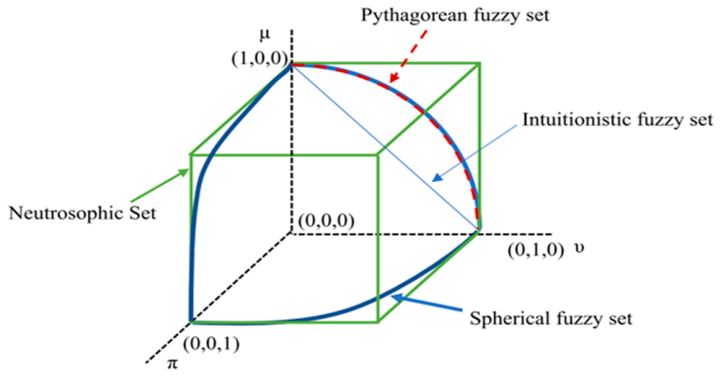
SFSs are an advanced extension of traditional fuzzy set models, integrating the core features of Intuitionistic, Pythagorean, and Neutrosophic fuzzy sets. Each SFS is characterized by three parameters, including membership, non-membership, and hesitancy, subject to the constraint that the squared sum of these values does not exceed one. This structure enables greater flexibility in modeling uncertainty and imprecision. Geometrically, a spherical fuzzy number is represented as a point within or on the surface of a unit sphere, where points closer to the surface indicate higher certainty, while interior points reflect greater uncertainty. This geometric interpretation offers an intuitive and visual understanding of how SFSs capture imprecise judgments, as illustrated in Figure 1.
Definition 1.
SFS  A ~ S  is defined as follows:
A ~ S = { x , ( μ A ~ S ( x ) , v A ~ S ( x ) , π A ~ S ( x ) ) | x X }
where  A ~ S  denotes a SFS of the universe  X :
μ A ~ S x :   X 0,1 , v A ~ S x : X 0,1 , π A ~ S ( x ) : X 0,1
and   0 μ A ~ S 2 x + v A ~ S 2 x + π A ~ S 2 ( x ) 1
where  x X , and for each  x ,  μ A ~ S ( x ) ,   v A ~ S ( x ) , and  π A ~ S ( x )  represent the membership, nonmembership, and hesitancy levels of  x  to  A ~ S , respectively.
Definition 2.
Let  A ~ S = ( μ A ~ S ,   v A ~ S ,   π A ~ S )  and  B ~ S = ( μ B ~ S ,   v B ~ S ,   π B ~ S )  be two SFS. Some arithmetic operations of SFS are described as follows:
Union:
A ~ S B ~ S = { m a x { μ A ~ S , μ B ~ S } , m i n { v A ~ S , v B ~ S } , m i n { ( 1 ( ( m a x { μ A ~ S , μ B ~ S } ) 2 + ( m i n { v A ~ S , v B ~ S } ) 2 ) ) 1 / 2 , m a x { π A ~ S , π B ~ S } } }
Intersection:
A ~ S B ~ S = { m i n { μ A ~ S , μ B ~ S } , m a x { v A ~ S , v B ~ S } , m a x { ( 1 ( ( m i n { μ A ~ S , μ B ~ S } ) 2 + ( m a x { v A ~ S , v B ~ S } ) 2 ) ) 1 / 2 , m i n { π A ~ S , π B ~ S } } }
Addition:
A ~ S B ~ S = { ( μ A ~ S 2 + μ B ~ S 2 μ A ~ S 2 μ B ~ S 2 ) 1 / 2 , v A ~ S v B ~ S , ( ( 1 μ B ~ S 2 ) π A ~ S 2 + ( 1 μ A ~ S 2 ) π B ~ S 2 π A ~ S 2 π B ~ S 2 ) 1 / 2 }
Multiplication:
A ~ S B ~ S = { μ A ~ S 2 μ B ~ S 2 , ( v A ~ S 2 + v B ~ S 2 v A ~ S 2 v B ~ S 2 ) 1 / 2 , ( ( 1 v B ~ S 2 ) π A ~ S 2 + ( 1 v A ~ S 2 ) π B ~ S 2 π A ~ S 2 π B ~ S 2 ) 1 / 2 }
Multiplication by a scalar;  λ > 0 :
λ . A ~ S = { ( 1 ( 1 μ A ~ S 2 ) λ ) 1 / 2 , v A ~ S λ , ( ( 1 μ A ~ S 2 ) λ ( 1 μ A ~ S 2 π A ~ S 2 ) λ ) 1 / 2 }
Power of  A ~ S ; λ > 0 :
A ~ S λ = { μ A ~ S λ , ( 1 ( 1 v A ~ S 2 ) λ ) 1 / 2 , ( ( 1 v A ~ S 2 ) λ ( 1 v A ~ S 2 π A ~ S 2 ) λ ) 1 / 2 }  
Definition 3.
For SFSs  A ~ S = ( μ A ~ S ,   v A ~ S ,   π A ~ S )  and  B ~ S = ( μ B ~ S ,   v B ~ S ,   π B ~ S ) , the following are valid under the condition  λ ,   λ 1 , λ 2 > 0 :
A ~ S B ~ S = B ~ S A ~ S
λ ( A ~ S B ~ S ) = λ A ~ S λ B ~ S
λ 1 A ~ S λ 2 A ~ S = ( λ 1 + λ 2 ) A ~ S
( A ~ S B ~ S ) λ = A ~ S λ B ~ S λ
A ~ S λ 1 A ~ S λ 2 = A ~ S λ 1 + λ 2
Definition 4.
For the spherical weighted arithmetic mean (SWAM) with respect to,  w = ( w 1 ,   w 2 , . . . ,   w n w i [ 0,1 ] , and  i = 1 n w i = 1 , the SWAM is calculated as follows:
S W A M w ( A ~ S 1 , , A ~ S n ) = w 1 A ~ S 1 + w 2 A ~ S 2 + + w n A ~ S n = { [ 1 i = 1 n ( 1 μ A ~ S i 2 ) w i ] 1 / 2 , i = 1 n v A ~ S i w i , [ i = 1 n ( 1 μ A ~ S i 2 ) w i i = 1 n ( 1 μ A ~ S i 2 π A ~ S i 2 ) w i ] 1 / 2 }
Definition 5.
For the spherical weighted geometric mean (SWGM) with respect to,  w = ( w 1 ,   w 2 . . . ,   w n ) ,  w i     [ 0,1 ]     and  i = 1 n w i = 1 , the SWGM is calculated as follows:
S W G M w ( A ~ S 1 , , A ¨ S n ) = A ~ S 1 w 1 + A ~ S 2 w 2 + + A ~ S n w n = i = 1 n μ A ~ S i w i , [ 1 i = 1 n ( 1 v A ~ S i 2 ) w i ] 1 / 2 , [ i = 1 n ( 1 v A ~ S i 2 ) w i i = 1 n ( 1 v A ~ S i 2 π A ~ S i 2 ) w i ] 1 / 2
Normalized spherical distance between A ~ S   and   B ~ S on the surface of a sphere
d i s n A ~ S , B ~ S = 2 n π i = 1 n   a r c c o s μ A ~ S x i μ B ~ S x i + v A ~ S x i v B ~ S x i + π A ~ S x i π B ~ S x i
Clearly, we have that 0 d i s n A ~ S , B ~ S n and 0 d i s n A ~ S , B ~ S 1 .

3.2. The Proposed SF-Delphi and SF-AHP Approach

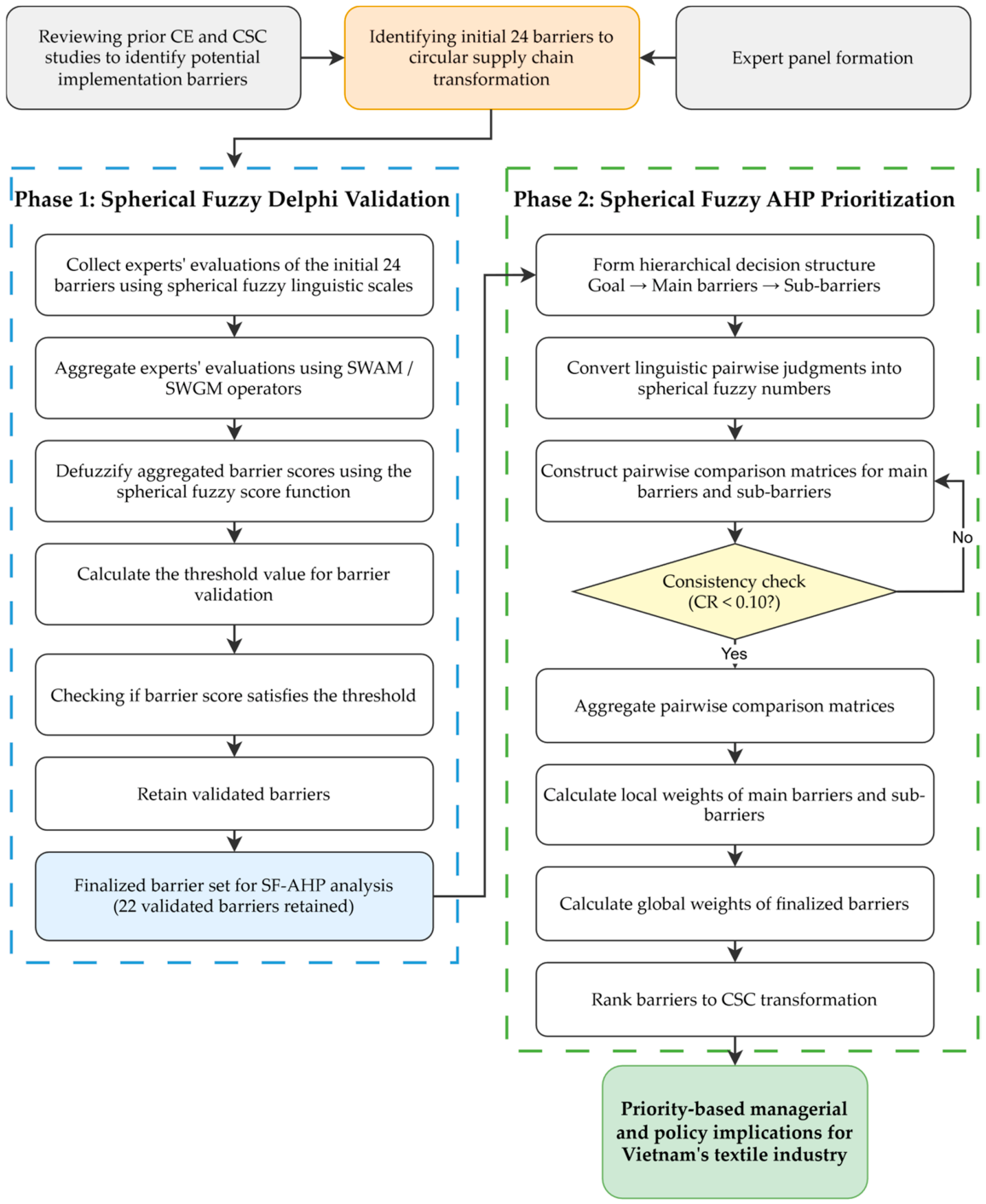
The research framework was designed to transform a broad set of literature-informed barriers into a validated and prioritized barrier structure for Vietnam’s T&A industry. As shown in Figure 2, the proposed two-stage hybrid decision-making framework integrates the SF- Delphi method and the SF-AHP to evaluate implementation barriers to circular supply chain (CSC) transformation. In the first stage, the SF-Delphi method is applied to validate and refine the initial barrier set derived from the literature review, as explained in Section 2.2 and Table 1. This stage aims to remove barriers that are less relevant or insufficiently supported by expert consensus. In the second stage, the finalized barriers are prioritized using SF-AHP. The hierarchical structure of the decision problem allows the main barrier dimensions and sub-barriers to be evaluated systematically under conditions of uncertainty, vagueness, and hesitation in expert judgments. By combining SF-Delphi and SF-AHP, the proposed framework provides both a validation mechanism and a prioritization tool for identifying the most critical barriers to CSC implementation.

3.2.1. Phase I: SF-Delphi Validation

In Phase I, the SF-Delphi method was used to screen and validate the initial set of 24 barriers identified from the literature review, as shown in Table 1. The SF-Delphi stage served as a fuzzy screening and validation procedure before prioritization. In this stage, experts evaluated the contextual relevance of each barrier using spherical fuzzy linguistic terms, which allow agreement, disagreement, and hesitation to be represented simultaneously. This method, recently modified by Nguyen [21], provides a targeted and efficient mechanism for assessing the relevance of decision criteria under uncertainty. The expert evaluations were aggregated and converted into scores, which were then compared with a predefined threshold value. Barriers that did not satisfy the threshold rule were removed from the final barrier set, while the retained barriers were used as the input for the subsequent SF-AHP prioritization.
In this study, the SF-Delphi stage was implemented as a modified one-round expert-based screening procedure rather than a traditional multi-round Delphi process. This design was considered appropriate because the initial barrier set had already been developed from the literature review, and the purpose of the SF-Delphi stage was not to generate new barriers through repeated rounds, but to validate the contextual relevance of the identified barriers before SF-AHP prioritization. The use of spherical fuzzy evaluations also helps capture uncertainty and hesitation in expert judgments during the screening process. Therefore, the SF-Delphi stage was used as a relevance validation step to reduce the initial barrier pool and retain only barriers considered sufficiently important for Vietnam’s textile and apparel industry. The detailed steps of the SF-Delphi validation procedure are presented as follows.
Step 1. The language terms indicated in Table 2 must be used by experts to rate the criteria.
The SWGM operator is used to obtain the significance vector for each factor using Equation (17), we have Equation (19) as follows:
U ~ a g g = α 11 , β 11 , γ 11 α 1 m , β 1 m , γ 1 m α n 1 , β n 1 , γ n 1 α n m , β n m , γ n m
Step 2. The equation calculates the score function using Equation (20):
S c o r e d i = 2 α i j γ i j 2 β i j γ i j 2
Step 3. Validate the list of critical criteria. The threshold is attained by Equation (21):
D i = i = 1 n     d i m
If d i < D , criterion C i is removed, and if d i > D , criterion C i is valid.

3.2.2. Phase II: SF-AHP Prioritization

In Phase II, the SF-AHP method is employed to determine the relative importance of the finalized barriers. After the SF-Delphi validation stage, the retained barriers are structured into a hierarchical model consisting of the research goal, main barrier dimensions, and sub-barriers. Experts conduct pairwise comparisons using spherical fuzzy linguistic scales to assess the relative importance of barriers. These evaluations are aggregated and converted into spherical fuzzy comparison matrices. The SF-AHP procedure is then used to calculate the local weights of the main dimensions and sub-barriers, followed by the global weights of all finalized barriers. This stage enables the study to rank the barriers according to their relative importance while accounting for uncertainty and hesitation in expert judgments. The final ranking provides practical guidance for firms, supply chain stakeholders, and policymakers in prioritizing actions for CSC transformation.
Step 1. A hierarchical decision tree is divided into three levels, including the research goal (level 1), list of criteria C = { C 1 , C 2 , C n } (level 2). The hierarchical decision structure in this paper consists of three levels: the research goal, the main barrier categories, and the corresponding sub-barriers.
Step 2. Pairwise comparison matrices are performed regarding linguistic terms, as shown in Table 3. The score indices (SI) are determined by Equations (19) and (20):
The linguistic SFS mappings in Table 2 follow the theoretical formulation of SFS (Kutlu Gündoğdu and Kahraman, 2019) [35]. Each spherical fuzzy number satisfies the admissibility condition μ 2   +   ν 2   +   π 2     1 , ensuring mathematical validity. The scale preserves monotonicity across importance levels and symmetry between reciprocal judgments and is consistent with prior SFS-based AHP applications, indicating that the numerical assignments are grounded in established SFS literature.
S I = 100   [ ( μ A ~ S π A ~ S ) 2 ( v A ~ S π A ~ S ) 2 ]
for the AMI, VHI, HI, SMI, and EI.
1 / S I = 1 / 100   [ ( μ A ~ S π A ~ S ) 2 ( v A ~ S π A ~ S ) 2 ]
for the EI, SLI, LI, VLI, and ALI.
Step 3. A consistency check is required for pairwise comparison matrices by the consistency ratio (CR), where the CR must be less than 10%.
Step 4. Compute the spherical fuzzy weights of the main barrier dimensions and sub-barriers using the SWAM operator using Equation (16), where w = 1 / n .
Step 5. The final ranking of barriers is obtained by defuzzifying the global spherical fuzzy weights. The defuzzification of spherical fuzzy numbers is conducted using a spherical fuzzy score function. This function converts each spherical fuzzy weight ( μ , v , π ) into a single crisp value through the nonlinear score expression shown in Equation (24):
S w ~ j s = 100   [ 3 μ A ~ S π A ~ S / 2 2 v A ~ S / 2 π A ~ S 2 ]
Normalize the criteria weights using Equation (25) and apply the spherical fuzzy multiplication shown in Equation (26):
w ¯ j s =   S   ( w ~ j s ) / j = 1 n S ( w ~ j s )
A ~ S i j = w ¯ j s .   A ~ S i = ( 1 ( 1 μ A ~ S 2 ) w j s ) 1 / 2 ,   v A ~ S w ¯ j s ,   ( ( 1 μ A ~ S 2 ) w j s ( 1 μ A ~ S 2 π A ~ S 2 ) w j s ) 1 / 2   i

3.3. Data Collection

Data were collected through interviews with experts in Vietnam’s textile and apparel (T&A) sector. This stage required respondents who had practical knowledge of circular economy and long-term experience in the T&A industry or related policy fields. In this study, ten experts were selected to evaluate the barriers (see Supplementary Material). The experts were selected using purposive sampling based on three criteria: relevant experience in the T&A supply chain or sustainability- and policy-related activities, at least eight years of work experience, and sufficient familiarity with circular economy or circular supply chain transformation issues.
Most of the experts worked directly in different parts of the T&A supply chain, including garment manufacturing, yarn and fabric manufacturing, retailing, and raw material supply. Their positions included quality and sustainable development manager, garment technology account manager, procurement manager, production and quality manager, general director, and sustainable development manager. In addition, one expert was from the governmental and policy-making side, with experience in corporate governance and policy consulting in Vietnam. This expert was included to provide a broader perspective on sustainability and circularity from the institutional side.
The experts had different educational backgrounds, including B.Sc., M.Sc., MBA, and PhD qualifications. Their working experience ranged from 8 to 20 years. Specifically, the panel included experts with 8, 9, 10, 15, and 20 years of experience in textile-related or policy-related positions. The inclusion of these experts was considered appropriate because they represented different supply chain positions and had sufficient experience to assess the relevance and importance of barriers to CSC implementation. Since all experts satisfied the predefined selection criteria and represented complementary perspectives within the T&A supply chain, their opinions were assigned equal weights during the aggregation process. This approach was used to avoid privileging one stakeholder group over another and to avoid introducing additional subjective weighting into the expert-based evaluation.
After the expert data were collected, their evaluations were used in the SF-Delphi stage to validate the initial barrier set and in the SF-AHP stage to prioritize the validated barriers.

4. Results Analysis

4.1. Results of SF-Delphi

The SF-Delphi method was applied to validate the initial set of 24 barriers identified from the literature review. The purpose of this stage was to ensure that the barriers included in the subsequent prioritization stage were relevant to the context of circular supply chain (CSC) transformation in Vietnam’s T&A industry. The experts evaluated the initial barriers using spherical fuzzy linguistic scales, and their opinions were aggregated into spherical fuzzy numbers (SFNs). The aggregated results were then defuzzified to obtain the score of each barrier. The detailed SF-Delphi results are presented in Table 4.
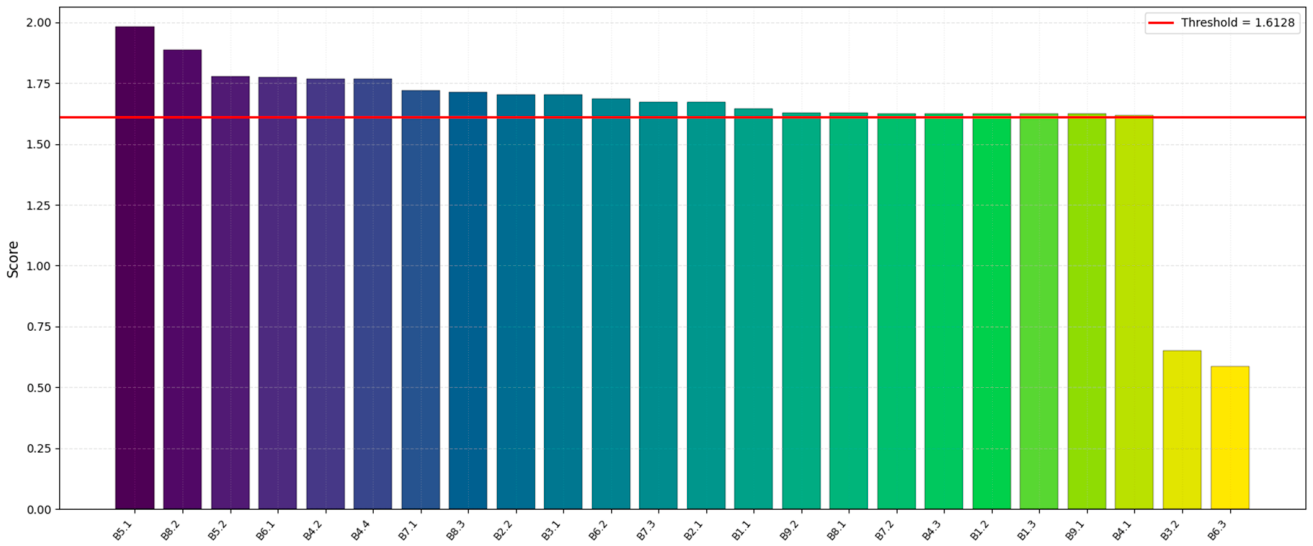
As shown in Table 4, the threshold value was calculated as D = 1.6128. This value was used as the decision boundary for validating the initial barriers. Barriers with scores greater than the threshold were accepted, while those with scores lower than the threshold were removed from the final barrier set. Among the 24 initial barriers, 22 barriers exceeded the threshold and were therefore accepted. The accepted barriers had scores ranging from 1.6164 to 1.9829, indicating that most of the proposed barriers were considered relevant by the expert panel. The highest score was obtained by B5.1 Lack of sectoral standardization with a score of 1.9829, followed by B8.2 Uncertainty in return on investment with a score of 1.8881. Other highly rated barriers included B5.2 Lack of environmental certifications (1.7779), B4.2 Quality concerns of recycled materials (1.7678), B4.4 High cost of recycled raw materials (1.7678), and B6.1 Lack of circular economy awareness (1.7759). These results suggest that regulatory, economic, material-related, and awareness-related barriers were strongly recognized by the experts during the validation stage.
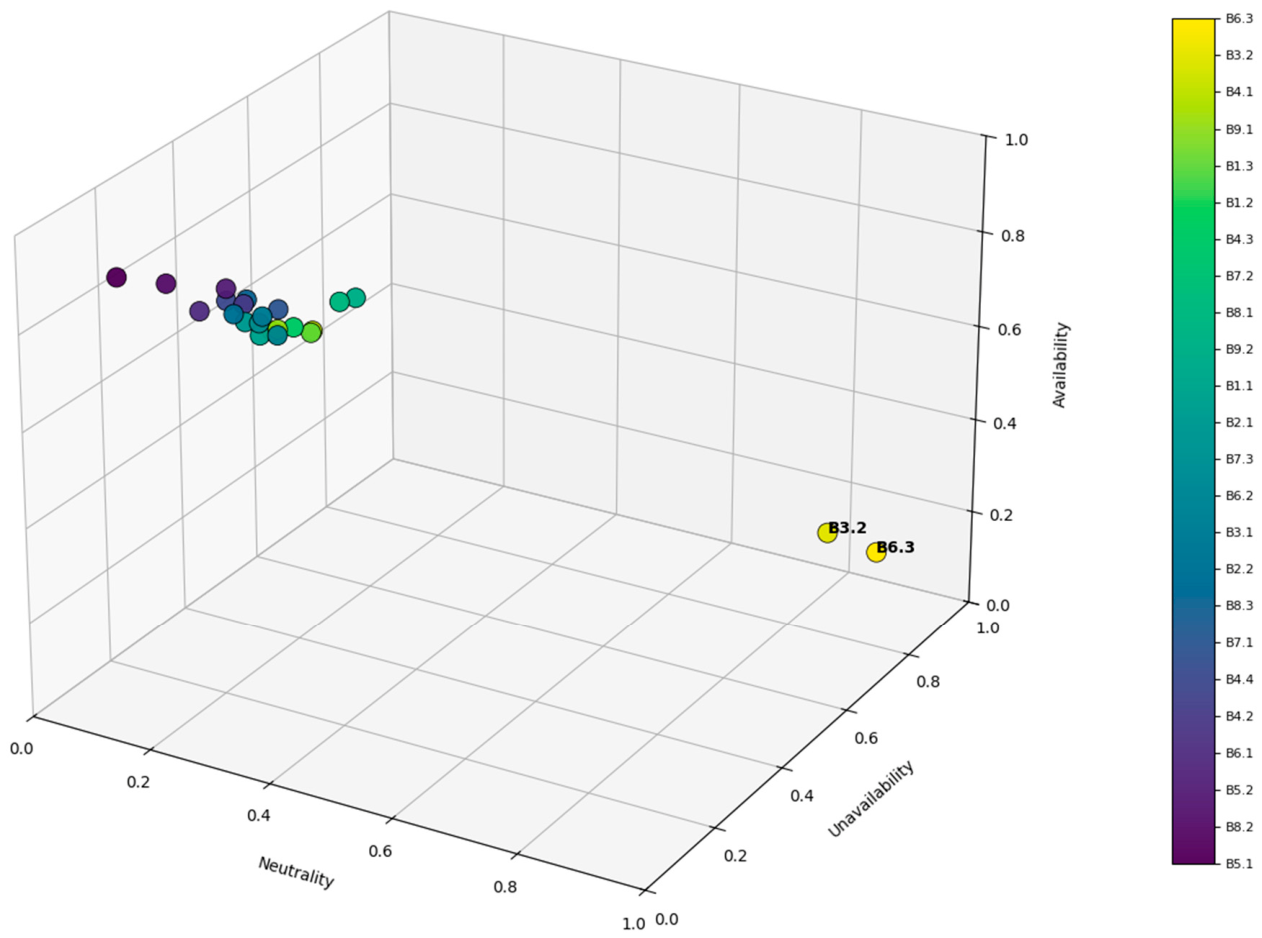
The visualization results further support the SF-Delphi screening decision. Figure 3 presents the spherical fuzzy distribution of the barriers based on the three components of SFNs, namely availability, unavailability, and neutrality. Most of the barriers are clustered in the region with relatively high availability and low unavailability, showing that experts generally agreed on their relevance to CSC implementation. However, B3.2 Complexity in product architecture and B6.3 Lack of implementation guidelines for circular economy practices are positioned separately from the main cluster. These two barriers show lower availability and higher uncertainty compared with the accepted barriers, indicating weaker expert consensus regarding their contextual relevance.
Figure 4 shows the defuzzified scores of all barriers together with the threshold line. The red threshold line clearly distinguishes the barriers retained for further analysis from those removed after SF-Delphi validation. Almost all barriers are located above the threshold, confirming their suitability for the next stage. In contrast, B3.2 and B6.3 fall clearly below the threshold. Specifically, B3.2 Complexity in product architecture obtained a score of 0.6494, while B6.3 Lack of implementation guidelines for circular economy practices obtained the lowest score of 0.5855. This screening result also helped reduce potential overlap in the initial barrier framework by excluding barriers that were theoretically relevant but less contextually decisive according to the expert panel. Therefore, these two barriers were rejected and excluded from the subsequent SF-AHP analysis.
The rejection of these two barriers does not necessarily mean that they are irrelevant in all contexts. Rather, it indicates that, compared with the other barriers, the expert panel did not consider them sufficiently decisive for CSC transformation in Vietnam’s T&A industry. Product architecture complexity may be more critical in highly design-driven or product disassembly-intensive settings, while implementation guidelines may overlap with broader barriers such as lack of sectoral standardization, lack of circular economy awareness, and lack of technical capability. Accordingly, the SF-Delphi stage refined the initial barrier pool from 24 barriers to 22 validated barriers. These validated barriers were then used as the input for the SF-AHP stage to determine their relative importance and final ranking.

4.2. Results of SF-AHP

After the SF-Delphi stage, the 22 validated barriers were evaluated using the SF-AHP method. The pairwise comparisons were conducted for both the main barrier categories and the sub-barriers. The crisp matrix and normalized matrix are presented in Table 5 and Table 6, while Table 7 shows the spherical fuzzy weights of the main categories, the local weights of the sub-barriers, the global weights, the final crisp weights, and the final ranking. Consequently, CR = 0.0697 < 0.1, which indicates an acceptable outcome.
According to Table 7, the most important main barrier category is B8 Economic barriers, with a crisp weight of 0.185. This result shows that economic issues are the dominant concern in the transition toward CSC practices in Vietnam’s T&A industry. The next important categories are B1 Management and decision-making with a weight of 0.167, and B9 Technical infrastructure with a weight of 0.151. These three main categories are followed by B5 Rules and regulations (0.105) and B4 Materials (0.103). The remaining categories have lower weights, including B2 Labour (0.090), B7 Integration and collaboration (0.069), B3 Design and production process challenges (0.067), and B6 Knowledge and awareness (0.064). Therefore, at the main-category level, the results indicate that financial feasibility, managerial readiness, and technical infrastructure are the major dimensions affecting CSC implementation.
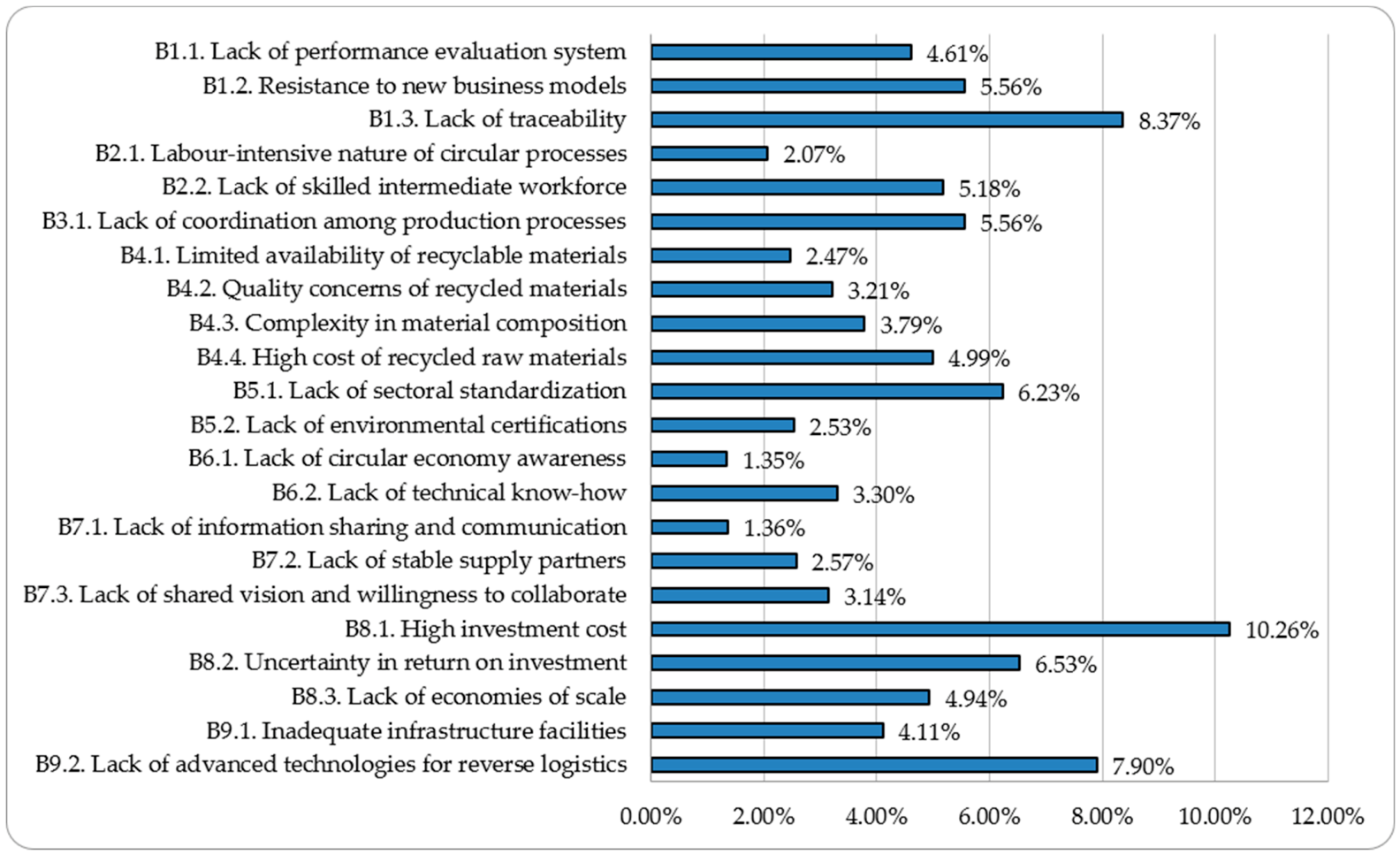
For the sub-barriers, the global weights provide a more detailed ranking. B8.1 High investment cost obtains the highest final crisp weight (0.103) and ranks first. This result is consistent with the high weight of the economic category and indicates that the initial cost of circular transformation is the most serious barrier perceived by experts. The second-ranked barrier is B1.3 Lack of traceability, with a final crisp weight of 0.084. This shows that the ability to track materials, recycled content, and product information is considered highly important in T&A circularity. B9.2 Lack of advanced technologies for reverse logistics ranks third, with a final crisp weight of 0.079, indicating the importance of technological support for collection, sorting, product return, and material recovery.
The fourth and fifth positions are B8.2 Uncertainty in return on investment and B5.1 Lack of sectoral standardization, with final crisp weights of 0.065 and 0.062, respectively. These two barriers show that firms are not only concerned about the amount of investment, but also about whether circular practices can generate clear financial returns and whether there are consistent standards to guide implementation. Other barriers with relatively high ranks include B3.1 Lack of coordination among production processes and B1.2 Resistance to new business models, both with a final crisp weight of 0.056. They are followed by B2.2 Lack of skilled intermediate workforce (0.052), B4.4 High cost of recycled raw materials (0.050), and B8.3 Lack of economies of scale (0.049).
Figure 5 presents the final crisp weights of all validated barriers. The distribution of the final crisp weights also confirms the dominance of several barriers. B8.1, B1.3, and B9.2 clearly have higher weights than the remaining barriers. In contrast, some barriers receive much lower weights. B6.1 Lack of circular economy awareness has the lowest final crisp weight (0.013) and ranks last. B7.1 Lack of information sharing and communication ranks 21st with a weight of 0.014, while B2.1 Labour-intensive nature of circular processes ranks 20th with a weight of 0.021. These low rankings do not mean that these barriers are not relevant. Rather, in comparison with investment cost, traceability, reverse logistics technology, and standardization, the experts considered them less influential in the current implementation context.
Overall, the SF-AHP results show that the most critical barriers are concentrated around economic feasibility, traceability, reverse logistics technology, return on investment, and sectoral standardization. The final ranking suggests that firms and policymakers should first address high-cost investment requirements, improve traceability systems, strengthen reverse logistics technologies, and develop clearer sector-specific standards before expecting broader CSC implementation in Vietnam’s T&A industry.

5. Discussion

5.1. Interpretation of Results

The results show that the most critical barriers are concentrated around economic feasibility, traceability, reverse logistics technology, return on investment, and sectoral standardization. This finding suggests that CSC transformation in Vietnam’s T&A industry is not mainly constrained by the awareness of circular economy alone, but by the practical ability of firms to finance, organize, and technically implement circular material flows. The highest-ranked barrier, high investment cost, reflects the capital-intensive nature of circular transformation. Textile firms need to invest in cleaner production systems, waste separation, traceability tools, recycling-related technologies, and reverse logistics arrangements. This can be difficult in Vietnam’s T&A industry, where many firms operate with limited margins and where small and medium-sized enterprises still account for a large share of the sector [38].
The high ranking of lack of traceability is also meaningful in the Vietnamese context. As an export-oriented industry, Vietnam’s T&A sector is increasingly exposed to sustainability requirements from international buyers and markets, particularly as major markets such as the EU are promoting more durable, reusable, recyclable, and circular textile products [39]. Traceability is no longer only an internal management issue, but is becoming a requirement for verifying material origin, recycled content, and environmental compliance [40]. Therefore, the lack of traceability can prevent firms from proving circularity performance and responding to buyer requirements. Similarly, the lack of advanced technologies for reverse logistics indicates that the current system for collecting, sorting, returning, and recovering textile waste remains underdeveloped [12]. Without adequate technological support, firms may find it difficult to move from waste reduction at the factory level to broader circular material recovery across the supply chain.
These findings are partly consistent with previous studies in other textile-producing countries such as India, Bangladesh, and China, where economic, technological, and regulatory barriers are also frequently reported [3,9,16]. However, the Vietnam-specific contribution of this study lies in showing how these common barriers are prioritized under the structural conditions of Vietnam’s T&A industry. In particular, strong export dependence, the dominance of SMEs, limited digital and traceability readiness, fragmented recycling and reverse logistics systems, and evolving sector-specific standards make investment cost, traceability, reverse logistics technology, return on investment, and standardization especially important. Thus, the findings do not suggest that Vietnam faces completely unique barriers, but rather that familiar CSC barriers appear with different levels of urgency and managerial meaning in the Vietnamese context.

5.2. Theoretical Implications

This study provides several theoretical implications for CSC transformation research. First, the findings support the view that CSC transformation should be understood as a combination of external institutional pressure and internal capability development. From the perspective of Institutional Theory, barriers such as lack of sectoral standardization, lack of environmental certification, and lack of traceability reflect the influence of external rules, buyer requirements, and compliance expectations [41]. In export-oriented industries such as Vietnam’s T&A sector, firms are increasingly expected to demonstrate transparent material flows and sustainability performance. Therefore, institutional conditions not only create pressure for change, but also shape which barriers become more urgent for firms.
Second, the findings can also be interpreted through the Resource-Based View and Dynamic Capabilities perspective [42]. High investment cost, uncertainty in return on investment, lack of advanced reverse logistics technologies, lack of skilled workforce, and limited traceability capability indicate that firms need specific resources and capabilities to implement CSC practices. Circular transformation requires more than environmental intention; it requires financial resources, technological infrastructure, data management capability, and the ability to reconfigure production and supply chain processes. In this sense, the study contributes to the CSC literature by showing that barriers are not isolated obstacles, but reflect capability gaps that limit firms’ ability to respond to institutional pressure and develop circular supply chain practices.
Third, the integrated SF-Delphi–SF-AHP approach contributes methodologically to CSC barrier studies by combining expert-based validation and prioritization under uncertainty. The SF-Delphi stage helps refine the initial barrier framework by screening barriers according to contextual relevance, while the SF-AHP stage provides a structured prioritization of the validated barriers. This combination is useful in emerging economy contexts where quantitative data on CSC implementation are still limited and expert judgment remains important for understanding early-stage transformation barriers.

5.3. Practical Implications

The findings also provide practical implications for different stakeholder groups involved in CSC transformation. For textile and apparel manufacturers, the priority should be to adopt a phased transformation strategy. Since high investment cost and uncertainty in return on investment were ranked highly, firms should not start with large-scale circular projects immediately. Instead, they can begin with low-cost and manageable actions such as internal waste separation, digital recording of waste flows, supplier information collection, and basic material traceability. These actions can create the foundation for more advanced recycling, reverse logistics, and circular business models [43].
For logistics providers and recyclers, the results highlight the need to develop reverse logistics and material recovery services that are suitable for textile waste. Logistics providers can support manufacturers by designing collection routes, consolidation points, and return flows for fabric waste, defective products, and post-production materials. Recyclers can work with manufacturers to improve sorting, classification, and quality control of recovered materials. Stronger cooperation between logistics providers, recyclers, and manufacturers can reduce fragmentation in textile waste recovery and improve the feasibility of circular material flows.
For government agencies and industry associations, the high ranking of sectoral standardization and traceability suggests the need for clearer textile-specific guidance [39]. Policy support should not only encourage the circular economy in general, but also provide practical standards for textile waste classification, recycled material quality, traceability data, and environmental certification. Government agencies can also support green finance, tax incentives, pilot projects, and shared infrastructure for textile collection and recycling. Industry associations can play a coordinating role by providing training, developing common traceability templates, connecting manufacturers with recyclers, and promoting pilot circular supply chain projects. International buyers may also contribute by supporting suppliers through long-term purchasing commitments, technical assistance, and cost-sharing mechanisms for traceability and circularity upgrades.

6. Conclusions, Limitations, and Future Research

This study analyzed barriers to circular supply chain transformation in Vietnam’s T&A industry using an integrated SF-Delphi and SF-AHP approach. The SF-Delphi stage validated 22 barriers from the initial barrier set, and the SF-AHP stage ranked these barriers based on expert judgments. The results show that the most important barriers are high investment cost, lack of traceability, lack of advanced technologies for reverse logistics, uncertainty in return on investment, and lack of sectoral standardization. These findings suggest that CSC transformation in Vietnam’s T&A industry requires not only environmental awareness, but also financial capacity, traceability capability, reverse logistics infrastructure, and clearer sector-specific standards.
This study has several limitations. First, the analysis is based on expert judgments, which are useful for examining complex and emerging decision problems but may still reflect the experience and perspectives of the selected expert panel. Although the SF-Delphi threshold and SF-AHP consistency check were applied to support the reliability of the expert-based evaluation, further consensus and robustness checks could provide additional insights into the stability of expert agreement and barrier rankings. Future research can extend this study in several directions. Survey-based empirical research could be conducted to validate the barrier framework with a larger sample of firms. In addition, structural modelling methods such as SEM or PLS-SEM may be used to examine relationships among barriers and their effects on CSC implementation outcomes. Future studies may also apply Kendall’s W, repeated Delphi rounds, perturbation-based sensitivity analysis, comparative MCDM methods, DEMATEL, ISM, or longitudinal case studies to further examine consensus, ranking robustness, causal relationships, and dynamic changes in CSC transformation barriers over time.

Supplementary Materials

The following supporting information can be downloaded at https://www.mdpi.com/article/10.3390/su18136703/s1: Table S1: Information of 10 Experts; Table S2: Data from experts’ interview for SF-Delphi stage; Table S3: Initial comparison matrix of main criteria in SF-AHP; Table S4. Crisp matrix; Table S5. Normalized matrix.

Author Contributions

Conceptualization, N.-A.-T.N. and T.-T.D.; data curation, N.-A.-T.N. and T.-T.D.; formal analysis, N.-A.-T.N.; investigation, N.-A.-T.N.; methodology, N.-A.-T.N. and T.-T.D.; project administration, N.-A.-T.N.; software, N.-A.-T.N. and T.-T.D.; validation, N.-A.-T.N. and T.-T.D.; writing—original draft, N.-A.-T.N. and T.-T.D.; writing—review and editing, N.-A.-T.N. All authors have read and agreed to the published version of the manuscript.

Funding

This research received no external funding.

Institutional Review Board Statement

Ethical review and approval were waived for this study by Hong Bang International University, as it was an anonymous, non-interventional expert questionnaire/interview for academic research purposes. It did not involve biomedical or experimental procedures, clinical intervention, medical treatment, biological samples, vulnerable participants, deception, or collection of sensitive personal information.

Informed Consent Statement

Informed consent was obtained from all subjects involved in the study.

Data Availability Statement

The original contributions presented in this study are included in the article. Further inquiries can be directed to the corresponding authors.

Acknowledgments

The authors appreciate the support from the Industrial University of Ho Chi Minh City, Vietnam, and Hong Bang International University, Vietnam. The authors also sincerely thank all experts who generously dedicated their time to participating in the expert evaluation process and providing valuable insights and feedback for this study.

Conflicts of Interest

The authors declare no conflicts of interest.

References

  1. Kazancoglu, I.; Kazancoglu, Y.; Yarimoglu, E.; Kahraman, A. A Conceptual Framework for Barriers of Circular Supply Chains for Sustainability in the Textile Industry. Sustain. Dev. 2020, 28, 1477–1492. [Google Scholar] [CrossRef]
  2. Thinakaran, S.; Chandravelu, P.; Ponnambalam, S.G.; Sankaranarayanan, B.; Karuppiah, K. Analyzing the Challenges to Circular Economy in Indian Fashion Industry. IEEE Access 2023, 11, 711–727. [Google Scholar] [CrossRef]
  3. Salman, S.; Shanta, M.H.; Uday, R.M.; Rahman, R. Circular Economy Transition in Bangladesh’s Ready-Made Garments Sector: Investigating the Key Barriers Through a Fuzzy DEMATEL Analysis. Bus. Strategy Environ. 2025, 34, 3982–4000. [Google Scholar] [CrossRef]
  4. Ponnambalam, S.G.; Sankaranarayanan, B.; Karuppiah, K.; Thinakaran, S.; Chandravelu, P.; Lam, H.L. Analysing the Barriers Involved in Recycling the Textile Waste in India Using Fuzzy DEMATEL. Sustainability 2023, 15, 8864. [Google Scholar] [CrossRef]
  5. Vu, K. Textile and Garment Exports up for Continued Growth in 2025. Available online: https://en.vneconomy.vn/textile-and-garment-exports-up-for-continued-growth-in-2025.htm (accessed on 15 December 2025).
  6. Werner-Lewandowska, K.; Golinska-Dawson, P.; Mierzwiak, R. Enablers and Barriers in Building the Circular Supply Chain through Remanufacturing-Grey DEMATEL Approach. Int. J. Prod. Econ. 2025, 284, 109617. [Google Scholar] [CrossRef]
  7. John, R.; Rahman, M. An Examination of 3R (Reuse-Remanufacturing-Recycling) Challenges in the Reverse Logistics Process of the Textile and Clothing Industry. Int. J. Fash. Des. Technol. Educ. 2025, 18, 419–443. [Google Scholar] [CrossRef]
  8. Kazancoglu, I.; Kazancoglu, Y.; Kahraman, A.; Yarimoglu, E.; Soni, G. Investigating Barriers to Circular Supply Chain in the Textile Industry from Stakeholders’ Perspective. Int. J. Logist. Res. Appl. 2022, 25, 521–548. [Google Scholar] [CrossRef]
  9. Chen, G.; Geng, D.; Zhu, Q. Implementation Barriers to the Circular Supply Chain Mode for Pre-Consumer Textile Waste Reprocessing in China. Resour. Conserv. Recycl. 2024, 206, 107621. [Google Scholar] [CrossRef]
  10. Circular Economy Transformation in Vietnam’s Textile and Garment Industry: Opportunities, Challenges, and Proposed Solutions. Available online: https://tapchicongthuong.vn/chuyen-doi-kinh-te-tuan-hoan-nganh-det-may-viet-nam--co-hoi--thach-thuc-va-de-xuat-giai-phap-507407.htm (accessed on 15 May 2026).
  11. Nguyen, M.H.; Islam, S.; Tan, C.S.L. An Examination of Barriers and Enablers to Circular Economy Transition among Small and Medium-Sized Enterprises in the Vietnamese Fashion and Textile Industry. Clean. Prod. Lett. 2026, 10, 100125. [Google Scholar] [CrossRef]
  12. GIZ Viet Nam. Pre-Consumer Textile Waste Recycling in Viet Nam. Available online: https://www.giz.de/de/downloads/giz2025-en-ecosystem-mapping.pdf (accessed on 20 May 2026).
  13. Lilavanichakul, A.; Lekutai, P.; Thamtheerasathian, L.; Mekkriengkrai, D.; Charoenrat, I.; Tuntariyanond, P. Transitioning to the Circular Textile and Fashion Industry: Drivers and Barriers from Stakeholder’s Perspectives. Environ. Sustain. Indic. 2025, 28, 101060. [Google Scholar] [CrossRef]
  14. Bukhonka, N.P.; Pesic, M.; Nemesa, I.; Radovancevic, D.; Bozoki, V. An Analysis of the Current State of Pre-Consumer Textile Waste in Textile Manufacturing: A Case Study. Res. J. Text. Appar. 2026, 1–20. [Google Scholar] [CrossRef]
  15. Nguyen, P.-H.; Nguyen, L.-A.T.; Pham, T.-V.; Vu, T.-G.; Vu, D.-M.; Nguyen, T.-H.T.; Le, H.-Q.; Le, H.-G.H. Mapping Barriers to Sustainable Fashion Consumption: Insights from Neutrosophic-Z Number and Delphi-DEMATEL Integration. Neutrosophic Sets Syst. 2025, 80, 45. [Google Scholar]
  16. Sharma, R.; Yadav, V.; Gaur, T.S. Barriers to Adopting Circular Economy Practices in Indian Textile Industries. Discov. Sustain. 2025, 6, 345. [Google Scholar] [CrossRef]
  17. Madumali, S.; Thibbotuwawa, A.; Sivakumar, T.; Nielsen, P. Analyzing Barriers to Circular Economy Implementation in Textile Supply Chains: A Fuzzy Delphi and ISM Approach for Developing Economies. IFAC-PapersOnLine 2025, 59, 2124–2129. [Google Scholar] [CrossRef]
  18. Rayhan, M.G.S.; Masum, M.; Karuppiah, K. Modelling the Enablers of Circular Economy in Textile and Apparel Industry: An Integrated Fuzzy TISM and Fuzzy DEMATEL Approach. Int. J. Ind. Eng. Oper. Manag. 2025, 7, 309–325. [Google Scholar] [CrossRef]
  19. Padilla-Rivera, A.; do Carmo, B.B.T.; Arcese, G.; Merveille, N. Social Circular Economy Indicators: Selection through Fuzzy Delphi Method. Sustain. Prod. Consum. 2021, 26, 101–110. [Google Scholar] [CrossRef]
  20. Keleş Tayşir, N.; Ülgen, B.; İyigün, N.Ö.; Görener, A. A Framework to Overcome Barriers to Social Entrepreneurship Using a Combined Fuzzy MCDM Approach. Soft Comput. 2024, 28, 2325–2351. [Google Scholar] [CrossRef]
  21. Nguyen, P.H. Spherical Fuzzy Decision-Making Approach Integrating Delphi and TOPSIS for Package Tour Provider Selection. Math. Probl. Eng. 2022, 2022, 4249079. [Google Scholar] [CrossRef]
  22. Ghag, N.; Acharya, P.; Khanapuri, V. Analyzing the Sustainable International Competitiveness Factors of SMEs by Fuzzy Delphi and Neutrosophic DEMATEL. Bus. Strategy Dev. 2023, 6, 447–463. [Google Scholar] [CrossRef]
  23. Gupta, S.; Gupta, N. Enhancing Freight Logistics: Overcoming Barriers and Driving Sustainable Growth with an Integrated Grey Delphi DEMATEL Approach. Benchmarking 2025, 33, 368–391. [Google Scholar] [CrossRef]
  24. Ruano, M.; Huang, C.Y.; Nguyen, P.H.; Nguyen, L.A.T.; Le, H.Q.; Tran, L.C. Enhancing Sustainability in Belize’s Ecotourism Sector: A Fuzzy Delphi and Fuzzy DEMATEL Investigation of Key Indicators. Mathematics 2023, 11, 2816. [Google Scholar] [CrossRef]
  25. Nguyen, P.H.; Nguyen, L.A.T.; Vu, D.M.; Vu, T.G.; Danh-Nguyen, A.P.; Nguyen, T.L. Strategic Stakeholder Analysis for Vietnam’s Carbon Credit System: A Neutrosophic Approach. J. Open Innov. Technol. Mark. Complex. 2025, 11, 100597. [Google Scholar] [CrossRef]
  26. Emkani, M.; Alimohammadlou, M.; Zarei, E.; Jahangiri, M.; Kamalinia, M. A Quantitative Multi-Dimensional Resilience Framework in Process Industries. Eng. Appl. Artif. Intell. 2025, 161, 112100. [Google Scholar] [CrossRef]
  27. Amoozad Mahdiraji, H.; Yaftiyan, F.; Abbasi-Kamardi, A.; Vrontis, D.; Gong, Y. Disentangling the Resiliency of International Transportation Systems under Uncertainty by a Novel Multi-Layer Spherical Fuzzy Decision-Making Framework: Evidence from an Emerging Economy. Transp. Res. Part A Policy Pract. 2024, 186, 104151. [Google Scholar] [CrossRef]
  28. Nguyen, P.H. A Fully Completed Spherical Fuzzy Data-Driven Model for Analyzing Employee Satisfaction in Logistics Service Industry. Mathematics 2023, 11, 2235. [Google Scholar] [CrossRef]
  29. Nguyen, P.H. A Data-Driven MCDM Approach-Based Spherical Fuzzy Sets for Evaluating Global Augmented Reality Providers in Education. IEEE Access 2025, 13, 6102–6119. [Google Scholar] [CrossRef]
  30. Korucuk, S.; Aytekin, A.; Görçün, Ö.F.; Tirkolaee, E.B. Evaluating the Sustainability Performance of Urban Transport Systems with a Spherical Fuzzy Hybrid Model. Expert Syst. Appl. 2026, 316, 131368. [Google Scholar] [CrossRef]
  31. Saaty, T.L. How to Make a Decision: The Analytic Hierarchy Process. Eur. J. Oper. Res. 1990, 48, 9–26. [Google Scholar] [CrossRef]
  32. Hossain, M.K.; Thakur, V. Benchmarking Health-Care Supply Chain by Implementing Industry 4.0: A Fuzzy-AHP-DEMATEL Approach. Benchmarking Int. J. 2020, 28, 556–581. [Google Scholar] [CrossRef]
  33. Wang, C.-N.; Dang, T.-T.; Nguyen, N.-A.-T. Outsourcing Reverse Logistics for E-Commerce Retailers: A Two-Stage Fuzzy Optimization Approach. Axioms 2021, 10, 34. [Google Scholar] [CrossRef]
  34. Unal, Y.; Temur, G.T. Sustainable Supplier Selection by Using Spherical Fuzzy AHP. J. Intell. Fuzzy Syst. 2021, 42, 593–603. [Google Scholar] [CrossRef]
  35. Kutlu Gündoğdu, F.; Kahraman, C. Spherical Fuzzy Sets and Spherical Fuzzy TOPSIS Method. J. Intell. Fuzzy Syst. 2019, 36, 337–352. [Google Scholar] [CrossRef]
  36. Nebati, E.E.; Ayvaz, B.; Kusakci, A.O. Digital Transformation in the Defense Industry: A Maturity Model Combining SF-AHP and SF-TODIM Approaches. Appl. Soft Comput. 2023, 132, 109896. [Google Scholar] [CrossRef]
  37. Moslem, S.; Pilla, F. Planning Location of Parcel Lockers Using Group Analytic Hierarchy Process in Spherical Fuzzy Environment. Transp. Res. Interdiscip. Perspect. 2024, 24, 101024. [Google Scholar] [CrossRef]
  38. Tran, D.T.M.; Van Thai, V.; Duc, T.T.H.; Nguyen, T.-T. The Role of Organisational and Contextual Factors in Supply Chain Collaboration and Competitive Advantage: The Case of the Garment Industry in Vietnam. Int. J. Logist. Manag. 2024, 35, 1628–1652. [Google Scholar] [CrossRef]
  39. European Commission. EU Strategy for Sustainable and Circular Textiles; European Commission: Brussels, Belgium, 2022. [Google Scholar]
  40. Adisorn, T.; Tholen, L.; Götz, T. Towards a Digital Product Passport Fit for Contributing to a Circular Economy. Energies 2021, 14, 2289. [Google Scholar] [CrossRef]
  41. Hörner Bussolo, G.; Visintin, F.; Saccani, N.; Bressanelli, G. Assessing Stakeholder Engagement to the EU Strategy for Sustainable and Circular Textiles: A Systematic Review Integrating Stakeholder and Institutional Theories. J. Environ. Manag. 2026, 397, 128308. [Google Scholar] [CrossRef] [PubMed]
  42. Manzoor, U.; Baig, S.A.; Hashim, M.; Sami, A.; Rehman, H.-U.; Sajjad, I. The Effect of Supply Chain Agility and Lean Practices on Operational Performance: A Resource-Based View and Dynamic Capabilities Perspective. TQM J. 2022, 34, 1273–1297. [Google Scholar] [CrossRef]
  43. Ellen MacArthur Foundation. A New Textiles Economy: Redesigning Fashion’s Future. Available online: https://www.ellenmacarthurfoundation.org/a-new-textiles-economy (accessed on 20 May 2026).
Figure 1. Geometric illustration of IFS, PFS, NS, and SFS.
Sustainability 18 06703 g001
Figure 2. Research framework.
Sustainability 18 06703 g002
Figure 3. SF-Delphi experts’ integrated opinions.
Sustainability 18 06703 g003
Figure 4. SF-Delphi results.
Sustainability 18 06703 g004
Figure 5. Final crisp weights of validated barriers.
Sustainability 18 06703 g005
Table 1. Selected implementation barriers.
Main CategoriesBarrier NameExplanationReferences
Management and
decision-making (B1)
B1.1. Lack of performance evaluation systemThis limits firms’ ability to monitor circular practices, assess resource efficiency, and evaluate progress toward CE implementation.[1,2,7,8]
B1.2. Resistance to new business modelsThis reflects firms’ reluctance to move away from established linear practices toward circular models that require organizational and supply chain restructuring.
B1.3. Lack of traceabilityThis constrains transparency in textile value chains by limiting firms’ ability to monitor product lifecycles, material flows, recycled content, and material origin.
Labour (B2)B2.1. Labour-intensive nature of circular processesCircular activities such as collection, sorting, repair, and material separation are often labour-intensive, which can increase operational costs and reduce process efficiency.[1,2,7,8]
B2.2. Lack of skilled intermediate workforceThis limits firms’ ability to perform specialized circular activities, including sorting, reprocessing, recycling, and quality control.
Design and production process challenges (B3)B3.1. Lack of coordination among production processesThis can create inefficiencies in textile circularity by increasing material waste, delaying processing activities, and weakening the integration of circular practices across production stages.[1,8,14,16]
B3.2. Complexity in product architectureThis makes disassembly, separation, and high-quality recycling more difficult, especially when products contain blended fibers or multiple components.
Materials (B4)B4.1. Limited availability of recyclable materialsThis restricts the stable supply of secondary resources needed for circular manufacturing and reduces firms’ ability to substitute virgin inputs.[1,2,8,9]
B4.2. Quality concerns of recycled materialsThis arises from fiber degradation and inconsistent material properties during reprocessing, which may reduce product durability and limit their acceptance in textile production.
B4.3. Complexity in material compositionThis creates technical difficulties for material separation, sorting, and high-value fiber recovery particularly the use of blended fibers and chemical finishes.
B4.4. High cost of recycled raw materialsThis can make circular inputs less economically attractive than virgin materials.
Rules and regulations
(B5)
B5.1. Lack of sectoral standardizationThis creates uncertainty in waste classification, recycling processes, product quality requirements, and the monitoring of circular supply chain performance.[16,17,18]
B5.2. Lack of environmental certificationsThis limits firms’ ability to verify sustainability claims, build market trust, and meet buyer or export-market requirements.
Knowledge and awareness (B6)B6.1 Lack of circular economy awarenessThis can reduce demand for circular products and weaken firms’ willingness to adopt circular practices.[2,16]
B6.2. Lack of technical know-howThis lack in recycling technologies and circular manufacturing processes limits firms’ ability to replace virgin inputs and maintain product quality.
B6.3. Lack of implementation guidelines for circular economy practicesThis leaves firms without clear direction for selecting sustainable materials and integrating circular principles into production processes.
Integration and collaboration (B7)B7.1. Lack of information sharing and communicationThis reduces the coordination needed to monitor material flows, support reverse logistics, and implement circular processes across supply chain actors.[1,2,7,8]
B7.2. Lack of stable supply partnersThis makes it difficult for firms to secure consistent flows of recyclable materials and maintain circular procurement, quality, and recovery practices.
B7.3. Lack of shared vision and willingness to collaborateThis weakens collective commitment among suppliers, manufacturers, recyclers, and retailers, thereby limiting joint circular initiatives.
Economic barriers (B8)B8.1. High investment costThis limits firms’ ability to adopt circular operations because infrastructure upgrades, reprocessing technologies, and workforce training require substantial upfront capital.[3,4,13,16]
B8.2. Uncertainty in return on investmentThis discourages firms from investing in circular business models, especially when payback periods are unclear and virgin materials remain cost-competitive.
B8.3. Lack of economies of scaleThis increases the unit cost of circular products and recycled materials, making circular practices less competitive in price-sensitive markets.
Technical infrastructure (B9)B9.1. Inadequate infrastructure facilitiesThis barrier constrains circular implementation by limiting the capacity for waste collection, storage, sorting, and high-quality reprocessing.[1,2,8,16]
B9.2. Lack of advanced technologies for reverse logisticsThis reduces the efficiency of product return, material tracking, automated sorting, and high-value recovery processes.
Table 2. Spherical linguistic expressions for the SF-Delphi method.
Linguistic ScaleCode(α, β, γ)
Utmost ImportanceAMI(0.9, 0.1, 0.1)
Very High SignificanceVHI(0.8, 0.2, 0.2)
High SignificanceHI(0.7, 0.3, 0.3)
Moderate ImportanceSMI(0.6, 0.4, 0.4)
Equivalent ImportanceEI(0.5, 0.5, 0.5)
Moderately Low ImportanceSLI(0.4, 0.6, 0.4)
Low SignificanceLI(0.3, 0.7, 0.3)
Very Low SignificanceVLI(0.2, 0.8, 0.2)
Minimal ImportanceALI(0.1, 0.9, 0.1)
Table 3. Spherical linguistic expressions for SF-AHP method.
Linguistics TermsSymbolFuzzy Number ( μ , v , π ) Score Index (SI)
Absolutely more importanceAMI(0.9, 0.1, 0.0)9
Very high importanceVHI(0.8, 0.2, 0.1)7
High importanceHI(0.7, 0.3, 0.2)5
Slightly more importanceSMI(0.6, 0.4, 0.3)3
Equally importanceEI(0.5, 0.4, 0.4)1
Slightly low importanceSLI(0.4, 0.6, 0.3)1/3
Low importanceLI(0.3, 0.7, 0.2)1/5
Very low importanceVLI(0.2, 0.8, 0.1)1/7
Absolutely low importanceALI(0.1, 0.9, 0.0)1/9
Table 4. SF-Delphi results.
BarriersSFNs ( α , β , γ ) ScoreDecision
B1.1(0.766, 0.245, 0.249)1.6437Accept
B1.2(0.765, 0.249, 0.254)1.6253Accept
B1.3(0.765, 0.249, 0.254)1.6253Accept
B2.1(0.767, 0.240, 0.242)1.6721Accept
B2.2(0.775, 0.239, 0.244)1.7047Accept
B3.1(0.775, 0.239, 0.244)1.7047Accept
B3.2(0.606, 0.399, 0.406)0.6494Reject
B4.1(0.764, 0.250, 0.257)1.6164Accept
B4.2(0.784, 0.233, 0.239)1.7678Accept
B4.3(0.765, 0.249, 0.254)1.6253Accept
B4.4(0.784, 0.233, 0.239)1.7678Accept
B5.1(0.807, 0.203, 0.206)1.9829Accept
B5.2(0.784, 0.232, 0.235)1.7779Accept
B6.1(0.779, 0.224, 0.225)1.7759Accept
B6.2(0.774, 0.243, 0.249)1.6855Accept
B6.3(0.594, 0.413, 0.422)0.5855Reject
B7.1(0.781, 0.242, 0.251)1.7187Accept
B7.2(0.765, 0.249, 0.254)1.6253Accept
B7.3(0.767, 0.240, 0.242)1.6721Accept
B8.1(0.776, 0.258, 0.277)1.6265Accept
B8.2(0.796, 0.216, 0.218)1.8881Accept
B8.3(0.775, 0.238, 0.241)1.7144Accept
B9.1(0.765, 0.249, 0.254)1.6253Accept
B9.2(0.776, 0.258, 0.277)1.6265Accept
Threshold (D) 1.6128
Table 5. Crisp matrix.
B1B2B3B4B5B6B7B8B9
B10.1040.3120.2080.2010.3740.2230.2390.0710.092
B20.0130.0380.0470.0410.0370.0630.0370.0550.022
B30.0120.0190.0240.0110.0110.0250.0210.0540.010
B40.0280.0490.1170.0540.0590.1070.0430.0700.021
B50.0160.0600.1220.0540.0590.1060.0530.0930.049
B60.0120.0150.0240.0120.0140.0250.0300.0550.010
B70.0140.0340.0370.0410.0370.0280.0330.0550.011
B80.7070.3300.2140.3750.3080.2180.2900.4870.700
B90.0950.1430.2080.2130.1020.2050.2540.0590.085
Table 6. Normalized matrix.
B1B2B3B4B5B6B7B8B9MEANWSV
B10.1040.3120.2080.2010.3740.2230.2390.0710.0920.20272.0223
B20.0130.0380.0470.0410.0370.0630.0370.0550.0220.03920.3709
B30.0120.0190.0240.0110.0110.0250.0210.0540.0100.02080.1940
B40.0280.0490.1170.0540.0590.1070.0430.0700.0210.06080.5685
B50.0160.0600.1220.0540.0590.1060.0530.0930.0490.06770.6374
B60.0120.0150.0240.0120.0140.0250.0300.0550.0100.02180.2037
B70.0140.0340.0370.0410.0370.0280.0330.0550.0110.03220.3063
B80.7070.3300.2140.3750.3080.2180.2900.4870.7000.40324.8255
B90.0950.1430.2080.2130.1020.2050.2540.0590.0850.15151.5042
Table 7. SF-AHP results.
Main
Categories
SF_W_MainCrisp W-MainBarriersSF_W_SubSF_W_GlobalCrisp_W_
Global
S w ~ s
Final Crisp_ W
w ~ s
Ranking
μ ν π μ ν π μ ν π
B10.7650.2540.1630.167B1.10.3900.5720.3110.2990.6090.3257.3330.04611
B1.20.4610.4970.3260.3530.5440.3418.8450.0567
B1.30.6490.3330.2800.4970.4100.30813.3180.0842
B20.4500.5220.3190.090B2.10.3760.5890.3130.1690.7250.3583.2940.02120
B2.20.7460.2440.2310.3360.5620.3598.2380.0528
B30.3420.6470.2770.067B3.11.0000.0000.0000.3420.6470.2778.8520.0566
B40.5060.4740.3030.103B4.10.3710.6040.2870.1880.7130.3393.9310.02519
B4.20.4590.5100.3150.2320.6530.3685.1080.03215
B4.30.5200.4630.3040.2630.6250.3676.0300.03813
B4.40.6420.3590.2600.3250.5700.3557.9430.0509
B50.5170.4640.3000.105B5.10.7540.2420.2300.3900.5110.3499.9120.0625
B5.20.3740.5940.3130.1940.7010.3564.0280.02518
B60.3320.6510.2820.064B6.10.3880.5680.3170.1290.7810.3222.1420.01322
B6.20.6920.2870.2580.2290.6870.3265.2520.03314
B70.3610.5960.3260.069B7.10.3600.6100.2890.1300.7710.3342.1670.01421
B7.20.5490.4300.3030.1980.6890.3694.0920.02617
B7.30.6360.3420.2900.2300.6560.3735.0050.03116
B80.8370.1700.1240.185B8.10.7040.2900.2410.5890.3320.26416.3240.1031
B8.20.4810.4800.3190.4030.5030.33010.3950.0654
B8.30.3770.5840.3120.3160.6000.3227.8600.04910
B90.7010.3210.2000.151B9.10.3920.5620.3190.2740.6220.3386.5350.04112
B9.20.6750.3030.2700.4730.4310.31512.5740.0793
Disclaimer/Publisher’s Note: The statements, opinions and data contained in all publications are solely those of the individual author(s) and contributor(s) and not of MDPI and/or the editor(s). MDPI and/or the editor(s) disclaim responsibility for any injury to people or property resulting from any ideas, methods, instructions or products referred to in the content.