

Review

A DMAIC-Based Technology–Organization–Environment (TOE) Framework for Sustainable Industry 4.0 Adoption

1
Research & Doctoral Studies, Hamdan Bin Mohammed Smart University, Dubai P.O. Box 71400, United Arab Emirates
2
School of Business and Quality Management, Hamdan Bin Mohammed Smart University, Dubai P.O. Box 71400, United Arab Emirates
3
School of Sustainability and Green Economy, Hamdan Bin Mohammed Smart University, Dubai P.O. Box 71400, United Arab Emirates
4
School of e-Education, Hamdan Bin Mohammed Smart University, Dubai P.O. Box 71400, United Arab Emirates
*
Author to whom correspondence should be addressed.
Sustainability 2026, 18(13), 6695; https://doi.org/10.3390/su18136695
Submission received: 29 April 2026 / Revised: 22 June 2026 / Accepted: 29 June 2026 / Published: 2 July 2026

Abstract

The fourth industrial revolution has been discussed generously in literature, as it centers around offering high value and customized products or services to the consumer by harnessing the potential of cutting-edge technologies. It comes as no surprise that it has brought about a paradigm shift in the manufacturing and services sector; however, it is imperative to analyze the variables which influence its adoption. Although there has been an increasing number of studies helping us to understand the adoption of Industry 4.0, there is no structured and process-oriented implementation roadmap that brings together contextual factors for the adoption, nor a step-by-step methodology regarding improvements. Therefore, the authors have conducted a review in which the barriers to Industry 4.0 adoption have been analyzed in a manufacturing context and their corresponding drivers have been discussed. The study reveals that top management commitment, clear strategy, and a skilled workforce play a significant role in the adoption of Industry 4.0 technologies. Afterwards, the authors have developed a conceptual framework for Industry 4.0 adoption by combining DMAIC with a Technology–Organization–Environment (TOE) framework. The recommended framework is designed to facilitate sustainable digital transformation, helping organizations navigate through a structured ability-building process, upskill their workforce, and embrace technologies that align with sustainability objectives. From an academic perspective, the research makes key contributions to technology management literature by utilizing the TOE approach in a proper manner through DMAIC principles. For practitioners, the research work provides an easy four-step process that can assist them in adopting Industry 4.0 technologies in a proper manner.

1. Introduction

It comes as no surprise that adoption of contemporary technological approaches results in the improved economic performance of manufacturing sector organizations, as the globalization of manufacturing and supply chains requires fast and efficient production processes with a high degree of customization and assurance of high-quality standards. The first industrial revolution led to steam engines, the second industrial revolution introduced the world to mass manufacturing, the third industrial revolution increased the dependence on IT technologies, whereas the fourth industrial revolution realized the role of intelligent and autonomous machinery. The fourth industrial revolution, or Industry 4.0, has brought about a paradigm shift in the manufacturing canvas since its introduction in 2011, and its impacts on business performance have been extensively discussed in the literature. The 4.0 technologies in the industry include, but are not limited to, big data, Internet of Things, RFID, artificial intelligence, machine learning, additive manufacturing, integrated systems, cyber-physical systems, cloud computing, 3D printing, etc. However, there are researchers who have identified more than 50 technologies that constitute Industry 4.0 [1], which suggests that there is still uncertainty in academia regarding the constituents of Industry 4.0. On the practitioner front, this is manifested in the issues that industries face which aim to embrace the fourth industrial revolution, since the implementation of Industry 4.0 is a complex process [2,3].
Although there is a vast amount of literature emerging on barriers to the adoption of Industry 4.0, the challenge that exists is that the literature focuses mainly on identifying what is causing the barriers and not on offering manufacturing practitioners an adoption-process-oriented and stepwise implementation roadmap based on known process improvement methodology. There are descriptive catalogs of barriers [2,3], but these do not include a process of action for adoption. Moreover, contextual explanatory models such as the Technology–Organization–Environment (TOE) model [4] are very good at explaining the context, but they do not offer procedural guidance. This is also significant for small- and medium-sized enterprises (SMEs) who struggle with scarcity of resources and the lack of clear implementation routes [5]. Therefore, it is imperative to understand the barriers to its implementation, a detailed analysis of which will ultimately lead to its drivers.
Many researchers have endeavored to identify the barriers in Industry 4.0 implementation using survey-based approaches. Stentoft et al. [6] undertook the case study of Romanian SMEs and suggested that lack of knowledge, standards, top management commitment, internal capabilities, etc., are strong barriers to Industry 4.0 implementation. Hoyer et al. [3] performed a comprehensive literature review of the barriers affecting Industry 4.0 adoption and suggest that strategic consideration by top management, maturity level of IT infrastructure, organizational development, pressure from competitors, and lean manufacturing implementation are important Industry 4.0 implementation enablers. Moktadir et al. [2] explored the leather industry in Bangladesh and suggest that a lack of technological infrastructure is the key barrier to the adoption of Industry 4.0 technologies, followed by complex integration with existing production processes and the lack of data protection. Horváth and Szabó [7] remark that a lack of financial resources, qualified human resources, complexity in technological integration, and organizational resistance are key barriers to Industry 4.0 implementation, whereas adoption is driven by growing competition, customer expectation, management support, and increased innovation capacity. Raj et al. [8] remark on the financial aspect of Industry 4.0 adoption and suggest that high capital investment and a lack of clarity regarding economic benefit are the key financial barriers to Industry 4.0 adoption, whereas data security, lack of skills, lack of infrastructure, and the negative social impact of labor workforce loss are the organizational and operational barriers. Veile et al. [9] have suggested that the implementation of Industry 4.0 in a holistic manner requires a socio-technical systems approach in which human, technological, and organizational aspects must be considered simultaneously. However, these studies do not discuss the Industry 4.0 implementation approaches from a Technology–Organization–Environment (TOE) perspective. Therefore, the following research questions are formulated:
RQ-1.
What is the current state-of-the-art barriers and drivers of Industry 4.0 implementation in manufacturing industries?
RQ-2.
How can industries implement Industry 4.0 approaches in a holistic fashion by utilizing process improvement techniques?
RQ-1 has been explored using a literature review approach, whereas the authors have utilized the amalgamation of the TOE framework and the Define-Measure-Analyze-Improve-Control (DMAIC) process improvement methodology to develop a conceptual framework for Industry 4.0 adoption in manufacturing industries. The paper is structured as follows: Section 2 discusses the literature review approach utilized and the search and selection criteria is expounded. Section 3 comprises the barriers and drivers identified through the literature review and provides a brief overview of Industry 4.0 implementation approaches. Section 4 identifies the caveats and proposes a novel conceptual model for Industry 4.0 implementation, whereas Section 5 concludes the research.

2. Literature Review

In this section we combine previous research on the adoption of Industry 4.0, highlighting barriers, enabling drivers, and current implementation approaches. The proposed DMAIC-TOE framework is based on this synthesis.

2.1. Barriers to Industry 4.0 Adoption

The current mode of industry represents a paradigm shift towards digitalization through industrial IoT, big data, smart manufacturing, cloud computing, and smart factories. However, adoption is complicated [10] due to lack of understanding of Industry 4.0 principles, its antecedents, and its drivers [11,12]. Table 1 presents a review synthesis of the barriers identified across the reviewed literature, categorized by nature.
The barriers can be categorized broadly into cultural, operational, and financial barriers, which have been discussed extensively by Ozkan-Ozen et al. [16], Raj et al. [8], and Kamble et al. [13]. However, it is imperative to understand how the implementation of Industry 4.0 can be ensured in a proper manner. Veile et al. [9] have suggested that the implementation of Industry 4.0 in a holistic manner requires a socio-technical systems approach in which human, technological, and organizational aspects must be considered simultaneously. From a human perspective, skills and knowledge are of fundamental importance so that the industry 4.0 constituents of autonomous systems, cybersecurity, system integration, and system planning are understood. In addition to this, the technological aspect comprises cyber-physical systems, big data analytics, Internet of Things (IoT), smart networks, etc., which need to be tailored to the organizational requirement, thus requiring the industry to have a thorough analysis of its needs. In addition to this, the organizational aspect reveals that decentralized decision-making, top management commitment, and acceptance to change is important, whilst also being aware of the financial risks and challenges one would face.

2.2. Drivers of Industry 4.0 Adoption

Barriers slow adoption, but a complementary set of drivers enables and accelerates adoption. It is just as important to comprehend these drivers when creating an implementation framework that is effective. Table 2 shows the drivers that were identified during the literature review and has been arranged in a similar format to the barrier typology for ease of comparison.
An interesting insight gained by comparing Table 1 and Table 2 is that for most barriers, there exists a driver which is essentially the organizational inverse of the barrier. For instance, lack of strategy’ is offset with ‘clear digital strategy’ and ‘resistance to change’ is offset with ‘innovation culture’. The symmetry implies that an effective implementation framework should be able to tackle contextual barriers in parallel with fostering the contextual drivers. The integration of DMAIC and TOE as suggested in Section 4 is motivated in this regard.

2.3. Existing Implementation Approaches and Research Gap

An interesting insight gained by comparing Table 1 and Table 2 is that for most barriers, there exists a driver which is essentially the organizational inverse of the barrier. Despite growing interest in Industry 4.0 adoption, existing studies lack a structured, process-oriented implementation roadmap that integrates contextual adoption factors with a stepwise improvement methodology [5]. Consequently, we propose the integration of DMAIC and TOE, as suggested in Section 4.

3. Research Methodology

The authors utilized a literature review approach in which research works regarding Industry 4.0 implementation, its barriers, and its drivers were searched, scrutinized, and selected. The review was conducted in accordance with the Preferred Reporting Items for literature review protocol [37] to provide transparency, reproducibility, and to minimize selection bias. Literature reviews [38,39] can be used to summarize knowledge in a more comprehensive and broader context, where there is a widely dispersed body of evidence.

3.1. Search Strategy and Database Selection

Academic journals, book chapters, and conference papers were considered, whilst being cognizant of the lack of reliable information from blogs and online websites. The scholarly databases included Scopus (multi-disciplinary abstract and citation database), Emerald Insight, and SpringerLink. Taylor & Francis journals that are indexed in Scopus were also captured. The databases chosen were those with a high coverage of literature on manufacturing management, operations, and technology management [40].
A search period of 2011–2021 was initially determined for Industry 4.0, since the concept was introduced in 2011. The latest research published in 2025 was also considered [5]. The conceptual framework introduced here is, however, not dependent on the most recent empirical observations, but on the adoption logic of structures.

3.2. Keywords and Search Terms

The search keywords were based on the two research questions and the conceptual domain of the study. The phenomenon, the adoption-related constructs (barriers, challenges, drivers, enablers), and the implementation context (manufacturing) were captured in the construction of keywords. These are the following keyword strings used:
  • (“Industry 4.0” OR “Fourth Industrial Revolution”) AND (“barriers” OR “challenges” OR “inhibitors”);
  • (“Industry 4.0” OR “Fourth Industrial Revolution”) AND (“adoption” OR “implementation” OR “readiness”);
  • (“Industry 4.0”) AND (“drivers” OR “enablers” OR “critical success factors”).
At the search stage, the keywords “lean manufacturing”, “agile manufacturing”, and “sustainable manufacturing” were also excluded from the results, as these studies did not relate to Industry 4.0 adoption per se, but separately to the mentioned approaches.

3.3. Selection Process

The final sample size (n = 19) is relatively small to ensure review quality over quantity. To ensure that the included studies were relevant to the barriers and/or drivers of Industry 4.0 in manufacturing contexts, the inclusion criteria prioritized studies published in high-impact peer-reviewed journals that addressed Industry 4.0 barriers and/or drivers in manufacturing contexts. Articles which tackled topics near Industry 4.0 adoption but were not directly related to it (such as lean manufacturing and sustainable manufacturing) were not considered and not included to preserve the theme.

3.4. Inclusion and Exclusion Criteria

Table 3 presents the inclusion and exclusion criteria applied at the eligibility stage.
Th developed inclusion and exclusion criteria helped in achieving the most relevant research works which were consistent with the research questions. A total of 19 papers were selected after thorough scrutiny, and their statistics are given in Table 4.

4. DMAIC- and TOE-Based Industry 4.0 Implementation Framework

Following the results of the comprehensive literature review and the established research gap, the authors posit that the amalgamation of DMAIC (Define-Measure-Analyze-Improve-Control) with the TOE framework can assist Industry 4.0 implementation in the manufacturing sector. There are three reasons for using DMAIC as the process improvement backbone. First, DMAIC is a well-established improvement approach with proven use in various fields such as supply chain management [41], financial services [42], IT services management [43,44], and manufacturing process optimization [45,46,47]. Importantly, recent applications show the ability of DMAIC to be applied in industrial automation applications, such as an application where DMAIC was used to improve the control-loop performance in an iron ore processing plant, reducing the number of defects and stabilizing the process, showing its transferability to Industry 4.0-applicable operational environments. Second, DMAIC is a highly iterative and cyclical approach and naturally fits into the logic of continuous improvement that Industry 4.0 technologies support. Third, the five structured phases of DMAIC offer a procedural framework that can be directly applied to the three TOE adoption contexts, allowing the adoption factors to be translated into four actionable implementation steps.
The TOE framework proposed by Tornatzky and Fleischer [4] describes the process of innovation in a firm through three contexts: technological, organizational, and environmental. The technological context caters to technologies relevant to the firm and those currently in use; the organizational context refers to intra-organizational systems, procedures, resources, and capabilities; and the environmental context deals with market competition, infrastructure support, and government policies [33]. Although there are other models that can be used to explain technology adoption (e.g., the Diffusion of Innovations (DOI) theory and resource-based view), the TOE framework was chosen because it explicitly includes the environmental/external context, which consistently is cited in the literature as a driver (e.g., policy support, competitive pressure) that other models underweight.

4.1. Phase 1—Define Goals in an Organizational Context

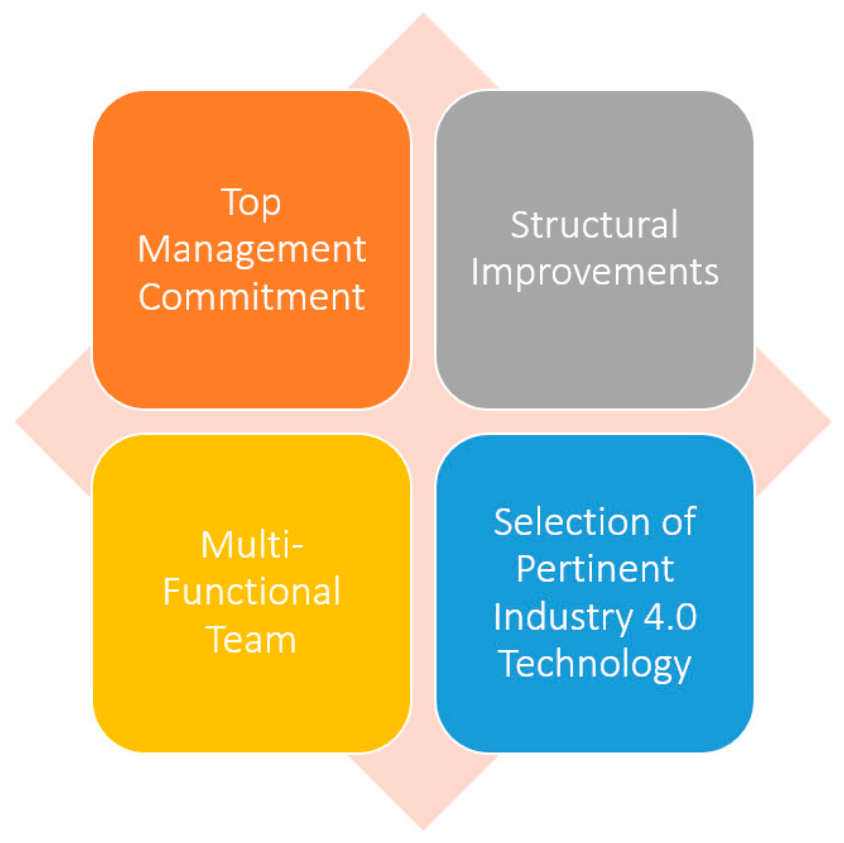
To adopt Industry 4.0 technologies, there needs to be an organizational-level improvement approach that aims to achieve competitive advantage in the market. In this case, it is essential to have unerring commitment from top management. In a manufacturing context, pertinent Industry 4.0 technologies need to be identified that help top management to exercise a greater degree of control over the process, pivoting around increased visibility. Such practices are strong drivers for continuous improvement and help in identifying bottlenecks in the production process. Technologies such as cloud-based systems, radio-frequency identification devices (RFIDs), sensors, etc., help in achieving an increased level of control. However, at the same time, top management must prioritize gaining a competitive advantage using contemporary approaches, which centers upon investment in technology.
The goals given in Figure 1 will help achieve the following objectives:
  • Market leadership;
  • Improved processes;
  • High-quality and reliable products.
The size of the firm is another decisive factor in determining the success of Industry 4.0 implementation. There exists a narrative that larger firms have higher chances of success due to increased financial capabilities, which in turn helps mitigate any risk. This can be attributed to the presence of multi-faceted personnel with a degree of decentralization, as this positively influences the adoption process [33]. However, Arnold et al. [34] suggest that firm size is not a strong influencing factor in Industry 4.0 adoption, which has been reported in an IT context before by Baker [33]. Da Silva et al. [25] suggest that organizational management is of paramount importance in technology adoption as it fosters an environment of learning and sharing and acts as a strong lever of smooth intra-organizational communication. It is imperative to have fluid and non-rigid processes to assist the adoption of Industry 4.0 technologies, and the authors suggest that in the first phase of the framework, the top management should bring in structural improvements in the organization to leverage Industry 4.0 technologies, followed by the selection of the most pertinent technologies via a multi-functional team.

4.2. Phase 2—Measuring Organizational Readiness

Once the top management is fully committed towards implementing pertinent Industry 4.0 technologies, the next step is measuring the readiness levels of the organization. On a broader scale, Ganzarain and Errasti [48] developed a three-stage maturity model for Industry 4.0, consisting of envisioning the digital transformation, enabling the digital transformation vis-à-vis customer propositions, and enacting its progress by utilizing the human and financial resources at one’s disposal. The stages of the maturity scale were defined as an initial (absence of Industry 4.0 vision), managed (existence of Industry 4.0 roadmap), defined (identification of customer segments and value propositions), transformed (enactment of strategy), and detailed BM (business model transformation).
Castelo-Branco et al. [31] suggest that interconnectivity, interoperability, and virtualization are the basic tenets of Industry 4.0 infrastructure as their combined presence is a strong lever for Industry 4.0 implementation. In addition to that, the ability to process copious amount of data generated by Industry 4.0 infrastructure is also a determinant of the readiness of the organization. Pacchini et al. [32] employed standards adopted from SAE in an Industry 4.0 context, in which four levels as pre-requisites for adoption are given, which are L0 (Industry 4.0 component absent or there are major inconsistencies in its implementation), L1 (Industry 4.0 component present but with minor inconsistencies), L2 (Industry 4.0 component is present), and L3 (Industry 4.0 component is fully implemented). These levels are the antecedents of six degrees of readiness, which are given as follows:
  • Embryonic (0–9.99%)—possessing superficial knowledge regarding enabling technologies;
  • Initial (10–24.99%)—limited knowledge of some technologies;
  • Primary (25–49.99%)—decent knowledge of all technologies, but only a handful are adopted;
  • Intermediate (50–74.99%)—full knowledge of all technologies and adoption has commenced;
  • Advanced (75–89.99%)—full knowledge of all technologies and there is a high degree of adoption;
  • Ready (90–100%)—complete adoption of all the technologies.
Sony and Naik [49] suggest that the level of digitization of an organization can be viewed as the percentage of assets that are equipped with sensors. This can be further extrapolated to the analysis and processing of big data, which forms an integral part of organizational capability. Therefore, it is imperative to utilize a hybrid model that elaborates upon the Industry 4.0 readiness level.
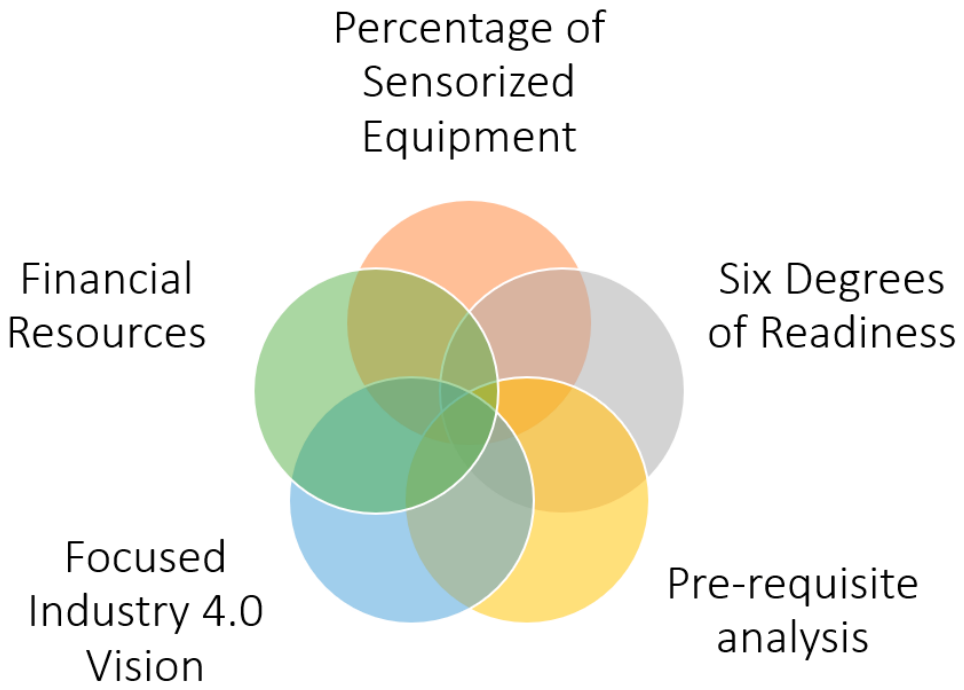
Figure 2 describes the five factors that measure the Industry 4.0 readiness level; the factors have been selected via a thorough analysis of the literature. The authors posit that the six levels of maturity have to be preceded by pre-requisite analysis for accurately measuring the readiness level of the organization, which in itself is centered upon a focused Industry 4.0 vision. However, it should be noted that financial capabilities are of extreme importance in endeavoring towards digitalization, and the onus is on the managerial personnel to be patient with the outcomes.

4.3. Phase 3—Analyzing the Organizational Environment

After measuring organizational readiness, it is essential to critically analyze the inter- and intra-organizational environment. Strong market competition is a significant driver of technological innovation, but it is reliant upon a technically competent workforce. Training and development are therefore imperative. Veile et al. [9] suggest that Industry 4.0 implementation requires a change in corporate culture, executed incrementally to make change more palpable to employees. Open, democratic communication channels foster cooperation. Flexible hierarchies facilitate faster decision-making with minimal information gatekeeping. Tortorella et al. [35] argue that Industry 4.0 implementation supports organizational learning and brings about a cultural shift. Liao et al. [36] suggest a comprehensive effort towards developing a socio-technical work organization in which workers consider themselves task owners, while ensuring workplace changes do not negatively affect their livelihoods. In an Industry 4.0 environment, providing job security is essential for harmonious human–robot interaction.
This phase is the specific phase in which the environmental TOE dimension is addressed. It is also includes three sub-factors that are analytically separate and should be treated explicitly, namely: competitive and coercive pressure from the market and industry peers, as identified by Gupta et al. [30], as strong drivers in the exploration of new technologies; government regulatory frameworks and national digitization policies with direct impacts on the cost and risk calculation of adoption, as described by Gupta et al. [33]; and infrastructure support availability, consisting of access to digital connectivity, tech vendors, and Industry 4.0 service providers in the operating environment. Consideration of the context—such as the extent to which the government provides support for digitization and how developed the vendor ecosystem is—is a key factor that any implementation roadmap would need to consider, and one where adoption barriers are significantly lower when present.
In the quest for market excellence, the importance of the inter-organizational environment cannot be ignored. Gupta et al. [30] have stated that an exploration orientation is a strong driver for Industry 4.0 adoption, in which firms explore new avenues and technologies. However, harnessing existing technologies, i.e., an exploitation orientation, also carries a positive influence on Industry 4.0 adoption. In a competitive environment, coercive and normative pressures strongly drive the implementation of disruptive technologies in an exploration context. Sony [50] has predicted that vertical integration of hierarchal subsystems and using the value stream mapping tool of lean manufacturing as a pre-requisite helps in adopting Industry 4.0 technologies in a strategic manner. Amjad et al. [51] have suggested that production-related waste can easily be addressed by using Industry 4.0 approaches.

4.4. Phase 4—Improve and Control Industrial Capabilities for Continuous Improvement

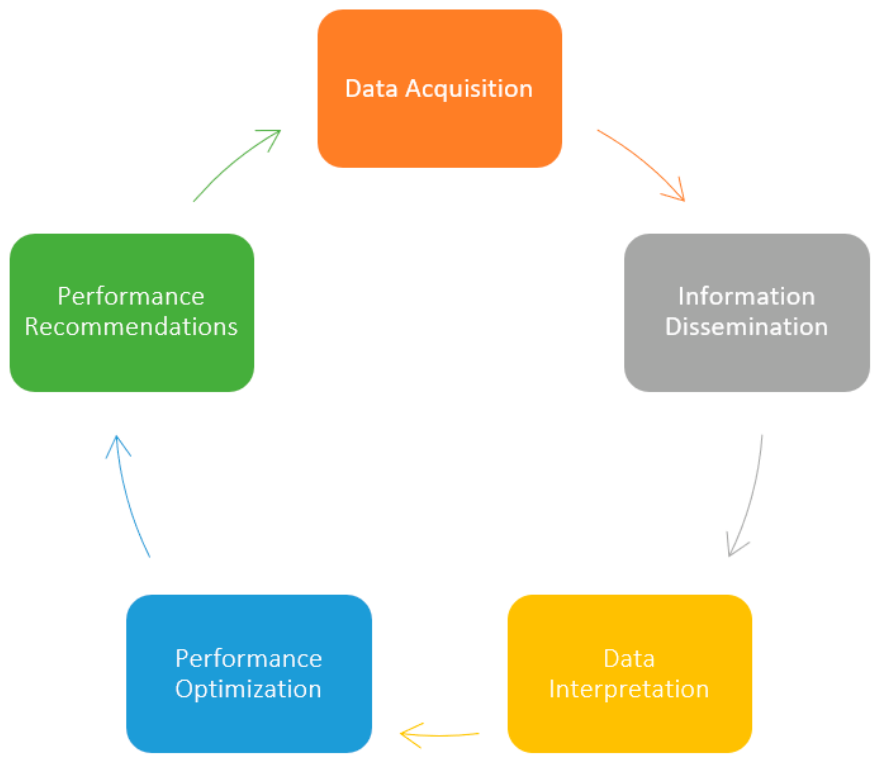
After defining goals to embrace the fourth industrial revolution, measurement of organizational readiness levels to adopt disruptive technologies, and analysis of the organizational environment, this is the enactment phase where industrial capabilities should be improved to achieve excellence. The results of organizational readiness levels provide a fair idea of where a firm stands technologically, whereas analysis of the organizational environment provides an overview of how the adoption of Industry 4.0 technologies would fare. In order to achieve manufacturing excellence, it is essential to understand the customer’s perspective. As obvious from Figure 3, it requires a holistic change in mindset and calls for a conscious effort towards continuous improvement.
Vinodh et al. [52] have suggested that the concepts of lean, lean six sigma, Kaizen, and sustainability can be integrated with thirteen Industry 4.0 technologies to achieve manufacturing excellence. However, the processing of big data has a crucial role in making informed decisions and identifying customer patterns, and Buer et al. [53], as shown in Figure 3, have also developed a five-stage model which starts with the collection of data through sensors and contemporary measures, followed by data sharing that is conducted by digital communication, which leads to data analysis using various AI-based algorithms. After data analysis, the optimization phase ensues which can also be assisted by AI technologies, and the improvement opportunities are then fed back into the process. This cyclical process is depicted in Figure 4 where the feedback to the data is looped back with the data collection procedure to attain continuous improvement.

4.5. Final Framework

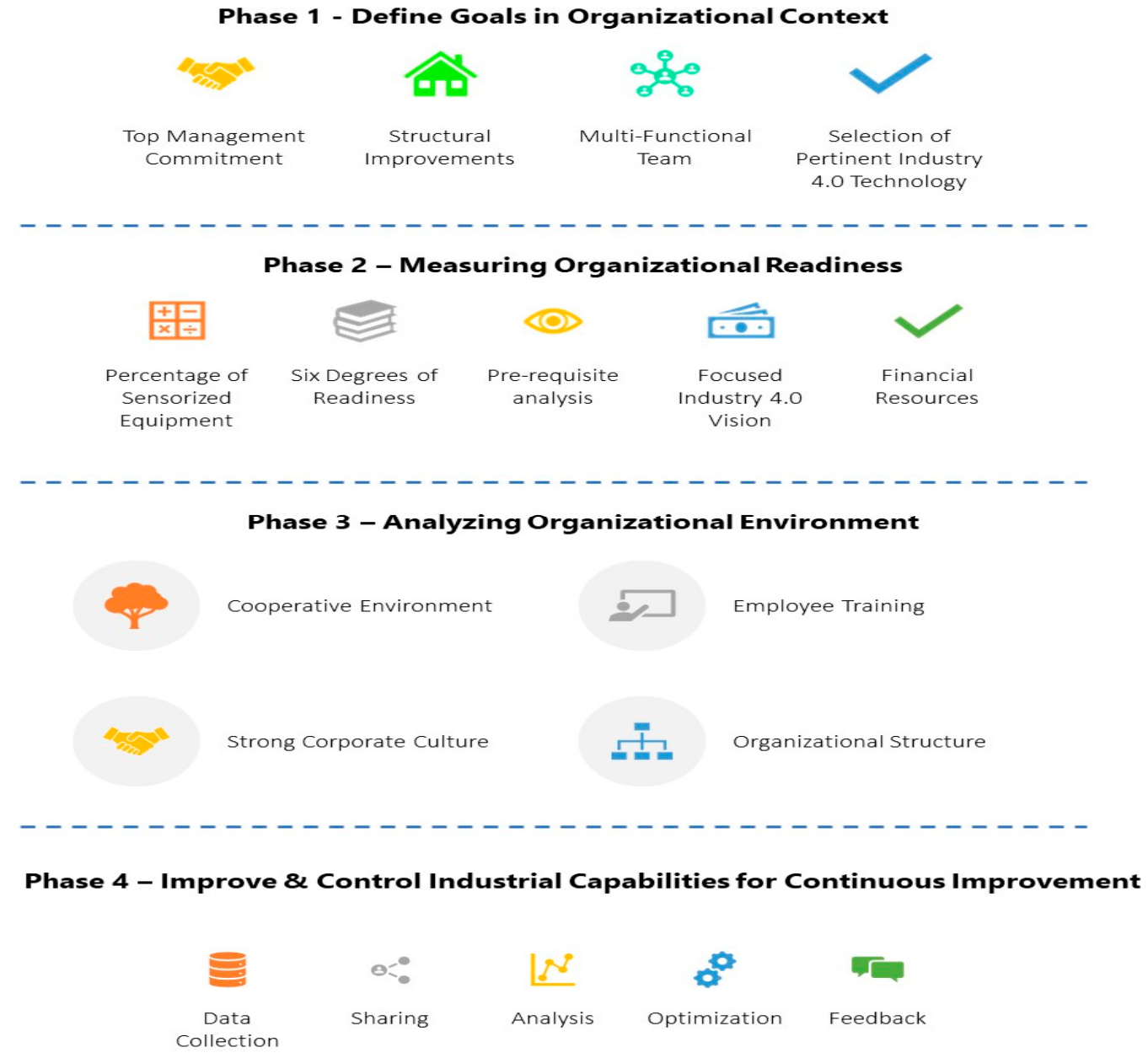
The entire four-phase process is shown in Figure 4. The novelty of this framework is that the contextual TOE dimensions are embedded in the DMAIC process steps, providing a contextually relevant and actionable roadmap. It is important to note that although the authors were unable to find any previous study that integrates DMAIC and TOE explicitly for the adoption of Industry 4.0 to the best of the authors’ knowledge, other process-improvement TOE integrations could exist in related areas of technology management. Future work requires empirical validation of the results using a case study or expert evaluation.
One important consideration is that the traditional DMAIC process contains five phases. This is not a mistake: in the current framework, ‘Improve’ and ‘Control’ are merged into Phase 4. Control in the context of the adoption of Industry 4.0 must always be associated with improvement: Buer et al. [53] describe the data-driven continuous improvement cycle, which incorporates control mechanisms into the improvement process. They should be operationally linked with one another, and separating them would be an artificial division of activities if Industry 4.0 technologies like real-time sensor networks, artificial intelligence for optimization, and digital dashboards are used. The same phenomenon has been observed in DMAIC applications in IT and service environments [44] where operational facts call for a merging of phases.
Table 5 presents the explicit mapping between each framework phase, its DMAIC stage, the corresponding TOE dimension, and the key activities and constructs addressed.

5. Conclusions

Through a literature review on the barriers to Industry 4.0 adoption and a synthesis of implementation approaches, the authors have proposed a four-phase conceptual framework that harnesses DMAIC methodology and the TOE framework. The conceptual model presents the four phases in an integrated, procedurally actionable manner. The research addresses RQ-1 by analyzing common barriers and drivers of Industry 4.0 implementation from the literature and providing a critical overview of technical, organizational, and human aspects. RQ-2 is addressed by developing a conceptual model that takes a four-phase DMAIC approach while explicitly articulating the TOE framework across all phases.
The framework has implications for sustainable industrial development. The proposed roadmap will assist organizations to a structured approach incorporating digital capability development, workforce upskilling, and technology adoption, while explicitly considering environmental pressures and regulatory environments, thus contributing to responsible and resource-efficient manufacturing transformation. Adopting Industry 4.0 technologies in such a structured approach can lead to a substantial reduction in production waste, energy use, and resource inefficiency—all of which are ways to achieve sustainability goals at the organizational and sectoral level.
From an academic perspective, the research makes key contributions to technology management literature by utilizing the TOE approach in an appropriate manner through DMAIC principles. For practitioners, it provides a clear four-step process for Industry 4.0 adoption. Despite these contributions, the research carries several limitations.
Future further research should be done by applying case studies to the framework and then validating the framework with the help of experts through the Delphi method. The framework could also be assessed through a survey of applicability across all firm sizes and industrial sectors. Theoretically, the combination of the Improve and Control phases should be investigated in practice to determine if operational separation would provide further insights.

6. Contribution and Originality

This study offers three primary contributions to the literature on Industry 4.0 adoption. First, we extend the TOE framework by integrating it with DMAIC methodology. This synthesis creates a novel process-context model, moving beyond the TOE framework’s focus on contextual determinants to provide a clear, stepwise implementation process. Second, we synthesize the disparate barriers and drivers identified in prior research into a cohesive roadmap structured around technological, organizational, and environmental dimensions, thereby bridging the gap between descriptive reviews and actionable guidance. Finally, our third and most practical contribution is a four-phase implementation roadmap defining goals, measuring readiness, analyzing the environment, and improving capabilities designed to be particularly valuable for SMEs navigating the complexities of adoption. Collectively, these contributions advance the field by offering a unique DMAIC-TOE framework that connects adoption contexts to a continuous improvement logic, providing managers with actionable insights.

Author Contributions

Conceptualization, M.Z.R. and M.A.M.; methodology, M.Z.R.; software, F.A.S.; validation, M.Z.R., M.A.M. and M.E.; formal analysis, M.Z.R.; investigation, F.A.S.; resources, F.D.; data curation, F.A.S.; writing—original draft preparation, M.Z.R.; writing—review and editing, M.Z.R., M.A.M. and M.E.; visualization, F.A.S.; supervision, M.Z.R.; project administration, M.Z.R.; funding acquisition, F.D. All authors have read and agreed to the published version of the manuscript.

Funding

This research received no external funding.

Institutional Review Board Statement

Not applicable.

Informed Consent Statement

Not applicable.

Data Availability Statement

No new data were created or analyzed in this study.

Conflicts of Interest

The authors declare no conflicts of interest.

References

  1. Klingenberg, C.O.; Borges, M.A.V.; Antunes, J.A.V., Jr. Industry 4.0 as a data-driven paradigm: A systematic literature review on technologies. J. Manuf. Technol. Manag. 2019, 29, 910–936. [Google Scholar]
  2. Moktadir, M.A.; Ali, S.M.; Kusi-Sarpong, S.; Shaikh, M.A.A. Assessing challenges for implementing Industry 4.0: Implications for process safety and environmental protection. Process Saf. Environ. Prot. 2018, 117, 730–741. [Google Scholar] [CrossRef]
  3. Hoyer, C.; Gunawan, I.; Reaiche, C.H. The Implementation of Industry 4.0—A Systematic Literature Review of the Key Factors. Syst. Res. Behav. Sci. 2020, 37, 557–578. [Google Scholar] [CrossRef]
  4. Tornatzky, L.; Fleischer, M. The Process of Technology Innovation; Lexington Books: Lexington, MA, USA, 1990; p. 165. [Google Scholar]
  5. Reis, L.A.; Euzébio, T.A.M.; da Silva, M.T.; Santana, A.C. Using the Six Sigma DMAIC Methodology to Enhance the Performance of Control Loops in an Iron Ore Processing Plant. IEEE Access 2025, 13, 163690–163700. [Google Scholar] [CrossRef]
  6. Stentoft, J.; Adsbøll Wickstrøm, K.; Philipsen, K.; Haug, A. Drivers and barriers for Industry 4.0 readiness and practice: Empirical evidence from small and medium-sized manufacturers. Prod. Plan. Control 2020, 29, 910–936. [Google Scholar]
  7. Horváth, D.; Szabó, R.Z. Driving forces and barriers of Industry 4.0: Do multinational and small and medium-sized companies have equal opportunities? Technol. Forecast. Soc. Change 2019, 146, 119–132. [Google Scholar] [CrossRef]
  8. Raj, A.; Dwivedi, G.; Sharma, A.; De Sousa Jabbour, A.B.L.; Rajak, S. Barriers to the Adoption of Industry 4.0 Technologies in the Manufacturing Sector: An Inter-Country Comparative Perspective. Int. J. Prod. Econ. 2019, 224, 107546. [Google Scholar]
  9. Veile, J.W.; Kiel, D.; Müller, J.M.; Voigt, K.-I. Lessons learned from Industry 4.0 implementation in the German manufacturing industry. J. Manuf. Technol. Manag. 2019, 31, 977–997. [Google Scholar] [CrossRef]
  10. Erol, S.; Jäger, A.; Hold, P.; Ott, K.; Sihn, W. Tangible Industry 4.0: A Scenario-Based Approach to Learning for the Future of Production. Procedia CIRP 2016, 54, 13–18. [Google Scholar] [CrossRef]
  11. Amjad, M.S.; Rafique, M.Z.; Khan, M.A. Modern divulge in production optimization: An implementation framework of LARG manufacturing with Industry 4.0. Int. J. Lean Six Sigma 2021, 12, 992–1016. [Google Scholar] [CrossRef]
  12. Amjad, M.S.; Rafique, M.Z.; Khan, M.A. Leveraging Optimized and Cleaner Production through Industry 4.0. Sustain. Prod. Consum. 2021, 26, 859–871. [Google Scholar] [CrossRef]
  13. Kamble, S.S.; Gunasekaran, A.; Sharma, R. Analysis of the driving and dependence power of barriers to adopt Industry 4.0 in Indian manufacturing industry. Comput. Ind. 2018, 101, 107–119. [Google Scholar] [CrossRef]
  14. Akdil, K.Y.; Ustundag, A.; Cevikcan, E. Maturity and Readiness Model for Industry 4.0 Strategy. In Industry 4.0: Managing the Digital Transformation; Springer: Cham, Switzerland, 2018. [Google Scholar]
  15. Kipper, L.M.; Furstenau, L.B.; Hoppe, D.; Frozza, R.; Iepsen, S. Scopus scientific mapping production in Industry 4.0 (2011–2018): A bibliometric analysis. Int. J. Prod. Res. 2020, 58, 1605–1627. [Google Scholar]
  16. Ozkan-Ozen, Y.D.; Kazancoglu, Y.; Mangla, S.K. Synchronized barriers for circular supply chains in Industry 3.5/Industry 4.0 transition for sustainable resource management. Resour. Conserv. Recycl. 2020, 161, 104986. [Google Scholar] [CrossRef]
  17. Chauhan, C.; Singh, A.; Luthra, S. Barriers to Industry 4.0 adoption and its performance implications: An empirical investigation of emerging economy. J. Clean. Prod. 2021, 285, 124809. [Google Scholar] [CrossRef]
  18. Majumdar, A.; Garg, H.; Jain, R. Managing the barriers of Industry 4.0 adoption and implementation in textile and clothing industry: Interpretive structural model and triple helix framework. Comput. Ind. 2021, 125, 103372. [Google Scholar] [CrossRef]
  19. Khanzode, A.G.; Sarma, P.; Mangla, S.K.; Yuan, H. Modeling the Industry 4.0 adoption for sustainable production in Micro, Small & Medium Enterprises. J. Clean. Prod. 2021, 279, 123489. [Google Scholar] [CrossRef]
  20. Sharma, M.; Kamble, S.; Mani, V.; Sehrawat, R.; Belhadi, A.; Sharma, V. Industry 4.0 adoption for sustainability in multi-tier manufacturing supply chain in emerging economies. J. Clean. Prod. 2021, 281, 125013. [Google Scholar] [CrossRef]
  21. Halse, L.L.; Jæger, B. Operationalizing Industry 4.0: Understanding Barriers of Industry 4.0 and Circular Economy. In Proceedings of the IFIP International Conference on Advances in Production Management Systems, Austin, TX, USA, 1–5 September 2019; Springer: Cham, Switzerland, 2019; pp. 135–142. [Google Scholar]
  22. Kumar, P.; Singh, R.K.; Kumar, V. Managing supply chains for sustainable operations in the era of Industry 4.0 and circular economy: Analysis of barriers. Resour. Conserv. Recycl. 2021, 164, 105215. [Google Scholar] [CrossRef]
  23. Rajput, S.; Singh, S.P. Industry 4.0—Challenges to implement circular economy. Benchmarking Int. J. 2019, 28, 1717–1739. [Google Scholar] [CrossRef]
  24. Ghadge, A.; Kara, M.E.; Moradlou, H.; Goswami, M. The impact of Industry 4.0 implementation on supply chains. J. Manuf. Technol. Manag. 2020, 31, 669–686. [Google Scholar] [CrossRef]
  25. Da Silva, V.L.; Kovaleski, J.L.; Pagani, R.N.; Silva, J.D.M.; Corsi, A. Implementation of Industry 4.0 concept in companies: Empirical evidences. Int. J. Comput. Integr. Manuf. 2020, 33, 325–342. [Google Scholar]
  26. Abdul-Hamid, A.-Q.; Ali, M.H.; Tseng, M.-L.; Lan, S.; Kumar, M. Impeding challenges on Industry 4.0 in circular economy: Palm oil industry in Malaysia. Comput. Oper. Res. 2020, 123, 105052. [Google Scholar] [CrossRef]
  27. Kumar, S.; Raut, R.D.; Nayal, K.; Kraus, S.; Yadav, V.S.; Narkhede, B.E. To identify Industry 4.0 and circular economy adoption barriers in the agriculture supply chain by using ISM-ANP. J. Clean. Prod. 2021, 293, 126023. [Google Scholar] [CrossRef]
  28. Kumar, S.; Suhaib, M.; Asjad, M. Narrowing the barriers to Industry 4.0 practices through PCA-Fuzzy AHP-K means. J. Adv. Manag. Res. 2020, 18, 200–226. [Google Scholar] [CrossRef]
  29. Satyro, W.C.; De Mesquita Spinola, M.; Sacomano, J.B.; Da Silva, M.T.; Gonçalves, R.F.; De Paula Pessoa, M.S.; Contador, J.C.; Contador, J.L.; Schiavo, L. Implementation of Industry 4.0 in Germany, Brazil and Portugal: Barriers and Benefits. In Proceedings of the IFIP International Conference on Advances in Production Management Systems, Austin, TX, USA, 1–5 September 2019; Springer: Cham, Switzerland, 2019; pp. 323–330. [Google Scholar]
  30. Gupta, S.; Modgil, S.; Gunasekaran, A.; Bag, S. Dynamic capabilities and institutional theories for Industry 4.0 and digital supply chain. Supply Chain Forum Int. J. 2020, 21, 139–157. [Google Scholar] [CrossRef]
  31. Castelo-Branco, I.; Cruz-Jesus, F.; Oliveira, T. Assessing Industry 4.0 readiness in manufacturing: Evidence for the European Union. Comput. Ind. 2019, 107, 22–32. [Google Scholar] [CrossRef]
  32. Pacchini, A.P.T.; Lucato, W.C.; Facchini, F.; Mummolo, G. The degree of readiness for the implementation of Industry 4.0. Comput. Ind. 2019, 113, 103125. [Google Scholar] [CrossRef]
  33. Baker, J. The Technology–Organization–Environment Framework. In Information Systems Theory; Springer: New York, NY, USA, 2012. [Google Scholar]
  34. Arnold, C.; Veile, J.; Voigt, K.-I. What Drives Industry 4.0 Adoption? An Examination of Technological, Organizational, and Environmental Determinants. In Proceedings of the 27th International Conference on Management of Technology (IAMOT), Birmingham, UK, 22–26 April 2018. [Google Scholar]
  35. Tortorella, G.L.; Vergara, A.M.C.; Garza-Reyes, J.A.; Sawhney, R. Organizational learning paths based upon Industry 4.0 adoption: An empirical study with Brazilian manufacturers. Int. J. Prod. Econ. 2020, 219, 284–294. [Google Scholar] [CrossRef]
  36. Liao, Y.; Deschamps, F.; Loures, E.D.F.R.; Ramos, L.F.P. Past, present and future of Industry 4.0—A systematic literature review and research agenda proposal. Int. J. Prod. Res. 2017, 55, 3609–3629. [Google Scholar] [CrossRef]
  37. Sangwa, N.R.; Sangwan, K.S. Leanness assessment of organizational performance: A systematic literature review. J. Manuf. Technol. Manag. 2018, 29, 768–788. [Google Scholar] [CrossRef]
  38. Antony, J.; Psomas, E.; Garza-Reyes, J.A.; Hines, P. Practical implications and future research agenda of lean manufacturing: A systematic literature review. Prod. Plan. Control 2020, 32, 889–925. [Google Scholar] [CrossRef]
  39. Kamble, S.S.; Gunasekaran, A.; Gawankar, S.A. Sustainable Industry 4.0 framework: A systematic literature review identifying the current trends and future perspectives. Process Saf. Environ. Prot. 2018, 117, 408–425. [Google Scholar] [CrossRef]
  40. Loh, K.L.; Lau, D.H. Blue ocean leadership in lean sustainability. Int. J. Lean Six Sigma 2019, 10, 275–294. [Google Scholar] [CrossRef]
  41. Mishra, P.; Sharma, R.K. A hybrid framework based on SIPOC and Six Sigma DMAIC for improving process dimensions in supply chain network. Int. J. Qual. Reliab. Manag. 2014, 31, 522–546. [Google Scholar] [CrossRef]
  42. Kumar, S.; Wolfe, A.D.; Wolfe, K.A. Using Six Sigma DMAIC to improve credit initiation process in a financial services operation. Int. J. Product. Perform. Manag. 2008, 57, 659–676. [Google Scholar] [CrossRef]
  43. Antony, J.; Bhuller, A.S.; Kumar, M.; Mendibil, K.; Montgomery, D.C. Application of Six Sigma DMAIC methodology in a transactional environment. Int. J. Qual. Reliab. Manag. 2012, 29, 31–53. [Google Scholar] [CrossRef]
  44. Li, S.-H.; Wu, C.-C.; Yen, D.C.; Lee, M.-C. Improving the efficiency of IT help-desk service by Six Sigma management methodology (DMAIC)—A case study of C company. Prod. Plan. Control 2011, 22, 612–627. [Google Scholar] [CrossRef]
  45. Jirasukprasert, P.; Garza-Reyes, J.A.; Kumar, V.; Lim, M.K. A Six Sigma and DMAIC application for the reduction of defects in a rubber gloves manufacturing process. Int. J. Lean Six Sigma 2014, 5, 2–21. [Google Scholar] [CrossRef]
  46. Abhilash, C.; Thakkar, J.J. Application of Six Sigma DMAIC methodology to reduce the defects in a telecommunication cabinet door manufacturing process. Int. J. Qual. Reliab. Manag. 2019, 36, 1540–1555. [Google Scholar] [CrossRef]
  47. Srinivasan, K.; Muthu, S.; Devadasan, S.; Sugumaran, C. Enhancement of sigma level in the manufacturing of furnace nozzle through DMAIC approach of Six Sigma: A case study. Prod. Plan. Control 2016, 27, 810–822. [Google Scholar] [CrossRef]
  48. Ganzarain, J.; Errasti, N. Three stage maturity model in SME’s toward Industry 4.0. J. Ind. Eng. Manag. (JIEM) 2016, 9, 1119–1128. [Google Scholar] [CrossRef]
  49. Sony, M.; Naik, S. Key ingredients for evaluating Industry 4.0 readiness for organizations: A literature review. Benchmarking Int. J. 2019, 27, 2213–2232. [Google Scholar] [CrossRef]
  50. Sony, M. Industry 4.0 and lean management: A proposed integration model and research propositions. Prod. Manuf. Res. 2018, 6, 416–432. [Google Scholar] [CrossRef]
  51. Amjad, M.S.; Rafique, M.Z.; Hussain, S.; Khan, M.A. A new vision of LARG Manufacturing—A trail towards Industry 4.0. CIRP J. Manuf. Sci. Technol. 2020, 31, 377–393. [Google Scholar] [CrossRef]
  52. Vinodh, S.; Antony, J.; Agrawal, R.; Douglas, J.A. Integration of continuous improvement strategies with Industry 4.0: A systematic review and agenda for further research. TQM J. 2020, 33, 441–472. [Google Scholar] [CrossRef]
  53. Buer, S.-V.; Fragapane, G.I.; Strandhagen, J.O. The Data-Driven Process Improvement Cycle: Using Digitalization for Continuous Improvement. IFAC-PapersOnLine 2018, 51, 1035–1040. [Google Scholar] [CrossRef]
Figure 1. Defining goals in an organizational context.
Sustainability 18 06695 g001
Figure 2. Measuring organizational readiness for Industry 4.0 adoption.
Sustainability 18 06695 g002
Figure 3. Five phases for adoption of digitalization.
Sustainability 18 06695 g003
Figure 4. TOE- and DMAIC-based Industry 4.0 Implementation Framework.
Sustainability 18 06695 g004
Table 1. Barriers to Industry 4.0 adoption.
BarrierDescriptionReference from Previous Literature
High InvestmentAdoption of Industry 4.0 technologies requires high capital expenditure and considerable investment in infrastructure that is not possible for small- and medium-scale businesses.[2,8,13,14,15,16]
Lack of StrategyIndustry 4.0 adoption requires a coherent strategy that demands perseverance from top and middle management, something that is often missing during the implementation stages.[2,6,8,13,17]
Unclear Top ManagementTop management is quite often unclear regarding which technologies constitute the industry 4.0 theme and which technologies are well suited to their business. Also, they are unclear regarding the long-term economic benefits of Industry 4.0 technologies, and this serves as a deterrent to the adoption of Industry 4.0 practices.[17,18,19,20,21,22]
Lack of Integrated StructureIntra-organizational cooperation is the core tenet of Industry 4.0 adoption and implementation, and a lack of clarity among the department hampers the implementation of Industry 4.0 technologies, i.e., horizontal and vertical integration are necessary for successful implementation of the aforesaid.[6,7,8,17,23]
Security RisksWith heavy reliance on cybernetworks and the requirement of an elaborate Internet of Things (IoT) system, there are issues of information security and the fear of data losses.[6,9,24,25]
Loss of jobsThe workforce has legitimate fears about the loss of jobs as laborious processes are often made easier by the introduction of intelligent machines that have better cycle times and efficiency.[16,18,20]
Resistance to ChangeOften, the adoption of a new technology/approach in the manufacturing sector is negatively influenced by the resistance of the workers to change in the traditional processes. Moreover, Industry 4.0 adoption requires workers to learn new skills and attain increased qualifications, which may not be possible for small- and medium-sized enterprises.[6,7,8,20]
Lack of standardizationCurrently, there is no elaborate scheme on how Industry 4.0 can be adopted, implemented, and what the basic requirements are that need to be fulfilled, etc. This suggests that there is an element of risk involved in Industry 4.0 adoption; a risk only large companies can take due to their strong financial standing. In addition to this, there are no certifications that can increase the internal capacity of workers/managers to adopt Industry 4.0 practices.[8,26,27,28,29]
Table 2. Drivers to Industry 4.0 adoption.
Driver CategoryDescriptionReference from Previous Literature
Top Management CommitmentOrganizationalActive and sustained leadership commitment is the single strongest enabler of Industry 4.0 adoption.[3,6,9,17]
Clear Digital StrategyOrganizationalA well-defined roadmap with measurable milestones guides consistent investment and implementation.[2,6,13]
Skilled WorkforceOrganizationalTechnically capable employees reduce integration risk and accelerate adoption of smart technologies.[7,8,9]
Competitive PressureEnvironmentalMarket competition and normative industry pressure drive firms to adopt disruptive technologies.[7,30]
Infrastructure MaturityTechnologicalExisting IT maturity, connectivity, and digitization level act as pre-requisite enablers.[3,31,32]
Government and Policy SupportEnvironmentalRegulatory frameworks, subsidies, and national digitization initiatives lower adoption barriers.[33,34]
Innovation CultureCulturalOrganizations with learning-oriented cultures and decentralized decision-making adopt faster.[35,36]
Table 3. Inclusion and Exclusion Criteria.
Inclusion CriteriaExclusion Criteria
Well-known databases: Scopus, Emerald Insight, Springer Link, and Taylor & FrancisNon-academic databases, websites, blogs, etc.
Articles strictly related to Industry 4.0Articles related to other approaches such as lean manufacturing, agile manufacturing, sustainable manufacturing, etc.
Articles discussing barriers to Industry 4.0 or the drivers of Industry 4.0Articles focused on Industry 4.0 constituents
English language articlesArticles written in other languages
Table 4. List of journals considered in the present study.
Journal TitleNumber of Articles
Journal of Cleaner Production4
International Journal of Computer Integrated Manufacturing1
Journal of Manufacturing Technology Management2
Technological Forecasting and Social Change1
Computers in Industry2
International Journal of Production Research1
Resources, Conservation and Recycling2
Process Safety and Environmental Protection1
International Journal of Production Economics1
Benchmarking: An International Journal1
Production Planning and Control1
Journal of Advances in Management Research1
Computers and Operations Research1
Total19
Table 5. DMAIC-TOE Phase Mapping for Industry 4.0 Adoption.
PhaseDMAIC StageTOE DimensionKey Constructs and Activities
1: DefineDefineOrganizationalTop management commitment; competitive advantage goals; identification of relevant Industry 4.0 technologies; structural adjustments for cross-functional collaboration; firm size considerations.
2: MeasureMeasureTechnological + OrganizationalReadiness assessment (maturity level L0–L3, six-stage readiness scale); interconnectivity and virtualization baseline; big data processing capacity; financial capability audit.
3: AnalyzeAnalyzeEnvironmental + OrganizationalMarket competition analysis; coercive/normative pressure assessment; skill gap analysis; workforce training needs; corporate culture readiness; job security policy design; government regulatory landscape.
4: Improve and ControlImprove + Control (merged)Technological + EnvironmentalTechnology enactment; data-driven continuous improvement cycle (collect–share–analyze–optimize–feedback); lean/Kaizen integration; customer-oriented performance monitoring; sustained competitive positioning.
Disclaimer/Publisher’s Note: The statements, opinions and data contained in all publications are solely those of the individual author(s) and contributor(s) and not of MDPI and/or the editor(s). MDPI and/or the editor(s) disclaim responsibility for any injury to people or property resulting from any ideas, methods, instructions or products referred to in the content.