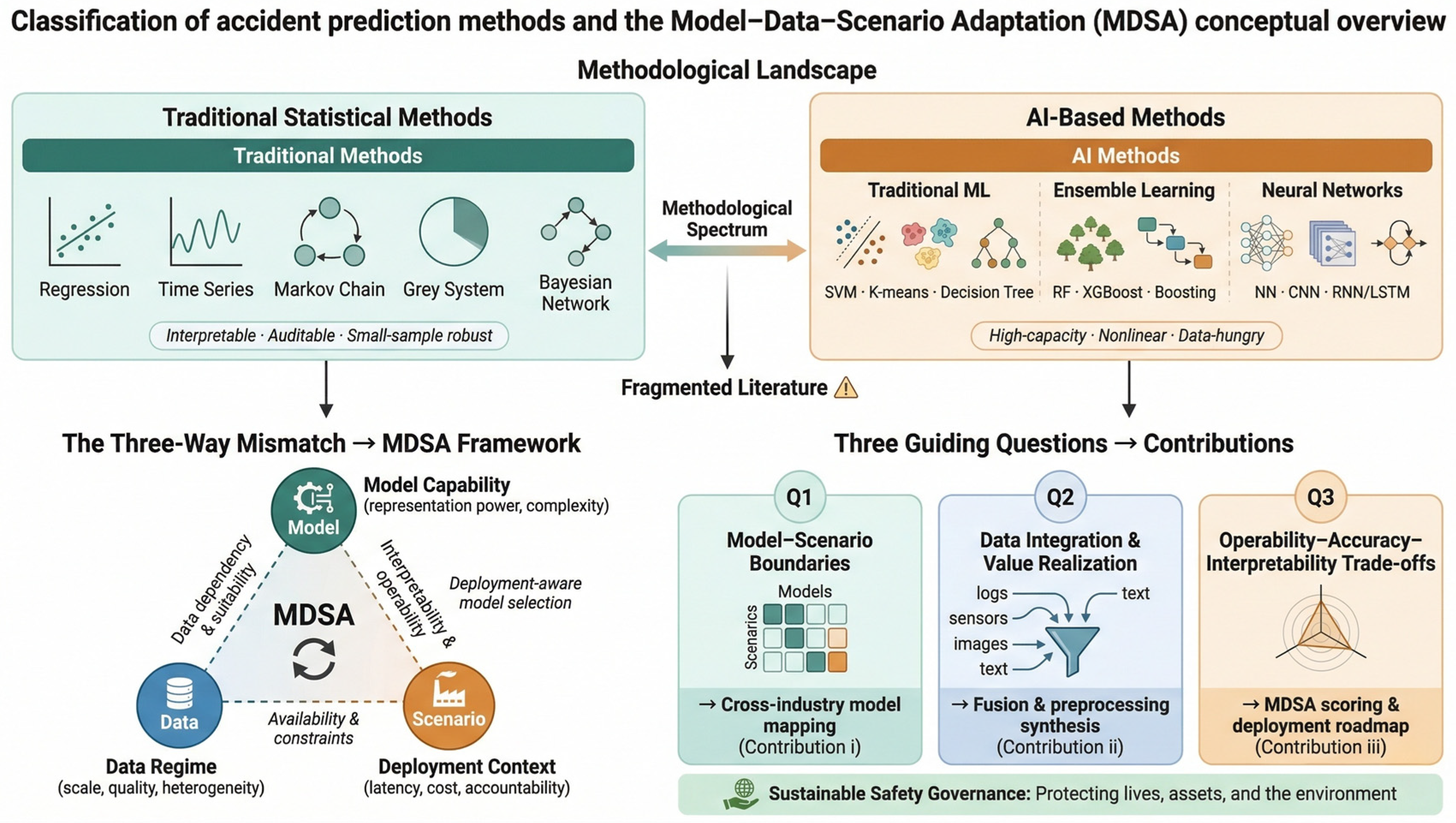
Navigating Fragmented Research: A Model–Data–Scenario Adaptation (MDSA) Framework for Sustainable Accident Prediction and Risk Governance in High-Risk Industries


Abstract
1. Introduction: The Fragmented Landscape of Accident Prediction Research
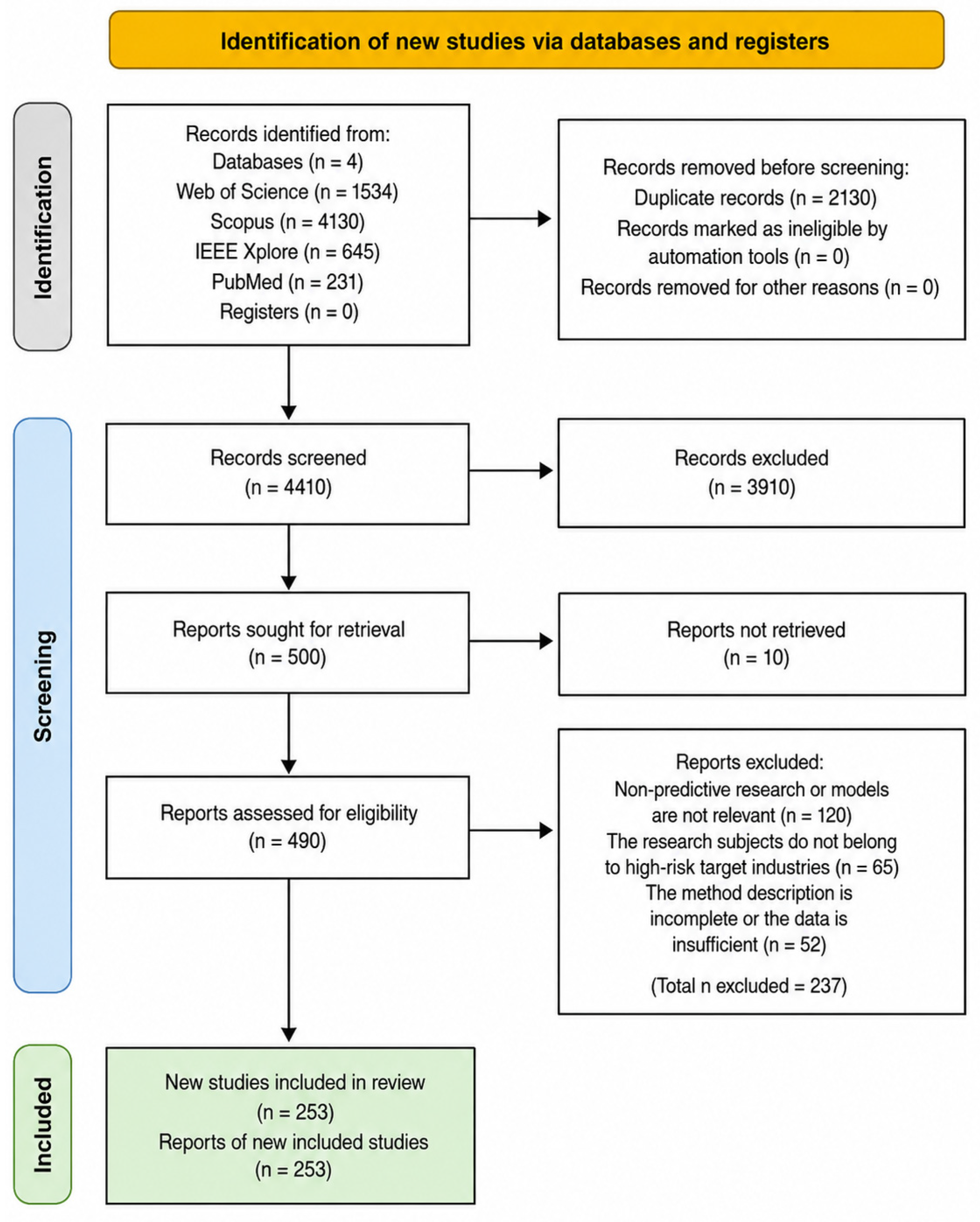
2. Methods
3. Accident Prediction Methodologies: A Critical Analysis
3.1. Traditional Statistical Methods: Interpretable Baselines
3.1.1. Regression Prediction Method
3.1.2. Time Series Method
3.1.3. Markov Chain Prediction Method
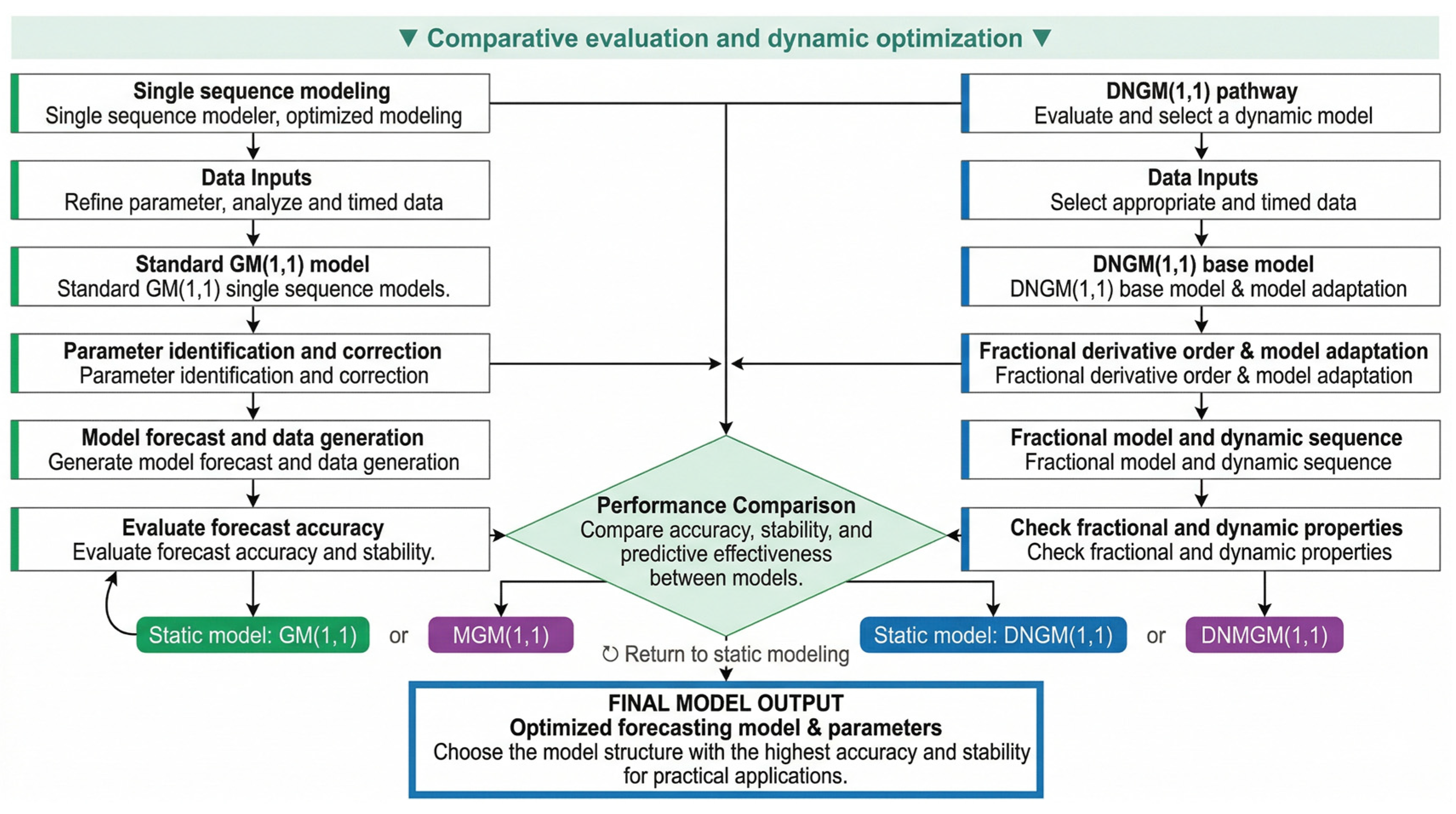
3.1.4. Grey Prediction Method
3.1.5. Bayesian Prediction Method
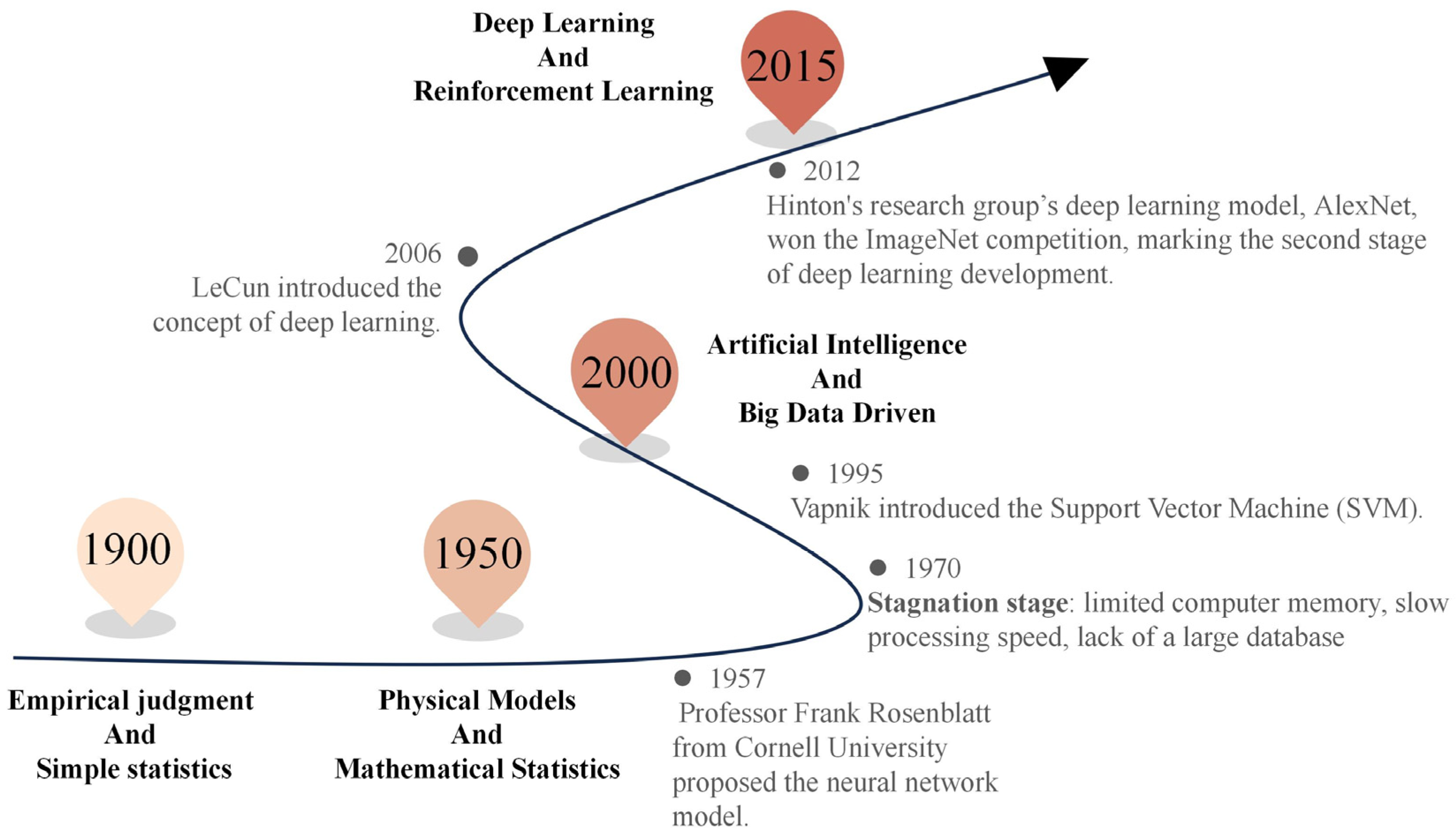
3.2. Artificial Intelligence (AI) Methods: Performance-Driven Architectures
3.2.1. Traditional Machine Learning
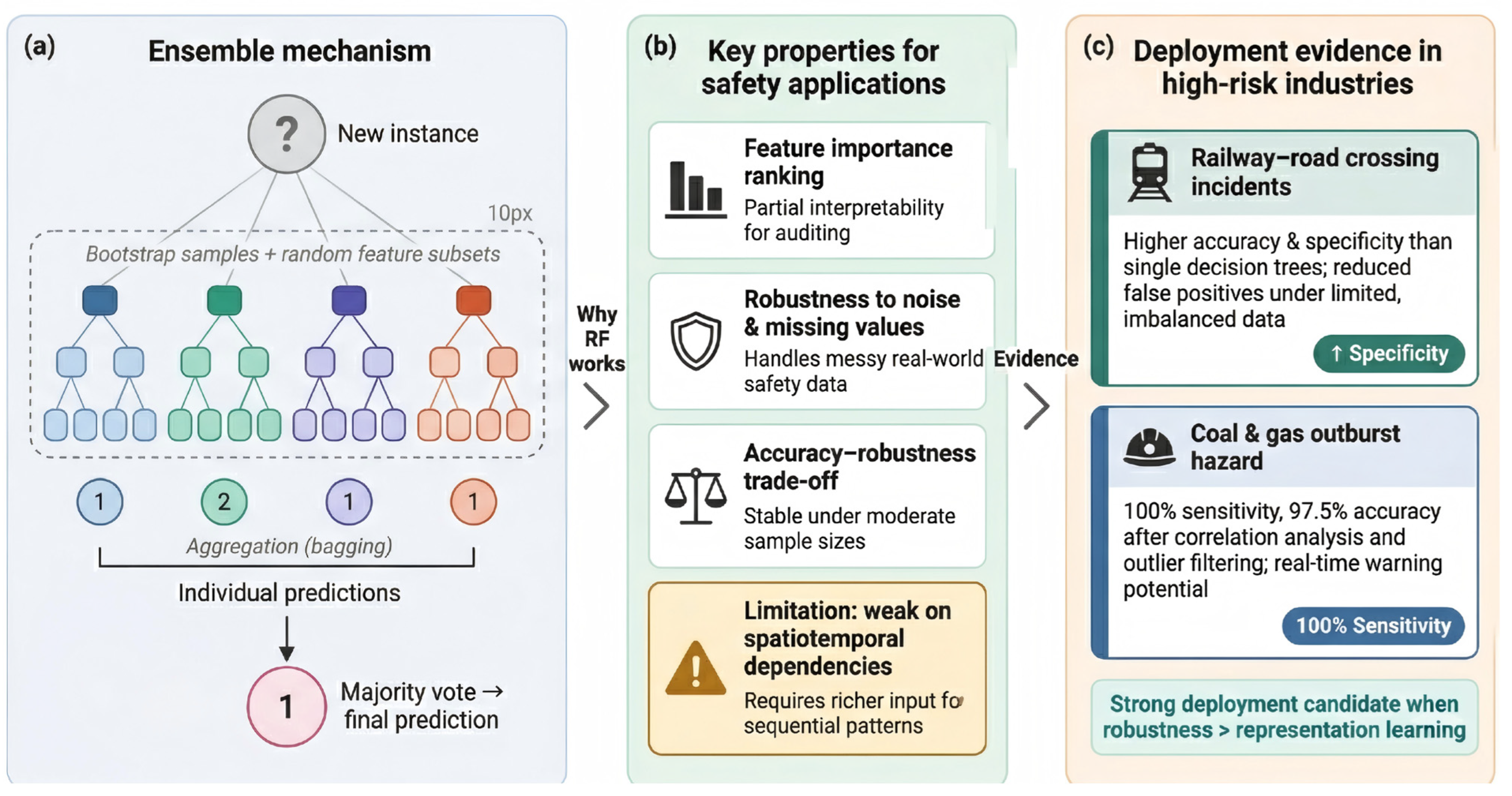
3.2.2. Ensemble Learning
3.2.3. Neural Networks
3.3. Method–Data–Scenario Implications for MDSA
4. Scenario-Based Analysis of AI Applications in Accident Prediction
4.1. Transportation Sector: Harnessing Spatiotemporal Dynamics
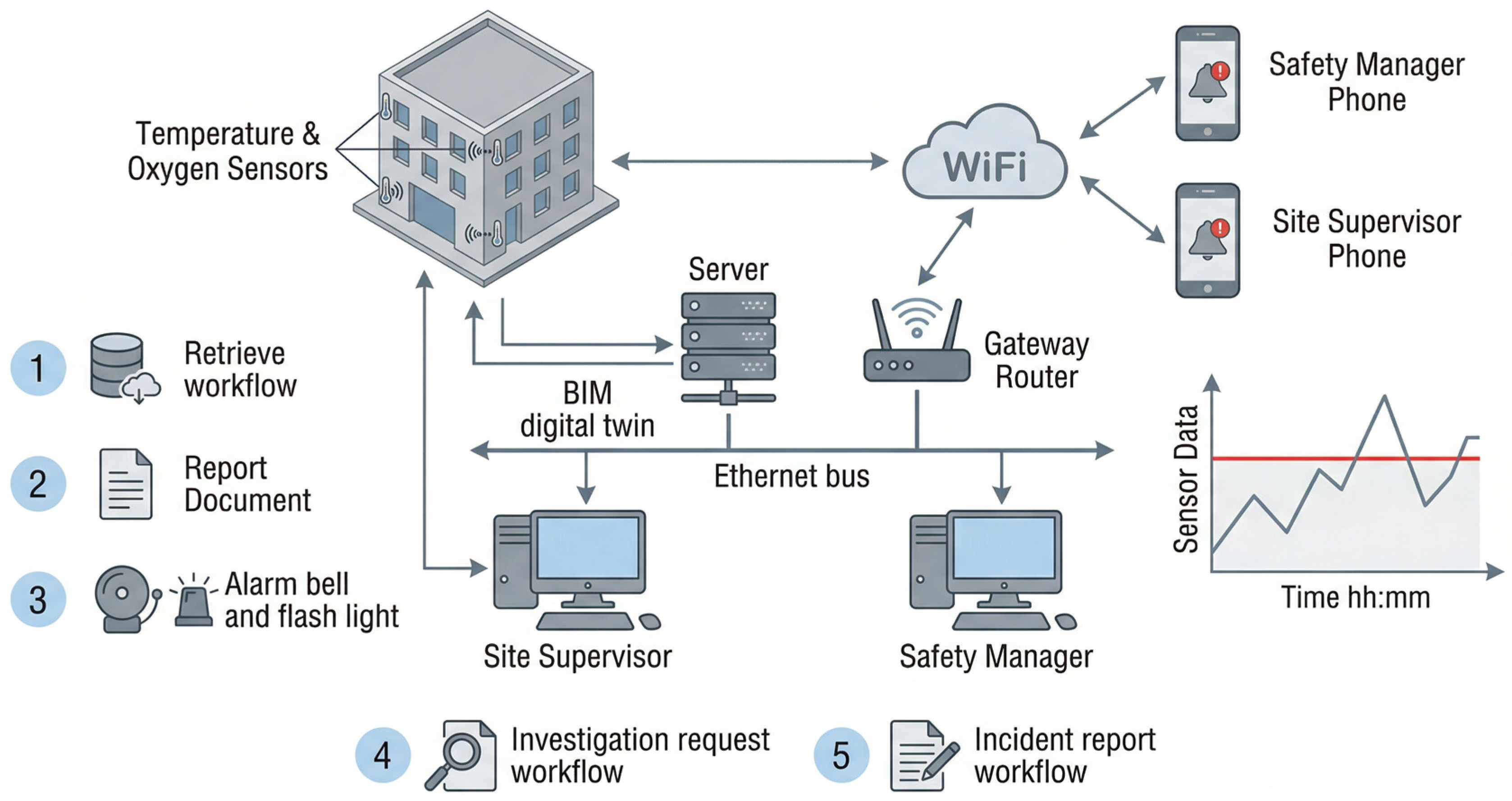
4.2. Construction Sector: Navigating Human and Environmental Factors
4.3. Fire and Electrical Power Industries: Predicting Rare Events
4.4. Chemical and Petrochemical Industries: Analyzing Complex Processes
4.5. Mining Sector: Dealing with Remote and Unstructured Environments
4.6. AI Model Suitability Analysis and Deployment Recommendations
4.7. Cross-Domain Quantitative Synthesis of Model Usage and Deployment Implications
4.7.1. Industrial Distribution of Accident Prediction Studies
4.7.2. Frequency Analysis of Model Families
4.7.3. Cross-Domain Comparison of Model Adoption Patterns
4.7.4. Performance Reporting and Limitations of Pooled Meta-Analysis
5. The Inevitability of Paradigm Shift: A Critical Analysis of AI’s Capabilities and Limitations
5.1. Drivers of the Paradigm Shift
5.2. What AI Uniquely Adds in Modern Accident Prediction
5.3. Why AI Fails in Safety-Critical Deployment
5.4. Implications for Deployment-Oriented Model Selection and the Link to MDSA
6. The Model–Data–Scenario Adaptation (MDSA) Framework: A Systems-Level Concept for Sustainable Safety Governance
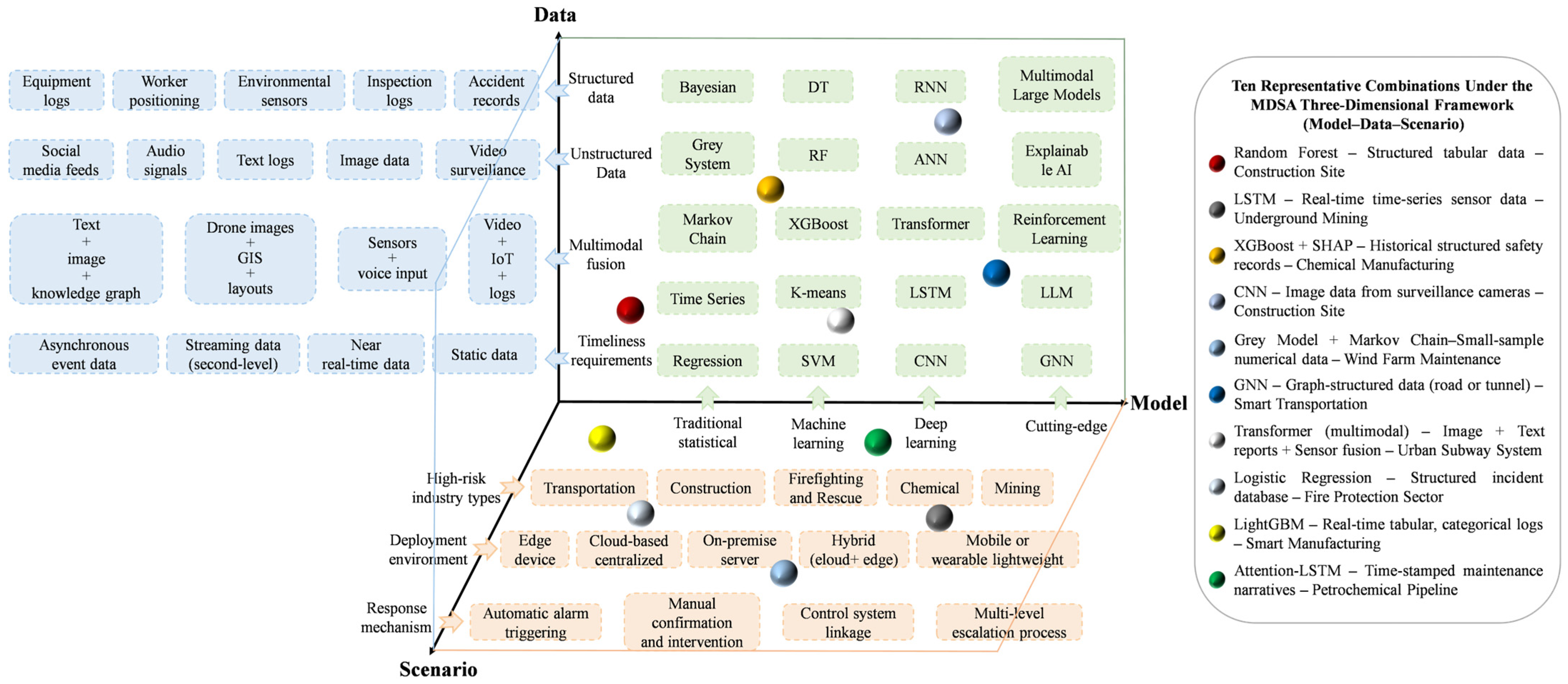
6.1. The Three Dimensions of the MDSA Framework
6.2. The MDSA Implementation Protocol
6.3. MDSA Decision Space and Illustrative Application
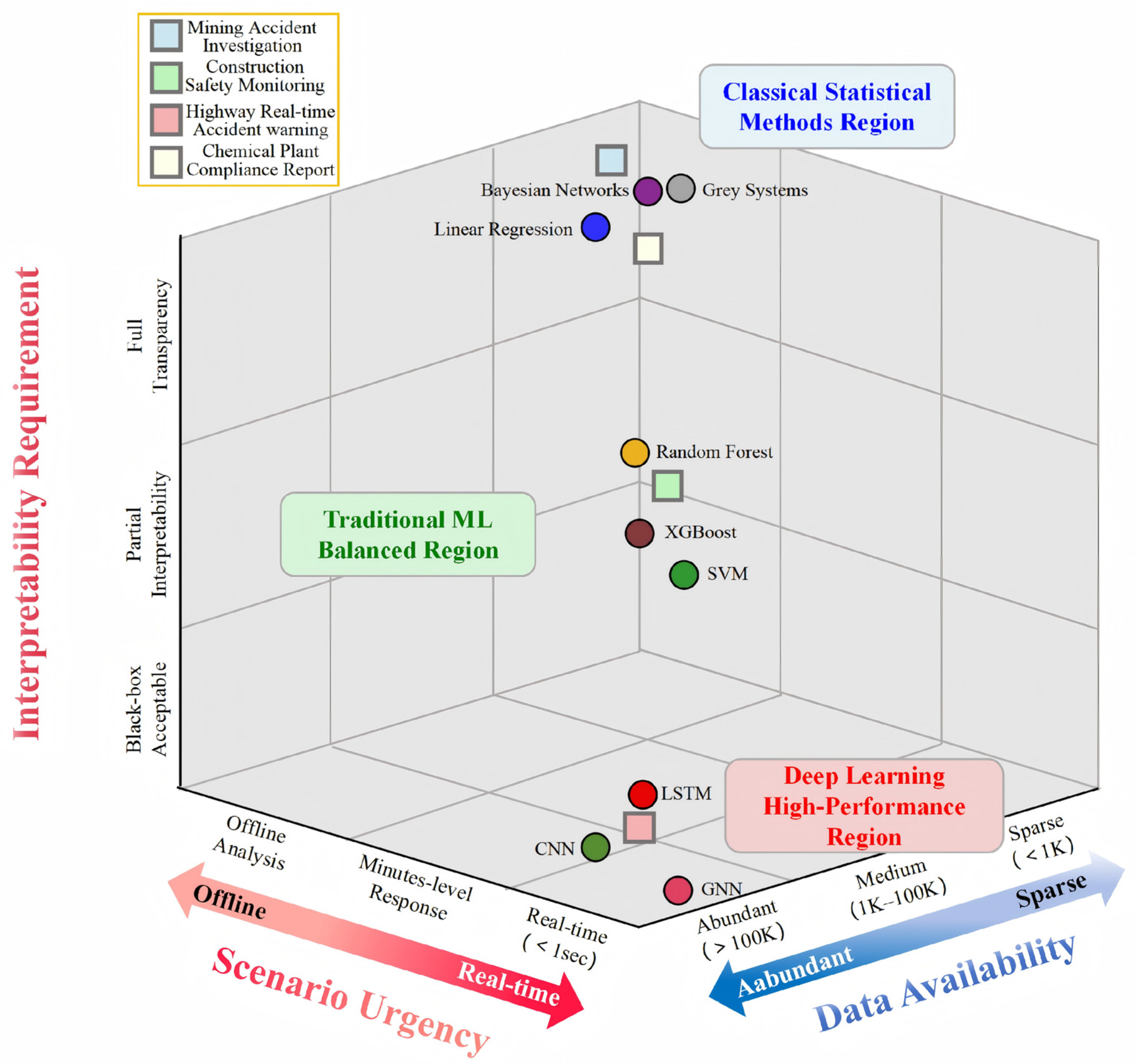
6.3.1. Visualizing the Decision Space
6.3.2. Illustrative Application: Chemical Plant Gas Leak Detection
6.3.3. Case-Based Failure Analysis and Industry-Specific Quantitative Impact Indicators
6.3.4. Indicative Trade-Off Boundaries for Deployment-Oriented Model Selection
6.4. Innovative Value and Comprehensive Advantages of MDSA Framework
7. Discussion
7.1. Mitigating the Generalization Limits of Grey Systems Within MDSA
7.2. The Dynamic Nature of Deployment Suitability: Deep Learning Under Evolving Edge-Computing Conditions
7.3. Limitations of the Review and the MDSA Framework
8. Conclusions and Future Prospects Toward Sustainable Safety Intelligence
Supplementary Materials
Author Contributions
Funding
Institutional Review Board Statement
Informed Consent Statement
Data Availability Statement
Acknowledgments
Conflicts of Interest
References
- United Nations. The 17 Goals—Sustainable Development Goals. Department of Economic and Social Affairs 2015. Available online: https://sdgs.un.org/goals (accessed on 29 April 2026).
- World Health Organization (WHO). Road Traffic Injuries. 2023. Available online: https://www.who.int/zh/news-room/fact-sheets/detail/road-traffic-injuries (accessed on 21 April 2025).
- National Fire Protection Association. Fire Loss in the United States. 2024. Available online: https://www.nfpa.org/education-and-research/research/nfpa-research/fire-statistical-reports/fire-loss-in-the-united-states (accessed on 19 June 2025).
- International Council on Mining and Metals (ICMM). Safety Performance: Benchmarking Progress of ICMM Company Members in 2023. 2024. Available online: https://www.icmm.com/en-gb/research/health-safety/benchmarking-2023-safety-data (accessed on 19 June 2025).
- Tamascelli, N.; Campari, A.; Parhizkar, T.; Paltrinieri, N. Artificial intelligence for safety and reliability: A descriptive, bibliometric and interpretative review on machine learning. J. Loss Prev. Process Ind. 2024, 90, 105343. [Google Scholar] [CrossRef]
- Kashifi, M.T.; Al-Turki, M.; Sharify, A.W. Deep hybrid learning framework for spatiotemporal crash prediction using big traffic data. Int. J. Transp. Sci. Technol. 2023, 12, 793–808. [Google Scholar] [CrossRef]
- Li, H.; Chen, L. Traffic accident risk prediction based on deep learning and spatiotemporal features of vehicle trajectories. PLoS ONE 2025, 20, e0320656. [Google Scholar] [CrossRef]
- Shi, W.; Huang, J.; Yang, G.; Su, S.; Jiang, S. Coal and gas outburst prediction based on data augmentation and neuroevolution. PLoS ONE 2025, 20, e0317461. [Google Scholar] [CrossRef]
- Jang, K.; Pilario, K.E.S.; Lee, N.; Moon, I.; Na, J. Explainable artificial intelligence for fault diagnosis of industrial processes. IEEE Trans. Ind. Informat. 2025, 21, 4–11. [Google Scholar] [CrossRef]
- Perez-Cerrolaza, J.; Abella, J.; Borg, M.; Donzella, C.; Cerquides, J.; Cazorla, F.J.; Englund, C.; Tauber, M.; Nikolakopoulos, G.; Flores, J.L. Artificial intelligence for safety-critical systems in industrial and transportation domains: A survey. ACM Comput. Surv. 2024, 56, 176:1–176:40. [Google Scholar] [CrossRef]
- Paleyes, A.; Urma, R.-G.; Lawrence, N.D. Challenges in deploying machine learning: A survey of case studies. ACM Comput. Surv. 2022, 55, 114:1–114:29. [Google Scholar] [CrossRef]
- Kantz, B.; Staudinger, C.; Feilmayr, C.; Wachlmayr, J.; Haberl, A.; Schuster, S.; Pernkopf, F. Robustness of Explainable Artificial Intelligence in Industrial Process Modelling. arXiv 2024, arXiv:2407.09127. [Google Scholar] [CrossRef]
- Carter, A.; Imtiaz, S.; Naterer, G.F. Review of interpretable machine learning for process industries. Process Saf. Environ. Prot. 2023, 170, 647–659. [Google Scholar] [CrossRef]
- Christopher, M. Bishop Pattern Recognition and Machine Learning, 1st ed.; Springer: New York, NY, USA, 2006. [Google Scholar]
- Hu, W.; Yang, Y.; Cheng, Z.; Yang, C.; Ren, X. Time-Series Event Prediction with Evolutionary State Graph; Association for Computing Machinery: New York, NY, USA, 2021; pp. 580–588. [Google Scholar] [CrossRef]
- Levent, İ.; Şahin, G.; Işık, G.; van Sark, W.G.J.H.M. Comparative analysis of advanced machine learning regression models with advanced artificial intelligence techniques to predict rooftop PV solar power plant efficiency using indoor solar panel parameters. Appl. Sci. 2025, 15, 3320. [Google Scholar] [CrossRef]
- Ye, L.; Ding, Y. Comparative analysis of shallow and deep machine learning models for predicting indoor thermal response of flexible envelope system. J. Energy Storage 2025, 126, 116997. [Google Scholar] [CrossRef]
- Ben-Gal, I. Bayesian Networks. In Encyclopedia of Statistics in Quality and Reliability; John Wiley & Sons, Ltd.: Hoboken, NJ, USA, 2008. [Google Scholar] [CrossRef]
- Haddaway, N.R.; Page, M.J.; Pritchard, C.C.; McGuinness, L.A. PRISMA2020: An R package and Shiny app for producing PRISMA 2020-compliant flow diagrams, with interactivity for optimised digital transparency and Open Synthesis. Campbell Syst. Rev. 2022, 18, e1230. [Google Scholar] [CrossRef]
- Zhou, M.; Sisiopiku, V.P. Relationship Between Volume-to-Capacity Ratios and Accident Rates. Transp. Res. Rec. 1997, 158, 47–52. [Google Scholar] [CrossRef]
- Greibe, P. Accident prediction models for urban roads. Accid. Anal. Prev. 2003, 35, 273–285. [Google Scholar] [CrossRef] [PubMed]
- Oh, J.; Washington, S.P.; Nam, D. Accident prediction model for railway-highway interfaces. Accid. Anal. Prev. 2006, 38, 346–356. [Google Scholar] [CrossRef]
- Hyndman, R.; Koehler, A.B.; Ord, J.K.; Snyder, R.D. Forecasting with Exponential Smoothing: The State Space Approach; Springer: Berlin/Heidelberg, Germany, 2008. [Google Scholar]
- Meng, G.; Liu, J.; Feng, R. Prediction of Construction and Production Safety Accidents in China Based on Time Series Analysis Combination Model. Appl. Sci. 2022, 12, 11124. [Google Scholar] [CrossRef]
- Wang, D.; Du, H.; Wang, Q.; Li, H. Weighted markov chain analysis and hierarchical clustering for landslide early warning in open-pit mine. Arab. J. Geosci. 2022, 15, 819. [Google Scholar] [CrossRef]
- Qingfu, L.; Qunfang, H.; Peng, Z. Application of Grey-Markov Model in Predicting Traffic Volume. In 2007 IEEE International Conference on Grey Systems and Intelligent Services; IEEE: New York, NY, USA, 2007; pp. 707–711. [Google Scholar] [CrossRef]
- Deng, J.-L. Control problems of grey systems. Syst. Control Lett. 1982, 1, 288–294. [Google Scholar] [CrossRef]
- Liu, J.; He, Y.; Feng, R.; Lyu, B. Building safer and more resilient cities in China: A novel approach using a dynamic nonhomogeneous Gray model for data-driven decision-making. PLoS ONE 2024, 19, e0310554. [Google Scholar] [CrossRef] [PubMed]
- Guo, S.; He, J.; Li, J.; Tang, B. Exploring the impact of unsafe behaviors on building construction accidents using a bayesian network. Int. J. Environ. Res. Public Health 2020, 17, 221. [Google Scholar] [CrossRef]
- Kumar, S.; Toshniwal, D. A data mining framework to analyze road accident data. J. Big Data 2015, 2, 26. [Google Scholar] [CrossRef]
- Li, M.; Wang, H.; Wang, D.; Shao, Z.; He, S. Risk assessment of gas explosion in coal mines based on fuzzy AHP and bayesian network. Process Saf. Environ. Prot. 2020, 135, 207–218. [Google Scholar] [CrossRef]
- Fu, G.; Xie, X.; Jia, Q.; Li, Z.; Chen, P.; Ge, Y. The development history of accident causation models in the past 100 years: 24Model, a more modern accident causation model. Process Saf. Environ. Prot. 2020, 134, 47–82. [Google Scholar] [CrossRef]
- Turing, A.M. Computing Machinery and Intelligence. In Parsing the Turing Test; Epstein, R., Roberts, G., Beber, G., Eds.; Springer: Dordrecht, The Netherlands, 2009; pp. 23–65. [Google Scholar] [CrossRef]
- Uhr, L.; Vossler, C. A Pattern Recognition Program that Generates, Evaluates, and Adjusts Its Own Operators; ACM Press: Los Angeles, CA, USA, 1961; p. 555. [Google Scholar] [CrossRef]
- Shao, Z.; Zhao, R.; Yuan, S.; Ding, M.; Wang, Y. Tracing the evolution of AI in the past decade and forecasting the emerging trends. Expert Syst. Appl. 2022, 209, 118221. [Google Scholar] [CrossRef]
- Cortes, C.; Vapnik, V. Support-vector networks. Mach. Learn. 1995, 20, 273–297. [Google Scholar] [CrossRef]
- Li, X.; Lord, D.; Zhang, Y.; Xie, Y. Predicting motor vehicle crashes using Support Vector Machine models. Accid. Anal. Prev. 2008, 40, 1611–1618. [Google Scholar] [CrossRef]
- Ren, G.; Zhou, Z. Traffic safety forecasting method by particle swarm optimization and support vector machine. Expert Syst. Appl. 2011, 38, 10420–10424. [Google Scholar] [CrossRef]
- Zhu, J.; Xiao-ping, M. Safety evaluation of human accidents in coal mine based on ant colony optimization and SVM. Procedia Earth Planet. Sci. 2009, 1, 1418–1424. [Google Scholar] [CrossRef]
- Anderson, T.K. Kernel density estimation and K-means clustering to profile road accident hotspots. Accid. Anal. Prev. 2009, 41, 359–364. [Google Scholar] [CrossRef]
- Deng, F.; Gu, W.; Zeng, W.; Zhang, Z.; Wang, F. Hazardous Chemical Accident Prevention Based on K-Means Clustering Analysis of Incident Information. IEEE Access 2020, 8, 180171–180183. [Google Scholar] [CrossRef]
- Aljofey, A.M.; Alwagih, K. Analysis of Accident Times for Highway Locations Using K-Means Clustering and Decision Rules Extracted from Decision Trees. Int. J. Comput. Appl. Technol. Res. 2018, 7, 001–011. [Google Scholar] [CrossRef]
- Zhou, X.; Lu, P.; Zheng, Z.; Tolliver, D.; Keramati, A. Accident Prediction Accuracy Assessment for Highway-Rail Grade Crossings Using Random Forest Algorithm Compared with Decision Tree. Reliab. Eng. Syst. Saf. 2020, 200, 106931. [Google Scholar] [CrossRef]
- Ru, Y.; Lv, X.; Guo, J.; Zhang, H.; Chen, L. Real-Time Prediction Model of Coal and Gas Outburst. Math. Probl. Eng. 2020, 2020, 1–5. [Google Scholar] [CrossRef]
- Shen, X.; Wei, S. Application of XGBoost for Hazardous Material Road Transport Accident Severity Analysis. IEEE Access 2020, 8, 206806–206819. [Google Scholar] [CrossRef]
- Yang, Y.; Wang, K.; Yuan, Z.; Liu, D. Predicting Freeway Traffic Crash Severity Using XGBoost-Bayesian Network Model with Consideration of Features Interaction. J. Adv. Transp. 2022, 2022, 4257865. [Google Scholar] [CrossRef]
- Parsa, A.B.; Movahedi, A.; Taghipour, H.; Derrible, S.; Mohammadian, A. Toward safer highways, application of XGBoost and SHAP for real-time accident detection and feature analysis. Accid. Anal. Prev. 2020, 136, 105405. [Google Scholar] [CrossRef]
- Çodur, M.Y.; Tortum, A. An artificial neural network model for highway accident prediction: A case study of erzurum, turkey. Promet-Traffic Transp. 2015, 27, 217–225. [Google Scholar] [CrossRef]
- Sameen, M.I.; Pradhan, B. Severity prediction of traffic accidents with recurrent neural networks. Appl. Sci. 2017, 7, 476. [Google Scholar] [CrossRef]
- Yuan, Z.; Zhou, X.; Yang, T. Hetero-ConvLSTM: A Deep Learning Approach to Traffic Accident Prediction on Heterogeneous Spatio-Temporal Data. In Proceedings of the 24th ACM SIGKDD International Conference on Knowledge Discovery & Data Mining, London, UK, 19–23 August 2018; pp. 984–992. [Google Scholar] [CrossRef]
- Mostofi, F.; Toğan, V. Construction safety predictions with multi-head attention graph and sparse accident networks. Autom. Constr. 2023, 156, 105102. [Google Scholar] [CrossRef]
- Dickerson, A.; Peirson, J.; Vickerman, R. Road Accidents and Traffic Flows: An Econometric Investigation. Economica 2000, 67, 101–121. [Google Scholar] [CrossRef]
- Erdogan, S.; Yilmaz, I.; Baybura, T.; Gullu, M. Geographical information systems aided traffic accident analysis system case study: City of Afyonkarahisar. Accid. Anal. Prev. 2008, 40, 174–181. [Google Scholar] [CrossRef]
- Sohn, S.Y.; Shin, H. Pattern recognition for road traffic accident severity in Korea. Ergonomics 2001, 44, 107–117. [Google Scholar] [CrossRef] [PubMed]
- Zeitouni, K.; Chelghoum, N. Spatial Decision Tree-Application to Traffic Risk Analysis. In Proceedings ACS/IEEE International Conference on Computer Systems and Applications; IEEE: New York, NY, USA, 2001; pp. 203–207. [Google Scholar]
- Lu, C.; Wang, Z.-Y.; Qin, W.-L.; Ma, J. Fault diagnosis of rotary machinery components using a stacked denoising autoencoder-based health state identification. Signal Process. 2017, 130, 377–388. [Google Scholar] [CrossRef]
- Tan, X.; Yu, F.; Zhao, X. Support vector machine algorithm for artificial intelligence optimization. Clust. Comput. 2019, 22, 15015–15021. [Google Scholar] [CrossRef]
- Aghajani, M.A.; Dezfoulian, R.S.; Arjroody, A.R.; Rezaei, M. Applying GIS to Identify the Spatial and Temporal Patterns of Road Accidents Using Spatial Statistics (case study: Ilam Province, Iran). Transp. Res. Procedia 2017, 25, 2126–2138. [Google Scholar] [CrossRef]
- Singh, N.; Katiyar, S.K. Application of geographical information system (GIS) in reducing accident blackspots and in planning of a safer urban road network: A review. Ecol. Inform. 2021, 66, 101436. [Google Scholar] [CrossRef]
- Takale, D.G.; Gunjal, S.D.; Khan, V.N.; Raj, A.; Gujar, S.N. Road Accident Prediction Model Using Data Mining Techniques. NeuroQuantology 2022, 20, 2094–2101. [Google Scholar]
- Choi, J.G.; Kong, C.W.; Kim, G.; Lim, S. Car crash detection using ensemble deep learning and multimodal data from dashboard cameras. Expert Syst. Appl. 2021, 183, 115400. [Google Scholar] [CrossRef]
- Du, S.; Li, T.; Gong, X.; Horng, S.-J. A Hybrid Method for Traffic Flow Forecasting Using Multimodal Deep Learning. Int. J. Comput. Intell. Syst. 2020, 13, 85. [Google Scholar] [CrossRef]
- Haghighat, A.K.; Ravichandra-Mouli, V.; Chakraborty, P.; Esfandiari, Y.; Arabi, S.; Sharma, A. Applications of Deep Learning in Intelligent Transportation Systems. J. Big Data Anal. Transp. 2020, 2, 115–145. [Google Scholar] [CrossRef]
- Mussah, A.R.; Adu-Gyamfi, Y. Machine learning framework for real-time assessment of traffic safety utilizing connected vehicle data. Sustainability 2022, 14, 15348. [Google Scholar] [CrossRef]
- Tantaoui, M.; Laanaoui, M.D.; Kabil, M. Big Data Accident Prediction System in Green Networks and Intelligent Transportation Systems. In Emerging Trends in ICT for Sustainable Development; Ben Ahmed, M., Mellouli, S., Braganca, L., Anouar Abdelhakim, B., Bernadetta, K.A., Eds.; Advances in Science, Technology & Innovation; Springer: Cham, Switzerland, 2021; pp. 121–127. [Google Scholar] [CrossRef]
- Vaa, T.; Penttinen, M.; Spyropoulou, I. Intelligent transport systems and effects on road traffic accidents: State of the art. IET Intell. Transp. Syst. 2007, 1, 81–88. [Google Scholar] [CrossRef]
- Zhu, L.; Yu, F.R.; Wang, Y.; Ning, B.; Tang, T. Big Data Analytics in Intelligent Transportation Systems: A Survey. IEEE Trans. Intell. Transp. Syst. 2019, 20, 383–398. [Google Scholar] [CrossRef]
- Lin, D.-J.; Chen, M.-Y.; Chiang, H.-S.; Sharma, P.K. Intelligent Traffic Accident Prediction Model for Internet of Vehicles With Deep Learning Approach. IEEE Trans. Intell. Transp. Syst. 2022, 23, 2340–2349. [Google Scholar] [CrossRef]
- Masello, L.; Castignani, G.; Sheehan, B.; Murphy, F.; McDonnell, K. On the road safety benefits of advanced driver assistance systems in different driving contexts. Transp. Res. Interdiscip. Perspect. 2022, 15, 100670. [Google Scholar] [CrossRef]
- Zalk, D.M.; Spee, T.; Gillen, M.; Lentz, T.J.; Garrod, A.; Evans, P.; Swuste, P. Review of Qualitative Approaches for the Construction Industry: Designing a Risk Management Toolbox. Saf. Health Work 2011, 2, 105–121. [Google Scholar] [CrossRef]
- Alkaissy, M.; Arashpour, M.; Zeynalian, M.; Li, H. Worksite Accident Impacts on Construction and Infrastructure: Nondeterministic Analysis of Subsectors and Organization Sizes. J. Constr. Eng. Manag. 2022, 148, 04022023. [Google Scholar] [CrossRef]
- Gholizadeh, P.; Esmaeili, B. Cost of Occupational Incidents for Electrical Contractors: Comparison Using Robust-Factorial Analysis of Variance. J. Constr. Eng. Manag. 2020, 146, 04020073. [Google Scholar] [CrossRef]
- Hwang, J.-M.; Won, J.-H.; Jeong, H.-J.; Shin, S.-H. Identifying Critical Factors and Trends Leading to Fatal Accidents in Small-Scale Construction Sites in Korea. Buildings 2023, 13, 2472. [Google Scholar] [CrossRef]
- Jeong, J.; Jeong, J. Quantitative Risk Evaluation of Fatal Incidents in Construction Based on Frequency and Probability Analysis. J. Manag. Eng. 2022, 38, 04021089. [Google Scholar] [CrossRef]
- Lee, J.; Jeong, J.; Soh, J.; Jeong, J. Quantitative Analysis of the Accident Prevention Costs in Korean Construction Projects. Buildings 2022, 12, 1536. [Google Scholar] [CrossRef]
- Soh, J.; Jeong, J.; Jeong, J.; Lee, J. Quantitative Risk Evaluation by Building Type Based on Probability and Cost of Accidents. Buildings 2023, 13, 327. [Google Scholar] [CrossRef]
- Koc, K.; Ekmekcioğlu, Ö.; Gürgün, A.P. Developing a National Data-Driven Construction Safety Management Framework with Interpretable Fatal Accident Prediction. J. Constr. Eng. Manag. 2023, 149, 04023010. [Google Scholar] [CrossRef]
- Koc, K.; Gürgün, A.P. Scenario-based automated data preprocessing to predict severity of construction accidents. Autom. Constr. 2022, 140, 104351. [Google Scholar] [CrossRef]
- Zermane, A.; Mohd Tohir, M.Z.; Zermane, H.; Baharudin, M.R.; Mohamed Yusoff, H. Predicting fatal fall from heights accidents using random forest classification machine learning model. Saf. Sci. 2023, 159, 106023. [Google Scholar] [CrossRef]
- Xu, W.; Wang, T.-K. Construction Worker Safety Prediction and Active Warning Based on Computer Vision and the Gray Absolute Decision Analysis Method. J. Constr. Eng. Manag. 2023, 149, 04023014. [Google Scholar] [CrossRef]
- Choi, J.; Gu, B.; Chin, S.; Lee, J.-S. Machine learning predictive model based on national data for fatal accidents of construction workers. Autom. Constr. 2020, 110, 102974. [Google Scholar] [CrossRef]
- Koc, K.; Ekmekcioğlu, Ö.; Gurgun, A.P. Integrating feature engineering, genetic algorithm and tree-based machine learning methods to predict the post-accident disability status of construction workers. Autom. Constr. 2021, 131, 103896. [Google Scholar] [CrossRef]
- Li, J.; Li, H.; Wang, F.; Cheng, A.S.K.; Yang, X.; Wang, H. Proactive analysis of construction equipment operators’ hazard perception error based on cognitive modeling and a dynamic Bayesian network. Reliab. Eng. Syst. Saf. 2021, 205, 107203. [Google Scholar] [CrossRef]
- Nguyen, L.D.; Tran, D.Q.; Chandrawinata, M.P. Predicting Safety Risk of Working at Heights Using Bayesian Networks. J. Constr. Eng. Manag. 2016, 142, 04016041. [Google Scholar] [CrossRef]
- Tian, Z.; Chen, Q.; Zhang, T. A method for assessing the crossed risk of construction safety. Saf. Sci. 2022, 146, 105531. [Google Scholar] [CrossRef]
- Golovina, O.; Perschewski, M.; Teizer, J.; König, M. Algorithm for quantitative analysis of close call events and personalized feedback in construction safety. Autom. Constr. 2019, 99, 206–222. [Google Scholar] [CrossRef]
- Martinez-Aires, M.D.; Lopez-Alonso, M.; Martinez-Rojas, M. Building information modeling and safety management: A systematic review. Saf. Sci. 2018, 101, 11–18. [Google Scholar] [CrossRef]
- Park, J.; Kim, K.; Cho, Y.K. Framework of Automated Construction-Safety Monitoring Using Cloud-Enabled BIM and BLE Mobile Tracking Sensors. J. Constr. Eng. Manag. 2017, 143, 05016019. [Google Scholar] [CrossRef]
- Rodrigues, F.; Baptista, J.S.; Pinto, D. BIM Approach in Construction Safety—A Case Study on Preventing Falls from Height. Buildings 2022, 12, 73. [Google Scholar] [CrossRef]
- Ding, L.Y.; Zhou, C.; Deng, Q.X.; Luo, H.B.; Ye, X.W.; Ni, Y.Q.; Guo, P. Real-time safety early warning system for cross passage construction in Yangtze Riverbed Metro Tunnel based on the internet of things. Autom. Constr. 2013, 36, 25–37. [Google Scholar] [CrossRef]
- Khan, M.; Khalid, R.; Anjum, S.; Khan, N.; Cho, S.; Park, C. Tag and IoT based safety hook monitoring for prevention of falls from height. Autom. Constr. 2022, 136, 104153. [Google Scholar] [CrossRef]
- Tsang, Y.P.; Choy, K.L.; Wu, C.H.; Ho, G.T.S.; Lam, C.H.Y.; Koo, P.S. An Internet of Things (IoT)-based risk monitoring system for managing cold supply chain risks. Ind. Manag. Data Syst. 2018, 118, 1432–1462. [Google Scholar] [CrossRef]
- Zhou, C.; Luo, H.; Fang, W.; Wei, R.; Ding, L. Cyber-physical-system-based safety monitoring for blind hoisting with the internet of things: A case study. Autom. Constr. 2019, 97, 138–150. [Google Scholar] [CrossRef]
- Riaz, Z.; Arslan, M.; Kiani, A.K.; Azhar, S. CoSMoS: A BIM and wireless sensor based integrated solution for worker safety in confined spaces. Autom. Constr. 2014, 45, 96–106. [Google Scholar] [CrossRef]
- Chowdhury, E.H.; Hassan, Q.K. Development of a new daily-scale forest fire danger forecasting system using remote sensing data. Remote Sens. 2015, 7, 2431–2448. [Google Scholar] [CrossRef]
- Chowdhury, E.H.; Hassan, Q.K. Operational perspective of remote sensing-based forest fire danger forecasting systems. ISPRS J. Photogramm. Remote Sens. 2015, 104, 224–236. [Google Scholar] [CrossRef]
- Sunar, F.; Özkan, C. Forest fire analysis with remote sensing data. Int. J. Remote Sens. 2001, 22, 2265–2277. [Google Scholar] [CrossRef]
- Zhang, J.-H.; Yao, F.-M.; Liu, C.; Yang, L.-M.; Boken, V.K. Detection, emission estimation and risk prediction of forest fires in China using satellite sensors and simulation models in the past three decades—An overview. Int. J. Environ. Res. Public Health 2011, 8, 3156–3178. [Google Scholar] [CrossRef]
- Cortez, P.; Morais, A.d.J.R. A Data Mining Approach to Predict Forest Fires Using Meteorological Data; Associação Portuguesa Para a Inteligência Artificial (APPIA): Braga, Portugal, 2007. [Google Scholar]
- Peterson, D.; Wang, J.; Ichoku, C.; Remer, L.A. Effects of lightning and other meteorological factors on fire activity in the North American boreal forest: Implications for fire weather forecasting. Atmos. Chem. Phys. 2010, 10, 6873–6888. [Google Scholar] [CrossRef]
- Vilchis-Francés, A.Y.; Díaz-Delgado, C.; Becerril Piña, R.; Mastachi Loza, C.A.; Gómez-Albores, M.Á.; Bâ, K.M. Daily prediction modeling of forest fire ignition using meteorological drought indices in the Mexican highlands. iForest 2021, 14, 437. [Google Scholar] [CrossRef]
- Abedi Gheshlaghi, H. Using GIS to Develop a Model for Forest Fire Risk Mapping. J. Indian Soc. Remote Sens. 2019, 47, 1173–1185. [Google Scholar] [CrossRef]
- Chuvieco, E.; Salas, J. Mapping the spatial distribution of forest fire danger using GIS. Int. J. Geogr. Inf. Sci. 1996, 10, 333–345. [Google Scholar] [CrossRef]
- Thach, N.N.; Ngo, D.B.-T.; Xuan-Canh, P.; Hong-Thi, N.; Thi, B.H.; Nhat-Duc, H.; Dieu, T.B. Spatial pattern assessment of tropical forest fire danger at Thuan Chau area (Vietnam) using GIS-based advanced machine learning algorithms: A comparative study. Ecol. Inf. 2018, 46, 74–85. [Google Scholar] [CrossRef]
- Maffei, C.; Lindenbergh, R.; Menenti, M. Combining multi-spectral and thermal remote sensing to predict forest fire characteristics. ISPRS J. Photogramm. Remote Sens. 2021, 181, 400–412. [Google Scholar] [CrossRef]
- Dimuccio, L.A.; Ferreira, R.; Cunha, L.; Almeida, A.C. de Regional forest-fire susceptibility analysis in central Portugal using a probabilistic ratings procedure and artificial neural network weights assignment. Int. J. Wildland Fire 2011, 20, 776–791. [Google Scholar] [CrossRef]
- Maeda, E.E.; Formaggio, A.R.; Shimabukuro, Y.E.; Arcoverde, G.F.B.; Hansen, M.C. Predicting forest fire in the Brazilian Amazon using MODIS imagery and artificial neural networks. Int. J. Appl. Earth Obs. Geoinf. 2009, 11, 265–272. [Google Scholar] [CrossRef]
- Cha, M.; Han, S.; Lee, J.; Choi, B. A virtual reality based fire training simulator integrated with fire dynamics data. Fire Saf. J. 2012, 50, 12–24. [Google Scholar] [CrossRef]
- Korhonen, T.; Hostikka, S. Fire dynamics simulator with evacuation: FDS+ Evac. In Technical Reference and User’s Guide; VTT Technical Research Centre of Finland: Espoo, Finland, 2009. [Google Scholar]
- McGrattan, K.B.; Baum, H.R.; Rehm, R.G.; Hamins, A.; Forney, G.P.; Floyd, J.E.; Hostikka, S.; Prasad, K. Fire Dynamics Simulator–Technical Reference Guide; National Institute of Standards and Technology, Building and Fire Research Laboratory: Gaithersburg, MD, USA, 2000.
- Ryder, N.L.; Sutula, J.A.; Schemel, C.F.; Hamer, A.J.; Van Brunt, V. Consequence modeling using the fire dynamics simulator. J. Hazard. Mater. 2004, 115, 149–154. [Google Scholar] [CrossRef]
- Shen, T.-S.; Huang, Y.-H.; Chien, S.-W. Using fire dynamic simulation (FDS) to reconstruct an arson fire scene. Build. Environ. 2008, 43, 1036–1045. [Google Scholar] [CrossRef]
- Chraim, F.; Erol, Y.B.; Pister, K. Wireless gas leak detection and localization. IEEE Trans. Ind. Inform. 2015, 12, 768–779. [Google Scholar] [CrossRef]
- Jain, P.C.; Kushwaha, R. Wireless Gas Sensor Network for Detection and Monitoring of Harmful Gases in Utility Areas and Industries. In 2012 Sixth International Conference on Sensing Technology (ICST); IEEE: New York, NY, USA, 2012; pp. 642–646. [Google Scholar]
- Ku, W.; Lee, G.; Lee, J.-Y.; Kim, D.-H.; Park, K.-H.; Lim, J.; Cho, D.; Ha, S.-C.; Jung, B.-G.; Hwang, H.; et al. Rational design of hybrid sensor arrays combined synergistically with machine learning for rapid response to a hazardous gas leak environment in chemical plants. J. Hazard. Mater. 2024, 466, 133649. [Google Scholar] [CrossRef]
- Ni, J.; Li, Z.; Xie, S.; Jia, C. Toxic Gas Leak Monitoring Alarm System Based on Wireless Sensor Network. In 2018 37th Chinese Control Conference (CCC); IEEE: New York, NY, USA, 2018; pp. 7288–7292. [Google Scholar]
- Cheng, C.-W.; Yao, H.-Q.; Wu, T.-C. Applying data mining techniques to analyze the causes of major occupational accidents in the petrochemical industry. J. Loss Prev. Process Ind. 2013, 26, 1269–1278. [Google Scholar]
- Li, Y.; Wang, H.; Bai, K.; Chen, S. Dynamic intelligent risk assessment of hazardous chemical warehouse fire based on electrostatic discharge method and improved support vector machine. Process Saf. Environ. Prot. 2021, 145, 425–434. [Google Scholar] [CrossRef]
- Chang, N.-B.; Wei, Y.L.; Tseng, C.C.; Kao, C.-Y. The design of a GIS-based decision support system for chemical emergency preparedness and response in an urban environment. Comput. Environ. Urban Syst. 1997, 21, 67–94. [Google Scholar] [CrossRef]
- Paithankar, A. Hazard Identification and Risk Analysis in Mining Industry. Bachelor’s Thesis, National Institute of Technology, Rourkela, India, 2011. [Google Scholar]
- Marhavilas, P.K.; Filippidis, M.; Koulinas, G.K.; Koulouriotis, D.E. An expanded HAZOP-study with fuzzy-AHP (XPA-HAZOP technique): Application in a sour crude-oil processing plant. Saf. Sci. 2020, 124, 104590. [Google Scholar] [CrossRef]
- Mohammed, A.U.; Aris, A.Z.; Ramli, M.F.; Isa, N.M.; Arabi, A.S.; Orosun, M.M. A Monte Carlo simulation of unmitigated risk of radon exposure from soil and groundwater around Maiganga Coal Mine, North-Eastern Nigeria. Arab. J. Geosci. 2022, 15, 1297. [Google Scholar] [CrossRef]
- Park, D.J.; Lee, Y.S. A comparison on predictive models of gas explosions. Korean J. Chem. Eng. 2009, 26, 313–323. [Google Scholar] [CrossRef]
- Edwards, J.C.; Hwang, C.C. CFD Modeling of Fire Spread Along Combustibles in a Mine Entry; Society for Mining, Metallurgy, and Exploration, Inc.: Englewood, CO, USA, 2006; pp. 1–5. [Google Scholar]
- Krazinski, J.L.; Buckius, R.O.; Krier, H. Coal dust flames: A review and development of a model for flame propagation. Prog. Energy Combust. Sci. 1979, 5, 31–71. [Google Scholar] [CrossRef]
- Rúa, M.O.B.; Aragón, A.J.D.; Baena, P.B. A study of fire propagation in coal seam with numerical simulation of heat transfer and chemical reaction rate in mining field. Int. J. Min. Sci. Technol. 2019, 29, 873–879. [Google Scholar] [CrossRef]
- Wessling, S.; Kessels, W.; Schmidt, M.; Krause, U. Investigating dynamic underground coal fires by means of numerical simulation. Geophys. J. Int. 2008, 172, 439–454. [Google Scholar] [CrossRef]
- Chen, P.; Xie, Y.; Jin, P.; Zhang, D. A wireless sensor data-based coal mine gas monitoring algorithm with least squares support vector machines optimized by swarm intelligence techniques. Int. J. Distrib. Sens. Netw. 2018, 14, 155014771877744. [Google Scholar] [CrossRef]
- Li, X.; Li, Y.; Zhang, Y.; Liu, F.; Fang, Y. Fault Diagnosis of Belt Conveyor Based on Support Vector Machine and Grey Wolf Optimization. Math. Probl. Eng. 2020, 2020, 1367078. [Google Scholar] [CrossRef]
- Fang, B. Method for Quickly Identifying Mine Water Inrush Using Convolutional Neural Network in Coal Mine Safety Mining. Wirel. Pers. Commun. 2022, 127, 945–962. [Google Scholar] [CrossRef]
- Gong, S.; Tan, Y.; Wang, W. Prediction and Evaluation of Coal Mine Coal Bump Based on Improved Deep Neural Network. Geofluids 2021, 2021, 7794753. [Google Scholar] [CrossRef]
- Wang, Y.; Lu, C.; Zuo, C. Coal mine safety production forewarning based on improved BP neural network. Int. J. Min. Sci. Technol. 2015, 25, 319–324. [Google Scholar] [CrossRef]
- Yan, P.; Shang, S.; Zhang, C.; Yin, N.; Zhang, X.; Yang, G.; Zhang, Z.; Sun, Q. Research on the processing of coal mine water source data by optimizing BP neural network algorithm with sparrow search algorithm. IEEE Access 2021, 9, 108718–108730. [Google Scholar] [CrossRef]
- Wang, S.; Zhang, J.; Li, J.; Miao, H.; Cao, J. Traffic Accident Risk Prediction via Multi-View Multi-Task Spatio-Temporal Networks. IEEE Trans. Knowl. Data Eng. 2023, 35, 12323–12336. [Google Scholar] [CrossRef]
- Adnan Yusuf, S.; Khan, A.; Souissi, R. Vehicle-to-everything (V2X) in the autonomous vehicles domain—A technical review of communication, sensor, and AI technologies for road user safety. Transp. Res. Interdiscip. Perspect. 2024, 23, 100980. [Google Scholar] [CrossRef]
- Dey, P.; Chaulya, S.K.; Kumar, S. Hybrid CNN-LSTM and IoT-based coal mine hazards monitoring and prediction system. Process Saf. Environ. Prot. 2021, 152, 249–263. [Google Scholar] [CrossRef]
- CIAPST. Technical Specifications for Intelligent Transportation Based on Multimodal Large Models 2023; CIAPST: Beijing, China, 2023. [Google Scholar]
- Viseras, A.; Meissner, M.; Marchal, J. Wildfire Front Monitoring with Multiple UAVs using Deep Q-Learning. IEEE Access 2021, 1, 123269–123281. [Google Scholar] [CrossRef]
- King, G.; Zeng, L. Logistic Regression in Rare Events Data. Political Anal. 2001, 9, 137–163. [Google Scholar] [CrossRef]
- Freitas, C.M.; da Silva, M.A. Work accidents which become disasters: Mine tailing dam failures in Brazil. Rev. Bras. Med. Trab. 2020, 17, 21–29. [Google Scholar] [CrossRef]
- The State Council The People’s Republic of China. Regulations on Security Protection of Key Information Infrastructure. Available online: https://www.gov.cn/gongbao/content/2021/content_5636138.htm (accessed on 14 February 2025).
- Yu, G.; Wang, Y.; Zheng, L.; Huang, J.; Li, J.; Gong, L.; Chen, R.; Li, W.; Huang, J.; Duh, Y.-S. Comprehensive study on the catastrophic explosion of ammonium nitrate stored in the warehouse of Beirut port. Process Saf. Environ. Prot. 2021, 152, 201–219. [Google Scholar] [CrossRef]



| Phase I: Foundation | Phase II: Synthesis & Gaps | Phase III: MDSA Framework | Phase IV: Discussion & Outlook |
|---|---|---|---|
| Introduction (Section 1) Fragmented Landscape | Methodologies (Section 3) Stat. Baselines (Section 3.1) AI Architectures (Section 3.2) | MDSA Concept (Section 6) Three Dimensions (Section 6.1) | Discussion (Section 7) Method Limits & Dynamics (Section 7.1 and Section 7.2) Review Limitations (Section 7.3) |
| Methods (Section 2) PRISMA Protocol | Sector Scenarios (Section 4) Transport, Construction, Fire, Chem, Mining (Section 4.1, Section 4.2, Section 4.3, Section 4.4 and Section 4.5) | Implementation (Section 6.2) Scoring Protocol | Conclusion (Section 8) Sustainable Safety Intelligence |
| Paradigm Shift (Section 5) AI Limitations (Section 5.3) Deployment Needs (Section 5.4) | Validation (Section 6.3) Illustrative Case Study |
| Model Category | Core Principle | Advantages | Disadvantages | Primary Trade-Off |
|---|---|---|---|---|
| Regression Models | Statistical relationship between dependent and independent variables | High interpretability; easy to implement | Assumes linear relationships; sensitive to multicollinearity | Interpretability vs. Performance |
| Time Series Models | Historical data patterns | Captures temporal dynamics; requires limited data | Assumes stationarity; difficult to model non-linear trends | Simplicity vs. Non-linearity |
| Markov Chain Models | State transitions and probabilities | Captures system evolution; low computational cost | Relies on the Markov assumption (memoryless) | Efficiency vs. Accuracy |
| Grey System Models | Weakens randomness through data processing | Effective with small, incomplete, or sparse datasets | Poor generalization; low long-term accuracy | Small Data vs. Generalization |
| Bayesian Networks | Probabilistic graphical model for causal relationships | Models causality and uncertainty; high interpretability | Requires expert knowledge for network structure; computationally intensive | Causality vs. Scalability |
| Model Category | Core Principle | Advantages | Disadvantages | Primary Trade-Off |
|---|---|---|---|---|
| Traditional ML | Learns patterns from feature vectors | High efficiency; good for structured data | Limited capacity for high-dimensional data; requires extensive feature engineering | Simplicity vs. Feature Engineering |
| Ensemble Learning | Combines multiple models to improve robustness | Highly accurate; robust against overfitting | High computational cost; reduced interpretability | Accuracy vs. Computational Cost |
| DNNs | Multilayer network for hierarchical feature learning | Excellent for complex, high-dimensional data; end-to-end learning | High data dependency; low interpretability (black-box) | Performance vs. Interpretability |
| Dimension | Traditional Methods | AI-Based Methods |
|---|---|---|
| Interpretability | High; principles are transparent and logically intuitive | Low; complex architectures with prominent “black-box” issues |
| Data Requirements | Can be applied to small datasets | Requires large volumes of high-quality training data |
| Model Adaptability | Suitable for linear, univariate prediction problems | Capable of modeling nonlinear, high-dimensional, and spatiotemporal dynamic data |
| Computational Complexity | Low; ideal for rapid deployment | High; demands substantial computational resources |
| Real-Time Capability | Limited; infrequent updates | Strong; supports real-time forecasting with sensors and streaming data |
| Application Limitations | Poor generalization in complex scenarios | Strong generalization capacity, though prone to overfitting if not properly regularized |
| Model Method | Accuracy | Interpretability | Spatiotemporal Processing Capability | Data Dependency | Typical Scenarios | Applicable Production Areas |
|---|---|---|---|---|---|---|
| Random Forest (RF) | Medium–high | High | Weak | Medium | Structured data prediction, e.g., injury record analysis, traffic accident classification | Transportation, construction, manufacturing |
| XGBoost | High | Medium–high | Weak | Medium | Accident severity ranking, risk level assessment | Construction, Transportation, Chemical |
| Support Vector Machine (SVM) | Medium | Medium | Weak | Low–Medium | Small sample fault diagnosis, accident type classification | Coal mine, electric power, manufacturing |
| K Nearest Neighbor (KNN) | Medium | High | Weak | Low | Hazardous Behavior Classification, Matching of Similar Working Conditions | Light industry, warehousing, manufacturing |
| Neural network (ANN) | High | Low | Medium | Medium High | Multi-dimensional variable fitting and prediction, e.g., accident modeling for construction environments or coal mine ventilation systems | Construction, mining, manufacturing |
| LSTM/GRU | High | Low | High (time series) | High | Time-series data modeling, e.g., sensor accident warning, equipment behavior prediction | Power, chemical, mining |
| ConvLSTM | High | Very low | Very high (spatiotemporal) | Very high | Intelligent traffic prediction, spatio-temporal accident risk distribution modeling | Intelligent transportation, intelligent mining |
| Graph Neural Network (GNN) | High | Low | High (topology) | High | Prediction of accident propagation in network structures, e.g., analysis of accident impact paths in power grid, transportation network structures | Power grid, pipeline network, transportation |
| Industry Sector | Typical Scenario & Data Characteristics | Applicable AI Models | Key Strengths of Model in This Context | MDSA Framework Perspective |
|---|---|---|---|---|
| Transportation | High-volume, spatiotemporal data from sensors, GPS, cameras | ConvLSTM, Hybrid CNN-RNN | Captures complex spatiotemporal patterns effectively | Data-intensive models are justified due to data richness. |
| Construction | Diverse, heterogeneous data with human and environmental factors | XGBoost, Random Forest, LightGBM | Handles mixed data types and identifies important features | Balancing accuracy with a degree of interpretability is key. |
| Chemical & Petrochemical | Complex process networks, sensor data with interdependencies | GNNs, Hybrid models | Models topological structures and complex causal links | Model must reflect the underlying physical and network structure. |
| Fire & Electrical | Sparse, imbalanced, and high-stakes data | Imbalanced learning techniques, Anomaly Detection | Effective for predicting rare, critical events | Prioritizing robustness for imbalanced data is crucial. |
| Mining | Sparse, unstructured, and sensor data from remote sites | CNNs, NLP models, Traditional ML | Adapts to different data modalities (e.g., image, text) | Model choice is dictated by the heterogeneous data format. |
| Industrial Domain | Number of Records | Percentage |
|---|---|---|
| Transportation | 92 | 36.4% |
| Fire/Electrical safety | 34 | 13.4% |
| Construction | 32 | 12.6% |
| General/Review/Methodological studies | 25 | 9.9% |
| Mining | 19 | 7.5% |
| Chemical/Petrochemical safety | 9 | 3.6% |
| Other/Unclear | 42 | 16.6% |
| Total | 253 | 100% |
| Model Family | Frequency of Occurrence | Main Implication for MDSA |
|---|---|---|
| ANN/BPNN | 39 | Frequently used for nonlinear fitting, but requires careful control of overfitting and interpretability limitations |
| SVM | 32 | Suitable for small- to medium-scale structured datasets and high-dimensional safety features |
| Deep learning/CNN/RNN/LSTM | 32 | Increasingly used in data-rich, image-based, sensor-based, and spatiotemporal scenarios |
| Simulation/CFD/physics-based models | 31 | Important in fire, explosion, gas dispersion, and physically governed accident processes |
| KNN/K-means/clustering | 27 | Useful for hotspot detection, pattern discovery, and preliminary risk stratification |
| Fuzzy/AHP/expert-based methods | 25 | Common in domains requiring expert judgment, interpretability, and qualitative risk reasoning |
| Random Forest | 25 | Provides a balanced trade-off among accuracy, robustness, and partial interpretability |
| Regression/GLM | 25 | Remains an important interpretable baseline, especially for count-based accident modeling |
| Bayesian/Bayesian networks | 24 | Suitable for causal reasoning, uncertainty modeling, and interpretable safety decision support |
| Time-series/ARIMA | 23 | Useful for temporal accident trend forecasting and short-term warning tasks |
| XGBoost/boosting models | 17 | Effective for structured tabular data and severity classification, especially when combined with explanation tools |
| Hybrid/ensemble models | 15 | Reflect attempts to combine complementary strengths of multiple model families |
| Decision tree | 14 | Provides interpretable classification rules but may suffer from limited generalization |
| Grey models | 13 | Suitable for small-sample and incomplete-information forecasting problems |
| Markov models | 8 | Useful for state transition and risk evolution modeling |
| GNN/graph-based models | 4 | Emerging approach for networked, relational, and propagation-based accident prediction |
| Industrial Domain | Frequently Observed Model Families | Data and Scenario Characteristics | MDSA Interpretation |
|---|---|---|---|
| Transportation | ANN/BPNN, clustering, deep learning, regression/GLM, time-series models, SVM, XGBoost | Large-scale, structured, spatiotemporal, and relatively accessible data; strong demand for real-time or near-real-time prediction | Data-rich conditions justify more complex models, but distribution shift and transferability remain key deployment risks |
| Construction | Bayesian networks, fuzzy/AHP, clustering, Random Forest, XGBoost, hybrid models | Fragmented project-level data, strong human and environmental factors, inconsistent labels, and high managerial accountability | Interpretability, actionability, and robustness across sites are often more important than marginal accuracy gains |
| Fire/Electrical safety | Simulation/CFD/physics-based models, time-series methods, regression, decision trees | Rare but high-consequence events, strong physical mechanisms, and asymmetric false-negative costs | Physics-informed modeling and recall-oriented early warning are critical |
| Chemical/Petrochemical safety | Simulation/physics-based models, hybrid models, fuzzy/expert methods, time-series models, neural networks | Sensor-driven, regulation-heavy, process-dependent, and drift-prone operating environments | Alarm credibility, interpretability, robustness, and regulatory auditability dominate model suitability |
| Mining | SVM, ANN/BPNN, deep learning, simulation, fuzzy/expert methods, clustering | Sparse, noisy, incomplete, and high-risk data; harsh sensing conditions and strong domain knowledge dependence | Small-sample robustness and expert knowledge integration are essential |
| General/Methodological studies | ANN/BPNN, deep learning, Bayesian models, Random Forest, SVM, fuzzy/expert methods | Cross-domain or methodological focus | Useful for methodological transfer, but direct deployment requires scenario-specific adaptation |
| Model Family | Typical Predictive Tendency | Computational Burden | Interpretability | Data Dependency | Deployment Suitability |
|---|---|---|---|---|---|
| Regression/GLM | Moderate for structured count or severity data | Low | High | Low to medium | Strong baseline for interpretable and regulated settings |
| Grey models | Moderate for small-sample temporal forecasting | Very low | Medium–high | Low | Suitable for sparse accident trend prediction |
| Bayesian networks | Moderate to high when causal structure is meaningful | Medium | High | Low to medium | Suitable for uncertainty reasoning and safety decision support |
| SVM | Medium to high for small- and medium-scale structured data | Medium | Medium–low | Low to medium | Suitable for small-sample classification and fault diagnosis |
| Random Forest | High and robust for heterogeneous tabular data | Medium–low | Medium–high | Medium | Strong balance between accuracy, robustness, and deployability |
| XGBoost/boosting | High for structured tabular data and severity classification | Medium | Medium with post hoc explanation | Medium | Suitable when accuracy and feature-level interpretation are both needed |
| ANN/BPNN | High for nonlinear fitting | Medium to high | Low | Medium to high | Useful but requires overfitting control and explanation support |
| LSTM/RNN/deep learning | High in data-rich temporal or multimodal scenarios | High | Low | High | Suitable for sensor-rich and spatiotemporal systems, but deployment burden is high |
| GNN/graph models | High potential for networked and relational accident propagation | High | Low to medium | High | Promising for transportation networks, pipelines, and power grids |
| Simulation/CFD/physics-based models | Strong for mechanism reproduction and scenario analysis | High | Medium–high | Scenario-dependent | Suitable for fire, explosion, dispersion, and physically governed hazards |
| Fuzzy/AHP/expert-based methods | Moderate but transparent | Low to medium | High | Low | Useful when expert knowledge and qualitative indicators dominate |
| Model Family | Accuracy | Training Time | Inference Speed | Data Dependency | Interpretability | Robustness |
|---|---|---|---|---|---|---|
| Linear Regression | 2 | 5 | 5 | 5 | 5 | 3 |
| Grey Systems (GM) | 2 | 5 | 5 | 5 | 4 | 2 |
| Bayesian Networks | 3 | 3 | 4 | 4 | 5 | 4 |
| Random Forest (RF) | 4 | 4 | 4 | 3 | 4 | 5 |
| Support Vector Machine (SVM) | 3 | 3 | 3 | 3 | 2 | 4 |
| XGBoost | 4 | 3 | 3 | 3 | 3 | 5 |
| Deep Neural Networks (DNN) | 5 | 2 | 2 | 2 | 1 | 3 |
| Long Short-Term Memory (LSTM) | 5 | 2 | 3 | 2 | 2 | 3 |
| Graph Neural Networks (GNN) | 5 | 1 | 2 | 1 | 1 | 2 |
| Industry | Typical Model–Data–Scenario Mismatch | Case-Based Failure Mechanism | Quantitative Impact Indicators | MDSA-Based Correction |
|---|---|---|---|---|
| Transportation | Models trained on historical traffic patterns are deployed under changed road networks, weather conditions, or traffic policies | High offline accuracy may degrade under temporal or spatial distribution shift | Recall/F1 degradation; false-alarm rate; warning delay; cross-site transfer error | Increase weights for spatiotemporal generalization, drift monitoring, recalibration, and real-time inference |
| Construction | Models trained on fragmented project-level data are transferred to sites with different reporting standards, worker behaviors, and management practices | Site-specific models may fail to generalize across projects, and alerts may be difficult for managers to interpret | Transfer accuracy drop; false intervention rate; user acceptance; interpretability score | Increase weights for interpretability, data-quality tolerance, cross-project robustness, and managerial actionability |
| Fire/Electrical safety | Rare ignition or fault events are hidden within large volumes of normal observations | High overall accuracy may mask poor detection of rare but catastrophic events | Rare-event recall; missed-alarm rate; false-negative cost; warning lead time | Prioritize recall, imbalance handling, early-warning lead time, and physics-informed reasoning |
| Chemical/Petrochemical safety | High-performing black-box models are deployed in regulated, sensor-driven, and human-supervised environments | Operators may not trust alarms; regulators may require auditable explanations; process drift may require frequent retraining | Alarm acceptance rate; inference latency; retraining frequency; documentation burden; maintenance cost | Increase weights for interpretability, robustness, edge feasibility, auditability, and process-drift tolerance |
| Mining | Data-hungry models are applied to sparse, noisy, incomplete, and harsh underground monitoring environments | Models may become unstable under missing sensors, small accident samples, and site-specific geological conditions | Missing-data sensitivity; false-negative rate; unstable generalization; sensor failure sensitivity; maintenance cost | Prioritize small-sample robustness, expert knowledge integration, uncertainty reasoning, and missing-data tolerance |
Disclaimer/Publisher’s Note: The statements, opinions and data contained in all publications are solely those of the individual author(s) and contributor(s) and not of MDPI and/or the editor(s). MDPI and/or the editor(s) disclaim responsibility for any injury to people or property resulting from any ideas, methods, instructions or products referred to in the content. |
© 2026 by the authors. Licensee MDPI, Basel, Switzerland. This article is an open access article distributed under the terms and conditions of the Creative Commons Attribution (CC BY) license.
Share and Cite
Feng, R.; Zhang, J.; Liu, J. Navigating Fragmented Research: A Model–Data–Scenario Adaptation (MDSA) Framework for Sustainable Accident Prediction and Risk Governance in High-Risk Industries. Sustainability 2026, 18, 6606. https://doi.org/10.3390/su18136606
Feng R, Zhang J, Liu J. Navigating Fragmented Research: A Model–Data–Scenario Adaptation (MDSA) Framework for Sustainable Accident Prediction and Risk Governance in High-Risk Industries. Sustainability. 2026; 18(13):6606. https://doi.org/10.3390/su18136606
Chicago/Turabian StyleFeng, Rui, Jingyuan Zhang, and Jian Liu. 2026. "Navigating Fragmented Research: A Model–Data–Scenario Adaptation (MDSA) Framework for Sustainable Accident Prediction and Risk Governance in High-Risk Industries" Sustainability 18, no. 13: 6606. https://doi.org/10.3390/su18136606
APA StyleFeng, R., Zhang, J., & Liu, J. (2026). Navigating Fragmented Research: A Model–Data–Scenario Adaptation (MDSA) Framework for Sustainable Accident Prediction and Risk Governance in High-Risk Industries. Sustainability, 18(13), 6606. https://doi.org/10.3390/su18136606