Agent-Based Simulation and Mechanism Identification of Evacuation Efficiency in a Typical Built-Up Area Within a Desert Corridor County: A Case Study of Ruoqiang, Xinjiang



Abstract
1. Introduction
2. Literature Review
2.1. A Shift in Evacuation Research from the Perspectives of Evacuation Resilience and Transportation Resilience
2.2. Evacuation Models and Behavioral Mechanism Settings
2.3. Research Gaps in Corridor-Dependent County-Level Evacuation and the Case Significance
3. Data Preparation and Methodology
3.1. Study Area
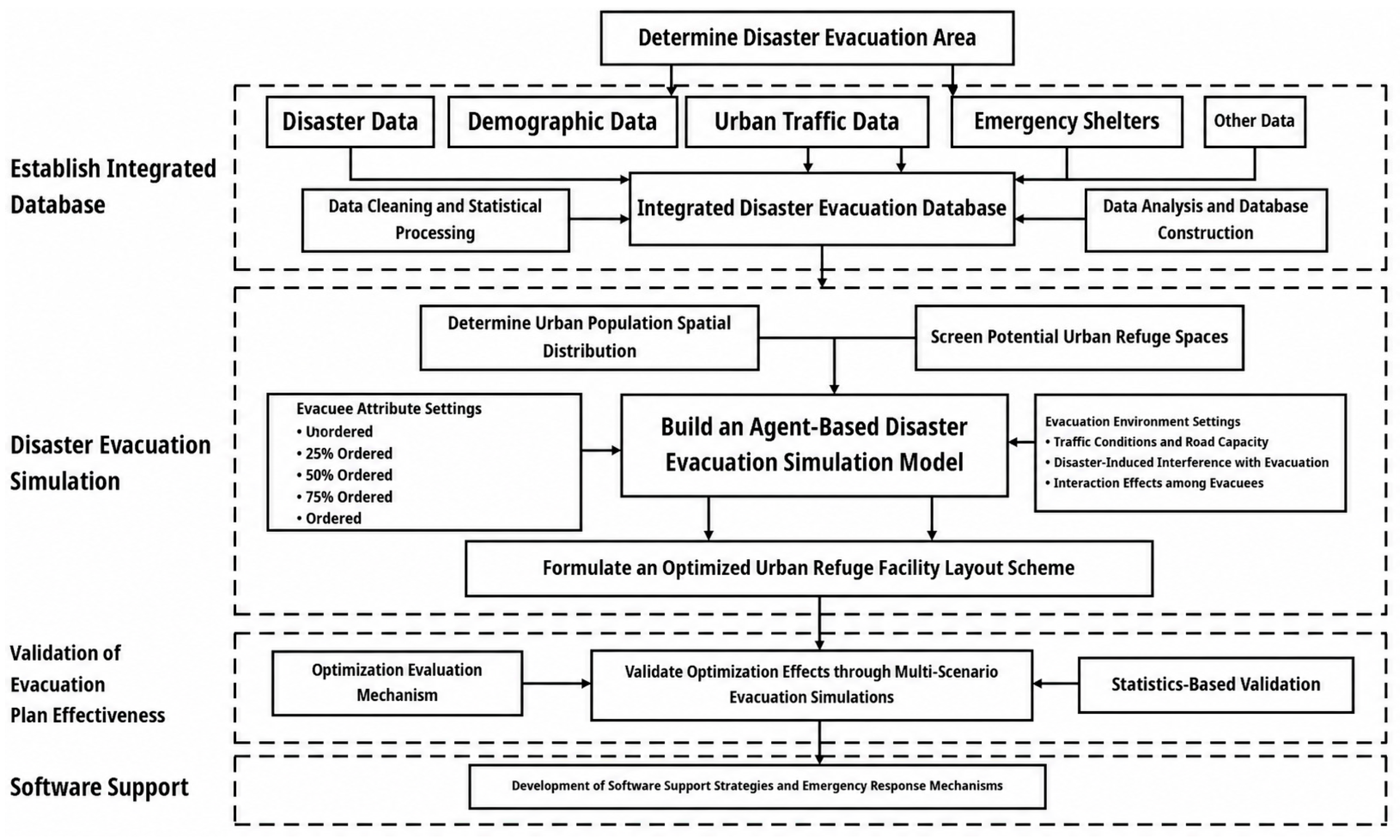
3.2. Technical Route
3.3. Data Preparation
3.4. Model Construction and Basic Rules
3.4.1. Model Positioning and Settings
3.4.2. Model Environment Construction
3.4.3. Continuous Release Mechanism
3.4.4. Behavioral Mode Settings
3.4.5. Origin-Type Success-Rate Statistics
3.4.6. Model Plausibility Check and Uncertainty Analysis
4. Results
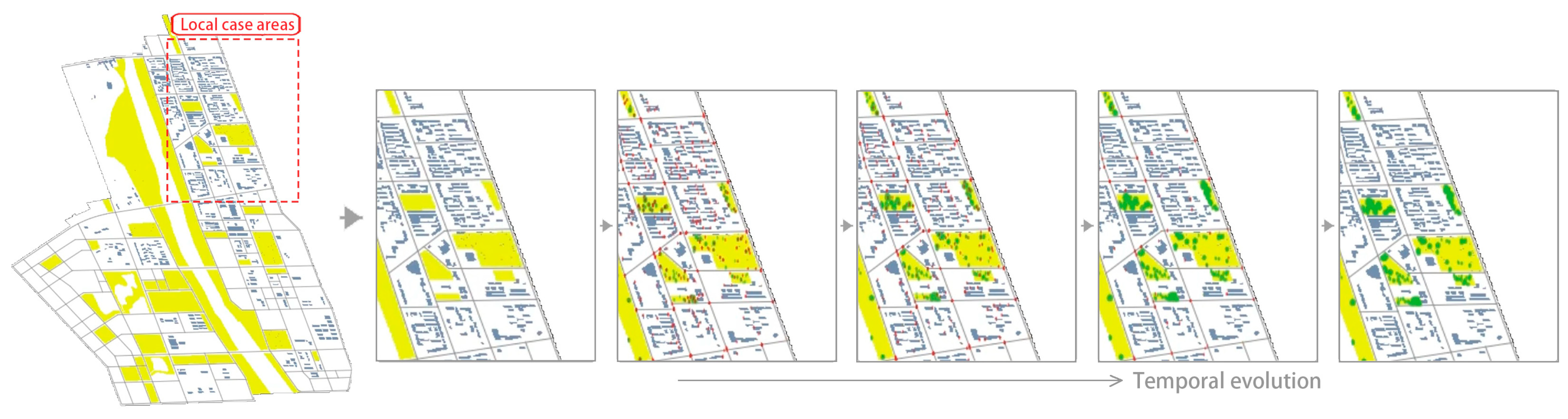
4.1. Simulation Results
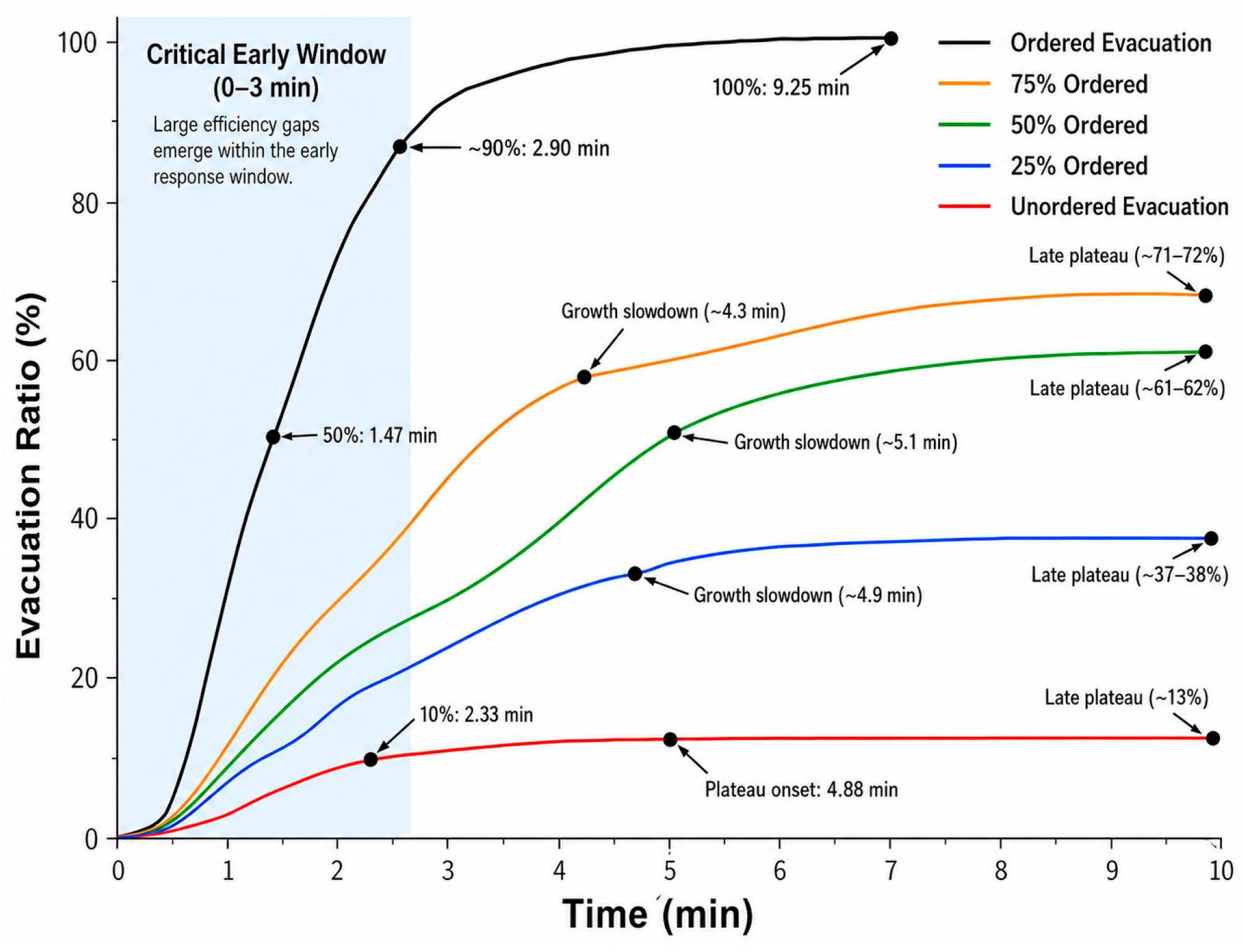
4.2. Overall Comparison of Evacuation Patterns
4.3. Differences in Evacuation Success Rates Across Origin Types
4.4. Behavioral Mechanism Interpretation
4.5. Model Plausibility Check and Uncertainty Results
5. Discussion
5.1. Main Findings
5.2. Theoretical Implications
5.3. Planning Implications
5.4. Limitations and Future Directions
6. Conclusions
Author Contributions
Funding
Institutional Review Board Statement
Informed Consent Statement
Data Availability Statement
Conflicts of Interest
References
- Wang, Z.; Jia, G. Simulation-Based and Risk-Informed Assessment of the Effectiveness of Tsunami Evacuation Routes Using Agent-Based Modeling: A Case Study of Seaside, Oregon. Int. J. Disaster Risk Sci. 2022, 13, 66–86. [Google Scholar] [CrossRef]
- Crooks, A.; Castle, C.; Batty, M. Key Challenges in Agent-Based Modelling for Geo-Spatial Simulation. Comput. Environ. Urban Syst. 2008, 32, 417–430. [Google Scholar] [CrossRef]
- Lee, J.; Kim, J.H. Which Mode Will Be Effective in a Massive Evacuation? J. Disaster Res. 2022, 17, 1115–1126. [Google Scholar] [CrossRef]
- Grothmann, T.; Reusswig, F. People at Risk of Flooding: Why Some Residents Take Precautionary Action While Others Do Not. Nat. Hazards 2006, 38, 101–120. [Google Scholar] [CrossRef]
- Meerow, S.; Newell, J.P.; Stults, M. Defining Urban Resilience: A Review. Landsc. Urban Plan. 2016, 147, 38–49. [Google Scholar] [CrossRef]
- Michaelis, T.; Brandimarte, L.; Mazzoleni, M. Capturing Flood-Risk Dynamics with a Coupled Agent-Based and Hydraulic Modelling Framework. Hydrol. Sci. J. 2020, 65, 1458–1473. [Google Scholar] [CrossRef]
- Vermuyten, H.; Beliën, J.; De Boeck, L.; Reniers, G.; Wauters, T. A Review of Optimisation Models for Pedestrian Evacuation and Design Problems. Saf. Sci. 2016, 87, 167–178. [Google Scholar] [CrossRef]
- Bubeck, P.; Botzen, W.J.W.; Aerts, J.C.J.H. A Review of Risk Perceptions and Other Factors That Influence Flood Mitigation Behavior. Risk Anal. 2012, 32, 1481–1495. [Google Scholar] [CrossRef] [PubMed]
- Wang, Z.; Jia, G. A Novel Agent-Based Model for Tsunami Evacuation Simulation and Risk Assessment. Nat. Hazards 2021, 105, 2045–2071. [Google Scholar] [CrossRef]
- Greco, A.; Pluchino, A.; Barbarossa, L.; Barreca, G.; Caliò, I.; Martinico, F.; Rapisarda, A. A New Agent-Based Methodology for the Seismic Vulnerability Assessment of Urban Areas. ISPRS Int. J. Geo-Inf. 2019, 8, 274. [Google Scholar] [CrossRef]
- Pan, X.; Han, C.S.; Dauber, K.; Law, K.H. A Multi-Agent Based Framework for the Simulation of Human and Social Behaviors during Emergency Evacuations. AI Soc. 2007, 22, 113–132. [Google Scholar] [CrossRef]
- Bruneau, M.; Chang, S.; Eguchi, R.; Lee, G.; O’Rourke, T.; Reinhorn, A.; Shinozuka, M.; Tierney, K.; Wallace, W.; Winterfeldt, D. A Framework to Quantitatively Assess and Enhance the Seismic Resilience of Communities. Earthq. Spectra 2003, 19, 733–752. [Google Scholar] [CrossRef]
- Crooks, A.T.; Wise, S. GIS and Agent-Based Models for Humanitarian Assistance. Comput. Environ. Urban Syst. 2013, 41, 100–111. [Google Scholar] [CrossRef]
- Zhuo, L.; Han, D. Agent-Based Modelling and Flood Risk Management: A Compendious Literature Review. J. Hydrol. 2020, 591, 125600. [Google Scholar] [CrossRef]
- Ghaffarian, S.; Roy, D.; Filatova, T.; Kerle, N. Agent-Based Modelling of Post-Disaster Recovery with Remote Sensing Data. Int. J. Disaster Risk Reduct. 2021, 60, 102285. [Google Scholar] [CrossRef]
- Mls, K.; Kořínek, M.; Štekerová, K.; Tučník, P.; Bureš, V.; Čech, P.; Husáková, M.; Mikulecký, P.; Nacházel, T.; Ponce, D.; et al. Agent-Based Models of Human Response to Natural Hazards: Systematic Review of Tsunami Evacuation. Nat. Hazards 2023, 115, 1887–1908. [Google Scholar] [CrossRef] [PubMed]
- Liu, Z.; Jacques, C.C.; Szyniszewski, S.; Guest, J.K.; Schafer, B.W.; Igusa, T.; Mitrani-Reiser, J. Agent-Based Simulation of Building Evacuation after an Earthquake: Coupling Human Behavior with Structural Response. Nat. Hazards Rev. 2016, 17, 04015019. [Google Scholar] [CrossRef]
- Vale, L.J.; Campanella, T.J. The Resilient City: How Modern Cities Recover from Disaster; Oxford University Press: New York, NY, USA, 2005; ISBN 978-0-19-803913-6. [Google Scholar]
- Chang, S.E. Urban Disaster Recovery: A Measurement Framework and Its Application to the 1995 Kobe Earthquake. Disasters 2010, 34, 303–327. [Google Scholar] [CrossRef] [PubMed]
- Burton, C.G. A Validation of Metrics for Community Resilience to Natural Hazards and Disasters Using the Recovery from Hurricane Katrina as a Case Study. Ann. Assoc. Am. Geogr. 2015, 105, 67–86. [Google Scholar]
- Serinaldi, F.; Kilsby, C.G. A Blueprint for Full Collective Flood Risk Estimation: Demonstration for European River Flooding. Risk Anal. 2017, 37, 1958–1976. [Google Scholar] [CrossRef] [PubMed]
- Tierolf, L.; Haer, T.; Botzen, W.J.W.; de Bruijn, J.; Ton, M.; Reimann, L.; Aerts, J. A Coupled Agent-Based Model for France for Simulating Adaptation and Migration Decisions under Future Coastal Flood Risk. Sci. Rep. 2023, 13, e4176. [Google Scholar] [CrossRef] [PubMed]
- Chen, C.; Koll, C.; Wang, H.; Lindell, M.K. An Interdisciplinary Agent-Based Evacuation Model: Integrating the Natural Environment, Built Environment, and Social System for Community Preparedness and Resilience. Nat. Hazards Earth Syst. Sci. 2023, 23, 733–749. [Google Scholar] [CrossRef]
- Beklaryan, A.L.; Akopov, A.S. Simulation of Agent-Rescuer Behaviour in Emergency Based on Modified Fuzzy Clustering: (Extended Abstract). In Proceedings of the 2016 International Conference on Autonomous Agents & Multiagent Systems, New York, NY, USA, 9 May 2016; pp. 1275–1276. [Google Scholar]
- Liyanage, S.; Dia, H.; Abduljabbar, R.; Bagloee, S.A. Flexible Mobility On-Demand: An Environmental Scan. Sustainability 2019, 11, 1262. [Google Scholar] [CrossRef]
- Aziz, H.M.A.; Park, B.H.; Morton, A.; Stewart, R.N.; Hilliard, M.; Maness, M. A High Resolution Agent-Based Model to Support Walk-Bicycle Infrastructure Investment Decisions: A Case Study with New York City. Transp. Res. Part C-Emerg. Technol. 2018, 86, 280–299. [Google Scholar] [CrossRef]
- O’Sullivan, D.; Haklay, M. Agent-Based Models and Individualism: Is the World Agent-Based? Environ. Plan. Econ. Space 2000, 32, 1409–1425. [Google Scholar] [CrossRef]
- Grimm, V.; Railsback, S.F. Individual-Based Modeling and Ecology; Princeton University Press: Princeton, NJ, USA, 2013; ISBN 978-1-4008-5062-4. [Google Scholar]
- Moradi, S. RecovUS: An Agent-Based Model of Post-Disaster Housing Recovery. Ph.D. Thesis, Texas Tech University, Lubbock, TX, USA, 2020. [Google Scholar]
- Costa, R.; Haukaas, T. The Effect of Resource Constraints on Housing Recovery Simulations. Int. J. Disaster Risk Reduct. 2021, 55, 102071. [Google Scholar] [CrossRef]
- Miceli, R.; Sotgiu, I.; Settanni, M. Disaster Preparedness and Perception of Flood Risk: A Study in an Alpine Valley in Italy. J. Environ. Psychol. 2008, 28, 164–173. [Google Scholar] [CrossRef]
- Lovreglio, R.; Ronchi, E.; Nilsson, D. An Evacuation Decision Model Based on Perceived Risk, Social Influence and Behavioural Uncertainty. Simul. Model. Pract. Theory 2016, 66, 226–242. [Google Scholar] [CrossRef]
- Wu, S.; Lei, Y.; Yang, S.; Cui, P.; Jin, W. An Agent-Based Approach to Integrate Human Dynamics Into Disaster Risk Management. Front. Earth Sci. 2022, 9. [Google Scholar] [CrossRef]
- Bonabeau, E. Agent-Based Modeling: Methods and Techniques for Simulating Human Systems. Proc. Natl. Acad. Sci. USA 2002, 99, 7280–7287. [Google Scholar] [CrossRef] [PubMed]
- Lawlor, J.A.; McGirr, S. Agent-Based Modeling as a Tool for Program Design and Evaluation. Eval. Program Plan. 2017, 65, 131–138. [Google Scholar] [CrossRef] [PubMed]
- Liu, C.; Liu, L.; Peng, Z.; Wu, H.; Wang, F.; Jiao, H.; Wang, J. Planning Public Electric Vehicle Charging Stations to Balance Efficiency and Equality: A Case Study in Wuhan, China. Sustain. Cities Soc. 2025, 124, 106314. [Google Scholar] [CrossRef]
- Dai, H.; Zhang, B.; Wang, W. A Multiwavelet Support Vector Regression Method for Efficient Reliability Assessment. Reliab. Eng. Syst. Saf. 2015, 136, 132–139. [Google Scholar] [CrossRef]
- Chen, X.; Zhan, F.B. Agent-Based Modelling and Simulation of Urban Evacuation: Relative Effectiveness of Simultaneous and Staged Evacuation Strategies. J. Oper. Res. Soc. 2008, 59, 25–33. [Google Scholar] [CrossRef]



| Indicator | Value or Description |
|---|---|
| Number of shelters | 6 |
| Shelter capacity setting | Calculated according to relevant Chinese emergency-evacuation standards and shelter area |
| Number of evacuation origins | 134 |
| Total evacuation population | 65,000 |
| Release interval | 30 s |
| Road-network construction method | Each polyline vertex in the road shapefile was converted into a node; links were established between consecutive vertices; endpoint nodes with identical coordinates were connected to form the road network |
| Origin Type | Spatial Characteristics | Disordered | 25% Ordered | 50% Ordered | 75% Ordered | Ordered | Interpretation |
|---|---|---|---|---|---|---|---|
| O1 | Near shelters and directly connected | 22–30% | 46–58% | 70–82% | 90–97% | 100% | Most sensitive to improved destination cognition |
| O2 | Medium distance and continuous road network | 12–18% | 35–46% | 58–72% | 82–92% | 100% | Improves steadily as the ordered proportion increases |
| O3 | Building-related detours | 7–13% | 24–36% | 45–60% | 70–84% | 100% | Detours weaken the benefits of the same ordered proportion |
| O4 | Near boundaries or in low-connectivity areas | 4–8% | 16–28% | 36–52% | 60–78% | 100% | More likely to generate residual retention |
| O5 | Far from shelters | 5–10% | 20–32% | 40–58% | 66–82% | 100% | Determines tail-end delay in the system |
| O6 | Near major bottleneck nodes | 8–15% | 28–40% | 50–66% | 72–86% | 100% | Affected by bottleneck-related movement pressure |
| Verification Indicator | GIS Shortest-Path Estimate | Fully Ordered Simulation Result | Absolute Difference | Relative Difference |
|---|---|---|---|---|
| Minimum travel time | 0.42 min | 0.48 min | 0.06 min | 14.3% |
| Average travel time | 1.52 min | 1.73 min | 0.21 min | 13.8% |
| Median travel time/T50 | 1.32 min | 1.47 min | 0.15 min | 11.4% |
| 75th-percentile travel time | 2.04 min | 2.34 min | 0.30 min | 14.7% |
| 90th-percentile travel time/T90 | 2.52 min | 2.90 min | 0.38 min | 15.1% |
| 95th-percentile travel time | 3.20 min | 3.70 min | 0.50 min | 15.6% |
| Maximum travel time/completion time | 8.20 min | 9.25 min | 1.05 min | 12.8% |
| Scenario | Number of Runs | Mean Final Evacuation Rate | Standard Deviation | Approximate 95% Simulation Interval | T10 | T50 | T90 | Plateau or Completion Time |
|---|---|---|---|---|---|---|---|---|
| Fully disordered | 30 | 13.1% | 0.7% | 11.7–14.5% | 2.33 min | Not reached | Not reached | Plateau onset: 4.88 min |
| 25% ordered | 30 | 37.6% | 1.3% | 35.0–40.2% | 1.45 min | Not reached | Not reached | Growth slowdown: 4.90 min |
| 50% ordered | 30 | 61.4% | 1.4% | 58.7–64.1% | 1.25 min | 5.08 min | Not reached | Growth slowdown: 5.10 min |
| 75% ordered | 30 | 71.7% | 1.1% | 69.5–73.9% | 1.03 min | 3.55 min | Not reached | Growth slowdown: 4.30 min |
| Fully ordered | 30 | 99.8% | 0.3% | 99.2–100.0% | 0.70 min | 1.47 min | 2.90 min | Completion time: 9.25 min |
Disclaimer/Publisher’s Note: The statements, opinions and data contained in all publications are solely those of the individual author(s) and contributor(s) and not of MDPI and/or the editor(s). MDPI and/or the editor(s) disclaim responsibility for any injury to people or property resulting from any ideas, methods, instructions or products referred to in the content. |
© 2026 by the authors. Licensee MDPI, Basel, Switzerland. This article is an open access article distributed under the terms and conditions of the Creative Commons Attribution (CC BY) license.
Share and Cite
Yang, L.; Wang, J.; He, L.; Huo, D.; Jiang, S.; Wu, H. Agent-Based Simulation and Mechanism Identification of Evacuation Efficiency in a Typical Built-Up Area Within a Desert Corridor County: A Case Study of Ruoqiang, Xinjiang. Sustainability 2026, 18, 6573. https://doi.org/10.3390/su18136573
Yang L, Wang J, He L, Huo D, Jiang S, Wu H. Agent-Based Simulation and Mechanism Identification of Evacuation Efficiency in a Typical Built-Up Area Within a Desert Corridor County: A Case Study of Ruoqiang, Xinjiang. Sustainability. 2026; 18(13):6573. https://doi.org/10.3390/su18136573
Chicago/Turabian StyleYang, Ling, Junliang Wang, Longhui He, Dongwei Huo, Shanshan Jiang, and Hao Wu. 2026. "Agent-Based Simulation and Mechanism Identification of Evacuation Efficiency in a Typical Built-Up Area Within a Desert Corridor County: A Case Study of Ruoqiang, Xinjiang" Sustainability 18, no. 13: 6573. https://doi.org/10.3390/su18136573
APA StyleYang, L., Wang, J., He, L., Huo, D., Jiang, S., & Wu, H. (2026). Agent-Based Simulation and Mechanism Identification of Evacuation Efficiency in a Typical Built-Up Area Within a Desert Corridor County: A Case Study of Ruoqiang, Xinjiang. Sustainability, 18(13), 6573. https://doi.org/10.3390/su18136573