Digital Platforms for Climate-Resilient and Sustainable Planning: Lessons on Nature-Based Solutions from a Louisiana Watershed-Scale Case Study




Abstract
1. Introduction
2. Materials and Methods
2.1. Preliminaries and Contextual Framing
- Relevance of the topic. Flooding was selected as the primary hazard due to its global significance and comparative value. This enables the analysis of adaptation strategies and digital platforms, addressing a common, urgent challenge in international contexts, despite differences in ecosystem service approaches.
- Data availability. The LWI platform provides access to heterogeneous data sources, including census data, satellite imagery, georeferenced maps, and field surveys.
- Technological innovation. The LWI platform features an advanced technological and information structure. These features support potential transferability and broader application to other contexts.
- Usability. The LWI platform integrates decision-support tools designed for different users and purposes, adopting differentiated user interfaces aligned with specific user roles and decision needs.
2.2. Methodological Approach
- -
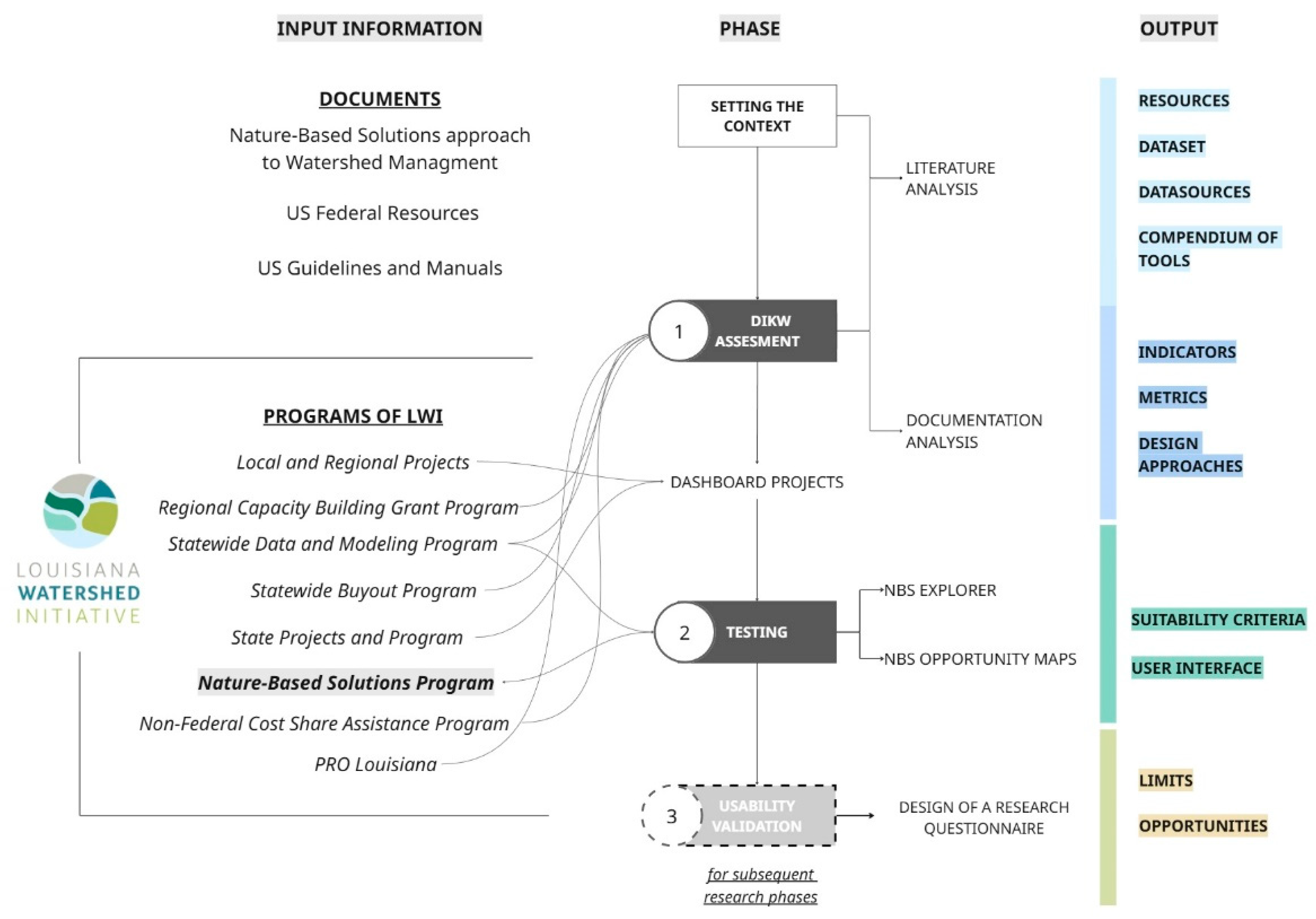
- Phase 1 consists of a DIKW-based analysis of the platform’s digital infrastructure. This phase is aimed at understanding how data, information, and knowledge are structured and interlinked within the system.
- -
- Phase 2 focuses on the testing of NbS-oriented decision-support tools. This phase specifically examines how the informational structures selected in Phase 1 are operationalized through the platform’s user interface, as experienced by the authors acting as expert users.
- -
- Phase 3 builds on the analytical insights from the previous phases. This phase aims to identify the key informational structures and decision-support processes for non-expert users. This phase defines the main topics for designing a questionnaire to be administered to a targeted user group in the future stage of the research.
2.3. Phase 1—DIKW-Based Analysis of the Digital Infrastructure
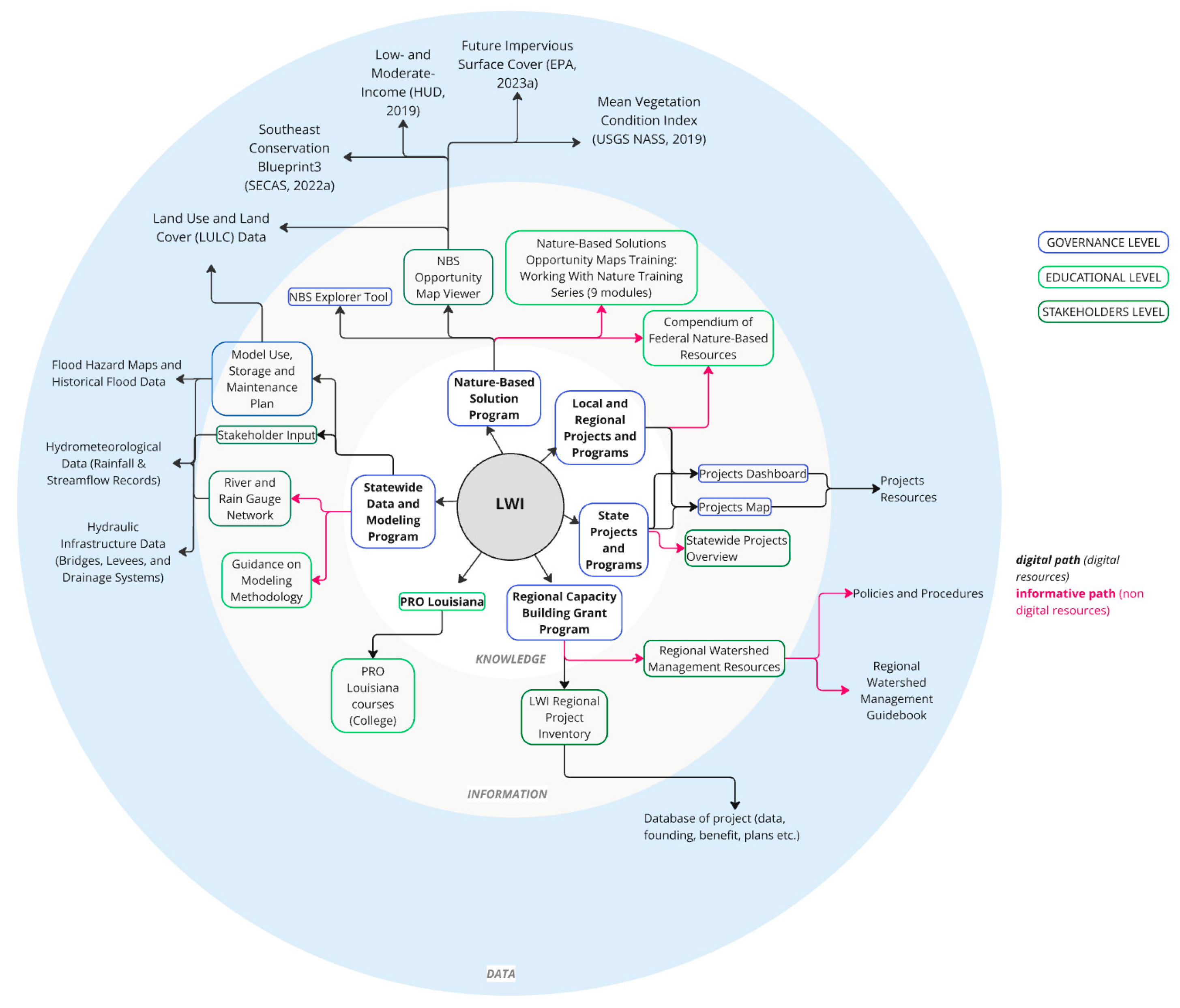
- Data, here identified as raw or minimally processed measurements and observations (e.g., geospatial layers, monitoring records, dashboards displaying values);
- Information, referring to resources that organize, structure, or contextualize data through rules, plans, criteria, or policies;
- Knowledge, intended as interpretative and procedural resources that explain how information is generated and how it can be applied in planning and decision-making contexts (e.g., the specific programs in the LWI);
- Wisdom is not treated as a directly observable layer of the digital infrastructure, due to it being an empirical dimension associated with the use of the platform in decision-making contexts.
- The program or initiative in which the resource is embedded (first column). The programs are here interpreted as the Knowledge level of the analysis (i.e., the context that guides the interpretation and application of information).
- The classification of the resources as Data or Information, based on its level of structuring and interpretability.
- A description of its function and purpose.
- The authorship of resources.
- Targeted users, categorized across governance, technical, educational, or stakeholder domains.
- The rationale—explicit or implicit—underlying its classification within the DIKW analytical framework.
2.4. Phase 2—Analysis and Testing of NbS-Oriented Decision-Support Interfaces
- (I).
- Indicators and key ecosystemic metrics, examining how ecosystem services, flood risk, and socio-environmental conditions are selected, represented, and operationalized within the tools;
- (II).
- Spatial criteria for suitability, focusing on how spatial datasets are combined, filtered, and visualized to support the localization and comparison of NbS planning;
- (III).
- Interface configuration and interaction, testing how users can navigate, interpret, and interrogate NbS-related information through the LWI interfaces;
- (IV).
- Decision-support orientation, analyzing how tools support prioritization processes, according to their specific outputs.
2.5. Phase 3—Usability Validation
3. Results
3.1. Phase 1—Findings from DIKW-Based Analysis of the Digital Infrastructure
- Data. At the Data level, the platform aggregates raw, spatially explicit datasets that describe the physical, ecological, and socio-economic conditions relevant to flood risk management and NbS planning. These include hydrological records and infrastructure data—such as flood hazard maps, historical flood events, rainfall and streamflow records, and hydraulic infrastructure inventories—which provide baseline metrics for understanding flood dynamics and system capacity. Land-use and socio-economic datasets, including land-use/land-cover classifications, socio-economic vulnerability indices, and impervious surface data, define the human and territorial context within which resilience strategies are formulated. Vegetation and ecological datasets, such as the Mean Vegetation Condition Index and biodiversity layers derived from regional conservation frameworks, support the identification of ecosystem conditions relevant to NbS opportunity mapping. A comprehensive list of the key spatial indicators and data sources used in this study is presented in Table 1, grouped by type and aligned with their analytical role within the platform.
- Information. At the Information level, raw datasets are structured, contextualized, and made accessible through inventories, guidelines, and technical resources. The LWI Regional Project Inventory consolidates project descriptions, funding sources, and benefit assessments into standardized records, enabling comparison across interventions and regions. Training materials, modeling guidelines, and methodological resources—such as the PRO Louisiana courses—translate data into operational workflows, while watershed-specific guidance documents contextualize information within local hydrological and institutional settings. At this level, data are no longer isolated inputs but become organized references for planning and coordination.
- Knowledge. The Knowledge level corresponds to the integration of structured information into operational programs and coordinated planning actions. State-led projects and programs draw on the information layer to prioritize investments, align inter-agency initiatives, and monitor implementation. Capacity-building processes, including regional grant programs, use platform-generated insights to enable local and regional governance. Within this level, the Nature-Based Solutions Program plays a central role, integrating ecosystem service indicators, hydrological modeling outputs, and socio-economic metrics through dedicated digital tools and training modules. Here, aggregated information is translated into site-specific, evidence-based options for NbS localization and design.
- Wisdom. In this study, there are no results for the Wisdom level. This is not represented as a discrete or directly observable layer of the platform because it is an emergent outcome generated by specific users within governance and decision-making contexts. This dimension could be analyzed in future studies by simulating the whole planning decision process.
3.2. Phase 2—Mapping Opportunities for NbSs with Digital Interfaces
- -
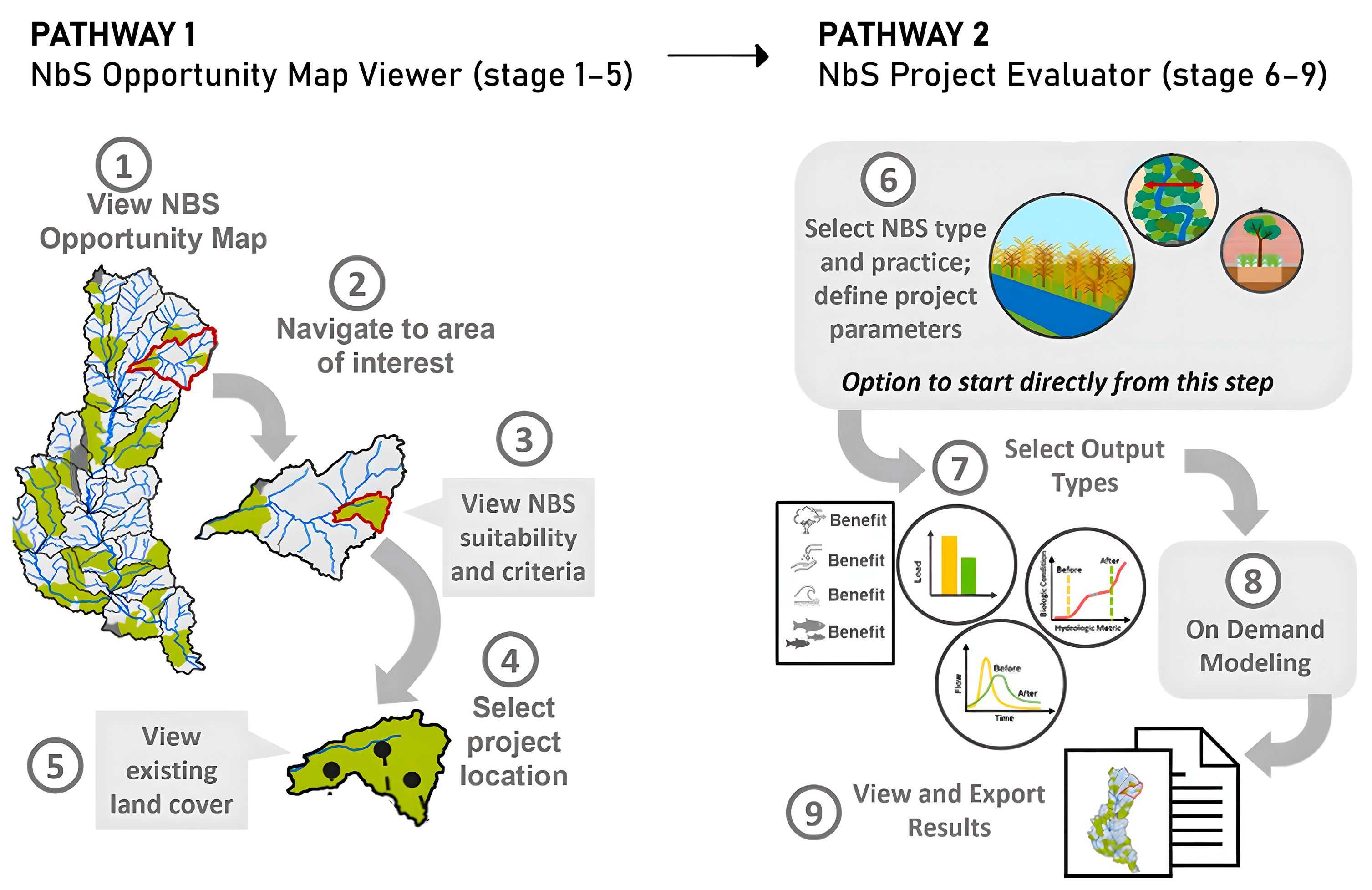
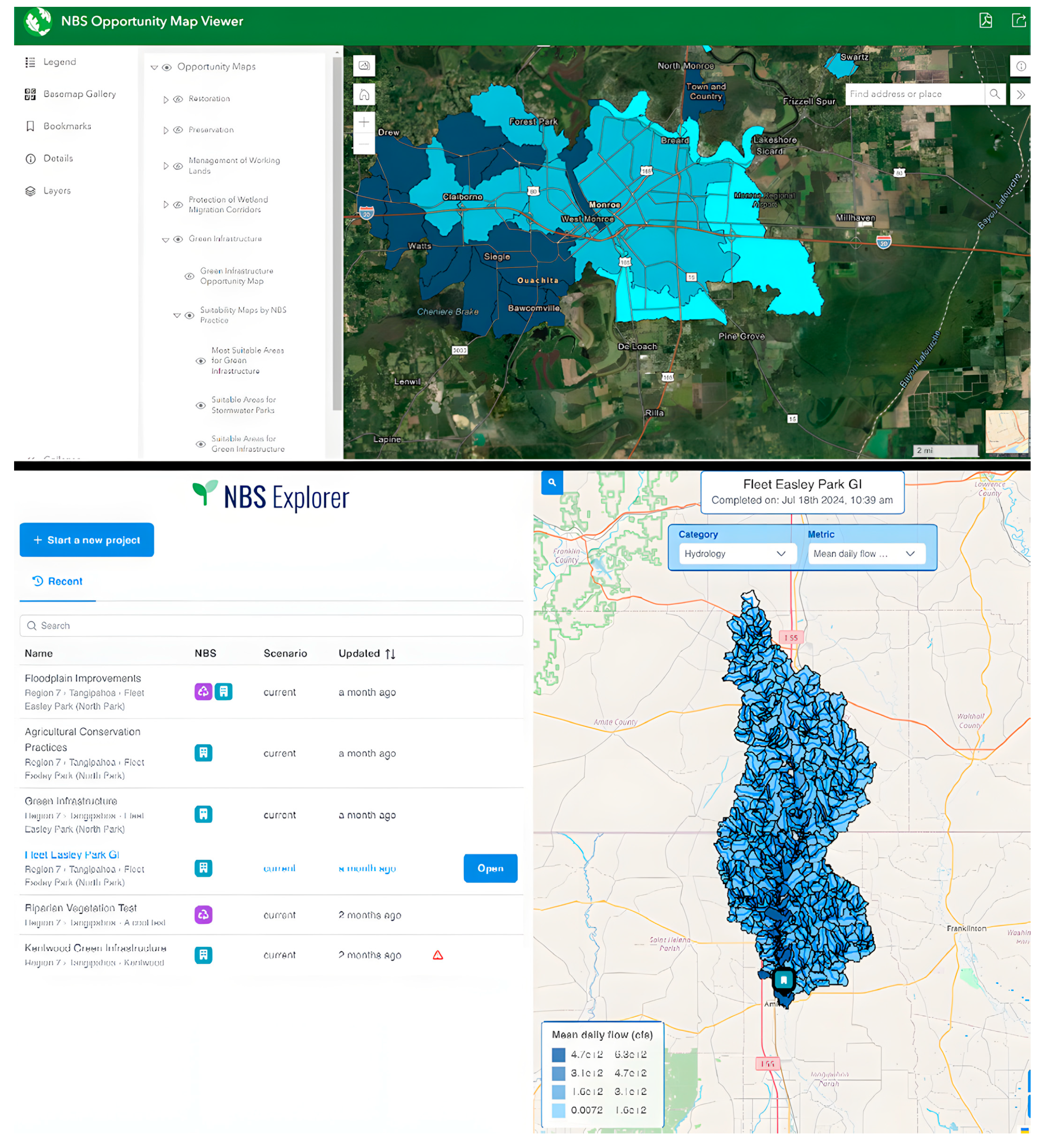
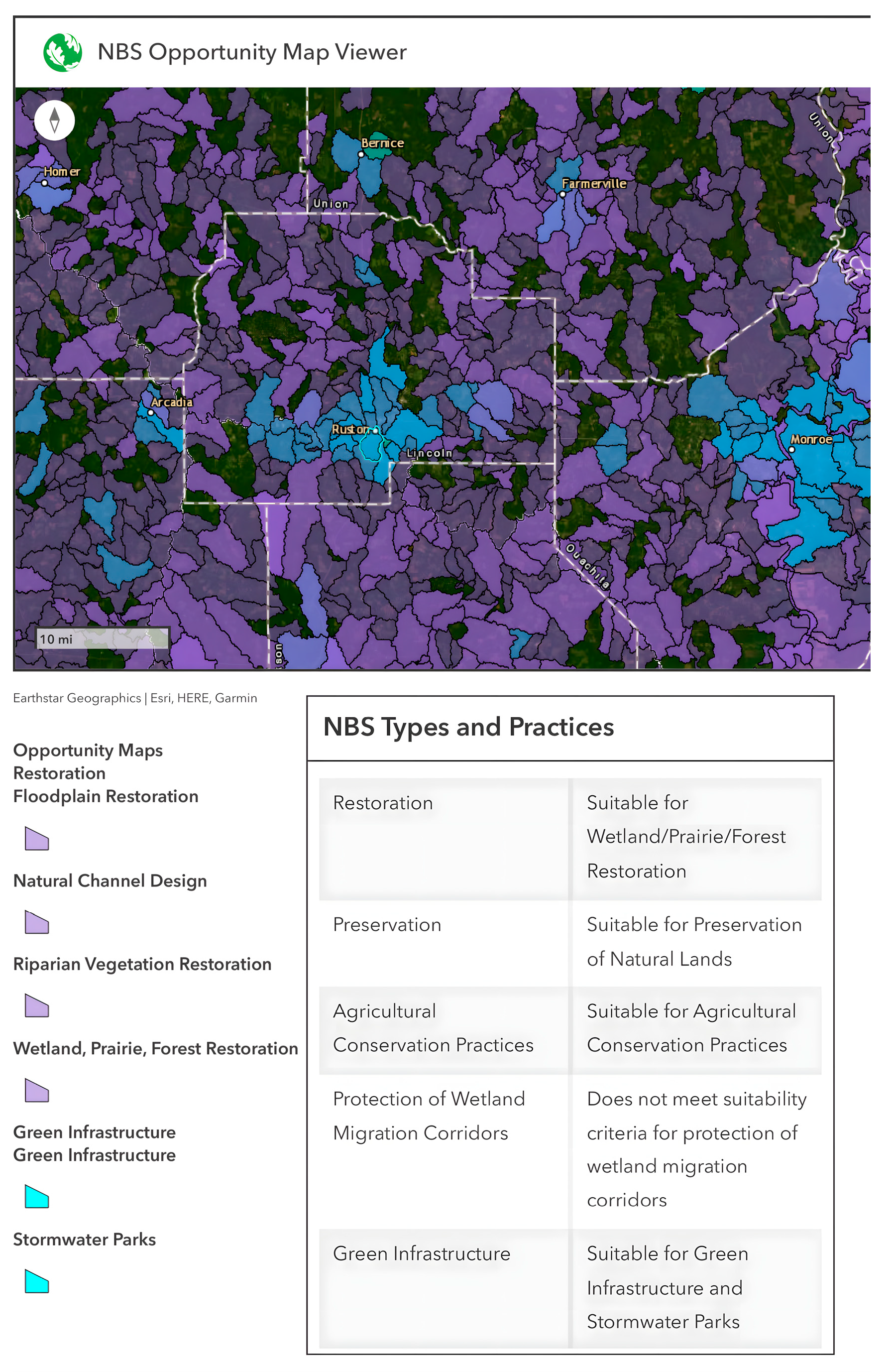
- The Opportunity Map Viewer primarily supports Pathway 1 (Stages 1–5), focusing on the preliminary identification of NbS opportunities. Through an open-access and simplified interface, users visualize statewide and catchment-scale NbS opportunity maps, navigate areas of interest, and explore land cover, hydrological boundaries, and ecological suitability layers. This tool is designed to facilitate an early-stage exploration and pre-selection of potential areas. This pathway is mainly oriented to non-expert users and to preliminary planning or meta-design purposes.
- -
- The NbS Explorer Tool extends this logic by providing additional functionalities associated with Pathway 2 (Stages 6–9). In addition to NbS opportunity mapping (stage 1–5), it enables the configuration and evaluation of specific NbS planning strategies. This second pathway allows expert users to select NbS types, define project parameters, and generate scenario-based outputs, including socio-economical ones. Through integrated metrics and on-demand modeling, the NbS Explorer Tool supports impact estimation and the export of structured results, such as maps and performance summaries, oriented toward more advanced planning and decision-support needs.
3.2.1. Analytical Framework for NbS Prioritization
- Ecosystem-service indicators are used to characterize ecological condition and functionality. Vegetation condition is assessed through the Mean Vegetation Condition Index (MVCI) derived from the VegScape platform, enabling the identification of degraded areas (MVCI ≤ −5%) and well-performing ecosystems (MVCI ≥ 5%), thus supporting both restoration and preservation strategies. Land-cover dynamics are mapped using the National Land Cover Database (NLCD 2001 and 2019). This map allows the detection of transitions between natural, agricultural, and developed land uses. Riparian and floodplain functions are mapped through the USFS National Riparian Areas Base Map and Fathom 100-year floodplain datasets, while soil and geomorphological characteristics are derived from SSURGO data and DEM-based metrics, including slope and stream sinuosity. All these indices and datasets are summarized in Table 1.
- Risk assessment criteria refer to ecological conditions on flood hazard dynamics. Flood susceptibility is assessed using high-resolution Fathom Flood Maps for both fluvial and pluvial flooding. Hydrologic connectivity is assessed through stream order, catchment boundaries (NHDPlus), and the spatial overlap between floodplains and riparian areas. Future exposure is incorporated through ICLUS land-use and urbanization scenarios, integrating long-term development into current NbS planning processes.
- Socio-economic metrics refer to environmental and risk indicators, situating NbS planning opportunities within their territorial and institutional context. Social vulnerability is identified through the spatial overlapping of income, population density, and low- to moderate-income community layers. A special indicator is the Urban Principal Component, derived via PCA from variables such as development intensity, road density, impervious surfaces, and population density. This is used to distinguish urban and peri-urban contexts. Land ownership and protection status are accounted for through the PAD-US dataset, excluding already protected areas from prioritization.
3.2.2. User Interface Configuration for Non-Expert Users
4. Discussion
5. Conclusions
Supplementary Materials
Author Contributions
Funding
Institutional Review Board Statement
Informed Consent Statement
Data Availability Statement
Acknowledgments
Conflicts of Interest
Abbreviations
| NbS | Nature-based Solution |
| LWI | Louisiana Watershed Initiative |
| SDSS | Spatial Decision-Support System |
| DIKW | Data–Information–Knowledge–Wisdom |
| ES | Ecosystem Services |
| GIS | Geographic Information System |
| Web GIS | Web-based Geographic Information System |
| MVCI | Mean Vegetation Condition Index |
| NLCD | National Land Cover Database |
| NHDPlus | National Hydrography Dataset Plus |
| SSURGO | Soil Survey Geographic Database |
| PAD-US | Protected Areas Database of the United States |
| EPA | U.S. Environmental Protection Agency |
| NOAA | National Oceanic and Atmospheric Administration |
| FEMA | Federal Emergency Management Agency |
| IPCC | Intergovernmental Panel on Climate Change |
| EEA | European Environment Agency |
| OECD | Organisation for Economic Co-operation and Development |
| PCA | Principal Component Analysis |
| CDBG-MIT | Community Development Block Grant Mitigation |
| RISE | Research and Innovation Staff Exchange |
Appendix A

| Program (Knowledge Level) | Resources (Data/Information) | Short Description & Purpose | Authorship | Target Users | DIKW Rationale (Implicit) |
|---|---|---|---|---|---|
| Local and Regional Projects & Programs | Information—Project map & dashboard | Digital interface providing structured access to local and regional flood-mitigation projects, funding rounds and implementation status. | Louisiana Office of Community Development (OCD)/LWI | Local & regional governments, planners | Provides organized access to project-related information supporting regional decision processes. |
| Information—Project lists and descriptions | Structured tables summarizing project scope, location and awarded funding. | OCD/LWI | Policymakers, watershed authorities | Consolidates project attributes into comparable informational records. | |
| State Projects & Programs | Information—State project and buyout overviews | Overview of state-funded mitigation and buyout initiatives and related investments. | OCD/LWI | State agencies, local governments | Aggregates statewide project information to support strategic coordination. |
| Information—Policies and procedures | Governance framework defining eligibility, selection and implementation rules. | OCD/LWI | Grant managers, agencies | Formalizes administrative and procedural information. | |
| Statewide Data and Modeling Program | Information—Modeling guidance and MUSM plan | Technical and institutional documentation governing model development, use and maintenance. | LWI TDQ Team; OCD; DOTD; academic & federal partners | Modelers, planners, agencies | Structures modeling practices and institutional arrangements into shared informational references. |
| Data—River and rain gauge records | Monitoring locations and records supporting hydrologic and hydraulic analyses. | LWI & USGS | Hydrologists, emergency managers | Provides foundational monitoring data feeding modeling and assessment processes. | |
| Information—Gauge network documentation | Reports and outreach materials describing network design and stakeholder input. | LWI & partners | Technical staff, stakeholders | Contextualizes monitoring data within design and governance frameworks. | |
| Regional Capacity Building Grant Program (RCBG) | Information—Governance documents, NOFA, FAQ | Program rules, evaluation criteria and coordination outputs for regional capacity building. | OCD/LWI | Watershed regions, consultants | Structures procedural and institutional information enabling regional coordination. |
| Information—Regional project inventory | Digital inventory of regional projects submitted or supported under RCBG. | LWI | Regional authorities | Organizes project information supporting comparative assessment and planning. | |
| Statewide Buyout Program | Information—Participation guides and procedures | Guidance documents outlining eligibility, responsibilities and implementation steps. | OCD/LWI | Homeowners, local governments | Translates program rules into operational informational resources. |
| Data—Flood-zone delineations | Spatial hazard layers used for eligibility verification. | LWI/OCD | Property owners, surveyors | Provides spatial reference data supporting program application. | |
| Nature-Based Solutions (NBS) Program | Information—NBS Opportunity Maps (tool-based) | Interactive spatial tools identifying potential areas for nature-based interventions based on multiple criteria. | The Nature Conservancy; RTI International; LWI | Planners, designers | Organizes spatial criteria and indicators into an informational decision-support environment. |
| Information—Technical guides, compendium and training | Documentation and training materials supporting interpretation and application of NBS tools. | LWI; FEMA; EPA; USACE; partners | Practitioners, policymakers | Supports informed use of NBS information within planning and design processes. | |
| Non-Federal Cost-Share Assistance Program | Information—Program description and procedures | Overview of funding mechanisms supporting non-federal match requirements. | OCD/LWI | Local governments | Structures eligibility and funding conditions into actionable information. |
| PRO Louisiana | Information—Training pathways and program overview | Workforce development and training opportunities in water and resilience sectors. | LWI; Louisiana Community & Technical College System | Students, workforce | Communicates educational and capacity-building opportunities within the LWI framework. |
Appendix B
- Rationale of LWI Platform Usabily Questionnarie
- SECTION 1—IDENTIFICATION AND CONSENT
| Response | |
| Interviewee Code/ID | ________________________________________________ |
| Role/Position | ________________________________________________ |
| Organization/Institution | ________________________________________________ |
| Range of Involvement | ☐ Academic Education ☐ Local governance ☐ Local stakeholder |
| Date of Interview | ____/____/202X |
| Consent Confirmed | [ ] YES, I confirm my consent (✔) |
- SECTION 2—LWI PLATFORM EXPERIENCE
- How would you describe the main function or purpose of the LWI platform based on your experience?
- Which components or tools within the platform are most relevant to you?
- Have you used or explored any specific modules? (Check all that apply)☐ Dashboards ☐ Project Data ☐ Spatial Maps ☐ Risk Simulations ☐ Other: ___________
- SECTION 3—LWI PLATFORM USABILITY
- 4.
- How do you typically interact with the platform? (e.g., consultation, data analysis, coordination)
- 5.
- What type of information or functionality do you use most frequently?
- 6.
- Is the platform integrated into your routine activities or your planning decision role?☐ Not at all ☐ Occasionally ☐ Partially Integrated ☐ Fully Integrated
- SECTION 4—USABILY OUTCOMES
- 7.
- Have you experienced any tangible outcomes or improvements resulting from the use of the platform?
- 8.
- Has the platform influenced inter-institutional collaboration or coordination efforts?
- 9.
- Did the platform directly support project selection, planning process or decision-making interactions?
- SECTION 5—FUTURE INTEGRATION AND IMPROVEMENTS
- 10.
- Are there any aspects of the platform usability that you think could be improved?
- 11.
- Would the platform usability benefit from additional data sources, models, or participatory inputs?
- 12.
- What features or enhancements would make the platform usability more effective or accessible?
References
- Millennium Ecosystem Assessment (MEA). Ecosystems and Human Well-Being: Synthesis; Island Press: Washington, DC, USA, 2005. [Google Scholar]
- Kabisch, N.; Korn, H.; Stadler, J.; Bonn, A. Nature-based solutions to climate change mitigation and adaptation in urban areas. Ecol. Soc. 2016, 21, 39. [Google Scholar] [CrossRef]
- Ahern, J.; Cilliers, S.; Niemelä, J. The concept of ecosystem services in adaptive urban planning and design. Landsc. Urban Plan. 2014, 125, 254–259. [Google Scholar] [CrossRef]
- Gill, S.E.; Handley, J.F.; Ennos, A.R.; Pauleit, S. Adapting cities for climate change: The role of green infrastructure. Built Environ. 2007, 33, 115–133. [Google Scholar] [CrossRef]
- Meerow, S.; Newell, J.P.; Stults, M. Defining urban resilience: A review. Landsc. Urban Plan. 2016, 147, 38–49. [Google Scholar] [CrossRef]
- Intergovernmental Panel on Climate Change (IPCC). Climate Change 2023: Synthesis Report; IPCC: Geneva, Switzerland, 2023. [Google Scholar]
- Nowak, D.J.; Greenfield, E.J.; Hoehn, R.E.; Lapoint, E. Carbon storage and sequestration by trees in urban and community areas of the United States. Environ. Pollut. 2013, 178, 229–236. [Google Scholar] [CrossRef] [PubMed]
- Norton, B.A.; Coutts, A.M.; Livesley, S.J.; Harris, R.J.; Hunter, A.M.; Williams, N.S.G. Planning for cooler cities: A framework to prioritise green infrastructure to mitigate high temperatures in urban landscapes. Landsc. Urban Plan. 2015, 134, 127–138. [Google Scholar] [CrossRef]
- Tzoulas, K.; Korpela, K.; Venn, S.; Yli-Pelkonen, V.; Kaźmierczak, A.; Niemela, J.; James, P. Promoting ecosystem and human health in urban areas using green infrastructure: A literature review. Landsc. Urban Plan. 2007, 81, 167–178. [Google Scholar] [CrossRef]
- World Health Organization (WHO). Urban Green Spaces and Health; WHO Regional Office for Europe: Copenhagen, Denmark, 2016. [Google Scholar]
- Maia da Rocha, S.; Almassy, D.; Pinter, L. Social and Cultural Values of Nature-Based Solutions; Naturvation Project, Horizon; Central European University: Vienna, Austria, 2020. [Google Scholar]
- European Commission. Mapping and Assessment of Ecosystems and Their Services (MAES); European Commission: Brussels, Belgium, 2013. [Google Scholar]
- European Environment Agency (EEA). Climate Change Adaptation and Disaster Risk Reduction in Europe; EEA Report No. 15/2017; EEA: Copenhagen, Denmark, 2017. [Google Scholar]
- European Commission. EU Biodiversity Strategy for 2030; European Commission: Brussels, Belgium, 2020. [Google Scholar]
- European Commission. EU Strategy on Adaptation to Climate Change; COM(2021) 82 final; European Commission: Brussels, Belgium, 2021. [Google Scholar]
- European Environment Agency (EEA). Nature-Based Solutions in Europe; EEA Report No. 01/2021; EEA: Copenhagen, Denmark, 2021. [Google Scholar]
- European Commission. Accounting for Ecosystems and Their Services in the European Union (INCA): Final Report 2021; European Commission: Brussels, Belgium, 2021; Available online: https://ec.europa.eu/eurostat (accessed on 10 June 2023).
- European Parliament; Council of the European Union. Regulation (EU) 2024/1991 on nature restoration. Off. J. Eur. Union 2024, L199. [Google Scholar]
- Densham, P.J. Spatial decision support systems. In Geographical Information Systems; Maguire, D.J., Goodchild, M.F., Rhind, D.W., Eds.; Longman: Harlow, UK, 1991; pp. 403–412. [Google Scholar]
- Reynolds, K.M.; Hessburg, P.F.; Bourgeron, P.S. Making Transparent Environmental Management Decisions; Springer: Dordrecht, The Netherlands, 2014. [Google Scholar]
- Sugumaran, R.; DeGroote, J. Spatial Decision Support Systems; CRC Press: Boca Raton, FL, USA, 2011. [Google Scholar]
- Sugumaran, V.; Sugumaran, R. Web-based Spatial Decision Support Systems (WebSDSS): Evolution, Architecture, Examples and Challenges. Commun. Assoc. Inf. Syst. 2007, 19, 40. [Google Scholar] [CrossRef]
- Shneiderman, B. Designing the User Interface; Addison-Wesley: Boston, MA, USA, 1997. [Google Scholar]
- Williams, S. Data Action; MIT Press: Cambridge, MA, USA, 2022. [Google Scholar]
- Borgman, C.L.; Darch, P.T.; Sands, A.E.; Pasquetto, I.V.; Golshan, M.S.; Wallis, J.C.; Traweek, S. Knowledge infrastructures in science: Data, diversity, and digital libraries. Int. J. Digit. Libr. 2015, 16, 207–227. [Google Scholar] [CrossRef]
- Karasti, H.; Millerand, F.; Hine, C.M.; Bowker, G.C. Knowledge infrastructures: Part I. Sci. Technol. Stud. 2016, 29, 2–12. [Google Scholar]
- Ackoff, R.L. From data to wisdom. J. Appl. Syst. Anal. 1989, 16, 3–9. [Google Scholar]
- Rowley, J. The wisdom hierarchy: Representations of the DIKW hierarchy. J. Inf. Sci. 2007, 33, 163–180. [Google Scholar] [CrossRef]
- Sanderson, H.; Hilden, M.; Russel, D.; Dessai, S. Database support for adaptation to climate change: An assessment of web-based portals across scales. Integr. Environ. Assess. Manag. 2016, 12, 627–631. [Google Scholar] [CrossRef] [PubMed]
- Henriksen, H.J.; Schneider, R.; Koch, J.; Ondracek, M.; Troldborg, L.; Seidenfaden, I.K.; Kragh, S.J.; Bøgh, E.; Stisen, S. A new digital twin for climate change adaptation, water management, and disaster risk reduction (HIP digital twin). Water 2022, 15, 25. [Google Scholar] [CrossRef]
- Lovell, S.T.; Taylor, J.R. Supplying urban ecosystem services through multifunctional green infrastructure in the United States. Landsc. Ecol. 2013, 28, 1447–1463. [Google Scholar] [CrossRef]
- Turner, K.; Badura, T.; Ferrini, S.; Morse-Jones, S. Natural capital accounting perspectives: A pragmatic way forward. Ecosyst. Health Sustain. 2019, 5, 237–241. [Google Scholar] [CrossRef]
- Federal Emergency Management Agency (FEMA). Building Community Resilience with Nature-Based Solutions; FEMA: Washington, DC, USA, 2021.
- U.S. Environmental Protection Agency (EPA). Regional Resilience Toolkit; EPA: Washington, DC, USA, 2019.
- U.S. Environmental Protection Agency (EPA). Climate Adaptation Implementation Plan 2022–2026; EPA: Washington, DC, USA, 2022.
- U.S. Environmental Protection Agency (EPA). SUSTAIN—A Framework for Placement of Best Management Practices in Urban Watersheds; EPA/600/R-09/095; EPA: Washington, DC, USA, 2009.
- Louisiana Watershed Initiative. CDBG-MIT Action Plan; Louisiana Watershed Initiative: Baton Rouge, LA, USA, 2019. Available online: https://www.doa.la.gov (accessed on 10 July 2025).
- Louisiana Watershed Initiative (LWI). Louisiana Watershed Initiative Overview; LWI: Baton Rouge, LA, USA, 2021. Available online: https://watershed.la.gov/about (accessed on 10 July 2025).
- Louisiana Watershed Initiative (LWI). Nature-Based Solutions Explorer Tool; LWI: Baton Rouge, LA, USA, 2021. Available online: https://watershed.la.gov/nature-based-solutions (accessed on 10 July 2025).
- National Research Council (NRC). Drawing Louisiana’s New Map: Addressing Land Loss in Coastal Louisiana; National Academies Press: Washington, DC, USA, 2006. [Google Scholar] [CrossRef]
- Star, S.L.; Ruhleder, K. Steps Toward an Ecology of Infrastructure: Design and Access for Large Information Spaces. Information Systems Research 1996, 7, 111–134. [Google Scholar] [CrossRef]
- Jasanoff, S. Judgment under siege: The three-body problem of expert legitimacy. In Democratization of Expertise? Springer: Dordrechtm, The Netherlands, 2005; Volume 24, pp. 219–245. [Google Scholar]
- Hars, A. Designing scientific knowledge infrastructures: The contribution of epistemology. Inf. Syst. Front. 2001, 3, 63–73. [Google Scholar] [CrossRef]
- ISO 9241-11; Ergonomics of Human-System Interaction—Part 11: Usability: Definitions and Concepts. International Organization for Standardization (ISO): Geneva, Switzerland, 2018.
- U.S. Department of Housing and Urban Development (HUD). Low- and Moderate-Income Data (LMISD); HUD: Washington, DC, USA, 2019. Available online: https://hudgis-hud.opendata.arcgis.com/datasets/3bd6767dcc5e4937a6232d9db04dd447_4 (accessed on 21 November 2023).
- U.S. Environmental Protection Agency (EPA). EnviroAtlas: Future Impervious Surface Cover Dataset; U.S. Environmental Protection Agency: Washington, DC, USA, 2023. Available online: https://www.epa.gov/enviroatlas (accessed on 21 November 2021).
- U.S. Department of Agriculture (USDA); National Agricultural Statistics Service (NASS). VegScape: Vegetation Condition Monitoring System; USDA: Washington, DC, USA; NASS: Washington, DC, USA, 2019. Available online: https://nassgeodata.gmu.edu/VegScape/ (accessed on 21 November 2023).
- Southeast Conservation Adaptation Strategy (SECAS). Southeast Conservation Blueprint Version 2022; Southeast Conservation Adaptation Strategy: Raleigh, NC, USA, 2022; Available online: https://secassoutheast.org/blueprint (accessed on 21 November 2023).


| Indicator | Description | Measurement Unit | Dataset | Dataset Source | Purpose |
|---|---|---|---|---|---|
| Land-Cover Change | Change in natural vegetation (wetlands, forest, prairie) to developed/agricultural land. | % Area Changed | NLCD 2001 & NLCD 2019 | US Geological Survey (USGS) | Identify suitable restoration areas |
| Vegetation Condition (MVCI) | Deviation of vegetation from historical normal conditions. | % Deviation | VegScape MVCI | USDA, National Agricultural Statistics Service | Detect vegetation health & degradation |
| Impervious Surface | Extent of impervious surfaces projected to 2050. | % Impervious | ICLUS Impervious Coverage | US EPA, Office of Research and Development | Identify urbanization pressures |
| Floodplain Area | Area susceptible to 100-year flood inundation (fluvial/pluvial). | Area (km2) | Fathom US Flood Map | Fathom Global | Define floodplain boundaries |
| Riparian Area | Land adjacent to rivers identified by 50-year flood heights. | Area (km2) | USFS Riparian Area Map | US Forest Service (USFS) | Define riparian restoration/preservation |
| Catchment Delineation | Small hydrological catchment units for analysis. | Area (~2.59 km2) | NHDPlus v2.1 | US Geological Survey (USGS) | Basic unit for spatial analysis |
| Soil Hydrologic Group | Soil infiltration capacity influencing runoff. | Categories (A–D) | SSURGO | USDA-NRCS | Evaluate suitability for infiltration |
| Slope | Mean slope within catchments/developed areas. | % slope | 1/3 arc-second DEM | USGS | Evaluate runoff & erosion risk |
| Stream Sinuosity & Slope | Measures stream meandering and slope for restoration suitability. | Ratio & % | NHDPlusV2, TNC Python Script | USGS, The Nature Conservancy (TNC) | Identify stream restoration potential |
| Protected Areas | Already conserved land. | Area (km2) | PAD-US | US Geological Survey (USGS) | Exclude areas from conservation planning |
| Urbanization Component | Composite urban disturbance index (Percent high intensity development, Percent medium intensity development, Percent low intensity development, Percent impervious surfaces, Percent open space, Road density, Population density). | Principal Component | StreamCat EPA, TIGER 2020, Census | US EPA, US Census Bureau | Urbanization assessment & suitability |
| Urban Park Size | Parks larger than 5 acres in urban environment. | Area (acres) | SECAS Urban Park Size | Southeast Conservation Adaptation Strategy (SECAS) | Identify suitable stormwater parks |
| Wetland Migration Corridors | Potential inland migration areas for coastal wetlands. | Area (km2) | Gulf of Mexico Migration Space | The Nature Conservancy (TNC) | Identify wetland migration corridors |
| Agricultural Land & Crop Type | Agricultural land use and crop types for land management. | Crop type/area (%) | USDA Cropland Data Layer | USDA, National Agricultural Statistics Service | Manage working lands |
| Ecosystem Approach | Description by LWI | NbS Strategies |
|---|---|---|
| Restoration | The rehabilitation of degraded natural lands or channels, or the re-establishment of land cover, removal of artificial drainage features, and restoration of natural contours so that soils, hydrology, vegetative community, and habitat are a close approximation of the original natural condition that existed prior to modification. | Floodplain Restoration Riparian Vegetation Restoration Natural Channel Design Wetland, Prairie, Forest Restoration |
| Preservation | Actions to preserve existing natural conditions across the landscape to continue to benefit from the hydrologic functions (infiltration, evapotranspiration, and water storage) occurring within unmodified geomorphology, soils, and vegetative cover. | Floodplain Preservation Riparian Vegetation Preservation Open Space Preservation Preservation of Natural Lands |
| Protection of Wetland Migration Corridors | Protection of inland areas identified as potential locations for wetland migration due to changes in coastal dynamics related to land subsidence and potential sea-level rise. Actions may include combinations of preservation, restoration, and/or protection given current land cover and ownership status. | Protection of Wetland Migration Corridors |
| Management of Working Lands | Adjustments in agriculture, forestry, or other land-management practices to improve infiltration and evapotranspiration and/or hold water in the landscape. | Variety of agricultural best-management practices, land-cover changes, or drainage modifications, dependent on land characteristics |
| Green Infrastructure | Range of measures that use plant or soil systems; permeable pavement or other permeable surfaces or substrates; stormwater harvesting and reuse; landscaping or rewilding to store, infiltrate, or evapotranspire stormwater and reduce flows to sewer systems or to surface waters. | Green Infrastructure (bioretention, tree trench, infiltration trench) Stormwater Park (subsurface storage, stormwater detention basin, constructed wetland) |
Disclaimer/Publisher’s Note: The statements, opinions and data contained in all publications are solely those of the individual author(s) and contributor(s) and not of MDPI and/or the editor(s). MDPI and/or the editor(s) disclaim responsibility for any injury to people or property resulting from any ideas, methods, instructions or products referred to in the content. |
© 2026 by the authors. Licensee MDPI, Basel, Switzerland. This article is an open access article distributed under the terms and conditions of the Creative Commons Attribution (CC BY) license.
Share and Cite
Di Palma, M.; Esposito De Vita, G.; Rigillo, M. Digital Platforms for Climate-Resilient and Sustainable Planning: Lessons on Nature-Based Solutions from a Louisiana Watershed-Scale Case Study. Sustainability 2026, 18, 2783. https://doi.org/10.3390/su18062783
Di Palma M, Esposito De Vita G, Rigillo M. Digital Platforms for Climate-Resilient and Sustainable Planning: Lessons on Nature-Based Solutions from a Louisiana Watershed-Scale Case Study. Sustainability. 2026; 18(6):2783. https://doi.org/10.3390/su18062783
Chicago/Turabian StyleDi Palma, Martina, Gabriella Esposito De Vita, and Marina Rigillo. 2026. "Digital Platforms for Climate-Resilient and Sustainable Planning: Lessons on Nature-Based Solutions from a Louisiana Watershed-Scale Case Study" Sustainability 18, no. 6: 2783. https://doi.org/10.3390/su18062783
APA StyleDi Palma, M., Esposito De Vita, G., & Rigillo, M. (2026). Digital Platforms for Climate-Resilient and Sustainable Planning: Lessons on Nature-Based Solutions from a Louisiana Watershed-Scale Case Study. Sustainability, 18(6), 2783. https://doi.org/10.3390/su18062783