


Abstract
As resource and environmental constraints continue to tighten, corporate green transformation has become a key micro-level foundation for achieving high-quality development. Using data on Chinese A-share listed firms from 2001 to 2024, this study examines the effect of executive environmental awareness on corporate green transformation and explores the underlying mechanisms. The results show that executive environmental awareness significantly promotes corporate green transformation, and this finding remains robust across a series of robustness checks. Mechanism tests indicate that green innovation serves as an important channel through which executive environmental awareness affects corporate green transformation. This channel operates primarily through symbolic green innovation, whereas the mediating role of substantive green innovation is not significant. Further analysis shows that pressure-oriented environmental awareness has a stronger positive effect on corporate green transformation than development-oriented environmental awareness, suggesting that corporate green transformation in the current institutional context remains largely responsive to external pressures. Heterogeneity analysis further reveals that the positive effect of executive environmental awareness is more pronounced among non-state-owned firms and firms located in eastern China. This study uncovers the internal cognitive mechanism underlying corporate green transformation from the perspective of executive awareness and provides empirical evidence on how environmental awareness can be translated into green transformation practices.
1. Introduction
As environmental constraints intensify and the low-carbon transition accelerates worldwide, corporate green transformation has become a critical micro-level foundation for achieving sustainable development and high-quality economic growth [1,2]. Compared with macro-level issues such as industrial transformation [3] and regional industrial restructuring [4], corporate green transformation is more directly reflected in firms’ production modes, innovation activities, resource allocation decisions, and environmental governance practices. However, substantial heterogeneity exists in firms’ willingness and ability to undertake green transformation, even when they face similar external institutional environments. While some firms actively integrate environmental objectives into strategic decision making and innovation investment, others remain largely passive and merely comply with external requirements. This divergence suggests that corporate green transformation cannot be fully explained by external institutional pressures alone; rather, it is also necessary to examine how internal decision-makers perceive, interpret, and respond to environmental issues.
Existing studies have primarily explained corporate green transformation from the perspective of external drivers, including environmental regulation [5,6], green credit policies [7,8], government intervention, and market pressure. Although these studies have substantially advanced our understanding of the institutional determinants of green transformation, several important gaps remain. First, the existing literature has paid relatively limited attention to the internal cognitive mechanisms through which top executives perceive environmental challenges, identify green development opportunities, and incorporate environmental considerations into strategic decision making. According to upper echelons theory, managerial cognition plays a critical role in shaping strategic choices and resource allocation decisions [9]. Therefore, executive environmental awareness may represent an important micro-level foundation for understanding variations in corporate green transformation [10].
Prior studies generally treat executive environmental awareness as a homogeneous construct and pay insufficient attention to its heterogeneous sources and motivations. In practice, executive environmental awareness may arise from regulatory requirements, compliance pressures, and external accountability mechanisms [11,12], or from the recognition of development opportunities, competitive advantages, and long-term value creation potential [13,14]. These two forms of awareness correspond to pressure-oriented environmental awareness and development-oriented environmental awareness, respectively, and may differ substantially in both their effectiveness and underlying mechanisms in promoting corporate green transformation.
Although green innovation is widely regarded as a key driver of corporate green transformation, existing research has paid insufficient attention to the heterogeneous nature of green innovation itself. Substantive green innovation typically requires substantial R&D investment, long-term technological accumulation, and genuine technological breakthroughs. In contrast, symbolic green innovation generally involves lower investment costs, shorter implementation cycles, and greater external visibility, making it a more accessible means for firms to respond to environmental regulations, market expectations, and stakeholder pressures. Consequently, whether executive environmental awareness promotes corporate green transformation through substantive green innovation or symbolic green innovation remains an open empirical question.
Against this backdrop, this study seeks to address three research questions. First, does executive environmental awareness promote corporate green transformation? Second, do pressure-oriented environmental awareness and development-oriented environmental awareness exert heterogeneous effects on corporate green transformation? Third, through which type of green innovation does executive environmental awareness influence corporate green transformation? To answer these questions, we construct textual measures of executive environmental awareness and corporate green transformation using annual reports of Chinese A-share listed firms from 2001 to 2024 and further examine the mediating roles of different types of green innovation based on green patent data.
This study makes three main contributions. First, by focusing on executive environmental awareness as an internal cognitive factor, we extend the literature on corporate green transformation beyond the traditional emphasis on external institutional drivers and provide a micro-level explanation of firms’ green transformation decisions. Second, we distinguish between pressure-oriented and development-oriented environmental awareness, thereby revealing the heterogeneous effects of different cognitive motivations on corporate green transformation and enriching the literature on executive environmental awareness. Third, we differentiate between substantive and symbolic green innovation and identify the specific innovation pathways through which executive environmental awareness affects corporate green transformation. Our findings show that executive environmental awareness primarily promotes corporate green transformation through symbolic green innovation rather than substantive green innovation. This finding suggests that the translation of environmental awareness into green transformation does not necessarily occur through deep technological breakthroughs but may also operate through firms’ strategic responses to external environmental pressures and legitimacy demands, thereby advancing our understanding of the heterogeneous roles of green innovation in the green transformation process.
2. Theoretical Analysis and Research Hypotheses
2.1. Environmental Awareness and Corporate Green Transformation
Environmental awareness refers to a firm’s understanding, judgment, and responsiveness regarding environmental protection requirements, green development trends, and the consequences of environmental behavior [15]. It reflects the extent to which a firm values ecological responsibility and green development in business decision making, and represents a cognitive approach that integrates external sustainability demands with internal strategic objectives [16].
The positive role of environmental awareness can be understood from two perspectives. From the perspective of cognitive stress theory [17], external pressures compel firms to pay closer attention to environmental regulation, social supervision, and market constraints, thereby encouraging them to reduce pollutant emissions, standardize business operations, and mitigate environmental and compliance risks. In this study, environmental awareness arising from such external pressures is defined as pressure-oriented environmental awareness.
By contrast, from the capability development view [18], firms may proactively identify green development opportunities, optimize resource allocation, enhance green innovation capabilities, and transform environmental protection requirements into technological improvement, product upgrading, and competitive advantage. This internally driven form of environmental awareness is defined as development-oriented environmental awareness. Taken together, environmental awareness constitutes an important cognitive foundation for promoting corporate sustainable development.
Corporate green transformation refers to the continuous process through which firms adjust their production modes, technological systems, resource use, organizational management, and strategic orientation toward lower pollution, lower energy consumption, and higher efficiency [19]. In essence, it is a dynamic process through which firms seek to reconcile economic performance with environmental responsibility. Proactive green transformation is critical for firms to improve resource use efficiency, strengthen environmental adaptability, and build long-term competitive advantages.
Accordingly, this study distinguishes environmental awareness into two dimensions, namely pressure-oriented environmental awareness and development-oriented environmental awareness, and examines their effects on corporate green transformation from the perspectives of resource acquisition and resource constraints within the resource-based view. Specifically, pressure-oriented environmental awareness compels firms to undertake green transformation by strengthening their perception of environmental regulatory pressure, stakeholder scrutiny, and environmental risk costs. Development-oriented environmental awareness, by contrast, promotes proactive green transformation by enhancing firms’ identification and integration of green resources, green technologies, and green market opportunities. Based on the above discussion, the following hypotheses are proposed:
Hypothesis 1.
Environmental awareness has a positive effect on corporate green transformation.
Hypothesis 1a.
Pressure-oriented environmental awareness has a positive effect on corporate green transformation.
Hypothesis 1b.
Development-oriented environmental awareness has a positive effect on corporate green transformation.
2.2. The Mediating Role of Green Innovation
Green innovation refers to innovation activities through which firms incorporate green principles and environmental protection requirements into product design, production processes, organizational management, and resource utilization. Through technological improvement, process optimization, and managerial adjustment, green innovation helps firms reduce resource consumption, decrease pollutant emissions, and improve environmental performance [20].
According to its objectives and behavioral orientation, green innovation can be divided into substantive green innovation and symbolic green innovation. Substantive green innovation refers to innovation activities centered on energy conservation, pollution control, cleaner production, and improved resource utilization efficiency. It emphasizes actual improvements in production and operational processes through green technologies and green processes. Symbolic green innovation mainly reflects visible and responsive innovation activities adopted by firms to satisfy external environmental expectations and legitimacy requirements. It emphasizes how firms respond to external environmental requirements through green project deployment, environmental image building, and environmental information disclosure.
Environmental awareness is not only an important driver of corporate green transformation but also a key cognitive foundation for green innovation. Upper echelons theory suggests that executives’ cognitive structures and value judgments shape firms’ strategic choices, while the natural resource-based view argues that green resources, green capabilities, and green innovation activities oriented toward environmental protection are essential for firms to build sustained competitive advantages and achieve green transformation. Existing studies have shown that when executives develop a clear understanding of environmental protection, low-carbon development, and green competitive trends, they tend to translate such awareness into strategic judgment and resource allocation, thereby promoting firms’ engagement in green innovation [21]. Green innovation, in turn, can facilitate corporate green transformation by improving resource efficiency, reducing environmental burdens, and strengthening firms’ green capabilities. Therefore, drawing on upper echelons theory and the natural resource-based view, this study argues that environmental awareness can promote corporate green transformation through green innovation.
Environmental awareness can promote substantive green innovation [22]. This is because executives’ attention to environmental issues and green development values strengthens firms’ focus on energy conservation, emission reduction, pollution control, and efficient resource use. Such awareness makes firms more willing to allocate financial, technological, and managerial resources to green product development, cleaner production upgrading, and process optimization [15]. Accordingly, environmental awareness promotes substantive green innovation by enhancing firms’ willingness to improve green technologies and allocate resources to substantive green innovation activities.
Environmental awareness can also promote symbolic green innovation. This is mainly because, when executives perceive environmental regulatory pressure, green market preferences, and stakeholder scrutiny, they tend to attach greater importance to environmental performance [23] and green legitimacy [24]. As a result, firms are more likely to respond to external demands by improving energy-saving and environmental protection equipment, optimizing green packaging arrangements, and upgrading pollution control facilities. In this sense, environmental awareness promotes symbolic green innovation by increasing firms’ sensitivity to institutional pressure, market reputation, and social responsibility. Based on the above discussion, the following hypotheses are proposed:
Hypothesis 2a.
Substantive green innovation mediates the relationship between environmental awareness and corporate green transformation.
Hypothesis 2b.
Symbolic green innovation mediates the relationship between environmental awareness and corporate green transformation.
Compared with substantive green innovation, symbolic green innovation is more likely to serve as a relatively rapid and observable channel through which executive environmental awareness is translated into corporate green transformation. Executive environmental awareness reflects managers’ perception of environmental regulation, market expectations, and stakeholder pressure. However, whether such awareness can be transformed into green innovation depends on the required resource commitment, technological uncertainty, implementation cycle, and external visibility of different innovation activities.
Substantive green innovation usually involves green invention patents that require substantial R&D investment, long-term technological accumulation, and genuine technological breakthroughs. Such innovation is characterized by higher uncertainty, longer development cycles, and greater dependence on firms’ technological capabilities. Therefore, even when executives have stronger environmental awareness, firms may not be able to convert such awareness into substantive green innovation outputs in the short term.
By contrast, symbolic green innovation is mainly reflected in green utility model patents, which are generally more incremental, less costly, easier to implement, and more externally visible than green invention patents. These characteristics allow firms to respond more quickly to environmental regulations, market expectations, and stakeholder pressures by producing observable green innovation outputs. As a result, executive environmental awareness may be more readily translated into symbolic green innovation than into substantive green innovation.
Accordingly, symbolic green innovation is expected to provide a more accessible and responsive mediating channel between executive environmental awareness and corporate green transformation. Therefore, the mediating effect of symbolic green innovation is likely to be stronger than that of substantive green innovation. Based on the above analysis, the following hypothesis is proposed:
Hypothesis 2c.
The mediating effect of symbolic green innovation is stronger than that of substantive green innovation in the relationship between executive environmental awareness and corporate green transformation.
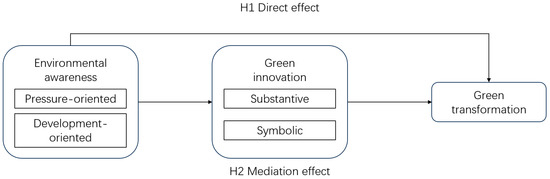
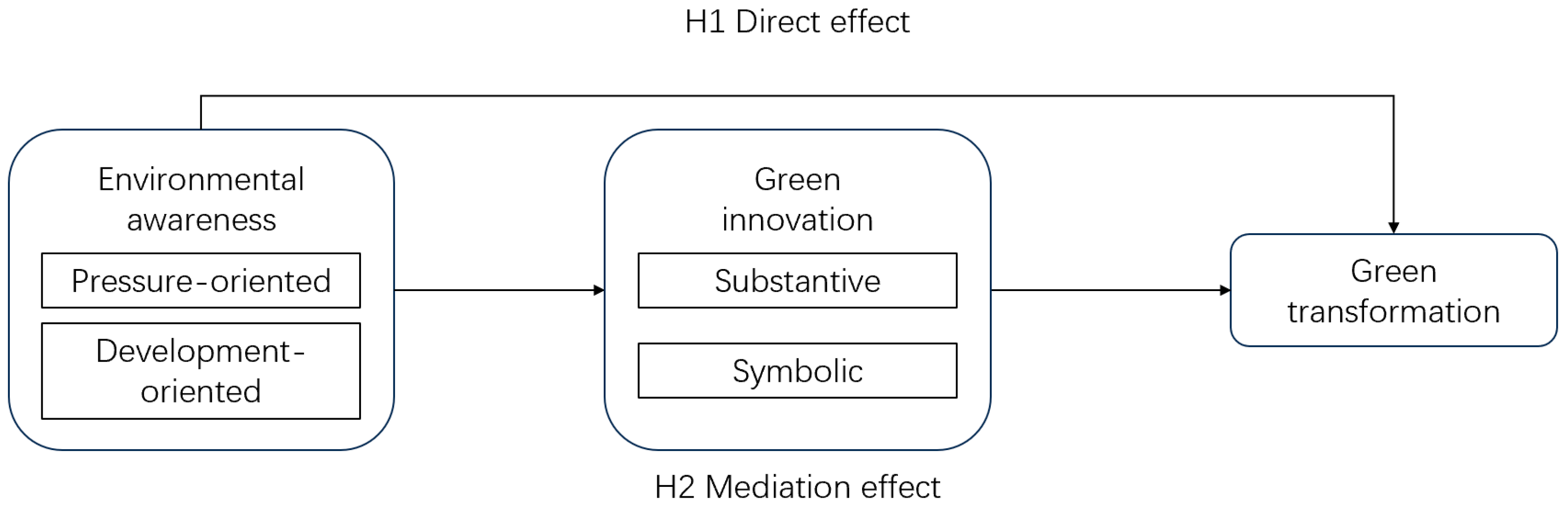
Based on the above theoretical analysis, the conceptual framework of this study is presented in Figure 1.
Figure 1.
Conceptual framework.
3. Research Design
3.1. Model Specification
To examine the effect of environmental awareness on corporate green transformation, this study estimates a two-way fixed effect model as follows:
where denotes the firm and denotes the year. represents the corporate green transformation index, and denotes executive environmental awareness. is the constant term, and are the coefficients to be estimated, captures firm fixed effects, captures year fixed effects, and is the random error term.
3.2. Data Sources and Variable Definitions
This study uses Chinese A-share listed firms from 2001 to 2024 as the research sample. Data are obtained from the China Stock Market and Accounting Research database and the Chinese Research Data Services database. The raw data were processed as follows. First, we excluded observations of ST, PT, and ST* firms. Second, we removed observations with missing values for key variables and winsorized the main continuous variables at the 1% and 99% levels. After these procedures, the final sample consisted of 53,747 firm-year observations.
- Dependent variable. Corporate green transformation index (GT). GT captures firms’ disclosed green transformation engagement, reflecting the extent to which firms communicate green development strategies, environmental governance practices, resource-use improvement, pollution control, and green technological initiatives in their annual reports. Following the text analysis methodology of Loughran and McDonald [25] and prior text-analysis studies on corporate green transformation [26,27,28], we measured GT using the frequency of green-transformation-related terms disclosed in firms’ annual reports. The keyword dictionary was adapted from the established 113-term framework used in recent studies of corporate green transformation, which classifies green-related expressions into five dimensions: advocacy and initiatives, strategic orientation, technological innovation, pollution control, and environmental management/governance. This framework is consistent with prior classifications such as publicity initiatives, strategic concepts or strategic vision, technological innovation, pollution control, and monitoring or environmental management. Accordingly, GT was calculated by counting the occurrence of these keywords in each firm-year annual report and applying the natural logarithm transformation, ln(1 + keyword frequency), to reduce skewness. The green transformation keyword dictionary used to construct the GT variable is reported in Table 1.Table 1. Green transformation keyword dictionary.
- 2.
- Core explanatory variable. Executive environmental awareness (ECA). Following the textual analysis approach of Hu et al. [29] and related studies [30,31], we constructed an ECA keyword dictionary using annual report texts. Existing studies generally measure executive green cognition from three dimensions: awareness of green competitive advantage, awareness of corporate social responsibility, and perception of external environmental pressure. Based on this established framework and the theoretical focus of this study, we further classified ECA into pressure-oriented environmental awareness and development-oriented environmental awareness. The executive environmental awareness keyword dictionary, including pressure-oriented and development-oriented environmental awareness, is presented in Table 2.Table 2. Executive environmental awareness keyword dictionary.
- 3.
- Mediating variables. Substantive green innovation (GREEN_H) was measured by the natural logarithm of one plus the number of green invention patents, following Khalid et al. [21]. Symbolic green innovation (GREEN_I) was measured by the natural logarithm of one plus the number of green utility model patents, following Xiao et al. [32].
- 4.
- Control variables. Following Dagestani et al. [1], García-Sánchez et al. [33], and Birindelli et al. [34], this study includes the following control variables: firm size (SIZE), firm age (AGE), leverage (LEV), board size (BOARD), revenue growth (GROWTH), cash flow ratio (CFLOW), proportion of independent directors (INDEP), shareholding ratio of the largest shareholder (Top1), CEO duality (DUAL), fixed asset ratio (FIXED), and Tobin’s Q (TOBINQ). The definitions and measurements of all variables used in this study are summarized in Table 3.Table 3. Variable definitions.
3.3. Descriptive Statistics
Table 4 reports the descriptive statistics for the main variables. The mean value of corporate green transformation (GT) is 1.796, with a standard deviation of 0.961, indicating that green transformation varies across sample firms. Executive environmental awareness (ECA) also shows considerable variation, suggesting that environmental awareness is unevenly distributed across firms and is relatively high only among a subset of firms. Overall, the sample firms are relatively stable in terms of firm size, firm age, and capital structure, while their profitability, growth, and market valuation exhibit a certain degree of heterogeneity.
Table 4.
Descriptive statistics.
4. Empirical Results
4.1. Baseline Regression
Table 5 presents the baseline regression results for the effect of environmental awareness on corporate green transformation. Column (1) includes only environmental awareness, while Column (2) further controls for firm characteristics and governance variables. The result in Column (1) shows that the coefficient of environmental awareness (ECA) is 0.030 and significant at the 1% level, indicating that environmental awareness promotes corporate green transformation. After the control variables are added, the coefficient of ECA remains positive and statistically significant, supporting Hypothesis H1.
Table 5.
Effect of environmental awareness on corporate green transformation.
The results in Table 5 also show that firm size (SIZE), firm age (FIRMAGE), profitability (ROA), and fixed asset ratio (FIXED) are significantly positive. This suggests that larger and more mature firms, as well as firms with stronger profitability and a more solid asset base, are more likely to advance green transformation. The R-squared value increases from 0.729 in Column (1) to 0.734 in Column (2), indicating that the inclusion of control variables improves the explanatory power of the model. Overall, the baseline results support the positive effect of environmental awareness on corporate green transformation.
4.2. Mediation Analysis
4.2.1. Green Innovation Channels
This section examines the mechanism through which environmental awareness affects corporate green transformation. The following model is specified:
where the definitions and measurements of the explanatory variable and control variables are consistent with those in the baseline regression. denotes the firm, and denotes the year. represents the mediating variables, including substantive green innovation (GREEN_H) and symbolic green innovation (GREEN_I). denotes executive environmental awareness. is the constant term, and are the coefficients to be estimated, and denote firm fixed effects and year fixed effects, respectively, and is the random error term.
Table 6 reports the results of the mechanism test for green innovation. Columns (1) and (2) examine the channel of substantive green innovation, while Columns (3) and (4) examine the channel of symbolic green innovation. The result in Column (1) shows that executive environmental awareness has no significant effect on substantive green innovation. In Column (2), the effect of substantive green innovation on corporate green transformation is also statistically insignificant. By contrast, Column (3) shows that executive environmental awareness significantly promotes symbolic green innovation, and Column (4) further shows that symbolic green innovation significantly promotes corporate green transformation. These results suggest that executive environmental awareness promotes corporate green transformation mainly through symbolic green innovation rather than substantive green innovation. The Bootstrap test of indirect effects further shows that the indirect effect of symbolic green innovation is significant, whereas that of substantive green innovation is not. Therefore, Hypothesis H2a is not supported, while Hypotheses H2b and H2c are supported.
Table 6.
Mechanism test: green innovation channels.
This result suggests that, as executive environmental awareness increases, firms are more inclined to respond to green transformation requirements through symbolic green innovation, which is relatively less costly, faster to implement, and more externally visible, rather than immediately translating such awareness into substantive green innovation that requires longer investment cycles and higher technological thresholds. In other words, the effect of executive environmental awareness on corporate green transformation exhibits a strategic response pattern, reflecting firms’ relatively prompt responses to environmental regulation, market evaluation, and stakeholder pressure.
4.2.2. Bootstrap Test for Mediating Effects
To further examine whether the mediating effect of symbolic green innovation is significantly stronger than that of substantive green innovation, we conduct a Bootstrap test for the difference between the two indirect effects. The results show that the indirect effect through substantive green innovation is positive but insignificant, whereas the indirect effect through symbolic green innovation is positive and statistically significant. More importantly, the difference between the two indirect effects is significantly positive (diff = 0.0000328, p = 0.034), with the 95% confidence interval not including zero. This indicates that symbolic green innovation plays a significantly stronger mediating role than substantive green innovation in the relationship between executive environmental awareness and corporate green transformation, thereby providing empirical support for H2c. To further verify whether the mediating effect of symbolic green innovation differs significantly from that of substantive green innovation, the Bootstrap test results for the difference between the two mediating effects are reported in Table 7.
Table 7.
Bootstrap test of the difference between mediating effects.
4.3. Endogeneity Tests
4.3.1. Instrumental Variable Approach
This study uses the lagged mean value of executive environmental awareness among other firms in the same industry, excluding the focal firm itself, as an instrumental variable (ECA_IND). Although industry-level environmental awareness may partially reflect common industry trends, the inclusion of firm and year fixed effects helps alleviate this concern. Therefore, the IV results should be interpreted as supportive rather than definitive evidence of causality. Table 8 reports the results of the instrumental variable estimation. The first stage regression shows that the coefficient of the instrumental variable is 0.523 and is significant at the 1% level, indicating that the lagged environmental awareness of industry peers significantly explains the focal firm’s executive environmental awareness. The second stage regression shows that the coefficient of executive environmental awareness is 0.110 and remains significant at the 1% level, suggesting that executive environmental awareness continues to promote corporate green transformation after the instrumental variable approach is used to address potential endogeneity concerns.
Table 8.
Instrumental variable estimation results.
The LM statistic is 93.796, with a p value of 0.000, which rejects the null hypothesis of underidentification. The Cragg–Donald Wald F statistic is 862.576, higher than the Stock Yogo critical value of 16.380 at the 10% maximal IV size level, indicating that weak instrument concerns are unlikely to be severe. Overall, the instrumental variable results further support the baseline conclusion.
4.3.2. Heckman Two-Stage Model
To further alleviate potential concerns arising from sample selection bias, this study employs the Heckman two-stage model. In the first stage, a firm’s inclusion in the final sample is used as the selection variable, and the proportion of other firms in the same industry entering the sample is used as the exclusion variable. The Probit results show that the coefficient of this industry peer selection variable is significantly positive, indicating that sample inclusion at the industry level has a significant effect on the likelihood that a firm enters the final sample.
In the second stage, the inverse Mills ratio is included in the baseline regression. The results show that the coefficient of the inverse Mills ratio is −0.2917 and significant at the 1% level, suggesting the presence of sample selection bias. Meanwhile, the coefficient of executive environmental awareness is 0.0288 and remains significant at the 1% level. This indicates that, after controlling for sample selection bias, the main conclusion of this study remains robust.
4.4. Robustness Checks
4.4.1. Excluding the Impact of Special Events
To further rule out the possibility that the estimation results are affected by the COVID-19 pandemic and other special period shocks, this study follows Sun et al. [35] and excludes observations from 2019 to 2023 before estimating the baseline model again. As shown in Column (1) of Table 9, the positive effect of environmental awareness on corporate green transformation remains significant. This result indicates that the baseline finding is not driven by special period shocks and further supports the robustness of the main conclusion.
Table 9.
Robustness checks.
4.4.2. Alternative Regression Models
To further examine whether the baseline results are sensitive to model specification, this study replaces the baseline regression with Tobit and Poisson models. The results are reported in Columns (2) and (3) of Table 9. The coefficients of environmental awareness remain significantly positive, providing further evidence that the positive effect of environmental awareness on corporate green transformation is robust to alternative model specifications.
4.4.3. Restricting the Sample to Manufacturing Firms
Given that manufacturing firms are characterized by more pronounced energy consumption and pollutant emissions, they face stronger demand for green transformation [36]. This study therefore restricts the sample to manufacturing firms as a robustness check. As shown in Column (4) of Table 9, the coefficient of executive environmental awareness remains significantly positive in the manufacturing subsample. This finding indicates that the main conclusion is not driven by differences in industrial composition in the full sample. It continues to hold among firms facing stronger green transformation pressures and engaging in more typical green innovation activities, thereby strengthening the robustness of the research findings.
4.4.4. Excluding Municipalities
Given the special status of municipalities in terms of administrative hierarchy, resource concentration, environmental regulation, and industrial structure [37], corporate green transformation in these cities may be more strongly influenced by policy support and resource advantages. To avoid the potential influence of these special regional samples on the results, this study removes firms located in municipalities and estimates the baseline model again. As shown in Column (5) of Table 9, the main conclusion remains robust.
4.4.5. Lagged Explanatory Variable
To alleviate potential reverse causality concerns, this study further estimates the baseline model using the one-period lagged value of executive environmental awareness as the core explanatory variable. As shown in Column (6) of Table 9, the coefficient of lagged executive environmental awareness remains significantly positive. This result suggests that the effect of executive environmental awareness on corporate green transformation exhibits some intertemporal persistence, further supporting the robustness of the baseline conclusion.
4.4.6. Length-Normalized Measure of Executive Environmental Awareness
Since the ECA variable is constructed based on the frequency of environmental-related keywords appearing in annual reports, the estimated results may be affected by differences in document length across firms. Specifically, firms with longer annual reports may mechanically exhibit higher keyword frequencies, thereby introducing potential measurement bias. To alleviate this concern, we reconstruct the ECA variable by normalizing the total frequency of ECA-related keywords by the total number of words in each annual report and multiplying the resulting ratio by 10,000 to obtain the frequency of ECA-related keywords per 10,000 words. We then apply the transformation ln(1 + x) to reduce skewness. The regression results are reported in Column (7) of Table 9. The coefficient of the length-normalized ECA remains significantly positive, indicating that the positive relationship between executive environmental awareness and corporate green transformation is not driven by differences in annual report length or disclosure intensity. Therefore, the baseline findings remain robust.
4.4.7. Excluding the Strategic-Orientation Dimension of GT
Although executive environmental awareness (ECA), green innovation, and corporate green transformation (GT) are conceptually related, they represent distinct stages of the theoretical framework. Specifically, ECA reflects executives’ environmental cognition, awareness, and value orientation, capturing how managers perceive, interpret, and prioritize environmental issues in strategic decision making. Green innovation is measured by green patent applications and reflects firms’ actual innovation activities and technological outputs, representing the behavioral mechanism through which managerial cognition is translated into organizational actions. In contrast, GT captures firms’ overall green transformation practices and outcomes, including environmental governance, resource utilization, green development, and sustainable operation. Therefore, ECA, green innovation, and GT correspond to the cognitive, behavioral, and outcome stages of the green transformation process, respectively, rather than alternative measures of the same construct.
To further alleviate concerns regarding potential conceptual overlap between ECA and the strategic-orientation dimension of GT, we reconstruct the GT index by excluding the strategic-orientation keywords and re-estimate the baseline model. The rationale is that strategic-orientation expressions in the GT dictionary may conceptually overlap with environmental strategy-related expressions contained in the ECA dictionary. The regression results are reported in Table 9 As shown in Column (8) of Table 9, the coefficient of ECA remains significantly positive.
4.4.8. Replacing the Dependent Variable with the ESG Environmental Pillar Score
To further address the concern that the text-based GT measure may not fully capture firms’ actual green transformation outcomes, we use the environmental pillar score of ESG as an alternative dependent variable. Compared with word frequency measures, ESG environmental scores provide a more direct assessment of firms’ environmental governance and environmental performance. The result in Column (9) shows that the coefficient of ECA remains positive and statistically significant at the 1 percent level. Specifically, the estimated coefficient is 0.006, indicating that higher executive environmental awareness is associated with better environmental performance. This finding is consistent with the baseline results and suggests that the positive effect of executive environmental awareness is not driven solely by textual disclosure, but also reflected in a more direct environmental outcome measure.
4.5. Common-Source Bias and Multicollinearity Tests
ECA reflects executives’ environmental cognition, awareness, and value orientation, representing the cognitive level of managerial decision making. Green innovation is measured by green patent applications and captures firms’ innovation activities and outputs, representing the behavioral level. GT reflects firms’ overall green transformation practices and outcomes, covering multiple dimensions such as environmental governance, resource utilization, and green development. Therefore, the three variables correspond to different stages from cognition to action and ultimately to transformation outcomes.
The Pearson correlation coefficient between GT and ECA is 0.413, indicating a moderate association rather than a high degree of overlap. Moreover, the VIF of ECA is 1.05 and the mean VIF is 1.31, both well below commonly accepted thresholds. These results suggest that the two variables are related but not mechanically equivalent, and that common-source bias or multicollinearity is unlikely to materially affect the empirical findings. The results of the common-source bias and multicollinearity tests are reported in Table 10.
Table 10.
Common-source bias and multicollinearity tests.
4.6. Heterogeneity Analysis
This study first conducts a heterogeneity analysis based on ownership structure. As shown in Table 11, executive environmental awareness promotes corporate green transformation in both state-owned and non-state-owned firms, but the effect is stronger among non-state-owned firms.
Table 11.
Heterogeneity analysis.
This result suggests that green transformation in non-state-owned firms is more closely associated with executives’ individual cognition and strategic judgment. Compared with state-owned firms, non-state-owned firms are subject to relatively weaker administrative green development mandates and policy constraints, and their green transformation is therefore more likely to be shaped by internal governance, market opportunity recognition, and executives’ proactive decision making. Consequently, when executives in non-state-owned firms have stronger environmental awareness, such awareness is more likely to be translated into green investment, green management, and green innovation. Although state-owned firms are also influenced by executive environmental awareness, their green transformation is often shaped simultaneously by government assessment, policy responsibility, and public ownership attributes, which may weaken the marginal role of executive environmental awareness.
This study further conducts a heterogeneity analysis across eastern, central, and western regions. As shown in Table 11, the positive effect of executive environmental awareness on corporate green transformation is mainly observed among firms located in eastern China. The effect is weaker among firms in western China and is not statistically significant among firms in central China. This result indicates that regional institutional environments and resource conditions affect how effectively executive environmental awareness is translated into green transformation practices.
Eastern China generally has a higher level of marketization, more developed green finance, richer technological and human capital resources, and more mature environmental information disclosure mechanisms. These conditions make it easier for executives’ environmental awareness to be converted into green transformation practices through resource allocation and strategic implementation. By contrast, firms in central and western China often face relatively insufficient green technology supply, capital support, and market pressure. Even when executives possess a certain degree of environmental awareness, resource constraints and transformation costs may limit their practical effect.
Overall, the heterogeneity analysis shows that the effect of executive environmental awareness on corporate green transformation is not homogeneous, but is shaped by ownership structure and regional development environments. Specifically, the effect is stronger in non-state-owned firms than in state-owned firms, and stronger in eastern China than in central and western China. This suggests that the effectiveness of executive environmental awareness requires market-oriented institutional support, resource availability, and organizational autonomy.
5. Further Analysis
Table 12 reports the effects of pressure-oriented and development-oriented environmental awareness on corporate green transformation. Column (1) presents the result for pressure-oriented environmental awareness, while Column (2) presents the result for development-oriented environmental awareness. The results show that both PEA and DEA have significantly positive coefficients, indicating that different dimensions of executive environmental awareness can promote corporate green transformation, although the magnitude of their effects differs.
Table 12.
Effects of pressure-oriented and development-oriented environmental awareness on corporate green transformation.
6. Conclusions and Implications
Using data on Chinese A-share listed firms from 2001 to 2024, this study examines the effect of executive environmental awareness on corporate green transformation and the underlying mechanisms. The results show that executive environmental awareness significantly promotes corporate green transformation. This finding remains robust after applying the instrumental variable approach, the Heckman two-stage model, alternative model specifications, and sample adjustment tests.
The mechanism analysis shows that environmental awareness does not merely remain at the level of managerial cognition, but is translated into green transformation practices through green innovation. However, this transmission mainly relies on symbolic green innovation, whereas the mediating role of substantive green innovation is not significant. Further distinguishing between different types of environmental awareness, the results show that pressure-oriented environmental awareness has a stronger effect on corporate green transformation than development-oriented environmental awareness. This suggests that corporate green transformation in the current institutional context still exhibits a clear external pressure response pattern.
The heterogeneity analysis further shows that the positive effect of executive environmental awareness is more pronounced among non-state-owned firms and firms located in eastern China. This indicates that ownership structure and regional institutional environments affect how effectively environmental awareness is translated into green transformation practices.
First, firms should translate executive environmental awareness into a sustained green strategic orientation. The findings show that executive environmental awareness significantly promotes corporate green transformation. Therefore, firms should not treat environmental protection merely as a compliance issue or a short-term response task, but should integrate it into business decision making, investment planning, and performance evaluation. In particular, boards of directors and top management teams should continuously monitor changes in environmental policies, carbon reduction requirements, and industry-level green development trends. Through targeted training, strategic discussions, and the decomposition of green objectives, firms can enhance managers’ understanding of the necessity and urgency of green transformation and ensure that environmental awareness is embedded in the strategic decision-making process.
Second, firms should strengthen their ability to translate environmental awareness into green innovation. The mechanism analysis shows that green innovation is an important pathway through which executive environmental awareness promotes corporate green transformation, and that this pathway currently operates mainly through symbolic green innovation. This suggests that, when responding to external green requirements, firms should not remain at the level of green narratives, green certifications, or low-cost patent deployment. Instead, they should gradually increase investment in substantive green innovation. Firms can build more stable research and development investment mechanisms and cross-functional coordination mechanisms around energy conservation, cleaner production, green process upgrading, and green product development. In this way, symbolic green innovation can evolve toward substantive green innovation, preventing green transformation from becoming merely symbolic or superficial.
Finally, governments and market institutions should provide more targeted support according to firm type and regional differences. The findings show that the effect of executive environmental awareness is stronger among non-state-owned firms and firms located in eastern China, indicating that firms differ in their ability to translate environmental awareness into green transformation actions. For non-state-owned firms, policy support should focus on reducing transformation costs and strengthening their motivation for proactive transformation through green finance, tax incentives, innovation subsidies, and information services. For firms in central and western China, greater efforts should be made to improve the supply of green technologies, environmental service platforms, and policy guidance, so as to compensate for deficiencies in resources, talent, and market conditions. In this way, environmental awareness can be translated into substantive green transformation outcomes across a broader range of enterprises.
Author Contributions
Conceptualization, B.Z.; methodology, B.Z.; software, B.Z.; validation, B.Z.; formal analysis, L.C.; investigation, L.C.; resources, L.C.; data curation, L.C.; writing—original draft, L.C. All authors have read and agreed to the published version of the manuscript.
Funding
This research received no external funding.
Institutional Review Board Statement
Not applicable.
Informed Consent Statement
Not applicable.
Data Availability Statement
The original contributions presented in this study are included in the article. Further inquiries can be directed to the corresponding author.
Conflicts of Interest
The authors declare no conflicts of interest.
References
- Dagestani, A.A.; Chen, P.; Du, L.; Hu, J.; Bilan, Y. The impacts of urban development orientation of resource-based cities on environmental information disclosure and greenwashing behavior of listed firms in China. Environ. Dev. Sustain. 2025, 27, 21515–21540. [Google Scholar]
- Wang, L.; Long, Y.; Li, C. Research on the impact mechanism of heterogeneous environmental regulation on enterprise green technology innovation. J. Environ. Manag. 2022, 322, 116127. [Google Scholar] [CrossRef] [Scilit]
- Yu, C.; de Jong, M.; Cheng, B. Getting depleted resource-based cities back on their feet again—The example of Yichun in China. J. Clean. Prod. 2016, 134, 42–50. [Google Scholar] [CrossRef] [Scilit]
- Li, Q.; Zeng, F.; Liu, S.; Yang, M.; Xu, F. The effects of China’s sustainable development policy for resource-based cities on local industrial transformation. Resour. Policy 2021, 71, 101940. [Google Scholar] [CrossRef] [Scilit]
- He, Y.; Ding, X.; Yang, C. Do environmental regulations and financial constraints stimulate corporate technological innovation? Evidence from China. J. Asian Econ. 2021, 72, 101265. [Google Scholar] [CrossRef] [Scilit]
- Krass, D.; Nedorezov, T.; Ovchinnikov, A. Environmental taxes and the choice of green technology. Prod. Oper. Manag. 2013, 22, 1035–1055. [Google Scholar] [CrossRef] [Scilit]
- Chi, Y.; Yang, Y. Green finance and green transition by enterprises: An exploration of market-oriented governance mechanisms. Borsa Istanb. Rev. 2023, 23, 628–646. [Google Scholar] [CrossRef] [Scilit]
- Hu, G.; Wang, X.; Wang, Y. Can the green credit policy stimulate green innovation in heavily polluting enterprises? Evidence from a quasi-natural experiment in China. Energy Econ. 2021, 98, 105134. [Google Scholar] [CrossRef] [Scilit]
- Hambrick, D.C.; Mason, P.A. Upper echelons: The organization as a reflection of its top managers. Acad. Manag. Rev. 1984, 9, 193–206. [Google Scholar] [CrossRef] [Scilit]
- Kraus, P.; Stokes, P.; Cooper, S.C.; Liu, Y.; Moore, N.; Britzelmaier, B.; Tarba, S. Cultural antecedents of sustainability and regional economic development-a study of SME ‘Mittelstand’ firms in Baden-Württemberg (Germany). Entrep. Reg. Dev. 2020, 32, 629–653. [Google Scholar] [CrossRef] [Scilit]
- Bae, H. Voluntary disclosure of environmental performance: Do publicly and privately owned organizations face different incentives/disincentives? Am. Rev. Public Adm. 2014, 44, 459–476. [Google Scholar]
- Meng, X.H.; Zeng, S.X.; Tam, C.M. From voluntarism to regulation: A study on ownership, economic performance and corporate environmental information disclosure in China. J. Bus. Ethics 2013, 116, 217–232. [Google Scholar]
- Peng, X.R.; Wei, J. Stakeholders’ environmental protection orientation and corporate ecological innovation: The moderating role of executives’ awareness of environmental protection. Stud. Sci. Educ. 2015, 33, 1109–1120. [Google Scholar]
- Tseng, M.L.; Wang, R.; Chiu, A.S.F.; Geng, Y.; Lin, Y.H. Improving performance of green innovation practices under uncertainty. J. Clean. Prod. 2013, 40, 71–82. [Google Scholar] [CrossRef] [Scilit]
- Wang, D.; Luo, Y.; Hu, S.; Yang, Q. Executives’ ESG cognition and enterprise green innovation: Evidence based on executives’ personal microblogs. Front. Psychol. 2022, 13, 1053105. [Google Scholar] [CrossRef] [Scilit] [PubMed]
- Shi, D.; Lu, S.; Fang, Z. The effect of executive green human capital on greenwashing. Res. Int. Bus. Financ. 2024, 71, 102461. [Google Scholar] [CrossRef] [Scilit]
- Homburg, A.; Stolberg, A. Explaining pro-environmental behavior with a cognitive theory of stress. J. Environ. Psychol. 2006, 26, 1–14. [Google Scholar] [CrossRef] [Scilit]
- Shahab, Y.; Ntim, C.G.; Chen, Y.; Ullah, F.; Li, H.; Ye, Z. Chief executive officer attributes, sustainable performance, environmental performance, and environmental reporting: New insights from upper echelons perspective. Bus. Strategy Environ. 2020, 29, 1–16. [Google Scholar]
- Cui, F.; Han, C.; Liu, P.; Teng, M. Green credit of China’s coal power enterprises during green transformation: A tripartite evolutionary game analysis. Energies 2022, 15, 5911. [Google Scholar] [CrossRef] [Scilit]
- Castellacci, F.; Lie, C.M. A taxonomy of green innovators: Empirical evidence from South Korea. J. Clean. Prod. 2017, 143, 1036–1047. [Google Scholar] [CrossRef] [Scilit]
- Khalid, Z.; Zhao, L.; Elahi, E.; Chang, X. The impact of green management on green innovation in sustainable technology: Moderating roles of executive environmental awareness, regulations, and ownership. Environ. Dev. Sustain. 2026, 28, 9961–9987. [Google Scholar]
- Cao, H.; Chen, Z. The driving effect of internal and external environment on green innovation strategy-The moderating role of top management’s environmental awareness. Nankai Bus. Rev. Int. 2019, 10, 342–361. [Google Scholar]
- Xu, P.; Ye, P.; Jahanger, A.; Huang, S.; Zhao, F. Can green credit policy reduce corporate carbon emission intensity: Evidence from China’s listed firms. Corp. Soc. Responsib. Environ. Manag. 2023, 30, 2623–2638. [Google Scholar]
- Wang, W.; Sun, Z.; Zhu, W.; Ma, L.; Dong, Y.; Su, X.; Wu, F. How does multi-agent govern corporate greenwashing? A stakeholder engagement perspective from “common” to “collaborative” governance. Corp. Soc. Responsib. Environ. Manag. 2023, 30, 291–307. [Google Scholar]
- Loughran, T.; McDonald, B. When is a liability not a liability? Textual analysis, dictionaries, and 10-Ks. J. Financ. 2011, 66, 35–65. [Google Scholar]
- Cheng, Z.; Wu, Y. Can the issuance of green bonds promote corporate green transformation? J. Clean. Prod. 2024, 443, 141071. [Google Scholar] [CrossRef] [Scilit]
- Dissanaike, G.; Dai, S.; Jayasekera, R.; Uddin, G.S. Supply chain configuration adaptations of highly-polluting firms in response to shocks from environmental pressures: Case for centralization or diversification? Bus. Strategy Environ. 2026, 35, 1403–1425. [Google Scholar]
- Liu, Y.; Kumar, S.; Liu, H.; Li, S.; Zhou, Z. ESG performance, digital transformation, and green innovation. Humanit. Soc. Sci. Commun. 2025, 12, 1739. [Google Scholar] [CrossRef] [Scilit]
- Hu, S.; Zhang, C.; Ji, Y.; Zhang, C. Does environmental information disclosure tone affect corporate green innovation in China? Based on the institutional perspective. Environ. Dev. Sustain. 2024, 26, 12239–12282. [Google Scholar]
- Hao, X.; Miao, E.; Wen, S.; Wu, H.; Xue, Y. Executive green cognition on corporate greenwashing behavior: Evidence from a-share listed companies in China. Bus. Strategy Environ. 2025, 34, 2012–2034. [Google Scholar]
- Liu, G.; Lin, Y.; Wang, H.; Liu, Z. Executive green cognition, risk preference, and ESG greenwashing. Humanit. Soc. Sci. Commun. 2026. [Google Scholar] [CrossRef] [Scilit]
- Xiao, D.; Dong, S.; Wang, J. Low carbon cities pilot, executive environmental cognition, and enterprise green technology innovation. Manag. Decis. Econ. 2024, 45, 2267–2281. [Google Scholar] [CrossRef] [Scilit]
- García-Sánchez, I.-M.; Ortiz-Martínez, E.; Marín-Hernández, S.; Aibar-Guzmán, B. How does the European Green Deal affect the disclosure of environmental information? Corp. Soc. Responsib. Environ. Manag. 2023, 30, 2766–2782. [Google Scholar] [CrossRef] [Scilit]
- Birindelli, G.; Chiappini, H.; Jalal, R.N.-U.-D. Greenwashing, bank financial performance and the moderating role of gender diversity. Res. Int. Bus. Financ. 2024, 69, 102235. [Google Scholar] [CrossRef] [Scilit]
- Sun, M.; Lin, J. The Power of Cognition: Has Executive Environmental Cognition Promoted Corporate Environmental Information Disclosure? Int. J. Financ. Econ. 2026. [Google Scholar] [CrossRef] [Scilit]
- Zhai, X.; An, Y. Analyzing influencing factors of green transformation in China’s manufacturing industry under environmental regulation: A structural equation model. J. Clean. Prod. 2020, 251, 119760. [Google Scholar] [CrossRef] [Scilit]
- Wei, H. The administrative hierarchy and growth of urban scale in China. Chin. J. Urban Environ. Stud. 2015, 3, 1550001. [Google Scholar] [CrossRef] [Scilit]

Disclaimer/Publisher’s Note: The statements, opinions and data contained in all publications are solely those of the individual author(s) and contributor(s) and not of MDPI and/or the editor(s). MDPI and/or the editor(s) disclaim responsibility for any injury to people or property resulting from any ideas, methods, instructions or products referred to in the content. |
© 2026 by the authors. Licensee MDPI, Basel, Switzerland. This article is an open access article distributed under the terms and conditions of the Creative Commons Attribution (CC BY) license.