Article

Monitoring Soil Carbon Storage and Flux Using TDLAS and GIS in a Resource-Based City: Spatial Distribution Characteristics and Sustainability Implications

1
School of Information Engineering, Huzhou Normal University, Huzhou 313000, China
2
School of Information Management, Xinjiang University of Finance and Economics, 449 Beijing Road, Urumqi 830012, China
3
Huzhou Key Laboratory of Urban Multidimensional Perception and Intelligent Computing, School of Electronic Information, Huzhou College, Huzhou 313000, China
*
Authors to whom correspondence should be addressed.
Sustainability 2026, 18(13), 6507; https://doi.org/10.3390/su18136507 (registering DOI)
Submission received: 8 June 2026 / Revised: 23 June 2026 / Accepted: 23 June 2026 / Published: 26 June 2026

Abstract

Under the “dual carbon” goals, Taiyuan, a prefecture-level administrative unit and energy-intensive region in Shanxi Province, China, has experienced changes in soil carbon storage and soil carbon flux under rapid urbanization and industrialization. To clarify the spatial patterns of soil carbon storage and flux, 26 field sampling sites, including 78 soil samples, were analyzed using laboratory measurements and an optimized tunable diode laser absorption spectroscopy–geographic information system (TDLAS–GIS) integrated monitoring approach. This study investigated the spatial patterns of soil carbon storage and flux and discussed their potentially associated factors, providing an exploratory workflow for regional carbon monitoring. The results showed clear spatial heterogeneity, with an average soil organic carbon (SOC) content of 10.86 g/kg. High-SOC areas were mainly located in the southern and southwestern plains, while lower SOC levels occurred in urban expansion zones and highly disturbed surfaces. The western mountainous areas were important ecological barriers but were not the highest measured SOC zones. At the site level, arable land and forestland showed higher mean SOC values than grassland, with average SOC contents of 12.47, 12.07, and 8.27 g/kg, respectively, although these land-use-related differences were not statistically significant. Soil carbon flux was relatively higher in some mountainous regions and industrial–ecological transition areas but lower in several urban expansion areas. The results suggest that urbanization and industrial activity may be associated with changes in SOC and soil-atmosphere CO2 exchange. This study describes the spatial variation characteristics of soil carbon storage and flux, establishes a reproducible TDLAS–GIS workflow for regional carbon monitoring, and provides exploratory support for ecological sustainability, sustainable land management, and the “dual carbon” strategy in northern resource-based cities.

1. Introduction

Soil carbon storage and soil-atmosphere CO2 exchange are central components of the terrestrial carbon cycle and play important roles in regulating atmospheric CO2 concentration [1], ecosystem productivity, and climate feedbacks [2]. Because the soil organic carbon pool is larger than the atmospheric and vegetation carbon pools [3], even small changes in soil carbon storage and soil carbon flux may affect regional and global carbon budgets [4]. In China, the goals of carbon peaking and carbon neutrality have placed higher requirements on ecological civilization construction, regional carbon monitoring [5], and low-carbon land management [6]. Therefore, understanding the spatial distribution of soil organic carbon and carbon flux is important for supporting regional carbon cycle assessment and the implementation of the “dual carbon” strategy.
Previous studies have shown that soil carbon storage and carbon flux are associated with land-use change, climatic conditions, vegetation cover, and human disturbance [7]. At the regional scale, urbanization can alter land cover and soil properties, thereby reducing soil organic carbon storage in some urban and peri-urban areas [8]. Natural vegetation cover, such as forestland and grassland, can contribute to carbon inputs through plant productivity, litterfall, and root turnover [9]. Industrial emissions and transportation activities may also affect soil-atmosphere carbon exchange by changing atmospheric CO2 concentration and disturbing the soil microenvironment [10]. However, in northern energy-based and resource-based cities, existing studies have often focused on individual land-use categories [11], such as farmland, forestland, or industrial zones, while integrated assessments of SOC and carbon flux across complex terrains and urban–rural mixed landscapes remain limited [12].
In this study, Taiyuan is treated as an energy-based prefecture-level administrative unit rather than only the urban settlement of Taiyuan. “Taiyuan” or “Taiyuan City” refers to the entire prefecture-level administrative territory of Taiyuan, including urban districts, county-level administrative areas, and non-urbanized spaces such as mountains, plains, agricultural land, forests, and grasslands. This administrative region has experienced rapid urbanization, intensive industrial activities, and substantial land-use transformation, resulting in complex interactions between natural ecosystems and human-disturbed areas. Agricultural areas in the central and southern plains are affected by farming practices and soil management [13], while urban expansion zones and industrial zones may show reduced SOC levels or altered carbon flux patterns under anthropogenic disturbance [14]. The western mountainous areas and eastern hills serve as well-vegetated ecological barrier zones; however, this ecological function should be distinguished from the spatial pattern of measured surface SOC concentration, which is also influenced by soil depth, terrain stability, erosion processes, and land-use management. Nevertheless, research on Taiyuan remains mostly limited to local areas or single indicators, leaving integrated assessments of SOC and soil carbon flux across the entire prefecture-level administrative territory insufficient.
Methodologically, SOC and soil carbon flux studies commonly combine field sampling, laboratory SOC determination, in situ CO2 monitoring, and GIS-based spatial analysis. GIS-based interpolation methods are widely used to visualize the spatial variability of soil properties and provide spatially explicit support for interpreting regional soil carbon patterns [15]. For soil CO2 monitoring, optical gas sensing techniques have become increasingly important because they allow sensitive and real-time detection of gas concentration changes, and TDLAS has been applied in CO2 and H2O concentration monitoring because of its high selectivity and suitability for real-time gas detection [16]. In addition, the rapid response characteristics of TDLAS further support its application in dynamic soil-atmosphere CO2 exchange monitoring [17]. Therefore, integrating laboratory SOC measurements, TDLAS-based CO2 monitoring, and GIS-based spatial analysis provides a feasible technical workflow for examining soil carbon storage and flux in heterogeneous regional landscapes. Despite these advances, several gaps remain. First, many studies have examined SOC storage or soil CO2 flux separately, while fewer studies have considered both indicators within the same regional framework [18]. Second, for resource-based cities, existing studies have paid more attention to industrial emissions, land use change, or ecological transformation, whereas soil carbon processes across urban–rural mixed landscapes remain less understood [19]. Third, quantitative models such as multivariate regression, geographically weighted regression, or structural equation modeling are useful for identifying the relative contributions of potential environmental and anthropogenic factors, but they require denser sampling networks and more detailed explanatory variables [20]. Therefore, exploratory spatial analysis based on field observations remains useful for identifying regional SOC and carbon flux heterogeneity, although further quantitative modeling is still needed to decouple the contributions of different factors [21].
Based on the above background, this study uses Taiyuan as a representative energy-based prefecture-level administrative unit to explore the spatial heterogeneity of SOC and soil carbon flux. The study is guided by the following hypothesis: SOC and soil carbon flux exhibit spatial differences across land-use and topographic settings, and these patterns may be associated with vegetation cover, soil conditions, urbanization, and industrial disturbance. Specifically, this study aims to: (1) characterize the spatial distribution of SOC and soil carbon flux in Taiyuan; (2) compare SOC and flux patterns across different land-use and topographic backgrounds; and (3) discuss the potential environmental and anthropogenic factors associated with these spatial patterns and their implications for soil carbon management in resource-based cities.
The significance of this study lies in its integration of field SOC measurement, in situ TDLAS-based CO2 monitoring, and GIS-based spatial visualization to examine soil carbon processes in a resource-based urban–rural mixed region. Rather than quantifying the independent contribution of each driving factor, this study provides an exploratory spatial assessment of SOC and soil carbon flux patterns and discusses their potential associations with land use, topography, vegetation cover, and human disturbance. The findings may provide a useful reference for regional soil carbon monitoring, ecological restoration, and carbon-cycle management in Taiyuan and other resource-based cities facing similar urbanization and industrialization pressures.

2. Materials and Methods

2.1. Overview of the Study Area

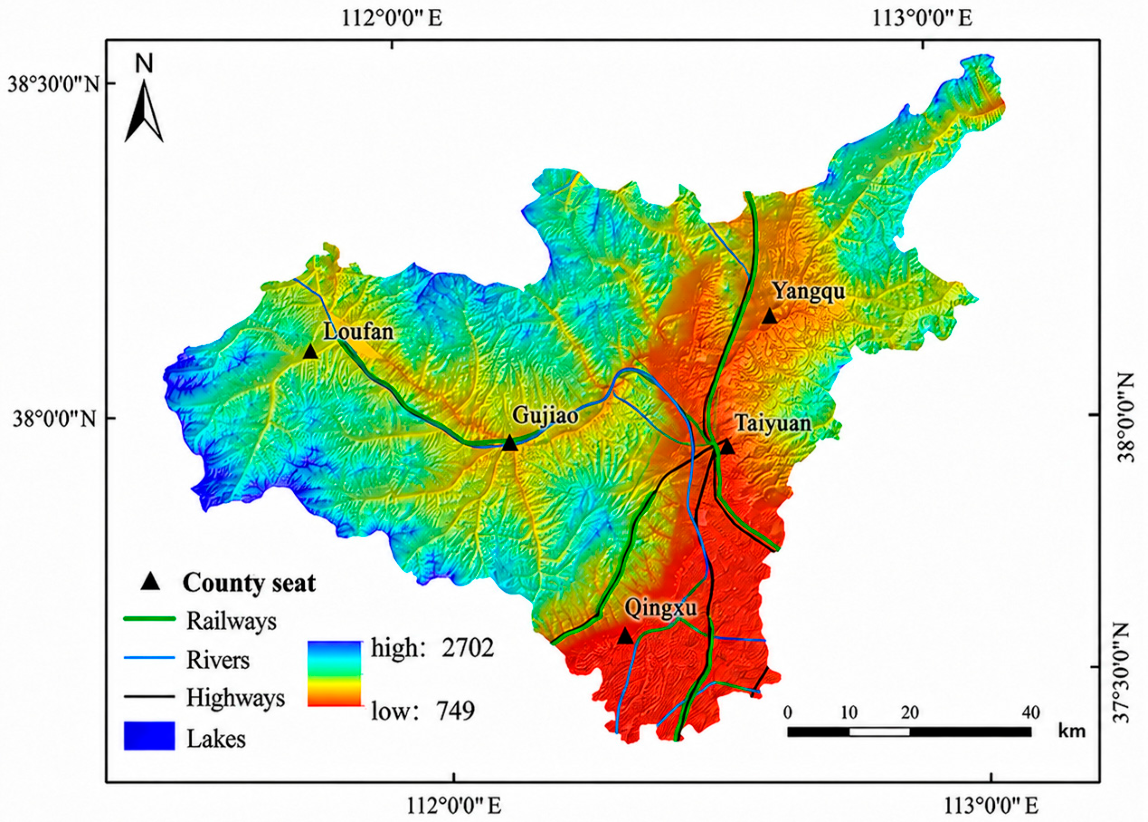
Located in the Fenhe River Valley Plain in the eastern part of the Loess Plateau, the prefecture-level city of Taiyuan, Shanxi Province, China, extends from 37°27′ to 38°25′ N and from 111°30′ to 113°09′ E (Figure 1), according to official regional geographic records and administrative boundary data [22]. In the context of China’s administrative system, Taiyuan City in this study refers to the whole prefecture-level administrative territory, not only the urban built-up area or the specific urban settlement of Taiyuan. This administrative unit administers 6 districts and 4 county-level administrative areas, covering approximately 6988 km2, and includes urban districts, county-level areas, mountainous regions, plains, agricultural land, forests, grasslands, and urban–rural transitional zones [23]. As the core area of the Taiyuan Metropolitan Area, it has experienced rapid industrialization and urban expansion. According to the Seventh National Population Census, the permanent resident population of Taiyuan was 5.3041 million in 2020 [24]. Rapid urbanization and industrial development have substantially changed land-cover patterns across the region [25].
Taiyuan has a temperate continental monsoon climate with pronounced seasonal variation. The region is characterized by dry and cold winters, warm and relatively wet summers, and precipitation mainly concentrated in July and August. According to regional climatic records, the annual average precipitation is approximately 456 mm, and the annual sunshine duration is around 2808 h [26]. These climatic conditions provide an important environmental background for vegetation growth, SOC accumulation, and soil-atmosphere CO2 exchange. Figure 1 illustrates the elevation distribution of Taiyuan based on digital elevation model data [27]. The terrain of Taiyuan is complex and includes mountains, hills, and plains. The western and northern parts are dominated by mountainous terrain, including parts of the Lüliang and Taihang mountain systems, with elevations exceeding 1500 m in some areas. These areas are characterized by relatively rich vegetation and serve as important ecological barriers; however, their measured surface SOC concentrations do not necessarily represent the highest values because mountainous terrain is often associated with shallow soil layers, steep slopes, and stronger erosion potential. The central region is mainly composed of the Fenhe River valley plain, generally at 800–1000 m above sea level, and forms an important agricultural and urban development zone. The eastern and southern parts include hilly and transitional terrain at approximately 1000 m elevation, with diverse land-use patterns.
Terrain and land-use conditions provide an important background for interpreting the spatial distribution of SOC and soil carbon flux. Mountainous and hilly areas are generally characterized by relatively high vegetation cover and ecological conservation functions, whereas plain areas are more strongly associated with agricultural production [28], urban construction, and industrial development [29]. Therefore, the coexistence of mountainous ecological zones, agricultural plains, and urban-industrial areas makes Taiyuan a suitable case for examining soil carbon patterns in a resource-based urban–rural mixed region.

2.2. Soil Sampling and SOC Determination

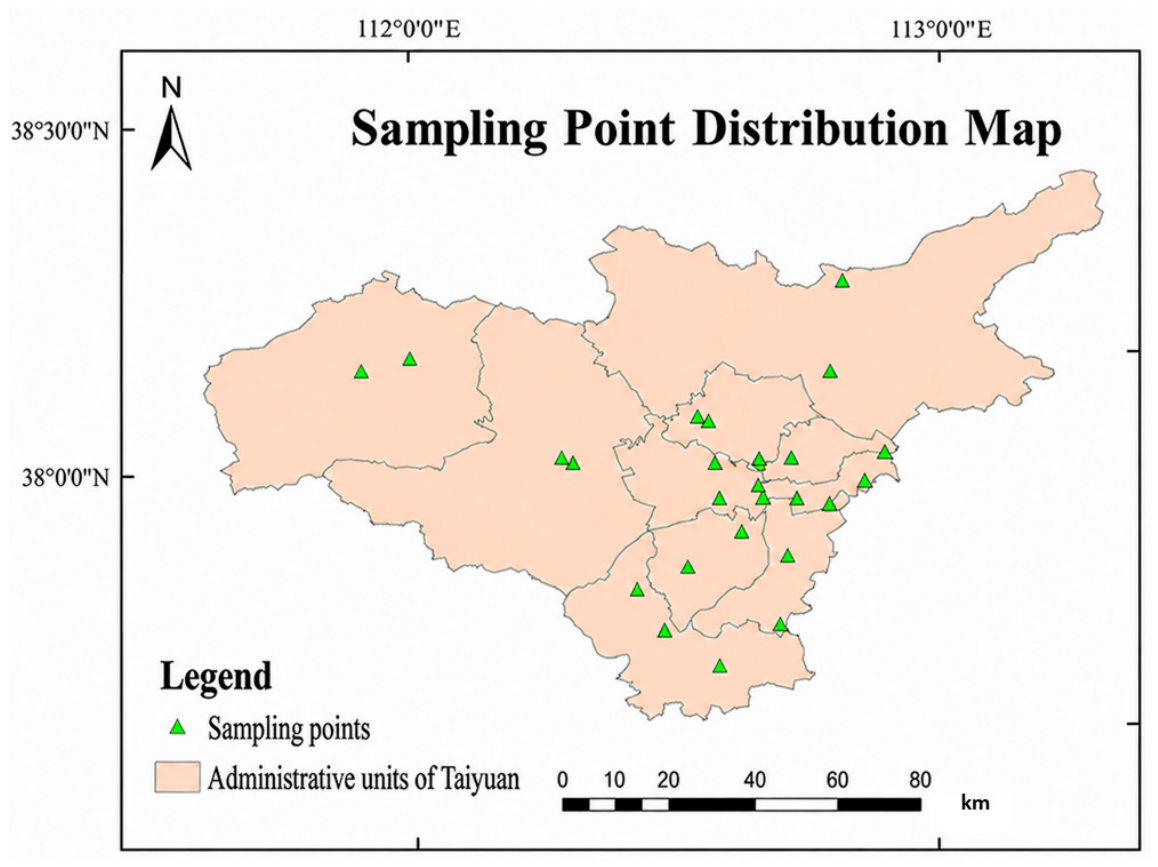
To ensure the representativeness and feasibility of field sampling, the sampling design was guided by the Technical Specification for Soil Environmental Monitoring (HJ/T 166-2004), particularly with respect to site selection, sample collection, and quality control [30]. In this study, the sampling scheme was not designed as a regular-grid or area-proportional sampling scheme. Instead, it was designed to ensure basic administrative coverage and local environmental representativeness across the prefecture-level administrative territory of Taiyuan. Specifically, 26 independent sampling sites were selected across all 6 districts and 4 county-level administrative areas of Taiyuan, with at least two sites arranged in each administrative unit. Within each district or county, sampling locations were further selected by considering dominant land-use types, terrain conditions, vegetation cover, human disturbance intensity, field accessibility, and the suitability of open soil surfaces for in situ CO2 flux monitoring. Therefore, “coverage across all administrative units” rather than “strictly uniform spatial distribution” was the main principle of the sampling design. Following field investigation, site verification, and accessibility assessment, 78 soil samples were collected from Taiyuan in June 2024. Sampling locations are shown in Figure 2. Triplicate soil specimens were collected at each independent sampling site for SOC analysis. Prior to sampling, undecomposed surface litter was removed to avoid interference. Soil specimens were obtained from the 0–20 cm soil layer and stored in sterile containers, then transported to the laboratory for subsequent processing. Visible non-soil materials, such as small plant roots, undecomposed litter fragments, stones, and gravel, were manually removed before air-drying and grinding. Following natural air-drying and grinding, SOC content was quantified using the potassium dichromate oxidation–spectrophotometry method according to HJ 615-2011 [31]. This method is commonly used for determining organic carbon in soil and sediment samples.
The land-use type of each sampling site was determined by combining field investigation with visual interpretation of high-resolution satellite imagery. Specifically, the geographic coordinates recorded during field sampling were imported into ArcGIS Desktop 10.8.2 (Esri, Redlands, CA, USA) and overlaid with the ArcGIS World Imagery basemap and the land-use background map. The land-use type around each sampling point was then checked by visual photointerpretation based on image texture, color, spatial context, vegetation coverage, and surrounding land-cover characteristics. Each sampling point was classified as arable land, forestland, or grassland according to the combined evidence from field records and image interpretation. When the image interpretation was inconsistent with field observations, the field record was used as the primary basis for classification. Based on this procedure, the 26 sampling sites were classified into three land-use types, namely arable land, forestland, and grassland, and descriptive statistical analysis was conducted on the final SOC values of the sampling sites under each land use type. To visualize the spatial distribution of soil organic carbon across Taiyuan, the SOC values of the 26 independent sampling sites were interpolated using the inverse distance weighting (IDW) method in ArcGIS. The interpolated raster surface was clipped by the administrative boundary of Taiyuan to visualize the spatial variation in SOC content across the study area [32]. IDW was selected because it is suitable for estimating values at unsampled locations based on the distance-weighted influence of surrounding sampling points, although the resulting map was interpreted as exploratory spatial visualization rather than definitive high-resolution prediction. The color ramp of the interpolated raster was adjusted only for cartographic readability and smoother visual presentation, while the interpolation method, SOC value range, and legend classification were kept unchanged; no kriging, semi-variogram modelling, or other geostatistical interpolation method was applied. Considering the limited number of field sampling sites, the sampling and spatial analysis design in this study was intended to support an exploratory assessment of SOC spatial heterogeneity and land-use-related differences across Taiyuan, rather than to provide a definitive high-resolution prediction or to quantify the independent contribution of each driving factor.

2.3. Carbon Flux Detection

2.3.1. Theoretical Basis for Soil CO2 Detection and Carbon Flux Calculation

TDLAS was used to measure CO2 concentration at multiple vertical heights above the soil surface, providing the concentration data required for carbon flux calculation [33]. TDLAS is suitable for field CO2 monitoring because of its high precision, high sensitivity, rapid response, and non-contact measurement characteristics [34]. In this technique, the wavelength of a tunable semiconductor laser is scanned across the characteristic absorption line of CO2 [35], and the absorption signal is then used for gas concentration estimation [36]. According to the Lambert–Beer law, the relationship between the incident laser intensity, transmitted intensity, optical path length, gas concentration, pressure, and molar absorption coefficient can be expressed as follows:
I v = I 0 exp α v P C L
While C is the gas concentration, α v is the molar absorption coefficient with a unit of cm2/mol, and P is the gas pressure. The expression for the molar absorption coefficient α v is given by:
α v = S T f v v 0
where S T is the absorption line strength, f v v 0 is the line shape function. By combining and rearranging (1) and (2), the soil carbon dioxide flux concentration can be obtained as:
C = ln I I 0 S T f v v 0 P L
The integrated absorption signal can be further expressed as:
C = τ S T P L
where τ denotes the integrated absorbance. After τ , absorption line strength, gas pressure, and optical path length are determined, the CO2 concentration can be calculated.
The calculation of soil carbon flux was based on Fick’s law [37]. According to Fick’s First Law, the diffusion flux is proportional to the concentration gradient [38]. Soil-respiration-derived CO2 moves upward along the concentration gradient from the soil surface to the atmosphere, and the diffusion flux can be expressed as:
J = d m A d t = D C X
In this equation, D represents the diffusion coefficient, C corresponds to the volumetric concentration of the diffusing substance, and C / X denotes the concentration gradient. The negative sign indicates that diffusion occurs from high to low concentration, and J denotes the diffusion flux. The formula used to compute the diffusion coefficient D is presented below:
D = k T 3 2 P V A 1 3 + V B 1 3 1 μ A + 1 μ B
Herein, T denotes the thermodynamic temperature, P denotes the atmospheric pressure, μ A and μ B represent the molecular weights of gas A and gas B , respectively, V A and V B represent their corresponding diffusion volumes, and k is a constant coefficient. Given that this study focuses on the diffusion of carbon dioxide (CO2) in air, gas A refers to CO2 and gas B refers to air. Therefore, μ A = 44 g·mol−1, μ B = 29 g·mol−1, V A = 34, and V B = 29.9 were adopted. Notably, the diffusion coefficient D is dependent on ambient temperature and atmospheric pressure during the measurement process and is independent of the concentration of the diffusing substance. Since the variation in atmospheric pressure within the vertical measurement range was negligible, standard atmospheric pressure was used for calculation, while D was dynamically updated according to real-time ambient temperature. To account for the temporal variation in CO2 concentration at different vertical positions during non-steady-state diffusion [39], Fick’s Second Law was used [40], which states that the temporal rate of change in concentration at a given spatial position is equal to the negative spatial gradient of the diffusion flux:
C t = J x
Herein, C represents the volumetric concentration of the diffusing species, t represents the diffusion duration, and x stands for the spatial distance. Based on the assumption of semi-infinite medium diffusion, combined with the initial condition C x , 0 = C i and the boundary condition C 0 , t = C 1 , the analytical solution for the concentration distribution can be derived as follows:
C x i , t C 1 C i C 1 = 1 φ x i 2 D t , i = 1,2 , 3
where C 1 represents the concentration series corresponding to the first gradient in the bottom layer, and C i stands for the concentration series of any given gradient. The corrected CO2 concentrations at the three vertical gradients were then used to estimate the concentration gradient by ternary linear fitting. First, the original CO2 concentrations at the three vertical gradients were corrected via Fick’s Second Law. Subsequently, a linear regression model C   =   a · x + b was established between the corrected concentrations and vertical distances, and the least squares method was employed to solve for the regression slope a (i.e., the concentration gradient C / X ). The formula for calculating the slope is as follows:
a = 3 i = 1 3 x i C i i = 1 3 x i i = 1 3 C i 3 i = 1 3 x i 2 i = 1 3 x i 2
Among them, C i denotes the CO2 concentration corrected by Fick’s Second Law, and x i represents the vertical distance. Afterwards, unit conversion was performed using the following equation:
J m o l = J × P R T
where P is atmospheric pressure, R is the universal gas constant, and T is thermodynamic temperature. Because pressure variation within the 100 cm vertical profile was negligible, P was set to 101,325 Pa, while T was converted from the measured ambient temperature. The conversion factor P /( R T ) was used to transform the ppm-based flux into μ m o l · m ² · s ¹ .

2.3.2. Soil CO2 Sampling System and Setup

In the present investigation, a real-time open-path measuring platform based on TDLAS technology is established for in situ observation of carbon dioxide released during soil respiration. The system is composed of three core modules: an optomechanical module, an electronic control module, and a communication and software module.
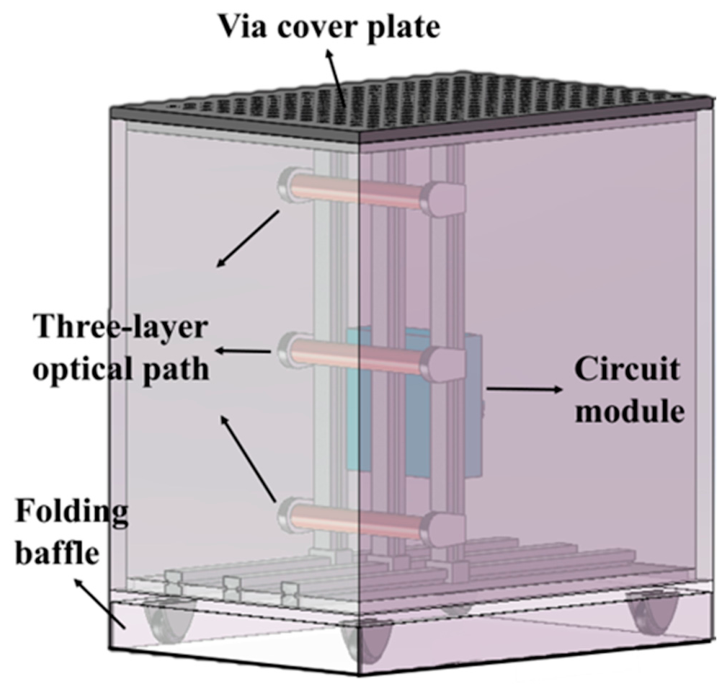
The optical–mechanical module employs three independent Whittaker cells (effective optical path length approximately 10 m) as optical sensing units, paired with a 2004 nm DFB laser light source (maximum output power 4.5 mW). The detection modules are arranged vertically within a height range of 10–80 cm to monitor CO2 concentration at multiple heights. A folding baffle at the system base reduces external airflow interference, while a perforated plate at the top maintains atmospheric pressure equilibrium. The electronic module employs an STM32H743VIT6 (STMicroelectronics, Geneva, Switzerland) microcontroller operating in two channels: one generates scanning signals while driving the laser via temperature and current control, the other controls an AD converter to acquire photodetector signals. Integrated circuits for low-noise photodetection, high-precision temperature control (±0.01 °C), and wavelength locking ensure stable laser operation. The communication and software module interfaces with the host computer via TCP protocol (IP: 192.168.6.10, Port: 5000). The host software, developed using LabVIEW 2020, provides communication, data processing (accumulated averaging and wavelet/moving average filtering), concentration correction (activated when temperature difference exceeds 10 °C), storage and display (saving key data in .txt format), and motor control (achieving optical path movement via a 28-step motor). The structure is illustrated in Figure 3:
The system has a data acquisition rate of 4.5 MSPS and 16-bit sampling resolution, and synchronously collects the original light intensity and spectral absorption signals of three optical paths, as well as laser temperature and time information. A foldable baffle is fitted at the bottom of the system. It can be stretched down to make contact with the ground and enclose the adjacent region, so as to isolate the internal CO2 from disturbances caused by the external environment. Driven by a stepper motor, the multi-pass cells located in the middle layer can achieve vertical displacement, and the three groups of such cells are able to move horizontally as an integrated unit to realize full-space gas detection. The upper part of the device is equipped with a uniformly arranged orifice plate, with a pore diameter of about 2.5 mm and a spacing of 2 mm. This structure permits CO2 to diffuse through the top pores and keeps the internal and external pressures balanced. The device is sealed with acrylic baffles around and on the top, which are only opened for equipment debugging. The three-dimensional structure allows gas to diffuse vertically, passing through three open gas cells in sequence before finally diffusing out of the instrument. A soil respiration CO2 collector is used to monitor the CO2 concentration from soil respiration. The acquisition process is as follows: initialization (setting IP address, storage mode, etc.) and self-test (GPS time synchronization) are carried out first; then acquisition is started, and the signals are amplified, denoised, filtered, and converted by AD and the measured data are uploaded to the host computer via the TCP communication protocol. In this study, 26 monitoring sites were set in different regions of Taiyuan, China. The relevant monitoring data are presented in the following sections.
To adapt to the complex terrain and intense human disturbance characteristics of energy-based cities, this study optimized the TDLAS monitoring platform in two aspects: (1) Spatial layout optimization: Three vertical gradient sensing units (15 cm, 25 cm, 35 cm above the soil surface) were set to capture the vertical concentration gradient of CO2 released by soil respiration, avoiding the uncertainty caused by single-point concentration measurement; (2) Data processing optimization: Ternary linear fitting was adopted to calculate the concentration gradient, comprehensively utilizing the observation information of three gradients to reduce the impact of local environmental noise (e.g., short-term wind disturbance) on results. This optimized scheme improves the adaptability and reliability of TDLAS technology in non-ideal field environments of energy-based cities.

2.3.3. Spatial Autocorrelation Analysis of Carbon Flux

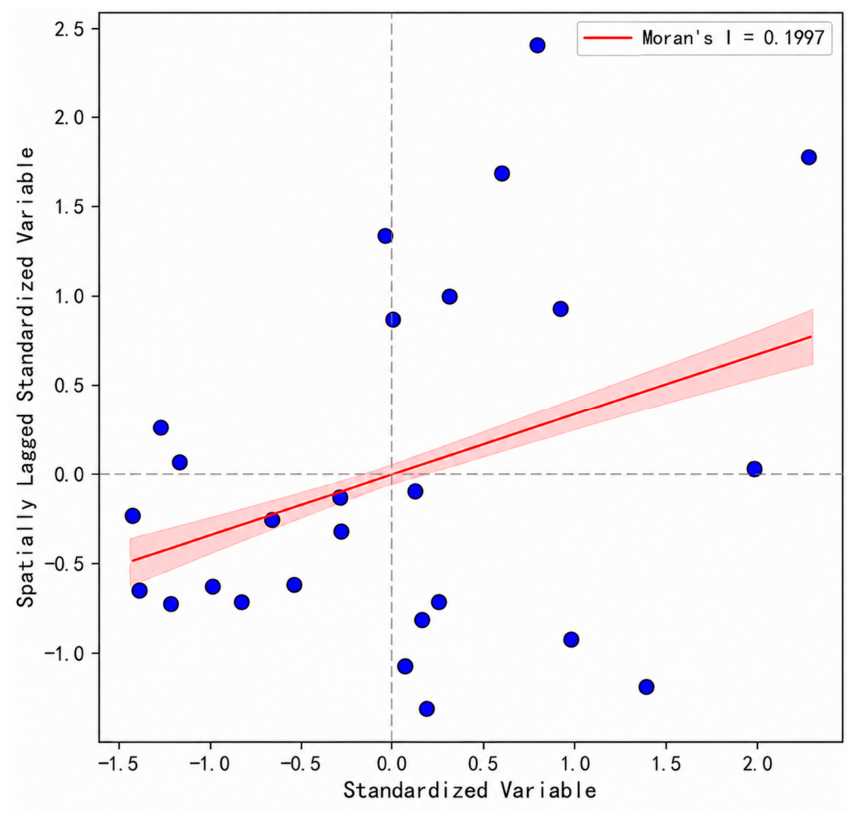
To explore the spatial distribution pattern of carbon flux measured by TDLAS, global spatial autocorrelation analysis was conducted using Moran’s I index [41]. This method was used to examine whether the carbon flux values showed potential spatial clustering or dispersion among the monitoring sites. The spatial weight matrix and row-standardized weighting scheme were constructed following established spatial autocorrelation analysis methods [42]. The global spatial autocorrelation analysis was performed using the Spatial Autocorrelation (Global Moran’s I) tool in the Spatial Statistics toolbox of ArcGIS.
A K-nearest-neighbor (KNN) method with K = 4 was adopted to construct the spatial weight matrix W, which defined the spatial adjacency relationship between sampling sites. This method was chosen because it is more suitable for discrete sampling points in urban areas than the distance threshold method, avoiding the problem of isolated points with no neighbors. The weight matrix was row-standardized (W′ = W/∑W) to ensure that the sum of weights for each site was 1, reducing the influence of uneven sampling density. The global Moran’s I index was calculated as follows:
I = n i = 1 n j = 1 n w i j x i x ¯ x j x ¯ i = 1 n j = 1 n w i j i = 1 n ( x i x ¯ ) 2
where n is the number of sampling sites ( n = 26), x i is the carbon flux value at site i , x ¯ is the mean carbon flux value across all sites, and w i j is the spatial weight between site i and site j , which takes a value of 1 if j is one of the 4 nearest neighbors of i and 0 otherwise. The statistical significance of Moran’s I was tested using a permutation test with 999 permutations, which generated a simulated distribution of I values under random spatial arrangement. The resulting Z-score and p-value were used to evaluate the spatial autocorrelation result. A p-value less than 0.05 was considered to indicate statistically detectable spatial autocorrelation under the exploratory framework of this study. A Z-score greater than 1.96 corresponds to positive spatial autocorrelation, whereas a Z-score less than −1.96 corresponds to negative spatial autocorrelation.
It should be noted that the global Moran’s I analysis in this study was used as an exploratory spatial diagnostic rather than as definitive evidence of strong spatial dependence. Because the field monitoring network contained 26 discrete sampling sites across the prefecture-level administrative territory of Taiyuan, the statistical power of spatial autocorrelation analysis was limited, and the results may be affected by boundary effects, uneven point spacing, and local environmental variability. Therefore, the Moran’s I result was interpreted together with field observations, land-use background, topographic conditions, and spatial visualization rather than being used as an independent basis for causal inference.

2.4. Statistical Comparison and Exploratory Analysis

To reduce the reliance on purely descriptive interpretation, formal statistical comparisons were further conducted using the site-level SOC values derived from the 26 independent sampling sites. Prior to group comparison, the normality and homogeneity of variance of SOC values were checked using the Shapiro–Wilk test and Levene’s test, respectively. For the comparison between mountainous and plain areas, Welch’s t-test was used because it is relatively robust to unequal variances and small sample sizes. For the comparison among different land-use types, one-way analysis of variance (ANOVA) was performed. When the assumptions of normality or homogeneity of variance were not fully satisfied, the corresponding non-parametric Kruskal–Wallis test was used as a robustness check. Effect sizes were also reported, including Cohen’s d for the two-group terrain comparison and eta-squared (η2) for the land-use comparison.
In addition, considering the limited number of independent monitoring sites, this study did not apply geographically weighted regression or high-dimensional multivariate spatial models. The 26-site sampling network was designed to ensure administrative coverage and environmental representativeness rather than to support dense spatial modelling. Therefore, applying geographically weighted regression under this sampling condition could lead to unstable local coefficients and overinterpretation. Instead, formal comparative tests and global spatial autocorrelation analysis were used to provide quantitative support for the observed spatial patterns, while the potential roles of land use, topography, vegetation cover, urbanization, and industrial disturbance were interpreted as associated factors rather than statistically isolated causal drivers.

3. Results

3.1. Spatial Variation Characteristics of Soil Organic Carbon

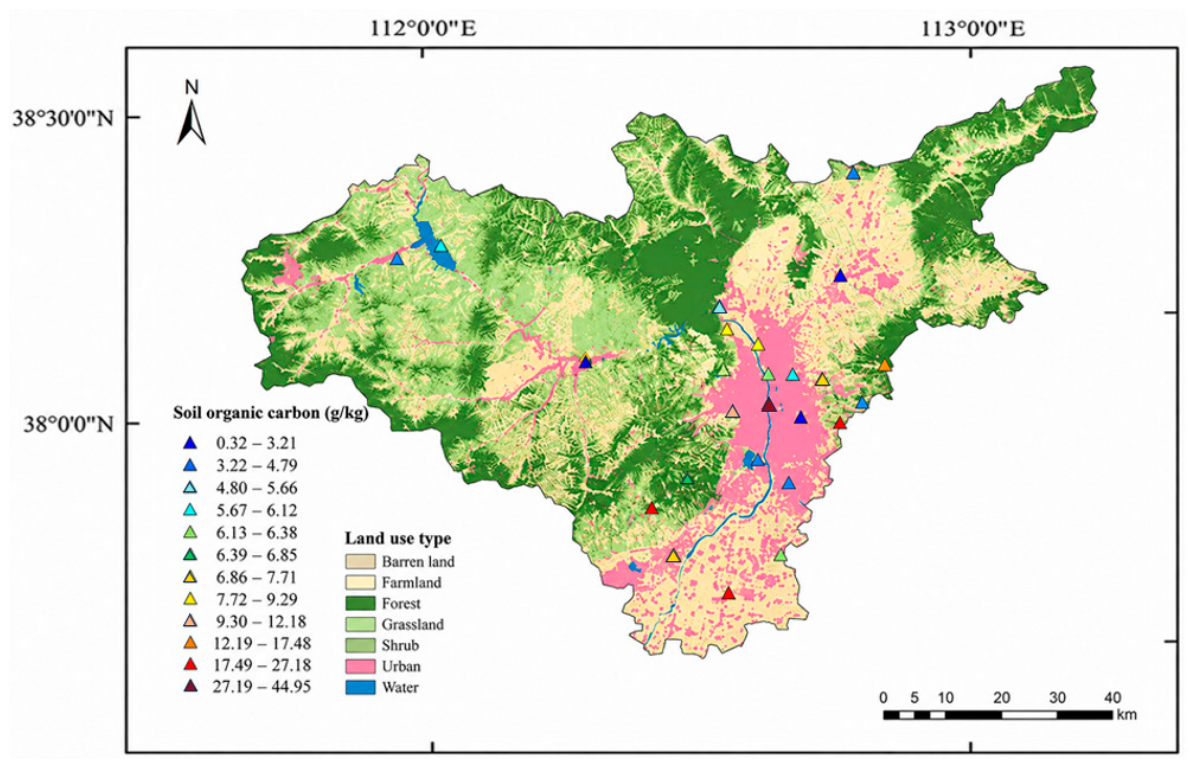
Figure 4 shows the spatial distribution of land-use types in Taiyuan City. Forestland and grassland are mainly distributed in mountainous and hilly areas. Arable land is primarily distributed in the central and southern plain areas. Urban and construction land is mainly concentrated in the central built-up area and surrounding expansion zones. Therefore, Figure 4 provides the land-use background for interpreting the spatial variation in SOC and soil carbon flux in Taiyuan.
Prior to the calculation of site-level soil organic carbon (SOC) values, quality control was implemented for the 78 replicate soil samples, consisting of three field replicates collected at each of the 26 independent sampling sites, using the Interquartile Range (IQR) criterion as a quality-control screening procedure. A total of 7 individual replicate values were identified as outliers using this criterion. For each independent sampling site, the final SOC value used for spatial interpolation and site-level comparison was calculated as the mean of the remaining valid replicate values. Therefore, most site-level SOC values were calculated from three valid field replicates, whereas a small number of site-level values were calculated from two valid field replicates after one outlier had been excluded. No independent sampling site had fewer than two valid replicate values after quality control.
The overall distribution of SOC content for the 78 replicate soil samples before site-level aggregation is presented in Table 1. The maximum SOC content in the topsoil of Taiyuan was 28.20 g/kg, with a minimum of 2.80 g/kg and an average of 10.86 g/kg. This average falls below the national average of 17.52 g/kg, placing it within the Grade III level of the national soil nutrient classification standards established during the Second National Soil Survey. The standard deviation was 7.29 g/kg, indicating substantial variation in SOC content across different replicate samples. This variation may reflect differences in land-use practices, soil types, and management measures within the region. The coefficient of variation (CV) was 0.67, representing moderate variability.
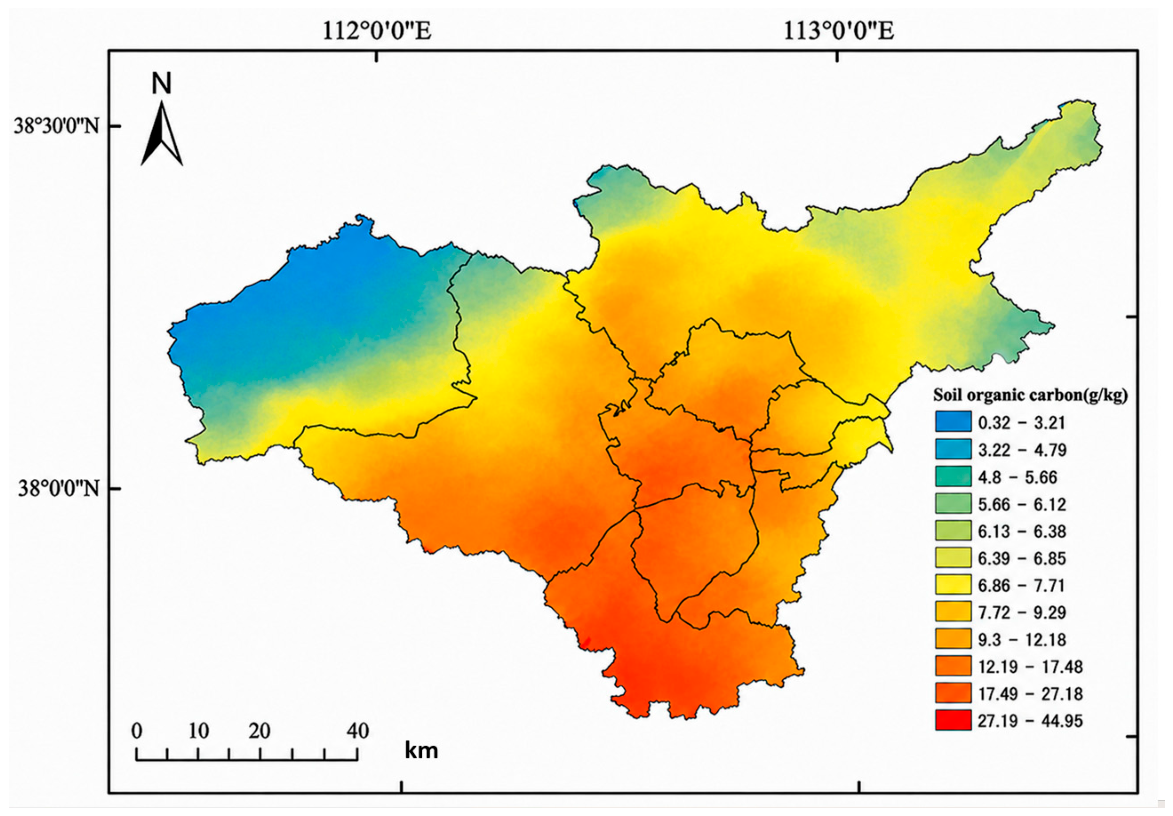
Figure 5 shows the interpolated spatial distribution of SOC across Taiyuan. The highest interpolated SOC map classes were mainly distributed in the southern and southwestern plain areas, with the upper class ranging from 17.19 to 44.95 g/kg. The central region showed moderate interpolated SOC values, ranging from approximately 6.66 to 17.48 g/kg. Lower interpolated SOC values were mainly observed in the northern and northeastern mountainous areas, where the lower map classes were predominantly within the range of 0.32–5.65 g/kg. Overall, the interpolated SOC map indicates clear spatial heterogeneity across the study area.

3.2. Topographical Comparison Analysis of Soil Organic Carbon

Among the 26 sampling points, 13 were located in mountainous areas and 13 in plains. The average soil organic carbon content in mountainous areas was 9.30 g/kg, whereas that in plains was 11.88 g/kg.
Table 2 compares SOC contents between mountainous and plain terrain. Among the 26 sampling points, 13 were located in mountainous areas and 13 in plain areas. The average SOC content was 9.30 g/kg in mountainous areas and 11.88 g/kg in plain areas. The maximum SOC content was 22.2 g/kg in mountainous areas and 23.3 g/kg in plain areas, while the minimum SOC content was 3.95 g/kg and 3.45 g/kg, respectively. Welch’s t-test was further conducted to examine whether the terrain-based difference was statistically significant. The result showed that the SOC difference between plain and mountainous areas was not statistically significant, although the mean value was descriptively higher in the plains than in the mountainous areas (t = 0.98, df = 21.71, p = 0.338). The effect size was small to moderate (Cohen’s d = 0.38). Therefore, the terrain-related SOC difference observed in this study should be interpreted as a descriptive tendency rather than a statistically confirmed terrain effect.

3.3. Soil Organic Carbon Variations Among Different Land Use Types

Table 3 presents the descriptive statistics of SOC content under three land-use types: farmland, forestland, and grassland.
Table 3 presents the descriptive statistics of SOC content under three land-use types: arable land, forestland, and grassland. Arable land showed an average SOC content of 12.47 g/kg, with values ranging from 3.95 to 22.83 g/kg. Forestland showed an average SOC content of 12.07 g/kg, with values ranging from 4.67 to 23.33 g/kg. Grassland showed an average SOC content of 8.27 g/kg, with values ranging from 3.45 to 22.22 g/kg. At the descriptive level, arable land and forestland showed higher mean SOC values than grassland. A one-way ANOVA was further conducted to test whether SOC differed significantly among the three land-use types. The result indicated that the difference among land-use groups was not statistically significant at the 0.05 level (F = 1.16, df = 2.23, p = 0.332), although the effect size suggested a modest land-use-related variation (η2 = 0.091). Therefore, land-use type may be associated with SOC variation in the present dataset, but the observed difference should not be interpreted as a statistically confirmed land-use effect due to the limited number of sampling sites and the relatively large within-group variability.
To further support the descriptive comparison above, formal statistical tests were conducted using the site-level SOC values from the 26 independent sampling sites. For the terrain comparison, Welch’s t-test was used to compare SOC content between mountainous and plain areas. For the land-use comparison, one-way ANOVA was used to compare SOC content among arable land, forestland, and grassland. The results are summarized in Table 4.
As shown in Table 4, neither the terrain-based SOC difference nor the land-use-based SOC difference reached statistical significance at the 0.05 level. Therefore, although plain areas showed a higher mean SOC value than mountainous areas, and arable land and forestland showed higher mean SOC values than grassland, these differences should be interpreted as descriptive tendencies rather than statistically confirmed effects. This result also indicates that the observed spatial heterogeneity of SOC may be influenced by multiple interacting factors, including land-use background, vegetation input, terrain conditions, soil disturbance, and local management practices.

3.4. Summary of SOC Distribution Characteristics

Overall, SOC in Taiyuan showed clear spatial heterogeneity. The 78 replicate soil samples had an average SOC content of 10.86 g/kg, with a minimum of 2.80 g/kg and a maximum of 28.20 g/kg. Plain areas showed a higher mean SOC value than mountainous areas, and arable land and forestland showed higher mean SOC values than grassland at the descriptive level. However, formal statistical tests indicated that these terrain- and land-use-related differences were not statistically significant at the 0.05 level. Spatially, relatively high SOC values were mainly observed in the southern and southwestern plain areas, whereas lower values were mainly observed in parts of the northern and northeastern mountainous areas. These results summarize the observed SOC patterns in the present dataset.

3.5. Regional Distribution of Carbon Flux

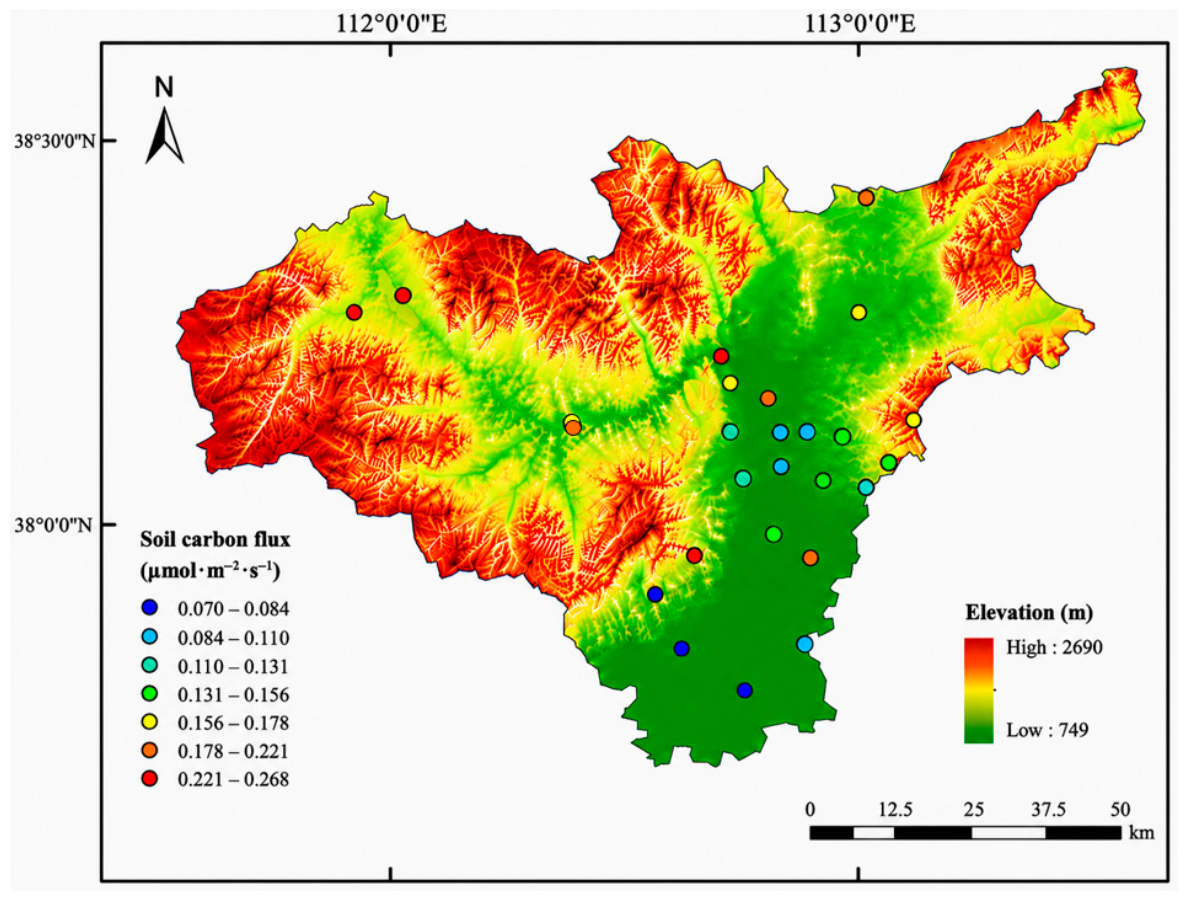
Figure 6 shows the spatial distribution of soil carbon flux and elevation in Taiyuan. The soil carbon flux values are expressed in μmol·m−2·s−1, and elevation is expressed in meters. Overall, soil carbon flux exhibited clear spatial heterogeneity across the study area. Relatively high flux values were observed in some western mountainous areas and several industrial or urban-fringe areas, whereas relatively low flux values were observed in parts of the central urban expansion areas and southern agricultural areas.
The spatial pattern shown in Figure 6 indicates that carbon flux values varied among different regional settings. Western mountainous and hilly areas generally contained several medium-to-high flux points, while the central plains mainly showed moderate flux values. In contrast, several urban expansion areas and southern agricultural sites showed relatively low flux values. These results describe the observed spatial distribution of soil carbon flux.

3.6. Overall Spatial Pattern and Autocorrelation of Soil Carbon Flux

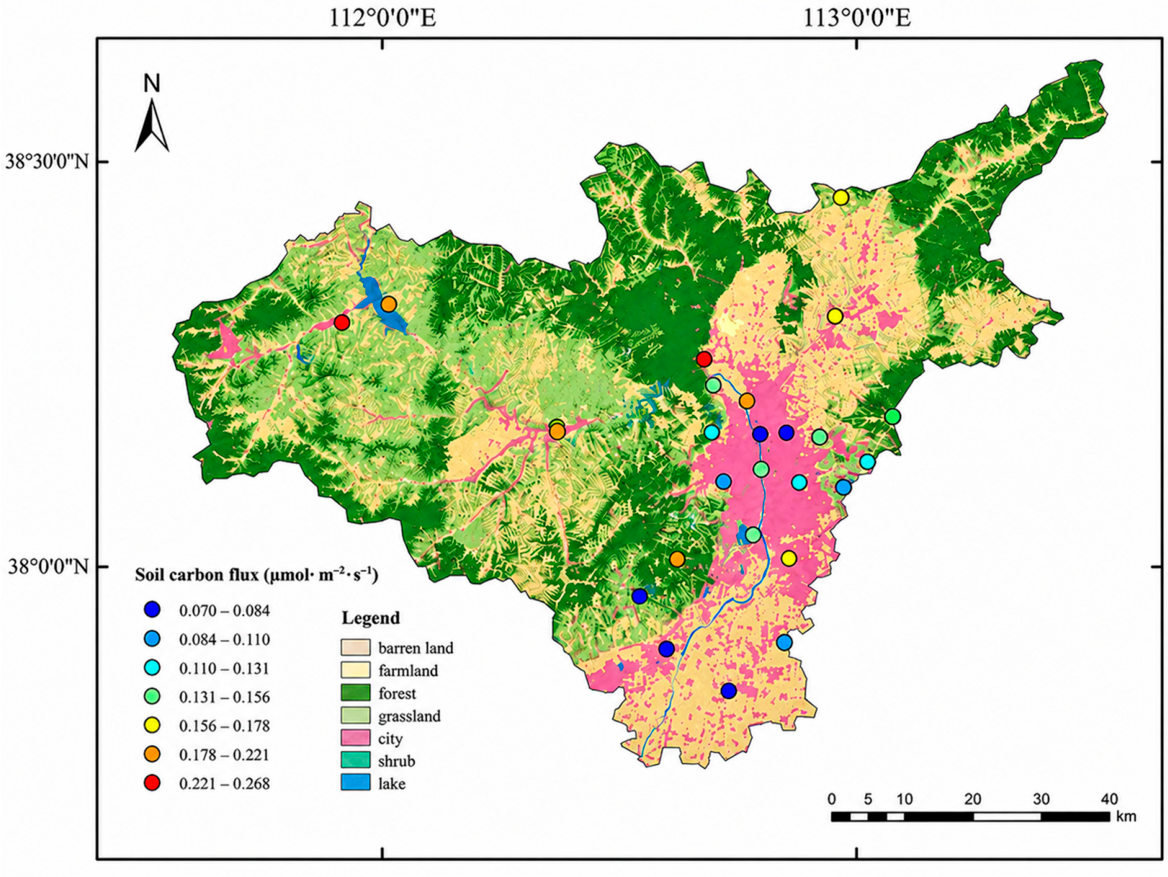
The measured soil carbon flux values across the 26 monitoring sites ranged from 0.0701 to 0.2680 μmol·m−2·s−1, with a mean value of 0.146 μmol·m−2·s−1. Figure 7 presents the spatial distribution of soil carbon flux sampling points over the land-use background in Taiyuan. The flux values showed spatial variation among mountainous ecological areas, industrial-urban fringe areas, central built-up areas, and southern agricultural areas.
As shown in Figure 7, relatively high carbon flux values were mainly observed in the western mountainous ecological zone and several northern industrial ecological transition sites. Moderate flux values were mainly distributed in the central urban built-up area, while relatively low flux values were mainly observed in the southern agriculture-dominated area. This spatial pattern was described based on the observed sampling point values and should be interpreted as a descriptive distribution pattern rather than a statistically tested regional difference.
For soil carbon flux, the global Moran’s I index was 0.1997, with a Z-score of 2.0886 and a p-value of 0.0260. The Moran scatter plot further showed a weak positive spatial autocorrelation pattern for soil carbon flux, as indicated by the fitted regression line and confidence interval shading in Figure 8. This result suggests a weak but positive spatial clustering tendency among the 26 monitoring sites. However, considering the limited number and uneven spatial distribution of sampling sites, the Moran’s I result should be interpreted as exploratory evidence rather than definitive proof of strong spatial dependence.
At the regional level, soil carbon flux values varied among the four regional zones. In the western mountainous ecological barrier zone, including Loufan County, Gujiao City, and the western part of Jinyuan District, flux values generally ranged from 0.1440 to 0.2680 μmol·m−2·s−1. The highest value was observed at Loufan Forest Park in Loufan County, reaching 0.2680 μmol·m−2·s−1. Relatively high values were also observed at Jinci Tianlong Mountain Scenic Area in Jinyuan District and Shuiquanzai Park in Gujiao City, with flux values of 0.2206 μmol·m−2·s−1 and 0.1955 μmol·m−2·s−1, respectively.
In the northern industrial–ecological transition zone, including Jiancaoping District and Yangqu County, flux values ranged from 0.0840 to 0.2521 μmol·m−2·s−1. The highest value in this zone was observed at Taigang Suburban Forest Park in Jiancaoping District, reaching 0.2521 μmol·m−2·s−1. Fenhe Wetland Park also showed a relatively high flux value of 0.1987 μmol·m−2·s−1. In Yangqu County, Yangxing Park and Yuquangu showed flux values of 0.1630 μmol·m−2·s−1 and 0.1783 μmol·m−2·s−1, respectively. By contrast, Taiyuan Forest Park in Jiancaoping District showed a relatively low value of 0.0840 μmol·m−2·s−1.
In the central urban built-up zone, including Xiaodian District, Yingze District, Wanbailin District, and Xinghualing District, soil carbon flux values ranged from 0.0784 to 0.1598 μmol·m−2·s−1. Hexie Park in Xiaodian District showed the highest value in this zone, with a flux of 0.1598 μmol·m−2·s−1. Qingnian Park in Wanbailin District and Longcheng Forest Park in Xinghualing District showed similar values of 0.1564 μmol·m−2·s−1 and 0.1549 μmol·m−2·s−1, respectively. Taiyuan Zoo in Xinghualing District showed the lowest value in this zone, with a flux of 0.0784 μmol·m−2·s−1, while Shuangta Park and Taitaishan Scenic Area in Yingze District showed moderate values of 0.1174 μmol·m−2·s−1 and 0.1312 μmol·m−2·s−1, respectively.
In the southern agriculture-dominated zone, mainly including Qingxu County, soil carbon flux values were relatively low and narrowly distributed, ranging from 0.0701 to 0.0814 μmol·m−2·s−1. The lowest value in the whole study area was observed at Longlin Mountain Scenic Area in Qingxu County, reaching 0.0701 μmol·m−2·s−1. Donghu Park and Yunmengwu Scenic Area showed similarly low values of 0.0720 μmol·m−2·s−1 and 0.0814 μmol·m−2·s−1, respectively. Overall, these regional summaries describe the observed distribution of soil carbon flux values across the 26 monitoring sites. Because no comparative statistical tests were conducted among the regional zones, the differences reported here should be interpreted as descriptive spatial patterns rather than statistically confirmed regional differences.

4. Discussion

The results of this study indicate that SOC storage and soil carbon flux showed different spatial patterns across Taiyuan. SOC was relatively higher in parts of the southern and southwestern plains, whereas soil carbon flux was relatively higher in some mountainous ecological areas and industrial–ecological transition areas. This pattern suggests that SOC concentration and soil carbon flux should be interpreted as related but distinct indicators of soil carbon cycling. SOC represents accumulated surface soil carbon, while soil carbon flux reflects more dynamic soil-atmosphere CO2 exchange processes.
The relatively higher SOC values observed in parts of the southern and southwestern plains are broadly consistent with studies showing that land-use type, vegetation input, and soil management can strongly affect SOC accumulation. Recent land-use change research has shown that conversions among forest, grassland, cropland, and other land-use categories may substantially alter SOC stocks, although the magnitude and direction of change depend on initial SOC level, climate, soil properties, and management history [43]. Similarly, studies in semiarid northern China have emphasized that SOC spatial variability is usually multi-scale and jointly affected by land use, topography, and soil environmental conditions [44]. These findings support our interpretation that the SOC pattern in Taiyuan should not be attributed to a single factor, but rather to the combined influence of land-use background, vegetation input, terrain stability, and local disturbance. The spatial representation of SOC in this study is also consistent with technical studies showing that land-use information can help interpret or improve SOC spatial prediction. For example, previous research on urban green spaces compared kriging combined with land use, ordinary kriging, inverse distance weighting, and radial basis function methods, and emphasized the role of land-use modes in SOC spatial prediction [45]. In the present study, IDW interpolation was used only as an exploratory visualization tool, and the land-use background was used to support the interpretation of SOC spatial patterns rather than to build a predictive spatial model. The relatively low SOC values observed in some urban expansion and disturbed areas are consistent with broader urban soil studies. Impervious surfaces and historical land-use legacies may produce complex SOC patterns in urban soils [46]. Recent urban greenspace SOC studies have also shown that surface SOC distribution in cities is influenced by both environmental conditions and urbanization-related factors [47]. In addition, urbanization may directly or indirectly reduce SOC by altering soil physicochemical properties, microbial communities, and enzyme activities, while vegetation characteristics may partly mitigate this negative effect [48]. Compared with these studies, the present work did not quantify microbial, enzymatic, or physicochemical pathways, but our spatial observations provide exploratory field evidence that disturbed urban and peri-urban surfaces may be associated with lower surface SOC. The observed soil carbon flux pattern may be related to differences in vegetation cover, soil respiration intensity, land-use background, and local hydrothermal conditions. Soil respiration is a major pathway of soil-atmosphere CO2 exchange, and previous studies have shown that soil CO2 flux is closely linked to vegetation productivity, root respiration, microbial decomposition, temperature, and precipitation or moisture conditions. More recent studies also emphasize that soil moisture strongly regulates carbon sequestration and greenhouse gas emissions by affecting photosynthesis, respiration, microbial activity, and soil organic matter dynamics [49]. In this study, relatively elevated flux values in some western mountainous and ecological park areas may therefore be associated with active vegetation growth, litter input, and soil respiration. Relatively high values in some industrial–ecological transition areas may reflect the combined influence of ecological land cover and nearby anthropogenic disturbance. In contrast, relatively low values in some urban expansion and agriculture-dominated areas may be associated with reduced vegetation input, surface modification, or soil disturbance. The mismatch between SOC concentration and soil carbon flux is consistent with the conceptual distinction between carbon pools and short-term CO2 exchange. SOC reflects accumulated soil carbon storage, whereas soil carbon flux is more sensitive to short-term biological activity, temperature, moisture, vegetation status, and disturbance. Recent long-term field observations have shown that the temperature and moisture sensitivities of soil respiration can vary across elevation gradients [50]. Therefore, areas with relatively high soil carbon flux do not necessarily correspond to the highest measured SOC concentrations. This helps explain why some mountainous ecological or park areas in Taiyuan showed relatively active carbon flux but did not always show the highest surface SOC values. Thus, the present study treats SOC-flux relationships as qualitative spatial associations rather than direct numerical correlations.
From a management perspective, the observed spatial patterns suggest differentiated soil carbon management strategies for resource-based cities. In the southern and southwestern plains, where relatively higher SOC values were observed, maintaining organic matter input and reducing excessive soil disturbance may help preserve surface SOC. In urban expansion and highly disturbed areas, increasing functional green space and restoring disturbed soils may support urban soil carbon recovery. In mountainous ecological barrier zones and industrial–ecological transition areas, continuous carbon flux monitoring may help identify areas with active soil-atmosphere CO2 exchange and support more targeted ecological management. These implications should be interpreted cautiously because the present study provides exploratory spatial evidence rather than causal attribution of individual environmental or anthropogenic drivers.
Several limitations should also be considered when interpreting the above discussion and the conclusions. First, the sampling scheme was designed to ensure administrative coverage and environmental representativeness rather than to follow a strictly area-proportional or regular-grid sampling strategy. Therefore, larger administrative units were not assigned proportionally larger numbers of sampling sites. Second, the spatial interpolation and Moran’s I analysis were based on 26 discrete monitoring sites across a relatively large prefecture-level administrative area. Although the K-nearest-neighbor method was used to construct the spatial weight matrix, the low sampling density may still introduce boundary effects, local uncertainty, and reduced statistical power. Therefore, the interpolated SOC surface and Moran’s I result should be regarded as exploratory spatial evidence rather than definitive high-resolution prediction or conclusive proof of strong spatial dependence.
In addition, although formal comparative tests were performed, the explanatory strength of the statistical analysis remains constrained by the limited number of independent monitoring sites. The terrain-based Welch’s t-test and land-use-based ANOVA did not show statistically significant differences at the 0.05 level, indicating that the observed group-level SOC differences should be interpreted cautiously. Geographically weighted regression, high-dimensional multivariate regression, and structural equation modeling were not applied because the 26-site sampling network and the available explanatory variables were insufficient to support stable parameter estimation or causal decomposition. Future studies should increase sampling density, improve spatial balance, collect detailed explanatory variables such as soil texture, soil moisture, bulk density, vegetation indices, impervious surface ratio, microbial indicators, enzyme activity, distance to industrial areas, and land-management intensity, and apply multivariate or spatially explicit models to verify the relative contributions of environmental and anthropogenic factors to SOC storage and soil carbon flux.

5. Conclusions

This study conducted an exploratory assessment of SOC and soil carbon flux in Taiyuan in 2024 by integrating field sampling, laboratory SOC determination, TDLAS-based CO2 monitoring, and GIS-based spatial visualization. The results showed that SOC and soil carbon flux both exhibited clear spatial heterogeneity, but their spatial patterns were not completely consistent. Relatively high SOC values were mainly observed in the southern and southwestern plain areas, while relatively high carbon flux values appeared in some western mountainous ecological areas and several industrial–ecological transition sites. The western mountainous areas functioned as important well-vegetated ecological barrier zones, but they did not correspond to the highest measured surface SOC concentrations in this study. These findings suggest that SOC and soil carbon flux should be treated as related but different indicators of soil carbon cycling.
Based on the observed spatial patterns, several region-specific management implications can be proposed. In the southern and southwestern plain areas with relatively high SOC values, soil carbon management should focus on maintaining organic matter input, improving farmland soil conservation, and avoiding excessive soil disturbance. In urban expansion zones and highly disturbed surfaces with relatively low SOC values, priority should be given to increasing functional green spaces, reducing unnecessary surface hardening, and restoring disturbed urban soils. In industrial–ecological transition areas where relatively high carbon flux values were observed, continuous CO2 flux monitoring and ecological buffer construction may help identify areas with intensified soil-atmosphere CO2 exchange. In the western mountainous ecological barrier zones, vegetation conservation and soil erosion control remain important for maintaining regional ecological stability.
Overall, this study provides an exploratory TDLAS-GIS workflow for monitoring soil carbon storage and soil carbon flux in a resource-based city. The findings provide preliminary support for regional soil carbon monitoring, ecological restoration planning, and sustainable land management under the “dual carbon” strategy.

Author Contributions

Conceptualization, L.J. and S.W.; methodology, L.G.; software, G.D.; validation, Z.S., Y.L. and Y.M.; formal analysis, Z.S.; investigation, L.G.; resources, L.J.; data curation, G.D.; writing—original draft preparation, G.D.; writing—review and editing, L.J. and Q.Y.; visualization, Q.Y.; supervision, S.W. and Q.Y.; project administration, L.J.; funding acquisition, Q.Y. All authors have read and agreed to the published version of the manuscript.

Funding

This research was funded by the 2024 Annual Project of Institute for Sustainable Development, Huzhou University (No. ISY2403), the Natural Science Foundation of Xinjiang Uygur Autonomous Region (No. 2025D01C74), the Open Research Program of Huzhou Key Laboratory of Urban Multidimensional Perception and Intelligent Computing (No. UMPIC202402) and the Public Welfare Project of Huzhou Municipal Bureau of Science and Technology (No. 2022GZ36).

Institutional Review Board Statement

Not applicable.

Informed Consent Statement

Not applicable.

Data Availability Statement

The data presented in this study can be requested from the first author for further use (G.D.).

Acknowledgments

The authors would like to acknowledge the valuable comments by the editors and reviewers, which have greatly improved the quality of this work.

Conflicts of Interest

The authors declare no conflicts of interest.

References

  1. Lal, R. Soil carbon sequestration impacts on global climate change and food security. Science 2004, 304, 1623–1627. [Google Scholar] [CrossRef] [PubMed]
  2. Hou, Q.; Yu, X. Seasonal variation in carbon flux and the driving mechanisms in the grassland ecosystem in a mountain region of Northwest China. Ecol. Indic. 2025, 179, 114168. [Google Scholar] [CrossRef]
  3. Post, W.M.; Emanuel, W.R.; Zinke, P.J.; Stangenberger, A.G. Soil carbon pools and world life zones. Nature 1982, 298, 156–159. [Google Scholar] [CrossRef]
  4. West, T.O.; Marland, G. A synthesis of carbon sequestration, carbon emissions, and net carbon flux in agriculture: Comparing tillage practices in the United States. Agric. Ecosyst. Environ. 2002, 91, 217–232. [Google Scholar] [CrossRef]
  5. Rong, T.; Zhang, P.; Zhu, H.; Jiang, L.; Li, Y.; Liu, Z. Spatial correlation evolution and prediction scenario of land use carbon emissions in China. Ecol. Inform. 2022, 71, 101802. [Google Scholar] [CrossRef]
  6. Liu, Z.; Zhu, H.; Wilson, J.; Adams, M.; Walker, T.R.; Xu, Y.; Tang, Y.; Wang, Z.; Liu, T.; Chen, Q. Achieving China’s ‘double carbon goals’, an analysis of the potential and cost of carbon capture in the resource-based area: Northwestern China. Energy 2024, 292, 130441. [Google Scholar] [CrossRef]
  7. Yu, H.; Song, W. Research progress on the impact of land use change on soil carbon sequestration. Land 2023, 12, 213. [Google Scholar] [CrossRef]
  8. Wang, S.; Adhikari, K.; Zhuang, Q.; Gu, H.; Jin, X. Impacts of urbanization on soil organic carbon stocks in the northeast coastal agricultural areas of China. Sci. Total Environ. 2020, 721, 137814. [Google Scholar] [CrossRef] [PubMed]
  9. Raich, J.W.; Schlesinger, W.H. The global carbon dioxide flux in soil respiration and its relationship to vegetation and climate. Tellus B 1992, 44, 81–99. [Google Scholar] [CrossRef]
  10. Li, Q.; Xia, X.; Kou, X.; Niu, L.; Wan, F.; Zhu, J.; Xiao, W. Forest carbon storage and carbon sequestration potential in Shaanxi Province, China. Forests 2023, 14, 2021. [Google Scholar] [CrossRef]
  11. Feng, Y.; Wang, L.; Nie, C. Can place-based policy reduce carbon emissions? Evidence from industrial transformation and upgrading exemplary zone in China. Humanit. Soc. Sci. Commun. 2024, 11, 877. [Google Scholar] [CrossRef]
  12. Yang, J.; Chen, F.; Wang, Y.; Mao, J.; Wang, D. Performance evaluation of ecological transformation of mineral resource-based cities: From the perspective of stage division. Ecol. Indic. 2023, 154, 110540. [Google Scholar] [CrossRef]
  13. Peng, Y.; Cheng, W.; Xu, X.; Song, H. Analysis and prediction of the spatiotemporal characteristics of land-use ecological risk and carbon storage in Wuhan metropolitan area. Ecol. Indic. 2024, 158, 111432. [Google Scholar] [CrossRef]
  14. Liu, Z.; Chen, Z.; Yu, G.; Zhang, W.; Zhang, T.; Han, L. The role of climate, vegetation, and soil factors on carbon fluxes in Chinese drylands. Front. Plant Sci. 2023, 14, 1060066. [Google Scholar] [CrossRef] [PubMed]
  15. Li, Y.; Wei, L.; Zeng, E. Research on the Associations and Indicative Thresholds of Urban Density on Carbon Performance: A Case Study of Chengdu-Chongqing Urban Agglomeration. Urban Build. Sci. 2026, 2, 6. [Google Scholar] [CrossRef]
  16. Gao, H.; Gong, J.; Liu, J.; Ye, T. Effects of land use/cover changes on soil organic carbon stocks in Qinghai-Tibet plateau: A comparative analysis of different ecological functional areas based on machine learning methods and soil carbon pool data. J. Clean. Prod. 2024, 434, 139854. [Google Scholar] [CrossRef]
  17. Bhunia, G.S.; Shit, P.K.; Maiti, R. Comparison of GIS-based interpolation methods for spatial distribution of soil organic carbon (SOC). J. Saudi Soc. Agric. Sci. 2018, 17, 114–126. [Google Scholar] [CrossRef]
  18. Karvinen, E.; Backman, L.; Järvi, L.; Kulmala, L. Soil respiration across a variety of tree-covered urban green spaces in Helsinki, Finland. Soil 2024, 10, 381–406. [Google Scholar] [CrossRef]
  19. Gu, Q.; Wu, Z.; Xie, D. Transformation and development of resource-based cities in China: A review and bibliometric analysis. Front. Environ. Sci. 2022, 10, 975669. [Google Scholar] [CrossRef]
  20. Shu, X.; Gao, L.; Yang, J.; Xia, J.; Song, H.; Zhu, L.; Zhang, K.; Wu, L.; Pang, Z. Spatial distribution characteristics and influencing factors of soil organic carbon based on the geographically weighted regression model. Environ. Monit. Assess. 2024, 196, 1083. [Google Scholar] [CrossRef] [PubMed]
  21. Jiang, B.; Xu, W.; Zhang, D.; Nie, F.; Sun, Q. Contrasting multiple deterministic interpolation responses to different spatial scale in prediction soil organic carbon: A case study in Mollisols regions. Ecol. Indic. 2022, 134, 108472. [Google Scholar] [CrossRef]
  22. Taiyuan Municipal Bureau of Statistics. Taiyuan Statistical Yearbook 2024; China Statistics Press: Beijing, China, 2024; Volume 34, pp. 739–751. [Google Scholar]
  23. Taiyuan Municipal People’s Government. Overview of Taiyuan: Administrative Divisions, Land Resources, and Socio-Economic Development; Taiyuan Municipal People’s Government: Taiyuan, China, 2026. [Google Scholar]
  24. National Bureau of Statistics of China. Tabulation on the 2020 Population Census of the People’s Republic of China; China Statistics Press: Beijing, China, 2022. [Google Scholar]
  25. Ding, X.; Zhao, W.; Yan, T.; Wang, L. Response of Ecosystem Service Value to Spatio-Temporal Pattern Evolution of Land Use in Typical Heavy Industry Cities: A Case Study of Taiyuan City, China. Land 2022, 11, 2035. [Google Scholar] [CrossRef]
  26. China Weather Network. Meteorological Data of Taiyuan; China Statistics Press: Beijing, China, 2026. [Google Scholar]
  27. Cheng, Q.; Wu, X.; Wei, L.; Hu, X.; Ni, J. 30-Year average monthly/1-kmclimate variables dataset of China (1951–1980, 1981–2010). J. Glob. Change Data Discov. 2022, 6, 533–544. [Google Scholar] [CrossRef]
  28. Zhang, Y.; Zhang, G.; Pan, J.; Fan, Z.; Chen, F.; Liu, Y. Soil organic carbon distribution in relation to terrain & land use—A case study in a small watershed of Danjiangkou reservoir area, China. Glob. Ecol. Conserv. 2019, 20, E00731. [Google Scholar] [CrossRef]
  29. Yuan, H.; Zhang, Z.; Feng, D.; Rong, X.; Zhang, S.; Yang, S. Assessment of the impact of land use/land cover change on carbon storage in Chengdu, China, in the context of carbon peaking and carbon neutrality, 2000–2030. Environ. Dev. Sustain. 2025, 27, 26661–26684. [Google Scholar] [CrossRef]
  30. HJ/T 166-2004; Technical Specification for Soil Environmental Monitoring. China Environmental Science Press: Beijing, China, 2004.
  31. HJ 615-2011; Soil—Determination of Organic Carbon—Potassium Dichromate Oxidation Spectrophotometric Method. China Environmental Science Press: Beijing, China, 2011.
  32. Zhang, Z.; Zhou, Y.; Huang, X. Applicability of GIS-based spatial interpolation and simulation for estimating the soil organic carbon storage in karst regions. Glob. Ecol. Conserv. 2020, 21, E00849. [Google Scholar] [CrossRef]
  33. Jia, L.; Li, X.; Zhu, T.; Zang, Y.; Huang, X.; Leng, H.; Gao, L. Design of soil respiration monitoring system based on TDLAS technology. In Proceedings of the 2022 4th International Conference on Intelligent Control, Measurement and Signal Processing (ICMSP); IEEE: New York, NY, USA, 2022. [Google Scholar]
  34. Zhu, X.; Yao, S.; Ren, W.; Lu, Z.; Li, Z. TDLAS monitoring of carbon dioxide with temperature compensation in power plant exhausts. Appl. Sci. 2019, 9, 442. [Google Scholar] [CrossRef]
  35. Zhang, Y.; Shao, L.; Feng, S.; Cheng, T.; Liu, K.; Wang, G.; Chen, J.; Mei, J.; Gao, X. Development of field-deployable TDLAS analyzer for high precision measurements of CO2 and H2O flux. Measurement 2026, 266, 120516. [Google Scholar] [CrossRef]
  36. Griffis, T.J.; Baker, J.; Sargent, S.; Tanner, B.; Zhang, J. Measuring field-scale isotopic CO2 fluxes with tunable diode laser absorption spectroscopy and micrometeorological techniques. Agric. For. Meteorol. 2004, 124, 15–29. [Google Scholar] [CrossRef]
  37. Kabwe, L.; Hendry, M.; Wilson, G.; Lawrence, J. Quantifying CO2 fluxes from soil surfaces to the atmosphere. J. Hydrol. 2002, 260, 1–14. [Google Scholar] [CrossRef]
  38. Drewitt, G.; Black, T.; Jassal, R. Using measurements of soil CO2 efflux and concentrations to infer the depth distribution of CO2 production in a forest soil. Can. J. Soil Sci. 2005, 85, 213–221. [Google Scholar] [CrossRef]
  39. Pingintha, N.; Leclerc, M.; Beasley, J.; Zhang, G.; Senthong, C. Assessment of the soil CO2 gradient method for soil CO2 efflux measurements: Comparison of six models in the calculation of the relative gas diffusion coefficient. Tellus B Chem. Phys. Meteorol. 2010, 62, 47–58. [Google Scholar] [CrossRef]
  40. Hao, W.; Xia, B.; Li, J.; Xu, M. Deep soil CO2 flux with strong temperature dependence contributes considerably to soil-atmosphere carbon flux. Ecol. Inform. 2023, 74, 101957. [Google Scholar] [CrossRef]
  41. Moran, P.A. Notes on continuous stochastic phenomena. Biometrika 1950, 37, 17–23. [Google Scholar] [CrossRef]
  42. Bivand, R.S.; Pebesma, E.J.; Gómez-Rubio, V. Applied Spatial Data Analysis with R; Springer: Berlin/Heidelberg, Germany, 2008. [Google Scholar]
  43. Huang, X.; Ibrahim, M.M.; Luo, Y.; Jiang, L.; Chen, J.; Hou, E. Land use change alters soil organic carbon: Constrained global patterns and predictors. Earth’s Future 2024, 12, E2023EF004254. [Google Scholar] [CrossRef]
  44. Li, L.; Yue, Y.; Qin, F.; Dong, X.; Sun, C.; Liu, Y.; Zhang, P. Multi-scale characterization of spatial variability of soil organic carbon in a semiarid zone in Northern China. Sustainability 2022, 14, 9390. [Google Scholar] [CrossRef]
  45. Guo, X.; Liu, Z.; Gao, D.; Xu, C.; Zhang, K.; Liu, X. Application of land use modes in the spatial prediction of soil organic carbon in urban green spaces. Int. Agrophysics 2023, 37, 1–14. [Google Scholar] [CrossRef]
  46. Bae, J.; Ryu, Y. High soil organic carbon stocks under impervious surfaces contributed by urban deep cultural layers. Landsc. Urban Plan. 2020, 204, 103953. [Google Scholar] [CrossRef]
  47. Guo, H.; Du, E.; Terrer, C.; Jackson, R.B. Global distribution of surface soil organic carbon in urban greenspaces. Nat. Commun. 2024, 15, 806. [Google Scholar] [CrossRef] [PubMed]
  48. Zhang, F.; Zhong, J.; Zhao, Y.; Cai, C.; Liu, W.; Wang, Q.; Wang, W.; Wang, H.; Jiang, X.; Yuan, R. Urbanization-induced soil organic carbon loss and microbial-enzymatic drivers: Insights from aggregate size classes in Nanchang city, China. Front. Microbiol. 2024, 15, 1367725. [Google Scholar] [CrossRef] [PubMed]
  49. Hao, Y.; Mao, J.; Bachmann, C.M.; Hoffman, F.M.; Koren, G.; Chen, H.; Tian, H.; Liu, J.; Tao, J.; Tang, J. Soil moisture controls over carbon sequestration and greenhouse gas emissions: A review. npj Clim. Atmos. Sci. 2025, 8, 16. [Google Scholar] [CrossRef]
  50. Yan, J.; Tong, M.; Liu, J.; Li, J.; Li, H. Temperature and moisture sensitivities of soil respiration vary along elevation gradients: An analysis from long-term field observations. Sci. Total Environ. 2024, 912, 169150. [Google Scholar] [CrossRef] [PubMed]
Figure 1. Elevation Map of Taiyuan City.
Sustainability 18 06507 g001
Figure 2. Sampling point locations across the administrative units of Taiyuan.
Sustainability 18 06507 g002
Figure 3. Schematic Diagram of the Optical-Mechanical Structure.
Sustainability 18 06507 g003
Figure 4. Spatial Distribution of Land Use Types in Taiyuan City.
Sustainability 18 06507 g004
Figure 5. Overall distribution of soil organic carbon assessed by IDW interpolation.
Sustainability 18 06507 g005
Figure 6. Distribution Map of Soil Carbon Flux in Taiyuan City.
Sustainability 18 06507 g006
Figure 7. Spatial distribution of soil carbon flux (μmol·m−2·s−1) over the land-use background in Taiyuan.
Sustainability 18 06507 g007
Figure 8. Moran scatter plot of soil carbon flux with fitted regression line and confidence interval shading. Blue dots represent site-level observations, the red line indicates the fitted regression line, and the pink shaded area represents the confidence interval.
Sustainability 18 06507 g008
Table 1. Overall distribution of SOC content for the 78 replicate soil samples.
Sample SizeMaxMinMeanStandard DeviationCV
7828.202.8010.867.290.67
Table 2. Descriptive statistics of SOC content in mountainous and plain areas.
TerrainSample SizeMaxMinAverageStandard Deviation
Mountainous region1322.23.959.305.52
Plain1323.33.4511.887.73
Table 3. Descriptive statistics of SOC content across different land-use types.
Land UseSample SizeMaxMinAverageStandard Deviation
Arable land822.833.9512.478.30
Forest land723.334.6712.076.49
Grass land1122.223.458.275.36
Table 4. Formal statistical comparison of SOC content across terrain and land-use groups.
ComparisonGroup-Level SOC Content, Mean ± SD (g/kg)Test MethodTest Statisticp-ValueEffect SizeInterpretation
Terrain typeMountainous area: 9.30 ± 5.52; Plain area: 11.88 ± 7.73Welch’s t-testt = 0.98,
df = 21.71
0.338Cohen’s d = 0.38Not significant
Land-use typeArable land: 12.47 ± 8.30; Forestland: 12.07 ± 6.49; Grassland: 8.27 ± 5.36One-way ANOVAF = 1.16, df = 2.230.332η2 = 0.091Not significant
Disclaimer/Publisher’s Note: The statements, opinions and data contained in all publications are solely those of the individual author(s) and contributor(s) and not of MDPI and/or the editor(s). MDPI and/or the editor(s) disclaim responsibility for any injury to people or property resulting from any ideas, methods, instructions or products referred to in the content.