Article

Does Green Finance Promote Green Development? Examining the Mechanisms of Green Innovation and Environmental Decentralization

School of Business, Macau University of Science and Technology, Macau 999078, China
*
Author to whom correspondence should be addressed.
Sustainability 2026, 18(12), 6339; https://doi.org/10.3390/su18126339 (registering DOI)
Submission received: 14 May 2026 / Revised: 17 June 2026 / Accepted: 19 June 2026 / Published: 21 June 2026
(This article belongs to the Topic Sustainable and Green Finance)

Abstract

This study examines whether green finance promotes green development across Chinese prefecture-level cities from 2005 to 2019. We find a positive association between green finance and green development using panel regressions with city and year fixed effects. This result remains robust after accounting for potential endogeneity and implementing a series of robustness checks. Further heterogeneity analysis shows that this positive effect is stronger in regions characterized by high fiscal capacity and within the Yangtze River Economic Belt. Additionally, green finance drives regional green development by promoting green innovation. Environmental decentralization moderates the relationship, with a stronger positive effect at higher levels of decentralization. This study offers empirical evidence regarding how green finance shapes green development outcomes.

1. Introduction

In the endeavor to achieve sustainable economic advancement, green development is a key focus in many fields. Green development aims for harmony between economic growth and ecological protection. It provides a path towards long-term development. But green development is constrained by structural issues, such as resource depletion, ecological damage, and environmental pollution. Heavy industries and intensive resource manufacturing have exacerbated these situations, leading to significant ecological damage. Additionally, rapid urbanization and rising energy consumption have contributed to economic growth but have imposed additional environmental burdens [1]. Under such circumstances, green development has become a national priority in China.
By optimizing economic structures and accelerating the shift in the growth model, green finance has long been employed as a critical policy instrument for green development [2]. It enhances ecological efficiency and aligns financial instruments with environmental objectives. Green finance includes green investments, green credits, green bonds, and others. Unlike traditional finance, green finance directs capital towards sustainable projects. For example, green credit boosts sustainable projects with efficient resource applications [3]. Green bonds have accelerated the low-carbon economy transition by channeling capital flows toward eco-friendly projects [4]. Moreover, green finance contributes to green innovation through easing firms’ capital constraints and supporting their greening capacity [5]. It also strengthens firms’ strategic resilience by supporting media reputation, providing funds, and improving governance efficiency [6]. Despite these findings, the overall role and macroeconomic impact of green finance remain insufficiently analyzed. Employing prefecture-level panel data of China over the period, this study investigates how green finance affects regional green development. A two-way fixed effects model reveals that green finance promotes green development. We explore the regional heterogeneity in this relationship. The impact is significant in the cities of the Yangtze River Economic Belt (YREB) and cities with strong fiscal capacity. Mechanism analysis shows that green innovation and environmental decentralization further reinforce this relationship.
This study makes three major contributions to existing literature. First, this study expands the perspective of green finance and green development research. Existing studies have primarily focused on firms’ greening capability [7], corporate sustainability [8], sustainable industrial restructuring [9], and environmental responsibility engagement [10]. However, there has been relatively limited attention at the urban level. Our research constructs a panel dataset covering 257 prefecture-level cities in China from 2005 to 2019. Compared with studies based on firm-level data, the prefecture-level perspective provides more detailed insights into how green finance influences green development across regions. The relatively long observation period further strengthens the analysis by capturing the sustained effects. Second, it presents a framework for examining regional differences in the green finance effect. Specifically, heterogeneity analyses are conducted for cities in the YREB and for regions with different levels of fiscal capacity, thereby identifying the conditions under which green finance more effectively promotes green development. Finally, it highlights crucial mechanisms that can guide policy and regional planning. This paper tests the mechanisms linking green finance and green development from two separate perspectives. Green innovation is tested as a mediating mechanism, and we further distinguish between substantive and strategic forms of green innovation to capture different types of innovation responses. Environmental decentralization is examined as a moderating factor. By incorporating these two mechanisms separately within the same empirical framework, the analysis provides a broader perspective on how green finance contributes to regional green development.
The subsequent sections are structured as follows. Section 2 builds the theoretical framework and formulates the hypotheses. Section 3 explains the data sources, variable measurement, and empirical design. Section 4 provides the main empirical evidence and related analyses. Section 5 closes the study by presenting conclusions, policy implications, limitations, and future research directions.

2. Theoretical Analyses and Research Hypotheses

2.1. Literature Review

Green development is commonly defined as an economic model that seeks to improve people’s quality of life and advance social fairness while mitigating ecological pressures, thereby balancing economic and environmental performance in pursuit of sustainable development. Currently, research has been devoted to measuring green development and identifying its determinants. Although various indicators have been developed, green development is often captured by narrowly defined regional proxies, particularly pollutant discharge. Wang and Luo [11] adopt total industrial sulfur dioxide emissions to capture environmental pollution. Carbon emissions are among the most commonly used single-factor indicators [12,13], given their significant contribution to greenhouse gas accumulation. In addition to single-factor indicators, several studies employ composite measures of green development. Other research constructs composite measures of green development based on the output–input ratio. Green total productivity is a common approach. This measure integrates economic performance and environmental protection within a unified framework. Li et al. [14] evaluate green development through green total factor productivity within an input–output framework. Shi et al. [15] emphasize that carbon emissions are a critical factor that must be incorporated into green total productivity measurement. Li et al. [16] further improved the measurement approach by employing a non-radial directional distance function, reflecting a gradual evolution from a traditional framework to a more comprehensive one that incorporates environmental constraints and undesirable outputs. Subsequent studies have further expanded and refined green development evaluation frameworks by incorporating indicators that capture ecological resources, economic performance, and the mechanisms linking environmental and economic outcomes [17]. Wen et al. 2025 [18] further refined the construction of green development indicators by developing an index system covering resource endowments, economic development, and transition pathways. In addition, the use of methods such as spatial correlation analysis, convergence tests, and random forest models enhances the explanatory power of the index system. Prior research suggests that broader measurement frameworks are needed to reflect the complexity and regional heterogeneity of green development.
In exploring how green finance interacts with green development, prior research indicates that it can strengthen corporate capacity for green investment, regulatory compliance, and governance. In particular, green finance instruments encourage firms to expand their engagement in green patent applications, thereby driving corporate green transformation [19]. Chen et al. [9] analyzes the role of green finance in transforming industrial enterprises toward green development. Green financial development significantly improves green production performance. Similarly, Li and Hua [20] find that environmental tax regulation contributes to improved corporate green performance. Specifically, higher noncompliance costs force enterprises to adopt renewable energy and low-emission production processes, and green technologies to reduce emissions. Recent research has further extended the analytical focus on green finance pilot policies. Liu et al. [21] examines how green finance pilot policies contribute to carbon emission reduction by strengthening corporate engagement. Corporate social and environmental responsibility helps improve corporate reputation, attract policy support, and promote environmentally friendly production [16]. In addition, regional conditions play an important role. Industrial upgrading can enable green finance policies to produce more pronounced reductions in pollution by promoting a shift toward cleaner, more sustainable production structures, while foreign direct investment contributes to emissions reduction through technology spillovers and the diffusion of advanced green production practices [22].
The existing literature primarily concerns how green financial products shape firms’ environmental responsibility or urban emissions reduction, while the underlying mechanisms of this relationship remain underexplored. Therefore, this study develops an integrated analytical framework to examine the theoretical mechanisms and empirical relationships among green finance, green innovation, environmental decentralization, and green development.

2.2. Research Hypotheses

2.2.1. Green Finance and Green Development

Sustainable projects have long production cycles. Their return on investment is uncertain, and they require a large capital outlay at the beginning. These features often create a financing dilemma. In the context of green development, green finance serves as a key source of institutional capital [23]. It promotes regional green development by channeling capital toward sustainable and low-carbon projects. Capital reallocation affects industrial upgrading and technological innovation, which can in turn enhance regional economic growth, environmental quality, and social welfare [3]. Green finance reallocating the responsibility for climate change from the current society to future societies. Therefore, it supports fairness and sustainability between generations in the long term [2]. Notably, green finance generates positive spillover effects to surrounding regions, highlighting its systemic and diffusion effects on regional low-carbon transformation [24]. These discussions provide the basis for the proposed hypothesis:
H1. 
Green finance significantly promotes green development.

2.2.2. The Mediating Effect of Green Innovation

Based on the above analysis, green finance is expected to promote green development. However, this effect may depend on green innovation. Green finance provides essential financial capital for green innovation. Green finance initiatives involve high upfront investment and long payback periods that traditional financing cannot easily cover [3]. By providing a sustainable funding source, green finance promotes environmentally beneficial innovation [25,26]. Green innovation enables the adoption of novel technologies and low-carbon methods. Supported by the rapid growth of green finance markets, green innovation has flourished to mitigate environmental risks, reduce pollution, and minimize resource waste [27]. Thereby, it represents a critical pathway toward green development [28]. Accordingly, the study advances the following hypothesis:
H2. 
Green innovation as an intermediary in promoting green development through green finance.

2.2.3. The Moderation Effect of Environmental Decentralization

Green finance has the core objective of promoting green development by providing financial support. Variations in environmental governance authorities across regions influence the effectiveness of green finance. High environmental decentralization increases local governments’ autonomy and accountability to effectively implement environmental policies [29]. These regions often exhibit more efficient financial systems and stronger technical capacities, which enhance their ability to effectively utilize green finance for green development [30,31]. Moreover, high levels of environmental decentralization can promote green finance and improve regional sustainability [32]. In contrast, under low levels of environmental decentralization, regional green development lags behind due to insufficient environmental oversight and resource mismatches [33]. Similarly, the promotion of green finance faces notable obstacles because of the limited financial autonomy of local governments [34]. Therefore, the hypothesis is proposed.
H3. 
Environmental decentralization positively moderates the relationship between green finance and green development.

3. Research Design

3.1. Data Sources

This study selects 257 prefecture-level cities in China from 2005 to 2019. Data are obtained from the City Statistical Yearbook, the National Intellectual Property Administration, and the CEIC China Database. To reduce potential heteroscedasticity, this study transforms some variables, such as GDP, using logarithms. After removing observations with missing values, the final balanced panel contains 3855 city-year observations.

3.2. Variable Definitions

3.2.1. Dependent Variable

Green development (GD) includes multiple dimensions that reflect sustainability, economic efficiency, and environmental impact. This study develops a three-layer evaluation system with five criterion layers and 26 indicators, drawing on the analytical structure of Cui et al. [35]. Specifically, the index covers environmental growth performance, environmental carrying capacity, and environmental guarantee capability. Detailed information on the indicators, units and attributes is presented in Table 1.
Considering the broader spatial and temporal coverage of this study, the entropy weights are recalculated using the sample of 257 prefecture-level cities. According to the constructed indicator system, the entropy weight method was applied to estimate the objective weights of the selected indicators. This method evaluates the information contribution of each indicator based on the dispersion of its observed values. Indicators with greater variability contain more information and are therefore assigned higher weights [36].
The raw data for each indicator is standardized to convert variables with different measurement units into a comparable dimensionless scale. This study uses the min–max normalization method, which scales the original data to [0, 1] and ensures consistency across indicators. Positive and negative indicators are standardized using Equations (1) and (2), respectively.
X ijt = x ijt min x ij ,   ,   x nj max x ij ,   ,   x nj min x ij ,   ,   x nj
X ijt   = max x ij ,   ,   x nj   x ijt max x ij ,   ,   x nj min x ij ,   ,   x nj
where x ijt denotes the original value of indicator j for city i in year t , and X ijt represents the standardized value. max x ij ,   ,   x nj and min x ij ,   ,   x nj represent the maximum and minimum values of indicator j , respectively.
After standardization, indicator weights were calculated using the entropy weight method. The proportion of the standardized value of indicator j for city i in year t was calculated as:
P ij   =   X ijt i = 1 n X ijt
Based on the definition of entropy, the information entropy E j of indicator j is calculated as:
E j   =   ln n 1 i = 1 n P ij ln P ij
where the entropy value satisfies E j 0 .
Then, the weight W j of indicator j was calculated as:
W j   =   1 E j j = 1 m 1 E j
According to the calculated weights of all indicators, green development index was obtained as:
G it   =   j = 1 M W j X ijt
where G it denotes the green development index of city i in year t , W j denotes the entropy weight of indicator j , and X ijt is the standardized value of indicator j .

3.2.2. Independent Variable

Green finance (GF) is measured using a composite index system comprising seven dimensions. Drawing on Chen and Xie [37], we construct a green finance indicator system comprising seven dimensions, as reported in Table 2. The index is constructed using the entropy weight method.

3.2.3. Mechanism Variable

Green innovation (GI), reflecting environmentally oriented technological innovation, is introduced as a mediating variable and measured by green patent application. However, patent applications may not fully reflect patent quality or commercialization value. Therefore, this study further distinguishes between substantive and strategic green innovation [38]. Green invention patent applications are used to measure substantive green innovation because they are generally associated with higher technological novelty and stronger knowledge creation. While green utility patent applications are used to measure strategic green innovation because they tend to reflect more incremental, application-oriented, and adaptive innovation activities. This distinction enables us to assess whether different types of green innovation generate heterogeneous mediating effects [25].

3.2.4. Moderating Variable

Environmental decentralization (ED) is captured by the proportion of environmental protection staff employed by local environmental authorities. Environmental protection personnel are the primary implementers of regulation, monitoring, and enforcement. Their allocation across government levels directly indicates the distribution of environmental governance responsibilities and enforcement resources. Under China’s administrative and staffing system, personnel size and distribution are relatively stable and institutionally constrained, with local fiscal support primarily channeled through personnel expenditure [29]. Changes in the scale and share of environmental personnel across government levels thus capture shifts in the division of environmental tasks and responsibilities. Therefore, changes in personnel allocation are more likely to reflect structural adjustments in environmental governance responsibilities rather than short-term policy fluctuations. When the government increases support for environmental protection, it may increase the staff in environmental agencies. A greater concentration of environmental protection personnel at the local level suggests stronger local authority in environmental governance [34]. This property makes the distribution of environmental protection personnel a valid and robust proxy for measuring environmental decentralization. Accordingly, ED is calculated as follows:
ED it   =   lepp it pop it lnep t pop t   ×   1 gdp it gdp t
where lepp it , pop it , and gdp it represent environmental protection personnel, the population size, and real GDP, respectively in city i and year t. lnep t , pop t , and gdp t represent the national level values.

3.2.5. Control Variables

Drawing on prior research [39], control variables can be categorized as: (1) industrial structure (IS), proxied by the share of tertiary industry value added in regional GDP; (2) economic development level (EDL), assessed by the logarithm of GDP; (3) urbanization rate (UR), calculated as the ratio of urban residents to the total regional population; (4) population density (PD), measured by the population per square kilometer. These control variables affect green development.

3.3. Empirical Models

To test the direct relationship proposed in Hypothesis 1, we estimate a baseline regression model with city and year fixed effects. The dataset is organized as a city-year panel, in which each city contributes one observation for each observed year. To account for potential heteroskedasticity and serial correlation within cities, all regressions use robust standard errors clustered at the city level to ensure valid statistical inference. The empirical model is estimated as follows:
GD it   = α 0   +   α 1 GF it   +   X it + λ t +   μ i +   ε it
where GF it and GD it represent green finance and green development at city i in year t . X it represents control variables. λ t and μ i denote the city and year fixed effect, respectively. ε it is the random error term. α 0 is the constant term, α 1 is the respective coefficient to be estimated.
Accordingly, to verify the potential indirect impact of green innovation and test Hypothesis 2, the following mediating effect model (9) is constructed.
GI it = β 0   + β 1 GF it + X it + λ t + μ i + ε it
where GI it r e p r e s e n t s green innovation at city i in year t . The expressions of GF it , X it , λ t , μ i , ε it are the same as those in Equation (8).
To further examine the moderate effect of environmental decentralization and verify Hypothesis 3, the specific model is as follows:
GD it = δ 0 + δ 1 GF it + δ 2 ED it   +   δ 3 GF it × ED it   +   X it + λ t   +   μ i   +   ε it
where ED it r e p r e s e n t s is environmental decentralization at city i in year t , GF it   ×   ED it is the cross-multiplication term. The coefficient of the interaction term δ 3 is the treatment effect of concern in this study. The other variables are similar to those of the baseline regression model.

4. Results

4.1. Descriptive Statistics

The descriptive statistics of the sample are presented in Table 3. Green development ranges from 4.829 to 82.490, with a mean of 12.755 and a standard deviation of 6.596, revealing substantial disparities across cities. This wide range indicates substantial regional disparities in green development across cities. Green finance exhibits a mean of 0.294 and a standard deviation of 0.099, with the values of most cities more concentrated around the mean. Green innovation has a mean of 0.418, with a maximum of 25.367, indicating substantial variation in green patent applications across prefecture-level cities. Environmental decentralization ranges from 0.023 to 8.838, with a mean of 1.170 and a standard deviation of 0.878, indicating notable differences across cities.
To verify the robustness of the regression results, multicollinearity among the explanatory variables was examined, with the results presented in Table 4. All variance inflation factors (VIF) are less than 5, revealing no multicollinearity.

4.2. Benchmark Results

Table 5 reports a statistically significant positive effect of green finance on green development. The coefficient of urbanization rate is negative and significant at the 10% level. This finding indicates that rapid urban expansion brings governance complexity and environmental pressures [40]. The economic development level exhibits a significantly positive coefficient, suggesting that fiscally stronger cities are better positioned to implement high-quality green development [41]. Moreover, industrial structure is positively associated with green development at the 1% significance level. Adjustments in industrial structure help cities advance regional environmental sustainability by improving energy efficiency and reducing pollution intensity [42]. Furthermore, there is no significant association between population density and green development. These results confirm Hypothesis 1.

4.3. Robustness Test

Referring to prior studies [43], a series of robust tests are performed in Table 6. Column (1) reports the results after shrinking all continuous variables at the 1st and 99th percentiles. Column (2) excludes the four municipalities of China (Beijing, Shanghai, Tianjin, and Chongqing). Column (3) replaces the calculation method of green finance by applying principal component analysis across seven distinct subdimensions. We further consider a lagged specification, as the effects may not materialize immediately within the same year. Following Lu et al. [44], we replace the contemporaneous green finance index with its one-period lagged value (L.GF) in Columns (4) and (5). Across all alternative models, green finance remains a positive and statistically significant coefficient, indicating that the baseline findings are robust.

4.4. Endogeneity Test

To account for potential endogeneity, the analysis further implements a two-stage least squares (2SLS) approach. Following Xu et al. [45], we use urban river density as an instrumental variable (IV). Cities with denser river networks are more likely to generate demand for financing for water management and ecological protection projects. These projects are closely associated with the credit allocation and investment activities supported by green finance. River density is therefore expected to be relevant to the development of urban green finance. Meanwhile, river density is largely determined by natural geographical conditions. It is relatively stable over time. This provides a plausible basis for using river density as an instrumental variable. Given that river density is time-invariant across cities, its level effect would be absorbed by city fixed effects in the panel specification. Therefore, we construct instrumental variables by interacting river density with the time trend.
Table 7 reports that the instrumental variable is positively and significantly related to green finance in the first stage. The second stage estimates are consistent with the baseline results, alleviating concerns regarding endogeneity. In addition, the Kleibergen–Paap statistics suggest that the instrument variable has sufficient explanatory power and that weak identification is unlikely to be a serious concern.

4.5. Heterogeneity Analysis

Cities are classified by location and local fiscal investment capacity. Considering differences in regional policy environments, economic conditions, and socio-cultural factors, we divided the full sample into two subsamples: cities located within the YREB and those outside the YREB (NON-YREB). The findings presented in Table 8 reveal that green finance significantly contributes to green development in YREB cities, whereas this relationship is not statistically significant in non-YREB cities. We further examine heterogeneity in local fiscal investment capacity by dividing cities into groups based on the median of their average fiscal expenditure. According to Table 8, that green finance significantly enhances green development only in cities with stronger fiscal capacity. To statistically confirm the differences in the estimated effects across subsamples, we further conduct Chow tests. The Chow statistics for YREB location and fiscal capacity are 51.11 and 93.23, respectively, both significant at the 1% level, indicating substantial cross-group differences. Overall, the heterogeneity analysis underscores the greater effectiveness of green finance in fiscally stronger regions and YREB cities.

4.6. Mechanism Analysis

The current analysis explores the mechanistic pathway of green innovation, with results presented in Table 9. Column (1) presents the total effect of green finance on green development. The coefficient remains positive and statistically significant at the 1% level, providing the basis for further examining the mediating role of green innovation. Similarly, column (2) shows a coefficient of 4.679, also significant at the 1% level, indicating that green finance can effectively stimulate green innovation. Column (3) further reports that the coefficient of the one-period lagged green finance variable is 4.342, remaining positive and statistically significant at the 1% level. The positive effect remains robust after including the lagged specification. Building on Du et al. [38], we distinguish substantive and strategic green innovation to assess heterogeneous mediation. The results in Columns (4) and (5) indicate that green finance significantly promotes both types, reinforcing the baseline findings.
Table 10 presents the bootstrap results based on 5000 replications. When green innovation is used as the mediator, both the indirect and direct effects are statistically significant, with coefficients of 1.547 and 2.831, respectively, and their 95% bootstrap confidence intervals exclude zero. Green innovation thus plays a partial mediating role between green finance and green development, supporting Hypothesis 2. Furthermore, this study performs a lagged mediation test to account for potential delayed effects. The indirect effect of lagged green finance through green innovation is 1.253, and its 95% bootstrap confidence interval excludes zero. This result confirms that the green innovation transmission mechanism remains robust after considering potential time lags. Further analysis reveals mediating effects across different types of green innovation. The findings suggest that the indirect effects of substantive and strategic green innovation are 1.092 and 1.996, respectively, with 95% bootstrap confidence intervals of [0.382, 1.802] and [1.149, 2.843]. Since both confidence intervals exclude zero, both mediating effects are statistically significant. Moreover, the mediating effect of strategic green innovation is larger than that of substantive green innovation, suggesting that green finance promotes green development not only through high-quality substantive innovation but also through more application-oriented and adaptive forms of green innovation.

4.7. Moderation Effect Analysis

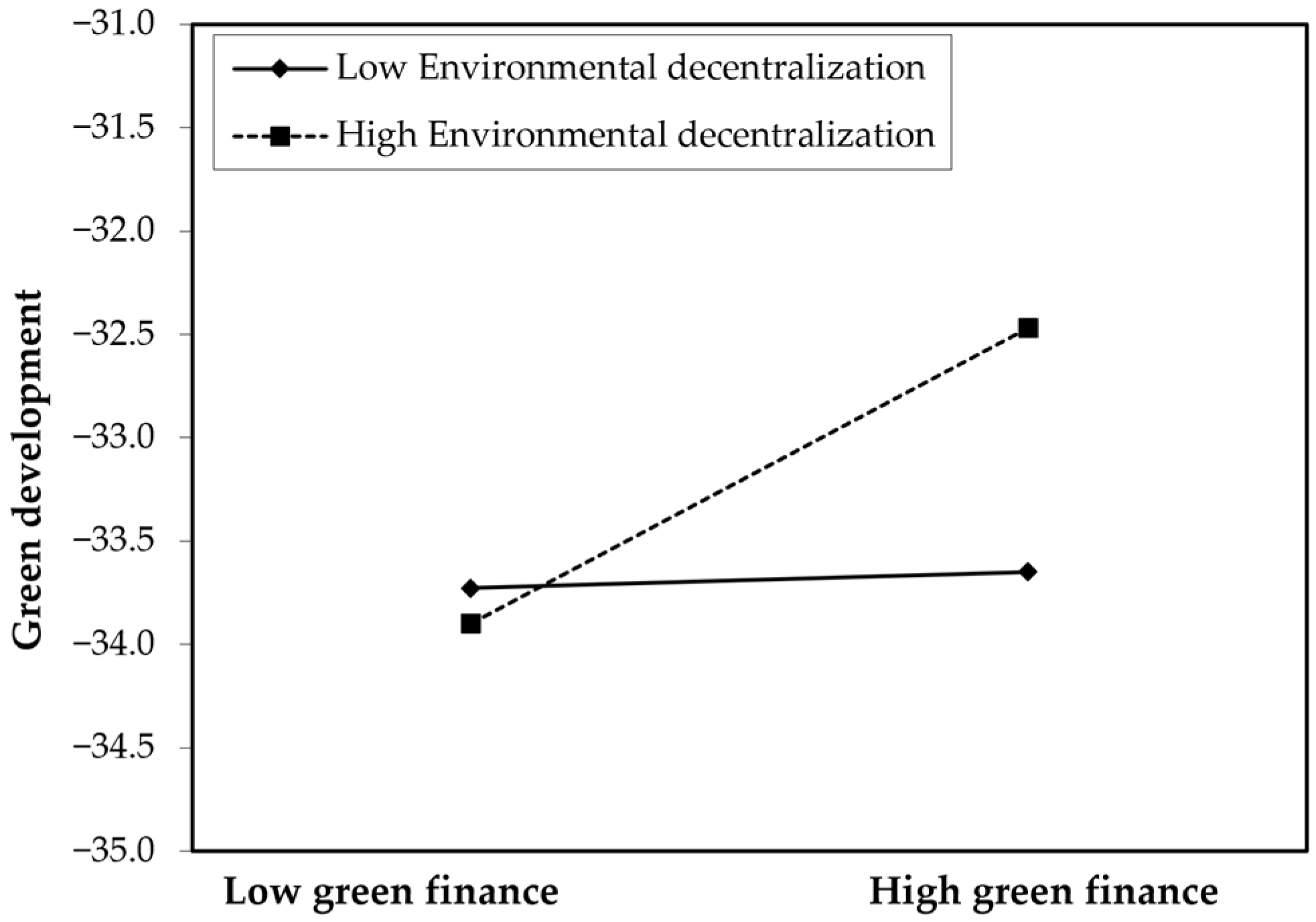
The research further examined the moderate role of environmental decentralization. The interaction term shows a significant positive coefficient at the 1% level in Table 11. Figure 1 displays the interaction plot, with environmental decentralization values set at plus and minus one standard deviation from the mean. Specifically, Table 12 shows that when environmental decentralization is high, green finance significantly promotes green development, with a 95% confidence interval of [3.283, 11.226]. In contrast, when environmental decentralization is low, the effect is not significant, with a 95% confidence interval of [−2.138, 2.946] that includes zero. These results suggest that higher environmental decentralization enables green finance to allocate raised capital more effectively toward green development. Therefore, Hypothesis 3 is supported.

5. Discussion

5.1. Research Conclusions

Our research examines the positive relationship between green finance and green development. Heterogeneity analysis further illustrates that green finance has a more substantial effect on green development in cities with higher fiscal capacity and in the YREB. The result confirms the significant mediating role of green innovation. Moreover, different types of green innovation operate through distinct mechanisms. Substantive green innovation supports long-term technological upgrading and knowledge creation, whereas strategic green innovation, represented by green utility model patent applications, promotes the practical diffusion and application of green technologies in local production and environmental governance. Finally, this study treats environmental decentralization as the moderating variable. The results indicate that a higher degree of environmental decentralization reinforces the contribution of green finance to green development.

5.2. Policy Implications

These empirical results offer policy implications for improving green development efficiency. First, this study finds that green finance markets can effectively promote green development. Local governments should strengthen regulatory guidance over financial mechanisms that support environmental sustainability. Greater efforts are needed to diversify green financial instruments to promote regional green development and expand market coverage. Regional governments should improve the institutional environment for green finance. A more transparent and well-functioning green finance system can help channel capital toward environmentally sustainable projects, support green innovation activities, and promote high-quality green development.
Second, policy design should take regional differences into account. In areas where green finance plays a more pronounced role, policymakers may prioritize pilot programs and accelerate the deployment of financial instruments that support environmental objectives. These measures can help improve the efficiency of green development. For cities with low fiscal capacity and lagging economic development, local governments should adopt tailored green finance policies. These policies should reflect local economic conditions, resource endowments, and environmental governance capacities, thereby maximize policy effectiveness and ultimately achieve coordinated regional development.
Third, given that green innovation plays an important mediating role, local governments should strengthen their guidance and support green innovation. Specifically, they need to design and implement targeted incentive policies according to local industrial structures and resource endowments. For green invention patents, green finance should be better directed toward technology-oriented projects with higher research intensity, longer development cycles, and stronger potential for substantive technological progress. For strategic innovation, policy efforts should prioritize improving the adoption of practical green technologies, particularly those with strong potential to translate into green development outcomes. These measures will reinforce the mechanism’s role and further enhance green development outcomes.
Finally, environmental decentralization highlights the importance of aligning governance authority. Therefore, the decentralization framework should be improved by clearly defining and assigning environmental responsibilities to local governments. The central government should focus on overall planning, coordination, and supervision. This improvement measure will enable local governments to more actively utilize green financial tools to meet the demands of green development.

5.3. Limitations and Recommendations for Future Studies

Despite providing important insights into how green finance relates to green development, several limitations of this study deserve future research attention. First, this study uses an aggregate green finance index to assess the overall effect of the causal relationship. Although this approach captures the comprehensive development of urban green finance, it does not separately evaluate the contributions of each subdimension. Future studies could further examine the effects and underlying mechanisms of different components. This would help identify which dimensions of green finance are most effective in promoting green development.
Second, this study constructs the green development index using the entropy weight method. While this method helps mitigate subjective weighting bias by relying on the information contained in the data, several limitations should be acknowledged. The entropy method is sensitive to the dispersion of indicators within the selected sample. Consequently, changes in city selection or the study period may alter indicator weights, potentially affecting the stability and comparability of the evaluation results. Subsequent studies can consider alternative weighting methods to enhance the robustness and generalizability of green development measurement.
A further limitation concerns the measurement of environmental decentralization. This study uses a personnel-based indicator at the city level. Specifically, it does not directly measure fiscal decentralization, formal legal authority, or regulatory discretion. Therefore, the index should be interpreted as a proxy for functional environmental decentralization. Future research could further validate this measure by incorporating additional indicators, such as environmental fiscal expenditure, regulatory authority, enforcement intensity, or pollution control responsibilities, when more detailed city-level data become available.
A final limitation concerns the sample period of this study. Given that the sample period is restricted to 2005–2019, the applicability of the findings to more recent years may be limited. This sample period was mainly determined by data availability, as several city-level indicators used to construct the green development index are not consistently available after 2019. Extending the sample period would generate substantial missing values and may weaken the comparability of the composite index. Subsequent studies can extend the temporal scope of the analysis by incorporating more recent observations as data availability improves.

Author Contributions

Conceptualization, X.H. and Z.Y.; methodology, X.H.; software, X.H.; validation, X.H., and Z.Y.; formal analysis, X.H.; investigation, Z.Y.; data curation, Z.Y.; writing—original draft preparation, X.H. and Z.Y.; writing—review and editing, X.H.; supervision, X.H. All authors have read and agreed to the published version of the manuscript.

Funding

This research received no external funding.

Institutional Review Board Statement

Not applicable.

Informed Consent Statement

Not applicable.

Data Availability Statement

The raw data supporting the conclusions of this article will be made available by the authors on request.

Conflicts of Interest

The authors declare no conflicts of interest.

References

  1. Chen, Y.; Tang, J. The impact of economic growth targets on the level of green development-A perspective on officials’ promotion incentives and environmental regulations. J. Environ. Manag. 2024, 368, 122056. [Google Scholar] [CrossRef] [PubMed]
  2. Zhou, J.; Guo, Y. The impact of green finance on economic growth and environmental quality. Financ. Res. Lett. 2026, 87, 109087. [Google Scholar] [CrossRef]
  3. Sun, J.; Chen, D. Green credit, tourism technology innovation, and sustainable development of tourism. Int. Rev. Econ. Financ. 2025, 99, 104004. [Google Scholar] [CrossRef]
  4. Deng, H.; Li, Y.; Lin, Y. Green financial policy and corporate risk-taking: Evidence from China. Financ. Res. Lett. 2023, 58, 104381. [Google Scholar] [CrossRef]
  5. Yu, C.H.; Wu, X.; Zhang, D.; Chen, S.; Zhao, J. Demand for green finance: Resolving financing constraints on green innovation in China. Energy Policy 2021, 153, 112255. [Google Scholar] [CrossRef]
  6. Hunjra, A.I. The green intentions of capital: How green finance is changing the boundaries of corporate sustainability strategies. J. Environ. Manag. 2025, 390, 126362. [Google Scholar] [CrossRef] [PubMed]
  7. Cai, Q.; Yu, Z.; Lin, Y. Do green funds reduce corporate green innovation bubbles: The role of green finance policy. Financ. Res. Lett. 2026, 90, 109398. [Google Scholar] [CrossRef]
  8. Shi, X.; Ma, J.; Jiang, A.; Wei, S.; Yue, L. Green bonds: Green investments or greenwashing? Int. Rev. Financ. Anal. 2023, 90, 102850. [Google Scholar] [CrossRef]
  9. Chen, D.; Hu, H.; Wang, N.; Chang, C.P. The impact of green finance on transformation to green energy: Evidence from industrial enterprises in China. Technol. Forecast. Soc. Change 2024, 204, 123411. [Google Scholar] [CrossRef]
  10. Liu, Y.; Huang, H.; Mbanyele, W.; Wang, F.; Liu, H. Does the issuance of green bonds nudge environmental responsibility engagements? Evidence from the Chinese green bond market. Financ. Innov. 2024, 10, 92. [Google Scholar] [CrossRef]
  11. Wang, X.; Luo, Y. Has technological innovation capability addressed environmental pollution from the dual perspective of FDI quantity and quality? Evidence from China. J. Clean. Prod. 2020, 258, 120941. [Google Scholar] [CrossRef]
  12. Paramati, S.R.; Mo, D.; Huang, R. The role of financial deepening and green technology on carbon emissions: Evidence from major OECD economies. Financ. Res. Lett. 2021, 41, 101794. [Google Scholar] [CrossRef]
  13. Ran, Q.; Zhang, J.; Hao, Y. Does environmental decentralization exacerbate China’s carbon emissions? Evidence based on dynamic threshold effect analysis. Sci. Total Environ. 2020, 721, 137656. [Google Scholar] [CrossRef] [PubMed]
  14. Li, X.; Zhao, C.; Cao, J. Official Turnover and Sustainable Development in China. J. Chin. Polit. Sci. 2023, 29, 649–672. [Google Scholar] [CrossRef]
  15. Shi, P.; Zhang, H.; Sun, C.; Wang, X.; Li, X. The driving effect of digital finance on green total factor productivity—Analysis based on double/debiased machine learning model and spatial durbin model. Financ. Res. Lett. 2025, 81, 107463. [Google Scholar] [CrossRef]
  16. Li, S.; Yin, Y.; Jiao, Z.; Zhao, Q. Financial investment and green development: How does financialization affect green total factor productivity? Financ. Res. Lett. 2025, 78, 10725. [Google Scholar] [CrossRef]
  17. Cai, Q.; Yu, Z.; Jiang, F. Smarter brains, greener cities? Unveiling the spatial effects of computational power on sustainable development. J. Clean. Prod. 2026, 558, 148249. [Google Scholar] [CrossRef]
  18. Wen, H.; Zhang, Y.; Zhou, F.; Tian, X. Towards ecological sustainability: The progress and spatio-temporal evolution of green development in China. J. Clean. Prod. 2025, 492, 144912. [Google Scholar] [CrossRef]
  19. Cheng, Z.; Wu, Y. Can the issuance of green bonds promote corporate green transformation? J. Clean. Prod. 2024, 443, 141071. [Google Scholar] [CrossRef]
  20. Li, Y.; Hua, Z. Environmental protection tax law and corporate ESG performance. Financ. Res. Lett. 2024, 64, 105423. [Google Scholar] [CrossRef]
  21. Liu, X.; Cifuentes-Faura, J.; Wang, C.A.; Wang, L. Can green finance policy reduce corporate carbon emissions? Evidence from a quasi-natural experiment in China. Brit. Account. Rev. 2025, 57, 101540. [Google Scholar] [CrossRef]
  22. Han, L.; Li, J. Does green finance reform promote corporate carbon emission reduction? Evidence from China’s green finance reform and innovation pilot zones. Econ. Anal. Policy 2025, 85, 2091–2111. [Google Scholar] [CrossRef]
  23. Yu, Z.; Yao, R.; Wu, H.; Wang, Z. Green finance and agricultural carbon emissions. Financ. Res. Lett. 2025, 86, 108698. [Google Scholar] [CrossRef]
  24. Wang, X.; Gao, C. Does green finance policy help to improve carbon reduction welfare performance? Evidence from China. Energy Econ. 2024, 132, 107452. [Google Scholar] [CrossRef]
  25. Huang, J.; Ma, L. Substantive green innovation or symbolic green innovation: The impact of fintech on corporate green innovation. Financ. Res. Lett. 2024, 63, 105265. [Google Scholar] [CrossRef]
  26. Jiang, L.; Bai, Y. Strategic or substantive innovation? -The impact of institutional investors’ site visits on green innovation evidence from China. Technol. Soc. 2022, 68, 101904. [Google Scholar] [CrossRef]
  27. Chang, J.; Jiang, H.; Liu, J.; Li, M. How the digital economy enhances the grain supply chain resilience in China: Exploring the moderating effects of government innovation-driven. Front. Sustain. Food Syst. 2024, 8, 1439593. [Google Scholar] [CrossRef]
  28. Song, W.; Yu, H. Green Innovation Strategy and Green Innovation: The Roles of Green Creativity and Green Organizational Identity. Corp. Soc. Responsib. Environ. Manag. 2017, 25, 135–150. [Google Scholar] [CrossRef]
  29. Wu, H.; Hao, Y.; Ren, S. How do environmental regulation and environmental decentralization affect green total factor energy efficiency: Evidence from China. Energy Econ. 2020, 91, 104880. [Google Scholar] [CrossRef]
  30. Dahiya, B. Cities in Asia, 2012: Demographics, economics, poverty, environment and governance. Cities 2012, 29, S44–S61. [Google Scholar] [CrossRef]
  31. Hao, Y.; Xu, L.; Guo, Y.; Wu, H. The inducing factors of environmental emergencies: Do environmental decentralization and regional corruption matter? J. Environ. Manag. 2022, 302, 114098. [Google Scholar] [CrossRef] [PubMed]
  32. Yu, H.; Wang, J.; Hou, J.; Yu, B.; Pan, Y. The effect of economic growth pressure on green technology innovation: Do environmental regulation, government support, and financial development matter? J. Environ. Manag. 2023, 330, 117172. [Google Scholar] [CrossRef] [PubMed]
  33. Feng, S.; Zhang, R.; Li, G. Environmental decentralization, digital finance and green technology innovation. Struct. Change Econ. Dyn. 2022, 61, 70–83. [Google Scholar] [CrossRef]
  34. Ren, S.; Du, M.; Bu, W.; Lin, T. Assessing the impact of economic growth target constraints on environmental pollution: Does environmental decentralization matter? J. Environ. Manag. 2023, 336, 117618. [Google Scholar] [CrossRef] [PubMed]
  35. Cui, X.; Shen, Z.; Li, Z.; Wu, J. Spatiotemporal evolutions and driving factors of green development performance of cities in the Yangtze River Economic Belt. Ecol. Inform. 2021, 66, 101476. [Google Scholar] [CrossRef]
  36. Hou, X.; Lv, T.; Xu, J.; Deng, X.; Liu, F.; Pi, D. Energy sustainability evaluation of 30 provinces in China using the improved entropy weight-cloud model. Ecol. Indic. 2021, 126, 107657. [Google Scholar] [CrossRef]
  37. Chen, C.; Xie, X. Digital economy development, industrial structure development, and green finance. Financ. Res. Lett. 2025, 85, 108152. [Google Scholar] [CrossRef]
  38. Du, M.; Antunes, J.; Wanke, P.; Chen, Z. Ecological efficiency assessment under the construction of low-carbon city: A perspective of green technology innovation. J. Environ. Plan. Manag. 2022, 65, 1727–1752. [Google Scholar] [CrossRef]
  39. Xu, L.; Fan, M.; Yang, L.; Shao, S. Heterogeneous green innovations and carbon emission performance: Evidence at China’s city level. Energy Econ. 2021, 99, 105269. [Google Scholar] [CrossRef]
  40. Cobbinah, P.B.; Erdiaw-Kwasie, M.O.; Amoateng, P. Africa’s urbanisation: Implications for sustainable development. Cities 2015, 47, 62–72. [Google Scholar] [CrossRef]
  41. Pan, Y.; Teng, T.; Wang, S.; Wang, T. Impact and mechanism of urbanization on urban green development in the Yangtze River Economic Belt. Ecol. Indic. 2024, 158, 111612. [Google Scholar] [CrossRef]
  42. Wu, Y.; Li, H.; Gu, Y.; Hu, H.; Zhou, G.; Yuan, Q. How can the lead industry improve sustainability based on the resource-economy-carbon nexus system? Sustain. Prod. Consum. 2024, 49, 82–91. [Google Scholar] [CrossRef]
  43. Lei, W.; Tang, K.; Shao, J.; Ran, F. Digital transformation, supply chain finance, and enterprise innovation. Financ. Res. Lett. 2024, 70, 106256. [Google Scholar] [CrossRef]
  44. Lu, Z.; Lin, Y.; Li, Y. Does corporate engagement in digital transformation influence greenwashing? Evidence from China. Financ. Res. Lett. 2023, 58, 104558. [Google Scholar] [CrossRef]
  45. Xu, A.; Dai, Y.; Hu, Z.; Qiu, K. Can green finance policy promote inclusive green growth?—Based on the quasi-natural experiment of China’s green finance reform and innovation pilot zone. Int. Rev. Econ. Financ. 2025, 100, 104090. [Google Scholar] [CrossRef]
Figure 1. Moderating effects of environmental decentralization.
Sustainability 18 06339 g001
Table 1. Construction of the Green Development Index.
SubsystemDimensionIndicator (Unit)Attribute
Environmental
growth
performance
Resource use
efficiency
Energy intensity per unit GDP (kwh/CNY)
Water use intensity per unit GDP
(ton/10,000 CNY)
Construction land per unit GDP (km2/108 CNY)
CO2 emissions per unit GDP (ton/10,000 CNY)
Industrial solid waste recycling efficiency (%)+
Economics development capacityPer capita GDP (10,000 CNY/person)+
Share of tertiary industry in GDP (%)+
Share of local fiscal expenditure allocated to
science and technology (%)
+
Efficiency of fixed asset investment (%)+
Environmental carrying capacityPollution abatement and environmental governance capacityIndustrial wastewater emission intensity (ton/10,000 CNY)
SO2 emission intensity from industrial
production (ton/10,000 CNY)
Industrial particulate emission intensity (ton/10,000 CNY)
Fertilizer application intensity in agricultural
production (ton/10,000 CNY)
Urban sewage treatment rate (%)+
Safe disposal rate of municipal solid waste (%)+
Environmental
quality
PM2.5 concentration (μg/m3)
Proportion of days with satisfactory air quality (%)+
Green space coverage in built-up areas (%)+
per capita urban public green space (%)+
Environmental guarantee
capability
Green livelihood
support capacity
Public bus availability per 10,000 population (Number)+
Per capita public transit usage (Person-times/person)+
Urban drainage pipeline density (km/km2)+
Urban road area per capita (m2/person)+
Per capita household electricity consumption (kwh/person)
Per capita water use by urban residents (ton/person)
Per capita hospital beds availability (Number)+
Note: “+” denotes a positive indicator, and “−” denotes a negative indicator.
Table 2. Green finance indicator system.
DimensionIndicator (Unit)Attribute
Green creditProportion of environmentally friendly project credit (%)+
Green investmentEnvironmental pollution treatment investment as share of GDP (%)+
Green insurancePenetration of environmental pollution liability insurance (%)+
Green bondDevelopment of green bond issuance (%)+
Green supportShare of fiscal environmental protection expenditure+
Green fundShare of green funds (%)+
Green equityThe level of development in green equity trading (%)+
Note: “+” denotes a positive indicator.
Table 3. Descriptive statistics.
VariablesObservationsMinMaxMeanStandard Deviation
GD38554.82982.49012.7556.596
GF38550.0540.6240.2940.099
UR38550.1141.0000.5180.167
EDL385513.31019.76016.2811.028
IS385511.05083.52039.1029.789
PD38555.0002648.000445.442333.305
GI38550.00025.3670.4181.410
substantive GI38550.00017.8310.2110.825
strategic GI38550.0009.0710.2070.614
ED38550.0238.8381.1700.878
Note: GD = green development; GF = green finance; UR = urbanization rate; EDL = economic development level; IS = industrial structure; PD = population density; GI = green innovation; ED = environmental decentralization. 3855 denotes city-year observations from 257 prefecture-level cities over 15 years.
Table 4. VIF test.
Table 4. VIF test.
VariableVIF1/VIF
EDL1.840.542
UR1.490.672
IS1.420.703
PD1.320.759
GF1.260.791
Mean1.47
Notes: VIF denotes the variance inflation factor. The VIF test is conducted using the full city-year panel sample of 257 prefecture-level cities observed over 15 years.
Table 5. Baseline regression.
VariablesGDGD
GF3.792 **
(1.920)
4.379 ***
(1.618)
UR −1.776 *
(0.996)
EDL 2.696 ***
(0.398)
IS 0.052 ***
(0.017)
PD 0.002
(0.004)
Constant8.042 ***
(0.510)
−35.419 ***
(6.143)
Observations38553855
R20.7130.732
City fixed effectYESYES
Year fixed effectYESYES
Note: * p < 0.10. ** p < 0.05. *** p < 0.01. Observations denote city-year observations. City-clustered robust standard errors are reported in parentheses. The full sample contains 3855 observations from 257 prefecture-level cities over 15 years.
Table 6. Results of robustness test.
VariablesGD (1)GD (2)GD (3)GF (4)GD (5)
GF3.688 ***
(1.408)
3.567 **
(1.394)
0.054 **
(0.022)
15.382 **
(6.984)
L.GF 0.204 ***
(0.025)
UR−1.135
(0.896)
−1.459
(0.943)
−1.740 *
(0.985)
0.011
(0.010)
−2.443 **
(1.168)
EDL2.627 ***
(0.344)
2.731 ***
(0.399)
2.653 ***
(0.402)
−0.008 *
(0.004)
2.812 ***
(0.386)
IS 0.054 ***
(0.011)
0.045 ***
(0.016)
0.051 ***
(0.017)
−0.000
(0.000)
0.040 **
(0.018)
PD0.002
(0.004)
0.002
(0.003)
0.002
(0.004)
0.000 ***
(0.000)
−0.001
(0.004)
Constant−34.410 ***
(5.178)
−35.405 ***
(6.126)
−33.778 ***
(6.229)
0.293 ***
(0.066)
−37.717 ***
(6.510)
Observations38553795385535983598
R20.7860.7390.7310.7690.701
City fixed effectYESYESYESYESYES
Year fixed effectYESYESYESYESYES
Note: * p < 0.10. ** p < 0.05. *** p < 0.01. L.GF is the one-period lagged green finance index. Observations denote city-year observations. City-clustered robust standard errors are reported in parentheses. The full sample contains 3855 observations from 257 prefecture-level cities over 15 years. The reduced sample contains 3795 observations after excluding the four centrally administered municipalities. The lagged sample contains 3598 observations after excluding the first-year observations for each city.
Table 7. Endogeneity tests.
VariablesGF (1)GD (2)
IV0.005 ***
(0.001)
GF 137.988 ***
(37.980)
UR0.016
(0.012)
−3.642 *
(2.095)
EDL−0.015 ***
(0.005)
4.238 ***
(0.823)
IS−0.000
(0.000)
0.056 **
(0.026)
PD0.000 ***
(0.000)
−0.007 *
(0.004)
Constant0.443 ***
(0.082)
−85.327 ***
(17.059)
Observations38553855
Kleibergen-Paap rk LM11.299 ***
Kleibergen-Paap rk Wald F30.018
City fixed effectYESYES
Year fixed effectYESYES
Note: * p < 0.10. ** p < 0.05. *** p < 0.01. IV denotes the instrumental variable. Observations denote city-year observations. City-clustered robust standard errors are reported in parentheses. The reduced sample contains 3855 observations, corresponding to 257 prefecture-level cities observed over 15 years.
Table 8. Heterogeneity test.
VariablesYREBNON-YREBHigh Fiscal CapacityLow Fiscal Capacity
GF8.021 ***
(2.737)
1.955
(1.779)
5.726 **
(2.741)
1.963
(1.229)
UR0.020
(1.602)
−2.582 **
(1.181)
−5.984 ***
(1.958)
1.235
(0.842)
EDL1.061
(1.007)
2.468 ***
(0.473)
2.232 **
(0.929)
2.344 ***
(0.300)
IS0.067 ***
(0.023)
0.041 *
(0.021)
0.056
(0.038)
0.029 **
(0.012)
PD0.006
(0.005)
0.002
(0.004)
0.000
(0.004)
−0.000
(0.003)
Constant−14.863
(14.277)
−30.255 ***
(7.384)
−26.627 *
(15.570)
−28.504 ***
(4.647)
Observations1590226519201935
R20.8240.6690.6990.847
Chow test51.11 ***93.23 ***
City fixed effectYESYESYESYES
Year fixed effectYESYESYESYES
Note: * p < 0.10. ** p < 0.05. *** p < 0.01. YREB denotes the Yangtze River Economic Belt; NON-YREB denotes regions outside the Yangtze River Economic Belt. Observations denote city-year observations. City-clustered robust standard errors are reported in parentheses. The YREB subsample contains 1590 observations, corresponding to 106 prefecture-level cities observed over 15 years. The NON-YREB subsample contains 2265 observations, corresponding to 151 prefecture-level cities observed over 15 years. The high and low fiscal capacity subsamples contain 1920 and 1935 observations, corresponding to 128 and 129 prefecture-level cities observed over 15 years, respectively.
Table 9. Mediation effect analysis.
VariablesGD (1)GI (2)GI (3)Substantive GI (4)Strategic GI (5)
GF4.379 ***
(1.618)
4.679 ***
(1.364)
2.467 ***
(0.769)
2.212 ***
(0.614)
L.GF 4.342 ***
(1.307)
UR−1.776 *
(0.996)
−2.261 ***
(0.841)
−2.604 ***
(0.910)
−1.308 **
(0.532)
−0.953 ***
(0.321)
EDL2.696 ***
(0.398)
0.901 ***
(0.222)
0.925 ***
(0.224)
0.510 ***
(0.127)
0.390 ***
(0.098)
IS0.052 ***
(0.017)
0.010
(0.008)
0.006
(0.008)
0.006
(0.004)
0.005
(0.004)
PD0.002
(0.004)
0.010 ***
(0.002)
0.010 ***
(0.002)
0.005 ***
(0.001)
0.005 ***
(0.001)
Constant−35.419 ***
(6.143)
−18.288 **
(3.602)
−18.564 ***
(3.605)
−10.093 ***
(2.052)
−8.196
(1.598)
Observations38553855359838553855
R20.7320.3100.3090.2460.364
City fixed effectYESYESYESYESYES
Year fixed effectYESYESYESYESYES
Note: * p < 0.10. ** p < 0.05. *** p < 0.01. Observations denote city-year observations. City-clustered robust standard errors are reported in parentheses. The full sample contains 3855 observations from 257 prefecture-level cities over 15 years. The lagged sample contains 3598 observations after excluding the first-year observations for each city.
Table 10. Bootstrap mediation analysis.
Confidence Interval (95%)
EffectStandard ErrorLLCIULCI
GIDirect effect2.8311.0460.7824.881
Indirect effects1.5470.4050.7532.342
GI (L.GF)Direct effect1.8901.032−0.1333.914
Indirect effects1.2530.3630.5411.964
Substantive GIDirect effect3.2871.0641.2025.372
Indirect effects1.0920.3620.3821.802
Strategic GIDirect effect2.3821.0230.3774.388
Indirect effects1.9960.4321.1492.843
Note: LLCI and ULCI denote the lower and upper limits of the confidence interval, respectively. The full sample contains 3855 observations from 257 prefecture-level cities over 15 years.
Table 11. Moderated path analysis.
VariablesGD (1)GD (2)
GF3.432 **
(1.697)
3.829 ***
(1.390)
ED0.356
(0.234)
0.288
(0.286)
GF × ED3.558 ***
(1.115)
3.903 ***
(1.118)
UR −1.271
(0.912)
EDL 2.615 ***
(0.483)
IS 0.045 **
(0.018)
PD 0.003
(0.003)
ControlsNOYES
Constant9.123 ***
(0.127)
−33.436 ***
(7.239)
sObservations38553855
R20.7240.743
City fixed effectYESYES
Year fixed effectYESYES
Note: ** p < 0.05. *** p < 0.01. Observations denote city-year observations. City-clustered robust standard errors are reported in parentheses. The full sample contains 3855 observations from 257 prefecture-level cities over 15 years. GF × ED denotes the interaction term.
Table 12. Conditional effects across levels of environmental decentralization.
CoefficientStandard ErrorLLCI (95%)ULCI (95%)
Low ED
(M − 1SD)
0.4041.297−2.1382.946
High ED
(M + 1SD)
7.2542.0263.28311.226
Note: LLCI and ULCI denote the lower and upper limits of the confidence interval, respectively. M and SD denote the mean and standard deviation of environmental decentralization, respectively. The full sample contains 3855 observations from 257 prefecture-level cities over 15 years.
Disclaimer/Publisher’s Note: The statements, opinions and data contained in all publications are solely those of the individual author(s) and contributor(s) and not of MDPI and/or the editor(s). MDPI and/or the editor(s) disclaim responsibility for any injury to people or property resulting from any ideas, methods, instructions or products referred to in the content.