1. Introduction
Coastal Louisiana contains one of the largest wetland complexes in North America, yet it is also among the most rapidly degrading coastal landscapes in the world [
1]. Long-term analyses by the U.S. Geological Survey show that coastal Louisiana experienced a net land area loss of approximately 4833 km
2 between 1932 and 2016, reflecting the combined effects of relative sea level rise, subsidence, hydrologic alteration, reduced sediment supply, and repeated storm impacts [
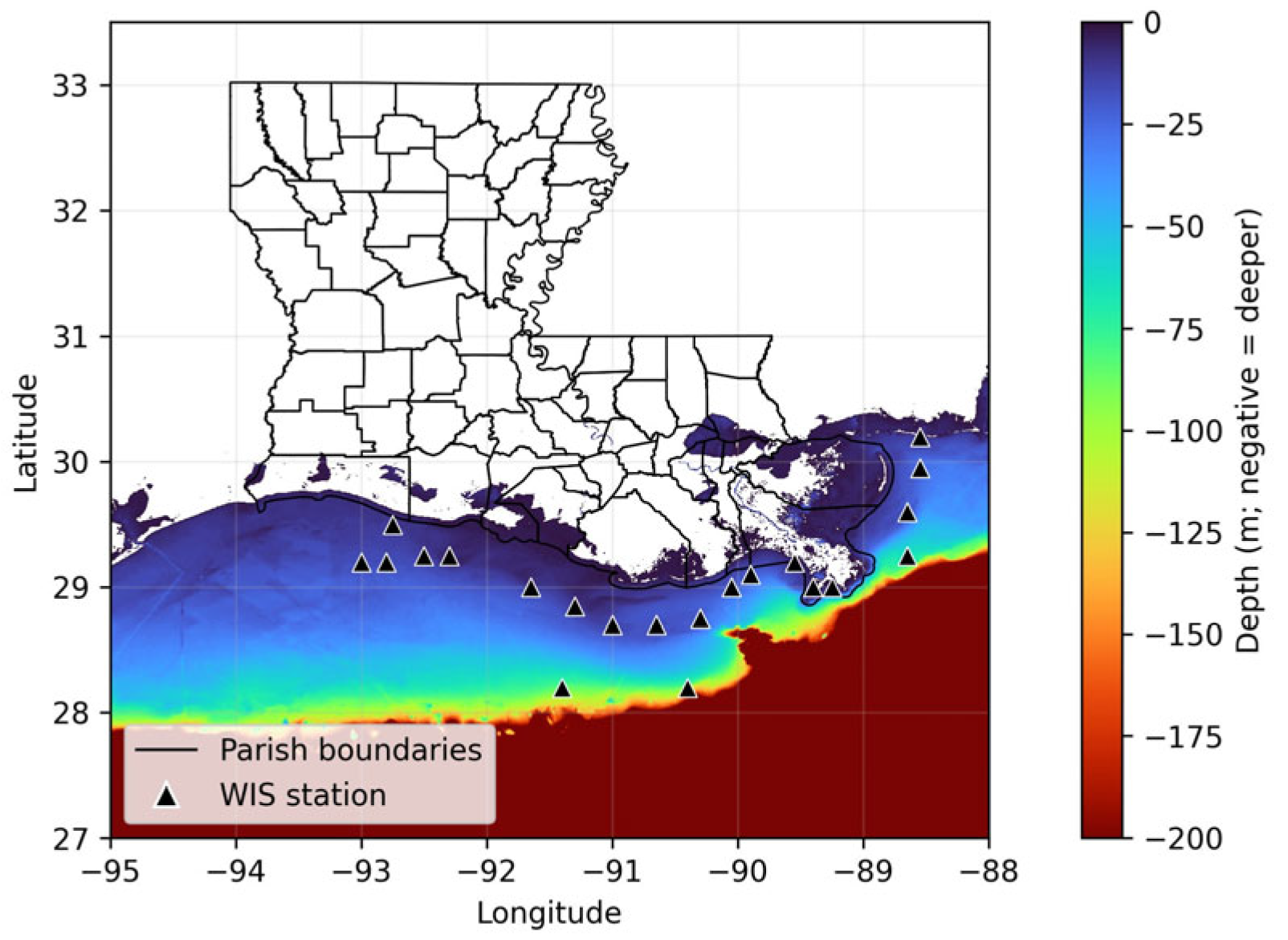
2]. This sustained wetland degradation has reduced the capacity of shallow marsh platforms and nearshore vegetated environments to dissipate storm-wave energy before it reaches restoration infrastructure (
Figure 1) [
3,
4]. Consequently, engineered features such as containment dikes used in marsh creation projects are increasingly exposed not only to stronger hydrodynamic forcing but also to wave-induced erosion, sediment resuspension, and possible loss of placed dredged material [
4,
5,
6].
This problem is especially relevant in Plaquemines Parish, where marsh creation remains a central component of Louisiana’s coastal restoration strategy [
7,
8]. The Louisiana Coastal Protection and Restoration Authority’s 2023 Coastal Master Plan continues to emphasize sediment-based restoration and marsh creation as key tools for sustaining wetlands and reducing future coastal risk [
9]. In these settings, containment dikes function not simply as hydraulic barriers but as sediment retention structures whose performance depends on limiting wave attack, slope erosion, and re-entrainment of recently placed material [
4,
6]. Because the Louisiana coast is fronted by a broad, shallow continental shelf and an extensive marsh-influenced nearshore zone, offshore storm waves undergo substantial transformation before reaching such structures [
10]. The magnitude of that transformation depends strongly on local bathymetry, water level, and bottom roughness, all of which influence the wave energy ultimately delivered to the dike face [
7,
11].
Phase-averaged spectral wave models provide an effective framework for resolving these processes across large, shallow coastal domains [
12]. Among them, SWAN (Simulating Waves Nearshore, Cycle III version 41.31A; Delft University of Technology, Delft, The Netherlands) is one of the most widely used third-generation spectral wave models for simulating the transformation of random short-crested waves in coastal regions with shallow water [
13,
14]. Its formulation accounts for key nearshore processes such as propagation, shoaling, refraction, depth-induced breaking, and bottom friction dissipation, making it well suited for assessing offshore-to-nearshore wave transformation in restoration settings [
15]. Although SWAN has been broadly applied in coastal engineering and hazard studies, relatively fewer applications have focused specifically on marsh-creation containment dikes in shallow, semi-sheltered environments where sediment retention and dike integrity are closely tied to foreshore roughness and local wave dissipation.
The wave-attenuation function of coastal wetlands is well established. Laboratory and field studies have shown that marsh vegetation can substantially reduce wave energy, even under storm surge conditions, through a combination of vegetation drag, turbulence generation, and enhanced dissipation across shallow vegetated foreshores [
16,
17,
18]. Broader evaluations of nature-based coastal defenses have likewise shown that wetlands can provide meaningful coastal protection benefits and, in many settings, complement or reduce dependence on conventional hard structures [
19,
20]. At the same time, attenuation is strongly site dependent, varying with water depth, vegetation characteristics, foreshore width, and incident wave conditions [
21,
22]. Accordingly, the protective value of marshes for coastal restoration infrastructure should be evaluated quantitatively for specific sites rather than inferred in only general terms [
23].
Previous studies have demonstrated that wetlands and vegetated foreshores can attenuate waves through depth-limited breaking, bottom friction, vegetation drag, and turbulence generation. Other studies have applied spectral wave models such as SWAN to evaluate wave transformation across shallow coastal shelves and restoration landscapes. However, fewer studies have explicitly linked offshore design-wave transformation, marsh-platform roughness, local soil context, dike-toe wave conditions, runup, and hydrodynamic loading within a single engineering framework for marsh-creation containment dikes. This gap is important because sediment retention performance depends not only on offshore wave climate but also on how shallow water dissipation modifies the hydraulic demand acting directly on containment infrastructure.
To address this gap, the present study develops an integrated framework to evaluate offshore-to-nearshore wave transformation, erosion risk reduction, and containment dike loading at a representative marsh-creation site in Plaquemines Parish, Louisiana. A statistically consistent offshore design wave derived from long-term Wave Information Study (WIS) hindcast data is propagated using SWAN under two idealized foreshore scenarios: a bare-bed condition and a marsh-roughened shallow water condition represented through enhanced bottom friction [
24,
25]. The resulting dike-toe wave conditions are then interpreted in terms of erosion risk reduction, 2% exceedance wave runup, and quasi-hydrostatic loading using established overtopping and coastal structure guidance [
26]. In addition, Web Soil Survey information is used to characterize the local soil and geomorphic context of the containment dike zone [
27]. Specifically, the objectives of this study are to (1) derive a statistically consistent 25-year offshore design-wave condition from long-term WIS hindcast data; (2) quantify offshore-to-nearshore wave transformation under bare-bed and marsh-roughened foreshore scenarios across three still-water levels using SWAN; (3) translate the resulting dike-toe wave conditions into erosion exposure, runup, and hydrodynamic-loading indicators; and (4) interpret these reductions within the local soil and sediment-management context of the marsh-creation site. By explicitly linking offshore wave climate, marsh-induced dissipation, local soil context, and dike-scale response, this study provides a quantitative basis for assessing how shallow-water marsh roughness can support sustainable sediment retention and reduce storm-wave impacts on coastal restoration infrastructure in Louisiana.
2. Study Area
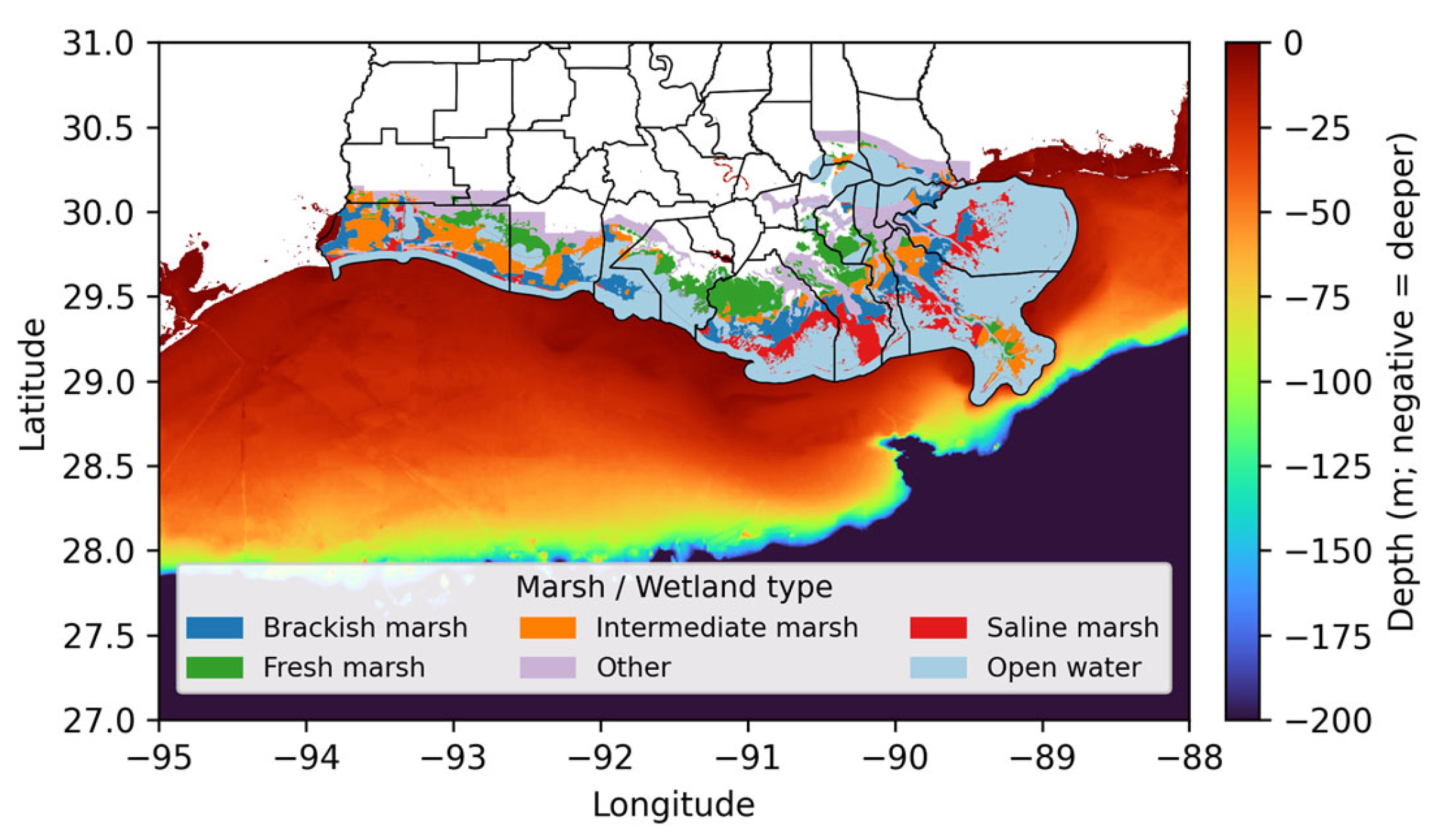
The study area is in the lower Plaquemines Parish region of coastal Louisiana, within the Mississippi River Delta Plain. This region is characterized by shallow bays, degrading wetlands, tidal passes, barrier features, and a broad continental shelf that strongly influences offshore-to-nearshore wave transformation. In recent decades, wetland loss and marsh degradation in this area have reduced the natural wave-dissipation capacity and increased the exposure of marsh-creation containment dikes to storm-driven waves, erosion, and sediment loss (
Figure 2).
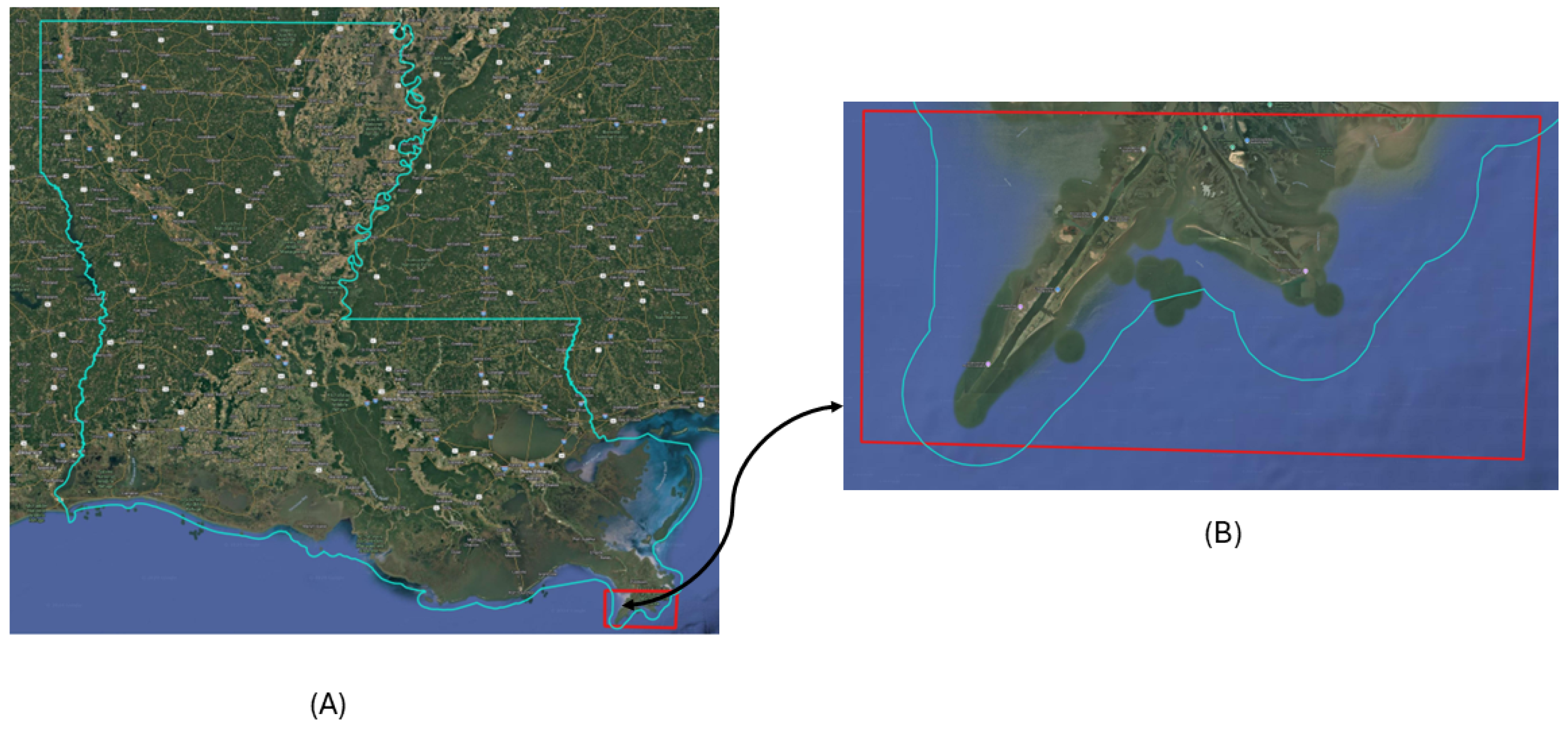
Figure 3 illustrates the geographic setting of the study area. Plaquemines Parish occupies a deltaic position along the northern Gulf of Mexico, and the selected modeling domain covers the lower Plaquemines coastal zone where marsh-creation and sediment-retention infrastructure are concentrated. The SWAN computational domain extends approximately 57 km in the east–west direction and 30 km in the north–south direction. This domain was selected to capture the principal processes governing offshore-to-nearshore wave transformation, including shoaling, refraction, depth-induced breaking, and bottom friction dissipation before waves reach the marsh platform and containment-dike zone.
The regional bathymetry was derived from publicly available NOAA and U.S. Geological Survey seamless elevation products and was used to represent the major depth gradients across the inner shelf, shallow bays, tidal passes, and nearshore marsh platform. In addition, spatial distributions of marsh and wetland types were obtained from the Louisiana Coastal Master Plan land-classification dataset, which identifies saline, brackish, intermediate, and fresh marsh environments across the region. In the present study, these mapped wetland distributions were used to provide regional context for the comparison between a bare-bed foreshore and a roughened marsh-platform foreshore.
Because the study focuses on engineering-scale wave transformation rather than plant-scale vegetation mechanics, marsh influence was represented as an effective shallow-water roughness condition rather than through explicit vegetation parameters. This allows the lower Plaquemines coast to be evaluated as a representative marsh-influenced restoration setting in which offshore waves propagate across a broad, shallow, and frictionally complex foreshore before reaching containment dikes. As such, the site provides a suitable real-world setting for assessing how marsh-platform roughness can affect wave attenuation, erosion risk indicators, and the hydraulic response of sediment-retention infrastructure in coastal Louisiana.
3. Materials and Methods
3.1. Wave and Water-Level Data
Deep-water wave forcing for the modeling framework was derived from the U.S. Army Corps of Engineers Wave Information Study (WIS) hindcast archive. Hourly wave records from WIS Station 73136, located offshore of Plaquemines Parish, were used to characterize long-term wave variability and extreme storm-wave conditions relevant to the Louisiana coast. The dataset spans 2000–2023 and includes significant wave heights, wave periods, and mean wave direction.
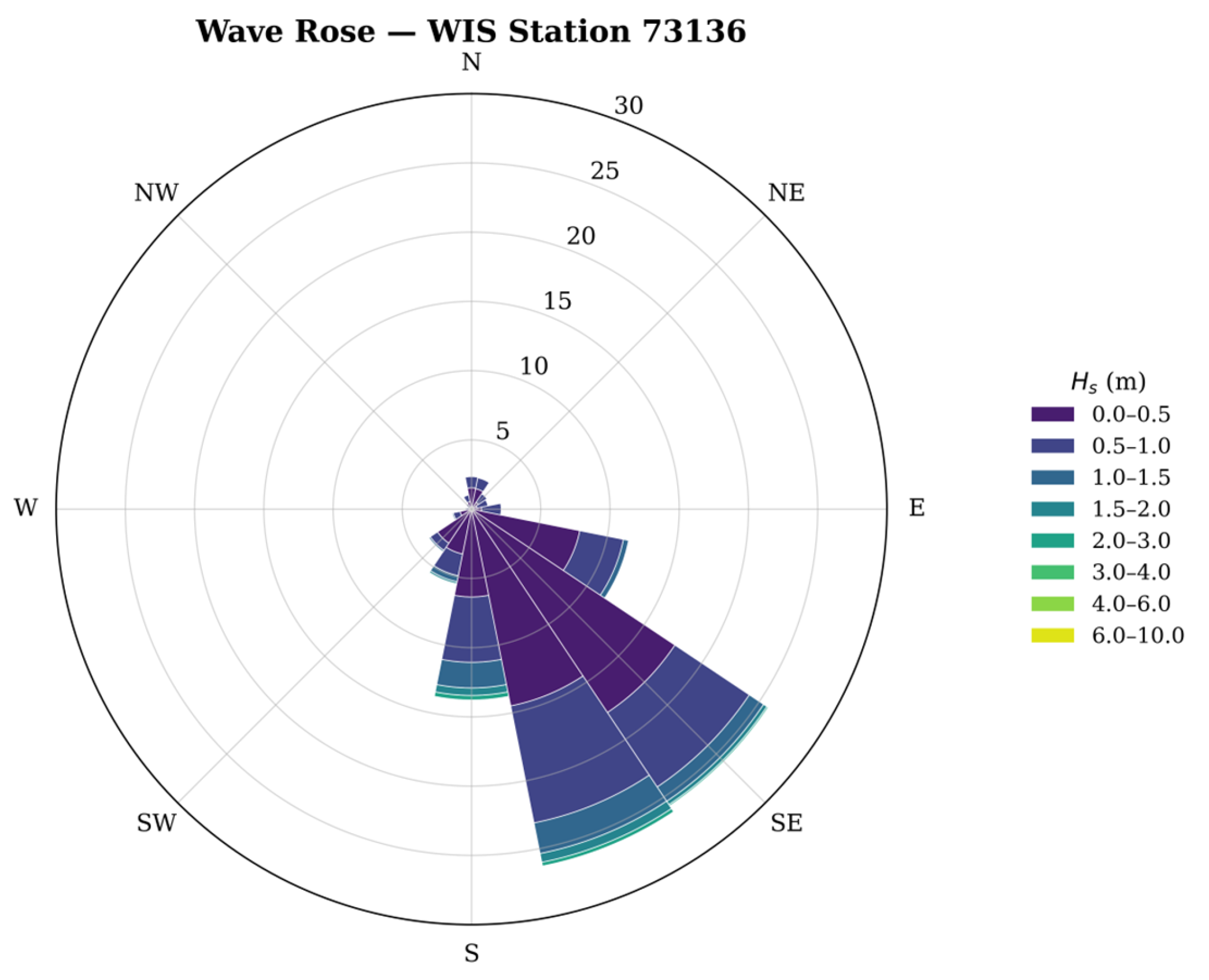
A directional wave rose constructed from the hindcast record is presented in
Figure 4. The offshore wave climate is dominated by waves approaching from the south to southeast sectors, while the most energetic storm-wave conditions are generally associated with south to south-southeast approach directions. During energetic events, significant wave heights frequently exceed 2–3 m, reflecting the influence of tropical storms and hurricanes in the northern Gulf of Mexico.
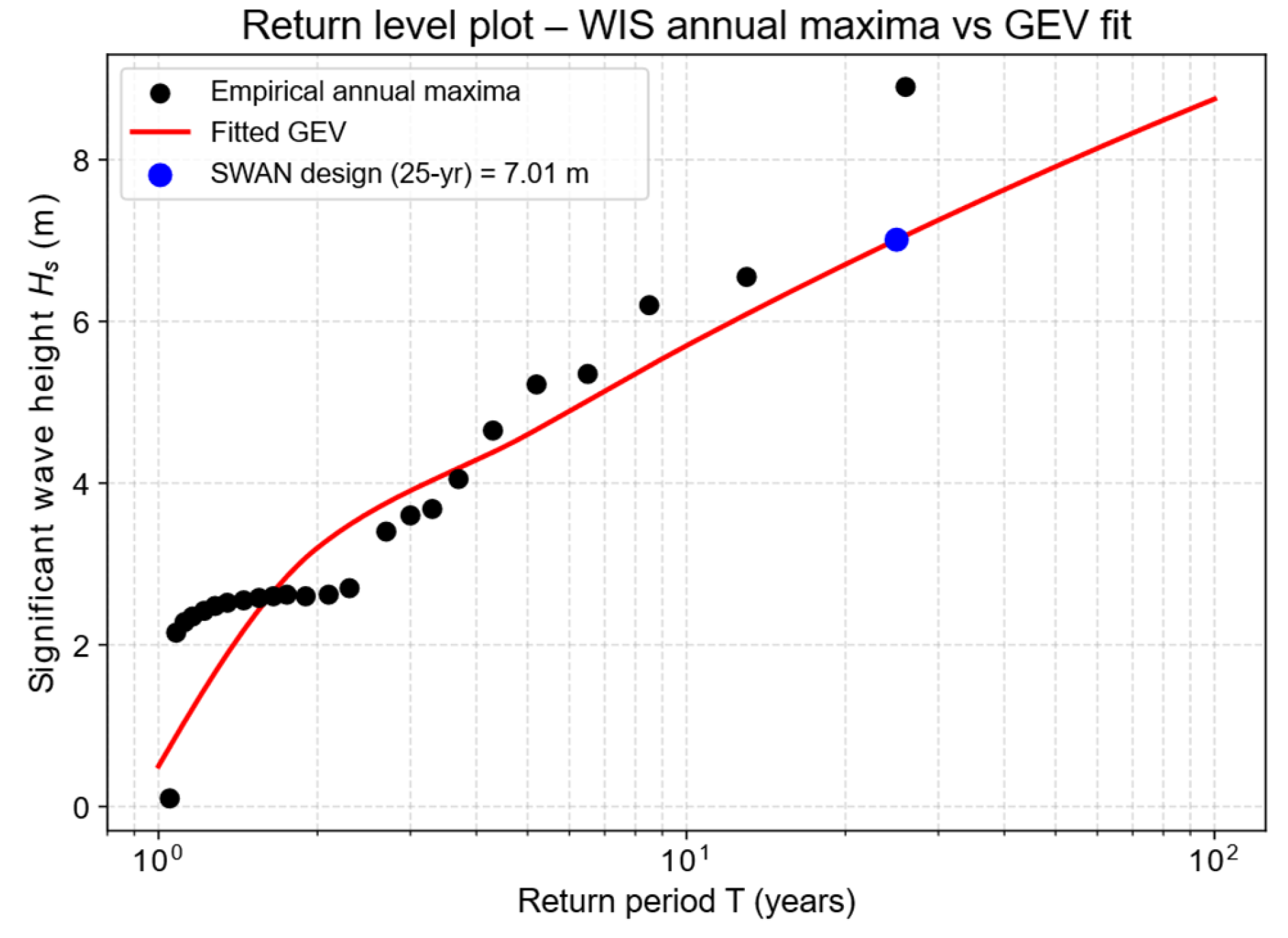
The return-level relationship for the annual maxima of significant wave height is shown in
Figure 5. To define the offshore design-wave condition, the annual maxima of significant wave height were extracted from the WIS record and fitted using a generalized extreme value (GEV) distribution. This analysis yielded a 25-year return-period significant wave height,
Hs,25, of 7.01 m. The associated energy-mean wave period,
Tm-1,0, was approximately 14.6 s, with a dominant storm-wave direction of approximately 152°. These parameters were used to prescribe the deep-water spectral boundary condition for the SWAN simulations.
The still-water level plays a critical role in controlling wave shoaling, depth-induced breaking, and bottom friction dissipation across Louisiana’s broad and shallow continental shelf. To evaluate this sensitivity, three static water-level scenarios were imposed in the wave model: mean water level, η = 0.00 m; moderate storm tide, η = +0.75 m; and elevated cyclonic storm tide, η = +1.75 m. These scenarios represent increasing levels of foreshore inundation and allow the influence of water depth on wave attenuation, marsh-platform roughness effects, erosion exposure indicators, and containment-dike loading to be evaluated consistently.
Together, the long-term WIS hindcast record, probabilistic extreme-value analysis, and multiple water-level scenarios provide a physically consistent set of offshore and nearshore forcing conditions for evaluating wave transformation toward the Plaquemines marsh platform and containment-dike system.
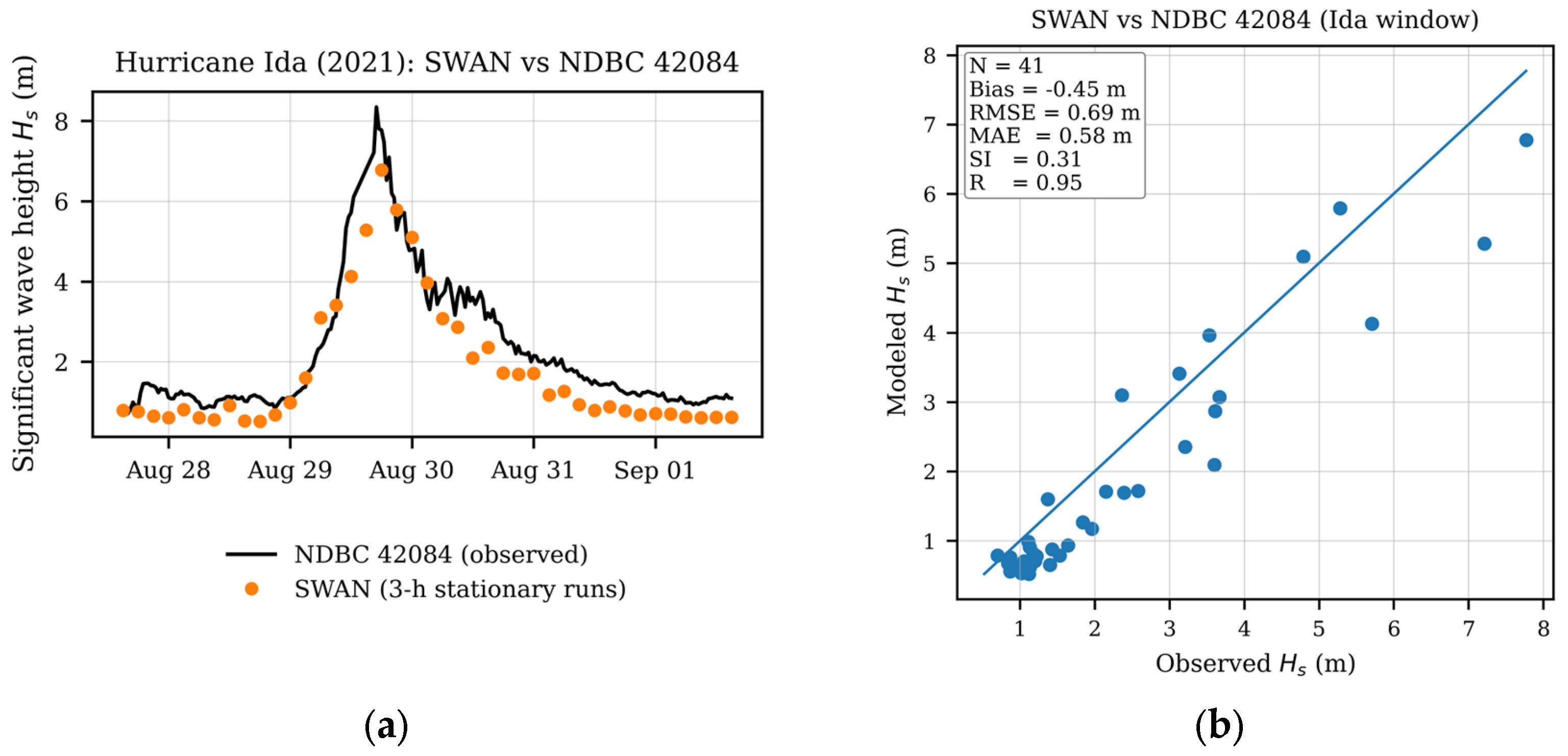
An event-based consistency check was also performed by comparing SWAN-predicted significant wave height with observations from NDBC Station 42084 during Hurricane Ida (27 August–1 September 2021). Ambient currents were not prescribed, and wave–current interaction was not included in the simulations; the implications of this simplification are discussed in
Section 4.7.
3.2. Bathymetry and Computational Grid
Bathymetric data for the SWAN simulations were obtained from a high-resolution seamless topo-bathymetric dataset referenced to UTM Zone 16N. The source bathymetry contained 9534 × 7736 grid nodes with a native horizontal resolution of approximately 28.3 m. These data were imported into SWAN using the INPGRID BOTTOM command and interpolated onto the model grid without external smoothing or depth filtering.
The SWAN computational domain covered approximately 57 km × 30 km and was represented using a regular Cartesian grid with 1142 × 598 computational cells, corresponding to 1143 × 599 output points. This yielded an average grid spacing of about 50 m in both horizontal directions. The grid origin was located at 253,424.87 m east and 3,194,039.99 m north in UTM Zone 16N. This resolution was selected to balance computational efficiency with adequate representation of the principal bathymetric gradients governing offshore-to-nearshore wave transformation.
Wave spectra were discretized using 36 directional bins at 10° increments and 24 frequency bins with a relative spacing of Δf/f = 0.05. This configuration was used in all the SWAN simulations. A summary of the computational grid, spectral discretization, and water-level scenarios is provided in
Table 1.
3.3. Marsh-Platform Roughness Representation
Marsh influence on wave transformation was represented using an effective-roughness approach. Instead of applying the explicit SWAN VEGETATION formulation [
28], the roughened marsh-platform condition was modeled by increasing the JONSWAP bottom-friction coefficient [
28]. Bottom-friction dissipation in SWAN is represented by the source term [
29]
where
is the empirical JONSWAP bottom-friction coefficient (m
2s
−3),
σ is the radian frequency,
is the wave direction,
k is the wave number,
d is the local water depth,
is the gravitational acceleration, and
is the variance density. Because the
term increases rapidly with depth, this dissipation mechanism acts primarily in shallow water, consistent with the marsh-platform setting considered here.
In this implicit representation, the combined effects of vegetation-influenced shallow-water surfaces, submerged organic material, and marsh microtopography are treated as an effective increase in bottom dissipation rather than as plant-scale drag. This approach was selected because the site-specific vegetation parameters required for explicit vegetation modeling, including stem density, stem diameter, vegetation height, flexibility, and drag coefficient, were not available for the modeled marsh-creation platform. Previous SWAN-based studies have shown that explicit vegetation formulations can provide a more physically based representation of vegetation-induced wave damping than an implicit bottom-friction approximation [
30,
31]. Therefore, the present results should be interpreted as conservative, scenario-based estimates of marsh-platform dissipation rather than a fully calibrated vegetation-drag simulation.
Two idealized bottom friction scenarios were considered to evaluate the sensitivity of nearshore wave transformation to increased shallow-water dissipation. In the lower friction scenario, a spatially uniform JONSWAP bottom-friction coefficient of = 0.038 m2s−3 was applied to represent a relatively lower dissipation bare-bed condition. In the higher friction scenario, was increased to 0.060 m2s−3 to represent an idealized roughened marsh-platform condition. These coefficients are used here as scenario-bound values rather than site-specific calibrated roughness parameters. Therefore, the higher friction case should not be interpreted as a direct physical calibration of vegetation drag, and the lower friction case should not be interpreted as a calibrated Gulf of Mexico bed-friction value. Instead, the two cases provide controlled lower and higher dissipation bounds for examining the first-order influence of increased shallow-water friction. By varying only the bottom-friction coefficient while holding all other model inputs constant, the simulations isolate the effect of increased shallow-water dissipation on wave attenuation, erosion-related exposure, wave runup, and containment-dike loading.
3.4. Local Soil and Erosion Susceptibility
To support interpretation of the hydrodynamic results in terms of erosion-risk reduction and sediment-management relevance, local soil information was obtained from the United States Department of Agriculture Natural Resources Conservation Service (USDA NRCS) Web Soil Survey for the marsh-creation and containment-dike area. The soil survey area of interest was defined locally around the containment-dike and marsh-platform zone rather than across the full SWAN domain because soil conditions and sediment-retention performance are inherently site-scale properties.
The mapped units indicate a low-relief, hydrologically active environment dominated by tidal water, frequently flooded dredged soils, and Balize–Larose soils (
Table 2). The Balize–Larose unit is classified as silt loam and is characterized in the upper 0–30 cm by 68.3% silt, 21.5% clay, and 10.2% sand, together with 11.33% organic matter and a bulk density of 0.62 g/cm
3. Both Aquents and Balize–Larose soils are rated as very poorly drained and frequently flooded.
These properties indicate a soft, organic-rich, silt-dominated marsh environment. Wave-induced erosion in such settings is governed by hydrodynamic forcing and by site-specific bed resistance, characterized most directly by critical shear stress; however, critical shear stress measurements were not available for the modeled marsh-creation platform. Therefore, the erosion-related interpretation in this study is based on the modeled reductions in toe wave height, Hs2-based exposure, runup, and hydrodynamic loading, while the Web Soil Survey information is used only to provide local soil and geomorphic context for the containment-dike and marsh-creation zone.
3.5. Wave Runup and Hydrodynamic Loading
Wave runup on the seaward slope of the containment dike was estimated using the EurOtop (2018) and TAW guidance for smooth, impermeable slopes under predominantly normal wave attack [
26]. The governing nondimensional parameter is the Iribarren number,
where
α is the dike slope angle,
is the significant wave height at the dike toe, and
is the deep-water wavelength,
with
and
taken here as the mean energy period
extracted from the SWAN simulations. For the Plaquemines Parish containment dike, the seaward slope is 1V:4H
.
The
exceedance runup height,
, was computed using the deterministic EurOtop formulation,
where
,
, and
are the berm, surface-roughness, and wave-obliquity reduction factors, respectively. In the present study, the dike was assumed to have a smooth, uniform slope and to experience approximately normal wave incidence at the toe; therefore, all reduction factors were set to unity:
This avoids double counting, since marsh effects on wave dissipation were already represented in the SWAN simulations through enhanced bottom friction across the foreshore. The computed Iribarren numbers satisfied , indicating a surging wave regime at the dike toe and supporting application of the EurOtop formulation.
Hydrodynamic loading on the seaward dike face was represented using a quasi-hydrostatic pressure distribution extending from the still-water level to the runup elevation
. The pressure at elevation
above the still-water level was taken as
where
is the density of seawater. Integration yields the resultant hydrodynamic force per unit width,
and the corresponding center of pressure,
For completeness, the resultant force normal to the slope may be written as
where
is the dike slope angle. For the 1V:4H slope considered here, this correction is small; therefore, the hydrodynamic loading results are reported in terms of the vertical resultant force per unit width for consistent comparison between the bare-bed and rough-marsh scenarios.
3.6. Bed Friction Sensitivity Analysis
To evaluate the sensitivity of the modeled wave conditions to bottom-friction specification, a targeted bed friction sensitivity analysis was performed in SWAN. For the bare-bed scenario, three JONSWAP bottom-friction coefficients were considered: , baseline, and . For the marsh-roughened scenario, the baseline value of was perturbed by ±20%, giving , , and . In each case, the selected friction coefficient was applied uniformly across the computational domain while all the other model inputs, including bathymetry, offshore spectral forcing, still-water level, computational grid, and numerical settings, were held constant.
Sensitivity was evaluated using two diagnostic measures derived from the SWAN outputs. First, spatial statistics of significant wave height were calculated within shallow-water regions defined by water-depth thresholds of m and m, including the mean and 95th percentile values. These shallow-zone statistics were used to assess whether the influence of bottom-friction variation was expressed across the nearshore marsh-platform corridor rather than only at a single extraction point. Second, localized wave conditions were extracted along the MIDLINE transect at the valid near-dike location closest to approximately 2 m water depth, representing a toe-proxy condition for the containment dike. Points with invalid or inactive wave-height output were excluded during toe-proxy extraction to avoid selecting dry or non-representative cells. Together, these diagnostics were used to assess the influence of bottom friction uncertainty on both shallow-zone wave attenuation and localized wave conditions relevant to wave runup, hydrodynamic loading, and erosion risk interpretation.
4. Results and Discussion
4.1. Offshore Wave Climate and Design-Wave Selection
The directional wave rose for WIS Station 73136 (
Figure 4) shows that the offshore wave climate near Plaquemines Parish is dominated by waves approaching from the south to southeast sectors. The most energetic wave events are concentrated in the south to south–southeast direction range, indicating that storms approaching from these sectors provide the principal offshore forcing toward the study region. This directional pattern is consistent with the exposure of the lower Louisiana coast to storm-wave conditions generated over the northern Gulf of Mexico.
The return-level relationship for the annual maxima of significant wave height is shown in
Figure 5. The fitted GEV model follows the empirical annual maxima closely over the range of return periods considered, supporting its use for offshore design-wave selection. Based on this analysis, the 25-year return period significant wave height,
, was estimated to be 7.01 m and was adopted as the offshore boundary condition for the SWAN simulations. The associated characteristic wave period was 14.6 s, with a dominant storm-wave direction of approximately 152°. These results provide a statistically consistent basis for the wave conditions used in the subsequent offshore-to-nearshore transformation analysis.
4.2. Event-Based Consistency Check During Hurricane Ida
To provide an observational benchmark for the storm-scale wave conditions represented by the numerical framework, SWAN predictions were compared with in situ measurements from NDBC Station 42084 (Southwest Pass Entrance, Louisiana) during Hurricane Ida (27 August–1 September 2021, UTC). The SWAN comparison point, hereafter referred to as model point B84, was selected as the active model grid point nearest to NDBC Station 42084. This comparison is treated as an event-based consistency check rather than a formal calibration or validation, because the simulations relied on prescribed offshore spectral forcing and did not include dynamic wind input or coupled surge–wave processes. The time-series comparison is shown in
Figure 6a, and the corresponding scatter comparison is shown in
Figure 6b.
The SWAN simulations reproduce the overall temporal evolution of Hurricane Ida’s wave field, including the rapid growth phase, peak timing, and subsequent decay. For the 41 matched samples, the model shows a modest negative bias of −0.45 m, a root mean square error of 0.69 m, a mean absolute error of 0.58 m, a scatter index of 0.31, and a high correlation coefficient of . The peak wave heights are slightly underestimated, but the timing and overall shape of the storm response are captured well.
The observed underprediction is consistent with the simplified assumptions adopted in this study, including the absence of explicit wind forcing, the use of a static water level, and the application of a spatially uniform bottom-friction coefficient. Despite these limitations, the strong agreement in timing, variability, and overall magnitude indicates that the SWAN configuration provides a physically credible representation of storm-scale wave conditions along the Louisiana shelf. This consistency check therefore supports the use of the modeled wave fields for comparative scenario analysis, even if absolute nearshore wave heights and derived loading estimates may be slightly conservative.
4.3. Offshore-to-Nearshore Wave Transformation and Marsh-Roughness Effects
Modeled wave transformation across the Plaquemines shelf is governed primarily by the broad cross-shore bathymetric gradient and the barrier–marsh configuration of the study area. Under the selected 25-year offshore design-wave condition, significant wave height decreases rapidly as waves propagate from the deeper offshore shelf across the shallow inner shelf and marsh platform. This attenuation reflects the combined influence of shoaling, depth-induced breaking, and bottom-friction dissipation as water depths transition from offshore depths to less than approximately 5 m inshore.
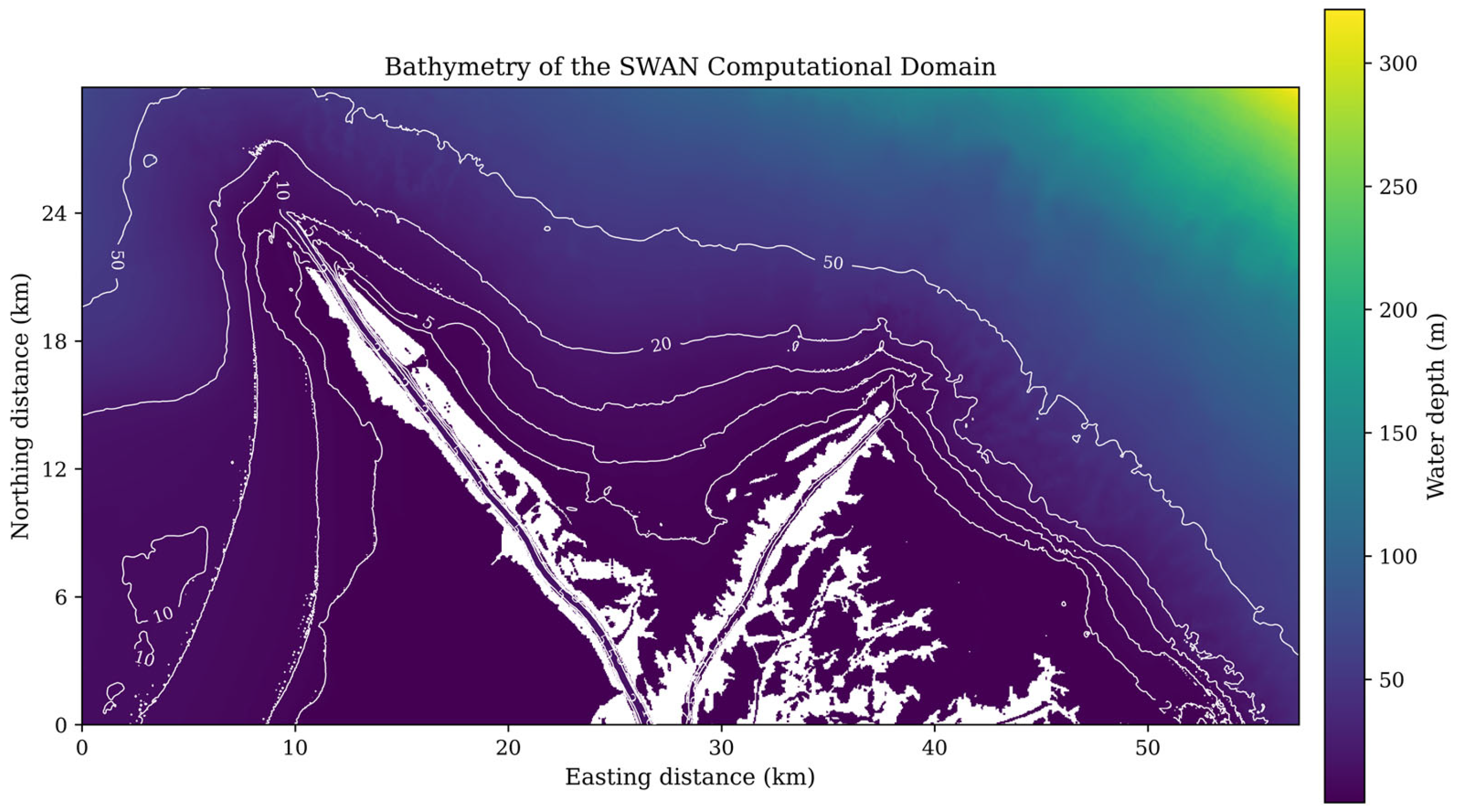
The bathymetry of the SWAN computational domain is shown in
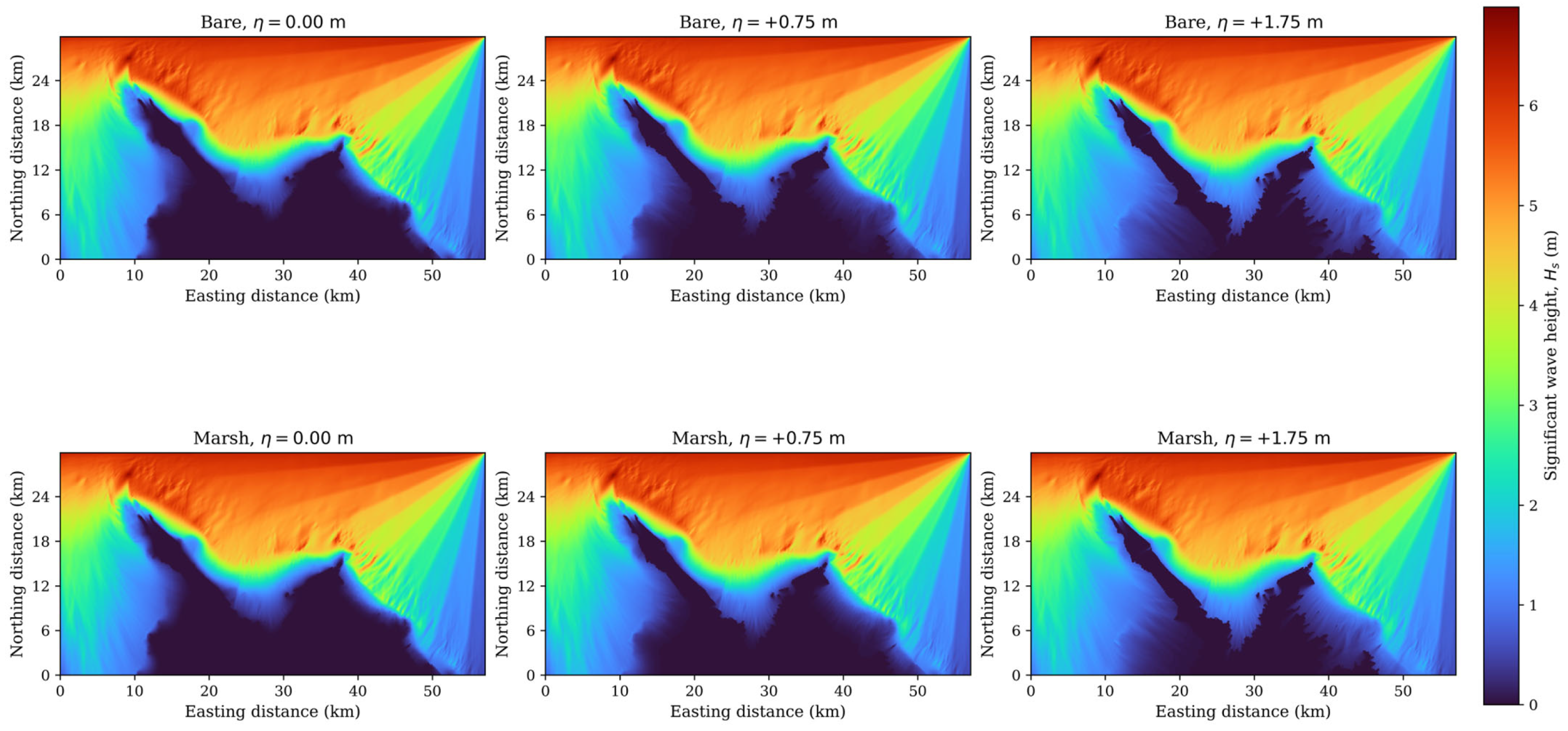
Figure 7, where white pixels denote land or dry cells. The broad, shallow platform promotes strong depth-limited breaking and frictional dissipation during shoreward wave propagation. Modeled significant wave-height fields for the three imposed still-water levels (
m,
m, and
m) are shown in
Figure 8 for both the bare-bed and roughened marsh-platform scenarios. Under bare-bed conditions, increasing water levels allow progressively greater inland penetration of wave energy. However, pronounced attenuation still occurs landward of the shallowest contours across all three water levels.
The spatial patterns in
Figure 8 indicate that wave attenuation is controlled by the interaction among water depth, bottom friction, and the broad marsh-platform geometry. At lower still-water levels, waves encounter shallow depths earlier during shoreward propagation, which promotes depth-induced breaking and frictional dissipation before the wave field reaches the containment-dike zone. As still-water level increases, greater inundation allows more wave energy to propagate across the shallow platform, as reflected by the expanded higher wave height zones in the nearshore corridor. However, the roughened marsh-platform scenario still produces lower nearshore wave heights than the bare-bed scenario because increased effective bottom dissipation acts over the final shallow-water propagation path. The engineering implication is that marsh-platform roughness is most beneficial in the near-dike corridor, where even modest reductions in local significant wave height can produce larger reductions in runup and hydrodynamic loading.
Domain-scale statistics indicate that the influence of marsh roughness on significant wave height is modest when averaged over the full wet computational domain but becomes increasingly important within shallow-water regions. The mean difference in over the entire wet grid increased from 0.0338 m at m to 0.0386 m at m and 0.0458 m at m. In shallow regions, the effect was more pronounced. For example, within depths of 5 m or less, the mean decreased from 0.4638 to 0.4334 m at m, from 0.5755 to 0.5257 m at m, and from 0.7472 to 0.6636 m at m. A similar trend was observed within the 10 m depth zone, confirming that enhanced marsh-platform roughness primarily affects the shallow inshore corridor rather than the offshore shelf.
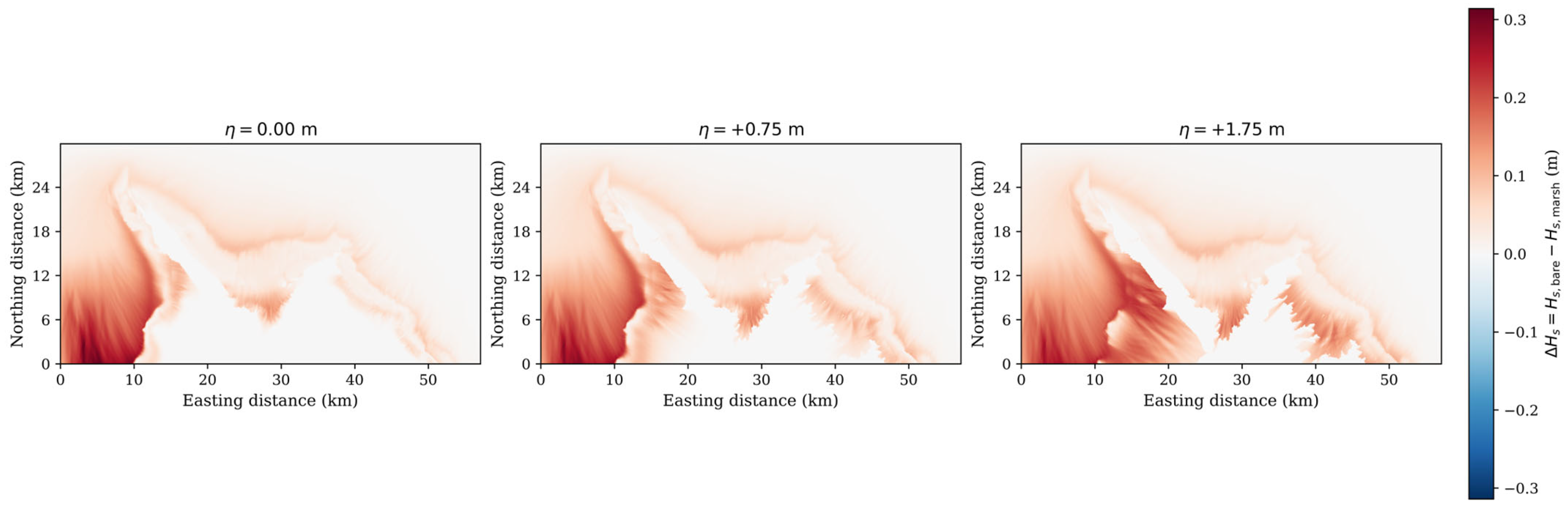
The effect of marsh roughness is more clearly isolated in the wave-height difference maps shown in
Figure 9, where
Positive values indicate wave-height reduction under the roughened marsh-platform scenario. The reductions are small offshore but become systematic and spatially coherent in shallow regions, particularly near the marsh-front transition and within the near-dike corridor. These spatial patterns indicate that enhanced bottom friction associated with marsh roughness primarily influences wave transformation during the final stages of shoreward propagation across the shallow platform.
To quantify the engineering relevance of these transformations, toe-proxy wave conditions were extracted at locations where the modeled water depth was closest to 2 m, representing a physically meaningful proxy for the seaward toe of typical marsh-creation containment dikes in Plaquemines Parish. The resulting toe conditions are summarized in
Table 3. Under bare-bed conditions, toe significant wave heights ranged from 0.555 to 0.638 m across the three still-water levels. Under the roughened marsh-platform scenario, toe wave heights decreased to 0.416–0.535 m, corresponding to reductions of 16.1%, 25.0%, and 27.4% for
,
, and
m, respectively.
The engineering significance of these reductions is amplified when interpreted using energy-related exposure metrics. Although toe wave-height reductions were on the order of 16–27%, the corresponding reductions in the
-based erosion-exposure proxy ranged from 29.6% to 47.4%. Because shallow-water wave-power trends scale closely with
under comparable toe-proxy depth conditions, the separate wave-power reduction metric was removed to avoid redundant interpretation. The
-based proxy is therefore used here as a compact indicator of erosion-related wave exposure. This nonlinear amplification indicates that moderate decreases in local wave height can translate into substantially larger decreases in erosion-related wave exposure at the containment-dike toe. These reductions provide the hydraulic basis for the lower runup elevations, reduced hydrodynamic forces, and lower erosion-risk potential discussed in
Section 4.4.
4.4. Wave Runup and Hydrodynamic Loading Reduction
The toe wave conditions summarized in
Table 3 were further translated into dike-scale response using the EurOtop 2% exceedance runup formulation and the quasi-hydrostatic loading approximation described in
Section 3.5. The computed runup and resultant force per unit width are summarized in
Table 4. Across the three still-water levels, the roughened marsh-platform scenario consistently reduced both runup elevation and hydrodynamic loading relative to the bare-bed condition. The 2% exceedance runup decreased from 2.14 to 1.81 m at
η = 0.00 m, from 1.87 to 1.42 m at
η = +0.75 m, and from 2.05 to 1.51 m at
η = +1.75 m. These values correspond to runup reductions of 15.4%, 24.0%, and 26.4%, respectively.
The reduction in hydrodynamic loading was even more pronounced. The resultant force decreased from 23.01 to 16.46 kN/m at η = 0.00 m, from 17.61 to 10.16 kN/m at η = +0.75 m, and from 21.19 to 11.48 kN/m at η = +1.75 m. These reductions correspond to 28.5%, 42.3%, and 45.8%, respectively. The larger percentage reduction in force compared with runup occurs because the quasi-hydrostatic resultant scales with the square of runup elevation. Therefore, even moderate reductions in wave height and runup can produce substantially larger reductions in hydraulic demand on the dike face.
These results strengthen the sustainability interpretation of the study. By reducing wave runup and hydrodynamic loading, marsh-platform roughness can lower the potential for slope erosion, overtopping-related sediment disturbance, and loss of placed dredged material from containment cells. The results therefore suggest that marsh-induced dissipation can complement engineered containment dikes and support more sustainable sediment-retention performance in coastal restoration projects.
4.5. Soil Erodibility and Sediment Management Implications
The hydrodynamic reductions reported above are especially important because the containment-dike and marsh-creation area is composed of soft, frequently flooded, and erosion-susceptible soil conditions, as summarized in
Table 2. The local units include frequently flooded dredged materials, tidal water, and Balize–Larose silt–loam soils. The Balize–Larose unit contains a high silt fraction, low bulk density, and a high organic matter content, indicating a soft marsh substrate that may be vulnerable to wave-induced erosion and sediment redistribution.
Within this context, the modeled reductions in toe wave height, Hs2-based erosion-exposure proxy, runup, and hydrodynamic loading have direct sediment management significance. Lower wave heights reduce the hydraulic energy available for bed and slope erosion, while lower runup and quasi-hydrostatic loading reduce the potential for wave attack on the containment-dike face. These reductions can help limit sediment resuspension, slope surface disturbance, and loss of recently placed dredged material from marsh-creation cells.
Therefore, the results suggest that marsh-platform roughness can provide a nature-based protective function for sediment-retention infrastructure. Rather than acting only as an ecological feature, the marsh platform contributes to engineering performance by dissipating wave energy before it reaches the dike. This supports the broader sustainability objective of combining natural roughness, sediment retention, and engineered containment systems to improve the durability of coastal restoration projects in low-relief deltaic environments.
4.6. Bed Friction Sensitivity Analysis
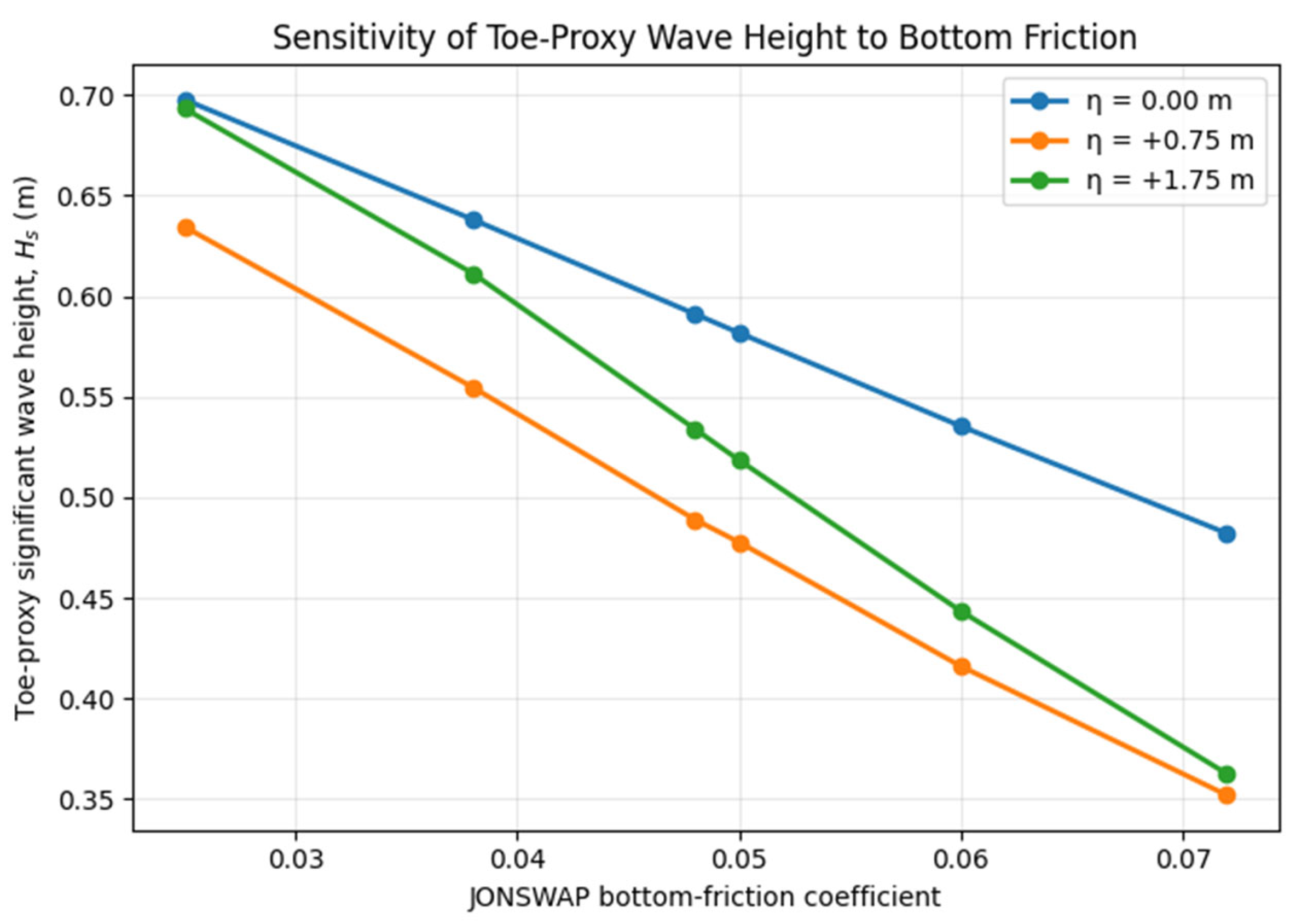
A bed friction sensitivity analysis was performed to evaluate whether the modeled marsh-roughness effect depends strongly on a single selected JONSWAP bottom-friction coefficient. For the bare-bed condition, the coefficient varied from 0.025 to 0.050, while for the marsh-roughened condition, it varied from 0.048 to 0.072. All the other model inputs, including bathymetry, offshore boundary forcing, still-water level, computational grid, and spectral discretization, were kept unchanged. Toe-proxy wave conditions were extracted from the MIDLINE transect at the valid near-dike location closest to approximately 2 m water depth. This extraction was performed separately for each still-water level; therefore, the toe-proxy location follows a moving depth-contour criterion rather than a fixed (x,y) coordinate. For a given water level, the same toe-proxy depth/location was used for all the bare-bed and marsh-roughened friction cases to ensure consistent comparison among the bottom-friction coefficients. The resulting sensitivity values are summarized in
Table 5.
The sensitivity results show a systematic decrease in toe-proxy significant wave height with an increasing JONSWAP bottom-friction coefficient. For the bare-bed sensitivity cases, increasing the coefficient from 0.025 to 0.050 reduced toe from 0.6976 to 0.5817 m at m, from 0.6344 to 0.4777 m at m, and from 0.6931 to 0.5185 m at m. A similar trend was observed for the marsh-roughened cases, where increasing the coefficient from 0.048 to 0.072 reduced toe from 0.5911 to 0.4821 m, 0.4890 to 0.3520 m, and 0.5340 to 0.3626 m for the three water levels, respectively.
The decreasing trends shown in
Figure 10 confirm that the direction of the modeled response remains stable across all the still-water levels. Although the exact magnitude of wave attenuation varies with the selected friction coefficient, greater shallow-water friction consistently reduces near-dike wave exposure. This supports the main conclusion of the study: enhanced marsh-platform roughness, represented here as increased effective bottom friction, reduces toe wave height and strengthens the associated reductions in erosion-exposure indicators, wave runup, and hydrodynamic loading reported in the main analysis.
In addition to the toe-proxy response, shallow-zone statistics were computed for the m and m regions to assess whether the sensitivity response was expressed across the nearshore marsh-platform corridor. The results show that increasing the JONSWAP bottom-friction coefficient generally reduced both the mean and 95th percentile within these shallow-water zones. For example, at m, the bare-bed mean in the m zone decreased from 0.482 to 0.447 m as increased from 0.025 to 0.050, while the m mean decreased from 0.996 to 0.935 m. Similarly, at m, the marsh-roughened mean in the m zone decreased from 0.708 to 0.623 m as increased from 0.048 to 0.072. These results confirm that the bed-friction response is not limited to a single toe-proxy extraction point but is expressed more broadly across shallow inshore waters.
4.7. Limitations and Uncertainty
Although the modeling framework provides useful insight into the role of marsh-platform roughness in reducing wave exposure at marsh-creation containment dikes, several limitations should be recognized. First, the roughened-marsh scenario was represented using an effective increase in the JONSWAP bottom-friction coefficient rather than an explicit vegetation-drag formulation. Therefore, the selected marsh-roughness coefficient should be interpreted as a scenario-based effective roughness parameter, not as a calibrated plant-scale vegetation coefficient. This approach was adopted because spatially continuous vegetation parameters, such as stem density, canopy height, frontal area, and drag coefficient, were not available across the full computational domain.
Second, the design-wave simulations were performed using stationary SWAN conditions with prescribed still-water levels. Dynamic storm-surge evolution, wind-wave growth within the domain, wave–current interaction, and time-varying water levels were not explicitly resolved. In particular, dynamic water level fluctuations during actual hurricane events can alter marsh submergence depth and therefore wave-damping efficiency, introducing moderate uncertainty when these results are extrapolated to transient extreme storm conditions. The imposed still-water levels should therefore be interpreted as scenario water levels rather than joint-probability water levels paired with the 25-year offshore wave height. Although the offshore boundary condition was defined using a 25-year return-period significant wave height, the combined occurrence of this wave condition with a specified still-water level does not necessarily correspond to a 25-year joint return period. In coastal Louisiana, storm waves and surge are physically correlated during tropical cyclone events, and a full joint-probability analysis of wave height, wave period, wave direction, surge level, and storm timing would be required to assign a formal joint return period to each combined forcing scenario. Therefore, the results should be interpreted primarily as a comparative scenario-based assessment of bare-bed and roughened marsh-platform conditions, rather than as a full storm-surge, hydrodynamic, or morphodynamic hindcast.
Third, the dike-toe wave conditions were extracted using a toe-proxy location based on approximately 2 m water depth along the MIDLINE transect. Although this provides a consistent basis for comparing scenarios, actual near-dike wave conditions may vary with exact dike alignment, local bathymetry, wetting–drying behavior, and spatial variability in marsh roughness.
Finally, the erosion risk was evaluated using wave-energy-related indicators, including an Hs2-based exposure proxy, rather than direct sediment-transport or morphodynamic modeling. These metrics provide useful indicators of relative erosion susceptibility, but they do not directly predict erosion volume, scour depth, or sediment deposition patterns. Future work should incorporate site-specific vegetation parameters, explicit SWAN vegetation formulations, coupled surge–wave modeling, field calibration, critical shear stress measurements, and sediment-transport or morphodynamic simulations.
From a practical engineering perspective, the present framework can support future development of marsh-width guidance and cost–benefit comparison for containment-dike protection. However, minimum foreshore marsh widths and construction/maintenance cost comparisons were not developed in this study because they require additional simulations with varying marsh widths, roughness conditions, water levels, storm directions, and dike geometries, as well as project-specific life-cycle cost data. Future work should extend the framework to evaluate marsh-width thresholds and compare traditional hard-dike systems with hybrid “dike + fronting marsh” alternatives for Louisiana Coastal Master Plan applications.
These limitations do not reduce the value of the comparative analysis; rather, they define the appropriate interpretation and scope of the results. The objective of this study was not to reproduce a specific storm hydrograph but to evaluate how marsh-platform roughness and water-level conditions influence near-dike wave transformation, runup, wave loading, and erosion-related indicators under a consistent design-wave framework.
4.8. Implications for Sustainable Sediment Management
The results of this study have direct implications for sustainable sediment management in marsh-creation projects. The modeled reductions in toe wave height, Hs2-based erosion exposure, runup, and hydrodynamic loading indicate that marsh-platform roughness can provide a functional buffer between offshore storm waves and sediment-retention infrastructure. By dissipating wave energy before it reaches the containment dike, the marsh platform may reduce the potential for slope erosion, sediment resuspension, and loss of recently placed dredged material from containment cells. This is particularly important in low-relief deltaic environments such as coastal Louisiana, where soft, frequently flooded, and silt-rich marsh soils are vulnerable to wave-induced disturbance.
From a restoration-design perspective, these findings support the use of nature-based or hybrid protection strategies in which marsh platforms and engineered containment dikes work together. The containment dike provides structural sediment retention, while the roughened marsh platform reduces incoming wave energy and hydraulic demand on the dike face. In this way, marsh-induced dissipation contributes not only to ecological function but also to engineering performance. Therefore, preserving or enhancing shallow marsh-platform roughness in front of sediment-retention infrastructure may improve project durability and support more sustainable coastal restoration outcomes.
5. Conclusions
This study evaluated offshore-to-nearshore wave transformation, erosion-risk reduction, wave runup, and hydrodynamic loading at a representative marsh-creation containment-dike site in coastal Louisiana. A 25-year offshore design-wave condition derived from long-term WIS hindcast data was propagated using the SWAN spectral wave model under bare-bed and roughened marsh-platform scenarios. Local Web Soil Survey data were also incorporated to provide soil and geomorphic context for the containment-dike and marsh-creation zone.
The results show that the broad shallow shelf and marsh platform strongly attenuate offshore storm-wave energy before waves reach the containment-dike zone. At the dike-toe proxy location, the roughened marsh-platform condition reduced significant wave height by 16.1–27.4% relative to the bare-bed scenario. Because erosion-related wave exposure scales nonlinearly with wave height, these reductions produced larger decreases in the -based erosion-exposure proxy, ranging from 29.6% to 47.4%. Since shallow-water wave power scales closely with , this proxy also represents the corresponding reduction in wave-power exposure.
The reduction in near-dike wave exposure also translated into a lower dike-scale hydraulic response. Across the three still-water levels considered, the roughened marsh-platform scenario reduced 2% exceedance runup by 15.4–26.4% and quasi-hydrostatic loading by 28.5–45.8%. These findings indicate that marsh-induced dissipation can meaningfully reduce wave attack on containment-dike slopes and may help limit sediment disturbance, slope erosion, and loss of placed dredged material from marsh-creation cells.
The bed friction sensitivity analysis further confirmed the robustness of the roughness interpretation. Increasing the JONSWAP bottom-friction coefficient consistently reduced toe-proxy significant wave height across all the still-water levels, and the shallow-zone statistics showed similar reductions in near-shore wave exposure. This indicates that the modeled response is not dependent on a single selected friction coefficient but reflects the broader role of enhanced shallow-water dissipation.
Overall, the findings support the role of marsh platforms as nature-based protective features that can complement engineered sediment-retention infrastructure. Although the roughened-marsh representation used in this study is scenario-based and does not explicitly resolve plant-scale vegetation mechanics, the results provide a practical first-order assessment of how enhanced shallow-water roughness can contribute to erosion-risk reduction and sustainable coastal restoration design. Future work should incorporate site-specific vegetation parameters, critical shear stress measurements, coupled surge–wave modeling, field calibration, and sediment-transport or morphodynamic simulations.