Article

Tourism Transformation and Oil Price Dynamics in Saudi Arabia: An ARDL Analysis of Religious and Non-Religious Tourism

Department of Economics, College of Business Administration, Princess Nourah Bint Abdulrahman University, P.O. Box 84428, Riyadh 11671, Saudi Arabia
*
Author to whom correspondence should be addressed.
Sustainability 2026, 18(12), 6295; https://doi.org/10.3390/su18126295 (registering DOI)
Submission received: 20 May 2026 / Revised: 16 June 2026 / Accepted: 17 June 2026 / Published: 18 June 2026

Abstract

This study provides strong evidence of structural asymmetries between religious and non-religious tourism demand in Saudi Arabia over the period 2015Q1–2024Q4. The unit root results indicate that all variables are integrated of order one, supporting the application of the ARDL framework. The bounds test confirms the existence of a long-run equilibrium relationship for both religious and non-religious tourism. However, the strength and determinants of these relationships differ across tourism segments, providing evidence of structural heterogeneity in tourism demand. The empirical findings show that global oil prices do not have a statistically significant direct effect on either tourism segment in both the short run and the long run, suggesting that their influence is indirect and transmitted through broader macroeconomic channels. In contrast, non-oil GDP exerts a positive effect on non-religious tourism and remains weakly significant in the long run, highlighting the critical role of economic diversification and sustained income growth under Vision 2030. Religious tourism, however, remains largely unaffected by economic growth, reflecting its institutional and policy-driven nature. The COVID-19 pandemic had a severe and persistent negative impact on tourism demand, with a more immediate and pronounced effect on religious tourism due to the suspension of Hajj and Umrah activities. Adjustment dynamics indicate that both tourism segments converge toward their long-run equilibrium following short-run shocks, although religious tourism exhibits a somewhat faster speed of adjustment. Diagnostic tests confirm that all econometric assumptions are satisfied, supporting the robustness and reliability of the results.

1. Introduction

Saudi Arabia is currently undergoing one of the most significant economic transformations in its modern history. At the center of this transformation is Vision 2030, a strategic framework launched in 2016 to reduce the country’s historical dependence on oil revenues and diversify its economic base. Within this agenda, the tourism sector has evolved from a secondary activity into a major pillar of national development. By targeting 150 million visitors annually and increasing tourism’s contribution to GDP to 10% by 2030, Saudi Arabia seeks to reposition itself as a global tourism destination beyond its traditional role as the custodian of the Two Holy Mosques. This diversification strategy reflects broader economic transformation efforts observed in oil-dependent economies seeking to reduce vulnerability to hydrocarbon price fluctuations [1,2].
However, this transition takes place within a complex macroeconomic environment characterized by the volatility of global oil prices. In oil-exporting economies such as Saudi Arabia, oil price fluctuations influence tourism through several competing transmission mechanisms. On the one hand, higher oil revenues expand fiscal space and enable large-scale investments in tourism infrastructure, transportation, entertainment, and mega-projects such as NEOM and the Red Sea Project. On the other hand, rising oil prices may increase transportation costs and reduce international competitiveness. Previous studies have shown that oil prices significantly affect tourism demand, transportation costs, and tourism competitiveness activities. However religious tourism is primarily driven by spiritual obligations, faith-based motivations, and institutional arrangements rather than purely economic incentives [3,4,5]. Demand in this segment is strongly shaped by quota systems, visa regulations, and religious motivations, making it relatively insensitive to short-term economic fluctuations. In contrast, non-religious tourism, including leisure, business, and visiting friends and relatives (VFR) tourism, operates within a more conventional market framework. Therefore, it is more responsive to macroeconomic conditions such as income growth, oil price movements, and changes in travel costs. Recent tourism studies also suggest that leisure and business tourism are highly sensitive to economic uncertainty, geopolitical risks, and transportation costs [6].
Despite the growing importance of tourism in Saudi Arabia’s diversification strategy, existing literature frequently treats tourism demand as a homogeneous aggregate. This aggregation may conceal important structural differences between tourism segments. As a result, it may lead to incomplete or misleading conclusions regarding the determinants of tourism demand. Although tourism demand modeling has evolved considerably over recent decades [7,8,9,10], much of the existing literature continues to rely on aggregate tourism indicators, potentially concealing important structural differences across tourism segments. While previous studies have explored the relationships among tourism demand, oil price volatility, and economic growth in oil-dependent economies, limited attention has been given to the differential effects of oil price fluctuations on religious and non-religious tourism within the Saudi context. This distinction is particularly important because the two segments differ fundamentally in their motivations, institutional structures, and responsiveness to economic conditions.
Accordingly, this study aims to examine how oil price fluctuations and non-oil GDP influence tourism demand in Saudi Arabia over the period 2015 Q1–2024 Q4. The study places particular emphasis on the differences between religious and non-religious tourism. Using the Autoregressive Distributed Lag (ARDL) approach, the study investigates both short-run dynamics and long-run equilibrium relationships. The ARDL methodology developed by Pesaran et al. (2001) [11] is particularly appropriate for small sample sizes and for examining both short-run dynamics and long-run equilibrium relationships among variables that are integrated of order I(0) and/or I(1). To account for exceptional external disruptions during the study period, the analysis also incorporates a COVID-19 dummy variable as an exogenous control variable capturing the structural shock associated with the pandemic. The pandemic generated unprecedented disruptions in global tourism flows, travel restrictions, and pilgrimage activities worldwide [12,13,14]. However, the primary focus of the study remains the examination of the effects of oil price fluctuations and non-oil economic growth on tourism demand in Saudi Arabia.
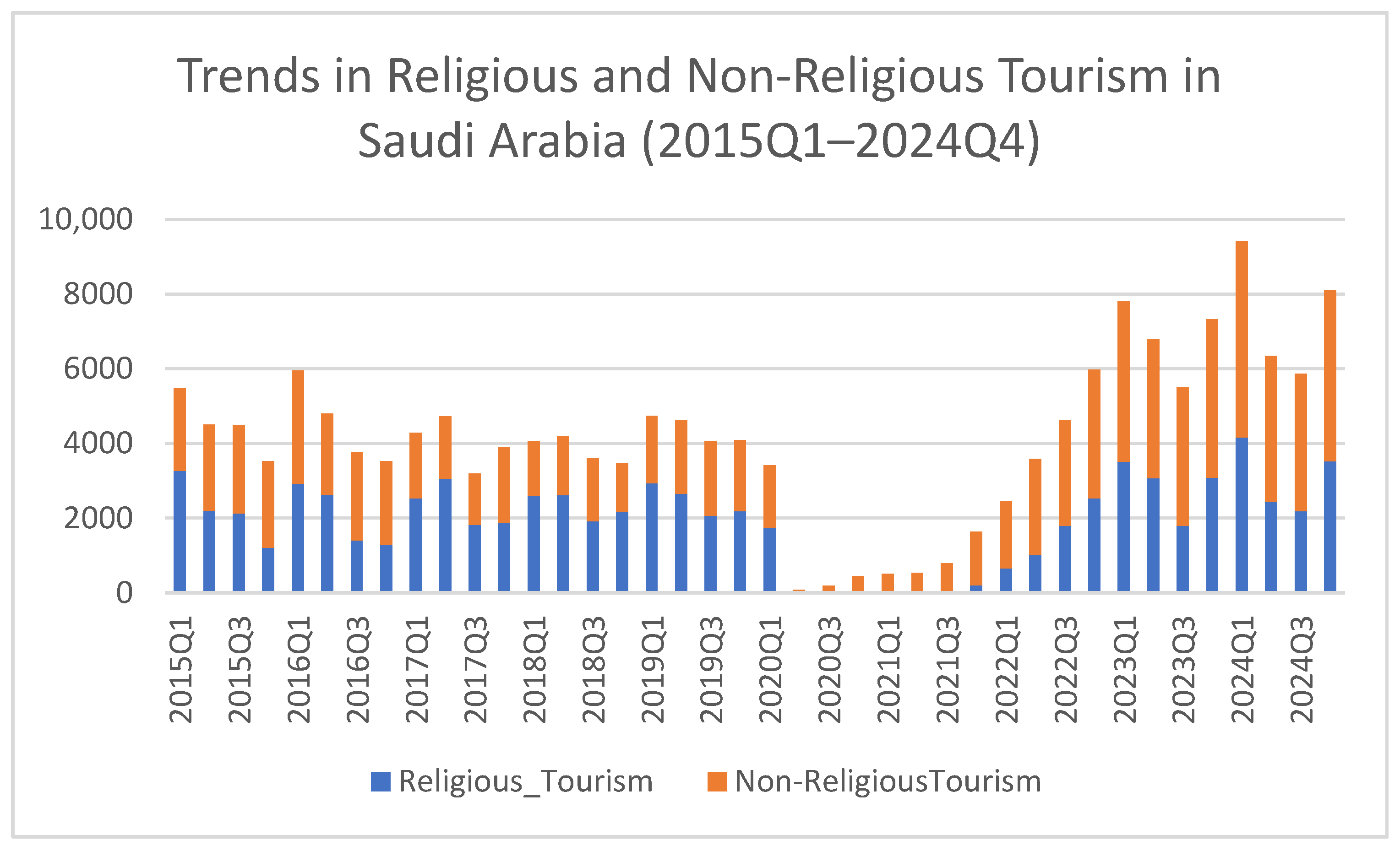
Figure 1 presents the evolution of religious and non-religious tourism in Saudi Arabia over the period 2015Q1–2024Q4. Both tourism segments experienced an unprecedented decline during the COVID-19 pandemic, reflecting travel restrictions and the temporary suspension of pilgrimage activities. However, the recovery trajectories differ substantially. Religious tourism gradually recovered following the resumption of Hajj and Umrah activities, whereas non-religious tourism exhibited stronger growth during the post-pandemic period, consistent with the tourism diversification objectives of Vision 2030. These contrasting patterns provide preliminary evidence of the structural differences between the two tourism segments and motivate the empirical analysis undertaken in this study.
The study contributes to literature in several important ways. First, it provides a disaggregated analysis of tourism demand by distinguishing between religious and non-religious tourism, thereby addressing an important gap in the existing literature. Unlike most previous studies that treat tourism demand as a homogeneous aggregate, this study explicitly examines the structural differences between religious and non-religious tourism and their distinct responses to macroeconomic factors. Second, it contributes to the emerging discussion on the oil–tourism nexus in resource-dependent economies. The study demonstrates that tourism demand responds asymmetrically across structurally different tourism segments. By showing that the oil price–tourism relationship is segment-specific rather than uniform, the study provides new evidence on tourism demand heterogeneity in an oil-dependent economy. Third, the study offers policy-relevant insights regarding the role of economic diversification, institutional management, and tourism resilience within the broader framework of Vision 2030. Furthermore, the study contributes novel evidence from Saudi Arabia during a period of unprecedented tourism transformation under Vision 2030, highlighting how different tourism segments contribute to economic diversification and respond to external shocks. However, the study does not aim to evaluate the causal impact of specific tourism policies or reforms implemented under Vision 2030. Rather, Vision 2030 provides the broader institutional and economic context within which tourism transformation has occurred in Saudi Arabia.
Overall, the findings are expected to provide a more nuanced understanding of tourism dynamics in Saudi Arabia and contribute to the broader debate on sustainable economic diversification in oil-dependent economies.
The remainder of this study is organized as follows. Section 2 presents the theoretical foundations of tourism demand and discusses the economic determinants of tourism activity. Section 3 and Section 4 review the literature and empirical evidence on the relationships between oil price volatility, economic growth, and tourism demand, while developing theoretical arguments underlying the study hypotheses. Section 5 examines tourism dynamics in Saudi Arabia, with particular emphasis on the distinction between religious and non-religious tourism and the role of the COVID-19 pandemic as a major structural shock. Section 6 describes the study area, data sources, variables, and methodological approach. Section 7 presents and discusses the empirical findings, including descriptive statistics, unit root tests, ARDL estimation results, and diagnostic tests. Finally, Section 8 concludes the study by summarizing the main findings, discussing policy implications, acknowledging limitations, and outlining directions for future research.

2. Theoretical Foundations of Tourism Demand

2.1. The Economics of Tourism Demand

Tourism demand is fundamentally a derived demand, shaped by the interaction between economic, social, psychological, and institutional forces. Within the standard economic framework, tourism behavior is grounded in consumer choice theory, which assumes that individuals make rational decisions to maximize utility subject to income and price constraints [8,15,16,17]. Accordingly, tourism demand is influenced by a set of key determinants, including income levels in the country of origin, relative prices across competing destinations, transportation costs, and destination-specific supply factors such as infrastructure quality, service provision, and institutional conditions. In addition, tourism demand is subject to unobserved heterogeneity and random shocks that may affect travel decisions over time. This multidimensional perspective highlights the complexity of tourism behavior and underscores the importance of integrating both demand-side and supply-side dynamics in empirical modeling [7,8,18,19].
Several complementary economic frameworks further enrich the theoretical underpinnings of tourism demand. The principle of utility maximization suggests that individuals allocate their budgets across goods and services, including travel, to maximize overall satisfaction [20]. Building on this, the random utility model emphasizes that destination choice is inherently probabilistic and driven by heterogeneous preferences and perceived attributes [21,22,23]. The life-cycle hypothesis introduces a dynamic dimension, positing that tourism consumption varies across different stages of life in response to changes in income, wealth accumulation, and personal circumstances [24,25]. Finally, the permanent income hypothesis suggests that individuals base their travel decisions on expected long-term income rather than short-term fluctuations, implying relative stability in tourism demand over time [26,27].
Despite their analytical strength, these frameworks share a common limitation: they implicitly assume that tourism is a discretionary and market-driven activity. This assumption becomes problematic in contexts where non-economic motivations and institutional constraints influence travel decisions. In the case of religious tourism, particularly pilgrimage to Mecca and Medina, demand is not solely determined by utility maximization but is deeply shaped by religious obligation, cultural norms, and regulatory frameworks, including quota systems and visa restrictions [3,4,28].
This distinction has an important implication: standard tourism demand models may not fully explain pilgrimage travel. In such cases, demand is less responsive to price and income, as travel decisions are driven mainly by religious commitment rather than economic factors [29].

2.2. The Oil–Tourism Nexus: Theoretical Transmission Mechanisms

In oil-dependent economies such as Saudi Arabia, tourism demand is further influenced by fluctuations in global oil prices. However, the relationship between oil prices and tourism is theoretically ambiguous, as it operates through multiple transmission channels with potentially offsetting effects [1]. First, the government revenue and public investment channels suggest a positive relationship. In oil-exporting countries, higher oil prices expand fiscal space, enabling increased public investment in tourism infrastructure, including transportation networks, accommodation facilities, and cultural attractions [30,31,32]. This, in turn, enhances destination attractiveness and stimulates tourism demand. Conversely, oil price declines may lead to fiscal consolidation, reducing public spending on tourism development.
Second, the transportation cost channel implies a negative relationship. Oil prices directly affect jet fuel costs, which account for a substantial share of airline operating expenses. Rising fuel prices are typically passed on to consumers through higher airfares, reducing tourism demand, particularly for long-haul and price-sensitive travelers [33,34,35]. Third, the exchange rate and competitiveness channel highlights the role of macroeconomic adjustments. Oil price increases are often associated with currency appreciation in oil-exporting economies, a phenomenon commonly referred to as “Dutch Disease” [36,37]. This appreciation raises the relative cost of the destination for foreign tourists, thereby reducing international competitiveness. Conversely, oil price declines may improve competitiveness through currency depreciation [38,39]. Fourth, the disposable income channel operates through origin countries. For tourists originating from oil-importing economies, higher oil prices reduce real disposable income by increasing energy-related expenditures, leading to a contraction in discretionary spending on travel [40]. This effect is particularly relevant for destinations that rely heavily on international tourists.
Fifth, the domestic economic activity channel suggests a positive indirect effect. In oil-exporting economies, oil revenues stimulate non-oil sectors through fiscal multipliers, supporting economic growth and increasing domestic tourism demand. Higher levels of non-oil GDP may also attract business travelers and support tourism-related services [9,41].
Overall, the effect of oil prices on tourism demand remains ambiguous, as it depends on the balance between competing channels, sector characteristics, and institutional conditions [42].

3. Oil Price Volatility and Tourism Demand

3.1. Empirical Evidence: A Fragmented and Context-Dependent Literature

The empirical relationship between oil price volatility and tourism demand remains highly contested, with findings that vary across countries, methodologies, and tourism segments. Rather than converging toward a unified conclusion, the literature reveals a fragmented landscape, suggesting that the oil and tourism nexus is inherently context-specific and sensitive to model specification.
A dominant strand of the literature identifies a negative relationship between oil prices and tourism demand, primarily through the transportation cost and income channels. Empirical evidence supports this view, showing that rising oil prices increase travel costs and reduce international tourist flows [33,42,43]. Nonlinear approaches further highlight asymmetric effects, where oil price increases suppress tourism demand more strongly than price decreases stimulate it, reflecting rigidities in pricing mechanisms within the tourism sector [42,44]. Panel-based evidence also suggests that certain segments, particularly business tourism, exhibit higher sensitivity to oil price fluctuations than leisure tourism [9,45].
In contrast, a second body of research finds insignificant or weak direct effects of oil prices on tourism demand once key macroeconomic variables, such as GDP and exchange rates, are incorporated into the model. These studies argue that oil prices influence tourism indirectly through their impact on economic growth and competitiveness [33,40]. Evidence from multi-country analyses shows that the oil price coefficient often becomes statistically insignificant when income effects are controlled for, suggesting a mediated relationship [9,46]. Importantly, this strand highlights tourism heterogeneity, with religious tourism showing limited sensitivity to economic fluctuations [3,4,5,47].
A third, more limited set of studies identifies positive effects, particularly in oil-exporting economies. In these contexts, rising oil prices increase government revenues, which are then invested in tourism infrastructure and development, offsetting negative cost effects. This fiscal transmission mechanism is supported by evidence linking tourism development, public investment, and economic growth in resource-dependent economies [2,31,41,48]. The coexistence of negative, insignificant, and positive findings underscores a fundamental limitation in the literature, the tendency to treat tourism as a homogeneous aggregate sector. This aggregation obscures critical differences in demand behavior across tourism types and may explain the lack of empirical consensus.

3.2. Why Religious Tourism Is Structurally Insensitive to Oil Prices

A growing body of theoretical and empirical work suggests that religious tourism, particularly pilgrimage to Saudi Arabia, exhibits structural resilience to economic shocks, including oil price fluctuations. This resilience can be explained by a set of reinforcing mechanisms that fundamentally alter the standard demand framework [3,4,28]. Religious obligation plays a central role. The Hajj pilgrimage is a mandatory religious duty for Muslims who are physically and financially able, which transforms travel from a discretionary activity into a non-substitutable life event. As a result, demand becomes highly inelastic with respect to price changes, as postponement carries religious significance [3,4]. Moreover, institutional constraints, particularly quota systems, decouple demand from market forces. Saudi Arabia allocates fixed pilgrimage quotas to each country, and these quotas are consistently fully utilized, often with long waiting lists. Under such conditions, the number of pilgrims is determined by administrative allocation rather than price or income dynamics, rendering traditional demand drivers largely irrelevant [28,29]. Long-term saving behavior insulates pilgrimage decisions from short-term economic fluctuations. Many pilgrims accumulate funds over extended periods specifically for Hajj, meaning that temporary changes in oil prices or income do not significantly alter their travel plans. This behavior is consistent with intertemporal consumption theories such as the life-cycle and permanent income hypotheses [25,27,49]. Cultural and spiritual motivations dominate economic considerations. For many individuals, pilgrimage represents a once-in-a-lifetime spiritual objective, influenced by age, health, and religious timing rather than macroeconomic conditions. This reinforces the idea that religious tourism demand is primarily driven by non-economic determinants [4,28,50].

3.3. Why Non-Religious Tourism Remains Economically Sensitive

In contrast, non-religious tourism operates within the standard framework of consumer choice and is therefore highly responsive to economic conditions, including oil price movements [7,51]. Leisure tourism is typically classified as a luxury good, with income elasticity exceeding unity. As oil prices rise, the resulting increase in transportation costs and reduction in disposable income, particularly in oil-importing countries, leads to a contraction in travel demand [52]. Moreover, the pass-through of fuel costs into airfares directly affects the affordability of long-haul tourism [18,53]. Business tourism exhibits a different but equally important channel of sensitivity. It is closely linked to corporate performance and macroeconomic activity, particularly in sectors related to energy [6]. Declines in oil prices may reduce business travel by weakening investment and commercial activity, while increases in oil prices may stimulate travel in energy-related industries [9,33]. Finally, visiting friends and relatives’ tourism, while less discretionary than leisure travel, remains more responsive to price changes than pilgrimage tourism. Travelers in this category typically bear their own transportation costs and may adjust travel frequency in response to economic conditions [7,54,55].
The theoretical and empirical analysis above leads to a clear set of testable hypotheses regarding the differential impact of oil price volatility:
H1. 
Oil price fluctuations significantly affect tourism demand in Saudi Arabia.
H1a. 
Oil price fluctuations significantly affect religious tourism demand [3,4].
H1b. 
Oil price fluctuations significantly affect non-religious tourism demand [33,42].

4. Economic Growth and Tourism Demand

4.1. The Bidirectional Relationship Between Tourism and Economic Growth

The relationship between economic growth and tourism demand has been extensively examined in the literature, giving rise to two competing but potentially complementary hypotheses: the Tourism-Led Growth Hypothesis (TLGH) and the Growth-Led Tourism Hypothesis (GLTH) [9,10,31]. The TLGH posits that tourism acts as a driver of economic growth, generating foreign exchange earnings, creating employment opportunities, and stimulating investment in infrastructure and related sectors such as transportation, hospitality, and retail. Through these channels, tourism contributes to economic expansion via both direct and indirect multiplier effects [30,56]. Empirical evidence from various country contexts, including Spain, Greece, and Mauritius, supports this view, often identifying tourism as a key engine of growth and, in some cases, establishing bidirectional causality between tourism and GDP [9,57,58,59]. Conversely, the GLTH argues that economic growth drives tourism demand. As income levels rise, households allocate a larger share of their expenditure to discretionary activities such as travel, reflecting the income-elastic nature of tourism consumption. In addition, economic growth facilitates investment in tourism infrastructure, marketing, and human capital, thereby enhancing destination attractiveness and supporting tourism expansion [7,27,60,61]. Cross-country evidence consistently finds that tourism demand exhibits positive income elasticity, often exceeding unity, particularly for long-haul and leisure travel [18]. Rather than being mutually exclusive, these two hypotheses suggest the existence of a dynamic and potentially bidirectional relationship between tourism and economic growth. However, the direction and strength of causality are likely to depend on structural characteristics of the tourism sector [9].

4.2. Disaggregating GDP Effects by Tourism Type

4.2.1. Religious Tourism and GDP: A Structurally Constrained Relationship

The relationship between economic growth and religious tourism demand is theoretically ambiguous, reflecting the coexistence of demand-enhancing and constraint-imposing mechanisms [3,4]. On the one hand, economic growth in origin countries can generate a positive income effect, enabling a larger share of the population to afford pilgrimage-related expenses. Similarly, higher non-oil GDP in Saudi Arabia supports investment in pilgrimage infrastructure, such as mosque expansion, transportation systems, and accommodation facilities, which may enhance the overall experience and stimulate demand. Government-led promotion and marketing efforts, financed through fiscal revenues, can further reinforce this effect [31]. On the other hand, several structural factors limit the responsiveness of religious tourism to GDP. Most notably, quota systems impose binding supply constraints, ensuring that the number of pilgrims remains fixed regardless of income growth. As a result, increases in potential demand do not translate into higher observed tourist flows. Moreover, the religious nature of pilgrimage reduces sensitivity to economic conditions, as participation is driven by spiritual obligation rather than discretionary consumption [28,29]. The prevalence of long-term saving behavior further weakens the link between short-term income fluctuations and travel decisions, consistent with intertemporal consumption theories [25].
Empirical evidence supports this theoretical ambiguity. Studies on pilgrimage destinations consistently find that GDP may have a short-run effect but becomes statistically insignificant in the long run due to institutional constraints [4]. Cross-country analyses further confirm that the income elasticity of religious tourism is low and often insignificant compared to other tourism segments [3].

4.2.2. Non-Religious Tourism and GDP: A Demand-Driven Relationship

In contrast, the relationship between economic growth and non-religious tourism demand is theoretically and empirically strong, positive, and robust. Leisure tourism, in particular, is widely regarded as a luxury good, with income elasticity typically exceeding one. As GDP increases, households allocate a disproportionately larger share of their income to travel, leading to rapid growth in tourism demand [7,18]. Business tourism is similarly linked to economic performance, as higher levels of economic activity generate increased demand for meetings, conferences, and trade-related travel [9,33]. Economic growth also facilitates investment in tourism infrastructure, including airports, hotels, entertainment venues, and cultural attractions, which further enhances destination competitiveness and attractiveness [32]. In addition, higher income levels support increased visiting friends and relatives travel, particularly in contexts characterized by large expatriate populations [35]. Empirical studies consistently confirm these relationships, reporting positive and statistically significant GDP elasticities across different tourism segments and country contexts [9,40]. While the magnitude of the effect varies depending on the type of tourism and level of development, the overall evidence strongly supports the view that non-religious tourism is highly responsive to economic growth.
By explicitly distinguishing between these segments, this research provides a more accurate and nuanced understanding of the GDP–tourism nexus in Saudi Arabia.
Based on this theoretical and empirical synthesis, the following hypotheses are proposed:
H2. 
Non-oil economic growth significantly affects tourism demand in Saudi Arabia.
H2a. 
Non-oil GDP positively affects religious tourism demand [8,16,27,32].
H2b. 
Non-oil GDP positively affects non-religious tourism demand [3,4,28,29].

5. Tourism Dynamics in Saudi Arabia: Religious Resilience, Market Transformation, and Structural Shocks

Tourism in Saudi Arabia exhibits a dual structure combining a highly institutionalized religious tourism sector and a rapidly evolving non-religious segment, each with distinct dynamics. Religious tourism, including Hajj and Umrah, is primarily driven by spiritual obligation rather than economic considerations. It is tightly regulated through quota systems and visa controls, making it effectively supply-constrained. As a result, demand is largely insensitive to price and income fluctuations and remains resilient to economic shocks [3,4,5,28,47]. In contrast, non-religious tourism operates within a market-driven framework and is highly responsive to economic conditions. Following the launch of Vision 2030, tourism has become a central pillar of economic diversification, supported by large-scale investments and policy reforms. This transformation has increased tourism flows and the sector’s contribution to GDP, while also making it more sensitive to macroeconomic variables such as income, oil prices, and exchange rates [8,9,32,33,42].
The COVID-19 pandemic represents a major structural break, with an unprecedented contraction in global tourism. Empirical studies document sharp declines in international arrivals and tourism revenues, followed by uneven recovery patterns across regions and tourism types [12,13,14]. Recovery has generally been faster for non-religious tourism due to pent-up demand, domestic tourism initiatives, and policy support under Vision 2030, whereas religious tourism recovery has been more closely tied to the gradual relaxation of pilgrimage restrictions and health-related regulations. Overall, the coexistence of a resilient, supply-constrained religious tourism sector and a dynamic, market-driven non-religious tourism sector provides a unique framework for analyzing tourism demand in Saudi Arabia. This dual structure implies that macroeconomic shocks, including oil price fluctuations, affect tourism demand asymmetrically across segments.
Based on the literature on tourism disruptions and recovery patterns, the following hypotheses are proposed regarding the impact of the COVID-19 pandemic on tourism demand in Saudi Arabia:
H3. 
The COVID-19 pandemic significantly affects tourism demand in Saudi Arabia.
H3a. 
The COVID-19 pandemic negatively affects religious tourism demand.
H3b. 
The COVID-19 pandemic negatively affects non-religious tourism demand.

6. Data and Methodology

6.1. Study Area and Data Description

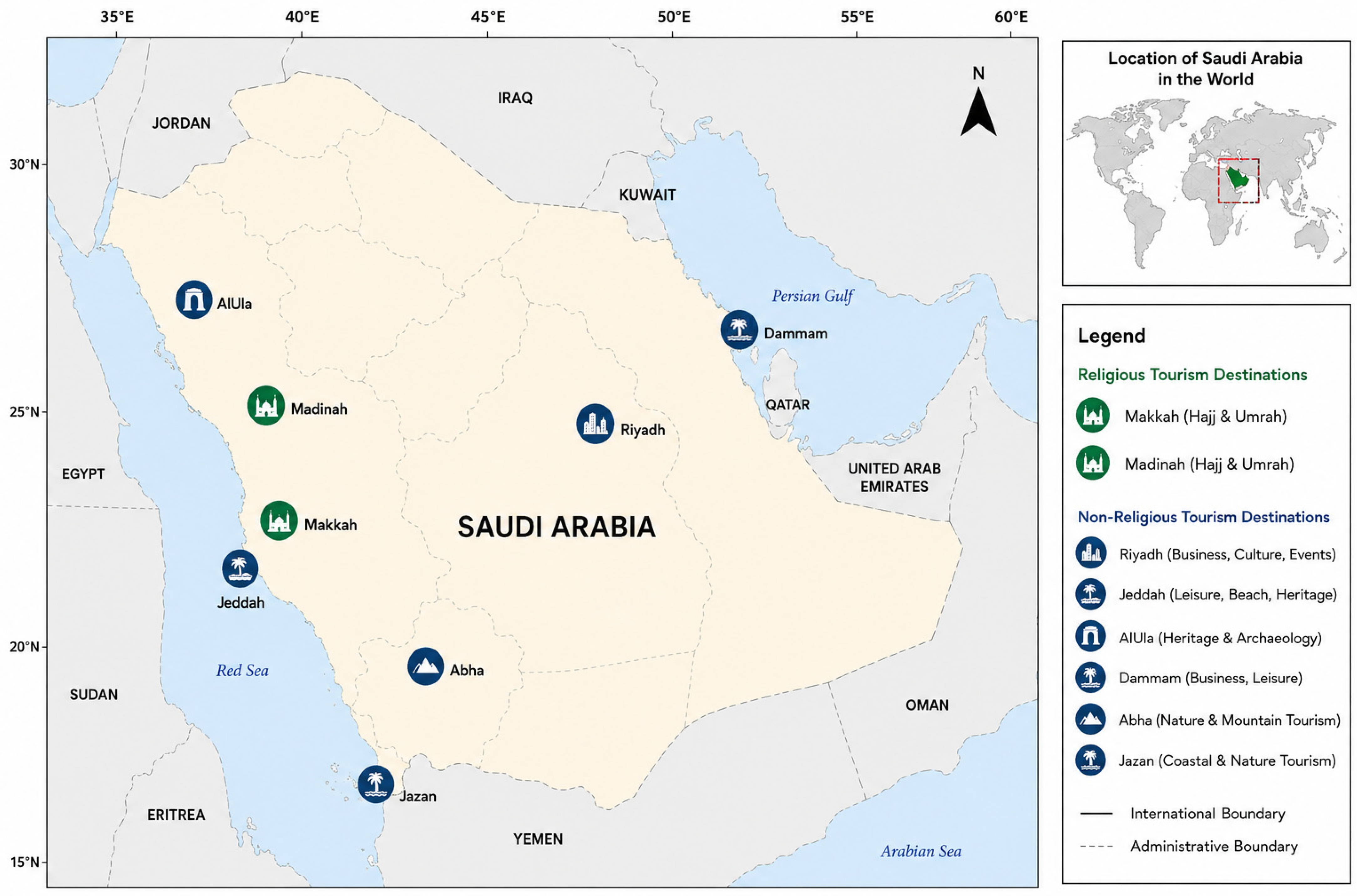
Saudi Arabia is located in the Arabian Peninsula and is one of the world’s most important destinations for religious tourism due to the presence of the two holy cities of Makkah and Madinah. In recent years, the country has also expanded its non-religious tourism offerings through the development of cultural, leisure, entertainment, and heritage destinations under Vision 2030. Figure 2 presents the study area and highlights the principal tourism destinations considered within the broader context of tourism development in Saudi Arabia.

6.2. Variables, Model Specification, and ARDL Methodology

To examine the impact of oil price fluctuations on tourism activity in Saudi Arabia, this study employs the Autoregressive Distributed Lag (ARDL) modeling approach. The ARDL framework is particularly suitable given the relatively small sample size (quarterly data, 2015Q1–2024Q4) and its ability to simultaneously estimate both short-run dynamics and long-run equilibrium relationships among variables integrated of order I(1), provided that none of the variables is integrated of order two, I(2) [11,62]. The empirical model includes two dependent variables, religious tourism (Hajj and Umrah) and non-religious tourism (leisure, business, and VFR), to capture the structural differences between tourism segments. The main explanatory variables are global oil prices and non-oil GDP, along with a COVID-19 dummy variable representing the pandemic shock. All variables are expressed in natural logarithms, except for the dummy variable. Table 1 summarizes the definitions and transformations of the variables used in the ARDL models. The logarithmic transformation of oil prices and non-oil GDP helps stabilize variance and allows the estimated coefficients to be interpreted as elasticities, while the COVID-19 dummy captures the exogenous disruption during the period 2020Q1–2021Q4.
It is important to note that the objective of this study is not to evaluate the effectiveness of specific tourism policies, visa reforms, or tourism initiatives implemented under Vision 2030. Rather, the analysis focuses on the relationship between macroeconomic factors, particularly oil price fluctuations and non-oil economic growth, and tourism demand. Vision 2030 is considered the broader institutional and economic context within which Saudi Arabia’s tourism transformation has occurred, and the study therefore provides policy-relevant insights rather than a formal policy impact assessment.

7. Results and Discussion

7.1. Descriptive Statistics and Correlation Analysis

Before conducting the empirical analysis, descriptive statistics and correlation analysis are used to provide an initial overview of the data. Table 2 reports the mean, standard deviation, minimum, and maximum values for all variables, offering insights into their distribution and variability over the sample period [63,64]. All continuous variables were transformed into natural logarithms prior to estimation. Because non-religious tourism recorded zero observations during the COVID-19 period, zero values were replaced by one unit before logarithmic transformation to ensure that the logarithm was defined and that all observations could be retained in the sample. Table 2 reports descriptive statistics for the logarithmically transformed variables used in the ARDL estimations. The results indicate that religious tourism maintains a relatively high average level, reflecting the central role of Hajj and Umrah in Saudi Arabia. However, its large standard deviation and wide range suggest significant fluctuations over time, largely driven by institutional decisions and external shocks. The minimum value close to zero highlights the severe disruption caused by the COVID-19 pandemic.
Non-religious tourism exhibits a slightly higher average and greater variability, indicating both its growing importance and higher sensitivity to economic conditions. The zero minimum value confirms periods of complete shutdown, while the higher maximum reflects strong expansion potential under Vision 2030. Among macroeconomic variables, non-oil GDP shows relatively stable growth with moderate variability, consistent with ongoing economic diversification efforts. In contrast, oil prices display substantial volatility, reflecting global market dynamics, suggesting an indirect rather than direct influence on tourism demand. The COVID-19 dummy captures a major structural shock during the sample period, accounting for the sharp decline in tourism activity due to travel restrictions. Overall, the descriptive statistics reveal that tourism demand in Saudi Arabia is highly influenced by external shocks, with non-religious tourism being more volatile and economically sensitive. In contrast, religious tourism remains more stable due to institutional factors. To assess multicollinearity, correlation analysis and the Variance Inflation Factor (VIF) are employed. The results indicate low interdependence among the explanatory variables, confirming that the model is well specified and suitable for reliable econometric estimation [63,64].

7.2. Unit Root Test

Before estimation, unit root tests are conducted to examine the stationarity properties of the variables. Specifically, the Augmented Dickey–Fuller (ADF) and Phillips–Perron (PP) tests are applied at both levels and first differences to determine the order of integration and avoid spurious regression results [11,65,66]. The results reported in Table 3 indicate that all variables are non-stationary at levels, as the null hypothesis of a unit root cannot be rejected according to both the ADF and PP tests. At first differences, global oil prices, non-oil GDP, religious tourism, and non-religious tourism become stationary, as the null hypothesis of a unit root is strongly rejected in both tests. This confirms that all variables are integrated of order one, I(1).
Overall, the findings reveal that all variables are integrated of order one, I(1). Since none of the variables are integrated of order two, I(2), the Autoregressive Distributed Lag (ARDL) bounds testing approach is appropriate for examining both short-run dynamics and long-run relationships among the variables [11,67]. The absence of I(2) variables satisfies the key condition for the validity of the ARDL framework and confirms its suitability for the present analysis.

7.3. ARDL Estimation Results

To examine the impact of oil price fluctuations on tourism activity in Saudi Arabia, this study employs the Autoregressive Distributed Lag (ARDL) modeling approach within a time-series framework. The ARDL method is particularly appropriate for this analysis for several reasons. First, it provides reliable and efficient estimates in small samples, such as the quarterly data used in this study (2015Q1–2024Q4). Second, it can be applied to variables integrated of order zero, I(0), and order one, I(1), provided that none of the variables is integrated of order two, I(2). Third, it allows for the simultaneous estimation of both short-run dynamics and long-run equilibrium relationships, making it well suited to capture the immediate and persistent effects of oil price fluctuations on tourism activity.
The optimal lag structure was selected using the Akaike Information Criterion (AIC). Given the quarterly frequency of the data and the relatively limited sample size, the maximum lag length was restricted to two quarters to preserve degrees of freedom and avoid over-parameterization. The selected specifications were ARDL (2,0,1,1) for the religious tourism model and ARDL (2,0,1,1) for the non-religious tourism model, as reported in Table 4.
To account for heterogeneity in tourism demand, two separate ARDL models are estimated: one for religious tourism and another for non-religious tourism. This dual-model specification enables a comparative analysis of structurally distinct tourism segments, reflecting their differing sensitivities to economic conditions and external shocks.
Furthermore, a parsimonious model specification was adopted by limiting the analysis to the key explanatory variables identified in the literature, namely oil prices, non-oil GDP, and the COVID-19 shock, thereby ensuring reliable estimation despite the relatively small sample size.
Model Specification (1)
ln ( R e l i g i o u s T o u r i s m t   = α 0 + i = 1 p α i l n ( R e l i g i o u s T o u r i s m t i ) + j = 0 q 1 β j l n ( O i l P r i c e t j )   + k = 0 q 2 γ k l n ( N O N O I L G D P t k ) + δ C O V I D t + ε t
The model (1) evaluates the extent to which oil price fluctuations, domestic economic activity (proxied by non-oil GDP), and the COVID-19 shock influence pilgrimage-based tourism (Hajj and Umrah) in Saudi Arabia. While oil prices may affect tourism through cost and macroeconomic channels, their impact on religious tourism is expected to be limited due to the sector’s unique structural characteristics. In contrast, non-oil GDP may exert a short-run positive effect by improving affordability and supporting tourism-related infrastructure. The COVID-19 variable captures the exogenous disruption caused by pandemic-related restrictions on mobility and pilgrimage activities. Overall, religious tourism is expected to exhibit high stability, low sensitivity to macroeconomic fluctuations, and strong dependence on institutional and policy frameworks, including quota systems and centralized management [3,4,25,28].
Model Specification (2)
l n ( N o n R e l i g i o u s T o u r i s m t )   = α 0 + i = 1 p α i l n ( N o n R e l i g i o u s T o u r i s m t i ) + j = 0 q 1 β j l n ( O i l P r i c e t j )   + k = 0 q 2 γ k l n ( N O N O I L G D P t k ) + δ C O V I D t + ε t
The model (2) captures the key determinants of market-driven tourism in Saudi Arabia, including leisure, business, visiting friends and relatives (VFR), and other non-religious travel activities. It evaluates how oil price fluctuations, domestic economic activity (non-oil GDP), and the COVID-19 shock influence tourism demand within a market-based framework. Unlike religious tourism, non-religious tourism is expected to be highly responsive to economic conditions, as it is largely discretionary and income-elastic. Oil prices may affect this segment through transportation costs and macroeconomic channels, while non-oil GDP reflects income growth and investment in tourism infrastructure. The COVID-19 variable captures the disruption to travel demand due to mobility restrictions and global uncertainty. Overall, non-religious tourism is expected to exhibit strong sensitivity to macroeconomic fluctuations and to play a central role in economic diversification under Vision 2030 [8,9,32,33,42].
The results of the ARDL bounds test reported in Table 4 reveal the existence of long-run equilibrium relationships in both tourism models. For the religious tourism model, the F-statistic (6.453) exceeds the upper critical bound at the 1% significance level, providing strong evidence of cointegration. Similarly, for the non-religious tourism model, the F-statistic (4.276) exceeds the upper critical bound at the 5% significance level, confirming the existence of a long-run relationship among the variables. These findings are further supported by the negative and statistically significant error correction terms reported for both models.
These findings can be interpreted in light of the fundamental structural characteristics of the two tourism segments. The presence of cointegration in the religious tourism model reflects its institutionalized and policy-driven nature, where demand is anchored by religious obligation, quota systems, and centralized management. In contrast, although non-religious tourism also exhibits a long-run equilibrium relationship, its dependence on market conditions and economic diversification policies suggests greater sensitivity to macroeconomic fluctuations and external shocks than religious tourism.
As a result, religious tourism follows a predictable and stable long-run path, relatively insulated from market fluctuations and economic shocks. This is consistent with the literature on religious tourism, which emphasizes its low elasticity and resilience to economic conditions [3,4,5]. Although cointegration is also confirmed for non-religious tourism, this segment exhibits a different adjustment mechanism. Unlike religious tourism, which is largely anchored by institutional and faith-based factors, non-religious tourism remains more responsive to market conditions, economic diversification policies, and investment cycles. The existence of cointegration suggests that non-religious tourism has developed a stable long-run relationship with its determinants, reflecting the increasing maturity of this segment under Vision 2030. Similar findings have been reported in the tourism-growth literature, where emerging tourism sectors often exhibit unstable or weak long-run relationships due to transitional dynamics and structural changes [9,32]. Moreover, the significance of the error correction term confirms that deviations from the long-run equilibrium are corrected over time, although the adjustment process is slower than in the religious tourism model [42,45]. Unlike religious tourism, which is demand-constrained by institutional factors, non-religious tourism is more flexible and responsive to changes in income, investment conditions, and global economic trends. Overall, the comparative results provide strong empirical support for the hypothesis that tourism demand in Saudi Arabia is structurally heterogeneous. Religious tourism exhibits stronger long-run stability and institutional anchoring, whereas non-religious tourism, despite exhibiting a long-run equilibrium relationship, remains more market-driven and sensitive to macroeconomic conditions. These findings highlight the importance of distinguishing between tourism segments when modeling tourism demand and assessing the impact of macroeconomic variables.

7.4. Interpretation and Comparison of Results

The short-run results reported in Table 5 provide important insights into the dynamic responses of tourism demand in Saudi Arabia. The error correction terms are negative and statistically significant in both models, confirming convergence toward equilibrium. The magnitude of the coefficients indicates that approximately 68.6% of deviations from long-run equilibrium are corrected within one quarter in the religious tourism model, compared with 55.6% in the non-religious tourism model, suggesting a faster adjustment process in the former.
Global oil prices do not exert a statistically significant effect on either model, indicating that short-term fluctuations in global oil markets do not directly influence tourism demand. This finding aligns with previous studies highlighting the indirect transmission of oil price shocks through broader macroeconomic channels rather than immediate demand effects [42,45]. For religious tourism, this result is further explained by its non-discretionary nature, where travel decisions are driven primarily by religious obligation rather than economic considerations [3,4].
In contrast, non-oil GDP exhibits a strong and statistically significant positive effect in the short run. The change in non-oil GDP has a large positive impact on both types of tourism: 18.263 (p = 0.037) for religious tourism and 13.309 (p < 0.01) for non-religious tourism. The lagged level of non-oil GDP is only marginally significant for non-religious tourism (coefficient = 1.013, p < 0.10) and statistically insignificant for religious tourism (coefficient = 0.569, p > 0.10). This confirms that economic growth, income expansion, and infrastructure development play a crucial role in stimulating tourism demand, consistent with the tourism-led growth and income-elasticity literature [8,9]. These findings suggest that non-religious tourism is more responsive to sustained economic growth, whereas religious tourism remains relatively insulated from persistent economic fluctuations.
The pandemic dummy variable exerts a strong and statistically significant negative effect across both models, confirming the severe disruption caused by COVID-19. For religious tourism, both the lagged pandemic effect (coefficient = −3.505, p < 0.01) and the short-run change effect (coefficient = −3.867, p < 0.01) are negative and highly significant, reflecting the unprecedented suspension of Hajj and Umrah activities, strict capacity restrictions, and limitations on international pilgrim arrivals during the pandemic period. Similarly, non-religious tourism experienced substantial adverse effects from the pandemic. The lagged pandemic dummy (coefficient = −0.957, p < 0.01) and the short-run change in the pandemic dummy (coefficient = −1.572, p < 0.01) both exert significant negative effects, indicating that travel restrictions, reduced mobility, and economic uncertainty severely constrained tourism activity. However, the magnitude of the impact remains considerably larger for religious tourism, highlighting the exceptional vulnerability of pilgrimage-based travel to public health measures and mobility restrictions. These findings are consistent with global evidence documenting the severe consequences of COVID-19 for tourism demand and the particularly strong disruptions experienced by religious tourism destinations [12,14]. Regarding short-run dynamics, the lagged change in religious tourism exhibits a positive and statistically significant coefficient (0.436, p < 0.01), indicating positive momentum in religious tourism, whereby past growth contributes to further growth. Similarly, the lagged change in non-religious tourism is positive and statistically significant (0.376, p < 0.01), suggesting the presence of short-run persistence in tourism activity. However, the magnitude of this effect is larger for religious tourism, indicating stronger momentum and a more stable adjustment process. These findings further support the view that religious tourism is characterized by greater resilience and continuity, whereas non-religious tourism remains relatively more responsive to changing economic conditions and external shocks.
The short-run results highlight a clear asymmetry between tourism segments. Religious tourism is characterized by stability, stronger momentum, and faster adjustment toward equilibrium, whereas non-religious tourism is more sensitive to economic conditions and external shocks, despite also exhibiting significant short-run persistence.
The long-run results reported in Table 6 indicate that global oil prices are not statistically significant in either model, suggesting that oil price fluctuations do not exert a direct structural effect on tourism demand in Saudi Arabia. Instead, their influence appears to operate indirectly through broader macroeconomic channels, including income, investment, and overall economic activity. This finding is consistent with previous studies emphasizing the indirect transmission of oil price shocks to tourism [42,45]. In contrast, non-oil GDP exhibits a positive long-run effect on non-religious tourism. A 1% increase in non-oil GDP is associated with approximately a 1.823% increase in non-religious tourism demand. However, this coefficient is statistically significant only at the 10% level and should therefore be interpreted with caution. The result provides suggestive rather than conclusive evidence that economic diversification may support non-religious tourism development under Vision 2030. This finding supports the view that market-driven tourism is responsive to broader economic conditions and income expansion [8,9]. For religious tourism, however, non-oil GDP is not statistically significant (coefficient = −0.829, p > 0.10), indicating that long-run demand is not primarily driven by economic growth. Rather, religious tourism appears to be shaped by institutional capacity, quota systems, religious obligations, and government policies. This finding is consistent with the literature emphasizing the structural rigidity and relatively low income elasticity of religious tourism demand [4,5]. The pandemic dummy variable remains negative and statistically significant in both models, confirming the persistent long-run impact of COVID-19 on tourism demand. The estimated effect is substantially larger for religious tourism (coefficient = −5.107, p < 0.01) than for non-religious tourism (coefficient = −1.723, p < 0.01), reflecting the severe disruption caused by the suspension of Hajj and Umrah activities during the pandemic period. These results suggest that the pandemic generated not only temporary declines in tourism activity but also persistent effects on travel patterns, tourism management, and regulatory frameworks [13,14]. Overall, the long-run results reinforce the existence of structural differences between tourism segments in Saudi Arabia. While religious tourism remains primarily influenced by institutional and faith-based factors, non-religious tourism is more closely linked to economic growth and diversification. These findings support the argument that tourism demand in Saudi Arabia is heterogeneous and that different tourism segments respond differently to long-run macroeconomic conditions.

7.5. Diagnostic Tests

Table 7 reports the results of the diagnostic tests for the ARDL models. The findings confirm that all standard econometric assumptions are satisfied, indicating that the estimated models are robust and reliable. Specifically, the residuals are normally distributed, free from serial correlation, and exhibit constant variance, ensuring the validity of statistical inference [63,64]. These results are particularly important given the relatively small sample size, as they confirm the adequacy of the selected ARDL specifications and support the reliability of the estimated coefficients. Furthermore, the parsimonious model structure and optimal lag selection help preserve degrees of freedom while adequately capturing the dynamic relationships among the variables. The lag structure was selected using the Akaike Information Criterion (AIC), and the resulting specifications satisfy all post-estimation diagnostic tests, providing additional support for the robustness of the estimated models.
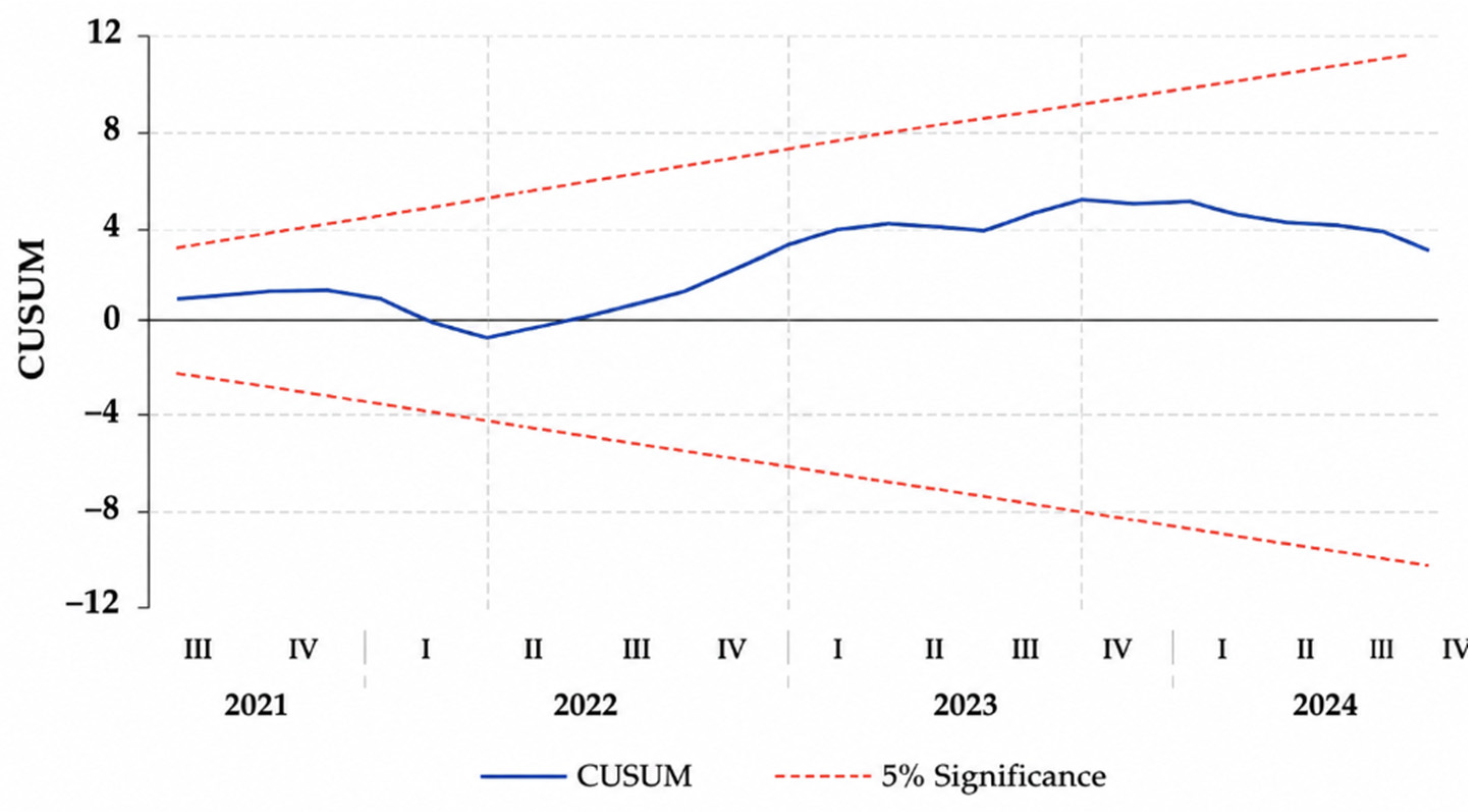
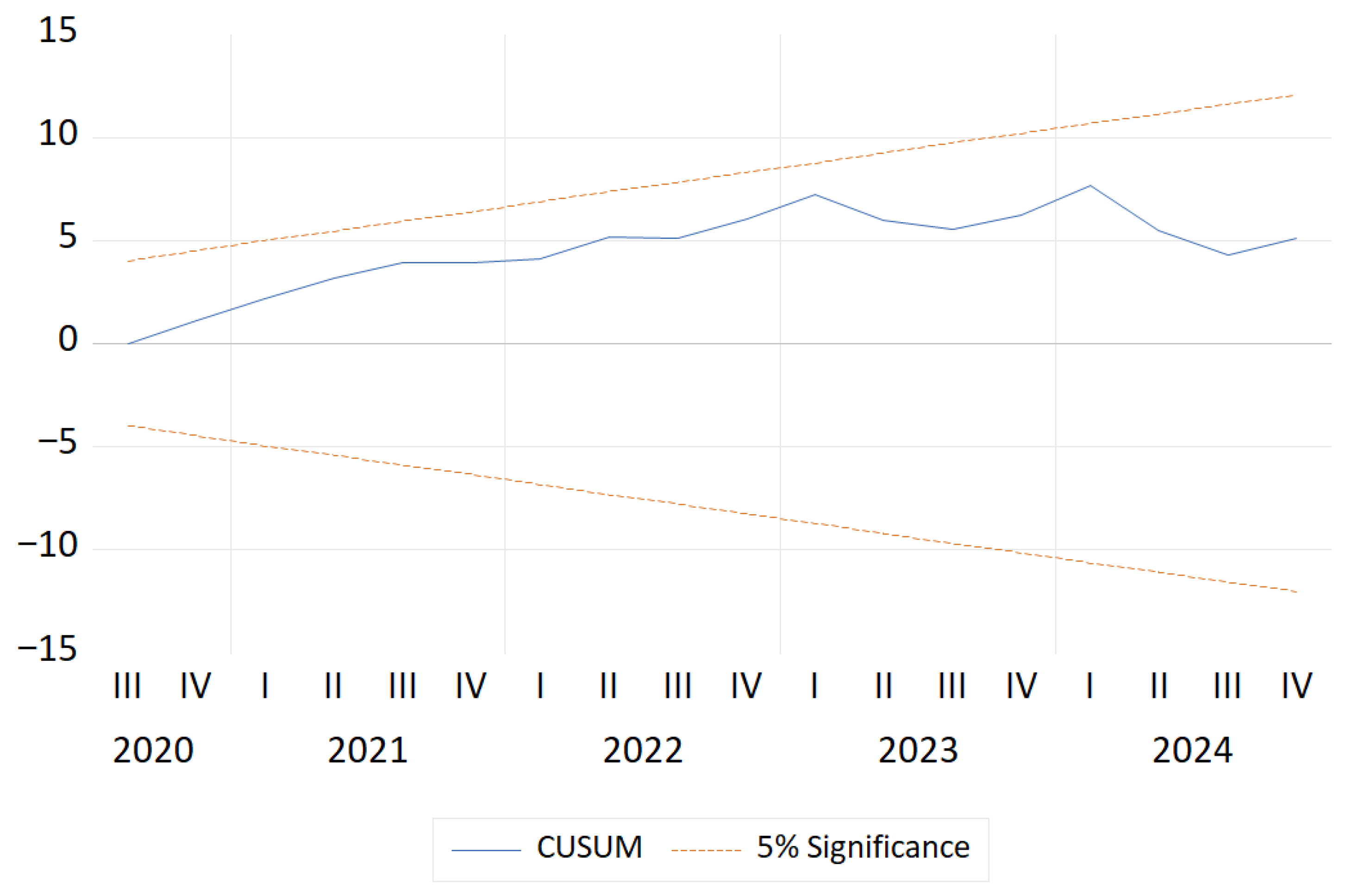
Figure 3 and Figure 4 present the CUSUM and CUSUM of squares (CUSUMSQ) tests, which are used to assess the stability of the model coefficients over time. In both cases, the plots remain within the 5% critical bounds throughout the sample period, indicating the absence of structural breaks and confirming parameter stability. While the CUSUM test evaluates the stability of coefficients, the CUSUMSQ test assesses the stability of the residual variance. The consistency of both tests suggests that the underlying relationships remain stable over time [68].

7.6. Hypothesis Validation

The empirical findings provide mixed support for the proposed hypotheses and confirm that tourism demand in Saudi Arabia responds differently to economic and external shocks depending on the tourism segment considered.
H1. 
Oil price fluctuations significantly affect tourism demand in Saudi Arabia.
The results do not provide evidence of a statistically significant direct effect of oil price fluctuations on either religious tourism (H1a) or non-religious tourism (H1b) in the short run or the long run. Therefore, H1 is not supported. This finding is consistent with studies suggesting that oil prices influence tourism primarily through indirect macroeconomic channels rather than through direct effects on tourism demand [42,45].
H2. 
Non-oil economic growth significantly affects tourism demand in Saudi Arabia.
The results provide partial support for H2. The positive effect of non-oil GDP is strongly confirmed for non-religious tourism in the short run and remains positive and statistically significant at the 10% level in the long run (H2b). However, the effect is not statistically significant for religious tourism in the long run (H2a), suggesting that this segment is influenced more by institutional and faith-based factors than by economic conditions. These findings are consistent with the tourism-led growth literature and previous studies on religious tourism demand [5,9].
H3. 
The COVID-19 pandemic significantly affects tourism demand in Saudi Arabia.
The results strongly support H3. The COVID-19 pandemic exerted a negative and statistically significant effect on both religious tourism (H3a) and non-religious tourism (H3b). The impact was substantially larger for religious tourism, reflecting the suspension of Hajj and Umrah activities during the pandemic. For non-religious tourism, the negative effect was also significant but more gradual, indicating different adjustment and recovery patterns across tourism segments. These findings are consistent with the growing literature documenting the severe impact of COVID-19 on global tourism activity [12,13,14].
Overall, the findings confirm that tourism demand in Saudi Arabia is structurally heterogeneous. Religious tourism remains primarily driven by institutional and faith-based factors, whereas non-religious tourism is more responsive to economic growth and diversification policies. These results highlight the importance of distinguishing between tourism segments when evaluating tourism demand determinants and designing tourism development strategies under Vision 2030.

8. Conclusions, Policy Recommendation Limits, and Future Research

The results demonstrate that religious and non-religious tourism demand follow different behavioral and adjustment patterns, reflecting pronounced structural heterogeneity in Saudi Arabia’s tourism sector between 2015Q1 and 2024Q4. The unit root results indicate that all variables are integrated of order one, I(1), supporting the application of the ARDL framework. The bounds test confirms the existence of a long-run equilibrium relationship for both religious and non-religious tourism. However, the strength and determinants of these relationships differ across tourism segments, providing evidence of structural heterogeneity in tourism demand. The empirical findings show that global oil prices do not have a statistically significant direct effect on either tourism segment in both the short run and the long run, suggesting that their influence is indirect and transmitted through broader macroeconomic channels. In contrast, non-oil GDP exerts a positive and statistically significant effect on non-religious tourism in the short run. In the long run, the effect remains positive but only weakly significant at the 10% level and should therefore be interpreted with caution. These findings suggest that economic diversification and sustained income growth continue to support the expansion of market-driven tourism under Vision 2030. Religious tourism, however, remains largely unaffected by economic growth, reflecting its institutional and policy-driven nature. The COVID-19 pandemic had a severe and persistent negative impact on tourism demand, with a more immediate and pronounced effect on religious tourism due to the suspension of Hajj and Umrah activities. Adjustment dynamics indicate that both tourism segments converge toward their long-run equilibrium following short-run shocks, although religious tourism exhibits a somewhat faster speed of adjustment. Diagnostic tests confirm that all econometric assumptions are satisfied, supporting the robustness and reliability of the results.
In terms of hypothesis validation, the results provide mixed support for the proposed framework. Oil prices are found to have no statistically significant effect on either religious tourism or non-religious tourism in both the short run and the long run. Therefore, H1, as well as its sub-hypotheses H1a and H1b, are not supported. These findings suggest that oil price fluctuations influence tourism demand indirectly through broader macroeconomic channels rather than through direct structural effects.
Non-oil economic growth emerges as an important determinant of tourism demand, providing partial support for H2. Specifically, non-oil GDP exerts a positive and significant effect on non-religious tourism in the short run and a positive but weakly significant effect in the long run, supporting H2b. For religious tourism, however, non-oil GDP exerts a positive and significant effect only in the short run, while its long-run effect remains statistically insignificant, providing partial support for H2a. These findings indicate that non-religious tourism is more responsive to economic diversification and income growth, whereas religious tourism remains largely driven by institutional and faith-based factors.
The results strongly support H3 and its sub-hypotheses H3a and H3b. The COVID-19 pandemic exerts a significant negative effect on both religious and non-religious tourism demand. The impact is particularly severe for religious tourism due to the suspension of Hajj and Umrah activities during the pandemic period, while non-religious tourism also experienced substantial disruptions associated with travel restrictions and reduced economic activity.
Overall, the findings confirm the existence of structural heterogeneity in tourism demand in Saudi Arabia. Religious tourism remains primarily influenced by institutional and religious factors, whereas non-religious tourism is more sensitive to economic conditions and diversification policies. These results highlight the importance of distinguishing between tourism segments when examining tourism demand and formulating tourism development strategies.
These findings suggest several important policy implications. First, tourism policy should adopt a differentiated approach: religious tourism requires institutional management focusing on capacity, regulation, and infrastructure, whereas non-religious tourism should be supported through continued economic diversification, income growth, and destination development under Vision 2030. Second, oil price fluctuations should not be considered a direct policy lever for tourism promotion. Third, strengthening the non-oil economy is essential for sustaining long-term growth in non-religious tourism. Fourth, enhancing resilience to external shocks, through contingency planning, flexible regulatory frameworks, and support for domestic tourism, is crucial given the magnitude of pandemic-related disruptions. Finally, the rapid adjustment of religious tourism highlights its potential role as a key driver of recovery following crises.
Despite its contributions, this study has several limitations. First, the relatively short sample period (2015Q1–2024Q4) results in a limited number of effective observations after lag selection. Although the ARDL framework is appropriate for small samples, future studies could benefit from longer time series and additional observations to further assess the robustness of the estimated relationships. Second, the study does not explicitly evaluate the impact of individual Vision 2030 tourism policies, such as visa reforms, entertainment initiatives, destination development programs, or mega-projects including NEOM and the Red Sea Project. Assessing the causal effects of these policies would require dedicated policy indicators, alternative identification strategies, and a longer post-implementation observation period. Third, the sample period captures the immediate effects of the COVID-19 pandemic but not the full recovery phase of tourism activity. Fourth, although the selected variables capture the primary macroeconomic mechanisms relevant to the study objectives, tourism demand is influenced by a broader set of economic, institutional, and geopolitical factors. Variables such as exchange rates, visa policies, transportation costs, destination attractiveness, tourism infrastructure, and geopolitical developments may also affect tourism flows and could not be incorporated due to data limitations and the need to preserve a parsimonious model specification. Consequently, the estimated relationships should be interpreted within the scope of the variables included in the analysis.
Future research could extend the analysis by incorporating additional macroeconomic and institutional variables, applying nonlinear ARDL models to capture asymmetric effects of oil price changes, and expanding the dataset to include the post-pandemic recovery period. Comparative panel studies across oil-exporting countries and advanced time-frequency approaches, such as wavelet analysis, could further enhance understanding of the tourism–oil price relationship. In addition, integrating qualitative dimensions, including spiritual motivations and institutional constraints, would provide a more comprehensive framework for analyzing religious tourism demand.
Overall, this study demonstrates that tourism demand in oil-dependent economies is structurally heterogeneous, with religious tourism driven primarily by institutional and faith-based factors and non-religious tourism shaped by market dynamics and economic conditions. By explicitly distinguishing between religious and non-religious tourism, the analysis reveals that these segments respond differently to macroeconomic shocks and oil price fluctuations. The findings provide evidence that the oil price–tourism nexus is segment-specific rather than uniform, thereby challenging aggregate modeling approaches and offering a more nuanced foundation for both empirical research and policy design. They further suggest that tourism development strategies in oil-dependent economies should recognize the distinct economic and institutional mechanisms governing different tourism segments rather than adopting a one-size-fits-all approach. This distinction is particularly relevant for countries pursuing economic diversification through tourism expansion, where segment-specific policies may be more effective than aggregate tourism strategies.


Author Contributions

Author Contributions: Conceptualization, F.M. and E.A.; methodology, E.A.; validation, E.A. and F.M.; formal analysis, E.A.; investigation, E.A. and F.M.; data curation, E.A.; writing—original draft preparation, F.M.; writing—review and editing, E.A. and F.M.; visualization, E.A.; supervision, F.M.; project administration, F.M. and E.A.; funding acquisition, E.A. All authors have read and agreed to the published version of the manuscript.

Funding

This research was funded by Princess Nourah bint Abdulrahman University Researchers Supporting Project number (PNURSP2026R961), Princess Nourah bint Abdulrahman University, Riyadh, Saudi Arabia.

Data Availability Statement

The data that support the findings of this study are openly available to the public.

Acknowledgments

The authors extend their appreciation to Princess Nourah bint Abdulrahman University Researchers Supporting Project number (PNURSP2026R961), Princess Nourah bint Abdulrahman University, Riyadh, Saudi Arabia.

Conflicts of Interest

The authors declare no conflicts of interest.

References

  1. Kakabayev, M.; Babayev, Y.; Esengulyyev, E.; Jummanov, U. Economic diversification strategies for oil dependent economies. Символ науки 2024, 9–11. [Google Scholar]
  2. Alhowaish, A.K. Is tourism development a sustainable economic growth strategy in the long run? Evidence from GCC countries. Sustainability 2016, 8, 605. [Google Scholar] [CrossRef]
  3. Rinschede, G. Forms of religious tourism. Ann. Tour. Res. 1992, 19, 51–67. [Google Scholar] [CrossRef]
  4. Mishrif, A. Introduction to Economic Diversification in the GCC Region. In Economic Diversification in the Gulf Region, Volume I; Mishrif, A., Al Balushi, Y., Eds.; Palgrave Macmillan: Singapore, 2018. [Google Scholar] [CrossRef]
  5. Henderson, J.C. Religious tourism and its management: The hajj in Saudi Arabia. Int. J. Tour. Res. 2011, 13, 541–552. [Google Scholar]
  6. Lee, K.-J.; Choi, S.-Y. A comparative wavelet analysis of the differential sensitivities of leisure and business travel to geopolitical risks and economic policy uncertainty: A study of inbound travel to South Korea. J. Hosp. Tour. Manag. 2023, 55, 202–208. [Google Scholar] [CrossRef]
  7. Lim, C. Review of international tourism demand models. Ann. Tour. Res. 1997, 24, 835–849. [Google Scholar] [CrossRef]
  8. Song, H.; Witt, S.F. Forecasting international tourist flows to Macau. Tour. Manag. 2006, 27, 214–224. [Google Scholar] [CrossRef]
  9. Brida, J.G.; Cortes-Jimenez, I.; Pulina, M. Has the tourism-led growth hypothesis been validated? A literature review. Curr. Issues Tour. 2016, 19, 394–430. [Google Scholar]
  10. Alcalá-Ordóñez, A.; Brida, J.G.; Cárdenas-García, P.J. Has the tourism-led growth hypothesis been confirmed? Evidence from an updated literature review. Curr. Issues Tour. 2024, 27, 3571–3607. [Google Scholar]
  11. Pesaran, M.H.; Shin, Y.; Smith, R.J. Bounds testing approaches to the analysis of level relationships. J. Appl. Econom. 2001, 16, 289–326. [Google Scholar] [CrossRef]
  12. Gössling, S.; Scott, D.; Hall, C.M. Pandemics, tourism and global change: A rapid assessment of COVID-19. J. Sustain. Tour. 2020, 29, 1–20. [Google Scholar] [CrossRef]
  13. Sigala, M. Tourism and COVID-19: Impacts and implications for advancing and resetting industry and research. J. Bus. Res. 2020, 117, 312–321. [Google Scholar] [CrossRef] [PubMed]
  14. Škare, M.; Soriano, D.R.; Porada-Rochoń, M. Impact of COVID-19 on the travel and tourism industry. Technol. Forecast. Soc. Change 2021, 163, 120469. [Google Scholar] [PubMed]
  15. Deaton, A.; Muellbauer, J. Economics and Consumer Behavior; Cambridge University Press: Cambridge, UK, 1980. [Google Scholar]
  16. Segarra, V.; Olivera, M.; Cárdenas-García, P.J. On the Determinants of International Tourism Demand Flow: A Regional Analysis for Spain. J. Tour. Serv. 2025, 16, 300–318. [Google Scholar] [CrossRef]
  17. Song, H.; Liu, Y.; Cherapanukorn, V. Methodological advancements in tourism demand modelling and forecasting: Time-varying parameter models. Tour. Rev. 2026, 81, 104–127. [Google Scholar]
  18. Crouch, G.I. Demand elasticities for short-haul versus long-haul tourism. J. Travel Res. 1994, 33, 2–7. [Google Scholar]
  19. Jamil, A.; Munir, N.; Kakar, M.A.; Kakar, M.K. Modeling International Tourism Demand: Evidence from European Arrivals to Pakistan Using Panel Data Techniques. J. Manag. Sci. Res. Rev. 2026, 5, 333–352. [Google Scholar]
  20. Becker, G.S. The Economic Way of Looking at Life; University of Chicago Law School: Chicago, IL, USA, 1993. [Google Scholar]
  21. Hateftabar, F. The Study of Development in the Tourism Industry: Iran as a Destination with Special Attributes; Université Panthéon-Sorbonne-Paris I: Paris, France, 2020. [Google Scholar]
  22. Hensher, D.A.; Stopher, P.R. Behavioural travel modelling. In Behavioural Travel Modelling; Routledge: Abingdon, UK, 2021; pp. 11–52. [Google Scholar]
  23. McFadden, D. The measurement of urban travel demand. J. Public Econ. 1974, 3, 303–328. [Google Scholar] [CrossRef]
  24. Anastasopoulos, P. Models of international trade and of international travel: A comparative. In Quantity and Quality in Economic Research: Studies in Applied Business Research: Volume IV; Routledge: Abingdon, UK, 2019. [Google Scholar]
  25. Modigliani, F. The life cycle hypothesis of saving, the demand for wealth and the supply of capital. Soc. Res. 1966, 33, 160–217. [Google Scholar]
  26. Schubert, S.F.; Schamel, G. Sustainable tourism development: A dynamic model incorporating resident spillovers. Tour. Econ. 2021, 27, 1561–1587. [Google Scholar]
  27. Smeral, E. Tourism forecasting performance considering the instability of demand elasticities. J. Travel Res. 2017, 56, 913–926. [Google Scholar]
  28. Angelucci, A.; Cortelezzi, F.; Cupri, A. Religious Tourism and Sustainability in the MENA Region; Ledizioni: Milan, Italy, 2025. [Google Scholar]
  29. Alhothali, G.T.; Mavondo, F.; Elgammal, I. Sustainability of religious travel and tourism: A profile deviation perspective. J. Islam. Mark. 2023, 14, 1551–1576. [Google Scholar]
  30. Hazari, B.R.; Sgro, P. Tourism and growth in a dynamic model of trade. J. Int. Trade Econ. Dev. 2004, 265, 243–252. [Google Scholar] [CrossRef]
  31. Schubert, S.F.; Brida, J.G.; Risso, W.A. The impacts of international tourism demand on economic growth of small economies dependent on tourism. Tour. Manag. 2011, 32, 377–385. [Google Scholar] [CrossRef]
  32. Balado-Naves, R.; Boto-García, D.; Baños-Pino, J. Bridging Theory and Empirics: A Growth Equation for Tourism-Driven Economies. Eur. J. Tour. Res. 2026, 42, 4211. [Google Scholar] [CrossRef]
  33. Dogru, T.; Bulut, U. Is tourism an engine for economic recovery? Theory and empirical evidence. Tour. Manag. 2018, 67, 425–434. [Google Scholar] [CrossRef]
  34. Vinod, B. Airline pricing. In The Evolution of Yield Management in the Airline Industry: Origins to the Last Frontier; Springer: Berlin/Heidelberg, Germany, 2021; pp. 41–68. [Google Scholar]
  35. Njoku, D. Consumer Decision-Making in Airline Bookings: The Role of Perceived Value and Price Sensitivity. Master’s Thesis, University of Malta, Msida, Malta, 2025. [Google Scholar]
  36. Corden, W.M.; Neary, J.P. Booming sector and de-industrialisation in a small open economy. Econ. J. 1982, 92, 825–848. [Google Scholar] [CrossRef]
  37. Ali, I. Oil Development and Libyan Economy: The Structural Manifestation of the “Dutch Disease”. 2019. Available online: https://www.researchgate.net/publication/331487178_Oil_Development_and_Libyan_Economy_the_Structural_Manifestation_of_the_Dutch_Disease (accessed on 3 May 2026).
  38. Ekanayake, E.M.; Long, A.E. Tourism development and economic growth in developing countries. Int. J. Bus. Financ. Res. 2012, 6, 61–63. [Google Scholar]
  39. Jahan-Parvar, M.R.; Mohammadi, H. Oil prices and competitiveness: Time series evidence from six oil-producing countries. J. Econ. Stud. 2009, 36, 98–118. [Google Scholar] [CrossRef]
  40. Paramati, S.R.; Alam, M.S.; Chen, C.-F. The effects of tourism on economic growth and CO2 emissions: A comparison between developed and developing economies. J. Travel Res. 2017, 56, 712–724. [Google Scholar]
  41. Seetanah, B. Assessing the dynamic economic impact of tourism for island economies. Ann. Tour. Res. 2011, 38, 291–308. [Google Scholar] [CrossRef]
  42. Becken, S. A critical review of tourism and oil. Ann. Tour. Res. 2011, 38, 359–379. [Google Scholar] [CrossRef]
  43. Katircioğlu, S.T. Testing the tourism-induced EKC hypothesis: The case of Singapore. Econ. Model. 2014, 41, 383–391. [Google Scholar] [CrossRef]
  44. Abbasi, K.R.; Lv, K.; Radulescu, M.; Shaikh, P.A. Economic complexity, tourism, energy prices, and environmental degradation in the top economic complexity countries: Fresh panel evidence. Environ. Sci. Pollut. Res. 2021, 28, 68717–68731. [Google Scholar] [CrossRef] [PubMed]
  45. Chatziantoniou, I.; Filis, G.; Eeckels, B.; Apostolakis, A. Oil prices, tourism income and economic growth: A structural VAR approach for European Mediterranean countries. Tour. Manag. 2013, 36, 331–341. [Google Scholar] [CrossRef]
  46. Shahzad, S.J.H.; Shahbaz, M.; Ferrer, R.; Kumar, R.R. Tourism-led growth hypothesis in the top ten tourist destinations: New evidence using the quantile-on-quantile approach. Tour. Manag. 2017, 60, 223–232. [Google Scholar] [CrossRef]
  47. Eid, R.; El-Gohary, H. The role of Islamic religiosity on the relationship between perceived value and tourist satisfaction. Tour. Manag. 2015, 46, 477–488. [Google Scholar] [CrossRef]
  48. Apergis, N.; Payne, J.E. Tourism and growth in the Caribbean–evidence from a panel error correction model. Tour. Econ. 2012, 18, 449–456. [Google Scholar] [CrossRef]
  49. Choe, J. Religious tourism. Tour. Geogr. 2025, 27, 830–839. [Google Scholar]
  50. Mardi, M.; Chandrasekar, U. Beyond Economics: Education and Culture as Key Drivers of Community Participation in Halal Tourism. AL-Insyiroh J. Studi Keislam. 2025, 11, 181–210. [Google Scholar] [CrossRef]
  51. Liro, J.; Meneghello, S. Understanding contemporary religious tourism through the lens of the experience economy approach. In Creating the Sacred Landscape: Pilgrimages and Ritual Practices; Springer: Berlin/Heidelberg, Germany, 2025; pp. 89–108. [Google Scholar]
  52. Iloranta, R. Luxury tourism—A review of the literature. Eur. J. Tour. Res. 2022, 30, 3007. [Google Scholar]
  53. Correia, A.; Kozak, M. Luxury tourism. In Encyclopedia of Tourism; Springer: Berlin/Heidelberg, Germany, 2025; pp. 630–631. [Google Scholar]
  54. Dong, Z.D.; Miller, E.J. Intra-provincial long-distance leisure travel-activity heterogeneity across age groups: A multi-group latent class analysis. Transp. Lett. 2026, 18, 771–788. [Google Scholar]
  55. Farstad, E.; Mehmetoglu, M.; Higham, J.; Landa-Mata, I.; Hopkins, D.; Jacobsen, J.K.S. Back to the future: Advancing more sustainable tourism through domestic summer holidaying after the COVID-19 pandemic. Nor. Geogr. Tidsskr.-Nor. J. Geogr. 2024, 78, 197–209. [Google Scholar] [CrossRef]
  56. Seetanah, B.; Nunkoo, R.; Gopy-Ramdhany, N.; Jaffur, Z.K. Tourism development and economic growth: Theoretical underpinnings and agenda for future research. In A Modern Guide to Tourism Economics; Edward Elgar Publishing: Cheltenham, UK, 2022; pp. 152–169. [Google Scholar]
  57. Gounder, R. Tourism-led and economic-driven nexus in Mauritius: Spillovers and inclusive development policies in the case of an African nation. Tour. Econ. 2022, 28, 1040–1058. [Google Scholar]
  58. Opuala-Charles, S.; Omoke, P.C.; Uche, E. The dynamic role of financial development in analyzing the N-shaped tourism-led growth hypothesis in Mauritius. J. Knowl. Econ. 2023, 14, 4903–4928. [Google Scholar] [CrossRef]
  59. Fauzel, S.; Seetanah, B.; Sannassee, R.V. Analysing the impact of tourism foreign direct investment on economic growth: Evidence from a small island developing state. Tour. Econ. 2017, 23, 1042–1055. [Google Scholar]
  60. Zuo, B.; Huang, S. Revisiting the tourism-led economic growth hypothesis: The case of China. J. Travel Res. 2018, 57, 151–163. [Google Scholar]
  61. Perles-Ribes, J.F.; Moreno-Izquierdo, L. Testing the tourism led growth hypothesis: A nonsensical exercise? Eur. J. Tour. Res. 2024, 38, 3817. [Google Scholar] [CrossRef]
  62. Narayan, P.K. The government revenue and government expenditure nexus: Empirical evidence from nine Asian countries. J. Asian Econ. 2005, 15, 1203–1216. [Google Scholar] [CrossRef]
  63. Gujarati, D.N. Basic Econometrics, 4th ed.; McGraw-HiII/lrwin: Columbus, OH, USA, 2012. [Google Scholar]
  64. Wooldridge, J.M. Introductory Econometrics a Modern Approach; South-Western Cengage Learning: Boston, MA, USA, 2016. [Google Scholar]
  65. Dickey, D.A.; Fuller, W.A. Distribution of the estimators for autoregressive time series with a unit root. J. Am. Stat. Assoc. 1979, 74, 427–431. [Google Scholar] [CrossRef]
  66. Phillips, P. Testing for unit roots in time series regression. Biometrika 1988, 71, 599–607. [Google Scholar]
  67. Narayan, P.K. The saving and investment nexus for China: Evidence from cointegration tests. Appl. Econ. 2005, 37, 1979–1990. [Google Scholar] [CrossRef]
  68. Brown, R.L.; Durbin, J.; Evans, J.M. Techniques for testing the constancy of regression relationships over time. J. R. Stat. Soc. Ser. B Stat. Methodol. 1975, 37, 149–163. [Google Scholar] [CrossRef]
Figure 1. Trends in Religious and Non-Religious Tourism in Saudi Arabia (2015Q1–2024Q4). Source: Authors’ presentation based on data from the Saudi Ministry of Tourism and GASTAT. Note: Religious tourism refers to Hajj and Umrah visitors, while non-religious tourism includes leisure, business, visiting friends and relatives (VFR), cultural, and other non-pilgrimage travel activities.
Sustainability 18 06295 g001
Figure 2. Major religious and non-religious tourism destinations in Saudi Arabia. Source: Authors’ illustration based on data from the Saudi Ministry of Tourism, GASTAT, and OpenStreetMap.
Sustainability 18 06295 g002
Figure 3. CUSUM test Religious Tourism model.
Sustainability 18 06295 g003
Figure 4. CUSUM test Non-Religious Tourism model.
Sustainability 18 06295 g004
Table 1. Variable Definitions.
Variable NameDefinitionTransformationData SourceModel Role
Religious TourismNumber of religious visitors (Hajj and Umrah) in Saudi Arabialn (REL)Ministry of Tourism; GASTATDependent Variable (Model 1)
Non-Religious TourismSum of leisure, business, VFR, and other tourism activitiesln (NONREL)Ministry of Tourism; GASTATDependent Variable (Model 2)
Oil PriceGlobal oil price (e.g., Brent crude, USD per barrel)ln (OIL)World Bank Commodity Price DataIndependent Variable
Non-Oil GDPReal non-oil GDP of Saudi Arabialn (GDP)General Authority for Statistics (GASTAT)Independent Variable
COVID-19 DummyDummy = 1 for 2020Q1–2021Q4, 0 otherwiseLevel (0/1)Author’s constructionIndependent Variable
Source: Authors’ compilation based on data obtained from the Saudi Ministry of Tourism, the General Authority for Statistics (GASTAT), the World Bank Commodity Price Data, and the authors’ construction of the COVID-19 dummy variable. Note: Religious tourism refers to visitors traveling for Hajj and Umrah purposes. Non-religious tourism includes leisure, business, visiting friends and relatives (VFR), and other tourism activities. The classification is based on the purpose of travel rather than the residency status of travelers. All continuous variables are expressed in natural logarithms to reduce heteroscedasticity and allow coefficient interpretation as elasticities. The COVID-19 dummy equals 1 during the pandemic period (2020Q1–2021Q4) and 0 otherwise.
Table 2. Descriptive statistics.
VariablesDefinitionMeanMedianStd. Dev.MinMaxSkewnessKurtosis
LRELHajj and Umrah visitors (log)6.7307.6742.2780.0008.335−2.0045.636
LNONRELLeisure, business, VFR, other (log)7.4747.6040.8454.3998.564−1.7626.564
LNGDPReal non-oil GDP (million SAR, log)13.10813.0600.15212.92913.3970.6021.928
LOILBrent crude (USD/barrel, log)4.1594.1810.2803.5084.718−0.3092.577
COVID-19=1 for 2020Q1–2021Q40.2000.0000.4050.0001.0001.5003.250
Source: Authors’ calculations. Note: Table 2 reports descriptive statistics for the logarithmically transformed variables (LREL, LNONREL, LNGDP, and LOIL) used in the ARDL estimations. For non-religious tourism, a constant of one was added prior to logarithmic transformation [ln(x + 1)] to accommodate zero observations recorded during the COVID-19 period.
Table 3. Unit Root Test Results.
VariableLevelFirst Difference
Phillips–Perron (p-Value)ADF (p-Value)Phillips–Perron (p-Value)ADF (p-Value)
Non-oil GDP1.704 (0.9995)0.562 (0.9868)−7.057 (0.0000)−6.979 (0.0000)
Global oil price−1.662 (0.4420)−1.662 (0.4420)−5.520 (0.0000)−5.510 (0.0000)
Religious tourism−2.011 (0.2812)−1.847 (0.3529)−5.369 (0.0001)−5.364 (0.0001)
Nonreligious tourism−2.025 (0.2752)−2.016 (0.2792)−6.703 (0.0000)−6.617 (0.0000)
Source: Authors’ calculations. Notes: The null hypothesis of both the Augmented Dickey–Fuller (ADF) and Phillips–Perron (PP) tests is that the series contains a unit root. Rejection of the null hypothesis indicates stationarity. The results indicate that all variables are integrated of order one, I(1), while none is integrated of order two, I(2). Therefore, the ARDL bounds testing approach is appropriate for examining both short-run and long-run relationships among the variables.
Table 4. Summary Comparison of ARDL Models for Religious and Non-Religious Tourism.
CriterionReligious Tourism Model (1)Non-Religious Tourism Model (2)
Selected ModelARDL(2,0,1,1)ARDL(2,0,1,1)
Sample/Observations3838
F-Bounds Statistic6.4534.276
Upper Bound (5%)4.0884.088
Upper Bound (1%)5.5445.544
Cointegration (Bounds Test)YesYes
Cointegration InterpretationEvidence of cointegration at
the 1% significance level
Evidence of cointegration at
the 5% significance level
Error Correction Term (ECT)−0.686−0.556
ECT p-value0.00020.0092
Long-Run RelationshipConfirmedConfirmed
Source: Authors’ calculations.
Table 5. Short-Run (Conditional Error Correction) Results under the ARDL approach.
VariableReligious Tourism (Coeff./Std. Error)Non-Religious Tourism (Coeff./Std. Error)
C9.500
(15.235)
−9.038
(8.126)
ECT(−1) *−0.686 ***
(0.162)
−0.556 ***
(0.200)
LOIL **−0.735
(0.865)
−0.020
(0.642)
LNONGDP (−1)0.569
(1.358)
1.013 *
(0.768)
COVID_19 (−1)−3.505 ***
(0.851)
−0.957 ***
(0.353)
D (Religious Tourism (−1))0.436 ***
(0.132)
D (Non-Religious Tourism (−1))0.376 ***
(0.127)
D(LNONGDP)18.263 **
(8.379)
13.309 ***
(3.290)
Source: Authors’ calculations. Notes: Standard errors are reported in parentheses. Level variables represent long-run effects, Δ denotes short-run changes, and ECT(−1) is the error-correction term. *** p < 0.01, ** p < 0.05, * p < 0.10.
Table 6. Long-Run Levels Equation under the ARDL approach.
VariableReligious Tourism (Coeff./Std. Error)Non-Religious Tourism (Coeff./Std. Error)
LOIL1.070
(1.271)
−0.020
(0.642)
LNONGDP−0.829
(2.008)
1.823 *
(1.076)
COVID_19−5.107 ***
(0.486)
−1.723 ***
(0.267)
C13.840
(22.585)
−16.269
(12.218)
Source: Authors’ calculations. Notes: Standard errors are reported in parentheses. *** p < 0.01, * p < 0.10.
Table 7. Diagnostic Tests Comparison: Religious vs. Non-Religious Tourism.
TestReligious TourismNon-Religious Tourism
Jarque–Bera (Normality)JB = 2.805
(p = 0.245)
JB = 0.666
(p = 0.716)
Breusch–Godfrey LM (Serial Correlation)F = 0.132
(p = 0.876)
F = 0.686
(p = 0.511)
Breusch–Pagan–Godfrey (Heteroskedasticity)F = 0.627
(p = 0.824)
F = 1.920
(p = 0.108)
CUSUM Test (Stability)Within 5% bounds Within 5% bounds
Model SpecificationCorrect (RESET passed) Correct (RESET passed)
Source: Authors’ calculations.
Disclaimer/Publisher’s Note: The statements, opinions and data contained in all publications are solely those of the individual author(s) and contributor(s) and not of MDPI and/or the editor(s). MDPI and/or the editor(s) disclaim responsibility for any injury to people or property resulting from any ideas, methods, instructions or products referred to in the content.