Article

Optimal Sizing of a Hybrid Nanogrid System Using Multi-Objective Neural Architecture Search Under Improved Uncertainty and Battery Degradation: A Case Study of Desert Camping in Hafr Al-Batin, Saudi Arabia

by
Mohammad Shoaib Shahriar
1,*,
Houssem R. E. H. Bouchekara
1,
Abdulgafor Alfares
1,
Yusuf Abubakar Sha’aban
2,
Ali Mukhaylif Mohammed
1,
Makbul A. M. Ramli
3 and
Muhammad Sharjeel Javaid
4
1
Department of Electrical Engineering, University of Hafr Al-Batin, Hafr Al-Batin 31991, Saudi Arabia
2
Department of Computer, Electrical and Software Engineering, Embry-Riddle Aeronautical University, Prescott, AZ 86301, USA
3
Center of Research Excellence in Renewable Energy and Power Systems, King Abdulaziz University, Jeddah 21589, Saudi Arabia
4
Department of Electrical and Electronic Engineering, Imperial College London, London SW7 2AZ, UK
*
Author to whom correspondence should be addressed.
Sustainability 2026, 18(12), 6292; https://doi.org/10.3390/su18126292 (registering DOI)
Submission received: 23 April 2026 / Revised: 24 May 2026 / Accepted: 2 June 2026 / Published: 18 June 2026
(This article belongs to the Section Energy Sustainability)

Abstract

Optimal sizing of hybrid renewable energy systems for desert camps is a multi-objective problem that must account for cost, reliability, component degradation, and uncertainty. This paper introduces an improved multi-objective neural architecture search (IMONAS) framework for hybrid nanogrid sizing in the desert environment of Hafr Al-Batin, Saudi Arabia. The framework combines neural optimization, stochastic uncertainty modeling, and explicit battery degradation modeling, a combination not addressed in the reviewed studies for this application. Six test cases are examined by varying uncertainty assumptions, battery degradation, and the annual duration of uncertain operation. For each case, IMONAS provides Pareto-front solutions that specify the photovoltaic, diesel generator, battery autonomy, and inverter choices while minimizing the cost of energy (COE) and the loss of power supply probability (LPSP). IMONAS is compared with the original MONAS and five other multi-objective optimization methods. In addition to visual Pareto-front comparisons, the assessment uses Pareto-dominance indicators, namely the C-metric and an aggregated score derived from pairwise C-metric comparisons across the algorithms and cases. The results provide a validated sizing framework for remote arid-region nanogrids under uncertainty and battery degradation.

1. Introduction

The transition towards sustainable energy systems has kept renewable energy integration at the center of energy research, especially in remote and off-grid locations with abundant resources. The deserts of Saudi Arabia have strong renewable energy potential, but extreme temperatures, dust accumulation, and logistical constraints make energy system operation difficult. Systems designed for milder environments may therefore fail when deployed in desert regions [1,2,3]. In Saudi Arabia, the renewable energy ambitions of Vision 2030 coincide with growing demand for desert tourism and recreational camping facilities. This creates a need for optimized, reliable, and cost-effective power systems that can operate under harsh environmental conditions, where conventional systems often struggle [4,5,6].
Hafr Al-Batin, a city in Saudi Arabia’s Eastern Province bordering Kuwait, is known for its winter desert camps. The city receives average horizontal solar irradiation of 5.8 kWh/m2/day, which indicates strong photovoltaic (PV) generation potential. It also experiences temperature variations of approximately 15–45 °C. Grid connectivity, fuel supply, and seasonal camping activities produce substantial load-demand variations [7,8]. In the load profiles used in this study, the average daily demand is 27.06 kWh and 72.63 kWh for the weekdays and weekends, respectively. These conditions require sizing methods that account for uncertainty in resource availability and load behavior while maintaining economic viability and operational reliability. Nanogrids offer a modular way to combine energy resources, but they also require reliable power electronic interfaces for fault-tolerant operations under extreme weather conditions [9].
Several studies have investigated hybrid renewable energy system sizing with metaheuristic algorithms. This review focuses on works relevant to the Saudi Arabian desert. Bouchekara et al. [10] developed an improved decomposition multi-objective evolutionary algorithm (IMOEAD) for Yanbu City. Their approach achieved an energy cost of USD 0.0716–0.1159/kWh while incorporating load uncertainty through Monte Carlo simulations and modeling a 75% battery capacity reduction over the system lifetime [10]. Alotaibi et al. [11] proposed a gradually reduced-particles particle swarm optimization (GRP-PSO) algorithm that reduced convergence time by 58% relative to conventional approaches. They evaluated pumped hydro storage and reported a levelized cost of energy of USD 0.034325/kWh, with a 34.2–41.1% cost reduction compared with battery and green hydrogen storage systems [11]. Eltamaly et al. [12] introduced demand response strategies in smart-grid frameworks and reported a 20.66% reduction in component size with zero loss of expected energy by using dynamic tariffs linked to the battery state of charge.
Despite these advances, most studies still use metaheuristic algorithms. Table 1 summarizes ten studies on hybrid renewable energy systems sizing in Saudi Arabia. As shown in Table 1, only one reviewed study used neural network-based optimization. Hussein Farh et al. (2024) applied a reinforcement learning neural network algorithm (RLNNA), obtaining an annualized system cost of USD 1,219,744 with zero loss of power supply probability and an 86.37% renewable fraction [13]. RLNNA converged faster and produced better solutions than a genetic algorithm (GA) [14], particle swarm optimization (PSO) [15], and self-adaptive differential evolution (DE) [16]. However, one implementation is not enough to establish the suitability of neural architecture search for hybrid microgrid sizing.
The remaining nine studies used metaheuristic approaches, including IMOEAD [10], GRP-PSO [11], PSO variants [12], MOEA/DD [17], NSGA [18], ARO [19], SDO [20], SSO [21], and comparative implementations of OOA, ZOA, and FFO [22]. Related work has also reported multi-objective evolutionary algorithms for renewable system design and sizing [23], including scenario-dominance formulations for hybrid renewable energy systems [24,25]. Advanced power electronic architectures, such as dynamic weighted-selection control for multi-source load management, may further improve neural-optimized systems by supporting flexible resource allocation and fault tolerance [26].
Recent work on multi-objective neural architecture search (MONAS) offers a more adaptive optimization framework. The evolutionary MONAS framework proposed by [27] uses a coevolutionary strategy and a two-stage offspring generation mechanism to address multimodal and many-objective neural architecture search problems. It maintains two interacting populations so that convergence and diversity preservation can be handled separately. This structure helps the algorithm explore multiple Pareto sets and reduce premature convergence. MONAS uses a two-stage search mechanism in which crossover and differential evolution are applied at different phases. It also uses a diversity-aware fitness evaluation mechanism to prioritize well-distributed solutions. This feature is relevant to hybrid energy system design, where several conflicting configurations can be feasible. Despite its performance in neural architecture optimization, MONAS has seen limited use for hybrid renewable energy system sizing under uncertainty, battery degradation, and harsh environmental conditions.
Table 1. Characteristics of included studies on hybrid renewable energy system optimization in Saudi Arabia.
StudyLocationSystem ComponentsOptimization AlgorithmPrimary Objectives
H. Bouchekara et al., 2023 [10]YanbuPV, Wind, Battery, DieselIMOEADCOE, LPSP
Majed A. Alotaibi et al., 2021 [11]Dumah AljandalWind, PV, PHESGRP-PSO LCE
A. Eltamaly et al., 2021 [12]Northern Saudi ArabiaWind, PV, Battery, DieselPSO, BA, SMOCOE, LOLP
H. Bouchekara et al., 2021 [8]Hafr Al-BatinSolar PV, Battery, DieselMOEA/DDCOE, LPSP
Doaa M. Hasanin et al., 2021 [18]YanbuPV, Wind, Diesel, BatteryNSGALPSP, COE, RF
Ahmed S. Menesy et al., 2024 [19]YanbuPV, Wind, Diesel, BatteryAROCOE, LPSP, Excess Energy
F. Alturki et al., 2020 [20]Northern Saudi ArabiaPV, Wind, Battery, DieselSDOASC, LPSP, REF
A. Fathy et al., 2020 [21]AljoufPV, Wind, Battery, Diesel, InverterSSOCOE, LPSP
Mohammed Alqahtani et al., 2025 [22]TabukPV, Wind, Biomass, BatteryOOA, ZOA, FFONPC, LPSP
Hassan M. Hussein Farh et al., 2024 [13]Saudi ArabiaSolar PV, Wind, Battery, DieselRLNNAASC, LPSP, REF
The reviewed literature leaves three gaps that matter for desert camping applications. First, uncertainty modeling remains limited. H. Bouchekara et al. used Monte Carlo simulation to quantify load uncertainty [10], whereas other studies relied on deterministic sensitivity analyses with ± 20 % variations in wind speed and solar irradiance [11,21] or used reliability metrics such as loss of power supply probability as indirect uncertainty proxies [13,22]. This matters because probabilistic uncertainty modeling can shift Pareto fronts and expose reliability–cost trade-offs that deterministic approaches may obscure [10]. Desert environments add correlated uncertainty through solar availability and temperature-induced efficiency changes, while camping loads are also irregular and require stochastic treatment.
Second, only three of the ten reviewed studies explicitly model battery degradation [8,10,11], even though degradation affects long-term cost and reliability. Bouchekara et al. [10] modeled depth-of-discharge effects, charge–discharge cycling, and calendar aging, and reported a 75% capacity reduction over the system lifetime. Alotaibi et al. [11] modeled depth-of-discharge relationships, lithium-ion battery state of health ending at 80% capacity, and self-discharge rates of 0.2% per day. Bouchekara et al. [8] emphasized temperature effects and recommended battery operation at 25 °C to maintain derating factors. Studies that omit degradation can underestimate replacement costs and bias the design toward battery banks that do not maintain performance over 20–25 year system lifetimes.
Third, the combination of neural architecture search, uncertainty modeling, and battery degradation has not been investigated for Hafr Al-Batin desert camps or similar environments. Bouchekara et al. [7,8] provided direct applications to Hafr Al-Batin desert camps, with cost of electricity values ranging from USD 0.1933 to 0.278 /kWh for interconnected microgrid configurations serving daily demands of 30.93–72.46 kWh [8]. However, that work used a multi-objective evolutionary algorithm based on dominance and decomposition (MOEA/DD) rather than neural optimization. The reported 42–50% cost reductions from microgrid interconnection relative to standalone nanogrids [8] indicate substantial optimization potential, but the approach still relies on deterministic assumptions and simplified degradation representation. Desert-specific factors, including temperature extremes of 15–45 °C, dust effects on PV performance, and seasonal load variation, require an integrated optimization framework that can capture nonlinear environmental relationships.
These gaps motivate the present study: the development and validation of a multi-objective neural architecture search framework with stochastic uncertainty modeling and explicit battery degradation for hybrid nanogrid sizing in Hafr Al-Batin desert camping applications. Unlike conventional metaheuristics based on predefined search heuristics, neural architecture search can learn sizing policies from environmental and operational data and adapt to nonlinear system behavior. The proposed framework uses stochastic scenario generation to represent relationships among solar availability, temperature effects, load variation, and battery degradation. Its degradation model includes calendar aging, cycle aging, and temperature-dependent capacity fade, allowing lifecycle cost and battery sizing to be evaluated over extended desert operation.
A modified and improved version of MONAS has been proposed in this paper to increase the efficacy of the optimization process. The modification is made in the search strategy of the algorithm, rather than in the population initialization or the fitness evaluation functions, which were kept the same as in MONAS. In the original MONAS, GA-based operators are used during the first half of the iterations, while DE-based operators are used during the second half according to a fixed schedule. In contrast, the proposed IMONAS replaces this rigid mechanism with an adaptive selection process in which GA and DE are selected dynamically during the search according to updated probabilities. These probabilities are automatically adjusted based on the survival success of the offspring generated after environmental selection. In this way, IMONAS offers a better search strategy at different stages of the optimization process while maintaining an improved balance between exploration and exploitation.
In light of the above discussion, this research makes three contributions. First, it applies improved multi-objective neural architecture search (IMONAS) to hybrid renewable energy system sizing and extends the neural optimization evidence beyond the single RLNNA study reported in [13]. Second, it models load uncertainty and battery degradation together and evaluates their effects through six scenarios [12,18,19]. Third, it provides a sizing framework calibrated for Hafr Al-Batin desert camps, using empirical load profiles, environmental data, and operational constraints that reflect Saudi Arabian desert tourism.
The remainder of this paper is organized as follows. Section 2 presents the system modeling framework, including PV generation, battery storage with degradation, diesel backup, battery bank sizing, and inverter sizing for desert camping applications. Section 3 formulates the multi-objective optimization problem, including the objective functions, constraints, and decision variables. Section 4 describes the Hafr Al-Batin case study, including geographic and climatic data, camping load profiles, component specifications, and converter architecture requirements. Section 5 presents the neural architecture search algorithm and the associated equations. Section 6 reports and discusses the optimization results for the six test cases. Section 7 concludes the paper.

2. Nanogrid System Components

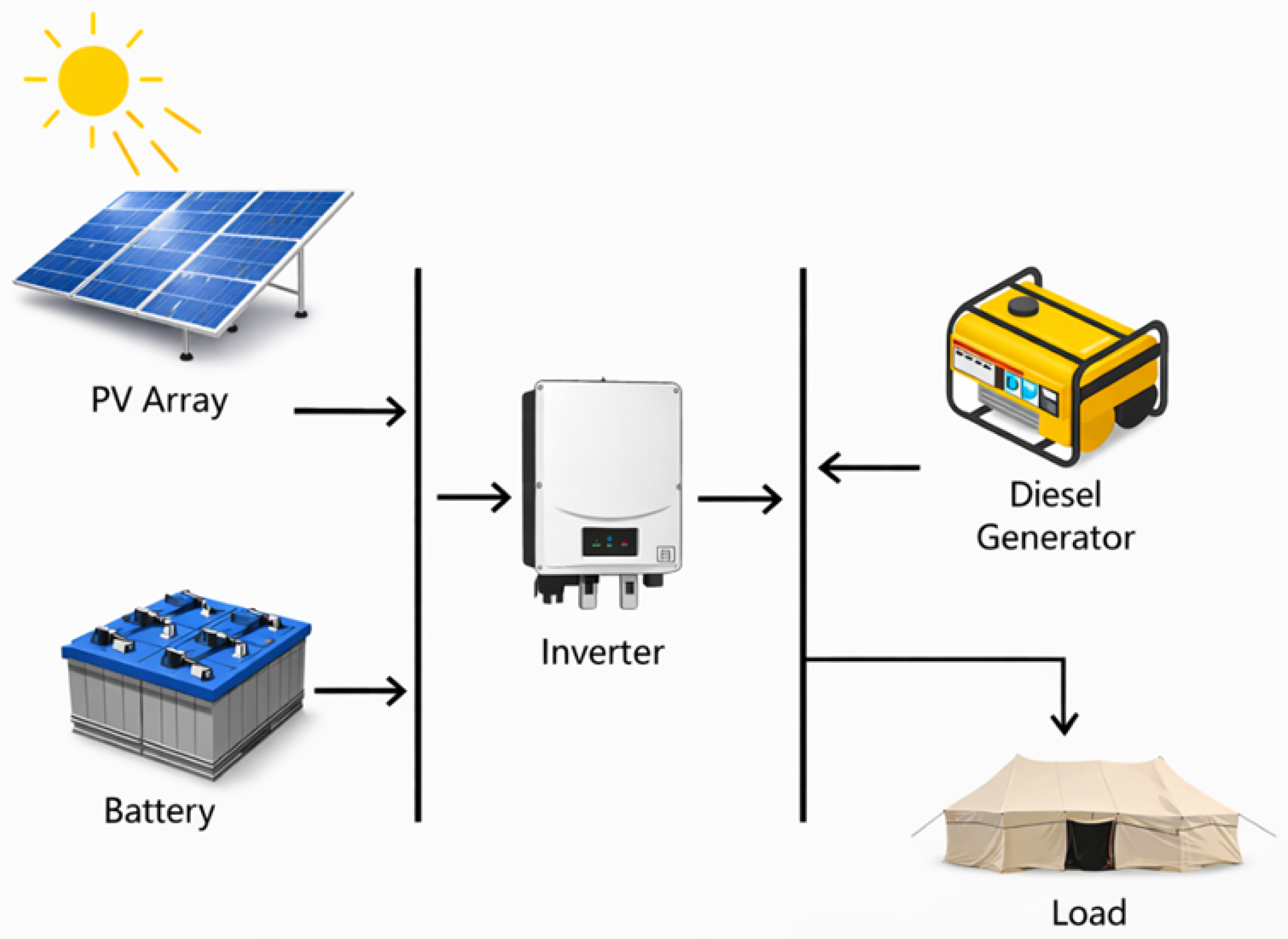
Figure 1 shows the independent hybrid nanogrid considered in this study. The system consists of a PV system, a battery bank, an inverter, and a diesel generator supplying a desert camping tent load. The following subsections describe the sizing models used for these components [28].

2.1. Photovoltaic System

The power output of the PV panel ( P P V ) is calculated as [29,30]:
P P V = P n × F / ( F r e f ) [ 1 + B k ( ( T α + ( 0.0256 × F ) ) T s t c ) ] ,
where P n denotes the rated PV power at standard test conditions (STCs), F is the solar radiation ( W /m2), F r e f is the reference irradiance, set to 1 kW/m, B k is a constant equal to 3.7 × 10 3 (1/°C), and  T α is the ambient temperature. T s t c denotes the PV cell temperature under STC (25 °C).

2.2. Diesel Generator

A diesel generator is the auxiliary energy source in the hybrid system and reduces the required storage capacity. It also improves supply reliability for remote loads. Because diesel generators operate inefficiently at low loading, they are mainly used during peak demand and battery depletion periods. The sizing procedure must therefore avoid light-load or no-load operation [31]. For the hybrid renewable system, diesel generator output must be estimated accurately. The fuel consumption of the diesel generator F ( t ) is expressed as [32]:
F ( t ) = a P D G ( t ) + b P D G r a t e d ,
where P D G ( t ) denotes generated power and P D G r a t e d denotes rated power. The equation uses two fuel consumption coefficients, a and b, which are set to 0.246 and 0.08415, respectively, in this study [33]. The total diesel engine efficiency ( η D E ) is calculated from the thermal brake efficiency of the diesel unit ( η t e m p b r a k e ) and the generator efficiency ( η g e n e r a t o r ).
η D E = η t e m p b r a k e × η g e n e r a t o r ,

2.3. Battery Bank Sizing

The battery bank capacity and the required number of battery units must be determined for the hybrid renewable energy system. The following parameters directly affect battery sizing [7,34]:
1.
Autonomy days (ADs) refer to the number of consecutive days the battery bank can sustain the required load without solar energy input.
2.
The maximum usable capacity of the battery, referred to as the depth of discharge (DoD). A common practice is to configure the system to operate within 40–80% of the typical discharge range [35].
3.
Ambient temperature directly affects battery capacity and lifetime. Elevated temperatures can increase available capacity while reducing battery life. Batteries are generally recommended to be maintained at 25 °C when the derating factor ( K T ) is equal to one.
The battery bank capacity, measured in ampere-hours (Ah), is determined as follows:
B req = L d · A D D o D · K T ,
where L d represents the consumed ampere-hours in a single day (Ah/day).
The number of batteries required in parallel ( N p ) is determined from the required battery bank capacity ( B req ) and the capacity of the selected battery unit ( B u ):
N p = B req B u ,
The number of series-connected batteries ( N s ) needed to achieve the required voltage is
N s = V sys V b ,
where V sys and V b are the DC system voltage and battery voltage, respectively, measured in volts.
The product of N p and N s gives the total number of required batteries:
N tot = N p · N s ,
The total battery bank cost ( C Bank ) is calculated as the product of the unit battery cost ( C u ) and the number of batteries:
C Bank = N tot · C u ,

2.4. Inverter Sizing

One inverter can provide the required power supply for a compact hybrid system, while larger systems may require additional inverters. The number of inverters therefore needs to be determined during sizing [36]. For a standalone system, the required number of inverters ( N i n v ) is obtained from the ratio of maximum load power ( P L ) to maximum inverter power ( P i n v ).
N i n v = P L P i n v ,
For a grid-connected system, the ratio of the maximum hybrid-system output power ( P H ) to P i n v is used to determine the required number of inverters ( N i n v g r i d ), but this case is not addressed in this study.
N i n v g r i d = P H P i n v ,

2.5. Modeling Uncertainty in Microgrids

Uncertainty should be explicitly considered in optimization-based microgrid studies because several important variables are inherently non-deterministic in practice. These include load demand, renewable generation, electricity prices, generating-unit availability, consumer behavior, and islanding conditions. Since such factors cannot be represented adequately under purely deterministic assumptions, stochastic modeling is commonly used to provide a more realistic description of system behavior [37].

2.5.1. Stochastic and Deterministic Models

In a deterministic model, all input variables are assumed to be known. Therefore, for a given set of inputs, the model produces a unique and repeatable output. Although deterministic models are useful as baseline references, they may not accurately capture the actual operating conditions of microgrids, where several parameters fluctuate randomly over time [38].
In contrast, a stochastic model treats one or more inputs as random variables. Consequently, repeated runs of the model may produce different outputs even when the same general operating conditions are assumed. The collection of these outputs can then be interpreted statistically. Among the most widely used stochastic techniques, Monte Carlo simulation is particularly attractive because it generates multiple random realizations of uncertain inputs and evaluates the system repeatedly under these scenarios [39,40].
In this work, uncertainty is introduced into the load demand profile using a Monte Carlo-based perturbation mechanism [37]. Let the original load profile be denoted by
P Load ( t ) , t = 1 , 2 , , T ,
where P Load ( t ) is the load demand at time step t, and T is the total number of time samples.
A set of N u uncertain time instants is selected randomly from the interval { 1 , 2 , , T } , where N u denotes the number of uncertainty events introduced into the load profile. Let this random set be represented by
T u = { t 1 , t 2 , , t N u } .
In addition, let α denote the uncertainty level expressed in decimal form, where α [ 0 , 1 ] . For each selected instant t k T u , a binary random variable b k is generated such that
b k { 0 , 1 } .
If b k = 1 , the load is decreased by a fraction α , whereas if b k = 0 , the load is increased by the same fraction. Thus, the perturbed load profile P ˜ Load ( t ) is defined as
P ˜ Load ( t k ) = P Load ( t k ) ( 1 α ) , if b k = 1 , P Load ( t k ) ( 1 + α ) , if b k = 0 .
Equivalently, (14) can be written in compact form as
P ˜ Load ( t k ) = P Load ( t k ) 1 + α ( 1 2 b k ) , k = 1 , 2 , , N u .
For all time instants not selected in T u , the load remains unchanged, i.e.,
P ˜ Load ( t ) = P Load ( t ) , t T u .
Accordingly, the uncertain load profile is obtained by randomly selecting a subset of time samples and perturbing each selected value upward or downward by a prescribed percentage. This procedure is repeated across Monte Carlo runs to generate multiple possible realizations of the load demand. These realizations are then used to assess the effect of load uncertainty on the sizing and performance of the microgrid.
The main advantage of this approach lies in its simplicity and computational efficiency. It enables uncertainty to be incorporated directly into the load model without requiring a more complex forecasting framework or a fully time-correlated stochastic process. Therefore, it provides a practical way to evaluate the robustness of the proposed design under uncertain demand conditions.

2.5.2. Battery Degradation

Battery replacement during the project lifetime is undesirable due to its economic impact and its influence on system operation. Therefore, battery degradation should be explicitly considered in storage sizing studies to obtain more realistic planning results. The main factors affecting battery degradation include the depth of discharge (DoD), the allowable number of charge/discharge cycles, and the calendar lifetime of the battery energy storage system [41].
In [42], a mixed-integer programming (MIP) approach was employed to determine the optimal battery size and DoD for a standalone microgrid. A probabilistic mixed-integer linear programming (MILP) model incorporating battery degradation in the energy-cost minimization problem was presented in [43] for the integration of renewable energy sources and storage systems in fast-charging stations. In [44], an enhanced MILP-based framework considering both service life and capacity degradation was proposed to determine the battery size, DoD, and replacement year.
In this work, battery degradation is modeled through a time-dependent degradation factor that progressively reduces the effective battery capacity over the planning horizon. When degradation is considered, the degradation factor is defined as
γ ( t ) = 1 + 0.75 1 7 × Number _ Week × 24 t ,
where t denotes time in hours. According to (17), the battery capacity decreases linearly from its nominal value at the beginning of operation to 75 % of its initial value at the end of the considered horizon. When degradation is neglected, the degradation factor is simply taken as
γ ( t ) = 1 .
The degradation factor is directly incorporated into the battery charging and discharging constraints. Accordingly, the maximum admissible charging energy and discharging energy at time step t are changed based on the degradation value.
Therefore, the degradation progressively shrinks the feasible operating range of the battery over time by reducing the effective usable capacity. Consequently, the long-term contribution of the storage system becomes more limited, which leads to a more realistic representation of the battery behavior within the optimization framework. This assumption should be interpreted as a linear degradation to 75 % of the initial battery capacity at the end of the horizon, rather than as a generic degradation model. The cycle aging, calendar aging, or temperature-dependent effects are not calculated separately in this modeling rather it adopts a simplified linear capacity-based representation to capture the long-term impact of battery degradation in a computationally efficient manner.

3. Problem Formulation

3.1. Multi-Objective Optimization Formulation

The nanogrid model and the multi-objective optimization problem are formulated as follows [7,16]:
min x F ( x ) = f 1 ( x ) , f 2 ( x ) ,
s . t . h ( x ) = 0 ,
g ( x ) 0 .
where f 1 x and f 2 x represent the cost of electricity (COE) and loss of power supply probability (LPSP), respectively. Vector x contains the design variables. The function h x represents the equality constraints, whereas g x represents the inequality constraints.
The objective is to find a diverse set of non-dominated solutions (i.e., vectors x ) that minimize the objectives while satisfying the constraints.

3.2. Objective Functions

3.2.1. Cost Analysis

The cost-effectiveness of a hybrid renewable energy system can be assessed with several metrics. This study uses COE, which represents the cost per unit of supplied energy. COE is calculated as [45]:
C O E = C R F × N P C t o t a l h = 1 h = 8760 P l o a d ,
The capital recovery factor (CRF) accounts for the interest rate (i) and the system lifetime. The net present cost ( N P C t o t a l ) includes capital investment, maintenance, operating, and replacement costs over the project lifetime. P l o a d is the hourly consumed power. For a PV panel and system lifetime of m, CRF is calculated as
C R F = i 1 + i m 1 + i m 1 ,

3.2.2. Reliability Analysis

Uncertainty must be considered when designing a renewable energy system. If renewable resources are lower than expected, or if technical problems occur, the system may fail to meet demand. The loss of power supply probability (LPSP) measures this condition and is computed as [46]:
L P S P = t = 1 8760 T i m e P a t P l o a d t 8760 × 100 ,
where P a t and P l o a d t are the available and required power at time t, respectively.

3.3. Design Variables

The number of PV panels ( n P V ), diesel generators ( n D G ), and autonomy days ( n A D ) are design variables because they directly affect system performance. To give the designer/operator more options beyond these usual sizing variables, the developed program also considers commercially available PV panel, battery, and inverter models. The program uses model data as input and selects the component models during optimization. This allows the designer/operator to choose components based on cost and reliability despite the large number of available market options.
Therefore, the vector of design variables is as follows:
x = n P V , n D G , n A D , m P V , m b a t t e r y , m i n v e r t e r ,
The variables m P V , m b a t t e r y , and  m i n v e r t e r represent the PV, battery, and inverter models, respectively.

3.4. Constraints

The optimization formulation includes battery capacity constraints, defined as follows:
E m i n E Battery i E max ,
E min = 1 D o D C B a t t e r y ,
where E Battery i is the stored battery energy at the ith hour. E min and E max are the minimum and maximum battery energy storage capacities, respectively. The formulation also includes the depth of discharge, denoted as DoD, to prevent over-discharge (80% in this work).

4. Case Study and Data Description

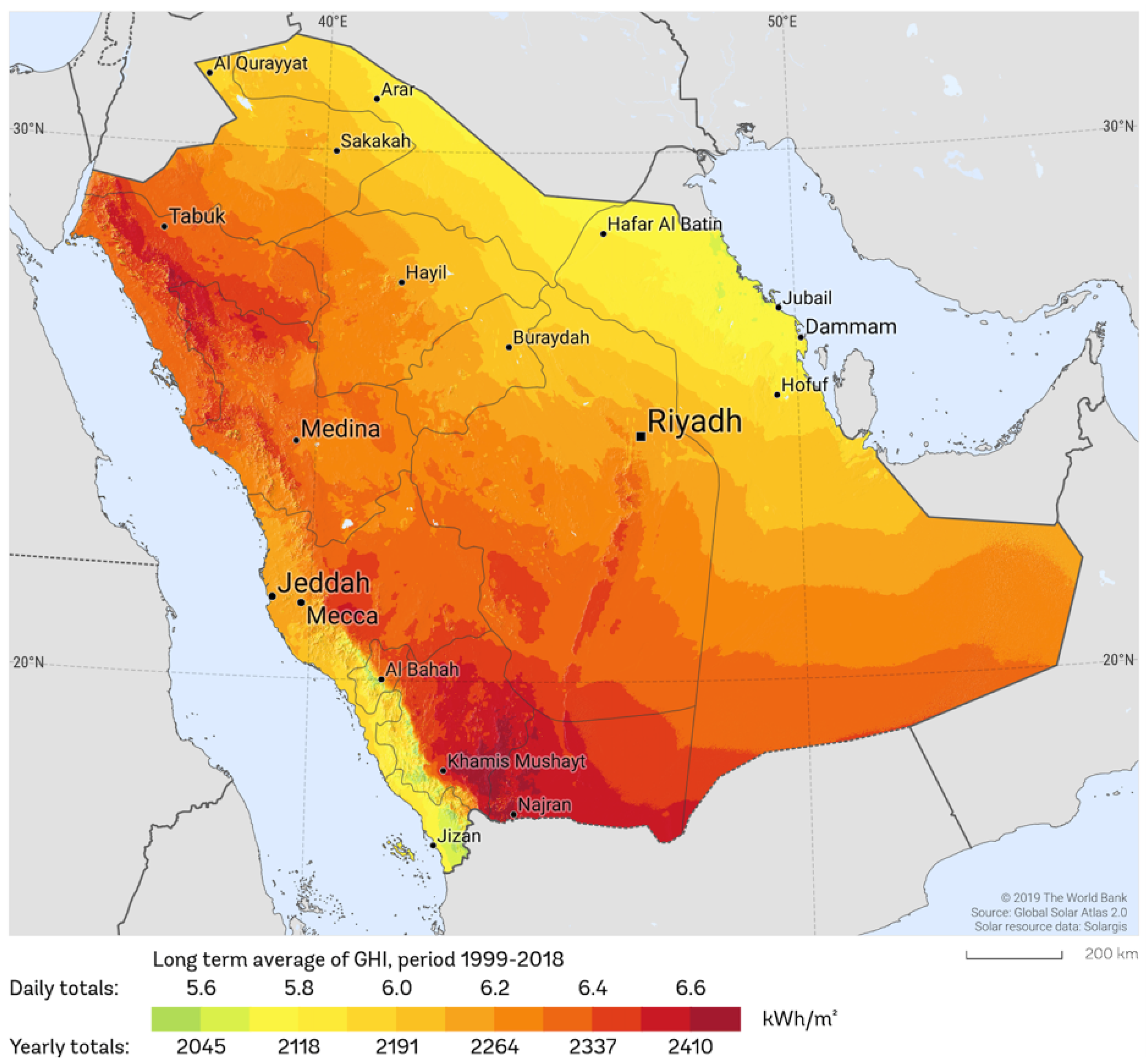
The Arabian Peninsula has abundant solar resources, and several Gulf nations have sought to use this resource for power generation [47]. Saudi Arabia, however, still relies heavily on fossil fuels for electricity supply [48]. Previous studies using Saudi Arabian data have examined the techno-economic feasibility of renewable energy integration [49] and sustainability indicators related to economics, environment, technology, energy, and society. Figure 2 shows global horizontal solar irradiation for Saudi Arabia.
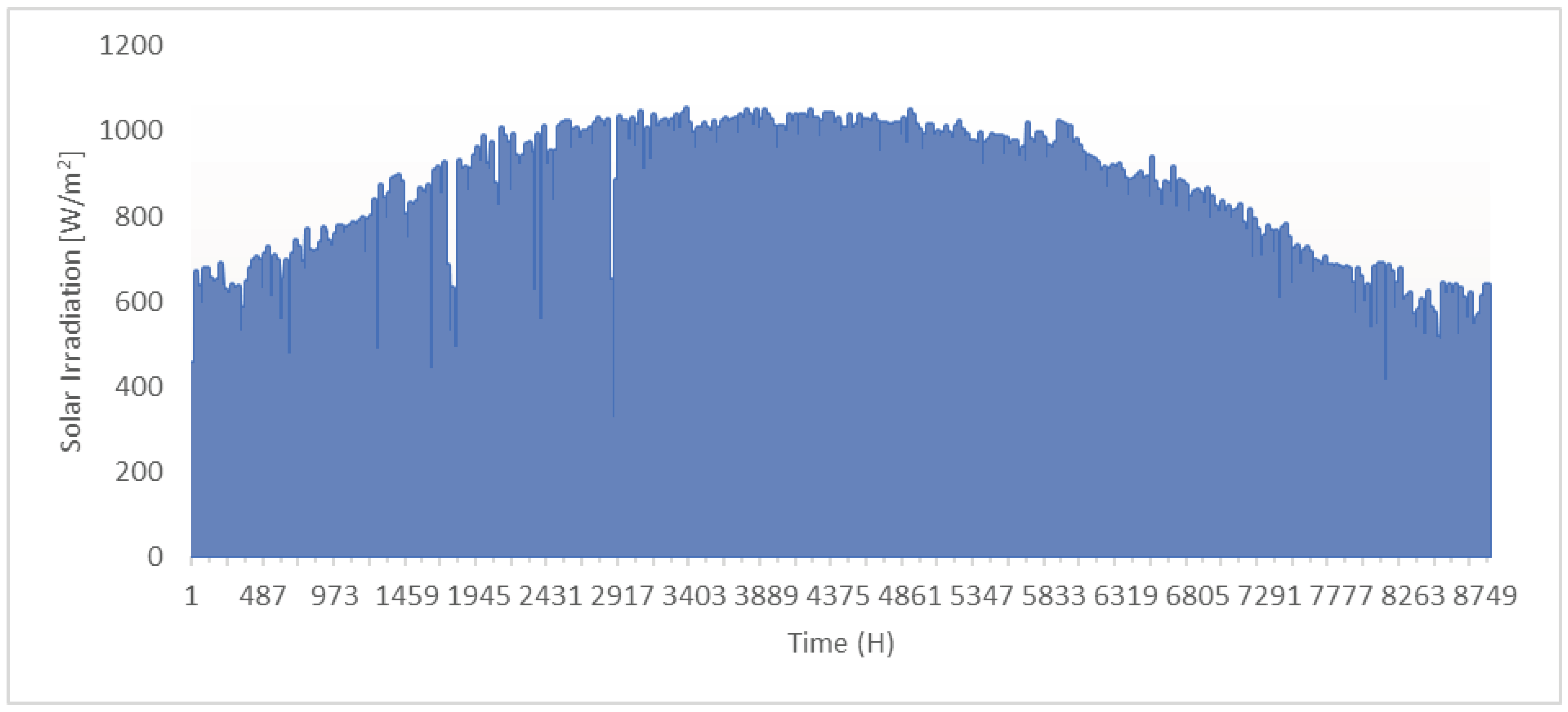
The average daily total horizontal irradiation in Hafr Al-Batin, a city in Saudi Arabia’s Eastern Province, is approximately 5.8 kWh/m2. The city is known for winter desert camps that are commonly powered by diesel generators, which contribute to local emissions. The hourly solar irradiation for Hafr Al-Batin is shown in Figure 3.
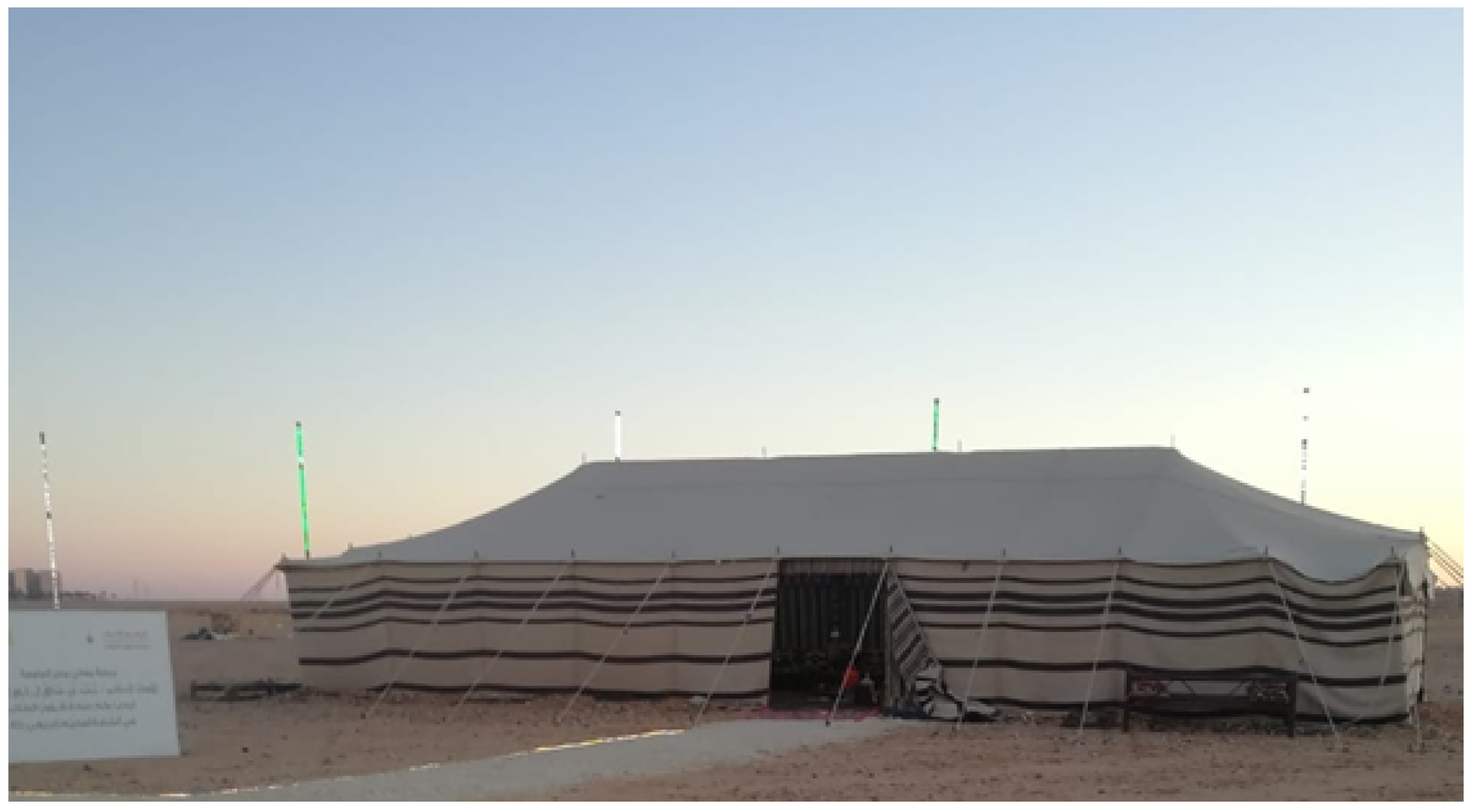
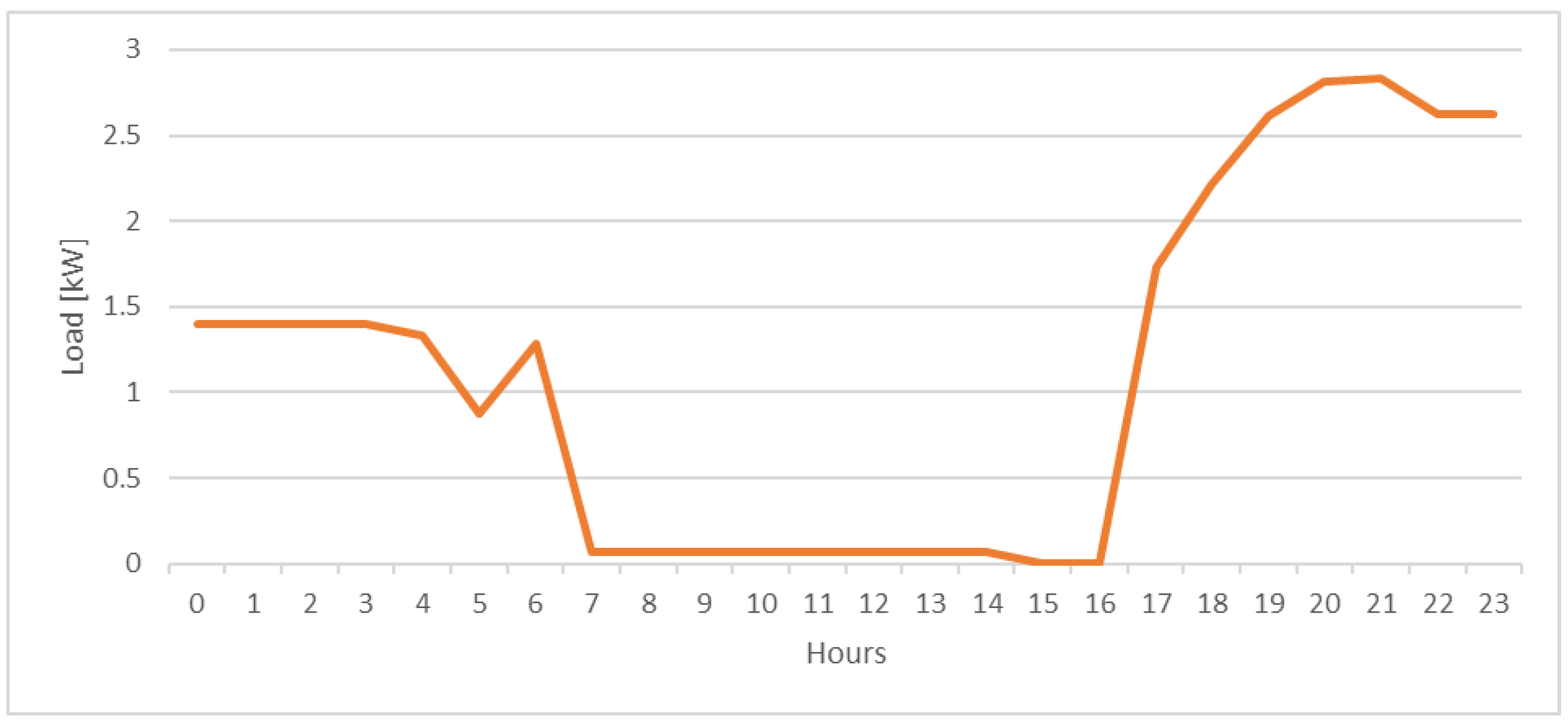
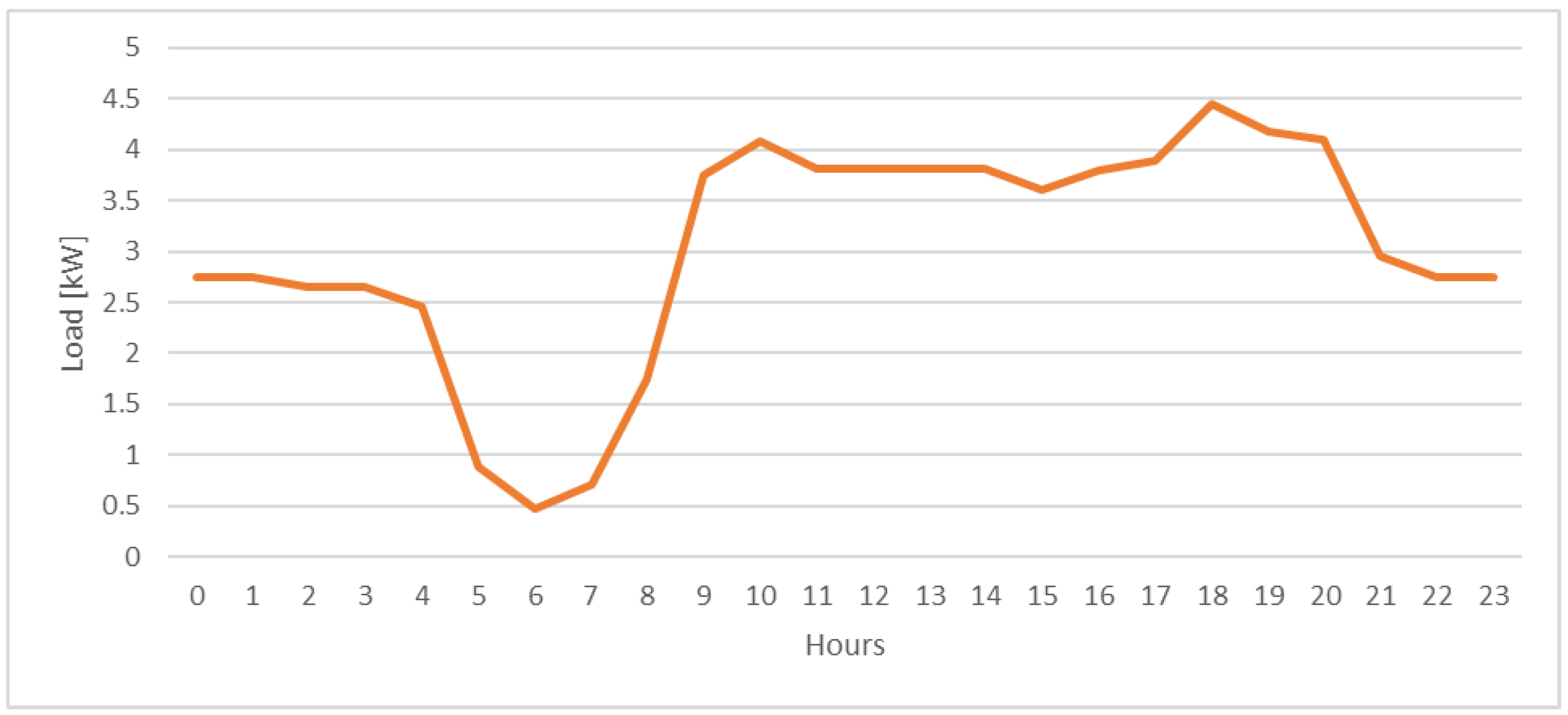
A typical desert camp used for short family stays consists of three living tents, two toilets, one watchman room, and fencing. Table 2 presents the electrical load calculation for a representative camp, and the load details were verified through a visit to a camp in the study area. The average daily energy requirements for weekdays and weekends are 27.06 kWh and 72.63 kWh, respectively. Weekday peak demand is 2.83 kW, whereas weekend peak demand is 4.45 kW. On weekdays, the camp is usually empty between 7:00 a.m. and 4:00 p.m. when residents go to town for work and other daily activities. Figure 4 depicts a typical desert camp, whereas Figure 5 and Figure 6 show the weekday and weekend load profiles, respectively.

5. Problem—Solution Approach

The adopted multi-objective neural architecture search (MONAS) framework is a coevolutionary optimization strategy designed for multi-objective neural architecture search problems (MONASPs) [27]. In this work, the original MONAS is first adopted as the baseline framework, and then an improved version, referred to as IMONAS, is developed to enhance the balance between exploration and exploitation. The algorithms, MONAS and its improved version, are not ANN-based training methods and are not used here to search for neural network architectures in the conventional deep-learning sense. Rather, they are optimization frameworks inspired by the neural architecture search concept, but they can also be employed as general multi-objective optimization algorithms.
This section summarizes the main principles of the original MONAS framework and then highlights the modifications introduced in IMONAS. The complete details of the original MONAS can be found in [27].

5.1. Multi-Objective Neural Architecture Search (MONAS) Framework

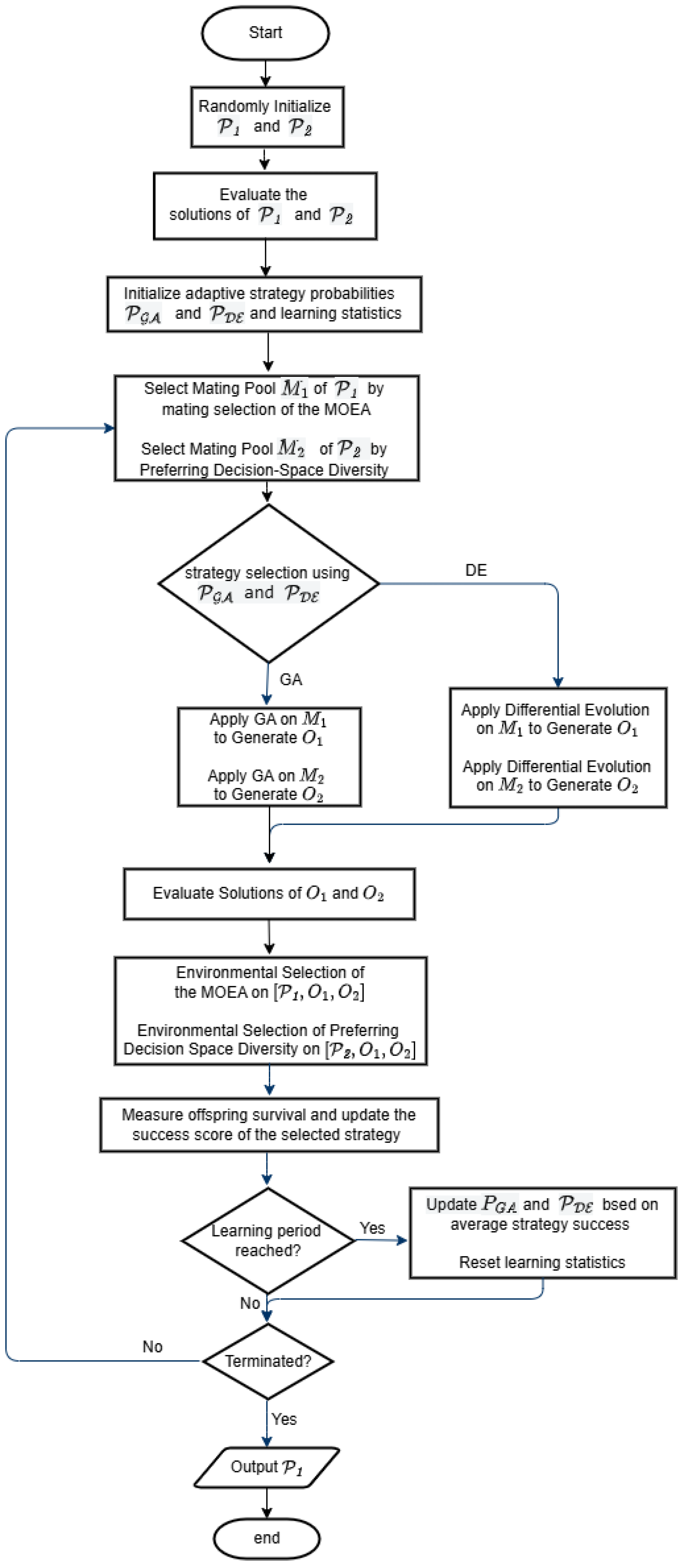
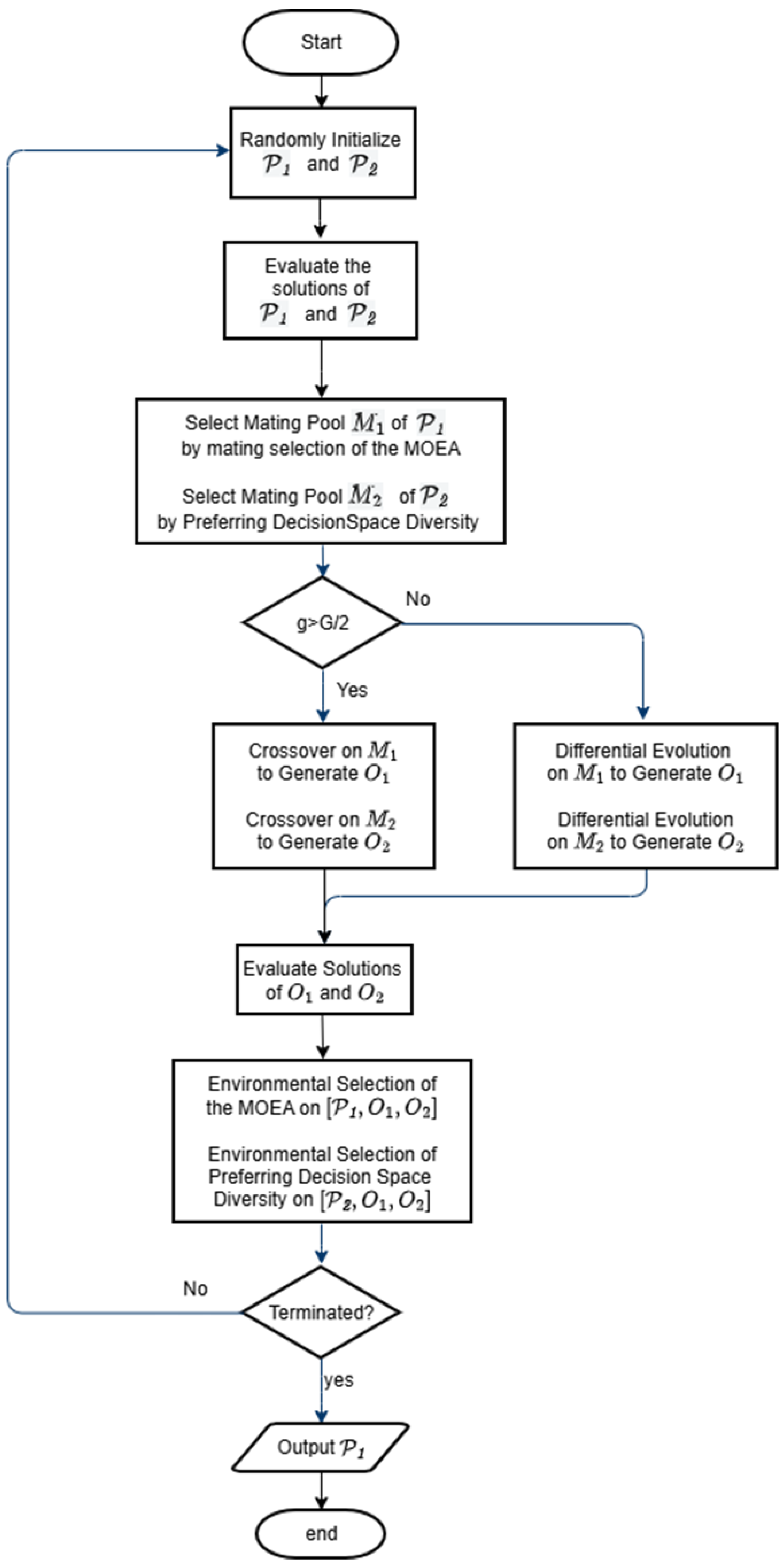
The overall MONAS framework is illustrated in Figure 7. The algorithm starts by randomly initializing two populations: the main population P 1 and the auxiliary population P 2 . The main population is evaluated in the objective space using the adopted multi-objective evolutionary algorithm (MOEA), whereas the auxiliary population is guided by a fitness measure that promotes diversity in the decision space. In this work, the fitness assigned to solutions in P 2 is expressed as
F x = C x + D x ,
where C x denotes the convergence term and D x denotes the decision-space diversity term.
The convergence term is computed as
C x = y P , y x r ( x , y ) ,
where
r ( x , y ) = 1 , if y x , 0 , otherwise ,
and y x means that solution y dominates solution x. The diversity term is defined by
D x = 1 dist ( x , x ) + 2 ,
where dist ( x , x ) is the Euclidean distance between solution x and its k-th nearest neighbor in the decision space.
After evaluation, mating selection is independently carried out for both populations. The mating pool of P 1 is generated according to the selection mechanism of the adopted MOEA, while the mating pool of P 2 is determined by emphasizing decision-space diversity so as to encourage the discovery of multiple equivalent Pareto-optimal sets.
In the original MONAS, offspring generation follows a two-stage mechanism. During the first half of the search process, i.e., when g < G max / 2 , genetic algorithm (GA)-based variation operators are employed to improve convergence and facilitate broad recombination among solutions. In this stage, offspring are generated using simulated binary crossover (SBX) for real-valued variables and uniform crossover (UC) for binary and integer components, as expressed by
( x , y ) = SBX ( x r l , y r l ) , UC ( x b i , y b i ) , UC ( x i n t , y i n t ) .
During the second half of the search process, differential evolution (DE)-based variation is used to strengthen exploration and capture dependencies among decision variables. For a parent solution p i and two selected vectors x i and y i , the offspring is generated as
o i = p i + F · ( x i y i ) ,
where F is the DE scaling factor. Once the offspring populations are created, environmental selection is performed. The offspring sets generated from P 1 and P 2 are merged with their corresponding parent populations. The next generation of P 1 is selected according to the environmental selection mechanism of the adopted MOEA in the objective space, while the next generation of P 2 is selected using a diversity-oriented strategy in the decision space. Under this strategy, solutions satisfying F i 1 are selected first. If the number of selected solutions exceeds the population size N, truncation is applied by iteratively removing the solution with the smallest diversity contribution:
x = arg min x P 2 D ( x ) .
The evolutionary process continues until the stopping condition is satisfied. The final output of the algorithm is obtained from the main population P 1 . Therefore, the original MONAS relies on three principal features: (i) a coevolutionary structure that separates convergence and diversity preservation, (ii) a two-stage search process based on GA followed by DE, and (iii) a decision-space diversity maintenance mechanism that supports the identification of multiple equivalent Pareto-optimal solutions.

5.2. Improved MONAS (IMONAS)

Although the original MONAS provides a useful balance between convergence and diversity, its search strategy transition is fixed: GA is always used in the first half of the iterations, while DE is always used in the second half. This rigid schedule may not be optimal for all optimization stages or problem instances. To overcome this limitation, an improved variant, called IMONAS, is proposed in this work.
The overall IMONAS framework is illustrated in Figure 8. The main difference between IMONAS and MONAS is that IMONAS replaces the fixed two-stage search schedule with an adaptive strategy selection mechanism. Instead of forcing the algorithm to use GA during the first half and DE during the second half, IMONAS selects either GA or DE at each iteration according to adaptive probabilities p GA and p DE , with 
p GA + p DE = 1 .
At the beginning of the search, both strategies are given equal probability, i.e.,
p GA = p DE = 0.5 .
To evaluate the usefulness of each search strategy, IMONAS monitors the survival of offspring after environmental selection. More specifically, after offspring are generated using either GA or DE, the algorithm counts how many offspring survive into the next generation in both P 1 and P 2 . This survival count is used as a measure of the success of the selected strategy. The cumulative success scores of GA and DE are recorded over a learning period.
After every predefined learning window, the average success of each strategy is computed, and the probability of selecting GA is updated according to the relative performance of the two strategies. To avoid abrupt probability fluctuations, a smoothing update is used, and a minimum probability threshold is also enforced so that neither strategy is completely discarded during the search. In this manner, IMONAS maintains the participation of both GA and DE while gradually favoring the more effective one for the current search state.
It should be noted that IMONAS preserves the main coevolutionary structure of MONAS. The two-population architecture, the objective-space and decision-space fitness assignment, and the environmental selection mechanisms remain unchanged. Therefore, the improvement introduced in IMONAS is specifically related to the offspring generation stage, where the search becomes adaptive rather than predetermined.
In summary, the proposed IMONAS improves MONAS by introducing an online learning mechanism for search operator selection. This modification allows the algorithm to dynamically adjust the use of GA and DE according to their observed contribution to population improvement. As a result, IMONAS is expected to provide a better balance between exploration and exploitation, enhance search flexibility, and improve robustness across different optimization cases.

6. Application, Results, and Discussion

This paper investigates the six cases listed in Table 3. The detailed characteristics of the PV panel, battery, and inverter models used in this study are listed in Table A1, Table A2 and Table A3 respectively. The proposed IMONAS approach was evaluated against the original MONAS and several comparison algorithms using a population size of 100 particles and 200 iterations. These parameter settings were determined based on preliminary experimental tests. These values were found to provide a good balance between convergence performance, diversity preservation along the Pareto front, and computational efficiency. This is particularly important in the present multi-objective optimization problem, where the objective is not only to approach the Pareto front but also to obtain a well-distributed set of non-dominated solutions. Smaller population sizes or fewer iterations were found to reduce the quality of the Pareto front approximation, whereas larger values increased the computational cost without significant improvement.
Furthermore, to assess the proposed IMONAS algorithm, its performance was compared with the original MONAS and several established multi-objective optimization algorithms: speed constrained multi-objective particle swarm optimization (SMPSO), novel modified particle swarm optimization (NMPSO), multi-objective particle swarm optimization with disturbance operation (MPSOD), multi-objective evolutionary algorithm based on decomposition (MOEAD), and reference vector guided evolutionary algorithm (RVEA). The internal parameters of each algorithm are given in Table 4.
The design variables are bounded as follows:
N PV [ 2 , 100 ] ,
N DG [ 1 , 10 ] ,
A D [ 1 , 2 ] ,
PVModel [ 1 , 13 ] ,
BatteryModel [ 1 , 27 ] ,
InverterModel [ 1 , 8 ] .
Table 3 summarizes the investigated cases. Case 1 is the baseline case without uncertainty or degradation. Case 2 includes 10% load uncertainty for 1000 h/year, while Case 3 applies the same load uncertainty for 2000 h/year. Cases 4–6 correspond to Cases 1–3, respectively, but include battery degradation. The choice of 1000 h/year and 2000 h/year was intended to represent two levels of uncertainty severity, while the 10% deviation was adopted as a bounded fluctuation around the nominal demand profile. This uncertainty representation is a simplified Monte Carlo distribution model chosen for computational efficiency and robustness analysis, rather than a fully correlated probabilistic forecasting model.

6.1. Results and Discussion

For all cases, the objective functions (LPSP and COE) are plotted using identical axis limits. This provides a consistent visual basis for comparing the Pareto fronts (PFs) obtained under different uncertainty and degradation assumptions.

6.1.1. Case 1

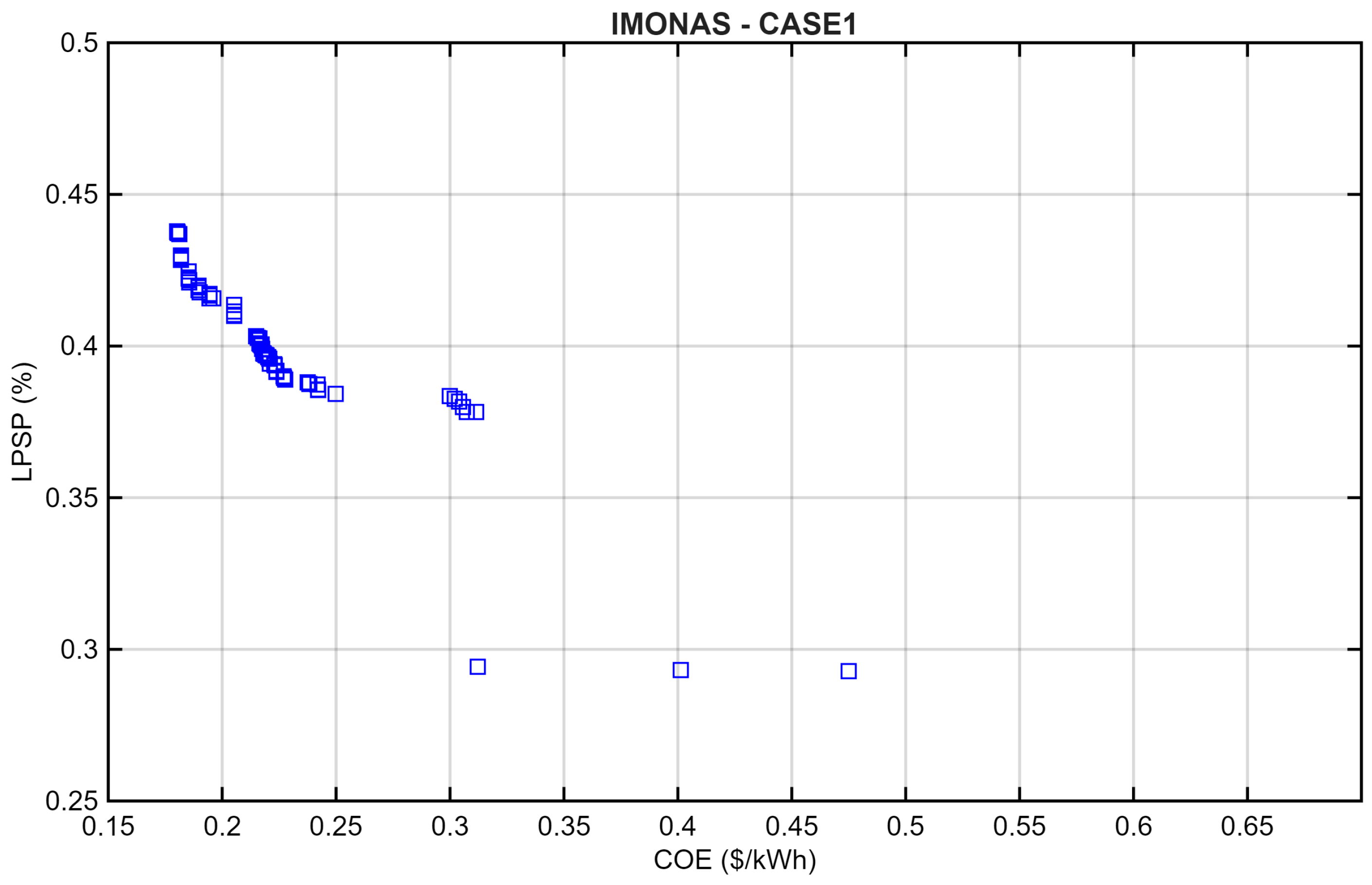
Figure 9 shows the solutions obtained for Case 1 using the proposed IMONAS approach. IMONAS identified 69 non-dominated solutions, whose objective vectors form the PF. The plotted solutions lie approximately between ( COE = $0.1819/kWh, LPSP = 0.4299%) and ( COE = $0.3074/kWh, LPSP = 0.3783%). The front spans a clear cost–reliability trade-off instead of concentrating the candidate designs in a narrow region.
For convenience, only 20 selected solutions from the obtained PF are reported in Table 5, sorted in ascending order of COE. Solution #1 includes 16 PV panels, one diesel generator, and a battery autonomy of 1.026 days, which is approximately 24 h and 37 min. The selected component models are PV model #1, battery model #16, and inverter model #3. This solution yields COE = U S D 0.1819 / kWh and LPSP = 0.4299 % , making it the most economical solution among the listed ones, although with a relatively higher LPSP.
A second representative design is Solution #8, which uses 17 PV panels, one diesel generator, and an autonomy of about 33 h, with PV model #1, battery model #16, and inverter model #3. This configuration gives LPSP = 0.4104 % and COE = U S D 0.2053 / kWh .
Solution #15 consists of 29 PV panels, one diesel generator, and a battery autonomy of approximately 31.5 h, with PV model #1, battery model #18, and inverter model #2. This solution provides LPSP = 0.3874 % and COE = U S D 0.2384 / kWh .
At the high-investment end of the PF, Solution #20 uses 49 PV panels, one diesel generator, battery autonomy of approximately 25 h, PV model #1, battery model #18, and inverter model #2. This configuration achieves the lowest LPSP among the obtained solutions, 0.3783 % , but also has the highest COE, U S D 0.3074 / kWh . The result illustrates the expected trade-off: improved reliability requires a more expensive system configuration.

6.1.2. Case 2

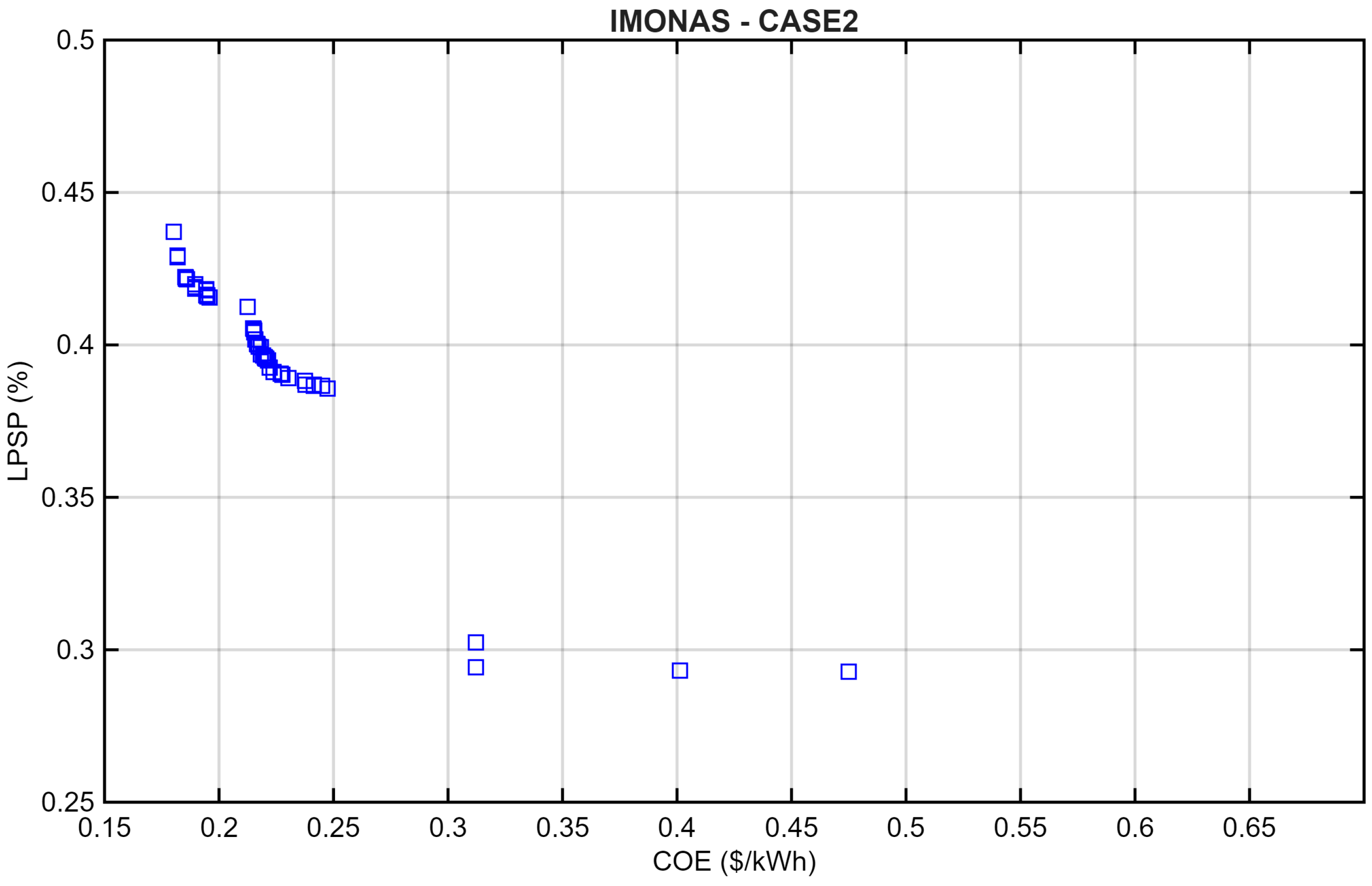
Figure 10 plots the PF obtained for Case 2 using IMONAS. The algorithm generated 56 non-dominated solutions. For clarity, Table 6 lists 20 representative solutions, which capture the cost–reliability trade-off across the front.
In this case, Solution #1 includes 16 PV panels, one diesel generator, and battery autonomy of 1.025 days (approximately 24 h and 36 min), with PV model #1, battery model #16, and inverter model #3. It provides COE = U S D 0.1819 / kWh and LPSP = 0.4292 % , making it the least-cost configuration in the reported solution set.
A second representative option is Solution #10, which uses 21 PV panels, one diesel generator, and autonomy of approximately 31.5 h, with PV model #1, battery model #18, and inverter model #3. This solution achieves LPSP = 0.4053 % and COE = U S D 0.2152 / kWh .
Solution #18 uses 26 PV panels and one diesel generator, with an autonomy of about 29 h. The selected models are PV model #1, battery model #18, and inverter model #3. This solution yields COE = U S D 0.2304 / kWh and LPSP = 0.3892 % .
Solution #20 differs structurally from most other solutions: it includes only two PV panels and two diesel generators, with battery autonomy of roughly 24 h, PV model #7, battery model #18, and inverter model #3. This solution achieves COE = U S D 0.3121 / kWh and a much lower LPSP = 0.3023 % .

6.1.3. Case 3

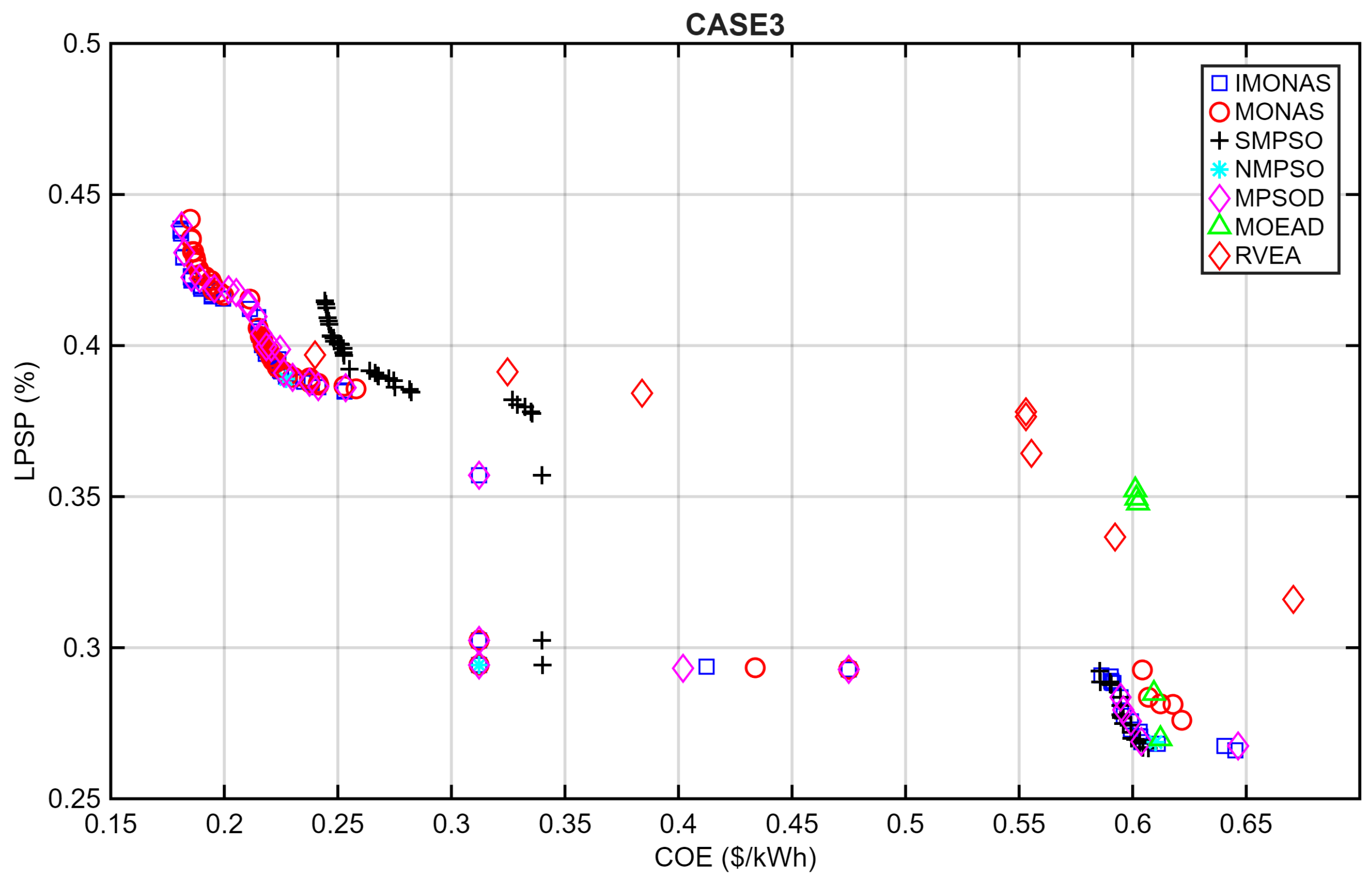
Figure 11 shows the solutions obtained for Case 3. IMONAS generated 74 non-dominated solutions, the largest number among the six cases, giving a wider design space and a richer set of trade-offs. As in the other cases, Table 7 reports 20 representative solutions.
The first listed configuration, Solution #1, has 16 PV panels, one diesel generator, and battery autonomy of 1.023 days (approximately 24 h and 33 min), using PV model #1, battery model #16, and inverter model #3. Its objectives are COE = U S D 0.1819 / kWh and LPSP = 0.4291 % , again representing the lowest-cost solution.
Solution #6 uses 19 PV panels, one diesel generator, and autonomy of about 33 h, with PV model #4, battery model #16, and inverter model #3. This design gives COE = U S D 0.2113 / kWh and LPSP = 0.4122 % . Compared with Solution #1, it improves reliability through a different PV model and higher battery autonomy, but at a higher cost.
Solution #15 is a compromise design with 29 PV panels, one diesel generator, PV model #1, battery model #18, inverter model #2, and nanogrid autonomy of around 31 h. It yields COE = U S D 0.2384 / kWh and LPSP = 0.3876 % , representing improved reliability at moderate cost.
At the reliability-oriented end of the reported solution set, Solution #20 uses 18 PV panels, 2 diesel generators, and exactly 24 h of autonomy, with PV model #1, battery model #3, and inverter model #3. The corresponding objectives are COE = U S D 0.6032 / kWh and LPSP = 0.2708 % . This reduces LPSP substantially, but with a significant increase in system cost and diesel dependence.

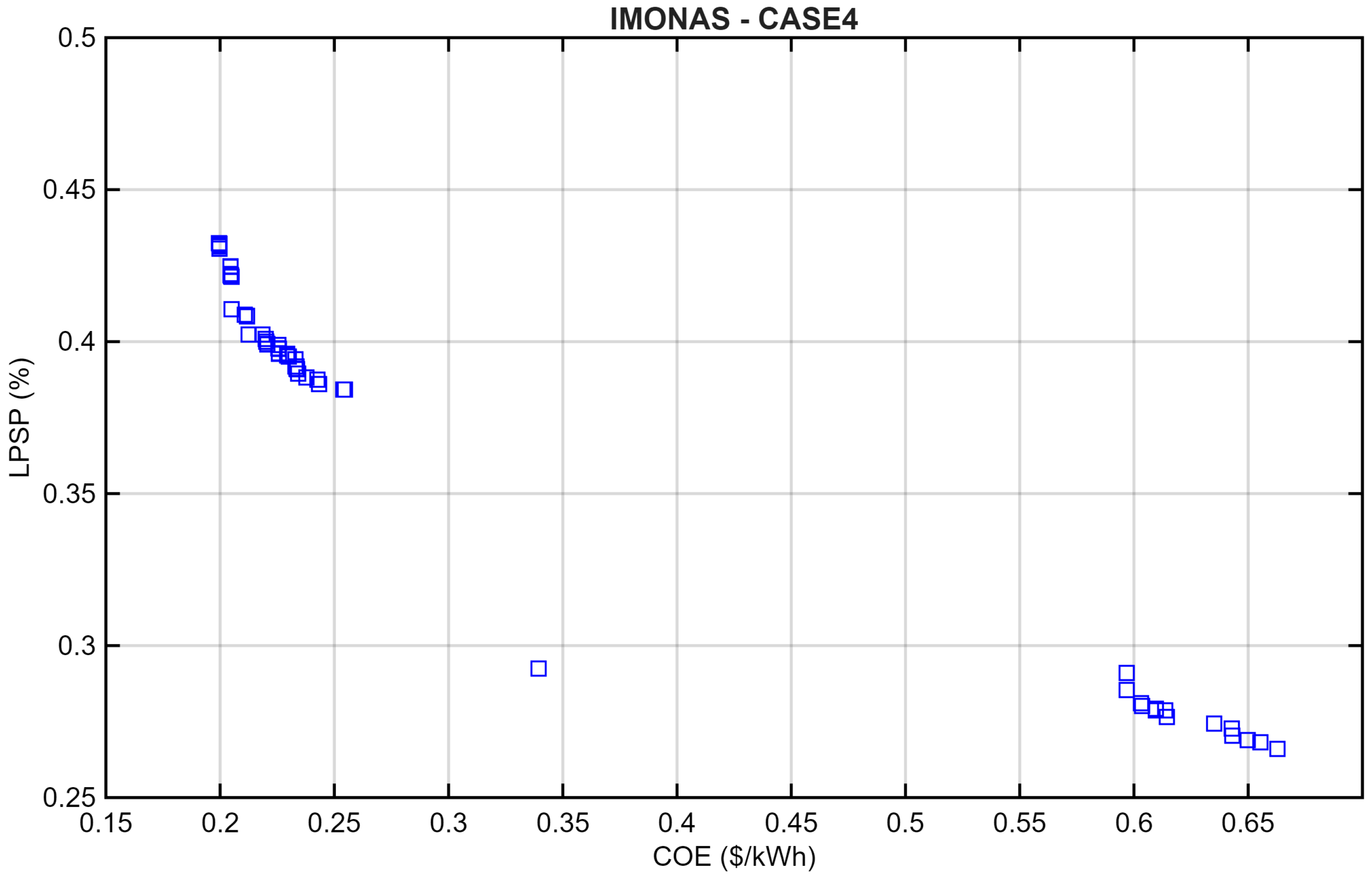
6.1.4. Case 4

Figure 12 shows the PF obtained for Case 4. IMONAS generated 60 non-dominated solutions. The 20 solutions listed in Table 8 show broader variation in battery autonomy and component combinations than in some previous cases.
Solution #1 has 15 PV panels, one diesel generator, and a relatively large autonomy of about 39 h, with PV model #1, battery model #16, and inverter model #3. This configuration gives COE = U S D 0.1996 / kWh and LPSP = 0.4322 % .
A second representative design is Solution #5, which includes 18 PV panels, one diesel generator, autonomy of approximately 38 h, PV model #1, battery model #18, and inverter model #3. Its objectives are COE = U S D 0.2109 / kWh and LPSP = 0.4089 % .
Solution #16 comprises 27 PV panels, one diesel generator, autonomy of 1.573 days (around 37 h and 45 min), and models #1, #18, and #3 for PV, battery, and inverter, respectively. This option yields COE = U S D 0.2426 / kWh and LPSP = 0.3874 % , showing that reliability can be improved while maintaining one diesel generator.
At the more reliability-oriented edge of the PF, Solution #20 uses 27 PV panels, two diesel generators, autonomy of almost one day, PV model #1, battery model #3, and inverter model #1. It gives COE = U S D 0.6428 / kWh and LPSP = 0.2728 % . As in the previous cases, lower LPSP is obtained through a substantial cost increase and greater reliance on diesel generation.

6.1.5. Case 5

Figure 13 shows the PF obtained for Case 5. IMONAS produced 47 non-dominated solutions. Although this is fewer than in Cases 1–4, the 20 solutions in Table 9 still include varied PV models, battery models, inverter models, and autonomy levels.
Solution #1 has 18 PV panels, one diesel generator, and an autonomy of approximately one day, with PV model #4, battery model #16, and inverter model #3. This design results in COE = U S D 0.1878 / kWh and LPSP = 0.4218 % , making it the most economical solution in the reported set.
Solution #5 uses 23 PV panels, one diesel generator, and an autonomy of about 40 h, with PV model #10, battery model #18, and inverter model #2. It gives COE = U S D 0.2283 / kWh and LPSP = 0.3995 % . The longer autonomy and PV subsystem change improve reliability, though at a higher system cost.
At the high-cost end, Solution #20 uses 27 PV panels, one diesel generator, and autonomy of around 40 h, with PV model #1, battery model #1, and inverter model #2. It produces COE = U S D 0.2984 / kWh and LPSP = 0.3833 % , one of the best reliability levels in the reported set.

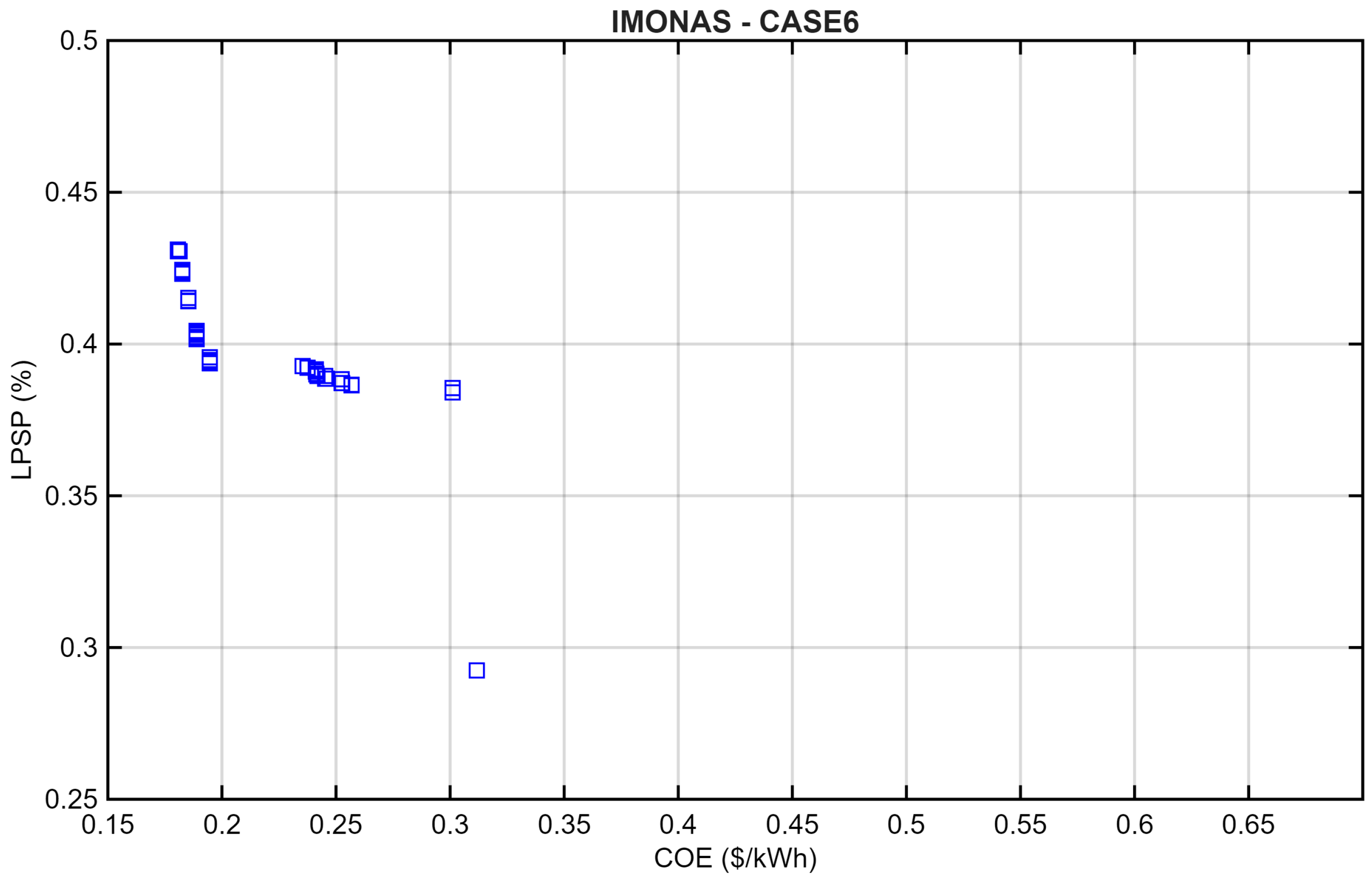
6.1.6. Case 6

Figure 14 shows the PF obtained for Case 6. IMONAS generated 47 non-dominated solutions, the same number as in Case 5. The PF remains well distributed and provides multiple design options. Table 10 reports 20 selected solutions, although the full PF contains more solutions.
Solution #1 consists of 16 PV panels, one diesel generator, and battery autonomy of approximately 24 h, with PV model #1, battery model #16, and inverter model #3. This design gives COE = U S D 0.1826 / kWh and LPSP = 0.4242 % .
Solution #10 uses 19 PV panels, one diesel generator, and autonomy of 1.000 day, with PV model #1, battery model #16, and inverter model #3. It yields COE = U S D 0.1947 / kWh and LPSP = 0.3957 % .
Solution #14 comprises 28 PV panels, one diesel generator, and autonomy of about 37 h, with PV model #4, battery model #18, and inverter model #3. This solution results in COE = U S D 0.2412 / kWh and LPSP = 0.3915 % , illustrating the effect of increasing PV penetration and changing component models.
Solution #20 includes 27 PV panels, one diesel generator, and autonomy of around 39 h, with PV model #1, battery model #1, and inverter model #1. It achieves COE = U S D 0.3012 / kWh and LPSP = 0.3840 % . Case 6 therefore follows the same trade-off pattern: reliability improves as the system becomes more expensive and usually larger in renewable and storage capacity.
Across Cases 1–6, IMONAS yields diverse and well-distributed PFs with feasible nanogrid design alternatives for designers and operators. Lower-COE solutions generally use fewer PV panels and simpler component configurations, but they have higher LPSP values. More reliable configurations usually require more PV panels, longer battery autonomy, and, in some cases, a second diesel generator, which increases COE. The numbers of non-dominated solutions are 69, 56, 74, 60, 47, and 47 for Cases 1–6, respectively, indicating that IMONAS maintains a broad decision space across the investigated conditions.

6.2. Effect of Uncertainty and Battery Degradation on the PF

Figure 15, Figure 16 and Figure 17 compare the effects of uncertainty and battery degradation on the optimal nanogrid design. Uncertainty is inherent in microgrid operation because renewable generation, load demand, and other operating conditions vary over time. Battery degradation must also be included because storage capacity gradually decreases, affecting both reliability and cost. Stochastic uncertainty modeling and explicit degradation modeling therefore provide a more realistic basis for nanogrid planning.

6.2.1. Effect of Uncertainty

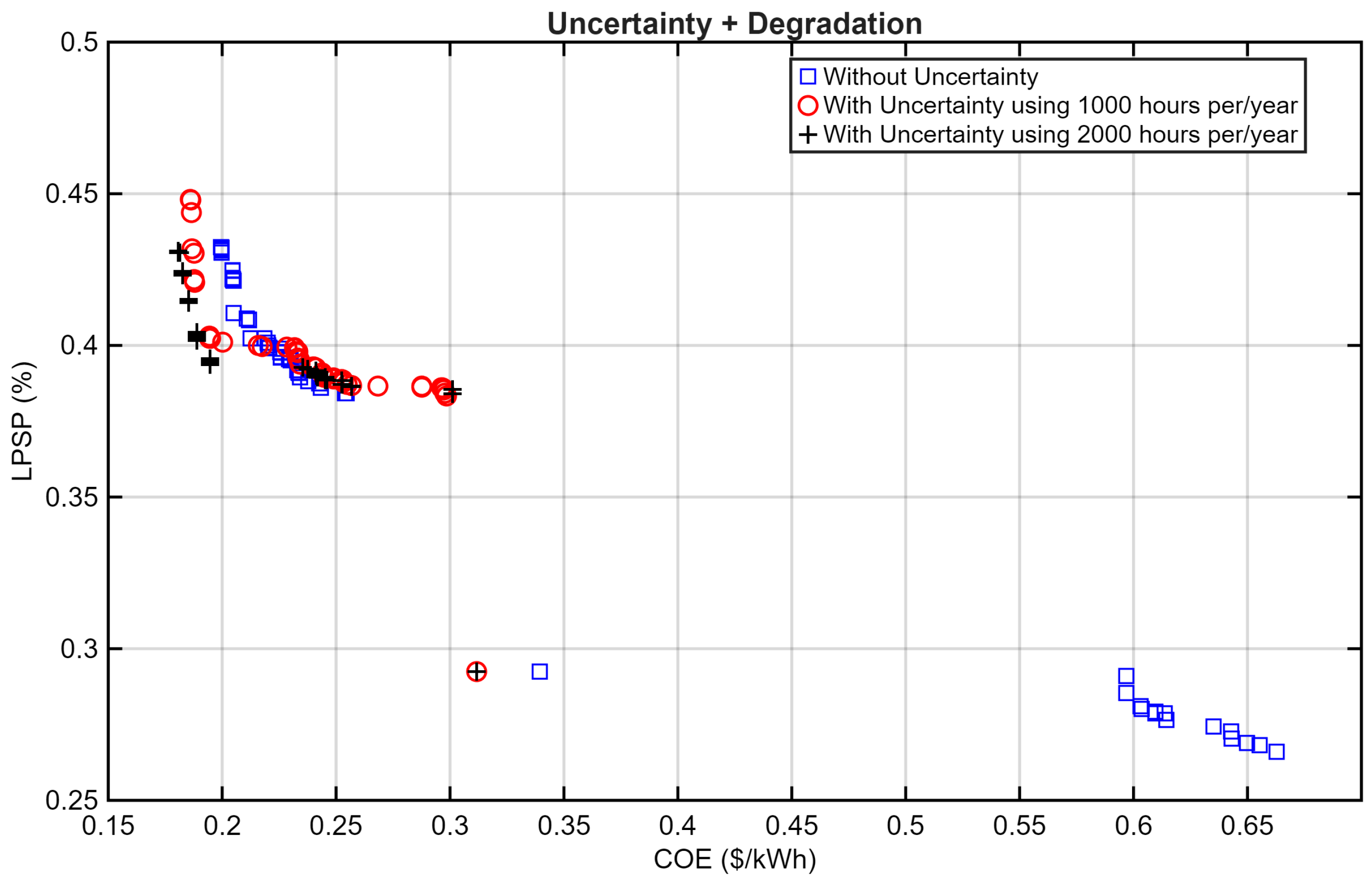
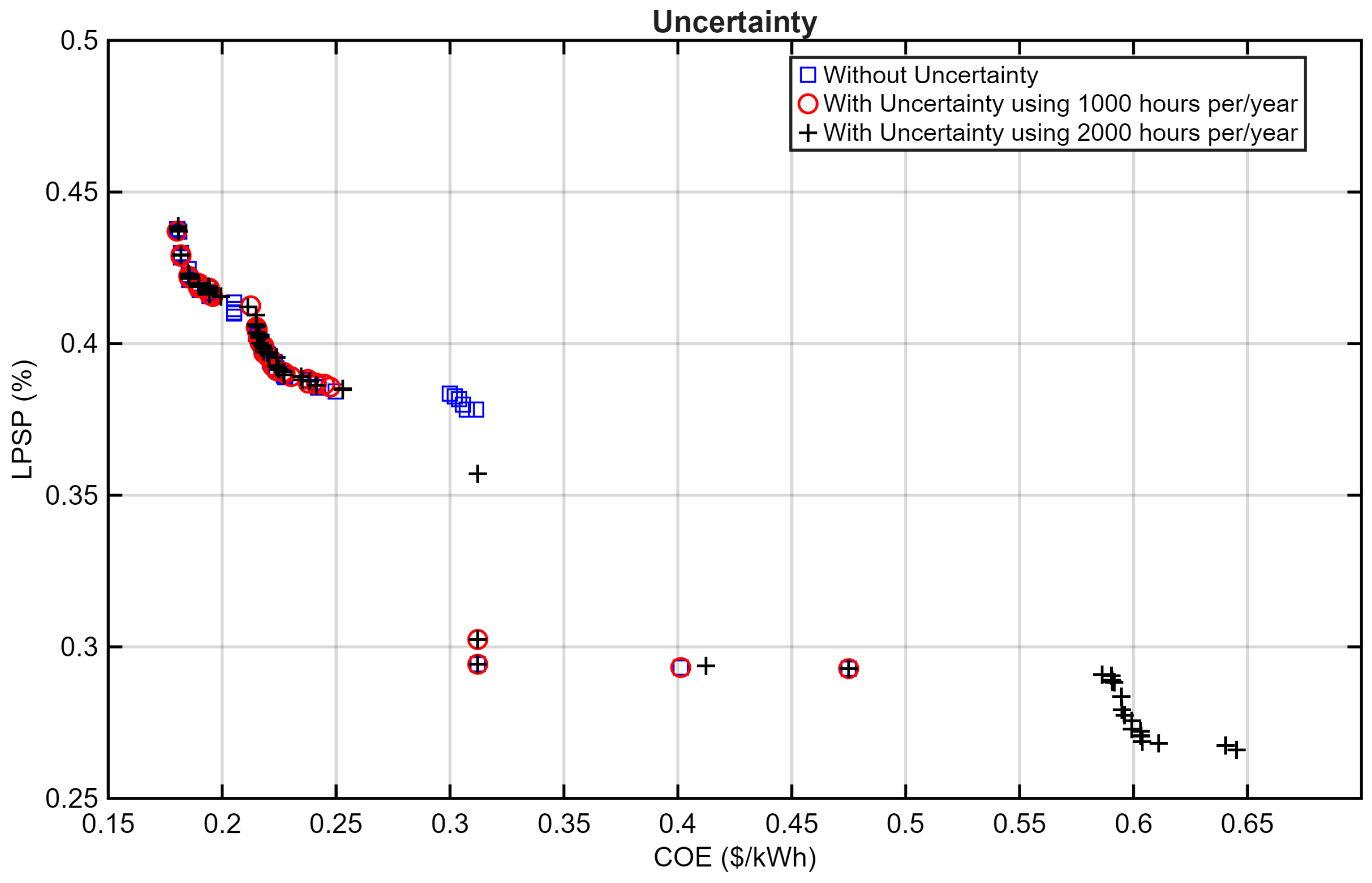
Figure 15 compares the PFs obtained for Case 1, Case 2, and Case 3, which correspond to the following conditions:
  • Without uncertainty;
  • With uncertainty using 1000 h/year;
  • With uncertainty using 2000 h/year.
The PF shifts when uncertainty is incorporated. The deterministic case provides the most optimistic solutions because the uncertain variable is assumed to follow known and fixed conditions. Under this assumption, the optimizer can use the available resource more aggressively, giving lower-cost configurations for a given reliability level.
Once uncertainty is introduced, the PF moves away from the deterministic front, particularly in the low-LPSP region. Maintaining the same reliability under uncertain operation requires more conservative and more expensive system designs. In practical terms, the system needs additional support through larger PV capacity, more storage, or stronger reliance on dispatchable sources such as the diesel generator. As a result, COE increases when uncertainty is considered.
Between the two uncertain cases, the front for 2000 h/year generally extends further toward higher COE values than the front for 1000 h/year, especially for the most reliable solutions. A longer uncertain operating period therefore imposes a stronger design burden: the optimizer must invest more to preserve supply adequacy. Figure 15 shows that increasing uncertainty reduces the optimism of the deterministic design and makes the reliability–cost trade-off more expensive.
The uncertain cases remain relatively close to the deterministic case in the higher-LPSP region, but the differences become more pronounced as the design moves toward lower LPSP values. Highly reliable configurations are more sensitive to operating uncertainty, so small reductions in predictability may require significant extra investment when the target is to keep power shortages very low.

6.2.2. Effect of Uncertainty and Battery Degradation

Figure 15, Figure 16 and Figure 17 show that uncertainty and battery degradation both affect the nanogrid PF. The baseline case without uncertainty or degradation gives the most optimistic solutions, with lower COE values for comparable LPSP levels. When uncertainty is introduced, the PF shifts toward more conservative designs, especially in the low-LPSP region, and the 2000 h/year case is generally more penalizing than the 1000 h/year case.
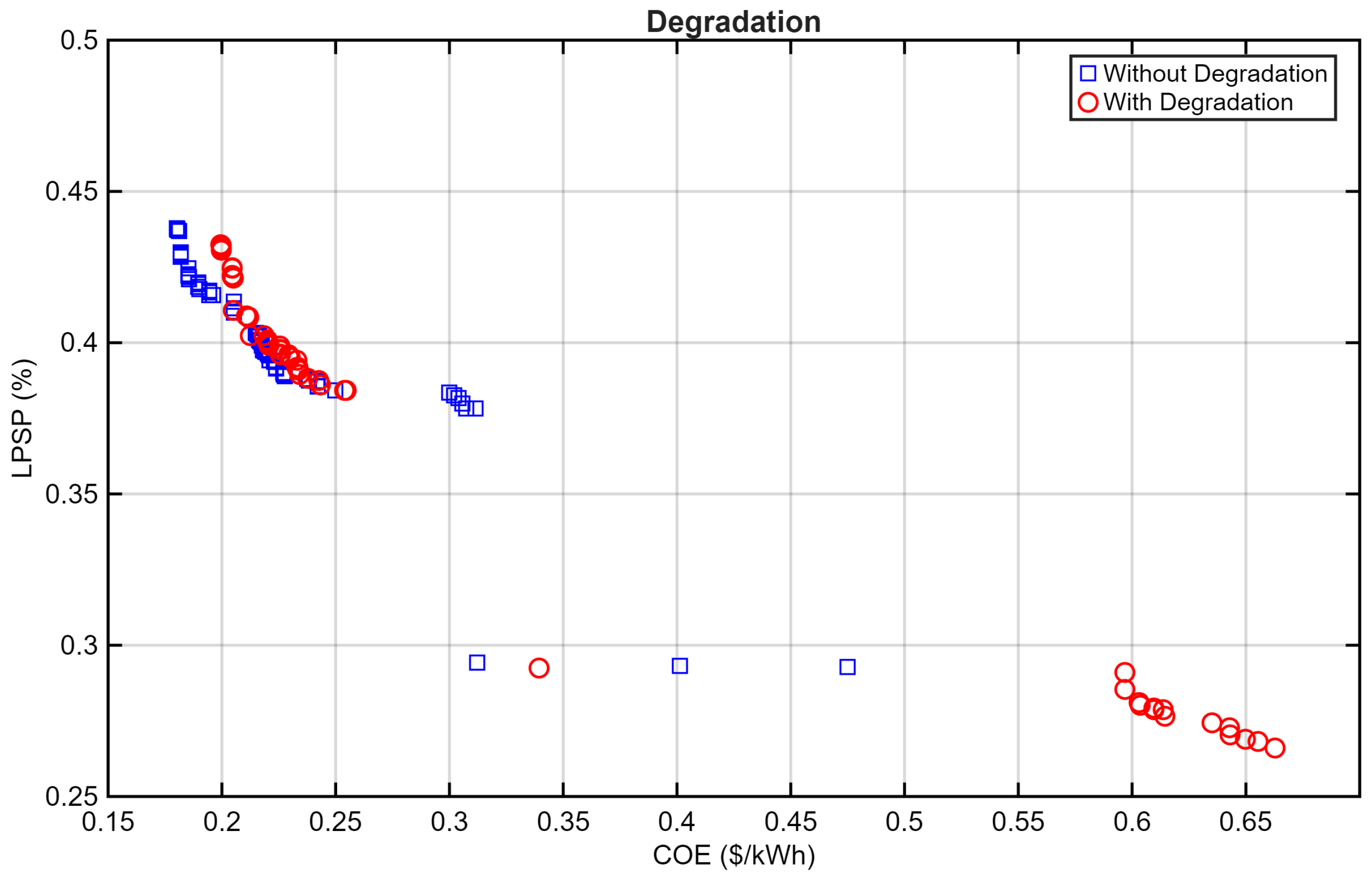
Figure 16 shows that battery degradation also deteriorates the PF. When degradation is considered, the same reliability level can no longer be achieved at the same cost as in the case without degradation. Battery aging reduces effective storage capability over time, forcing the optimizer to choose more expensive and robust configurations. The effect is visible over a broad portion of the front, so degradation influences both cost-oriented and reliability-oriented solutions.
When uncertainty and degradation are considered simultaneously, as shown in Figure 17, the PF shifts further toward higher COE values. Ignoring these effects can therefore produce overly optimistic designs, whereas including both effects gives a more realistic basis for nanogrid planning.

6.3. Performance Comparison

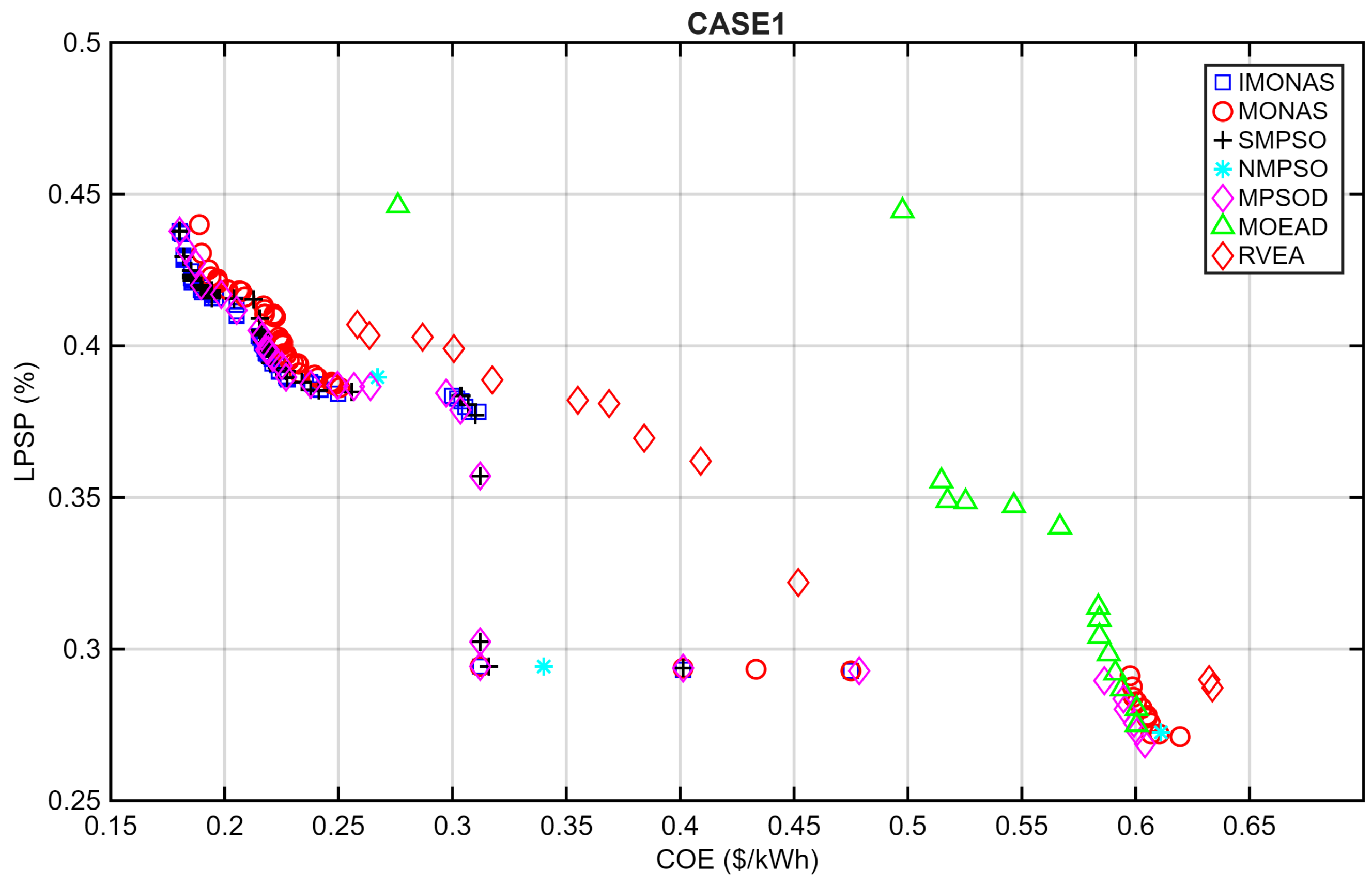
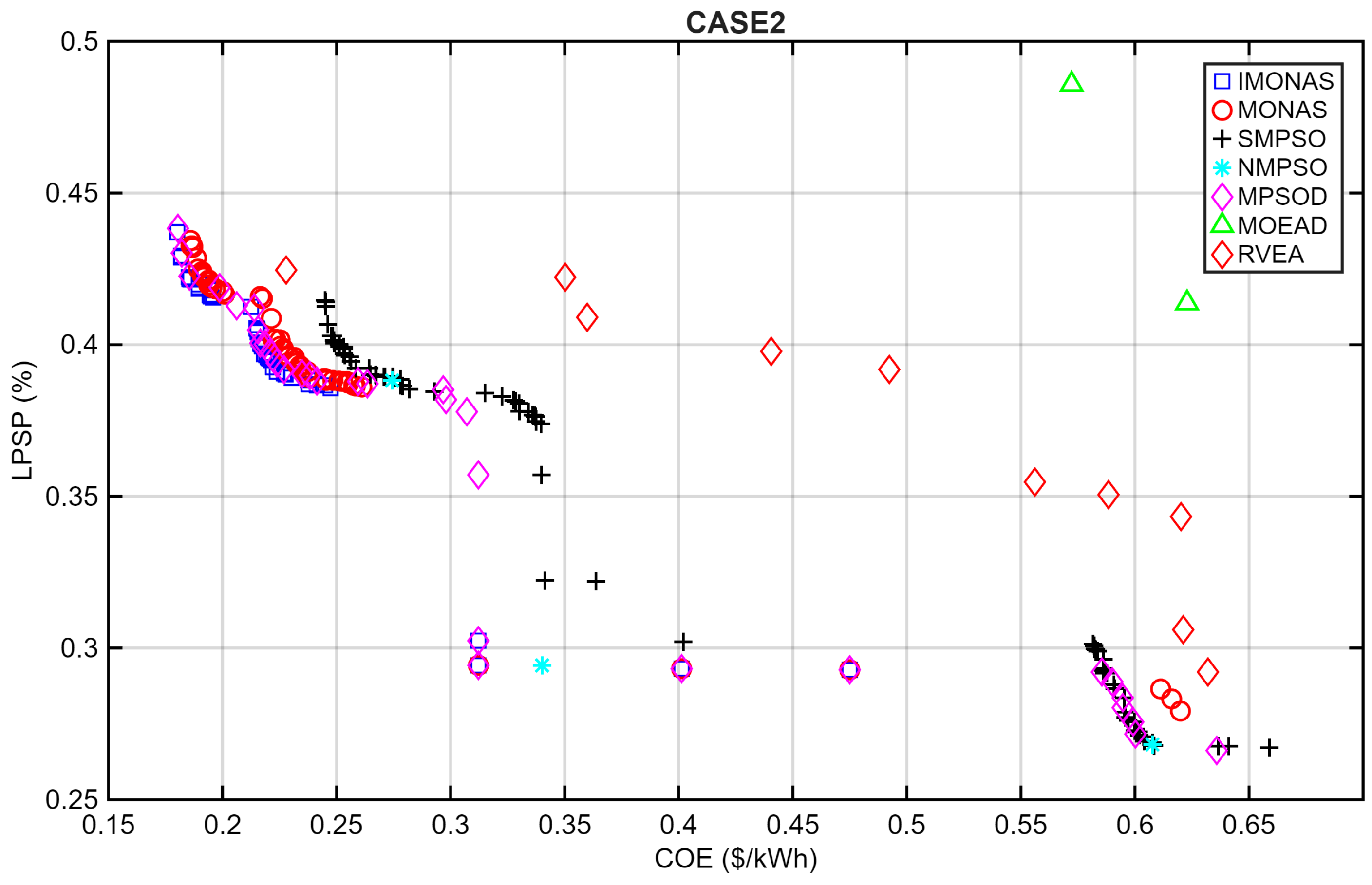
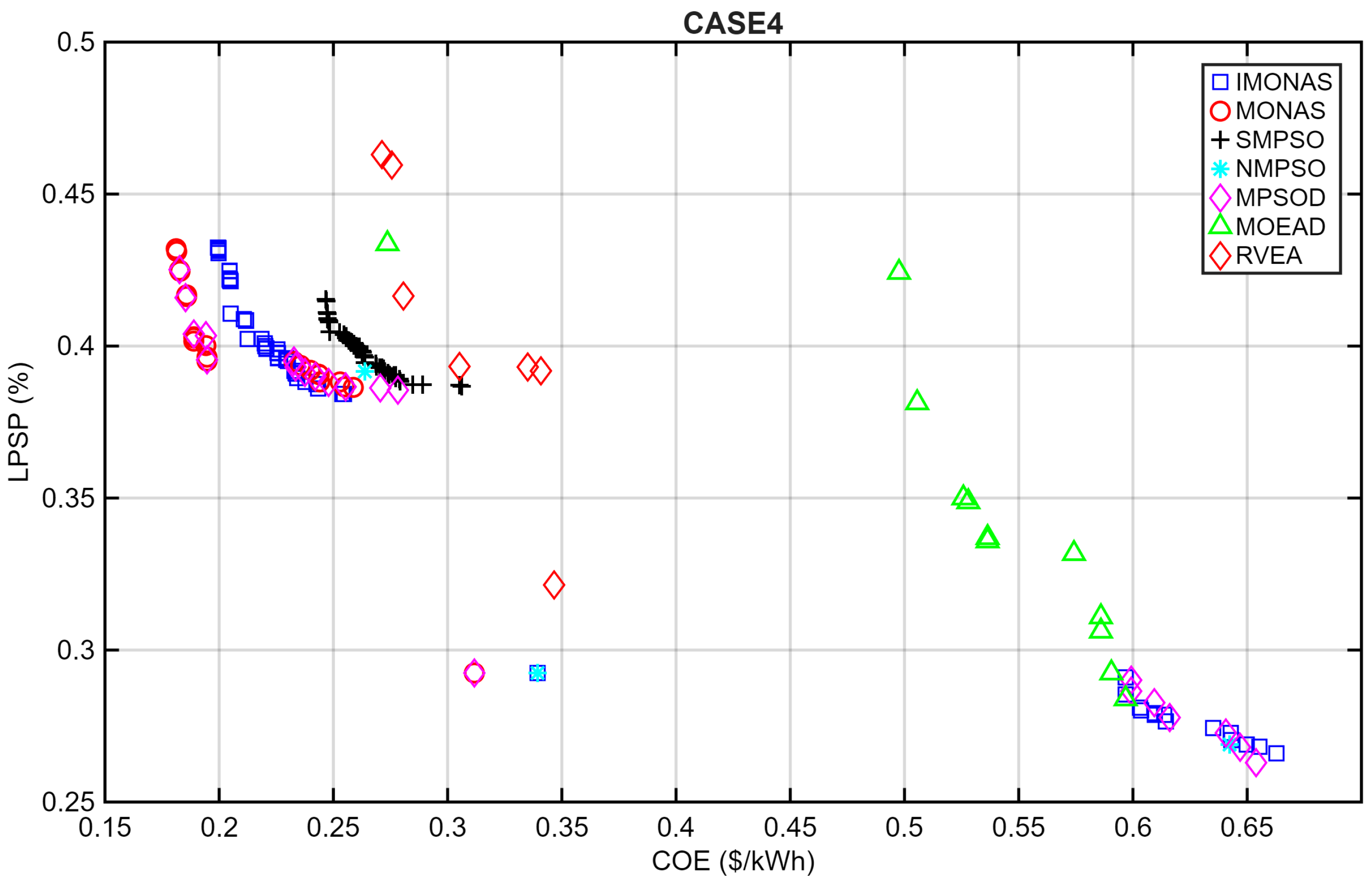
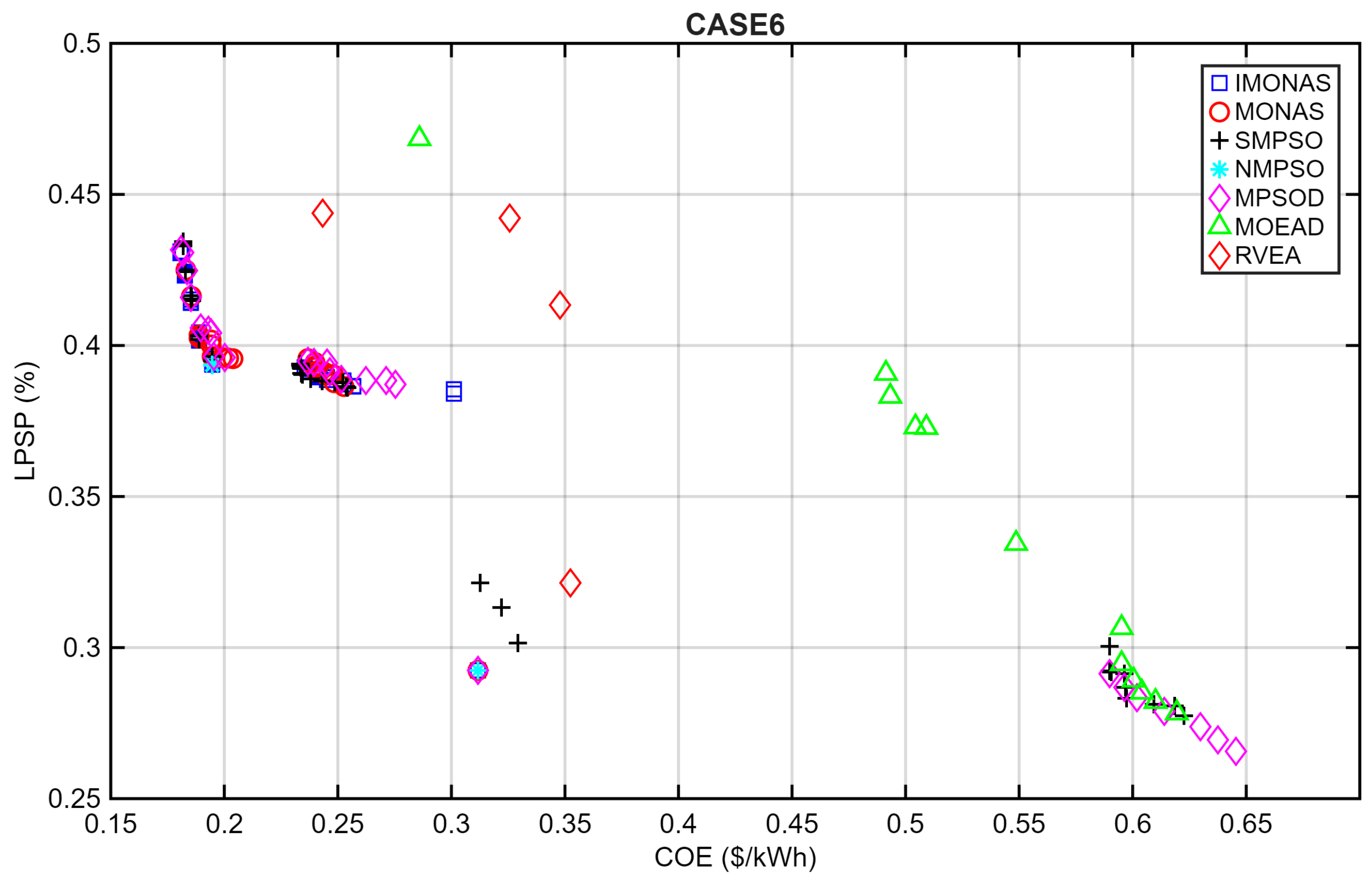
To assess the effectiveness of the proposed IMONAS algorithm, its performance was compared with the original MONAS and several well-established multi-objective optimization algorithms, namely SMPSO, NMPSO, MPSOD, MOEA/D, and RVEA. The Pareto-front (PF) solutions obtained by the competing algorithms are shown in Figure 18, Figure 19, Figure 20, Figure 21, Figure 22 and Figure 23. These graphical comparisons are further supported by quantitative performance indicators, including the C-metric, generational distance (GD), inverted generational distance (IGD), hypervolume (HV), and spacing.

Statistical C-Metric Analysis over 25 Independent Runs

Since all the compared algorithms are stochastic in nature, each algorithm was independently executed 25 times for each case using different random initializations. For each run, the pairwise C-metric values were calculated between the PF generated by IMONAS and the PFs generated by the competing algorithms. Let A and B denote two approximated PFs. The C-metric is defined as
C ( A , B ) = b B a A : a b | B | ,
where | B | is the number of solutions in set B, and  a b means that solution a dominates, or is equal to, solution b. Therefore, C ( A , B ) measures the proportion of solutions in B that are dominated by at least one solution in A. A value of C ( A , B ) = 1 indicates that all solutions in B are dominated by or equal to solutions in A, whereas C ( A , B ) = 0 indicates that none of the solutions in B is dominated by A.
In the revised analysis, the C-metric values were first computed for all 25 runs, and then the mean values were used to quantify the average dominance relationship between IMONAS and each competing algorithm. In addition, the Wilcoxon signed-rank test was applied to the run-by-run C-metric results in order to assess whether the superiority of IMONAS over each competing method was statistically significant. The resulting mean pairwise C-metric values and corresponding p-values are summarized in Table 11.
Table 11 shows that IMONAS consistently achieves substantially higher mean C ( A 1 , A 2 ) values than the reverse mean C ( A 2 , A 1 ) values against most competing algorithms across all six cases. This indicates that, on average over 25 independent runs, the PF generated by IMONAS dominates a significantly larger portion of the PFs generated by the competing methods than vice versa. The superiority of IMONAS is especially pronounced against MOEA/D and RVEA in all cases, with very large dominance margins and very small p-values. The Wilcoxon signed-rank test further confirms that these differences are statistically significant in nearly all comparisons. The only cases where the statistical significance is weaker are the comparisons with MPSOD in Cases 2 and 6, where the corresponding p-values are slightly above 0.05, indicating that MPSOD remains the closest competitor to IMONAS in those scenarios.
Because the C-metric is directional, a single pairwise value is not sufficient to establish a complete ranking among all algorithms. Therefore, for each case, an aggregated case-wise C-score was computed as
CaseScore i = j = 1 j i n alg C ( A i , A j ) C ( A j , A i ) ,
where A i denotes the PF produced by the ith algorithm and n alg is the total number of competing algorithms. This score reflects the net dominance strength of algorithm i against all other algorithms in the same case. A positive value indicates that the algorithm dominates the others more frequently than it is dominated by them, whereas a negative value indicates weaker dominance performance.
Table 12 confirms that IMONAS achieves the highest case-wise C-score in all six cases, which demonstrates the strongest overall dominance behavior among the compared algorithms. MPSOD and MONAS are the closest competitors, particularly in Cases 2, 3, 4, and 6, but they remain consistently below IMONAS. By contrast, MOEA/D and RVEA obtain strongly negative scores in all cases, which indicates weak dominance performance. These results are fully consistent with the visual PF comparisons shown in Figure 18, Figure 19, Figure 20, Figure 21, Figure 22 and Figure 23.
The overall NetCScore is then obtained by averaging the case-wise C-scores over the six cases. However, because no single metric can fully characterize the quality of an approximated PF, additional performance indicators were also considered, namely GD, IGD, HV, and spacing. GD measures the average distance from the obtained PF to the reference PF and thus evaluates convergence. IGD measures the average distance from the reference PF to the obtained PF and therefore reflects both convergence and coverage. HV quantifies the volume of the objective space dominated by the obtained PF with respect to a predefined reference point and hence jointly reflects convergence and diversity. The spacing metric evaluates the uniformity of solution distribution along the PF. Since GD, IGD, and spacing are minimization-oriented indicators, lower values are preferred, whereas for HV and NetCScore, higher values are preferred.
For each metric, the algorithms were ranked case by case and run by run, and the average rank was then computed over all cases and runs. The final average rank was calculated as the arithmetic mean of the average ranks obtained for NetCScore, GD, IGD, HV, and spacing. Thus, the headings of Table 13 are interpreted as follows: NetCScore denotes the overall average case-wise C-score, AvgRank_Cscore is the average rank based on the case-wise C-score, AvgRank_GD is the average rank based on GD, AvgRank_IGD is the average rank based on IGD, AvgRank_HV is the average rank based on HV, AvgRank_Spacing is the average rank based on spacing, and FinalAvgRank is the mean of these five average ranks. A lower final average rank indicates better overall performance.
Table 13 clearly shows that IMONAS achieves the best overall performance among all compared algorithms, with the lowest final average rank of 2.1360. In addition to having the highest NetCScore, IMONAS also obtains the best or near-best average ranks in GD, HV, and spacing, while remaining highly competitive in IGD. MPSOD ranks second overall and represents the closest competitor to IMONAS, mainly due to its strong performance in IGD and HV. MONAS ranks third, followed by SMPSO, while NMPSO, RVEA, and MOEA/D show weaker overall performance. These results demonstrate that IMONAS provides the best overall compromise between dominance strength, convergence toward the reference front, coverage, and distribution quality across the six considered cases.
Furthermore, Figure 18 compares the PFs obtained for Case 1. The IMONAS PF occupies a competitive region of the objective space and provides a favorable compromise between low COE and low LPSP. Its front is well distributed and covers much of the desirable trade-off region, indicating good convergence and diversity. MPSOD and SMPSO also produce competitive solutions in parts of the front, whereas MOEAD and RVEA remain farther from the best trade-off region.
Figure 19 presents the comparison for Case 2. IMONAS extends further toward the desirable lower-left region of the objective plane while maintaining diversity. MONAS also performs reasonably well, but its front is generally less competitive than that of IMONAS. The remaining algorithms, especially MOEAD and RVEA, produce less favorable fronts, consistent with their lower dominance scores in the quantitative analysis.
Figure 22 shows the PF comparison for Case 3. IMONAS provides one of the strongest approximations to the trade-off surface, with a broad and well-distributed set of non-dominated solutions. MPSOD is also competitive in this case, but IMONAS remains more balanced overall. MONAS shows acceptable performance, whereas NMPSO and SMPSO are less consistent. MOEAD and RVEA remain weaker, especially in the low-COE/low-LPSP region.
Figure 20 corresponds to Case 4 and shows a narrower gap between IMONAS, MONAS, and MPSOD. IMONAS still generates a strong PF with good spread and competitive convergence, but several algorithms produce reasonable fronts. Case 4 is therefore more challenging, and IMONAS remains among the leading methods rather than clearly dominating all competitors.
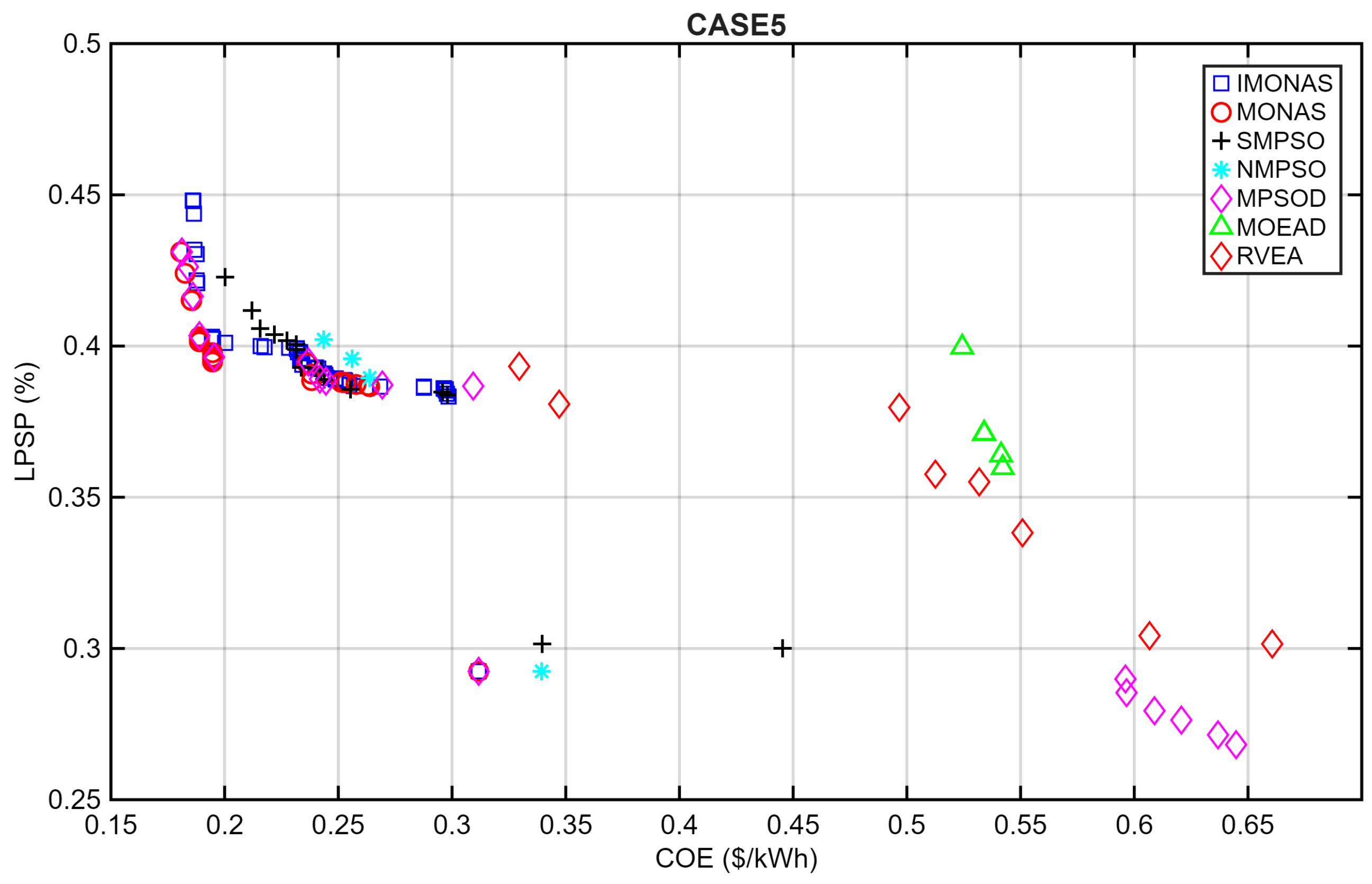
Figure 21 illustrates the results for Case 5. MONAS and MPSOD are particularly competitive, consistent with the high case scores reported later. IMONAS still yields a well-formed PF with acceptable diversity and strong solutions in important parts of the search space. Although IMONAS is not the sole leading method in this case, it remains competitive. MOEAD and RVEA again show the weakest performance.
Figure 23 presents the PF comparison for Case 6. IMONAS regains a clearer advantage, generating a diverse PF close to the best attainable trade-off region. SMPSO also provides some competitive solutions, but the IMONAS front is more comprehensive and better distributed. MONAS performs moderately, while MOEAD and RVEA show limited competitiveness.
Taken together, Figure 18, Figure 19, Figure 20, Figure 21, Figure 22 and Figure 23 show that IMONAS produces high-quality PFs across the six cases. In most scenarios, it balances convergence toward the best trade-off region with diversity along the front. MONAS and MPSOD are competitive in several cases and occasionally outperform IMONAS in isolated scenarios, but IMONAS has the most stable overall behavior.

7. Conclusions

This study developed and applied an improved multi-objective neural architecture search (IMONAS) framework to optimize a hybrid renewable nanogrid system for desert camping applications in Hafr Al-Batin, Saudi Arabia. The proposed approach integrates neural-based optimization with uncertainty modeling and explicit battery degradation modeling, addressing limitations in the reviewed sizing studies. The originality of the article lies in both the algorithmic improvement to IMONAS by the dynamic selection capability of the operators and its application to a more realistic and comprehensive planning model.
The results show that IMONAS can generate well-distributed Pareto fronts under multiple operating scenarios while balancing cost and reliability objectives. Across the six test cases, the framework identified configurations of PV units, diesel generators, battery autonomy, and inverters that trade off the cost of energy (COE) and loss of power supply probability (LPSP). The results also show that uncertainty and battery degradation affect system design, supporting their inclusion in planning studies for harsh environments.
Comparison with the original MONAS and five other multi-objective optimization techniques indicates that IMONAS has the strongest overall performance across the investigated cases. The visual PF comparisons and C-metric assessment show improved convergence and diversity in most cases, although MONAS and MPSOD remain competitive under some operating conditions. The framework supports design decisions for hybrid energy systems in remote desert areas by incorporating uncertainty and degradation effects into the sizing process. Future work may extend the framework to real-time adaptive control and include additional renewable resources and demand-side management strategies.
The proposed strategy of nano-grid model optimization can be practically implemented in any other part of the world for islanded loads, with necessary scaling of the parameters. Anyway, the policy of connecting such off-grid loads with the national grid can also be investigated. Battery replacement strategy, selection of the PV panel, its proper maintenance, optimal load management strategy, etc., practical aspects should be considered before any real-life implementation.
There are some limitations of the presented research that can be further investigated and implemented in future work. Real-world experimental validation, more detailed degradation modeling, use of temperature-dependent electrochemical battery models, limited calculation of environmental indicators, inclusion of the latest models of PV, battery, and generators, analysis of the uncertainty models for solar energy, calculation and analysis of the sustainability indicators, etc., are the major aspects to be looked at.


Author Contributions

Conceptualization, H.R.E.H.B., M.A.M.R. and M.S.S.; methodology, H.R.E.H.B. and M.S.J.; software, H.R.E.H.B.; validation, H.R.E.H.B., M.S.S. and M.A.M.R.; formal analysis, M.S.S., M.S.J. and Y.A.S.; investigation, H.R.E.H.B., M.S.S. and Y.A.S.; resources, M.S.S., H.R.E.H.B., A.A. and Y.A.S.; data curation, H.R.E.H.B.; writing—original draft preparation, H.R.E.H.B., M.S.S., A.A., A.M.M. and Y.A.S.; writing—review and editing, H.R.E.H.B., M.S.S., Y.A.S., A.A., A.M.M. and M.A.M.R.; visualization, M.S.S., H.R.E.H.B., M.S.J. and M.A.M.R.; supervision, H.R.E.H.B. and M.A.M.R.; project administration, M.S.S. and H.R.E.H.B.; funding acquisition, M.S.S. and H.R.E.H.B. All authors have read and agreed to the published version of the manuscript.

Funding

This research was funded by the Deputyship for Research & Innovation, Ministry of Education in Saudi Arabia through the project number 0023-1446-S.

Data Availability Statement

All data used are available within the manuscript. Additional information is available upon reasonable request from the corresponding author.

Acknowledgments

The authors extend their appreciation to the Deputyship for Research & Innovation, Ministry of Education in Saudi Arabia for funding this research work through the project number 0023-1446-S.

Conflicts of Interest

The authors declare no conflicts of interest.

Appendix A

Table A1. PV panel models and information [35].
Model No.Name Y PV (W)Efficiency α P T c NOCT (°C)Cost (USD)Cost (USD/W)
Model #1Kyocera Solar (KC200)200.000.20−0.4647.00800.004.00
Model #2BP Solar (SX 170B)170.000.17−0.4647.00728.974.29
Model #3Evergreen (Spruce ES−170)170.000.17−0.4647.00731.004.30
Model #4Evergreen (Spruce ES−180)180.000.18−0.4647.00774.004.30
Model #5Evergreen (Spruce ES−190)190.000.19−0.4647.00817.004.30
Model #6Solar World (SW−165)165.000.17−0.4647.00709.974.30
Model #7Mitsubishi (PV−MF155EB3)155.000.16−0.4647.00669.974.32
Model #8Sharp (ND−208U1)208.000.21−0.4647.00898.564.32
Model #9Sharp (NE−170U1)170.000.17−0.4647.00739.504.35
Model #10Mitsubishi (PV−MF165EB4)165.000.17−0.4647.00719.974.36
Model #11Sunwize (SW 150)150.000.15−0.4647.00668.314.46
Model #12Kyocera (KC175GT)175.000.18−0.4647.00799.004.57
Model #13Kyocera (KC175GT)175.000.18−0.4647.00799.004.57
Table A2. Battery models and information [35].
Model No. NameEfficiencyCapacity (Ah)Voltage (V)Cost (USD)Lifetime (Yrs)Weight (lbs)
Model #1MK 8L160.85370.006.00288.7712.00113.00
Model #2Surrette 12-CS-11PS0.85357.0012.001118.9612.00272.00
Model #3Surrette 2KS33PS0.851765.002.00874.9012.00208.00
Model #4Surrette 4-CS-17PS0.85546.004.00604.2312.00128.00
Model #5Surrette 4-KS-21PS0.851104.004.001110.4412.00267.00
Model #6Surrette 4-KS-25PS0.851350.004.001386.8512.00315.00
Model #7Surrette 6-CS-17PS0.85546.006.00906.3112.00221.00
Model #8Surrette 6-CS-21PS0.85683.006.001075.0112.00271.00
Model #9Surrette 6-CS-25PS0.85820.006.001241.3712.00318.00
Model #10Surrette 8-CS-17PS0.85546.008.001256.2112.00294.00
Model #11Surrette 8-CS-25PS0.85820.008.001654.7612.00424.00
Model #12Surrette S-4600.85350.006.00324.9312.00117.00
Model #13Surrette S-5300.85400.006.00370.6512.00127.00
Model #14Trojan L16H0.85420.006.00357.0012.00121.00
Model #15Trojan T-1050.85225.006.00138.0012.0062.00
Model #16US Battery US1850.85195.0012.00216.5812.00111.00
Model #17US Battery US22000.85225.006.00127.9912.0063.00
Model #18US Battery US2500.85250.006.00126.3512.0072.00
Model #19Surrette S-4600.85350.006.00357.3612.00117.00
Model #20Surrette S-530 6V0.85400.006.00406.0912.00127.00
Model #21Surrette 4-CS-17PS0.85546.004.00770.4512.00128.00
Model #22Surrette 4-KS-21PS0.851104.004.001206.0012.00267.00
Model #23Surrette 4-KS-25PS0.851350.004.001508.8312.00315.00
Model #24Surrette 6-CS-17PS0.85546.006.00932.3112.00221.00
Model #25Surrette 6-CS-21PS0.85683.006.001164.0012.00271.00
Model #26Surrette 6-CS-25PS0.85820.006.001349.4512.00318.00
Model #27Surrette 8-CS-17PS0.85820.008.001795.7112.00424.00
Table A3. Inverter models and specifications [35].
Model No. Inverter Manufacturer (Model)Price (USD)Power (W)DC Input Voltage (VDC)AC Output Voltage (VAC)Nominal Freq. (Hz)Efficiency
Model #1Xantrex (XW6048)3597.75600048120600.92
Model #2Xantrex (XW4548)2878.20450048120600.92
Model #3Xantrex (SW5548)2735.85550048120600.92
Model #4Xantrex (SW4048)2178.96400048120600.92
Model #5Outback (GTFX3048)1760.00300048120600.92
Model #6Outback (GVFX3648)1913.00360048120600.92
Model #7Sunny Island (SI4248U)4228.00420048120600.92
Model #8Sunny Island (SI5048U)6535.00500048120600.92

References

  1. Ellabban, O.; Abu-Rub, H.; Blaabjerg, F. Renewable energy resources: Current status, future prospects and their enabling technology. Renew. Sustain. Energy Rev. 2014, 39, 748–764. [Google Scholar] [CrossRef]
  2. Das, B.K.; Alotaibi, M.A.; Das, P.; Islam, M.; Das, S.K.; Hossain, M.A. Feasibility and techno-economic analysis of stand-alone and grid-connected PV/Wind/Diesel/Batt hybrid energy system: A case study. Energy Strategy Rev. 2021, 37, 100673. [Google Scholar] [CrossRef]
  3. Kuranc, A.; Dudziak, A.; Słowik, T. Low-Carbon Hydrogen Production and Use on Farms: European and Global Perspectives. Energies 2025, 18, 5312. [Google Scholar] [CrossRef]
  4. Hepbasli, A.; Alsuhaibani, Z. A key review on present status and future directions of solar energy studies and applications in Saudi Arabia. Renew. Sustain. Energy Rev. 2011, 15, 5021–5050. [Google Scholar] [CrossRef]
  5. Ali, M.F.; Hossain, M.A.; Julhash, M.M.; Ashikuzzaman, M.; Alam, M.S.; Sheikh, M.R.I. A Techno-Economic Analysis of a Hybrid Microgrid System in a Residential Area of Bangladesh: Optimizing Renewable Energy. Sustainability 2024, 16, 5183–5202. [Google Scholar] [CrossRef]
  6. Aljohani, T.M. Comparative Assessment of Optimization Strategies with a Hybrid Branch-and-Cut Time Decomposition for Optimal Energy Management Systems. Sustainability 2026, 18, 2586. [Google Scholar] [CrossRef]
  7. Bouchekara, H.R.; Shahriar, M.; Irshad, U.; Sha’Aban, Y.S.; Mahmud, M.P.; Javaid, M.; Ramli, M.A.; Farjana, S.H. Optimal sizing of hybrid photovoltaic/diesel/battery nanogrid using a parallel multiobjective PSO-based approach: Application to desert camping in Hafr Al-Batin city in Saudi Arabia. Energy Rep. 2021, 7, 4360–4375. [Google Scholar] [CrossRef]
  8. Bouchekara, H.R.A.H.; Shahriar, M.S.; Javaid, M.S.; Sha’aban, Y.A.; Ramli, M.A.M. Multi-Objective Optimization of a Hybrid Nanogrid/Microgrid: Application to Desert Camps in Hafr Al-Batin. Energies 2021, 14, 1245. [Google Scholar] [CrossRef]
  9. Zubi, G.; Makridis, S. Microgrid Optimization with Metaheuristic Algorithms—A Review of Technologies and Trends for Sustainable Energy Systems. Sustainability 2026, 18, 647. [Google Scholar] [CrossRef]
  10. Bouchekara, H.R.E.H.; Sha’aban, Y.A.; Shahriar, M.S.; Abdullah, S.M.; Ramli, M.A. Sizing of Hybrid PV/Battery/Wind/Diesel Microgrid System Using an Improved Decomposition Multi-Objective Evolutionary Algorithm Considering Uncertainties and Battery Degradation. Sustainability 2023, 15, 11073. [Google Scholar] [CrossRef]
  11. Alotaibi, M.A.; Eltamaly, A.M. A Smart Strategy for Sizing of Hybrid Renewable Energy System to Supply Remote Loads in Saudi Arabia. Energies 2021, 14, 7069. [Google Scholar] [CrossRef]
  12. Eltamaly, A.M.; Alotaibi, M.A.; Alolah, A.I.; Ahmed, M.A. A Novel Demand Response Strategy for Sizing of Hybrid Energy System with Smart Grid Concepts. IEEE Access 2021, 9, 20277–20294. [Google Scholar] [CrossRef]
  13. Farh, H.H. Neural Network Algorithm with Reinforcement Learning for Microgrid Techno-Economic Optimization. Mathematics 2024, 12, 280. [Google Scholar] [CrossRef]
  14. Luna-Rubio, R.; Trejo-Perea, M.; Vargas-Vázquez, D.; Ríos-Moreno, G. Optimal sizing of renewable hybrids energy systems: A review of methodologies. Sol. Energy 2012, 86, 1077–1088. [Google Scholar] [CrossRef]
  15. Borhanazad, H.; Mekhilef, S.; Ganapathy, V.G.; Modiri-Delshad, M.; Mirtaheri, A. Optimization of micro-grid system using MOPSO. Renew. Energy 2014, 71, 295–306. [Google Scholar] [CrossRef]
  16. Ramli, M.A.; Bouchekara, H.; Alghamdi, A.S. Optimal sizing of PV/wind/diesel hybrid microgrid system using multi-objective self-adaptive differential evolution algorithm. Renew. Energy 2018, 121, 400–411. [Google Scholar] [CrossRef]
  17. Bouchekara, H.R.E.H.; Javaid, M.S.; Shaaban, Y.A.; Shahriar, M.S.; Ramli, M.A.M.; Latreche, Y. Decomposition based multiobjective evolutionary algorithm for PV/Wind/Diesel Hybrid Microgrid System design considering load uncertainty. Energy Rep. 2021, 7, 52–69. [Google Scholar] [CrossRef]
  18. Hasanin, D.; Saleh, A.; Mahmoud, M. Multi-Objective Self-Adaptive a Non-Dominated Sorting Genetic (NSGA) Algorithm for Optimal Sizing of PV/Wind/Diesel Hybrid Microgrid System. Aswan Univ. J. Sci. Technol. 2021, 1, 135249. [Google Scholar] [CrossRef]
  19. Menesy, A.S.; Sultan, H.M.; Hamanah, W.M.; Habiballah, I.O.; Abido, M.A.; Kamel, S. Optimal Sizing of Isolated Hybrid Microgrid for Residential Community in Saudi Arabia. In Proceedings of the 2024 IEEE 34th Australasian Universities Power Engineering Conference (AUPEC); IEEE: New York, NY, USA, 2024; Volume 11, pp. 1–6. [Google Scholar] [CrossRef]
  20. Alturki, F.A.; Al-Shamma’a, A.A.; Farh, H.M.H.; AlSharabi, K. Optimal sizing of autonomous hybrid energy system using supply-demand-based optimization algorithm. Int. J. Energy Res. 2021, 45, 605–625. [Google Scholar] [CrossRef]
  21. Fathy, A.; Kaaniche, K.; Alanazi, T.M. Recent Approach Based Social Spider Optimizer for Optimal Sizing of Hybrid PV/Wind/Battery/Diesel Integrated Microgrid in Aljouf Region. IEEE Access 2020, 8, 57630–57645. [Google Scholar] [CrossRef]
  22. Alqahtani, M.; Alhajri, S.; Menesy, A.S.; Mohammed, A.M.; Sultan, H.M.; Khalid, M. Comprehensive techno-environmental evaluation of an isolated PV/wind/biomass hybrid microgrid employing various battery technologies: A comparative analysis. PLoS ONE 2025, 20, e0317757. [Google Scholar] [CrossRef] [PubMed]
  23. Wang, R.; Li, G.; Ming, M.; Wu, G.; Wang, L. An efficient multi-objective model and algorithm for sizing a stand-alone hybrid renewable energy system. Energy 2017, 141, 2288–2299. [Google Scholar] [CrossRef]
  24. Zhao, F.; Zhao, L.; Wang, L.; Song, H. A collaborative LSHADE algorithm with comprehensive learning mechanism. Appl. Soft Comput. 2020, 96, 106609. [Google Scholar] [CrossRef]
  25. Hussain, A.; Kim, H.M. A Rule-Based Modular Energy Management System for AC/DC Hybrid Microgrids. Sustainability 2025, 17, 867. [Google Scholar] [CrossRef]
  26. Kumar, D.; Chauhan, Y.K.; Pandey, A.S.; Srivastava, A.K.; Vijayaraghavan, R.R.; Elavarasan, R.M.; Shafiullah, G.M. Optimal Sustainable Energy Management for Isolated Microgrid: A Hybrid Jellyfish Search-Golden Jackal Optimization Approach. Sustainability 2025, 17, 4801. [Google Scholar] [CrossRef]
  27. Ming, F.; Gong, W.; Xue, B.; Zhang, M.; Jin, Y. An Evolutionary Framework for Multi-Objective Neural Architecture Search. IEEE Trans. Evol. Comput. 2025, early access. [Google Scholar] [CrossRef]
  28. Soudan, B.; Darya, A. Autonomous smart switching control for off-grid hybrid PV/battery/diesel power system. Energy 2020, 211, 118567. [Google Scholar] [CrossRef]
  29. Razmjoo, A.; Shirmohammadi, R.; Davarpanah, A.; Pourfayaz, F.; Aslani, A. Stand-alone hybrid energy systems for remote area power generation. Energy Rep. 2019, 5, 231–241. [Google Scholar] [CrossRef]
  30. Daud, A.K.; Ismail, M.S. Design of isolated hybrid systems minimizing costs and pollutant emissions. Renew. Energy 2012, 44, 215–224. [Google Scholar] [CrossRef]
  31. El-Hefnawi, S.H. Photovoltaic diesel-generator hybrid power system sizing. Renew. Energy 1998, 13, 33–40. [Google Scholar] [CrossRef]
  32. Ashari, M.; Nayar, C. An optimum dispatch strategy using set points for a photovoltaic (PV)–diesel–battery hybrid power system. Sol. Energy 1999, 66, 1–9. [Google Scholar] [CrossRef]
  33. Azoumah, Y.; Yamegueu, D.; Ginies, P.; Coulibaly, Y.; Girard, P. Sustainable electricity generation for rural and peri-urban populations of sub-Saharan Africa: The “flexy-energy” concept. Energy Policy 2011, 39, 131–141. [Google Scholar] [CrossRef]
  34. Souraki, H.P.; Radmehr, M.; Rezanejad, M. Distributed energy storage system-based control strategy for hybrid DC/AC microgrids in grid-connected mode. Int. J. Energy Res. 2019, 43, 6283–6295. [Google Scholar] [CrossRef]
  35. Rivera, M. Small Wind/Photovoltaic Hybrid Renewable Energy System Optimization. Master’s Thesis, University of Puerto Rico Mayagüez Campus, San Juan, Puerto Rico, 2008. [Google Scholar]
  36. Sarangi, S.; Sahu, B.K.; Rout, P.K. Distributed generation hybrid AC/DC microgrid protection: A critical review on issues, strategies, and future directions. Int. J. Energy Res. 2020, 44, 3347–3364. [Google Scholar] [CrossRef]
  37. Paniagua Sánchez-Mateos, J. Reliability-Constrained Microgrid Design. Master’s Thesis, KTH School of Electrical Engineering, Stockholm, Sweden, 2016. [Google Scholar]
  38. ur Rehman, W.; Bo, R.; Mehdipourpicha, H.; Kimball, J.W. Sizing battery energy storage and PV system in an extreme fast charging station considering uncertainties and battery degradation. Appl. Energy 2022, 313, 118745. [Google Scholar] [CrossRef]
  39. Bayram, I.S.; Michailidis, G.; Devetsikiotis, M.; Bhattacharya, S.; Chakrabortty, A.; Granelli, F. Local energy storage sizing in plug-in hybrid electric vehicle charging stations under blocking probability constraints. In Proceedings of the 2011 IEEE International Conference on Smart Grid Communications (SmartGridComm); IEEE: New York, NY, USA, 2011; pp. 78–83. [Google Scholar] [CrossRef]
  40. Chen, H.; Hu, Z.; Zhang, H.; Luo, H. Coordinated charging and discharging strategies for plug-in electric bus fast charging station with energy storage system. IET Gener. Transm. Distrib. 2018, 12, 2019–2028. [Google Scholar] [CrossRef]
  41. Gjelaj, M.; Hashemi, S.; Traeholt, C.; Andersen, P.B. Grid integration of DC fast-charging stations for EVs by using modular li-ion batteries. IET Gener. Transm. Distrib. 2018, 12, 4368–4376. [Google Scholar] [CrossRef]
  42. Sadeghi-Barzani, P.; Rajabi-Ghahnavieh, A.; Kazemi-Karegar, H. Optimal fast charging station placing and sizing. Appl. Energy 2014, 125, 289–299. [Google Scholar] [CrossRef]
  43. Moradzadeh, M.; Abdelaziz, M.M.A. A New MILP Formulation for Renewables and Energy Storage Integration in Fast Charging Stations. IEEE Trans. Transp. Electrif. 2020, 6, 181–198. [Google Scholar] [CrossRef]
  44. Negarestani, S.; Fotuhi-Firuzabad, M.; Rastegar, M.; Rajabi-Ghahnavieh, A. Optimal Sizing of Storage System in a Fast Charging Station for Plug-in Hybrid Electric Vehicles. IEEE Trans. Transp. Electrif. 2016, 2, 443–453. [Google Scholar] [CrossRef]
  45. Kaabeche, A.; Belhamel, M.; Ibtiouen, R. Techno-economic valuation and optimization of integrated photovoltaic/wind energy conversion system. Sol. Energy 2011, 85, 2407–2420. [Google Scholar] [CrossRef]
  46. Yang, H.; Zhou, W.; Lu, L.; Fang, Z. Optimal sizing method for stand-alone hybrid solar–wind system with LPSP technology by using genetic algorithm. Sol. Energy 2008, 82, 354–367. [Google Scholar] [CrossRef]
  47. Alnaser, W.E.; Alnaser, N.W. The Impact of the Rise of Using Solar Energy in GCC Countries. In Renewable Energy and Sustainable Buildings: Selected Papers from the World Renewable Energy Congress WREC 2018; Sayigh, A., Ed.; Springer International Publishing: Cham, Switzerland, 2020; pp. 167–183. [Google Scholar] [CrossRef]
  48. Alharbi, F.; Csala, D. Saudi Arabia’s Solar and Wind Energy Penetration: Future Performance and Requirements. Energies 2020, 13, 588. [Google Scholar] [CrossRef]
  49. Seedahmed, M.M.; Ramli, M.A.; Bouchekara, H.R.; Shahriar, M.S.; Milyani, A.H.; Rawa, M. A techno-economic analysis of a hybrid energy system for the electrification of a remote cluster in western Saudi Arabia. Alex. Eng. J. 2022, 61, 5183–5202. [Google Scholar] [CrossRef]
Figure 1. Independent hybrid nanogrid.
Sustainability 18 06292 g001
Figure 2. Global horizontal irradiation in Saudi Arabia.
Sustainability 18 06292 g002
Figure 3. Hourly solar irradiation for Hafr Al-Batin city.
Sustainability 18 06292 g003
Figure 4. An example of a desert camp tent in Hafr Al-Batin city.
Sustainability 18 06292 g004
Figure 5. Load profile for a weekday [10].
Sustainability 18 06292 g005
Figure 6. Load profile for a weekend day [10].
Sustainability 18 06292 g006
Figure 7. Flowchart of the MONAS framework.
Sustainability 18 06292 g007
Figure 8. Flowchart of the IMONAS framework.
Sustainability 18 06292 g008
Figure 9. PF obtained for Case 1 using the proposed IMONAS approach.
Sustainability 18 06292 g009
Figure 10. PF obtained for Case 2 using the proposed IMONAS approach.
Sustainability 18 06292 g010
Figure 11. PF obtained for Case 3 using the proposed IMONAS approach.
Sustainability 18 06292 g011
Figure 12. PF obtained for Case 4 using the proposed IMONAS approach.
Sustainability 18 06292 g012
Figure 13. PF obtained for Case 5 using the proposed IMONAS approach.
Sustainability 18 06292 g013
Figure 14. PF obtained for Case 6 using the proposed IMONAS approach.
Sustainability 18 06292 g014
Figure 15. Comparison between the PFs obtained for Cases 1, 2, and 3 using the proposed IMONAS approach.
Sustainability 18 06292 g015
Figure 16. Comparison between the PFs obtained for Cases 1 and 4 using the proposed IMONAS approach.
Sustainability 18 06292 g016
Figure 17. Comparison between the PFs obtained for Cases 4, 5, and 6 using the proposed IMONAS approach.
Sustainability 18 06292 g017
Figure 18. Comparison of the PFs obtained by IMONAS, MONAS, SMPSO, NMPSO, MPSOD, MOEAD, and RVEA for Case 1.
Sustainability 18 06292 g018
Figure 19. Comparison of the PFs obtained by IMONAS, MONAS, SMPSO, NMPSO, MPSOD, MOEAD, and RVEA for Case 2.
Sustainability 18 06292 g019
Figure 20. Comparison of the PFs obtained by IMONAS, MONAS, SMPSO, NMPSO, MPSOD, MOEAD, and RVEA for Case 4.
Sustainability 18 06292 g020
Figure 21. Comparison of the PFs obtained by IMONAS, MONAS, SMPSO, NMPSO, MPSOD, MOEAD, and RVEA for Case 5.
Sustainability 18 06292 g021
Figure 22. Comparison of the PFs obtained by IMONAS, MONAS, SMPSO, NMPSO, MPSOD, MOEAD, and RVEA for Case 3.
Sustainability 18 06292 g022
Figure 23. Comparison of the PFs obtained by IMONAS, MONAS, SMPSO, NMPSO, MPSOD, MOEAD, and RVEA for Case 6.
Sustainability 18 06292 g023
Table 2. Appliance load profile for weekday and weekend usage.
ApplianceLoad (kW)QuantityHours/WeekdayHours/Weekend
Toaster0.16101
Ceiling fans0.453213
Cellular Charger0.026334
Laptop computer0.1012210
TV Flat screen LCD 460.045279
Tent light0.04121313
Fence lights Type 10.04101111
Fence lights Type 20.01201010
Fence lights Type 30.025101010
Air conditioner1.1291710
Refrigerator0.06531615
Vacuum Cleaner0.8111
Table 3. Summary of the investigated cases.
CaseDescription
Case 1Without uncertainty; without degradation
Case 210% load uncertainty for 1000 h/year; without degradation
Case 310% load uncertainty for 2000 h/year; without degradation
Case 4Without uncertainty; with degradation
Case 5Same uncertainty as Case 2; with degradation
Case 6Same uncertainty as Case 3; with degradation
Table 4. Main internal parameter settings of the compared optimization algorithms.
AlgorithmParameterDefinitionValue
MONASNumber of populationsMain and auxiliary populations2
Switching pointTransition from GA to DE G max / 2
Tournament sizeNumber of candidates in tournament selection2
Selection thresholdEnvironmental selection threshold1
GA crossover probabilityProbability of crossover1
GA crossover indexSBX distribution index20
GA mutation factorMutation probability factor1
GA mutation indexPolynomial mutation index20
DE crossover rateDifferential evolution crossover rate1
DE scaling factorDifferential evolution scaling factor0.5
DE mutation factorMutation probability factor after DE1
DE mutation indexPolynomial mutation index after DE20
IMONASNumber of populationsMain and auxiliary populations2
Tournament sizeNumber of candidates in tournament selection2
Selection thresholdEnvironmental selection threshold1
Initial GA probabilityInitial probability of selecting GA0.5
Initial DE probabilityInitial probability of selecting DE0.5
GA success scoreAccumulated success score of GA0
DE success scoreAccumulated success score of DE0
GA usage countNumber of GA uses in a learning window0
DE usage countNumber of DE uses in a learning window0
Learning periodFrequency of probability update10
Safety constantSmall numerical safety constant 10 6
Smoothing factorSmoothing factor in adaptive update0.8
Minimum probabilityMinimum allowed probability for a strategy0.1
GA crossover probabilityProbability of crossover1
GA crossover indexSBX distribution index20
GA mutation factorMutation probability factor1
GA mutation indexPolynomial mutation index20
DE crossover rateDifferential evolution crossover rate1
DE scaling factorDifferential evolution scaling factor0.5
DE mutation factorMutation probability factor after DE1
DE mutation indexPolynomial mutation index after DE20
SMPSOTournament sizeNumber of candidates in tournament selection2
Inertia weightParticle inertia weightRandom in [ 0.1 , 0.5 ]
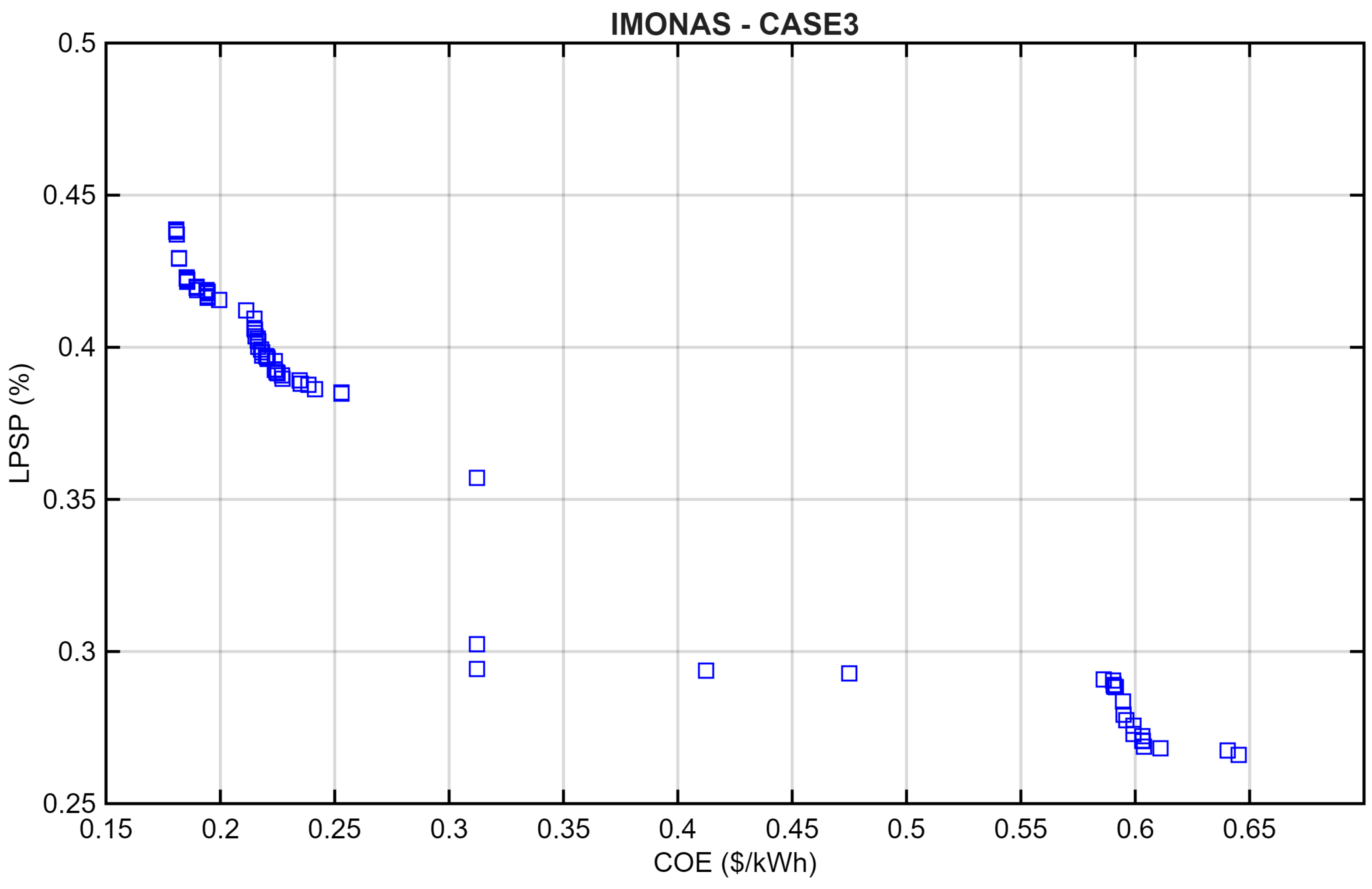
Random coefficient 1First random vector in velocity updateRandom in [ 0 , 1 ]
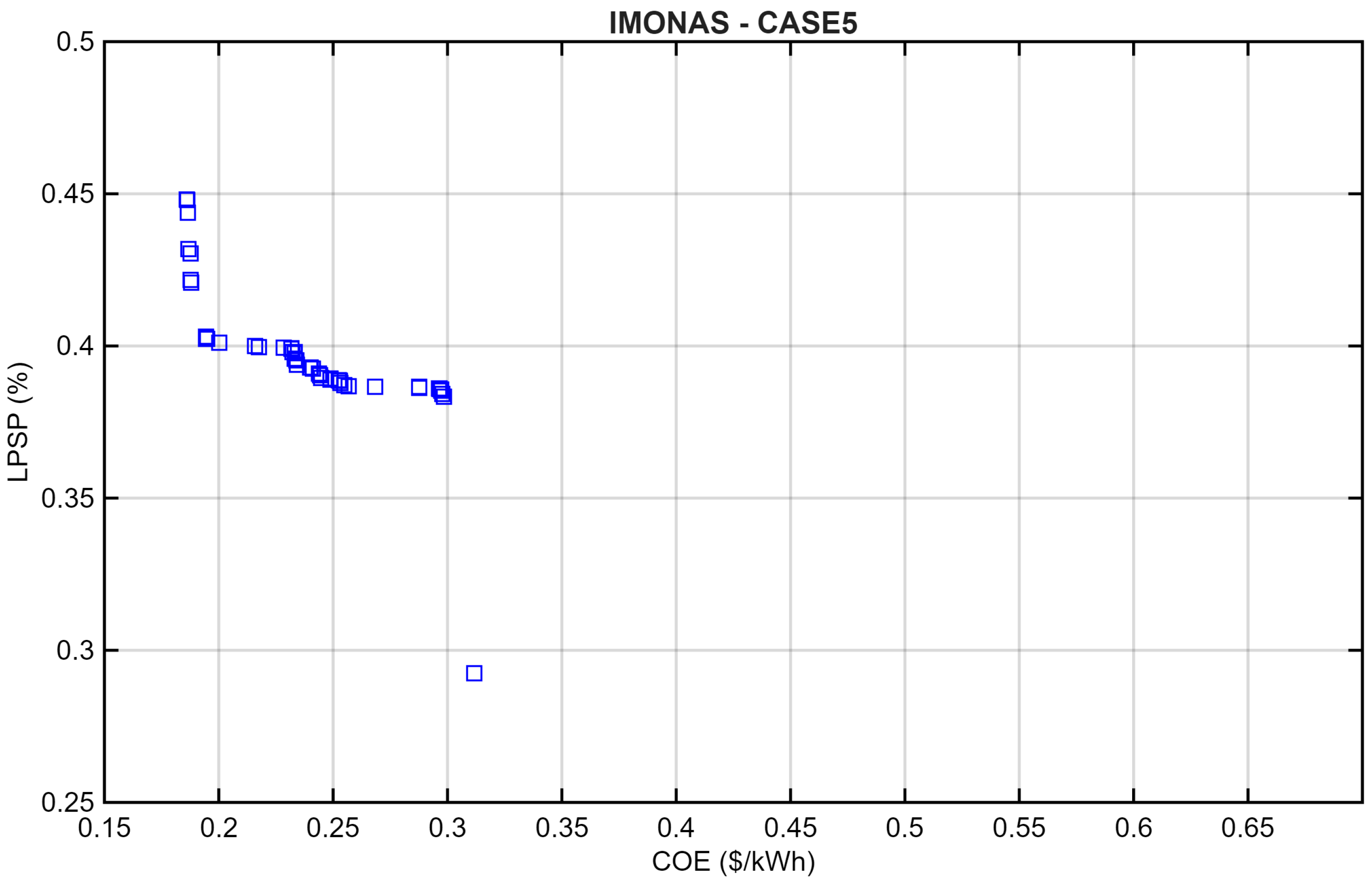
Random coefficient 2Second random vector in velocity updateRandom in [ 0 , 1 ]
Acceleration coefficient 1Cognitive learning coefficientRandom in [ 1.5 , 2.5 ]
Acceleration coefficient 2Social learning coefficientRandom in [ 1.5 , 2.5 ]
Constriction parameterConstriction-related parameter max ( 4 , C 1 + C 2 )
Velocity limitMaximum absolute velocity ( UB LB ) / 2
Mutation indexPolynomial mutation distribution index5
Mutation probability 1Probability of activating mutation for a particle0.15
Mutation probability 2Probability of mutating each variable 1 / D
Velocity damping factorFactor applied after boundary violation0.001
NMPSOInertia weightParticle inertia weightRandom in [ 0.1 , 0.5 ]
Random coefficient 1First random vector in velocity updateRandom in [ 0 , 1 ]
Random coefficient 2Second random vector in velocity updateRandom in [ 0 , 1 ]
Random coefficient 3Third random vector in velocity updateRandom in [ 0 , 1 ]
Acceleration coefficient 1Cognitive learning coefficientRandom in [ 1.5 , 2.5 ]
Acceleration coefficient 2Social learning coefficientRandom in [ 1.5 , 2.5 ]
Acceleration coefficient 3Additional guiding coefficientRandom in [ 1.5 , 2.5 ]
Personal bestBest position found by each particleDominance-based update
Archive sizeMaximum number of stored non-dominated solutionsN
GA crossover probabilityCrossover probability in GAhalf1
GA crossover indexSBX distribution index in GAhalf10
GA mutation factorMutation probability factor in GAhalf1
GA mutation indexPolynomial mutation distribution index in GAhalf10
Elite guide rangeArchive fraction used to guide particles N / 10
Archive recombination rangeArchive fraction used in GAhalf N / 2
MPSODNeighborhood sizeNumber of neighboring subproblems N / 10
Tournament sizeNumber of candidates in tournament selection2
Neighborhood selection probabilityProbability of selecting pbest from neighbors0.9
Global selection probabilityProbability of selecting pbest from whole population0.1
PSO coefficient 1Cognitive acceleration coefficient2
PSO coefficient 2Social acceleration coefficient2
DE crossover rateDifferential evolution crossover rate0.5
DE scaling factorDifferential evolution scaling factor0.5
Mutation factorMutation probability factor1
Mutation indexPolynomial mutation distribution index20
PSO application probabilityProbability of applying PSO update to a variable0.5
Random coefficient 1First random vector in PSO updateRandom in [ 0 , 1 ]
Random coefficient 2Second random vector in PSO updateRandom in [ 0 , 1 ]
Initial population sizeNumber of random solutions before classification 2 N
MOEA/DNeighborhood sizeNumber of neighboring subproblems N / 10
Number of parentsNumber of parents used in variation2
Crossover probabilityProbability of applying SBX crossover1
Crossover indexSBX distribution index20
Mutation factorMutation probability factor1
Mutation indexPolynomial mutation distribution index20
PBI penalty parameterPenalty coefficient in PBI aggregation5
RVEAPenalty exponentControls the rate of change in the APD penalty2
Adaptation frequencyFrequency of reference vector adaptation0.1
Crossover probabilityProbability of applying SBX crossover1
Crossover indexSBX distribution index20
Mutation factorMutation probability factor1
Mutation indexPolynomial mutation distribution index20
Table 5. Selected solutions from the PF for Case 1 using the proposed IMONAS approach.
SolutionNPVNDGAD (Days)PV ModelBattery ModelInverter ModelCOE (USD/kWh)LPSP (%)
11611.02611630.18190.4299
21611.02511630.18190.4290
31611.02511630.18190.4283
41811.00011630.18950.4198
51911.00011630.19430.4168
61911.00411630.19450.4158
71911.02311620.19610.4157
81711.37011630.20530.4104
92211.31311830.21640.4019
102311.31511830.21830.3974
112311.29511830.21910.3971
122411.26911820.22310.3937
132511.31411830.22370.3919
142511.30511830.22390.3915
152911.31511820.23840.3874
163211.31411820.24990.3843
174611.00011830.29980.3835
184711.01411830.30200.3826
194811.00911830.30570.3798
204911.04511820.30740.3783
Table 6. Selected solutions from the PF for Case 2 using the proposed IMONAS approach.
SolutionNPVNDGADPV ModelBattery ModelInverter ModelCOE (USD/kWh)LPSP (%)
11611.02511630.18190.4292
21611.02411630.18190.4291
31711.02011630.18540.4220
41711.01811620.18610.4216
51811.00011630.18950.4200
61911.00011630.19430.4165
71911.00011630.19430.4163
81911.00711630.19460.4163
91911.01111630.19480.4162
102111.30611830.21520.4053
112111.30611830.21530.4052
122111.30511830.21530.4046
132211.30711830.21660.4004
142311.31511830.21830.3992
152311.28111830.21990.3961
162411.31611830.22070.3955
172311.26511820.22140.3950
182611.21811830.23040.3892
192911.31911830.24740.3856
20221.00871830.31210.3023
Table 7. Selected solutions from the PF for Case 3 using the proposed IMONAS approach.
SolutionNPVNDGAD (Days)PV ModelBattery ModelInverter ModelCOE (USD/kWh)LPSP (%)
11611.02311630.18190.4291
21711.01311630.18540.4225
31711.02011630.18540.4216
41811.00011630.18950.4200
51911.00111630.19430.4181
61911.38541630.21130.4122
72111.31411830.21490.4093
82111.31111830.21500.4062
92211.30811830.21660.4002
102511.31511830.22370.3954
112511.30511830.22390.3926
122511.31211820.22440.3919
132611.31211830.22690.3908
142611.30111830.22710.3897
152911.28911820.23840.3876
163511.27321810.25290.3848
17221.00011830.31210.3571
18221.00071830.31210.3023
191721.0011330.59920.2729
201821.0001330.60320.2708
Table 8. Selected solutions from the PF for Case 4 using the proposed IMONAS approach.
SolutionNPVNDGADPV ModelBattery ModelInverter ModelCOE (USD/kWh)LPSP (%)
11511.63211630.19960.4322
21511.60611630.19980.4314
31611.63751630.20440.4248
41811.63921630.20460.4220
51811.57711830.21090.4089
61811.57011820.21170.4083
71911.71311830.22020.3999
82311.56011830.22560.3976
92311.57311830.22560.3962
102411.56211830.22940.3959
112511.50611830.23290.3943
122511.51411830.23290.3942
132511.52211830.23300.3919
142511.56411830.23350.3919
152511.56811820.23430.3895
162711.57311830.24260.3874
171821.0122330.59680.2909
181921.0091330.61440.2764
192521.0141310.63520.2744
202721.0131310.64280.2728
Table 9. Selected solutions from the PF for Case 5 using the proposed IMONAS approach.
SolutionNPVNDGADPV ModelBattery ModelInverter ModelCOE (USD/kWh)LPSP (%)
11811.02441630.18780.4218
21811.02241630.18780.4209
32011.00551630.20020.4010
42211.08391640.21580.4000
52311.648101820.22830.3995
62211.56481830.23220.3981
72711.53391830.23310.3980
82711.55191830.23310.3976
92811.555101830.23400.3953
103011.54791830.24390.3909
113011.56991830.24420.3905
123211.566101830.24880.3893
133211.572101830.24890.3889
143311.540101830.25240.3887
153411.553101830.25690.3867
162711.62981830.26830.3867
172511.6121120.28760.3866
182711.5781120.29620.3861
192711.6301120.29770.3843
202711.6501120.29840.3833
Table 10. Selected solutions from the PF for Case 6 using the proposed IMONAS approach.
SolutionNPVNDGADPV ModelBattery ModelInverter ModelCOE (USD/kWh)LPSP (%)
11611.02611630.18260.4242
21711.02611630.18530.4143
31711.02611630.18530.4141
41811.01411630.18890.4042
51811.01411630.18890.4038
61811.01411630.18890.4037
71811.01411630.18890.4031
81811.01311630.18890.4030
91811.00611630.18890.4016
101911.00011630.19470.3957
111911.00011630.19470.3948
121911.00411630.19470.3941
132511.56251830.23530.3928
142811.53841830.24120.3915
152811.54041830.24120.3910
162811.55141830.24140.3900
172911.54041830.24520.3894
182911.54041830.24520.3886
192811.63741830.25240.3885
202711.6311110.30120.3840
Table 11. Mean pairwise C-metric values over 25 independent runs and corresponding Wilcoxon signed-rank p-values for IMONAS versus the competing algorithms.
CaseAlgorithm 1Algorithm 2Mean C ( A 1 , A 2 ) Mean C ( A 2 , A 1 ) p-Value
Case 1IMONASMONAS0.63310.1437 6.02 × 10 4
Case 1IMONASSMPSO0.61550.1427 3.62 × 10 5
Case 1IMONASNMPSO0.39730.0838 2.31 × 10 3
Case 1IMONASMPSOD0.45570.2267 9.42 × 10 3
Case 1IMONASMOEAD0.81970.0321 1.17 × 10 5
Case 1IMONASRVEA0.97760.0018 1.83 × 10 6
Case 2IMONASMONAS0.62350.1675 1.08 × 10 3
Case 2IMONASSMPSO0.61870.1810 1.08 × 10 3
Case 2IMONASNMPSO0.56360.0674 1.18 × 10 4
Case 2IMONASMPSOD0.46890.2956 8.27 × 10 2
Case 2IMONASMOEAD0.86560.0298 8.74 × 10 6
Case 2IMONASRVEA0.99000.0000 8.94 × 10 7
Case 3IMONASMONAS0.63130.1659 2.16 × 10 4
Case 3IMONASSMPSO0.63910.1213 2.86 × 10 5
Case 3IMONASNMPSO0.51830.0273 6.12 × 10 5
Case 3IMONASMPSOD0.47890.2152 4.22 × 10 2
Case 3IMONASMOEAD0.86290.0076 7.99 × 10 6
Case 3IMONASRVEA0.96060.0133 3.04 × 10 6
Case 4IMONASMONAS0.57230.2937 3.70 × 10 2
Case 4IMONASSMPSO0.67510.0960 1.74 × 10 4
Case 4IMONASNMPSO0.71670.0402 4.31 × 10 5
Case 4IMONASMPSOD0.46280.2163 1.19 × 10 2
Case 4IMONASMOEAD0.79080.0000 1.16 × 10 5
Case 4IMONASRVEA0.97220.0120 2.44 × 10 6
Case 5IMONASMONAS0.77600.1259 1.56 × 10 4
Case 5IMONASSMPSO0.77110.0608 1.38 × 10 5
Case 5IMONASNMPSO0.68390.0450 6.84 × 10 5
Case 5IMONASMPSOD0.58150.0391 1.56 × 10 5
Case 5IMONASMOEAD0.85350.0024 9.38 × 10 6
Case 5IMONASRVEA0.98830.0000 1.31 × 10 6
Case 6IMONASMONAS0.69170.2269 4.92 × 10 3
Case 6IMONASSMPSO0.65460.1235 4.93 × 10 4
Case 6IMONASNMPSO0.78460.0761 4.19 × 10 5
Case 6IMONASMPSOD0.47220.2039 8.75 × 10 2
Case 6IMONASMOEAD0.80310.0057 1.20 × 10 5
Case 6IMONASRVEA0.95720.0087 1.83 × 10 6
Table 12. Case-wise aggregated C-scores of the competing algorithms based on the mean pairwise C-metric values over 25 independent runs.
CaseIMONASMONASSMPSONMPSOMPSODMOEADRVEA
Case 13.26831.06520.67630.86282.7125−4.3895−4.1956
Case 23.38901.30170.78830.10753.0447−4.6649−3.9664
Case 33.54051.56360.7692−0.04402.9127−4.7263−4.0157
Case 43.53172.76220.1210−0.63952.7991−4.3918−4.1828
Case 54.38122.02000.2367−0.14712.2955−4.7295−4.0569
Case 63.71872.09531.0955−0.87892.7379−4.4495−4.3191
Table 13. Final overall ranking of the compared algorithms based on NetCScore, GD, IGD, HV, and spacing over 25 independent runs.
AlgorithmNetCScoreAvgRank _CscoreAvgRank_GDAvgRank_IGDAvgRank_HVAvgRank_SpacingFinalAvgRank
IMONAS3.63821.60671.73332.61332.22672.50002.1360
MPSOD2.75042.42672.52671.41331.36674.04002.3547
MONAS1.80133.05333.08673.69333.10003.51333.2893
SMPSO0.61453.84004.00672.96673.68002.02673.3040
NMPSO−0.12324.12003.68675.46004.71335.71334.7387
RVEA−4.12276.39336.18005.32676.00675.08675.7987
MOEAD−4.55866.56006.78006.52676.90675.12006.3787
Disclaimer/Publisher’s Note: The statements, opinions and data contained in all publications are solely those of the individual author(s) and contributor(s) and not of MDPI and/or the editor(s). MDPI and/or the editor(s) disclaim responsibility for any injury to people or property resulting from any ideas, methods, instructions or products referred to in the content.