Review

Is Mass Timber Positioned to Lead Future Sustainable Construction? A Review of Economic, Cost, and Market Dimensions

1
Department of Sustainable Biomaterials, Brooks Forest Products Center, Virginia Polytechnic Institute and State University, Blacksburg, VA 24061, USA
2
Department of Forestry, Faculty of Agriculture and Animal Science, University of Muhammadiyah Malang, Malang 65152, Indonesia
3
Virginia Cooperative Extension, Blacksburg, VA 24061, USA
*
Author to whom correspondence should be addressed.
Sustainability 2026, 18(12), 6291; https://doi.org/10.3390/su18126291 (registering DOI)
Submission received: 24 April 2026 / Revised: 24 May 2026 / Accepted: 4 June 2026 / Published: 18 June 2026

Abstract

The construction sector contributes substantially to global greenhouse gas emissions, making material substitutions a key strategy for advancing sustainability transitions. Mass timber has emerged as a low-carbon alternative to mineral-based construction materials, offering biogenic carbon storage and compatibility with prefabricated and industrialized building systems. This study aims to systematically synthesize the economic, cost, and market evidence on mass timber construction by reviewing 143 peer-reviewed publications, with the objective of clarifying what is empirically known and where uncertainties remain. The reviewed literature reveals three core findings. First, economic outcomes are mixed: while several studies report regional value creation, supply-chain upgrading, and alignment with circular-economy principles, others highlight persistent constraints such as limited manufacturing capacity and uneven policy support. Second, construction cost findings vary substantially, ranging from cost parity or modest savings relative to conventional systems to premiums of approximately 10–15%, shaped by regional pricing, labor availability, transportation distance, regulatory conditions, and supply-chain maturity. Third, market-oriented studies consistently identify slow diffusion, limited practitioner experience, and risk-averse investment environments as key barriers to adoption. Overall, the review shows that economic performance is not yet consistently established and underscores the need for more standardized, context-sensitive, and methodologically consistent evaluation frameworks to support informed decision-making and the sustainable scaling of mass timber construction.

1. Introduction

The global construction sector is undergoing a profound shift as policy-makers, industries, and researchers seek alternatives to carbon intensive materials such as concrete and steel. Mass timber, a group of engineered wood products used for structural application, has emerged as one of the most promising pathways toward low-carbon, resource-efficient construction [1,2]. Examples of this category are Cross-Laminated Timber (CLT), a multilayer panel composed of orthogonally oriented lumber commonly used for floors, walls, and roof diaphragms; Glue-Laminated Timber (GLT or glulam), which consists of parallel laminated boards bonded with structural adhesives and is typically used for beams and columns in long-term applications; and Laminated Veneer Lumber (LVL), an engineered product made from thin wood veneers layered to form high-strength members often used for headers, rim boards, and structural framing components [3]. Together with Nail-Laminated Timber (NLT) and Dowel-Laminated Timber (DLT), as well as hybrid timber–concrete or timber–steel construction systems, these products form a rapidly expanding family of structural materials designed to enhance strength, stability, and prefabrication efficiency of construction [4,5].
In recent years, mass timber has gained global attention not only for its structural performance but also for its potential to support climate mitigation and circular-economy transitions [6]. Mass timber offers a substantially lower carbon footprint than conventional construction materials because wood stores biogenic carbon and requires less energy to process [7]. At the same time, mass timber aligns with circular-economy principles through design for disassembly, reuse, modularity, and material recovery, features that position it as a strategic solution for reducing construction waste and extending material lifecycles [8]. The recent literature demonstrates that salvaged lumber from deconstructed buildings can also be incorporated into new mass timber panels [9,10]. However, transportation distance and logistics remain critical determinants of both carbon performance and cost competitiveness, as long-haul movement of lumber or prefabricated panels can offset environmental benefits and increase project expenses, particularly in regions with limited local manufacturing capacity [11,12].
Despite these advantages, the field remains characterized by competing hypotheses and unresolved debates. Some scholars argue that mass timber can deliver cost-competitive [13], scalable, and carbon-negative construction solutions [14], while others caution that supply-chain volatility, high upfront material costs, and limited market maturity may constrain widespread adoption [2,15,16]. The use of fast-growing or low-grade wood species is celebrated by some as a pathway to affordability and regional economic revitalization, yet others question whether variability in material quality may introduce new risks [10,17]. For example, although salvaged wood is increasingly recognized as a high value circular resource, its integration into mainstream production remains limited due to the absence of standardized grading systems and the lack of a formal secondary materials market [18,19].
As mass timber transitions from a niche innovation to a mainstream construction material, questions surrounding investment viability, price dynamics, supply-chain integration, and industry readiness have become increasingly urgent [20,21]. The rapid expansion of mass timber research after 2020, driven by advances in prefabrication, modular construction, hardwood CLT development, and urban decarbonization policies, has produced a fragmented knowledge landscape in which economic, market, and cost considerations are dispersed across disciplines and geographic regions [22,23,24]. At the same time, many of these practical and market-oriented challenges are being addressed outside the traditional scholarly domain, through industry-led experimentation, pilot projects, and practitioner knowledge exchange. Forums such as the International Mass Timber Conference, for example, demonstrate how issues related to procurement risk, pricing volatility, insurance, logistics, and workforce capacity are actively discussed and resolved in practice. However, because these topics often fall outside conventional research frameworks or established scholastic funding mechanisms, the resulting insights remain weakly captured in the academic literature, contributing to a persistent disconnect between rapidly evolving industry practice and the formal evidence base.
This study addresses these gaps by conducting a review of peer-reviewed publications to synthesize existing knowledge on the economic forces influencing mass timber’s development. The review brings together insights on market structures, cost behavior, and competitiveness relative to conventional materials to clarify how these factors shape adoption dynamics. By integrating findings across economics, costs, and market development, this review helps situate current evidence, highlights areas of convergence and uncertainty, and points to where further empirical work and policy discussion may be most productively directed.

2. Materials and Method

This study employed a rapid-review methodology to synthesize peer-reviewed evidence on the economic, cost, and market dimensions of mass timber. Rapid reviews streamline certain steps of full systematic reviews while maintaining transparency and reproducibility [25]. The review followed the PRISMA 2020 guidelines for reporting evidence syntheses, including a structured search strategy, predefined eligibility criteria, and a documented screening workflow [26].
A targeted search was conducted in the Web of Science Core Collection, covering all records available up to January 2026. The Boolean query TS = (“mass timber” OR “laminated timber”) AND TS = (“economy” OR “market” OR “cost”) was applied with an English-language filter. In Web of Science, the TS field tag retrieves publications whose titles, abstracts, or keywords explicitly reference the searched concepts.
As this study was conducted as a rapid review, the search strategy was intentionally streamlined to balance methodological rigor with timely synthesis. Rapid reviews commonly limit the number of databases and narrow search terms to accelerate evidence identification while maintaining transparency. The selected keywords were adapted from the previous literature who used similar terminology to capture economic and market related analyses of mass timber [27]. Although this approach may not retrieve all studies related to lifecycle cost, techno-economic analysis, supply chains, procurement, insurance, or willingness to pay, the chosen terms reflect the dominant vocabulary used in peer-reviewed publications addressing economic, cost, and market dimensions. This targeted strategy aligns with rapid-review standards and ensures that the included evidence remains focused and relevant to the review’s objectives.
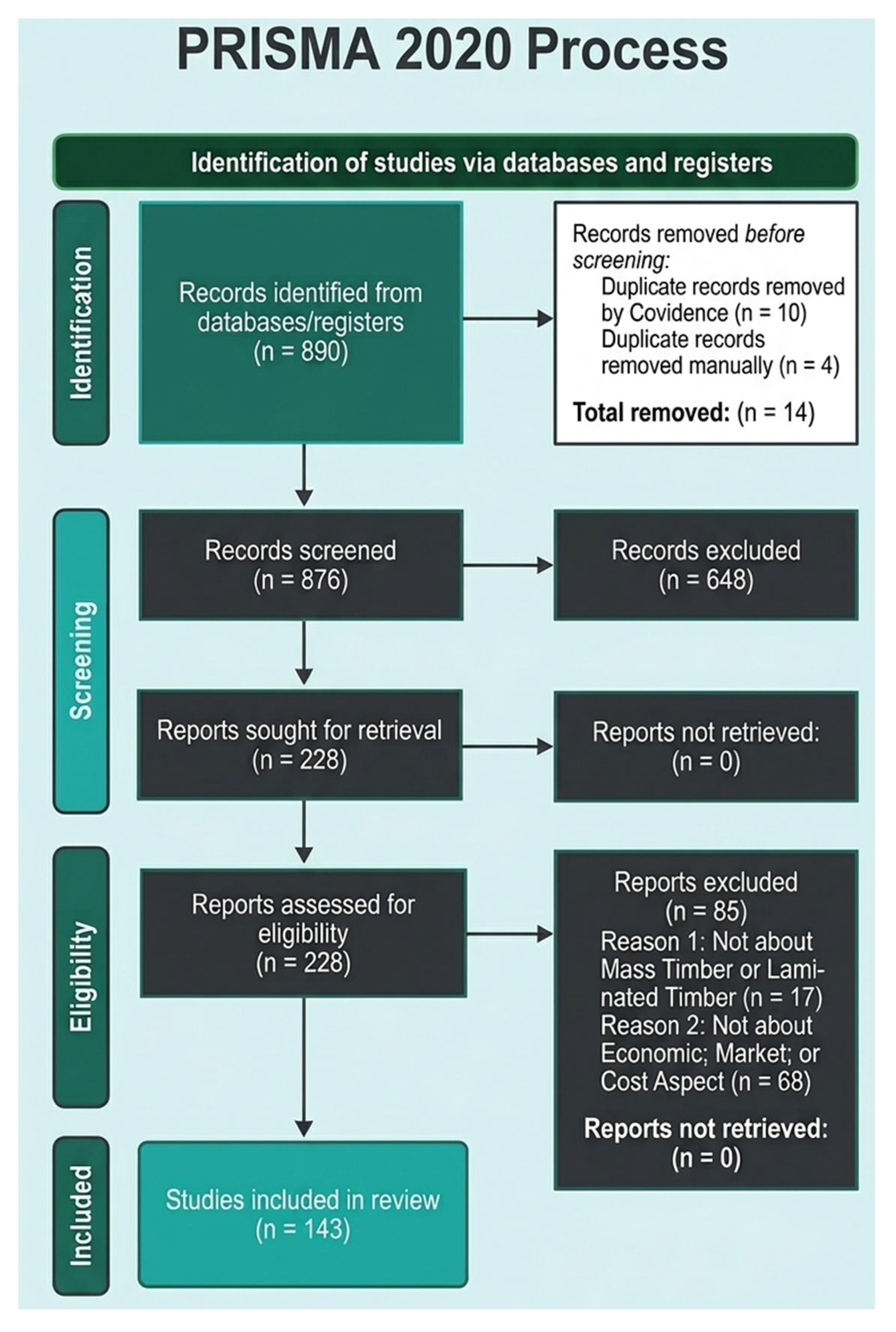
All retrieved records were imported into Covidence for automated deduplication and structured screening. Title and abstract screening and full-text assessment were conducted by two reviewers using predefined criteria aligned with the rapid-review scope. Conflicts were resolved through Covidence’s consensus tool. Covidence systematic review software (https://app.covidence.org; Veritas Health Innovation, Melbourne, Australia) does not provide a public version number. The PRISMA 2020 flow diagram summarizing identification, screening, eligibility, and inclusion is provided in Figure 1.
Studies were eligible if they examined mass timber products and explicitly addressed at least one economic, cost, or market dimension. Eligible designs included empirical analyses, techno-economic assessments, modeling studies, conceptual papers, and review articles. Studies focused solely on structural engineering, material science, or non-timber construction materials were excluded. Only English language publications were included.
The breadth of eligible study designs reflects the rapid-review approach, which prioritizes timely synthesis of heterogeneous evidence rather than exhaustive methodological filtering [28]. Including empirical studies, modeling work, techno-economic analyses, conceptual contributions, and review articles is appropriate for a rapid review because economic, cost, and market analyses of mass timber are distributed across diverse methodological traditions. To avoid duplication of evidence when review articles were included alongside primary studies, the data extraction focused on the unique analytical contributions of each source rather than counting findings multiple times. This approach maintains coherence in the synthesis while ensuring that the review captures the full range of economic and market perspectives relevant to mass timber.
Data extraction followed a structured and iterative process to ensure consistency and traceability. Extracted variables included authorship, publication year, study objectives, geographic scope, methodological approach, and economic, cost, or market findings. Given the heterogeneity of study designs, a narrative synthesis approach was used to integrate evidence across themes, consistent with rapid-review standards.
The thematic synthesis did not employ formal qualitative coding procedures such as double coding, line-by-line coding, or a full extraction matrix. Instead, consistent with rapid-review standards, the first author conducted an interpretive grouping of recurring economic, cost, and market concepts across the included studies, with the second author providing supervisory oversight to ensure consistency and conceptual clarity. Themes and subthemes were developed iteratively by reviewing extracted information and identifying patterns that appeared across multiple studies. Each study was assigned to themes based on its primary analytical focus, and care was taken to avoid duplication by ensuring that review articles were not counted as independent evidence when their underlying primary studies were already included. This streamlined approach aligns with the rapid-review methodology, which emphasizes timely synthesis over exhaustive qualitative coding.
During the iterative thematic synthesis, an additional theme “Building Typology” emerged as a distinct analytical category. Although the review did not employ formal qualitative coding procedures, recurring patterns across the 143 studies showed that discussions of Mid-Rise Applications, High-Rise Feasibility, Hybrid Systems, and Structural Optimization formed a coherent conceptual cluster that was not fully captured by the four original themes. Following the interpretive grouping conducted by the first author and supervised by the second author, this cluster was elevated into a standalone theme to complement the existing categories of Products, Economic Dimensions, Market Dimensions, and Cost Dimensions. The addition of Building Typology reflects the inductive nature of the rapid-review process, in which themes are refined as patterns become clearer, and ensures that the thematic structure accurately represents the breadth of evidence in the literature. A summary of these thematic distributions is presented in Table 1.
Although rapid reviews streamline certain steps, such as limiting databases or simplifying appraisal, the use of PRISMA 2020 ensures transparency in reporting and sup-ports replicability of the review process.

3. Results

The mapping of the selected studies revealed a research landscape shaped by several consolidated thematic directions. A total of 143 studies met the eligibility criteria, forming a comprehensive dataset that captures the evolution of mass timber product research across economic, market, and cost dimensions over the past three decades. The complete list of all included studies is provided in the Supplementary Material (Mass Timber Research Population).
Geographically, the literature reflects distinct regional priorities. Studies in the United States frequently examine market awareness, feasibility assessments, and economic decision-making related to the adoption, reflecting an early-stage market characterized by uncertainty and project-level evaluation [29,30]. In contrast, European research places stronger emphasis on production capacity [31], resource utilization [32], and Structural Optimization as drivers of economic performance [33]. Research from Asia and Oceania often focuses on supply-chain development and the economic potential of emerging hardwood-based products [34,35]. Studies from South America highlight industrial competitiveness and resource availability suggesting that economic viability is closely tied to regional forestry assets and export potential [31]. Taken together, these regional differences help explain why cost and economic findings vary throughout the literature: economic performance is not assessed under comparable conditions, but instead reflects differing stages of market maturity, supply-chain development, and resource availability.
Parallel streams of scholarship advance Lifecycle Assessment (LCA) and Lifecycle Costing (LCC) within circular-economy frameworks, including comparative evaluations of mass timber products and conventional construction materials [29]. In Europe, research places strong emphasis on the structural performance, material behavior, and design optimization of Cross-Laminated Timber (CLT), reflecting long standing engineering traditions in Austria, Germany, and the Nordic region [36,37].
Additional studies explore the socio-economic and policy dimensions of hardwood-based mass timber products, including their market viability, regulatory implications, and contributions to sustainable construction [27,38,39]. The recurrence of these thematic clusters indicates a stabilizing and maturing field, where research trajectories, ranging from structural integrity to market dynamics, are becoming increasingly distinct and specialized.
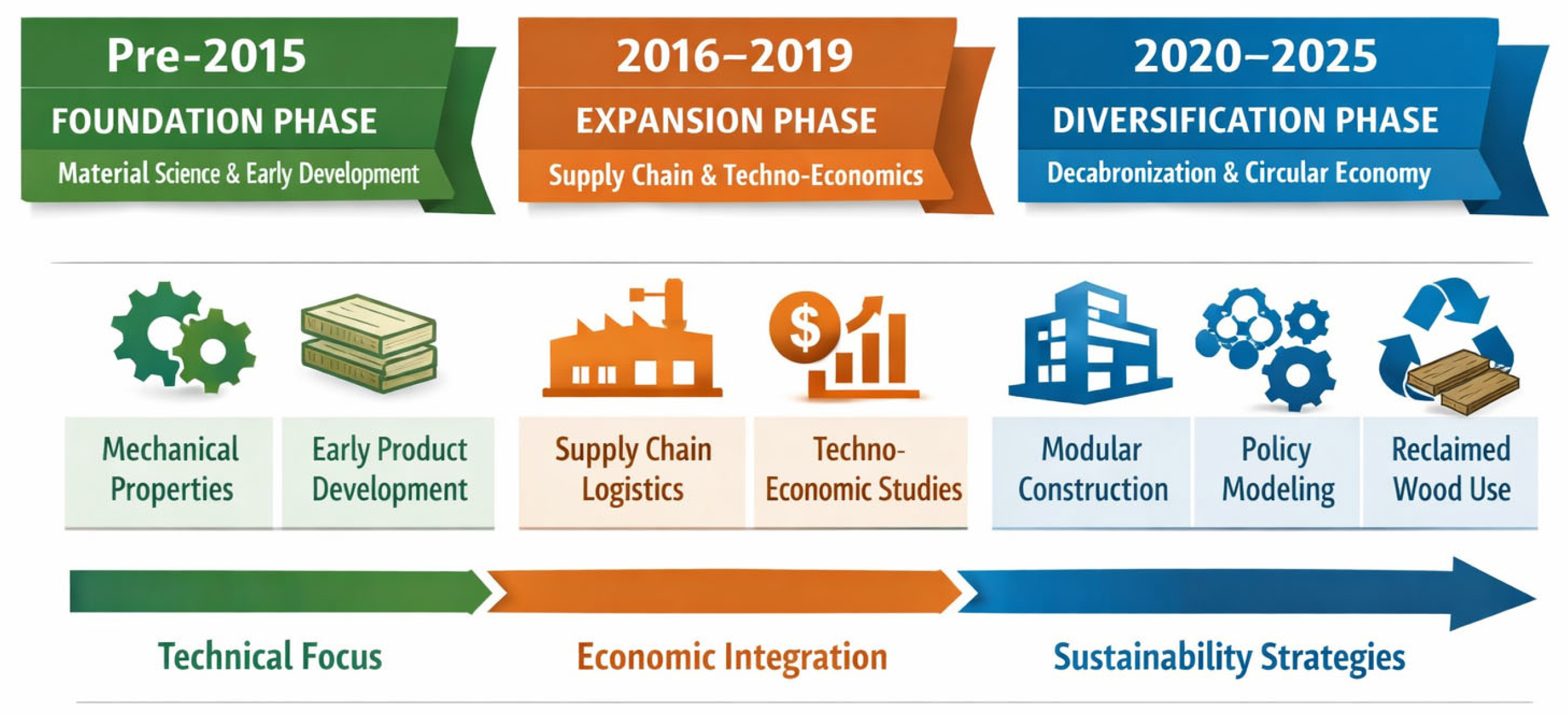
The temporal distribution of publications shows a marked acceleration after 2020. Earlier studies (pre-2015) focused primarily on mechanical properties and early product development. Between 2016 and 2019, research expanded into supply-chain logistics and techno-economic frameworks [21]. The period from 2020 to 2025 represents the most prolific phase, characterized by diversification into modular construction [40,41], agent-based modeling for policy analysis [42], and the use of salvaged or reclaimed wood [43,44]. This shift reflects a broader transformation in which mass timber is increasingly framed not only as a technical innovation but also as a strategic pathway for construction decarbonization and circular-economy transitions [4,45].
Figure 2 below visualizes this progression, illustrating how the thematic focus of mass timber research has evolved from technical foundations toward economic integration and sustainability strategies. The timeline highlights the transition from early material studies to system level analyses that position mass timber as a cornerstone of low-carbon construction.
Across the dataset, the research objectives converge into three dominant pillars. The first centers on structural and material performance [17,46], including bending and shear testing [47], durability assessments [1,36], and manufacturing innovations such as the use of fast-growing or low-quality timber [17,48]. The second pillar integrates sustainability and economics, with studies combining LCA–LCC methodologies and carbon footprint analysis to evaluate the environmental and financial implications of mass timber [49,50]. The third pillar present findings on market adoption, policy, and perception, encompassing analyses of adoption barriers, optimal facility siting, and the influence of national building codes on market readiness [2,51,52]. Together, these pillars illustrate the increasingly multidisciplinary nature of mass timber scholarship and the broadening scope of inquiry beyond purely technical considerations.
The interdisciplinary nature of the field is further reflected in the diversity of publication outlets. Engineering-focused journals remain central for structural research [13,40,48,53], forestry journals dominate material science and manufacturing discussions [9,39,54,55], and environmental journals increasingly host sustainability and circular-economy analyses [4,49,52,56]. This disciplinary breadth enriches the field but also contributes to methodological variation, which complicates direct comparison of economic outcomes across studies.
Geographically, the research exhibits a global footprint with concentrated activity in regions with strong forestry sectors and decarbonization agendas. The United States, particularly the Pacific Northwest, Appalachia, and the Southeast, serves as a major hub for feasibility and market-readiness studies [21,29,57,58]. Europe, especially Austria, Sweden, Germany, and Finland, continues to lead in structural innovation and circular-economy models [32,36,37,59]. Emerging contributions from Malaysia, South Korea, South Africa, Uruguay, and Turkey broaden the narrative by examining hybrid products, hardwood utilization, and regional timber quality [17,20,34,60]. However, representation from Sub-Saharan Africa and parts of South Asia remains limited, constraining global comparability of economic findings.
Taken together, these patterns reveal a research domain that is increasingly multidimensional, integrating structural, environmental, economic, and market perspectives. The variability in reported economic outcomes across regions and typologies reflects differing stages of market maturity, supply-chain development, policy environments, and resource availability [22,29,61,62,63].

3.1. Mass Timber Products

The Mass Timber Products theme was intentionally condensed in the revised manuscript to provide essential context without overshadowing the economic, cost, and market synthesis. Rather than offering detailed technical descriptions of CLT, GLT, LVL, NLT, and DLT, the revised section focuses on how differences among these products influence cost structures, supply-chain requirements, market readiness, and project feasibility. For example, CLT’s high prefabrication level affects installation speed and labor costs; GLT’s structural efficiency influences material volumes and price competitiveness; LVL’s mechanical performance affects design optimization and cost trade-offs; and NLT and DLT, which rely on simpler manufacturing processes, have implications for localized production and supply-chain integration. To support this streamlined approach, Table 2 summarizes the key product-specific characteristics that directly shape economic, cost, and market outcomes, ensuring that the discussion remains aligned with the economic orientation of the review and directly addresses reviewer feedback.

3.2. Economic Dimensions

The Economic Dimensions theme captures how the literature conceptualizes and evaluates the financial performance of mass timber across different contexts. Five subthemes emerged from the synthesis: Expense Framework, Price Dynamics, Investment Feasibility, Economic Competitiveness, and Financial Modeling. These subthemes reflect how studies assess cost structures, market behavior, and economic viability at both the project and system levels. Table 3 summarizes the key findings associated with each subtheme, demonstrating the analytical basis for the economic synthesis presented in this review.

3.3. Market Dimensions

The Market Dimensions theme captures how the literature evaluates the conditions that enable or constrain mass timber adoption across different regions and building sectors. Five subthemes emerged from the synthesis: Market Growth, Market Barriers, Market Drivers, Industry Adoption, and Supply-Chain Integration. These subthemes reflect how studies assess demand formation, practitioner readiness, regulatory environments, and the structural factors that shape market expansion. Table 4 summarizes the key findings associated with each subtheme, demonstrating how market-related dynamics influence the economic and adoption outcomes reported across the reviewed studies.

3.4. Cost Dimensions

The Cost Dimensions theme captures how the literature evaluates the financial implications of mass timber across different stages of the building lifecycle. Four subthemes emerged from the synthesis: Production Cost, Installation Cost, Lifecycle Cost, and Comparative Cost Analysis. These subthemes reflect how studies assess cost drivers, construction efficiencies, long-term economic performance, and the relative cost position of mass timber compared with conventional materials. Table 5 summarizes the key findings associated with each subtheme, demonstrating how cost-related evidence informs broader assessments of economic feasibility and market competitiveness.
Comparative cost evidence across the reviewed studies shows that mass timber’s financial performance varies substantially by region, typology, and analytical assumptions. A tall mass timber project examined in the United States demonstrated that actual construction costs were approximately 6% lower than budgeted, with the authors noting that reduced construction time contributed significantly to overall savings [113]. A related comparison between a mass timber and reinforced-concrete buildings found that the mass timber alternative was 6.42% more expensive per square foot, although it experienced fewer and less costly change orders, improving cost predictability [72].
Lifecycle-based assessments also reveal mixed outcomes. A high-rise mass timber building in the Pacific Northwest was found to be 4–6% more expensive than its reinforced-concrete counterpart, but the study emphasized that shorter construction duration and reduced foundation requirements improved long-term cost performance [114]. A complementary LCA/LCC comparison similarly reported that mass timber’s higher upfront material costs can be partially offset by operational energy savings over the building’s service life [14].
Other comparative analyses show higher premiums in early-stage or high-rise applications. A multicriteria decision analysis of 5- and 12-story prototypes in the Pacific Northwest reported that mass timber superstructure costs were 21–27% higher than steel alternatives due to market immaturity and material price volatility [29]. In Australia, mass timber buildings were estimated to carry a 4–6% premium relative to reinforced concrete [70], while a recent comparison in Türkiye found that mass timber construction costs were five to six times higher than reinforced concrete due to local pricing structures and limited supply-chain capacity [111].
At the same time, several studies highlight conditions under which mass timber approaches cost parity. An evaluation of mass timber beam–column gravity systems found that total project costs can be competitive when schedule savings and reduced foundation loads are incorporated into the analysis [76]. Collectively, these findings indicate that cost outcomes depend heavily on regional supply-chain maturity, Building Typology, comparator material, and whether analyses incorporate lifecycle or operational benefits.
To provide transparency for the cost ranges reported in the abstract, Table 6 compiles comparative cost studies that evaluate mass timber against reinforced concrete, steel, or budgeted project estimates. The table reports the region, Building Typology, comparator material, cost outcome (parity, modest savings, or premium), and key analytical assumptions. Together with the narrative synthesis, this comparative evidence clarifies the empirical basis for the reported cost ranges and the conditions under which mass timber achieves or departs from cost competitiveness.

3.5. Building Typology

The Building Typology theme captures how mass timber’s economic and technical performance varies across different building forms and structural configurations. Four subthemes emerged from the synthesis: Mid-Rise Applications, High-Rise Feasibility, Hybrid Timber–Concrete Systems, and Structural Optimization. These subthemes reflect how typology influences cost competitiveness, installation efficiency, regulatory constraints, and material performance. Table 7 summarizes the key findings associated with each subtheme, demonstrating how the building form shapes the economic and market outcomes reported across the reviewed studies.

4. Discussion

Evaluating whether mass timber is positioned to lead sustainable construction requires situating its performance within the broader economic, institutional, and market systems that govern its adoption. Across the reviewed literature, mass timber is no longer understood as a purely technical innovation; its competitiveness emerges from coordinated supply chains, stable policy environments, and institutional readiness [23,129,130]. Although mass timber consistently delivers sustainability benefits, such as embodied-carbon reduction, biogenic storage, circular-economy potential, and regional economic development, these advantages do not automatically translate into market leadership [131,132]. Economic outcomes remain highly context-dependent, shaped by manufacturing scale, labor conditions, supply-chain maturity, and regulatory stability. This makes clear that cost-competitiveness is not an inherent material property but an emergent outcome of the surrounding ecosystem [39,46,133,134].
A recurring tension in the literature concerns the gap between higher upfront costs and longer-term lifecycle benefits [2,66,135]. Limited manufacturing capacity, fragmented supply chains, and volatile lumber markets often elevate initial material costs, particularly in regions where production networks are still developing [15,136]. Yet these premiums are frequently offset by lifecycle advantages such as reduced embodied energy, shorter construction timelines, lower on-site waste, and end-of-life recovery opportunities [43,137]. Divergent cost findings across studies largely reflect differences in temporal framing: mass timber appears costly when evaluated as a capital expenditure but becomes more favorable when assessed through lifecycle-based sustainability frameworks [16,135,138]. This reinforces the need for investment decisions aligned with long-term decarbonization and circular-economy objectives.
A central tension in the literature concerns the gap between higher upfront costs and longer-term lifecycle benefits [2,66,135]. Limited manufacturing capacity, fragmented supply chains, and volatile lumber markets frequently elevate initial material costs, particularly in regions where production networks are still developing [15,136]. Yet these premiums are often offset by lifecycle advantages such as reduced embodied energy, shorter construction timelines, lower on-site waste, and end-of-life recovery opportunities [43,137]. Divergent cost findings across studies largely reflect differences in temporal framing: mass timber appears costly when evaluated as a capital expenditure but becomes more favorable when assessed through lifecycle-based sustainability frameworks [16,135,138]. This distinction underscores the need for investment decisions aligned with long-term decarbonization and circular-economy objectives rather than short-term cost benchmarks.
Material diversification further illustrates how economic and sustainability objectives intersect. Fast-growing species, low-grade lumber, and salvaged wood are increasingly recognized as viable feedstocks that expand resource availability and strengthen supply resilience [139,140,141,142,143]. However, their integration into markets remains uneven. The primary barriers are institutional, such as lack of standardized grading, certification pathways, and functioning secondary-materials markets, rather than technical feasibility [139,144,145,146]. As a result, circular feedstocks remain difficult to specify, price, and procure consistently at scale. This helps explain why studies in mature markets report stronger economic performance, while studies in emerging markets highlight higher costs and uncertainty.
Market adoption is also shaped by social acceptance and perceived risk. While mass timber is widely viewed as environmentally preferable, concerns about fire safety, durability, and long-term performance persist [147,148,149,150]. Evidence shows that positive environmental beliefs often coexist with risk-based skepticism, influencing willingness to adopt. For instance, a study in the U.S. reported that respondents appreciated the renewable and environmental attributes of mass timber construction while simultaneously expressing heightened fire-risk concerns that negatively influenced their overall perceptions of wood structure [151]. These perception dynamics reinforce findings across the literature that communication and education are essential mechanisms for reducing uncertainty and accelerating adoption, particularly among audiences unfamiliar with mass timber or exposed to misconceptions regarding safety and reliability [152]. In parallel, five recurring themes, environmental sustainability, fire safety, human health and well-being, structural durability, and market costs, have been synthesized as the dominant factors shaping public perceptions [51]. Effective communication strategies must therefore integrate sustainability claims with accessible evidence on safety, performance, and cost trajectories to address the mixed enthusiasm–skepticism landscape that currently influences mass timber’s legitimacy.
Synthesizing these findings, market barriers can be more clearly distinguished into demand-side barriers (social acceptance, perceived risk, and client familiarity) [24,119,150], supply-side barriers (manufacturing capacity, supply-chain fragmentation, and timber availability) [153,154,155], regulatory barriers (building codes, permitting, insurance, and certification requirements) [22,119,155], and financial barriers (upfront cost premiums, price volatility, and limited access to lifecycle-based financing) [43,119,154]. This categorization clarifies how different constraints interact to shape mass timber’s market trajectory.
Building Typology further conditions economic outcomes. Many cost-competitive projects fall within the mid-rise range (8–12 stories) [16,156], where mass timber’s structural efficiency [15,16], prefabrication advantages [15,24], and reduced foundation loads align most effectively with design requirements [157]. In contrast, projects adapted from concrete or steel templates often experience higher costs due to non-optimized spans, connection detailing, or fire-rating requirements [29]. This indicates that cost performance depends not only on material pricing or supply-chain maturity but also on selecting building types that leverage mass timber’s inherent efficiencies.
Finally, demand-side sustainability signals (particularly certification) offer a pathway for market transformation. Growing willingness to pay for certified timber suggests that credible certification can function as both a sustainability mechanism and a trust-building device [158,159,160,161,162]. Transparent sustainability claims reduce perceived risk and strengthen acceptance [158,163]. Several studies propose monetizing carbon benefits through offset mechanisms, internalizing climate advantages typically excluded from conventional cost assessments [24,164,165]. When supported by robust accounting frameworks and policy recognition, such valuation could significantly strengthen the economic rationale for mass timber.
Taken together, the evidence indicates that mass timber’s potential leadership in sustainable construction depends less on its material attributes and more on the maturity of the institutional, productive, and market ecosystems that support it. Its competitiveness emerges where these systems are aligned—and falters where they are not.


5. Conclusions

Mass timber is positioned to contribute to sustainable construction, but its leadership potential is conditional rather than inherent. Evidence across 143 studies shows that its competitiveness depends on the maturity of the surrounding ecosystem—coordinated supply chains, adequate building codes and permitting pathways, sufficient industrial capacity, credible certification systems, and the use of lifecycle-based cost assessment. When these institutional, productive, and market conditions are aligned, mass timber delivers strong sustainability and economic performance; where they are absent, adoption remains constrained. In other words, mass timber’s potential to support future sustainable construction depends on the extent to which enabling systems are developed and effectively integrated.

6. Study Limitations and Future Pathways

This review is shaped by several inherent limitations that define the interpretive boundaries of its findings. The available literature remains geographically concentrated in a few regions, and the heterogeneity of study designs (ranging from techno-economic assessments to experimental material testing) limits the comparability of results. In addition, the review relies primarily on peer-reviewed sources, meaning that industry reports, proprietary datasets, and practitioner insights that often contain valuable cost and market information were beyond the scope of this synthesis.
These limitations point to several productive directions for future research. Priority areas include the development of standardized grading systems and performance databases for emerging feedstocks, the use of more advanced economic modeling to capture market volatility and supply-chain risks, and empirical studies that document real-world circular-economy practices such as design for disassembly and secondary-material markets. Further work on logistics optimization, digital traceability, and comparative policy analysis will also be essential for understanding how regulatory frameworks and industrial capacity shape mass timber’s long-term adoption trajectory.

Supplementary Materials

The following supporting information can be downloaded at: https://www.mdpi.com/article/10.3390/su18126291/s1, File S1: PRISMA 2020 Checklist. File S2: Mass Timber Research Population. References [31,166,167,168,169,170,171,172,173,174,175,176,177,178,179,180,181,182,183,184,185,186,187,188,189,190,191,192,193] are cited in the Supplementary Materials.

Author Contributions

Conceptualization, P.L. and K.W.; methodology, G.G.P., P.L., K.W. and A.G.; software, G.G.P.; validation, P.L., K.W. and D.H.; formal analysis, G.G.P. and A.G.; investigation, G.G.P.; resources, P.L.; data curation, G.G.P. and A.G.; writing—original draft preparation, G.G.P.; writing—review and editing, G.G.P., P.L., K.W., D.H. and B.B.; visualization, G.G.P.; supervision, P.L.; project administration, P.L.; funding acquisition, P.L. and B.B. All authors have read and agreed to the published version of the manuscript.

Funding

This research received funding from Virginia Cooperative Extension Year 2025/2026.

Institutional Review Board Statement

Not applicable.

Informed Consent Statement

Not applicable.

Data Availability Statement

No new data were created or analyzed in this study. Data supporting the findings of this review consist of previously published studies, all of which are cited in the main text and listed in the Supplementary Material.

Acknowledgments

During the preparation of this study, the authors used Microsoft Copilot (accessed through the university’s institutional account) to refine the search strategy and clarify the inclusion and exclusion criteria. No AI tools were used to generate data, conduct analysis, or interpret findings. Covidence, which was used for screening and workflow management, is not a generative AI tool; it performs rule-based deduplication and facilitates reviewer decision tracking without producing or interpreting scientific content. The authors have reviewed and edited the output and take full responsibility for the content of this publication.

Conflicts of Interest

The authors declare no conflicts of interest.

Abbreviations

The following abbreviations are used in this manuscript:
CLTCross-Laminated Timber
DLTDowel-Laminated Timber
DfDDesign for Disassembly
DfMADesign for Manufacture and Assembly
GLTGlue-Laminated Timber (Glulam)
LCCLifecycle Costing
LCALifecycle Assessment
LVLLaminated Veneer Lumber
MTCMass Timber Construction
NLTNail-Laminated Timber
NPVNet Present Value
PRISMAPreferred Reporting Items for Systematic Reviews and Meta-Analyses
SGHLStructural-Grade Hardwood Lumber

References

  1. Ayanleye, S.; Udele, K.; Nasir, V.; Zhang, X.; Militz, H. Durability and Protection of Mass Timber Structures: A Review. J. Build. Eng. 2021, 46, 103731. [Google Scholar] [CrossRef]
  2. Liang, S.; Gu, H.; Bergman, R. Environmental Life-Cycle Assessment and Life-Cycle Cost Analysis of a High-Rise Mass Timber Building: A Case Study in Pacific Northwestern United States. Sustainability 2021, 13, 7831. [Google Scholar] [CrossRef]
  3. Brandner, R.; Flatscher, G.; Ringhofer, A.; Schickhofer, G.; Thiel, A. Cross Laminated Timber (CLT): Overview and Development. Eur. J. Wood Wood Prod. 2016, 74, 331–351. [Google Scholar] [CrossRef]
  4. Balasbaneh, A.; Sher, W. A Systematic Literature Review of Life Cycle Sustainability Assessment of Mass Timber in the Construction Industry toward Circular Economy. Environ. Dev. Sustain. 2024, 28, 14073–14109. [Google Scholar] [CrossRef]
  5. Han, L.; Kutnar, A.; Sandak, J.; Šušteršič, I.; Sandberg, D. Adhesive- and Metal-Free Assembly Techniques for Prefabricated Multi-Layer Engineered Wood Products: A Review on Wooden Connectors. Forests 2023, 14, 311. [Google Scholar] [CrossRef]
  6. Felmer, G.; Morales-Vera, R.; Astroza, R.; González, I.; Puettmann, M.; Wishnie, M. A Lifecycle Assessment of a Low-Energy Mass-Timber Building and Mainstream Concrete Alternative in Central Chile. Sustainability 2022, 14, 1249. [Google Scholar] [CrossRef]
  7. Lin, L.; Trabucco, D.; Perrucci, G. End-of-Life Scenarios for Mass Timber: Assumptions, Limitations and Potentials—A Literature Review. Appl. Sci. 2025, 15, 1208. [Google Scholar]
  8. Pomponi, F.; Moncaster, A. Circular Economy for the Built Environment: A Research Framework. J. Clean. Prod. 2017, 143, 710–718. [Google Scholar] [CrossRef]
  9. Da Rosa Azambuja, R.; DeVallance, D.; Mcneel, J. Evaluation of Low-Grade Yellow-Poplar (Liriodendron tulipifera) as Raw Material for Cross-Laminated Timber Panel Production. For. Prod. J. 2021, 72, 1–10. [Google Scholar] [CrossRef]
  10. Liao, Y.; Tu, D.; Zhou, J.; Zhou, H.; Yun, H.; Gu, J.; Hu, C. Feasibility of Manufacturing Cross-Laminated Timber Using Fast-Grown Small Diameter Eucalyptus Lumbers. Constr. Build. Mater. 2017, 132, 508–515. [Google Scholar] [CrossRef]
  11. Balasbaneh, A.T.; Sher, W.; Yeoh, D. Recommending a new building structure to alleviate environmental impact in tropical climates: Increasing the use of wood in construction. Int. J. Life Cycle Assess. 2022, 27, 885–901. [Google Scholar] [CrossRef]
  12. Chaggaris, R.; Pei, S.; Kingsley, G.; Feitel, A. Carbon Impact and Cost of Mass Timber Beam–Column Gravity Systems. Sustainability 2021, 13, 2966. [Google Scholar] [CrossRef]
  13. Jacobs, A.; Timmers, M.; Sundnes, J.; Baker, A. Mass Timber High-Rise Design, Cost and Schedule Research: Competitive Advantages of Wood Over Concrete. In Structures and Architecture; CRC Press: Boca Raton, FL, USA, 2016. [Google Scholar]
  14. Liang, S.; Gu, H.; Bergman, R.; Kelley, S.S. Comparative Life-Cycle Assessment of a Mass Timber Building and Concrete Alternative. Wood Fiber Sci. 2020, 52, 217–229. [Google Scholar] [CrossRef]
  15. Abed, J.; Rayburg, S.; Rodwell, J.; Neave, M. A Review of the Performance and Benefits of Mass Timber as an Alternative to Concrete and Steel for Improving the Sustainability of Structures. Sustainability 2022, 14, 5570. [Google Scholar] [CrossRef]
  16. Jolly, R.; Fairweather, H.; Rayburg, S.; Rodwell, J. Life Cycle Assessment and Cost Analysis of Mid-Rise Mass Timber vs. Concrete Buildings in Australia. Sustainability 2024, 16, 6465. [Google Scholar] [CrossRef]
  17. Baño, V.; Pérez-Gomar, C.; Godoy, D.; Moya, L. Structural Yield of Fast-Growing Hardwood vs. Softwood Glulam Beams. Forests 2024, 16, 8. [Google Scholar] [CrossRef]
  18. Godina, M.; Gowler, P.; Rose, C.; Wiegand, E.; Mills, H.; Koronaki, A.; Ramage, M.; Shah, D. Strategies for Salvaging and Repurposing Timber Elements from Existing Buildings in the UK. J. Clean. Prod. 2025, 489, 144629. [Google Scholar] [CrossRef]
  19. Rahman, M.d.R.; Korsunova, A.; Dmitrijeva, A.; Toppinen, A. From Barriers to Solutions for Reclaiming Wood in Construction: A Business Ecosystem Case in Finland. Circ. Econ. Sustain. 2025, 5, 3551–3574. [Google Scholar] [CrossRef]
  20. Amoruso, F.M.; Schuetze, T. Life Cycle Assessment and Costing of Carbon Neutral Hybrid-Timber Building Renovation Systems: Three Applications in the Republic of Korea. Build. Environ. 2022, 222, 109395. [Google Scholar] [CrossRef]
  21. Brandt, K.; Wilson, A.; Bender, D.; Dolan, J.; Wolcott, M. Techno-Economic Analysis for Manufacturing Cross-Laminated Timber. Bioresources 2019, 14, 7790–7804. [Google Scholar] [CrossRef]
  22. Ahmed, S.; Arocho, I. Mass Timber Building Material in the U.S. Construction Industry: Determining the Existing Awareness Level, Construction-Related Challenges, and Recommendations to Increase Its Current Acceptance Level. Clean. Eng. Technol. 2020, 1, 100007. [Google Scholar] [CrossRef]
  23. Gutiérrez, N.; Negrão, J.; Dias, A.; Guindos, P. Bibliometric Review of Prefabricated and Modular Timber Construction from 1990 to 2023: Evolution, Trends, and Current Challenges. Sustainability 2024, 16, 2134. [Google Scholar] [CrossRef]
  24. Nepal, P.; Prestemon, J.; Ganguly, I.; Kumar, V.; Bergman, R.; Poudyal, N. The Potential Use of Mass Timber in Mid-to High-Rise Construction and the Associated Carbon Benefits in the United States. PLoS ONE 2024, 19, e0298379. [Google Scholar] [CrossRef] [PubMed]
  25. Page, M.J.; McKenzie, J.E.; Bossuyt, P.M.; Boutron, I.; Hoffmann, T.C.; Mulrow, C.D.; Shamseer, L.; Tetzlaff, J.M.; Akl, E.A.; Brennan, S.E.; et al. The PRISMA 2020 Statement: An Updated Guideline for Reporting Systematic Reviews. BMJ 2021, 372, 71. [Google Scholar] [CrossRef] [PubMed]
  26. Analytics Clarivate. Web of Science Core Collection: Reference Guide. Available online: https://clarivate.com/webofsciencegroup/solutions/web-of-science-core-collection/ (accessed on 12 March 2025).
  27. Abad, F.; Rameezdeen, R.; Chileshe, N. Circular Economy Design Strategies in Mass Timber Construction: A Systematic Literature Review. Smart Sustain. Built Environ. 2024, 15, 1177–1199. [Google Scholar] [CrossRef]
  28. Haby, M.M.; Chapman, E.; Clark, R.; Barreto, J.; Reveiz, L.; Lavis, J.N. What Are the Best Methodologies for Rapid Reviews of the Research Evidence for Evidence-Informed Decision Making in Health Policy and Practice: A Rapid Review. Health Res. Policy Syst. 2016, 14, 83. [Google Scholar] [CrossRef] [PubMed]
  29. Ahmad, F.; Allan, K.; Phillips, A.R. Multicriteria Decision Analysis of Steel and Mass Timber Prototype Buildings in the Pacific Northwest. J. Archit. Eng. 2023, 29, 04023001. [Google Scholar] [CrossRef]
  30. Zhang, Z.; Lan, K. Understanding the Impacts of Plant Capacities and Uncertainties on the Techno-Economic Analysis of Cross-Laminated Timber Production in the Southern U.S. J. Renew. Mater. 2022, 10, 53–73. [Google Scholar] [CrossRef]
  31. Dieste, A.; Baño, V.; Moltini, G.; Villanueva, J.L.; Lafuente, E. Technical–Economic Evaluation of a Small-Scale Model Plant for the Manufacture of Pine Glue Laminated Timber. Eur. J. Wood Wood Prod. 2022, 80, 1263–1273. [Google Scholar] [CrossRef]
  32. Risse, M.; Weber-Blaschke, G.; Richter, K. Eco-Efficiency Analysis of Recycling Recovered Solid Wood from Construction into Laminated Timber Products. Sci. Total Environ. 2019, 661, 107–119. [Google Scholar] [CrossRef] [PubMed]
  33. Villar-García, J.R.; Vidal-López, P.; Rodríguez-Robles, D.; Guaita, M. Cost Optimisation of Glued Laminated Timber Roof Structures Using Genetic Algorithms. Biosyst. Eng. 2019, 187, 258–277. [Google Scholar] [CrossRef]
  34. Balasbaneh, A.T.; Sher, W. Economic and Environmental Life Cycle Assessment of Alternative Mass Timber Walls to Evaluate Circular Economy in Building: MCDM Method. Environ. Dev. Sustain. 2024, 26, 239–268. [Google Scholar] [CrossRef]
  35. Dissanayake, H.; Gunawardena, T.; Mendis, P. Stakeholder Perspectives on Aligning Sawmilling and Prefabrication for Greater Efficiency in Australia’s Timber Manufacturing Sector. Sustainability 2026, 18, 148. [Google Scholar] [CrossRef]
  36. Wieruszewski, M.; Mazela, B. Cross Laminated Timber (CLT) as an Alternative Form of Construction Wood. Wood Ind./Drv. Ind. 2017, 68, 359–367. [Google Scholar] [CrossRef]
  37. Ilgın, H.E.; Karjalainen, M.; Mikkola, P. Views of Cross-Laminated Timber (CLT) Manufacturer Representatives around the World on CLT Practices and Its Future Outlook. Buildings 2023, 13, 2912. [Google Scholar] [CrossRef]
  38. Abad, F.; Rameezdeen, R.; Chileshe, N. Understanding Barriers to Circular Economy Design in Mass Timber Construction: An Innovation Diffusion Theory Perspective. Eng. Constr. Archit. Manag. 2026, 33, 22–46. [Google Scholar] [CrossRef]
  39. Adhikari, S.; Bond, B.; Quesada, H.; Smith, R. Lumber Supply-Chain Practice in Cross-Laminated Timber Industries in the United States: A Comparison with Austrian Producers. For. Prod. J. 2023, 73, 370–377. [Google Scholar] [CrossRef]
  40. Bhandari, S.; Fischer, E.C.; Riggio, M.; Muszynski, L.; Jahedi, S. Mechanical Characterization of Connections for Modular Cross-Laminated Timber Construction Using Underutilized Lumber. J. Struct. Eng. 2024, 150, 04023221. [Google Scholar] [CrossRef]
  41. Bhandari, S.; Riggio, M.; Jahedi, S.; Fischer, E.C.; Muszynski, L.; Luo, Z. A Review of Modular Cross Laminated Timber Construction: Implications for Temporary Housing in Seismic Areas. J. Build. Eng. 2023, 63, 105485. [Google Scholar] [CrossRef]
  42. Wiggins, M.S.; Lee, H.W.; Echenagucia, T.M. Concurrent Modeling of Embodied Carbon and Construction Costs for Mass Timber Construction. In Construction Research Congress 2024; American Society of Civil Engineers: Reston, VA, USA, 2024. [Google Scholar]
  43. Ahn, N.; Dodoo, A.; Riggio, M.; Muszynski, L.; Schimleck, L.; Puettmann, M. Circular Economy in Mass Timber Construction: State-of-the-Art, Gaps and Pressing Research Needs. J. Build. Eng. 2022, 53, 104562. [Google Scholar] [CrossRef]
  44. Arbelaez, R.; Schimleck, L.; Sinha, A. Salvaged Lumber for Structural Mass Timber Panels: Manufacturing and Testing. Wood Fiber Sci. 2020, 52, 178–190. [Google Scholar] [CrossRef]
  45. Hassegawa, M.; Van Brusselen, J.; Cramm, M.; Verkerk, P.J. Wood-Based Products in the Circular Bioeconomy: Status and Opportunities towards Environmental Sustainability. Land 2022, 11, 2131. [Google Scholar] [CrossRef]
  46. Aspila, A.; Heinisuo, M.; Leivo, V.; Malaska, M.; Mela, K.; Pajunen, S.; Vuorela, M. Collected Data on Bending, Vibration, and Push-out Tests of Shallow Steel-Timber Composite Beams—Nordic System. Data Brief 2024, 57, 111172. [Google Scholar] [CrossRef] [PubMed]
  47. Satir, E.; Adhikari, S.; Hindman, D.P. Evaluation of Bending and Shear Properties of Mixed Softwood & Hardwood Cross-Laminated Timbers. J. Build. Eng. 2024, 96, 110646. [Google Scholar] [CrossRef]
  48. Chiniforush, A.A.; Belleville, B.; Li, W.; Wang, E.; Nero, R.; Ngo, T. Utilization of Low-Grade Timber in the Construction Industry. Structures 2025, 80, 110024. [Google Scholar] [CrossRef]
  49. Bose, B.; Hendrickson, T.P.; Nordahl, S.L.; Kane, S.; Fan, J.; Miller, S.A.; Scown, C.D. Life-Cycle Carbon Footprint and Total Production Potential of Cross-Laminated Timber from California’s Wildland-Urban Interface. Environ. Res. Lett. 2025, 20, 094046. [Google Scholar] [CrossRef]
  50. Liu, R.; Yao, L.; Gong, Y.; Wang, Z. Life Cycle Assessment with Carbon Footprint Analysis in Glulam Buildings: A Review. Buildings 2025, 15, 2127. [Google Scholar] [CrossRef]
  51. Paudel, A.; Larasatie, P.; Godar Chhetri, S.; Rubino, E.; Boston, K. Perceptions of Multi-Story Wood Buildings: A Scoping Review. Buildings 2025, 15, 2127. [Google Scholar] [CrossRef]
  52. Bucci Ancapi, F.; Kleijweg, M.; Van den Berghe, K.; Yorke-Smith, N.; van Bueren, E. How Ex Ante Policy Evaluation Supports Circular City Development: Amsterdam’s Mass Timber Construction Policy. J. Environ. Manag. 2025, 376, 124516. [Google Scholar] [CrossRef]
  53. Bechert, S.; Aldinger, L.; Wood, D.; Knippers, J.; Menges, A. Urbach Tower: Integrative Structural Design of a Lightweight Structure Made of Self-Shaped Curved Cross-Laminated Timber. Structures 2021, 33, 3667–3681. [Google Scholar] [CrossRef]
  54. Kühle, S.; Teischinger, A.; Gronalt, M. Optimal Location of Laminated Beech Production Plants within the Solid Hardwood Supply Network in Austria. Silva Fenn. 2019, 53, 10074. [Google Scholar] [CrossRef]
  55. Adhikari, R.K.; Poudyal, N.C.; Brandeis, C.; Nepal, P. Identifying Optimal Locations for Hardwood CLT Plants in Tennessee: Application of a Spatially Explicit Framework. For. Prod. J. 2023, 73, 219–230. [Google Scholar] [CrossRef]
  56. Vamza, I.; Valters, K.; Luksta, I.; Resnais, P.; Blumberga, D. Complete Circularity in Cross-Laminated Timber Production. Environ. Clim. Technol. 2021, 25, 1101–1113. [Google Scholar] [CrossRef]
  57. Palacio-Betancur, A.; Hormozabad, S.J.; Niman, C.; Masterson, P.; Sturlaugson, B.; Brewer, J.; Swetnam, B.; Bryson, L.S.; Soto, M.G. Compressive Properties of Cross-Laminated Timber Panels Made of Hardwood Tree Species from the Appalachian Region. J. Archit. Eng. 2023, 29, 04022043. [Google Scholar] [CrossRef]
  58. Bremner, A.; Poudyal, N.C.; Nepal, P.; Brandeis, C.; Taylor, A. Stakeholders’ Attitudes and Perceptions Regarding the Viability of Hardwood Cross Laminated Timber (CLT). J. For. 2025, 123, 757–779. [Google Scholar] [CrossRef]
  59. Kovacic, I.; Waltenbereger, L.; Gourlis, G. Tool for Life Cycle Analysis of Facade-Systems for Industrial Buildings. J. Clean. Prod. 2016, 130, 260–272. [Google Scholar] [CrossRef]
  60. Balasbaneh, A.T.; Sher, W.; Yeoh, D.; Yasin, M.N. Economic and Environmental Life Cycle Perspectives on Two Engineered Wood Products: Comparison of LVL and GLT Construction Materials. Environ. Sci. Pollut. Res. 2023, 30, 26964–26981. [Google Scholar] [CrossRef]
  61. Ahmed, S.; Arocho, I. Feasibility Assessment of Mass Timber as a Mainstream Building Material in the US Construction Industry: Level of Involvement, Existing Challenges, and Recommendations. Pract. Period. Struct. Des. Constr. 2021, 26, 04021008. [Google Scholar] [CrossRef]
  62. Ahmed, N.N.; Pokharel, R.; Miesel, J.; Saffron, C.M. Assessing Feedstock Availability and Economic Feasibility of Utilizing Forest Biomass for Biochar Production in Stationary and Portable Systems in Michigan. GCB Bioenergy 2025, 17, 70030. [Google Scholar] [CrossRef]
  63. Bremner, A.; Poudyal, N.C.; Nepal, P.; Brandeis, C.; Taylor, A.; Bergman, R. Social, Economic, and Policy Aspects of Cross-Laminated Timber: A Review of Emerging Literature and Future Research Needs. For. Policy Econ. 2026, 183, 103695. [Google Scholar] [CrossRef]
  64. Marković, N.; Marjanović, M.; Cvetković, R. Design Approach for Cost-Effective Hybrid CLT Floors. Gradjevinar 2022, 74, 301–311. [Google Scholar] [CrossRef]
  65. Marjanović, M.; Marković, N.; Damnjanović, E.; Cvetković, R. Three-Dimensional Stress Analysis and Design of Cross-Laminated Timber Panels Using Full-Layerwise-Theory-Based Finite Element Method. Thin-Walled Struct. 2020, 157, 107156. [Google Scholar] [CrossRef]
  66. Gu, H.; Liang, S.; Bergman, R. Comparison of Building Construction and Life-Cycle Cost for a High-Rise Mass Timber Building with Its Concrete Alternative. For. Prod. J. 2020, 70, 482–492. [Google Scholar] [CrossRef]
  67. Setter, L.; Smoorenburg, E.; Wijesuriya, S.; Tabares-Velasco, P.C. Energy and hygrothermal performance of cross laminated timber single-family homes subjected to constant and variable electric rates. J. Build. Eng. 2019, 25, 100784. [Google Scholar] [CrossRef]
  68. Tažiková, A.; Struková, Z.; Kozlovská, M.; Škvarka, M. Time–Cost Analysis of Construction of Administrative Buildings Using Wood-Based Construction Systems. Appl. Sci. 2024, 14, 1176. [Google Scholar] [CrossRef]
  69. Evison, D.C.; Kremer, P.D.; Guiver, J. Mass Timber Construction in Australia and New Zealand-Status, and Economic and Environmental Influences on Adoption. Wood Fiber Sci. 2018, 50, 128–138. [Google Scholar] [CrossRef]
  70. Kremer, P.D.; Symmons, M.A. Mass Timber Construction as an Alternative to Concrete and Steel in the Australia Building Industry: A PESTEL Evaluation of the Potential. Int. Wood Prod. J. 2015, 6, 138–147. [Google Scholar] [CrossRef]
  71. Balasbaneh, A.T.; Bin Marsono, A.K. Strategies for Reducing Greenhouse Gas Emissions from Residential Sector by Proposing New Building Structures in Hot and Humid Climatic Conditions. Build. Environ. 2017, 124, 357–368. [Google Scholar] [CrossRef]
  72. Ahmed, S.; Arocho, I. CostAnalysis of a Mass Timber Building Project: Comparison of Budgeted and Actual Construction Cost. In Proceedings of the Construction Research Congress; American Society of Civil Engineers: Reston, VA, USA, 2022. [Google Scholar] [CrossRef]
  73. Bayramoglu, M.M.; Demir, A.; Birinci, A.U.; Ozturk, H.; Ilhan, O.; Candan, Z.; Demirkir, C. Effect of Lumber Quality Grade on the Mechanical Properties and Product Costs of Cross-Laminated Panels. Bioresources 2025, 2, 3519–3533. [Google Scholar] [CrossRef]
  74. Mayencourt, P.; Mueller, C. Structural Optimization of Cross-Laminated Timber Panels in One-Way Bending. Structures 2019, 18, 48–59. [Google Scholar] [CrossRef]
  75. Tighnavard Balasbaneh, A.; Sher, W.; Yeoh, D.; Koushfar, K. LCA & LCC Analysis of Hybrid Glued Laminated Timber–Concrete Composite Floor Slab System. J. Build. Eng. 2022, 49, 104005. [Google Scholar] [CrossRef]
  76. Chaggaris, R.; Pei, S.; Kingsley, G.; Kinder, E. Cost-Effectiveness of Mass Timber Beam–Column Gravity Systems. J. Archit. Eng. 2021, 27, 04021028. [Google Scholar] [CrossRef]
  77. Brandner, R. Properties of Axially Loaded Self-Tapping Screws with Focus on Application in Hardwood. Wood Mater. Sci. Eng. 2019, 14, 254–268. [Google Scholar] [CrossRef]
  78. Pei, S.; Fragiacomo, M.; Isoda, H.; Li, M.; Xiao, Y.; Smith, T. Codification and Research for Mass Timber Buildings in Selected Seismic Regions: An Overview. Eng. Struct. 2026, 346, 121685. [Google Scholar] [CrossRef]
  79. Ussher, E.; Gurholt, C.U.D.; Mikalsen, J.N.; Aloisio, A.; Tomasi, R. Effect of Construction Features on the Dynamic Performance of Mid-Rise CLT Platform-Type Buildings. Wood Mater. Sci. Eng. 2022, 17, 261–273. [Google Scholar] [CrossRef]
  80. Pilathottathil, S.N.; Rauf, A. Barriers to the Use of Cross-Laminated Timber for Mid-Rise Residential Buildings in the UAE. Sustainability 2024, 16, 6837. [Google Scholar] [CrossRef]
  81. Shahnewaz, M.; Dickof, C.; Bevilacqua, N.; Tannert, T. Innovative CLT Gravity and Lateral Systems for Vancouver School Projects. In Structures Congress 2022; American Society of Civil Engineers: Reston, VA, USA, 2022. [Google Scholar]
  82. Ben, Q.; Zhang, C.; Shi, B.; Yang, H. Experimental Evaluation of Flexural Behavior of Stress Laminated Timber Decks. J. Renew. Mater. 2022, 10, 3599–3610. [Google Scholar] [CrossRef]
  83. Piacenza, J.R.; Tumer, I.Y.; Seyedmahmoudi, S.H.; Haapala, K.R.; Hoyle, C. Comparison of sustainability performance for cross laminated timber and concrete. In International Design Engineering Technical Conferences and Computers and Information in Engineering Conference; American Society of Mechanical Engineers: New York, NY, USA, 2013. [Google Scholar]
  84. Pedrero Zazo, C.; Gosselink, P.; Kromanis, R. Life Cycle Assessment (LCA) and Life Cycle Cost (LCC) Analysis of Adhesives in Block-Glued Laminated Timber. Sustainability 2025, 17, 8055. [Google Scholar] [CrossRef]
  85. Guo, J.; Prestemon, J.; Johnston, C. Forest Market Outlook in the Southern United States. For. Policy Econ. 2023, 157, 103091. [Google Scholar] [CrossRef]
  86. Bahmanzad, A.; Clouston, P.; Arwade, S.; Schreyer, A.C. Shear Properties of Symmetric Angle-Ply Cross-Laminated Timber Panels. J. Mater. Civ. Eng. 2020, 32, 04020254. [Google Scholar] [CrossRef]
  87. Lamers, P.; Roni, M.S.; Tumuluru, J.S.; Jacobson, J.J.; Cafferty, K.G.; Hansen, J.K.; Kenney, K.; Teymouri, F.; Bals, B. Techno-Economic Analysis of Decentralized Biomass Processing Depots. Bioresour. Technol. 2015, 194, 205–213. [Google Scholar] [CrossRef] [PubMed]
  88. Buck, D.; Wang, X.; Hagman, O.; Gustafsson, A. Comparison of Different Assembling Techniques Regarding Cost, Durability, and Ecology—A Survey of Multi-Layer Wooden Panel Assembly Load-Bearing Construction Elements. BioResources 2015, 10, 8378–8396. [Google Scholar] [CrossRef]
  89. Sun, F.; Xiong, Y.; Yousefpour, R. Market Assessment of Cross-Laminated Timber (CLT) Fabricated from Red Pine in Ontario. For. Sci. Technol. 2025, 22, 320–331. [Google Scholar] [CrossRef]
  90. Thinley, J.; Hengrasmee, S. Innovating Bhutan’s Residential Construction with Mass Timber for Economic and Environmental Sustainability. J. Build. Eng. 2023, 78, 107763. [Google Scholar] [CrossRef]
  91. Norris, J.R.; Hassler, C.C.; Denes, L.; Oporto, G.; Bencsik, B.; McNeel, J.F. Producing Hardwood Cross-Laminated Timber (HCLT) Mats from Low-Grade Red Oak Lumber. For. Prod. J. 2024, 74, 88–97. [Google Scholar] [CrossRef]
  92. Kremer, P.D.; Abbasnejad, B.; Ahankoob, A.; Wakefield, R. Advancing Global Mass Timber Construction—A Decade of Progress, Challenges and Future Directions: A Systematic Literature Review. Build. Environ. 2025, 284, 113458. [Google Scholar]
  93. Ilgın, H.E.; Karjalainen, M. Insights from Finnish Experts on the Construction Practices and Future Prospects of Cross-Laminated Timber (CLT). Forests 2024, 15, 31. [Google Scholar] [CrossRef]
  94. Tighnavard Balasbaneh, A.; Sher, W. Comparative sustainability evaluation of two engineered wood-based construction materials: Life cycle analysis of CLT versus GLT. Build. Environ. 2021, 204, 108112. [Google Scholar] [CrossRef]
  95. Bazli, M.; Heitzmann, M.; Ashrafi, H. Long-Span Timber Flooring Systems: A Systematic Review from Structural Performance and Design Considerations to Constructability and Sustainability Aspects. J. Build. Eng. 2022, 48, 103981. [Google Scholar] [CrossRef]
  96. Campbell, A. What Engineers (Still) Do Not Know about Wood: An Engineer’s Perspective on Key Knowledge Gaps in the Use of Mass Timber. Int. Wood Prod. J. 2020, 11, 70–79. [Google Scholar] [CrossRef]
  97. Mutlu, E.O.; Şener, K.C.; Anıl, Ö. Comparison of Mass-Timber and RC Buildings in Terms of Seismic Performance, LCA, and Cost in Türkiye. Bull. Earthq. Eng. 2025, 23, 4221–4253. [Google Scholar] [CrossRef]
  98. Hassegawa, M.; Karlberg, A.; Hertzberg, M.; Verkerk, P.J. Innovative Forest products in the circular bioeconomy [version 2; peer review: 2 approved]. Open Res. Eur. 2022, 2, 19. [Google Scholar] [CrossRef] [PubMed]
  99. Schlotzhauer, P.; Kovryga, A.; Emmerich, L.; Bollmus, S.; Van de Kuilen, J.-W.; Militz, H. Analysis of Economic Feasibility of Ash and Maple Lamella Production for Glued Laminated Timber. Forests 2019, 10, 529. [Google Scholar] [CrossRef]
  100. Teweldebrhan, B.T.; Tesfamariam, S. Seismic Loss and Resilience Assessment of CLT Coupled Walls and Glulam Moment Resisting Frame System. Soil Dyn. Earthq. Eng. 2026, 202, 110035. [Google Scholar] [CrossRef]
  101. Low, S.P.; Gao, S.; Ng, S.K. The Adoption of Mass-Engineered Timber (MET) in the Singapore Construction Industry: Barriers and Drivers. J. Clean. Prod. 2021, 327, 129430. [Google Scholar] [CrossRef]
  102. Chen, C.X.; Pierobon, F.; Ganguly, I. Life Cycle Assessment (LCA) of Cross-Laminated Timber (CLT) Produced in Western Washington: The Role of Logistics and Wood Species Mix. Sustainability 2019, 11, 1278. [Google Scholar] [CrossRef]
  103. Mahdavifar, V.; Barbosa, A.R.; Sinha, A.; Muszynski, L.; Gupta, R.; Pryor, S.E. Hysteretic Response of Metal Connections on Hybrid Cross-Laminated Timber Panels. J. Struct. Eng. 2019, 145, 04018237. [Google Scholar] [CrossRef]
  104. Diao, Y.; Loss, C. Long-Span CLT-Glulam Composite Flooring System Connected with Bamboo-Based Shear Connectors: Feasibility of Design for Assembly. In Canadian Society of Civil Engineering Annual Conference; Springer Nature: Cham, Switzerland, 2022. [Google Scholar]
  105. Hassan, O.A.B.; Johansson, C. Glued Laminated Timber and Steel Beams: A Comparative Study of Structural Design, Economic and Environmental Consequences. J. Eng. Des. Technol. 2018, 16, 398–417. [Google Scholar] [CrossRef]
  106. Arbelaez, R.; Schimleck, L.; Dahlen, J.; Wood, S. Evaluation of lumber from deconstructed Portland residential buildings. Wood Fiber Sci. 2019, 51, 432–440. [Google Scholar] [CrossRef]
  107. Hassan, O.; Nour, A.; Abdulahad, G. A Comparative Study Between Glulam and Concrete Columns in View of Design, Economy and Environment. Case Stud. Constr. Mater. 2022, 16, e00966. [Google Scholar] [CrossRef]
  108. Jahedi, S.; Muszynski, L.; Riggio, M.; Bhandari, S. Bending Characteristics of Custom CLT Layups Laminated with Ponderosa Pine Harvested from Restoration Programs. Wood Fiber Sci. 2024, 55, 282–294. [Google Scholar] [CrossRef]
  109. Malomo, D.; Xie, Y.; Doudak, G. Unified Life-Cycle Cost–Benefit Analysis Framework and Critical Review for Sustainable Retrofit of Canada’s Existing Buildings Using Mass Timber. Can. J. Civ. Eng. 2024, 51, 687–703. [Google Scholar] [CrossRef]
  110. Stoner, M.; Asce, A.M.; Pang, W. Tornado Hazard Assessment of Residential Structures Built Using Cross-Laminated Timber and Light-Frame Wood Construction in the US. Nat. Hazards Rev. 2021, 22, 04021032. [Google Scholar] [CrossRef]
  111. Ahmed, S.; Arocho, I. Analysis of Cost Comparison and Effects of Change Orders during Construction: Study of a Mass Timber and a Concrete Building Project. J. Build. Eng. 2021, 33, 101856. [Google Scholar] [CrossRef]
  112. Balboni, B.M.; Favis, J.; van Schalkwyk, J.; Brunetti, M.; Nocetti, M.; Wessels, C.B. The Use of Shank-Containing Screws to Provide the Adhesion Pressure Needed during CLT Manufacturing Using Young Eucalyptus Wood. Eur. J. Wood Wood Prod. 2025, 83, 120. [Google Scholar] [CrossRef]
  113. Ahmed, S.; Arocho, I. Identifying the Level of Awareness and Challenges to Adopt Mass Timber by the Construction Practitioners in the United States. In Construction Research Congress 2022; American Society of Civil Engineers: Reston, VA, USA, 2022; pp. 502–512. [Google Scholar]
  114. Adhikari, S.; Bond, B.; Quesada, H. Producing Structural Grade Hardwood Lumber as a Raw Material for Cross-Laminated Timber: Yield and Economic Analysis. BioResources 2021, 19, 23–40. [Google Scholar] [CrossRef]
  115. Medel-Vera, C.; Contreras, M.C. Resilience-Based Predictive Models for the Seismic Behaviour of Mid-Rise, Base-Isolated CLT Buildings for Social Housing Applications in Chile. J. Build. Eng. 2021, 44, 103397. [Google Scholar] [CrossRef]
  116. Dolan, J.D.; Wilson, A.; Brandt, K.; Bender, D.A.; Wolcott, M.P. Structural Design Process for Estimating Cross-Laminated Timber Use Factors for Buildings. Bioresources 2019, 14, 7247–7265. [Google Scholar] [CrossRef]
  117. McCord, K.H.; Dillon, H.E.; Hu, A.; Carlson, S.; Phillips, A.R.; Jung, Y.J.; Gunderson, P.; Tarufelli, B.; Antonopoulos, C.A. Comparative Life Cycle Assessment of a Modular Cross-Laminated Timber Residential Building Designed for Disassembly and Reuse versus Traditional Wood Frame Construction. J. Clean. Prod. 2025, 528, 146541. [Google Scholar] [CrossRef]
  118. Brandner, R.; Ringhofer, A.; Sieder, R. Out-of-Plane Bending Properties of Cross Laminated Timber (CLT). Constr. Build. Mater. 2024, 438, 136991. [Google Scholar] [CrossRef]
  119. Giorgio, B.; Barlet, A.; Blanchet, P.; Cabral, M.R.; Perez, C.; Gaudelas, A. Using Mass Timber in Multi-Storey and Non-Residential Projects: Motivations and Barriers for Professionals in Quebec. Bioresources 2025, 1, 1931–1970. [Google Scholar]
  120. Resnais, P.; Grekis, A.; Keivs, M.; Gaujena, B. Possibilities of Useful Use of Gluedwooden Construction Residues. Materials 2021, 14, 4106. [Google Scholar] [CrossRef] [PubMed]
  121. Öberg, V.; Jockwer, R.; Goto, Y.; Al-Emrani, M. Design for Structural Adaptation: Economic Feasibility of an Implementation for Swedish Timber Buildings. Build. Res. Inf. 2025, 53, 759–776. [Google Scholar] [CrossRef]
  122. Brandner, R.; Ringhofer, A.; Reichinger, T. Performance of Axially-Loaded Self-Tapping Screws in Hardwood: Properties and Design. Eng. Struct. 2019, 188, 677–699. [Google Scholar] [CrossRef]
  123. Dong, T.; Chen, C.; Li, Y.; Han, D.; Wang, X.; Duan, Y. Multi-Objective Optimization Framework for Timber- Based Geriatric Facilities: Integrating Material and Spatial Adaptability. Bioresources 2025, 20, 6100–6115. [Google Scholar] [CrossRef]
  124. Azad, S.; Khademibami, L.; Bowman, T.; Montague, I.; Naka, K.; Fatemi, S.A.; Shmulsky, R. Nondestructive Evaluation of Lumber and Cross-Laminated Timber from Pine Trees Felled for up to One Year. For. Prod. J. 2025, 75, 433–440. [Google Scholar] [CrossRef]
  125. Miyazaki, K.; Matsuzaki, H. Development of Urban Timber Buildings Using Glued Laminated Timber Having Fire Resistance. In Proceedings of the IOP Conference Series: Earth and Environmental Science; Institute of Physics Publishing: Bristol, UK, 2019; Volume 294. [Google Scholar]
  126. Buka-Vaivade, K.; Serdjuks, D.; Pakrastins, L. Cost Factor Analysis for Timber–Concrete Composite with a Lightweight Plywood Rib Floor Panel. Buildings 2022, 12, 761. [Google Scholar] [CrossRef]
  127. Srivaro, S.; Lim, H.; Li, M.; Pasztory, Z. Properties of Mixed Species/Density Cross Laminated Timber Made of Rubberwood and Coconut Wood. Structures 2022, 40, 237–246. [Google Scholar] [CrossRef]
  128. Karjalainen, M.; Ilgın, H.E.; Tulonen, L. Main Design Considerations and Prospects of Contemporary Tall Timber Apartment Buildings: Views of Key Professionals from Finland. Sustainability 2021, 13, 6593. [Google Scholar] [CrossRef]
  129. Yan, L.; Klingner, R.; Al-Qudsi, A.; Chen, H.; Dand, J.A. Current Market Landscape and Industry Voices in Key Timber Construction Markets. Buildings 2025, 15, 3381. [Google Scholar] [CrossRef]
  130. Campbell, A. Mass Timber in the Circular Economy: Paradigm in Practice? In Proceedings of the Institution of Civil Engineers—Engineering Sustainability; Thomas Telford Ltd.: London, UK, 2019. [Google Scholar] [CrossRef]
  131. Litleskare, S.; Wuyts, W. Planning Reclamation, Diagnosis and Reuse in Norwegian Timber Construction with Circular Economy Investment and Operating Costs for Information. Sustainability 2023, 15, 10225. [Google Scholar] [CrossRef]
  132. Husgafvel, R.; Sakaguchi, D. Circular Economy Development in the Wood Construction Sector in Finland. Sustainability 2023, 15, 7871. [Google Scholar] [CrossRef]
  133. Landmann, A.; Mahamid, M.; Amir, O. Cost Optimization of Cross-Laminated Timber Panels in One-Way Bending. Eur. J. Wood Wood Prod. 2022, 80, 1275–1291. [Google Scholar] [CrossRef]
  134. Aggestam, F.; Giurca, A. Implementing Circular-Bioeconomy Principles across Two Value Chains of the Wood-Based Sector: A Conceptual Approach. Land 2022, 11, 2037. [Google Scholar] [CrossRef]
  135. Hassan, F.S.; Grobbelaar, S. Comparative Assessment of the Economic Feasibility of Mass Timber Buildings. In Proceedings of the 15th International Scientific Conference “Business and Management 2025”, New Trends in Contemporary Economics, Business and Management; Vilnius Gediminas Technical University: Vilnius, Lithuania, 2025. [Google Scholar]
  136. Nepal, P.; Johnston, C.; Ganguly, I. Effects on Global Forests and Wood Product Markets of Increased Demand for Mass Timber. Sustainability 2021, 13, 13943. [Google Scholar] [CrossRef]
  137. Deb, P.; Assogba, N.; Li, W. Price Volatility Modeling for the Lumber Futures Market: A Generalized Autoregressive Conditional Heteroskedasticity-Mixed Data Sampling Approach. For. Sci. 2023, 69, 510–519. [Google Scholar] [CrossRef]
  138. Duan, Z.; Huang, Q.; Zhang, Q. Life Cycle Assessment of Mass Timber Construction: A Review. Build. Environ. 2022, 221, 109320. [Google Scholar] [CrossRef]
  139. Dukarska, D.; Kawalerczyk, J.; Sedliačik, J.; Antov, P.; Unisa, M. Alternative Wood Raw Material Sources in Particleboard and OSB Production—Challenges and Perspectives. Polymers 2025, 17, 1760. [Google Scholar] [CrossRef] [PubMed]
  140. Tighnavard Balasbaneh, A.; Sher, W.; Ashour, A. Combining the Circular Economy and Bio-Based Materials for Alternative Waste Wood Applications for the Construction Industry. Eng. Constr. Archit. Manag. 2025, 33, 4257–4277. [Google Scholar] [CrossRef]
  141. Trisatya, D.R.; Santoso, A.; Abdurrachman, A.; Prastiwi, D.A. Performance of Six-Layered Cross Laminated Timber of Fast-Growing Species Glued with Tannin Resorcinol Formaldehyde. J. Korean Wood Sci. Technol. 2023, 51, 81–97. [Google Scholar] [CrossRef]
  142. Seng Hua, L.; Wei Chen, L.; Antov, P.; Kristak, L.; Md Tahir, P. Engineering Wood Products from Eucalyptus spp. Adv. Mater. Sci. Eng. 2022, 2022, 8000780. [Google Scholar] [CrossRef]
  143. Fos, M.; Oliver-Villanueva, J.V.; Vazquez, M. Radial Variation in Anatomical Wood Characteristics and Physical Properties of Paulownia Elongata x Paulownia Fortunei Hybrid Cotevisa 2 from Fast-Growing Plantations. Eur. J. Wood Wood Prod. 2023, 81, 819–831. [Google Scholar] [CrossRef]
  144. Rose, C.M.; Bergsagel, D.; Dufresne, T.; Unubreme, E.; Lyu, T.; Duffour, P.; Stegemann, J.A. Cross-Laminated Secondary Timber: Experimental Testing and Modelling the Effect of Defects and Reduced Feedstock Properties. Sustainability 2018, 10, 4118. [Google Scholar] [CrossRef]
  145. Ridley-Ellis, D.; Stapel, P.; Baño, V. Strength Grading of Sawn Timber in Europe: An Explanation for Engineers and Researchers. Eur. J. Wood Wood Prod. 2016, 74, 291–306. [Google Scholar] [CrossRef]
  146. Cherry, R.; Karunasena, W.; Manalo, A. Maximizing the Use of Out-of-Grade Hybrid Pine in Engineered Wood Products: Bond Performance, the Effect of Resin Streaking, Knots, and Pith. Forests 2023, 14, 1916. [Google Scholar] [CrossRef]
  147. Santos, F.L.D.L.; Santos, H.F.; Costa, L.L.; Lima, V.S.; Cunha, R.D.A.; César, S.F. Mass Timber as a Tool to Sustainable Construction: A Review. Rev. Gestão Soc. E Ambient. 2025, 19, e011329. [Google Scholar] [CrossRef]
  148. Menzemer, L.W.; Vad Karsten, M.M.; Gwynne, S.; Dragsted, A.; Ronchi, E. Public Perception of Fire Safety and Risk of Timber Buildings. Wood Mater. Sci. Eng. 2025, 20, 755–768. [Google Scholar] [CrossRef]
  149. Wong, F.P.K.; Oldfield, P.; Osmond, P. Industry Perceptions of Mass Engineered Timber (MET) Construction: A Comparison of South-East Asia with Other Regions. Archit. Eng. Des. Manag. 2024, 20, 1543–1565. [Google Scholar] [CrossRef]
  150. Encinas, F.; Truffello, R.; Margalet, M.; Inostroza, B.; Aguirre-Núñez, C.; Ubilla, M. Sustainability Meets Society: Public Perceptions of Energy-Efficient Timber Construction and Implications for Chile’s Decarbonisation Policies. Buildings 2025, 15, 2921. [Google Scholar] [CrossRef]
  151. Larasatie, P.; Guerrero, J.E.; Conroy, K.; Hall, T.E.; Hansen, E.; Needham, M.D. What Does the Public Believe about Tall Wood Buildings? An Exploratory Study in the US Pacific Northwest. J. For. 2018, 116, 429–436. [Google Scholar] [CrossRef]
  152. Larasatie, P.; Young, K.; Hansen, E. Concrete Cracks, Wood Burns: Competing Narratives in the Construction Sector. Int. Wood Prod. J. 2024, 15, 110–118. [Google Scholar] [CrossRef]
  153. Dorrah, D.H.; El-Diraby, E. Mass Timber in High-Rise Buildings: Modular Design and Construction; Permitting and Contracting Issues. In Modular and Offsite Construction (MOC) Summit Proceedings; University of Alberta: Edmonton, AB, Canada, 2019. [Google Scholar]
  154. Higginson, J.; Kouhirostami, M. A Comparison of Mass Timber Perceptions Among Construction Professionals Over Time. Proceedings of the Associated School of Construction, 2025; Available online: https://www.ascweb.org (accessed on 10 January 2026).
  155. Zaman, A.; Chan, Y.Q.; Jonescu, E.; Stewart, I. Critical Challenges and Potential for Widespread Adoption of Mass Timber Construction in Australia—An Analysis of Industry Perceptions. Buildings 2022, 12, 1405. [Google Scholar] [CrossRef]
  156. Van der Westhuyzen, F.S.; Wium, J. A Development Cost Comparison between a Multi-Storey Mass Timber and Reinforced Concrete Building in South Africa. J. S. Afr. Inst. Civ. Eng. 2021, 63, 35–44. [Google Scholar] [CrossRef]
  157. Ilgın, H.E. High-Rise Residential Timber Buildings: Emerging Architectural and Structural Design Trends. Buildings 2024, 14, 25. [Google Scholar] [CrossRef]
  158. Paluš, H.; Parobek, J.; Šulek, R.; Lichý, J.; Šálka, J. Understanding Sustainable Forest Management Certification in Slovakia: Forest Owners’ Perception of Expectations, Benefits and Problems. Sustainability 2018, 10, 2470. [Google Scholar] [CrossRef]
  159. Poratelli, F.; Blanc, S.; Pippinato, L.; Zanchini, R.; Bruzzese, S.; Brun, F. Willingness to Pay for Certified Wooden Products: A Critical Literature Review. For. Stud. 2022, 76, 46–63. [Google Scholar] [CrossRef]
  160. Jensen, K.; Jakus, P.M.; English, B.; Menard, J. Market Participation and Willingness to Pay for Environmentally Certified Products. For. Sci. 2003, 49, 632–641. [Google Scholar] [CrossRef]
  161. Panico, T.; Caracciolo, F.; Furno, M. Analysing the Consumer Purchasing Behaviour for Certified Wood Products in Italy. For. Policy Econ. 2022, 136, 102670. [Google Scholar] [CrossRef]
  162. Handrito, R.P.; Larasatie, P.; Suryadi, N.; Rahman, A.F.; Sari, D.M.; Fitriastuti, T.; Satria, D. The More Concerned You Are, the Greener You Are: The Role of Consumer Personality towards Adoption of Biobased Shopping Bags. Bioprod. Bus. 2024, 9, 1–18. [Google Scholar] [CrossRef]
  163. Klinger, S.; Bayne, K.M.; Yao, R.T.; Payn, T. Credence Attributes in the Forestry Sector and the Role of Environmental, Social and Governance (ESG) Factors. Forests 2022, 13, 432. [Google Scholar] [CrossRef]
  164. Gibson, A.; Pomponi, F. The Impact of Forest Management Success Rates on the Net Carbon Benefits of Using Timber in Construction. Sustainability 2025, 17, 1919. [Google Scholar] [CrossRef]
  165. Borovics, A.; Király, É.; Kottek, P.; Illés, G.; Schiberna, E. From Climate Liability to Market Opportunity: Valuing Carbon Sequestration and Storage Services in the Forest-Based Sector. Forests 2025, 16, 1251. [Google Scholar] [CrossRef]
  166. Ahmed, S.; Arocho, I. Implementing a choosing-by-advantages decision-making method to evaluate the critical success factors of mass-timber building materials in the US. J. Constr. Eng. Manag. 2022, 148, 05022010. [Google Scholar] [CrossRef]
  167. Ahmed, S.; Arocho, I. Choosing by Advantages (CBA) Method to Determine Feasibility of Mass Timber Building Material in the US Construction Market. In Proceedings of the Construction Research Congress 2022, Arlington, VA, USA, 9–12 March 2022; pp. 681–691. [Google Scholar] [CrossRef]
  168. Ahmed, S.; Dharmapalan, V.; Jin, Z. A Subject Review on the Use of Mass Timber in the US Construction Industry. In Proceedings of the Construction Research Congress 2024, Orlando, FL, USA, 20–23 March 2024; pp. 287–295. [Google Scholar] [CrossRef]
  169. Azambuja, R.R.; DeVallance, D.; McNeel, J. Cross-Laminated Timber Panels Produced by Low-Grade Yellow-Poplar Sorted by Nondestructive Evaluation. For. Prod. J. 2024, 74, 331–336. [Google Scholar] [CrossRef]
  170. Basterra, L.-A.; Baño, V.; López, G.; Cabrera, G.; Vallelado, P. Identification and Trend Analysis of Multistorey Timber Buildings in the SUDOE Region. Buildings 2023, 13, 1501. [Google Scholar] [CrossRef]
  171. Bencsik, B.; Dénes, L.; Sosa, E.; Hassler, C.; McNeel, J. Shear and Bending Properties of Homogeneous and Hybrid CLT Panels Fabricated from Low-Value North American Hardwood Species. For. Prod. J. 2025, 75, 319–331. [Google Scholar] [CrossRef]
  172. Bhat, J. Buckling behavior of cross laminated poplar timber columns using various performance improvement techniques. Mater. Today Proc. 2021, 44, 4684–4690. [Google Scholar] [CrossRef]
  173. Dos Santos Bobadilha, G.; Stokes, C.; Ohno, K.; Kirker, G.; Lopes, D.; Nejad, M. Physical, Optical, and Visual Performance of Coated Cross-Laminated Timber during Natural and Artificial Weathering. Coatings 2021, 11, 252. [Google Scholar] [CrossRef]
  174. Brandt, K.; Latta, G.; Camenzind, D.; Dolan, D.; Bender, D.; Wilson, A.; Wolcott, M. Projected cross-laminated timber demand and lumber supply analysis. BioResources 2020, 16, 862–881. [Google Scholar] [CrossRef]
  175. Burback, B.; Pei, S. Cross-Laminated Timber for Single-Family Residential Construction: Comparative Cost Study. J. Archit. Eng. 2017, 23, 05017002. [Google Scholar] [CrossRef]
  176. Cabral, M.; Blanchet, P. A State of the Art of the Overall Energy Efficiency of Wood Buildings—An Overview and Future Possibilities. Materials 2021, 14, 1848. [Google Scholar] [CrossRef] [PubMed]
  177. Caniato, M.; Marzi, A.; Bettarello, F.; Gasparella, A. Designers’ expectations of buildings physics performances related to green timber buildings. Energy Build. 2022, 276, 112525. [Google Scholar] [CrossRef]
  178. Espinoza, O.; Buehlmann, U. Cross-Laminated Timber in the USA: Opportunity for Hardwoods? Curr. For. Rep. 2018, 4, 1–12. [Google Scholar] [CrossRef]
  179. Huzita, T.; Sasaki, T.; Araki, S.; Kayo, C. Life Cycle Regional Economic Impacts of Bridge Repair Using Cross-Laminated Timber Floor Slabs: A Case Study in Akita Prefecture, Japan. Buildings 2022, 12, 158. [Google Scholar] [CrossRef]
  180. Iwase, T.; Sasaki, T.; Araki, S.; Huzita, T.; Kayo, C. Environmental and Economic Evaluation of Small-Scale Bridge Repair Using Cross-Laminated Timber Floor Slabs. Sustainability 2020, 12, 3424. [Google Scholar] [CrossRef]
  181. Jones, K.; Stegemann, J.; Sykes, J.; Winslow, P. Adoption of unconventional approaches in construction: The case of cross-laminated timber. Constr. Build. Mater. 2016, 125, 690–702. [Google Scholar] [CrossRef]
  182. Khanal, N.; Pokharel, R.; Poudel, J.; Gc, S.; Shannon, E.; Huff, E.; Finley, A. Analysis of location, feedstock availability, and economic impacts of potential mass timber processing facilities in Michigan. For. Policy Econ. 2024, 163, 103203. [Google Scholar] [CrossRef]
  183. Mahdavifar, V.; Sinha, A.; Barbosa, A.; Muszynski, L.; Gupta, R. Lateral and Withdrawal Capacity of Fasteners on Hybrid Cross-Laminated Timber Panels. J. Mater. Civ. Eng. 2018, 30, 04018249. [Google Scholar] [CrossRef]
  184. Laguarda-Mallo, M.; Espinoza, O. Awareness, Perceptions and Willingness to Adopt Cross-Laminated Timber by the Architecture Community in the United States. J. Clean. Prod. 2015, 94, 198–207. [Google Scholar] [CrossRef]
  185. Martinez Villanueva, E.; Mamledasai, H.; Martinez, P.; Poostchi, P.; Ahmad, R. Design and simulation of an automated robotic machining cell for cross-laminated timber panels. Procedia CIRP 2021, 100, 175–180. [Google Scholar] [CrossRef]
  186. Ranta, S.; Akulenko, E.; Huerta, H.; Wang, S.; Jouttijärvi, S.; Miettunen, K. Feasibility and greenhouse gas emissions of timber structures in solar photovoltaic carport construction. Front. Built Environ. 2024, 10, 1379956. [Google Scholar] [CrossRef]
  187. Santos, P.; Correia, J.; Godinho, L.; Dias, A. Life cycle analysis of cross-insulated timber panels. Structures 2021, 31, 280–294. [Google Scholar] [CrossRef]
  188. Scouse, A.; Kelley, S.; Liang, S.; Bergman, R. Regional and net economic impacts of high-rise mass timber construction in Oregon. Sustain. Cities Soc. 2020, 61, 102154. [Google Scholar] [CrossRef]
  189. Seppälä, M.; Ilgin, H.; Karjalainen, M.; Pajunen, S. An Analysis on Finnish Wooden Bridge Practices. Appl. Sci. 2023, 13, 4325. [Google Scholar] [CrossRef]
  190. Smith, R.; Griffin, G.; Rice, T.; Hagehofer-Daniell, B. Mass timber: Evaluating construction performance. Archit. Eng. Des. Manag. 2018, 14, 1–12. [Google Scholar] [CrossRef]
  191. Taheri, F.; Nagaraj, M.; Khosravi, P. Buckling response of glue-laminated columns reinforced with fiber-reinforced plastic sheets. Compos. Struct. 2009, 88, 481–490. [Google Scholar] [CrossRef]
  192. You, T.; Teweldebrhan, B.; Wang, W.; Tesfamariam, S. Seismic loss and resilience assessment of tall-coupled cross-laminated timber wall building. Earthq. Spectra 2023, 39, 1243–1267. [Google Scholar] [CrossRef]
  193. Zhao, J.; Wang, J.; Dénes, L.; Liu, Z.; Anderson, N.; Bergman, R.; Lan, K.; Hu, W. Life cycle assessment of hardwood cross-laminated timber production in the eastern United States. J. Clean. Prod. 2025, 527, 146669. [Google Scholar] [CrossRef]
Figure 1. PRISMA 2020 flow diagram for study selection.
Sustainability 18 06291 g001
Figure 2. Timeline of mass timber research themes.
Sustainability 18 06291 g002
Table 1. Final themes and subthemes identified in this review.
Main ThemesSubthemes
Mass Timber ProductsCLT, GLT (glulam), LVL, NLT, DLT
Economic DimensionsExpense Framework; Price Dynamics; Investment Feasibility; Economic Competitiveness; Financial Modeling
Market DimensionsMarket Growth; Market Barriers; Market Drivers; Industry Adoption; Supply-Chain Integration
Cost DimensionsProduction Cost; Lifecycle Cost; Installation Cost; Operational Cost; Comparative Cost Analysis
Building TypologyMid-rise Buildings; High-rise Buildings; Hybrid Systems; Structural Efficiency; Design Optimization
Table 2. Key findings related to mass timber product types.
Product SubthemeKey Findings from the Literature
CLTUsed for wall and floor panels [64]; increasing market share [65]; applied in mid and high-rise buildings [13,66,67]; influences installation speed and prefabrication-related cost savings [1,68].
GLT (Glulam)Compared with concrete/steel for columns [69,70]; high structural efficiency [46,71]; affects material volume requirements and cost competitiveness [13,33].
LVLUsed for large structural members [22,72]; high mechanical performance [65,73]; relevant for Structural Optimization and design efficiency [74].
NLT/DLTSimple manufacturing processes; potential for localized production; relevant for regional supply-chain integration [27,34].
Hybrid SystemsUsed to optimize performance in taller buildings; influences connection detailing and associated cost implications [46,75].
Table 3. Economic Dimensions and key findings across the reviewed studies.
Economic SubthemeKey Findings from the Literature
Expense FrameworkStudies consistently distinguish between material cost, installation cost, and long-term operational cost [7,22,76]. Mass timber often shows higher upfront material cost but potential savings in installation time and labor due to prefabrication [27,75].
Price DynamicsCLT and GLT prices are strongly influenced by regional manufacturing capacity [21,77], transportation distance [55], lumber availability [39], and market maturity [21,27]. Price volatility is higher in emerging markets with limited supply-chain integration [78].
Investment FeasibilityMany studies evaluate feasibility for mid-rise buildings [67,79,80], showing that mass timber becomes financially viable when time savings, carbon incentives [38,45], or local supply chains reduce cost premiums [73,81]. Incentives and policy support significantly improve feasibility.
Economic CompetitivenessCompetitiveness varies by region and typology. Mass timber is most competitive in markets with high labor costs [1,12], strong prefabrication ecosystems [53,82], or carbon-pricing mechanisms [20,49]. Comparative studies show cost parity in optimized designs.
Financial ModelingResearch employs EIO-LCA [83], unit-cost modeling [76], sensitivity analysis [21,84], and scenario-based simulations to evaluate economic impacts [7,85]. Models highlight the importance of transportation, manufacturing scale, and policy incentives in shaping total cost [31,86,87,88].
Table 4. Market Dimensions and key findings across the reviewed studies.
Market SubthemeKey Findings from the Literature
Market GrowthMarket expansion is strongest in regions with supportive building codes [4,12,66], carbon-focused policies [89,90], and established prefabrication industries [53]. Growth remains uneven globally [78], with North America and Europe leading adoption [21,43,91].
Market BarriersCommon barriers include limited practitioner familiarity [35], fragmented supply chains [45,92], lack of standardized components [52,75], and perceived fire-safety or durability risks [1,93]. These barriers are more pronounced in emerging markets.
Market DriversKey drivers include demand for low-carbon construction [4,94,95], architectural preference for exposed timber [76,78], faster construction timelines [92,96], and policy incentives such as embodied-carbon credits or procurement mandates [42,57,67,97].
Industry AdoptionAdoption depends on contractor experience [98,99], availability of trained labor [55], and institutional familiarity with mass timber [98,100]. Early adopters tend to be firms with strong design-build capacity or sustainability-oriented portfolios [101].
Supply-Chain IntegrationMarket readiness is strongly shaped by lumber availability [39], regional CLT/GLT manufacturing capacity [78], and logistical efficiency [41,54,102]. Weak integration increases cost volatility and reduces competitiveness.
Table 5. Cost Dimensions and key findings across the reviewed studies.
Cost SubthemeKey Findings from the Literature
Production CostProduction cost varies by lumber species [57,103], manufacturing scale [21,45], and regional supply-chain maturity [70,92]. CLT and GLT often exhibit higher material cost than concrete or steel [94], especially in markets with limited manufacturing capacity [30,55].
Installation CostPrefabrication and lighter components reduce installation time [75,104], labor requirements [66,105], and on-site disruption [106]. Several studies report installation-phase savings that partially offset higher material costs [107,108], particularly in mid-rise buildings [86].
Lifecycle Cost (LCC)LCC analyses show that mass timber can achieve long-term cost advantages through reduced construction time [44,85], improved energy performance [20,59], and potential carbon-credit benefits [63,90]. However, results vary depending on assumptions about service life [7,66], maintenance, and end-of-life recovery [7,109].
Comparative Cost AnalysisComparative studies reveal mixed outcomes: mass timber is cost-competitive in optimized designs [33,110], regions with high labor costs [1,33,111], or where carbon incentives exist [38,45]. Cost disadvantages persist in markets with immature supply chains or high transportation costs [48,101,108,112].
Table 6. Comparative cost evidence for mass timber relative to conventional systems.
StudyRegionBuilding TypologyComparatorCost OutcomeKey Assumptions
Ahmed and Arocho, 2022 [72]USATall mass timber building (real project)Budgeted cost (project estimate)Modest savings/near parity—actual total cost lower than budgetedBased on comparison of budgeted vs. actual cost; schedule reduction and lighter structure reduce overall project cost; highlights impact of construction time and foundations.
Ahmed and Arocho, 2021 [61]USAMid-rise commercial buildingReinforced concretePremium—mass timber more expensive per m2/ft2 than RCDirect cost comparison of MT vs. RC; early-stage market, conservative detailing; MT shows higher upfront cost but fewer and less costly change orders, improving predictability.
Liang et al., 2021 [2]USA (Pacific Northwest)High-rise mass timber vs. RC alternativeReinforced concretePremium within 10–15% range (construction cost)LCA + LCC case study; MT has higher construction cost but benefits from shorter schedule, reduced foundation loads, and lower environmental impacts over lifecycle.
Liang et al., 2020 [14]USA (Pacific Northwest)Multi-story office/residentialReinforced concreteNear parity/context-dependentComparative LCA/LCC; higher material cost for MT partially offset by operational energy savings; cost outcome sensitive to service life and energy assumptions.
Ahmad et al., 2023 [29]USA (Pacific Northwest)5- and 12-story prototype buildingsSteel framePremium (often > 10–15%)Multicriteria decision analysis; MT superstructure cost higher than steel due to material price, market immaturity, and limited supply; explores trade-offs with environmental performance.
Chaggaris et al., 2021 [76]USABeam–column gravity systems (office/commercial)Steel/RC gravity systemsParity to modest savings (project level)Techno-economic evaluation; schedule savings and reduced foundation loads can make MT competitive at total project cost level when time and indirect costs are included.
Kremer and Symmons, 2015 [70]AustraliaMid-rise mass timber buildingReinforced concreteSmall premium (within~10% range)Early adoption context; limited contractor experience and supply-chain maturity; identifies non-cost drivers (sustainability, speed) as important for adoption.
Table 7. Building Typology and key findings across the reviewed studies.
Typology SubthemeKey Findings from the Literature
Mid-Rise ApplicationsMass timber is most cost-competitive in mid-rise buildings (typically 6–12 stories) [115,116], where prefabrication efficiencies, reduced foundation loads [14,76,117], and shorter construction timelines generate measurable economic advantages [41].
High-Rise FeasibilityHigh-rise applications face greater regulatory scrutiny [52,118], fire-safety requirements [93,119,120], and engineering complexity [121]. Economic feasibility improves when Hybrid Systems or performance-based codes are available [27,44,46,75,83], but cost premiums remain common [42,103].
Hybrid Timber–Concrete SystemsComposite systems (e.g., timber–concrete floors) enhance stiffness [48,122], acoustic performance [123,124], and fire resistance [33,125]. These systems can achieve competitive lifecycle performance when operational energy savings and usable floor area are included in evaluations [20,109].
Structural OptimizationOptimization strategies, such as panel thickness reduction [116,126,127], efficient span layouts [95,104], and material-specific design [13,64,105], significantly influence cost and performance. Optimized designs consistently outperform non-optimized ones in both cost and structural efficiency [64,105,116,128].
Disclaimer/Publisher’s Note: The statements, opinions and data contained in all publications are solely those of the individual author(s) and contributor(s) and not of MDPI and/or the editor(s). MDPI and/or the editor(s) disclaim responsibility for any injury to people or property resulting from any ideas, methods, instructions or products referred to in the content.