1. Introduction
Sport tourism refers to travel undertaken to participate in or attend sporting events away from home [
1,
2,
3], and it has been identified as one of the fastest-growing tourism segments worldwide, contributing substantially to the sector’s environmental footprint. Mobility, rather than what occurs at venues, drives the bulk of those emissions. Travel accounted for over 70% of emissions produced by the 2024 Union of European Football Associations (UEFA) European Championship [
4], roughly 80% by the National Collegiate Athletic Association (NCAA) Men’s Basketball Tournament [
5], and between 70% and 90% by typical mega-events [
6,
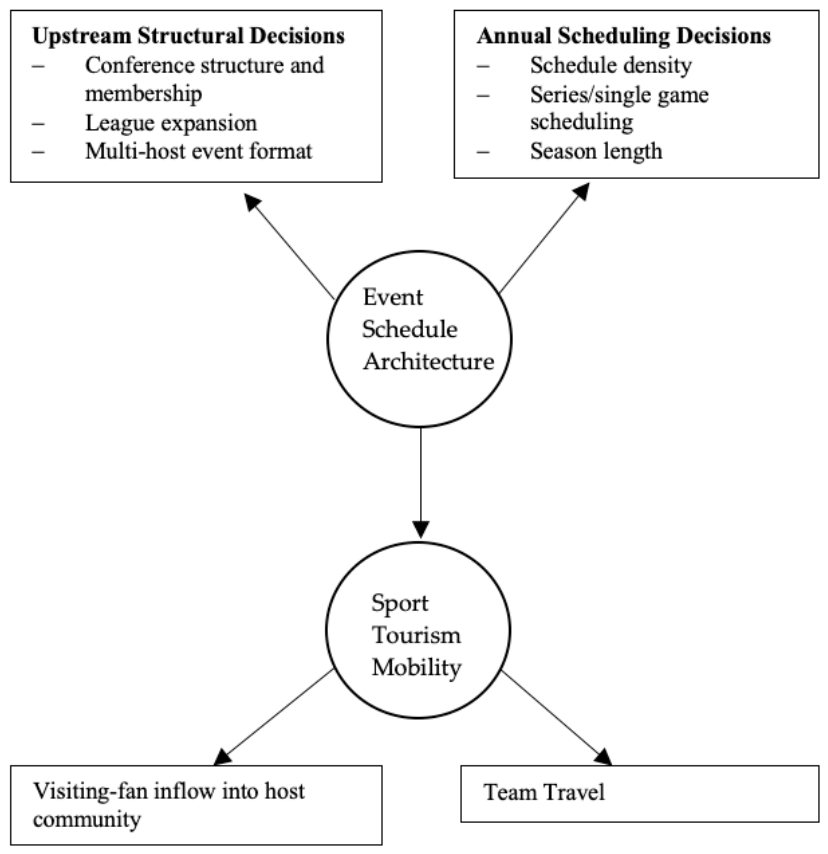
7]. The environmental sustainability of sport tourism therefore largely depends on the scheduling decisions that shape who travels where, when, and how. In this review, the term “event schedule architecture” was used to capture those decisions. It specifically refers to the set of choices through which leagues, federations, and conferences determine which competitive schedules occur, between which opponents, on what calendar, and in what venues (as shown in
Figure 1). The term covers both the annual scheduling decisions that produce a season of games and the upstream structural decisions, such as conference realignment and league expansion, that constrain those games. Each game on the resulting calendar functions as a discrete sports-tourism event in which a visiting team, or both teams, enter a host community accompanied by a larger inflow of visiting fans whose mobility produces the dominant share of the game’s emissions footprint.
Recent empirical work has begun to map the magnitude of this lever. Wynes [
8] documented that pandemic-era schedule adjustments in the four largest North American professional leagues reduced air-travel emissions by approximately 22% relative to a 2018 baseline, with no permanent technological or behavioral change required. Scenario analysis of amateur soccer in Germany [
9] suggested that geographically compact regrouping of teams could cut travel distances by 25%. Conference realignment in U.S. college sports offers the most visible recent demonstration of the lever working in reverse: the 2024 Power Four conference realignment, in which the University of California, Los Angeles; the University of Southern California; the University of Oregon; and the University of Washington joined the Big Ten Conference (Big Ten); and the University of Texas and the University of Oklahoma joined the Southeastern Conference (SEC), raised college football team-travel emissions by 67% in a single season [
10], with the Big Ten increase reaching 112%. Modeling work projects that the realignment will roughly double Power Five emissions in the steady state [
11,
12].
Despite the magnitude of these effects, event schedule architecture has not been examined as an environmental policy instrument. Sports tourism scholarship has theorized about destination sustainability [
1,
2,
13] and the bidirectional relationship between sports and the environment [
14,
15] but has not addressed how league-level scheduling decisions shape sports-tourism travel patterns at the source. The environmental policy literature has produced sophisticated frameworks for analyzing instrument choice, regulatory design, and institutional fit [
16,
17,
18,
19], without applying them to sports tourism. This review is the first to bring these studies into systematic contact, advancing a sports-tourism-centered argument regarding how event schedule architecture should be governed.
This review is organized around three core claims. First, event schedule architecture meets the formal criteria for an environmental policy instrument: it operates on the activity that produces the externality (sport-tourism travel by visiting teams and visiting fans), the magnitude of its emissions effect is empirically established and large, and the authority that exercises it is institutionally identifiable. Second, event schedule architecture has functioned as a policy instrument with no environmental design; its environmental properties follow incidentally from decisions made on commercial and competitive grounds. Third, three institutional pathologies, i.e., regulatory capture by commercial stakeholders, the absence of mandatory environmental impact assessment for major schedule decisions, and the gap between organization-level voluntary commitments and league-level scheduling authority, suppress the effectiveness of event schedule architecture as an environmental policy instrument. The following three research questions guide the current review.
RQ1: How does empirical evidence regarding travel emissions validate or challenge the view of event schedule architecture as a policy instrument?
RQ2: Against the standard criteria for environmental policy instruments, how does event schedule architecture perform?
RQ3: What institutional reforms and governance issues should be addressed for event schedules to effectively manage sports tourism?
2. Materials and Methods
The narrative review approach was employed, which is appropriate when the synthesis aim is to integrate evidence and concepts from multiple disciplinary traditions into a coherent interpretive frame [
20]. The review draws on three research sectors that have not previously been brought into systematic contact: sport tourism scholarship on destination sustainability, spectator travel, and event-related mobility; sport ecology on the bidirectional relationship between sports and the natural environment; and environmental policy regarding instrument choice and regulatory design.
Sources were identified through systematic searches of Web of Science, Scopus, SPORTDiscus, and Hospitality & Tourism Complete using term combinations across four families: sports tourism terms (sport tourism, sport tourism, spectator travel, fan travel, visiting fans, away fans, event tourism, destination sustainability, sport mobility); sports environment terms (sport ecology, professional sport, college sport, NCAA, basketball, football, soccer, hockey, baseball, cricket, volleyball, competition schedule, event schedule, conference realignment, event density, game density, team travel, carbon footprint, Greenhouse gas emissions); policy-instrument terms (environmental policy instrument, instrument choice, regulatory design, environmental impact assessment, strategic environmental assessment); and institutional terms (private governance, self-regulation, regulatory capture, institutional design, voluntary commitment). Searches were limited to English-language publications from 2000 to 2025. Manual searching of relevant academic journals, including Journal of Sustainable Tourism, Journal of Sport and Tourism, Sustainability, Sport Management Review, Journal of Cleaner Production, Annals of Tourism Research, Tourism Management, Environmental Science and Technology, Review of Environmental Economics and Policy, and Regulation and Governance, was conducted. Industry reports were sourced from the Fédération Internationale des Associations de Footballeurs Professionnels (FIFPRO), the NCAA, the UEFA, the Fédération Internationale de Football Association (FIFA), the United Nations Framework Convention on Climate Change Sports for Climate Action Initiative, league sustainability reports, and economic-impact studies of host cities.
Sources were retained when they addressed at least one of the following: measurement of emissions associated with sport-tourism travel or event schedule architecture; the relationship between emissions and scheduling, conference realignment, or international expansion; visiting-fan mobility; sport tourism destination sustainability; environmental policy instrument design or evaluation; or institutional analysis of regulatory governance, voluntary commitments, and private regulation of cross-organizational externalities. A total of 55 peer-reviewed articles, books, and industry reports were synthesized (see details in
Table 1,
Table 2 and
Table 3 and
Supplementary Table S1). No weighting scheme was applied across these source types; each source was treated as valuable evidence, and the four types were used as complementary rather than substitute forms of input. Books and peer-reviewed articles supplied the primary theoretical and methodological grounding for sport tourism, sport ecology, policy-instrument typology, and instrument-choice criteria. Industry reports supplied up-to-date empirical evidence on specific recent cases that peer-reviewed studies have not yet published, most notably the 2024 NCAA Power Four conference realignment and the emergence of new transnational competition formats. When the same claim was supported by both peer-reviewed and gray-literature sources, confidence in the claim was considered stronger. When the type of source matters for understanding or evaluating a claim, it is identified in the text rather than left implicit in the citation alone.
Synthesis was organized around three analytical dimensions drawn from the policy-instrument literature [
16,
17]: the empirical evidence base for schedule-driven emissions effects, the performance of event schedule architecture against standard instrument-choice criteria, and the institutional conditions affecting its deployment. This organizing frame allowed sources regarding sport tourism, sport ecology, and environmental policy to be compared using common analytical terms across all three literature types.
3. Results
3.1. Event Schedule Architecture as a Sport-Tourism Management Instrument
The sport tourism and sport ecology literature provide supporting theoretical frameworks and empirical evidence. As an established tourism sub-field, sport tourism examines travel undertaken to participate in or attend sport events away from home [
1,
2,
3]. Its environmental sustainability is dominated by spectator and team mobility, which together drive the carbon footprint of organized sports. The triple-bottom-line (TBL) provides the conventional analytic framework for sport tourism sustainability [
2,
13]. Within this frame, environmental indicators stand alongside community well-being, cultural authenticity, and local economic returns as co-equal pillars that event organizers should highlight and strategically manage. Although the TBL framework has dominated destination-level sport tourism analysis, it has rarely been extended upstream to the league-level decisions that produce visiting-fan inflows in the first place, which is a crucial gap that this review addresses directly.
A complementary body of literature regards sport ecology, which McCullough, Orr, and Kellison [
14] formalized as a sport-management subdiscipline organized around impact assessment, organizational decision making, and fan engagement. Within this frame, the Climate Vulnerability of Sport Organizations framework [
15] places organizations on a two-axis space defined by climate impact and organizational capacity. Reviews by Wilby et al. [
21] and Orr et al. [
22] map the field and flag persistent under-coverage of women’s sports, the Global South, and several major sports. In U.S. college sports, three lines of work are particularly relevant. Cooper and McCullough [
5] quantified the carbon footprint of the NCAA Men’s Tournament. Triantafyllidis et al. [
23] analyzed spectator transport at collegiate football events and identified on-campus versus off-campus stadium location as a significant determinant. Casper et al. [
24] surveyed NCAA Football Bowl Subdivision athletic departments and documented a substantial gap between expressed environmental concern and actual planning. Pelcher et al. [
25] examined NCAA participation in the AASHE STARS framework and found low engagement. The conference realignment literature is the newest addition: Wilson [
12] and Hong et al. [
11] each quantify the emissions consequences of the 2024 Power Five realignment, with industry analyses [
10] confirming the order of magnitude. While sport ecology has produced detailed event-footprint studies, it has rarely connected event-level emissions to the upstream architecture decisions that produce them. In other words, event schedule architecture has not been positioned as a strategic instrument for managing the sport-tourism externalities produced by visiting-fan inflows.
The environmental policy literature classifies policy instruments into four standard types [
16,
17,
18]. Command-and-control instruments specify permitted activity directly. Economic incentive instruments alter relative prices. Information-based instruments enable stakeholder pressure on disclosed performance. Procedural instruments require environmental information to be considered in authoritative decisions, with environmental impact assessment (EIA) applied to projects and strategic environmental assessment (SEA) applied upstream to plans, programs, and policies [
26,
27,
28]. Instruments are evaluated against five criteria [
16,
17]: cost-effectiveness, distributional equity, ability to address uncertainty, political feasibility, and institutional compatibility. Three recurrent insights shape the analysis that follows. No single instrument dominates across all five criteria [
16]; hybrid instruments often outperform pure types [
18]; and the same nominal instrument performs differently depending on the governance arrangements through which it is implemented [
19,
29].
Event schedule architecture qualifies as an instrument within this typology on three conceptually related grounds, each anchored in a separate theoretical tradition. First, the architecture operates directly on the activity that produces the externality, occupying the earlier locus of intervention that Coasean externality analysis distinguishes from output-based instruments such as Pigouvian taxes, tradable permits, and disclosure regimes [
30]: scheduling decisions determine whether, where, and how visiting-fan and team-travel mobility is produced before any emissions occur, while taxes, permits, and disclosure act on the outputs of decisions already made. Second, the architecture has institutionally identifiable authority—schedules and conference structures are set by leagues, federations, conferences, and confederations through documented annual or contractual processes—which the regulatory-governance literature on non-state environmental authority [
19,
31,
32] recognizes as a structural condition for private-sector decision making to carry instrumental properties when it exercises rule-setting authority over externality-producing activities. Third, the magnitude of its emissions effect is empirically large, ranging from 22% to 67% across studied contexts (developed in
Section 3.2), bringing the architecture within the empirical range of conventional instruments evaluated in the policy literature. The procedural policy tradition adds a complementary point: EIA and SEA establish that the introduction of environmental information into authoritative deliberations is itself an instrument [
26,
27,
28], so the absence of any such requirement in current scheduling deliberation is not a peripheral institutional detail but the missing procedural overlay that would convert the architecture from a latent into an operating environmental policy instrument.
This approach is also well suited to the structure of professional sport. Traditional policy tools often depend on regulatory authority that does not exist across the sport sector. For example, Pigouvian taxes require an authority that can tax emitters, cap-and-trade systems require an authority that can set and enforce emissions caps, and mandatory disclosure policies require reporting and enforcement mechanisms. No single authority has these powers across leagues and competitions that operate internationally. In contrast, scheduling authority already exists and is routinely exercised by governing bodies across sport. This authority aligns with the transnational nature of modern competitions, including UEFA Champions League matches, NFL international games, and the 2026 FIFA World Cup hosted by three countries. Incorporating environmental considerations into scheduling decisions therefore builds on an established process rather than creating a new regulatory system. This does not mean that scheduling reforms should replace conventional environmental policies. Instead, they can address emissions associated with cross-border sport activities that are difficult for existing policies to regulate, while allowing jurisdiction-specific measures, such as carbon taxes on domestic aviation, to operate alongside them.
Sport tourism scholarship has long advocated TBL management of destinations [
2,
13] and stakeholder engagement in destination planning [
3,
33] without extending these principles upstream to the league-level decisions that produce the visiting-fan inflows destinations must absorb. Sport ecology has measured event-level footprints [
5,
34] without theorizing the upstream architecture that shapes them. Event schedules have shaped environmental outcomes throughout the modern era of professional and collegiate sport, without anyone designing them for that purpose. Treating event schedule architecture as a sport-tourism management instrument means two things: subjecting it to the evaluation criteria applied to other environmental policy instruments, and connecting event-level destination sustainability work to the structural decisions that determine where and when events are held.
3.2. Empirical Evidence on Event Schedule Architecture and Sport-Tourism Emissions
Event schedule architecture influences sport-tourism emissions through three intermediate stages. First, the architectural decision sets the fixture geometry of the season: each fixture has a specific origin, destination, opponent, and date. Second, the fixture geometry determines the mobility pattern: the geographic span between origin and destination sets the distance per trip, the season calendar determines whether trips can be consolidated through series scheduling or must be made individually, and the time available between fixtures determines whether ground transport is feasible or whether air travel is required. Third, distance, frequency, and modal composition together determine per-fixture emissions, which aggregate into the league-level totals reported below. The empirical evidence in the following sub-sections measures the emission outcomes at the end of this pathway; the analytical claim is that the upstream architectural decision drives those outcomes through the intermediate variables named here.
3.2.1. Visiting-Fan Inflows and the Dominance of Spectator Mobility
Sport tourism is essentially spectator-centered, and its visiting-fan share of event-level emissions exceeds the team-travel share by an order of magnitude. This feature is even more salient for major sporting events. The 2024 UEFA European Championship pre-event analysis estimated fan travel at over 70% of total event emissions and team travel (including active players) at less than 1% [
4]. Cooper and McCullough’s [
5] analysis of the 2019 NCAA Men’s Basketball Tournament covered 689,753 fans, players, and staff combined across 67 games, with travel responsible for roughly 80% of total emissions and visiting fans accounting for the overwhelming majority of that travel. The same dominance recurs across studied mega-events: travel ranges from 70% to 90% of total event emissions, and visiting spectators rather than competing teams generate the majority of that travel [
6,
7].
This pattern extends from mega-events through tournaments to regular-season games. At the 2025 NCAA Tournament first-and-second-round site in Wichita, 53% of approximately 43,000 attendees came from out of town [
35]. When estimating the consumption of the 2025–2026 College Football Playoff first-round games, the IMPLAN Group adopted a 60% non-local attendance assumption at campus host sites as an industry-standard parameter [
36]. The 2025 NCAA Tournament regional sites, such as San Antonio, routinely expect 100,000 or more visitors across an event week [
36]. These tournament-scale flows are recurrent and represent the visiting-fan inflow that any neutral site or attractive away-game produces, scaled to the relevant fan base and the salience of the event.
Visiting-fan inflows remain substantial during regular-season play. Premier League regulations require home teams to allocate a minimum of 3000 away tickets at venues with more than 30,000 seats and at least 10% of capacity at smaller grounds, institutionalizing visiting-fan access into the structure of every match [
37]. Hotel operators near Penn State home football games report that approximately 25% of guests at marquee events are visiting away-team supporters [
38]. SEC home football weekends produce hotel occupancy near 100% with rates two to three times the local norm, and much of that demand is attributable to traveling fans [
39]. Although the proportion of visiting fans varies by competition salience, the underlying pattern is consistent: every away game pulls a measurable visiting-fan inflow into a host community, and across a season, these inflows aggregate into a substantial sport-tourism externality.
Within visiting-fan mobility, modal share is sensitive to the geographic span of the schedule. Loewen and Wicker [
40] estimated average Bundesliga fan emissions at 311.1 kg CO
2-equivalent per season, with car travel responsible for approximately 70% of this total. Kraft et al. [
41] reproduced the dominance of car travel for lower-tier German football. Triantafyllidis et al. [
23] identified stadium location (on-campus versus off-campus) as a significant determinant of collegiate-football spectator emissions. Three patterns recur across these studies: visiting fans constitute a substantial share of attendance at marquee events, car travel dominates the modal share at medium-distance away games, and aggregate emissions scale with the spatial distribution of fans relative to venues. All three are sensitive to event schedule architecture.
3.2.2. Team Travel and Annual Schedule Architecture
Although a smaller share of total event emissions than visiting-fan travel, team travel is the most directly controllable component through annual schedule design and is the most thoroughly studied. Wynes [
8] examined the four major North American professional leagues (i.e., NBA, NHL, MLB, and NFL) and found that the four collectively logged 7.5 million kilometers of air travel and emitted approximately 122,000 tons of CO
2 from team flights in the 2018 regular season. In comparison, an aggregate 22% emission reduction was achieved during the 2020 pandemic season due to three architectural changes: increased geographic sorting (more games against opponents in the same conference or region), increased use of consecutive-game series (multiple games at the same venue before flying onward), and cancellation of overseas games. The NHL, which adopted the most comprehensive package, realized a 50% decrease in its per-game travel emissions. The same architectural changes that reduce team travel also reduce visiting-fan travel by shortening the geographic span of away-game flows.
Series-based scheduling warrants separate emphasis. With N games against an opponent, single-game scheduling can require up to 2N flights for the visiting team, while series scheduling requires only two flights, regardless of N. Wynes [
8] identifies this as the primary explanation for MLB’s lower per-game emissions, despite its longer schedule. Mixed-integer programming applied to amateur soccer schedules has demonstrated similar potential: a scenario analysis of women’s and men’s amateur soccer in Germany [
9] estimated that reallocating 384 teams across 35 groups into geographically compact groupings reduced aggregate travel distances by approximately 25%, with the largest single-league savings of 62% achieved in an urban men’s competition.
Season length sets the absolute envelope of travel demand. Wynes [
8] estimates that a 10-game reduction in the NBA regular season would save approximately 5000 tons of CO
2 per year. Event density (also fixture density), defined as events per unit time, interacts with travel patterns because high-density schedules constrain a league’s ability to use ground transport, increasing reliance on charter aviation. Across these elements, annual scheduling decisions made by a known set of authoritative bodies determine team-travel volumes and modal compositions in ways that are quantitatively large and operationally tractable.
3.2.3. Conference Realignment as an Upstream Constraint
Conference realignment is one of the most consequential and visible structural decisions in U.S. college sports. Although realignment is not part of annual scheduling, it operates as the upstream constraint that determines which competitive matchups are possible and therefore shapes the schedule that is subsequently produced. Conferences originated as collections of geographically proximate institutions, with the Big Ten founded in 1895 around Midwestern universities and the Pac-8 founded around West Coast universities, because long-distance travel was prohibitive at the time [
42]. The arrival of widespread air travel decoupled membership from geography, although the geographic logic remained partially intact until the 2024 Power Four realignment broke it decisively. Several conferences now span the Continental United States, with member institutions on opposite coasts.
The environmental consequences are now being measured. Industry analyses covering all football schedules of the 2024 Power Four conferences (i.e., SEC, Big Ten, Big 12, and ACC) [
10] estimated that team-travel emissions rose 67% relative to those for 2023, with the Big Ten increase reaching 112% (3635 tons of CO
2 in 2024) and that of the SEC totaling 22% (1569 tons). Modeling work by Hong et al. [
11] using College Football Data API schedules from 2010 to 2024 estimated that the realignment will approximately double Power Five carbon emissions in the steady state. Wilson [
12] compared the actual 2024 alignment with a theoretical geographically based alternative and quantified substantial savings achievable through geographic realignment.
These published estimations capture only team travel; visiting-fan inflow consequences are larger. A Pac-12 fan who previously drove from Los Angeles, California, to Seattle, Washington, for a road game now flies from Los Angeles, California, to Columbus, Ohio, or to University Park, Pennsylvania. The transportation mode shift from car to plane multiplies per-fan emissions, even when fan-base travel rates remain constant. The consequences extend beyond football to all sports played by Power Four institutions. Penn State officials confirmed during reporting on the realignment that all 26 sports teams at the institution are affected by the conference’s geographic expansion [
43]. Volleyball, basketball, swimming, golf, and many other Olympic sports now make cross-country trips that previously could be achieved by bus, and visiting fans who follow these programs face the same modal shift.
The realignment case is analytically significant for two reasons. First, it demonstrates event schedule architecture operating in reverse: the same set of institutions and the same set of events, reorganized into geographically incoherent conferences, produce substantially higher sport-tourism emissions through both team-travel and visiting-fan-travel channels. The architecture variable is causally identified by the discrete realignment decision. Second, the deliberative process did not include systematic environmental analysis. Conference offices and member institutions, when asked about environmental impacts, referenced student welfare considerations and broadcast revenue but not emissions [
43].
Table 4 below summarizes these empirical claims, classified by the type of evidence supporting each claim (directly evidenced, modeled, or inferential).
3.2.4. League Expansion and International Competition Growth
Three distinct mechanisms generate league-level expansion in sport-tourism mobility, each reshaping the architecture within which subsequent annual schedules are set. First, league expansion adds member teams to an existing competition: Major League Soccer (MLS) has grown from 10 teams in 1996 to 30 teams by 2025, with member teams spread across the Continental United States and Canada, producing a comparable expansion of intra-league travel demand to that observed in U.S. college sports. The NBA has announced plans to launch a European league [
44], a structural expansion that would create a parallel competition, with substantial transatlantic team- and fan flows. Second, international-game scheduling embeds long-haul games within an existing domestic season: the NFL has played regular-season games in London since 2007 and in Munich since 2022; the NBA has staged regular-season games in Mexico City; and MLB has run international series in Tokyo, London, and Mexico City. Third, tournament expansion enlarges the size and geographic footprint of existing periodic competitions: the UEFA Champions League reformatting for the 2024/25 season expanded continental matches across European football [
45]; the Concacaf Champions Cup now includes Major League Soccer, Liga MX, and lower-tier competitions, generating additional cross-border games; the 2026 FIFA World Cup will be the first to expand to 48 teams and the first to span three host countries (the United States, Canada, Mexico) [
46], multiplying both team-travel demand and visiting-fan inflows relative to those of prior editions; and the 2025 FIFA Club World Cup expansion to 32 teams introduced an additional continental-tier competition layered on top of existing team calendars. Across all three mechanisms, each international game multiplies per-game travel emissions by an order of magnitude relative to that of a domestic away game and produces additional sport-tourism inflows, including substantial international visiting-fan mobility, in destination cities. The empirical literature has not systematically quantified the per-game emissions of expansion games across leagues, and most league public reporting does not disaggregate international-game emissions. Each of these structural decisions was reached through governance processes that did not systematically include environmental analysis.
The above-mentioned evidence sources empirically support that event schedule architecture is a quantitatively large lever for sport-tourism emissions, with documented effects in the 22% to 67% range across studied contexts. Visiting-fan inflows dominate event-level emissions, scale with the geographic span of the schedule, and amplify the effects of team-level architectural change. The 22% reduction documented by Wynes [
8], the 25% to 35% range modeled by Abu-Omar et al. [
9], the 67% to 112% increases produced by the 2024 NCAA realignment, and the 80% travel share of major-event emissions together establish the order of magnitude across professional and collegiate North American and European contexts. These changes are achieved by rearranging existing events or reconfiguring conference structures rather than by reducing total competitions.
3.3. Evaluating Event Schedule Architecture Against Instrument-Choice Criteria
Five standard instrument-choice criteria [
16,
17] provide a clear pattern when applied to event schedule architecture as a tool for managing sport-tourism externalities. In terms of cost-effectiveness, schedule reform exhibits unusual properties. Direct costs are low: scheduling already relies on sophisticated optimization tools, and adding environmental constraints adds modest computational cost. However, indirect costs are rooted in commercial implications: regional sorting reduces nationally televised inter-region matchups; conference realignment toward geographic coherence would devalue broadcast deals priced against the current cross-country structure; series-based scheduling changes the rhythm of the fan experience. By comparison, traditional mechanisms like emissions tax or permit systems impose financial penalties without addressing the underlying schedule logic or the resulting fan mobility. In regards to cost-effectiveness, narrowly construed, event schedule architecture offers a better mechanism because it intervenes directly at the source of externality rather than merely taxing its output.
In terms of distributional equity, schedule reform has unusual properties. Reduced international expansion redistributes commercial value between domestic and international markets and between domestic and international sport-tourism flows. Conference realignment reform would redistribute media-rights values between conferences and have differential effects on host communities that have built local economies around current visiting-fan flows. Geographic sorting concentrates competitive matchups within regions, reshaping host-destination dependencies on tourism inflows. Sport-tourism scholarship has long emphasized that destination communities differ in their capacity to absorb tourism benefits and costs [
2,
13,
33]; reforms that redistribute visiting-fan flows therefore have differential equity implications across host communities. The literature has not systematically modeled these effects, and the absence of distributional analysis is itself a research gap (
Section 4).
In terms of addressing uncertainty, schedule reform performs well. The magnitude of emissions effects is empirically established within reasonable bounds across multiple contexts (
Section 3.2), and the instrument is robust to technological uncertainty: its effects do not depend on the future trajectory of sustainable aviation fuel, electric aircraft, or other technologies whose timing and cost are uncertain. By comparison, emissions taxes face the standard quantity-versus-price trade-off [
47].
In terms of political feasibility, the architecture’s candidacy is weakest. Schedules and conference structures are set by leagues, federations, conferences, and confederations whose governance arrangements were not designed with environmental performance in mind. Decision-making processes do not require environmental information to be considered in authoritative deliberations, and concentrated commercial opposition (broadcasters, sponsors, gambling partners) faces only diffuse environmental support. The 2024 NCAA realignment is the clearest contemporary illustration: a deliberative process produced an alignment substantially increasing sport-tourism emissions, with no procedural mechanism through which environmental considerations could have entered the decision-making process.
In terms of institutional compatibility, event schedule architecture has favorable properties. Schedules are already produced annually by authoritative bodies through established processes. Adding environmental criteria to existing scheduling processes is institutionally easier than creating new emissions taxes (which would require regulatory authority over a sector that currently has none), new permit markets (which would require cross-league coordination), or mandatory disclosure (which would require enforcement capacity that current sport-governance bodies lack). The institutional infrastructure exists; what is missing is the procedural requirement that environmental information enter scheduling deliberations.
Across the five criteria, event schedule architecture performs strongly in regards to cost-effectiveness, the ability to address uncertainty, and institutional compatibility. It exhibits uncertain distributional properties that require further research, and it faces serious political feasibility constraints rooted in the governance arrangements through which schedules and conference alignments are set. The architecture is technically attractive but politically constrained as a sport-tourism management instrument. Its effective deployment depends on institutional reforms that the next section identifies as the central agenda for future research.
4. Discussion
This review has identified five research gaps, each paired with a corresponding future research agenda. These interrelated gaps span the political economy of schedule reform, quantitative instrument comparison, procedural reform design, demographic and geographic extension of the empirical base, and causal evaluation. The research agenda proposed here is framed to be operational rather than merely indicative.
4.1. Political Economy of Event Schedule Architecture Reform
Regulatory capture in sport-sector scheduling operates through four institutional channels. The first channel is the media-rights contract, which specifies scheduling parameters as binding contract terms (minimum televised fixtures, kickoff windows, broadcast-window participation) and therefore removes those parameters from active deliberation. The second channel is the member-institution voting structure: conference governance is exercised through votes by member institutions whose financial position depends on the broadcast revenue distributed by the conference, which aligns institutional incentives with broadcaster preferences. The third channel is conference-commissioner agenda-setting authority: commissioners draft realignment proposals before they reach member votes and negotiate broadcast contracts on behalf of the conference, which gives them substantial influence over which architectural alternatives are considered. The fourth channel is the absence of external stakeholders with an interest in the deliberation: scheduling decisions do not require consultation with host cities, environmental regulators, or affected fan bases. These four channels operated in combination during the 2024 NCAA Power Four realignment [
43]: ESPN and Fox broadcasting contracts established the financial frame; member institutions voted in line with the revenue projections; conference commissioners drafted the proposals and negotiated the contracts; and no procedural mechanism opened the deliberation to host cities, fan bases, or environmental stakeholders. The result is not a contingent failure of governance but a structural pattern that systematically favors commercial considerations that align with high-emissions configurations [
48].
The above-mentioned four channels describe how scheduling capture operates institutionally, but the comparative empirical investigation of these channels is not yet established in the literature. The instrument-choice literature treats political feasibility as a primary criterion for instrument design [
16,
49], but the political economy of sport-league scheduling and NCAA conference realignment has not been mapped systematically. The 2024 NCAA realignment offers an unusually well-documented test case. The 2024 NCAA realignment is unusually well-documented in journalistic and industry sources, but no peer-reviewed study has reconstructed the deliberative record to determine the relative decision-relevant weight of media-rights value, member-institution branding, athlete welfare, and environmental considerations, nor the procedural mechanisms that excluded the latter.
The corresponding research agenda is to construct a comparative political-economy account of recent architectural decisions. Three case studies should be highlighted: the 2024 NCAA Power Four realignment, the UEFA Champions League 2024/25 reformatting, and the NFL international-game expansion. Each case could reconstruct the stakeholder positions, the financial stakes, the deliberative process, and the role (or absence) of environmental considerations. Methods should combine document analysis of public filings and broadcast-rights agreements; semi-structured interviews with conference and league office personnel, athletic department leadership, broadcaster executives, athlete representatives, and host-community officials; and stakeholder-mapping exercises identifying veto players, swing constituencies, and potential coalitions for environmental reform. For each case, the results should show which stakeholder groups would have worked together to bring up the emission agenda and what specific rules or steps would have allowed them to achieve it.
4.2. Quantitative Comparison of Event Schedule Architecture with Established Policy Benchmarks
The previous section qualitatively evaluates the architecture against alternatives, but no published study quantifies the cost-effectiveness, distributional incidence, parameter-uncertainty sensitivity of schedule reform against emissions taxes, or mandatory disclosure for any sport league or conference. The instrument-choice literature has produced such comparisons routinely in sectors with mature emissions-regulation systems (e.g., electric power, manufacturing, transport), but the sport context lacks both empirical baselines and modeling infrastructure. Distributional analysis is particularly underdeveloped. How schedule reforms affect different host destinations, different categories of teams, and women’s sports relative to men’s sports remains largely unknown. The sustainable-destination-management literature [
2,
13] treats the fair distribution of tourism costs and benefits across host communities as a core sustainability concern, and rigorous engagement with this concern depends on the distributional analysis that the field has not yet produced.
Therefore, league- and conference-specific comparative instrument analyses are urgently demanded. For a defined emissions reduction target (e.g., a 30% reduction in team-and-spectator travel emissions), future research should estimate the cost of achieving the target through schedule reform alone, through an aviation emissions tax, and through mandatory disclosure with empirically estimated stakeholder-pressure responses. Three relevant methodological areas should be highlighted: first, the development of disaggregated emissions baselines per team, per game, and per host destination using flight-distance data, aircraft-specific emission factors, and origin-destination spectator survey data; second, the modeling of the commercial elasticities required to estimate the cost of each instrument; and third, the conducting of destination-incidence analyses identifying which host communities and which teams bear disproportionate costs under each instrument. The 2024 NCAA realignment offers a natural experiment, allowing researchers to compare emissions before and after the architectural change.
4.3. Procedural Reforms and Institutional Alignment for Sport Governance
Currently, sport sustainability operates almost entirely through voluntary commitments rather than mandatory regulation: the United Nations Framework Convention on Climate Change (UNFCCC) Sports for Climate Action framework [
50], league sustainability reports, NCAA bid criteria, and individual institution commitments are voluntary responses to the absence of mandatory regulatory oversight aimed at sport-sector environmental performance. The institutional-design literature is skeptical of voluntary commitments when collective-action problems and cross-organizational externalities are at stake [
19,
31], and three pathologies recur. First, regulatory capture shapes the deliberative process. Decisions about schedules and conference structures are dominated by broadcasters, sponsors, gambling partners, and the largest member teams or institutions, whose commercial interests favor high-emissions architectural choices [
48]. The 2024 NCAA realignment is the clearest recent example: it was driven principally by media-rights consolidation [
43]. Second, mandatory environmental impact assessment is absent from sport governance. In most sectors, decisions of significant environmental consequence trigger EIA or SEA requirements [
26,
27,
28]. The 2024 NCAA realignment, the UEFA Champions League 2024/25 reformatting [
45], and the NBA’s European league expansion plans [
44] all proceeded without any published environmental impact analyses. Third, organization-level sustainability commitments are misaligned with the level at which scheduling decisions are actually made. Individual NCAA athletic departments and individual teams sign sustainability commitments, yet the practices most consequential for sport-tourism emissions are decided at the league or conference level. The entity making the commitment does not control the practice. EIA and SEA exist in well-developed forms in most sectors but have not been utilized for event schedule architecture decisions. Key institutional design questions remain unclear, including who is responsible for the analysis, what the analysis should cover, when the analysis should be required, what alternatives should be evaluated, which stakeholders must be consulted, and what transparency requirements should apply.
Future studies should make efforts to develop standard Schedule Environmental Impact Assessment (SEIA) protocols. Specifically, protocols should move beyond voluntary reporting toward a structured regulatory framework. This includes setting thresholds for mandatory analysis during structural shifts (e.g., conference realignment), expanding the scope to include fan travel, and requiring the evaluation of alternative schedule designs. Such a system should be grounded in transparency and stakeholder consultation, ensuring that scheduling decisions are uphold climate commitments. Regarding the level-of-authority question, comparative governance analyses should examine multi-level commitment structures in adjacent sectors: industry-wide voluntary agreements with national-government endorsement, supply-chain certification schemes (Forest Stewardship Council, Marine Stewardship Council [
32]), and international sport-governance models (the World Anti-Doping Agency tripartite structure). Several institutional contexts could serve as pilot settings, including the NCAA, domestic professional leagues with stronger central authority, and international federations with active sustainability programs. Comparative pilot designs across these contexts would yield the most generalizable lessons.
4.4. Empirical Scope of Event Schedule Architecture Research
Existing schedule-emissions evidence is centered around elite men’s competitions in North America and Western Europe and on U.S. college men’s football and basketball [
21,
22]. NCAA women’s competitions, professional women’s leagues (e.g., NWSL, WSL, WNBA, PWHL), second-tier men’s competitions, and leagues outside North America and Western Europe (e.g., J-League, Chinese Super League, Indian Premier League cricket, Confederation of African Football club competitions, and Copa Libertadores) are under-represented. The NCAA Women’s Tournament receives event-level sustainability reporting [
51] but no peer-reviewed quantitative emissions analysis comparable to that of Cooper and McCullough [
5]. Whether the architecture lever functions similarly under different geographic, modal, and commercial conditions is unknown, and the political economy of sport-tourism reform may differ substantially across these contexts.
Accordingly, future studies should replicate the baseline schedule-based emission assessments across various contexts, such as NCAA women’s competitions; professional women’s leagues; J-League, Chinese Super League, and Confederation of African Football club competitions; and Copa Libertadores. In addition, second-tier men’s competitions where geographic and commercial conditions differ from elite contexts should be examined. Therefore, schedule-reform standards developed for elite men’s sports may apply differently to differently resourced women’s and second-tier contexts. Each replication should follow a standardized methodology compatible with those of Wynes [
8] and Cooper and McCullough [
5] to enable cross-context comparison.
4.5. Causal Evaluation of Mitigation Interventions
Beyond the pandemic natural experiment documented by Wynes [
8] and the realignment data on U.S. college football [
10,
11,
12], few causal evaluations of architectural reforms exist. The literature is rich in descriptive estimates and forward-looking optimization scenarios but weak in regards to the identification of the causal effects of specific reforms, spectator mode-shift programs, or fuel-substitution initiatives. Without strong causal evidence, policy recommendations are based on inference instead of demonstrated effectiveness.
Future studies should leverage discrete schedule-rule changes for difference-in-differences and synthetic-control analyses of emissions outcomes. Candidate empirical settings include NHL realignment events, NBA conference rebalancing, the Premier League’s mid-season player break, and individual NCAA conference realignments preceding the 2024 wave. Spectator transportation interventions (e.g., free transit passes, park-and-ride incentives, and rail-discount programs) should be evaluated using regression-discontinuity designs around eligibility thresholds. Sustainable aviation fuel agreements should be tracked as their volumes scale. Randomized experiments could provide evidence on whether spectators change their travel behavior after receiving travel-related messages.
5. Conclusions
Sport tourism generates substantial environmental externalities, the majority of which arise from the visiting-fan and team mobility determined by event schedule architecture. Each scheduled away game pulls a visiting-team movement, accompanied by a larger visiting-fan inflow, into a host community. Mobility dominates event-level emissions across mega-events, tournaments, and regular-season games, and the architectural decisions that produce these flows are made by leagues, federations, and conferences operating without environmental design criteria. Event schedule architecture meets the formal criteria of an environmental policy instrument and produces emissions effects of policy-relevant magnitude. Against the standard criteria for instrument choice, the architecture performs strongly in regards to cost-effectiveness, uncertainty handling, and institutional compatibility, while facing serious political feasibility constraints rooted in three governance pathologies: regulatory capture, the absence of mandatory environmental impact assessment, and the gap between organization-level commitments and league- or conference-level authority.
The 2024 NCAA Power Four conference realignment serves throughout the review as the clearest contemporary illustration. The realignment was a discrete architectural decision with substantial sport-tourism consequences, negotiated through a process dominated by commercial stakeholders, without environmental impact assessment, and against a backdrop of member-institution sustainability commitments that the realignment makes structurally harder to fulfill. Comparable architectural decisions in professional sport, including NBA European expansion plans, MLS continental growth, and FIFA Club World Cup expansion, follow the same pattern.
Five research gaps were identified, each paired with a related future research agenda: comparative political-economy analysis of recent architectural decisions; quantitative comparison of event schedule architecture against alternative environmental policy instruments; procedural-design work to develop SEIA protocols, including the level at which environmental commitments should be mandatory; demographic and geographic extension of the empirical base; and causal evaluation of mitigation interventions. The agenda is operational and offers a feasible path through which sport tourism scholarship, sport ecology, and environmental policy and institutional design literatures can be brought into productive contact.
This study’s contributions align with several Sustainable Development Goals (SDG). SDG 13 (i.e., Climate Action) is engaged through the architecture’s effect on sport-tourism emissions. SDG 11 (i.e., Sustainable Cities and Communities) is engaged through the host-city consequences of architectural decisions for tourism flows, infrastructure demand, and local environmental impact. SDG 12 (i.e., Responsible Consumption and Production) is engaged through the production patterns of the sport product itself and the consumption patterns of fans who travel to it. SDG 17 (i.e., Partnerships for the Goals) is engaged through the multi-level governance reforms proposed by the review.
Meanwhile, this review has several limitations. First, as a narrative rather than systematic review, it does not exhaustively cover any single literature type, and selection biases inherent in source identification cannot be fully ruled out. A registered systematic review or scoping review of schedule-driven emissions evidence, with pre-specified inclusion criteria and search protocols, would test the robustness of the synthesis presented here. Second, the evidence base is weighted toward elite men’s competitions in North America and Western Europe. As suggested in
Section 4.4, cross-context replication studies across women’s, second-tier men’s, and non-Western leagues would assess whether architecture-based emission reductions are robust across different geographic, modal, and commercial contexts. Third, the NCAA realignment evidence draws marginally on non-peer-reviewed research outputs. Though the central conclusions hold across multiple independent estimates, the precise magnitudes should be further refined as the literature develops. Nonetheless, none of these limitations undermine the key findings of this study: event schedule architecture reform is an influential environmental lever in sport-tourism-intensive professional and collegiate sport, conference realignment is its most consequential and contested current application, and the institutional reforms required to deploy it effectively are absent in the sport industry.